1
Kubernetes Networking 101
whoami
• TME at Arista networks.
• Works on network automation with customers.
• 10+ years in the network industry.
• I like Kubernetes more than most :D
Agenda
- Kubernetes 1000ft view
- CNI (Most of our time will be spent here)
- Network Design considerations
- Load balancing
- Security
https://github.com/burnyd/nynog-k8s-networking-101
@burneeed
2
What is Kubernetes?
ETCD ETCD ETCD
Controller Controller Controller
Scheduler Scheduler Scheduler
API server API server API server
Master 1 Master 2 Master 3
Kubelet Kube proxy Kubelet Kube proxy Kubelet Kube proxy Kubelet Kube proxy
Minion Minion Minion Minion
Control
Plane
Data Plane
3
Kubernetes API and scheduling….
ETCD
Controller
Scheduler
API server
K8s
Master
Kubelet Kube proxy
Minion 1
I need a 3 tiered
APP with a load
balancer HALP!
Kubelet Kube proxy
Minion 2
Kubelet Kube proxy
Minion 3
Web
APP DB LB
4
Kubernetes Promise model
Kubelet Kube proxy
Minion 1
Kubelet Kube proxy
Minion 2
Kubelet Kube proxy
Minion 3
Web
APP DB DB
“Planes can breakdown, cars can breakdown, but no
one at the post office ever calls you when any of those
things happen! They make a promise to you —
They promise that this letter will get there in
2 days. How they do it is not a concern!”
- Kelsey Hightower
5
Demo Environment
Kubelet Kube proxy Kubelet Kube proxy Kubelet Kube proxy
Worker2
Worker control-plane
192.168.16.0/24
Core-dns Core-dns
etcd
api-server
controller-manager
scheduler
https://github.com/burnyd/nynog-k8s-networking-101
Demo Environment
PS.. There is no networking by default! Nothing
works!
So we need networking!
- Coredns pods are stuck in Pending status and do not have IP addresses.
- All the control plane components work because they are operating in what is called
“Host networking mode” As they are using the same IP address that the system is
using.
- This is why the CNI exists!
6
7
CNI Rules
• Supplement ip addresses to pods.
• Pod to Pod communication.
• Pod to Service communication.
• Connectivity WITHOUT NAT!
cni spec
7
Popular Kubernetes CNIs
8
Kubernetes PodCIDR
Kubelet Kube proxy
Minion 1
Kubelet Kube proxy
Minion 2
Kubelet Kube proxy
Minion 3
Kubelet Kube proxy
Minion 100
…………………………….
PodCIDR: 10.0.0.0/24 PodCIDR: 10.0.1.0/24 PodCIDR: 10.0.2.0/24 PodCIDR: 10.0.99.0/24
PodCIDR is a general ipv4/ipv6 range in which a pod can use for IP space. This is
entirely adjustable upon creation of a cluster. This is the range in which a Kubernetes
pod will use for its ip address.
CNI How does it work?
CNI Binary
/opt/cni/bin
Kube
proxy
Pod
Container Container
Eth0
Container run time
Kubelet
CNI JSON
/etc/cni/net.d/00-
cni.json
Kubernetes node
CNI Json example /etc/cni/net.d/00-cni.json
{
"cniVersion": "1.0.0",
"name": "dbnet",
"type": "bridge",
"bridge": "cni0",
"ipam": {
"type": "host-local",
"subnet": "10.0.0.0/24",
"gateway": "100.0.1"
},
"dns": {
"nameservers": [ "10.0.0.1" ]
}
}
—----------------------------------------------------------------------------------------
/opt/cni/bin folder
root@nynog-k8s-networking-101-worker:/opt/cni/bin# ls -l
total 28900
-rwxr-xr-x 1 root root 14057472 May 31 15:28 cilium-cni
-rwxr-xr-x 1 root root 3565330 Feb 5 2021 host-local
-rwxr-xr-x 1 root root 3530531 Feb 5 2021 loopback
-rwxr-xr-x 1 root root 3966455 Feb 5 2021 portmap
-rwxr-xr-x 1 root root 4467317 Feb 5 2021 ptp
-rwxr-xr-x 1 root root 4235123 Feb 5 2021 bridge
10.0.0.1/24
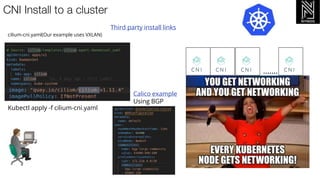
CNI Install to a cluster
cilium-cni.yaml(Our example uses VXLAN)
Kubectl apply -f cilium-cni.yaml
Third party install links
…….
Calico example
Using BGP
10
Kubernetes Networking under the hood
• root@nynog-k8s-networking-101-worker:/# iptables -t nat -L KUBE-SERVICES -n
• Chain KUBE-SERVICES (2 references)
• target prot opt source destination
• KUBE-MARK-MASQ tcp -- !10.0.0.0/16 10.96.0.1 /* default/kubernetes:https cluster IP */ tcp dpt:443
• KUBE-SVC-NPX46M4PTMTKRN6Y tcp -- 0.0.0.0/0 10.96.0.1 /* default/kubernetes:https cluster IP */ tcp dpt:443
• KUBE-MARK-MASQ udp -- !10.0.0.0/16 10.96.0.10 /* kube-system/kube-dns:dns cluster IP */ udp dpt:53
• KUBE-SVC-TCOU7JCQXEZGVUNU udp -- 0.0.0.0/0 10.96.0.10 /* kube-system/kube-dns:dns cluster IP */ udp dpt:53
• KUBE-MARK-MASQ tcp -- !10.0.0.0/16 10.96.0.10 /* kube-system/kube-dns:dns-tcp cluster IP */ tcp dpt:53
• KUBE-SVC-ERIFXISQEP7F7OF4 tcp -- 0.0.0.0/0 10.96.0.10 /* kube-system/kube-dns:dns-tcp cluster IP */ tcp dpt:53
• KUBE-MARK-MASQ tcp -- !10.0.0.0/16 10.96.0.10 /* kube-system/kube-dns:metrics cluster IP */ tcp dpt:9153
• KUBE-SVC-JD5MR3NA4I4DYORP tcp -- 0.0.0.0/0 10.96.0.10 /* kube-system/kube-dns:metrics cluster IP */ tcp dpt:9153
• KUBE-NODEPORTS all -- 0.0.0.0/0 0.0.0.0/0 /* kubernetes service nodeports; NOTE: this must be the last rule in this chain */
ADDRTYPE match dst-type LOCAL
root@nynog-k8s-networking-101-worker:/# ip r
default via 192.168.16.1 dev eth0
10.0.0.0/24 via 10.0.0.125 dev vxlan src 10.0.0.1
10.0.1.0/24 via 10.0.0.125 dev vxlan src 10.0.0.1 mtu 1450 // Route traffic to Node2 through VXLAN
10.0.2.0/24 via 10.0.0.125 dev vxlan src 10.0.0.1 mtu 1450 // Route traffic to Node3 through VXLAN
192.168.16.0/20 dev eth0 proto kernel scope link src 192.168.16.4
Every Kubernetes Node has routes to get to other nodes via CNI
Every Kubernetes Node has IP tables by default… or ebpf
Kubelet Kube proxy
K8s node
Linux Kernel routing
IPtables
11
Topology routed
Leaf Leaf
Spine1 Spine2 Spine3 Spine4
Leaf Leaf Border Border
Pod CIDR - 10.0.0.0/24 Pod CIDR - 10.0.1.0/24 Pod CIDR - 10.0.3.0/24
AS 65001 AS 65002 AS 65003
Advertise BGP - Pod CIDR Network to ToRs Advertise BGP - Pod CIDR Network to ToRs Advertise BGP - Pod CIDR Network to ToRs
K8s
node
K8s
node
K8s
node
The internets
12
Overlay model
Leaf1 Leaf2
Kubelet
Kube
proxy
.
.
1
10.0.0.0/24
10.0.0.3/24
10.0.0.2/24
Eth1
Eth2
Spine1 Spine2 Spine3 Spine4
Leaf3 Leaf4
Kubelet
Kube
proxy
.
.
1
10.0.1.0/24
10.0.1.3/24
10.0.1.2/24
Eth1
Eth2
VXLAN VXLAN
Pod CIDR - 10.0.0.0/24 Pod CIDR - 10.0.1.0/24
K8s
node
K8s
node
Routing table
10.0.1.0/24 - > VXLAN1
Routing table
10.0.0.0/24 - > VXLAN1
13
Hybrid Model
Leaf Leaf
Spine1 Spine2 Spine3 Spine4
Leaf Leaf Border Border
Pod CIDR - 10.0.0.0/24 Pod CIDR - 10.0.1.0/24 Pod CIDR - 10.0.3.0/24
AS 65003
Advertise all BGP Pod CIDR example 10.0.0/8
K8s
node
K8s
node
K8s
node
VXLAN
VXLAN VXLAN
Node Routing table
10.0.1.0/24 - > VXLAN1
10.0.0.0/24 - > VXLAN1
Node Routing table
10.0.0.0/24 - > VXLAN1
10.0.3.0/24 - > VXLAN1
Node Routing table
10.0.1.0/24 - > VXLAN1
10.0.3.0/24 - > VXLAN1
14
15
Kubernetes services
• Pods are constantly coming up and down. They are ephemeral.
• We need a general way to either load balance or go to a service that
represents multiple pods.
Kubelet Kube proxy Kubelet Kube proxy
DB web-pod
10.0.1.1
10.0.0.1
10.0.1.2
10.0.2.2
X
15
Kubelet Kube proxy Kubelet
Kube proxy
web-pod web-pod
10.0.2.1
10.0.3.2
10.0.2.2
web-service web-service
10.96.1.2/32
10.96.1.2/32
10.0.3.1
K8s node1 K8s node2 K8s node3 K8s node4
Exposing services (Load balancing)
● ClusterIP: Exposes the Service on a cluster-internal IP. Choosing this value makes the Service only reachable from
within the cluster. This is the default ServiceType.
● NodePort: Exposes the Service on each Node's IP at a static port (the NodePort). A ClusterIP Service, to which the NodePort
Service routes, is automatically created. You'll be able to contact the NodePort Service, from outside the cluster, by
requesting <NodeIP>:<NodePort>.
● LoadBalancer: Exposes the Service externally using a cloud provider's load balancer. NodePort and ClusterIP Services, to
which the external load balancer routes, are automatically created.
16
Kubelet
Kube
proxy
app1
10.0.0.1
10.0.0.
1
Loadbalancer(metallb)
BGP Advertisement
10.96.0.6
16
Kubelet
Kube
proxy
app1
10.0.1.1
10.0.1.
2
Nodeport
192.168.16.2:30001 - >
10.96.0.5:8080
Clusterip:
app1.svc.cluster.local
10.96.0.7
16
Kubelet
Kube
proxy
app1
10.0.2.1
10.02.2
service
10.96.0.5
service
10.96.0.6
service
10.96.0.7
Ingress
Kube proxy
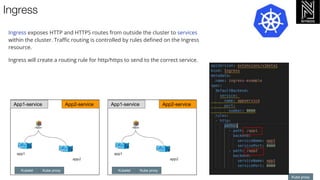
Ingress exposes HTTP and HTTPS routes from outside the cluster to services
within the cluster. Traffic routing is controlled by rules defined on the Ingress
resource.
Ingress will create a routing rule for http/https to send to the correct service.
Kubelet Kube proxy
app1
App1-service App2-service
app2
Kubelet Kube proxy
app1
App1-service App2-service
app2
17
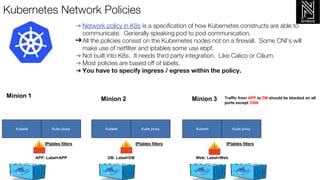
Kubernetes Network Policies
Kubelet Kube proxy
Minion 1
Kubelet Kube proxy
Minion 2
Kubelet Kube proxy
Minion 3
APP: Label=APP Web: Label=Web
DB: Label=DB
Traffic from APP to DB should be blocked on all
ports except 3306
IPtables filters IPtables filters IPtables filters
18
➔ Network policy in K8s is a specification of how Kubernetes constructs are able to
communicate. Generally speaking pod to pod communication.
➔All the policies consist on the Kubernetes nodes not on a firewall. Some CNI’s will
make use of netfilter and iptables some use ebpf.
➔ Not built into K8s. It needs third party integration. Like Calico or Cilium.
➔ Most policies are based off of labels.
➔ You have to specify ingress / egress within the policy.
19
Thank you!

Nynog-K8s-networking-101.pptx

  • 1.
    1 Kubernetes Networking 101 whoami •TME at Arista networks. • Works on network automation with customers. • 10+ years in the network industry. • I like Kubernetes more than most :D Agenda - Kubernetes 1000ft view - CNI (Most of our time will be spent here) - Network Design considerations - Load balancing - Security https://github.com/burnyd/nynog-k8s-networking-101 @burneeed
  • 2.
    2 What is Kubernetes? ETCDETCD ETCD Controller Controller Controller Scheduler Scheduler Scheduler API server API server API server Master 1 Master 2 Master 3 Kubelet Kube proxy Kubelet Kube proxy Kubelet Kube proxy Kubelet Kube proxy Minion Minion Minion Minion Control Plane Data Plane
  • 3.
    3 Kubernetes API andscheduling…. ETCD Controller Scheduler API server K8s Master Kubelet Kube proxy Minion 1 I need a 3 tiered APP with a load balancer HALP! Kubelet Kube proxy Minion 2 Kubelet Kube proxy Minion 3 Web APP DB LB
  • 4.
    4 Kubernetes Promise model KubeletKube proxy Minion 1 Kubelet Kube proxy Minion 2 Kubelet Kube proxy Minion 3 Web APP DB DB “Planes can breakdown, cars can breakdown, but no one at the post office ever calls you when any of those things happen! They make a promise to you — They promise that this letter will get there in 2 days. How they do it is not a concern!” - Kelsey Hightower
  • 5.
    5 Demo Environment Kubelet Kubeproxy Kubelet Kube proxy Kubelet Kube proxy Worker2 Worker control-plane 192.168.16.0/24 Core-dns Core-dns etcd api-server controller-manager scheduler https://github.com/burnyd/nynog-k8s-networking-101
  • 6.
    Demo Environment PS.. Thereis no networking by default! Nothing works! So we need networking! - Coredns pods are stuck in Pending status and do not have IP addresses. - All the control plane components work because they are operating in what is called “Host networking mode” As they are using the same IP address that the system is using. - This is why the CNI exists! 6
  • 7.
    7 CNI Rules • Supplementip addresses to pods. • Pod to Pod communication. • Pod to Service communication. • Connectivity WITHOUT NAT! cni spec 7 Popular Kubernetes CNIs
  • 8.
    8 Kubernetes PodCIDR Kubelet Kubeproxy Minion 1 Kubelet Kube proxy Minion 2 Kubelet Kube proxy Minion 3 Kubelet Kube proxy Minion 100 ……………………………. PodCIDR: 10.0.0.0/24 PodCIDR: 10.0.1.0/24 PodCIDR: 10.0.2.0/24 PodCIDR: 10.0.99.0/24 PodCIDR is a general ipv4/ipv6 range in which a pod can use for IP space. This is entirely adjustable upon creation of a cluster. This is the range in which a Kubernetes pod will use for its ip address.
  • 9.
    CNI How doesit work? CNI Binary /opt/cni/bin Kube proxy Pod Container Container Eth0 Container run time Kubelet CNI JSON /etc/cni/net.d/00- cni.json Kubernetes node CNI Json example /etc/cni/net.d/00-cni.json { "cniVersion": "1.0.0", "name": "dbnet", "type": "bridge", "bridge": "cni0", "ipam": { "type": "host-local", "subnet": "10.0.0.0/24", "gateway": "100.0.1" }, "dns": { "nameservers": [ "10.0.0.1" ] } } —---------------------------------------------------------------------------------------- /opt/cni/bin folder root@nynog-k8s-networking-101-worker:/opt/cni/bin# ls -l total 28900 -rwxr-xr-x 1 root root 14057472 May 31 15:28 cilium-cni -rwxr-xr-x 1 root root 3565330 Feb 5 2021 host-local -rwxr-xr-x 1 root root 3530531 Feb 5 2021 loopback -rwxr-xr-x 1 root root 3966455 Feb 5 2021 portmap -rwxr-xr-x 1 root root 4467317 Feb 5 2021 ptp -rwxr-xr-x 1 root root 4235123 Feb 5 2021 bridge 10.0.0.1/24
  • 10.
    CNI Install toa cluster cilium-cni.yaml(Our example uses VXLAN) Kubectl apply -f cilium-cni.yaml Third party install links ……. Calico example Using BGP 10
  • 11.
    Kubernetes Networking underthe hood • root@nynog-k8s-networking-101-worker:/# iptables -t nat -L KUBE-SERVICES -n • Chain KUBE-SERVICES (2 references) • target prot opt source destination • KUBE-MARK-MASQ tcp -- !10.0.0.0/16 10.96.0.1 /* default/kubernetes:https cluster IP */ tcp dpt:443 • KUBE-SVC-NPX46M4PTMTKRN6Y tcp -- 0.0.0.0/0 10.96.0.1 /* default/kubernetes:https cluster IP */ tcp dpt:443 • KUBE-MARK-MASQ udp -- !10.0.0.0/16 10.96.0.10 /* kube-system/kube-dns:dns cluster IP */ udp dpt:53 • KUBE-SVC-TCOU7JCQXEZGVUNU udp -- 0.0.0.0/0 10.96.0.10 /* kube-system/kube-dns:dns cluster IP */ udp dpt:53 • KUBE-MARK-MASQ tcp -- !10.0.0.0/16 10.96.0.10 /* kube-system/kube-dns:dns-tcp cluster IP */ tcp dpt:53 • KUBE-SVC-ERIFXISQEP7F7OF4 tcp -- 0.0.0.0/0 10.96.0.10 /* kube-system/kube-dns:dns-tcp cluster IP */ tcp dpt:53 • KUBE-MARK-MASQ tcp -- !10.0.0.0/16 10.96.0.10 /* kube-system/kube-dns:metrics cluster IP */ tcp dpt:9153 • KUBE-SVC-JD5MR3NA4I4DYORP tcp -- 0.0.0.0/0 10.96.0.10 /* kube-system/kube-dns:metrics cluster IP */ tcp dpt:9153 • KUBE-NODEPORTS all -- 0.0.0.0/0 0.0.0.0/0 /* kubernetes service nodeports; NOTE: this must be the last rule in this chain */ ADDRTYPE match dst-type LOCAL root@nynog-k8s-networking-101-worker:/# ip r default via 192.168.16.1 dev eth0 10.0.0.0/24 via 10.0.0.125 dev vxlan src 10.0.0.1 10.0.1.0/24 via 10.0.0.125 dev vxlan src 10.0.0.1 mtu 1450 // Route traffic to Node2 through VXLAN 10.0.2.0/24 via 10.0.0.125 dev vxlan src 10.0.0.1 mtu 1450 // Route traffic to Node3 through VXLAN 192.168.16.0/20 dev eth0 proto kernel scope link src 192.168.16.4 Every Kubernetes Node has routes to get to other nodes via CNI Every Kubernetes Node has IP tables by default… or ebpf Kubelet Kube proxy K8s node Linux Kernel routing IPtables 11
  • 12.
    Topology routed Leaf Leaf Spine1Spine2 Spine3 Spine4 Leaf Leaf Border Border Pod CIDR - 10.0.0.0/24 Pod CIDR - 10.0.1.0/24 Pod CIDR - 10.0.3.0/24 AS 65001 AS 65002 AS 65003 Advertise BGP - Pod CIDR Network to ToRs Advertise BGP - Pod CIDR Network to ToRs Advertise BGP - Pod CIDR Network to ToRs K8s node K8s node K8s node The internets 12
  • 13.
    Overlay model Leaf1 Leaf2 Kubelet Kube proxy . . 1 10.0.0.0/24 10.0.0.3/24 10.0.0.2/24 Eth1 Eth2 Spine1Spine2 Spine3 Spine4 Leaf3 Leaf4 Kubelet Kube proxy . . 1 10.0.1.0/24 10.0.1.3/24 10.0.1.2/24 Eth1 Eth2 VXLAN VXLAN Pod CIDR - 10.0.0.0/24 Pod CIDR - 10.0.1.0/24 K8s node K8s node Routing table 10.0.1.0/24 - > VXLAN1 Routing table 10.0.0.0/24 - > VXLAN1 13
  • 14.
    Hybrid Model Leaf Leaf Spine1Spine2 Spine3 Spine4 Leaf Leaf Border Border Pod CIDR - 10.0.0.0/24 Pod CIDR - 10.0.1.0/24 Pod CIDR - 10.0.3.0/24 AS 65003 Advertise all BGP Pod CIDR example 10.0.0/8 K8s node K8s node K8s node VXLAN VXLAN VXLAN Node Routing table 10.0.1.0/24 - > VXLAN1 10.0.0.0/24 - > VXLAN1 Node Routing table 10.0.0.0/24 - > VXLAN1 10.0.3.0/24 - > VXLAN1 Node Routing table 10.0.1.0/24 - > VXLAN1 10.0.3.0/24 - > VXLAN1 14
  • 15.
    15 Kubernetes services • Podsare constantly coming up and down. They are ephemeral. • We need a general way to either load balance or go to a service that represents multiple pods. Kubelet Kube proxy Kubelet Kube proxy DB web-pod 10.0.1.1 10.0.0.1 10.0.1.2 10.0.2.2 X 15 Kubelet Kube proxy Kubelet Kube proxy web-pod web-pod 10.0.2.1 10.0.3.2 10.0.2.2 web-service web-service 10.96.1.2/32 10.96.1.2/32 10.0.3.1 K8s node1 K8s node2 K8s node3 K8s node4
  • 16.
    Exposing services (Loadbalancing) ● ClusterIP: Exposes the Service on a cluster-internal IP. Choosing this value makes the Service only reachable from within the cluster. This is the default ServiceType. ● NodePort: Exposes the Service on each Node's IP at a static port (the NodePort). A ClusterIP Service, to which the NodePort Service routes, is automatically created. You'll be able to contact the NodePort Service, from outside the cluster, by requesting <NodeIP>:<NodePort>. ● LoadBalancer: Exposes the Service externally using a cloud provider's load balancer. NodePort and ClusterIP Services, to which the external load balancer routes, are automatically created. 16 Kubelet Kube proxy app1 10.0.0.1 10.0.0. 1 Loadbalancer(metallb) BGP Advertisement 10.96.0.6 16 Kubelet Kube proxy app1 10.0.1.1 10.0.1. 2 Nodeport 192.168.16.2:30001 - > 10.96.0.5:8080 Clusterip: app1.svc.cluster.local 10.96.0.7 16 Kubelet Kube proxy app1 10.0.2.1 10.02.2 service 10.96.0.5 service 10.96.0.6 service 10.96.0.7
  • 17.
    Ingress Kube proxy Ingress exposesHTTP and HTTPS routes from outside the cluster to services within the cluster. Traffic routing is controlled by rules defined on the Ingress resource. Ingress will create a routing rule for http/https to send to the correct service. Kubelet Kube proxy app1 App1-service App2-service app2 Kubelet Kube proxy app1 App1-service App2-service app2 17
  • 18.
    Kubernetes Network Policies KubeletKube proxy Minion 1 Kubelet Kube proxy Minion 2 Kubelet Kube proxy Minion 3 APP: Label=APP Web: Label=Web DB: Label=DB Traffic from APP to DB should be blocked on all ports except 3306 IPtables filters IPtables filters IPtables filters 18 ➔ Network policy in K8s is a specification of how Kubernetes constructs are able to communicate. Generally speaking pod to pod communication. ➔All the policies consist on the Kubernetes nodes not on a firewall. Some CNI’s will make use of netfilter and iptables some use ebpf. ➔ Not built into K8s. It needs third party integration. Like Calico or Cilium. ➔ Most policies are based off of labels. ➔ You have to specify ingress / egress within the policy.
  • 19.