Jan 21, 2016
Scala Apologia
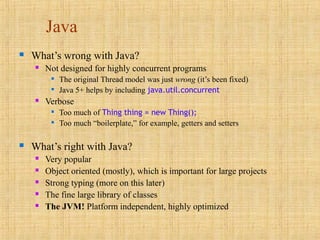
Java
 What’s wrong with Java?
 Not designed for highly concurrent programs

The original Thread model was just wrong (it’s been fixed)

Java 5+ helps by including java.util.concurrent
 Verbose

Too much of Thing thing = new Thing();

Too much “boilerplate,” for example, getters and setters
 What’s right with Java?
 Very popular
 Object oriented (mostly), which is important for large projects
 Strong typing (more on this later)
 The fine large library of classes
 The JVM! Platform independent, highly optimized
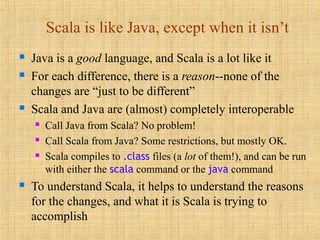
Scala is like Java, except when it isn’t
 Java is a good language, and Scala is a lot like it
 For each difference, there is a reason--none of the
changes are “just to be different”
 Scala and Java are (almost) completely interoperable
 Call Java from Scala? No problem!
 Call Scala from Java? Some restrictions, but mostly OK.
 Scala compiles to .class files (a lot of them!), and can be run
with either the scala command or the java command
 To understand Scala, it helps to understand the reasons
for the changes, and what it is Scala is trying to
accomplish
Consistency is good
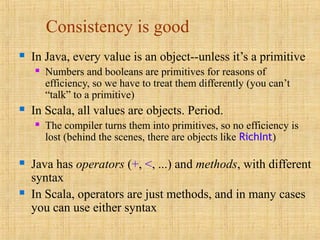
 In Java, every value is an object--unless it’s a primitive
 Numbers and booleans are primitives for reasons of
efficiency, so we have to treat them differently (you can’t
“talk” to a primitive)
 In Scala, all values are objects. Period.
 The compiler turns them into primitives, so no efficiency is
lost (behind the scenes, there are objects like RichInt)
 Java has operators (+, <, ...) and methods, with different
syntax
 In Scala, operators are just methods, and in many cases
you can use either syntax
Type safety is good, verbosity is bad
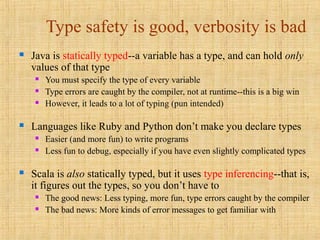
 Java is statically typed--a variable has a type, and can hold only
values of that type
 You must specify the type of every variable
 Type errors are caught by the compiler, not at runtime--this is a big win
 However, it leads to a lot of typing (pun intended)
 Languages like Ruby and Python don’t make you declare types
 Easier (and more fun) to write programs
 Less fun to debug, especially if you have even slightly complicated types
 Scala is also statically typed, but it uses type inferencing--that is,
it figures out the types, so you don’t have to
 The good news: Less typing, more fun, type errors caught by the compiler
 The bad news: More kinds of error messages to get familiar with
Verbosity
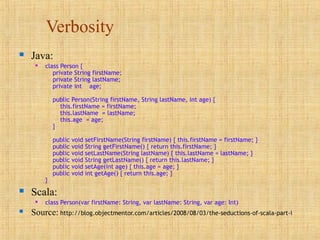
 Java:
 class Person {
private String firstName;
private String lastName;
private int age;
public Person(String firstName, String lastName, int age) {
this.firstName = firstName;
this.lastName = lastName;
this.age = age;
}
public void setFirstName(String firstName) { this.firstName = firstName; }
public void String getFirstName() { return this.firstName; }
public void setLastName(String lastName) { this.lastName = lastName; }
public void String getLastName() { return this.lastName; }
public void setAge(int age) { this.age = age; }
public void int getAge() { return this.age; }
}
 Scala:
 class Person(var firstName: String, var lastName: String, var age: Int)
 Source: http://blog.objectmentor.com/articles/2008/08/03/the-seductions-of-scala-part-i
null
 “I call it my billion-dollar mistake. It was the invention of the
null reference in 1965. At that time, I was designing the first
comprehensive type system for references in an object oriented
language (ALGOL W). My goal was to ensure that all use of
references should be absolutely safe, with checking performed
automatically by the compiler. But I couldn't resist the temptation
to put in a null reference, simply because it was so easy to
implement. This has led to innumerable errors, vulnerabilities,
and system crashes, which have probably caused a billion dollars
of pain and damage in the last forty years.”
--Tony Hoare
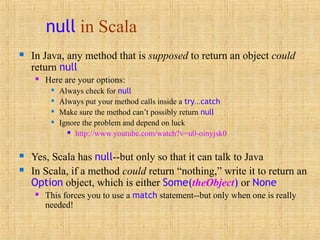
null in Scala
 In Java, any method that is supposed to return an object could
return null
 Here are your options:

Always check for null

Always put your method calls inside a try...catch

Make sure the method can’t possibly return null

Ignore the problem and depend on luck
 http://www.youtube.com/watch?v=u0-oinyjsk0
 Yes, Scala has null--but only so that it can talk to Java
 In Scala, if a method could return “nothing,” write it to return an
Option object, which is either Some(theObject) or None
 This forces you to use a match statement--but only when one is really
needed!
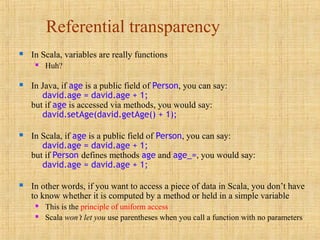
Referential transparency
 In Scala, variables are really functions
 Huh?
 In Java, if age is a public field of Person, you can say:
david.age = david.age + 1;
but if age is accessed via methods, you would say:
david.setAge(david.getAge() + 1);
 In Scala, if age is a public field of Person, you can say:
david.age = david.age + 1;
but if Person defines methods age and age_=, you would say:
david.age = david.age + 1;
 In other words, if you want to access a piece of data in Scala, you don’t have
to know whether it is computed by a method or held in a simple variable
 This is the principle of uniform access
 Scala won’t let you use parentheses when you call a function with no parameters
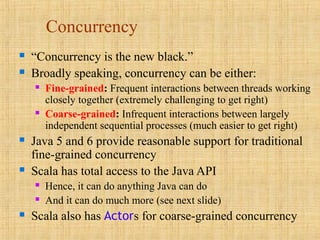
Concurrency
 “Concurrency is the new black.”
 Broadly speaking, concurrency can be either:
 Fine-grained: Frequent interactions between threads working
closely together (extremely challenging to get right)
 Coarse-grained: Infrequent interactions between largely
independent sequential processes (much easier to get right)
 Java 5 and 6 provide reasonable support for traditional
fine-grained concurrency
 Scala has total access to the Java API
 Hence, it can do anything Java can do
 And it can do much more (see next slide)
 Scala also has Actors for coarse-grained concurrency
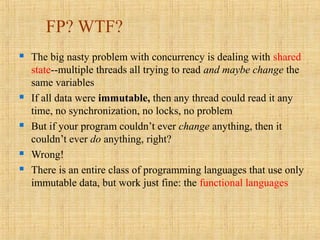
FP? WTF?
 The big nasty problem with concurrency is dealing with shared
state--multiple threads all trying to read and maybe change the
same variables
 If all data were immutable, then any thread could read it any
time, no synchronization, no locks, no problem
 But if your program couldn’t ever change anything, then it
couldn’t ever do anything, right?
 Wrong!
 There is an entire class of programming languages that use only
immutable data, but work just fine: the functional languages
Functional languages
 The best-known functional languages are ML, OCaml,
and Haskell
 Functional languages are regarded as:
 “Ivory tower languages,” used only by academics (mostly
but not entirely true)
 Difficult to learn (mostly true)
 The solution to all concurrent programming problems
everywhere (exaggerated, but not entirely wrong)
 Scala is an “impure” functional language--you can
program functionally, but it isn’t forced upon you
Scala as a functional language
 The hope--my hope, anyway--is that Scala will let people “sneak
up” on functional programming (FP), and gradually learn to use it
 This is how C++ introduced Object-Oriented programming
 Even a little bit of functional programming makes some things a
lot easier
 Meanwhile, Scala has plenty of other attractions
 FP really is a different way of thinking about programming, and
not easy to master...
 ...but...
 Most people that master it, never want to go back
“You can write a Fortran program...”
 There’s a old saying: “You can write a Fortran program in any language.”
 Some people quote this as “You can write a C program...,” but the quote is older
than the C language
 People still say this, but I discovered recently that what they mean by it has
changed (!)
 Old meaning: You can bring your old (Fortran) programming habits into the
new language, writing exactly the same kind of program you would in Fortran,
whether they make sense or not, and just totally ignore the distinctive
character of the new language.
 New meaning: You can write a crappy program in any language.
 Moral: You can “write a Java program in Scala.” That’s okay at first--you
have to start out with what you know, which is Java. After that, you have a
choice: You can (gradually) learn “the Scala way,” or you can keep writing
crappy Scala programs.
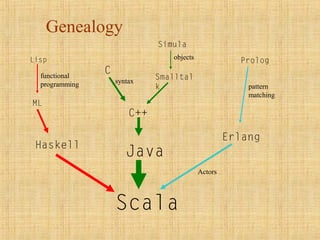
Genealogy
Scala
Java
C
C++
Simula
Smalltal
k
Prolog
Erlang
Haskell
ML
Lisp
functional
programming syntax
objects
pattern
matching
Actors
The End

scala-intro

  • 1.
  • 2.
    Java  What’s wrongwith Java?  Not designed for highly concurrent programs  The original Thread model was just wrong (it’s been fixed)  Java 5+ helps by including java.util.concurrent  Verbose  Too much of Thing thing = new Thing();  Too much “boilerplate,” for example, getters and setters  What’s right with Java?  Very popular  Object oriented (mostly), which is important for large projects  Strong typing (more on this later)  The fine large library of classes  The JVM! Platform independent, highly optimized
  • 3.
    Scala is likeJava, except when it isn’t  Java is a good language, and Scala is a lot like it  For each difference, there is a reason--none of the changes are “just to be different”  Scala and Java are (almost) completely interoperable  Call Java from Scala? No problem!  Call Scala from Java? Some restrictions, but mostly OK.  Scala compiles to .class files (a lot of them!), and can be run with either the scala command or the java command  To understand Scala, it helps to understand the reasons for the changes, and what it is Scala is trying to accomplish
  • 4.
    Consistency is good In Java, every value is an object--unless it’s a primitive  Numbers and booleans are primitives for reasons of efficiency, so we have to treat them differently (you can’t “talk” to a primitive)  In Scala, all values are objects. Period.  The compiler turns them into primitives, so no efficiency is lost (behind the scenes, there are objects like RichInt)  Java has operators (+, <, ...) and methods, with different syntax  In Scala, operators are just methods, and in many cases you can use either syntax
  • 5.
    Type safety isgood, verbosity is bad  Java is statically typed--a variable has a type, and can hold only values of that type  You must specify the type of every variable  Type errors are caught by the compiler, not at runtime--this is a big win  However, it leads to a lot of typing (pun intended)  Languages like Ruby and Python don’t make you declare types  Easier (and more fun) to write programs  Less fun to debug, especially if you have even slightly complicated types  Scala is also statically typed, but it uses type inferencing--that is, it figures out the types, so you don’t have to  The good news: Less typing, more fun, type errors caught by the compiler  The bad news: More kinds of error messages to get familiar with
  • 6.
    Verbosity  Java:  classPerson { private String firstName; private String lastName; private int age; public Person(String firstName, String lastName, int age) { this.firstName = firstName; this.lastName = lastName; this.age = age; } public void setFirstName(String firstName) { this.firstName = firstName; } public void String getFirstName() { return this.firstName; } public void setLastName(String lastName) { this.lastName = lastName; } public void String getLastName() { return this.lastName; } public void setAge(int age) { this.age = age; } public void int getAge() { return this.age; } }  Scala:  class Person(var firstName: String, var lastName: String, var age: Int)  Source: http://blog.objectmentor.com/articles/2008/08/03/the-seductions-of-scala-part-i
  • 7.
    null  “I callit my billion-dollar mistake. It was the invention of the null reference in 1965. At that time, I was designing the first comprehensive type system for references in an object oriented language (ALGOL W). My goal was to ensure that all use of references should be absolutely safe, with checking performed automatically by the compiler. But I couldn't resist the temptation to put in a null reference, simply because it was so easy to implement. This has led to innumerable errors, vulnerabilities, and system crashes, which have probably caused a billion dollars of pain and damage in the last forty years.” --Tony Hoare
  • 8.
    null in Scala In Java, any method that is supposed to return an object could return null  Here are your options:  Always check for null  Always put your method calls inside a try...catch  Make sure the method can’t possibly return null  Ignore the problem and depend on luck  http://www.youtube.com/watch?v=u0-oinyjsk0  Yes, Scala has null--but only so that it can talk to Java  In Scala, if a method could return “nothing,” write it to return an Option object, which is either Some(theObject) or None  This forces you to use a match statement--but only when one is really needed!
  • 9.
    Referential transparency  InScala, variables are really functions  Huh?  In Java, if age is a public field of Person, you can say: david.age = david.age + 1; but if age is accessed via methods, you would say: david.setAge(david.getAge() + 1);  In Scala, if age is a public field of Person, you can say: david.age = david.age + 1; but if Person defines methods age and age_=, you would say: david.age = david.age + 1;  In other words, if you want to access a piece of data in Scala, you don’t have to know whether it is computed by a method or held in a simple variable  This is the principle of uniform access  Scala won’t let you use parentheses when you call a function with no parameters
  • 10.
    Concurrency  “Concurrency isthe new black.”  Broadly speaking, concurrency can be either:  Fine-grained: Frequent interactions between threads working closely together (extremely challenging to get right)  Coarse-grained: Infrequent interactions between largely independent sequential processes (much easier to get right)  Java 5 and 6 provide reasonable support for traditional fine-grained concurrency  Scala has total access to the Java API  Hence, it can do anything Java can do  And it can do much more (see next slide)  Scala also has Actors for coarse-grained concurrency
  • 11.
    FP? WTF?  Thebig nasty problem with concurrency is dealing with shared state--multiple threads all trying to read and maybe change the same variables  If all data were immutable, then any thread could read it any time, no synchronization, no locks, no problem  But if your program couldn’t ever change anything, then it couldn’t ever do anything, right?  Wrong!  There is an entire class of programming languages that use only immutable data, but work just fine: the functional languages
  • 12.
    Functional languages  Thebest-known functional languages are ML, OCaml, and Haskell  Functional languages are regarded as:  “Ivory tower languages,” used only by academics (mostly but not entirely true)  Difficult to learn (mostly true)  The solution to all concurrent programming problems everywhere (exaggerated, but not entirely wrong)  Scala is an “impure” functional language--you can program functionally, but it isn’t forced upon you
  • 13.
    Scala as afunctional language  The hope--my hope, anyway--is that Scala will let people “sneak up” on functional programming (FP), and gradually learn to use it  This is how C++ introduced Object-Oriented programming  Even a little bit of functional programming makes some things a lot easier  Meanwhile, Scala has plenty of other attractions  FP really is a different way of thinking about programming, and not easy to master...  ...but...  Most people that master it, never want to go back
  • 14.
    “You can writea Fortran program...”  There’s a old saying: “You can write a Fortran program in any language.”  Some people quote this as “You can write a C program...,” but the quote is older than the C language  People still say this, but I discovered recently that what they mean by it has changed (!)  Old meaning: You can bring your old (Fortran) programming habits into the new language, writing exactly the same kind of program you would in Fortran, whether they make sense or not, and just totally ignore the distinctive character of the new language.  New meaning: You can write a crappy program in any language.  Moral: You can “write a Java program in Scala.” That’s okay at first--you have to start out with what you know, which is Java. After that, you have a choice: You can (gradually) learn “the Scala way,” or you can keep writing crappy Scala programs.
  • 15.
  • 16.