SOUTH CAROLINA 
MATHEMATICS ACADEMIC 
STANDARDS 
South Carolina Department of Education 
Columbia, South Carolina 
February 2007 
Digitized by South Carolina State Library
ii 
Contents 
Acknowledgements........................................................................................................................ iii 
Introduction .....................................................................................................................................1 
Format of Standards ........................................................................................................................6 
Grade-Level Standards 
Kindergarten ....................................................................................................................................7 
Grade 1...........................................................................................................................................14 
Grade 2...........................................................................................................................................21 
Grade 3...........................................................................................................................................28 
Grade 4...........................................................................................................................................35 
Grade 5...........................................................................................................................................42 
Grade 6...........................................................................................................................................49 
Grade 7...........................................................................................................................................56 
Grade 8...........................................................................................................................................63 
High School Core Area Standards 
Elementary Algebra .......................................................................................................................70 
Intermediate Algebra .....................................................................................................................77 
Geometry........................................................................................................................................84 
Precalculus .....................................................................................................................................92 
Data Analysis and 
Probability………………………………………………………………………………..............99 
Appendix A: Revised Bloom’s Taxonomy.................................................................................105 
Digitized by South Carolina State Library
iii 
Acknowledgements 
South Carolina owes a debt of gratitude to the following organizations and 
individuals for their assistance in the development of the new South Carolina 
mathematics academic standards: 
South Carolina Education Oversight Committee 
Dr. Jo Anne Anderson, executive director of the South Carolina Education 
Oversight Committee (EOC), and Dr. Paul Horne, the EOC’s director of 
curriculum and program overview, facilitated the work of three mathematics 
review teams: a team of mathematics educators from across the nation; a team 
of South Carolina parents, business, and community leaders; and a team of 
South Carolina special education and English language learner teachers. 
State Mathematics Review Panel 
District superintendents recommended educators from around the state to serve 
as members of the State Mathematics Review Panel. The panel reviewed and 
recommended revisions to the 2000 standards document, South Carolina 
Mathematics Curriculum Standards. 
Mid-Continent Research for Education and Learning 
John Kendall, senior director of research at Mid-Continent Research for 
Education and Learning, led a team of content analysts who provided rigorous, 
grade-level indicators for the South Carolina standards based on national and 
state standards documents. 
State Department of Education 
The mathematics standards in this document were developed under the direction 
of Lucinda Saylor, deputy superintendent of the Division of Curriculum Services 
and Assessment, and Dr. Helena Tillar, director of the Office of Curriculum and 
Standards. 
The following State Department of Education staff members assisted in the 
design and development of this document: 
Office of Curriculum and Standards 
Dr. John Holton, Coordinator 
Mary L. Ruzga, Education Associate, Writing Panel Coordinator 
Jeannie Martin, Mathematics Specialist, Elementary Writing Panel Chair 
Terrie R. Dew, Mathematics Specialist, Middle Writing Panel Chair 
Heyward Hickman, Education Associate, Secondary Panel Chair 
Office of Assessment 
Amelia Brailsford, Coordinator 
Buck Brown, Mathematics Assessment Specialist 
Harriet H. Pritchard, Mathematics Assessment Specialist 
Digitized by South Carolina State Library
iv 
Office of State Superintendent 
Dr. Gail Swanson, Editor 
State Mathematics Writing Panel 
Sandy Branyon – Jasper County School District 
Gloria H. Brown – Horry County School District 
Deborah S. Donovan – Lexington School District 2 
Bill Gillam – Richland 2 School District 
Sandra Goff – Upstate Regional Center for Educational Support 
Dr. Paula Gregg – Commission on Higher Education 
Mary Beth Heirs – Lexington 4 School District 
Dianne S. Steelman – Lexington School District 1 
Rhonda A. Willis – Hampton District One 
Professional Organizations 
South Carolina Council of Teachers of Mathematics 
South Carolina Leaders of Mathematics Education 
Digitized by South Carolina State Library
1 
Introduction 
Beginning in 2004, the term for the state-approved expectations for student 
learning and academic performance in South Carolina was changed from 
curriculum standards to academic standards. In accordance with the South 
Carolina Education Accountability Act of 1998 (S.C. Code Ann. § 59-18-110), 
State Board of Education Regulation 43-234 explains the purpose of academic 
standards thusly: 
Each school district board of trustees will ensure quality schooling by 
providing a rigorous, relevant curriculum for all students. 
Each school district must use the academic achievement standards 
adopted by the State Board of Education to push schools and students 
toward high performance by aligning assessments to those standards and 
linking policies and criteria for performance standards, accreditation, 
reporting, school rewards, and targeted assistance. 
The South Carolina Mathematics Academic Standards is not a curriculum. The 
academic standards in this document are not sequenced for instruction, do not 
prescribe classroom activities or materials, and do not dictate instructional 
strategies, approaches, and practices. A mathematics standards support 
document, issued by the State Department of Education (SDE), will serve as a 
resource for districts in constructing district level, standards-based mathematics 
curriculum. By constructing individual district mathematics curriculum, districts 
may add or expand topics and organize content to fit a district’s students’ needs. 
Development and Review of the South Carolina Mathematics Academic 
Standards 
The SDE, in partnership with Mid-Continent Research for Education and 
Learning, developed the academic standards and indicators for mathematics 
utilizing a number of resources. Central among these resources were the South 
Carolina Mathematics Curriculum Standards 2000, the EOC report that contains 
recommendations from national experts, parents, and business leaders and 
recommendations of the State Mathematics Review Panel. 
The mathematics standards in the South Carolina Mathematics Curriculum 
Standards 2000 document were aligned with national standards. The national 
standards are set forth in Principles and Standards for School Mathematics 
produced by the National Council of Teachers of Mathematics and published in 
2000 by the National Council of Teachers of Mathematics, Inc. in Reston, Virginia 
(available at http://www.nctm.org). The national standards continue to serve as a 
guide for the revised South Carolina Mathematics Academic Standards of 2007 
Digitized by South Carolina State Library
and the supporting indicators. In addition, the following sources were also 
utilized: 
Curriculum Focal Points for Prekindergarten through Grade 8 Mathematics, 
The National Council of Teachers of Mathematics (Virginia: The National 
Council of Teachers of Mathematics, Inc., 2006). 
Mathematics Framework for the 2005 National Assessment of Educational 
Progress, developed by the Council of Chief State School Officers, NAEP 
Mathematics Project (Washington, DC: National Assessment Governing 
Board, U.S. Department of Education, n.d.). 
Mathematics Assessment and Exercise Specifications for the National 
Assessment of Educational Progress, developed by the Council of Chief State 
School Officers, NAEP Mathematics Consensus Project (Washington, 
DC: National Assessment Governing Board, U.S. Department of 
Education, n.d.). 
A Taxonomy for Learning, Teaching, and Assessing: A Revision of Bloom’s 
Taxonomy of Educational Objectives (New York: Allyn and Bacon, 2001) 
Published mathematics standards from the states of Alabama, California, 
Virginia, and Indiana in accordance with recommendations from the EOC 
national panel. 
Operating procedures for the review of all newly revised South Carolina 
academic standards were agreed upon by the SDE and the EOC during the 
summer of 2003 and published in the Standard Operating Procedure. Those 
procedures were used in the field review of the first draft of the revised South 
Carolina Mathematics Academic Standards, conducted from October 10, 2006 
through November 29, 2006. Feedback from that review was incorporated into 
the final draft, which was presented to the State Board of Education in January 
2007. 
Changes in the South Carolina Mathematics Academic Standards 
Document 
The structure and organization of the South Carolina mathematics academic 
standards document have been changed in several ways: 
• Academic standards are specified for nine grade levels (Kindergarten through 
grade eight) and five high school core areas: Elementary Algebra, 
Intermediate Algebra, Geometry, Precalculus, and Data Analysis and 
Probability. 
2 
Digitized by South Carolina State Library
• Each grade level and core area set of standards is now preceded by an 
overview page. For Kindergarten through grade eight, the overview page sets 
forth highlights of new learning. For the high school core areas the overview 
page sets forth information relative to a core area. 
• The number of standards—which ranges from six to seven for each grade or 
3 
high school core area—has been significantly reduced. 
• Each grade level and high school core area begins with a standard based on 
the process standards of problem solving, reasoning and proof, 
communication, connections, and representations. The process standard 
highlights methods by which students should acquire and use the content 
reflected in each of the standards that follow the process standard. 
• In Kindergarten through grade eight a standard is written specifically for each 
of the five mathematical strands – Number and Operations, Algebra, 
Geometry, Measurement, and Data Analysis and Probability. This affords 
clear vertical articulation of content. 
• The statements of the academic standards are newly constructed. 
Each standard is now stated as one full sentence that begins with the clause 
“Through the process standards students will demonstrate an understanding 
of . . .” and goes on to specify particular content and skills. The verb phrase 
“to demonstrate an understanding of” is used with its general, everyday 
meaning and does not describe a cognitive category from the taxonomy. 
Following each of the academic standards are indicators which are intended 
to help meet the need for grade level specificity. The indicators are 
statements of the specific cognitive processes (expressed in the main verbs) 
and the content knowledge and skills that students must demonstrate in order 
to meet the grade-level or high school core area standard. 
The main verbs in the indicators are taxonomic. That is, the main verbs 
identify specific aspects of the cognitive process as described in the revised 
Bloom’s taxonomy (included in this standards document as Appendix A). Use 
of the revised taxonomy will allow teachers to identify the kind of content 
(knowledge) addressed in the indicators (factual, conceptual, procedural, or 
metacognitive). In addition, use of the revised taxonomy will help teachers 
align lessons with both the content and the cognitive process identified in the 
indicators. 
Many of the indicators in mathematics address conceptual knowledge and fall 
under the second category of cognitive processing, understanding, which 
fosters transfer and meaningful learning rather than rote learning and 
memorization. These revised mathematics standards also contain some 
indicators that require students to analyze or evaluate mathematical 
Digitized by South Carolina State Library
representations or situations. As a result, students must use understanding as 
they demonstrate even more cognitively complex learning. 
• The term including appears in parenthetical statements in the mathematics 
indicators to introduce a list of specifics that are intended to clarify and focus 
the teaching and learning of the particular concept. That is, within these 
parenthetical including statements are specified the components of the 
indicator that are critical for the specific grade level or core area with regard 
both to the state assessments and to the management of time in the 
classroom. While instruction must focus on the entire indicator, careful 
attention should be paid to include in the instruction the components specified 
in the parenthetical including statements. When components are listed in 
parentheses without the word including, the parenthetical components serve 
as the basis for instruction. 
• When teaching, it is important to provide students with opportunities to 
explore and relate new learning to previous knowledge. With the introduction 
of new learning, it is also important that students be given opportunities to 
generate strategies that lead to their individual, conceptual understanding of 
new mathematical concepts. With some concepts the progression from 
generated strategies to application of algorithms, procedures, or formulas can 
occur within relatively short periods of time. With other concepts, the 
progression requires more time. In an effort to alert educators as to when the 
progression should occur for students in first through eighth grades, specific 
language has been used with certain indicators. If an indicator begins with: 
o “Generate strategies. . .” this is the first time the concept has been 
formally introduced and students will need experiences that foster 
conceptual understanding, 
o “Apply an algorithm/procedure/formula. . .” the concept has been 
introduced in a previous grade, students should have a conceptual 
understanding, and the goal is now fluency, 
o “Apply strategies and algorithms/procedures/formulas. . .” this is the 
first time the concept has been introduced and students should 
progress to fluency. 
Statewide Assessments 
The mathematics standards and indicators for grades three through eight will be 
used as the basis for the Palmetto Achievement Challenge Tests (PACT) in 
mathematics. The mathematics standards for the high school core area of 
Elementary Algebra will be used as the basis for items on the state-required end-of- 
course examination for Algebra I and Mathematics for the Technologies 2. 
The PACT is based on the broad standards at each grade level. Individual test 
questions will be aligned with the indicators and in most cases will measure the 
4 
Digitized by South Carolina State Library
specific cognitive process stated in the main verb in the indicator. However, 
some indicators may be assessed through items that address other appropriate 
cognitive processes within the same category as the main verb in the indicator or 
may address processes in categories of lower cognitive complexity. For example, 
the assessment of an indicator that requires students to classify two-dimensional 
shapes as polygons or non-polygons – which would fall in the second cognitive 
category, Understand – might also ask the student to demonstrate other related 
cognitive processes such as comparing polygons and nonpolygons or giving 
examples of polygons or nonpolygons. 
5 
Digitized by South Carolina State Library
6 
Format of Standards for 
All Grade Levels and High 
School Core Areas 
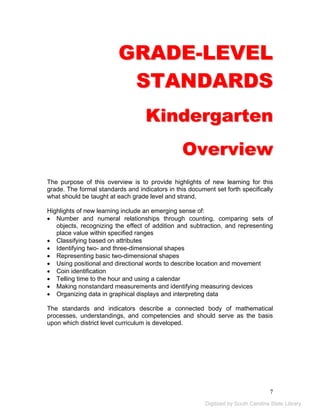
The 
This is the overview page. For 
Kindergarten through grade eight 
the text gives highlights of new 
learning for the particular grade 
level. For the high school core 
areas, the text gives an overview of 
the subject matter. 
GRADE-LEVEL STANDARDS 
Kindergarten 
Overview 
The purpose of this overview is to provide highlights 
of new learning for this grade. The formal standards 
and indicators in this document set forth specifically 
what should be taught at each grade level and strand. 
Highlights of new learning include an emerging sense of: 
• Number and numeral relationships through 
counting, comparing sets of objects, recognizing 
the effect of addition and subtraction, and 
representing place value 
• Classifying based on attributes 
• Identifying two- and three-dimensional shapes 
• Representing basic two-dimensional shapes 
• Using positional and directional words to describe 
location and movement 
• Coin identification 
• Telling time to the hour and using a calendar 
• Making nonstandard measurements and identifying 
measuring devices 
• Organizing data in graphical displays and 
interpreting data 
The standards and indicators describe a connected 
body of mathematical processes, understandings, and 
competencies and should serve as the basis upon which 
district level curriculum is developed. 
Kindergarten 
Standard K-2: ----------------------------- 
----------------------------- 
Indicators 
K-2.1 ---------------------------------------- 
K-2.2 ---------------------------------------- 
This is the second standard for 
Kindergarten. 
Indicators follow each standard. 
Digitized by South Carolina State Library
GRADE-LEVEL 
STANDARDS 
Kindergarten 
Overview 
The purpose of this overview is to provide highlights of new learning for this 
grade. The formal standards and indicators in this document set forth specifically 
what should be taught at each grade level and strand. 
Highlights of new learning include an emerging sense of: 
• Number and numeral relationships through counting, comparing sets of 
objects, recognizing the effect of addition and subtraction, and representing 
place value within specified ranges 
• Classifying based on attributes 
• Identifying two- and three-dimensional shapes 
• Representing basic two-dimensional shapes 
• Using positional and directional words to describe location and movement 
• Coin identification 
• Telling time to the hour and using a calendar 
• Making nonstandard measurements and identifying measuring devices 
• Organizing data in graphical displays and interpreting data 
The standards and indicators describe a connected body of mathematical 
processes, understandings, and competencies and should serve as the basis 
upon which district level curriculum is developed. 
7 
Digitized by South Carolina State Library
The revised standards for grades K-8 consist of six standards per grade - one standard 
per grade for the mathematical processes and one standard per grade for each of the 
five content strands of mathematics. 
8 
Kindergarten 
Process Standards 
The mathematical processes of problem solving, reasoning and proof, 
communication, connections, and representations provide the framework for 
teaching, learning, and assessing. Instructional programs should be built around 
those processes. 
Standard K-1: Students will demonstrate an emerging sense of the 
academic standards and accompanying indicators 
through problem solving, reasoning and proof, 
communication, connections, and representations. 
The indicators for this standard are appropriate for grades K-2 and were adapted from Principles 
and Standards for School Mathematics, NCTM, 2000. Classroom application should be based on 
grade level standards, mathematical goals for the class, and the skills, needs, and 
understandings of the students. 
Indicators 
K-1.1 Apply substantive problem solving. 
K-1.2 Generate conjectures and exchange mathematical ideas. 
K-1.3 Explain and justify answers. 
K-1.4 Create and describe patterns to reason systematically. 
K-1.5 Generalize mathematical concepts. 
K-1.6 Apply mathematical communication in a variety of forms. 
K-1.7 Generalize connections among mathematics, the environment, and other 
subjects. 
K-1.8 Use multiple, informal representations to convey mathematical ideas. 
Digitized by South Carolina State Library
9 
Kindergarten 
Number and Operations 
Standard K-2: Through the process standards students will 
demonstrate an emerging sense of quantity and numeral 
relationships, joining and separating sets, and place 
value. 
Indicators 
K-2.1 Recall numbers by counting forward (through 99) and backward (from 
10). 
K-2.2 Translate between numeral and quantity (through 31). 
K-2.3 Compare set of objects (more than, less than, or the same as) (through 
31). 
K-2.4 Represent simple joining and separating situations (through 10). 
K-2.5 Understand that addition results in increase and subtraction results in 
decrease. 
K-2.6 Analyze the magnitude of a digit based on its place value (through 99). 
K-2.7 Represent the place value of each digit in a two-digit whole number. 
K-2.8 Identify ordinal positions (through thirty-first). 
Digitized by South Carolina State Library
10 
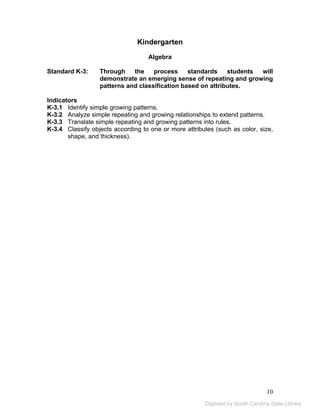
Kindergarten 
Algebra 
Standard K-3: Through the process standards students will 
demonstrate an emerging sense of repeating and growing 
patterns and classification based on attributes. 
Indicators 
K-3.1 Identify simple growing patterns. 
K-3.2 Analyze simple repeating and growing relationships to extend patterns. 
K-3.3 Translate simple repeating and growing patterns into rules. 
K-3.4 Classify objects according to one or more attributes (such as color, size, 
shape, and thickness). 
Digitized by South Carolina State Library
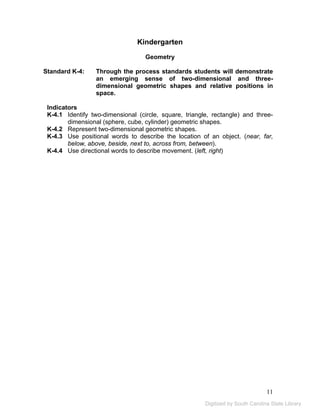
11 
Kindergarten 
Geometry 
Standard K-4: Through the process standards students will demonstrate 
an emerging sense of two-dimensional and three-dimensional 
geometric shapes and relative positions in 
space. 
Indicators 
K-4.1 Identify two-dimensional (circle, square, triangle, rectangle) and three-dimensional 
(sphere, cube, cylinder) geometric shapes. 
K-4.2 Represent two-dimensional geometric shapes. 
K-4.3 Use positional words to describe the location of an object. (near, far, 
below, above, beside, next to, across from, between). 
K-4.4 Use directional words to describe movement. (left, right) 
Digitized by South Carolina State Library
12 
Kindergarten 
Measurement 
Standard K-5: Through the process standards students will 
demonstrate an emerging sense of coin values and linear, 
weight, time, and temperature measurements. 
Indicators 
K-5.1 Identify a penny, a nickel, a dime, a quarter, and a dollar and the value of 
each. 
K-5.2 Compare the lengths of two objects both directly and indirectly to order 
objects according to length. 
K-5.3 Use nonstandard units to explore measurement concepts (length and 
weight). 
K-5.4 Identify measuring devices used to measure length (rulers, yardsticks, 
tape measures), weight (scales, balances), time (calendar, clock – digital 
and analog), and temperature (thermometer—digital and standard). (A1) 
K-5.5 Understand which measure is appropriate for a given situation (length, 
weight, time, and temperature). 
K-5.6 Use clocks (analog and digital) to tell time to the hour. 
K-5.7 Use a calendar to identify dates, days of the week, and months of the 
year. 
K-5.8 Recall equivalencies associated with time (7 days = 1 week and 12 
months = 1 year). 
Digitized by South Carolina State Library
13 
Kindergarten 
Data Analysis and Probability 
Standard K-6: Through the process standards students will 
demonstrate an emerging sense of organizing and 
interpreting data. 
Indicators 
K-6.1 Organize data in graphical displays using drawings and pictures. 
K-6.2 Interpret data from a graph. 
Digitized by South Carolina State Library
Grade 1 
Overview 
The purpose of this overview is to provide highlights of new learning for this 
grade. The formal standards and indicators in this document set forth specifically 
what should be taught at each grade level and strand. In this overview and in the 
formal indicators whenever an indicator begins with: 
• “Generate strategies. . .” this is the first time the concept has been formally 
14 
introduced, 
• “Apply an algorithm/procedure/formula. . .” the concept has been 
introduced in a previous grade and the goal is now fluency, 
• “Apply strategies and algorithms/procedures/formulas. . .” this is the first 
time the concept has been introduced and students should progress to 
fluency. 
Highlights of new learning include a sense of: 
• Representing quantities in word form 
• Recalling basic addition and subtraction facts 
• Generating strategies to add and subtract without regrouping 
• How patterns relate to addition and subtraction 
• Translating patterns into rules 
• Classify two-dimensional shapes as polygons or non-polygons 
• Identifying line symmetry 
• Determining the value of a collection of coins 
• Generating and using common referents for whole inch measurements 
• Telling time to the half hour and recognizing past and future dates on a 
calendar 
• Using thermometers to determine temperature 
• Using survey questions to generate data and make predictions based on data 
The standards and indicators describe a connected body of mathematical 
understandings and competencies and should serve as the basis upon which 
district level curriculum is developed. 
Digitized by South Carolina State Library
The revised standards for grades K-8 consist of six standards per grade - one standard 
per grade for the mathematical processes and one standard per grade for each of the 
five content strands of mathematics. 
15 
Grade 1 
Process Standards 
The mathematical processes of problem solving, reasoning and proof, 
communication, connections, and representations provide the framework for 
teaching, learning, and assessing. Instructional programs should be built around 
those processes. 
Standard 1-1: Students will demonstrate a sense of the academic 
standards and accompanying indicators through problem 
solving, reasoning and proof, communication, 
connections, and representations. 
The indicators for this standard are appropriate for grades K-2 and were adapted from Principles 
and Standards for School Mathematics, NCTM, 2000. Classroom application should be based on 
grade level standards, mathematical goals for the class, and the skills, needs, and 
understandings of the students. 
Indicators 
1-1.1 Apply substantive problem solving. 
1-1.2 Generate conjectures and exchange mathematical ideas. 
1-1.3 Explain and justify answers. 
1-1.4 Create and describe patterns to reason systematically. 
1-1.5 Generalize mathematical concepts. 
1-1.6 Apply mathematical communication in a variety of forms. 
1-1.7 Generalize connections among mathematics, the environment, and other 
subjects. 
1-1.8 Use multiple, informal representations to convey mathematical ideas. 
Digitized by South Carolina State Library
16 
Grade 1 
Number and Operations 
Standard 1-2: Through the process standards students will 
demonstrate a sense of whole numbers, basic addition 
and related subtraction facts, ways to represent whole 
numbers, and connections among oral, numeric, and 
written word forms of whole numbers. 
Indicators 
1-2.1 Translate between numeral and quantity (through 100). 
1-2.2 Use estimation to determine the approximate number of objects in a set 
of 20 to 100 objects. 
1-2.3 Represent quantities in word form (through ten). 
1-2.4 Recognize whole number words that correspond to numerals (through 
twenty). 
1-2.5 Compare whole number quantities (through 100) with words (is greater 
than, is less than, or is equal to). 
1-2.6 Recall basic addition facts (through 9 + 9) and corresponding subtraction 
facts. 
1-2.7 Summarize the inverse relationship between addition and subtraction. 
1-2.8 Generate strategies to add and subtract without regrouping through two-digit 
numbers. 
1-2.9 Analyze the magnitude of a digit based on its place value. (through 999). 
Digitized by South Carolina State Library
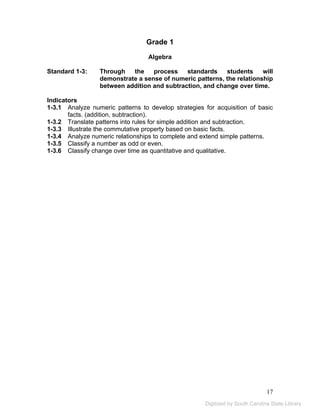
17 
Grade 1 
Algebra 
Standard 1-3: Through the process standards students will 
demonstrate a sense of numeric patterns, the relationship 
between addition and subtraction, and change over time. 
Indicators 
1-3.1 Analyze numeric patterns to develop strategies for acquisition of basic 
facts. (addition, subtraction). 
1-3.2 Translate patterns into rules for simple addition and subtraction. 
1-3.3 Illustrate the commutative property based on basic facts. 
1-3.4 Analyze numeric relationships to complete and extend simple patterns. 
1-3.5 Classify a number as odd or even. 
1-3.6 Classify change over time as quantitative and qualitative. 
Digitized by South Carolina State Library
18 
Grade 1 
Geometry 
Standard 1-4: Through the process standards students will 
demonstrate a sense of two-dimensional and three-dimensional 
geometric shapes, symmetry, and relative 
positions and directions in space. 
Indicators 
1-4.1 Identify three-dimensional geometric shapes. (prism, pyramid, cone) 
1-4.2 Analyze two-dimensional shapes. (circle, square, triangle, rectangle) 
1-4.3 Classify two-dimensional shapes as polygons or non-polygons. 
1-4.4 Identify a line of symmetry. 
1-4.5 Use positional and directional words (north, south, east, west) to describe 
location and movement. 
Digitized by South Carolina State Library
19 
Grade 1 
Measurement 
Standard 1-5: Through the process standards students will 
demonstrate a sense of combination of coins and linear, 
weight, time, and temperature measurements. 
Indicators 
1-5.1 Use a counting procedure to determine the value (less than a dollar) of a 
collection of pennies, nickels, dimes, and quarters. 
1-5.2 Represent a nickel, a dime, a quarter, a half-dollar, and a dollar by 
combinations of coins. 
1-5.3 Represent money using symbolic notation (cent and dollar symbol). 
1-5.4 Use customary units (whole inches) to measure the length of an object. 
1-5.5 Generate common referents for whole inches. 
1-5.6 Use common referents to make estimates (whole inches). 
1-5.7 Use nonstandard units to measure the weight of objects. 
1-5.8 Use clocks (digital and analog) to tell and record time to the half-hour. 
1-5.9 Illustrate past and future dates on a calendar. 
1-5.10 Represent dates in standard form (June 1, 2007) and numeric form (6-1- 
2007). 
1-5.11 Use thermometers (Celsius and Fahrenheit) to identify temperatures. 
Digitized by South Carolina State Library
20 
Grade 1 
Data Analysis and Probability 
Standard 1-6: Through the process standards students will 
demonstrate a sense of collecting, organizing, and 
interpreting data and making predictions based on data. 
Indicators 
1-6.1 Use survey questions to collect data. 
1-6.2 Organize data in graphical displays using picture graphs, object graphs, 
bar graphs, and tables. 
1-6.3 Interpret displayed data using comparative language (more, less, greater, 
fewer, greater than, less than). 
1-6.4 Predict based on data if events are likely or unlikely to occur. 
Digitized by South Carolina State Library
Grade 2 
Overview 
The purpose of this overview is to provide highlights of new learning at this 
grade. The formal standards and indicators in this document set forth specifically 
what should be taught at each grade level and strand. In this overview and in the 
formal indicators whenever an indicator begins with: 
• “Generate strategies. . .” this is the first time the concept has been formally 
21 
introduced, 
• “Apply an algorithm/procedure/formula. . .” the concept has been 
introduced in a previous grade and the goal is now fluency, 
• “Apply strategies and algorithms/procedures/formulas. . .” this is the first 
time the concept has been introduced and students should progress to 
fluency. 
Highlights of new learning include an understanding of: 
• Estimating items in a set 
• Equal groupings as repeated addition and sharing equally as repeated 
subtraction 
• Generating strategies to add and subtract two-digit numerals with regrouping 
• Generating strategies to round numbers to the nearest ten 
• Skip counting 
• Multiple lines of symmetry 
• Predicting results of combing and subdividing two-dimensional shapes 
• Making change 
• Using appropriate tools and units to measure 
• Telling time to the nearest five minute interval and quarter hour 
• Matching a.m. and p.m. to familiar situations 
• Creating survey questions to collect data 
• Inferring trends and make predications based on data sets 
The standards and indicators describe a connected body of mathematical 
understandings and competencies and should serve as the basis upon which 
district level curriculum is developed. 
Digitized by South Carolina State Library
The revised standards for grades K-8 consist of six standards per grade - one standard 
per grade for the mathematical processes and one standard per grade for each of the five 
content strands of mathematics. 
22 
Grade 2 
Process Standards 
The mathematical processes of problem solving, reasoning and proof, 
communication, connections, and representations provide the framework for 
teaching, learning, and assessing. Instructional programs should be built around 
those processes. 
Standard 2-1: Students will demonstrate an understanding of the 
academic standards and accompanying indicators 
through problem solving, reasoning and proof, 
communication, connections and representations. 
The indicators for this standard are appropriate for grades K-2 and were adapted from Principles 
and Standards for School Mathematics, NCTM, 2000. Classroom application should be based on 
grade level standards, mathematical goals for the class, and the skills, needs, and 
understandings of the students. 
Indicators 
2-1.1 Apply substantive problem solving. 
2-1.2 Generate conjectures and exchange mathematical ideas. 
2-1.3 Explain and justify answers. 
2-1.4 Create and describe patterns to reason systematically. 
2-1.5 Generalize mathematical concepts. 
2-1.6 Apply mathematical communication in a variety of forms. 
2-1.7 Generalize connections among mathematics, the environment, and other 
subjects. 
2-1.8 Use multiple, informal representations to convey mathematical ideas. 
Digitized by South Carolina State Library
23 
Grade 2 
Number and Operations 
Standard 2-2: Through the process standards students will 
demonstrate an understanding of the base-ten 
numeration system, place value, and accurate, efficient, 
and generalizable methods to add and subtract whole 
numbers. 
Indicators 
2-2.1 Generate estimation strategies to determine the approximate number of 
objects in a set of at most 1,000 objects. 
2-2.2 Represent quantities in word form (through twenty). 
2-2.3 Represent multiples of ten in word form (through ninety). 
2-2.4 Compare whole number quantities (through 999) with symbols (<, >, =) 
and words (is less than, is greater than, is equal to). 
2-2.5 Interpret models of equal groupings (multiplication) as repeated addition 
and arrays. 
2-2.6 Interpret models of sharing equally (division) as repeated subtraction and 
arrays. 
2-2.7 Generate strategies to add and subtract pairs of two-digit whole numbers 
with regrouping. 
2-2.8 Generate addition and subtraction strategies to find missing addends and 
subtrahends in number combinations (through 20). 
2-2.9 Generate strategies to round numbers to the nearest 10 (through 90). 
2-2.10 Analyze the magnitude of a digit based on its place value (through 
thousands). 
Digitized by South Carolina State Library
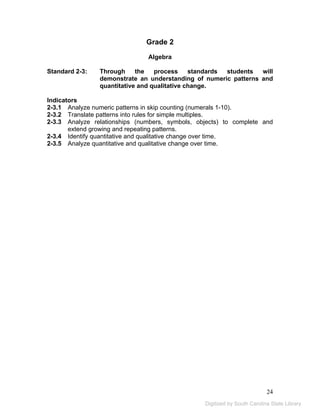
24 
Grade 2 
Algebra 
Standard 2-3: Through the process standards students will 
demonstrate an understanding of numeric patterns and 
quantitative and qualitative change. 
Indicators 
2-3.1 Analyze numeric patterns in skip counting (numerals 1-10). 
2-3.2 Translate patterns into rules for simple multiples. 
2-3.3 Analyze relationships (numbers, symbols, objects) to complete and 
extend growing and repeating patterns. 
2-3.4 Identify quantitative and qualitative change over time. 
2-3.5 Analyze quantitative and qualitative change over time. 
Digitized by South Carolina State Library
25 
Grade 2 
Geometry 
Standard 2-4: Through the process standards students will 
demonstrate an understanding of symmetry and the 
relationship between two-dimensional and three-dimensional 
shapes. 
Indicators 
2-4.1 Analyze three-dimensional shapes according to number and shape of 
faces, edges, corners, and bases. (sphere, cube, cylinder, prism, 
pyramid, cone) 
2-4.2 Identify multiple lines of symmetry. 
2-4.3 Predict the results of combining and subdividing polygons and circles. 
Digitized by South Carolina State Library
26 
Grade 2 
Measurement 
Standard 2-5: Through the process standards students will 
demonstrate an understanding of combination of coins 
and bills, and linear, time, and weight measurements. 
Indicators 
2-5.1 Use a counting procedure to determine the value of a collection of coins 
and bills. 
2-5.2 Use coins to make change up to one dollar. 
2-5.3 Use appropriate tools and units to measure objects to the nearest whole 
unit: length (centimeters, feet, yards), liquid volume (cups, quarts, 
gallons), weight (ounces, pounds), and temperature (Fahrenheit, Celsius). 
2-5.4 Generate common referents for measures (foot, yard, centimeter). 
2-5.5 Use common referents to make estimates (foot, yard, centimeter). 
2-5.6 Predict whether the measure will be greater or smaller when different 
units are used to measure the same object. 
2-5.7 Use clocks (digital and analog) to tell and record time to the nearest 
quarter hour and to the nearest five-minute interval. 
2-5.8 Match a.m. and p.m. to familiar situations. 
2-5.9 Recall equivalencies associated with length (12 inches = 1 foot, 3 feet = 1 
yard) and time (60 minutes = 1 hour, 24 hours = 1 day). 
Digitized by South Carolina State Library
27 
Grade 2 
Data Analysis and Probability 
Standard 2-6: Through the process standards students will 
demonstrate an understanding of creating questions to 
collect data, organizing data, describing trends of a data 
set and making predictions based on data. 
Indicators 
2-6.1 Create survey questions to collect data. 
2-6.2 Organize data in charts, graphs (pictographs), and tables. 
2-6.3 Infer trends from a data set (increasing, decreasing, random). 
2-6.4 Predict based on data if events are more likely or less likely to occur. 
Digitized by South Carolina State Library
Grade 3 
Overview 
The purpose of this overview is to provide highlights of new learning at this 
grade. The formal standards and indicators in this document set forth specifically 
what should be taught at each grade level and strand. In this overview and in the 
formal indicators whenever an indicator begins with: 
• “Generate strategies. . .” this is the first time the concept has been formally 
28 
introduced, 
• “Apply an algorithm/procedure/formula. . .” the concept has been 
introduced in a previous grade and the goal is now fluency, 
• “Apply strategies and algorithms/procedures/formulas. . .” this is the first 
time the concept has been introduced and students should progress to 
fluency. 
Highlights of new learning include an understanding of: 
• Symbolically comparing number quantities 
• Applying an algorithm to fluently add and subtract whole numbers 
• The concept of fractions 
• Recalling basic multiplication and division facts 
• Generating strategies to multiply whole numbers (single digit factor and one 
double digit factor) 
• Using symbols to represent an unknown quantity in a simple addition, 
subtraction, or multiplication equation 
• Attributes of circles 
• Classifying of polygons 
• The concepts of lines, line segments, and angles 
• Predicting results of one transformation 
• Generating strategies to determine perimeters of polygons 
• Telling time to the nearest minute 
• Applying a procedure to find the range of a data set 
• Comparing the benefits of multiple representations of a given data set 
• Understanding when the probability of an event is 0 or 1 
The standards and indicators describe a connected body of mathematical 
understandings and competencies and should serve as the basis upon which 
district level curriculum is developed. 
Digitized by South Carolina State Library
29 
Grade 3 
The revised standards for grades K-8 consist of six standards per grade - one standard 
per grade for the mathematical processes and one standard per grade for each of the five 
content strands of mathematics. 
Process Standards 
The mathematical processes of problem solving, reasoning and proof, 
communication, connections, and representations provide the framework for 
teaching, learning, and assessing. Instructional programs should be built around 
those processes. 
Standard 3-1: Students will demonstrate an understanding of the 
academic standards and accompanying indicators 
through problem solving, reasoning and proof, 
communication, connections and representations. 
The indicators for this standard are appropriate for grades 3-5 and were adapted from Principles 
and Standards for School Mathematics, NCTM, 2000. Classroom application should be based on 
grade level standards, mathematical goals for the class, and the skills, needs, and 
understandings of the students. 
Indicators 
3-1.1 Generate and organize information to model and solve increasingly 
sophisticated problems. 
3-1.2 Generate conjectures and construct arguments that lead to conclusions 
about general mathematical properties and relationships. 
3-1.3 Explain and justify answers based on mathematical properties, structures, 
and relationships. 
3-1.4 Generate descriptions and mathematical statements about relationships 
between classes of objects. 
3-1.5 Generate arguments that may lead to general conclusions. 
3-1.6 Use correct, complete, and clearly written and oral mathematical 
language to pose questions, communicate ideas, and extend problem 
situations. 
3-1.7 Generalize connections between new mathematical ideas and previously 
considered, related concepts and subjects. 
3-1.8 Use flexibility in mathematical representations and recognize the 
limitations of various representations. 
Digitized by South Carolina State Library
30 
Grade 3 
Number and Operations 
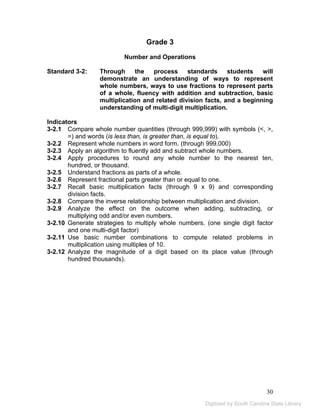
Standard 3-2: Through the process standards students will 
demonstrate an understanding of ways to represent 
whole numbers, ways to use fractions to represent parts 
of a whole, fluency with addition and subtraction, basic 
multiplication and related division facts, and a beginning 
understanding of multi-digit multiplication. 
Indicators 
3-2.1 Compare whole number quantities (through 999,999) with symbols (<, >, 
=) and words (is less than, is greater than, is equal to). 
3-2.2 Represent whole numbers in word form. (through 999,000) 
3-2.3 Apply an algorithm to fluently add and subtract whole numbers. 
3-2.4 Apply procedures to round any whole number to the nearest ten, 
hundred, or thousand. 
3-2.5 Understand fractions as parts of a whole. 
3-2.6 Represent fractional parts greater than or equal to one. 
3-2.7 Recall basic multiplication facts (through 9 x 9) and corresponding 
division facts. 
3-2.8 Compare the inverse relationship between multiplication and division. 
3-2.9 Analyze the effect on the outcome when adding, subtracting, or 
multiplying odd and/or even numbers. 
3-2.10 Generate strategies to multiply whole numbers. (one single digit factor 
and one multi-digit factor) 
3-2.11 Use basic number combinations to compute related problems in 
multiplication using multiples of 10. 
3-2.12 Analyze the magnitude of a digit based on its place value (through 
hundred thousands). 
Digitized by South Carolina State Library
31 
Grade 3 
Algebra 
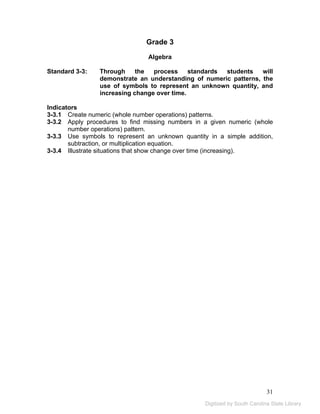
Standard 3-3: Through the process standards students will 
demonstrate an understanding of numeric patterns, the 
use of symbols to represent an unknown quantity, and 
increasing change over time. 
Indicators 
3-3.1 Create numeric (whole number operations) patterns. 
3-3.2 Apply procedures to find missing numbers in a given numeric (whole 
number operations) pattern. 
3-3.3 Use symbols to represent an unknown quantity in a simple addition, 
subtraction, or multiplication equation. 
3-3.4 Illustrate situations that show change over time (increasing). 
Digitized by South Carolina State Library
32 
Grade 3 
Geometry 
Standard 3-4: Through the process standards students will 
demonstrate an understanding of geometric attributes 
and the relationship to shape, congruency, symmetry, 
and movement within two-dimensional space. 
Indicators 
3-4.1 Identify attributes of circles. (center, radius, circumference, diameter) 
3-4.2 Classify polygons by number of sides. (triangles, quadrilaterals, 
pentagons, hexagons, octagons) 
3-4.3 Classify lines and line segments (parallel, perpendicular, intersecting) and 
angles (right, acute, obtuse). 
3-4.4 Classify triangles by lengths of side (scalene, isosceles, equilateral) and 
by sizes of angles. (acute, obtuse, right) 
3-4.5 Exemplify points, lines, line segments, rays, angles. 
3-4.6 Analyze the results of combining and subdividing two-dimensional shapes 
(circles, triangles, quadrilaterals, pentagons, hexagons, octagons). 
3-4.7 Predict the results of one transformation (slide, flip, turn) of a geometric 
shape. 
Digitized by South Carolina State Library
33 
Grade 3 
Measurement 
Standard 3-5: Through the process standards students will 
demonstrate an understanding of measurable attributes 
of objects, apply tools to determine measurements, and 
demonstrate an ability to make change. 
Indicators 
3-5.1 Use the fewest number of coins when making change. 
3-5.2 Use appropriate tools and units to measure objects to the nearest unit: 
length (meter, one-half inch), liquid volume (fluid ounce, pint, liter), weight 
(gram). 
3-5.3 Recognize relationship between meters/yards, kilometers/miles 
liters/quarts, and kilograms/pounds. 
3-5.4 Use common referents to make comparisons and estimates length 
(meters/yards, kilometers/miles), liquid volume (liters/quarts), weight 
(kilograms/pounds). 
3-5.5 Generate strategies to determine perimeters of polygons. 
3-5.6 Use clocks (digital and analog) to tell time to the nearest minute. 
3-5.7 Recall equivalencies associated with length (36 inches = 1 yard) and time 
(60 seconds = 1 minute). 
Digitized by South Carolina State Library
34 
Grade 3 
Data Analysis and Probability 
Standard 3-6: Through the process standards students will 
demonstrate an understanding of organizing, 
interpreting, analyzing and making predictions about 
data, the benefits of multiple representations of a data 
set, and the basic concepts of probability. 
Indicators 
3-6.1 Apply a procedure to find the range of a data set. 
3-6.2 Organize data in graphical displays. (tables, bar graphs, dots plots) 
3-6.3 Interpret graphical display. (tables, bar graphs, pictographs, dot plots) 
3-6.4 Analyze dot plots and bar graphs to make predictions about populations. 
3-6.5 Compare the benefits of multiple representations of a given data set. 
(tabular, dot plot, bar graph) 
3-6.6 Predict based on data if events are likely, unlikely, certain, or impossible. 
3-6.7 Understand when the probability of an event is 0 or 1. 
Digitized by South Carolina State Library
Grade 4 
Overview 
The purpose of this overview is to provide highlights of new learning at this 
grade. The formal standards and indicators in this document set forth specifically 
what should be taught at each grade level and strand. In this overview and in the 
formal indicators whenever an indicator begins with: 
• “Generate strategies. . .” this is the first time the concept has been formally 
35 
introduced, 
• “Apply an algorithm/procedure/formula. . .” the concept has been 
introduced in a previous grade and the goal is now fluency, 
• “Apply strategies and algorithms/procedures/formulas. . .” this is the first 
time the concept has been introduced and students should progress to 
fluency. 
Highlights of new learning include an understanding of: 
• Applying an algorithm to fluently multiply whole numbers 
• Generating strategies to divide whole numbers (single digit divisor) 
• Applying strategies and procedures to find equivalent forms of fractions and 
comparing fractions and decimals 
• Generating strategies to add and subtract decimals (through hundredths) 
• Translating among letters, symbols, and words to represent quantities in a 
simple mathematical expression or equation 
• Applying procedures to find the value of an unknown in a simple whole 
number equation 
• Analyzing quadrilaterals 
• Predicting results of multiple transformations 
• Finding points in the first quadrant of a coordinate grid 
• Generating strategies to determine area of rectangles and triangles 
• Using equivalencies to convert units of measure within the customary system 
• Applying strategies and procedures to determine elapsed time within a 
twelve-hour period 
• Interpreting data in graphical displays with increments greater or equal to one. 
• Analyzing possible outcomes of a simple event 
The standards and indicators describe a connected body of mathematical 
understandings and competencies and should serve as the basis upon which 
district level curriculum is developed. 
Digitized by South Carolina State Library
36 
Grade 4 
The revised standards for grades K-8 consist of six standards per grade - one standard 
per grade for the mathematical processes and one standard per grade for each of the 
five content strands of mathematics. 
Process Standards 
The mathematical processes of problem solving, reasoning and proof, 
communication, connections, and representations provide the framework for 
teaching, learning, and assessing. Instructional programs should be built around 
those processes. 
Standard 4-1: Students will demonstrate an understanding of the 
academic standards and accompanying indicators 
through problem solving, reasoning and proof, 
communication, connections and representations. 
The indicators for this standard are appropriate for grades 3-5 and were adapted from Principles 
and Standards for School Mathematics, NCTM, 2000. Classroom application should be based on 
grade level standards, mathematical goals for the class, and the skills, needs, and 
understandings of the students. 
Indicators 
4-1.1 Generate and organize information to model and solve increasingly 
sophisticated problems. 
4-1.2 Generate conjectures and construct arguments that lead to conclusions 
about general mathematical properties and relationships. 
4-1.3 Explain and justify answers based on mathematical properties, structures, 
and relationships. 
4-1.4 Generate descriptions and mathematical statements about relationships 
between classes of objects. 
4-1.5 Generate arguments that may lead to general conclusions. 
4-1.6 Use correct, complete, and clearly written and oral mathematical 
language to pose questions, communicate ideas, and extend problem 
situations. 
4-1.7 Generalize connections between new mathematical ideas and previously 
considered, related concepts and subjects. 
4-1.8 Use flexibility in mathematical representations and recognize the 
limitations of various representations. 
Digitized by South Carolina State Library
3 =.75, 
37 
Grade 4 
Number and Operations 
Standard 4-2: Through the process standards students will 
demonstrate an understanding of decimal notation as an 
extension of the place value system, the relationship 
between fractions and decimals, fluency with 
multiplication, and a beginning understanding of division 
and a beginning understanding of addition and 
subtraction of decimals. 
Indicators 
4-2.1 Recognize the period (units, thousands, millions, billions) in the place 
value structure of whole numbers. 
4-2.2 Apply divisibility rules for 2, 5 and 10. 
4-2.3 Apply an algorithm to fluently multiply whole numbers. 
4-2.4 Explain the effect on the product when one of the factors is changed. 
4-2.5 Generate strategies to divide whole numbers. (single-digit divisors) 
4-2.6 Analyze the magnitude of a digit based on its place value (through 
hundredths). 
4-2.7 Compare decimals (through hundredths) using symbols (>, <, =) and 
words (is greater than, is less than, is equal to). 
4-2.8 Apply strategies and procedures to find equivalent forms of fractions. 
4-2.9 Compare the relative size of fractions to benchmarks (0, 
1 , 1). 
2 
4-2.10 Identify common fraction/decimal equivalents. ( 
1 =.5, 
2 
1 =.25, 
4 
4 
multiples of 
1 , and multiples of 
10 
1 ). 
100 
4-2.11 Represent improper fractions, mixed numbers, and decimals. 
4-2.12 Generate strategies to add and subtract decimals (through hundredths). 
Digitized by South Carolina State Library
38 
Grade 4 
Algebra 
Standard 4-3: Through the process standards students will 
demonstrate an understanding of numeric and 
nonnumeric patterns, representing simple mathematical 
relationships, and applying procedures to find the value 
of an unknown. 
Indicators 
4-3.1 Analyze numeric (all operations), nonnumeric, and repeating patterns 
(including decimal patterns through hundredths). 
4-3.2 Generalize a rule for numeric (all operations), nonnumeric, and repeating 
patterns. 
4-3.3 Use a rule to complete a sequence or a table. 
4-3.4 Translate among, letters, symbols, and words to represent quantities in a 
simple mathematical expression or equation. 
4-3.5 Apply procedures to find the value of an unknown letter or symbol in a 
whole number equation. 
4-3.6 Illustrate situations that show change over time as increasing, decreasing, 
and varying. 
Digitized by South Carolina State Library
39 
Grade 4 
Geometry 
Standard 4-4: Through the process standards students will 
demonstrate an understanding of the characteristics and 
properties of two-dimensional and three-dimensional 
geometric shapes and a developing understanding of the 
applications of transformations and the coordinate 
system. 
Indicators 
4-4.1 Analyze quadrilaterals according to their properties. (square, rectangle, 
trapezoid, rhombus, parallelograms) 
4-4.2 Analyze the relationship between three-dimensional geometric shapes 
(cubes, rectangular prisms, cylinders) and their two-dimensional nets. 
4-4.3 Predict the results of multiple transformations (translation, reflection, 
rotation) of the same type on a two-dimensional geometric shape. 
4-4.4 Represent two-dimensional shapes (trapezoid, rhombus, parallelogram) 
and three-dimensional shapes (cube, rectangular prism, cylinder). 
4-4.5 Use transformation(s) to prove congruency. 
4-4.6 Represent points, lines, line segments, rays, angles, and polygons. 
4-4.7 Represent the location of points in the first quadrant of a coordinate grid 
with ordered pairs of whole numbers. 
4-4.8 Illustrate possible paths from one point to another along vertical and 
horizontal grid lines in the first quadrant of the coordinate plane. 
Digitized by South Carolina State Library
40 
Grade 4 
Measurement 
Standard 4-5: Through the process standards students will 
demonstrate an understanding of measurable attributes 
of objects including perimeter, area, angles, and elapsed 
time and conversions within the U.S. Customary System. 
Indicators 
4-5.1 Use appropriate tools and units to measure objects to the nearest unit: 
length (one-fourth inch, centimeter, millimeter), weight (milligram, pound, 
kilogram), and liquid volume (cup, quart, liter). 
4-5.2 Compare angle measures with referent angles (45 degrees, 90 degrees, 
180 degrees) to estimate angle measures. 
4-5.3 Use equivalencies to convert units of measure within the customary 
system: length (inches, feet, yards, miles), weight (ounces, pounds, tons), 
and liquid volume (cups, pints, quarts, gallons), and time (years, weeks, 
days, hours, minutes, seconds). 
4-5.4 Analyze the perimeter of a polygon. 
4-5.5 Generate strategies to determine area of rectangles and triangles. 
4-5.6 Apply strategies and procedures to determine the amount of elapsed time 
in hours and minutes within a twelve-hour period (a.m. or p.m.). 
4-5.7 Use a Celsius and Fahrenheit thermometer to determine temperature 
changes during time intervals. 
4-5.8 Recall equivalencies associated with length (5,280 feet = 1 mile), weight 
(16 ounces = 1 pound, 2,000 pounds = 1 ton), liquid volume (8 liquid 
ounces = 1 cup, 2 cups = 1 pint, 2 pints = 1 quart, 4 quarts = 1 gallon), 
and time (365 days = 1 year; 52 week = 1 year). 
4-5.9 Exemplify situations that require highly accurate measurements. 
Digitized by South Carolina State Library
41 
Grade 4 
Data Analysis and Probability 
Standard 4-6: Through the process standards students will 
demonstrate an understanding of the impact of data 
collection methods, interpreting and organizing data, the 
appropriate graph for categorical and numerical data, and 
analyze possible outcomes of a simple event. 
Indicators 
4-6.1 Compare how data collection methods impact survey results. 
4-6.2 Interpret data in graphical displays with scale increments greater than or 
equal to one (tables, line graphs, bar graphs, double bar graphs). 
4-6.3 Organize data in graphical displays (tables, line graphs, bar graphs with 
scale increments greater than one). 
4-6.4 Distinguish between categorical and numerical data. 
4-6.5 Match categorical and numerical data to appropriate graphs. 
4-6.6 Predict based on data if events are likely, unlikely, certain, impossible, or 
equally likely. 
4-6.7 Analyze possible outcomes of a simple event. 
Digitized by South Carolina State Library
Grade 5 
Overview 
The purpose of this overview is to provide highlights of new learning at this 
grade. The formal standards and indicators in this document set forth specifically 
what should be taught at each grade level and strand. In this overview and in the 
formal indicators whenever an indicator begins with: 
• “Generate strategies. . .” this is the first time the concept has been formally 
42 
introduced, 
• “Apply an algorithm/procedure/formula. . .” the concept has been 
introduced in a previous grade and the goal is now fluency, 
• “Apply strategies and algorithms/procedures/formulas. . .” this is the first 
time the concept has been introduced and students should progress to 
fluency. 
Highlights of new learning include an understanding of: 
• Applying an algorithm to fluently divide whole numbers 
• The concept of prime and composite numbers 
• Generating strategies to add and subtract fractions 
• Applying an algorithm to add and subtract decimals (through thousandths) 
• Classifying shapes as congruent 
• Translating between two-dimensional representations and three-dimensional 
objects 
• Predicting results of combined multiple transformations 
• Analyzing shapes for line and/or rotational symmetry 
• Using a protractor to measure angles 
• Using equivalencies to convert units of measure within the metric system 
• Applying formulas to determine perimeter and area 
• Applying strategies and formulas to determine volume 
• Applying procedures to determine elapsed time within a twenty-four hour 
period 
• Applying procedures to calculate the measures of center 
• Concluding why the sum of the probabilities of the outcomes of an experiment 
must equal 1 
The standards and indicators describe a connected body of mathematical 
understandings and competencies and should serve as the basis upon which 
district level curriculum is developed. 
Digitized by South Carolina State Library
43 
Grade 5 
The revised standards for grades K-8 consist of six standards per grade - one standard 
per grade for the mathematical processes and one standard per grade for each of the five 
content strands of mathematics. 
Process Standards 
The mathematical processes of problem solving, reasoning and proof, 
communication, connections, and representations provide the framework for 
teaching, learning, and assessing. Instructional programs should be built around 
those processes. 
Standard 5-1: Students will demonstrate an understanding of the 
academic standards and accompanying indicators 
through problem solving, reasoning and proof, 
communication, connections and representations. 
The indicators for this standard are appropriate for grades 3-5 and were adapted from Principles 
and Standards for School Mathematics, NCTM, 2000. Classroom application should be based on 
grade level standards, mathematical goals for the class, and the skills, needs, and 
understandings of the students. 
Indicators 
5-1.1 Generate and organize information to model and solve increasingly 
sophisticated problems. 
5-1.2 Generate conjectures and construct arguments that lead to conclusions 
about general mathematical properties and relationships. 
5-1.3 Explain and justify answers based on mathematical properties, structures, 
and relationships. 
5-1.4 Generate descriptions and mathematical statements about relationships 
between classes of objects. 
5-1.5 Generate arguments that may lead to general conclusions. 
5-1.6 Use correct, complete, and clearly written and oral mathematical 
language to pose questions, communicate ideas, and extend problem 
situations. 
5-1.7 Generalize connections between new mathematical ideas and previously 
considered, related concepts and subjects. 
5-1.8 Use flexibility in mathematical representations and recognize the 
limitations of various representations. 
Digitized by South Carolina State Library
44 
Grade 5 
Number and Operations 
Standard 5-2: Through the process standards students will 
demonstrate an understanding of the place value system, 
fluency in division of whole numbers, fluency in addition 
and subtraction of decimals, and a beginning 
understanding of addition and subtraction of fractions. 
Indicators 
5-2.1 Analyze the magnitude of a digit based on its place value (decimal 
numbers through thousandths and whole numbers). 
5-2.2 Apply an algorithm to fluently divide whole numbers. 
5-2.3 Understand the relationship among the divisor, dividend, and quotient. 
5-2.4 Compare whole numbers, decimals and/or fractions and mixed numbers 
(<, >, =). 
5-2.5 Apply an algorithm to add and subtract decimals. (through thousandths). 
5-2.6 Classify numbers as prime or composite. 
5-2.7 Generate strategies to find the greatest common factor and least common 
multiple of two whole numbers. 
5-2.8 Generate strategies to add and subtract fractions. (like and unlike 
denominators). 
5-2.9 Apply divisibility rules for 3, 6, and 9. 
Digitized by South Carolina State Library
45 
Grade 5 
Algebra 
Standard 5-3: Through the process standards students will 
demonstrate an understanding of the use of patterns, 
relations, functions, models, structures, and algebraic 
symbols to represent quantitative relationships and 
analyze change in various contexts. 
Indicators 
5-3.1 Represent numeric, algebraic, and geometric patterns in words, symbols, 
algebraic expressions, or algebraic equations. 
5-3.2 Analyze patterns and functions with words, tables, and graphs. 
5-3.3 Match tables, graphs, expressions, equations, and or verbal descriptions 
of the same problem situation. 
5-3.4 Identify applications of commutative, associative, and distributive 
properties with whole numbers. 
5-3.5 Analyze situations that show change over time. 
Digitized by South Carolina State Library
46 
Grade 5 
Geometry 
Standard 5-4: Through the process standards students will 
demonstrate an understanding of the characteristics and 
properties of two-dimensional and three-dimensional 
geometric shapes and the application of transformations 
and symmetry. 
Indicators 
5-4.1 Apply the relationships of quadrilaterals to make logical arguments about 
their properties. 
5-4.2 Compare attributes (angles, side lengths, perimeter) of congruent shapes. 
5-4.3 Classify shapes as congruent. 
5-4.4 Translate between two-dimensional representations and three-dimensional 
objects. 
5-4.5 Predict the results of combined multiple transformations (translation, 
reflection, rotation) on a geometric shape. 
5-4.6 Analyze shapes to determine line symmetry and/or rotational symmetry. 
Digitized by South Carolina State Library
47 
Grade 5 
Measurement 
Standard 5-5: Through the process standards students will 
demonstrate an understanding of measurable attributes 
of objects, the units and systems of measurement, and 
apply tools and formulas to determine measurements. 
Indicators 
5-5.1 Use appropriate tools and units to measure objects to the precision of 
one-eighth inch. 
5-5.2 Use a protractor to measure angles from 0 to 180 degrees. 
5-5.3 Use equivalencies to convert units of measure within the metric system: 
length (millimeter, centimeter, meter, kilometer), liquid volume (milliliter, 
centiliter, liter, kiloliter), weight (milligram, centigram, gram, kilogram). 
5-5.4 Apply formulas to determine the perimeter and area of a shape (triangles, 
rectangles, parallelograms) 
5-5.5 Apply strategies and formulas to determine the volume of rectangular 
prisms. 
5-5.6 Apply procedures to determine the amount of elapsed time in hours, 
minutes, and seconds within a 24-hour period (a.m. and p.m.). 
5-5.7 Understand the relationship between the Celsius and Fahrenheit 
temperature scales. 
5-5.8 Recall equivalencies associated with length (10 millimeters = 1 
centimeter, 100 centimeters = 1 meter, 1000 meters = 1 kilometer), liquid 
volume (10 milliliters = 1 centiliter, 100 centiliters = 1 liter, 1000 liters = 1 
kiloliter), weight (10 milligrams = 1 centigram, 100 centigrams = 1 gram, 
1000 grams = 1 kilogram). 
Digitized by South Carolina State Library
48 
Grade 5 
Data Analysis and Probability 
Standard 5-6: Through the process standards students will 
demonstrate an understanding of designing an 
investigation, the affect of data collection methods on a 
data set, interpretation and application of measures of 
center, and application of basic concepts of probability. 
Indicators 
5-6.1 Design an investigation to address a question. 
5-6.2 Analyze how data collection methods affect the nature of the data set. 
5-6.3 Apply procedures to calculate the measures of center (mean, median, 
mode). 
5-6.4 Interpret the meaning and application of the measures of center. 
5-6.5 Represent the probability of a single stage event in words and fractions. 
5-6.6 Conclude why the sum of the probabilities of the outcomes of an 
experiment must equal 1. 
Digitized by South Carolina State Library
Grade 6 
Overview 
The purpose of this overview is to provide highlights of new learning at this 
grade. The formal standards and indicators in this document set forth specifically 
what should be taught at each grade level and strand. In this overview and in the 
formal indicators whenever an indicator begins with: 
• “Generate strategies. . .” this is the first time the concept has been formally 
49 
introduced, 
• “Apply an algorithm/procedure/formula. . .” the concept has been 
introduced in a previous grade and the goal is now fluency, 
• “Apply strategies and algorithms/procedures/formulas. . .” this is the first 
time the concept has been introduced and students should progress to 
fluency. 
Highlights of new learning include an understanding of: 
• The concepts of percents and integers 
• Comparing rational numbers and percents 
• Applying an algorithm to add and subtract fractions 
• Generating strategies to multiply and divide fractions and decimals 
• The concepts of exponents and powers of ten 
• Applying order of operations 
• Using inverse operations to solve one-step equations 
• Representing location of points in all four quadrants 
• Constructing two-dimensional shapes with rotational symmetry 
• Classifying shapes as similar 
• Identifying pairs of angles that are complementary or supplementary 
• Applying strategies and formulas to approximate circumference and area of a 
circle 
• Applying strategies and procedures to estimate and determine perimeter and 
area of irregular shapes 
• Using proportions to determine unit rates 
• Using a scale to determine distance 
• Applying procedures to calculate the probability for complementary events 
The standards and indicators describe a connected body of mathematical 
understandings and competencies and should serve as the basis upon which 
district level curriculum is developed. 
Digitized by South Carolina State Library
50 
Grade 6 
The revised standards for grades K-8 consist of six standards per grade - one standard 
per grade for the mathematical processes and one standard per grade for each of the five 
content strands of mathematics. 
Process Standards 
The mathematical processes of problem solving, reasoning and proof, 
communication, connections, and representations provide the framework for 
teaching, learning, and assessing. Instructional programs should be built around 
those processes. 
Standard 6-1: Students will demonstrate an understanding of the 
academic standards and accompanying indicators 
through problem solving, reasoning and proof, 
communication, connections and representations. 
The indicators for this standard are appropriate for grades 6-8 and were adapted from Principles 
and Standards for School Mathematics, NCTM, 2000. Classroom application should be based on 
grade level standards, mathematical goals for the class, and the skills, needs, and 
understandings of the students. 
Indicators 
6-1.1 Generate and solve complex, abstract problems that involve modeling 
physical, social, or mathematical phenomena. 
6-1.2 Evaluate conjectures and pose follow-up questions to prove or disprove 
conjectures. 
6-1.3 Use inductive and deductive reasoning to formulate mathematical 
arguments. 
6-1.4 Understand equivalent symbolic expressions as distinct symbolic forms 
that represent the same relationship. 
6-1.5 Generalize mathematical statements based on inductive and deductive 
reasoning. 
6-1.6 Use correct and clearly written/spoken words, variables, and notation to 
communicate about significant mathematical tasks. 
6-1.7 Generalize connections among a variety of representational forms and 
real world situations. 
6-1.8 Use standard and nonstandard representations to convey and support 
mathematical relationships. 
Digitized by South Carolina State Library
51 
Grade 6 
Number and Operations 
Standard 6-2: Through the process standards students will 
demonstrate an understanding of operations on fractions 
and decimals, a beginning understanding of ratio and 
rate, integers, and the use of exponential notation to 
represent whole numbers. 
Indicators 
6-2.1 Understand percents. (whole number percents through 100) 
6-2.2 Understand integers. 
6-2.3 Compare rational numbers and percents (whole number percents 
through 100). (≤, ≥, <, >, =) 
6-2.4 Apply an algorithm to add and subtract fractions 
6-2.5 Generate strategies to multiply and divide fractions and decimals. 
6-2.6 Understand the relationship between ratios and rates to multiplication and 
division. 
6-2.7 Apply strategies and procedures to determine values of powers of ten. 
(up to 106) 
6-2.8 Represent the prime factorization of numbers using exponents. 
6-2.9 Represent whole numbers using exponential form. 
Digitized by South Carolina State Library
52 
Grade 6 
Algebra 
Standard 6-3: Through the process standards students will 
demonstrate an understanding of writing, interpreting 
and using mathematical expressions, equations, and 
inequalities. 
Indicators 
6-3.1 Analyze numeric and algebraic patterns and pattern relationships. 
6-3.2 Apply order of operations to simplify whole number expressions. 
6-3.3 Represent algebraic relationships with variables in expressions, simple 
equations, and simple inequalities. 
6-3.4 Use the commutative, associative, and distributive properties to show that 
two expressions are equivalent. 
6-3.5 Use inverse operations to solve one-step equations (whole number 
coefficients and solutions). 
Digitized by South Carolina State Library
53 
Grade 6 
Geometry 
Standard 6-4: Through the process standards students will 
demonstrate an understanding of the properties and 
attributes of two-dimensional shapes through coordinate 
geometry and transformational geometry. 
Indicators 
6-4.1 Represent the location of points in a coordinate grid with ordered pairs of 
integers. 
6-4.2 Apply strategies and procedures to find the coordinates of the missing 
vertex of a square, rectangle, or right triangle when given the coordinates 
of the polygon’s other vertices. 
6-4.3 Generalize the relationship between line symmetry and rotational 
symmetry for two-dimensional shapes. 
6-4.4 Construct two-dimensional shapes with line or rotational symmetry. 
6-4.5 Identify the transformation(s) used to move a polygon from one location to 
another in the coordinate plane. 
6-4.6 Explain how transformations affect the location of the original polygon in 
the coordinate plane. 
6-4.7 Compare attributes (angles, side lengths, perimeter) of similar shapes. 
6-4.8 Classify shapes as similar. 
6-4.9 Classify pairs of angles as complementary or supplementary. 
Digitized by South Carolina State Library
54 
Grade 6 
Measurement 
Standard 6-5: Through the process standards students will 
demonstrate an emerging understanding of the concept 
of pi and an understanding of circumference and area of 
circles, surface area of prisms and cylinders, perimeter 
and area of irregular shapes, and rates. 
Indicators 
6-5.1 Explain the relationships among the circumference, diameter, and radius 
of a circle. 
6-5.2 Apply strategies and formulas with an approximation of pi (3.14, 22/7) to 
find the circumference and area of a circle. 
6-5.3 Generate strategies to determine the surface area of a rectangular prism 
and of a cylinder. 
6-5.4 Apply strategies and procedures to estimate the perimeter and area of 
irregular shapes. 
6-5.5 Apply strategies and procedures (combine/subdivide) to find perimeter 
and area of irregular shapes. 
6-5.6 Use proportions to determine unit rates. 
6-5.7 Use a scale to determine distance. 
Digitized by South Carolina State Library
55 
Grade 6 
Data Analysis and Probability 
Standard 6-6: Through the process standards students will 
demonstrate an understanding through data analysis and 
probability of relationships within one population or 
sample. 
Indicators 
6-6.1 Predict the characteristics of one population based on the analysis of 
sample data. 
6-6.2 Organize data in appropriate graphical representations (frequency tables, 
histograms, stem and leaf plots). 
6-6.3 Analyze which measure of central tendency (mean, median, mode) is the 
most appropriate for a given purpose. 
6-6.4 Use theoretical probability to determine the sample space and probability 
for one and two-stage events (tree diagrams, models, list, chart, picture). 
6-6.5 Apply procedures to calculate the probability for complementary events. 
Digitized by South Carolina State Library
Grade 7 
Overview 
The purpose of this overview is to provide highlights of new learning at this 
grade. The formal standards and indicators in this document set forth specifically 
what should be taught at each grade level and strand. In this overview and in the 
formal indicators whenever an indicator begins with: 
• “Generate strategies. . .” this is the first time the concept has been formally 
56 
introduced, 
• “Apply an algorithm/procedure/formulas. . .” the concept has been 
introduced in a previous grade and the goal is now fluency, 
• “Apply strategies and algorithms/procedures/formulas. . .” this is the first 
time the concept has been introduced and students should progress to 
fluency. 
Highlights of new learning include an understanding of: 
• Fractional percents and percents greater than 100 
• The concept of square roots and the inverse relationship between squaring 
and finding square roots of perfect squares 
• The meaning of absolute value 
• Generating strategies to add, subtract, multiply and divide integers 
• Applying an algorithm to multiply and divide fractions and decimals 
• Using inverse operations to solve two-step equations and inequalities 
• Classifying and explaining proportional relationships 
• Translating between two-dimensional representations and three-dimensional 
representations of compound figures 
• Creating tessellations with transformations and explain the angle measure 
relationships among shapes that tessellate 
• Applying strategies and formulas to determine the surface area and volume of 
three-dimensional shapes 
• Using one-step unit analysis to convert between and within the customary 
and metric systems 
• Applying procedures to calculate the interquartile range 
• Applying procedures to calculate the probability of mutually exclusive events 
The standards and indicators describe a connected body of mathematical 
understandings and competencies and should serve as the basis upon which 
district level curriculum is developed. 
Digitized by South Carolina State Library
57 
Grade 7 
The revised standards for grades K-8 consist of six standards per grade - one standard 
per grade for the mathematical processes and one standard per grade for each of the five 
content strands of mathematics. 
Process Standards 
The mathematical processes of problem solving, reasoning and proof, 
communication, connections, and representations provide the framework for 
teaching, learning, and assessing. Instructional programs should be built around 
those processes. 
Standard 7-1: Students will demonstrate an understanding of the 
academic standards and accompanying indicators 
through problem solving, reasoning and proof, 
communication, connections and representations. 
The indicators for this standard are appropriate for grades 6-8 and were adapted from Principles 
and Standards for School Mathematics, NCTM, 2000. Classroom application should be based on 
grade level standards, mathematical goals for the class, and the skills, needs, and 
understandings of the students. 
Indicators 
7-1.1 Generate and solve complex, abstract problems that involve modeling 
physical, social, or mathematical phenomena. 
7-1.2 Evaluate conjectures and pose follow-up questions to prove or disprove 
conjectures. 
7-1.3 Use inductive and deductive reasoning to formulate mathematical 
arguments. 
7-1.4 Understand equivalent symbolic expressions as distinct symbolic forms 
that represent the same relationship. 
7-1.5 Generalize mathematical statements based on inductive and deductive 
reasoning. 
7-1.6 Use correct and clearly written/spoken words, variables, and notation to 
communicate about significant mathematical tasks. 
7-1.7 Generalize connections among a variety of representational forms and 
real world situations. 
7-1.8 Use standard and nonstandard representations to convey and support 
mathematical relationships. 
Digitized by South Carolina State Library
58 
Grade 7 
Number and Operations 
Standard 7-2: Through the process standards students will 
demonstrate an understanding of absolute value, ratio, 
rate, and proportion and fluency in operations with 
integers. 
Indicators 
7-2.1 Understand fractional percents and percents greater than one hundred. 
7-2.2 Represent the location of rational numbers and square roots of perfect 
squares on a number line. 
7-2.3 Compare rational numbers, percents, and square roots of perfect 
squares. (≤, ≥, <, >, =) 
7-2.4 Understand the meaning of absolute value. 
7-2.5 Apply ratios, rates, and proportions. (discounts, taxes, tips, interest, unit 
cost, similar shapes). 
7-2.6 Translate between standard form and exponential form. 
7-2.7 Translate between standard form and scientific notation. 
7-2.8 Generate strategies to add, subtract, multiply, and divide integers. 
7-2.9 Apply an algorithm to multiply and divide fractions and decimals. 
7-2.10 Understand the inverse relationship between squaring and finding square 
roots of perfect squares. 
Digitized by South Carolina State Library
59 
Grade 7 
Algebra 
Standard 7-3: Through the process standards students will 
demonstrate an understanding of proportional 
relationships. 
Indicators 
7-3.1 Analyze geometric patterns and pattern relationships. 
7-3.2 Analyze tables and graphs to describe the rate of change between 
quantities. 
7-3.3 Understand slope as a constant rate of change. 
7-3.4 Use inverse operations to solve two-step equations and two-step 
inequalities. 
7-3.5 Represent on a number line the solution of a two-step inequality. 
7-3.6 Represent proportional relationships with graphs, tables, and equations. 
7-3.7 Classify relationships as directly proportional, inversely proportional, or 
non-proportional. 
Digitized by South Carolina State Library
60 
Grade 7 
Geometry 
Standard 7-4: Through the process standards students will 
demonstrate an understanding of the properties and 
attributes of two-dimensional and three-dimensional 
shapes through coordinate, spatial, analytical, and 
transformational geometry. 
Indicators 
7-4.1 Analyze geometric properties and relationships (properties of triangles, 
congruence, similarity, transformations) to make deductive arguments. 
7-4.2 Explain the results of the intersection of two or more geometric shapes in 
a plane. 
7-4.3 Illustrate the cross section of a solid. 
7-4.4 Translate between two-dimensional representations and three-dimensional 
representations of compound figures. 
7-4.5 Analyze the congruent and supplementary relationships (alternate 
interior, alternate exterior, corresponding, adjacent) of the angles formed 
by parallel lines and a transversal. 
7-4.6 Compare areas of similar shapes and of congruent shapes. 
7-4.7 Explain the proportional relationship among attributes of similar shapes. 
7-4.8 Apply proportional reasoning to find missing attributes of similar shapes. 
7-4.9 Create tessellations with transformations. 
7-4.10 Explain the relationship of the angle measures among shapes that 
tessellate. 
Digitized by South Carolina State Library
61 
Grade 7 
Measurement 
Standard 7-5: Through the process standards students will 
demonstrate an understanding of scale factors and rates, 
calculating perimeter, area, surface area, and volume 
using appropriate units, techniques, and formulas and 
relationships between the U.S. Customary and Metric 
Systems. 
Indicators 
7-5.1 Use ratio and proportion to solve problems involving scale factors and 
rates. 
7-5.2 Apply strategies and formulas to determine the surface area and volume 
of three-dimensional shapes (prism, pyramid, cylinder). 
7-5.3 Generate strategies to determine the perimeter and area of trapezoids. 
7-5.4 Recall equivalencies between customary and metric systems associated 
with length (1 square yard = 9 square feet, 1 cubic meter = 1 million cubic 
centimeters, 1 kilometer = 5/8 of a mile, 1 inch = 2.54 centimeters), 
weight (2.2 kilograms = 1 pound), and liquid volume (1.06 quarts = 1 liter). 
7-5.5 Use one-step unit analysis to convert between and within the customary 
and metric systems. 
Digitized by South Carolina State Library
62 
Grade 7 
Data Analysis and Probability 
Standard 7-6: Through the process standards students will 
demonstrate an understanding of relationships between 
two populations or samples through data analysis and 
probability. 
Indicators 
7-6.1 Predict the characteristics of two populations based on the analysis of 
sample data. 
7-6.2 Organize data using appropriate graphical representations (box plots and 
circle graphs). 
7-6.3 Apply procedures to calculate the interquartile range. 
7-6.4 Interpret the interquartile range for data. 
7-6.5 Apply procedures to calculate the probability for mutually exclusive events 
(simple or compound). 
7-6.6 Interpret the probability for mutually exclusive events (simple or 
compound). 
7-6.7 Differentiate between experimental and theoretical probability of the same 
event. 
7-6.8 Use the Fundamental Counting Principle to determine the number of 
possible outcomes in a multi-stage event. 
Digitized by South Carolina State Library
Grade 8 
Overview 
The purpose of this overview is to provide highlights of new learning at this 
grade. The formal standards and indicators in this document set forth specifically 
what should be taught at each grade level and strand. In this overview and in the 
formal indicators whenever an indicator begins with: 
• “Generate strategies. . .” this is the first time the concept has been formally 
63 
introduced, 
• “Apply an algorithm/procedure/formula. . .” the concept has been 
introduced in a previous grade and the goal is now fluency, 
• “Apply strategies and algorithms/procedures/formulas. . .” this is the first 
time the concept has been introduced and students should progress to 
fluency. 
Highlights of new learning include an understanding of: 
• Applying an algorithm to add, subtract, multiply, and divide integers 
• The concept of irrational numbers 
• Applying procedures to approximate square and cube roots 
• Applying procedures to solve multi-step equations 
• Classifying relationships between two variables as linear or non-linear 
• Identifying the coordinates of the x and y intercepts of a linear equation 
• Slope as a constant rate of change 
• Applying the Pythagorean Theorem 
• Using ordered pairs, equations, intercepts, and intersections to locate points 
and lines in a coordinate plane 
• Apply a dilation on a square a rectangle or a right triangle in a coordinate 
plane and analyze the effect 
• Applying strategies and formulas to determine volume of three-dimensional 
shapes 
• Using multi-step unit analysis to convert between and with the customary and 
metric systems 
• Applying procedures to compute the odds of a given event 
The standards and indicators describe a connected body of mathematical 
understandings and competencies and should serve as the basis upon which 
district level curriculum is developed. 
Digitized by South Carolina State Library
64 
Grade 8 
The revised standards for grades K-8 consist of six standards per grade - one standard 
per grade for the mathematical processes and one standard per grade for each of the 
five content strands of mathematics. 
Process Standards 
The mathematical processes of problem solving, reasoning and proof, 
communication, connections, and representations provide the framework for 
teaching, learning, and assessing. Instructional programs should be built around 
those processes. 
Standard 8-1: Students will demonstrate an understanding of the 
academic standards and accompanying indicators 
through problem solving, reasoning and proof, 
communication, connections and representations. 
The indicators for this standard are appropriate for grades 6-8 and were adapted from Principles 
and Standards for School Mathematics, NCTM, 2000. Classroom application should be based on 
grade level standards, mathematical goals for the class, and the skills, needs, and 
understandings of the students. 
Indicators 
8-1.1 Generate and solve complex, abstract problems that involve modeling 
physical, social, or mathematical phenomena. 
8-1.2 Evaluate conjectures and pose follow-up questions to prove or disprove 
conjectures. 
8-1.3 Use inductive and deductive reasoning to formulate mathematical 
arguments. 
8-1.4 Understand equivalent symbolic expressions as distinct symbolic forms 
that represent the same relationship. 
8-1.5 Generalize mathematical statements based on inductive and deductive 
reasoning. 
8-1.6 Use correct and clearly written/spoken words, variables, and notation to 
communicate about significant mathematical tasks. 
8-1.7 Generalize connections among a variety of representational forms and 
real world situations. 
8-1.8 Use standard and nonstandard representations to convey and support 
mathematical relationships. 
Digitized by South Carolina State Library
65 
Grade 8 
Number and Operations 
Standard 8-2: Through the process standards students will 
demonstrate an understanding of rational numbers and a 
beginning understanding of irrational numbers. 
Indicators 
8-2.1 Apply an algorithm to add, subtract, multiply, and divide integers. 
8-2.2 Understand the effect of multiplying and dividing a rational number by 
another rational number. 
8-2.3 Represent the approximate location of irrational numbers on a number 
line. 
8-2.4 Compare rational and irrational numbers. (≤, ≥, <, >, =) 
8-2.5 Apply absolute value. 
8-2.6 Apply strategies and procedures to approximate (between two whole 
numbers) the square root or cube root of whole numbers (less than 
1,000). 
8-2.7 Apply ratios, rates, and proportions. 
Digitized by South Carolina State Library
66 
Grade 8 
Algebra 
Standard 8-3: Through the process standards students will 
demonstrate an understanding of equations, inequalities, 
and linear functions. 
Indicators 
8-3.1 Translate among verbal, graphical, tabular and algebraic representations 
of linear functions. 
8-3.2 Represent algebraic relationships with equations and inequalities. 
8-3.3 Use properties (commutative, associative, distributive) to examine 
equivalence of a variety of algebraic expressions. 
8-3.4 Apply procedures to solve multi-step equations. 
8-3.5 Classify relationships (graphs, tables, equations) between two variables 
as linear or non-linear. 
8-3.6 Identify the coordinates of the x and y intercepts of a linear equation from 
a graph, equation, or table. 
8-3.7 Identify the slope of a linear equation from a graph, equation, or table. 
Digitized by South Carolina State Library
67 
Grade 8 
Geometry 
Standard 8-4: Through the process standards students will 
demonstrate an understanding of the properties and 
attributes of two-dimensional shapes through coordinate, 
spatial, analytical, and transformational geometry. 
Indicators 
8-4.1 Apply the Pythagorean Theorem. 
8-4.2 Use ordered pairs, equations, intercepts, and intersections to locate 
points and lines in a coordinate plane. 
8-4.3 Apply a dilation(s) on a square, a rectangle or a right triangle in a 
coordinate plane. 
8-4.4 Analyze the effect of a dilation(s) on a square, a rectangle or a right 
triangle in a coordinate plane. 
Digitized by South Carolina State Library
68 
Grade 8 
Measurement 
Standard 8-5: Through the process standards students will 
demonstrate an understanding of proportionality of 
similar figures, pi, applying formulas to determine 
volume, levels of accuracy and precision, and 
relationships between the U.S. Customary and Metric 
Systems. 
Indicators 
8-5.1 Use proportional reasoning and properties of similar shapes to determine 
length of a missing side. 
8-5.2 Explain the effect on area of two-dimensional shapes and effect on 
volume of three-dimensional shapes when one or more of the dimensions 
are changed. 
8-5.3 Apply strategies and formulas to determine volume of three-dimensional 
shapes (cone, sphere). 
8-5.4 Apply formulas to determine the exact (pi) circumference and area of 
circles. 
8-5.5 Apply formulas to determine the perimeter and area of trapezoids. 
8-5.6 Analyze a variety of measurement situations to determine the necessary 
level of accuracy and precision. 
8-5.7 Use multi-step unit analysis to convert between and within the customary 
and metric systems. 
Digitized by South Carolina State Library
69 
Grade 8 
Data Analysis and Probability 
Standard 8-6: Through the process standards students will 
demonstrate an understanding of relationships between 
two variables within one population or sample through 
data analysis and probability. 
Indicators 
8-6.1 Generalize the relationship between two sets of data using scatterplots 
and lines of best fit. 
8-6.2 Organize data using appropriate graphical representations (matrices and 
scatterplots). 
8-6.3 Use theoretical and experimental probability to make inferences and 
convincing arguments about an event or events. 
8-6.4 Apply procedures to calculate the probability of two dependent events. 
8-6.5 Interpret the probability for two dependent events. 
8-6.6 Apply procedures to compute the odds of a given event. 
8-6.7 Analyze probability using area models. 
8-6.8 Interpret graphic and tabular data representations using measures of 
central tendency (mean, median, and mode) and range. 
Digitized by South Carolina State Library
HIGH SCHOOL 
CORE AREA 
STANDARDS 
Elementary Algebra 
Overview 
The elementary algebra standards provide students with the foundation for 
higher-level mathematics courses. The standards establish the process skills 
and core content for all courses based on the elementary algebra standards. 
They also provide students with the mathematics skills and conceptual 
understanding necessary for mathematics–related technical careers. 
Teachers, schools, and districts should use these standards to make decisions 
concerning the structure and content of Algebra 1, Mathematics for the 
Technologies 1, and Mathematics for the Technologies 2. Educators must 
determine the extent to which courses or individual classes based on the 
elementary algebra standards may go beyond the standards. These decisions 
will involve choices regarding additional content, activities, and learning 
strategies and will depend on the objectives of the particular courses or individual 
classes. All courses based on the elementary algebra standards must include 
instruction using the mathematics process standards, allowing students to 
engage in problem solving, decision making, critical thinking, and applied 
learning. 
In courses based on the elementary algebra standards, hand-held graphing 
calculators are required for instruction and assessment. Students should use a 
variety of representations, tools, and technologies to solve problems. 
The standards in the elementary algebra core area will be the basis for the 
development of the items on the state-required end-of-course examination for 
Algebra 1 and Mathematics for the Technologies 2. 
70 
Digitized by South Carolina State Library
71 
Elementary Algebra 
Standard EA-1: The student will use the mathematical processes of 
representation, connection, communication, reasoning 
and proof, and problem solving. 
Indicators 
EA-1.1 Communicate knowledge of algebraic relationships using mathematical 
terminology appropriately. 
EA-1.2 Connect algebra with other branches of mathematics. 
EA-1.3 Apply algebraic methods to solve problems in real world contexts. 
EA-1.4 Judge the reasonableness of solutions. 
EA-1.5 Understand algebraic relationships using a variety of representations, 
including verbal, graphical, numerical, and symbolic. 
EA-1.6 Understand how algebraic relationships can be represented in concrete 
models, pictorial models, and diagrams. 
EA-1.7 Understand how to represent algebraic relationships using tools such as 
hand-held computing devices, spreadsheets, and computer algebra 
systems. 
Digitized by South Carolina State Library
72 
Elementary Algebra 
Standard EA-2: Through the process standards the student will 
demonstrate an understanding of the real number system 
and operations involving exponents, matrices, and 
algebraic expressions. 
Indicators 
EA-2.1 Exemplify elements of the real number system, including integers, 
rational numbers, and irrational numbers. 
EA-2.2 Apply the laws of exponents and roots to solve problems. 
EA-2.3 Carry out a procedure to perform operations (including multiplication and 
division) with numbers written in scientific notation. 
EA-2.4 Use dimensional analysis to convert units of measure within a system. 
EA-2.5 Carry out a procedure to simplify numerical expressions, including 
expressions with square roots, using the properties of real numbers 
(including commutative, associative, and distributive). 
EA-2.6 Carry out a procedure to evaluate an expression by substituting a value 
for the variable. 
EA-2.7 Carry out a procedure (including addition, subtraction, multiplication, and 
division by a monomial) to simplify polynomial expressions. 
EA-2.8 Carry out a procedure to factor binomials, trinomials, and polynomials 
using various techniques including expressions with a greatest common 
factor, difference between two squares, and quadratic trinomials. 
EA-2.9 Carry out a procedure to perform operations with matrices including 
addition, subtraction, and scalar multiplication. 
EA-2.10 Represent applied problems using matrices. 
Digitized by South Carolina State Library
73 
Elementary Algebra 
Standard EA-3: Through the process standards the student will 
demonstrate an understanding of relations and functions. 
Indicators 
EA-3.1 Classify a relationship as being either a function or not a function from 
data presented through a table, set of ordered pairs, or graph. 
EA-3.2 Use function notation to represent functional relationships. 
EA-3.3 Carry out a procedure to evaluate a function for a given element in the 
domain. 
EA-3.4 Analyze the graph of a continuous function to determine the domain and 
range of the function. 
EA-3.5 Carry out a procedure to graph parent functions 
(including y = x, y = x2, y = x, y = x , and y = 1 
x 
). 
EA-3.6 Classify a variation as direct or inverse. 
EA-3.7 Carry out a procedure to solve literal equations for a specified variable. 
EA-3.8 Apply proportional reasoning to solve problems. 
Digitized by South Carolina State Library
74 
Elementary Algebra 
Standard EA-4: Through the process standards the student will 
demonstrate an understanding of writing and solving 
linear equations. 
Indicators 
EA-4.1 Carry out a procedure to write an equation of a line with a given slope 
and a y-intercept. 
EA-4.2 Carry out a procedure to write an equation of a line with a given slope 
passing through a given point. 
EA-4.3 Carry out a procedure to write an equation of a line passing through two 
given points. 
EA-4.4 Use a procedure to write an equation of a trend line from a given 
scatterplot. 
EA-4.5 Represent linear equations in multiple forms including point-slope, 
slope-intercept, and standard. 
EA-4.6 Carry out procedures to solve linear equations in one variable 
algebraically. 
EA-4.7 Carry out procedures to solve linear inequalities in one variable 
algebraically and graph the solution. 
EA-4.8 Carry out a procedure to solve systems of two linear equations 
graphically. 
EA-4.9 Carry out a procedure to solve systems of two linear equations 
algebraically. 
Digitized by South Carolina State Library
75 
Elementary Algebra 
Standard EA-5: Through the process standards the student will 
demonstrate an understanding of the graphs and 
characteristics of linear equations. 
Indicators 
EA-5.1 Carry out a procedure to graph a line given the equation of the line. 
EA-5.2 Analyze the effects of changes in the slope, m, and the y-intercept, b, on 
the graph of y = mx + b. 
EA-5.3 Carry out a procedure to graph the line with a given slope and a y-intercept. 
EA-5.4 Carry out a procedure to graph the line with a given slope passing 
through a given point. 
EA-5.5 Carry out a procedure to determine the x-intercept and y-intercept of 
lines from data given tabularly, graphically, symbolically, and verbally. 
EA-5.6 Carry out a procedure to determine the slope of a line from data given 
tabularly, graphically, symbolically, and verbally. 
EA-5.7 Apply the concept of slope as a rate of change to solve problems. 
EA-5.8 Analyze the equations of two lines of two lines to determine if the lines 
are perpendicular or parallel. 
EA-5.9 Analyze given information to write a linear function that models a given 
problem situation. 
EA-5.10 Analyze given information to determine the domain and range of a linear 
function in a problem situation. 
EA-5.11 Analyze given information to write a system of linear equations that 
models a give problem situation. 
Digitized by South Carolina State Library
76 
Elementary Algebra 
Standard EA-6: Through the process standards the student will 
demonstrate an understanding of quadratic relationships 
and functions. 
Indicators 
EA-6.1 Analyze the effects of changing the leading coefficient, a, on the graph 
of y = ax2. 
EA-6.2 Analyze the effects of changing the constant, c, on the graph of 
y = x2 + c . 
EA-6.3 Analyze the graph of a quadratic function to determine its equation. 
EA-6.4 Carry out a procedure to solve quadratic equations by factoring. 
EA-6.5 Carry out a graphical procedure to approximate the solutions of 
quadratic equations. 
EA-6.6 Analyze given information to determine the domain of a quadratic 
function in a problem situation. 
Digitized by South Carolina State Library
Intermediate Algebra 
Overview 
The intermediate algebra standards provide students with the foundation for 
higher-level mathematics courses. The standards establish the process skills 
and core content for all courses based on the intermediate algebra standards. 
They also provide students with the mathematics skills and conceptual 
understanding necessary for mathematics–related technical careers. 
Teachers, schools, and districts should use these standards to make decisions 
concerning the structure and content of Algebra 2. Educators must determine 
the extent to which courses or individual classes based on the intermediate 
algebra standards may go beyond the standards. These decisions will involve 
choices regarding additional content, activities, and learning strategies and will 
depend on the objectives of the particular courses or individual classes. All 
courses based on the intermediate algebra standards must include instruction 
using the mathematics process standards, allowing students to engage in 
problem solving, decision making, critical thinking, and applied learning. 
In courses based on the intermediate algebra standards, hand-held graphing 
calculators are required for instruction and assessment. Students should use a 
variety of representations, tools, and technologies to solve problems. 
77 
Digitized by South Carolina State Library
78 
Intermediate Algebra 
Standard IA-1: The student will use the mathematical processes of 
representation, connection, communication, reasoning 
and proof, and problem solving. 
Indicators 
IA-1.1 Communicate knowledge of algebraic relationships using mathematical 
terminology appropriately. 
IA-1.2 Connect algebra with other branches of mathematics. 
IA-1.3 Apply algebraic methods to solve problems in real world contexts. 
IA-1.4 Judge the reasonableness of solutions. 
IA-1.5 Understand algebraic relationships using a variety of representations, 
including verbal, graphical, numerical, and symbolic. 
IA-1.6 Understand how algebraic relationships can be represented in concrete 
models, pictorial models, and diagrams. 
IA-1.7 Understand how to represent algebraic relationships using tools such as 
hand-held computing devices, spreadsheets, and computer algebra 
systems. 
Digitized by South Carolina State Library
79 
Intermediate Algebra 
Standard IA-2: Through the process standards the student will 
demonstrate an understanding of functions, systems of 
equations, and systems of linear inequalities. 
Indicators 
IA-2.1 Carry out a procedure to solve a system of linear inequalities. 
IA-2.2 Carry out a procedure to solve a system of linear inequalities 
graphically. 
IA-2.3 Analyze a problem situation to determine a system of linear inequalities 
that models the problem situation. 
IA-2.4 Use linear programming to solve contextual problems involving a system 
of linear inequalities. 
IA-2.5 Carry out procedures to perform operations on polynomial functions, 
including f(x) + g(x), f(x) – g(x), f(x) • g(x), and f(x)/g(x). 
IA-2.6 Apply a procedure to write the equation of a composition of given 
functions. 
IA-2.7 Carry out a procedure to graph translations of parent functions 
(including y = x, y = x2, y = x, y = x , and y = 1 
x 
). 
IA-2.8 Carry out a procedure to graph transformations of parent functions 
(including y = x, y = x2, and y = x ). 
IA-2.9 Carry out a procedure to graph discontinuous functions, including 
piecewise and step functions. 
IA-2.10 Carry out a procedure to determine the domain and range of 
discontinuous functions, including piecewise and step functions. 
IA-2.11 Carry out a procedure to solve a system of equations, including one 
linear function and one quadratic function. 
Digitized by South Carolina State Library
80 
Intermediate Algebra 
Standard IA-3: Through the process standards the student will 
demonstrate an understanding of quadratic equations 
and the complex number system. 
Indicators 
IA-3.1 Carry out a procedure to simplify expressions involving powers of i. 
IA-3.2 Carry out a procedure to perform operations with complex numbers 
including addition, subtraction, multiplication, and division. 
IA-3.3 Carry out a procedure to solve quadratic equations algebraically 
(including factoring, completing the square, and the quadratic formula). 
IA-3.4 Use the discriminant to determine the number and type of solutions of a 
quadratic equation. 
IA-3.5 Analyze given information, including quadratic models, to solve 
contextual problems. 
IA-3.6 Carry out a procedure to write an equation of a quadratic function given 
its roots. 
Digitized by South Carolina State Library
81 
Intermediate Algebra 
Standard IA-4: Through the process standards the student will 
demonstrate an understanding of algebraic expressions 
and nonlinear functions. 
Indicators 
IA-4.1 Carry out a procedure to perform operations (including multiplication, 
exponentiation, and division) with polynomial expressions. 
IA-4.2 Carry out a procedure to determine specified points (including zeros, 
maximums, and minimums) of polynomial functions. 
IA-4.3 Carry out a procedure to solve polynomial equations (including factoring 
by grouping, difference of two squares, sum of cubes, and difference of 
cubes). 
IA-4.4 Analyze given information, including polynomial models, to solve 
contextual problems. 
IA-4.5 Carry out a procedure to simplify algebraic expressions involving 
rational exponents. 
IA-4.6 Carry out a procedure to simplify algebraic expressions involving 
logarithms. 
IA-4.7 Carry out a procedure to perform operations with expressions involving 
rational exponents including addition, subtraction, multiplication, 
division, and exponentiation. 
IA-4.8 Carry out a procedure to perform operations with rational expressions 
including addition, subtraction, multiplication, and division. 
IA-4.9 Carry out a procedure to solve radical equations algebraically. 
IA-4.10 Carry out a procedure to solve logarithmic equations algebraically. 
IA-4.11 Carry out a procedure to solve logarithmic equations graphically. 
IA-4.12 Carry out a procedure to solve rational equations algebraically. 
IA-4.13 Carry out a procedure to graph logarithmic functions. 
IA-4.14 Carry out a procedure to graph exponential functions. 
Digitized by South Carolina State Library
82 
Intermediate Algebra 
Standard IA-5: Through the process standards the student will 
demonstrate an understanding of conic sections. 
Indicators 
IA-5.1 Given an equation of a circle of the form, x2 + y2 = r2, carry out a 
procedure to graph the circle. 
IA-5.2 Carry out a procedure to write an equation of a circle centered at the 
origin given its radius. 
IA-5.3 Given an equation of an ellipse of the form, x2 
a2 + y2 
b2 =1, carry out a 
procedure to graph the ellipse. 
IA-5.4 Carry out a procedure to write an equation of an ellipse centered at the 
origin given information from among length of major axis, length of minor 
axis, and vertices. 
IA-5.5 Given an equation of a hyperbola of the form, x2 
a2 − y2 
b2 =1, carry out a 
procedure to graph the hyperbola. 
IA-5.6 Carry out a procedure to write an equation of a hyperbola centered at 
the origin with given vertices. 
IA-5.7 Match the equation of a conic section with its graph. 
Digitized by South Carolina State Library
83 
Intermediate Algebra 
Standard IA-6: Through the process standards the student will 
demonstrate an understanding of sequences and series. 
Indicators 
IA-6.1 Categorize a sequence as arithmetic, geometric, or neither. 
IA-6.2 Carry out a procedure to write a specified term of an arithmetic or 
geometric sequence given the nth term of the sequence. 
IA-6.3 Carry out a procedure to write a formula for the nth term of an arithmetic 
or geometric sequence given at least four consecutive terms of the 
sequence. 
IA-6.4 Carry out a procedure to write a formula for the nth term of an arithmetic 
or geometric sequence given at least four terms of the sequence. 
IA-6.5 Represent an arithmetic or geometric series using sigma notation. 
IA-6.6 Carry out a procedure to calculate the sum of an arithmetic or geometric 
series written using sigma notation. 
IA-6.7 Carry out a procedure to determine consecutive terms of a sequence 
that is defined recursively. 
IA-6.8 Carry out a procedure to define a sequence recursively given four or 
more consecutive terms of the sequence. 
IA-6.9 Translate between explicit form and recursive form of sequences. 
Digitized by South Carolina State Library
Geometry 
Overview 
The geometry standards provide students with the foundation for higher-level 
mathematics courses. The standards establish the process skills and core 
content for all courses based on the geometry standards. They also provide 
students with the mathematics skills and conceptual understanding necessary for 
mathematics–related technical careers. 
Teachers, schools, and districts should use these standards to make decisions 
concerning the structure and content of Geometry and Mathematics for the 
Technologies 3. Educators must determine the extent to which courses or 
individual classes based on the geometry standards may go beyond the 
standards. These decisions will involve choices regarding additional content, 
activities, and learning strategies and will depend on the objectives of the 
particular courses or individual classes. All courses based on the geometry 
standards must include instruction using the mathematics process standards, 
allowing students to engage in problem solving, decision making, critical thinking, 
and applied learning. 
In courses based on the geometry standards, students should use a variety of 
representations, tools, and technologies to solve problems. 
84 
Digitized by South Carolina State Library
85 
Geometry 
Standard G-1: The student will use the mathematical processes of 
representation, connection, communication, reasoning 
and proof, and problem solving. 
Indicators 
G-1.1 Demonstrate an understanding of the axiomatic structure of geometry 
using undefined terms, definitions, postulates, theorems, and corollaries. 
G-1.2 Communicate knowledge of geometric relationships using mathematical 
terminology appropriately. 
G-1.3 Apply basic rules of logic to determine the validity of the converse, 
inverse, and contrapositive of a conditional statement. 
G-1.4 Formulate and test conjectures using a variety of tools such as concrete 
models, graphing calculators, spreadsheets, and dynamic geometry 
software. 
G-1.5 Use inductive reasoning to formulate conjectures. 
G-1.6 Use deductive reasoning to validate conjectures with formal and 
informal proofs, and give counterexamples to disprove a statement. 
G-1.7 Understand the historical development of geometry. 
G-1.8 Connect geometry with other branches of mathematics. 
G-1.9 Demonstrate an understanding of how geometry applies to real world 
contexts (including architecture, construction, farming, astronomy). 
G-1.10 Understand geometric relationships including constructions through 
investigations using a variety of tools such as straightedge, compass, 
paper folding, dynamic geometry software, and hand-held computing 
devices. 
Digitized by South Carolina State Library
86 
Geometry 
Standard G-2: Through the process standards the student will 
demonstrate an understanding of basic geometric 
figures, their properties, and the relationships between or 
among them. 
Indicators 
G-2.1 Infer missing elements of visual or numerical geometric patterns 
(including triangular numbers, rectangular numbers, and number of 
diagonals in polygons). 
G-2.2 Apply properties of parallel lines, intersecting lines, and parallel lines cut 
by a transversal to solve problems. 
G-2.3 Use the congruence of line segments and angles to solve problems. 
G-2.4 Use direct measurement to determine the length of a segment, measure 
of an angle, and distance from a point to a line. 
G-2.5 Carry out a procedure to create geometric constructions (including 
midpoint of a line segment, angle bisector, perpendicular bisector of a 
line segment, line through a given point that is parallel to a given line, 
and line through a given point that is perpendicular to a given line). 
G-2.6 Use scale factors to solve problems involving scale drawings and 
models. 
G-2.7 Use geometric probability to solve problems. 
Digitized by South Carolina State Library
87 
Geometry 
Standard G-3: Through the process standards the student will 
demonstrate an understanding of triangles, their 
properties, special segments of triangles, and 
relationships between or among triangles. 
Indicators 
G-3.1 Carry out a procedure to compute the perimeter of a triangle. 
G-3.2 Carry out a procedure to compute the area of a triangle. 
G-3.3 Analyze how changes in dimensions affect the perimeter or area of 
triangles. 
G-3.4 Apply properties of isosceles and equilateral triangles to solve problems. 
G-3.5 Use interior angles, exterior angles, medians, angle bisectors, altitudes, 
and perpendicular bisectors to solve problems. 
G-3.6 Apply the Triangle Sum Theorem to solve problems. 
G-3.7 Apply the Triangle Inequality Theorem to solve problems. 
G-3.8 Apply congruence and similarity between triangles to solve problems. 
G-3.9 Apply theorems to prove triangles are similar or congruent. 
G-3.10 Use the Pythagorean Theorem and its converse to solve problems. 
G-3.11 Use the properties of 45-45-90 and 30-60-90 triangles to solve 
problems. 
G-3.12 Use trigonometric ratios (including sine, cosine, tangent) to solve 
problems involving right triangles. 
Digitized by South Carolina State Library
88 
Geometry 
Standard G-4: Through the process standards the student will 
demonstrate an understanding of quadrilaterals and other 
polygons, their properties, and relationships between or 
among them. 
Indicators 
G-4.1 Carry out a procedure to compute the perimeter of quadrilaterals, 
regular polygons, and composite figures. 
G-4.2 Carry out a procedure to find the area of quadrilaterals, regular 
polygons, and composite figures. 
G-4.3 Apply procedures to compute measures of interior and exterior angles of 
polygons. 
G-4.4 Analyze how changes in dimensions affect the perimeter or area of 
quadrilaterals and regular polygons. 
G-4.5 Apply properties and attributes of quadrilaterals and regular polygons 
and their component parts to solve problems. 
G-4.6 Apply congruence and similarity between shapes (including 
quadrilaterals and polygons) to solve problems. 
Digitized by South Carolina State Library
89 
Geometry 
Standard G-5: Through the process standards the student will 
demonstrate an understanding of circles, their properties, 
lines that intersect them and special segments to solve 
problems. 
Indicators 
G-5.1 Carry out a procedure to compute the circumference of circles. 
G-5.2 Carry out a procedure to compute the area of circles. 
G-5.3 Analyze how a change in radius affects the circumference or area of a 
circle. 
G-5.4 Carry out a procedure to compute arc length or area of a sector of a 
circle. 
G-5.5 Apply properties of component parts of a circle (including radii, 
diameters, chords, sectors, arcs, and segments) to solve problems. 
G-5.6 Apply properties of lines that intersect circles (including two secants, two 
tangents, or a secant and a tangent) to solve problems. 
G-5.7 Apply properties of central angles, inscribed angles, and arcs of circles 
to solve problems. 
Digitized by South Carolina State Library
90 
Geometry 
Standard G-6: Through the process standards the student will 
demonstrate an understanding of transformations, 
coordinate geometry and vectors to solve problems. 
Indicators 
G-6.1 Use the distance formula to solve problems. 
G-6.2 Use the midpoint formula to solve problems. 
G-6.3 Apply transformations (translation, reflection, rotation, and dilation) to 
figures in the coordinate plane using sketches and coordinates. 
G-6.4 Apply transformations (including translation and dilation) to figures in the 
coordinate plane using matrices. 
G-6.5 Carry out a procedure to represent the sum of two vectors geometrically 
by using the parallelogram method. 
G-6.6 Carry out a procedure to determine the magnitude and direction of the 
resultant by direct measurement using a scale drawing. 
G-6.7 Carry out a procedure to compute the magnitude of the resultant of two 
perpendicular vectors using the Pythagorean Theorem. 
G-6.8 Carry out a procedure to determine the direction of the resultant of two 
perpendicular vectors using direct measurement. 
Digitized by South Carolina State Library
91 
Geometry 
Standard G-7: Through the process standards the student will 
demonstrate an understanding of surface area and 
volume for given three-dimensional objects. 
Indicators 
G-6.1 Carry out a procedure to compute the surface area of three-dimensional 
objects (including cones, cylinders, pyramids, prisms, spheres, and 
hemispheres). 
G-6.2 Carry out a procedure to compute the volume of three-dimensional 
objects (including cones, cylinders, pyramids, prisms, spheres, 
hemispheres, and composite objects). 
G-6.3 Analyze how changes in dimensions affect the volume of objects 
(including cylinders, prisms, and spheres). 
G-6.4 Apply congruence and similarity between objects to solve problems. 
G-6.5 Apply a procedure to draw a top-view, front-view, and side-view of a 
three-dimensional object. 
G-6.6 Apply a procedure to draw an isometric view of a three-dimensional 
object. 
Digitized by South Carolina State Library
Precalculus 
Overview 
The precalculus standards provide students with the foundation for calculus 
courses. The standards establish the process skills and core content for all 
courses based on the precalculus standards. They also provide students with 
the mathematics skills and conceptual understanding necessary for 
mathematics–related technical careers. 
Teachers, schools, and districts should use these standards to make decisions 
concerning the structure and content of Precalculus. Educators must determine 
the extent to which courses or individual classes based on the precalculus 
standards may go beyond the standards. These decisions will involve choices 
regarding additional content, activities, and learning strategies and will depend 
on the objectives of the particular courses or individual classes. All courses 
based on the precalculus standards must include instruction using the 
mathematics process standards, allowing students to engage in problem solving, 
decision making, critical thinking, and applied learning. 
In courses based on the precalculus standards, hand-held graphing calculators 
are required for instruction and assessment. Students should use a variety of 
representations, tools, and technologies to solve problems. 
92 
Digitized by South Carolina State Library
93 
Precalculus 
Standard PC-1: The student will use the mathematical processes of 
representation, connection, communication, reasoning 
and proof, and problem solving. 
Indicators 
PC-1.1 Communicate knowledge of algebraic and trigonometric relationships 
using mathematical terminology appropriately. 
PC-1.2 Connect algebra and trigonometry with other branches of mathematics. 
PC-1.3 Apply algebraic methods to solve problems in real world contexts. 
PC-1.4 Judge the reasonableness of solutions. 
PC-1.5 Understand algebraic and trigonometric relationships using a variety of 
representations, including verbal, graphical, numerical, and symbolic. 
PC-1.6 Understand how algebraic and trigonometric relationships can be 
represented in concrete models, pictorial models, and diagrams. 
PC-1.7 Understand how to represent algebraic and trigonometric relationships 
using tools such as hand-held computing devices, spreadsheets, and 
computer algebra systems. 
Digitized by South Carolina State Library
94 
Precalculus 
Standard PC-2: Through the process standards the student will 
demonstrate an understanding of the characteristics and 
behaviors of functions and operations on functions. 
Indicators 
PC-2.1 Carry out a procedure to graph parent functions (including y = xn, y = 
loga x, y = ln x, y = 1/x, y = ex, y = ax, y = sin x, y = cos x, y = tan x, y = 
csc x, y = sec x, and y = cot x). 
PC-2.2 Carry out a procedure to graph transformations (including –f(x), a • f(x), 
f(x) + d, f(x - c), f(-x), f(b • x), |f(x)|, and f(|x|)) of parent functions and 
combinations of transformations. 
PC-2.3 Analyze a graph to describe the transformation (including –f(x), a • f(x), 
f(x) + d, f(x - c), f(-x), f(b • x), |f(x)|, and f(|x|)) of parent functions. 
PC-2.4 Carry out procedures to algebraically solve equations involving parent 
functions or transformations of parent functions (including y = xn, 
y = loga x, y = ln x, y = 1/x, y = ex, y = ax, y = sin x, y = cos x, y = tan x, y 
= csc x, y = sec x, and y = cot x). 
PC-2.5 Analyze graphs, tables, and equations to determine the domain and 
range of parent functions or transformations of parent functions 
(including y = xn, y = loga x, y = ln x, y = 1/x, y = ex, y = ax, y = sin x, 
y = cos x, y = tan x, y = csc x, y = sec x, and y = cot x.) 
PC-2.6 Analyze a function or the symmetry of its graph to determine whether 
the function is even, odd, or neither. 
PC-2.7 Recognize and use connections among significant points of a function 
(including roots, maximum points, and minimum points), the graph of a 
function, and the algebraic representation of a function. 
PC-2.8 Carry out a procedure to determine if the inverse of a function exists. 
PC-2.9 Carry out a procedure to write a rule for the inverse of a function, if it 
exists. 
Digitized by South Carolina State Library
95 
Precalculus 
Standard PC-3: Through the process standards the student will 
demonstrate an understanding of the behaviors of 
polynomial functions and rational functions. 
Indicators 
PC-3.1 Carry out a procedure to graph quadratic and higher order polynomial 
functions by analyzing intercepts and end behavior. 
PC-3.2 Apply the Rational Root Theorem to determine a set of possible rational 
roots of a polynomial equation. 
PC-3.3 Carry out a procedure to calculate the zeros of polynomial functions 
from a set of possible zeros. 
PC-3.4 Carry out procedures to determine characteristics of rational functions, 
including domain, range, intercepts, asymptotes, and discontinuities. 
PC-3.5 Analyze given information to write a polynomial function that models a 
given problem situation. 
PC-3.6 Carry out a procedure to solve polynomial equations algebraically. 
PC-3.7 Carry out a procedure to solve polynomial equations graphically. 
PC-3.8 Carry out a procedure to solve rational equations algebraically. 
PC-3.9 Carry out a procedure to solve rational equations graphically. 
PC-3.10 Carry out a procedure to solve polynomial inequalities algebraically. 
PC-3.11 Carry out a procedure to solve polynomial inequalities graphically. 
Digitized by South Carolina State Library
96 
Precalculus 
Standard PC-4: Through the process standards the student will 
demonstrate an understanding of the behaviors of 
exponential and logarithmic functions. 
Indicators 
PC-4.1 Carry out a procedure to graph exponential functions by analyzing 
intercepts and end behavior. 
PC-4.2 Carry out a procedure to graph logarithmic functions by analyzing 
intercepts and end behavior. 
PC-4.3 Carry out procedures to determine characteristics of exponential 
functions, including domain, range, intercepts, and asymptotes. 
PC-4.4 Carry out procedures to determine characteristics of logarithmic 
functions, including domain, range, intercepts, and asymptotes. 
PC-4.5 Apply the laws of exponents to solve problems involving rational 
exponents. 
PC-4.6 Analyze given information to write an exponential function that models a 
given problem situation. 
PC-4.7 Apply laws of logarithms to solve problems. 
PC-4.8 Carry out a procedure to solve exponential equations algebraically. 
PC-4.9 Carry out a procedure to solve exponential equations graphically. 
PC-4.10 Carry out a procedure to solve logarithmic equations algebraically. 
PC-4.11 Carry out a procedure to solve logarithmic equations graphically. 
Digitized by South Carolina State Library
97 
Precalculus 
Standard PC-5: Through the process standards the student will 
demonstrate an understanding of the behaviors of 
trigonometric functions. 
Indicators 
PC-5.1 Understand how angles are measured in either degrees or radians. 
PC-5.2 Carry out a procedure to convert between degree measure and radian 
measure. 
PC-5.3 Carry out a procedure to plot points in the polar coordinate system. 
PC-5.4 Carry out a procedure to graph trigonometric functions by analyzing 
intercepts, periodic behavior, and graphs of reciprocal functions. 
PC-5.5 Carry out procedures to determine characteristics of trigonometric 
functions, including domain, range, intercepts, and asymptotes. 
PC-5.6 Apply a procedure to evaluate trigonometric expressions. 
PC-5.7 Analyze given information to write a trigonometric function that models 
a given problem situation involving periodic phenomena. 
PC-5.8 Analyze given information to write a trigonometric equation that models 
a given problem situation involving right triangles. 
PC-5.9 Carry out a procedure to calculate the area of a triangle given the 
lengths of two sides and the measure of the included angle. 
PC-5.10 Carry out a procedure to solve trigonometric equations algebraically. 
PC-5.11 Carry out a procedure to solve trigonometric equations graphically. 
PC-5.12 Apply the Law of Sines and Law of Cosines to solve problems. 
PC-5.13 Apply a procedure to graph the inverse function for sine, cosine, and 
tangent. 
PC-5.14 Apply trigonometric relationships (including reciprocal identities, 
Pythagorean identities, even and odd identities, addition and 
subtraction formulas of sine, cosine, and tangent, and double angle 
formulas) to verify other trigonometric identities. 
PC-5.15 Carry out a procedure to compute the slope of a line given the angle of 
inclination of the line. 
Digitized by South Carolina State Library
98 
Precalculus 
Standard A-6: Through the process standards the student will 
demonstrate an understanding of the behavior of conic 
sections geometrically and algebraically. 
Indicators 
PC-6.1 Given an equation of a circle of the form, (x − h)2 + (y − k)2 = r2 , carry out 
a procedure to graph the circle. 
PC-6.2 Analyze given information (from among center, radius, diameter) to 
write an equation of a circle. 
PC-6.3 Apply a procedure to calculate the coordinates of points where a line 
intersects a circle. 
PC-6.4 Given an equation of an ellipse of the form, 
(x − h)2 
a2 + (y − k)2 
b2 =1, carry 
out a procedure to graph the ellipse. 
PC-6.5 Given an equation of a hyperbola of the form, 
(x − h)2 
a2 − (y − k)2 
b2 = 1, 
carry out a procedure to graph the hyperbola. 
PC-6.6 Given an equation of a parabola of the form, y − k = a(x − h)2 , carry out 
a procedure to graph the parabola. 
Digitized by South Carolina State Library
Data Analysis and 
Probability 
Overview 
The data analysis and probability standards provide students with the foundation 
for higher-level mathematics courses. The standards establish the process skills 
and core content for all courses based on the data analysis and probability 
standards. They also provide students with the mathematics skills and 
conceptual understanding necessary for mathematics–related technical careers. 
Teachers, schools, and districts should use these standards to make decisions 
concerning the structure and content of Data Analysis and Probability and 
Mathematics for the Technologies 4. Educators must determine the extent to 
which courses or individual classes based on the data analysis and probability 
standards may go beyond the standards. These decisions will involve choices 
regarding additional content, activities, and learning strategies and will depend 
on the objectives of the particular courses or individual classes. All courses 
based on the data analysis and probability standards must include instruction 
using the mathematics process standards, allowing students to engage in 
problem solving, decision making, critical thinking, and applied learning. 
In courses based on the data analysis and probability, hand-held graphing 
calculators are required for instruction and assessment. Students should use a 
variety of representations, tools, and technologies to solve problems. 
99 
Digitized by South Carolina State Library
100 
DATA ANALYSIS AND PROBABILITY 
Standard DA-1: The student will use the mathematical processes of 
representation, connection, communication, reasoning 
and proof, and problem solving. 
Indicators 
DA-1.1 Execute procedures to conduct simple probability experiments and 
collect data using manipulatives including spinners, dice, cards, and 
coins. 
DA-1.2 Execute procedures to find measures of probability and statistics using 
tools such as hand-held computing devices, spreadsheets, and 
statistical software. 
DA-1.3 Execute procedures to conduct a simulation using random number 
tables and/or technology including hand-held computing devices and 
computers. 
DA-1.4 Design and conduct a statistical research project, produce a report, and 
summarize the findings. 
DA-1.5 Apply the principles of probability and statistics to solve problems in real 
world contexts. 
DA-1.6 Communicate knowledge of data analysis and probability using 
mathematical terminology appropriately. 
DA-1.7 Judge the reasonableness of solutions based on the source of the data, 
the design of the study, the way the data displayed, and the way the 
data is analyzed. 
DA-1.8 Compare data sets using graphs and summary statistics. 
Digitized by South Carolina State Library
101 
DATA ANALYSIS AND PROBABILITY 
Standard DA-2: Through the process standards the student will 
demonstrate an understanding of the design of a 
statistical study. 
Indicators 
DA-2.1 Classify a data collection procedure as a survey, an observational 
study, or a controlled experiment. 
DA-2.2 Compare various random sampling techniques including simple, 
stratified, cluster, and systematic. 
DA-2.3 Analyze a data collection procedure to classify the sampling technique 
used as simple cluster, systematic, or convenience. 
DA-2.4 Critique data collection methods and describe how bias can be 
controlled or reduced 
DA-2.5 Judge which of two or more possible experimental designs will best 
answer a given research question. 
DA-2.6 Generate a research question and design a statistical study to answer 
the research question. 
Digitized by South Carolina State Library
102 
DATA ANALYSIS AND PROBABILITY 
Standard DA-3: Through the process standards the student will 
demonstrate an understanding of how to collect, 
organize, display, and interpret data. 
Indicators 
DA-3.1 Use manipulatives, random number tables, and technology to collect 
data and conduct experiments and simulations. 
DA-3.2 Organize and represent data using pictographs, bar graphs, pie charts, 
dot plots, histograms, time-series plots, stem-and-leaf plots, box-and-whiskers 
plots, and scatter plots. 
DA-3.3 Given a data set or problem situation, select appropriate graphical 
display(s) from among pictographs, bar graphs, pie charts, dot plots, 
histograms, time-series plots, stem-and-leaf plots, box-and-whiskers 
plots, and scatter plots. 
DA-3.4 Represent frequency distributions using displays such as categorical 
frequency distributions/pareto charts, histograms, frequency polygons, 
cumulative frequency distributions/ogives. 
DA-3.5 Classify the shape of a scatterplot (including linear, quadratic, or 
exponential). 
DA-3.6 Classify graphically and analytically the correlation between two 
variables as positive, negative, or no correlation. 
DA-3.7 Carry out a procedure to determine an equation for a trend line for a 
scatterplot exhibiting a linear pattern by using visual approximation. 
DA-3.8 Carry out a procedure to determine a line of best fit for a scatterplot 
exhibiting a linear pattern by using technology. 
DA-3.9 Explain the meaning of the correlation coefficient, r. 
DA-3.10 Use interpolation or extrapolation to predict values based on 
relationship between two variables. 
Digitized by South Carolina State Library
103 
DATA ANALYSIS AND PROBABILITY 
Standard DA-4: Through the process standards the student will 
demonstrate an understanding of basic statistical 
methods of analyzing data. 
Indicators 
DA-4.1 Classify a variable as a statistic or a parameter. 
DA-4.2 Compare descriptive and inferential statistics. 
DA-4.3 Classify a variable as discrete or continuous and categorical or 
quantitative. 
DA-4.4 Use procedures and/or technology to find measures of central tendency 
(mean, median, mode) for given data. 
DA-4.5 Predict the effect of transformations of data on measures of central 
tendency, variability, and the shape of the distribution. 
DA-4.6 Use procedures and/or technology to find measures of spread (range, 
variance, standard deviation, interquartile range) and outliers for give 
data. 
DA-4.7 Use procedures and/or technology to find measures of position 
(including median, quartiles, percentiles, standard scores) for given 
data. 
DA-4.8 Classify a distribution as symmetric, positively skewed, or negatively 
skewed. 
DA-4.9 Explain the significance of the shape of a distribution. 
DA-4.10 Use knowledge of the Empirical Rule to solve problems involving data 
that is distributed normally. 
DA-4.11 Use control charts to determine if a process is in control. 
Digitized by South Carolina State Library
104 
DATA ANALYSIS AND PROBABILITY 
Standard DA-5: Through the process standards the student will 
demonstrate an understanding of the basic concepts of 
probability. 
Indicators 
DA-5.1 Construct a sample space for an experiment and represent it as a list, 
chart, picture, or tree diagram. 
DA-5.2 Use counting techniques to determine the number of possible outcomes 
of an event. 
DA-5.3 Classify events as dependent or independent. 
DA-5.4 Categorize two events as mutually exclusive or not mutually exclusive. 
DA-5.5 Use the concept of complementary sets to compute probabilities. 
DA-5.6 Use the binomial probability distribution to solve problems. 
DA-5.7 Carry out a procedure to compute simple probabilities and compound 
probabilities including conditional probabilities. 
DA-5.8 Use a procedure to find geometric probability in real world contexts. 
DA-5.9 Compare theoretical and experimental probabilities. 
DA-5.10 Construct and compare theoretical and experimental probability 
distributions. 
DA-5.11 Use procedures to find the expected value of discrete random variables 
and construct meaning within contexts. 
DA-5.12 Understand the law of large numbers. 
DA-5.13 Carry out a procedure to compute conditional probability using two-way 
tables. 
Digitized by South Carolina State Library
105 
APPENDIX A 
Revised Bloom’s Taxonomy 
In 1956, Benjamin Bloom and his colleagues published the Taxonomy of 
Educational Objectives: The Classification of Educational Goals, a 
groundbreaking book that classified educational goals according to the cognitive 
processes that learners must use in order to attain those goals. The work, which 
was enthusiastically received, was utilized by teachers to analyze learning in the 
classroom for nearly fifty years. 
However, research during that time span generated new ideas and information 
about how learners learn and how teachers teach. Education practice is very 
different today. Even the measurement of achievement has changed: teachers 
now live in a standards-based world defined by state accountability systems. 
In order to reflect the new data and insights about teaching and learning that the 
past forty-five years of research have yielded—and to refocus educators’ 
attention on the value of the original Bloom’s taxonomy—Lorin Anderson and 
David Krathwohl led a team of colleagues in revising and enhancing that system 
to make it more usable for aligning standards, instruction, and assessment in 
today’s schools. The results of their work were published in 2001 as A Taxonomy 
for Learning, Teaching, and Assessing: A Revision of Bloom’s Taxonomy of 
Educational Objectives (New York: Allyn and Bacon)—a book that is important to 
educators because it provides the common understanding of expectations that is 
critical for improving student achievement in all subjects. 
The revised taxonomy is two-dimensional, identifying both the kind of knowledge 
to be learned (knowledge dimension) and the kind of learning expected from 
students (cognitive processes) to help teachers and administrators improve 
alignment and rigor in the classroom. This taxonomy will assist educators to 
improve instruction, to ensure that their lessons and assessments are aligned 
with one another and with the state standards, that their lessons are cognitively 
rich, and that instructional opportunities are not missed. 
Mathematics goes well beyond simple recognition and recall and the 
memorization of facts that many people mistake for the core of mathematics. The 
verbs in the indicators of the 2007 mathematics academic standards are 
subcategories of the six cognitive processes described in the revised Bloom’s 
taxonomy. The verbs are intentionally selected to be appropriate when teaching 
the particular content in each indicator. For example, one might compare 
attributes of congruent shapes or classify shapes as congruent. Both of these are 
included in the cognitive process dimension understand, which has five other 
Digitized by South Carolina State Library
processes: interpreting, exemplifying, summarizing, inferring, and explaining. All 
seven subcategories are important aspects of understanding and should be part 
of the learning process for that indicator when they are appropriate for the 
content. In addition, cognitive process categories lower on the taxonomy may 
need to be addressed in order to reach the next level. For example, students 
need to recognize and recall attributes of shapes to compare them. State 
assessments such as the PACT might address any of the subcategories in a 
particular cognitive category or categories lower on the taxonomy as appropriate 
to the content. Beginning with these revised mathematics standards, descriptions 
of the kinds of learning required in South Carolina standards will be drawn 
directly from the revised Bloom’s taxonomy. 
Tables 1 and 2 below are reproduced from Anderson and Krathwohl’s Taxonomy 
for Learning, Teaching, and Assessing, pages 46 and 67, respectively. Table 3, 
“A Taxonomy for Teaching, Learning, and Assessing,” describes both 
dimensions of the taxonomy: the categories and subcategories of knowledge 
described in table 1 and the cognitive processes described in table 2. This matrix 
is provided as a template for teachers to use in analyzing their instruction as they 
seek to align standards, units/lessons/activities, and assessments. Examples and 
more information about specific uses of the matrix can be found in the Taxonomy 
for Learning, Teaching and Assessing. 
106 
Digitized by South Carolina State Library
107 
Table 1: The Knowledge Dimension 
MAJOR TYPES AND SUBTYPES EXAMPLES 
A. FACTUAL KNOWLEDGE—The basic elements students must know to be acquainted with a 
discipline or solve problems in it 
AA. Knowledge of terminology Technical vocabulary, musical symbols 
AB. Knowledge of specific details and 
elements 
Major natural resources, reliable sources of information 
B. CONCEPTUAL KNOWLEDGE—The interrelationships among the basic elements within a larger 
structure that enable them to function together 
BA. Knowledge of classifications and 
categories 
Periods of geological time, forms of business ownership 
BB. Knowledge of principles and 
generalizations 
Pythagorean theorem, law of supply and demand 
BC. Knowledge of theories, models, 
and structures 
Theory of evolution, structure of Congress 
C. PROCEDURAL KNOWLEDGE—How to do something, methods and inquiry, and criteria for using 
skills, algorithms, techniques, and methods 
CA. Knowledge of subject-specific 
skills and algorithms 
Skills used in painting with watercolors, whole-number 
division algorithm 
CB. Knowledge of subject-specific 
techniques and methods 
Interviewing techniques, scientific method 
CC. Knowledge of criteria for 
determining when to use 
appropriate procedures 
Criteria used to determine when to apply a procedure 
involving Newton’s second law, criteria used to judge the 
feasibility of using a particular method to estimate business 
costs 
D. METACOGNITIVE KNOWLEDGE—Knowledge of cognition in general as well as awareness and 
knowledge of one’s own cognition 
DA. Strategic knowledge Knowledge of outlining as a means of capturing the structure 
of a unit of subject matter in a textbook, knowledge of the use 
of heuristics 
DB. Knowledge about cognitive tasks, 
including appropriate contextual 
and conditional knowledge 
Knowledge of the types of tests particular teachers 
administer, knowledge of the cognitive demands of different 
tasks 
DC. Self-knowledge Knowledge that critiquing essays is a personal strength, 
whereas writing essays is a personal weakness; awareness of 
one’s own knowledge level 
From Lorin W. Anderson and David R. Krathwohl, A Taxonomy for Learning, Teaching, and Assessing: A Revision of Bloom’s Educational 
Objectives, © 2001. Published by Allyn and Bacon, Boston, MA. © 2001 by Pearson Education. Reprinted by permission of the publisher. 
Digitized by South Carolina State Library
108 
Table 2: The Cognitive Process Dimension 
CATEGORIES 
&COGNITIVE 
PROCESSES 
ALTERNATIVE 
NAMES DEFINITIONS AND EXAMPLES 
1. REMEMBER—Retrieve relevant knowledge from long-term memory 
1.1 RECOGNIZING Identifying Locating knowledge in long-term memory that is consistent 
with presented material (e.g., Recognize the dates of 
important events in United States history) 
1.2 RECALLING Retrieving Retrieving relevant knowledge from long-term memory 
(e.g., Recall the dates of important events in United States 
history) 
2. UNDERSTAND—Construct meaning from instructional messages, including oral, written, and 
graphic communication 
2.1 INTERPRETING Clarifying, 
paraphrasing, 
representing, 
translating 
Changing from one form of representation (e.g., numerical) 
to another (e.g., verbal) (e.g., Paraphrase important speeches 
and documents) 
2.2 EXEMPLIFYING Illustrating, 
instantiating 
Finding a specific example or illustration of a concept or 
principle (e.g., Give examples of various artistic painting 
styles) 
2.3 CLASSIFYIng Categorizing, 
subsuming 
Determining that something belongs to a category (e.g., 
Classify observed or described cases of mental disorders) 
2.4 SUMMARIZING Abstracting, 
generalizing 
Abstracting a general theme or major point(s) (e.g., Write a 
short summary of events portrayed on a videotape) 
2.5 INFERRING Concluding, 
extrapolating, 
interpolating, 
predicting 
Drawing a logical conclusion from presented information (e.g., 
In learning a foreign language, infer grammatical principles 
from examples) 
2.6 COMPARING Contrasting, 
mapping, 
matching 
Detecting correspondences between two ideas, objects, and the 
like (e.g., Compare historical events to contemporary 
situations) 
2.7 EXPLAINING Constructing 
models 
Constructing a cause-and-effect model of a system (e.g., 
Explain the causes of important 18th Century events in France) 
3. APPLY—Carry out or use a procedure in a given situation 
3.1 EXECUTING Carrying out Applying a procedure to a familiar task (e.g., Divide one whole 
number by another whole number, both with multiple digits) 
3.2 IMPLEMENTING Using Applying a procedure to an unfamiliar task (e.g., Use Newton’s 
Second Law in situations in which it is appropriate) 
From Lorin W. Anderson and David R. Krathwohl, A Taxonomy for Learning, Teaching, and Assessing: A Revision of Bloom’s Educational Objectives, 
© 2001. Published by Allyn and Bacon, Boston, MA. © 2001 by Pearson Education. Reprinted by permission of the publisher. 
Digitized by South Carolina State Library
109 
Table 2: The Cognitive Process Dimension 
CATEGORIES 
&COGNITIVE 
PROCESSES 
ALTERNATIVE 
NAMES DEFINITIONS AND EXAMPLES 
4. ANALYZE—Break material into its constituent parts and determine how the parts relate to one 
another and to an overall structure or purpose 
4.1 DIFFERENTIATING Discriminating, 
distinguishing, 
focusing, 
selecting 
Distinguishing relevant from irrelevant parts or important from 
unimportant parts of presented material (e.g., Distinguish 
between relevant and irrelevant numbers in a mathematical 
word problem) 
4.2 ORGANIZING Finding 
coherence, 
integrating, 
outlining, 
parsing, 
structuring 
Determining how elements fit or function within a structure 
(e.g., Structure evidence in a historical description into 
evidence for and against a particular historical explanation) 
4.3 ATTRIBUTING Deconstructing Determine a point of view, bias, values, or intent underlying 
presented material (e.g., Determine the point of view of the 
author of an essay in terms of his or her political perspective) 
5. EVALUATE—Make judgments based on criteria and standards 
5.1 CHECKING Coordinating, 
detecting, 
monitoring, 
testing 
Detecting inconsistencies or fallacies within a process or 
product; determining whether a process or product has internal 
consistency; detecting the effectiveness of a procedure as it is 
being implemented (e.g., Determine if a scientist’s conclusions 
follow from observed data) 
5.2 CRITIQUING Judging Detecting inconsistencies between a product and external 
criteria, determining whether a product has external 
consistency; detecting the appropriateness of a procedure for a 
given problem (e.g., Judge which of two methods is the best 
way to solve a given problem) 
6. CREATE—Put elements together to form a coherent or functional whole; reorganize elements into a 
new pattern or structure 
6.1 GENERATING Hypothesizing Coming up with alternative hypotheses based on criteria (e.g., 
Generate hypotheses to account for an observed phenomenon) 
6.2 PLANNING Designing Devising a procedure for accomplishing some task (e.g., Plan a 
research paper on a given historical topic) 
6.3 PRODUCING Constructing Inventing a product (e.g., Build habitats for a specific purpose) 
Digitized by South Carolina State Library
Table 3: A Taxonomy for Teaching, Learning, and Assessing 
110 
THE COGNITIVE PROCESS DIMENSION 
THE KNOWLEDGE DIMENSION 
1. Remember— 
Retrieve relevant 
knowledge from 
long-term memory 
1.1 Recognizing 
1.2 Recalling 
2. Understand— 
Construct meaning 
from instructional 
messages, including 
oral, written, and 
graphic 
communication 
2.1 Interpreting 
2.2 Exemplifying 
2.3 Classifying 
2.4 Summarizing 
2.5 Inferring 
2.6 Comparing 
2.7 Explaining 
3. Apply—Carry out 
or use a procedure 
in a given situation 
3.1 Executing 
3.2 Implementing 
4. Analyze—Break 
material into its 
constituent parts 
and determine how 
the parts relate to 
one another and to 
an overall structure 
or purpose 
4.1 Differentiating 
4.2 Organizing 
4.3 Attributing 
5. Evaluate—Make 
judgments based o 
criteria and 
standards 
5.1 Checking 
5.2 Critiquing 
A. Factual Knowledge—The basic elements 
that students must know to be acquainted 
with a discipline or solve problems in it 
AA. Knowledge of terminology 
AB. Knowledge of specific details and 
elements 
B. Conceptual Knowledge—The 
interrelationships among the basic 
elements within a larger structure that 
enable them to function together 
BA. Knowledge of classifications and 
categories 
BB. Knowledge of principles and 
generalizations 
BC. Knowledge of theories, models, and 
structures 
C. Procedural Knowledge—How to do 
something, methods of inquiry, and 
criteria for using skills, algorithms, 
techniques, and methods 
CA. Knowledge of subject-specific skills 
and algorithms 
CB. Knowledge of subject-specific 
techniques and methods 
CC. Knowledge of criteria for determining 
when to use appropriate procedures 
D. Metacognitive Knowledge—Knowledge of 
cognition in general as well as awareness 
of one’s own cognition 
DA. Strategic knowledge 
DB. Knowledge about cognitive tasks, 
including appropriate contextual and 
conditional knowledge 
DC. Self-knowledge 
Digitized by South Carolina State Library

SC Math Academic Standards

  • 1.
    SOUTH CAROLINA MATHEMATICSACADEMIC STANDARDS South Carolina Department of Education Columbia, South Carolina February 2007 Digitized by South Carolina State Library
  • 2.
    ii Contents Acknowledgements........................................................................................................................iii Introduction .....................................................................................................................................1 Format of Standards ........................................................................................................................6 Grade-Level Standards Kindergarten ....................................................................................................................................7 Grade 1...........................................................................................................................................14 Grade 2...........................................................................................................................................21 Grade 3...........................................................................................................................................28 Grade 4...........................................................................................................................................35 Grade 5...........................................................................................................................................42 Grade 6...........................................................................................................................................49 Grade 7...........................................................................................................................................56 Grade 8...........................................................................................................................................63 High School Core Area Standards Elementary Algebra .......................................................................................................................70 Intermediate Algebra .....................................................................................................................77 Geometry........................................................................................................................................84 Precalculus .....................................................................................................................................92 Data Analysis and Probability………………………………………………………………………………..............99 Appendix A: Revised Bloom’s Taxonomy.................................................................................105 Digitized by South Carolina State Library
  • 3.
    iii Acknowledgements SouthCarolina owes a debt of gratitude to the following organizations and individuals for their assistance in the development of the new South Carolina mathematics academic standards: South Carolina Education Oversight Committee Dr. Jo Anne Anderson, executive director of the South Carolina Education Oversight Committee (EOC), and Dr. Paul Horne, the EOC’s director of curriculum and program overview, facilitated the work of three mathematics review teams: a team of mathematics educators from across the nation; a team of South Carolina parents, business, and community leaders; and a team of South Carolina special education and English language learner teachers. State Mathematics Review Panel District superintendents recommended educators from around the state to serve as members of the State Mathematics Review Panel. The panel reviewed and recommended revisions to the 2000 standards document, South Carolina Mathematics Curriculum Standards. Mid-Continent Research for Education and Learning John Kendall, senior director of research at Mid-Continent Research for Education and Learning, led a team of content analysts who provided rigorous, grade-level indicators for the South Carolina standards based on national and state standards documents. State Department of Education The mathematics standards in this document were developed under the direction of Lucinda Saylor, deputy superintendent of the Division of Curriculum Services and Assessment, and Dr. Helena Tillar, director of the Office of Curriculum and Standards. The following State Department of Education staff members assisted in the design and development of this document: Office of Curriculum and Standards Dr. John Holton, Coordinator Mary L. Ruzga, Education Associate, Writing Panel Coordinator Jeannie Martin, Mathematics Specialist, Elementary Writing Panel Chair Terrie R. Dew, Mathematics Specialist, Middle Writing Panel Chair Heyward Hickman, Education Associate, Secondary Panel Chair Office of Assessment Amelia Brailsford, Coordinator Buck Brown, Mathematics Assessment Specialist Harriet H. Pritchard, Mathematics Assessment Specialist Digitized by South Carolina State Library
  • 4.
    iv Office ofState Superintendent Dr. Gail Swanson, Editor State Mathematics Writing Panel Sandy Branyon – Jasper County School District Gloria H. Brown – Horry County School District Deborah S. Donovan – Lexington School District 2 Bill Gillam – Richland 2 School District Sandra Goff – Upstate Regional Center for Educational Support Dr. Paula Gregg – Commission on Higher Education Mary Beth Heirs – Lexington 4 School District Dianne S. Steelman – Lexington School District 1 Rhonda A. Willis – Hampton District One Professional Organizations South Carolina Council of Teachers of Mathematics South Carolina Leaders of Mathematics Education Digitized by South Carolina State Library
  • 5.
    1 Introduction Beginningin 2004, the term for the state-approved expectations for student learning and academic performance in South Carolina was changed from curriculum standards to academic standards. In accordance with the South Carolina Education Accountability Act of 1998 (S.C. Code Ann. § 59-18-110), State Board of Education Regulation 43-234 explains the purpose of academic standards thusly: Each school district board of trustees will ensure quality schooling by providing a rigorous, relevant curriculum for all students. Each school district must use the academic achievement standards adopted by the State Board of Education to push schools and students toward high performance by aligning assessments to those standards and linking policies and criteria for performance standards, accreditation, reporting, school rewards, and targeted assistance. The South Carolina Mathematics Academic Standards is not a curriculum. The academic standards in this document are not sequenced for instruction, do not prescribe classroom activities or materials, and do not dictate instructional strategies, approaches, and practices. A mathematics standards support document, issued by the State Department of Education (SDE), will serve as a resource for districts in constructing district level, standards-based mathematics curriculum. By constructing individual district mathematics curriculum, districts may add or expand topics and organize content to fit a district’s students’ needs. Development and Review of the South Carolina Mathematics Academic Standards The SDE, in partnership with Mid-Continent Research for Education and Learning, developed the academic standards and indicators for mathematics utilizing a number of resources. Central among these resources were the South Carolina Mathematics Curriculum Standards 2000, the EOC report that contains recommendations from national experts, parents, and business leaders and recommendations of the State Mathematics Review Panel. The mathematics standards in the South Carolina Mathematics Curriculum Standards 2000 document were aligned with national standards. The national standards are set forth in Principles and Standards for School Mathematics produced by the National Council of Teachers of Mathematics and published in 2000 by the National Council of Teachers of Mathematics, Inc. in Reston, Virginia (available at http://www.nctm.org). The national standards continue to serve as a guide for the revised South Carolina Mathematics Academic Standards of 2007 Digitized by South Carolina State Library
  • 6.
    and the supportingindicators. In addition, the following sources were also utilized: Curriculum Focal Points for Prekindergarten through Grade 8 Mathematics, The National Council of Teachers of Mathematics (Virginia: The National Council of Teachers of Mathematics, Inc., 2006). Mathematics Framework for the 2005 National Assessment of Educational Progress, developed by the Council of Chief State School Officers, NAEP Mathematics Project (Washington, DC: National Assessment Governing Board, U.S. Department of Education, n.d.). Mathematics Assessment and Exercise Specifications for the National Assessment of Educational Progress, developed by the Council of Chief State School Officers, NAEP Mathematics Consensus Project (Washington, DC: National Assessment Governing Board, U.S. Department of Education, n.d.). A Taxonomy for Learning, Teaching, and Assessing: A Revision of Bloom’s Taxonomy of Educational Objectives (New York: Allyn and Bacon, 2001) Published mathematics standards from the states of Alabama, California, Virginia, and Indiana in accordance with recommendations from the EOC national panel. Operating procedures for the review of all newly revised South Carolina academic standards were agreed upon by the SDE and the EOC during the summer of 2003 and published in the Standard Operating Procedure. Those procedures were used in the field review of the first draft of the revised South Carolina Mathematics Academic Standards, conducted from October 10, 2006 through November 29, 2006. Feedback from that review was incorporated into the final draft, which was presented to the State Board of Education in January 2007. Changes in the South Carolina Mathematics Academic Standards Document The structure and organization of the South Carolina mathematics academic standards document have been changed in several ways: • Academic standards are specified for nine grade levels (Kindergarten through grade eight) and five high school core areas: Elementary Algebra, Intermediate Algebra, Geometry, Precalculus, and Data Analysis and Probability. 2 Digitized by South Carolina State Library
  • 7.
    • Each gradelevel and core area set of standards is now preceded by an overview page. For Kindergarten through grade eight, the overview page sets forth highlights of new learning. For the high school core areas the overview page sets forth information relative to a core area. • The number of standards—which ranges from six to seven for each grade or 3 high school core area—has been significantly reduced. • Each grade level and high school core area begins with a standard based on the process standards of problem solving, reasoning and proof, communication, connections, and representations. The process standard highlights methods by which students should acquire and use the content reflected in each of the standards that follow the process standard. • In Kindergarten through grade eight a standard is written specifically for each of the five mathematical strands – Number and Operations, Algebra, Geometry, Measurement, and Data Analysis and Probability. This affords clear vertical articulation of content. • The statements of the academic standards are newly constructed. Each standard is now stated as one full sentence that begins with the clause “Through the process standards students will demonstrate an understanding of . . .” and goes on to specify particular content and skills. The verb phrase “to demonstrate an understanding of” is used with its general, everyday meaning and does not describe a cognitive category from the taxonomy. Following each of the academic standards are indicators which are intended to help meet the need for grade level specificity. The indicators are statements of the specific cognitive processes (expressed in the main verbs) and the content knowledge and skills that students must demonstrate in order to meet the grade-level or high school core area standard. The main verbs in the indicators are taxonomic. That is, the main verbs identify specific aspects of the cognitive process as described in the revised Bloom’s taxonomy (included in this standards document as Appendix A). Use of the revised taxonomy will allow teachers to identify the kind of content (knowledge) addressed in the indicators (factual, conceptual, procedural, or metacognitive). In addition, use of the revised taxonomy will help teachers align lessons with both the content and the cognitive process identified in the indicators. Many of the indicators in mathematics address conceptual knowledge and fall under the second category of cognitive processing, understanding, which fosters transfer and meaningful learning rather than rote learning and memorization. These revised mathematics standards also contain some indicators that require students to analyze or evaluate mathematical Digitized by South Carolina State Library
  • 8.
    representations or situations.As a result, students must use understanding as they demonstrate even more cognitively complex learning. • The term including appears in parenthetical statements in the mathematics indicators to introduce a list of specifics that are intended to clarify and focus the teaching and learning of the particular concept. That is, within these parenthetical including statements are specified the components of the indicator that are critical for the specific grade level or core area with regard both to the state assessments and to the management of time in the classroom. While instruction must focus on the entire indicator, careful attention should be paid to include in the instruction the components specified in the parenthetical including statements. When components are listed in parentheses without the word including, the parenthetical components serve as the basis for instruction. • When teaching, it is important to provide students with opportunities to explore and relate new learning to previous knowledge. With the introduction of new learning, it is also important that students be given opportunities to generate strategies that lead to their individual, conceptual understanding of new mathematical concepts. With some concepts the progression from generated strategies to application of algorithms, procedures, or formulas can occur within relatively short periods of time. With other concepts, the progression requires more time. In an effort to alert educators as to when the progression should occur for students in first through eighth grades, specific language has been used with certain indicators. If an indicator begins with: o “Generate strategies. . .” this is the first time the concept has been formally introduced and students will need experiences that foster conceptual understanding, o “Apply an algorithm/procedure/formula. . .” the concept has been introduced in a previous grade, students should have a conceptual understanding, and the goal is now fluency, o “Apply strategies and algorithms/procedures/formulas. . .” this is the first time the concept has been introduced and students should progress to fluency. Statewide Assessments The mathematics standards and indicators for grades three through eight will be used as the basis for the Palmetto Achievement Challenge Tests (PACT) in mathematics. The mathematics standards for the high school core area of Elementary Algebra will be used as the basis for items on the state-required end-of- course examination for Algebra I and Mathematics for the Technologies 2. The PACT is based on the broad standards at each grade level. Individual test questions will be aligned with the indicators and in most cases will measure the 4 Digitized by South Carolina State Library
  • 9.
    specific cognitive processstated in the main verb in the indicator. However, some indicators may be assessed through items that address other appropriate cognitive processes within the same category as the main verb in the indicator or may address processes in categories of lower cognitive complexity. For example, the assessment of an indicator that requires students to classify two-dimensional shapes as polygons or non-polygons – which would fall in the second cognitive category, Understand – might also ask the student to demonstrate other related cognitive processes such as comparing polygons and nonpolygons or giving examples of polygons or nonpolygons. 5 Digitized by South Carolina State Library
  • 10.
    6 Format ofStandards for All Grade Levels and High School Core Areas The This is the overview page. For Kindergarten through grade eight the text gives highlights of new learning for the particular grade level. For the high school core areas, the text gives an overview of the subject matter. GRADE-LEVEL STANDARDS Kindergarten Overview The purpose of this overview is to provide highlights of new learning for this grade. The formal standards and indicators in this document set forth specifically what should be taught at each grade level and strand. Highlights of new learning include an emerging sense of: • Number and numeral relationships through counting, comparing sets of objects, recognizing the effect of addition and subtraction, and representing place value • Classifying based on attributes • Identifying two- and three-dimensional shapes • Representing basic two-dimensional shapes • Using positional and directional words to describe location and movement • Coin identification • Telling time to the hour and using a calendar • Making nonstandard measurements and identifying measuring devices • Organizing data in graphical displays and interpreting data The standards and indicators describe a connected body of mathematical processes, understandings, and competencies and should serve as the basis upon which district level curriculum is developed. Kindergarten Standard K-2: ----------------------------- ----------------------------- Indicators K-2.1 ---------------------------------------- K-2.2 ---------------------------------------- This is the second standard for Kindergarten. Indicators follow each standard. Digitized by South Carolina State Library
  • 11.
    GRADE-LEVEL STANDARDS Kindergarten Overview The purpose of this overview is to provide highlights of new learning for this grade. The formal standards and indicators in this document set forth specifically what should be taught at each grade level and strand. Highlights of new learning include an emerging sense of: • Number and numeral relationships through counting, comparing sets of objects, recognizing the effect of addition and subtraction, and representing place value within specified ranges • Classifying based on attributes • Identifying two- and three-dimensional shapes • Representing basic two-dimensional shapes • Using positional and directional words to describe location and movement • Coin identification • Telling time to the hour and using a calendar • Making nonstandard measurements and identifying measuring devices • Organizing data in graphical displays and interpreting data The standards and indicators describe a connected body of mathematical processes, understandings, and competencies and should serve as the basis upon which district level curriculum is developed. 7 Digitized by South Carolina State Library
  • 12.
    The revised standardsfor grades K-8 consist of six standards per grade - one standard per grade for the mathematical processes and one standard per grade for each of the five content strands of mathematics. 8 Kindergarten Process Standards The mathematical processes of problem solving, reasoning and proof, communication, connections, and representations provide the framework for teaching, learning, and assessing. Instructional programs should be built around those processes. Standard K-1: Students will demonstrate an emerging sense of the academic standards and accompanying indicators through problem solving, reasoning and proof, communication, connections, and representations. The indicators for this standard are appropriate for grades K-2 and were adapted from Principles and Standards for School Mathematics, NCTM, 2000. Classroom application should be based on grade level standards, mathematical goals for the class, and the skills, needs, and understandings of the students. Indicators K-1.1 Apply substantive problem solving. K-1.2 Generate conjectures and exchange mathematical ideas. K-1.3 Explain and justify answers. K-1.4 Create and describe patterns to reason systematically. K-1.5 Generalize mathematical concepts. K-1.6 Apply mathematical communication in a variety of forms. K-1.7 Generalize connections among mathematics, the environment, and other subjects. K-1.8 Use multiple, informal representations to convey mathematical ideas. Digitized by South Carolina State Library
  • 13.
    9 Kindergarten Numberand Operations Standard K-2: Through the process standards students will demonstrate an emerging sense of quantity and numeral relationships, joining and separating sets, and place value. Indicators K-2.1 Recall numbers by counting forward (through 99) and backward (from 10). K-2.2 Translate between numeral and quantity (through 31). K-2.3 Compare set of objects (more than, less than, or the same as) (through 31). K-2.4 Represent simple joining and separating situations (through 10). K-2.5 Understand that addition results in increase and subtraction results in decrease. K-2.6 Analyze the magnitude of a digit based on its place value (through 99). K-2.7 Represent the place value of each digit in a two-digit whole number. K-2.8 Identify ordinal positions (through thirty-first). Digitized by South Carolina State Library
  • 14.
    10 Kindergarten Algebra Standard K-3: Through the process standards students will demonstrate an emerging sense of repeating and growing patterns and classification based on attributes. Indicators K-3.1 Identify simple growing patterns. K-3.2 Analyze simple repeating and growing relationships to extend patterns. K-3.3 Translate simple repeating and growing patterns into rules. K-3.4 Classify objects according to one or more attributes (such as color, size, shape, and thickness). Digitized by South Carolina State Library
  • 15.
    11 Kindergarten Geometry Standard K-4: Through the process standards students will demonstrate an emerging sense of two-dimensional and three-dimensional geometric shapes and relative positions in space. Indicators K-4.1 Identify two-dimensional (circle, square, triangle, rectangle) and three-dimensional (sphere, cube, cylinder) geometric shapes. K-4.2 Represent two-dimensional geometric shapes. K-4.3 Use positional words to describe the location of an object. (near, far, below, above, beside, next to, across from, between). K-4.4 Use directional words to describe movement. (left, right) Digitized by South Carolina State Library
  • 16.
    12 Kindergarten Measurement Standard K-5: Through the process standards students will demonstrate an emerging sense of coin values and linear, weight, time, and temperature measurements. Indicators K-5.1 Identify a penny, a nickel, a dime, a quarter, and a dollar and the value of each. K-5.2 Compare the lengths of two objects both directly and indirectly to order objects according to length. K-5.3 Use nonstandard units to explore measurement concepts (length and weight). K-5.4 Identify measuring devices used to measure length (rulers, yardsticks, tape measures), weight (scales, balances), time (calendar, clock – digital and analog), and temperature (thermometer—digital and standard). (A1) K-5.5 Understand which measure is appropriate for a given situation (length, weight, time, and temperature). K-5.6 Use clocks (analog and digital) to tell time to the hour. K-5.7 Use a calendar to identify dates, days of the week, and months of the year. K-5.8 Recall equivalencies associated with time (7 days = 1 week and 12 months = 1 year). Digitized by South Carolina State Library
  • 17.
    13 Kindergarten DataAnalysis and Probability Standard K-6: Through the process standards students will demonstrate an emerging sense of organizing and interpreting data. Indicators K-6.1 Organize data in graphical displays using drawings and pictures. K-6.2 Interpret data from a graph. Digitized by South Carolina State Library
  • 18.
    Grade 1 Overview The purpose of this overview is to provide highlights of new learning for this grade. The formal standards and indicators in this document set forth specifically what should be taught at each grade level and strand. In this overview and in the formal indicators whenever an indicator begins with: • “Generate strategies. . .” this is the first time the concept has been formally 14 introduced, • “Apply an algorithm/procedure/formula. . .” the concept has been introduced in a previous grade and the goal is now fluency, • “Apply strategies and algorithms/procedures/formulas. . .” this is the first time the concept has been introduced and students should progress to fluency. Highlights of new learning include a sense of: • Representing quantities in word form • Recalling basic addition and subtraction facts • Generating strategies to add and subtract without regrouping • How patterns relate to addition and subtraction • Translating patterns into rules • Classify two-dimensional shapes as polygons or non-polygons • Identifying line symmetry • Determining the value of a collection of coins • Generating and using common referents for whole inch measurements • Telling time to the half hour and recognizing past and future dates on a calendar • Using thermometers to determine temperature • Using survey questions to generate data and make predictions based on data The standards and indicators describe a connected body of mathematical understandings and competencies and should serve as the basis upon which district level curriculum is developed. Digitized by South Carolina State Library
  • 19.
    The revised standardsfor grades K-8 consist of six standards per grade - one standard per grade for the mathematical processes and one standard per grade for each of the five content strands of mathematics. 15 Grade 1 Process Standards The mathematical processes of problem solving, reasoning and proof, communication, connections, and representations provide the framework for teaching, learning, and assessing. Instructional programs should be built around those processes. Standard 1-1: Students will demonstrate a sense of the academic standards and accompanying indicators through problem solving, reasoning and proof, communication, connections, and representations. The indicators for this standard are appropriate for grades K-2 and were adapted from Principles and Standards for School Mathematics, NCTM, 2000. Classroom application should be based on grade level standards, mathematical goals for the class, and the skills, needs, and understandings of the students. Indicators 1-1.1 Apply substantive problem solving. 1-1.2 Generate conjectures and exchange mathematical ideas. 1-1.3 Explain and justify answers. 1-1.4 Create and describe patterns to reason systematically. 1-1.5 Generalize mathematical concepts. 1-1.6 Apply mathematical communication in a variety of forms. 1-1.7 Generalize connections among mathematics, the environment, and other subjects. 1-1.8 Use multiple, informal representations to convey mathematical ideas. Digitized by South Carolina State Library
  • 20.
    16 Grade 1 Number and Operations Standard 1-2: Through the process standards students will demonstrate a sense of whole numbers, basic addition and related subtraction facts, ways to represent whole numbers, and connections among oral, numeric, and written word forms of whole numbers. Indicators 1-2.1 Translate between numeral and quantity (through 100). 1-2.2 Use estimation to determine the approximate number of objects in a set of 20 to 100 objects. 1-2.3 Represent quantities in word form (through ten). 1-2.4 Recognize whole number words that correspond to numerals (through twenty). 1-2.5 Compare whole number quantities (through 100) with words (is greater than, is less than, or is equal to). 1-2.6 Recall basic addition facts (through 9 + 9) and corresponding subtraction facts. 1-2.7 Summarize the inverse relationship between addition and subtraction. 1-2.8 Generate strategies to add and subtract without regrouping through two-digit numbers. 1-2.9 Analyze the magnitude of a digit based on its place value. (through 999). Digitized by South Carolina State Library
  • 21.
    17 Grade 1 Algebra Standard 1-3: Through the process standards students will demonstrate a sense of numeric patterns, the relationship between addition and subtraction, and change over time. Indicators 1-3.1 Analyze numeric patterns to develop strategies for acquisition of basic facts. (addition, subtraction). 1-3.2 Translate patterns into rules for simple addition and subtraction. 1-3.3 Illustrate the commutative property based on basic facts. 1-3.4 Analyze numeric relationships to complete and extend simple patterns. 1-3.5 Classify a number as odd or even. 1-3.6 Classify change over time as quantitative and qualitative. Digitized by South Carolina State Library
  • 22.
    18 Grade 1 Geometry Standard 1-4: Through the process standards students will demonstrate a sense of two-dimensional and three-dimensional geometric shapes, symmetry, and relative positions and directions in space. Indicators 1-4.1 Identify three-dimensional geometric shapes. (prism, pyramid, cone) 1-4.2 Analyze two-dimensional shapes. (circle, square, triangle, rectangle) 1-4.3 Classify two-dimensional shapes as polygons or non-polygons. 1-4.4 Identify a line of symmetry. 1-4.5 Use positional and directional words (north, south, east, west) to describe location and movement. Digitized by South Carolina State Library
  • 23.
    19 Grade 1 Measurement Standard 1-5: Through the process standards students will demonstrate a sense of combination of coins and linear, weight, time, and temperature measurements. Indicators 1-5.1 Use a counting procedure to determine the value (less than a dollar) of a collection of pennies, nickels, dimes, and quarters. 1-5.2 Represent a nickel, a dime, a quarter, a half-dollar, and a dollar by combinations of coins. 1-5.3 Represent money using symbolic notation (cent and dollar symbol). 1-5.4 Use customary units (whole inches) to measure the length of an object. 1-5.5 Generate common referents for whole inches. 1-5.6 Use common referents to make estimates (whole inches). 1-5.7 Use nonstandard units to measure the weight of objects. 1-5.8 Use clocks (digital and analog) to tell and record time to the half-hour. 1-5.9 Illustrate past and future dates on a calendar. 1-5.10 Represent dates in standard form (June 1, 2007) and numeric form (6-1- 2007). 1-5.11 Use thermometers (Celsius and Fahrenheit) to identify temperatures. Digitized by South Carolina State Library
  • 24.
    20 Grade 1 Data Analysis and Probability Standard 1-6: Through the process standards students will demonstrate a sense of collecting, organizing, and interpreting data and making predictions based on data. Indicators 1-6.1 Use survey questions to collect data. 1-6.2 Organize data in graphical displays using picture graphs, object graphs, bar graphs, and tables. 1-6.3 Interpret displayed data using comparative language (more, less, greater, fewer, greater than, less than). 1-6.4 Predict based on data if events are likely or unlikely to occur. Digitized by South Carolina State Library
  • 25.
    Grade 2 Overview The purpose of this overview is to provide highlights of new learning at this grade. The formal standards and indicators in this document set forth specifically what should be taught at each grade level and strand. In this overview and in the formal indicators whenever an indicator begins with: • “Generate strategies. . .” this is the first time the concept has been formally 21 introduced, • “Apply an algorithm/procedure/formula. . .” the concept has been introduced in a previous grade and the goal is now fluency, • “Apply strategies and algorithms/procedures/formulas. . .” this is the first time the concept has been introduced and students should progress to fluency. Highlights of new learning include an understanding of: • Estimating items in a set • Equal groupings as repeated addition and sharing equally as repeated subtraction • Generating strategies to add and subtract two-digit numerals with regrouping • Generating strategies to round numbers to the nearest ten • Skip counting • Multiple lines of symmetry • Predicting results of combing and subdividing two-dimensional shapes • Making change • Using appropriate tools and units to measure • Telling time to the nearest five minute interval and quarter hour • Matching a.m. and p.m. to familiar situations • Creating survey questions to collect data • Inferring trends and make predications based on data sets The standards and indicators describe a connected body of mathematical understandings and competencies and should serve as the basis upon which district level curriculum is developed. Digitized by South Carolina State Library
  • 26.
    The revised standardsfor grades K-8 consist of six standards per grade - one standard per grade for the mathematical processes and one standard per grade for each of the five content strands of mathematics. 22 Grade 2 Process Standards The mathematical processes of problem solving, reasoning and proof, communication, connections, and representations provide the framework for teaching, learning, and assessing. Instructional programs should be built around those processes. Standard 2-1: Students will demonstrate an understanding of the academic standards and accompanying indicators through problem solving, reasoning and proof, communication, connections and representations. The indicators for this standard are appropriate for grades K-2 and were adapted from Principles and Standards for School Mathematics, NCTM, 2000. Classroom application should be based on grade level standards, mathematical goals for the class, and the skills, needs, and understandings of the students. Indicators 2-1.1 Apply substantive problem solving. 2-1.2 Generate conjectures and exchange mathematical ideas. 2-1.3 Explain and justify answers. 2-1.4 Create and describe patterns to reason systematically. 2-1.5 Generalize mathematical concepts. 2-1.6 Apply mathematical communication in a variety of forms. 2-1.7 Generalize connections among mathematics, the environment, and other subjects. 2-1.8 Use multiple, informal representations to convey mathematical ideas. Digitized by South Carolina State Library
  • 27.
    23 Grade 2 Number and Operations Standard 2-2: Through the process standards students will demonstrate an understanding of the base-ten numeration system, place value, and accurate, efficient, and generalizable methods to add and subtract whole numbers. Indicators 2-2.1 Generate estimation strategies to determine the approximate number of objects in a set of at most 1,000 objects. 2-2.2 Represent quantities in word form (through twenty). 2-2.3 Represent multiples of ten in word form (through ninety). 2-2.4 Compare whole number quantities (through 999) with symbols (<, >, =) and words (is less than, is greater than, is equal to). 2-2.5 Interpret models of equal groupings (multiplication) as repeated addition and arrays. 2-2.6 Interpret models of sharing equally (division) as repeated subtraction and arrays. 2-2.7 Generate strategies to add and subtract pairs of two-digit whole numbers with regrouping. 2-2.8 Generate addition and subtraction strategies to find missing addends and subtrahends in number combinations (through 20). 2-2.9 Generate strategies to round numbers to the nearest 10 (through 90). 2-2.10 Analyze the magnitude of a digit based on its place value (through thousands). Digitized by South Carolina State Library
  • 28.
    24 Grade 2 Algebra Standard 2-3: Through the process standards students will demonstrate an understanding of numeric patterns and quantitative and qualitative change. Indicators 2-3.1 Analyze numeric patterns in skip counting (numerals 1-10). 2-3.2 Translate patterns into rules for simple multiples. 2-3.3 Analyze relationships (numbers, symbols, objects) to complete and extend growing and repeating patterns. 2-3.4 Identify quantitative and qualitative change over time. 2-3.5 Analyze quantitative and qualitative change over time. Digitized by South Carolina State Library
  • 29.
    25 Grade 2 Geometry Standard 2-4: Through the process standards students will demonstrate an understanding of symmetry and the relationship between two-dimensional and three-dimensional shapes. Indicators 2-4.1 Analyze three-dimensional shapes according to number and shape of faces, edges, corners, and bases. (sphere, cube, cylinder, prism, pyramid, cone) 2-4.2 Identify multiple lines of symmetry. 2-4.3 Predict the results of combining and subdividing polygons and circles. Digitized by South Carolina State Library
  • 30.
    26 Grade 2 Measurement Standard 2-5: Through the process standards students will demonstrate an understanding of combination of coins and bills, and linear, time, and weight measurements. Indicators 2-5.1 Use a counting procedure to determine the value of a collection of coins and bills. 2-5.2 Use coins to make change up to one dollar. 2-5.3 Use appropriate tools and units to measure objects to the nearest whole unit: length (centimeters, feet, yards), liquid volume (cups, quarts, gallons), weight (ounces, pounds), and temperature (Fahrenheit, Celsius). 2-5.4 Generate common referents for measures (foot, yard, centimeter). 2-5.5 Use common referents to make estimates (foot, yard, centimeter). 2-5.6 Predict whether the measure will be greater or smaller when different units are used to measure the same object. 2-5.7 Use clocks (digital and analog) to tell and record time to the nearest quarter hour and to the nearest five-minute interval. 2-5.8 Match a.m. and p.m. to familiar situations. 2-5.9 Recall equivalencies associated with length (12 inches = 1 foot, 3 feet = 1 yard) and time (60 minutes = 1 hour, 24 hours = 1 day). Digitized by South Carolina State Library
  • 31.
    27 Grade 2 Data Analysis and Probability Standard 2-6: Through the process standards students will demonstrate an understanding of creating questions to collect data, organizing data, describing trends of a data set and making predictions based on data. Indicators 2-6.1 Create survey questions to collect data. 2-6.2 Organize data in charts, graphs (pictographs), and tables. 2-6.3 Infer trends from a data set (increasing, decreasing, random). 2-6.4 Predict based on data if events are more likely or less likely to occur. Digitized by South Carolina State Library
  • 32.
    Grade 3 Overview The purpose of this overview is to provide highlights of new learning at this grade. The formal standards and indicators in this document set forth specifically what should be taught at each grade level and strand. In this overview and in the formal indicators whenever an indicator begins with: • “Generate strategies. . .” this is the first time the concept has been formally 28 introduced, • “Apply an algorithm/procedure/formula. . .” the concept has been introduced in a previous grade and the goal is now fluency, • “Apply strategies and algorithms/procedures/formulas. . .” this is the first time the concept has been introduced and students should progress to fluency. Highlights of new learning include an understanding of: • Symbolically comparing number quantities • Applying an algorithm to fluently add and subtract whole numbers • The concept of fractions • Recalling basic multiplication and division facts • Generating strategies to multiply whole numbers (single digit factor and one double digit factor) • Using symbols to represent an unknown quantity in a simple addition, subtraction, or multiplication equation • Attributes of circles • Classifying of polygons • The concepts of lines, line segments, and angles • Predicting results of one transformation • Generating strategies to determine perimeters of polygons • Telling time to the nearest minute • Applying a procedure to find the range of a data set • Comparing the benefits of multiple representations of a given data set • Understanding when the probability of an event is 0 or 1 The standards and indicators describe a connected body of mathematical understandings and competencies and should serve as the basis upon which district level curriculum is developed. Digitized by South Carolina State Library
  • 33.
    29 Grade 3 The revised standards for grades K-8 consist of six standards per grade - one standard per grade for the mathematical processes and one standard per grade for each of the five content strands of mathematics. Process Standards The mathematical processes of problem solving, reasoning and proof, communication, connections, and representations provide the framework for teaching, learning, and assessing. Instructional programs should be built around those processes. Standard 3-1: Students will demonstrate an understanding of the academic standards and accompanying indicators through problem solving, reasoning and proof, communication, connections and representations. The indicators for this standard are appropriate for grades 3-5 and were adapted from Principles and Standards for School Mathematics, NCTM, 2000. Classroom application should be based on grade level standards, mathematical goals for the class, and the skills, needs, and understandings of the students. Indicators 3-1.1 Generate and organize information to model and solve increasingly sophisticated problems. 3-1.2 Generate conjectures and construct arguments that lead to conclusions about general mathematical properties and relationships. 3-1.3 Explain and justify answers based on mathematical properties, structures, and relationships. 3-1.4 Generate descriptions and mathematical statements about relationships between classes of objects. 3-1.5 Generate arguments that may lead to general conclusions. 3-1.6 Use correct, complete, and clearly written and oral mathematical language to pose questions, communicate ideas, and extend problem situations. 3-1.7 Generalize connections between new mathematical ideas and previously considered, related concepts and subjects. 3-1.8 Use flexibility in mathematical representations and recognize the limitations of various representations. Digitized by South Carolina State Library
  • 34.
    30 Grade 3 Number and Operations Standard 3-2: Through the process standards students will demonstrate an understanding of ways to represent whole numbers, ways to use fractions to represent parts of a whole, fluency with addition and subtraction, basic multiplication and related division facts, and a beginning understanding of multi-digit multiplication. Indicators 3-2.1 Compare whole number quantities (through 999,999) with symbols (<, >, =) and words (is less than, is greater than, is equal to). 3-2.2 Represent whole numbers in word form. (through 999,000) 3-2.3 Apply an algorithm to fluently add and subtract whole numbers. 3-2.4 Apply procedures to round any whole number to the nearest ten, hundred, or thousand. 3-2.5 Understand fractions as parts of a whole. 3-2.6 Represent fractional parts greater than or equal to one. 3-2.7 Recall basic multiplication facts (through 9 x 9) and corresponding division facts. 3-2.8 Compare the inverse relationship between multiplication and division. 3-2.9 Analyze the effect on the outcome when adding, subtracting, or multiplying odd and/or even numbers. 3-2.10 Generate strategies to multiply whole numbers. (one single digit factor and one multi-digit factor) 3-2.11 Use basic number combinations to compute related problems in multiplication using multiples of 10. 3-2.12 Analyze the magnitude of a digit based on its place value (through hundred thousands). Digitized by South Carolina State Library
  • 35.
    31 Grade 3 Algebra Standard 3-3: Through the process standards students will demonstrate an understanding of numeric patterns, the use of symbols to represent an unknown quantity, and increasing change over time. Indicators 3-3.1 Create numeric (whole number operations) patterns. 3-3.2 Apply procedures to find missing numbers in a given numeric (whole number operations) pattern. 3-3.3 Use symbols to represent an unknown quantity in a simple addition, subtraction, or multiplication equation. 3-3.4 Illustrate situations that show change over time (increasing). Digitized by South Carolina State Library
  • 36.
    32 Grade 3 Geometry Standard 3-4: Through the process standards students will demonstrate an understanding of geometric attributes and the relationship to shape, congruency, symmetry, and movement within two-dimensional space. Indicators 3-4.1 Identify attributes of circles. (center, radius, circumference, diameter) 3-4.2 Classify polygons by number of sides. (triangles, quadrilaterals, pentagons, hexagons, octagons) 3-4.3 Classify lines and line segments (parallel, perpendicular, intersecting) and angles (right, acute, obtuse). 3-4.4 Classify triangles by lengths of side (scalene, isosceles, equilateral) and by sizes of angles. (acute, obtuse, right) 3-4.5 Exemplify points, lines, line segments, rays, angles. 3-4.6 Analyze the results of combining and subdividing two-dimensional shapes (circles, triangles, quadrilaterals, pentagons, hexagons, octagons). 3-4.7 Predict the results of one transformation (slide, flip, turn) of a geometric shape. Digitized by South Carolina State Library
  • 37.
    33 Grade 3 Measurement Standard 3-5: Through the process standards students will demonstrate an understanding of measurable attributes of objects, apply tools to determine measurements, and demonstrate an ability to make change. Indicators 3-5.1 Use the fewest number of coins when making change. 3-5.2 Use appropriate tools and units to measure objects to the nearest unit: length (meter, one-half inch), liquid volume (fluid ounce, pint, liter), weight (gram). 3-5.3 Recognize relationship between meters/yards, kilometers/miles liters/quarts, and kilograms/pounds. 3-5.4 Use common referents to make comparisons and estimates length (meters/yards, kilometers/miles), liquid volume (liters/quarts), weight (kilograms/pounds). 3-5.5 Generate strategies to determine perimeters of polygons. 3-5.6 Use clocks (digital and analog) to tell time to the nearest minute. 3-5.7 Recall equivalencies associated with length (36 inches = 1 yard) and time (60 seconds = 1 minute). Digitized by South Carolina State Library
  • 38.
    34 Grade 3 Data Analysis and Probability Standard 3-6: Through the process standards students will demonstrate an understanding of organizing, interpreting, analyzing and making predictions about data, the benefits of multiple representations of a data set, and the basic concepts of probability. Indicators 3-6.1 Apply a procedure to find the range of a data set. 3-6.2 Organize data in graphical displays. (tables, bar graphs, dots plots) 3-6.3 Interpret graphical display. (tables, bar graphs, pictographs, dot plots) 3-6.4 Analyze dot plots and bar graphs to make predictions about populations. 3-6.5 Compare the benefits of multiple representations of a given data set. (tabular, dot plot, bar graph) 3-6.6 Predict based on data if events are likely, unlikely, certain, or impossible. 3-6.7 Understand when the probability of an event is 0 or 1. Digitized by South Carolina State Library
  • 39.
    Grade 4 Overview The purpose of this overview is to provide highlights of new learning at this grade. The formal standards and indicators in this document set forth specifically what should be taught at each grade level and strand. In this overview and in the formal indicators whenever an indicator begins with: • “Generate strategies. . .” this is the first time the concept has been formally 35 introduced, • “Apply an algorithm/procedure/formula. . .” the concept has been introduced in a previous grade and the goal is now fluency, • “Apply strategies and algorithms/procedures/formulas. . .” this is the first time the concept has been introduced and students should progress to fluency. Highlights of new learning include an understanding of: • Applying an algorithm to fluently multiply whole numbers • Generating strategies to divide whole numbers (single digit divisor) • Applying strategies and procedures to find equivalent forms of fractions and comparing fractions and decimals • Generating strategies to add and subtract decimals (through hundredths) • Translating among letters, symbols, and words to represent quantities in a simple mathematical expression or equation • Applying procedures to find the value of an unknown in a simple whole number equation • Analyzing quadrilaterals • Predicting results of multiple transformations • Finding points in the first quadrant of a coordinate grid • Generating strategies to determine area of rectangles and triangles • Using equivalencies to convert units of measure within the customary system • Applying strategies and procedures to determine elapsed time within a twelve-hour period • Interpreting data in graphical displays with increments greater or equal to one. • Analyzing possible outcomes of a simple event The standards and indicators describe a connected body of mathematical understandings and competencies and should serve as the basis upon which district level curriculum is developed. Digitized by South Carolina State Library
  • 40.
    36 Grade 4 The revised standards for grades K-8 consist of six standards per grade - one standard per grade for the mathematical processes and one standard per grade for each of the five content strands of mathematics. Process Standards The mathematical processes of problem solving, reasoning and proof, communication, connections, and representations provide the framework for teaching, learning, and assessing. Instructional programs should be built around those processes. Standard 4-1: Students will demonstrate an understanding of the academic standards and accompanying indicators through problem solving, reasoning and proof, communication, connections and representations. The indicators for this standard are appropriate for grades 3-5 and were adapted from Principles and Standards for School Mathematics, NCTM, 2000. Classroom application should be based on grade level standards, mathematical goals for the class, and the skills, needs, and understandings of the students. Indicators 4-1.1 Generate and organize information to model and solve increasingly sophisticated problems. 4-1.2 Generate conjectures and construct arguments that lead to conclusions about general mathematical properties and relationships. 4-1.3 Explain and justify answers based on mathematical properties, structures, and relationships. 4-1.4 Generate descriptions and mathematical statements about relationships between classes of objects. 4-1.5 Generate arguments that may lead to general conclusions. 4-1.6 Use correct, complete, and clearly written and oral mathematical language to pose questions, communicate ideas, and extend problem situations. 4-1.7 Generalize connections between new mathematical ideas and previously considered, related concepts and subjects. 4-1.8 Use flexibility in mathematical representations and recognize the limitations of various representations. Digitized by South Carolina State Library
  • 41.
    3 =.75, 37 Grade 4 Number and Operations Standard 4-2: Through the process standards students will demonstrate an understanding of decimal notation as an extension of the place value system, the relationship between fractions and decimals, fluency with multiplication, and a beginning understanding of division and a beginning understanding of addition and subtraction of decimals. Indicators 4-2.1 Recognize the period (units, thousands, millions, billions) in the place value structure of whole numbers. 4-2.2 Apply divisibility rules for 2, 5 and 10. 4-2.3 Apply an algorithm to fluently multiply whole numbers. 4-2.4 Explain the effect on the product when one of the factors is changed. 4-2.5 Generate strategies to divide whole numbers. (single-digit divisors) 4-2.6 Analyze the magnitude of a digit based on its place value (through hundredths). 4-2.7 Compare decimals (through hundredths) using symbols (>, <, =) and words (is greater than, is less than, is equal to). 4-2.8 Apply strategies and procedures to find equivalent forms of fractions. 4-2.9 Compare the relative size of fractions to benchmarks (0, 1 , 1). 2 4-2.10 Identify common fraction/decimal equivalents. ( 1 =.5, 2 1 =.25, 4 4 multiples of 1 , and multiples of 10 1 ). 100 4-2.11 Represent improper fractions, mixed numbers, and decimals. 4-2.12 Generate strategies to add and subtract decimals (through hundredths). Digitized by South Carolina State Library
  • 42.
    38 Grade 4 Algebra Standard 4-3: Through the process standards students will demonstrate an understanding of numeric and nonnumeric patterns, representing simple mathematical relationships, and applying procedures to find the value of an unknown. Indicators 4-3.1 Analyze numeric (all operations), nonnumeric, and repeating patterns (including decimal patterns through hundredths). 4-3.2 Generalize a rule for numeric (all operations), nonnumeric, and repeating patterns. 4-3.3 Use a rule to complete a sequence or a table. 4-3.4 Translate among, letters, symbols, and words to represent quantities in a simple mathematical expression or equation. 4-3.5 Apply procedures to find the value of an unknown letter or symbol in a whole number equation. 4-3.6 Illustrate situations that show change over time as increasing, decreasing, and varying. Digitized by South Carolina State Library
  • 43.
    39 Grade 4 Geometry Standard 4-4: Through the process standards students will demonstrate an understanding of the characteristics and properties of two-dimensional and three-dimensional geometric shapes and a developing understanding of the applications of transformations and the coordinate system. Indicators 4-4.1 Analyze quadrilaterals according to their properties. (square, rectangle, trapezoid, rhombus, parallelograms) 4-4.2 Analyze the relationship between three-dimensional geometric shapes (cubes, rectangular prisms, cylinders) and their two-dimensional nets. 4-4.3 Predict the results of multiple transformations (translation, reflection, rotation) of the same type on a two-dimensional geometric shape. 4-4.4 Represent two-dimensional shapes (trapezoid, rhombus, parallelogram) and three-dimensional shapes (cube, rectangular prism, cylinder). 4-4.5 Use transformation(s) to prove congruency. 4-4.6 Represent points, lines, line segments, rays, angles, and polygons. 4-4.7 Represent the location of points in the first quadrant of a coordinate grid with ordered pairs of whole numbers. 4-4.8 Illustrate possible paths from one point to another along vertical and horizontal grid lines in the first quadrant of the coordinate plane. Digitized by South Carolina State Library
  • 44.
    40 Grade 4 Measurement Standard 4-5: Through the process standards students will demonstrate an understanding of measurable attributes of objects including perimeter, area, angles, and elapsed time and conversions within the U.S. Customary System. Indicators 4-5.1 Use appropriate tools and units to measure objects to the nearest unit: length (one-fourth inch, centimeter, millimeter), weight (milligram, pound, kilogram), and liquid volume (cup, quart, liter). 4-5.2 Compare angle measures with referent angles (45 degrees, 90 degrees, 180 degrees) to estimate angle measures. 4-5.3 Use equivalencies to convert units of measure within the customary system: length (inches, feet, yards, miles), weight (ounces, pounds, tons), and liquid volume (cups, pints, quarts, gallons), and time (years, weeks, days, hours, minutes, seconds). 4-5.4 Analyze the perimeter of a polygon. 4-5.5 Generate strategies to determine area of rectangles and triangles. 4-5.6 Apply strategies and procedures to determine the amount of elapsed time in hours and minutes within a twelve-hour period (a.m. or p.m.). 4-5.7 Use a Celsius and Fahrenheit thermometer to determine temperature changes during time intervals. 4-5.8 Recall equivalencies associated with length (5,280 feet = 1 mile), weight (16 ounces = 1 pound, 2,000 pounds = 1 ton), liquid volume (8 liquid ounces = 1 cup, 2 cups = 1 pint, 2 pints = 1 quart, 4 quarts = 1 gallon), and time (365 days = 1 year; 52 week = 1 year). 4-5.9 Exemplify situations that require highly accurate measurements. Digitized by South Carolina State Library
  • 45.
    41 Grade 4 Data Analysis and Probability Standard 4-6: Through the process standards students will demonstrate an understanding of the impact of data collection methods, interpreting and organizing data, the appropriate graph for categorical and numerical data, and analyze possible outcomes of a simple event. Indicators 4-6.1 Compare how data collection methods impact survey results. 4-6.2 Interpret data in graphical displays with scale increments greater than or equal to one (tables, line graphs, bar graphs, double bar graphs). 4-6.3 Organize data in graphical displays (tables, line graphs, bar graphs with scale increments greater than one). 4-6.4 Distinguish between categorical and numerical data. 4-6.5 Match categorical and numerical data to appropriate graphs. 4-6.6 Predict based on data if events are likely, unlikely, certain, impossible, or equally likely. 4-6.7 Analyze possible outcomes of a simple event. Digitized by South Carolina State Library
  • 46.
    Grade 5 Overview The purpose of this overview is to provide highlights of new learning at this grade. The formal standards and indicators in this document set forth specifically what should be taught at each grade level and strand. In this overview and in the formal indicators whenever an indicator begins with: • “Generate strategies. . .” this is the first time the concept has been formally 42 introduced, • “Apply an algorithm/procedure/formula. . .” the concept has been introduced in a previous grade and the goal is now fluency, • “Apply strategies and algorithms/procedures/formulas. . .” this is the first time the concept has been introduced and students should progress to fluency. Highlights of new learning include an understanding of: • Applying an algorithm to fluently divide whole numbers • The concept of prime and composite numbers • Generating strategies to add and subtract fractions • Applying an algorithm to add and subtract decimals (through thousandths) • Classifying shapes as congruent • Translating between two-dimensional representations and three-dimensional objects • Predicting results of combined multiple transformations • Analyzing shapes for line and/or rotational symmetry • Using a protractor to measure angles • Using equivalencies to convert units of measure within the metric system • Applying formulas to determine perimeter and area • Applying strategies and formulas to determine volume • Applying procedures to determine elapsed time within a twenty-four hour period • Applying procedures to calculate the measures of center • Concluding why the sum of the probabilities of the outcomes of an experiment must equal 1 The standards and indicators describe a connected body of mathematical understandings and competencies and should serve as the basis upon which district level curriculum is developed. Digitized by South Carolina State Library
  • 47.
    43 Grade 5 The revised standards for grades K-8 consist of six standards per grade - one standard per grade for the mathematical processes and one standard per grade for each of the five content strands of mathematics. Process Standards The mathematical processes of problem solving, reasoning and proof, communication, connections, and representations provide the framework for teaching, learning, and assessing. Instructional programs should be built around those processes. Standard 5-1: Students will demonstrate an understanding of the academic standards and accompanying indicators through problem solving, reasoning and proof, communication, connections and representations. The indicators for this standard are appropriate for grades 3-5 and were adapted from Principles and Standards for School Mathematics, NCTM, 2000. Classroom application should be based on grade level standards, mathematical goals for the class, and the skills, needs, and understandings of the students. Indicators 5-1.1 Generate and organize information to model and solve increasingly sophisticated problems. 5-1.2 Generate conjectures and construct arguments that lead to conclusions about general mathematical properties and relationships. 5-1.3 Explain and justify answers based on mathematical properties, structures, and relationships. 5-1.4 Generate descriptions and mathematical statements about relationships between classes of objects. 5-1.5 Generate arguments that may lead to general conclusions. 5-1.6 Use correct, complete, and clearly written and oral mathematical language to pose questions, communicate ideas, and extend problem situations. 5-1.7 Generalize connections between new mathematical ideas and previously considered, related concepts and subjects. 5-1.8 Use flexibility in mathematical representations and recognize the limitations of various representations. Digitized by South Carolina State Library
  • 48.
    44 Grade 5 Number and Operations Standard 5-2: Through the process standards students will demonstrate an understanding of the place value system, fluency in division of whole numbers, fluency in addition and subtraction of decimals, and a beginning understanding of addition and subtraction of fractions. Indicators 5-2.1 Analyze the magnitude of a digit based on its place value (decimal numbers through thousandths and whole numbers). 5-2.2 Apply an algorithm to fluently divide whole numbers. 5-2.3 Understand the relationship among the divisor, dividend, and quotient. 5-2.4 Compare whole numbers, decimals and/or fractions and mixed numbers (<, >, =). 5-2.5 Apply an algorithm to add and subtract decimals. (through thousandths). 5-2.6 Classify numbers as prime or composite. 5-2.7 Generate strategies to find the greatest common factor and least common multiple of two whole numbers. 5-2.8 Generate strategies to add and subtract fractions. (like and unlike denominators). 5-2.9 Apply divisibility rules for 3, 6, and 9. Digitized by South Carolina State Library
  • 49.
    45 Grade 5 Algebra Standard 5-3: Through the process standards students will demonstrate an understanding of the use of patterns, relations, functions, models, structures, and algebraic symbols to represent quantitative relationships and analyze change in various contexts. Indicators 5-3.1 Represent numeric, algebraic, and geometric patterns in words, symbols, algebraic expressions, or algebraic equations. 5-3.2 Analyze patterns and functions with words, tables, and graphs. 5-3.3 Match tables, graphs, expressions, equations, and or verbal descriptions of the same problem situation. 5-3.4 Identify applications of commutative, associative, and distributive properties with whole numbers. 5-3.5 Analyze situations that show change over time. Digitized by South Carolina State Library
  • 50.
    46 Grade 5 Geometry Standard 5-4: Through the process standards students will demonstrate an understanding of the characteristics and properties of two-dimensional and three-dimensional geometric shapes and the application of transformations and symmetry. Indicators 5-4.1 Apply the relationships of quadrilaterals to make logical arguments about their properties. 5-4.2 Compare attributes (angles, side lengths, perimeter) of congruent shapes. 5-4.3 Classify shapes as congruent. 5-4.4 Translate between two-dimensional representations and three-dimensional objects. 5-4.5 Predict the results of combined multiple transformations (translation, reflection, rotation) on a geometric shape. 5-4.6 Analyze shapes to determine line symmetry and/or rotational symmetry. Digitized by South Carolina State Library
  • 51.
    47 Grade 5 Measurement Standard 5-5: Through the process standards students will demonstrate an understanding of measurable attributes of objects, the units and systems of measurement, and apply tools and formulas to determine measurements. Indicators 5-5.1 Use appropriate tools and units to measure objects to the precision of one-eighth inch. 5-5.2 Use a protractor to measure angles from 0 to 180 degrees. 5-5.3 Use equivalencies to convert units of measure within the metric system: length (millimeter, centimeter, meter, kilometer), liquid volume (milliliter, centiliter, liter, kiloliter), weight (milligram, centigram, gram, kilogram). 5-5.4 Apply formulas to determine the perimeter and area of a shape (triangles, rectangles, parallelograms) 5-5.5 Apply strategies and formulas to determine the volume of rectangular prisms. 5-5.6 Apply procedures to determine the amount of elapsed time in hours, minutes, and seconds within a 24-hour period (a.m. and p.m.). 5-5.7 Understand the relationship between the Celsius and Fahrenheit temperature scales. 5-5.8 Recall equivalencies associated with length (10 millimeters = 1 centimeter, 100 centimeters = 1 meter, 1000 meters = 1 kilometer), liquid volume (10 milliliters = 1 centiliter, 100 centiliters = 1 liter, 1000 liters = 1 kiloliter), weight (10 milligrams = 1 centigram, 100 centigrams = 1 gram, 1000 grams = 1 kilogram). Digitized by South Carolina State Library
  • 52.
    48 Grade 5 Data Analysis and Probability Standard 5-6: Through the process standards students will demonstrate an understanding of designing an investigation, the affect of data collection methods on a data set, interpretation and application of measures of center, and application of basic concepts of probability. Indicators 5-6.1 Design an investigation to address a question. 5-6.2 Analyze how data collection methods affect the nature of the data set. 5-6.3 Apply procedures to calculate the measures of center (mean, median, mode). 5-6.4 Interpret the meaning and application of the measures of center. 5-6.5 Represent the probability of a single stage event in words and fractions. 5-6.6 Conclude why the sum of the probabilities of the outcomes of an experiment must equal 1. Digitized by South Carolina State Library
  • 53.
    Grade 6 Overview The purpose of this overview is to provide highlights of new learning at this grade. The formal standards and indicators in this document set forth specifically what should be taught at each grade level and strand. In this overview and in the formal indicators whenever an indicator begins with: • “Generate strategies. . .” this is the first time the concept has been formally 49 introduced, • “Apply an algorithm/procedure/formula. . .” the concept has been introduced in a previous grade and the goal is now fluency, • “Apply strategies and algorithms/procedures/formulas. . .” this is the first time the concept has been introduced and students should progress to fluency. Highlights of new learning include an understanding of: • The concepts of percents and integers • Comparing rational numbers and percents • Applying an algorithm to add and subtract fractions • Generating strategies to multiply and divide fractions and decimals • The concepts of exponents and powers of ten • Applying order of operations • Using inverse operations to solve one-step equations • Representing location of points in all four quadrants • Constructing two-dimensional shapes with rotational symmetry • Classifying shapes as similar • Identifying pairs of angles that are complementary or supplementary • Applying strategies and formulas to approximate circumference and area of a circle • Applying strategies and procedures to estimate and determine perimeter and area of irregular shapes • Using proportions to determine unit rates • Using a scale to determine distance • Applying procedures to calculate the probability for complementary events The standards and indicators describe a connected body of mathematical understandings and competencies and should serve as the basis upon which district level curriculum is developed. Digitized by South Carolina State Library
  • 54.
    50 Grade 6 The revised standards for grades K-8 consist of six standards per grade - one standard per grade for the mathematical processes and one standard per grade for each of the five content strands of mathematics. Process Standards The mathematical processes of problem solving, reasoning and proof, communication, connections, and representations provide the framework for teaching, learning, and assessing. Instructional programs should be built around those processes. Standard 6-1: Students will demonstrate an understanding of the academic standards and accompanying indicators through problem solving, reasoning and proof, communication, connections and representations. The indicators for this standard are appropriate for grades 6-8 and were adapted from Principles and Standards for School Mathematics, NCTM, 2000. Classroom application should be based on grade level standards, mathematical goals for the class, and the skills, needs, and understandings of the students. Indicators 6-1.1 Generate and solve complex, abstract problems that involve modeling physical, social, or mathematical phenomena. 6-1.2 Evaluate conjectures and pose follow-up questions to prove or disprove conjectures. 6-1.3 Use inductive and deductive reasoning to formulate mathematical arguments. 6-1.4 Understand equivalent symbolic expressions as distinct symbolic forms that represent the same relationship. 6-1.5 Generalize mathematical statements based on inductive and deductive reasoning. 6-1.6 Use correct and clearly written/spoken words, variables, and notation to communicate about significant mathematical tasks. 6-1.7 Generalize connections among a variety of representational forms and real world situations. 6-1.8 Use standard and nonstandard representations to convey and support mathematical relationships. Digitized by South Carolina State Library
  • 55.
    51 Grade 6 Number and Operations Standard 6-2: Through the process standards students will demonstrate an understanding of operations on fractions and decimals, a beginning understanding of ratio and rate, integers, and the use of exponential notation to represent whole numbers. Indicators 6-2.1 Understand percents. (whole number percents through 100) 6-2.2 Understand integers. 6-2.3 Compare rational numbers and percents (whole number percents through 100). (≤, ≥, <, >, =) 6-2.4 Apply an algorithm to add and subtract fractions 6-2.5 Generate strategies to multiply and divide fractions and decimals. 6-2.6 Understand the relationship between ratios and rates to multiplication and division. 6-2.7 Apply strategies and procedures to determine values of powers of ten. (up to 106) 6-2.8 Represent the prime factorization of numbers using exponents. 6-2.9 Represent whole numbers using exponential form. Digitized by South Carolina State Library
  • 56.
    52 Grade 6 Algebra Standard 6-3: Through the process standards students will demonstrate an understanding of writing, interpreting and using mathematical expressions, equations, and inequalities. Indicators 6-3.1 Analyze numeric and algebraic patterns and pattern relationships. 6-3.2 Apply order of operations to simplify whole number expressions. 6-3.3 Represent algebraic relationships with variables in expressions, simple equations, and simple inequalities. 6-3.4 Use the commutative, associative, and distributive properties to show that two expressions are equivalent. 6-3.5 Use inverse operations to solve one-step equations (whole number coefficients and solutions). Digitized by South Carolina State Library
  • 57.
    53 Grade 6 Geometry Standard 6-4: Through the process standards students will demonstrate an understanding of the properties and attributes of two-dimensional shapes through coordinate geometry and transformational geometry. Indicators 6-4.1 Represent the location of points in a coordinate grid with ordered pairs of integers. 6-4.2 Apply strategies and procedures to find the coordinates of the missing vertex of a square, rectangle, or right triangle when given the coordinates of the polygon’s other vertices. 6-4.3 Generalize the relationship between line symmetry and rotational symmetry for two-dimensional shapes. 6-4.4 Construct two-dimensional shapes with line or rotational symmetry. 6-4.5 Identify the transformation(s) used to move a polygon from one location to another in the coordinate plane. 6-4.6 Explain how transformations affect the location of the original polygon in the coordinate plane. 6-4.7 Compare attributes (angles, side lengths, perimeter) of similar shapes. 6-4.8 Classify shapes as similar. 6-4.9 Classify pairs of angles as complementary or supplementary. Digitized by South Carolina State Library
  • 58.
    54 Grade 6 Measurement Standard 6-5: Through the process standards students will demonstrate an emerging understanding of the concept of pi and an understanding of circumference and area of circles, surface area of prisms and cylinders, perimeter and area of irregular shapes, and rates. Indicators 6-5.1 Explain the relationships among the circumference, diameter, and radius of a circle. 6-5.2 Apply strategies and formulas with an approximation of pi (3.14, 22/7) to find the circumference and area of a circle. 6-5.3 Generate strategies to determine the surface area of a rectangular prism and of a cylinder. 6-5.4 Apply strategies and procedures to estimate the perimeter and area of irregular shapes. 6-5.5 Apply strategies and procedures (combine/subdivide) to find perimeter and area of irregular shapes. 6-5.6 Use proportions to determine unit rates. 6-5.7 Use a scale to determine distance. Digitized by South Carolina State Library
  • 59.
    55 Grade 6 Data Analysis and Probability Standard 6-6: Through the process standards students will demonstrate an understanding through data analysis and probability of relationships within one population or sample. Indicators 6-6.1 Predict the characteristics of one population based on the analysis of sample data. 6-6.2 Organize data in appropriate graphical representations (frequency tables, histograms, stem and leaf plots). 6-6.3 Analyze which measure of central tendency (mean, median, mode) is the most appropriate for a given purpose. 6-6.4 Use theoretical probability to determine the sample space and probability for one and two-stage events (tree diagrams, models, list, chart, picture). 6-6.5 Apply procedures to calculate the probability for complementary events. Digitized by South Carolina State Library
  • 60.
    Grade 7 Overview The purpose of this overview is to provide highlights of new learning at this grade. The formal standards and indicators in this document set forth specifically what should be taught at each grade level and strand. In this overview and in the formal indicators whenever an indicator begins with: • “Generate strategies. . .” this is the first time the concept has been formally 56 introduced, • “Apply an algorithm/procedure/formulas. . .” the concept has been introduced in a previous grade and the goal is now fluency, • “Apply strategies and algorithms/procedures/formulas. . .” this is the first time the concept has been introduced and students should progress to fluency. Highlights of new learning include an understanding of: • Fractional percents and percents greater than 100 • The concept of square roots and the inverse relationship between squaring and finding square roots of perfect squares • The meaning of absolute value • Generating strategies to add, subtract, multiply and divide integers • Applying an algorithm to multiply and divide fractions and decimals • Using inverse operations to solve two-step equations and inequalities • Classifying and explaining proportional relationships • Translating between two-dimensional representations and three-dimensional representations of compound figures • Creating tessellations with transformations and explain the angle measure relationships among shapes that tessellate • Applying strategies and formulas to determine the surface area and volume of three-dimensional shapes • Using one-step unit analysis to convert between and within the customary and metric systems • Applying procedures to calculate the interquartile range • Applying procedures to calculate the probability of mutually exclusive events The standards and indicators describe a connected body of mathematical understandings and competencies and should serve as the basis upon which district level curriculum is developed. Digitized by South Carolina State Library
  • 61.
    57 Grade 7 The revised standards for grades K-8 consist of six standards per grade - one standard per grade for the mathematical processes and one standard per grade for each of the five content strands of mathematics. Process Standards The mathematical processes of problem solving, reasoning and proof, communication, connections, and representations provide the framework for teaching, learning, and assessing. Instructional programs should be built around those processes. Standard 7-1: Students will demonstrate an understanding of the academic standards and accompanying indicators through problem solving, reasoning and proof, communication, connections and representations. The indicators for this standard are appropriate for grades 6-8 and were adapted from Principles and Standards for School Mathematics, NCTM, 2000. Classroom application should be based on grade level standards, mathematical goals for the class, and the skills, needs, and understandings of the students. Indicators 7-1.1 Generate and solve complex, abstract problems that involve modeling physical, social, or mathematical phenomena. 7-1.2 Evaluate conjectures and pose follow-up questions to prove or disprove conjectures. 7-1.3 Use inductive and deductive reasoning to formulate mathematical arguments. 7-1.4 Understand equivalent symbolic expressions as distinct symbolic forms that represent the same relationship. 7-1.5 Generalize mathematical statements based on inductive and deductive reasoning. 7-1.6 Use correct and clearly written/spoken words, variables, and notation to communicate about significant mathematical tasks. 7-1.7 Generalize connections among a variety of representational forms and real world situations. 7-1.8 Use standard and nonstandard representations to convey and support mathematical relationships. Digitized by South Carolina State Library
  • 62.
    58 Grade 7 Number and Operations Standard 7-2: Through the process standards students will demonstrate an understanding of absolute value, ratio, rate, and proportion and fluency in operations with integers. Indicators 7-2.1 Understand fractional percents and percents greater than one hundred. 7-2.2 Represent the location of rational numbers and square roots of perfect squares on a number line. 7-2.3 Compare rational numbers, percents, and square roots of perfect squares. (≤, ≥, <, >, =) 7-2.4 Understand the meaning of absolute value. 7-2.5 Apply ratios, rates, and proportions. (discounts, taxes, tips, interest, unit cost, similar shapes). 7-2.6 Translate between standard form and exponential form. 7-2.7 Translate between standard form and scientific notation. 7-2.8 Generate strategies to add, subtract, multiply, and divide integers. 7-2.9 Apply an algorithm to multiply and divide fractions and decimals. 7-2.10 Understand the inverse relationship between squaring and finding square roots of perfect squares. Digitized by South Carolina State Library
  • 63.
    59 Grade 7 Algebra Standard 7-3: Through the process standards students will demonstrate an understanding of proportional relationships. Indicators 7-3.1 Analyze geometric patterns and pattern relationships. 7-3.2 Analyze tables and graphs to describe the rate of change between quantities. 7-3.3 Understand slope as a constant rate of change. 7-3.4 Use inverse operations to solve two-step equations and two-step inequalities. 7-3.5 Represent on a number line the solution of a two-step inequality. 7-3.6 Represent proportional relationships with graphs, tables, and equations. 7-3.7 Classify relationships as directly proportional, inversely proportional, or non-proportional. Digitized by South Carolina State Library
  • 64.
    60 Grade 7 Geometry Standard 7-4: Through the process standards students will demonstrate an understanding of the properties and attributes of two-dimensional and three-dimensional shapes through coordinate, spatial, analytical, and transformational geometry. Indicators 7-4.1 Analyze geometric properties and relationships (properties of triangles, congruence, similarity, transformations) to make deductive arguments. 7-4.2 Explain the results of the intersection of two or more geometric shapes in a plane. 7-4.3 Illustrate the cross section of a solid. 7-4.4 Translate between two-dimensional representations and three-dimensional representations of compound figures. 7-4.5 Analyze the congruent and supplementary relationships (alternate interior, alternate exterior, corresponding, adjacent) of the angles formed by parallel lines and a transversal. 7-4.6 Compare areas of similar shapes and of congruent shapes. 7-4.7 Explain the proportional relationship among attributes of similar shapes. 7-4.8 Apply proportional reasoning to find missing attributes of similar shapes. 7-4.9 Create tessellations with transformations. 7-4.10 Explain the relationship of the angle measures among shapes that tessellate. Digitized by South Carolina State Library
  • 65.
    61 Grade 7 Measurement Standard 7-5: Through the process standards students will demonstrate an understanding of scale factors and rates, calculating perimeter, area, surface area, and volume using appropriate units, techniques, and formulas and relationships between the U.S. Customary and Metric Systems. Indicators 7-5.1 Use ratio and proportion to solve problems involving scale factors and rates. 7-5.2 Apply strategies and formulas to determine the surface area and volume of three-dimensional shapes (prism, pyramid, cylinder). 7-5.3 Generate strategies to determine the perimeter and area of trapezoids. 7-5.4 Recall equivalencies between customary and metric systems associated with length (1 square yard = 9 square feet, 1 cubic meter = 1 million cubic centimeters, 1 kilometer = 5/8 of a mile, 1 inch = 2.54 centimeters), weight (2.2 kilograms = 1 pound), and liquid volume (1.06 quarts = 1 liter). 7-5.5 Use one-step unit analysis to convert between and within the customary and metric systems. Digitized by South Carolina State Library
  • 66.
    62 Grade 7 Data Analysis and Probability Standard 7-6: Through the process standards students will demonstrate an understanding of relationships between two populations or samples through data analysis and probability. Indicators 7-6.1 Predict the characteristics of two populations based on the analysis of sample data. 7-6.2 Organize data using appropriate graphical representations (box plots and circle graphs). 7-6.3 Apply procedures to calculate the interquartile range. 7-6.4 Interpret the interquartile range for data. 7-6.5 Apply procedures to calculate the probability for mutually exclusive events (simple or compound). 7-6.6 Interpret the probability for mutually exclusive events (simple or compound). 7-6.7 Differentiate between experimental and theoretical probability of the same event. 7-6.8 Use the Fundamental Counting Principle to determine the number of possible outcomes in a multi-stage event. Digitized by South Carolina State Library
  • 67.
    Grade 8 Overview The purpose of this overview is to provide highlights of new learning at this grade. The formal standards and indicators in this document set forth specifically what should be taught at each grade level and strand. In this overview and in the formal indicators whenever an indicator begins with: • “Generate strategies. . .” this is the first time the concept has been formally 63 introduced, • “Apply an algorithm/procedure/formula. . .” the concept has been introduced in a previous grade and the goal is now fluency, • “Apply strategies and algorithms/procedures/formulas. . .” this is the first time the concept has been introduced and students should progress to fluency. Highlights of new learning include an understanding of: • Applying an algorithm to add, subtract, multiply, and divide integers • The concept of irrational numbers • Applying procedures to approximate square and cube roots • Applying procedures to solve multi-step equations • Classifying relationships between two variables as linear or non-linear • Identifying the coordinates of the x and y intercepts of a linear equation • Slope as a constant rate of change • Applying the Pythagorean Theorem • Using ordered pairs, equations, intercepts, and intersections to locate points and lines in a coordinate plane • Apply a dilation on a square a rectangle or a right triangle in a coordinate plane and analyze the effect • Applying strategies and formulas to determine volume of three-dimensional shapes • Using multi-step unit analysis to convert between and with the customary and metric systems • Applying procedures to compute the odds of a given event The standards and indicators describe a connected body of mathematical understandings and competencies and should serve as the basis upon which district level curriculum is developed. Digitized by South Carolina State Library
  • 68.
    64 Grade 8 The revised standards for grades K-8 consist of six standards per grade - one standard per grade for the mathematical processes and one standard per grade for each of the five content strands of mathematics. Process Standards The mathematical processes of problem solving, reasoning and proof, communication, connections, and representations provide the framework for teaching, learning, and assessing. Instructional programs should be built around those processes. Standard 8-1: Students will demonstrate an understanding of the academic standards and accompanying indicators through problem solving, reasoning and proof, communication, connections and representations. The indicators for this standard are appropriate for grades 6-8 and were adapted from Principles and Standards for School Mathematics, NCTM, 2000. Classroom application should be based on grade level standards, mathematical goals for the class, and the skills, needs, and understandings of the students. Indicators 8-1.1 Generate and solve complex, abstract problems that involve modeling physical, social, or mathematical phenomena. 8-1.2 Evaluate conjectures and pose follow-up questions to prove or disprove conjectures. 8-1.3 Use inductive and deductive reasoning to formulate mathematical arguments. 8-1.4 Understand equivalent symbolic expressions as distinct symbolic forms that represent the same relationship. 8-1.5 Generalize mathematical statements based on inductive and deductive reasoning. 8-1.6 Use correct and clearly written/spoken words, variables, and notation to communicate about significant mathematical tasks. 8-1.7 Generalize connections among a variety of representational forms and real world situations. 8-1.8 Use standard and nonstandard representations to convey and support mathematical relationships. Digitized by South Carolina State Library
  • 69.
    65 Grade 8 Number and Operations Standard 8-2: Through the process standards students will demonstrate an understanding of rational numbers and a beginning understanding of irrational numbers. Indicators 8-2.1 Apply an algorithm to add, subtract, multiply, and divide integers. 8-2.2 Understand the effect of multiplying and dividing a rational number by another rational number. 8-2.3 Represent the approximate location of irrational numbers on a number line. 8-2.4 Compare rational and irrational numbers. (≤, ≥, <, >, =) 8-2.5 Apply absolute value. 8-2.6 Apply strategies and procedures to approximate (between two whole numbers) the square root or cube root of whole numbers (less than 1,000). 8-2.7 Apply ratios, rates, and proportions. Digitized by South Carolina State Library
  • 70.
    66 Grade 8 Algebra Standard 8-3: Through the process standards students will demonstrate an understanding of equations, inequalities, and linear functions. Indicators 8-3.1 Translate among verbal, graphical, tabular and algebraic representations of linear functions. 8-3.2 Represent algebraic relationships with equations and inequalities. 8-3.3 Use properties (commutative, associative, distributive) to examine equivalence of a variety of algebraic expressions. 8-3.4 Apply procedures to solve multi-step equations. 8-3.5 Classify relationships (graphs, tables, equations) between two variables as linear or non-linear. 8-3.6 Identify the coordinates of the x and y intercepts of a linear equation from a graph, equation, or table. 8-3.7 Identify the slope of a linear equation from a graph, equation, or table. Digitized by South Carolina State Library
  • 71.
    67 Grade 8 Geometry Standard 8-4: Through the process standards students will demonstrate an understanding of the properties and attributes of two-dimensional shapes through coordinate, spatial, analytical, and transformational geometry. Indicators 8-4.1 Apply the Pythagorean Theorem. 8-4.2 Use ordered pairs, equations, intercepts, and intersections to locate points and lines in a coordinate plane. 8-4.3 Apply a dilation(s) on a square, a rectangle or a right triangle in a coordinate plane. 8-4.4 Analyze the effect of a dilation(s) on a square, a rectangle or a right triangle in a coordinate plane. Digitized by South Carolina State Library
  • 72.
    68 Grade 8 Measurement Standard 8-5: Through the process standards students will demonstrate an understanding of proportionality of similar figures, pi, applying formulas to determine volume, levels of accuracy and precision, and relationships between the U.S. Customary and Metric Systems. Indicators 8-5.1 Use proportional reasoning and properties of similar shapes to determine length of a missing side. 8-5.2 Explain the effect on area of two-dimensional shapes and effect on volume of three-dimensional shapes when one or more of the dimensions are changed. 8-5.3 Apply strategies and formulas to determine volume of three-dimensional shapes (cone, sphere). 8-5.4 Apply formulas to determine the exact (pi) circumference and area of circles. 8-5.5 Apply formulas to determine the perimeter and area of trapezoids. 8-5.6 Analyze a variety of measurement situations to determine the necessary level of accuracy and precision. 8-5.7 Use multi-step unit analysis to convert between and within the customary and metric systems. Digitized by South Carolina State Library
  • 73.
    69 Grade 8 Data Analysis and Probability Standard 8-6: Through the process standards students will demonstrate an understanding of relationships between two variables within one population or sample through data analysis and probability. Indicators 8-6.1 Generalize the relationship between two sets of data using scatterplots and lines of best fit. 8-6.2 Organize data using appropriate graphical representations (matrices and scatterplots). 8-6.3 Use theoretical and experimental probability to make inferences and convincing arguments about an event or events. 8-6.4 Apply procedures to calculate the probability of two dependent events. 8-6.5 Interpret the probability for two dependent events. 8-6.6 Apply procedures to compute the odds of a given event. 8-6.7 Analyze probability using area models. 8-6.8 Interpret graphic and tabular data representations using measures of central tendency (mean, median, and mode) and range. Digitized by South Carolina State Library
  • 74.
    HIGH SCHOOL COREAREA STANDARDS Elementary Algebra Overview The elementary algebra standards provide students with the foundation for higher-level mathematics courses. The standards establish the process skills and core content for all courses based on the elementary algebra standards. They also provide students with the mathematics skills and conceptual understanding necessary for mathematics–related technical careers. Teachers, schools, and districts should use these standards to make decisions concerning the structure and content of Algebra 1, Mathematics for the Technologies 1, and Mathematics for the Technologies 2. Educators must determine the extent to which courses or individual classes based on the elementary algebra standards may go beyond the standards. These decisions will involve choices regarding additional content, activities, and learning strategies and will depend on the objectives of the particular courses or individual classes. All courses based on the elementary algebra standards must include instruction using the mathematics process standards, allowing students to engage in problem solving, decision making, critical thinking, and applied learning. In courses based on the elementary algebra standards, hand-held graphing calculators are required for instruction and assessment. Students should use a variety of representations, tools, and technologies to solve problems. The standards in the elementary algebra core area will be the basis for the development of the items on the state-required end-of-course examination for Algebra 1 and Mathematics for the Technologies 2. 70 Digitized by South Carolina State Library
  • 75.
    71 Elementary Algebra Standard EA-1: The student will use the mathematical processes of representation, connection, communication, reasoning and proof, and problem solving. Indicators EA-1.1 Communicate knowledge of algebraic relationships using mathematical terminology appropriately. EA-1.2 Connect algebra with other branches of mathematics. EA-1.3 Apply algebraic methods to solve problems in real world contexts. EA-1.4 Judge the reasonableness of solutions. EA-1.5 Understand algebraic relationships using a variety of representations, including verbal, graphical, numerical, and symbolic. EA-1.6 Understand how algebraic relationships can be represented in concrete models, pictorial models, and diagrams. EA-1.7 Understand how to represent algebraic relationships using tools such as hand-held computing devices, spreadsheets, and computer algebra systems. Digitized by South Carolina State Library
  • 76.
    72 Elementary Algebra Standard EA-2: Through the process standards the student will demonstrate an understanding of the real number system and operations involving exponents, matrices, and algebraic expressions. Indicators EA-2.1 Exemplify elements of the real number system, including integers, rational numbers, and irrational numbers. EA-2.2 Apply the laws of exponents and roots to solve problems. EA-2.3 Carry out a procedure to perform operations (including multiplication and division) with numbers written in scientific notation. EA-2.4 Use dimensional analysis to convert units of measure within a system. EA-2.5 Carry out a procedure to simplify numerical expressions, including expressions with square roots, using the properties of real numbers (including commutative, associative, and distributive). EA-2.6 Carry out a procedure to evaluate an expression by substituting a value for the variable. EA-2.7 Carry out a procedure (including addition, subtraction, multiplication, and division by a monomial) to simplify polynomial expressions. EA-2.8 Carry out a procedure to factor binomials, trinomials, and polynomials using various techniques including expressions with a greatest common factor, difference between two squares, and quadratic trinomials. EA-2.9 Carry out a procedure to perform operations with matrices including addition, subtraction, and scalar multiplication. EA-2.10 Represent applied problems using matrices. Digitized by South Carolina State Library
  • 77.
    73 Elementary Algebra Standard EA-3: Through the process standards the student will demonstrate an understanding of relations and functions. Indicators EA-3.1 Classify a relationship as being either a function or not a function from data presented through a table, set of ordered pairs, or graph. EA-3.2 Use function notation to represent functional relationships. EA-3.3 Carry out a procedure to evaluate a function for a given element in the domain. EA-3.4 Analyze the graph of a continuous function to determine the domain and range of the function. EA-3.5 Carry out a procedure to graph parent functions (including y = x, y = x2, y = x, y = x , and y = 1 x ). EA-3.6 Classify a variation as direct or inverse. EA-3.7 Carry out a procedure to solve literal equations for a specified variable. EA-3.8 Apply proportional reasoning to solve problems. Digitized by South Carolina State Library
  • 78.
    74 Elementary Algebra Standard EA-4: Through the process standards the student will demonstrate an understanding of writing and solving linear equations. Indicators EA-4.1 Carry out a procedure to write an equation of a line with a given slope and a y-intercept. EA-4.2 Carry out a procedure to write an equation of a line with a given slope passing through a given point. EA-4.3 Carry out a procedure to write an equation of a line passing through two given points. EA-4.4 Use a procedure to write an equation of a trend line from a given scatterplot. EA-4.5 Represent linear equations in multiple forms including point-slope, slope-intercept, and standard. EA-4.6 Carry out procedures to solve linear equations in one variable algebraically. EA-4.7 Carry out procedures to solve linear inequalities in one variable algebraically and graph the solution. EA-4.8 Carry out a procedure to solve systems of two linear equations graphically. EA-4.9 Carry out a procedure to solve systems of two linear equations algebraically. Digitized by South Carolina State Library
  • 79.
    75 Elementary Algebra Standard EA-5: Through the process standards the student will demonstrate an understanding of the graphs and characteristics of linear equations. Indicators EA-5.1 Carry out a procedure to graph a line given the equation of the line. EA-5.2 Analyze the effects of changes in the slope, m, and the y-intercept, b, on the graph of y = mx + b. EA-5.3 Carry out a procedure to graph the line with a given slope and a y-intercept. EA-5.4 Carry out a procedure to graph the line with a given slope passing through a given point. EA-5.5 Carry out a procedure to determine the x-intercept and y-intercept of lines from data given tabularly, graphically, symbolically, and verbally. EA-5.6 Carry out a procedure to determine the slope of a line from data given tabularly, graphically, symbolically, and verbally. EA-5.7 Apply the concept of slope as a rate of change to solve problems. EA-5.8 Analyze the equations of two lines of two lines to determine if the lines are perpendicular or parallel. EA-5.9 Analyze given information to write a linear function that models a given problem situation. EA-5.10 Analyze given information to determine the domain and range of a linear function in a problem situation. EA-5.11 Analyze given information to write a system of linear equations that models a give problem situation. Digitized by South Carolina State Library
  • 80.
    76 Elementary Algebra Standard EA-6: Through the process standards the student will demonstrate an understanding of quadratic relationships and functions. Indicators EA-6.1 Analyze the effects of changing the leading coefficient, a, on the graph of y = ax2. EA-6.2 Analyze the effects of changing the constant, c, on the graph of y = x2 + c . EA-6.3 Analyze the graph of a quadratic function to determine its equation. EA-6.4 Carry out a procedure to solve quadratic equations by factoring. EA-6.5 Carry out a graphical procedure to approximate the solutions of quadratic equations. EA-6.6 Analyze given information to determine the domain of a quadratic function in a problem situation. Digitized by South Carolina State Library
  • 81.
    Intermediate Algebra Overview The intermediate algebra standards provide students with the foundation for higher-level mathematics courses. The standards establish the process skills and core content for all courses based on the intermediate algebra standards. They also provide students with the mathematics skills and conceptual understanding necessary for mathematics–related technical careers. Teachers, schools, and districts should use these standards to make decisions concerning the structure and content of Algebra 2. Educators must determine the extent to which courses or individual classes based on the intermediate algebra standards may go beyond the standards. These decisions will involve choices regarding additional content, activities, and learning strategies and will depend on the objectives of the particular courses or individual classes. All courses based on the intermediate algebra standards must include instruction using the mathematics process standards, allowing students to engage in problem solving, decision making, critical thinking, and applied learning. In courses based on the intermediate algebra standards, hand-held graphing calculators are required for instruction and assessment. Students should use a variety of representations, tools, and technologies to solve problems. 77 Digitized by South Carolina State Library
  • 82.
    78 Intermediate Algebra Standard IA-1: The student will use the mathematical processes of representation, connection, communication, reasoning and proof, and problem solving. Indicators IA-1.1 Communicate knowledge of algebraic relationships using mathematical terminology appropriately. IA-1.2 Connect algebra with other branches of mathematics. IA-1.3 Apply algebraic methods to solve problems in real world contexts. IA-1.4 Judge the reasonableness of solutions. IA-1.5 Understand algebraic relationships using a variety of representations, including verbal, graphical, numerical, and symbolic. IA-1.6 Understand how algebraic relationships can be represented in concrete models, pictorial models, and diagrams. IA-1.7 Understand how to represent algebraic relationships using tools such as hand-held computing devices, spreadsheets, and computer algebra systems. Digitized by South Carolina State Library
  • 83.
    79 Intermediate Algebra Standard IA-2: Through the process standards the student will demonstrate an understanding of functions, systems of equations, and systems of linear inequalities. Indicators IA-2.1 Carry out a procedure to solve a system of linear inequalities. IA-2.2 Carry out a procedure to solve a system of linear inequalities graphically. IA-2.3 Analyze a problem situation to determine a system of linear inequalities that models the problem situation. IA-2.4 Use linear programming to solve contextual problems involving a system of linear inequalities. IA-2.5 Carry out procedures to perform operations on polynomial functions, including f(x) + g(x), f(x) – g(x), f(x) • g(x), and f(x)/g(x). IA-2.6 Apply a procedure to write the equation of a composition of given functions. IA-2.7 Carry out a procedure to graph translations of parent functions (including y = x, y = x2, y = x, y = x , and y = 1 x ). IA-2.8 Carry out a procedure to graph transformations of parent functions (including y = x, y = x2, and y = x ). IA-2.9 Carry out a procedure to graph discontinuous functions, including piecewise and step functions. IA-2.10 Carry out a procedure to determine the domain and range of discontinuous functions, including piecewise and step functions. IA-2.11 Carry out a procedure to solve a system of equations, including one linear function and one quadratic function. Digitized by South Carolina State Library
  • 84.
    80 Intermediate Algebra Standard IA-3: Through the process standards the student will demonstrate an understanding of quadratic equations and the complex number system. Indicators IA-3.1 Carry out a procedure to simplify expressions involving powers of i. IA-3.2 Carry out a procedure to perform operations with complex numbers including addition, subtraction, multiplication, and division. IA-3.3 Carry out a procedure to solve quadratic equations algebraically (including factoring, completing the square, and the quadratic formula). IA-3.4 Use the discriminant to determine the number and type of solutions of a quadratic equation. IA-3.5 Analyze given information, including quadratic models, to solve contextual problems. IA-3.6 Carry out a procedure to write an equation of a quadratic function given its roots. Digitized by South Carolina State Library
  • 85.
    81 Intermediate Algebra Standard IA-4: Through the process standards the student will demonstrate an understanding of algebraic expressions and nonlinear functions. Indicators IA-4.1 Carry out a procedure to perform operations (including multiplication, exponentiation, and division) with polynomial expressions. IA-4.2 Carry out a procedure to determine specified points (including zeros, maximums, and minimums) of polynomial functions. IA-4.3 Carry out a procedure to solve polynomial equations (including factoring by grouping, difference of two squares, sum of cubes, and difference of cubes). IA-4.4 Analyze given information, including polynomial models, to solve contextual problems. IA-4.5 Carry out a procedure to simplify algebraic expressions involving rational exponents. IA-4.6 Carry out a procedure to simplify algebraic expressions involving logarithms. IA-4.7 Carry out a procedure to perform operations with expressions involving rational exponents including addition, subtraction, multiplication, division, and exponentiation. IA-4.8 Carry out a procedure to perform operations with rational expressions including addition, subtraction, multiplication, and division. IA-4.9 Carry out a procedure to solve radical equations algebraically. IA-4.10 Carry out a procedure to solve logarithmic equations algebraically. IA-4.11 Carry out a procedure to solve logarithmic equations graphically. IA-4.12 Carry out a procedure to solve rational equations algebraically. IA-4.13 Carry out a procedure to graph logarithmic functions. IA-4.14 Carry out a procedure to graph exponential functions. Digitized by South Carolina State Library
  • 86.
    82 Intermediate Algebra Standard IA-5: Through the process standards the student will demonstrate an understanding of conic sections. Indicators IA-5.1 Given an equation of a circle of the form, x2 + y2 = r2, carry out a procedure to graph the circle. IA-5.2 Carry out a procedure to write an equation of a circle centered at the origin given its radius. IA-5.3 Given an equation of an ellipse of the form, x2 a2 + y2 b2 =1, carry out a procedure to graph the ellipse. IA-5.4 Carry out a procedure to write an equation of an ellipse centered at the origin given information from among length of major axis, length of minor axis, and vertices. IA-5.5 Given an equation of a hyperbola of the form, x2 a2 − y2 b2 =1, carry out a procedure to graph the hyperbola. IA-5.6 Carry out a procedure to write an equation of a hyperbola centered at the origin with given vertices. IA-5.7 Match the equation of a conic section with its graph. Digitized by South Carolina State Library
  • 87.
    83 Intermediate Algebra Standard IA-6: Through the process standards the student will demonstrate an understanding of sequences and series. Indicators IA-6.1 Categorize a sequence as arithmetic, geometric, or neither. IA-6.2 Carry out a procedure to write a specified term of an arithmetic or geometric sequence given the nth term of the sequence. IA-6.3 Carry out a procedure to write a formula for the nth term of an arithmetic or geometric sequence given at least four consecutive terms of the sequence. IA-6.4 Carry out a procedure to write a formula for the nth term of an arithmetic or geometric sequence given at least four terms of the sequence. IA-6.5 Represent an arithmetic or geometric series using sigma notation. IA-6.6 Carry out a procedure to calculate the sum of an arithmetic or geometric series written using sigma notation. IA-6.7 Carry out a procedure to determine consecutive terms of a sequence that is defined recursively. IA-6.8 Carry out a procedure to define a sequence recursively given four or more consecutive terms of the sequence. IA-6.9 Translate between explicit form and recursive form of sequences. Digitized by South Carolina State Library
  • 88.
    Geometry Overview Thegeometry standards provide students with the foundation for higher-level mathematics courses. The standards establish the process skills and core content for all courses based on the geometry standards. They also provide students with the mathematics skills and conceptual understanding necessary for mathematics–related technical careers. Teachers, schools, and districts should use these standards to make decisions concerning the structure and content of Geometry and Mathematics for the Technologies 3. Educators must determine the extent to which courses or individual classes based on the geometry standards may go beyond the standards. These decisions will involve choices regarding additional content, activities, and learning strategies and will depend on the objectives of the particular courses or individual classes. All courses based on the geometry standards must include instruction using the mathematics process standards, allowing students to engage in problem solving, decision making, critical thinking, and applied learning. In courses based on the geometry standards, students should use a variety of representations, tools, and technologies to solve problems. 84 Digitized by South Carolina State Library
  • 89.
    85 Geometry StandardG-1: The student will use the mathematical processes of representation, connection, communication, reasoning and proof, and problem solving. Indicators G-1.1 Demonstrate an understanding of the axiomatic structure of geometry using undefined terms, definitions, postulates, theorems, and corollaries. G-1.2 Communicate knowledge of geometric relationships using mathematical terminology appropriately. G-1.3 Apply basic rules of logic to determine the validity of the converse, inverse, and contrapositive of a conditional statement. G-1.4 Formulate and test conjectures using a variety of tools such as concrete models, graphing calculators, spreadsheets, and dynamic geometry software. G-1.5 Use inductive reasoning to formulate conjectures. G-1.6 Use deductive reasoning to validate conjectures with formal and informal proofs, and give counterexamples to disprove a statement. G-1.7 Understand the historical development of geometry. G-1.8 Connect geometry with other branches of mathematics. G-1.9 Demonstrate an understanding of how geometry applies to real world contexts (including architecture, construction, farming, astronomy). G-1.10 Understand geometric relationships including constructions through investigations using a variety of tools such as straightedge, compass, paper folding, dynamic geometry software, and hand-held computing devices. Digitized by South Carolina State Library
  • 90.
    86 Geometry StandardG-2: Through the process standards the student will demonstrate an understanding of basic geometric figures, their properties, and the relationships between or among them. Indicators G-2.1 Infer missing elements of visual or numerical geometric patterns (including triangular numbers, rectangular numbers, and number of diagonals in polygons). G-2.2 Apply properties of parallel lines, intersecting lines, and parallel lines cut by a transversal to solve problems. G-2.3 Use the congruence of line segments and angles to solve problems. G-2.4 Use direct measurement to determine the length of a segment, measure of an angle, and distance from a point to a line. G-2.5 Carry out a procedure to create geometric constructions (including midpoint of a line segment, angle bisector, perpendicular bisector of a line segment, line through a given point that is parallel to a given line, and line through a given point that is perpendicular to a given line). G-2.6 Use scale factors to solve problems involving scale drawings and models. G-2.7 Use geometric probability to solve problems. Digitized by South Carolina State Library
  • 91.
    87 Geometry StandardG-3: Through the process standards the student will demonstrate an understanding of triangles, their properties, special segments of triangles, and relationships between or among triangles. Indicators G-3.1 Carry out a procedure to compute the perimeter of a triangle. G-3.2 Carry out a procedure to compute the area of a triangle. G-3.3 Analyze how changes in dimensions affect the perimeter or area of triangles. G-3.4 Apply properties of isosceles and equilateral triangles to solve problems. G-3.5 Use interior angles, exterior angles, medians, angle bisectors, altitudes, and perpendicular bisectors to solve problems. G-3.6 Apply the Triangle Sum Theorem to solve problems. G-3.7 Apply the Triangle Inequality Theorem to solve problems. G-3.8 Apply congruence and similarity between triangles to solve problems. G-3.9 Apply theorems to prove triangles are similar or congruent. G-3.10 Use the Pythagorean Theorem and its converse to solve problems. G-3.11 Use the properties of 45-45-90 and 30-60-90 triangles to solve problems. G-3.12 Use trigonometric ratios (including sine, cosine, tangent) to solve problems involving right triangles. Digitized by South Carolina State Library
  • 92.
    88 Geometry StandardG-4: Through the process standards the student will demonstrate an understanding of quadrilaterals and other polygons, their properties, and relationships between or among them. Indicators G-4.1 Carry out a procedure to compute the perimeter of quadrilaterals, regular polygons, and composite figures. G-4.2 Carry out a procedure to find the area of quadrilaterals, regular polygons, and composite figures. G-4.3 Apply procedures to compute measures of interior and exterior angles of polygons. G-4.4 Analyze how changes in dimensions affect the perimeter or area of quadrilaterals and regular polygons. G-4.5 Apply properties and attributes of quadrilaterals and regular polygons and their component parts to solve problems. G-4.6 Apply congruence and similarity between shapes (including quadrilaterals and polygons) to solve problems. Digitized by South Carolina State Library
  • 93.
    89 Geometry StandardG-5: Through the process standards the student will demonstrate an understanding of circles, their properties, lines that intersect them and special segments to solve problems. Indicators G-5.1 Carry out a procedure to compute the circumference of circles. G-5.2 Carry out a procedure to compute the area of circles. G-5.3 Analyze how a change in radius affects the circumference or area of a circle. G-5.4 Carry out a procedure to compute arc length or area of a sector of a circle. G-5.5 Apply properties of component parts of a circle (including radii, diameters, chords, sectors, arcs, and segments) to solve problems. G-5.6 Apply properties of lines that intersect circles (including two secants, two tangents, or a secant and a tangent) to solve problems. G-5.7 Apply properties of central angles, inscribed angles, and arcs of circles to solve problems. Digitized by South Carolina State Library
  • 94.
    90 Geometry StandardG-6: Through the process standards the student will demonstrate an understanding of transformations, coordinate geometry and vectors to solve problems. Indicators G-6.1 Use the distance formula to solve problems. G-6.2 Use the midpoint formula to solve problems. G-6.3 Apply transformations (translation, reflection, rotation, and dilation) to figures in the coordinate plane using sketches and coordinates. G-6.4 Apply transformations (including translation and dilation) to figures in the coordinate plane using matrices. G-6.5 Carry out a procedure to represent the sum of two vectors geometrically by using the parallelogram method. G-6.6 Carry out a procedure to determine the magnitude and direction of the resultant by direct measurement using a scale drawing. G-6.7 Carry out a procedure to compute the magnitude of the resultant of two perpendicular vectors using the Pythagorean Theorem. G-6.8 Carry out a procedure to determine the direction of the resultant of two perpendicular vectors using direct measurement. Digitized by South Carolina State Library
  • 95.
    91 Geometry StandardG-7: Through the process standards the student will demonstrate an understanding of surface area and volume for given three-dimensional objects. Indicators G-6.1 Carry out a procedure to compute the surface area of three-dimensional objects (including cones, cylinders, pyramids, prisms, spheres, and hemispheres). G-6.2 Carry out a procedure to compute the volume of three-dimensional objects (including cones, cylinders, pyramids, prisms, spheres, hemispheres, and composite objects). G-6.3 Analyze how changes in dimensions affect the volume of objects (including cylinders, prisms, and spheres). G-6.4 Apply congruence and similarity between objects to solve problems. G-6.5 Apply a procedure to draw a top-view, front-view, and side-view of a three-dimensional object. G-6.6 Apply a procedure to draw an isometric view of a three-dimensional object. Digitized by South Carolina State Library
  • 96.
    Precalculus Overview Theprecalculus standards provide students with the foundation for calculus courses. The standards establish the process skills and core content for all courses based on the precalculus standards. They also provide students with the mathematics skills and conceptual understanding necessary for mathematics–related technical careers. Teachers, schools, and districts should use these standards to make decisions concerning the structure and content of Precalculus. Educators must determine the extent to which courses or individual classes based on the precalculus standards may go beyond the standards. These decisions will involve choices regarding additional content, activities, and learning strategies and will depend on the objectives of the particular courses or individual classes. All courses based on the precalculus standards must include instruction using the mathematics process standards, allowing students to engage in problem solving, decision making, critical thinking, and applied learning. In courses based on the precalculus standards, hand-held graphing calculators are required for instruction and assessment. Students should use a variety of representations, tools, and technologies to solve problems. 92 Digitized by South Carolina State Library
  • 97.
    93 Precalculus StandardPC-1: The student will use the mathematical processes of representation, connection, communication, reasoning and proof, and problem solving. Indicators PC-1.1 Communicate knowledge of algebraic and trigonometric relationships using mathematical terminology appropriately. PC-1.2 Connect algebra and trigonometry with other branches of mathematics. PC-1.3 Apply algebraic methods to solve problems in real world contexts. PC-1.4 Judge the reasonableness of solutions. PC-1.5 Understand algebraic and trigonometric relationships using a variety of representations, including verbal, graphical, numerical, and symbolic. PC-1.6 Understand how algebraic and trigonometric relationships can be represented in concrete models, pictorial models, and diagrams. PC-1.7 Understand how to represent algebraic and trigonometric relationships using tools such as hand-held computing devices, spreadsheets, and computer algebra systems. Digitized by South Carolina State Library
  • 98.
    94 Precalculus StandardPC-2: Through the process standards the student will demonstrate an understanding of the characteristics and behaviors of functions and operations on functions. Indicators PC-2.1 Carry out a procedure to graph parent functions (including y = xn, y = loga x, y = ln x, y = 1/x, y = ex, y = ax, y = sin x, y = cos x, y = tan x, y = csc x, y = sec x, and y = cot x). PC-2.2 Carry out a procedure to graph transformations (including –f(x), a • f(x), f(x) + d, f(x - c), f(-x), f(b • x), |f(x)|, and f(|x|)) of parent functions and combinations of transformations. PC-2.3 Analyze a graph to describe the transformation (including –f(x), a • f(x), f(x) + d, f(x - c), f(-x), f(b • x), |f(x)|, and f(|x|)) of parent functions. PC-2.4 Carry out procedures to algebraically solve equations involving parent functions or transformations of parent functions (including y = xn, y = loga x, y = ln x, y = 1/x, y = ex, y = ax, y = sin x, y = cos x, y = tan x, y = csc x, y = sec x, and y = cot x). PC-2.5 Analyze graphs, tables, and equations to determine the domain and range of parent functions or transformations of parent functions (including y = xn, y = loga x, y = ln x, y = 1/x, y = ex, y = ax, y = sin x, y = cos x, y = tan x, y = csc x, y = sec x, and y = cot x.) PC-2.6 Analyze a function or the symmetry of its graph to determine whether the function is even, odd, or neither. PC-2.7 Recognize and use connections among significant points of a function (including roots, maximum points, and minimum points), the graph of a function, and the algebraic representation of a function. PC-2.8 Carry out a procedure to determine if the inverse of a function exists. PC-2.9 Carry out a procedure to write a rule for the inverse of a function, if it exists. Digitized by South Carolina State Library
  • 99.
    95 Precalculus StandardPC-3: Through the process standards the student will demonstrate an understanding of the behaviors of polynomial functions and rational functions. Indicators PC-3.1 Carry out a procedure to graph quadratic and higher order polynomial functions by analyzing intercepts and end behavior. PC-3.2 Apply the Rational Root Theorem to determine a set of possible rational roots of a polynomial equation. PC-3.3 Carry out a procedure to calculate the zeros of polynomial functions from a set of possible zeros. PC-3.4 Carry out procedures to determine characteristics of rational functions, including domain, range, intercepts, asymptotes, and discontinuities. PC-3.5 Analyze given information to write a polynomial function that models a given problem situation. PC-3.6 Carry out a procedure to solve polynomial equations algebraically. PC-3.7 Carry out a procedure to solve polynomial equations graphically. PC-3.8 Carry out a procedure to solve rational equations algebraically. PC-3.9 Carry out a procedure to solve rational equations graphically. PC-3.10 Carry out a procedure to solve polynomial inequalities algebraically. PC-3.11 Carry out a procedure to solve polynomial inequalities graphically. Digitized by South Carolina State Library
  • 100.
    96 Precalculus StandardPC-4: Through the process standards the student will demonstrate an understanding of the behaviors of exponential and logarithmic functions. Indicators PC-4.1 Carry out a procedure to graph exponential functions by analyzing intercepts and end behavior. PC-4.2 Carry out a procedure to graph logarithmic functions by analyzing intercepts and end behavior. PC-4.3 Carry out procedures to determine characteristics of exponential functions, including domain, range, intercepts, and asymptotes. PC-4.4 Carry out procedures to determine characteristics of logarithmic functions, including domain, range, intercepts, and asymptotes. PC-4.5 Apply the laws of exponents to solve problems involving rational exponents. PC-4.6 Analyze given information to write an exponential function that models a given problem situation. PC-4.7 Apply laws of logarithms to solve problems. PC-4.8 Carry out a procedure to solve exponential equations algebraically. PC-4.9 Carry out a procedure to solve exponential equations graphically. PC-4.10 Carry out a procedure to solve logarithmic equations algebraically. PC-4.11 Carry out a procedure to solve logarithmic equations graphically. Digitized by South Carolina State Library
  • 101.
    97 Precalculus StandardPC-5: Through the process standards the student will demonstrate an understanding of the behaviors of trigonometric functions. Indicators PC-5.1 Understand how angles are measured in either degrees or radians. PC-5.2 Carry out a procedure to convert between degree measure and radian measure. PC-5.3 Carry out a procedure to plot points in the polar coordinate system. PC-5.4 Carry out a procedure to graph trigonometric functions by analyzing intercepts, periodic behavior, and graphs of reciprocal functions. PC-5.5 Carry out procedures to determine characteristics of trigonometric functions, including domain, range, intercepts, and asymptotes. PC-5.6 Apply a procedure to evaluate trigonometric expressions. PC-5.7 Analyze given information to write a trigonometric function that models a given problem situation involving periodic phenomena. PC-5.8 Analyze given information to write a trigonometric equation that models a given problem situation involving right triangles. PC-5.9 Carry out a procedure to calculate the area of a triangle given the lengths of two sides and the measure of the included angle. PC-5.10 Carry out a procedure to solve trigonometric equations algebraically. PC-5.11 Carry out a procedure to solve trigonometric equations graphically. PC-5.12 Apply the Law of Sines and Law of Cosines to solve problems. PC-5.13 Apply a procedure to graph the inverse function for sine, cosine, and tangent. PC-5.14 Apply trigonometric relationships (including reciprocal identities, Pythagorean identities, even and odd identities, addition and subtraction formulas of sine, cosine, and tangent, and double angle formulas) to verify other trigonometric identities. PC-5.15 Carry out a procedure to compute the slope of a line given the angle of inclination of the line. Digitized by South Carolina State Library
  • 102.
    98 Precalculus StandardA-6: Through the process standards the student will demonstrate an understanding of the behavior of conic sections geometrically and algebraically. Indicators PC-6.1 Given an equation of a circle of the form, (x − h)2 + (y − k)2 = r2 , carry out a procedure to graph the circle. PC-6.2 Analyze given information (from among center, radius, diameter) to write an equation of a circle. PC-6.3 Apply a procedure to calculate the coordinates of points where a line intersects a circle. PC-6.4 Given an equation of an ellipse of the form, (x − h)2 a2 + (y − k)2 b2 =1, carry out a procedure to graph the ellipse. PC-6.5 Given an equation of a hyperbola of the form, (x − h)2 a2 − (y − k)2 b2 = 1, carry out a procedure to graph the hyperbola. PC-6.6 Given an equation of a parabola of the form, y − k = a(x − h)2 , carry out a procedure to graph the parabola. Digitized by South Carolina State Library
  • 103.
    Data Analysis and Probability Overview The data analysis and probability standards provide students with the foundation for higher-level mathematics courses. The standards establish the process skills and core content for all courses based on the data analysis and probability standards. They also provide students with the mathematics skills and conceptual understanding necessary for mathematics–related technical careers. Teachers, schools, and districts should use these standards to make decisions concerning the structure and content of Data Analysis and Probability and Mathematics for the Technologies 4. Educators must determine the extent to which courses or individual classes based on the data analysis and probability standards may go beyond the standards. These decisions will involve choices regarding additional content, activities, and learning strategies and will depend on the objectives of the particular courses or individual classes. All courses based on the data analysis and probability standards must include instruction using the mathematics process standards, allowing students to engage in problem solving, decision making, critical thinking, and applied learning. In courses based on the data analysis and probability, hand-held graphing calculators are required for instruction and assessment. Students should use a variety of representations, tools, and technologies to solve problems. 99 Digitized by South Carolina State Library
  • 104.
    100 DATA ANALYSISAND PROBABILITY Standard DA-1: The student will use the mathematical processes of representation, connection, communication, reasoning and proof, and problem solving. Indicators DA-1.1 Execute procedures to conduct simple probability experiments and collect data using manipulatives including spinners, dice, cards, and coins. DA-1.2 Execute procedures to find measures of probability and statistics using tools such as hand-held computing devices, spreadsheets, and statistical software. DA-1.3 Execute procedures to conduct a simulation using random number tables and/or technology including hand-held computing devices and computers. DA-1.4 Design and conduct a statistical research project, produce a report, and summarize the findings. DA-1.5 Apply the principles of probability and statistics to solve problems in real world contexts. DA-1.6 Communicate knowledge of data analysis and probability using mathematical terminology appropriately. DA-1.7 Judge the reasonableness of solutions based on the source of the data, the design of the study, the way the data displayed, and the way the data is analyzed. DA-1.8 Compare data sets using graphs and summary statistics. Digitized by South Carolina State Library
  • 105.
    101 DATA ANALYSISAND PROBABILITY Standard DA-2: Through the process standards the student will demonstrate an understanding of the design of a statistical study. Indicators DA-2.1 Classify a data collection procedure as a survey, an observational study, or a controlled experiment. DA-2.2 Compare various random sampling techniques including simple, stratified, cluster, and systematic. DA-2.3 Analyze a data collection procedure to classify the sampling technique used as simple cluster, systematic, or convenience. DA-2.4 Critique data collection methods and describe how bias can be controlled or reduced DA-2.5 Judge which of two or more possible experimental designs will best answer a given research question. DA-2.6 Generate a research question and design a statistical study to answer the research question. Digitized by South Carolina State Library
  • 106.
    102 DATA ANALYSISAND PROBABILITY Standard DA-3: Through the process standards the student will demonstrate an understanding of how to collect, organize, display, and interpret data. Indicators DA-3.1 Use manipulatives, random number tables, and technology to collect data and conduct experiments and simulations. DA-3.2 Organize and represent data using pictographs, bar graphs, pie charts, dot plots, histograms, time-series plots, stem-and-leaf plots, box-and-whiskers plots, and scatter plots. DA-3.3 Given a data set or problem situation, select appropriate graphical display(s) from among pictographs, bar graphs, pie charts, dot plots, histograms, time-series plots, stem-and-leaf plots, box-and-whiskers plots, and scatter plots. DA-3.4 Represent frequency distributions using displays such as categorical frequency distributions/pareto charts, histograms, frequency polygons, cumulative frequency distributions/ogives. DA-3.5 Classify the shape of a scatterplot (including linear, quadratic, or exponential). DA-3.6 Classify graphically and analytically the correlation between two variables as positive, negative, or no correlation. DA-3.7 Carry out a procedure to determine an equation for a trend line for a scatterplot exhibiting a linear pattern by using visual approximation. DA-3.8 Carry out a procedure to determine a line of best fit for a scatterplot exhibiting a linear pattern by using technology. DA-3.9 Explain the meaning of the correlation coefficient, r. DA-3.10 Use interpolation or extrapolation to predict values based on relationship between two variables. Digitized by South Carolina State Library
  • 107.
    103 DATA ANALYSISAND PROBABILITY Standard DA-4: Through the process standards the student will demonstrate an understanding of basic statistical methods of analyzing data. Indicators DA-4.1 Classify a variable as a statistic or a parameter. DA-4.2 Compare descriptive and inferential statistics. DA-4.3 Classify a variable as discrete or continuous and categorical or quantitative. DA-4.4 Use procedures and/or technology to find measures of central tendency (mean, median, mode) for given data. DA-4.5 Predict the effect of transformations of data on measures of central tendency, variability, and the shape of the distribution. DA-4.6 Use procedures and/or technology to find measures of spread (range, variance, standard deviation, interquartile range) and outliers for give data. DA-4.7 Use procedures and/or technology to find measures of position (including median, quartiles, percentiles, standard scores) for given data. DA-4.8 Classify a distribution as symmetric, positively skewed, or negatively skewed. DA-4.9 Explain the significance of the shape of a distribution. DA-4.10 Use knowledge of the Empirical Rule to solve problems involving data that is distributed normally. DA-4.11 Use control charts to determine if a process is in control. Digitized by South Carolina State Library
  • 108.
    104 DATA ANALYSISAND PROBABILITY Standard DA-5: Through the process standards the student will demonstrate an understanding of the basic concepts of probability. Indicators DA-5.1 Construct a sample space for an experiment and represent it as a list, chart, picture, or tree diagram. DA-5.2 Use counting techniques to determine the number of possible outcomes of an event. DA-5.3 Classify events as dependent or independent. DA-5.4 Categorize two events as mutually exclusive or not mutually exclusive. DA-5.5 Use the concept of complementary sets to compute probabilities. DA-5.6 Use the binomial probability distribution to solve problems. DA-5.7 Carry out a procedure to compute simple probabilities and compound probabilities including conditional probabilities. DA-5.8 Use a procedure to find geometric probability in real world contexts. DA-5.9 Compare theoretical and experimental probabilities. DA-5.10 Construct and compare theoretical and experimental probability distributions. DA-5.11 Use procedures to find the expected value of discrete random variables and construct meaning within contexts. DA-5.12 Understand the law of large numbers. DA-5.13 Carry out a procedure to compute conditional probability using two-way tables. Digitized by South Carolina State Library
  • 109.
    105 APPENDIX A Revised Bloom’s Taxonomy In 1956, Benjamin Bloom and his colleagues published the Taxonomy of Educational Objectives: The Classification of Educational Goals, a groundbreaking book that classified educational goals according to the cognitive processes that learners must use in order to attain those goals. The work, which was enthusiastically received, was utilized by teachers to analyze learning in the classroom for nearly fifty years. However, research during that time span generated new ideas and information about how learners learn and how teachers teach. Education practice is very different today. Even the measurement of achievement has changed: teachers now live in a standards-based world defined by state accountability systems. In order to reflect the new data and insights about teaching and learning that the past forty-five years of research have yielded—and to refocus educators’ attention on the value of the original Bloom’s taxonomy—Lorin Anderson and David Krathwohl led a team of colleagues in revising and enhancing that system to make it more usable for aligning standards, instruction, and assessment in today’s schools. The results of their work were published in 2001 as A Taxonomy for Learning, Teaching, and Assessing: A Revision of Bloom’s Taxonomy of Educational Objectives (New York: Allyn and Bacon)—a book that is important to educators because it provides the common understanding of expectations that is critical for improving student achievement in all subjects. The revised taxonomy is two-dimensional, identifying both the kind of knowledge to be learned (knowledge dimension) and the kind of learning expected from students (cognitive processes) to help teachers and administrators improve alignment and rigor in the classroom. This taxonomy will assist educators to improve instruction, to ensure that their lessons and assessments are aligned with one another and with the state standards, that their lessons are cognitively rich, and that instructional opportunities are not missed. Mathematics goes well beyond simple recognition and recall and the memorization of facts that many people mistake for the core of mathematics. The verbs in the indicators of the 2007 mathematics academic standards are subcategories of the six cognitive processes described in the revised Bloom’s taxonomy. The verbs are intentionally selected to be appropriate when teaching the particular content in each indicator. For example, one might compare attributes of congruent shapes or classify shapes as congruent. Both of these are included in the cognitive process dimension understand, which has five other Digitized by South Carolina State Library
  • 110.
    processes: interpreting, exemplifying,summarizing, inferring, and explaining. All seven subcategories are important aspects of understanding and should be part of the learning process for that indicator when they are appropriate for the content. In addition, cognitive process categories lower on the taxonomy may need to be addressed in order to reach the next level. For example, students need to recognize and recall attributes of shapes to compare them. State assessments such as the PACT might address any of the subcategories in a particular cognitive category or categories lower on the taxonomy as appropriate to the content. Beginning with these revised mathematics standards, descriptions of the kinds of learning required in South Carolina standards will be drawn directly from the revised Bloom’s taxonomy. Tables 1 and 2 below are reproduced from Anderson and Krathwohl’s Taxonomy for Learning, Teaching, and Assessing, pages 46 and 67, respectively. Table 3, “A Taxonomy for Teaching, Learning, and Assessing,” describes both dimensions of the taxonomy: the categories and subcategories of knowledge described in table 1 and the cognitive processes described in table 2. This matrix is provided as a template for teachers to use in analyzing their instruction as they seek to align standards, units/lessons/activities, and assessments. Examples and more information about specific uses of the matrix can be found in the Taxonomy for Learning, Teaching and Assessing. 106 Digitized by South Carolina State Library
  • 111.
    107 Table 1:The Knowledge Dimension MAJOR TYPES AND SUBTYPES EXAMPLES A. FACTUAL KNOWLEDGE—The basic elements students must know to be acquainted with a discipline or solve problems in it AA. Knowledge of terminology Technical vocabulary, musical symbols AB. Knowledge of specific details and elements Major natural resources, reliable sources of information B. CONCEPTUAL KNOWLEDGE—The interrelationships among the basic elements within a larger structure that enable them to function together BA. Knowledge of classifications and categories Periods of geological time, forms of business ownership BB. Knowledge of principles and generalizations Pythagorean theorem, law of supply and demand BC. Knowledge of theories, models, and structures Theory of evolution, structure of Congress C. PROCEDURAL KNOWLEDGE—How to do something, methods and inquiry, and criteria for using skills, algorithms, techniques, and methods CA. Knowledge of subject-specific skills and algorithms Skills used in painting with watercolors, whole-number division algorithm CB. Knowledge of subject-specific techniques and methods Interviewing techniques, scientific method CC. Knowledge of criteria for determining when to use appropriate procedures Criteria used to determine when to apply a procedure involving Newton’s second law, criteria used to judge the feasibility of using a particular method to estimate business costs D. METACOGNITIVE KNOWLEDGE—Knowledge of cognition in general as well as awareness and knowledge of one’s own cognition DA. Strategic knowledge Knowledge of outlining as a means of capturing the structure of a unit of subject matter in a textbook, knowledge of the use of heuristics DB. Knowledge about cognitive tasks, including appropriate contextual and conditional knowledge Knowledge of the types of tests particular teachers administer, knowledge of the cognitive demands of different tasks DC. Self-knowledge Knowledge that critiquing essays is a personal strength, whereas writing essays is a personal weakness; awareness of one’s own knowledge level From Lorin W. Anderson and David R. Krathwohl, A Taxonomy for Learning, Teaching, and Assessing: A Revision of Bloom’s Educational Objectives, © 2001. Published by Allyn and Bacon, Boston, MA. © 2001 by Pearson Education. Reprinted by permission of the publisher. Digitized by South Carolina State Library
  • 112.
    108 Table 2:The Cognitive Process Dimension CATEGORIES &COGNITIVE PROCESSES ALTERNATIVE NAMES DEFINITIONS AND EXAMPLES 1. REMEMBER—Retrieve relevant knowledge from long-term memory 1.1 RECOGNIZING Identifying Locating knowledge in long-term memory that is consistent with presented material (e.g., Recognize the dates of important events in United States history) 1.2 RECALLING Retrieving Retrieving relevant knowledge from long-term memory (e.g., Recall the dates of important events in United States history) 2. UNDERSTAND—Construct meaning from instructional messages, including oral, written, and graphic communication 2.1 INTERPRETING Clarifying, paraphrasing, representing, translating Changing from one form of representation (e.g., numerical) to another (e.g., verbal) (e.g., Paraphrase important speeches and documents) 2.2 EXEMPLIFYING Illustrating, instantiating Finding a specific example or illustration of a concept or principle (e.g., Give examples of various artistic painting styles) 2.3 CLASSIFYIng Categorizing, subsuming Determining that something belongs to a category (e.g., Classify observed or described cases of mental disorders) 2.4 SUMMARIZING Abstracting, generalizing Abstracting a general theme or major point(s) (e.g., Write a short summary of events portrayed on a videotape) 2.5 INFERRING Concluding, extrapolating, interpolating, predicting Drawing a logical conclusion from presented information (e.g., In learning a foreign language, infer grammatical principles from examples) 2.6 COMPARING Contrasting, mapping, matching Detecting correspondences between two ideas, objects, and the like (e.g., Compare historical events to contemporary situations) 2.7 EXPLAINING Constructing models Constructing a cause-and-effect model of a system (e.g., Explain the causes of important 18th Century events in France) 3. APPLY—Carry out or use a procedure in a given situation 3.1 EXECUTING Carrying out Applying a procedure to a familiar task (e.g., Divide one whole number by another whole number, both with multiple digits) 3.2 IMPLEMENTING Using Applying a procedure to an unfamiliar task (e.g., Use Newton’s Second Law in situations in which it is appropriate) From Lorin W. Anderson and David R. Krathwohl, A Taxonomy for Learning, Teaching, and Assessing: A Revision of Bloom’s Educational Objectives, © 2001. Published by Allyn and Bacon, Boston, MA. © 2001 by Pearson Education. Reprinted by permission of the publisher. Digitized by South Carolina State Library
  • 113.
    109 Table 2:The Cognitive Process Dimension CATEGORIES &COGNITIVE PROCESSES ALTERNATIVE NAMES DEFINITIONS AND EXAMPLES 4. ANALYZE—Break material into its constituent parts and determine how the parts relate to one another and to an overall structure or purpose 4.1 DIFFERENTIATING Discriminating, distinguishing, focusing, selecting Distinguishing relevant from irrelevant parts or important from unimportant parts of presented material (e.g., Distinguish between relevant and irrelevant numbers in a mathematical word problem) 4.2 ORGANIZING Finding coherence, integrating, outlining, parsing, structuring Determining how elements fit or function within a structure (e.g., Structure evidence in a historical description into evidence for and against a particular historical explanation) 4.3 ATTRIBUTING Deconstructing Determine a point of view, bias, values, or intent underlying presented material (e.g., Determine the point of view of the author of an essay in terms of his or her political perspective) 5. EVALUATE—Make judgments based on criteria and standards 5.1 CHECKING Coordinating, detecting, monitoring, testing Detecting inconsistencies or fallacies within a process or product; determining whether a process or product has internal consistency; detecting the effectiveness of a procedure as it is being implemented (e.g., Determine if a scientist’s conclusions follow from observed data) 5.2 CRITIQUING Judging Detecting inconsistencies between a product and external criteria, determining whether a product has external consistency; detecting the appropriateness of a procedure for a given problem (e.g., Judge which of two methods is the best way to solve a given problem) 6. CREATE—Put elements together to form a coherent or functional whole; reorganize elements into a new pattern or structure 6.1 GENERATING Hypothesizing Coming up with alternative hypotheses based on criteria (e.g., Generate hypotheses to account for an observed phenomenon) 6.2 PLANNING Designing Devising a procedure for accomplishing some task (e.g., Plan a research paper on a given historical topic) 6.3 PRODUCING Constructing Inventing a product (e.g., Build habitats for a specific purpose) Digitized by South Carolina State Library
  • 114.
    Table 3: ATaxonomy for Teaching, Learning, and Assessing 110 THE COGNITIVE PROCESS DIMENSION THE KNOWLEDGE DIMENSION 1. Remember— Retrieve relevant knowledge from long-term memory 1.1 Recognizing 1.2 Recalling 2. Understand— Construct meaning from instructional messages, including oral, written, and graphic communication 2.1 Interpreting 2.2 Exemplifying 2.3 Classifying 2.4 Summarizing 2.5 Inferring 2.6 Comparing 2.7 Explaining 3. Apply—Carry out or use a procedure in a given situation 3.1 Executing 3.2 Implementing 4. Analyze—Break material into its constituent parts and determine how the parts relate to one another and to an overall structure or purpose 4.1 Differentiating 4.2 Organizing 4.3 Attributing 5. Evaluate—Make judgments based o criteria and standards 5.1 Checking 5.2 Critiquing A. Factual Knowledge—The basic elements that students must know to be acquainted with a discipline or solve problems in it AA. Knowledge of terminology AB. Knowledge of specific details and elements B. Conceptual Knowledge—The interrelationships among the basic elements within a larger structure that enable them to function together BA. Knowledge of classifications and categories BB. Knowledge of principles and generalizations BC. Knowledge of theories, models, and structures C. Procedural Knowledge—How to do something, methods of inquiry, and criteria for using skills, algorithms, techniques, and methods CA. Knowledge of subject-specific skills and algorithms CB. Knowledge of subject-specific techniques and methods CC. Knowledge of criteria for determining when to use appropriate procedures D. Metacognitive Knowledge—Knowledge of cognition in general as well as awareness of one’s own cognition DA. Strategic knowledge DB. Knowledge about cognitive tasks, including appropriate contextual and conditional knowledge DC. Self-knowledge Digitized by South Carolina State Library