VS
AGENDA
INDIAN
EDUCATION
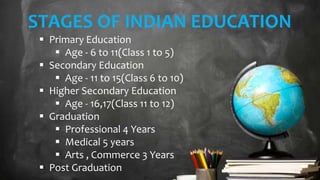
STAGES OF INDIAN EDUCATION
 Primary Education
 Age - 6 to 11(Class 1 to 5)
 Secondary Education
 Age - 11 to 15(Class 6 to 10)
 Higher Secondary Education
 Age - 16,17(Class 11 to 12)
 Graduation
 Professional 4 Years
 Medical 5 years
 Arts , Commerce 3 Years
 Post Graduation
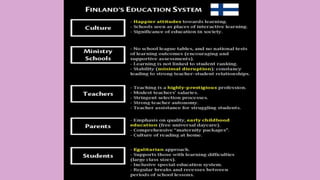
FINLAND’S EDUCATION SYSTEM
• Education in Finland is an education system with fully subsidised
meals served to full-time students.
• The present education system in Finland consists of day care
programmes(for babies and toddlers) and a one-year “pre-school”(or
kindergarten for six year-olds);a nine year compulsory basic
comprehensive school.
• Finland has consistently ranked high in the PISA study, which
compares national educational systems internationally, although in
the recent years Finland has been displaced from the very top.
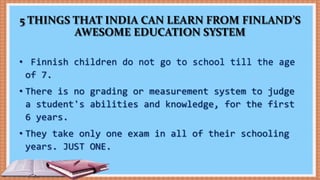
5 THINGS THAT INDIA CAN LEARN FROM FINLAND’S
AWESOME EDUCATION SYSTEM
• Finnish children do not go to school till the age
of 7.
• There is no grading or measurement system to judge
a student's abilities and knowledge, for the first
6 years.
• They take only one exam in all of their schooling
years. JUST ONE.
• And that's when they turn 16.
• Elementary school students only have 20 hours of classes per
week. That's 4 hours in a day. And rarely any homework!
DISTINCTION IN EDUCATION
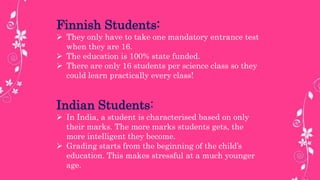
Finnish Students:
 They only have to take one mandatory entrance test
when they are 16.
 The education is 100% state funded.
 There are only 16 students per science class so they
could learn practically every class!
Indian Students:
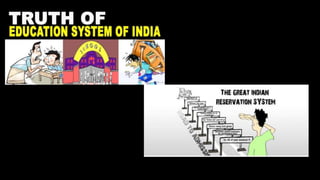
 In India, a student is characterised based on only
their marks. The more marks students gets, the
more intelligent they become.
 Grading starts from the beginning of the child’s
education. This makes stressful at a much younger
age.
Grading system in Finland Grading system in India
Education system India vs Finland

Education system India vs Finland

  • 1.
  • 3.
  • 4.
  • 5.
    STAGES OF INDIANEDUCATION  Primary Education  Age - 6 to 11(Class 1 to 5)  Secondary Education  Age - 11 to 15(Class 6 to 10)  Higher Secondary Education  Age - 16,17(Class 11 to 12)  Graduation  Professional 4 Years  Medical 5 years  Arts , Commerce 3 Years  Post Graduation
  • 8.
    FINLAND’S EDUCATION SYSTEM •Education in Finland is an education system with fully subsidised meals served to full-time students. • The present education system in Finland consists of day care programmes(for babies and toddlers) and a one-year “pre-school”(or kindergarten for six year-olds);a nine year compulsory basic comprehensive school. • Finland has consistently ranked high in the PISA study, which compares national educational systems internationally, although in the recent years Finland has been displaced from the very top.
  • 10.
    5 THINGS THATINDIA CAN LEARN FROM FINLAND’S AWESOME EDUCATION SYSTEM • Finnish children do not go to school till the age of 7. • There is no grading or measurement system to judge a student's abilities and knowledge, for the first 6 years. • They take only one exam in all of their schooling years. JUST ONE.
  • 11.
    • And that'swhen they turn 16. • Elementary school students only have 20 hours of classes per week. That's 4 hours in a day. And rarely any homework!
  • 12.
  • 13.
    Finnish Students:  Theyonly have to take one mandatory entrance test when they are 16.  The education is 100% state funded.  There are only 16 students per science class so they could learn practically every class! Indian Students:  In India, a student is characterised based on only their marks. The more marks students gets, the more intelligent they become.  Grading starts from the beginning of the child’s education. This makes stressful at a much younger age.
  • 14.
    Grading system inFinland Grading system in India