1203 Preservation Park Way, Suite 302 Oakland, CA 94612 | Tel: 510-268-1260 | schoolhealthcenters.org
SBHCs
(School-Based Health Centers)
101
May 2019
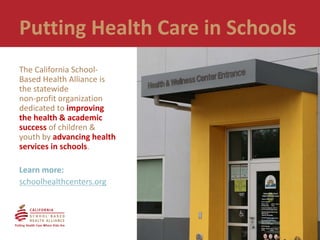
The California School-
Based Health Alliance is
the statewide
non-profit organization
dedicated to improving
the health & academic
success of children &
youth by advancing health
services in schools.
Learn more:
schoolhealthcenters.org
Putting Health Care in Schools
• Conference
registration discount
• Tools & resources
• Technical assistance
Sign up today:
bit.ly/CSHAmembership
Become a
member, get
exclusive benefits
WORKSHOP OBJECTIVES
Provide attendees with tools to:
• Build collaborations between school districts, health
providers and other community agencies
• Launch the first steps in SBHC planning process
• Use best practices in SBHC-school integration
PAIR AND SHARE
Introduce yourself to your neighbor and
share:
• What stage of SBHC development are you in…
Contemplating? Planning? Up & running?
Interested Partner?
• What are you hoping to learn today?
GO AROUND
Name, Role, Stage & Goal for today
WHAT IS A SCHOOL-BASED
HEALTH CENTER?
•Delivers primary medical care PLUS
•Located on or near a school campus
•Serves students and sometimes
siblings, family members, and the
community
•Promotes school-wide health
WHAT SERVICES ARE
PROVIDED?
WHO IS SERVED?
WHO RUNS SCHOOL-BASED
HEALTH CENTERS?
CONSIDERATIONS FOR
DEVELOPING SUSTAINABLE
SCHOOL-BASED HEALTH CARE
PROGRAMS
School-based health centers usually serve all students at a
school even if they are:
Uninsured
Enrolled in a insurance that does not reimburse the
school health center
Reimbursement rates do not often cover actual costs:
A significant portion of staff time is spent conducting education,
outreach, and case management that is not generally
reimbursable.
KEY STEPS IN PLANNING
• Create integrated planning process (with
youth & family input)
• Discuss why SBHC is needed (Conduct
Needs Assessment, gather data)
• Determine Best Model
KEY QUESTIONS
• Who will the SBHC serve
• Services & Staffing Model
• Facilities
• Funding Plan
• Coordination between agencies
•Local health department
•Community clinic
•Community/teaching hospital
•Mental health, substance
abuse, and social service
agencies
•Private physicians
•University faculty
•Elected officials
•Business and community
leaders
•Faith community
•School superintendent,
board, or designee
•School faculty and
administration
•Students
•Parents
Establish a Planning Committee:
Composition
CHKS survey
Free and reduced price lunch rates, Medi-Cal,
uninsured rates
County public health indicators
Attendance, dropout rates & School Discipline rates
Needs Assessment:
Existing data sources
• Peer Health Educators
• Peer Health Coaching
• Youth Advocacy
• Research Teams (CBPR)
• Youth Advisory Boards/Teams
Youth Engagement
Models
Consent & Confidentiality
HIPAA / FERPA
Clinic / SBHC Policies
Structure:
• Regular partner meeting
•Coordination of Services
Team (COST) meetings (referral
process and case
management)
Student Access:
• Create plan on how a
student would access
services from class.
• Is it physically
accessible?
• Do all teachers know
when to excuse?
Best Practices
SBHC PRINCIPLES
SBHCs deliver enhanced access by bringing health care directly to where students and
families are and conducting active school-based outreach to connect students with care.
SBHCs strengthen prevention and population health by connecting clinical care with
public health approaches such as group and classroom education, school wide
screenings and prevention programs, creation of healthier environments, or efforts to
address the social determinants of health.
SBHCs offer intensive support for the highest need students by being present on a daily
basis to manage chronic disease, address behavioral health issues, deal with crises, and
help students and families access resources.
SBHCs have a shared mission with the school to improve academic achievement by
working together to address absenteeism, school climate, classroom behavior, and
performance.
SBHCs are committed to functioning as part of an integrated health care system by
communicating and coordinating care with other providers, partners, and payers.
SCHOOL NURSE
Role:
• Care Coordinator
• Triage
• Liaison
• Champion
• Staff Educator
It is essential that the
school nurse is part of your
planning process from the
beginning!
SBHCS THRIVE ON
PARTNERSHIPS
• The best SBHCs are a result of a strong link
between the school district and clinic provider.
Other beneficial partners can include:
• Community-based organizations
• Municipalities
• County public health departments
• Mental health providers
• SBHCs work best when well integrated into the
school environment
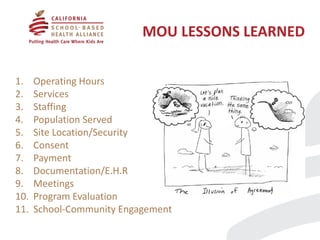
MOU LESSONS LEARNED
1. Operating Hours
2. Services
3. Staffing
4. Population Served
5. Site Location/Security
6. Consent
7. Payment
8. Documentation/E.H.R
9. Meetings
10. Program Evaluation
11. School-Community Engagement
WHAT MAKES SCHOOL-
BASED HEALTH CENTERS
EFFECTIVE?
Enhanced access to
health care
Stronger
prevention &
population health
Intensive support
for the highest
need students
Support for
school’s mission to
improve academic
achievement
Integration into the
health care system
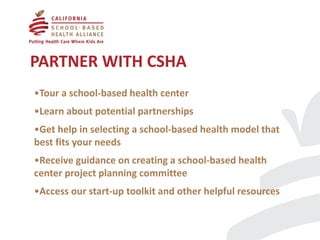
PARTNER WITH CSHA
•Tour a school-based health center
•Learn about potential partnerships
•Get help in selecting a school-based health model that
best fits your needs
•Receive guidance on creating a school-based health
center project planning committee
•Access our start-up toolkit and other helpful resources
schoolhealthcenters.org
info@schoolhealthcenters.org
schoolhealthcenters
sbh4ca
sbh4ca
STAY CONNECTED
1203 Preservation Park Way, Suite 302 Oakland, CA 94612 | Tel: 510-268-1260 | schoolhealthcenters.org
Amy Ranger
aranger@schoolhealthcenters.org
Rany

SBHCs 101

  • 1.
    1203 Preservation ParkWay, Suite 302 Oakland, CA 94612 | Tel: 510-268-1260 | schoolhealthcenters.org SBHCs (School-Based Health Centers) 101 May 2019
  • 2.
    The California School- BasedHealth Alliance is the statewide non-profit organization dedicated to improving the health & academic success of children & youth by advancing health services in schools. Learn more: schoolhealthcenters.org Putting Health Care in Schools
  • 3.
    • Conference registration discount •Tools & resources • Technical assistance Sign up today: bit.ly/CSHAmembership Become a member, get exclusive benefits
  • 4.
    WORKSHOP OBJECTIVES Provide attendeeswith tools to: • Build collaborations between school districts, health providers and other community agencies • Launch the first steps in SBHC planning process • Use best practices in SBHC-school integration
  • 5.
    PAIR AND SHARE Introduceyourself to your neighbor and share: • What stage of SBHC development are you in… Contemplating? Planning? Up & running? Interested Partner? • What are you hoping to learn today? GO AROUND Name, Role, Stage & Goal for today
  • 6.
    WHAT IS ASCHOOL-BASED HEALTH CENTER? •Delivers primary medical care PLUS •Located on or near a school campus •Serves students and sometimes siblings, family members, and the community •Promotes school-wide health
  • 8.
  • 9.
  • 10.
  • 11.
    CONSIDERATIONS FOR DEVELOPING SUSTAINABLE SCHOOL-BASEDHEALTH CARE PROGRAMS School-based health centers usually serve all students at a school even if they are: Uninsured Enrolled in a insurance that does not reimburse the school health center Reimbursement rates do not often cover actual costs: A significant portion of staff time is spent conducting education, outreach, and case management that is not generally reimbursable.
  • 12.
    KEY STEPS INPLANNING • Create integrated planning process (with youth & family input) • Discuss why SBHC is needed (Conduct Needs Assessment, gather data) • Determine Best Model
  • 13.
    KEY QUESTIONS • Whowill the SBHC serve • Services & Staffing Model • Facilities • Funding Plan • Coordination between agencies
  • 14.
    •Local health department •Communityclinic •Community/teaching hospital •Mental health, substance abuse, and social service agencies •Private physicians •University faculty •Elected officials •Business and community leaders •Faith community •School superintendent, board, or designee •School faculty and administration •Students •Parents Establish a Planning Committee: Composition
  • 15.
    CHKS survey Free andreduced price lunch rates, Medi-Cal, uninsured rates County public health indicators Attendance, dropout rates & School Discipline rates Needs Assessment: Existing data sources
  • 16.
    • Peer HealthEducators • Peer Health Coaching • Youth Advocacy • Research Teams (CBPR) • Youth Advisory Boards/Teams Youth Engagement Models
  • 17.
    Consent & Confidentiality HIPAA/ FERPA Clinic / SBHC Policies
  • 18.
    Structure: • Regular partnermeeting •Coordination of Services Team (COST) meetings (referral process and case management) Student Access: • Create plan on how a student would access services from class. • Is it physically accessible? • Do all teachers know when to excuse? Best Practices
  • 19.
    SBHC PRINCIPLES SBHCs deliverenhanced access by bringing health care directly to where students and families are and conducting active school-based outreach to connect students with care. SBHCs strengthen prevention and population health by connecting clinical care with public health approaches such as group and classroom education, school wide screenings and prevention programs, creation of healthier environments, or efforts to address the social determinants of health. SBHCs offer intensive support for the highest need students by being present on a daily basis to manage chronic disease, address behavioral health issues, deal with crises, and help students and families access resources. SBHCs have a shared mission with the school to improve academic achievement by working together to address absenteeism, school climate, classroom behavior, and performance. SBHCs are committed to functioning as part of an integrated health care system by communicating and coordinating care with other providers, partners, and payers.
  • 21.
    SCHOOL NURSE Role: • CareCoordinator • Triage • Liaison • Champion • Staff Educator It is essential that the school nurse is part of your planning process from the beginning!
  • 22.
    SBHCS THRIVE ON PARTNERSHIPS •The best SBHCs are a result of a strong link between the school district and clinic provider. Other beneficial partners can include: • Community-based organizations • Municipalities • County public health departments • Mental health providers • SBHCs work best when well integrated into the school environment
  • 23.
    MOU LESSONS LEARNED 1.Operating Hours 2. Services 3. Staffing 4. Population Served 5. Site Location/Security 6. Consent 7. Payment 8. Documentation/E.H.R 9. Meetings 10. Program Evaluation 11. School-Community Engagement
  • 24.
    WHAT MAKES SCHOOL- BASEDHEALTH CENTERS EFFECTIVE? Enhanced access to health care Stronger prevention & population health Intensive support for the highest need students Support for school’s mission to improve academic achievement Integration into the health care system
  • 25.
    PARTNER WITH CSHA •Toura school-based health center •Learn about potential partnerships •Get help in selecting a school-based health model that best fits your needs •Receive guidance on creating a school-based health center project planning committee •Access our start-up toolkit and other helpful resources
  • 26.
    schoolhealthcenters.org info@schoolhealthcenters.org schoolhealthcenters sbh4ca sbh4ca STAY CONNECTED 1203 PreservationPark Way, Suite 302 Oakland, CA 94612 | Tel: 510-268-1260 | schoolhealthcenters.org Amy Ranger aranger@schoolhealthcenters.org Rany