Black Swan Startups: Spotting
Tomorrow’s Big Digital Disruptors
An interview with
Transform to the power of digital
Saul Klein
Partner with Index Ventures
Saul Klein
PartnerwithIndexVentures
Saul Klein
The Rise of Big Bang
Disruptions
Could you give us an overview of
Index Ventures?
Index Ventures is an early-stage venture
capital firm, founded in 1996 with €3
billion under management across
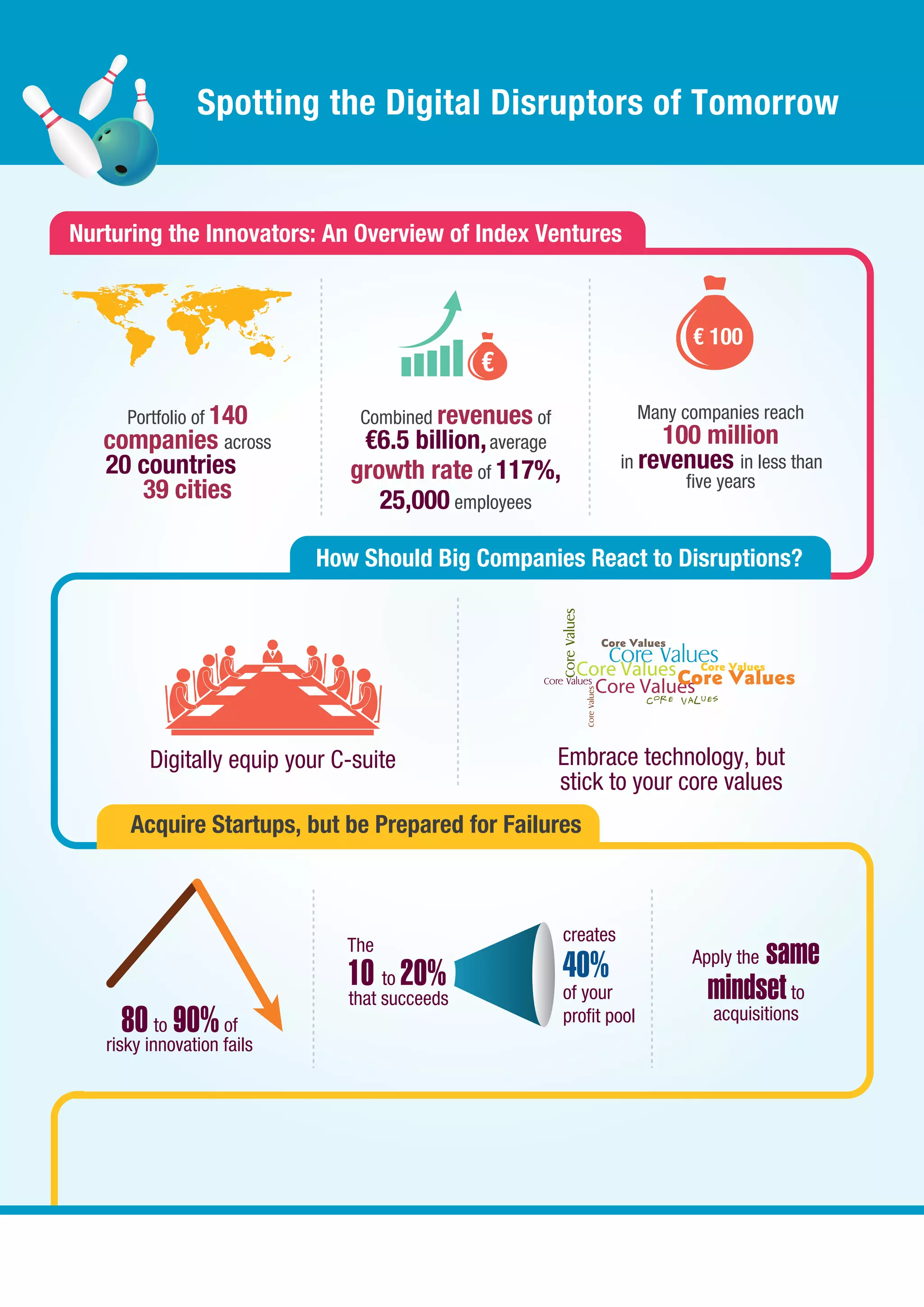
various funds. We have a portfolio of
140 companies across 20 countries and
39 cities, in almost all sectors where
technology is a disruptive force. The
combined revenues of these companies
amount to around €6.5 billion, with an
average growth rate of circa 117%, and
employing 25,000 people. Over just
the last 12 months, we have had 10
companies that have gone public or
exited at more than a billion dollars. They
include King, Criteo, Just Eat, Arista,
Climate Corporation and Supercell. Many
of our companies reach the 100 million
mark in revenue in less than five years.
Some of them are generating billions in
revenue in less than three years.
How do you assess the disruptive
potential of startups?
Well, there is never one specific thing.
Spotting disruption is like finding a black
swan. If it were that easy, everyone
would be able to do it. However, the
things that we look out for are: market
opportunity, strong leadership, and a
product that fundamentally changes
the customer experience within that
sector. The market and leadership team
are relatively easy to ascertain, but the
product or customer experience are
more difficult. In sector after sector,
we are looking for businesses that are
delivering a product that serves a real
need. But the mode of delivering that
need should change the dynamics of
the industry in a way that it becomes
hard for incumbents to compete.
You recently argued that it takes
less and less time to create $10
billion in value today. Does it mean
that we are now seeing more big
bang disruptions?
Yes, absolutely, we will see more
and more big bang disruptions. Let’s
be clear on one point – the Internet
changes everything. There are three
billion people connected to the Internet
with smart phones, which is going
to increase to nearly six billion in the
next five years. Until 10 years ago, the
Internet was only used by 300 million
people, mainly in the U.S. and Western
Europe. With the growing addressable
market, the opportunities are 10x, 20x,
or 50x bigger on the consumer side
than 10 years ago. On the enterprise
side, it used to take six to twelve months
to land a $1 million annual contract.
Today, you can get to 10,000 customers
with virtually no sales force. Also, until
a few years back, the customer base
of cloud computing and SaaS was the
Fortune 500. Today, it’s the Fortune
5 Million. Businesses are witnessing
customer growth and revenue growth at
extraordinary speeds.
The emergence of a new entrepreneurial
culture is certainly accentuating this
new wave of disruptions. We recently
conducted research and found that, on
Facebook, there are 55 million people
interested in entrepreneurship. This is
a huge number and not far from the
amount of people who are interested
in celebrities like Beyoncé or Ronaldo.
Peoplestartingtheirownbusinesseshas
become a mainstream phenomenon.
Becoming an entrepreneur is also
much more accessible: the tools of
production are now incredibly low-cost;
the distribution platforms – app stores
and social media – are often free; and
the ability to access capital through
platforms like crowdfunding is widely
and globally available.
Big Companies
Reacting to Digital
Disruptions
Why do you think big companies
are not well equipped to combat
disruption from startups?
I think there are a number of different
levels. Firstly, startups have a cost
base – OpEx and CapEx – that is
radically different from the incumbent.
Incumbents have high legacy cost
in everything from infrastructure to
IT. Trying to compete with someone
who has a lightweight or a cloud-
based cost base is difficult. Secondly,
Spotting disruption
is like finding a black
swan. If it were that
easy, everyone would be
able to do it.
very few incumbents have boards or
C-suites that are equipped with the
right digital skills compared to the
strong digital skills that startups have.
Finally, incumbents have profit pools
that they are perpetually trying to
protect, restricting their capacity for risk
taking. All these factors together put the
incumbent in a tough spot. Incumbents
have huge assets in terms of their
balance sheets, distribution channels
and human capital. However, unless
they are prepared to be aggressive and
take risks, it is very hard to compete.
Do you believe that big businesses
are not tech-savvy enough?
It is not that big companies do not take
tech seriously. Most big companies
spend over a billion dollars a year on
IT. Whether they spend it wisely or not
is a completely different matter. Big
companies do not get enough exposure
to the truly innovative technology and
business models that start-ups are
involved with. This is because big
companies focus on buying from big
companies, and not really engaging
with small companies. But before you
know it, these small companies are
actually pretty big, driving most of the
technology changes.
You also need a C-suite that really
understands technology. What
companies need is a board or a C-suite
that really challenges and critiques the
company’s IT/technology investments.
This is a board that would point to
the results achieved by startups and
question why their company cannot
emulate them. For example, they might
point to Adyen – a payments technology
firm – that can process billions of
transactions in 130 countries at much
lower cost. Or Instagram, which built
a global network of 400 million people
with 30 developers.
How do you think big companies
should react to disruption from
smaller, newer players?
It’s important for big companies to
think about what their core values are
and then think about how emerging
technologies – robotics, virtual reality,
AI, etc – could be incorporated to
their strategic advantage. One of the
reasons that big companies have been
in business for a long time is because
they have a set of values that has been
successful over time. Companies like
GE or Marks & Spencer – which have
been in business for over a hundred
years – have been successful because
they are consistent with their values.
Companies succeed best when they
are true to who they are, not when they
try and be something that they are not.
Is acquiring the disruptor a good
approach to fight back?
I think it absolutely needs to be a part
of the toolkit. However, companies have
not been great at doing that. When you
look at innovation, 80 to 90% of risky
innovation fails, but it is the 10 to 20%
that succeed that create 40% of your
profit pool. In the venture business, 62%
of the capital that you invest returns 1x
or below. So, let’s apply that thinking
to M&A. The wrong way to think about
M&A is that every acquisition I make
is going to succeed. The right way to
think of M&A is that some will succeed
and some will fail. I will significantly
overpay on some companies and I will
massively underpay on others. If Google
bought YouTube today, it would be $50
to 100 billion. They bought it at 1.6, and
everyone thought they were insane.
We see many big companies
investing in accelerators and
acquiring incubators. Do you
believe this is the right approach
to engage with the
startup ecosystem?
Big companies will truly engage with
the startup ecosystem when they
spend between 5% and 25% of their
tech and innovation budget with a small
company. Accelerators are nothing but
Corporate Social Responsibility. They
help big companies participate in the
ecosystem and gain visibility. However, it
means nothing until there is commercial
engagement that happens through
procurements and purchase orders.
Europe as a
Startup Hub
Is Europe catching up with the US
on the startup front?
It is clear that billion-dollar companies
now come from anywhere in the world
and not just from Silicon Valley. However,
it is much easier to be an enterprise
company in the Bay Area because big
companies in the Bay Area are earlier
adopters of new technology.
Very few incumbents
have boards or CXO
suites that are equipped
with the right
digital skills.
Saul Klein
We will see more
and more big bang
disruptions.
Saul Klein
The right way to think
of M&A is some will
succeed and some will
fail. I will significantly
overpay on some
companies and I will
massively underpay
on others.
The financial services
sector has an enormous
amount of potential
for disruption.
What can Europe learn from
countries like Israel regarding
startups and the tech ecosystem?
There are a lot of successful tech
ecosystems now in Europe. London
is probably the biggest, but you have
great ecosystems building in Berlin,
Stockholm, Dublin and Paris. However,
Israel is unique as it is almost akin
to a Silicon Valley to the rest of the
world. You have a diverse technology
ecosystem and strong infrastructure.
Within the space of an hour’s drive,
you can see the cutting-edge, including
ad:tech, cleantech, cybersecurity,
cloud computing, storage, networking,
semiconductors, e-commerce, and
consumer mobile. The density of the
Israeli ecosystem is unique when you
compare it with other markets and
locations beyond Silicon Valley. To create
an ecosystem, you need to look at the
specific attributes of the geographical
location. You want to see small
businesses, venture capital, universities,
governments, and big companies.
These are the five dimensions of an
ecosystem you need for fruitful cross-
pollination. Europe always had great
micro-centers of innovation, but they
were never effectively connected. This
is starting to change.
Looking Ahead
Which are the key startups to
watch for in 2015?
On the enterprise side you have
companies like Hortonworks in Big
Data, Pure Storage in the storage sector
or Dropbox in cloud computing, Adyen
in financial services, and LookOut in
mobile security. Then you have some
really interesting consumer businesses,
like BlaBlaCar, Etsy and SoundCloud.
The list is endless. In every sector and
geography there are 5 or 10 companies
that are poised to break out and go
mainstream.
In terms of sectors, which ones
are going to suffer most from
disruption in the next year?
All sectors that have been disrupted will
be disrupted again because of mobile
and social. Media & entertainment, retail
and travel have been disrupted once,
and they are going to get repeatedly
disrupted again. The financial services
sector also has an enormous amount of
potential for disruption. No one will be
exempt!
Spotting the Digital Disruptors of Tomorrow
Rightshore®
is a trademark belonging to Capgemini
CapgeminiConsultingistheglobalstrategyandtransformation
consulting organization of the Capgemini Group, specializing
in advising and supporting enterprises in significant
transformation, from innovative strategy to execution and with
an unstinting focus on results. With the new digital economy
creating significant disruptions and opportunities, our global
team of over 3,600 talented individuals work with leading
companies and governments to master Digital Transformation,
drawing on our understanding of the digital economy and
our leadership in business transformation and organizational
change.
Find out more at:
http://www.capgemini-consulting.com/
With more than 140,000 people in over 40 countries, Capgemini
is one of the world’s foremost providers of consulting,
technology and outsourcing services. The Group reported 2013
global revenues of EUR 10.1 billion. Together with its clients,
Capgemini creates and delivers business and technology
solutions that fit their needs and drive the results they want. A
deeply multicultural organization, Capgemini has developed its
own way of working, the Collaborative Business ExperienceTM,
and draws on Rightshore®
, its worldwide delivery model.
Learn more about us
at www.capgemini.com.
About Capgemini
Capgemini Consulting is the strategy and transformation consulting brand of Capgemini Group. The information contained in this document is proprietary.
© 2015 Capgemini. All rights reserved.
Partner with Index Ventures
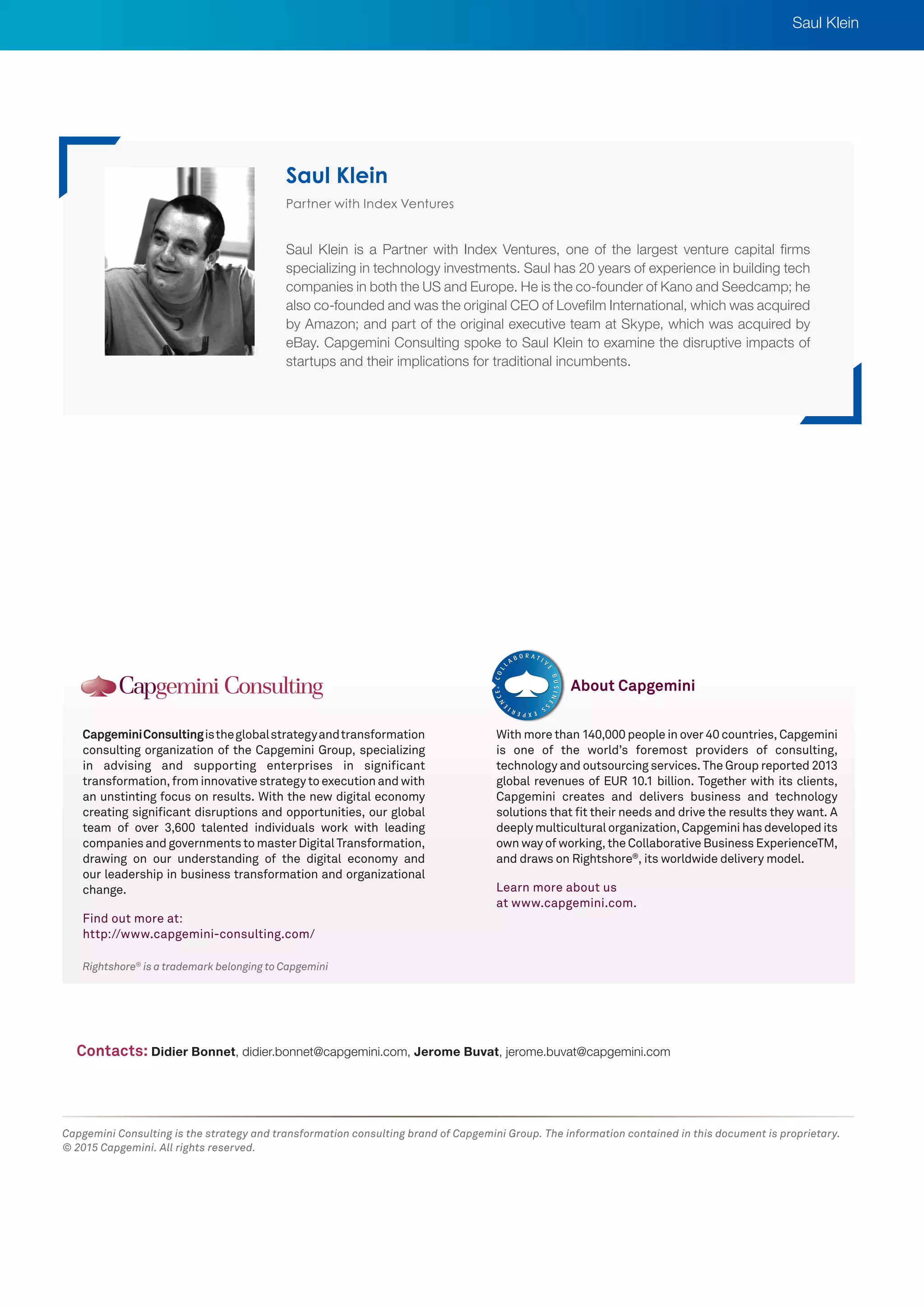
Saul Klein is a Partner with Index Ventures, one of the largest venture capital firms
specializing in technology investments. Saul has 20 years of experience in building tech
companies in both the US and Europe. He is the co-founder of Kano and Seedcamp; he
also co-founded and was the original CEO of Lovefilm International, which was acquired
by Amazon; and part of the original executive team at Skype, which was acquired by
eBay. Capgemini Consulting spoke to Saul Klein to examine the disruptive impacts of
startups and their implications for traditional incumbents.
Saul Klein
Contacts: Didier Bonnet, didier.bonnet@capgemini.com, Jerome Buvat, jerome.buvat@capgemini.com
Saul Klein

DIGITAL LEADERSHIP: An interview with Saul Klein Partner with Index Ventures

  • 1.
    Black Swan Startups:Spotting Tomorrow’s Big Digital Disruptors An interview with Transform to the power of digital Saul Klein Partner with Index Ventures
  • 2.
    Saul Klein PartnerwithIndexVentures Saul Klein TheRise of Big Bang Disruptions Could you give us an overview of Index Ventures? Index Ventures is an early-stage venture capital firm, founded in 1996 with €3 billion under management across various funds. We have a portfolio of 140 companies across 20 countries and 39 cities, in almost all sectors where technology is a disruptive force. The combined revenues of these companies amount to around €6.5 billion, with an average growth rate of circa 117%, and employing 25,000 people. Over just the last 12 months, we have had 10 companies that have gone public or exited at more than a billion dollars. They include King, Criteo, Just Eat, Arista, Climate Corporation and Supercell. Many of our companies reach the 100 million mark in revenue in less than five years. Some of them are generating billions in revenue in less than three years. How do you assess the disruptive potential of startups? Well, there is never one specific thing. Spotting disruption is like finding a black swan. If it were that easy, everyone would be able to do it. However, the things that we look out for are: market opportunity, strong leadership, and a product that fundamentally changes the customer experience within that sector. The market and leadership team are relatively easy to ascertain, but the product or customer experience are more difficult. In sector after sector, we are looking for businesses that are delivering a product that serves a real need. But the mode of delivering that need should change the dynamics of the industry in a way that it becomes hard for incumbents to compete. You recently argued that it takes less and less time to create $10 billion in value today. Does it mean that we are now seeing more big bang disruptions? Yes, absolutely, we will see more and more big bang disruptions. Let’s be clear on one point – the Internet changes everything. There are three billion people connected to the Internet with smart phones, which is going to increase to nearly six billion in the next five years. Until 10 years ago, the Internet was only used by 300 million people, mainly in the U.S. and Western Europe. With the growing addressable market, the opportunities are 10x, 20x, or 50x bigger on the consumer side than 10 years ago. On the enterprise side, it used to take six to twelve months to land a $1 million annual contract. Today, you can get to 10,000 customers with virtually no sales force. Also, until a few years back, the customer base of cloud computing and SaaS was the Fortune 500. Today, it’s the Fortune 5 Million. Businesses are witnessing customer growth and revenue growth at extraordinary speeds. The emergence of a new entrepreneurial culture is certainly accentuating this new wave of disruptions. We recently conducted research and found that, on Facebook, there are 55 million people interested in entrepreneurship. This is a huge number and not far from the amount of people who are interested in celebrities like Beyoncé or Ronaldo. Peoplestartingtheirownbusinesseshas become a mainstream phenomenon. Becoming an entrepreneur is also much more accessible: the tools of production are now incredibly low-cost; the distribution platforms – app stores and social media – are often free; and the ability to access capital through platforms like crowdfunding is widely and globally available. Big Companies Reacting to Digital Disruptions Why do you think big companies are not well equipped to combat disruption from startups? I think there are a number of different levels. Firstly, startups have a cost base – OpEx and CapEx – that is radically different from the incumbent. Incumbents have high legacy cost in everything from infrastructure to IT. Trying to compete with someone who has a lightweight or a cloud- based cost base is difficult. Secondly, Spotting disruption is like finding a black swan. If it were that easy, everyone would be able to do it.
  • 3.
    very few incumbentshave boards or C-suites that are equipped with the right digital skills compared to the strong digital skills that startups have. Finally, incumbents have profit pools that they are perpetually trying to protect, restricting their capacity for risk taking. All these factors together put the incumbent in a tough spot. Incumbents have huge assets in terms of their balance sheets, distribution channels and human capital. However, unless they are prepared to be aggressive and take risks, it is very hard to compete. Do you believe that big businesses are not tech-savvy enough? It is not that big companies do not take tech seriously. Most big companies spend over a billion dollars a year on IT. Whether they spend it wisely or not is a completely different matter. Big companies do not get enough exposure to the truly innovative technology and business models that start-ups are involved with. This is because big companies focus on buying from big companies, and not really engaging with small companies. But before you know it, these small companies are actually pretty big, driving most of the technology changes. You also need a C-suite that really understands technology. What companies need is a board or a C-suite that really challenges and critiques the company’s IT/technology investments. This is a board that would point to the results achieved by startups and question why their company cannot emulate them. For example, they might point to Adyen – a payments technology firm – that can process billions of transactions in 130 countries at much lower cost. Or Instagram, which built a global network of 400 million people with 30 developers. How do you think big companies should react to disruption from smaller, newer players? It’s important for big companies to think about what their core values are and then think about how emerging technologies – robotics, virtual reality, AI, etc – could be incorporated to their strategic advantage. One of the reasons that big companies have been in business for a long time is because they have a set of values that has been successful over time. Companies like GE or Marks & Spencer – which have been in business for over a hundred years – have been successful because they are consistent with their values. Companies succeed best when they are true to who they are, not when they try and be something that they are not. Is acquiring the disruptor a good approach to fight back? I think it absolutely needs to be a part of the toolkit. However, companies have not been great at doing that. When you look at innovation, 80 to 90% of risky innovation fails, but it is the 10 to 20% that succeed that create 40% of your profit pool. In the venture business, 62% of the capital that you invest returns 1x or below. So, let’s apply that thinking to M&A. The wrong way to think about M&A is that every acquisition I make is going to succeed. The right way to think of M&A is that some will succeed and some will fail. I will significantly overpay on some companies and I will massively underpay on others. If Google bought YouTube today, it would be $50 to 100 billion. They bought it at 1.6, and everyone thought they were insane. We see many big companies investing in accelerators and acquiring incubators. Do you believe this is the right approach to engage with the startup ecosystem? Big companies will truly engage with the startup ecosystem when they spend between 5% and 25% of their tech and innovation budget with a small company. Accelerators are nothing but Corporate Social Responsibility. They help big companies participate in the ecosystem and gain visibility. However, it means nothing until there is commercial engagement that happens through procurements and purchase orders. Europe as a Startup Hub Is Europe catching up with the US on the startup front? It is clear that billion-dollar companies now come from anywhere in the world and not just from Silicon Valley. However, it is much easier to be an enterprise company in the Bay Area because big companies in the Bay Area are earlier adopters of new technology. Very few incumbents have boards or CXO suites that are equipped with the right digital skills. Saul Klein We will see more and more big bang disruptions.
  • 4.
    Saul Klein The rightway to think of M&A is some will succeed and some will fail. I will significantly overpay on some companies and I will massively underpay on others. The financial services sector has an enormous amount of potential for disruption. What can Europe learn from countries like Israel regarding startups and the tech ecosystem? There are a lot of successful tech ecosystems now in Europe. London is probably the biggest, but you have great ecosystems building in Berlin, Stockholm, Dublin and Paris. However, Israel is unique as it is almost akin to a Silicon Valley to the rest of the world. You have a diverse technology ecosystem and strong infrastructure. Within the space of an hour’s drive, you can see the cutting-edge, including ad:tech, cleantech, cybersecurity, cloud computing, storage, networking, semiconductors, e-commerce, and consumer mobile. The density of the Israeli ecosystem is unique when you compare it with other markets and locations beyond Silicon Valley. To create an ecosystem, you need to look at the specific attributes of the geographical location. You want to see small businesses, venture capital, universities, governments, and big companies. These are the five dimensions of an ecosystem you need for fruitful cross- pollination. Europe always had great micro-centers of innovation, but they were never effectively connected. This is starting to change. Looking Ahead Which are the key startups to watch for in 2015? On the enterprise side you have companies like Hortonworks in Big Data, Pure Storage in the storage sector or Dropbox in cloud computing, Adyen in financial services, and LookOut in mobile security. Then you have some really interesting consumer businesses, like BlaBlaCar, Etsy and SoundCloud. The list is endless. In every sector and geography there are 5 or 10 companies that are poised to break out and go mainstream. In terms of sectors, which ones are going to suffer most from disruption in the next year? All sectors that have been disrupted will be disrupted again because of mobile and social. Media & entertainment, retail and travel have been disrupted once, and they are going to get repeatedly disrupted again. The financial services sector also has an enormous amount of potential for disruption. No one will be exempt!
  • 5.
    Spotting the DigitalDisruptors of Tomorrow
  • 6.
    Rightshore® is a trademarkbelonging to Capgemini CapgeminiConsultingistheglobalstrategyandtransformation consulting organization of the Capgemini Group, specializing in advising and supporting enterprises in significant transformation, from innovative strategy to execution and with an unstinting focus on results. With the new digital economy creating significant disruptions and opportunities, our global team of over 3,600 talented individuals work with leading companies and governments to master Digital Transformation, drawing on our understanding of the digital economy and our leadership in business transformation and organizational change. Find out more at: http://www.capgemini-consulting.com/ With more than 140,000 people in over 40 countries, Capgemini is one of the world’s foremost providers of consulting, technology and outsourcing services. The Group reported 2013 global revenues of EUR 10.1 billion. Together with its clients, Capgemini creates and delivers business and technology solutions that fit their needs and drive the results they want. A deeply multicultural organization, Capgemini has developed its own way of working, the Collaborative Business ExperienceTM, and draws on Rightshore® , its worldwide delivery model. Learn more about us at www.capgemini.com. About Capgemini Capgemini Consulting is the strategy and transformation consulting brand of Capgemini Group. The information contained in this document is proprietary. © 2015 Capgemini. All rights reserved. Partner with Index Ventures Saul Klein is a Partner with Index Ventures, one of the largest venture capital firms specializing in technology investments. Saul has 20 years of experience in building tech companies in both the US and Europe. He is the co-founder of Kano and Seedcamp; he also co-founded and was the original CEO of Lovefilm International, which was acquired by Amazon; and part of the original executive team at Skype, which was acquired by eBay. Capgemini Consulting spoke to Saul Klein to examine the disruptive impacts of startups and their implications for traditional incumbents. Saul Klein Contacts: Didier Bonnet, didier.bonnet@capgemini.com, Jerome Buvat, jerome.buvat@capgemini.com Saul Klein