A guide to RSSB


Supporting continuous improvement in the GB railway industry
Contents


 3   RSSB underpinning knowledge based decision-making

 4   RSSB and co-operation in the railway industry

 5   Our members

 7   Safety data & intelligence

 9   Research & development

10   Co-operative programmes

13   Interface standards

15   The future
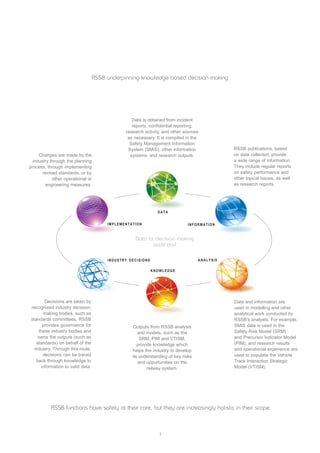
RSSB underpinning knowledge based decision-making


                                                  Data is obtained from incident
                                                  reports, confidential reporting,
                                               research activity, and other sources
                                                as necessary. It is compiled in the
                                                 Safety Management Information
                                                System (SMIS), other information              RSSB publications, based
     Changes are made by the                     systems, and research outputs.               on data collected, provide
  industry through the planning                                                               a wide range of information.
process, through implementing                                                                 They include regular reports
       revised standards, or by                                                               on safety performance and
            other operational or                                                              other topical issues, as well
        engineering measures.                                                                 as research reports.


                                                               DATA


                                        IMPLEMENTATION                       INFORMATION


                                                   Data to decision-making
                                                          audit trail

                                        INDUSTRY DECISIONS                         ANALYSIS

                                                             KNOWLEDGE


        Decisions are taken by                                                                Data and information are
 recognised industry decision-                                                                used in modelling and other
       making bodies, such as                                                                 analytical work conducted by
 standards committees. RSSB                                                                   RSSB’s analysts. For example,
       provides governance for                     Outputs from RSSB analysis                 SMIS data is used in the
     these industry bodies and                       and models, such as the                  Safety Risk Model (SRM)
     owns the outputs (such as                        SRM, PIM and VTISM,                     and Precursor Indicator Model
    standards) on behalf of the                      provide knowledge which                  (PIM), and research results
   industry. Through this route,                  helps the industry to develop               and operational experience are
       decisions can be traced                    its understanding of key risks              used to populate the Vehicle
    back through knowledge to                        and opportunities on the                 Track Interaction Strategic
      information to valid data.                          railway system.                     Model (VTISM).


           RSSB functions have safety at their core, but they are increasingly holistic in their scope


                                                                3
RSSB and co-operation
in the railway industry
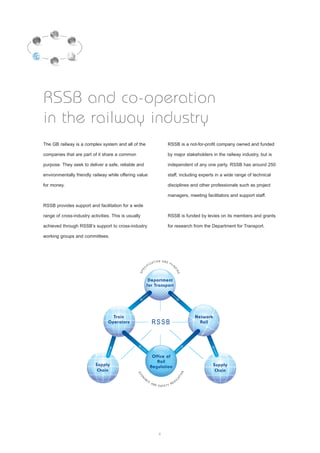
The GB railway is a complex system and all of the                                    RSSB is a not-for-profit company owned and funded

companies that are part of it share a common                                         by major stakeholders in the railway industry, but is

purpose. They seek to deliver a safe, reliable and                                   independent of any one party. RSSB has around 250

environmentally friendly railway while offering value                                staff, including experts in a wide range of technical

for money.                                                                           disciplines and other professionals such as project

                                                                                     managers, meeting facilitators and support staff.

RSSB provides support and facilitation for a wide

range of cross-industry activities. This is usually                                  RSSB is funded by levies on its members and grants

achieved through RSSB’s support to cross-industry                                    for research from the Department for Transport.

working groups and committees.


                                                                               ON AND
                                                                        AT I          FU
                                                                   IC
                                                              IF                           N
                                                          C
                                                                                           DI
                                                      E


                                                                                               NG
                                                  SP


                                                               Department
                                                              for Transport


                                    Train                                                                Network
                                  Operators                             RSSB                               Rail


                                                                    Office of
                                                                      Rail
                           Supply                                  Regulation                                      Supply
                            Chain                                                                                   Chain
                                                                                                    ON
                                                 EC


                                                                                                    TI
                                                  O


                                                      O
                                                      N


                                                                                               LA


                                                          M
                                                              IC
                                                                                       E       GU
                                                                    AN
                                                                          D S AFE TY R


                                                                                4
Our members
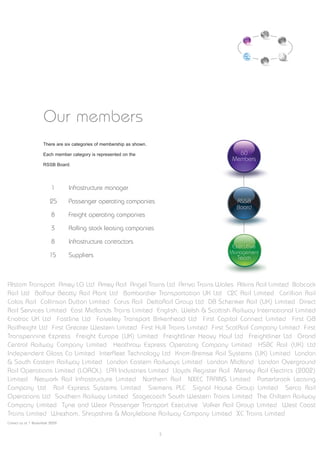
                     There are six categories of membership as shown.

                     Each member category is represented on the                 60
                                                                              Members
                     RSSB Board.


                         1      Infrastructure manager

                         25     Passenger operating companies                   RSSB
                                                                                Board
                         8      Freight operating companies

                         3      Rolling stock leasing companies

                         8      Infrastructure contractors
                                                                              Executive
                                                                             Management
                        15      Suppliers                                       Team


Alstom Transport Amey LG Ltd Amey Rail Angel Trains Ltd Arriva Trains Wales Atkins Rail Limited Babcock
Rail Ltd Balfour Beatty Rail Plant Ltd Bombardier Transportation UK Ltd C2C Rail Limited Carillion Rail
Colas Rail Collinson Dutton Limited Corus Rail DeltaRail Group Ltd DB Schenker Rail (UK) Limited Direct
Rail Services Limited East Midlands Trains Limited English, Welsh & Scottish Railway International Limited
Enotrac UK Ltd Fastline Ltd Faiveley Transport Birkenhead Ltd First Capital Connect Limited First GB
Railfreight Ltd First Greater Western Limited First Hull Trains Limited First ScotRail Company Limited First
Transpennine Express Freight Europe (UK) Limited Freightliner Heavy Haul Ltd Freightliner Ltd Grand
Central Railway Company Limited Heathrow Express Operating Company Limited HSBC Rail (UK) Ltd
Independent Glass Co Limited Interfleet Technology Ltd Knorr-Bremse Rail Systems (UK) Limited London
& South Eastern Railway Limited London Eastern Railways Limited London Midland London Overground
Rail Operations Limited (LOROL) LPA Industries Limited Lloyds Register Rail Mersey Rail Electrics (2002)
Limited Network Rail Infrastructure Limited Northern Rail NXEC TRAINS Limited Porterbrook Leasing
Company Ltd Rail Express Systems Limited Siemens PLC Signal House Group Limited Serco Rail
Operations Ltd Southern Railway Limited Stagecoach South Western Trains Limited The Chiltern Railway
Company Limited Tyne and Wear Passenger Transport Executive Volker Rail Group Limited West Coast
Trains Limited Wrexham, Shropshire & Marylebone Railway Company Limited XC Trains Limited
Correct as at 1 November 2009


                                                                        5
20
                                         18                                 1 6 .9 %                      1 5 .3 %                    ju ri e s
                                                                            %                                        w e ig h te d in
                                                                     1 5 .5
                                         16
                                                                                                  1 2 .4 %            fa ta li ti e s
                                          14
                                                        1 2 .5 %                       11 .0 %
                                          12
                                              10                   8 .8 %
                                               8                                                 5 .8 %

                                               6
                                                   4
                                                   2


                                                                  2008
                                                                  2007
                                                   0
                                                                 2006
                                                                 2005
                                                                2004
                                                                2003
                                                               2002
                                                               2001


[DATA COLLECTION]


                                                                                                                                  ATOC


19 collisions between trains and road vehicles at level crossings in 2008
(mainly as a result of road users’ behaviour),         the highest level since 2003

                     THERE ARE APPROXIMATELY 7,000 LEVEL CROSSINGS ON THE GB MAINLINE RAILWAY


                                     6
Safety data                                       &     intelligence
While individual organisations are accountable for                           These models provide members with an

safety within their own undertakings, RSSB plays                             understanding of the risks to passengers, workforce

a key role in the management of system safety.                               and the general public and contribute significantly to

RSSB’s core functions include measuring safety                               improved performance across the industry.

performance and analysing risk.
                                                                             140

                                                                             120
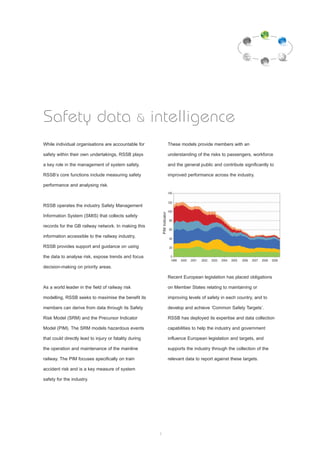
RSSB operates the industry Safety Management
                                                                             100
                                                             PIM Indicator


Information System (SMIS) that collects safety
                                                                              80
records for the GB railway network. In making this
                                                                              60

information accessible to the railway industry,                               40

RSSB provides support and guidance on using                                   20

the data to analyse risk, expose trends and focus                              0
                                                                               1999   2000   2001   2002   2003   2004   2005   2006   2007   2008   2009

decision-making on priority areas.

                                                                             Recent European legislation has placed obligations

As a world leader in the field of railway risk                               on Member States relating to maintaining or

modelling, RSSB seeks to maximise the benefit its                            improving levels of safety in each country, and to

members can derive from data through its Safety                              develop and achieve ‘Common Safety Targets’.

Risk Model (SRM) and the Precursor Indicator                                 RSSB has deployed its expertise and data collection

Model (PIM). The SRM models hazardous events                                 capabilities to help the industry and government

that could directly lead to injury or fatality during                        influence European legislation and targets, and

the operation and maintenance of the mainline                                supports the industry through the collection of the

railway. The PIM focuses specifically on train                               relevant data to report against these targets.

accident risk and is a key measure of system

safety for the industry.


                                                         7
77
         %
            ris                                                                                                      r
  wo     fro k                                                                                             from viou
be rkfor m                                        CE                                                   risk r beha
  ha
     vio ce                           F
                                          O
                                              R
                                                                                                  48% enge
                                                                                                       s
        ur                        K
                                                                                                   pas
                            R
                        WO


                                                                               TO


                                                   %
                                              21        SK
                                                                                 PAS


                                                   RI
                       TO


                                                                        %
                                                                   39    SK
                                                                                 SENGE


   1%
                                                                    RI                                30 % ris k fro m
   2%
                                                                                                      wo rkf orc e be ha vio ur
                     TO P


                                                         %
                                                    40        SK
                                                                                       R


                                                         RI
                                                                                 S
                          UB


                                                                                                   17%
                             LI


                             C
                                                                                                 pub risk
                                                                                                       lic    f
                                                                                             5%            beh rom
                                                                                           en ri              avi
                                                                                                                  our
                                                                                             gi sk
                                                                                               ne fr
                                                                                                 er om
                                                                                                   in
                         beh k from


                                                                                                      g
                                our
                            avi
                            s
                  pub 7% ri
                     lic
                      9


                                                                                      [OPERATIONAL RISK ANALYSIS]


                                                                                                                                                                 ATOC


                                                                            5 passenger fatalities in 2008, the lowest number ever recorded

                                                                                    YEARLY PASSENGER JOURNEYS CONTINUE TO RISE , LATEST FIGURE : 1.2 BILLION JOURNEYS


                                                                                                               8
Research                             &      development
RSSB manages two industry-wide research and                   the technical strategy advisory group, which consists

development programmes, both of which are DfT                 of senior industry, academic, government and

funded – a programme that supports long-term                  regulatory representatives, facilitated by RSSB.

strategy and a core programme that supports many              It has delivered a ‘road map’ which shows the

aspects of operations. RSSB undertakes research               contribution that different applications can make

projects that cross industry boundaries or interfaces.        to the 30-year vision.


The core programme has a broad capability and                 The research that RSSB undertakes for the industry

expertise in areas such as engineering, operations,           is a part of the overall RSSB support to operations

human factors, risk, workforce development,                   and the delivery of industry objectives. Research

occupational health, sustainable development and              outputs add value to the industry through providing

public behaviour. It works with client groups from            answers to questions, evidence to support decisions,

across the industry to deliver solutions to current and       tools that support ongoing operations etc. In all cases

future challenges and the evidence base to support            the research is not an end in itself, and it is only

complex or controversial industry decisions.                  through engagement with the wider industry

                                                              at both inception and completion that the fruits of

With government support the core programme                    research can be embedded and add value. The

has been supplemented with a new strategic                    effectiveness of the research depends on

programme, to support the development and                     considerable input from across industry through

implementation of the Rail Technical Strategy. The            involvement in client groups and research

strategy, which includes a vision of the railways in          projects themselves.

30 years’ time, has the primary objective of helping

the industry achieve challenging long-term goals              The RSSB website received 500,000 requests for

associated with customers, carbon, capacity and               research reports in 2008.

cost (the 4 Cs). The programme has a single client,


                                                          9
Co-operative programmes
RSSB’s functions are interdependent and combine to

deliver a package of services to the industry. For

example, both research and risk modelling inform the

development of interface standards; and safety data

and intelligence are used to support the industry’s

efforts on community safety. These synergies add to

the economic efficiency of RSSB’s delivery of each of

them, and provide the company with the necessary                 Each SIC involves senior people from all parts of

critical mass to deliver coherent solutions.                     the industry and both sides of the interface. The

                                                                 SIC looks for opportunities to improve efficiency at

As a result, RSSB has become the natural home for a              the interface, considers how the industry can best

range of cross-industry activities. RSSB facilitates five        respond to those opportunities, and promotes

System Interface Committees (SICs), which help the               agreement on how solutions can be implemented.

industry to manage all aspects of system interfaces in

the most effective way. The interfaces covered by the            The Sustainable Rail Programme (SRP) is helping

five SICs are:                                                   the industry to respond to the opportunities and

•    Vehicle / Structures                                        challenges presented by sustainable development.

•    Vehicle / Track

•    Vehicle / Train energy                                      RSSB’s engineering and operations knowledge,

•    Vehicle / Train control and communications                  together with its experience of managing standards,

•    Vehicle / Vehicle.                                          has resulted in the company providing substantial

                                                                 input to the cross-industry programme, led by

                                                                 Network Rail, to deliver the European Rail Traffic

                                                                 Management System (ERTMS).


                                                            10
Through its Safety Management System (SMS)                     In 2008 RSSB took on responsibility for the industry’s

initiative, RSSB supports and facilitates the efficient        Confidential Incident Reporting and Analysis System

implementation of British and European legislation in          (CIRAS), which reflects RSSB’s existing knowledge

the field of safety management. RSSB also supports             and experience of managing programmes as well as

the industry’s efforts to modernise its supplier               its expertise in safety and human factors.

assurance regimes through the provision and

promotion of the Railway Industry Supplier Approval

Scheme (RISAS).


                                                               The aim of the industry’s work on community safety

                                                               is to maintain and build public confidence in personal

                                                               safety and security while people travel on trains or

RSSB also sponsors the online National Incident                use railway facilities, and to protect the interests of

Reporting system that helps maintain the safety of             the industry and its workforce. Much of the industry’s

the railway network, by providing a platform for rail          work on community safety is carried out at local level

companies to communicate important information                 by individual companies and by collaborative effort

concerning safety incidents in real time. Recognised           through Community Safety Partnership Groups

as the leading such system in the country, it records          (CSPGs). RSSB works at the industry level to

details of remedial action taken by affected                   support these local initiatives with the resources

companies in response to the original incident and             they need.

so builds a history of events and actions taken.


                                                          11
[PERFORMANCE MONITORING]


                                                                                                 50 0


                                                                                                    40 0


                                                                                                    30 0
                                                                                                    29 7    NUM BER OF   SPAD S


                                                                                                     20 0


                                                                                                     10 0

                                                                                                      11. 34 %   RIS K LEV EL


                                                                                                       0
                                                                                         JUN E 09
                                                                                          MA R 09
                                                                                          DE C 08
                                                                                         SE PT 08
                                                                              JUN E 08
                                                                               MA R 08
                                                                               DE C 07
                                                                   SE PT 07
                                                                    JUN 07
                                                                   MA R 07
                                                         DE C 06
                                                        SE PT 06
                                                        JUN E 06
                                              MA R 06
                                              DE C 05
                                             SE PT 05
                                  JUN E 05
                                   MA R 05
                                   DE C 04
                       SE PT 04
                        JUN 04
                       MA R 04
                       DE C 03
                      SE PT 03
           JUN E 03
            MA R 03
            DE C 02
           SE PT 02
JUN E 02
 MA R 02
 DE C 01
SE PT 01


                                                                                                                                  Network Rail


                                       More than    80%        reduction in risk from signals passed at danger in 2008 since 2001


                                                                        BRITAIN ’ S RAILWAY NETWORK COMPRISES OVER 21,000 TRACK MILES


                                                                       12
Interface standards
Railway Group Standards (RGSs) are documents                  Since the enactment in UK legislation of the

that define mandatory engineering and operational             European directives on safety and interoperability,

requirements in respect of the mainline railway. The          the European standards regime, based on Technical

central purpose of RGSs is to enable the different            Specifications for Interoperability (TSIs), has become

participants in the industry to co-operate safely and         increasingly important for the GB mainline railway.

efficiently where they need to do so, without having          RSSB’s role in managing RGSs has led to it playing

to reinvent the basis of that co-operation every time.        an important part in European standards –

                                                              particularly in achieving clarity about how to work

Compliance with RGSs is mandatory, through licence            with TSIs and in co-ordinating input to the

conditions, and the content of each RGS is                    development of the TSIs themselves.

developed and agreed by the GB railway industry,

through Standards Committees facilitated by RSSB.

RSSB’s role includes drafting the content of

standards and assessing their impact, as well as

managing meetings, carrying out consultations, and

publishing the standards themselves.


                                                         13
RSSB   will continue to develop its services to meet the changing needs of its members


                           14
The future
RSSB will continue to support the industry’s efforts to              published ‘Sustainable Development Principles’ as

improve safety while significantly reducing costs and                listed below. The SD Principles represent core values

in its drive towards being the backbone of a modern                  that are fundamental to the delivery of a sustainable

and sustainable integrated transport system. In order                railway that meets the travel needs of society without

to achieve this RSSB will seek to assist the industry                compromising future quality of life.

in embedding, in everything it does, the recently


Customer-driven Embed a culture where dialogue with                      Carbon smart Pursue initiatives to achieve long-term
customers puts them at the very heart of the railway,                    reductions in carbon emissions through improved energy
and where they are able to make optimal travel and                       efficiency, new technology and lower carbon power
logistics choices.                                                       sources and facilitate modal shift, helping others make
                                                                         more carbon efficient journeys.
Putting rail in reach of people Position rail as an
inclusive, affordable and accessible transport system through            Energy wise Maximise rail’s energy efficiency for
the provision of information and accessible facilities.                  traction and non-traction use.

Providing an end-to-end journey Work together with all                   Supporting the economy Boost the productivity and
transport modes to provide an integrated, accessible                     competitiveness of the UK, at a national and regional level,
transport system.                                                        through the provision of efficient passenger and freight
                                                                         services and by facilitating agglomeration and catalysing
Being an employer of choice Respect, encourage and                       economic regeneration.
develop a diverse workforce, support its wellbeing and
actively consider and address the challenges of the future               Optimising the railway Maximise the rail system’s
global labour market.                                                    capability and build on its strengths to deliver a transport
                                                                         system that is efficient and offers good value for money.
Reducing our environmental impact Operate and
improve the business in a way that minimises the negative                Being transparent Promote a culture of open and
impacts and maximises the benefits of the railway to                     accountable decision-making and measure, monitor and
the environment.                                                         report publicly on our progress toward sustainability.


                                                                15
RSSB
Block 2
Angel Square
1 Torrens Street
London EC1V 1NY

Tel. +44 (0)20 3142 5300
enquirydesk@rssb.co.uk


www.rssb.co.uk

A guide to RSSB

  • 1.
    A guide toRSSB Supporting continuous improvement in the GB railway industry
  • 2.
    Contents 3 RSSB underpinning knowledge based decision-making 4 RSSB and co-operation in the railway industry 5 Our members 7 Safety data & intelligence 9 Research & development 10 Co-operative programmes 13 Interface standards 15 The future
  • 3.
    RSSB underpinning knowledgebased decision-making Data is obtained from incident reports, confidential reporting, research activity, and other sources as necessary. It is compiled in the Safety Management Information System (SMIS), other information RSSB publications, based Changes are made by the systems, and research outputs. on data collected, provide industry through the planning a wide range of information. process, through implementing They include regular reports revised standards, or by on safety performance and other operational or other topical issues, as well engineering measures. as research reports. DATA IMPLEMENTATION INFORMATION Data to decision-making audit trail INDUSTRY DECISIONS ANALYSIS KNOWLEDGE Decisions are taken by Data and information are recognised industry decision- used in modelling and other making bodies, such as analytical work conducted by standards committees. RSSB RSSB’s analysts. For example, provides governance for Outputs from RSSB analysis SMIS data is used in the these industry bodies and and models, such as the Safety Risk Model (SRM) owns the outputs (such as SRM, PIM and VTISM, and Precursor Indicator Model standards) on behalf of the provide knowledge which (PIM), and research results industry. Through this route, helps the industry to develop and operational experience are decisions can be traced its understanding of key risks used to populate the Vehicle back through knowledge to and opportunities on the Track Interaction Strategic information to valid data. railway system. Model (VTISM). RSSB functions have safety at their core, but they are increasingly holistic in their scope 3
  • 4.
    RSSB and co-operation inthe railway industry The GB railway is a complex system and all of the RSSB is a not-for-profit company owned and funded companies that are part of it share a common by major stakeholders in the railway industry, but is purpose. They seek to deliver a safe, reliable and independent of any one party. RSSB has around 250 environmentally friendly railway while offering value staff, including experts in a wide range of technical for money. disciplines and other professionals such as project managers, meeting facilitators and support staff. RSSB provides support and facilitation for a wide range of cross-industry activities. This is usually RSSB is funded by levies on its members and grants achieved through RSSB’s support to cross-industry for research from the Department for Transport. working groups and committees. ON AND AT I FU IC IF N C DI E NG SP Department for Transport Train Network Operators RSSB Rail Office of Rail Supply Regulation Supply Chain Chain ON EC TI O O N LA M IC E GU AN D S AFE TY R 4
  • 5.
    Our members There are six categories of membership as shown. Each member category is represented on the 60 Members RSSB Board. 1 Infrastructure manager 25 Passenger operating companies RSSB Board 8 Freight operating companies 3 Rolling stock leasing companies 8 Infrastructure contractors Executive Management 15 Suppliers Team Alstom Transport Amey LG Ltd Amey Rail Angel Trains Ltd Arriva Trains Wales Atkins Rail Limited Babcock Rail Ltd Balfour Beatty Rail Plant Ltd Bombardier Transportation UK Ltd C2C Rail Limited Carillion Rail Colas Rail Collinson Dutton Limited Corus Rail DeltaRail Group Ltd DB Schenker Rail (UK) Limited Direct Rail Services Limited East Midlands Trains Limited English, Welsh & Scottish Railway International Limited Enotrac UK Ltd Fastline Ltd Faiveley Transport Birkenhead Ltd First Capital Connect Limited First GB Railfreight Ltd First Greater Western Limited First Hull Trains Limited First ScotRail Company Limited First Transpennine Express Freight Europe (UK) Limited Freightliner Heavy Haul Ltd Freightliner Ltd Grand Central Railway Company Limited Heathrow Express Operating Company Limited HSBC Rail (UK) Ltd Independent Glass Co Limited Interfleet Technology Ltd Knorr-Bremse Rail Systems (UK) Limited London & South Eastern Railway Limited London Eastern Railways Limited London Midland London Overground Rail Operations Limited (LOROL) LPA Industries Limited Lloyds Register Rail Mersey Rail Electrics (2002) Limited Network Rail Infrastructure Limited Northern Rail NXEC TRAINS Limited Porterbrook Leasing Company Ltd Rail Express Systems Limited Siemens PLC Signal House Group Limited Serco Rail Operations Ltd Southern Railway Limited Stagecoach South Western Trains Limited The Chiltern Railway Company Limited Tyne and Wear Passenger Transport Executive Volker Rail Group Limited West Coast Trains Limited Wrexham, Shropshire & Marylebone Railway Company Limited XC Trains Limited Correct as at 1 November 2009 5
  • 6.
    20 18 1 6 .9 % 1 5 .3 % ju ri e s % w e ig h te d in 1 5 .5 16 1 2 .4 % fa ta li ti e s 14 1 2 .5 % 11 .0 % 12 10 8 .8 % 8 5 .8 % 6 4 2 2008 2007 0 2006 2005 2004 2003 2002 2001 [DATA COLLECTION] ATOC 19 collisions between trains and road vehicles at level crossings in 2008 (mainly as a result of road users’ behaviour), the highest level since 2003 THERE ARE APPROXIMATELY 7,000 LEVEL CROSSINGS ON THE GB MAINLINE RAILWAY 6
  • 7.
    Safety data & intelligence While individual organisations are accountable for These models provide members with an safety within their own undertakings, RSSB plays understanding of the risks to passengers, workforce a key role in the management of system safety. and the general public and contribute significantly to RSSB’s core functions include measuring safety improved performance across the industry. performance and analysing risk. 140 120 RSSB operates the industry Safety Management 100 PIM Indicator Information System (SMIS) that collects safety 80 records for the GB railway network. In making this 60 information accessible to the railway industry, 40 RSSB provides support and guidance on using 20 the data to analyse risk, expose trends and focus 0 1999 2000 2001 2002 2003 2004 2005 2006 2007 2008 2009 decision-making on priority areas. Recent European legislation has placed obligations As a world leader in the field of railway risk on Member States relating to maintaining or modelling, RSSB seeks to maximise the benefit its improving levels of safety in each country, and to members can derive from data through its Safety develop and achieve ‘Common Safety Targets’. Risk Model (SRM) and the Precursor Indicator RSSB has deployed its expertise and data collection Model (PIM). The SRM models hazardous events capabilities to help the industry and government that could directly lead to injury or fatality during influence European legislation and targets, and the operation and maintenance of the mainline supports the industry through the collection of the railway. The PIM focuses specifically on train relevant data to report against these targets. accident risk and is a key measure of system safety for the industry. 7
  • 8.
    77 % ris r wo fro k from viou be rkfor m CE risk r beha ha vio ce F O R 48% enge s ur K pas R WO TO % 21 SK PAS RI TO % 39 SK SENGE 1% RI 30 % ris k fro m 2% wo rkf orc e be ha vio ur TO P % 40 SK R RI S UB 17% LI C pub risk lic f 5% beh rom en ri avi our gi sk ne fr er om in beh k from g our avi s pub 7% ri lic 9 [OPERATIONAL RISK ANALYSIS] ATOC 5 passenger fatalities in 2008, the lowest number ever recorded YEARLY PASSENGER JOURNEYS CONTINUE TO RISE , LATEST FIGURE : 1.2 BILLION JOURNEYS 8
  • 9.
    Research & development RSSB manages two industry-wide research and the technical strategy advisory group, which consists development programmes, both of which are DfT of senior industry, academic, government and funded – a programme that supports long-term regulatory representatives, facilitated by RSSB. strategy and a core programme that supports many It has delivered a ‘road map’ which shows the aspects of operations. RSSB undertakes research contribution that different applications can make projects that cross industry boundaries or interfaces. to the 30-year vision. The core programme has a broad capability and The research that RSSB undertakes for the industry expertise in areas such as engineering, operations, is a part of the overall RSSB support to operations human factors, risk, workforce development, and the delivery of industry objectives. Research occupational health, sustainable development and outputs add value to the industry through providing public behaviour. It works with client groups from answers to questions, evidence to support decisions, across the industry to deliver solutions to current and tools that support ongoing operations etc. In all cases future challenges and the evidence base to support the research is not an end in itself, and it is only complex or controversial industry decisions. through engagement with the wider industry at both inception and completion that the fruits of With government support the core programme research can be embedded and add value. The has been supplemented with a new strategic effectiveness of the research depends on programme, to support the development and considerable input from across industry through implementation of the Rail Technical Strategy. The involvement in client groups and research strategy, which includes a vision of the railways in projects themselves. 30 years’ time, has the primary objective of helping the industry achieve challenging long-term goals The RSSB website received 500,000 requests for associated with customers, carbon, capacity and research reports in 2008. cost (the 4 Cs). The programme has a single client, 9
  • 10.
    Co-operative programmes RSSB’s functionsare interdependent and combine to deliver a package of services to the industry. For example, both research and risk modelling inform the development of interface standards; and safety data and intelligence are used to support the industry’s efforts on community safety. These synergies add to the economic efficiency of RSSB’s delivery of each of them, and provide the company with the necessary Each SIC involves senior people from all parts of critical mass to deliver coherent solutions. the industry and both sides of the interface. The SIC looks for opportunities to improve efficiency at As a result, RSSB has become the natural home for a the interface, considers how the industry can best range of cross-industry activities. RSSB facilitates five respond to those opportunities, and promotes System Interface Committees (SICs), which help the agreement on how solutions can be implemented. industry to manage all aspects of system interfaces in the most effective way. The interfaces covered by the The Sustainable Rail Programme (SRP) is helping five SICs are: the industry to respond to the opportunities and • Vehicle / Structures challenges presented by sustainable development. • Vehicle / Track • Vehicle / Train energy RSSB’s engineering and operations knowledge, • Vehicle / Train control and communications together with its experience of managing standards, • Vehicle / Vehicle. has resulted in the company providing substantial input to the cross-industry programme, led by Network Rail, to deliver the European Rail Traffic Management System (ERTMS). 10
  • 11.
    Through its SafetyManagement System (SMS) In 2008 RSSB took on responsibility for the industry’s initiative, RSSB supports and facilitates the efficient Confidential Incident Reporting and Analysis System implementation of British and European legislation in (CIRAS), which reflects RSSB’s existing knowledge the field of safety management. RSSB also supports and experience of managing programmes as well as the industry’s efforts to modernise its supplier its expertise in safety and human factors. assurance regimes through the provision and promotion of the Railway Industry Supplier Approval Scheme (RISAS). The aim of the industry’s work on community safety is to maintain and build public confidence in personal safety and security while people travel on trains or RSSB also sponsors the online National Incident use railway facilities, and to protect the interests of Reporting system that helps maintain the safety of the industry and its workforce. Much of the industry’s the railway network, by providing a platform for rail work on community safety is carried out at local level companies to communicate important information by individual companies and by collaborative effort concerning safety incidents in real time. Recognised through Community Safety Partnership Groups as the leading such system in the country, it records (CSPGs). RSSB works at the industry level to details of remedial action taken by affected support these local initiatives with the resources companies in response to the original incident and they need. so builds a history of events and actions taken. 11
  • 12.
    [PERFORMANCE MONITORING] 50 0 40 0 30 0 29 7 NUM BER OF SPAD S 20 0 10 0 11. 34 % RIS K LEV EL 0 JUN E 09 MA R 09 DE C 08 SE PT 08 JUN E 08 MA R 08 DE C 07 SE PT 07 JUN 07 MA R 07 DE C 06 SE PT 06 JUN E 06 MA R 06 DE C 05 SE PT 05 JUN E 05 MA R 05 DE C 04 SE PT 04 JUN 04 MA R 04 DE C 03 SE PT 03 JUN E 03 MA R 03 DE C 02 SE PT 02 JUN E 02 MA R 02 DE C 01 SE PT 01 Network Rail More than 80% reduction in risk from signals passed at danger in 2008 since 2001 BRITAIN ’ S RAILWAY NETWORK COMPRISES OVER 21,000 TRACK MILES 12
  • 13.
    Interface standards Railway GroupStandards (RGSs) are documents Since the enactment in UK legislation of the that define mandatory engineering and operational European directives on safety and interoperability, requirements in respect of the mainline railway. The the European standards regime, based on Technical central purpose of RGSs is to enable the different Specifications for Interoperability (TSIs), has become participants in the industry to co-operate safely and increasingly important for the GB mainline railway. efficiently where they need to do so, without having RSSB’s role in managing RGSs has led to it playing to reinvent the basis of that co-operation every time. an important part in European standards – particularly in achieving clarity about how to work Compliance with RGSs is mandatory, through licence with TSIs and in co-ordinating input to the conditions, and the content of each RGS is development of the TSIs themselves. developed and agreed by the GB railway industry, through Standards Committees facilitated by RSSB. RSSB’s role includes drafting the content of standards and assessing their impact, as well as managing meetings, carrying out consultations, and publishing the standards themselves. 13
  • 14.
    RSSB will continue to develop its services to meet the changing needs of its members 14
  • 15.
    The future RSSB willcontinue to support the industry’s efforts to published ‘Sustainable Development Principles’ as improve safety while significantly reducing costs and listed below. The SD Principles represent core values in its drive towards being the backbone of a modern that are fundamental to the delivery of a sustainable and sustainable integrated transport system. In order railway that meets the travel needs of society without to achieve this RSSB will seek to assist the industry compromising future quality of life. in embedding, in everything it does, the recently Customer-driven Embed a culture where dialogue with Carbon smart Pursue initiatives to achieve long-term customers puts them at the very heart of the railway, reductions in carbon emissions through improved energy and where they are able to make optimal travel and efficiency, new technology and lower carbon power logistics choices. sources and facilitate modal shift, helping others make more carbon efficient journeys. Putting rail in reach of people Position rail as an inclusive, affordable and accessible transport system through Energy wise Maximise rail’s energy efficiency for the provision of information and accessible facilities. traction and non-traction use. Providing an end-to-end journey Work together with all Supporting the economy Boost the productivity and transport modes to provide an integrated, accessible competitiveness of the UK, at a national and regional level, transport system. through the provision of efficient passenger and freight services and by facilitating agglomeration and catalysing Being an employer of choice Respect, encourage and economic regeneration. develop a diverse workforce, support its wellbeing and actively consider and address the challenges of the future Optimising the railway Maximise the rail system’s global labour market. capability and build on its strengths to deliver a transport system that is efficient and offers good value for money. Reducing our environmental impact Operate and improve the business in a way that minimises the negative Being transparent Promote a culture of open and impacts and maximises the benefits of the railway to accountable decision-making and measure, monitor and the environment. report publicly on our progress toward sustainability. 15
  • 16.
    RSSB Block 2 Angel Square 1Torrens Street London EC1V 1NY Tel. +44 (0)20 3142 5300 enquirydesk@rssb.co.uk www.rssb.co.uk