1High Level Skills Development and the Role of UoTs3rd SATN Annual Conference September 2010Prof A.P Staak
OutlineBroader Policy ContextThe need for High Level Skills DevelopmentUoT’s response to the need for High Level Skills DevelopmentSkills Development in the Context of the NQFThe Role of UoTsStrategic PartnershipsCurriculum Challenges for UoTs2
Broader Policy ContextPurposes of Higher Education (White Paper, 1997)To provide the labour market, in a knowledge-driven and knowledge-dependent society, with the ever-changing high-level competencies and expertise necessary for the growth and prosperity of a modern economy…..To contribute to the creation, sharing and evaluation of knowledge. Higher education engages in the pursuit of academic scholarship and intellectual inquiry……To contribute to the socialization of enlightened, responsible and constructively critical citizens……3
Broader Policy ContextDevelopment of high-level skills for the labour market has been emphasized. To address critical skills shortage, to support economic growth, alleviate poverty and unemployment.ASGISA – identified skills shortage as largest impediment to achieving Millenium GoalsJIPSA – outflow of ASGISA … to address the skills shortage.4
Broader Policy ContextSkills Development Act (1998); NSDS- National Skills Development Levy	- SETAs and learnershipsNational R&D Strategy (2002) 	- highlights concerns regarding high level HR dev. in S&T	- the need to support the National System of InnovationSkills Development Amendment Act (2008) 	- focuses on skills required for employment (OLS)- occupation the centre of qualifications development	- makes provision for three sub-frameworks of the NQF 						(GFETQF, HEQF, OQF)5
The Need for High Level Skills DevelopmentPolicies and Strategies Guided thinking on HL skills development and defined the need.To respond to labour market needs, focusing specifically on scarce skills areas
To support the growth and development needs of a modern economy and society at large
To support knowledge production		.. that responds to societies needs		.. that supports innovation 		.. that reflects a shift towards Mode2          knowledge production6
The Need for High Level Skills DevelopmentMode 2 Knowledge Production (Gibbons):Knowledge that is responsive to societies needs (greater social accountability)Knowledge produced in the context of applicationKnowledge production that is transdisciplinaryKnowledge production increasingly distributed 	(increasingly being produced outside higher education)Shift towards reconfiguration of existing knowledge and applying it in different contexts7
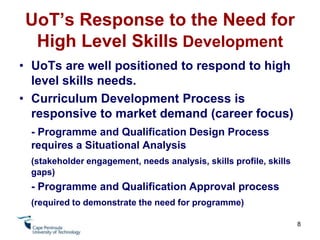
UoT’s Response to the Need for High Level Skills DevelopmentUoTs are well positioned to respond to high level skills needs. Curriculum Development Process is responsive to market demand (career focus)- Programme and Qualification Design Process requires a Situational Analysis (stakeholder engagement, needs analysis, skills profile, skills gaps)	- Programme and Qualification Approval process(required to demonstrate the need for programme)8
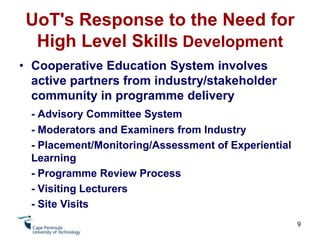
UoT's Response to the Need for High Level Skills DevelopmentCooperative Education System involves  active partners from industry/stakeholder community in programme delivery- Advisory Committee System 	- Moderators and Examiners from Industry	- Placement/Monitoring/Assessment of Experiential Learning	- Programme Review Process	- Visiting Lecturers	- Site Visits 9
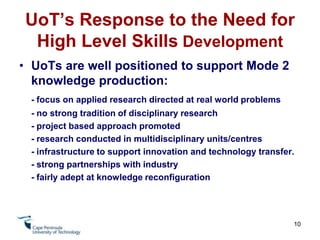
UoT’s Response to the Need for High Level Skills DevelopmentUoTs are well positioned to support Mode 2 knowledge production:- focus on applied research directed at real world problems	- no strong tradition of disciplinary research	- project based approach promoted	- research conducted in multidisciplinary units/centres	- infrastructure to support innovation and technology transfer.	- strong partnerships with industry	- fairly adept at knowledge reconfiguration10
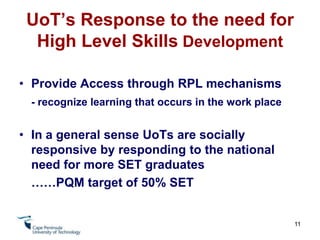
UoT’s Response to the need for High Level Skills DevelopmentProvide Access through RPL mechanisms- recognize learning that occurs in the work placeIn a general sense UoTs are socially responsive by responding to the national need for more SET graduates	……PQM target of 50% SET 11
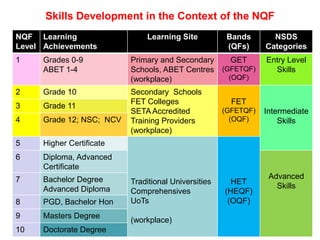
Skills Development in the Context of the NQF
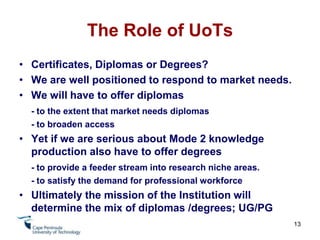
The Role of UoTsCertificates, Diplomas or Degrees?We are well positioned to respond to market needs.We will have to offer diplomas - to the extent that market needs diplomas	- to broaden accessYet if we are serious about Mode 2 knowledge production also have to offer degrees - to provide a feeder stream into research niche areas. 	- to satisfy the demand for professional workforceUltimately the mission of the Institution will determine the mix of diplomas /degrees; UG/PG13
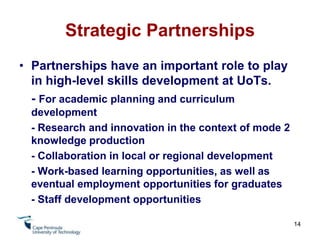
Strategic PartnershipsPartnerships have an important role to play in high-level skills development at UoTs.	- For academic planning and curriculum development	- Research and innovationin the context of mode 2 knowledge production	- Collaboration in local or regional development	- Work-based learning opportunities, as well as eventual employment opportunities for graduates	- Staff development opportunities 14
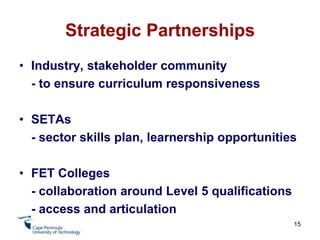
Strategic PartnershipsIndustry, stakeholder community	- to ensure curriculum responsivenessSETAs	- sector skills plan, learnership opportunitiesFET Colleges	- collaboration around Level 5 qualifications	- access and articulation15
Strategic PartnershipsProvincial Governments, Municipalities	- role of HE in regional developmentKnowledge Networks	- establishing partnerships with other sites of knowledge production16
Curriculum ChallengesDetermine the right PQM mix- mix of degrees, diplomas, UG,PG programmesDeveloping articulation pathways- diploma to degree	- undergrad to postgrad	- FET to HET	- Occupational Qualifications to HETPromote interdisciplinarity	- problem based approaches	- faculty wide electives17

SATN Conference 2010 - Prof Anthony Staak

  • 1.
    1High Level SkillsDevelopment and the Role of UoTs3rd SATN Annual Conference September 2010Prof A.P Staak
  • 2.
    OutlineBroader Policy ContextTheneed for High Level Skills DevelopmentUoT’s response to the need for High Level Skills DevelopmentSkills Development in the Context of the NQFThe Role of UoTsStrategic PartnershipsCurriculum Challenges for UoTs2
  • 3.
    Broader Policy ContextPurposesof Higher Education (White Paper, 1997)To provide the labour market, in a knowledge-driven and knowledge-dependent society, with the ever-changing high-level competencies and expertise necessary for the growth and prosperity of a modern economy…..To contribute to the creation, sharing and evaluation of knowledge. Higher education engages in the pursuit of academic scholarship and intellectual inquiry……To contribute to the socialization of enlightened, responsible and constructively critical citizens……3
  • 4.
    Broader Policy ContextDevelopmentof high-level skills for the labour market has been emphasized. To address critical skills shortage, to support economic growth, alleviate poverty and unemployment.ASGISA – identified skills shortage as largest impediment to achieving Millenium GoalsJIPSA – outflow of ASGISA … to address the skills shortage.4
  • 5.
    Broader Policy ContextSkillsDevelopment Act (1998); NSDS- National Skills Development Levy - SETAs and learnershipsNational R&D Strategy (2002) - highlights concerns regarding high level HR dev. in S&T - the need to support the National System of InnovationSkills Development Amendment Act (2008) - focuses on skills required for employment (OLS)- occupation the centre of qualifications development - makes provision for three sub-frameworks of the NQF (GFETQF, HEQF, OQF)5
  • 6.
    The Need forHigh Level Skills DevelopmentPolicies and Strategies Guided thinking on HL skills development and defined the need.To respond to labour market needs, focusing specifically on scarce skills areas
  • 7.
    To support thegrowth and development needs of a modern economy and society at large
  • 8.
    To support knowledgeproduction .. that responds to societies needs .. that supports innovation .. that reflects a shift towards Mode2 knowledge production6
  • 9.
    The Need forHigh Level Skills DevelopmentMode 2 Knowledge Production (Gibbons):Knowledge that is responsive to societies needs (greater social accountability)Knowledge produced in the context of applicationKnowledge production that is transdisciplinaryKnowledge production increasingly distributed (increasingly being produced outside higher education)Shift towards reconfiguration of existing knowledge and applying it in different contexts7
  • 10.
    UoT’s Response tothe Need for High Level Skills DevelopmentUoTs are well positioned to respond to high level skills needs. Curriculum Development Process is responsive to market demand (career focus)- Programme and Qualification Design Process requires a Situational Analysis (stakeholder engagement, needs analysis, skills profile, skills gaps) - Programme and Qualification Approval process(required to demonstrate the need for programme)8
  • 11.
    UoT's Response tothe Need for High Level Skills DevelopmentCooperative Education System involves active partners from industry/stakeholder community in programme delivery- Advisory Committee System - Moderators and Examiners from Industry - Placement/Monitoring/Assessment of Experiential Learning - Programme Review Process - Visiting Lecturers - Site Visits 9
  • 12.
    UoT’s Response tothe Need for High Level Skills DevelopmentUoTs are well positioned to support Mode 2 knowledge production:- focus on applied research directed at real world problems - no strong tradition of disciplinary research - project based approach promoted - research conducted in multidisciplinary units/centres - infrastructure to support innovation and technology transfer. - strong partnerships with industry - fairly adept at knowledge reconfiguration10
  • 13.
    UoT’s Response tothe need for High Level Skills DevelopmentProvide Access through RPL mechanisms- recognize learning that occurs in the work placeIn a general sense UoTs are socially responsive by responding to the national need for more SET graduates ……PQM target of 50% SET 11
  • 14.
    Skills Development inthe Context of the NQF
  • 15.
    The Role ofUoTsCertificates, Diplomas or Degrees?We are well positioned to respond to market needs.We will have to offer diplomas - to the extent that market needs diplomas - to broaden accessYet if we are serious about Mode 2 knowledge production also have to offer degrees - to provide a feeder stream into research niche areas. - to satisfy the demand for professional workforceUltimately the mission of the Institution will determine the mix of diplomas /degrees; UG/PG13
  • 16.
    Strategic PartnershipsPartnerships havean important role to play in high-level skills development at UoTs. - For academic planning and curriculum development - Research and innovationin the context of mode 2 knowledge production - Collaboration in local or regional development - Work-based learning opportunities, as well as eventual employment opportunities for graduates - Staff development opportunities 14
  • 17.
    Strategic PartnershipsIndustry, stakeholdercommunity - to ensure curriculum responsivenessSETAs - sector skills plan, learnership opportunitiesFET Colleges - collaboration around Level 5 qualifications - access and articulation15
  • 18.
    Strategic PartnershipsProvincial Governments,Municipalities - role of HE in regional developmentKnowledge Networks - establishing partnerships with other sites of knowledge production16
  • 19.
    Curriculum ChallengesDetermine theright PQM mix- mix of degrees, diplomas, UG,PG programmesDeveloping articulation pathways- diploma to degree - undergrad to postgrad - FET to HET - Occupational Qualifications to HETPromote interdisciplinarity - problem based approaches - faculty wide electives17