HOW DOYOU ASSESS
WHETHER LEARNING
OUTCOMES ARE
ALIGNEDTOTHE NQF?
Dr Linda Meyer
SAPHE
2019/06/27
2
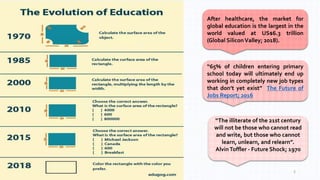
“The illiterate of the 21st century
will not be those who cannot read
and write, but those who cannot
learn, unlearn, and relearn”.
AlvinToffler - Future Shock; 1970
“65% of children entering primary
school today will ultimately end up
working in completely new job types
that don’t yet exist” The Future of
Jobs Report; 2016
After healthcare, the market for
global education is the largest in the
world valued at US$6.3 trillion
(Global SiliconValley; 2018).
2019/06/27
3
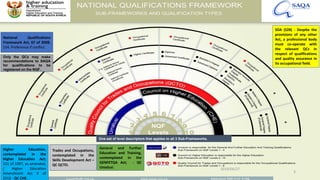
National Qualifications
Framework Act, 67 of 2008.
S34. Preference if conflict.
General and Further
Education and Training,
contemplated in the
GENFETQA Act; - QC
Umalusi.
Higher Education,
contemplated in the
Higher Education Act;
101 of 1997, as amended,
/ Higher Education
Amendment Act 9 of
2016 - QC CHE.
Trades and Occupations,
contemplated in the
Skills Development Act –
QC QCTO.
SDA (S28) - Despite the
provisions of any other
Act, a professional body
must co-operate with
the relevant QCs in
respect of qualifications
and quality assurance in
its occupational field.
Only the QCs may make
recommendations to SAQA
for qualifications to be
registered on the NQF.
One set of level descriptors that applies to all 3 Sub-Frameworks.
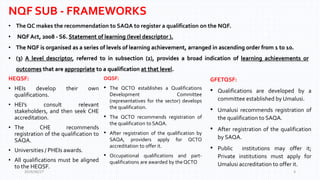
NQF SUB - FRAMEWORKS
HEQSF:
• HEIs develop their own
qualifications.
• HEI’s consult relevant
stakeholders, and then seek CHE
accreditation.
• The CHE recommends
registration of the qualification to
SAQA.
• Universities / PHEIs awards.
• All qualifications must be aligned
to the HEQSF.
2019/06/27 4
OQSF:
• The QCTO establishes a Qualifications
Development Committee
(representatives for the sector) develops
the qualification.
• The QCTO recommends registration of
the qualification to SAQA.
• After registration of the qualification by
SAQA, providers apply for QCTO
accreditation to offer it.
• Occupational qualifications and part-
qualifications are awarded by the QCTO.
• The QC makes the recommendation to SAQA to register a qualification on the NQF.
• NQF Act, 2008 - S6. Statement of learning (level descriptor ).
• The NQF is organised as a series of levels of learning achievement, arranged in ascending order from 1 to 10.
• (3) A level descriptor, referred to in subsection (2), provides a broad indication of learning achievements or
outcomes that are appropriate to a qualification at that level.
GFETQSF:
• Qualifications are developed by a
committee established by Umalusi.
• Umalusi recommends registration of
the qualification to SAQA.
• After registration of the qualification
by SAQA.
• Public institutions may offer it;
Private institutions must apply for
Umalusi accreditation to offer it.
Bologna Follow-Up Group (BFUG)’
• A Report by the Structural ReformsWorking Group to the Bologna Follow-Up
Group (BFUG)’ - report considering 47 countries in 2014 – highlights:
a. The critical role of learning outcomes and capacity improvement required in HEI’s.
b. NQF’s are essential for ‘fair recognition’ - NQF must be used by HEIs in qualifications
and recognition.
c. Appeals for common transparency infrastructure, including subject specific learning
outcomes.
d. Calls for a common understanding of LO in relation to knowledge , general
competence, and level.
e. Centres the curriculum expressed in terms of LO and aligned to NQF at the centre of
educational reform.
2019/06/27 5
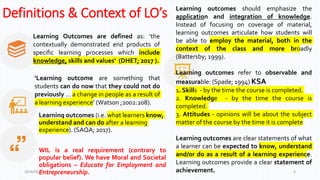
Definitions & Context of LO’s
Learning Outcomes are defined as: ‘the
contextually demonstrated end products of
specific learning processes which include
knowledge, skills and values‘ (DHET; 2017 ).
Learning outcomes (i.e. what learners know,
understand and can do after a learning
experience). (SAQA; 2017).
WIL is a real requirement (contrary to
popular belief). We have Moral and Societal
obligations – Educate for Employment and
Entrepreneurship.
‘Learning outcome are something that
students can do now that they could not do
previously … a change in people as a result of
a learning experience’ (Watson ;2002:208).
2019/06/27 6
Learning outcomes should emphasize the
application and integration of knowledge.
Instead of focusing on coverage of material,
learning outcomes articulate how students will
be able to employ the material, both in the
context of the class and more broadly
(Battersby; 1999).
Learning outcomes refer to observable and
measurable: (Spade; 1994) KSA
1. Skills - by the time the course is completed.
2. Knowledge - by the time the course is
completed.
3. Attitudes - opinions will be about the subject
matter of the course by the time it is complete
Learning outcomes are clear statements of what
a learner can be expected to know, understand
and/or do as a result of a learning experience.
Learning outcomes provide a clear statement of
achievement.
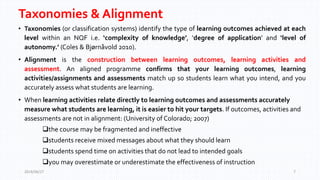
Taxonomies & Alignment
• Taxonomies (or classification systems) identify the type of learning outcomes achieved at each
level within an NQF i.e. ‘complexity of knowledge’, ‘degree of application’ and ‘level of
autonomy.’ (Coles & Bjørnåvold 2010).
• Alignment is the construction between learning outcomes, learning activities and
assessment. An aligned programme confirms that your learning outcomes, learning
activities/assignments and assessments match up so students learn what you intend, and you
accurately assess what students are learning.
• When learning activities relate directly to learning outcomes and assessments accurately
measure what students are learning, it is easier to hit your targets. If outcomes, activities and
assessments are not in alignment: (University of Colorado; 2007)
the course may be fragmented and ineffective
students receive mixed messages about what they should learn
students spend time on activities that do not lead to intended goals
you may overestimate or underestimate the effectiveness of instruction
2019/06/27 7
THE NQF & Learning Outcomes
Nested learning / aka stratified approach (Dr M - CHE)
• A registered national qualification consists of a planned combination of learning
outcomes which has a defined purpose or purposes, intended to provide qualifying learners
with applied competence and a basis for further learning and which has been assessed in
terms of exit level outcomes, registered on the NQF and certified and awarded by a
recognised body (SAQA, 2017).
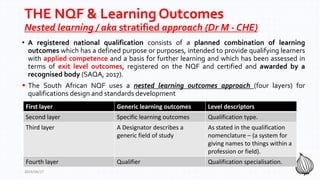
 The South African NQF uses a nested learning outcomes approach (four layers) for
qualifications design and standards development
2019/06/27 8
First layer Generic learning outcomes Level descriptors
Second layer Specific learning outcomes Qualification type.
Third layer A Designator describes a
generic field of study
As stated in the qualification
nomenclature – (a system for
giving names to things within a
profession or field).
Fourth layer Qualifier Qualification specialisation.
The NQF & Learning Outcomes
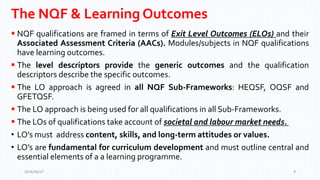
 NQF qualifications are framed in terms of Exit Level Outcomes (ELOs) and their
Associated Assessment Criteria (AACs). Modules/subjects in NQF qualifications
have learning outcomes.
 The level descriptors provide the generic outcomes and the qualification
descriptors describe the specific outcomes.
 The LO approach is agreed in all NQF Sub-Frameworks: HEQSF, OQSF and
GFETQSF.
 The LO approach is being used for all qualifications in all Sub-Frameworks.
 The LOs of qualifications take account of societal and labour market needs.
• LO’s must address content, skills, and long-term attitudes or values.
• LO’s are fundamental for curriculum development and must outline central and
essential elements of a a learning programme.
2019/06/27 9
The NQF & Learning Outcomes
 The level descriptors give an indication of the general cognitive
competencies that should be developed by all qualifications at all levels and,
therefore, give broad guidance for the development of Exit Level Outcomes
(ELOs), Associated Assessment Criteria (AACs), curriculum content,
Learning Outcomes (LOs) and assessment for qualifications at each level.
 The positioning of two or more qualifications on the same NQF level
indicates that the qualifications are broadly comparable in terms of the
cognitive level of the ELOs of the qualification and the generic cognitive
competencies developed.
 The qualification descriptors provide more detailed information on the
purpose and nature of the qualification. (SAQA; 2018:27).
 By the time a qualification gets registered – certain LO’s are outdated.
2019/06/27 10
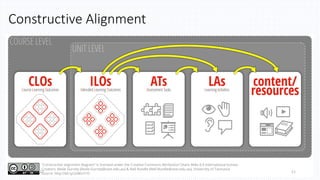
Constructive Alignment
2019/06/27 11
Aligning Outcomes :
Programme-level
Learning
Outcomes
Curriculum Map
Course-level
Learning
Outcomes
2019/06/27 12
Course-level
Learning
Outcomes
Inspiration from
Bloom’s
Taxonomy
Unit/Chapter
Learning
Outcomes
Module Learning
Outcomes
Learning
Activities
Assess and collect
data.
University of Colorado-The Center for Faculty Development 2007
The NQF & Learning Outcomes
2019/06/27 13
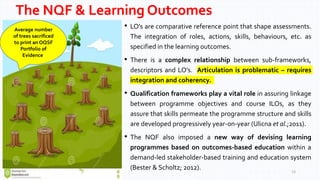
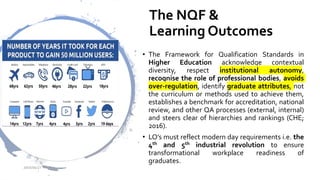
Average number
of trees sacrificed
to print an OQSF
Portfolio of
Evidence.
• LO’s are comparative reference point that shape assessments.
The integration of roles, actions, skills, behaviours, etc. as
specified in the learning outcomes.
• There is a complex relationship between sub-frameworks,
descriptors and LO’s. Articulation is problematic – requires
integration and coherency.
• Qualification frameworks play a vital role in assuring linkage
between programme objectives and course ILOs, as they
assure that skills permeate the programme structure and skills
are developed progressively year-on-year (Ulicna et al.;2011).
• The NQF also imposed a new way of devising learning
programmes based on outcomes-based education within a
demand-led stakeholder-based training and education system
(Bester & Scholtz; 2012).
The NQF &
Learning
Outcomes -
HE
2019/06/27
 Detailed descriptions of each of the qualifications in the
HEQSF, including the permitted exceptions, can be found in
The Higher Education Qualifications Sub-Framework published
by the CHE in 2013.
 The HEQSF qualification types are mapped according to
NQF levels 5 to 10 and are described in terms of:
 Learning outcomes (generic and specific),
 Total minimum credits required,
 Purpose and characteristics,
 Minimum admission requirements, and
 Articulation rules with other qualification types.
 Robust quality assurance regimes (internal and external)
must be applied.
 HE qualifications - national reviews have identified
inconsistencies i.e. of the state of provision of LLB degrees
in SA.
14
The NQF &
Learning Outcomes
• The Framework for Qualification Standards in
Higher Education acknowledge contextual
diversity, respect institutional autonomy,
recognise the role of professional bodies, avoids
over-regulation, identify graduate attributes, not
the curriculum or methods used to achieve them,
establishes a benchmark for accreditation, national
review, and other QA processes (external, internal)
and steers clear of hierarchies and rankings (CHE;
2016).
• LO’s must reflect modern day requirements i.e. the
4th and 5th industrial revolution to ensure
transformational workplace readiness of
graduates.
2019/06/27
BENEFITS OF A LEARNING OUTCOMES-BASED
APPROACH (Adam; 2015)
1. Clarifies and establishes standards -
NQF/level descriptors.
2. More accurate international
comparisons - NQF, qualifications, etc.
3. Provides transparency so more
objective judgements can be made.
4.The basis of recognition tools.
5. Facilitate the cathartic rethink of the
curriculum.
6. Improve qualifications - fit for 21st
Century.
2019/06/27 16
7. Highlight the learning-delivery-
assessment relationship.
8. Essential for student-centred learning,
transferable skills and employability.
9. Aids recognition - RPL & more accurate
decision making.
10. Facilitates the use of credits & credit
allocation.
11. Improve articulation between sub
systems.
12. Strengthen quality assurance
mechanisms.
Aligning LO’s
to the NQF
• Qualification frameworks play a vital role in assuring linkage
between programme objectives and course ILOs, as they
assure that skills permeate the programme structure and skills
are developed progressively year-on-year (Ulicna et al.;2011).
• Qualification frameworks support HEIs in delivering better
skills learning and produces higher quality graduates that
attract employers: (Allais; 2010)
a. Aligning LOs authentication in criteria to programme
objectives.
b. Programme LOs must be correctly delimited.
c. LOs are relevant to programme aims and appropriate to the
course level.
d. LOs are aligned with programme LOs.
17
IE.
• Identify basic human neuro systems and their functions.
• Apply the physiological principles that govern, maintain, and enhance
motor skills.
• Record and describe observations with pictures, numbers, or words.
Aligning LO’s
to the NQF
e. Programme and course requirements are comprehensively
elaborated and presented.
f. The programme is designed with social responsibility and
student participation.
g. Expected student outcomes are clearly identified.
h. Programme LOs are developed in line with NQF
requirements and best-fit level.
i. Programme LOs are developed in line with NQF level
descriptors and provides a progression in terms of level of
understanding to the topic.
j. There are clearly defined assessment criteria, cross-
referenced to each assessment method.
k. The programme is designed with coverage of required
employability skills.
l. Verification process for programme objectives and course
LOs, they must also assure that the objectives cover a
wider range of employability skills.
18
The learning outcome approach is, above
all, a perspective and a mode of thinking in
order to develop valid programmes
(Kennedy et al, 2012).
Learning Outcomes
• Specify an action by the
students/learners that is observable.
• Specify an action by the
students/learners that is measurable
and specify an action that is done by
the students/learners - rather than
the faculty members (Suskie; 2004).
• LO’s describe what we want students
to get out of a college education and
importantly that “research has shown
that students learn more effectively
when they understand course and
program learning outcomes” (Suskie
2016). 19
Good learning outcomes are:
 Active (Active / ActionVerb)
 Attractive
 Appropriate
 Attainable & Manageable
 Assessable
 Clear
 Contextual
 Visible
 Real – Not aspirational
 Simple language
 Focus on High priority learning
 Measurable
 Learner Centred etc.
 Specify - level, criterion, standards of
knowledge
Critical skills in a changing world!
Complex
problem
solving
Critical
thinking
Creativity People
Management /
Social
interaction
Coordinating
with others
STEAM -
Science,
Technology,
Engineering,
Arts & Maths.(World Economic Forum)
2019/06/27 21
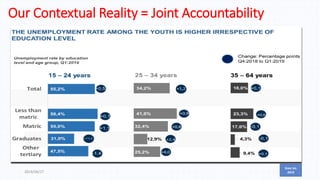
Stats SA;
2019
Our Contextual Reality = Joint Accountability
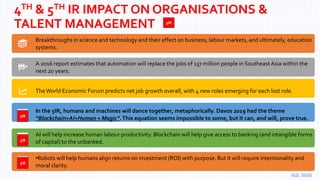
4TH & 5TH IR IMPACT ON ORGANISATIONS &
TALENT MANAGEMENT
Breakthroughs in science and technology and their effect on business, labour markets, and ultimately, education
systems.
A 2016 report estimates that automation will replace the jobs of 137 million people in Southeast Asia within the
next 20 years.
TheWorld Economic Forum predicts net job growth overall, with 4 new roles emerging for each lost role.
In the 5IR, humans and machines will dance together, metaphorically. Davos 2019 had the theme
“Blockchain+AI+Human = Magic”.This equation seems impossible to some, but it can, and will, prove true.
AI will help increase human labour productivity. Blockchain will help give access to banking (and intangible forms
of capital) to the unbanked.
•Robots will help humans align returns on investment (ROI) with purpose. But it will require intentionality and
moral clarity.
(ILO; 2016)
5IR
5IR
5IR
5IR
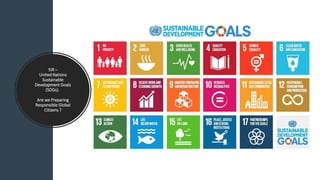
5IR –
United Nations
Sustainable
Development Goals
(SDGs).
Are we Preparing
Responsible Global
Citizens ?
CHANGES IN THE WOW & OCCUPATIONAL TYPES
LO CONSIDERATIONS -THE NQF AND OUR SOCIAL CONSTRUCT
Many existing
occupations will
disappear
New jobs are
emerging
More hybrid jobs
The end of fixed job
descriptions
Cross-functional
project teams
Workforce mobility
and project-based
work
Virtual organisations
“The real challenge for workers may lie not
in being replaced by a machine but in how
to reskill to work side-by-side with the new
tools and capabilities that advanced
technologies bring.” (Deloitte, 2017: 197)
•Thank you.
2019/06/24 23
2019/06/27 25
Education is the passport to the future, for tomorrow
belongs to those who prepare for it today. Malcolm X
Nothing in this world can take the place of persistence.
Talent will not: nothing is more common than
unsuccessful men with talent. Genius will not;
unrewarded genius is almost a proverb. Education will
not: the world is full of educated derelicts. Persistence
and determination alone are omnipotent. Calvin Coolidge

Dr. Linda Meyer aligning Learning Outcomes

  • 1.
    HOW DOYOU ASSESS WHETHERLEARNING OUTCOMES ARE ALIGNEDTOTHE NQF? Dr Linda Meyer SAPHE 2019/06/27
  • 2.
    2 “The illiterate ofthe 21st century will not be those who cannot read and write, but those who cannot learn, unlearn, and relearn”. AlvinToffler - Future Shock; 1970 “65% of children entering primary school today will ultimately end up working in completely new job types that don’t yet exist” The Future of Jobs Report; 2016 After healthcare, the market for global education is the largest in the world valued at US$6.3 trillion (Global SiliconValley; 2018).
  • 3.
    2019/06/27 3 National Qualifications Framework Act,67 of 2008. S34. Preference if conflict. General and Further Education and Training, contemplated in the GENFETQA Act; - QC Umalusi. Higher Education, contemplated in the Higher Education Act; 101 of 1997, as amended, / Higher Education Amendment Act 9 of 2016 - QC CHE. Trades and Occupations, contemplated in the Skills Development Act – QC QCTO. SDA (S28) - Despite the provisions of any other Act, a professional body must co-operate with the relevant QCs in respect of qualifications and quality assurance in its occupational field. Only the QCs may make recommendations to SAQA for qualifications to be registered on the NQF. One set of level descriptors that applies to all 3 Sub-Frameworks.
  • 4.
    NQF SUB -FRAMEWORKS HEQSF: • HEIs develop their own qualifications. • HEI’s consult relevant stakeholders, and then seek CHE accreditation. • The CHE recommends registration of the qualification to SAQA. • Universities / PHEIs awards. • All qualifications must be aligned to the HEQSF. 2019/06/27 4 OQSF: • The QCTO establishes a Qualifications Development Committee (representatives for the sector) develops the qualification. • The QCTO recommends registration of the qualification to SAQA. • After registration of the qualification by SAQA, providers apply for QCTO accreditation to offer it. • Occupational qualifications and part- qualifications are awarded by the QCTO. • The QC makes the recommendation to SAQA to register a qualification on the NQF. • NQF Act, 2008 - S6. Statement of learning (level descriptor ). • The NQF is organised as a series of levels of learning achievement, arranged in ascending order from 1 to 10. • (3) A level descriptor, referred to in subsection (2), provides a broad indication of learning achievements or outcomes that are appropriate to a qualification at that level. GFETQSF: • Qualifications are developed by a committee established by Umalusi. • Umalusi recommends registration of the qualification to SAQA. • After registration of the qualification by SAQA. • Public institutions may offer it; Private institutions must apply for Umalusi accreditation to offer it.
  • 5.
    Bologna Follow-Up Group(BFUG)’ • A Report by the Structural ReformsWorking Group to the Bologna Follow-Up Group (BFUG)’ - report considering 47 countries in 2014 – highlights: a. The critical role of learning outcomes and capacity improvement required in HEI’s. b. NQF’s are essential for ‘fair recognition’ - NQF must be used by HEIs in qualifications and recognition. c. Appeals for common transparency infrastructure, including subject specific learning outcomes. d. Calls for a common understanding of LO in relation to knowledge , general competence, and level. e. Centres the curriculum expressed in terms of LO and aligned to NQF at the centre of educational reform. 2019/06/27 5
  • 6.
    Definitions & Contextof LO’s Learning Outcomes are defined as: ‘the contextually demonstrated end products of specific learning processes which include knowledge, skills and values‘ (DHET; 2017 ). Learning outcomes (i.e. what learners know, understand and can do after a learning experience). (SAQA; 2017). WIL is a real requirement (contrary to popular belief). We have Moral and Societal obligations – Educate for Employment and Entrepreneurship. ‘Learning outcome are something that students can do now that they could not do previously … a change in people as a result of a learning experience’ (Watson ;2002:208). 2019/06/27 6 Learning outcomes should emphasize the application and integration of knowledge. Instead of focusing on coverage of material, learning outcomes articulate how students will be able to employ the material, both in the context of the class and more broadly (Battersby; 1999). Learning outcomes refer to observable and measurable: (Spade; 1994) KSA 1. Skills - by the time the course is completed. 2. Knowledge - by the time the course is completed. 3. Attitudes - opinions will be about the subject matter of the course by the time it is complete Learning outcomes are clear statements of what a learner can be expected to know, understand and/or do as a result of a learning experience. Learning outcomes provide a clear statement of achievement.
  • 7.
    Taxonomies & Alignment •Taxonomies (or classification systems) identify the type of learning outcomes achieved at each level within an NQF i.e. ‘complexity of knowledge’, ‘degree of application’ and ‘level of autonomy.’ (Coles & Bjørnåvold 2010). • Alignment is the construction between learning outcomes, learning activities and assessment. An aligned programme confirms that your learning outcomes, learning activities/assignments and assessments match up so students learn what you intend, and you accurately assess what students are learning. • When learning activities relate directly to learning outcomes and assessments accurately measure what students are learning, it is easier to hit your targets. If outcomes, activities and assessments are not in alignment: (University of Colorado; 2007) the course may be fragmented and ineffective students receive mixed messages about what they should learn students spend time on activities that do not lead to intended goals you may overestimate or underestimate the effectiveness of instruction 2019/06/27 7
  • 8.
    THE NQF &Learning Outcomes Nested learning / aka stratified approach (Dr M - CHE) • A registered national qualification consists of a planned combination of learning outcomes which has a defined purpose or purposes, intended to provide qualifying learners with applied competence and a basis for further learning and which has been assessed in terms of exit level outcomes, registered on the NQF and certified and awarded by a recognised body (SAQA, 2017).  The South African NQF uses a nested learning outcomes approach (four layers) for qualifications design and standards development 2019/06/27 8 First layer Generic learning outcomes Level descriptors Second layer Specific learning outcomes Qualification type. Third layer A Designator describes a generic field of study As stated in the qualification nomenclature – (a system for giving names to things within a profession or field). Fourth layer Qualifier Qualification specialisation.
  • 9.
    The NQF &Learning Outcomes  NQF qualifications are framed in terms of Exit Level Outcomes (ELOs) and their Associated Assessment Criteria (AACs). Modules/subjects in NQF qualifications have learning outcomes.  The level descriptors provide the generic outcomes and the qualification descriptors describe the specific outcomes.  The LO approach is agreed in all NQF Sub-Frameworks: HEQSF, OQSF and GFETQSF.  The LO approach is being used for all qualifications in all Sub-Frameworks.  The LOs of qualifications take account of societal and labour market needs. • LO’s must address content, skills, and long-term attitudes or values. • LO’s are fundamental for curriculum development and must outline central and essential elements of a a learning programme. 2019/06/27 9
  • 10.
    The NQF &Learning Outcomes  The level descriptors give an indication of the general cognitive competencies that should be developed by all qualifications at all levels and, therefore, give broad guidance for the development of Exit Level Outcomes (ELOs), Associated Assessment Criteria (AACs), curriculum content, Learning Outcomes (LOs) and assessment for qualifications at each level.  The positioning of two or more qualifications on the same NQF level indicates that the qualifications are broadly comparable in terms of the cognitive level of the ELOs of the qualification and the generic cognitive competencies developed.  The qualification descriptors provide more detailed information on the purpose and nature of the qualification. (SAQA; 2018:27).  By the time a qualification gets registered – certain LO’s are outdated. 2019/06/27 10
  • 11.
  • 12.
    Aligning Outcomes : Programme-level Learning Outcomes CurriculumMap Course-level Learning Outcomes 2019/06/27 12 Course-level Learning Outcomes Inspiration from Bloom’s Taxonomy Unit/Chapter Learning Outcomes Module Learning Outcomes Learning Activities Assess and collect data. University of Colorado-The Center for Faculty Development 2007
  • 13.
    The NQF &Learning Outcomes 2019/06/27 13 Average number of trees sacrificed to print an OQSF Portfolio of Evidence. • LO’s are comparative reference point that shape assessments. The integration of roles, actions, skills, behaviours, etc. as specified in the learning outcomes. • There is a complex relationship between sub-frameworks, descriptors and LO’s. Articulation is problematic – requires integration and coherency. • Qualification frameworks play a vital role in assuring linkage between programme objectives and course ILOs, as they assure that skills permeate the programme structure and skills are developed progressively year-on-year (Ulicna et al.;2011). • The NQF also imposed a new way of devising learning programmes based on outcomes-based education within a demand-led stakeholder-based training and education system (Bester & Scholtz; 2012).
  • 14.
    The NQF & Learning Outcomes- HE 2019/06/27  Detailed descriptions of each of the qualifications in the HEQSF, including the permitted exceptions, can be found in The Higher Education Qualifications Sub-Framework published by the CHE in 2013.  The HEQSF qualification types are mapped according to NQF levels 5 to 10 and are described in terms of:  Learning outcomes (generic and specific),  Total minimum credits required,  Purpose and characteristics,  Minimum admission requirements, and  Articulation rules with other qualification types.  Robust quality assurance regimes (internal and external) must be applied.  HE qualifications - national reviews have identified inconsistencies i.e. of the state of provision of LLB degrees in SA. 14
  • 15.
    The NQF & LearningOutcomes • The Framework for Qualification Standards in Higher Education acknowledge contextual diversity, respect institutional autonomy, recognise the role of professional bodies, avoids over-regulation, identify graduate attributes, not the curriculum or methods used to achieve them, establishes a benchmark for accreditation, national review, and other QA processes (external, internal) and steers clear of hierarchies and rankings (CHE; 2016). • LO’s must reflect modern day requirements i.e. the 4th and 5th industrial revolution to ensure transformational workplace readiness of graduates. 2019/06/27
  • 16.
    BENEFITS OF ALEARNING OUTCOMES-BASED APPROACH (Adam; 2015) 1. Clarifies and establishes standards - NQF/level descriptors. 2. More accurate international comparisons - NQF, qualifications, etc. 3. Provides transparency so more objective judgements can be made. 4.The basis of recognition tools. 5. Facilitate the cathartic rethink of the curriculum. 6. Improve qualifications - fit for 21st Century. 2019/06/27 16 7. Highlight the learning-delivery- assessment relationship. 8. Essential for student-centred learning, transferable skills and employability. 9. Aids recognition - RPL & more accurate decision making. 10. Facilitates the use of credits & credit allocation. 11. Improve articulation between sub systems. 12. Strengthen quality assurance mechanisms.
  • 17.
    Aligning LO’s to theNQF • Qualification frameworks play a vital role in assuring linkage between programme objectives and course ILOs, as they assure that skills permeate the programme structure and skills are developed progressively year-on-year (Ulicna et al.;2011). • Qualification frameworks support HEIs in delivering better skills learning and produces higher quality graduates that attract employers: (Allais; 2010) a. Aligning LOs authentication in criteria to programme objectives. b. Programme LOs must be correctly delimited. c. LOs are relevant to programme aims and appropriate to the course level. d. LOs are aligned with programme LOs. 17 IE. • Identify basic human neuro systems and their functions. • Apply the physiological principles that govern, maintain, and enhance motor skills. • Record and describe observations with pictures, numbers, or words.
  • 18.
    Aligning LO’s to theNQF e. Programme and course requirements are comprehensively elaborated and presented. f. The programme is designed with social responsibility and student participation. g. Expected student outcomes are clearly identified. h. Programme LOs are developed in line with NQF requirements and best-fit level. i. Programme LOs are developed in line with NQF level descriptors and provides a progression in terms of level of understanding to the topic. j. There are clearly defined assessment criteria, cross- referenced to each assessment method. k. The programme is designed with coverage of required employability skills. l. Verification process for programme objectives and course LOs, they must also assure that the objectives cover a wider range of employability skills. 18 The learning outcome approach is, above all, a perspective and a mode of thinking in order to develop valid programmes (Kennedy et al, 2012).
  • 19.
    Learning Outcomes • Specifyan action by the students/learners that is observable. • Specify an action by the students/learners that is measurable and specify an action that is done by the students/learners - rather than the faculty members (Suskie; 2004). • LO’s describe what we want students to get out of a college education and importantly that “research has shown that students learn more effectively when they understand course and program learning outcomes” (Suskie 2016). 19 Good learning outcomes are:  Active (Active / ActionVerb)  Attractive  Appropriate  Attainable & Manageable  Assessable  Clear  Contextual  Visible  Real – Not aspirational  Simple language  Focus on High priority learning  Measurable  Learner Centred etc.  Specify - level, criterion, standards of knowledge
  • 20.
    Critical skills ina changing world! Complex problem solving Critical thinking Creativity People Management / Social interaction Coordinating with others STEAM - Science, Technology, Engineering, Arts & Maths.(World Economic Forum)
  • 21.
    2019/06/27 21 Stats SA; 2019 OurContextual Reality = Joint Accountability
  • 22.
    4TH & 5THIR IMPACT ON ORGANISATIONS & TALENT MANAGEMENT Breakthroughs in science and technology and their effect on business, labour markets, and ultimately, education systems. A 2016 report estimates that automation will replace the jobs of 137 million people in Southeast Asia within the next 20 years. TheWorld Economic Forum predicts net job growth overall, with 4 new roles emerging for each lost role. In the 5IR, humans and machines will dance together, metaphorically. Davos 2019 had the theme “Blockchain+AI+Human = Magic”.This equation seems impossible to some, but it can, and will, prove true. AI will help increase human labour productivity. Blockchain will help give access to banking (and intangible forms of capital) to the unbanked. •Robots will help humans align returns on investment (ROI) with purpose. But it will require intentionality and moral clarity. (ILO; 2016) 5IR 5IR 5IR 5IR
  • 23.
    5IR – United Nations Sustainable DevelopmentGoals (SDGs). Are we Preparing Responsible Global Citizens ?
  • 24.
    CHANGES IN THEWOW & OCCUPATIONAL TYPES LO CONSIDERATIONS -THE NQF AND OUR SOCIAL CONSTRUCT Many existing occupations will disappear New jobs are emerging More hybrid jobs The end of fixed job descriptions Cross-functional project teams Workforce mobility and project-based work Virtual organisations “The real challenge for workers may lie not in being replaced by a machine but in how to reskill to work side-by-side with the new tools and capabilities that advanced technologies bring.” (Deloitte, 2017: 197)
  • 25.
    •Thank you. 2019/06/24 23 2019/06/2725 Education is the passport to the future, for tomorrow belongs to those who prepare for it today. Malcolm X Nothing in this world can take the place of persistence. Talent will not: nothing is more common than unsuccessful men with talent. Genius will not; unrewarded genius is almost a proverb. Education will not: the world is full of educated derelicts. Persistence and determination alone are omnipotent. Calvin Coolidge