National Conference on Sustainable Advanced Technologies for Environmental Management (SATEM-2017)
June 28-30, 2017
Paper No.71
Methylene Blue Removal: An Approach towards Sludge Management after Adsorption of
Cadmium onto Surfactant Modified Chitosan Beads
Preeti Pal# and Anjali Pal*
# School of Environmental Science and Engineering
* Department of Civil Engineering
Indian Institute of Technology, Kharagpur, West Bengal - 721302,
India.
Email: pal.preiti@iitkgp.ac.in; anjalipal@civil.iitkgp.ernet.in
1
2
Chitosan SDS Cadmium Methylene blue
Introduction
•Chitin deacetylation
•Obtained from marine
waste
•Presence of –OH and –
NH2 groups make it feasible
modifications.
•Highly toxic, carcinogenic,
persistent metal
Used in
• PVC products
• Color pigments and
alloys
• Ni-Cd batteries
• Anticorrosion agent
Can affect
• Liver and kidney
• Respiratory system
• Skeletal system
Used to treat
methemoglobinemia (7-8
mg/kg) (Sikka et al., 2011)
Can cause
• Dizziness
• Mental confusion
• Headache
• Fever
• High blood pressure
•An anionic surfactant
Used in
• Cosmetics
• Pharmaceutical
• Food products
• Industrial cleaning
Can cause
• Skin and eye
irritation
Permissible limit is
0.003 mg/L (IS
10500:2012)
Tolerance limits for inland
surface waters and drinking
water- 1.0 mg/L (IS 10500:2012)
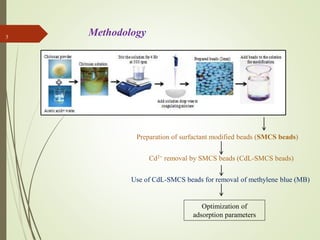
Preparation of surfactant modified beads (SMCS beads)
Cd2+ removal by SMCS beads (CdL-SMCS beads)
Methodology
Optimization of
adsorption parameters
Use of CdL-SMCS beads for removal of methylene blue (MB)
3
Figure: Schematic of the formation of CS beads and its modification with SDS for removal of Cd2+
to form CdL-SMCS beads followed by the adsorption of MB.
4
CS beads
SMCS beads
CdL-SMCS beads
MBL-SMCS beads
CS powder
Step 1
Step 2
Step 3
Step 4
Step-wise modification of CS beads
(Pal and Pal, 2017)
0
100
200
300
400
10 20 50 100 250
qt(mg/g)
MB concentration (mg/L)
CS beads
CdL-SMCS beads
Figure: Evaluation of the CS and Cd2+ loaded SMCS beads (Cd loading = 125 mg/g) for removal of MB.
[MB]: 10-250 mg/L, adsorbent dose: 0.45g/L, time: 72 h, agitation speed: 100 rpm, temperature: 30oC.
Evaluation of the CS and CdL-SMCS beads for
removal of MB
5
Type of
adsorbent
[MB] (mg/L) *qt (mg/g)
CS beads 250 64.35
CdL-SMCS
beads
250 366.46
*qt = mg of adsorbate (MB) adsorbed on the
adsorbent (CdL-SMCS) in a given time
Selection of beads after Cd2+ loading
Figure: Effect of Cd2+ loading on removal of MB by CdL-SMCS beads. [MB]: 50 mg/L, dose: 0.45g/L, time:
72 h, agitation: 100 rpm, temperature: 30oC.
6
% R for MB qt (mg/g)
Cd2+ MB
98.86 124.86 219.68
0
10
20
30
40
50
60
70
80
90
100
0
50
100
150
200
250
10 20 30 50 100
%RemovalofMB
qt(mg/g)
Cd2+ concentration used for SMCS beads loading (mg/L)
qt (mg/g) for MB removal
qt (mg/g) for Cd2+ removal
% Removal (MB)
Effect of contact time on adsorption of MB on CdL-SMCS
beads
88.75
92.06
92.75
0
10
20
30
40
50
60
70
80
90
100
0 0.083 0.5 1 2 4 12 24 48 72 96
%RemovalofMB
Time (h)
Figure: Time dependency on removal of MB using CdL-SMCS beads. [MB]: 50 mg/L, dose: 0.45g/L,
agitation: 100 rpm, temperature: 30oC.
7
Time (h) % R of MB
48 88.75
72 92.06
96 92.75
Effect of adsorbent dose on adsorption of MB
0
50
100
150
200
250
300
350
400
450
500
50
60
70
80
90
100
0.09 0.225 0.45 0.675 0.9 1.35
qt(mg/g)
%RemovalofMB
Dose (g/L)
% Removal
Capacity (mg/g)
Figure: Effect of adsorbent dosage on removal of MB by CdL-SMCS beads. [MB]: 50 mg/L, time: 72 h,
agitation speed: 100 rpm, temperature: 30oC.
8
Dose (g/L) % R of MB
0.45 95.63
0.675 96.15
Figure: Effect of MB concentration on its removal by CdL-SMCS beads. [MB]: 10-250 mg/L, dose:
0.45g/L, time: 72 h, agitation speed: 100 rpm. The photograph showing (a) SMCS beads, (b) CdL-SMCS
beads, (c) 10 mg/L MB loaded beads (d) 50 mg/L MB loaded beads.
Effect of MB concentration on % removal efficiency of
CdL-SMCS beads
9
Model Pseudo first order Pseudo second order
Equation of linear fit
line
Ln (qe-qt) =-0.0009x + 3.6812 t/qt = 0.0097x + 0.4675
R2 0.8785 0.999
qe (mg/g) 39.69 103.09
Constant (k) kS1 =9.0×10⁻⁴ (min−1) kS2=2.0×10⁻⁴ (g mg−1 min−1)
-1
0
1
2
3
4
5
0
10
20
30
40
50
60
0 2000 4000 6000
Ln(qe-qt)
t/qt
Time (min)
Pseudo second order curve fitting
Pseudo first order curve fitting
(a)
Kinetic study for adsorption of MB on to CdL-SMCS beads
Figure: Kinetics on MB removal by CdL-SMCS beads. (a) The fitting of pseudo first order and pseudo second order model, and (b)
plot of qt vs. t for experimental data and calculated values of qe (based on the pseudo-second order model). [MB]: 50 mg/L, dose:
0.45g/L, time: 72 h, agitation: 100 rpm, temperature: 30oC.
Table: Pseudo first order and pseudo second order rate constants of MB adsorption onto the CdL-SMCS beads.
10
0
20
40
60
80
100
120
0 1000 2000 3000 4000 5000 6000
qt(mg/g)
Time (min)
qt calculated
qt experimental
(b)
0.00
0.10
0.20
0.30
0.40
0.50
0 50 100 150
Ce/qe(g/L)
Ce (mg/L)
(a)
0
1
2
3
4
5
6
7
-2 0 2 4 6
Ln(qe)
Ln (Ce)
(b)
Figure: Langmuir (a) and Freundlich (b) adsorption isotherm model for removal of MB using CdL-SMCS beads. [MB]: 10-
250 mg/L, dose: 0.45g/L, time: 72 h, agitation: 100 rpm, temperature: 30oC.
Equilibrium adsorption isotherm study on MB removal by
CdL-SMCS beads
11
Model Parameters Values
Langmuir isotherm model
Equation Ce/qe = 0.002Ce + 0.062
qmax (mg/g) (Maximum
adsorption capacity)
500.0
KL 0.0323
R2 0.922
Freundlich isotherm model
Equation lnqe = 0.516 lnCe + 3.342
kf [(mg/g)(L/mg)1/n] (constant
related to adsorption
capacity)
28.76
1/n (adsorption intensity) 0.516
R2 0.985
Table: Adsorption isotherm model equations, values of isotherm constants and their corresponding R2 values.
Wavenumbers
(cm-1)
Characteristic
band
Reference
1604 C=C [Ramaraju et al., 2014]
1539 C=C of aromatic
compound
[Ramaraju et al., 2014]
1337 CH3 (of MB) [Xiong et al., 2010]
1014 C-O stretching [Gottipati et al., 2010]
890 -NH2
[Akinyeye et al., 2016]
808 -C-H- [Qutub et al., 2016]
Interpretation of the peaks obtained by the FTIR spectra of the CdL-SMCS and
MBL-SMCS beads.
FTIR analysis of MB loaded CdL-SMCS beads (MBL-SMCS) and
CdL-SMCS beads
12
• Surfactant-modified chitosan (SMCS) beads were successfully prepared.
• SMCS beads were able to remove Cd2+ from aqueous solutions.
• CdL-SMCS loaded beads (124.86 mg/g) successfully removed MB from aqueous
solution.
• Optimized dose= 0.45 g/L.
• Contact time= 72 h
• Agitation speed= 100 rpm at 30oC
• The material (SMCS beads) is broadly suitable for the removal of positively
charged pollutants.
• Adsorption followed Freundlich isotherm, which confirms the multilayer adsorption.
• Langmuir adsorption capacity obtained was 500.0 mg/g.
• Kinetic data complied with pseudo-second order model.
• CS beads used successively for the removal of SDS, Cd2+, and MB.
Conclusions
13
D.L. Postai, C.A. Demarchi and F. Zanatta, D.C.C. Melo, C.A. Rodrigues, “Adsorption of rhodamine B and
methylene blue dyes using waste of seeds of Aleurites Moluccana, a low cost adsorbent,” Alexandria Eng. J.,
vol. 55, pp. 1713–1723, 2016.
L. Xiong, Y. Yang, J. Mai, W. Sun, C. Zhang, D. Wei, Q. Chen and J. Ni, “Adsorption behavior of methylene
blue onto titanate nanotubes,” Chem. Eng. J., vol. 156, pp. 313–320, 2010.
R. Gottipati and S. Mishra, Application of biowaste (waste generated in biodiesel plant) as an adsorbent for the
removal of hazardous dye - Methylene blue - From aqueous phase, Brazilian J. Chem. Eng., vol. 27, pp. 357–
367, 2010.
J.O. Akinyeye, T.B. Ibigbami and O. Odeja, “Effect of chitosan powder prepared from snail shells to remove
lead (II) ion and nickel (II) ion from aqueous solution and its adsorption isotherm model,” Am. J. Appl. Chem.,
vol. 4, pp. 146, 2016.
N. Qutub, B.M. Pirzada, K. Umar and S. Sabir, “Synthesis of CdS nanoparticles using different sulfide ion
precursors: Formation mechanism and photocatalytic degradation of Acid Blue-29,” J. Environ. Chem. Eng.,
vol. 4, pp. 808–817, 2016.
P. Pal and A. Pal, “Surfactant-modified chitosan beads for cadmium ion adsorption,” Int. J. Biol. Macromol.
(2017). doi:http://dx.doi.org/10.1016/j.ijbiomac.2017.02.042.
P. Sikka, V.K. Bindra, S. Kapoor, V. Jain, K.K. Saxena, “Blue cures blue but be cautious." J. Pharm. Bioall. Sci.
vol. 3, pp. 543, 2011.
14 References
Thankyou

Satem 30th june

  • 1.
    National Conference onSustainable Advanced Technologies for Environmental Management (SATEM-2017) June 28-30, 2017 Paper No.71 Methylene Blue Removal: An Approach towards Sludge Management after Adsorption of Cadmium onto Surfactant Modified Chitosan Beads Preeti Pal# and Anjali Pal* # School of Environmental Science and Engineering * Department of Civil Engineering Indian Institute of Technology, Kharagpur, West Bengal - 721302, India. Email: pal.preiti@iitkgp.ac.in; anjalipal@civil.iitkgp.ernet.in 1
  • 2.
    2 Chitosan SDS CadmiumMethylene blue Introduction •Chitin deacetylation •Obtained from marine waste •Presence of –OH and – NH2 groups make it feasible modifications. •Highly toxic, carcinogenic, persistent metal Used in • PVC products • Color pigments and alloys • Ni-Cd batteries • Anticorrosion agent Can affect • Liver and kidney • Respiratory system • Skeletal system Used to treat methemoglobinemia (7-8 mg/kg) (Sikka et al., 2011) Can cause • Dizziness • Mental confusion • Headache • Fever • High blood pressure •An anionic surfactant Used in • Cosmetics • Pharmaceutical • Food products • Industrial cleaning Can cause • Skin and eye irritation Permissible limit is 0.003 mg/L (IS 10500:2012) Tolerance limits for inland surface waters and drinking water- 1.0 mg/L (IS 10500:2012)
  • 3.
    Preparation of surfactantmodified beads (SMCS beads) Cd2+ removal by SMCS beads (CdL-SMCS beads) Methodology Optimization of adsorption parameters Use of CdL-SMCS beads for removal of methylene blue (MB) 3
  • 4.
    Figure: Schematic ofthe formation of CS beads and its modification with SDS for removal of Cd2+ to form CdL-SMCS beads followed by the adsorption of MB. 4 CS beads SMCS beads CdL-SMCS beads MBL-SMCS beads CS powder Step 1 Step 2 Step 3 Step 4 Step-wise modification of CS beads (Pal and Pal, 2017)
  • 5.
    0 100 200 300 400 10 20 50100 250 qt(mg/g) MB concentration (mg/L) CS beads CdL-SMCS beads Figure: Evaluation of the CS and Cd2+ loaded SMCS beads (Cd loading = 125 mg/g) for removal of MB. [MB]: 10-250 mg/L, adsorbent dose: 0.45g/L, time: 72 h, agitation speed: 100 rpm, temperature: 30oC. Evaluation of the CS and CdL-SMCS beads for removal of MB 5 Type of adsorbent [MB] (mg/L) *qt (mg/g) CS beads 250 64.35 CdL-SMCS beads 250 366.46 *qt = mg of adsorbate (MB) adsorbed on the adsorbent (CdL-SMCS) in a given time
  • 6.
    Selection of beadsafter Cd2+ loading Figure: Effect of Cd2+ loading on removal of MB by CdL-SMCS beads. [MB]: 50 mg/L, dose: 0.45g/L, time: 72 h, agitation: 100 rpm, temperature: 30oC. 6 % R for MB qt (mg/g) Cd2+ MB 98.86 124.86 219.68 0 10 20 30 40 50 60 70 80 90 100 0 50 100 150 200 250 10 20 30 50 100 %RemovalofMB qt(mg/g) Cd2+ concentration used for SMCS beads loading (mg/L) qt (mg/g) for MB removal qt (mg/g) for Cd2+ removal % Removal (MB)
  • 7.
    Effect of contacttime on adsorption of MB on CdL-SMCS beads 88.75 92.06 92.75 0 10 20 30 40 50 60 70 80 90 100 0 0.083 0.5 1 2 4 12 24 48 72 96 %RemovalofMB Time (h) Figure: Time dependency on removal of MB using CdL-SMCS beads. [MB]: 50 mg/L, dose: 0.45g/L, agitation: 100 rpm, temperature: 30oC. 7 Time (h) % R of MB 48 88.75 72 92.06 96 92.75
  • 8.
    Effect of adsorbentdose on adsorption of MB 0 50 100 150 200 250 300 350 400 450 500 50 60 70 80 90 100 0.09 0.225 0.45 0.675 0.9 1.35 qt(mg/g) %RemovalofMB Dose (g/L) % Removal Capacity (mg/g) Figure: Effect of adsorbent dosage on removal of MB by CdL-SMCS beads. [MB]: 50 mg/L, time: 72 h, agitation speed: 100 rpm, temperature: 30oC. 8 Dose (g/L) % R of MB 0.45 95.63 0.675 96.15
  • 9.
    Figure: Effect ofMB concentration on its removal by CdL-SMCS beads. [MB]: 10-250 mg/L, dose: 0.45g/L, time: 72 h, agitation speed: 100 rpm. The photograph showing (a) SMCS beads, (b) CdL-SMCS beads, (c) 10 mg/L MB loaded beads (d) 50 mg/L MB loaded beads. Effect of MB concentration on % removal efficiency of CdL-SMCS beads 9
  • 10.
    Model Pseudo firstorder Pseudo second order Equation of linear fit line Ln (qe-qt) =-0.0009x + 3.6812 t/qt = 0.0097x + 0.4675 R2 0.8785 0.999 qe (mg/g) 39.69 103.09 Constant (k) kS1 =9.0×10⁻⁴ (min−1) kS2=2.0×10⁻⁴ (g mg−1 min−1) -1 0 1 2 3 4 5 0 10 20 30 40 50 60 0 2000 4000 6000 Ln(qe-qt) t/qt Time (min) Pseudo second order curve fitting Pseudo first order curve fitting (a) Kinetic study for adsorption of MB on to CdL-SMCS beads Figure: Kinetics on MB removal by CdL-SMCS beads. (a) The fitting of pseudo first order and pseudo second order model, and (b) plot of qt vs. t for experimental data and calculated values of qe (based on the pseudo-second order model). [MB]: 50 mg/L, dose: 0.45g/L, time: 72 h, agitation: 100 rpm, temperature: 30oC. Table: Pseudo first order and pseudo second order rate constants of MB adsorption onto the CdL-SMCS beads. 10 0 20 40 60 80 100 120 0 1000 2000 3000 4000 5000 6000 qt(mg/g) Time (min) qt calculated qt experimental (b)
  • 11.
    0.00 0.10 0.20 0.30 0.40 0.50 0 50 100150 Ce/qe(g/L) Ce (mg/L) (a) 0 1 2 3 4 5 6 7 -2 0 2 4 6 Ln(qe) Ln (Ce) (b) Figure: Langmuir (a) and Freundlich (b) adsorption isotherm model for removal of MB using CdL-SMCS beads. [MB]: 10- 250 mg/L, dose: 0.45g/L, time: 72 h, agitation: 100 rpm, temperature: 30oC. Equilibrium adsorption isotherm study on MB removal by CdL-SMCS beads 11 Model Parameters Values Langmuir isotherm model Equation Ce/qe = 0.002Ce + 0.062 qmax (mg/g) (Maximum adsorption capacity) 500.0 KL 0.0323 R2 0.922 Freundlich isotherm model Equation lnqe = 0.516 lnCe + 3.342 kf [(mg/g)(L/mg)1/n] (constant related to adsorption capacity) 28.76 1/n (adsorption intensity) 0.516 R2 0.985 Table: Adsorption isotherm model equations, values of isotherm constants and their corresponding R2 values.
  • 12.
    Wavenumbers (cm-1) Characteristic band Reference 1604 C=C [Ramarajuet al., 2014] 1539 C=C of aromatic compound [Ramaraju et al., 2014] 1337 CH3 (of MB) [Xiong et al., 2010] 1014 C-O stretching [Gottipati et al., 2010] 890 -NH2 [Akinyeye et al., 2016] 808 -C-H- [Qutub et al., 2016] Interpretation of the peaks obtained by the FTIR spectra of the CdL-SMCS and MBL-SMCS beads. FTIR analysis of MB loaded CdL-SMCS beads (MBL-SMCS) and CdL-SMCS beads 12
  • 13.
    • Surfactant-modified chitosan(SMCS) beads were successfully prepared. • SMCS beads were able to remove Cd2+ from aqueous solutions. • CdL-SMCS loaded beads (124.86 mg/g) successfully removed MB from aqueous solution. • Optimized dose= 0.45 g/L. • Contact time= 72 h • Agitation speed= 100 rpm at 30oC • The material (SMCS beads) is broadly suitable for the removal of positively charged pollutants. • Adsorption followed Freundlich isotherm, which confirms the multilayer adsorption. • Langmuir adsorption capacity obtained was 500.0 mg/g. • Kinetic data complied with pseudo-second order model. • CS beads used successively for the removal of SDS, Cd2+, and MB. Conclusions 13
  • 14.
    D.L. Postai, C.A.Demarchi and F. Zanatta, D.C.C. Melo, C.A. Rodrigues, “Adsorption of rhodamine B and methylene blue dyes using waste of seeds of Aleurites Moluccana, a low cost adsorbent,” Alexandria Eng. J., vol. 55, pp. 1713–1723, 2016. L. Xiong, Y. Yang, J. Mai, W. Sun, C. Zhang, D. Wei, Q. Chen and J. Ni, “Adsorption behavior of methylene blue onto titanate nanotubes,” Chem. Eng. J., vol. 156, pp. 313–320, 2010. R. Gottipati and S. Mishra, Application of biowaste (waste generated in biodiesel plant) as an adsorbent for the removal of hazardous dye - Methylene blue - From aqueous phase, Brazilian J. Chem. Eng., vol. 27, pp. 357– 367, 2010. J.O. Akinyeye, T.B. Ibigbami and O. Odeja, “Effect of chitosan powder prepared from snail shells to remove lead (II) ion and nickel (II) ion from aqueous solution and its adsorption isotherm model,” Am. J. Appl. Chem., vol. 4, pp. 146, 2016. N. Qutub, B.M. Pirzada, K. Umar and S. Sabir, “Synthesis of CdS nanoparticles using different sulfide ion precursors: Formation mechanism and photocatalytic degradation of Acid Blue-29,” J. Environ. Chem. Eng., vol. 4, pp. 808–817, 2016. P. Pal and A. Pal, “Surfactant-modified chitosan beads for cadmium ion adsorption,” Int. J. Biol. Macromol. (2017). doi:http://dx.doi.org/10.1016/j.ijbiomac.2017.02.042. P. Sikka, V.K. Bindra, S. Kapoor, V. Jain, K.K. Saxena, “Blue cures blue but be cautious." J. Pharm. Bioall. Sci. vol. 3, pp. 543, 2011. 14 References
  • 15.