


All about the SSAT & Get Set for Top SSAT
scores!
What is the SSAT?
If you are seeking to enroll in any of elite
independent schools, worldwide between grades 4-
12, then you need to do well in the SSAT - Secondary
School Admissions Test.
School admission officers use this standardized test
to assess the abilities of students wanting to enroll in
an independent school.
The SSAT is not an achievement test nor does it
measure the personal characteristics such as
honesty, motivation, persistence, or creativity.
It measures a student’s math, verbal and reading
skills.
The SSAT score is not the only criterion used in
admission decisions. It is just one part of the
application to an independent school.
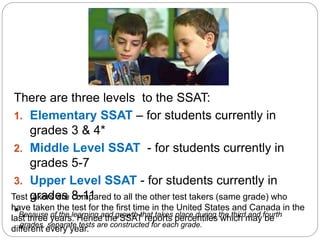
There are three levels to the SSAT:
1. Elementary SSAT – for students currently in
grades 3 & 4*
2. Middle Level SSAT - for students currently in
grades 5-7
3. Upper Level SSAT - for students currently in
grades 8-11
*Because of the learning and growth that takes place during the third and fourth
grades, separate tests are constructed for each grade.
Test takers are compared to all the other test takers (same grade) who
have taken the test for the first time in the United States and Canada in the
last three years. Hence the SSAT reports percentiles which may be
different every year.
SSAT Sections & Format
The SSAT is a timed, multiple-choice test that assesses quantitative,
verbal and reading skills that a student acquires in school and
beyond. These skills determine a student’s preparedness to study in
any of the finest independent schools in the world.
The SSAT at every level has these sections:
1. Writing Section – Not scored but a copy is provided to schools
to which your child’s score report is sent.
2. Quantitative Section – Assesses a mixture of concepts that are
considered to be the basis of your grade math curriculum and a
few that will challenge you.
3. Verbal Section – Has 2 parts: Synonyms part and Analogies
part
4. Reading Section - Consists of grade-level appropriate
passages, each with multiple-choice questions associated with it.
These passages may include biographies, prose, poetry, fiction,
and nonfiction.
5. Experimental Section - Not scored. Mixed content questions
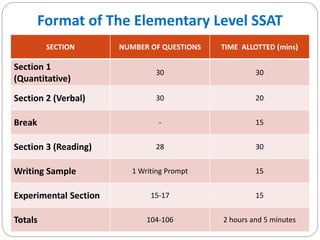
Format of The Elementary Level SSAT
SECTION NUMBER OF QUESTIONS TIME ALLOTTED (mins)
Section 1
(Quantitative)
30 30
Section 2 (Verbal) 30 20
Break - 15
Section 3 (Reading) 28 30
Writing Sample 1 Writing Prompt 15
Experimental Section 15-17 15
Totals 104-106 2 hours and 5 minutes
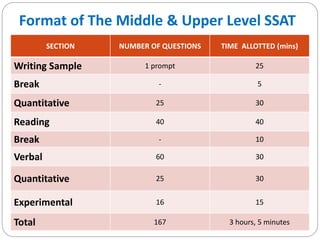
Format of The Middle & Upper Level SSAT
SECTION NUMBER OF QUESTIONS TIME ALLOTTED (mins)
Writing Sample 1 prompt 25
Break - 5
Quantitative 25 30
Reading 40 40
Break - 10
Verbal 60 30
Quantitative 25 30
Experimental 16 15
Total 167 3 hours, 5 minutes
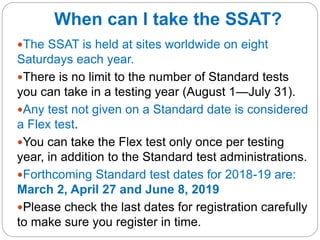
When can I take the SSAT?
The SSAT is held at sites worldwide on eight
Saturdays each year.
There is no limit to the number of Standard tests
you can take in a testing year (August 1—July 31).
Any test not given on a Standard date is considered
a Flex test.
You can take the Flex test only once per testing
year, in addition to the Standard test administrations.
Forthcoming Standard test dates for 2018-19 are:
March 2, April 27 and June 8, 2019
Please check the last dates for registration carefully
to make sure you register in time.
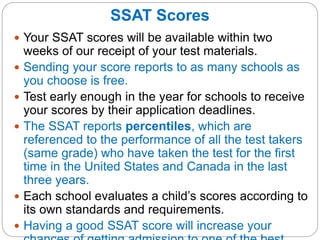
SSAT Scores
 Your SSAT scores will be available within two
weeks of our receipt of your test materials.
 Sending your score reports to as many schools as
you choose is free.
 Test early enough in the year for schools to receive
your scores by their application deadlines.
 The SSAT reports percentiles, which are
referenced to the performance of all the test takers
(same grade) who have taken the test for the first
time in the United States and Canada in the last
three years.
 Each school evaluates a child’s scores according to
its own standards and requirements.
 Having a good SSAT score will increase your
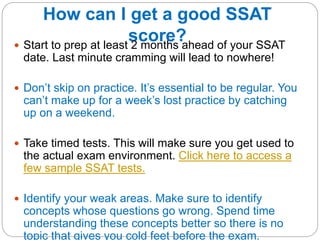
How can I get a good SSAT
score? Start to prep at least 2 months ahead of your SSAT
date. Last minute cramming will lead to nowhere!
 Don’t skip on practice. It’s essential to be regular. You
can’t make up for a week’s lost practice by catching
up on a weekend.
 Take timed tests. This will make sure you get used to
the actual exam environment. Click here to access a
few sample SSAT tests.
 Identify your weak areas. Make sure to identify
concepts whose questions go wrong. Spend time
understanding these concepts better so there is no
topic that gives you cold feet before the exam.
How can I get a good SSAT
score? Don’t worry too much. Do your best while prepping but fretting
will do you no good. Your SSAT score is only one component of
your entire application.
 Read as much as possible. Regular reading not only improves
your reading speed but also helps with vocabulary building.
Look up the dictionary for all the unfamiliar words as you read.
 Spot roots of words. Its easier to remember words once you
know the root word, eventually improving your vocabulary,
writing and reading skills.
 Maintain a good pace during the exam. Don’t spend too much
time on a single question. If you are stumped by a question,
move on and don’t think about it while you are attempting other
questions.
 As mentioned earlier, it’s not necessary to obtain a perfect
http://www.etutorworld.com
© 2019 eTutorWorld. All rights reserved.
contact@etutorworld.com
+1-269-763-4602
Personalized Online Tutoring to Ace at School &
Beyond
Math, Science, English & Test Prep

What is the ssat

  • 1.
    All about theSSAT & Get Set for Top SSAT scores! What is the SSAT?
  • 2.
    If you areseeking to enroll in any of elite independent schools, worldwide between grades 4- 12, then you need to do well in the SSAT - Secondary School Admissions Test. School admission officers use this standardized test to assess the abilities of students wanting to enroll in an independent school. The SSAT is not an achievement test nor does it measure the personal characteristics such as honesty, motivation, persistence, or creativity. It measures a student’s math, verbal and reading skills. The SSAT score is not the only criterion used in admission decisions. It is just one part of the application to an independent school.
  • 3.
    There are threelevels to the SSAT: 1. Elementary SSAT – for students currently in grades 3 & 4* 2. Middle Level SSAT - for students currently in grades 5-7 3. Upper Level SSAT - for students currently in grades 8-11 *Because of the learning and growth that takes place during the third and fourth grades, separate tests are constructed for each grade. Test takers are compared to all the other test takers (same grade) who have taken the test for the first time in the United States and Canada in the last three years. Hence the SSAT reports percentiles which may be different every year.
  • 4.
    SSAT Sections &Format The SSAT is a timed, multiple-choice test that assesses quantitative, verbal and reading skills that a student acquires in school and beyond. These skills determine a student’s preparedness to study in any of the finest independent schools in the world. The SSAT at every level has these sections: 1. Writing Section – Not scored but a copy is provided to schools to which your child’s score report is sent. 2. Quantitative Section – Assesses a mixture of concepts that are considered to be the basis of your grade math curriculum and a few that will challenge you. 3. Verbal Section – Has 2 parts: Synonyms part and Analogies part 4. Reading Section - Consists of grade-level appropriate passages, each with multiple-choice questions associated with it. These passages may include biographies, prose, poetry, fiction, and nonfiction. 5. Experimental Section - Not scored. Mixed content questions
  • 5.
    Format of TheElementary Level SSAT SECTION NUMBER OF QUESTIONS TIME ALLOTTED (mins) Section 1 (Quantitative) 30 30 Section 2 (Verbal) 30 20 Break - 15 Section 3 (Reading) 28 30 Writing Sample 1 Writing Prompt 15 Experimental Section 15-17 15 Totals 104-106 2 hours and 5 minutes
  • 6.
    Format of TheMiddle & Upper Level SSAT SECTION NUMBER OF QUESTIONS TIME ALLOTTED (mins) Writing Sample 1 prompt 25 Break - 5 Quantitative 25 30 Reading 40 40 Break - 10 Verbal 60 30 Quantitative 25 30 Experimental 16 15 Total 167 3 hours, 5 minutes
  • 7.
    When can Itake the SSAT? The SSAT is held at sites worldwide on eight Saturdays each year. There is no limit to the number of Standard tests you can take in a testing year (August 1—July 31). Any test not given on a Standard date is considered a Flex test. You can take the Flex test only once per testing year, in addition to the Standard test administrations. Forthcoming Standard test dates for 2018-19 are: March 2, April 27 and June 8, 2019 Please check the last dates for registration carefully to make sure you register in time.
  • 8.
    SSAT Scores  YourSSAT scores will be available within two weeks of our receipt of your test materials.  Sending your score reports to as many schools as you choose is free.  Test early enough in the year for schools to receive your scores by their application deadlines.  The SSAT reports percentiles, which are referenced to the performance of all the test takers (same grade) who have taken the test for the first time in the United States and Canada in the last three years.  Each school evaluates a child’s scores according to its own standards and requirements.  Having a good SSAT score will increase your
  • 9.
    How can Iget a good SSAT score? Start to prep at least 2 months ahead of your SSAT date. Last minute cramming will lead to nowhere!  Don’t skip on practice. It’s essential to be regular. You can’t make up for a week’s lost practice by catching up on a weekend.  Take timed tests. This will make sure you get used to the actual exam environment. Click here to access a few sample SSAT tests.  Identify your weak areas. Make sure to identify concepts whose questions go wrong. Spend time understanding these concepts better so there is no topic that gives you cold feet before the exam.
  • 10.
    How can Iget a good SSAT score? Don’t worry too much. Do your best while prepping but fretting will do you no good. Your SSAT score is only one component of your entire application.  Read as much as possible. Regular reading not only improves your reading speed but also helps with vocabulary building. Look up the dictionary for all the unfamiliar words as you read.  Spot roots of words. Its easier to remember words once you know the root word, eventually improving your vocabulary, writing and reading skills.  Maintain a good pace during the exam. Don’t spend too much time on a single question. If you are stumped by a question, move on and don’t think about it while you are attempting other questions.  As mentioned earlier, it’s not necessary to obtain a perfect
  • 11.
    http://www.etutorworld.com © 2019 eTutorWorld.All rights reserved. contact@etutorworld.com +1-269-763-4602 Personalized Online Tutoring to Ace at School & Beyond Math, Science, English & Test Prep