Security and privacy in private
 cloud
                                   A
              Synopsis Submitted in the partial fulfillment
                       for the award of degree of
                Master in Technology (CSE)(2011-2013)


SUBMITTED TO:                                             SUBMITTED BY:
Mr. OMKARA MURTHY                                         SARVESH KUMAR
     Outline
•   Clouds & case studies
•    Cloud computing
•   Abstract
•   Introduction
•   Objective of thesis work
•   Problems and benefits
•   Objectives
•   Security issues in private clouds
•   Research methodology
Outline…

•   Conclusion
•   References
Clouds and Case studies
   Cloud is just a internet based: email exists some where
    on some machine, I do not know where the exist.
   We have some servers that store email, videos, pictures,
    any thing else. where is that server and where exist we
    don’t know.
   That data is stored on cloud on some server or server of
    servers.
   When we want data just access the data with internet its
    available for me. this is the power of cloud.
Case studies…….

•   Feb.21,2011 during ICC WORLD CUP,
    INDIA
•   Everyday 10:00 am to 11:00 am ,since ?
    Till date, online ticket booking-IRCTC,india
•   May 2009,india jumbo general election.
•   A website launched by french first lady
    Carla Bruni has crashed on its first day.
Soln. of above scenarios

   Add more servers to balance the load(load
    balancing).
   Buying servers is a compound problem of
    companies/organization that are already
    on tight budget.
   In case if companies are financially strong
    then adding thousand of servers to handle
    a few days in traffic is homogenous waste
    of resources.
Cloud computing

   It is a internet based computing.
   Customers plug into the “cloud” to access
    it resources which are priced and provide
    “on demand”essentially,these IT resources
    are accessible and shared among multiple
    users.
   Cloud computing combine
    virtualization(one computer hosting
    several virtual servers”)
Cloud computing contd….
   Thus it offers three things….
i. Dynamism: your need is dynamic,so
     should be your infrastructure to support
     the changing needs.
ii.   Abstraction: from an end users
     perspective,they do not need care of o.s.
     the plugins,web security or s/w plateform.
iii. Resources sharing: provide the flexibility
     to share applications as well as other
     network resource such as hardware.
Cloud computing contd….
      Essential characterstics
I.    On demand self service: computing capabilities can be provisioned by the end user
      without any help from the the support team of the service provider.
II.   Scalable and elastic: any cloud service must be size up or size down based on
      applications demand and the users base.
      scalability is the ability to automatically grow ar shrink.
      elastically is how instantly an application can add or remove resources.
 iii. Resource pooling: achieved by multi-tenant application architecture.
iv.Use internet tech.: must be accessible through internet.
      Service models
i.     SaaS: service provider has a very administrative control on the application and is
       responsible for update, deployment, maintenance and security. Eg. Gmail
ii.    PaaS: paas is a plateform where s/w can be developed, tested and deployed.
iii.   IaaS: require of virtual computers, cloud storage, h/w infrastructure components like
       firewalls and configuration services.
      Deployment models
i.     Private cloud: cloud infrastructure is operated solely for an organization.
ii.    public cloud: made available to the general public.
iii.   Community clouds: shared by several organizations.
iv.    Hybrid cloud: combination of two or more clouds.
Abstract
   Now a days, cloud computing is not beneficial for business activities but it is
    also used in universities, academic institutions and private organizations.
   Cloud computing in academic environment will be benefitted by every
    student and staff where safety of data is needed in academic.
    Universities have various departments and no. of students with increased
    volume of data, then how we manage these data regularly and provide up to
    date information to students, faculties and other organizational activities.
   Creating a private cloud will be beneficial for university. Use of private cloud
    for university has many benefits such as e-mails Databases, educational
    resources and tools for faculty, administrators and staffs and other users on
    demand. they reduce the cost of power, electricity and air conditioning.
    The implementation of private cloud computing will help the universities by
    reducing the expenditure cost with decreasing their demand for software
    licensing and it has operational benefits.
   Private cloud reduces university IT complexity and cost.
Introduction
      The universities all over the world are under increasing pressure to employ the
       Information Technology (IT) for the welfare of faculty members, students, operational
       staff and management. The different stakeholders of a university like students,
       parents, employees, management, and administrators are continuously engaged in
       the process of educational planning, growth and other activities.
      In order to provide various facilities to the students, faculty, management and for the
       operation, the university needs storage and computing system that would integrate
       multiple services and concerned request..
      However, the universities in India are facing a number of challenges related to their
       management due to increased number of students.
      There are also some other reasons which rather obligated them to find appropriate
       storage solution for the universities like…
i.      Every time the data is transferred for storage should be well encrypted for security
        reasons and safe storage.
ii.     A continuous process is required to provide new backups as the file changes.
        Whenever there is some change in the file, the particular change needs to be backed
        up and not the whole file.
iii.    Since the university also includes students, teachers from non-computer
        background, so the accidental deletion of the file may be regular phenomenon.
        There must be some provision of getting the file back even if it is deleted from PC.
Literature review
   Mehmet Fatih Erkoç, Serhat Bahadir Kert : they tried
    to show that the Cloud Computing can also be used for
    universities. The main goal of suggested prototype is;
    managing effectively the technological needs of
    universities such as delivery of software, providing of
    development platform, storage of data, and computing.
    Ajith Singh. N, M. Hemalatha (2012) they tried to show
    that Lots of crisis has happen in business world as well
    as in academic environment. Data security, storage,
    processing power is limited while using traditional
    computing. Data are also in risk and not available all
    time. Due to cost many couldn’t fulfill the availability of
    resource to student and staff by using cloud computing
    in academic environment we can solve all the issue.
Contd…
 Silky Bansal, Sawtantar Singh, Amit Kumarey(2012) they
    propose different views and solutions in the area of cloud computing
    infrastructure for academic institutions.
   The main goals of this prototype are: to share existing resources
    and to improve the level of computer science education in present
    courses by implementing new technological solutions in Software
    Engineering projects, database management administration and
    development, systems analysis and design, networking and
    programming.
   Sara Qaisar and Kausar Fiaz Khawaja(2012) They propose
    Network/security issues related to the cloud computing environment.
    Networks structure faces some attacks that are denial off service
    attack, man in the middle attack.
Problems
   Universities in india are facing a lot of challenges related to their
    management due to increased number of students. Increasing no. of
    students is a factor of increased large volume of data. The different
    stakeholders of a university like students, parents, employees,
    management, and administrators are continuously engaged in the process
    of educational planning, growth and other activities. In order to provide
    various facilities to the students, faculty, management and for the operation,
    the university needs storage and computing system that would integrate
    multiple services and concerned request.
   Problem of power consumption, the air-conditioning and electronic waste
    that can be caused by number of datacenters.
   facing the problem of pay for infrastructure, and cost for taking licensesd
    software.
   security and privacy in data using some encryption techniques,
    authentication and authorization.
Objective of thesis work

   Our main objectives of thesis is to creat a private cloud
    for any university that will reduce the expenditure cost
    with decreasing their demand for software licensing and
    it has operational benefits.
   And then we deploy some applications in this cloud and
    also provide some security aspects like authentication
    and authorization and some encryption techniques.
   Thus the university needs not pay for infrastructure, they
    simple pay for how much they transfer and save on the
    providers server.
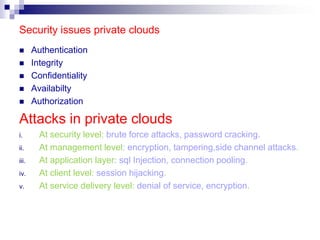
Security issues private clouds
      Authentication
      Integrity
      Confidentiality
      Availabilty
      Authorization

Attacks in private clouds
i.       At security level: brute force attacks, password cracking.
ii.      At management level: encryption, tampering,side channel attacks.
iii.     At application layer: sql Injection, connection pooling.
iv.      At client level: session hijacking.
v.       At service delivery level: denial of service, encryption.
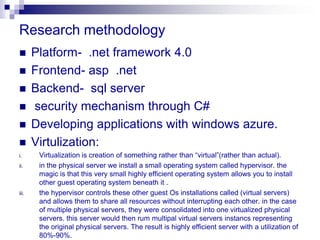
Research methodology
      Platform- .net framework 4.0
      Frontend- asp .net
      Backend- sql server
      security mechanism through C#
      Developing applications with windows azure.
      Virtulization:
i.      Virtualization is creation of something rather than “virtual”(rather than actual).
ii.     in the physical server we install a small operating system called hypervisor. the
        magic is that this very small highly efficient operating system allows you to install
        other guest operating system beneath it .
iii.    the hypervisor controls these other guest Os installations called (virtual servers)
        and allows them to share all resources without interrupting each other. in the case
        of multiple physical servers, they were consolidated into one virtualized physical
        servers. this server would then rum multipal virtual servers instancs representing
        the original physical servers. The result is highly efficient server with a utilization of
        80%-90%.
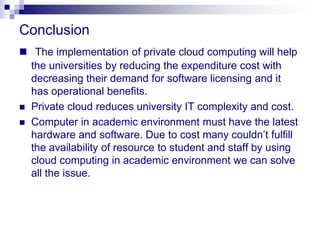
Conclusion
 The implementation of private cloud computing will help
  the universities by reducing the expenditure cost with
  decreasing their demand for software licensing and it
  has operational benefits.
 Private cloud reduces university IT complexity and cost.
 Computer in academic environment must have the latest
  hardware and software. Due to cost many couldn’t fulfill
  the availability of resource to student and staff by using
  cloud computing in academic environment we can solve
  all the issue.
References
   Zhifeng Xiao and Yang Xiao, “Security and Privacy in
    Cloud Computing”, IEEE COMMUNICATIONS
    SURVEYS & TUTORIALS,(2012).
   Mehmet Fatih Erkoç, Serhat Bahadir Kert,” Cloud
    Computing For Distributed University Campus: A
    Prototype Suggestion”.
   PRATEEK BHANTI, SUSHMA LEHRI and NARENDRA
    KUMAR,” CLOUD COMPUTING: A NEW PARADIGM
    FOR DATA STORAGE IN INDIAN UNIVERSITIES”,
    Prateek Bhanti et al./ Indian Journal of Computer
    Science and Engineering (IJCSE).
   Silky Bansal, Sawtantar Singh, Amit Kumar,” Use of
    Cloud Computing in Academic Institutions”.
References contd….

   Ayesha Malik, Muhammad Mohsin Nazir,” Security
    Framework for Cloud Computing Environment: A
    Review”, VOL. 3, NO. 3, March 2012 Journal of
    Emerging Trends in Computing and Information
    Sciences.
   Marinela Mircea and Anca Ioana Andreescu,” Using
    Cloud Computing in Higher Education: A Strategy to
    Improve Agility in the Current Financial Crisis”, IBIMA
    Publishing Communications of the IBIM
    http://www.ibimapublishing.com/journals/CIBIMA/cibima.
    html Vol. 2011 (2011), Article ID 875547.”

Sarvi

  • 1.
    Security and privacyin private cloud A Synopsis Submitted in the partial fulfillment for the award of degree of Master in Technology (CSE)(2011-2013) SUBMITTED TO: SUBMITTED BY: Mr. OMKARA MURTHY SARVESH KUMAR
  • 2.
    Outline • Clouds & case studies • Cloud computing • Abstract • Introduction • Objective of thesis work • Problems and benefits • Objectives • Security issues in private clouds • Research methodology
  • 3.
    Outline… • Conclusion • References
  • 4.
    Clouds and Casestudies  Cloud is just a internet based: email exists some where on some machine, I do not know where the exist.  We have some servers that store email, videos, pictures, any thing else. where is that server and where exist we don’t know.  That data is stored on cloud on some server or server of servers.  When we want data just access the data with internet its available for me. this is the power of cloud.
  • 5.
    Case studies……. • Feb.21,2011 during ICC WORLD CUP, INDIA • Everyday 10:00 am to 11:00 am ,since ? Till date, online ticket booking-IRCTC,india • May 2009,india jumbo general election. • A website launched by french first lady Carla Bruni has crashed on its first day.
  • 6.
    Soln. of abovescenarios  Add more servers to balance the load(load balancing).  Buying servers is a compound problem of companies/organization that are already on tight budget.  In case if companies are financially strong then adding thousand of servers to handle a few days in traffic is homogenous waste of resources.
  • 7.
    Cloud computing  It is a internet based computing.  Customers plug into the “cloud” to access it resources which are priced and provide “on demand”essentially,these IT resources are accessible and shared among multiple users.  Cloud computing combine virtualization(one computer hosting several virtual servers”)
  • 8.
    Cloud computing contd….  Thus it offers three things…. i. Dynamism: your need is dynamic,so should be your infrastructure to support the changing needs. ii. Abstraction: from an end users perspective,they do not need care of o.s. the plugins,web security or s/w plateform. iii. Resources sharing: provide the flexibility to share applications as well as other network resource such as hardware.
  • 9.
    Cloud computing contd….  Essential characterstics I. On demand self service: computing capabilities can be provisioned by the end user without any help from the the support team of the service provider. II. Scalable and elastic: any cloud service must be size up or size down based on applications demand and the users base. scalability is the ability to automatically grow ar shrink. elastically is how instantly an application can add or remove resources. iii. Resource pooling: achieved by multi-tenant application architecture. iv.Use internet tech.: must be accessible through internet.  Service models i. SaaS: service provider has a very administrative control on the application and is responsible for update, deployment, maintenance and security. Eg. Gmail ii. PaaS: paas is a plateform where s/w can be developed, tested and deployed. iii. IaaS: require of virtual computers, cloud storage, h/w infrastructure components like firewalls and configuration services.  Deployment models i. Private cloud: cloud infrastructure is operated solely for an organization. ii. public cloud: made available to the general public. iii. Community clouds: shared by several organizations. iv. Hybrid cloud: combination of two or more clouds.
  • 10.
    Abstract  Now a days, cloud computing is not beneficial for business activities but it is also used in universities, academic institutions and private organizations.  Cloud computing in academic environment will be benefitted by every student and staff where safety of data is needed in academic.  Universities have various departments and no. of students with increased volume of data, then how we manage these data regularly and provide up to date information to students, faculties and other organizational activities.  Creating a private cloud will be beneficial for university. Use of private cloud for university has many benefits such as e-mails Databases, educational resources and tools for faculty, administrators and staffs and other users on demand. they reduce the cost of power, electricity and air conditioning.  The implementation of private cloud computing will help the universities by reducing the expenditure cost with decreasing their demand for software licensing and it has operational benefits.  Private cloud reduces university IT complexity and cost.
  • 11.
    Introduction  The universities all over the world are under increasing pressure to employ the Information Technology (IT) for the welfare of faculty members, students, operational staff and management. The different stakeholders of a university like students, parents, employees, management, and administrators are continuously engaged in the process of educational planning, growth and other activities.  In order to provide various facilities to the students, faculty, management and for the operation, the university needs storage and computing system that would integrate multiple services and concerned request..  However, the universities in India are facing a number of challenges related to their management due to increased number of students.  There are also some other reasons which rather obligated them to find appropriate storage solution for the universities like… i. Every time the data is transferred for storage should be well encrypted for security reasons and safe storage. ii. A continuous process is required to provide new backups as the file changes. Whenever there is some change in the file, the particular change needs to be backed up and not the whole file. iii. Since the university also includes students, teachers from non-computer background, so the accidental deletion of the file may be regular phenomenon. There must be some provision of getting the file back even if it is deleted from PC.
  • 12.
    Literature review  Mehmet Fatih Erkoç, Serhat Bahadir Kert : they tried to show that the Cloud Computing can also be used for universities. The main goal of suggested prototype is; managing effectively the technological needs of universities such as delivery of software, providing of development platform, storage of data, and computing.  Ajith Singh. N, M. Hemalatha (2012) they tried to show that Lots of crisis has happen in business world as well as in academic environment. Data security, storage, processing power is limited while using traditional computing. Data are also in risk and not available all time. Due to cost many couldn’t fulfill the availability of resource to student and staff by using cloud computing in academic environment we can solve all the issue.
  • 13.
    Contd…  Silky Bansal,Sawtantar Singh, Amit Kumarey(2012) they propose different views and solutions in the area of cloud computing infrastructure for academic institutions.  The main goals of this prototype are: to share existing resources and to improve the level of computer science education in present courses by implementing new technological solutions in Software Engineering projects, database management administration and development, systems analysis and design, networking and programming.  Sara Qaisar and Kausar Fiaz Khawaja(2012) They propose Network/security issues related to the cloud computing environment. Networks structure faces some attacks that are denial off service attack, man in the middle attack.
  • 14.
    Problems  Universities in india are facing a lot of challenges related to their management due to increased number of students. Increasing no. of students is a factor of increased large volume of data. The different stakeholders of a university like students, parents, employees, management, and administrators are continuously engaged in the process of educational planning, growth and other activities. In order to provide various facilities to the students, faculty, management and for the operation, the university needs storage and computing system that would integrate multiple services and concerned request.  Problem of power consumption, the air-conditioning and electronic waste that can be caused by number of datacenters.  facing the problem of pay for infrastructure, and cost for taking licensesd software.  security and privacy in data using some encryption techniques, authentication and authorization.
  • 15.
    Objective of thesiswork  Our main objectives of thesis is to creat a private cloud for any university that will reduce the expenditure cost with decreasing their demand for software licensing and it has operational benefits.  And then we deploy some applications in this cloud and also provide some security aspects like authentication and authorization and some encryption techniques.  Thus the university needs not pay for infrastructure, they simple pay for how much they transfer and save on the providers server.
  • 16.
    Security issues privateclouds  Authentication  Integrity  Confidentiality  Availabilty  Authorization Attacks in private clouds i. At security level: brute force attacks, password cracking. ii. At management level: encryption, tampering,side channel attacks. iii. At application layer: sql Injection, connection pooling. iv. At client level: session hijacking. v. At service delivery level: denial of service, encryption.
  • 17.
    Research methodology  Platform- .net framework 4.0  Frontend- asp .net  Backend- sql server  security mechanism through C#  Developing applications with windows azure.  Virtulization: i. Virtualization is creation of something rather than “virtual”(rather than actual). ii. in the physical server we install a small operating system called hypervisor. the magic is that this very small highly efficient operating system allows you to install other guest operating system beneath it . iii. the hypervisor controls these other guest Os installations called (virtual servers) and allows them to share all resources without interrupting each other. in the case of multiple physical servers, they were consolidated into one virtualized physical servers. this server would then rum multipal virtual servers instancs representing the original physical servers. The result is highly efficient server with a utilization of 80%-90%.
  • 18.
    Conclusion  The implementationof private cloud computing will help the universities by reducing the expenditure cost with decreasing their demand for software licensing and it has operational benefits.  Private cloud reduces university IT complexity and cost.  Computer in academic environment must have the latest hardware and software. Due to cost many couldn’t fulfill the availability of resource to student and staff by using cloud computing in academic environment we can solve all the issue.
  • 19.
    References  Zhifeng Xiao and Yang Xiao, “Security and Privacy in Cloud Computing”, IEEE COMMUNICATIONS SURVEYS & TUTORIALS,(2012).  Mehmet Fatih Erkoç, Serhat Bahadir Kert,” Cloud Computing For Distributed University Campus: A Prototype Suggestion”.  PRATEEK BHANTI, SUSHMA LEHRI and NARENDRA KUMAR,” CLOUD COMPUTING: A NEW PARADIGM FOR DATA STORAGE IN INDIAN UNIVERSITIES”, Prateek Bhanti et al./ Indian Journal of Computer Science and Engineering (IJCSE).  Silky Bansal, Sawtantar Singh, Amit Kumar,” Use of Cloud Computing in Academic Institutions”.
  • 20.
    References contd….  Ayesha Malik, Muhammad Mohsin Nazir,” Security Framework for Cloud Computing Environment: A Review”, VOL. 3, NO. 3, March 2012 Journal of Emerging Trends in Computing and Information Sciences.  Marinela Mircea and Anca Ioana Andreescu,” Using Cloud Computing in Higher Education: A Strategy to Improve Agility in the Current Financial Crisis”, IBIMA Publishing Communications of the IBIM http://www.ibimapublishing.com/journals/CIBIMA/cibima. html Vol. 2011 (2011), Article ID 875547.”