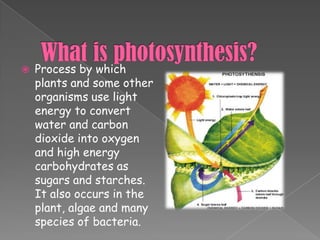
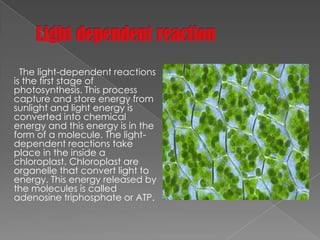
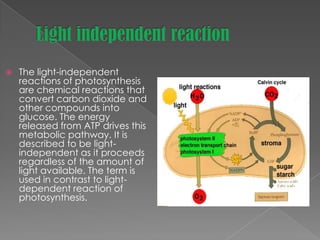
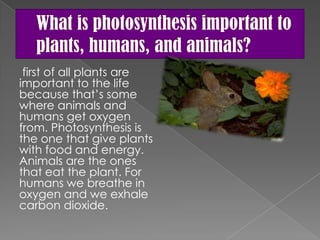
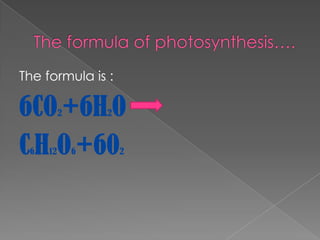
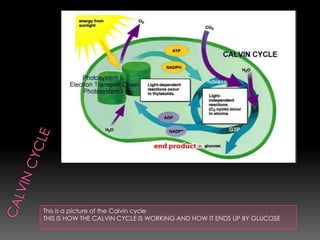
Photosynthesis is the process by which plants, algae, and some bacteria use sunlight, water and carbon dioxide to produce oxygen and energy in the form of glucose. It occurs in two stages - the light-dependent reactions where sunlight is absorbed and its energy is used to produce ATP and NADPH, and the light-independent reactions (Calvin cycle) where carbon dioxide is incorporated into organic compounds to form glucose. Chlorophyll, located in chloroplasts, plays a key role in absorbing sunlight to drive the process. Photosynthesis provides a critical source of food and oxygen for living organisms.





![Photosyntehsis PPT [Autosaved] Version two](https://cdn.slidesharecdn.com/ss_thumbnails/photosyntehsispptautosaved-241013005258-1d7c6b45-thumbnail.jpg?width=640&height=640&fit=bounds)


![Photosynthesis[1]](https://cdn.slidesharecdn.com/ss_thumbnails/photosynthesis1-200331163342-thumbnail.jpg?width=640&height=640&fit=bounds)


![Getting Started with Apache Spark: Big Data Made Simple [Free Meetup]](https://cdn.slidesharecdn.com/ss_thumbnails/apachesparkgettingstarted-260203175547-8361bcc3-thumbnail.jpg?width=640&height=640&fit=bounds)


