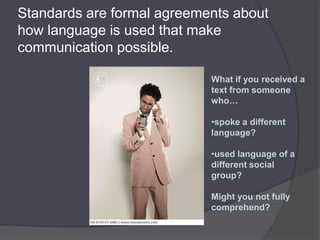
Standards are formal agreements about
how language is used that make
communication possible.

                            What if you received a
                            text from someone
                            who…

                            •spoke a different
                            language?

                            •used language of a
                            different social
                            group?

                            Might you not fully
                            comprehend?
How did standard English develop?

When did standardization of English
happen?

Where did it happen?
In the beginning there was lots of stuff to do for people to find out how they were going


to organize themselves as a group a maintain
Great Britain stands apart from the rest of
Europe because it is separated by water.
These seas can
be very
dangerous, but
some crossed
them to settle or
conquer at
different
points in early history.


WHO? ……
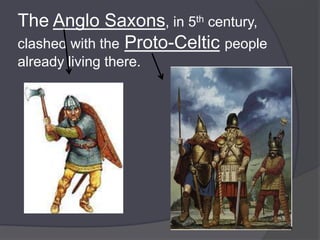
The Anglo Saxons, in 5th century,
clashed with the Proto-Celtic people
already living there.
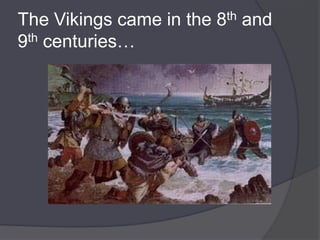
The Vikings came in the 8th and
9th centuries…
…and William the Conqueror
came with the Norman-French in
the 11th century.
As each culture came to Britain, it
changed the language in some form or
another.
That is just the beginning of the history
of the English language and how it
came to be one of the most irregular
and patch-worked languages in the
world.

English spoken in the U.S. has also
been profoundly impacted by African
Americans, who were originally brought
to America by Europeans as slaves.
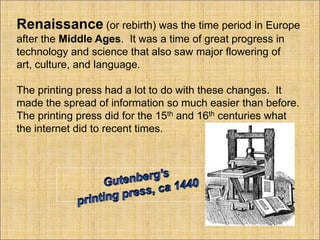
Renaissance (or rebirth) was the time period in Europe
after the Middle Ages. It was a time of great progress in
technology and science that also saw major flowering of
art, culture, and language.

The printing press had a lot to do with these changes. It
made the spread of information so much easier than before.
The printing press did for the 15th and 16th centuries what
the internet did to recent times.
Before the printing press, writing was mainly
for the elite or wealthy. The printing press
brought an            of books (and hence
information) that became available to the
general public. This gave rise to many new (and
different) forms of writing.

For the purposes of academia, people felt the
need for certain ground rules so that people
from different places could still read each
other’s writing.
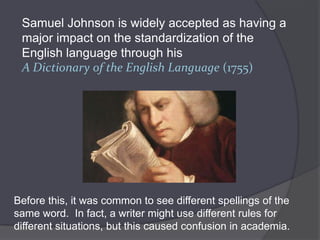
Samuel Johnson is widely accepted as having a
 major impact on the standardization of the
 English language through his
 A Dictionary of the English Language (1755)


Before this, it was common to see different spellings of the
same word. In fact, a writer might use different rules for
different situations, but this caused confusion in academia.
We can see (and hear) how people speak
differently today based on where they’re from
and who they are talking to.

Let’s listen to some variations present within
North Carolina that differ from the academic
standard.


  Sample of urban African American
   speech
  Sample of Appalachian speech
To someone unfamiliar with a type of
language, it may seem funny or
confusing.

One great way to understand and
appreciate different cultures is to study
the rules that govern the type of
language that they use.

Within academics, this type of study is
called Linguistics.
Picture References
Proto-Celtics
http://john844.org/images/proto-kelts-hallstatt-culture

Anglo Saxon
http://www.englisc-gateway.com/bbs/topic/30061-eu-to-conquer-anglo-saxons-and-jews/

Vikings
http://www.englisc-gateway.com/bbs/topic/30061-eu-to-conquer-anglo-saxons-and-jews/

William The Conqueror
http://sd-10807.dedibox.fr/show_items-feed=ba8d5c65e50c3e5536b41225cf1c4296?page=1

Picture for confusing text message
http://www.visualphotos.com/image/1x8706253/confused_man_reading_text_message

Gutenberg’s printing press
http://mallorykeeler.wordpress.com/2011/03/28/the-gutenberg-press-1440s/

Samuel Johnson
http://www.guardian.co.uk/books/2008/aug/09/biography

Language standards pp

  • 2.
    Standards are formalagreements about how language is used that make communication possible. What if you received a text from someone who… •spoke a different language? •used language of a different social group? Might you not fully comprehend?
  • 3.
    How did standardEnglish develop? When did standardization of English happen? Where did it happen?
  • 4.
    In the beginningthere was lots of stuff to do for people to find out how they were going to organize themselves as a group a maintain
  • 5.
    Great Britain standsapart from the rest of Europe because it is separated by water. These seas can be very dangerous, but some crossed them to settle or conquer at different points in early history. WHO? ……
  • 6.
    The Anglo Saxons,in 5th century, clashed with the Proto-Celtic people already living there.
  • 7.
    The Vikings camein the 8th and 9th centuries…
  • 8.
    …and William theConqueror came with the Norman-French in the 11th century.
  • 9.
    As each culturecame to Britain, it changed the language in some form or another. That is just the beginning of the history of the English language and how it came to be one of the most irregular and patch-worked languages in the world. English spoken in the U.S. has also been profoundly impacted by African Americans, who were originally brought to America by Europeans as slaves.
  • 10.
    Renaissance (or rebirth)was the time period in Europe after the Middle Ages. It was a time of great progress in technology and science that also saw major flowering of art, culture, and language. The printing press had a lot to do with these changes. It made the spread of information so much easier than before. The printing press did for the 15th and 16th centuries what the internet did to recent times.
  • 11.
    Before the printingpress, writing was mainly for the elite or wealthy. The printing press brought an of books (and hence information) that became available to the general public. This gave rise to many new (and different) forms of writing. For the purposes of academia, people felt the need for certain ground rules so that people from different places could still read each other’s writing.
  • 12.
    Samuel Johnson iswidely accepted as having a major impact on the standardization of the English language through his A Dictionary of the English Language (1755) Before this, it was common to see different spellings of the same word. In fact, a writer might use different rules for different situations, but this caused confusion in academia.
  • 14.
    We can see(and hear) how people speak differently today based on where they’re from and who they are talking to. Let’s listen to some variations present within North Carolina that differ from the academic standard.  Sample of urban African American speech  Sample of Appalachian speech
  • 15.
    To someone unfamiliarwith a type of language, it may seem funny or confusing. One great way to understand and appreciate different cultures is to study the rules that govern the type of language that they use. Within academics, this type of study is called Linguistics.
  • 16.
    Picture References Proto-Celtics http://john844.org/images/proto-kelts-hallstatt-culture Anglo Saxon http://www.englisc-gateway.com/bbs/topic/30061-eu-to-conquer-anglo-saxons-and-jews/ Vikings http://www.englisc-gateway.com/bbs/topic/30061-eu-to-conquer-anglo-saxons-and-jews/ WilliamThe Conqueror http://sd-10807.dedibox.fr/show_items-feed=ba8d5c65e50c3e5536b41225cf1c4296?page=1 Picture for confusing text message http://www.visualphotos.com/image/1x8706253/confused_man_reading_text_message Gutenberg’s printing press http://mallorykeeler.wordpress.com/2011/03/28/the-gutenberg-press-1440s/ Samuel Johnson http://www.guardian.co.uk/books/2008/aug/09/biography