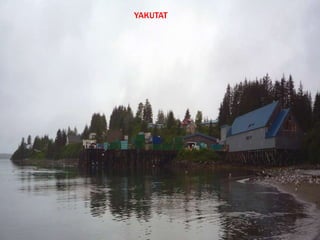
YAKUTAT
INITIAL GOALS OF UNIT
- Project Based
- Incorporate NGSS and Alaska State Standards
- Cultural Component
…Started brainstorming…
4
5
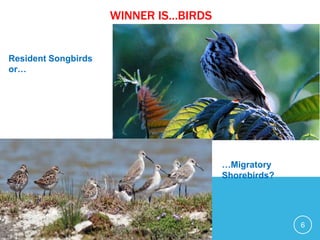
WINNER IS…BIRDS
6
Resident Songbirds
or…
…Migratory
Shorebirds?
7
HOW DO YOU DESIGN A PROJECT BASED UNIT?!
8
Project-Based Learning Model
PROJECT-BASED LEARNING MODEL- 8 STEPS
• Ecosystem Description
• Visit Site and explore thoroughly- technical map
• After Site: research on components
• Final Product: Write-up or map integrating information
• Define the Problem
• 2 Versions
• Research the Problem*
• What do they know, need to know
• What resources do they need, how will information be gathered
• Stakeholder Description
• - Gaining different perspectives: interview at least 2 stakeholders
9
PROJECT-BASED LEARNING MODEL- 8 STEPS
• Determine possible solutions
• Who has solved this before
• Develop a plan: identify, plan and reflect on project
• What are the resources and steps needed for implementation?
• Implement the plan: tracking progress through field
notes
• Students continually monitor and communicate process to
peers/teachers/stakeholders
• Summarize, evaluate, reflect
• - Present the work to peers for evaluation
10
GETTING TO KNOW OUR RESIDENT BIRDS
3rd & 4th Grade
- Year long life-science project
- Tentative problem (version 1):
What are the types of resident birds that live on the train
trail?
• Counts
• Identification
- NGSS: 3-LS3-1, 3-LS4-2, 3-LS1-1
- ASS: (4)SC2.2, (3)SC1.1, (3)SC2.1, (3)SC1.2
11
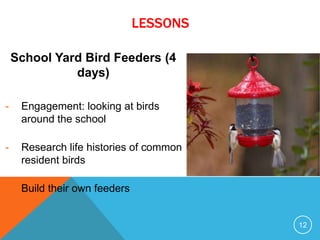
School Yard Bird Feeders (4
days)
- Engagement: looking at birds
around the school
- Research life histories of common
resident birds
- Build their own feeders
12
LESSONS
What is a Characteristic? (1 day)
• Engagement: Call students up
based on physical and behavioral
characteristics
• Group leaves on physical
characteristics
• Group pictures of Alaskan wildlife
on behavioral characteristics
13
LESSONS
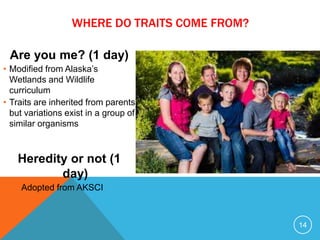
Are you me? (1 day)
• Modified from Alaska’s
Wetlands and Wildlife
curriculum
• Traits are inherited from parents
but variations exist in a group of
similar organisms
Heredity or not (1
day)
• Adopted from AKSCI
14
WHERE DO TRAITS COME FROM?
Traits of our Local Birds (1
day)
• Visiting the school bird feeder
• Physical and behavioral traits
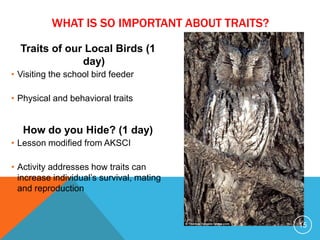
How do you Hide? (1 day)
• Lesson modified from AKSCI
• Activity addresses how traits can
increase individual’s survival, mating
and reproduction
15
WHAT IS SO IMPORTANT ABOUT TRAITS?
16

sarah Place based project learning

  • 2.
  • 4.
    INITIAL GOALS OFUNIT - Project Based - Incorporate NGSS and Alaska State Standards - Cultural Component …Started brainstorming… 4
  • 5.
  • 6.
  • 7.
  • 8.
    HOW DO YOUDESIGN A PROJECT BASED UNIT?! 8 Project-Based Learning Model
  • 9.
    PROJECT-BASED LEARNING MODEL-8 STEPS • Ecosystem Description • Visit Site and explore thoroughly- technical map • After Site: research on components • Final Product: Write-up or map integrating information • Define the Problem • 2 Versions • Research the Problem* • What do they know, need to know • What resources do they need, how will information be gathered • Stakeholder Description • - Gaining different perspectives: interview at least 2 stakeholders 9
  • 10.
    PROJECT-BASED LEARNING MODEL-8 STEPS • Determine possible solutions • Who has solved this before • Develop a plan: identify, plan and reflect on project • What are the resources and steps needed for implementation? • Implement the plan: tracking progress through field notes • Students continually monitor and communicate process to peers/teachers/stakeholders • Summarize, evaluate, reflect • - Present the work to peers for evaluation 10
  • 11.
    GETTING TO KNOWOUR RESIDENT BIRDS 3rd & 4th Grade - Year long life-science project - Tentative problem (version 1): What are the types of resident birds that live on the train trail? • Counts • Identification - NGSS: 3-LS3-1, 3-LS4-2, 3-LS1-1 - ASS: (4)SC2.2, (3)SC1.1, (3)SC2.1, (3)SC1.2 11
  • 12.
    School Yard BirdFeeders (4 days) - Engagement: looking at birds around the school - Research life histories of common resident birds - Build their own feeders 12 LESSONS
  • 13.
    What is aCharacteristic? (1 day) • Engagement: Call students up based on physical and behavioral characteristics • Group leaves on physical characteristics • Group pictures of Alaskan wildlife on behavioral characteristics 13 LESSONS
  • 14.
    Are you me?(1 day) • Modified from Alaska’s Wetlands and Wildlife curriculum • Traits are inherited from parents but variations exist in a group of similar organisms Heredity or not (1 day) • Adopted from AKSCI 14 WHERE DO TRAITS COME FROM?
  • 15.
    Traits of ourLocal Birds (1 day) • Visiting the school bird feeder • Physical and behavioral traits How do you Hide? (1 day) • Lesson modified from AKSCI • Activity addresses how traits can increase individual’s survival, mating and reproduction 15 WHAT IS SO IMPORTANT ABOUT TRAITS?
  • 16.