
Introduction to
SAP TM for Shippers
• What is SAP TM for Shippers?
• History of SAP TM
• Basic flow in ECC
• Processes and Capabilities in
SAP TM
• Conceptual view of SAP TM
• ECC - TM Integration alternatives
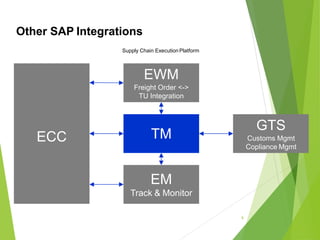
• Other Integrations
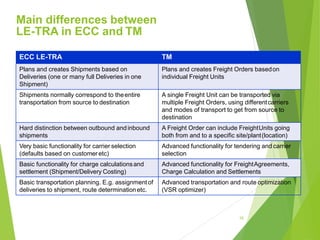
• Differences between LE-TRA and SAP TM
• Key Considerations
2
Agenda
SAP TM for Shippers
3
SAP TM has two main uses
1. Manage Transportation Planning and Execution for a shipper,
i.e. a producer and/or buyer/seller of goods
2. Manage Transportation Planning and Execution for a
transportation service provider, i.e. a company providing
transportation services to others (Shipper)
This presentation will focus on the first use.
The History of Transportation in
SAP Solutions
4
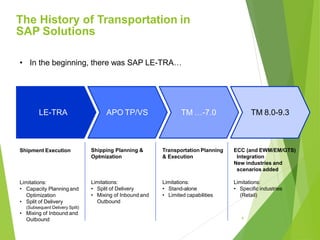
• In the beginning, there was SAP LE-TRA…
LE-TRA APO TP/VS TM …-7.0 TM 8.0-9.3
Shipment Execution
Limitations:
• Capacity Planning and
Optimization
• Split of Delivery
(Subsequent Delivery Split)
• Mixing of Inbound and
Outbound
Shipping Planning &
Optmization
Limitations:
• Split of Delivery
• Mixing of Inbound and
Outbound
Transportation Planning
& Execution
Limitations:
• Stand-alone
• Limited capabilities
ECC (and EWM/EM/GTS)
Integration
New industries and
scenarios added
Limitations:
• Specific industries
(Retail)
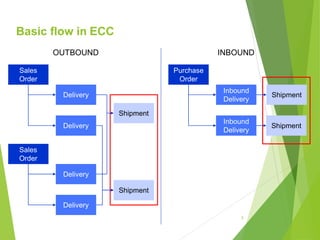
Basic flow in ECC
5
Sales
Order
Sales
Order
Delivery
Delivery
Delivery
Delivery
Shipment
Shipment
Purchase
Order
Inbound
Delivery
Inbound
Delivery
Shipment
Shipment
OUTBOUND INBOUND
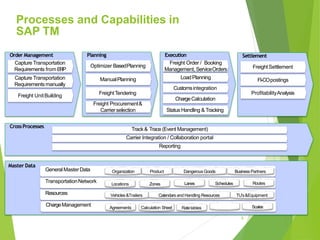
Processes and Capabilities in
SAP TM
6
Master Data
CrossProcesses
Planning
Freight Procurement&
Carrierselection
FreightTendering
Customsintegration
ChargeCalculation
StatusHandling & Tracking
GeneralMasterData
TransportationNetwork
Organization Product
Settlement
FI-COpostings
ProfitabilityAnalysis
BusinessPartners
Execution
Freight Order / Booking
Management, ServiceOrders
LoadPlanning
Resources
Locations Zones
Dangerous Goods
Lanes Schedules Routes
Vehicles&Trailers Calendars and Handling Resources TU’s&Equipment
FreightSettlement
ManualPlanning
Optimizer BasedPlanning
ChargeManagement Agreements Calculation Sheet Ratetables ChargeTypes Scales
Order Management
Capture Transportation
Requirements fromERP
Capture Transportation
Requirementsmanually
Track& Trace (Event Management)
Carrier Integration / Collaboration portal
Reporting
Freight UnitBuilding
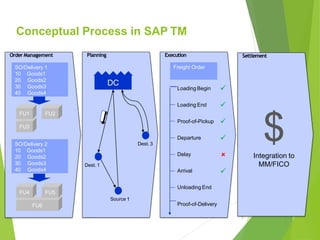
Conceptual Process in SAP TM
7
OrderManagement
FU3
FU6
SO/Delivery 1
10 Goods1
20 Goods2
30 Goods3
40 Goods4
SO/Delivery 2
10 Goods1
20 Goods2
30 Goods3
40 Goods4
FU1 FU2
FU4 FU5
Execution
Loading Begin
Loading End
Proof-of-Pickup
Departure
Arrival
Delay
Unloading End
Freight Order






Settlement
$Integration to
MM/FICO
Planning
DC
Dest. 1
Source 1
Proof-of-Delivery
Dest. 3
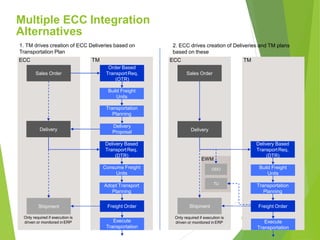
Multiple ECC Integration
Alternatives
8
Sales Order
Delivery
Order Based
TransportReq.
(OTR)
Transportation
Planning
Delivery
Proposal
Delivery Based
TransportReq.
(DTR)
Consume Freight
Units
Adopt Transport
Planning
Execute
Transportation
Build Freight
Units
Freight OrderShipment
1. TM drives creation of ECC Deliveries based on
Transportation Plan
ECC TM
Only required if execution is
driven or monitored in ERP
Sales Order
Delivery
Delivery Based
TransportReq.
(DTR)
Build Freight
Units
Transportation
Planning
Freight Order
Execute
Transportation
Shipment
2. ECC drives creation of Deliveries and TM plans
based on these
ECC TM
Only required if execution is
driven or monitored in ERP
EWM
ODO
TU
Supply Chain Execution Platform
Other SAP Integrations
TMECC
EWM
Freight Order <->
TU Integration
EM
Track & Monitor
GTS
Customs Mgmt
Copliance Mgmt
9
Main differences between
LE-TRA in ECC and TM
10
ECC LE-TRA TM
Plans and creates Shipments based on
Deliveries (one or many full Deliveries in one
Shipment)
Plans and creates Freight Orders basedon
individual Freight Units
Shipments normally correspond to theentire
transportation from source to destination
A single Freight Unit can be transported via
multiple Freight Orders, using differentcarriers
and modes of transport to get from source to
destination
Hard distinction between outbound andinbound
shipments
A Freight Order can include FreightUnits going
both from and to a specific site/plant(location)
Very basic functionality for carrier selection
(defaults based on customeretc)
Advanced functionality for tendering and carrier
selection
Basic functionality for charge calculationsand
settlement (Shipment/Delivery Costing)
Advanced functionality for FreightAgreements,
Charge Calculation and Settlements
Basic transportation planning. E.g. assignmentof
deliveries to shipment, route determinationetc.
Advanced transportation and route optimization
(VSR optimizer)
Key Considerations
11
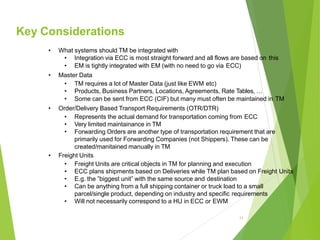
• What systems should TM be integrated with
• Integration via ECC is most straight forward and all flows are based on this
• EM is tightly integrated with EM (with no need to go via ECC)
• Master Data
• TM requires a lot of Master Data (just like EWM etc)
• Products, Business Partners, Locations, Agreements, Rate Tables, …
• Some can be sent from ECC (CIF) but many must often be maintained in TM
• Order/Delivery Based Transport Requirements (OTR/DTR)
• Represents the actual demand for transportation coming from ECC
• Very limited maintainance in TM
• Forwarding Orders are another type of transportation requirement that are
primarily used for Forwarding Companies (not Shippers). These can be
created/manitained manually in TM
• Freight Units
• Freight Units are critical objects in TM for planning and execution
• ECC plans shipments based on Deliveries while TM plan based on Freight Units
• E.g. the ”biggest unit” with the same source and destination
• Can be anything from a full shipping container or truck load to a small
parcel/single product, depending on industry and specific requirements
• Will not necessarily correspond to a HU in ECC or EWM
Take-aways about TM
12
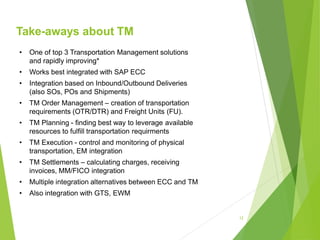
• One of top 3 Transportation Management solutions
and rapidly improving*
• Works best integrated with SAP ECC
• Integration based on Inbound/Outbound Deliveries
(also SOs, POs and Shipments)
• TM Order Management – creation of transportation
requirements (OTR/DTR) and Freight Units (FU).
• TM Planning - finding best way to leverage available
resources to fulfill transportation requirments
• TM Execution - control and monitoring of physical
transportation, EM integration
• TM Settlements – calculating charges, receiving
invoices, MM/FICO integration
• Multiple integration alternatives between ECC and TM
• Also integration with GTS, EWM
Questions
13
?
END
Thank you for listening
14

SAP TM

  • 1.
  • 2.
    • What isSAP TM for Shippers? • History of SAP TM • Basic flow in ECC • Processes and Capabilities in SAP TM • Conceptual view of SAP TM • ECC - TM Integration alternatives • Other Integrations • Differences between LE-TRA and SAP TM • Key Considerations 2 Agenda
  • 3.
    SAP TM forShippers 3 SAP TM has two main uses 1. Manage Transportation Planning and Execution for a shipper, i.e. a producer and/or buyer/seller of goods 2. Manage Transportation Planning and Execution for a transportation service provider, i.e. a company providing transportation services to others (Shipper) This presentation will focus on the first use.
  • 4.
    The History ofTransportation in SAP Solutions 4 • In the beginning, there was SAP LE-TRA… LE-TRA APO TP/VS TM …-7.0 TM 8.0-9.3 Shipment Execution Limitations: • Capacity Planning and Optimization • Split of Delivery (Subsequent Delivery Split) • Mixing of Inbound and Outbound Shipping Planning & Optmization Limitations: • Split of Delivery • Mixing of Inbound and Outbound Transportation Planning & Execution Limitations: • Stand-alone • Limited capabilities ECC (and EWM/EM/GTS) Integration New industries and scenarios added Limitations: • Specific industries (Retail)
  • 5.
    Basic flow inECC 5 Sales Order Sales Order Delivery Delivery Delivery Delivery Shipment Shipment Purchase Order Inbound Delivery Inbound Delivery Shipment Shipment OUTBOUND INBOUND
  • 6.
    Processes and Capabilitiesin SAP TM 6 Master Data CrossProcesses Planning Freight Procurement& Carrierselection FreightTendering Customsintegration ChargeCalculation StatusHandling & Tracking GeneralMasterData TransportationNetwork Organization Product Settlement FI-COpostings ProfitabilityAnalysis BusinessPartners Execution Freight Order / Booking Management, ServiceOrders LoadPlanning Resources Locations Zones Dangerous Goods Lanes Schedules Routes Vehicles&Trailers Calendars and Handling Resources TU’s&Equipment FreightSettlement ManualPlanning Optimizer BasedPlanning ChargeManagement Agreements Calculation Sheet Ratetables ChargeTypes Scales Order Management Capture Transportation Requirements fromERP Capture Transportation Requirementsmanually Track& Trace (Event Management) Carrier Integration / Collaboration portal Reporting Freight UnitBuilding
  • 7.
    Conceptual Process inSAP TM 7 OrderManagement FU3 FU6 SO/Delivery 1 10 Goods1 20 Goods2 30 Goods3 40 Goods4 SO/Delivery 2 10 Goods1 20 Goods2 30 Goods3 40 Goods4 FU1 FU2 FU4 FU5 Execution Loading Begin Loading End Proof-of-Pickup Departure Arrival Delay Unloading End Freight Order       Settlement $Integration to MM/FICO Planning DC Dest. 1 Source 1 Proof-of-Delivery Dest. 3
  • 8.
    Multiple ECC Integration Alternatives 8 SalesOrder Delivery Order Based TransportReq. (OTR) Transportation Planning Delivery Proposal Delivery Based TransportReq. (DTR) Consume Freight Units Adopt Transport Planning Execute Transportation Build Freight Units Freight OrderShipment 1. TM drives creation of ECC Deliveries based on Transportation Plan ECC TM Only required if execution is driven or monitored in ERP Sales Order Delivery Delivery Based TransportReq. (DTR) Build Freight Units Transportation Planning Freight Order Execute Transportation Shipment 2. ECC drives creation of Deliveries and TM plans based on these ECC TM Only required if execution is driven or monitored in ERP EWM ODO TU
  • 9.
    Supply Chain ExecutionPlatform Other SAP Integrations TMECC EWM Freight Order <-> TU Integration EM Track & Monitor GTS Customs Mgmt Copliance Mgmt 9
  • 10.
    Main differences between LE-TRAin ECC and TM 10 ECC LE-TRA TM Plans and creates Shipments based on Deliveries (one or many full Deliveries in one Shipment) Plans and creates Freight Orders basedon individual Freight Units Shipments normally correspond to theentire transportation from source to destination A single Freight Unit can be transported via multiple Freight Orders, using differentcarriers and modes of transport to get from source to destination Hard distinction between outbound andinbound shipments A Freight Order can include FreightUnits going both from and to a specific site/plant(location) Very basic functionality for carrier selection (defaults based on customeretc) Advanced functionality for tendering and carrier selection Basic functionality for charge calculationsand settlement (Shipment/Delivery Costing) Advanced functionality for FreightAgreements, Charge Calculation and Settlements Basic transportation planning. E.g. assignmentof deliveries to shipment, route determinationetc. Advanced transportation and route optimization (VSR optimizer)
  • 11.
    Key Considerations 11 • Whatsystems should TM be integrated with • Integration via ECC is most straight forward and all flows are based on this • EM is tightly integrated with EM (with no need to go via ECC) • Master Data • TM requires a lot of Master Data (just like EWM etc) • Products, Business Partners, Locations, Agreements, Rate Tables, … • Some can be sent from ECC (CIF) but many must often be maintained in TM • Order/Delivery Based Transport Requirements (OTR/DTR) • Represents the actual demand for transportation coming from ECC • Very limited maintainance in TM • Forwarding Orders are another type of transportation requirement that are primarily used for Forwarding Companies (not Shippers). These can be created/manitained manually in TM • Freight Units • Freight Units are critical objects in TM for planning and execution • ECC plans shipments based on Deliveries while TM plan based on Freight Units • E.g. the ”biggest unit” with the same source and destination • Can be anything from a full shipping container or truck load to a small parcel/single product, depending on industry and specific requirements • Will not necessarily correspond to a HU in ECC or EWM
  • 12.
    Take-aways about TM 12 •One of top 3 Transportation Management solutions and rapidly improving* • Works best integrated with SAP ECC • Integration based on Inbound/Outbound Deliveries (also SOs, POs and Shipments) • TM Order Management – creation of transportation requirements (OTR/DTR) and Freight Units (FU). • TM Planning - finding best way to leverage available resources to fulfill transportation requirments • TM Execution - control and monitoring of physical transportation, EM integration • TM Settlements – calculating charges, receiving invoices, MM/FICO integration • Multiple integration alternatives between ECC and TM • Also integration with GTS, EWM
  • 13.
  • 14.
    END Thank you forlistening 14