 SAP stands for systems,Applications and products in
data processing
 10 million users, 30,000 installations, 1000 partners,
21 Industry solutions. Customer world-wide, mostly
Fortune 500 companies. 95% of the top 100 German
companies use SAP.
 SAP is the fourth largest software company in the
world.
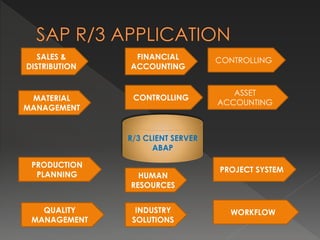
 The SAP R/3 system is a business software package
designed to integrate all areas of a business.
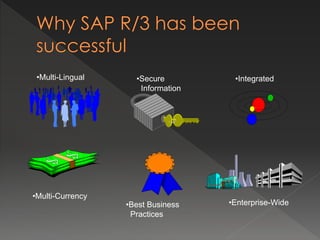
•Multi-Lingual
•Multi-Currency
•Secure
Information
•Integrated
•Enterprise-Wide•Best Business
Practices
SALES &
DISTRIBUTION
CONTROLLING
MATERIAL
MANAGEMENT
PRODUCTION
PLANNING
FINANCIAL
ACCOUNTING
HUMAN
RESOURCES
ASSET
ACCOUNTING
PROJECT SYSTEM
QUALITY
MANAGEMENT
INDUSTRY
SOLUTIONS
WORKFLOW
R/3 CLIENT SERVER
ABAP
CONTROLLING
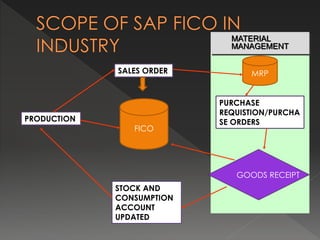
PRODUCTION
SALES ORDER
FICO
STOCK AND
CONSUMPTION
ACCOUNT
UPDATED
MRP
PURCHASE
REQUISTION/PURCHA
SE ORDERS
GOODS RECEIPT
MATERIAL
MANAGEMENT
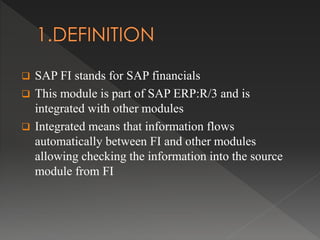
 SAP FI stands for SAP financials
 This module is part of SAP ERP:R/3 and is
integrated with other modules
 Integrated means that information flows
automatically between FI and other modules
allowing checking the information into the source
module from FI
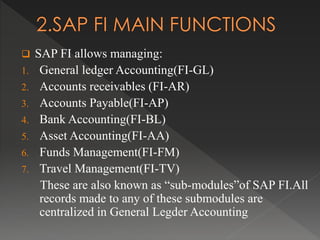
 SAP FI allows managing:
1. General ledger Accounting(FI-GL)
2. Accounts receivables (FI-AR)
3. Accounts Payable(FI-AP)
4. Bank Accounting(FI-BL)
5. Asset Accounting(FI-AA)
6. Funds Management(FI-FM)
7. Travel Management(FI-TV)
These are also known as “sub-modules”of SAP FI.All
records made to any of these submodules are
centralized in General Legder Accounting
 Document system: any data posted to SAP FI ledger
generates a document. Thus the document allows
following and keeping track of all the entries.
 Real time posting: any information recorded in SAP
FI is impacting immediately the accounting system
 As SAP FI is integrated with other modules financial
data from other modules(i.e. inventory, Payroll)are
automatically updated. These ensures the accuracy of
the figures between the modules
 Postings made in the sub-modules are automatically
impacting the General ledger. This is to ensure the
coherence of the Financial accounting
 Chart of Accounts: It is a list of General ledger
accounts that will be used to post documents in SAP
FI
 Company code: it is an independent and legal
accounting reporting unit. usually a company
 Business Area: it is like a business line or a specific
activity across companies and will allow
automatically preparing financial statements for this
given activity
 Multi Currencies: a currency is assigned to each company
code but SAP provides an automatic translation of each
documents posted in foreign currency
 Multi chart of accounts:a COA is assigned to each company
but for legal and reporting purposes a group and a local
chart of accounts can be defined
 Multi-ledgers:SAP FI new ledger version allows a multi ledgers
management .Depending on reporting needs(i.e.IFRS,local
GAAP…)scenario are predefined and documents postings
are impacting the different ledgers accordingly
 Real time processing with an integrated suite of
client/server applications.
 Comprehensive
 Open
 Business Process orientation
 Fully Integrated business process
 Modular Structure
 International – yet consistent
 Providing maximum flexibility & Scalability
 Strong backbone for future technologies.
 OSS 24 hr support available
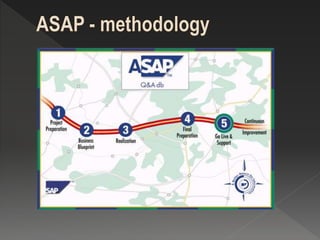
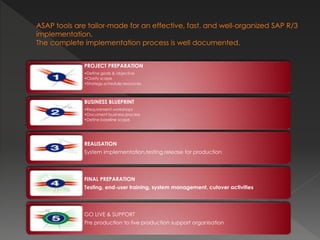
PROJECT PREPARATION
•Define goals & objective
•Clarify scope
•Strategy,schedule,resources
BUSINESS BLUEPRINT
•Requirement workshops
•Document business process
•Define baseline scope
REALISATION
System implementation,testing,release for production
FINAL PREPARATION
Testing, end-user training, system management, cutover activities
GO LIVE & SUPPORT
Pre production to live production support organisation

Sap introduction

  • 3.
     SAP standsfor systems,Applications and products in data processing  10 million users, 30,000 installations, 1000 partners, 21 Industry solutions. Customer world-wide, mostly Fortune 500 companies. 95% of the top 100 German companies use SAP.  SAP is the fourth largest software company in the world.  The SAP R/3 system is a business software package designed to integrate all areas of a business.
  • 4.
  • 5.
  • 6.
  • 7.
     SAP FIstands for SAP financials  This module is part of SAP ERP:R/3 and is integrated with other modules  Integrated means that information flows automatically between FI and other modules allowing checking the information into the source module from FI
  • 8.
     SAP FIallows managing: 1. General ledger Accounting(FI-GL) 2. Accounts receivables (FI-AR) 3. Accounts Payable(FI-AP) 4. Bank Accounting(FI-BL) 5. Asset Accounting(FI-AA) 6. Funds Management(FI-FM) 7. Travel Management(FI-TV) These are also known as “sub-modules”of SAP FI.All records made to any of these submodules are centralized in General Legder Accounting
  • 9.
     Document system:any data posted to SAP FI ledger generates a document. Thus the document allows following and keeping track of all the entries.  Real time posting: any information recorded in SAP FI is impacting immediately the accounting system  As SAP FI is integrated with other modules financial data from other modules(i.e. inventory, Payroll)are automatically updated. These ensures the accuracy of the figures between the modules  Postings made in the sub-modules are automatically impacting the General ledger. This is to ensure the coherence of the Financial accounting
  • 10.
     Chart ofAccounts: It is a list of General ledger accounts that will be used to post documents in SAP FI  Company code: it is an independent and legal accounting reporting unit. usually a company  Business Area: it is like a business line or a specific activity across companies and will allow automatically preparing financial statements for this given activity
  • 11.
     Multi Currencies:a currency is assigned to each company code but SAP provides an automatic translation of each documents posted in foreign currency  Multi chart of accounts:a COA is assigned to each company but for legal and reporting purposes a group and a local chart of accounts can be defined  Multi-ledgers:SAP FI new ledger version allows a multi ledgers management .Depending on reporting needs(i.e.IFRS,local GAAP…)scenario are predefined and documents postings are impacting the different ledgers accordingly
  • 12.
     Real timeprocessing with an integrated suite of client/server applications.  Comprehensive  Open  Business Process orientation  Fully Integrated business process  Modular Structure  International – yet consistent  Providing maximum flexibility & Scalability  Strong backbone for future technologies.  OSS 24 hr support available
  • 14.
    PROJECT PREPARATION •Define goals& objective •Clarify scope •Strategy,schedule,resources BUSINESS BLUEPRINT •Requirement workshops •Document business process •Define baseline scope REALISATION System implementation,testing,release for production FINAL PREPARATION Testing, end-user training, system management, cutover activities GO LIVE & SUPPORT Pre production to live production support organisation