PRACTICING ANTHROPOLOGY
IN DESIGN AND BUSINESS
Amy Santee, UX Researcher @ SpendWell Health
Portland State University
May 19th, 2015
1. Educational History
2. Work Experience
3. Project Examples
4. Reflections
@amysantee
circa 2000…
Interest in people, culture

Desire to travel

Innate curiosity about the
world

More observer than
participant (socially speaking)
It was decided…
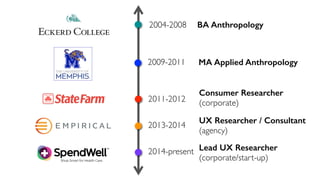
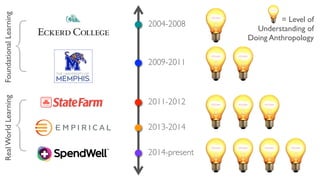
MA Applied Anthropology2009-2011
Consumer Researcher
(corporate)2011-2012
UX Researcher / Consultant
(agency)
2013-2014
Lead UX Researcher
(corporate/start-up)
2014-present
2004-2008 BA Anthropology
2004-2008
2009-2011
= Level of
Understanding of
Doing Anthropology
2011-2012
2013-2014
2014-present
Foundational Learning
{ Theory
Methods
Other competencies
2004-2008
2009-2011
= Level of
Understanding of
Doing Anthropology
2011-2012
2013-2014
2014-present
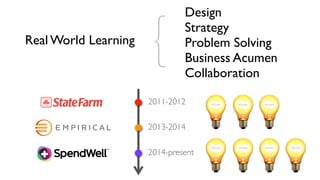
Real World Learning
{
Design
Strategy
Problem Solving
Business Acumen
Collaboration
2004-2008
2009-2011
FoundationalLearning
{
2011-2012
2013-2014
RealWorldLearning
{ 2014-present
= Level of
Understanding of
Doing Anthropology
Limited understanding of anthropology

Foundational knowledge and skills: cultural anthropology, writing, research,
critical thinking

Study abroad: cross-cultural experiences 

Budding researcher

Developing my own projects on phenomena of interest: The Facebook,
“gay” as derogatory term; research as a way to explore the world

Seeking opportunities to do research: Senior thesis on gentrification

Wasn’t really thinking about anthropology as a career: Except research
2004 - 2008
BA Anthropology
Took a year off (highly recommended)

Went back to master anthropology: Urban Anthropology and RESEARCH!

Also, it was the recession (Good timing) 

My understanding of the application of anthropology deepened: APPLYING it
to solve real world problems, understand social issues, recommend changes,
improve people’s lives

Problems of interest: Poverty, health care, community development, education

Practicum: community health and social capital, program evaluation
2009 - 2011
MA Applied 

Anthropology
In grad school, developed a side interest in culture and consumerism. 

First job out of grad school

Applying anthropology for realz (i.e., outside of academia)

An anthropologically interesting place to work: Learning the culture of
business - language, practices, beliefs, values, social structure, interaction

A learning experience: How to function in the business world, apply my
skills, communicate with others, convey information, build relationships
2011 - 2012
Consumer 

Researcher
What was I doing at an insurance company?!
Lead and support research projects
Design research plans, collect and analyze data, present findings
Examples:
• Agent office ethnography
• Call center work processes
• Shopping for insurance online
Project management
Recruiting participants, logistics, planning, proposal writing, travel, vendors
My Role at State Farm
It’s about being a [insert job title here.]

It’s about solving problems.

It’s about providing value.

…all with an anthropological perspective.
School trains us to “be anthropologists” rather than use anthropology skills in a
job. My experiences helped me realize that practicing anthropology isn’t about
“doing anthropology” and “being an anthropologist.”
I had to rethink my definition of “doing anthropology” 

in order to be a successful anthropologist and professional.
Anthropology is the perfect training for
business and design.
You have to understand people to design
things for them.
Anthropology gives you the tools to do this.
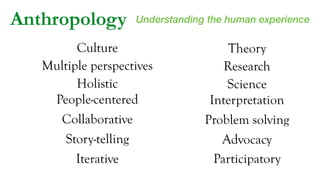
Anthropology Understanding the human experience
Theory
Research
Interpretation
Problem solving
Science
Advocacy
Culture
Multiple perspectives
People-centered
Collaborative
Holistic
Story-telling
Iterative Participatory
What is User Experience
(UX) research*?
*a.k.a. Design Research
A lot of design and business decisions 

get made in rooms like this…
In buildings like this…
(actually, this is where I work) :-)
When was the last time you
satisfied or delighted with a product
or service?
How about the last time you were
frustrated and totally let down?
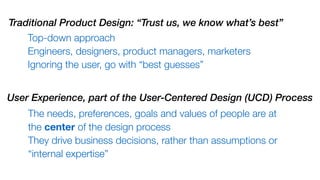
Top-down approach
Engineers, designers, product managers, marketers
Ignoring the user, go with “best guesses”
Traditional Product Design: “Trust us, we know what’s best”
The needs, preferences, goals and values of people are at
the center of the design process
They drive business decisions, rather than assumptions or
“internal expertise”
User Experience, part of the User-Centered Design (UCD) Process
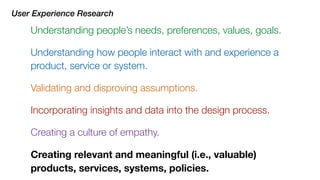
Understanding how people interact with and experience a
product, service or system.
User Experience Research
Understanding people’s needs, preferences, values, goals.
Incorporating insights and data into the design process.
Creating a culture of empathy.
Validating and disproving assumptions.
Creating relevant and meaningful (i.e., valuable)
products, services, systems, policies.
You are not your user.
Understanding > assuming / guessing
Users are experts.
UX Principles
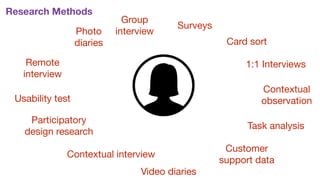
Contextual interview
Contextual
observation
Photo 

diaries
1:1 Interviews
Video diaries
Research Methods
Card sort
Usability test
Participatory
design research
Task analysis
Remote
interview
Group 

interview
Surveys
Customer
support data
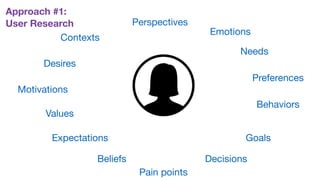
Contexts
Perspectives
Needs
Preferences
Beliefs
Values
Pain points
Goals
Behaviors
Motivations
Expectations
Desires
Emotions
Decisions
Approach #1:
User Research
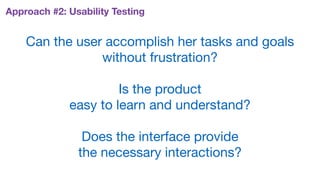
Approach #2: Usability Testing
Can the user accomplish her tasks and goals

without frustration?

Is the product 

easy to learn and understand?

Does the interface provide 

the necessary interactions?
UX research adds insight to the
design process.
The outputs of UX research inform
the inputs and outcomes of design
and business strategy.
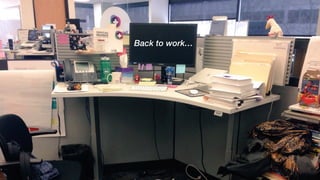
Back to work…
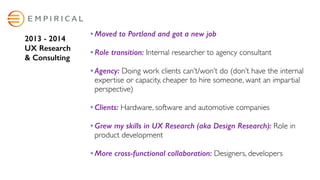
Moved to Portland and got a new job 

Role transition: Internal researcher to agency consultant

Agency: Doing work clients can’t/won’t do (don’t have the internal
expertise or capacity, cheaper to hire someone, want an impartial
perspective)

Clients: Hardware, software and automotive companies

Grew my skills in UX Research (aka Design Research): Role in
product development

More cross-functional collaboration: Designers, developers
2013 - 2014 

UX Research 

& Consulting
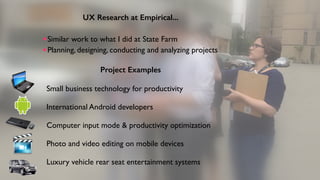
Project Examples
Small business technology for productivity
International Android developers

Computer input mode & productivity optimization
Photo and video editing on mobile devices
Luxury vehicle rear seat entertainment systems
UX Research at Empirical...
Similar work to what I did at State Farm
Planning, designing, conducting and analyzing projects
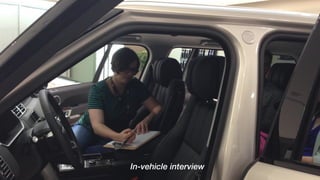
In-vehicle interview
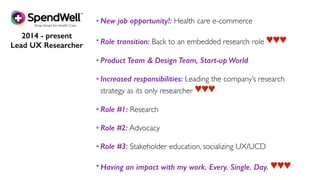
New job opportunity!: Health care e-commerce

Role transition: Back to an embedded research role ♥♥♥

Product Team & Design Team, Start-up World

Increased responsibilities: Leading the company’s research
strategy as its only researcher ♥♥♥

Role #1: Research

Role #2: Advocacy

Role #3: Stakeholder education, socializing UX/UCD

Having an impact with my work. Every. Single. Day. ♥♥♥
2014 - present
Lead UX Researcher
My field site
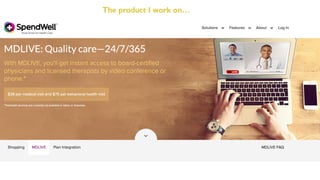
The product I work on…
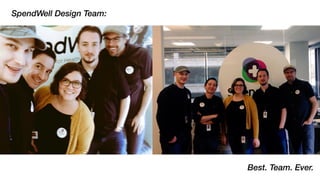
SpendWell Design Team:
Best. Team. Ever.
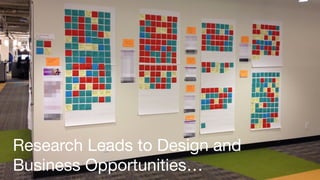
Research Leads to Design and
Business Opportunities…
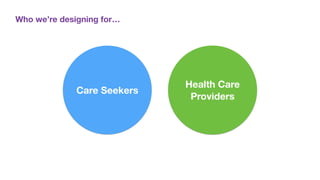
Who we’re designing for…
Health Care
Providers
Care Seekers
Project Example: 

SpendWell Provider Account
Registration Process
SpendWell Provider Account Registration Process
Project Goals
• Obtain user feedback on the experience of registering a provider account
on SpendWell.

• Get feedback on SpendWell’s branding, design, content, features and
value props.

• Understand the efficacy of our website marketing pages and other
communication with providers.

• Build our knowledge base of providers to develop provider personas.
Outcomes
• Improve the usability and overall user experience of our product for 

health care providers.

• Refine our marketing and provider communication.
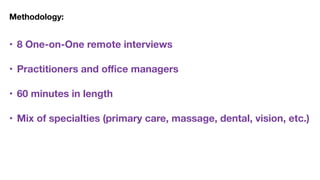
Methodology:
• 8 One-on-One remote interviews

• Practitioners and office managers 

• 60 minutes in length

• Mix of specialties (primary care, massage, dental, vision, etc.)
Provider feedback validated our design hypothesis: 

Overall, signing up for an account
on our website is simple, quick and
straightforward for small practices

- but may present issues for bigger
practices.
Talking to providers helped us understand: 

What entices them to sign up for
SpendWell - saving time, making
money, and business opportunities.
Providers reminded us that: 

It’s not just about the business of
health care, but the care of patients.
Our solution can help with this.
The research helped us get a better idea of: 

Which marketing messaging
resonates with small providers.
We walked away with a whole list of: 

The most frequently asked
questions that providers have about
SpendWell.
Our data and insights provided us with:
1. Changes to our website that will lead to an even more efficient and enjoyable 

account registration experience.

2. Direction for our website marketing and email campaigns.

3. Content to add to our Provider FAQ page.

4. Ideas for new content/media that helps providers through the process of signing
up for and using SpendWell (e.g., how-to videos, tutorials, etc.)

5. Marketing and design changes that will likely lead to a decrease in calls/emails to
Customer Support.
What would these changes mean for SpendWell and its users?
1. Better marketing and communication = 


Better understanding of SpendWell and the value it provides, an increase in
providers who sign up, and more engagement with the product.

2. An improved registration process =


An improved user experience, more positive sentiment about our brand.

3. More robust information on the site = 


Users who can help themselves, and a decrease in calls/emails to 

Customer Support.
What does this work mean for me professionally? 

I care about two things.
1. Using my anthropology training 


Research methods, theory, understanding of culture, critical thinking, etc.

2. Making a difference


Improving our user interface, advocating for our users, convincing stakeholders,
reminding people we’re not designing for ourselves, making sure our product
meets people’s needs and solves their problems, and ultimately improving
people’s experiences with our product.
I encourage you to explore
UX Research and Design as a
possible career path.
SOME FINAL THOUGHTS
Academic anthropology is “pure” anthropology.
Applied anthropology isn’t theoretical enough.
Applied anthropology isn’t intellectually stimulating.
4 Myths
BULLSHIT
Business is evil and you’re a horrible person if you

work there.
Network, network, network!!!
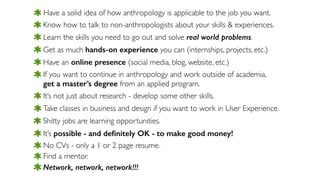
Have a solid idea of how anthropology is applicable to the job you want.
Know how to talk to non-anthropologists about your skills & experiences.
Learn the skills you need to go out and solve real world problems.
Get as much hands-on experience you can (internships, projects, etc.)
Have an online presence (social media, blog, website, etc.)
If you want to continue in anthropology and work outside of academia, 

get a master’s degree from an applied program.
It’s not just about research - develop some other skills.
Shitty jobs are learning opportunities.
Take classes in business and design if you want to work in User Experience.
It’s possible - and definitely OK - to make good money!
No CVs - only a 1 or 2 page resume.
Find a mentor.
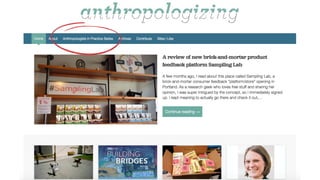
“Anthropologists in Practice” Interview Series

- 22 interviews and counting...

- Areas of practice: consulting, technology, branding, consumer research,
health care, community organizing, evaluation, teaching, urban planning, etc.

- Topics: training, career paths, job roles, accomplishments, advice for students
PDX Design Research Group
• Networking group for practitioners of UX
research and those who are interested in it.

• Meets every other month in downtown.

• Speakers: researchers working in UX in
different industries, including technology,
health care, consulting, etc.

• Free!

• Sign up: pdxdesignresearch@gmail.com
amylaurensantee@gmail.com
@amysantee
www.amysantee.com
.com
Thank you!

Praticing Anthropology in Business and Design

  • 1.
    PRACTICING ANTHROPOLOGY IN DESIGNAND BUSINESS Amy Santee, UX Researcher @ SpendWell Health Portland State University May 19th, 2015
  • 2.
    1. Educational History 2.Work Experience 3. Project Examples 4. Reflections
  • 3.
  • 4.
    circa 2000… Interest inpeople, culture
 Desire to travel
 Innate curiosity about the world
 More observer than participant (socially speaking)
 It was decided…
  • 5.
    MA Applied Anthropology2009-2011 ConsumerResearcher (corporate)2011-2012 UX Researcher / Consultant (agency) 2013-2014 Lead UX Researcher (corporate/start-up) 2014-present 2004-2008 BA Anthropology
  • 6.
    2004-2008 2009-2011 = Level of Understandingof Doing Anthropology 2011-2012 2013-2014 2014-present Foundational Learning { Theory Methods Other competencies
  • 7.
    2004-2008 2009-2011 = Level of Understandingof Doing Anthropology 2011-2012 2013-2014 2014-present Real World Learning { Design Strategy Problem Solving Business Acumen Collaboration
  • 8.
  • 9.
    Limited understanding ofanthropology
 Foundational knowledge and skills: cultural anthropology, writing, research, critical thinking
 Study abroad: cross-cultural experiences 
 Budding researcher
 Developing my own projects on phenomena of interest: The Facebook, “gay” as derogatory term; research as a way to explore the world
 Seeking opportunities to do research: Senior thesis on gentrification
 Wasn’t really thinking about anthropology as a career: Except research 2004 - 2008 BA Anthropology
  • 10.
    Took a yearoff (highly recommended)
 Went back to master anthropology: Urban Anthropology and RESEARCH!
 Also, it was the recession (Good timing) 
 My understanding of the application of anthropology deepened: APPLYING it to solve real world problems, understand social issues, recommend changes, improve people’s lives
 Problems of interest: Poverty, health care, community development, education
 Practicum: community health and social capital, program evaluation 2009 - 2011 MA Applied 
 Anthropology
  • 11.
    In grad school,developed a side interest in culture and consumerism. 
 First job out of grad school
 Applying anthropology for realz (i.e., outside of academia)
 An anthropologically interesting place to work: Learning the culture of business - language, practices, beliefs, values, social structure, interaction
 A learning experience: How to function in the business world, apply my skills, communicate with others, convey information, build relationships 2011 - 2012 Consumer 
 Researcher
  • 12.
    What was Idoing at an insurance company?!
  • 13.
    Lead and supportresearch projects Design research plans, collect and analyze data, present findings Examples: • Agent office ethnography • Call center work processes • Shopping for insurance online Project management Recruiting participants, logistics, planning, proposal writing, travel, vendors My Role at State Farm
  • 14.
    It’s about beinga [insert job title here.]
 It’s about solving problems.
 It’s about providing value.
 …all with an anthropological perspective. School trains us to “be anthropologists” rather than use anthropology skills in a job. My experiences helped me realize that practicing anthropology isn’t about “doing anthropology” and “being an anthropologist.” I had to rethink my definition of “doing anthropology” 
 in order to be a successful anthropologist and professional.
  • 15.
    Anthropology is theperfect training for business and design. You have to understand people to design things for them. Anthropology gives you the tools to do this.
  • 16.
    Anthropology Understanding thehuman experience Theory Research Interpretation Problem solving Science Advocacy Culture Multiple perspectives People-centered Collaborative Holistic Story-telling Iterative Participatory
  • 17.
    What is UserExperience (UX) research*? *a.k.a. Design Research
  • 18.
    A lot ofdesign and business decisions 
 get made in rooms like this… In buildings like this… (actually, this is where I work) :-)
  • 19.
    When was thelast time you satisfied or delighted with a product or service? How about the last time you were frustrated and totally let down?
  • 20.
    Top-down approach Engineers, designers,product managers, marketers Ignoring the user, go with “best guesses” Traditional Product Design: “Trust us, we know what’s best” The needs, preferences, goals and values of people are at the center of the design process They drive business decisions, rather than assumptions or “internal expertise” User Experience, part of the User-Centered Design (UCD) Process
  • 21.
    Understanding how peopleinteract with and experience a product, service or system. User Experience Research Understanding people’s needs, preferences, values, goals. Incorporating insights and data into the design process. Creating a culture of empathy. Validating and disproving assumptions. Creating relevant and meaningful (i.e., valuable) products, services, systems, policies.
  • 22.
    You are notyour user. Understanding > assuming / guessing Users are experts. UX Principles
  • 23.
    Contextual interview Contextual observation Photo diaries 1:1Interviews Video diaries Research Methods Card sort Usability test Participatory design research Task analysis Remote interview Group interview Surveys Customer support data
  • 24.
  • 25.
    Approach #2: UsabilityTesting Can the user accomplish her tasks and goals
 without frustration? Is the product 
 easy to learn and understand? Does the interface provide 
 the necessary interactions?
  • 26.
    UX research addsinsight to the design process. The outputs of UX research inform the inputs and outcomes of design and business strategy.
  • 27.
  • 28.
    Moved to Portlandand got a new job 
 Role transition: Internal researcher to agency consultant
 Agency: Doing work clients can’t/won’t do (don’t have the internal expertise or capacity, cheaper to hire someone, want an impartial perspective)
 Clients: Hardware, software and automotive companies
 Grew my skills in UX Research (aka Design Research): Role in product development
 More cross-functional collaboration: Designers, developers 2013 - 2014 
 UX Research 
 & Consulting
  • 29.
    Project Examples Small businesstechnology for productivity International Android developers
 Computer input mode & productivity optimization Photo and video editing on mobile devices Luxury vehicle rear seat entertainment systems UX Research at Empirical... Similar work to what I did at State Farm Planning, designing, conducting and analyzing projects
  • 30.
  • 31.
    New job opportunity!:Health care e-commerce
 Role transition: Back to an embedded research role ♥♥♥
 Product Team & Design Team, Start-up World
 Increased responsibilities: Leading the company’s research strategy as its only researcher ♥♥♥
 Role #1: Research
 Role #2: Advocacy
 Role #3: Stakeholder education, socializing UX/UCD
 Having an impact with my work. Every. Single. Day. ♥♥♥ 2014 - present Lead UX Researcher
  • 32.
  • 33.
    The product Iwork on…
  • 34.
    The product Iwork on…
  • 35.
  • 36.
    Research Leads toDesign and Business Opportunities…
  • 37.
    Who we’re designingfor… Health Care Providers Care Seekers
  • 38.
    Project Example: 
 SpendWellProvider Account Registration Process
  • 39.
    SpendWell Provider AccountRegistration Process Project Goals • Obtain user feedback on the experience of registering a provider account on SpendWell. • Get feedback on SpendWell’s branding, design, content, features and value props. • Understand the efficacy of our website marketing pages and other communication with providers. • Build our knowledge base of providers to develop provider personas. Outcomes • Improve the usability and overall user experience of our product for 
 health care providers. • Refine our marketing and provider communication.
  • 40.
    Methodology: • 8 One-on-Oneremote interviews
 • Practitioners and office managers 
 • 60 minutes in length
 • Mix of specialties (primary care, massage, dental, vision, etc.)
  • 41.
    Provider feedback validatedour design hypothesis: 
 Overall, signing up for an account on our website is simple, quick and straightforward for small practices
 - but may present issues for bigger practices.
  • 42.
    Talking to providershelped us understand: 
 What entices them to sign up for SpendWell - saving time, making money, and business opportunities.
  • 43.
    Providers reminded usthat: 
 It’s not just about the business of health care, but the care of patients. Our solution can help with this.
  • 44.
    The research helpedus get a better idea of: 
 Which marketing messaging resonates with small providers.
  • 45.
    We walked awaywith a whole list of: 
 The most frequently asked questions that providers have about SpendWell.
  • 46.
    Our data andinsights provided us with: 1. Changes to our website that will lead to an even more efficient and enjoyable 
 account registration experience.
 2. Direction for our website marketing and email campaigns.
 3. Content to add to our Provider FAQ page.
 4. Ideas for new content/media that helps providers through the process of signing up for and using SpendWell (e.g., how-to videos, tutorials, etc.)
 5. Marketing and design changes that will likely lead to a decrease in calls/emails to Customer Support.
  • 47.
    What would thesechanges mean for SpendWell and its users? 1. Better marketing and communication = 
 
 Better understanding of SpendWell and the value it provides, an increase in providers who sign up, and more engagement with the product.
 2. An improved registration process =
 
 An improved user experience, more positive sentiment about our brand.
 3. More robust information on the site = 
 
 Users who can help themselves, and a decrease in calls/emails to 
 Customer Support.
  • 48.
    What does thiswork mean for me professionally? 
 I care about two things. 1. Using my anthropology training 
 
 Research methods, theory, understanding of culture, critical thinking, etc.
 2. Making a difference
 
 Improving our user interface, advocating for our users, convincing stakeholders, reminding people we’re not designing for ourselves, making sure our product meets people’s needs and solves their problems, and ultimately improving people’s experiences with our product.
  • 49.
    I encourage youto explore UX Research and Design as a possible career path.
  • 50.
  • 51.
    Academic anthropology is“pure” anthropology. Applied anthropology isn’t theoretical enough. Applied anthropology isn’t intellectually stimulating. 4 Myths BULLSHIT Business is evil and you’re a horrible person if you
 work there.
  • 52.
    Network, network, network!!! Havea solid idea of how anthropology is applicable to the job you want. Know how to talk to non-anthropologists about your skills & experiences. Learn the skills you need to go out and solve real world problems. Get as much hands-on experience you can (internships, projects, etc.) Have an online presence (social media, blog, website, etc.) If you want to continue in anthropology and work outside of academia, 
 get a master’s degree from an applied program. It’s not just about research - develop some other skills. Shitty jobs are learning opportunities. Take classes in business and design if you want to work in User Experience. It’s possible - and definitely OK - to make good money! No CVs - only a 1 or 2 page resume. Find a mentor.
  • 54.
    “Anthropologists in Practice”Interview Series
 - 22 interviews and counting...
 - Areas of practice: consulting, technology, branding, consumer research, health care, community organizing, evaluation, teaching, urban planning, etc.
 - Topics: training, career paths, job roles, accomplishments, advice for students
  • 55.
    PDX Design ResearchGroup • Networking group for practitioners of UX research and those who are interested in it.
 • Meets every other month in downtown.
 • Speakers: researchers working in UX in different industries, including technology, health care, consulting, etc.
 • Free!
 • Sign up: pdxdesignresearch@gmail.com
  • 56.