NAME: PRATHVIRAJ
USN:4MW20ME401
CONTENT
1. Introduction
2. Working
3. Types Of Heat Storing Sand Battery
4. Charging And Discharging Of Heat-storing Sand Batteries
5. Material Used In Heat-storing Sand Batteries Points
6. Application Of Heat-storing Sand Batteries
7. Comparison To Other Energy Storage Technologies
8. Conclusion
9. Reference
INTRODUCTION
 Heat storing sand batteries are a type of renewable energy
storage technology that utilizes the heat capacity of sand
to store and release thermal energy.
 These batteries work by heating a volume of sand to a
high temperature using excess renewable energy, such as
from solar or wind power
WORKING
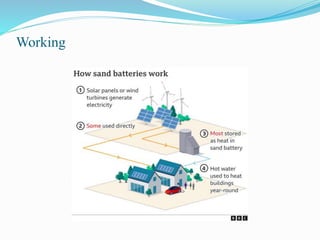
 Heat-storing sand batteries store thermal energy in sand,
which can then be used to generate electricity.
 The batteries consist of two tanks of sand, one at a high
temperature and one at a low temperature, connected by
pipes containing a heat transfer fluid.
 When the battery is charged, the heat transfer fluid is
pumped through the pipes from the hot sand tank to the
cold sand tank, transferring thermal energy from the hot
sand to the cold sand.
 The stored thermal energy can be used to generate
electricity by transferring the heat to a heat engine, which
in turn drives a generator to produce electricity
Working
Types of Heat-Storing Sand Batteries
Indirect Heat-Storing Sand Batteries
Direct Heat-Storing Sand Batteries
Thermochemical Heat-Storing Sand Batteries
Hybrid Heat-Storing Sand Batteries
Charging and Discharging of Heat-Storing Sand
Batteries
Charging Process
 Heat is transferred to the sand to store thermal energy
 Sand temperature increases until a threshold is reached, at
which point the energy is fully stored
 Charging times can vary depending on the type of sand
battery and the temperature of the heat source
Discharging Process
● When thermal energy is needed, the sand is exposed to a
heat sink or other device that can extract the heat
● The temperature of the sand drops and the stored energy is
released as heat
● Discharging times can vary depending on the type of sand
battery and the temperature of the heat sink
Material used in heat-storing sand batteries points
 Sand
 Heat transfer fluid
 Enclosure material
 Electrode and current collectors
Application of heat-storing sand batteries
 Renewable energy storage
 Heating and cooling
 Industrial application
 Emergency backup power
Comparison to Other Energy Storage Technologies
Lithium-ion Batteries
 Lithium-ion batteries are widely used for energy storage,
but they have limited energy density and can be expensive
Pumped hydro storage
 Pumped hydro storage is a mature and widely-used
technology for large-scale energy storage
 However, it requires specific geological features and can b
expensive to build and maintain
Comparison to Other Energy Storage Technologies
Flywheels
 Flywheels are a technology that stores energy by spinning
a rotor at high speed
 They are capable of very rapid charging and discharging.
but can be expensive and have limited energy storage
capacity
Thermal Energy Storage
 Thermal energy storage systems store energy in the form
of heat, usually by heating a fluid or material to a high
temperature
 They are often used in conjunction with solar thermal
systems or waste heat recovery systems
CONCLUSION
 Heat-storing sand batteries are a promising technology for
energy storage, with the potential to store large amounts of
energy at a low cost
 They can be used in a range of applications, such as
renewable energy storage, building heating and cooling,
and industrial process heat
 However, there are still challenges to be addressed, such
as improving efficiency, reducing maintenance
requirements, and integrating with existing energy
systems
CONCLUSION
 Research and development efforts are ongoing, and many
companies and organizations are investing in this
technology
 With further innovation and progress heat-storing sand
batteries may become a key component of a more
sustainable and resilient energy system in the future
REFERANCE
 Gabriela, Seasonal Sensible Thermal Energy Storage
Solutions, 1st ed. Technical University of Cluj-Napoco, 2017,
p.49. http://lejpt.academicdirect.org/A19/049_068.pd f
 S. Kalaiselvam and R. Parameshwaran, Thermal Energy
Storage Technologies for Sustainability, 1st ed. Elsevier, 2017,
pp. 1-64. https://www.elsevier.com/books/thermal-
energystorage-technologies for sustainability/kalaiselvam/978-
0-12-417291-3
 "Energy in the UAE / UAE Embassy in Washington, DC, Uae-
embossy.org, 2017.[Online]. Available: http://www.ude-
embassy.org/about-uae/energy-upe. (Accessed: 08-Apr-2017].
 O. Atoer, STORAGE OF THERMAL ENERGY, 1st ed.
Ankara: Gazi University, 2006
sandbattery-230420031727-fb2023ce (1).pdf

sandbattery-230420031727-fb2023ce (1).pdf

  • 1.
  • 2.
    CONTENT 1. Introduction 2. Working 3.Types Of Heat Storing Sand Battery 4. Charging And Discharging Of Heat-storing Sand Batteries 5. Material Used In Heat-storing Sand Batteries Points 6. Application Of Heat-storing Sand Batteries 7. Comparison To Other Energy Storage Technologies 8. Conclusion 9. Reference
  • 3.
    INTRODUCTION  Heat storingsand batteries are a type of renewable energy storage technology that utilizes the heat capacity of sand to store and release thermal energy.  These batteries work by heating a volume of sand to a high temperature using excess renewable energy, such as from solar or wind power
  • 4.
    WORKING  Heat-storing sandbatteries store thermal energy in sand, which can then be used to generate electricity.  The batteries consist of two tanks of sand, one at a high temperature and one at a low temperature, connected by pipes containing a heat transfer fluid.  When the battery is charged, the heat transfer fluid is pumped through the pipes from the hot sand tank to the cold sand tank, transferring thermal energy from the hot sand to the cold sand.  The stored thermal energy can be used to generate electricity by transferring the heat to a heat engine, which in turn drives a generator to produce electricity
  • 5.
  • 6.
    Types of Heat-StoringSand Batteries Indirect Heat-Storing Sand Batteries Direct Heat-Storing Sand Batteries Thermochemical Heat-Storing Sand Batteries Hybrid Heat-Storing Sand Batteries
  • 7.
    Charging and Dischargingof Heat-Storing Sand Batteries Charging Process  Heat is transferred to the sand to store thermal energy  Sand temperature increases until a threshold is reached, at which point the energy is fully stored  Charging times can vary depending on the type of sand battery and the temperature of the heat source
  • 8.
    Discharging Process ● Whenthermal energy is needed, the sand is exposed to a heat sink or other device that can extract the heat ● The temperature of the sand drops and the stored energy is released as heat ● Discharging times can vary depending on the type of sand battery and the temperature of the heat sink
  • 9.
    Material used inheat-storing sand batteries points  Sand  Heat transfer fluid  Enclosure material  Electrode and current collectors
  • 10.
    Application of heat-storingsand batteries  Renewable energy storage  Heating and cooling  Industrial application  Emergency backup power
  • 11.
    Comparison to OtherEnergy Storage Technologies Lithium-ion Batteries  Lithium-ion batteries are widely used for energy storage, but they have limited energy density and can be expensive Pumped hydro storage  Pumped hydro storage is a mature and widely-used technology for large-scale energy storage  However, it requires specific geological features and can b expensive to build and maintain
  • 12.
    Comparison to OtherEnergy Storage Technologies Flywheels  Flywheels are a technology that stores energy by spinning a rotor at high speed  They are capable of very rapid charging and discharging. but can be expensive and have limited energy storage capacity Thermal Energy Storage  Thermal energy storage systems store energy in the form of heat, usually by heating a fluid or material to a high temperature  They are often used in conjunction with solar thermal systems or waste heat recovery systems
  • 13.
    CONCLUSION  Heat-storing sandbatteries are a promising technology for energy storage, with the potential to store large amounts of energy at a low cost  They can be used in a range of applications, such as renewable energy storage, building heating and cooling, and industrial process heat  However, there are still challenges to be addressed, such as improving efficiency, reducing maintenance requirements, and integrating with existing energy systems
  • 14.
    CONCLUSION  Research anddevelopment efforts are ongoing, and many companies and organizations are investing in this technology  With further innovation and progress heat-storing sand batteries may become a key component of a more sustainable and resilient energy system in the future
  • 15.
    REFERANCE  Gabriela, SeasonalSensible Thermal Energy Storage Solutions, 1st ed. Technical University of Cluj-Napoco, 2017, p.49. http://lejpt.academicdirect.org/A19/049_068.pd f  S. Kalaiselvam and R. Parameshwaran, Thermal Energy Storage Technologies for Sustainability, 1st ed. Elsevier, 2017, pp. 1-64. https://www.elsevier.com/books/thermal- energystorage-technologies for sustainability/kalaiselvam/978- 0-12-417291-3  "Energy in the UAE / UAE Embassy in Washington, DC, Uae- embossy.org, 2017.[Online]. Available: http://www.ude- embassy.org/about-uae/energy-upe. (Accessed: 08-Apr-2017].  O. Atoer, STORAGE OF THERMAL ENERGY, 1st ed. Ankara: Gazi University, 2006