RDA: What to Expect Presented by: Mary Jo Chrabasz Cataloging Associate Naperville Public Library
A brief history of cataloging Early cataloging codes based on the Paris Principles and Cutter's Rules for a Printed Dictionary Catalog
Anglo-American Cataloging Rules (1967)
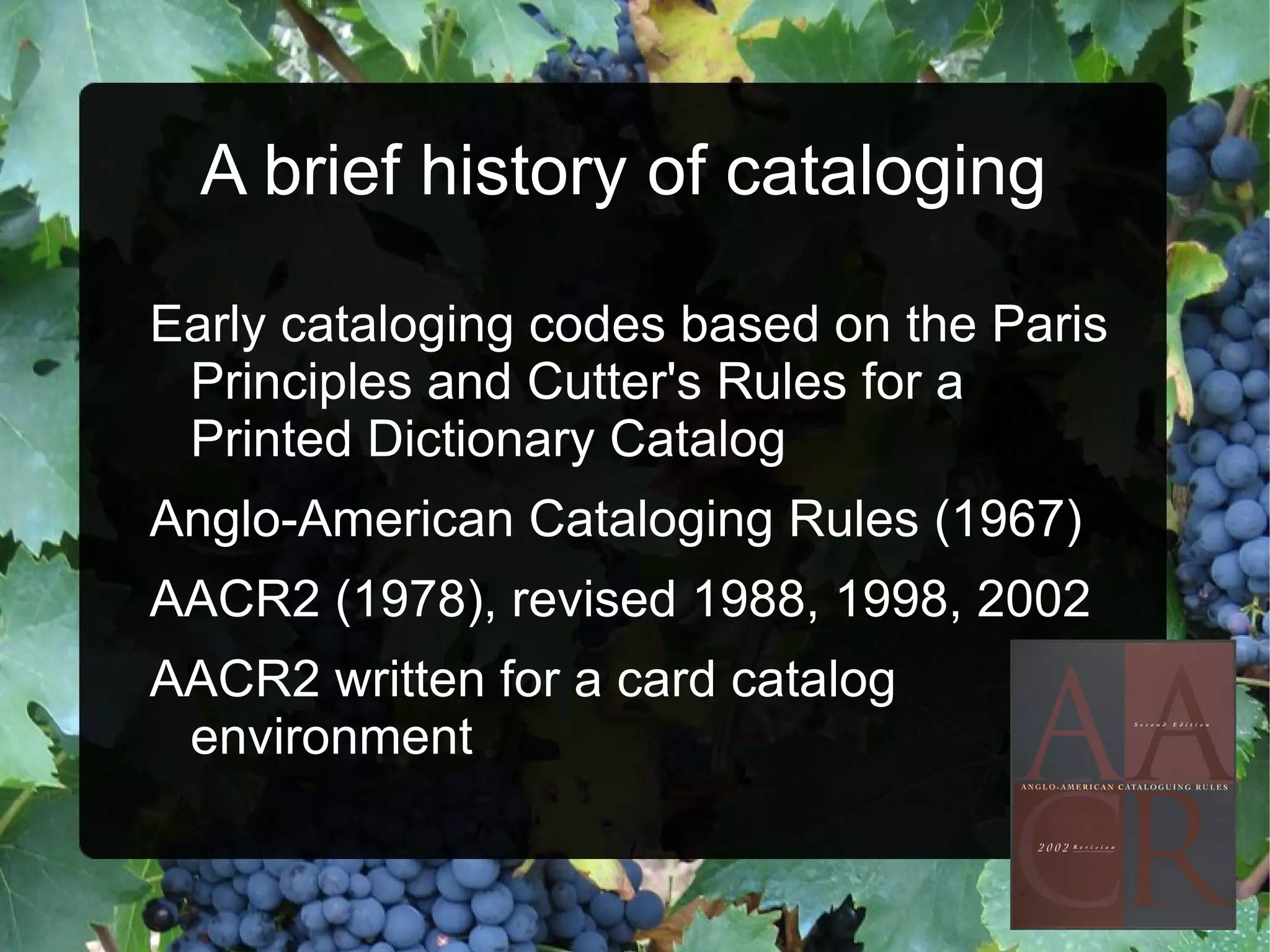
AACR2 (1978), revised 1988, 1998, 2002
AACR2 written for a card catalog environment
Moving into the computer age Machine Readable Cataloging (MARC) developed in mid-1960s
Libraries begin to use online catalogs in mid-1980s
Work on AACR3 is begun ; later changed name to RDA (Resource Description & Access)
RDA is written for an online catalog environment
RDA: Release and Testing RDA Toolkit goes online in June 2010
US national libraries decide to test the code before implementation
A wide variety of libraries chosen to catalog a "common set" of records using both AACR2 and RDA rules
Testing period ran from October to December 2010
RDA Testing Process Each library expected to catalog 25 "common set" records using both codes, working from a set of surrogates
Additionally, 5 records were selected for copy cataloging (changing from AACR2 to RDA rules in the process)
Libraries also expected to catalog additional items of their choice in RDA
RDA Testing Timeline Testing conducted October 1 st  to December 31 st , 2010
Committee chosen to analyze results
Committee report expected in April 2010
Implementation timeline will likely be released by summer
If implementation decided, most likely will be in early 2012

RDA: What to Expect

  • 1.
    RDA: What toExpect Presented by: Mary Jo Chrabasz Cataloging Associate Naperville Public Library
  • 2.
    A brief historyof cataloging Early cataloging codes based on the Paris Principles and Cutter's Rules for a Printed Dictionary Catalog
  • 3.
  • 4.
    AACR2 (1978), revised1988, 1998, 2002
  • 5.
    AACR2 written fora card catalog environment
  • 6.
    Moving into thecomputer age Machine Readable Cataloging (MARC) developed in mid-1960s
  • 7.
    Libraries begin touse online catalogs in mid-1980s
  • 8.
    Work on AACR3is begun ; later changed name to RDA (Resource Description & Access)
  • 9.
    RDA is writtenfor an online catalog environment
  • 10.
    RDA: Release andTesting RDA Toolkit goes online in June 2010
  • 11.
    US national librariesdecide to test the code before implementation
  • 12.
    A wide varietyof libraries chosen to catalog a "common set" of records using both AACR2 and RDA rules
  • 13.
    Testing period ranfrom October to December 2010
  • 14.
    RDA Testing ProcessEach library expected to catalog 25 "common set" records using both codes, working from a set of surrogates
  • 15.
    Additionally, 5 recordswere selected for copy cataloging (changing from AACR2 to RDA rules in the process)
  • 16.
    Libraries also expectedto catalog additional items of their choice in RDA
  • 17.
    RDA Testing TimelineTesting conducted October 1 st to December 31 st , 2010
  • 18.
    Committee chosen toanalyze results
  • 19.
  • 20.
    Implementation timeline willlikely be released by summer
  • 21.
    If implementation decided,most likely will be in early 2012
  • 22.
    FRBR : BuildingBlock for RDA Functional Requirements for Bibliographic Records (FRBR) released by the International Federation of Library Associations and Institutions (IFLA)
  • 23.
    Offers a theoreticalmodel of relationships between objects, such as works, authors, and subjects
  • 24.
    RDA is heavilybased on FRBR concepts
  • 25.
  • 26.
  • 27.
  • 28.
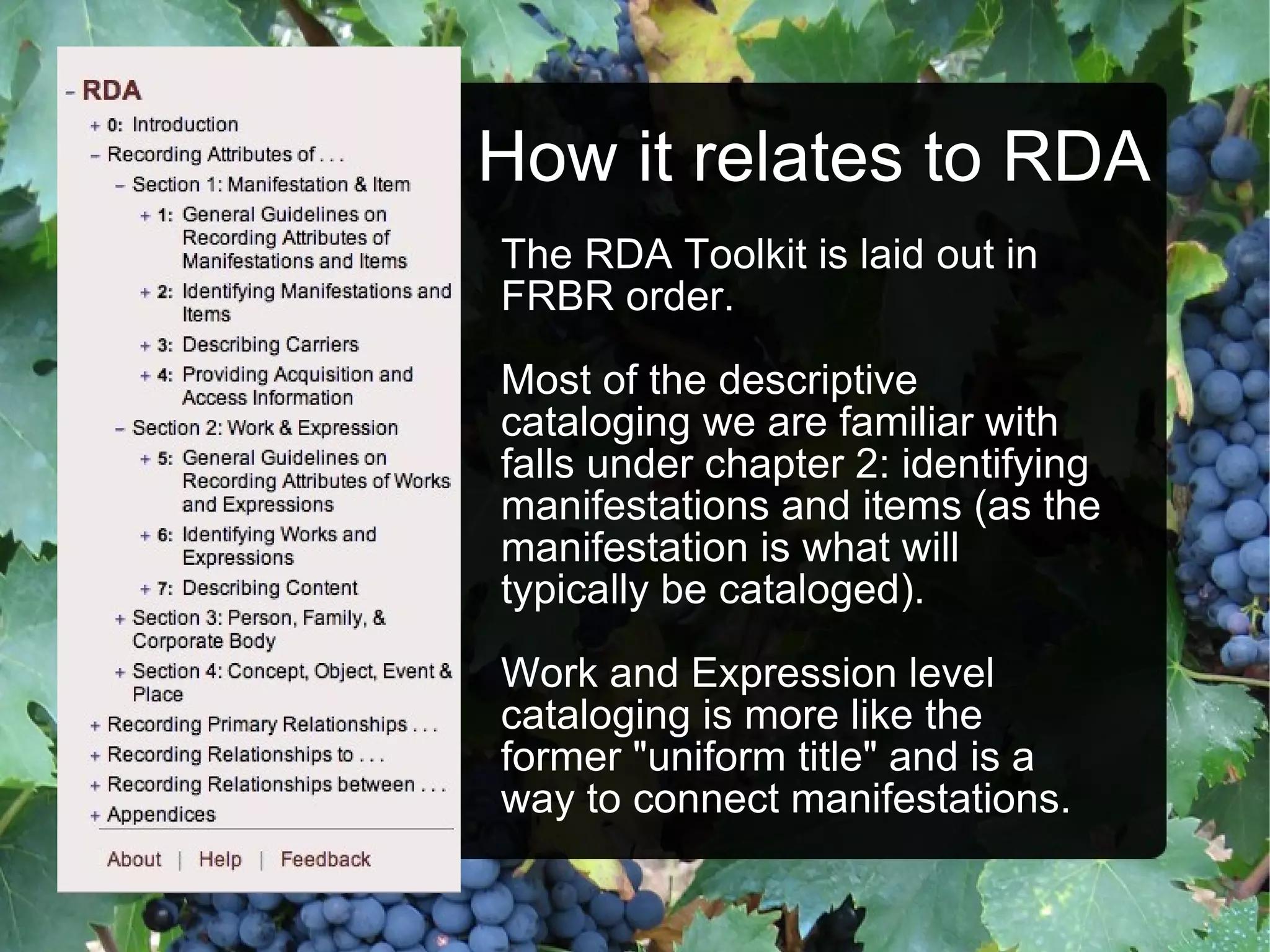
    How it relatesto RDA The RDA Toolkit is laid out in FRBR order.
  • 29.
    Most of thedescriptive cataloging we are familiar with falls under chapter 2: identifying manifestations and items (as the manifestation is what will typically be cataloged).
  • 30.
    Work and Expressionlevel cataloging is more like the former "uniform title" and is a way to connect manifestations.
  • 31.
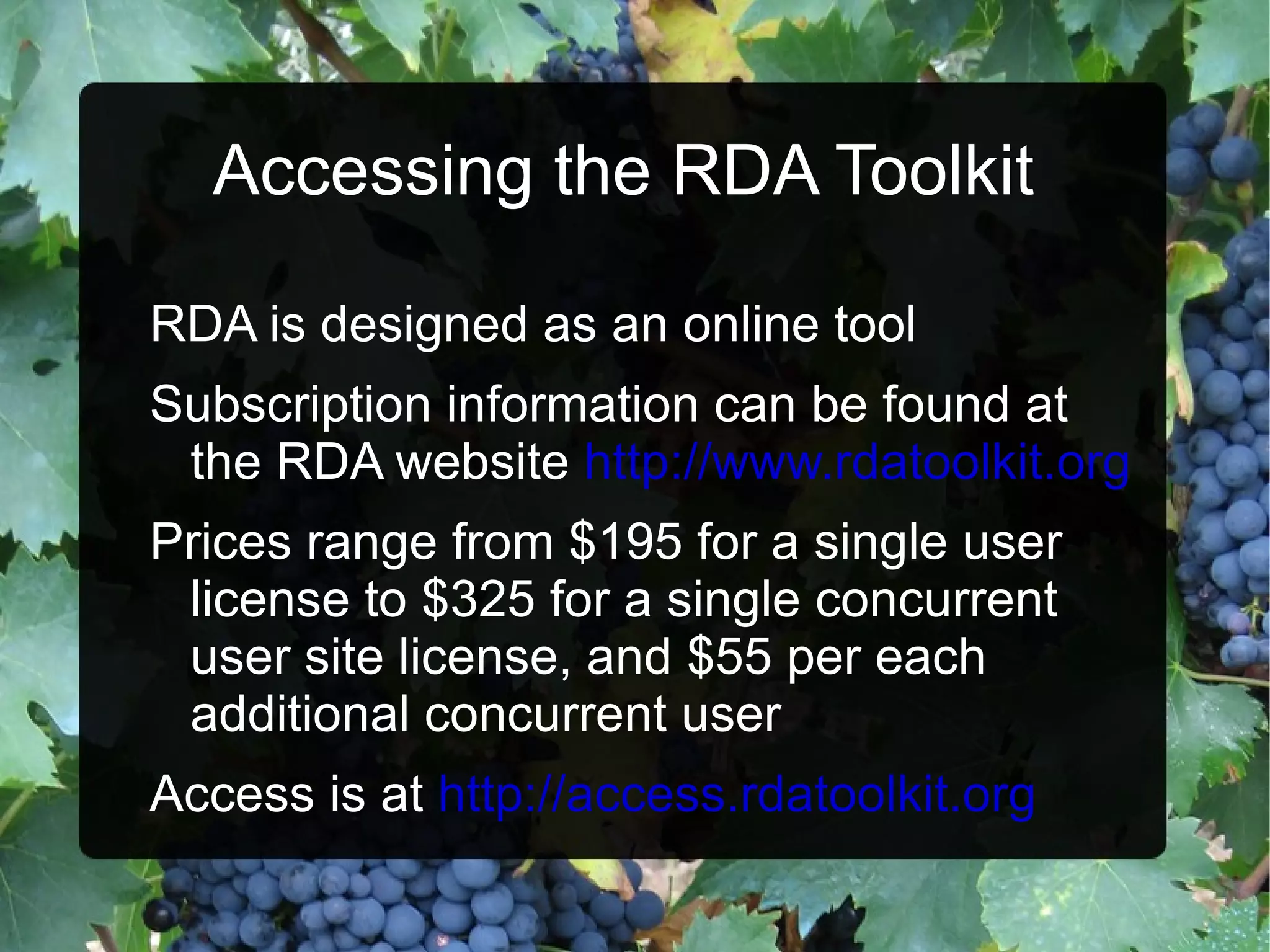
    Accessing the RDAToolkit RDA is designed as an online tool
  • 32.
    Subscription information canbe found at the RDA website http://www.rdatoolkit.org
  • 33.
    Prices range from$195 for a single user license to $325 for a single concurrent user site license, and $55 per each additional concurrent user
  • 34.
    Access is at http://access.rdatoolkit.org
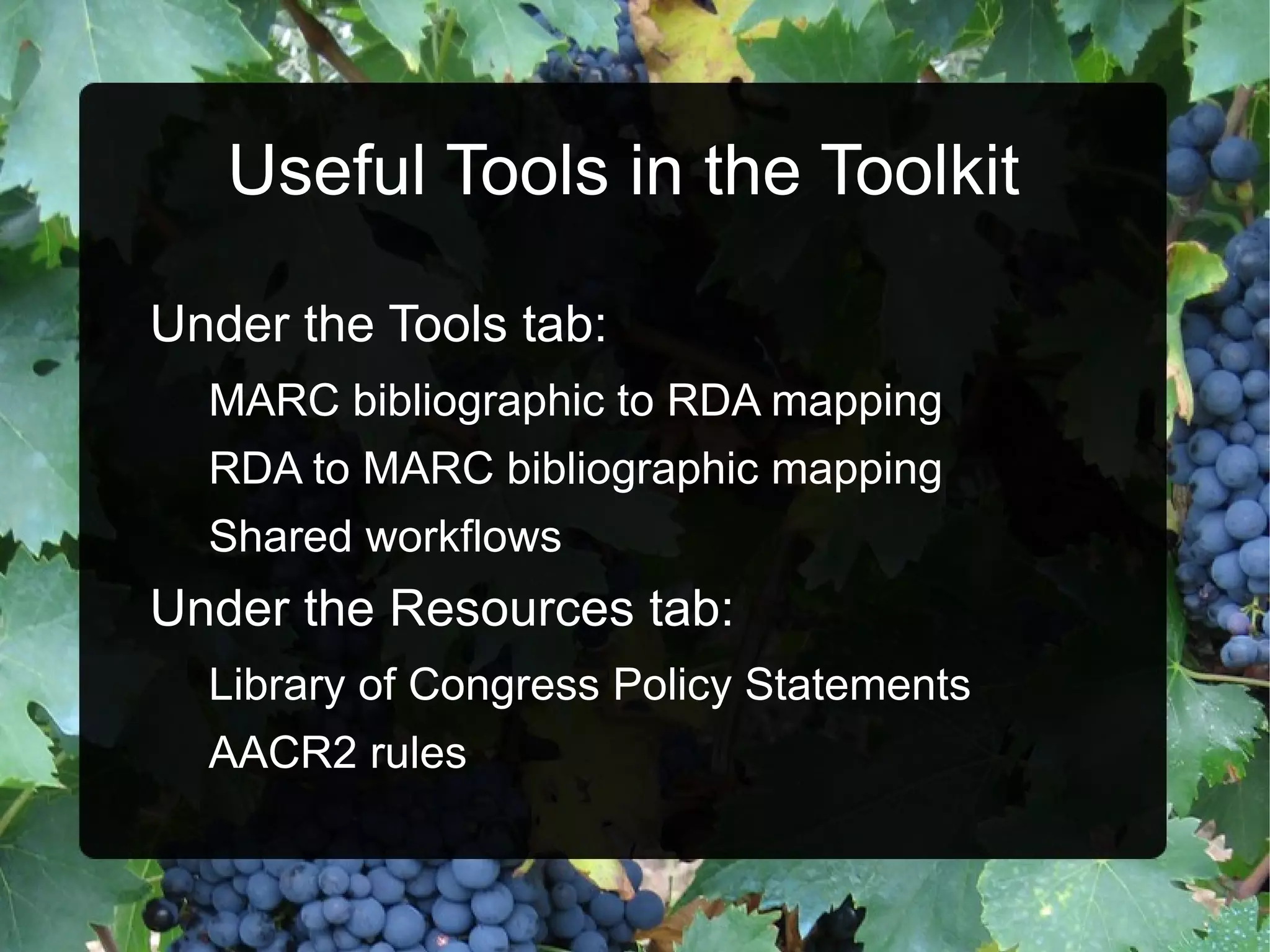
  • 35.
    Useful Tools inthe Toolkit Under the Tools tab: MARC bibliographic to RDA mapping
  • 36.
    RDA to MARCbibliographic mapping
  • 37.
    Shared workflows Underthe Resources tab: Library of Congress Policy Statements
  • 38.
  • 39.
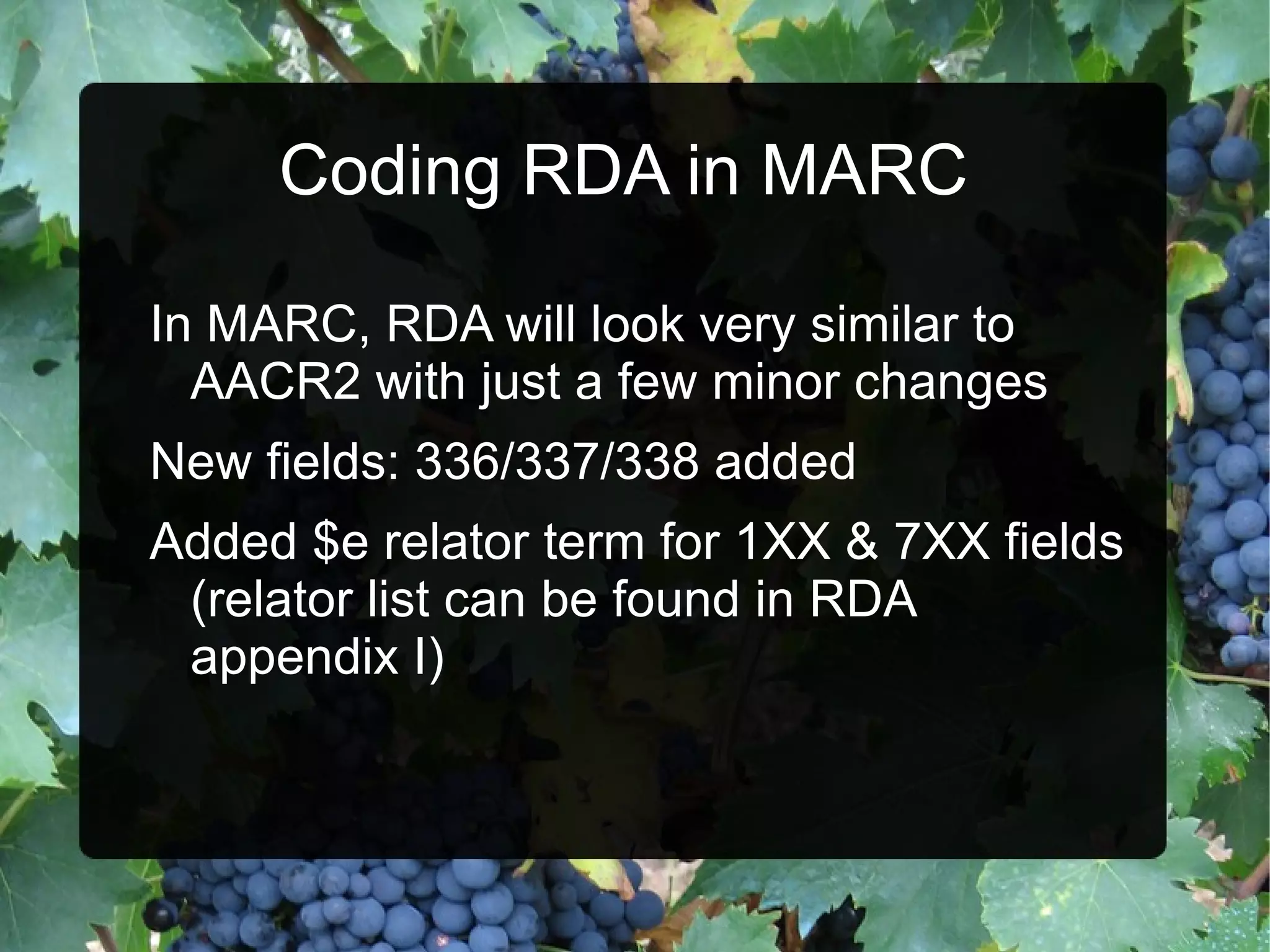
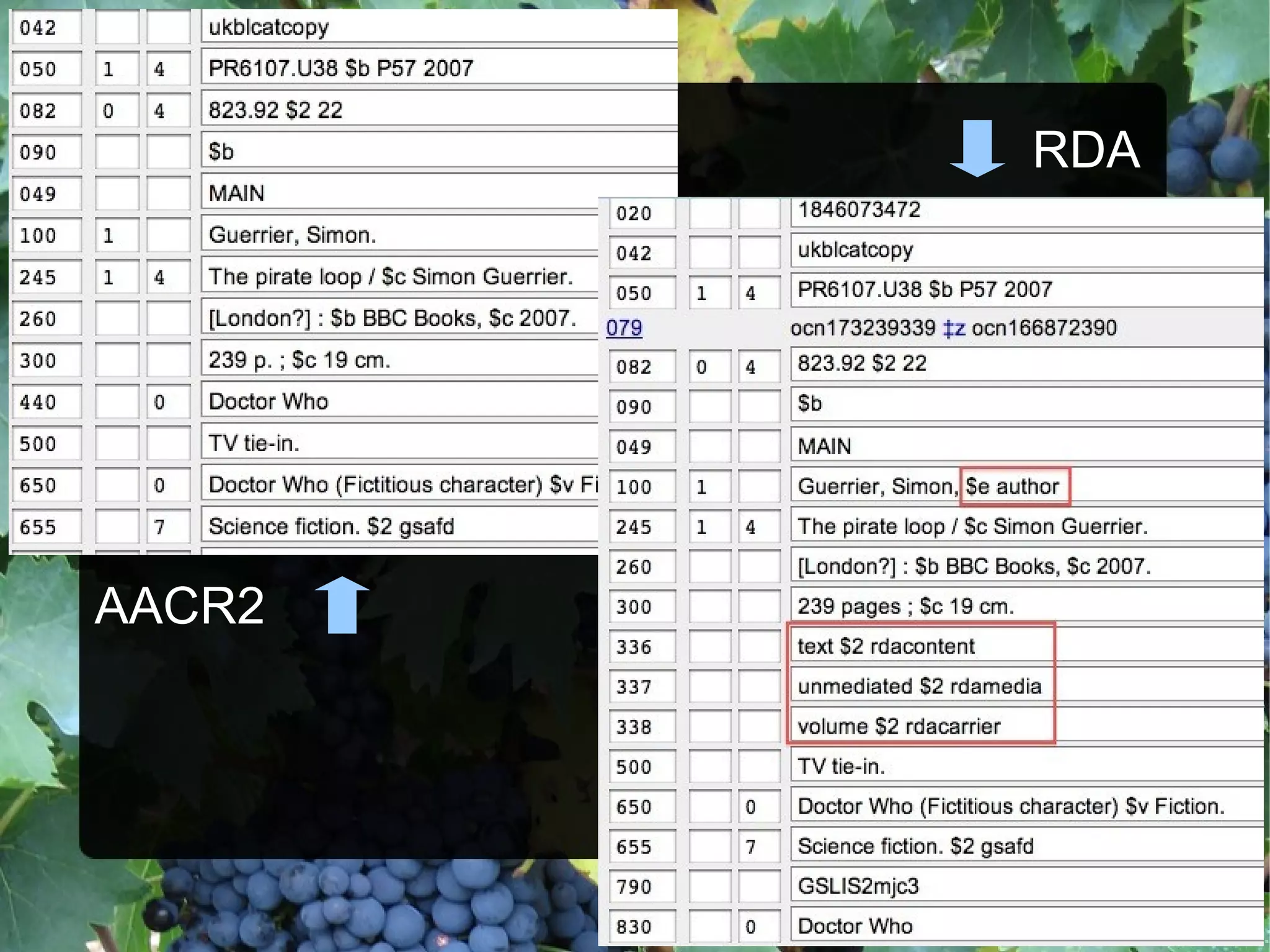
    Coding RDA inMARC In MARC, RDA will look very similar to AACR2 with just a few minor changes
  • 40.
  • 41.
    Added $e relatorterm for 1XX & 7XX fields (relator list can be found in RDA appendix I)
  • 42.
  • 43.
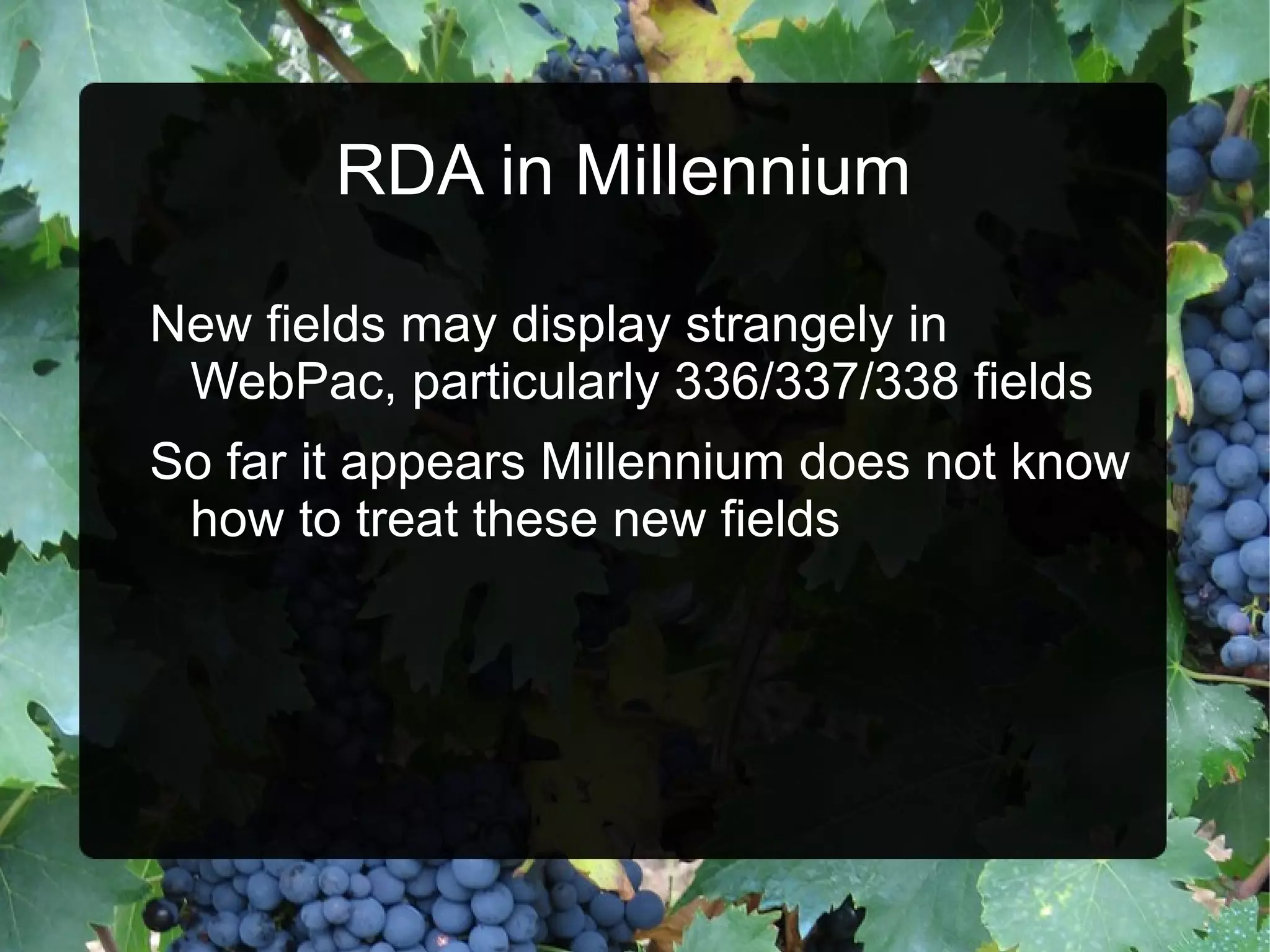
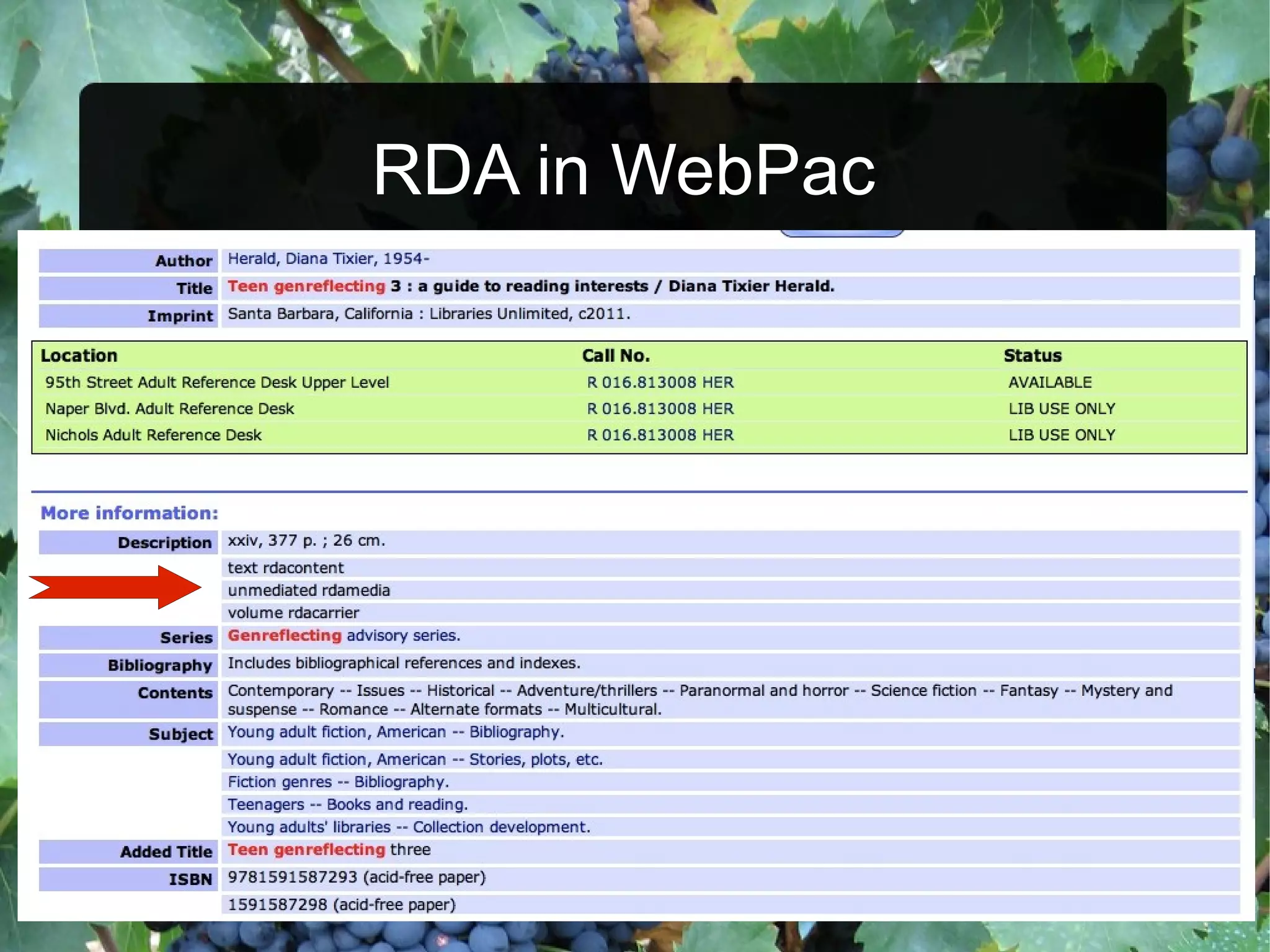
    RDA in MillenniumNew fields may display strangely in WebPac, particularly 336/337/338 fields
  • 44.
    So far itappears Millennium does not know how to treat these new fields
  • 45.
  • 46.
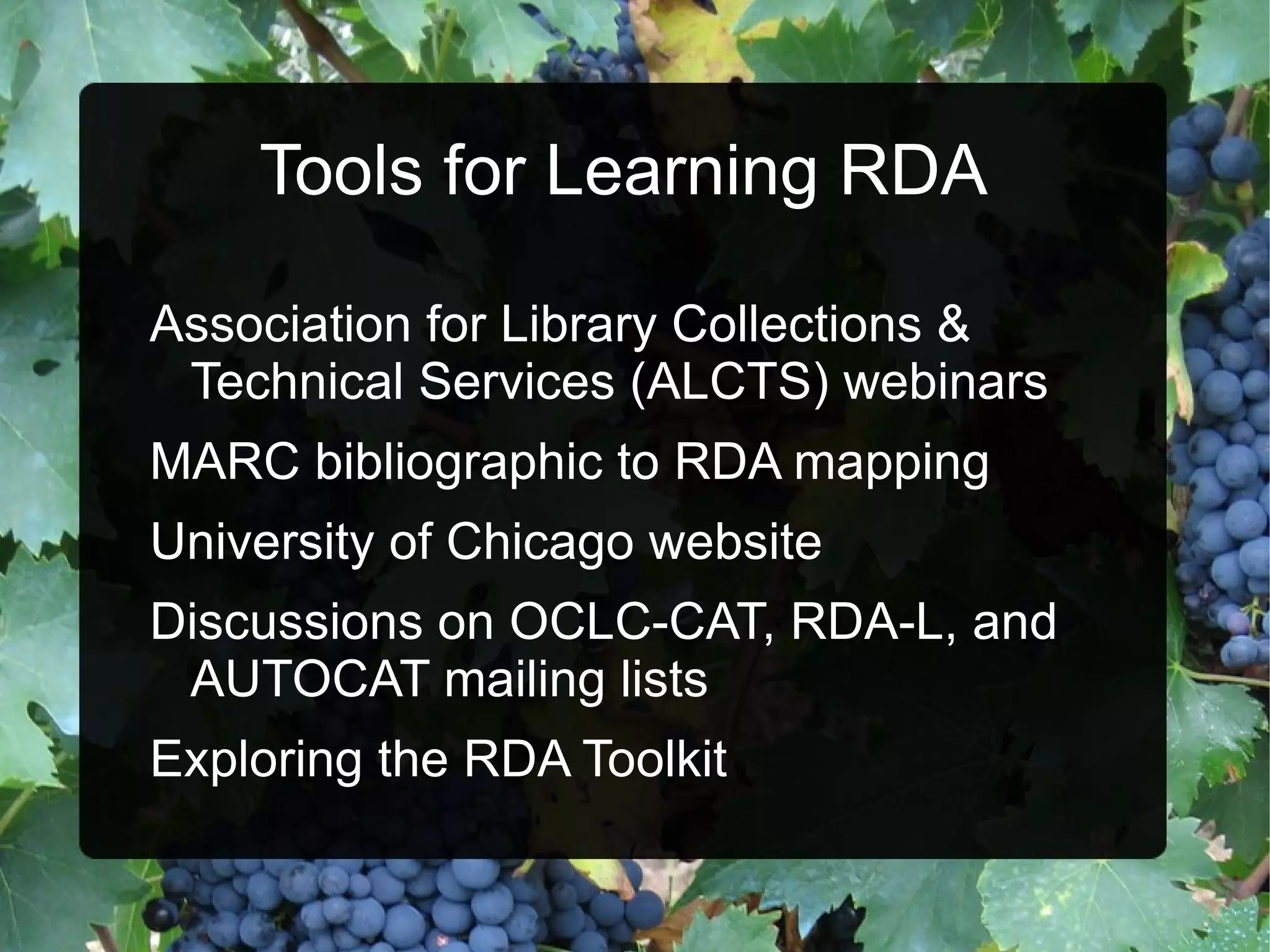
    Tools for LearningRDA Association for Library Collections & Technical Services (ALCTS) webinars
  • 47.
  • 48.
  • 49.
    Discussions on OCLC-CAT,RDA-L, and AUTOCAT mailing lists
  • 50.
  • 51.
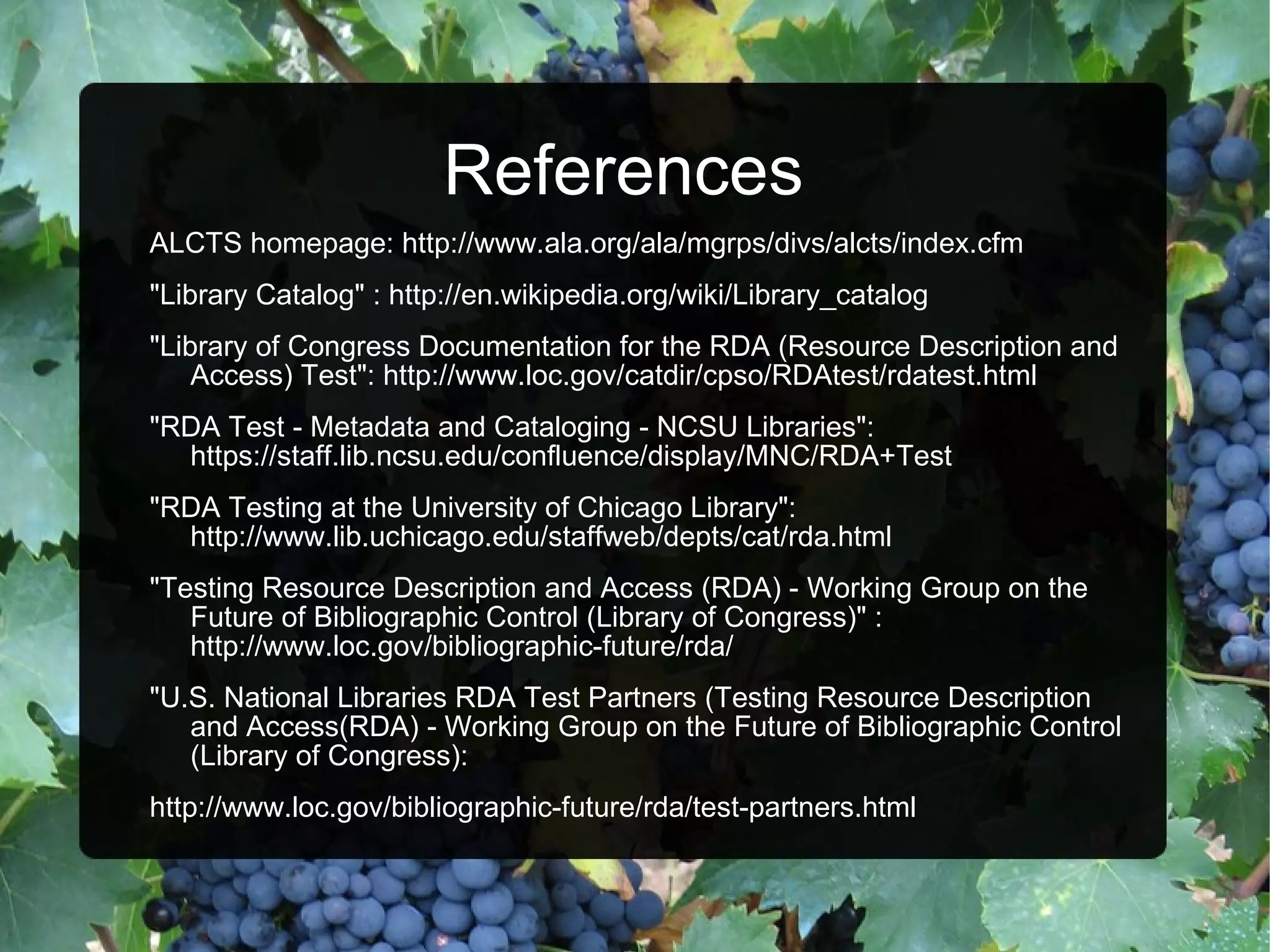
    References ALCTS homepage: http://www.ala.org/ala/mgrps/divs/alcts/index.cfm "Library Catalog" : http://en.wikipedia.org/wiki/Library_catalog "Library of Congress Documentation for the RDA (Resource Description and Access) Test": http://www.loc.gov/catdir/cpso/RDAtest/rdatest.html "RDA Test - Metadata and Cataloging - NCSU Libraries": https://staff.lib.ncsu.edu/confluence/display/MNC/RDA+Test "RDA Testing at the University of Chicago Library": http://www.lib.uchicago.edu/staffweb/depts/cat/rda.html "Testing Resource Description and Access (RDA) - Working Group on the Future of Bibliographic Control (Library of Congress)" : http://www.loc.gov/bibliographic-future/rda/ "U.S. National Libraries RDA Test Partners (Testing Resource Description and Access(RDA) - Working Group on the Future of Bibliographic Control (Library of Congress): http://www.loc.gov/bibliographic-future/rda/test-partners.html
  • 52.
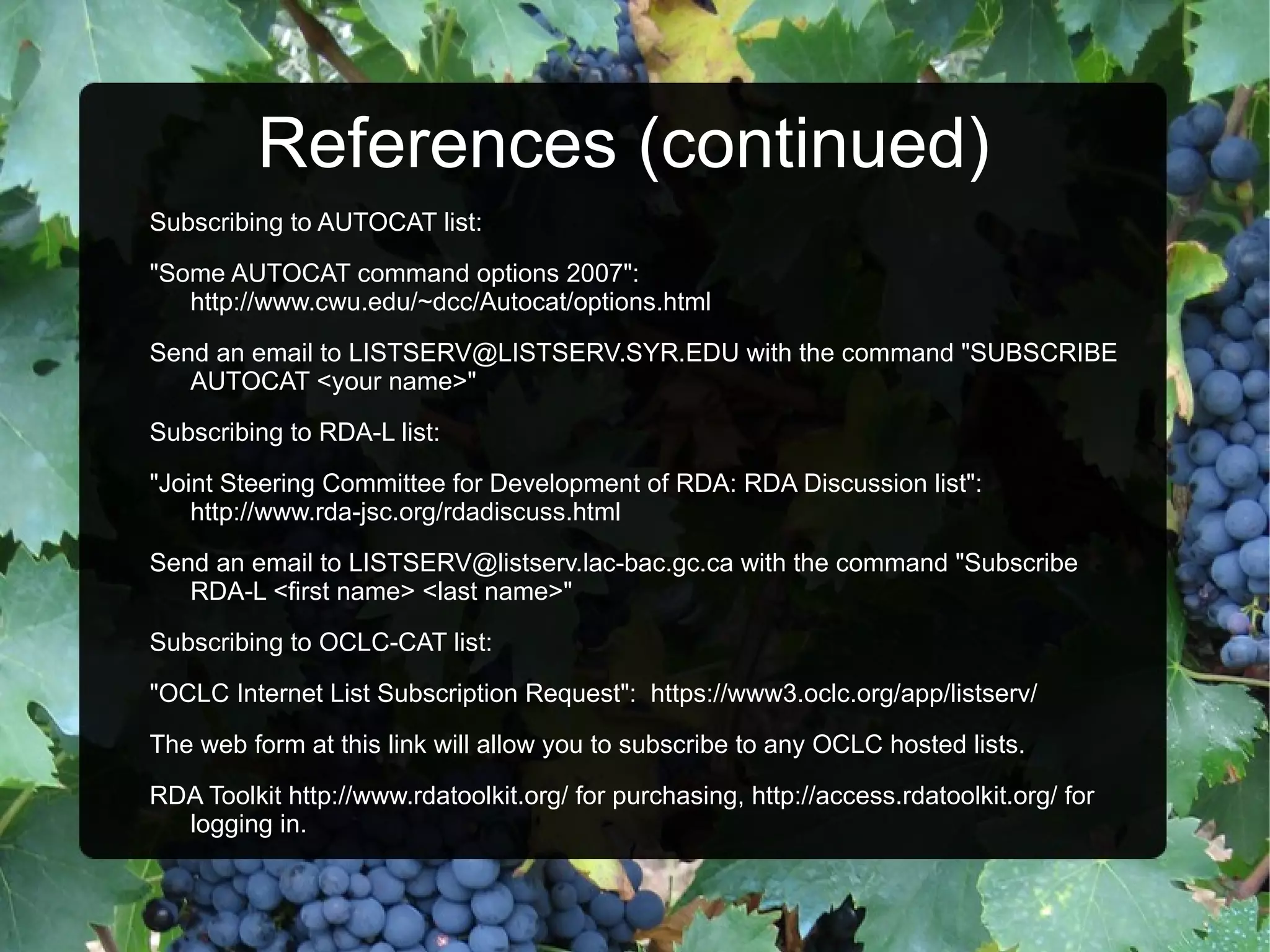
    References (continued) Subscribingto AUTOCAT list: &quot;Some AUTOCAT command options 2007&quot;: http://www.cwu.edu/~dcc/Autocat/options.html Send an email to [email_address] with the command &quot;SUBSCRIBE AUTOCAT <your name>&quot; Subscribing to RDA-L list: &quot;Joint Steering Committee for Development of RDA: RDA Discussion list&quot;: http://www.rda-jsc.org/rdadiscuss.html Send an email to [email_address] with the command &quot;Subscribe RDA-L <first name> <last name>&quot; Subscribing to OCLC-CAT list: &quot;OCLC Internet List Subscription Request&quot;: https://www3.oclc.org/app/listserv/ The web form at this link will allow you to subscribe to any OCLC hosted lists. RDA Toolkit http://www.rdatoolkit.org/ for purchasing, http://access.rdatoolkit.org/ for logging in.
  • 53.
    For more informationMary Jo Chrabasz, Naperville Public Library [email_address] Slideshow available on Slideshare, http://www.slideshare.net/mjchrabasz

Editor's Notes

  • #2 Presentation created by Mary Jo Chrabasz [email_address]
  • #3 Paris Principles came out of the first International Conference on Cataloging Principles in 1961 Charles Ammi Cutter published his Rules for a Printed Dictionary Catalog in 1876. The idea that a catalog should assist the user in finding books and showing what a library has on a given subject or by a given author is the basis for most modern cataloging. Anglo-American Cataloging rules first published in 1967, in separate editions for US &amp; other countries. The first major revision was in 1978, with many changes to headings and rules. More revisions followed in 1988, 1998, and 2002, adding chapters for new formats.
  • #4 The Library of Congress hired Henriette Avram to create a machine readable cataloging code in the early 1960s. She developed MARC, which was used by the Library of Congress to simplify creating copies of catalog cards for libraries and to more easily share the records. Distribution of MARC records on magnetic tape to selected test libraries began in the late 1960s. Beginning in the mid-1980s, library catalogs were brought online. At first just to terminals in the libraries themselves, as the internet developed, so did WebPAC programs (for Web-based Patron Access Catalog). Work on a new revision of AACR to bring it into the internet age began, with AACR3 evolving into RDA.
  • #5 When RDA was released, there were still many concerns about how useable the code was. The National libraries (Library of Congress, National Library of Medicine, National Library of Agriculture) decided to test the code before actually adopting it. 26 partner libraries were chosen for the test. A variety of different types of libraries were chosen, even including some library school students as testers. The RDA Toolkit was released in June 2010. Free access was offered to anyone who asked for it from the release until August 31st. After that, subscription pricing went into effect. The testing period ran from October 1 to December 31 of 2010. Testers were asked not to add any RDA records to OCLC before October 1st.
  • #6 A set of 25 &amp;quot;common set&amp;quot; records were identified, including a variety of material types and cataloging issues (such as Mark Twain&apos;s authority issues). Additionally, 5 &amp;quot;copy catalog&amp;quot; records were chosen. Each testing site was expected to catalog each of the common set records both with AACR rules and RDA rules. Surveys were then completed after each record was submitted, noting such details as the time it took to catalog, consultation with colleagues time, any issues or problems, and more. OCLC created &amp;quot;dummy&amp;quot; records that each testing institution added their test records to as Institutional Records.
  • #7 The RDA testing period ran from October 1 to December 31 st 2010. Analysis of the test records created began in January and a report from the committee is expected sometime in April. More information should be available at the ALA Annual Conference, June 23-28, 2011 in New Orleans. By then the report should be out and the National Libraries will have made some decisions about implementation of the new code.
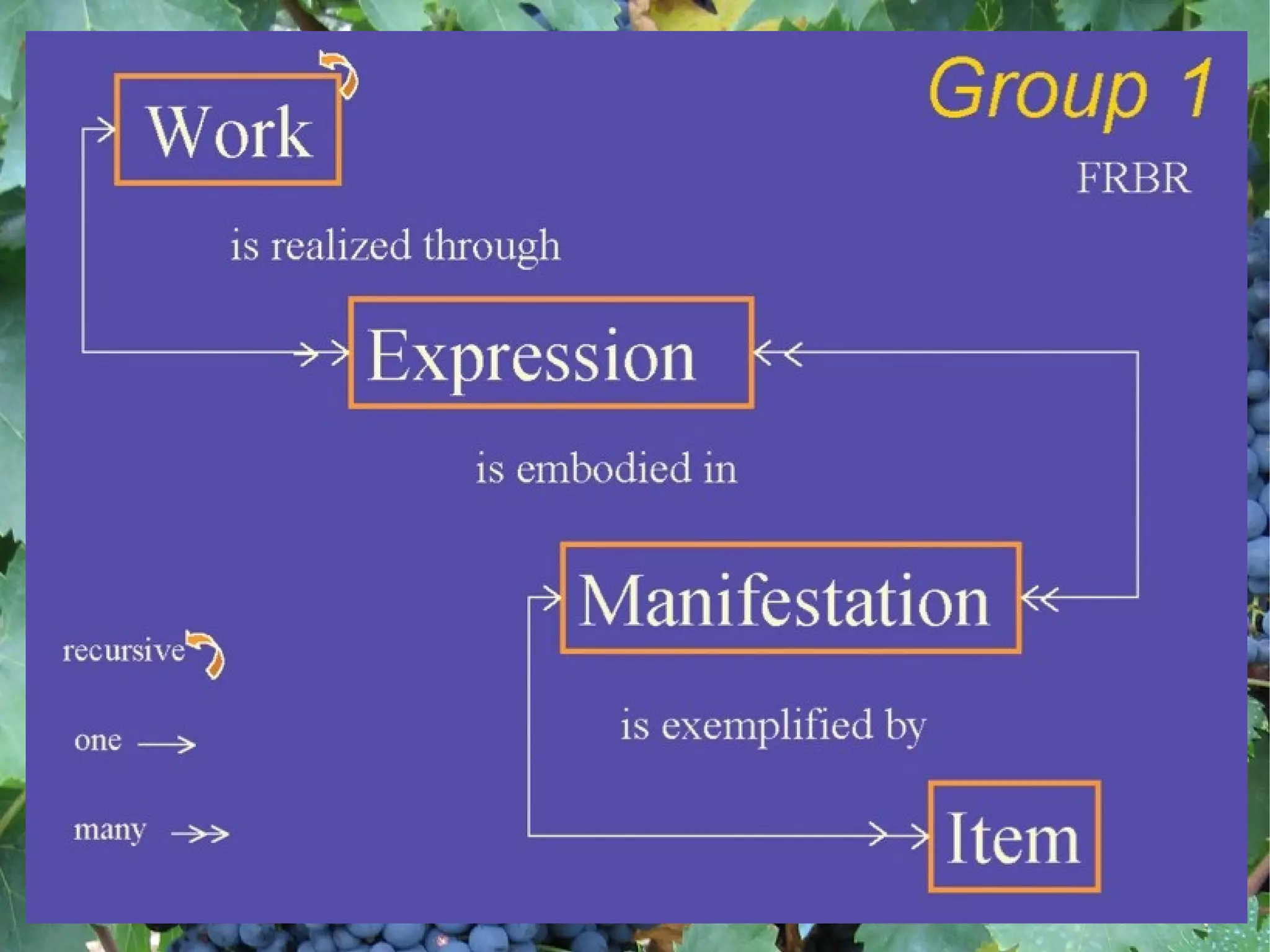
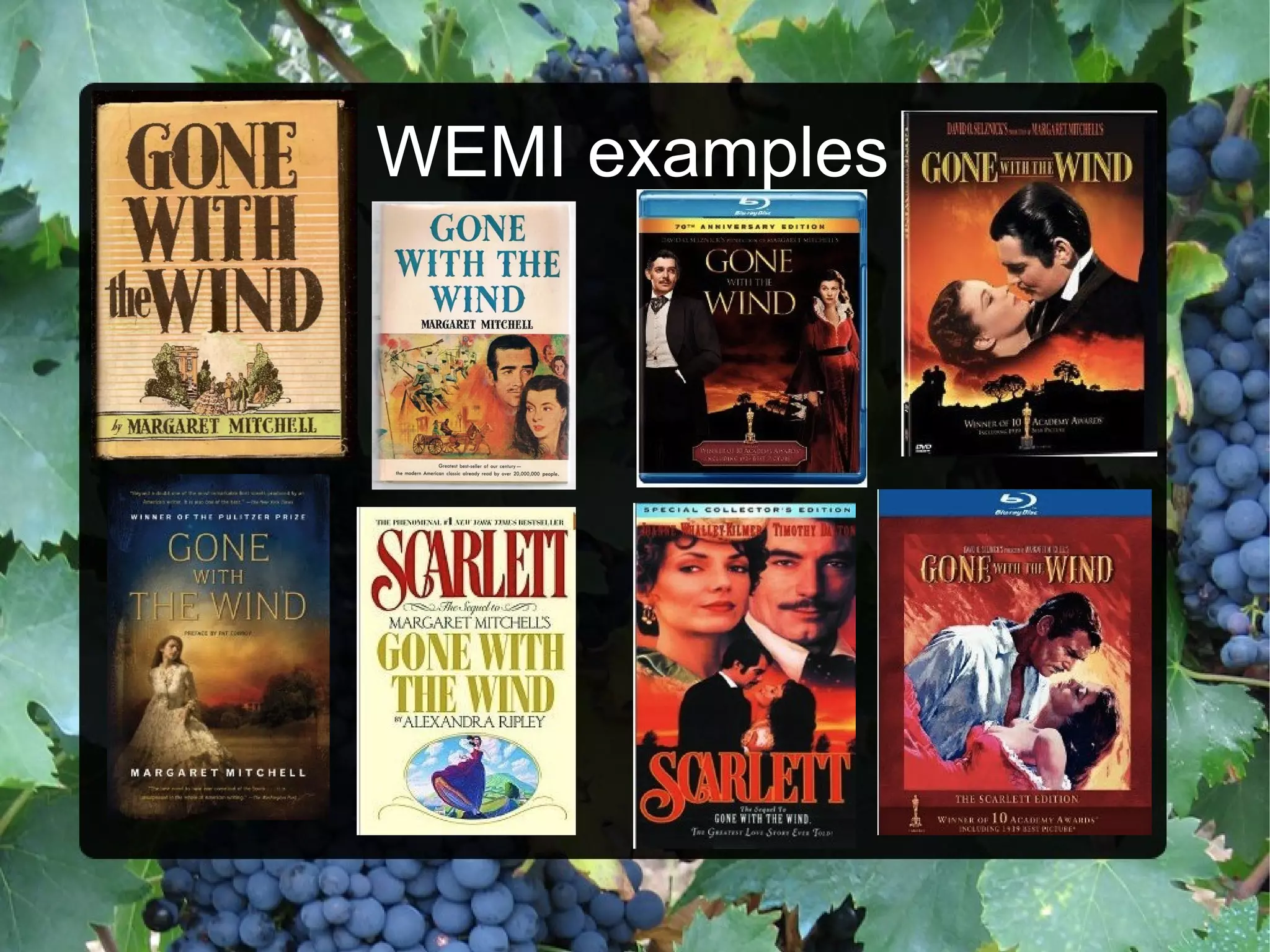
  • #8 FRBR is a theoretical concept developed by IFLA. It attempts to make the connection between different forms a &amp;quot;story&amp;quot; takes. In our current cataloging environment, a search for the book Gone With the Wind by Margaret Mitchell will not necessarily point you to the sequel, Scarlett or the movie. FRBR&apos;s goal is to help the user discover these connections and thus new materials more readily. FRBR is just a theoretical model. To test the ideas behind it, a cataloging code needed to be developed. RDA is that code. It is based very heavily on this concept and is laid out somewhat like the WEMI (Work-Expression-Manifestation-Item) diagram.
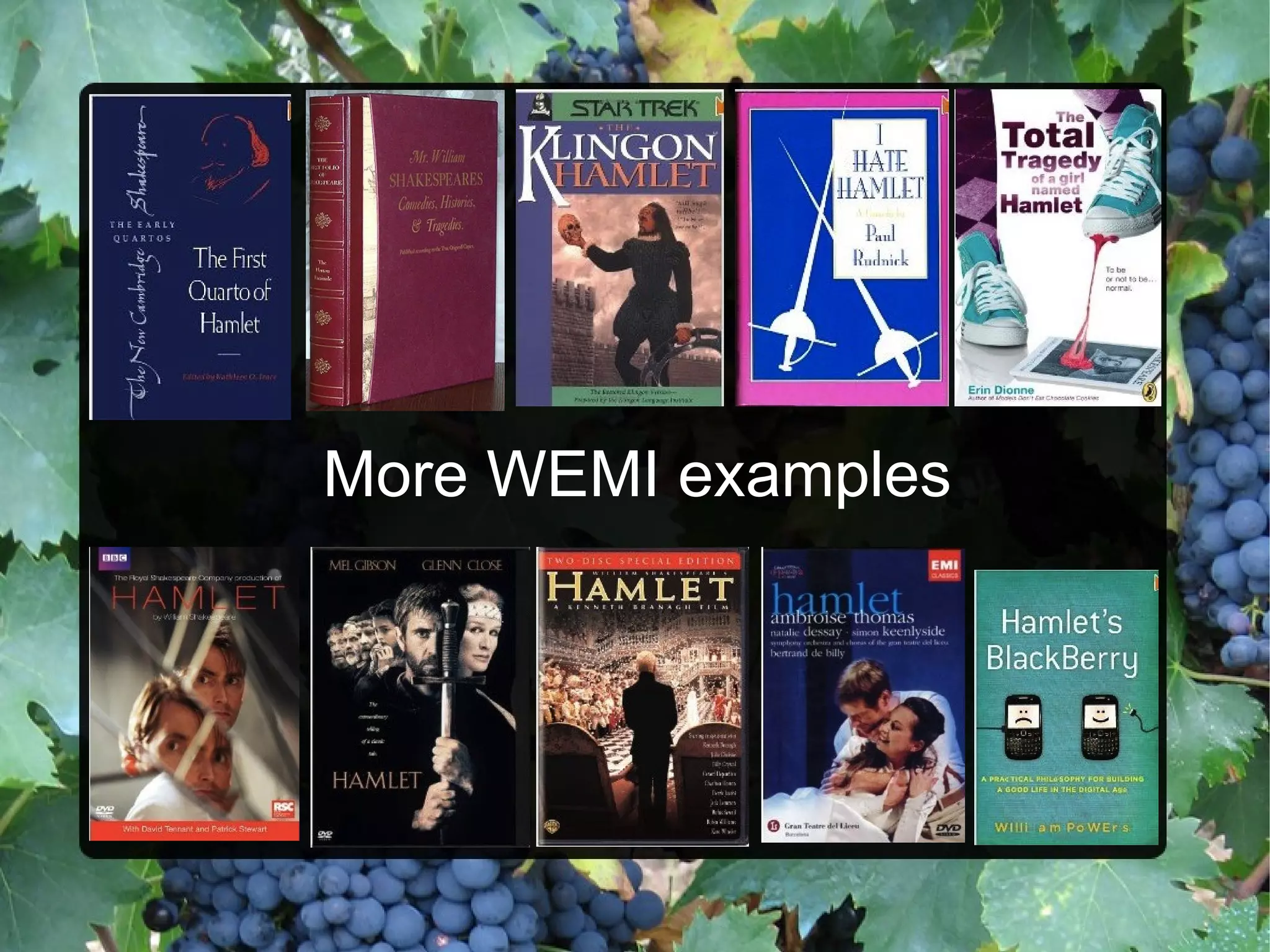
  • #9 WORK is the idea. It is the story in the author&apos;s head that hasn&apos;t yet been created. Work level cataloging is basically similar to the old &amp;quot;uniform title&amp;quot; idea – a uniform title that connects different versions of the same story together. EXPRESSION is when that idea becomes an actual thing – a book written by the author or a movie created by the director. MANIFESTATION is the physical form of the expression. You can have multiple manifestations of an expression (like the large print, paperback, hardcover, and translation of a book) but usually a manifestation represents just one expression of a work. ITEM is the physical individual copy in your hand.
  • #16 This is one of the &amp;quot;extra set&amp;quot; records I created for the RDA test. Since there was an existing record in OCLC I copy cataloged it, changing to RDA in the process. The AACR2 record on the left is the existing record in OCLC. The RDA record on the right is my Institutional Record that I attached for the test. I highlighted some of the main differences with red boxes. Also note the spelling out of &amp;quot;pages&amp;quot; in the 300 field. This example shows that, at least for now while we are still using MARC, the catalog records are not going to look extremely different in RDA.
  • #18 This is the first RDA record that was loaded into Naperville&apos;s catalog. This came from Baker &amp; Taylor&apos;s Customized Library Services program, pulled from the OCLC database. Note how the 336/337/338 fields display below the 300 field under the same general &amp;quot;description&amp;quot; heading.
  • #19 ALCTS is offering a variety of webinars: February 17 th is their &amp;quot;Ask the Experts&amp;quot; webinar. As implementation draws closer they will likely offer even more. Visit their homepage: http://www.ala.org/ala/mgrps/divs/alcts/index.cfm The mapping of MARC to RDA (&amp; vice versa) is available in the Toolkit under the &amp;quot;Tools&amp;quot; tab. University of Chicago is one of the leaders in RDA cataloging. They have some great information and resources at http://www.lib.uchicago.edu/staffweb/depts/cat/rda.html See the references slide for information on subscribing to lists. Exploring the Toolkit itself is actually a good way to learn how to use it.