San José Sustainability
Project
Tyler Pullen, Grace Lee, Emmanuel Assa, Rubi Rodriguez
March 23, 2017
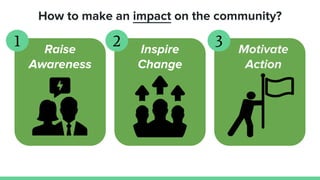
How to make an impact on the community?
Raise
Awareness
Inspire
Change
Motivate
Action
1 2 3
Scenario: I am a San José resident and come upon San
José’s public sustainability dashboard.
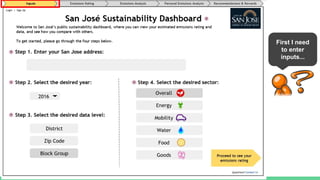
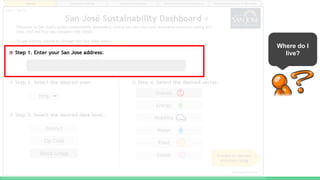
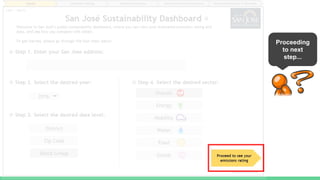
First I need
to enter
inputs...
Where do I
live?
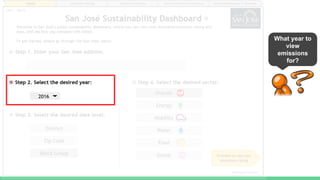
What year to
view
emissions
for?
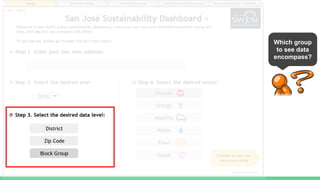
Which group
to see data
encompass?
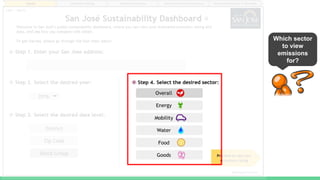
Which sector
to view
emissions
for?
Proceeding
to next
step...
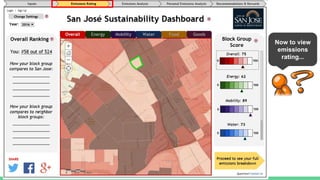
Now to view
emissions
rating...
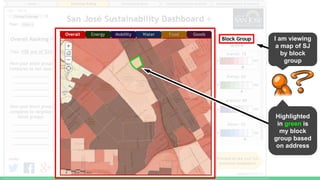
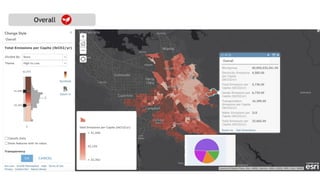
I am viewing
a map of SJ
by block
group
Highlighted
in green is
my block
group based
on address
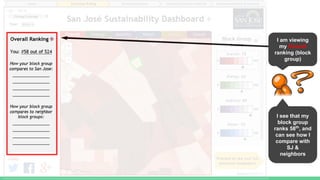
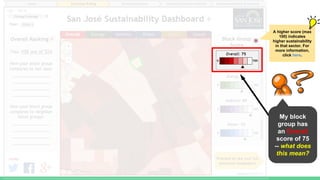
I am viewing
my Overall
ranking (block
group)
I see that my
block group
ranks 58th
, and
can see how I
compare with
SJ &
neighbors
A higher score (max
100) indicates
higher sustainability
in that sector. For
more information,
click here.
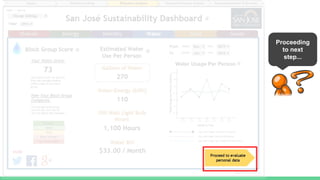
My block
group has
an Overall
score of 75
-- what does
this mean?
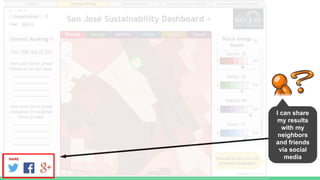
I can share
my results
with my
neighbors
and friends
via social
media
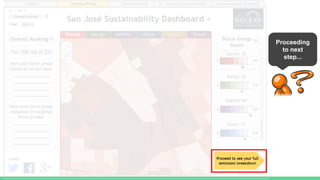
Proceeding
to next
step...
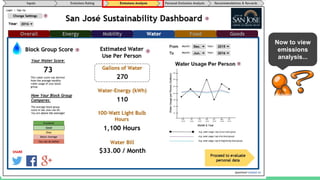
Now to view
emissions
analysis...
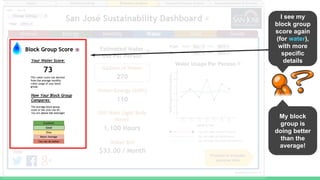
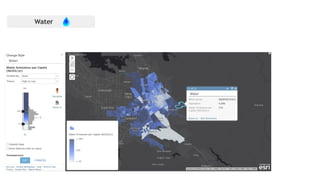
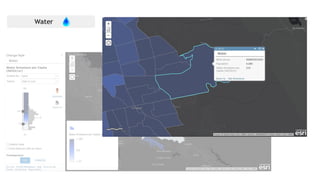
I see my
block group
score again
(for water),
with more
specific
details
My block
group is
doing better
than the
average!
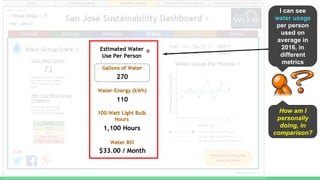
I can see
water usage
per person
used on
average in
2016, in
different
metrics
How am I
personally
doing, in
comparison?
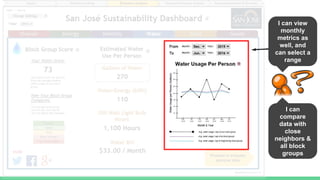
I can view
monthly
metrics as
well, and
can select a
range
I can
compare
data with
close
neighbors &
all block
groups
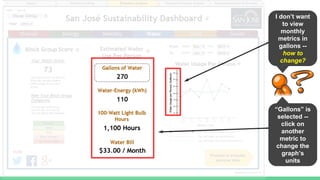
I don’t want
to view
monthly
metrics in
gallons --
how to
change?
“Gallons” is
selected --
click on
another
metric to
change the
graph’s
units
Proceeding
to next
step...
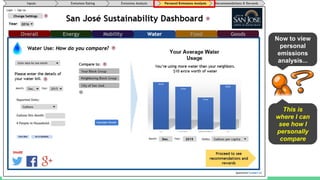
Now to view
personal
emissions
analysis...
This is
where I can
see how I
personally
compare
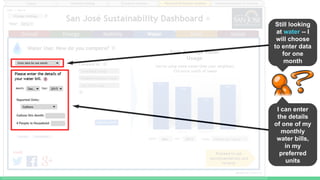
Still looking
at water -- I
will choose
to enter data
for one
month
I can enter
the details
of one of my
monthly
water bills,
in my
preferred
units
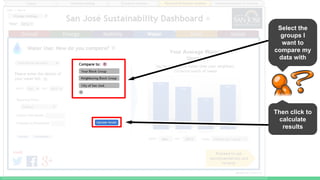
Select the
groups I
want to
compare my
data with
Then click to
calculate
results
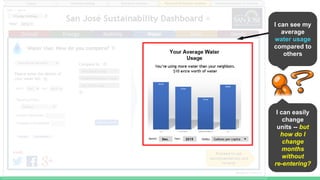
I can easily
change
units -- but
how do I
change
months
without
re-entering?
I can see my
average
water usage
compared to
others
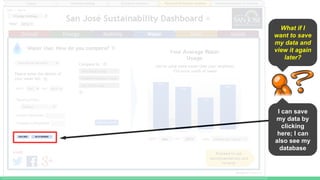
What if I
want to save
my data and
view it again
later?
I can save
my data by
clicking
here; I can
also see my
database
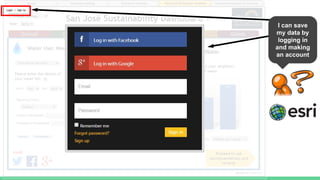
I can save
my data by
logging in
and making
an account
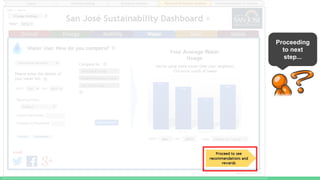
Proceeding
to next
step...
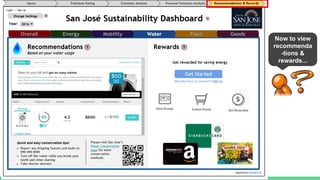
Now to view
recommenda
-tions &
rewards...
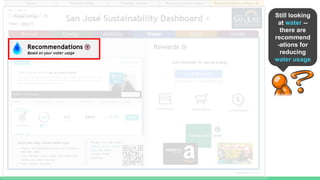
Still looking
at water --
there are
recommend
-ations for
reducing
water usage
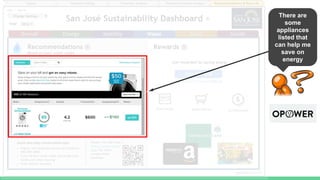
There are
some
appliances
listed that
can help me
save on
energy
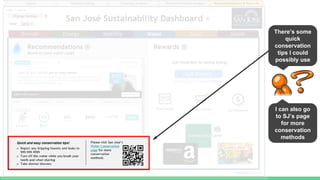
There’s some
quick
conservation
tips I could
possibly use
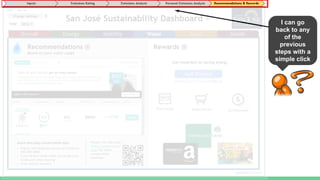
I can also go
to SJ’s page
for more
conservation
methods
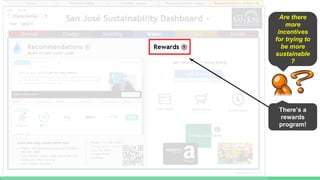
Are there
more
incentives
for trying to
be more
sustainable
?
There’s a
rewards
program!
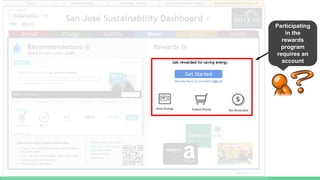
Participating
in the
rewards
program
requires an
account
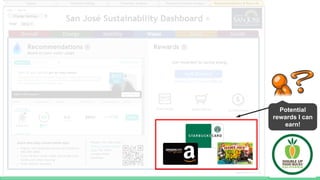
Potential
rewards I can
earn!
I can go
back to any
of the
previous
steps with a
simple click
Immediate Takeaways
● Focuses on interactivity, individual feedback/rewards, and competition
○ Intuitive
○ Inspires “Change starts with me” mentality
○ Carrot & stick approach: savings vs. shame
● Residents can see & choose which factors they want to improve on
Looking Ahead – Dashboard Visual
● Design iteration
○ Continue on to spring term
○ Hand off dashboard design to City Hall
○ Collect feedback from San Jose residents
● From theory to practice - PwC carries the torch?
○ Could incorporate dashboard design in their work
Data Sources
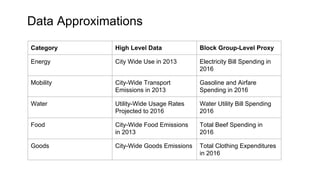
Data Approximations
Category High Level Data Block Group-Level Proxy
Energy City Wide Use in 2013 Electricity Bill Spending in
2016
Mobility City-Wide Transport
Emissions in 2013
Gasoline and Airfare
Spending in 2016
Water Utility-Wide Usage Rates
Projected to 2016
Water Utility Bill Spending
2016
Food City-Wide Food Emissions
in 2013
Total Beef Spending in
2016
Goods City-Wide Goods Emissions Total Clothing Expenditures
in 2016
Looking Ahead – Data Collection
● Current ArcGIS model built with proxy data
● Better data = better feedback = more relevant information for San José
planners and citizens
● Potential project for spring quarter - data collection / collection strategy
○ More granular PG&E data available
Q & A
Thank You!
Appendix
Logos
ISSUES TO ADDRESS
● If you did an iterative design process, worth mentioning/mentioning relevant insights if they are particularly significant.
● How do you make ppl interested in using the dashboard in the first place?
● How do you ensure ppl aren't trolling/giving fake info?
● Worth thinking a bit about ways to build interactivity re: communication into the dashboard - rn its mostly just about
visualizing one's sustainability, not rly talking about it/providing feedback to the government.
● I think the dashboard would be most helpful if data is provided in a more simple/immediate way - this is already being
done for sure, but one area that jumps out to me is some automated summary of info based on data entry with like
"you're doing best in..." and "you're doing worst in..." categories.

San Jose Sustainability CEE 224Y Final Presentation