GREENING OUR INDUSTRY Robin Thomson Environmentalist in training
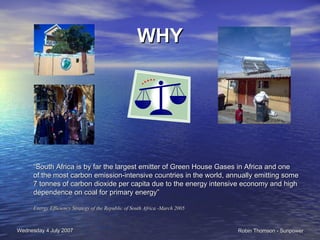
WHY “ South Africa is by far the largest emitter of Green House Gases in Africa and one  of the most carbon emission-intensive countries in the world, annually emitting some 7 tonnes of carbon dioxide per capita due to the energy intensive economy and high dependence on coal for primary energy” Energy Efficiency Strategy of the Republic of South Africa -March 2005
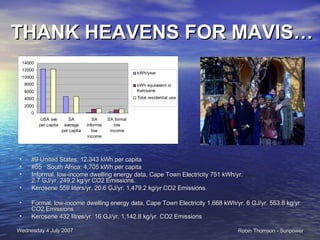
THANK HEAVENS FOR MAVIS… #9 United States: 12,343 kWh per capita  #55  South Africa: 4,705 kWh per capita  Informal, low-income dwelling energy data, Cape Town Electricity 751 kWh/yr.  2.7 GJ/yr. 249.2 kg/yr CO2 Emissions. Kerosene 559 liters/yr. 20.6 GJ/yr. 1,479.2 kg/yr CO2 Emissions. Formal, low-income dwelling energy data, Cape Town Electricity 1,668 kWh/yr. 6 GJ/yr. 553.8 kg/yr. CO2 Emissions Kerosene 432 litres/yr. 16 GJ/yr. 1,142.8 kg/yr. CO2 Emissions
WHO You Your Guests Your Staff Your Suppliers
HOW Measure Assess and bring in expertise Set targets Plan to implement (Use technology – VOIP, electronic statements) Learn, report and make progress Share - open source
MEASURE OUR IMPACT.   Look at our biggest uses of energy  and generators of CO 2 TRANSPORT HEATING COOLING
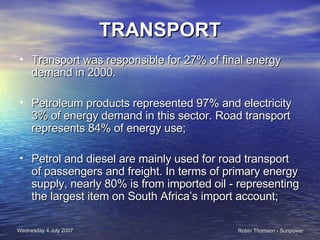
TRANSPORT Transport was responsible for 27% of final energy demand in 2000. Petroleum products represented 97% and electricity 3% of energy demand in this sector. Road transport represents 84% of energy use; Petrol and diesel are mainly used for road transport of passengers and freight. In terms of primary energy supply, nearly 80% is from imported oil - representing the largest item on South Africa’s import account;
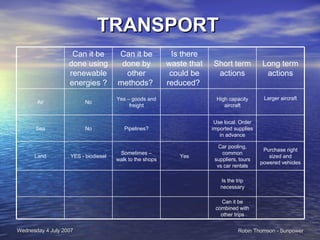
TRANSPORT Can it be combined with other trips Is the trip necessary Purchase right sized and powered vehicles Car pooling, common suppliers, tours vs car rentals Yes Sometimes – walk to the shops YES - biodiesel Land Use local. Order imported supplies in advance Pipelines? No Sea Larger aircraft High capacity aircraft Yes – goods and freight No Air Long term actions Short term actions Is there waste that could be reduced?  Can it be done by other methods?  Can it be done using renewable energies ?
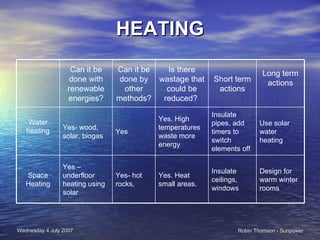
HEATING Design for warm winter rooms Insulate ceilings, windows Yes. Heat small areas.  Yes- hot rocks,  Yes – underfloor heating using solar Space Heating Use solar water heating Insulate pipes, add timers to switch elements off Yes. High temperatures waste more energy Yes Yes- wood, solar, biogas Water heating Long term actions Short term actions Is there wastage that could be reduced?  Can it be done by other methods? Can it be done with renewable energies?
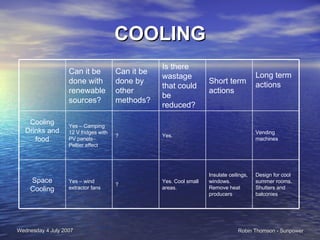
COOLING Design for cool summer rooms. Shutters and balconies Insulate ceilings, windows. Remove heat producers Yes. Cool small areas.  ? Yes – wind extractor fans Space Cooling Vending machines Yes.  ? Yes – Camping 12 V fridges with PV panels– Peltier effect Cooling Drinks and food Long term actions Short term actions Is there wastage that could be reduced?  Can it be done by other methods? Can it be done with renewable sources?
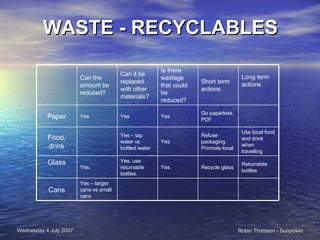
WASTE - RECYCLABLES Use local food and drink when travelling Refuse packaging. Promote local Yes Yes – tap water vs bottled water Food, drink Go paperless. PDF Yes Yes Yes Paper Yes – larger cans vs small cans Cans Returnable bottles Recycle glass Yes Yes, use returnable bottles. Yes.  Glass Long term actions Short term actions Is there wastage that could be reduced?  Can it be replaced with other materials? Can the amount be reduced?
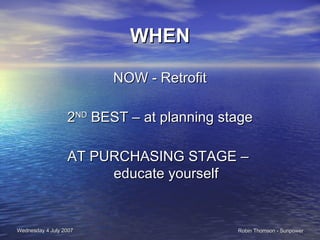
WHEN NOW - Retrofit 2 ND  BEST – at planning stage AT PURCHASING STAGE –  educate yourself
EDUCATION MATHS 1 Hypothesis 1: Awareness = Action  SCIENCE 1 To every action, there is an equal  and opposite reaction  Action = Prevent the creation of greenhouse gases
EDUCATION - actual case study Maths 1- Hypothesis 1:  Awareness = Action Length of Awareness – 1-13 years 8 people Do you recycle at home?  Do your friends and family recycle? Do you save water? Do you see benefits from our environmental practices? Why do we recycle? Do you tell others why we recycle? Do you tell others about using grey water? Do you tell others about re-using pool water? Do you tell others about using solar water?
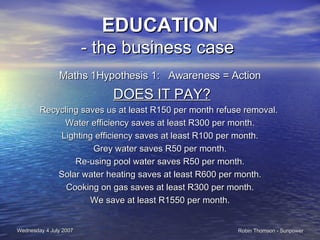
EDUCATION - the business case  Maths 1Hypothesis 1:  Awareness = Action DOES IT PAY? Recycling saves us at least R150 per month refuse removal.  Water efficiency saves at least R300 per month. Lighting efficiency saves at least R100 per month. Grey water saves R50 per month. Re-using pool water saves R50 per month. Solar water heating saves at least R600 per month. Cooking on gas saves at least R300 per month. We save at least R1550 per month.
EDUCATION 2 If  MATHS 1  Hypothesis is false Awareness  ≠   Action  Inaction = Creation of more  greenhouse gases SCIENCE 2 Inaction = More destructive climate change and less sustainable lifestyles
BUT  THEY  MUST… WE  ARE AWARE… BUT   The Americans must…( and I am not American) The West must… …( and I am not from the West) The Developed countries must… …( and I am not from a developed country) The Government must… …( and I am not from the government) The Rich must… …( and I am not rich) The Animals must… …( and I am not an animal) OR The humans must AND I AM A HUMAN
ENVIRONMENTAL  BALANCED SCORECARD REDUCE NEGATIVES  – LARGEST IMPACT FIRST Transport - you, guests, staff, suppliers Heating - you, guests, staff, suppliers Cooling - you, guests, staff, suppliers Polluting - you, guests, staff, suppliers Luxuries - you, guests, staff, suppliers
ENVIRONMENTAL BALANCED SCORECARD INCREASE POSITIVES Educating - you, guests, staff, suppliers Offset your impact - you, guests, staff, suppliers  Live your message - you, guests, staff, suppliers
SIMPLE ACTIONS Grey water capture and use  Recycle pool backwash water Choose recyclable materials Cut out paper usage Install solar water heating Install low flow showerheads
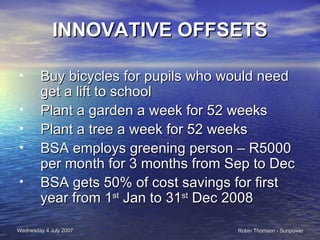
INNOVATIVE OFFSETS Buy bicycles for pupils who would need get a lift to school Plant a garden a week for 52 weeks  Plant a tree a week for 52 weeks BSA employs greening person – R5000 per month for 3 months from Sep to Dec BSA gets 50% of cost savings for first year from 1 st  Jan to 31 st  Dec 2008
It’s a cruel crazy beautiful world Every time you wake up I hope  it’s under a blue sky. It’s a cruel crazy beautiful world One day when you wake up I will  have to say goodbye
“ Goodbye - it’s your world so live in it!”  Johnny Clegg – It’s a cruel, crazy, beautiful world  This presentation will be available on www.sunpower.co.za/backpacking.htm

Robin Thomson

  • 1.
    GREENING OUR INDUSTRYRobin Thomson Environmentalist in training
  • 2.
    WHY “ SouthAfrica is by far the largest emitter of Green House Gases in Africa and one of the most carbon emission-intensive countries in the world, annually emitting some 7 tonnes of carbon dioxide per capita due to the energy intensive economy and high dependence on coal for primary energy” Energy Efficiency Strategy of the Republic of South Africa -March 2005
  • 3.
    THANK HEAVENS FORMAVIS… #9 United States: 12,343 kWh per capita #55 South Africa: 4,705 kWh per capita Informal, low-income dwelling energy data, Cape Town Electricity 751 kWh/yr. 2.7 GJ/yr. 249.2 kg/yr CO2 Emissions. Kerosene 559 liters/yr. 20.6 GJ/yr. 1,479.2 kg/yr CO2 Emissions. Formal, low-income dwelling energy data, Cape Town Electricity 1,668 kWh/yr. 6 GJ/yr. 553.8 kg/yr. CO2 Emissions Kerosene 432 litres/yr. 16 GJ/yr. 1,142.8 kg/yr. CO2 Emissions
  • 4.
    WHO You YourGuests Your Staff Your Suppliers
  • 5.
    HOW Measure Assessand bring in expertise Set targets Plan to implement (Use technology – VOIP, electronic statements) Learn, report and make progress Share - open source
  • 6.
    MEASURE OUR IMPACT. Look at our biggest uses of energy and generators of CO 2 TRANSPORT HEATING COOLING
  • 7.
    TRANSPORT Transport wasresponsible for 27% of final energy demand in 2000. Petroleum products represented 97% and electricity 3% of energy demand in this sector. Road transport represents 84% of energy use; Petrol and diesel are mainly used for road transport of passengers and freight. In terms of primary energy supply, nearly 80% is from imported oil - representing the largest item on South Africa’s import account;
  • 8.
    TRANSPORT Can itbe combined with other trips Is the trip necessary Purchase right sized and powered vehicles Car pooling, common suppliers, tours vs car rentals Yes Sometimes – walk to the shops YES - biodiesel Land Use local. Order imported supplies in advance Pipelines? No Sea Larger aircraft High capacity aircraft Yes – goods and freight No Air Long term actions Short term actions Is there waste that could be reduced? Can it be done by other methods? Can it be done using renewable energies ?
  • 9.
    HEATING Design forwarm winter rooms Insulate ceilings, windows Yes. Heat small areas. Yes- hot rocks, Yes – underfloor heating using solar Space Heating Use solar water heating Insulate pipes, add timers to switch elements off Yes. High temperatures waste more energy Yes Yes- wood, solar, biogas Water heating Long term actions Short term actions Is there wastage that could be reduced? Can it be done by other methods? Can it be done with renewable energies?
  • 10.
    COOLING Design forcool summer rooms. Shutters and balconies Insulate ceilings, windows. Remove heat producers Yes. Cool small areas. ? Yes – wind extractor fans Space Cooling Vending machines Yes. ? Yes – Camping 12 V fridges with PV panels– Peltier effect Cooling Drinks and food Long term actions Short term actions Is there wastage that could be reduced? Can it be done by other methods? Can it be done with renewable sources?
  • 11.
    WASTE - RECYCLABLESUse local food and drink when travelling Refuse packaging. Promote local Yes Yes – tap water vs bottled water Food, drink Go paperless. PDF Yes Yes Yes Paper Yes – larger cans vs small cans Cans Returnable bottles Recycle glass Yes Yes, use returnable bottles. Yes. Glass Long term actions Short term actions Is there wastage that could be reduced? Can it be replaced with other materials? Can the amount be reduced?
  • 12.
    WHEN NOW -Retrofit 2 ND BEST – at planning stage AT PURCHASING STAGE – educate yourself
  • 13.
    EDUCATION MATHS 1Hypothesis 1: Awareness = Action SCIENCE 1 To every action, there is an equal and opposite reaction Action = Prevent the creation of greenhouse gases
  • 14.
    EDUCATION - actualcase study Maths 1- Hypothesis 1: Awareness = Action Length of Awareness – 1-13 years 8 people Do you recycle at home? Do your friends and family recycle? Do you save water? Do you see benefits from our environmental practices? Why do we recycle? Do you tell others why we recycle? Do you tell others about using grey water? Do you tell others about re-using pool water? Do you tell others about using solar water?
  • 15.
    EDUCATION - thebusiness case Maths 1Hypothesis 1: Awareness = Action DOES IT PAY? Recycling saves us at least R150 per month refuse removal. Water efficiency saves at least R300 per month. Lighting efficiency saves at least R100 per month. Grey water saves R50 per month. Re-using pool water saves R50 per month. Solar water heating saves at least R600 per month. Cooking on gas saves at least R300 per month. We save at least R1550 per month.
  • 16.
    EDUCATION 2 If MATHS 1 Hypothesis is false Awareness ≠ Action Inaction = Creation of more greenhouse gases SCIENCE 2 Inaction = More destructive climate change and less sustainable lifestyles
  • 17.
    BUT THEY MUST… WE ARE AWARE… BUT The Americans must…( and I am not American) The West must… …( and I am not from the West) The Developed countries must… …( and I am not from a developed country) The Government must… …( and I am not from the government) The Rich must… …( and I am not rich) The Animals must… …( and I am not an animal) OR The humans must AND I AM A HUMAN
  • 18.
    ENVIRONMENTAL BALANCEDSCORECARD REDUCE NEGATIVES – LARGEST IMPACT FIRST Transport - you, guests, staff, suppliers Heating - you, guests, staff, suppliers Cooling - you, guests, staff, suppliers Polluting - you, guests, staff, suppliers Luxuries - you, guests, staff, suppliers
  • 19.
    ENVIRONMENTAL BALANCED SCORECARDINCREASE POSITIVES Educating - you, guests, staff, suppliers Offset your impact - you, guests, staff, suppliers Live your message - you, guests, staff, suppliers
  • 20.
    SIMPLE ACTIONS Greywater capture and use Recycle pool backwash water Choose recyclable materials Cut out paper usage Install solar water heating Install low flow showerheads
  • 21.
    INNOVATIVE OFFSETS Buybicycles for pupils who would need get a lift to school Plant a garden a week for 52 weeks Plant a tree a week for 52 weeks BSA employs greening person – R5000 per month for 3 months from Sep to Dec BSA gets 50% of cost savings for first year from 1 st Jan to 31 st Dec 2008
  • 22.
    It’s a cruelcrazy beautiful world Every time you wake up I hope it’s under a blue sky. It’s a cruel crazy beautiful world One day when you wake up I will have to say goodbye
  • 23.
    “ Goodbye -it’s your world so live in it!” Johnny Clegg – It’s a cruel, crazy, beautiful world This presentation will be available on www.sunpower.co.za/backpacking.htm