SAM SU
Case Summary
G
r
o
w
t
h:S
e
m
ic
o
n
d
u
c
to
rIn
d
u
s
t
r
yh
a
s1
6
%
o
fg
ro
w
thr
a
t
e
O
na
v
e
r
a
g
e,1
9
6
0-2
0
0
0
Crisis
:
2001
–
2002
Semicondu
ctor
Indust
r y
C
r i
si s
R
e
c
o
ve
r
y:S
a
m
s
u
n
gs
u
r
viv
e
d
c
r
isisw
it
ht
h
e
irc
o
m
p
e
t
e
n
c
ya
n
d
B
r
a
n
d
i
n
gs
t
r
a
t
e
g
y
2
0
0
5
1
9
6
0
S
a
m
s
u
n
gG
r
o
u
ps
t
a
r
t
e
dE
le
c
tr
o
n
i
c
s
in
d
u
s
t
r
yinte
le
vis
io
nm
a
r
k
e
t
1
9
7
4 1
9
8
0 2
0
0
4
1
9
6
9 1
9
9
2
K
o
r
e
aS
e
m
ic
o
n
d
u
c
to
r
c
o
m
p
a
n
yfo
u
n
d
e
d
,b
e
g
a
n
w
ithW
a
f
e
rp
r
o
d
u
c
t
io
n
.
A
n
da
c
q
u
i
r
e
db
yS
a
m
s
u
n
g
la
tte
r
ly
1
9
8
0
s
,S
a
m
s
u
n
gG
r
o
u
p
m
o
refo
c
u
so
nE
le
c
tr
o
n
i
c
s
m
a
r
k
e
ta
n
dfo
u
n
dS
a
m
s
u
n
g
E
le
c
tr
o
n
i
c
s
,m
a
n
u
fa
c
tu
r
in
g
inS
o
u
t
hK
o
r
e
ab
u
i
lt
S
a
m
s
u
n
gB
r
a
n
db
e
in
g
lis
t
e
da
s2
1
s
tv
a
lu
a
b
l
e
b
r
a
n
d
sinth
ew
o
rldb
y
In
t
e
r
b
r
a
n
dC
o
r
p
.
8
”W
a
fe
rte
c
h
n
o
l
o
g
y
d
e
v
e
lo
p
e
d
,d
r
a
m
a
tic
a
lly
s
h
i
fttoS
a
m
s
u
n
gof
p
r
o
d
u
c
t
io
nc
a
p
a
c
it
y
FLASH
32%
Mobile devices
SRAM
10%
Server & Workstation
DRAM
58%
Desktop
Logic Chips
S
a
le
s=$
1
6
6
.3B
illio
n
s
Memory Chips
S
a
le
s=$
3
3
.7B
illio
n
s
Industry Summary
S
e
m
ic
o
n
d
u
c
to
rIn
d
u
s
try
A
v
g
.G
ro
w
thrate=1
6
%
Sales=$200B
illio
n
s
(1996–2000)
M
ark
e
tS
izeต
ล
า
ดD
R
A
Min2003($19.5B
illio
n
)
896.4
672.8
535.3
521.5
68.2 Samsung
Micron
Infineon
Hynix
SMIC
M
ark
etS
hareต
ล
า
ดD
R
A
Min2
0
0
3
33%
25%
20%
19% 3% Samsung
Micron
Infineon
Hynix
SMIC
Production Volume in million unit
256 Mbit equiv. EXHIBIT 4
Industry Summary
D
R
A
MP
ro
d
u
c
ti
o
n
Electronics design tools; Samsung
develop in-house
Wafers; Samsung owned technology
to produce DRAM with the largest
wafer (more production capacity)
Materials; Semiconductor (Silicon
and Germanium) are costly in
production process and has a few
suppliers
System Firms; Samsung can
customize to met customer
requirements
Past Strategy
• Kun Hee Lee’s Strategy is learn from competitors, Samsung
invests in DVD and Video products for billions, Less priority in
quality control (sampling for quality check will be done in
some parts for a product), concentrate with high volume
production
• Economies of scale production, propose low price
products, Line stretching marketing strategy and Variety
of electronics products
Overall Low-Cost Provider is the main strategy of Samsung
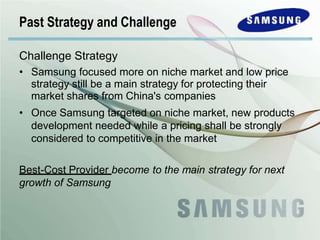
Past Strategy and Challenge
Challenge Strategy
• Samsung focused more on niche market and low price
strategy still be a main strategy for protecting their
market shares from China's companies
• Once Samsung targeted on niche market, new products
development needed while a pricing shall be strongly
considered to competitive in the market
Best-Cost Provider become to the main strategy for next
growth of Samsung
Past Strategy and Challenge
EXTE
SAM SU
Macro Environment Analysis
Political factors
(+) The industry is on focusing in several countries,
more government supports for technology
development
(+) South Korea has strong relationship with others
General economic conditions
(-) Economics regression of the world
(-) Instability of Exchange rates
(-) Interest rates volatility
(-) Perfect competitive market coming
Social force
(-) Environmental Conservatism’s Resistance
Natural environment
(-) Products is more sensitive with climate
Technological factors
(+) Technology market is moving fast
(+) No trends of new substitute technology
Global force
(-) Labor cost is trendy higher
Difficult
to Survive
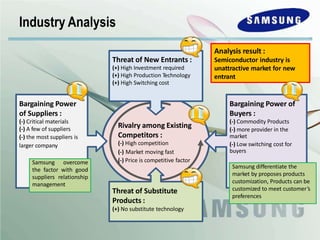
Analysis result :
Semiconductor industry is
unattractive market for new
entrant
Rivalry among Existing
Competitors :
(-) High competition
(-) Market moving fast
(-) Price is competitive factor
Industry Analysis
Bargaining Power
of Suppliers :
(-) Critical materials
(-) A few of suppliers
(-) the most suppliers is
larger company
Bargaining Power of
Buyers :
(-) Commodity Products
(-) more provider in the
market
(-) Low switching cost for
buyers
Threat of New Entrants :
(+) High Investment required
(+) High Production Technology
(+) High Switching cost
Threat of Substitute
Products :
(+) No substitute technology
Samsung differentiate the
market by proposes products
customization, Products can be
customized to meet customer’s
preferences
Samsung overcome
the factor with good
suppliers relationship
management
Competitor Analysis and Comparison
Analysis
Result
SAM SU
Internal Analysis
Firm Infrastructure : Adaptability culture organization
Human Resource Management : Acquire Korean global talent
Technological Management : Products development competition
Procurement : Economies of scale purchasing, Focus on potential
suppliers
Marketing Services :
& Sales :
Customize to
customer
demands
Operations
:
Focus on
quality, high
capacity and
low defect
Inbound
Logistics :
Focus on
time to
market,
Volume,
consistency
Outbound
Logistics :
Focus on
time to
market,
consistency
Variety of
products,
older-tech.
promotion
Support
Activities
Primary
Activities
Relationship with Suppliers Relationship with Buyers
,h
S
ido
tl r
Un
e
ive
n
rsig
ty.t
Ah
ll ris
ghts
ir
n
eserS
vea
d. msung’s Value Chain
Internal Analysis
Human Resource Management : Acquire Korean global talent
Technological Management : Products development competition
Procurement : Economies of scale purchasing, Focus on potential
suppliers
Marketing Services :
& Sales :
Customize to
customer
demands
Operations
:
Focus on
quality, high
capacity and
low defect
Variety of
products,
older-tech.
promotion
Support
Activities
Primary
Activities
Resource, Capability and Competency
Resource Capability
Tangible
• Financial : Cash flow and Capital
• Organizational : 5 Business units
• Physical : Fab Manufacturing
• Technological : High capacity production line
• Innovative products
• High capacity
• Varity of products
• Best quality
• Customize to customer’s demand
Competency
Intangible
• Human Assets : Recruit promoted successor
scholarship
• Brands : Value $12.6 billion (21stof the world)
• Company : Reward outstanding performance
Culture do not punish failure
• Excellence HRM
• Effective procurement by volume
• Creativity human capital
• Effective production technologies
... ICANAL
YSIS
SAM SU
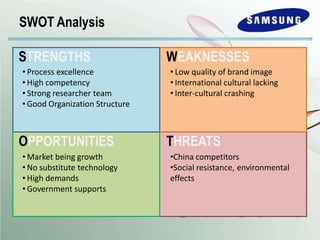
SWOT Analysis
STRENGTHS
• Process excellence
• High competency
• Strong researcher team
• Good Organization Structure
WEAKNESSES
• Low quality of brand image
• International cultural lacking
• Inter-cultural crashing
OPPORTUNITIES
• Market being growth
• No substitute technology
• High demands
• Government supports
THREATS
•China competitors
•Social resistance, environmental
effects
Strategic Analysis
Market
Growth
20%
0%
Relative Market Share 0.1X
10X
?
DRAM
SRAM
Flash
Flash
DRAM
SRAM
• DRAM - Less profits, reduce
investment
•Flash - More invests in R&D, gains
market share is critical strategy
• SRAM - Maintains the market
Strategic Group Analysis
Products
Development
High
Low
Average Selling Price High
Low
Sized by revenue
•Continuous product
improvement is very importance
•Small company needs partners
for more competitive advantage
to survive in the market
•Less competitive advantage /
less margin (low price strategy
needed)
Narrow
Market
Target
Focused Differentiation
Strategy in the Future
Differentiation Strategy
Broad
Market
Target
Cost Leadership Strategy
Focused Low-Cost
Strategy
Broad Differentiation
Strategy
Past and Current
Generic Business Strategy Analysis
Overall Low-Cost Provider
Strategy in the Past
Best-Cost Provider
Strategy in the Present
SAM SU
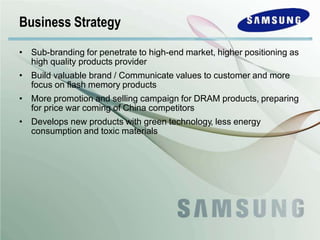
• Sub-branding for penetrate to high-end market, higher positioning as
high quality products provider
• Build valuable brand / Communicate values to customer and more
focus on flash memory products
• More promotion and selling campaign for DRAM products, preparing
for price war coming of China competitors
• Develops new products with green technology, less energy
consumption and toxic materials
Business Strategy
• Forward vertical integration for expanding business to downstream,
utilizes strength of technology expertise, manufacturing resources
and a large scale electronic materials provider to be a electronic
devices manufacturer
• Build up business in China, for blocking growth of China competitors
and gain cost advantage from low cost manufacturing (lower labor
rate)
Corporate Strategy
Implementation Strategy
• Prepares organization that suitable for international business
especially in China, recruits Chinese employee for faster familiar
with china’s culture and market behaviors
• Clearly formulation of forward vertical integration strategy, what
business units should to do (e.g. computer, cellphone, data storage)
• Keeps investment on R&D to be leader in innovation, technology
and cost advantage production
• Communicate vision and missions needed to employee
• Align goals of all related business sections to consistent with
corporate goal
samsung case study

samsung case study

  • 1.
  • 2.
    Case Summary G r o w t h:S e m ic o n d u c to rIn d u s t r yh a s1 6 % o fg ro w thr a t e O na v e r a g e,1 9 6 0-2 0 0 0 Crisis : 2001 – 2002 Semicondu ctor Indust r y C ri si s R e c o ve r y:S a m s u n gs u r viv e d c r isisw it ht h e irc o m p e t e n c ya n d B r a n d i n gs t r a t e g y 2 0 0 5 1 9 6 0 S a m s u n gG r o u ps t a r t e dE le c tr o n i c s in d u s t r yinte le vis io nm a r k e t 1 9 7 4 1 9 8 0 2 0 0 4 1 9 6 9 1 9 9 2 K o r e aS e m ic o n d u c to r c o m p a n yfo u n d e d ,b e g a n w ithW a f e rp r o d u c t io n . A n da c q u i r e db yS a m s u n g la tte r ly 1 9 8 0 s ,S a m s u n gG r o u p m o refo c u so nE le c tr o n i c s m a r k e ta n dfo u n dS a m s u n g E le c tr o n i c s ,m a n u fa c tu r in g inS o u t hK o r e ab u i lt S a m s u n gB r a n db e in g lis t e da s2 1 s tv a lu a b l e b r a n d sinth ew o rldb y In t e r b r a n dC o r p . 8 ”W a fe rte c h n o l o g y d e v e lo p e d ,d r a m a tic a lly s h i fttoS a m s u n gof p r o d u c t io nc a p a c it y
  • 3.
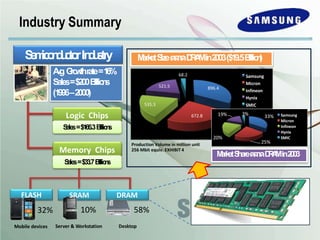
    FLASH 32% Mobile devices SRAM 10% Server &Workstation DRAM 58% Desktop Logic Chips S a le s=$ 1 6 6 .3B illio n s Memory Chips S a le s=$ 3 3 .7B illio n s Industry Summary S e m ic o n d u c to rIn d u s try A v g .G ro w thrate=1 6 % Sales=$200B illio n s (1996–2000) M ark e tS izeต ล า ดD R A Min2003($19.5B illio n ) 896.4 672.8 535.3 521.5 68.2 Samsung Micron Infineon Hynix SMIC M ark etS hareต ล า ดD R A Min2 0 0 3 33% 25% 20% 19% 3% Samsung Micron Infineon Hynix SMIC Production Volume in million unit 256 Mbit equiv. EXHIBIT 4
  • 4.
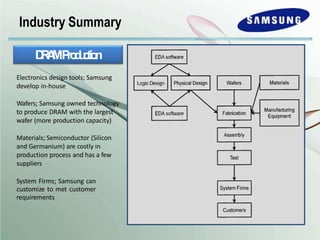
    Industry Summary D R A MP ro d u c ti o n Electronics designtools; Samsung develop in-house Wafers; Samsung owned technology to produce DRAM with the largest wafer (more production capacity) Materials; Semiconductor (Silicon and Germanium) are costly in production process and has a few suppliers System Firms; Samsung can customize to met customer requirements
  • 5.
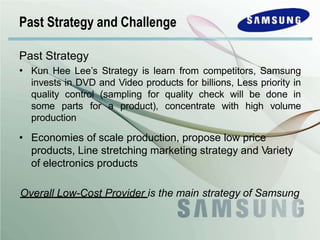
    Past Strategy • KunHee Lee’s Strategy is learn from competitors, Samsung invests in DVD and Video products for billions, Less priority in quality control (sampling for quality check will be done in some parts for a product), concentrate with high volume production • Economies of scale production, propose low price products, Line stretching marketing strategy and Variety of electronics products Overall Low-Cost Provider is the main strategy of Samsung Past Strategy and Challenge
  • 6.
    Challenge Strategy • Samsungfocused more on niche market and low price strategy still be a main strategy for protecting their market shares from China's companies • Once Samsung targeted on niche market, new products development needed while a pricing shall be strongly considered to competitive in the market Best-Cost Provider become to the main strategy for next growth of Samsung Past Strategy and Challenge
  • 7.
  • 8.
    Macro Environment Analysis Politicalfactors (+) The industry is on focusing in several countries, more government supports for technology development (+) South Korea has strong relationship with others General economic conditions (-) Economics regression of the world (-) Instability of Exchange rates (-) Interest rates volatility (-) Perfect competitive market coming Social force (-) Environmental Conservatism’s Resistance Natural environment (-) Products is more sensitive with climate Technological factors (+) Technology market is moving fast (+) No trends of new substitute technology Global force (-) Labor cost is trendy higher Difficult to Survive
  • 9.
    Analysis result : Semiconductorindustry is unattractive market for new entrant Rivalry among Existing Competitors : (-) High competition (-) Market moving fast (-) Price is competitive factor Industry Analysis Bargaining Power of Suppliers : (-) Critical materials (-) A few of suppliers (-) the most suppliers is larger company Bargaining Power of Buyers : (-) Commodity Products (-) more provider in the market (-) Low switching cost for buyers Threat of New Entrants : (+) High Investment required (+) High Production Technology (+) High Switching cost Threat of Substitute Products : (+) No substitute technology Samsung differentiate the market by proposes products customization, Products can be customized to meet customer’s preferences Samsung overcome the factor with good suppliers relationship management
  • 10.
    Competitor Analysis andComparison Analysis Result
  • 11.
  • 12.
    Internal Analysis Firm Infrastructure: Adaptability culture organization Human Resource Management : Acquire Korean global talent Technological Management : Products development competition Procurement : Economies of scale purchasing, Focus on potential suppliers Marketing Services : & Sales : Customize to customer demands Operations : Focus on quality, high capacity and low defect Inbound Logistics : Focus on time to market, Volume, consistency Outbound Logistics : Focus on time to market, consistency Variety of products, older-tech. promotion Support Activities Primary Activities Relationship with Suppliers Relationship with Buyers
  • 13.
    Relationship with SuppliersRelationship with Buyers ,h S ido tl r Un e ive n rsig ty.t Ah ll ris ghts ir n eserS vea d. msung’s Value Chain Internal Analysis Human Resource Management : Acquire Korean global talent Technological Management : Products development competition Procurement : Economies of scale purchasing, Focus on potential suppliers Marketing Services : & Sales : Customize to customer demands Operations : Focus on quality, high capacity and low defect Variety of products, older-tech. promotion Support Activities Primary Activities
  • 14.
    Resource, Capability andCompetency Resource Capability Tangible • Financial : Cash flow and Capital • Organizational : 5 Business units • Physical : Fab Manufacturing • Technological : High capacity production line • Innovative products • High capacity • Varity of products • Best quality • Customize to customer’s demand Competency Intangible • Human Assets : Recruit promoted successor scholarship • Brands : Value $12.6 billion (21stof the world) • Company : Reward outstanding performance Culture do not punish failure • Excellence HRM • Effective procurement by volume • Creativity human capital • Effective production technologies
  • 15.
  • 16.
    SWOT Analysis STRENGTHS • Processexcellence • High competency • Strong researcher team • Good Organization Structure WEAKNESSES • Low quality of brand image • International cultural lacking • Inter-cultural crashing OPPORTUNITIES • Market being growth • No substitute technology • High demands • Government supports THREATS •China competitors •Social resistance, environmental effects
  • 17.
    Strategic Analysis Market Growth 20% 0% Relative MarketShare 0.1X 10X ? DRAM SRAM Flash Flash DRAM SRAM • DRAM - Less profits, reduce investment •Flash - More invests in R&D, gains market share is critical strategy • SRAM - Maintains the market
  • 18.
    Strategic Group Analysis Products Development High Low AverageSelling Price High Low Sized by revenue •Continuous product improvement is very importance •Small company needs partners for more competitive advantage to survive in the market •Less competitive advantage / less margin (low price strategy needed)
  • 19.
    Narrow Market Target Focused Differentiation Strategy inthe Future Differentiation Strategy Broad Market Target Cost Leadership Strategy Focused Low-Cost Strategy Broad Differentiation Strategy Past and Current Generic Business Strategy Analysis Overall Low-Cost Provider Strategy in the Past Best-Cost Provider Strategy in the Present
  • 20.
  • 21.
    • Sub-branding forpenetrate to high-end market, higher positioning as high quality products provider • Build valuable brand / Communicate values to customer and more focus on flash memory products • More promotion and selling campaign for DRAM products, preparing for price war coming of China competitors • Develops new products with green technology, less energy consumption and toxic materials Business Strategy
  • 22.
    • Forward verticalintegration for expanding business to downstream, utilizes strength of technology expertise, manufacturing resources and a large scale electronic materials provider to be a electronic devices manufacturer • Build up business in China, for blocking growth of China competitors and gain cost advantage from low cost manufacturing (lower labor rate) Corporate Strategy
  • 23.
    Implementation Strategy • Preparesorganization that suitable for international business especially in China, recruits Chinese employee for faster familiar with china’s culture and market behaviors • Clearly formulation of forward vertical integration strategy, what business units should to do (e.g. computer, cellphone, data storage) • Keeps investment on R&D to be leader in innovation, technology and cost advantage production • Communicate vision and missions needed to employee • Align goals of all related business sections to consistent with corporate goal