ICT based language
teaching: SAMR
model
Pratiwi Indah (S892208005)
Lecturer :Prof. Dr. Endang Fauziati, M.Hum
● The Definition of SAMR Model
● The SAMR Model Explained (with Examples)
● 4 Phases of SAMR Model
Table of Contents
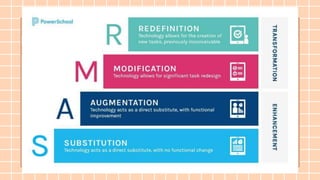
The SAMR Model is a framework created by Dr. Ruben Puentedura that categorizes four different
degrees of classroom technology integration. The letters “SAMR” stand for Substitution,
Augmentation, Modification, and Redefinition. The SAMR model was created to share a common
language across disciplines as teachers strive to personalize learning and help students visualize
complex concepts. The SAMR Model can be especially powerful during remote and blended learning
when integrated classroom technology makes teaching and learning a more seamless experience for
educators and students.
SAMR MODEL
The SAMR model consists of four steps: Substitution, Augmentation, Modification, and
Redefinition. Substitution and Augmentation are considered “Enhancement” steps, while
Modification and Redefinition are “Transformation” steps. Think of the difference between
seasoning an old family recipe (Enhancement) and creating an entirely new, original dish
(Transformation).
The SAMR Model Explained (with
Examples)
At this stage, technology is directly substituted for a more traditional teaching tool or method. It is a
simple, bare-bones, direct replacement.
Examples of substitution
● having students type their work instead of handwriting it
● using online quizzes and programs instead of pen and paper
● uploading a worksheet in PDF for student access, as opposed to photocopying
● using a digital interactive whiteboard as opposed to a traditional whiteboard and saving the
results as a document.
I
Substitution
At the augmentation stage, technology adds something to the learning process beyond just
convenience. It might give your students a clearer understanding of a complex topic or making
it engaging in a way that traditional methods can’t.
It also allows for the introduction of more independent and student-centric learning. By using
technology as a source of information, students can start actively learning without requiring
constant teacher-led instruction.
Examples of augmentation
● Students give more informative and engaging oral presentations accompanied by a PowerPoint
or Prezi containing multimedia elements.
● Students use the internet to independently research a topic, as opposed to relying on teacher
input.
● Students use an EdTech program that gamifies curriculum content for student engagement and
allows students to track progress in an accessible way.
● Teacher instruction is supplemented with a video that clarifies a particularly hard to explain
concept.
Augmentation
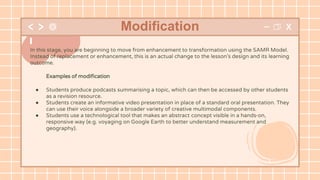
In this stage, you are beginning to move from enhancement to transformation using the SAMR Model.
Instead of replacement or enhancement, this is an actual change to the lesson’s design and its learning
outcome.
Examples of modification
● Students produce podcasts summarising a topic, which can then be accessed by other students
as a revision resource.
● Students create an informative video presentation in place of a standard oral presentation. They
can use their voice alongside a broader variety of creative multimodal components.
● Students use a technological tool that makes an abstract concept visible in a hands-on,
responsive way (e.g. voyaging on Google Earth to better understand measurement and
geography).
Modification
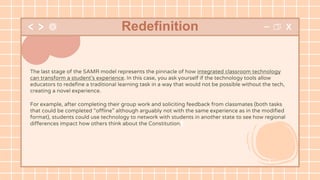
The last stage of the SAMR model represents the pinnacle of how integrated classroom technology
can transform a student’s experience. In this case, you ask yourself if the technology tools allow
educators to redefine a traditional learning task in a way that would not be possible without the tech,
creating a novel experience.
For example, after completing their group work and soliciting feedback from classmates (both tasks
that could be completed “offline” although arguably not with the same experience as in the modified
format), students could use technology to network with students in another state to see how regional
differences impact how others think about the Constitution.
Redefinition
https://www.3plearning.com/blog/connectingsamrmodel/
References

SAMR MODEL 2023.pptx

  • 1.
    ICT based language teaching:SAMR model Pratiwi Indah (S892208005) Lecturer :Prof. Dr. Endang Fauziati, M.Hum
  • 2.
    ● The Definitionof SAMR Model ● The SAMR Model Explained (with Examples) ● 4 Phases of SAMR Model Table of Contents
  • 3.
    The SAMR Modelis a framework created by Dr. Ruben Puentedura that categorizes four different degrees of classroom technology integration. The letters “SAMR” stand for Substitution, Augmentation, Modification, and Redefinition. The SAMR model was created to share a common language across disciplines as teachers strive to personalize learning and help students visualize complex concepts. The SAMR Model can be especially powerful during remote and blended learning when integrated classroom technology makes teaching and learning a more seamless experience for educators and students. SAMR MODEL
  • 5.
    The SAMR modelconsists of four steps: Substitution, Augmentation, Modification, and Redefinition. Substitution and Augmentation are considered “Enhancement” steps, while Modification and Redefinition are “Transformation” steps. Think of the difference between seasoning an old family recipe (Enhancement) and creating an entirely new, original dish (Transformation). The SAMR Model Explained (with Examples)
  • 6.
    At this stage,technology is directly substituted for a more traditional teaching tool or method. It is a simple, bare-bones, direct replacement. Examples of substitution ● having students type their work instead of handwriting it ● using online quizzes and programs instead of pen and paper ● uploading a worksheet in PDF for student access, as opposed to photocopying ● using a digital interactive whiteboard as opposed to a traditional whiteboard and saving the results as a document. I Substitution
  • 7.
    At the augmentationstage, technology adds something to the learning process beyond just convenience. It might give your students a clearer understanding of a complex topic or making it engaging in a way that traditional methods can’t. It also allows for the introduction of more independent and student-centric learning. By using technology as a source of information, students can start actively learning without requiring constant teacher-led instruction. Examples of augmentation ● Students give more informative and engaging oral presentations accompanied by a PowerPoint or Prezi containing multimedia elements. ● Students use the internet to independently research a topic, as opposed to relying on teacher input. ● Students use an EdTech program that gamifies curriculum content for student engagement and allows students to track progress in an accessible way. ● Teacher instruction is supplemented with a video that clarifies a particularly hard to explain concept. Augmentation
  • 8.
    In this stage,you are beginning to move from enhancement to transformation using the SAMR Model. Instead of replacement or enhancement, this is an actual change to the lesson’s design and its learning outcome. Examples of modification ● Students produce podcasts summarising a topic, which can then be accessed by other students as a revision resource. ● Students create an informative video presentation in place of a standard oral presentation. They can use their voice alongside a broader variety of creative multimodal components. ● Students use a technological tool that makes an abstract concept visible in a hands-on, responsive way (e.g. voyaging on Google Earth to better understand measurement and geography). Modification
  • 9.
    The last stageof the SAMR model represents the pinnacle of how integrated classroom technology can transform a student’s experience. In this case, you ask yourself if the technology tools allow educators to redefine a traditional learning task in a way that would not be possible without the tech, creating a novel experience. For example, after completing their group work and soliciting feedback from classmates (both tasks that could be completed “offline” although arguably not with the same experience as in the modified format), students could use technology to network with students in another state to see how regional differences impact how others think about the Constitution. Redefinition
  • 10.