The process of obtaining information from a subset(sample) of a
larger group(population).
The results for the sample are then used to make estimates of
the larger group.
Faster and cheaper than asking the entire population.
SAMPLING
 Get information about populations
 Reduce cost of research
 More accuracy of results
 Less field time
 Generalize about population
 When it’s impossible to study the whole population
WHY SAMPLING?
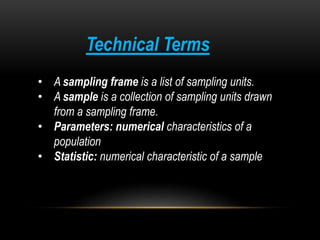
Technical Terms
• A sampling frame is a list of sampling units.
• A sample is a collection of sampling units drawn
from a sampling frame.
• Parameters: numerical characteristics of a
population
• Statistic: numerical characteristic of a sample
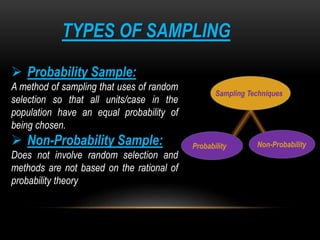
 Probability Sample:
A method of sampling that uses of random
selection so that all units/case in the
population have an equal probability of
being chosen.
 Non-Probability Sample:
Does not involve random selection and
methods are not based on the rational of
probability theory
Sampling Techniques
Probability Non-Probability
TYPES OF SAMPLING
Probability SAMPLING
Following are some commonly used sampling
methods:
• Simple Random Sampling
• Stratified Random Sampling
• Cluster Sampling
• Systematic Sampling
SIMPLE RANDOM SAMPLING
Application when population is small,
homogeneous & readily available
All subsets of the frame are given an
equal probability. Each element of the
frame thus has an equal probability of
selection. A table of random number or
lottery system is used to determine
which units are to be selected.
Possible Ways To Do Sampling
• The sampling units are chosen with
replacement in the sense that the chosen
units are placed back in the population.
• The sampling units are chosen without
replacement in the sense that units are
chosen are not placed back in the
population.
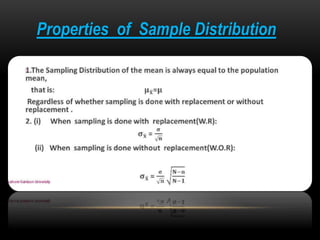
Properties of Sample Distribution
Advantages:
• Easy method to use
• No need of prior information of population
• Equal and independent chances of selection to every
element
Disadvantages:
• If sampling frame large, this method impracticable.
• Does not use researcher’s expertise .
• Larger risk of random error
Sampling (statistics and probability)

Sampling (statistics and probability)

  • 2.
    The process ofobtaining information from a subset(sample) of a larger group(population). The results for the sample are then used to make estimates of the larger group. Faster and cheaper than asking the entire population. SAMPLING
  • 3.
     Get informationabout populations  Reduce cost of research  More accuracy of results  Less field time  Generalize about population  When it’s impossible to study the whole population WHY SAMPLING?
  • 4.
    Technical Terms • Asampling frame is a list of sampling units. • A sample is a collection of sampling units drawn from a sampling frame. • Parameters: numerical characteristics of a population • Statistic: numerical characteristic of a sample
  • 5.
     Probability Sample: Amethod of sampling that uses of random selection so that all units/case in the population have an equal probability of being chosen.  Non-Probability Sample: Does not involve random selection and methods are not based on the rational of probability theory Sampling Techniques Probability Non-Probability TYPES OF SAMPLING
  • 6.
    Probability SAMPLING Following aresome commonly used sampling methods: • Simple Random Sampling • Stratified Random Sampling • Cluster Sampling • Systematic Sampling
  • 7.
    SIMPLE RANDOM SAMPLING Applicationwhen population is small, homogeneous & readily available All subsets of the frame are given an equal probability. Each element of the frame thus has an equal probability of selection. A table of random number or lottery system is used to determine which units are to be selected.
  • 8.
    Possible Ways ToDo Sampling • The sampling units are chosen with replacement in the sense that the chosen units are placed back in the population. • The sampling units are chosen without replacement in the sense that units are chosen are not placed back in the population.
  • 9.
  • 10.
    Advantages: • Easy methodto use • No need of prior information of population • Equal and independent chances of selection to every element Disadvantages: • If sampling frame large, this method impracticable. • Does not use researcher’s expertise . • Larger risk of random error