SAMPLING
DR. M. JOTHILAKSHMI, MBA., Ph.d., m.sc (Psy).,
Head & Assistant Professor,
BBA (SF)
VHNSN College, Virudhunagar
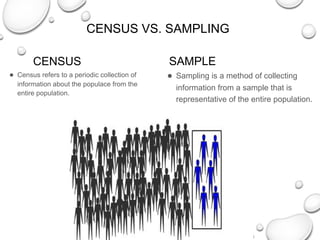
CENSUS VS. SAMPLING
CENSUS
● Census refers to a periodic collection of
information about the populace from the
entire population.
SAMPLE
● Sampling is a method of collecting
information from a sample that is
representative of the entire population.
RELIABILITY
CONTENT CENSUS SAMPLE
Reliability Data from the census is
reliable and accurate.
There is a margin of error in
data obtained from
sampling.
Time Census is very
time-consuming.
Sampling is quick.
Cost Census is very expensive Sampling is inexpensive.
Convenience It is not very convenient as
the researcher has to
allocate a lot of effort in
collecting data.
Sampling is the most
convenient method of
obtaining data about the
population.
● Population: The aggregate of all the units pertaining to a
study. It is called as universe or target population.
○ All the teaching professionals in VNR – A study on stress
management
● Element: A member of population.
○ Individual staff members
● Sample: A subset of units in a population, selected to
represent all units in a population of interest.
○ A list of professors who respond to the study.
● Sample unit: Element or set of elements considered for
selection in some stage of sampling.
○ College wise classification, Discipline wise classification
● Sample frame: This is the actual list of sampling units
from which the sample, or some stage of the sample, is
selected. It is simply a list of the study population.
○ Telephone directory, College address book.
● Sample design: A set of rules or procedures that specify
how a sample is to be selected. This can either be
probability or non-probability.
○ Using a convenience sampling method to select the
sample professors
● Sampling: A process of drawing a sample from population.
● Sample size: The number of elements in the obtained
sample.
○ 1500 college professors
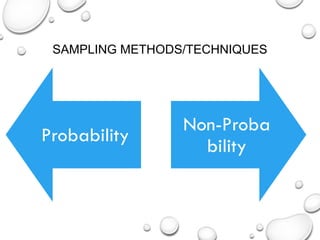
SAMPLING METHODS/TECHNIQUES
Probability
Non-Proba
bility
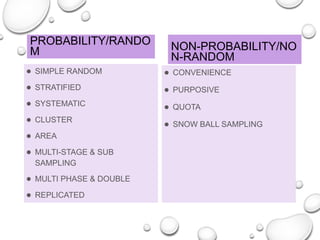
PROBABILITY/RANDO
M
● SIMPLE RANDOM
● STRATIFIED
● SYSTEMATIC
● CLUSTER
● AREA
● MULTI-STAGE & SUB
SAMPLING
● MULTI PHASE & DOUBLE
● REPLICATED
NON-PROBABILITY/NO
N-RANDOM
● CONVENIENCE
● PURPOSIVE
● QUOTA
● SNOW BALL SAMPLING
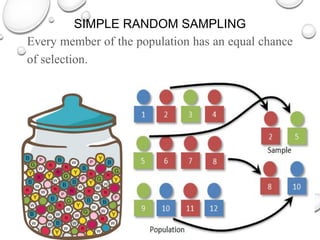
SIMPLE RANDOM SAMPLING
Every member of the population has an equal chance
of selection.
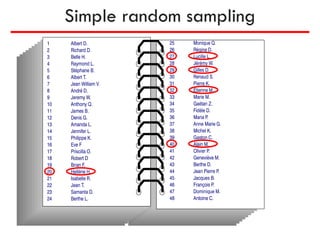
Simple random sampling
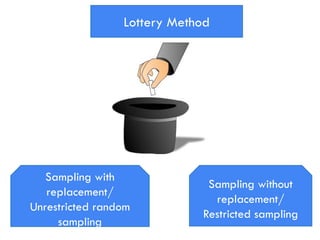
Lottery Method
Sampling with
replacement/
Unrestricted random
sampling
Sampling without
replacement/
Restricted sampling
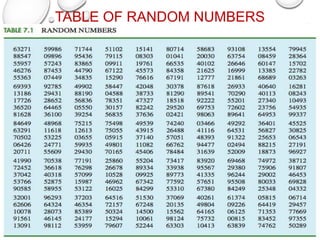
TABLE OF RANDOM NUMBERS
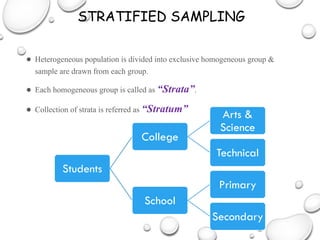
● Heterogeneous population is divided into exclusive homogeneous group &
sample are drawn from each group.
● Each homogeneous group is called as “Strata”.
● Collection of strata is referred as “Stratum”
STRATIFIED SAMPLING
Students
College
Arts &
Science
Technical
School
Primary
Secondary
16
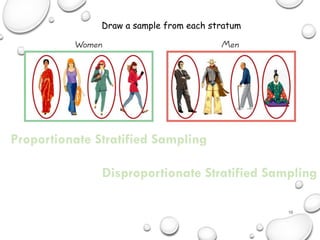
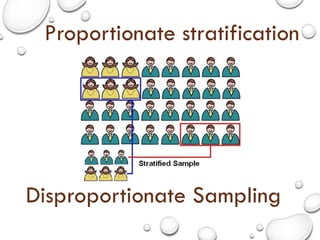
Draw a sample from each stratum
Proportionate Stratified Sampling
Disproportionate Stratified Sampling
Disproportionate Sampling
Proportionate stratification
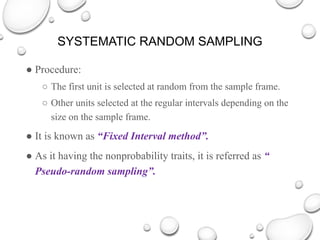
SYSTEMATIC RANDOM SAMPLING
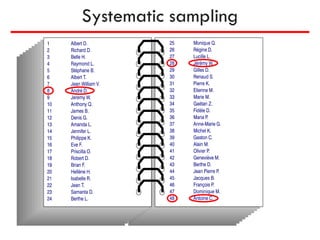
● Procedure:
○ The first unit is selected at random from the sample frame.
○ Other units selected at the regular intervals depending on the
size on the sample frame.
● It is known as “Fixed Interval method”.
● As it having the nonprobability traits, it is referred as “
Pseudo-random sampling”.
Systematic sampling
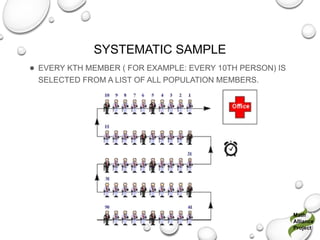
SYSTEMATIC SAMPLE
● EVERY KTH MEMBER ( FOR EXAMPLE: EVERY 10TH PERSON) IS
SELECTED FROM A LIST OF ALL POPULATION MEMBERS.
Math
Alliance
Project
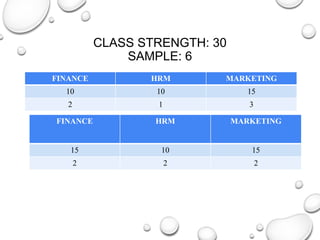
CLASS STRENGTH: 30
SAMPLE: 6
FINANCE HRM MARKETING
10 10 15
2 1 3
FINANCE HRM MARKETING
15 10 15
2 2 2
CLUSTER SAMPLING
Section 4
Section 5
Section 3
Section 2
Section 1
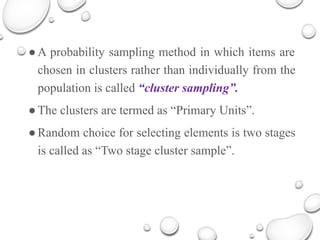
●A probability sampling method in which items are
chosen in clusters rather than individually from the
population is called “cluster sampling”.
●The clusters are termed as “Primary Units”.
●Random choice for selecting elements is two stages
is called as “Two stage cluster sample”.
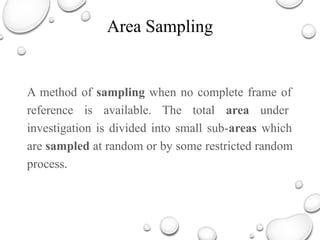
Area Sampling
A method of sampling when no complete frame of
reference is available. The total area under
investigation is divided into small sub-areas which
are sampled at random or by some restricted random
process.
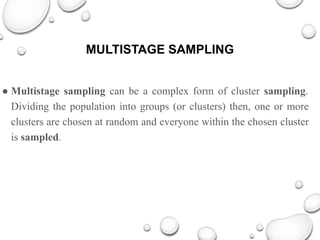
MULTISTAGE SAMPLING
● Multistage sampling can be a complex form of cluster sampling.
Dividing the population into groups (or clusters) then, one or more
clusters are chosen at random and everyone within the chosen cluster
is sampled.
DOUBLE AND MULTI PHASE SAMPLING
●A sampling method in which certain items of
information are drawn from the whole units of a
sample and certain other items of information are
taken from the subsample.
NON PROBABILITY SAMPLING
TECHNIQUES
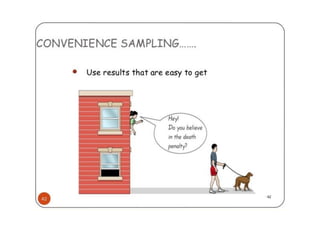
Convenience sampling
● The researcher selects the most accessible population members from which to
get information.
● Sample which are very close to hand, very convenient, readily available or
willing to respond are chosen.
● It is called as “Grab/ Opportunity Sampling/Accidental sampling”
○ “Collecting data from friends, acquaintances or from
colleagues”
JUDGEMENT SAMPLING
●The researcher uses judgement to select population
members who are good prospects for accurate
information.
●It known as “purposive of authoritative sampling”
○ Collecting details regarding VVV MBA from the
students from corresponding dept.
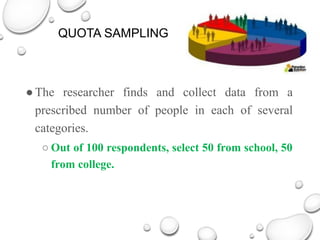
QUOTA SAMPLING
●The researcher finds and collect data from a
prescribed number of people in each of several
categories.
○ Out of 100 respondents, select 50 from school, 50
from college.
SNOW BALL SAMPLING
● “Chain sampling, chain-referral sampling or referral
sampling”.
● A snowball sample is one in which the researcher
collects data on the few members of the target
population he or she can locate, then asks those
individuals to provide information needed to locate
other members of that population whom they know.
○ A study on homeless, requires very few people and they
would lead to reach others.
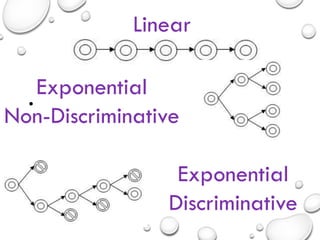
•
Linear
Exponential
Non-Discriminative
Exponential
Discriminative

SAMPLING IN RESEARCH METHODOLOGY.pptx.pdf

  • 1.
    SAMPLING DR. M. JOTHILAKSHMI,MBA., Ph.d., m.sc (Psy)., Head & Assistant Professor, BBA (SF) VHNSN College, Virudhunagar
  • 3.
    CENSUS VS. SAMPLING CENSUS ●Census refers to a periodic collection of information about the populace from the entire population. SAMPLE ● Sampling is a method of collecting information from a sample that is representative of the entire population.
  • 4.
    RELIABILITY CONTENT CENSUS SAMPLE ReliabilityData from the census is reliable and accurate. There is a margin of error in data obtained from sampling. Time Census is very time-consuming. Sampling is quick. Cost Census is very expensive Sampling is inexpensive. Convenience It is not very convenient as the researcher has to allocate a lot of effort in collecting data. Sampling is the most convenient method of obtaining data about the population.
  • 7.
    ● Population: Theaggregate of all the units pertaining to a study. It is called as universe or target population. ○ All the teaching professionals in VNR – A study on stress management ● Element: A member of population. ○ Individual staff members ● Sample: A subset of units in a population, selected to represent all units in a population of interest. ○ A list of professors who respond to the study. ● Sample unit: Element or set of elements considered for selection in some stage of sampling. ○ College wise classification, Discipline wise classification
  • 8.
    ● Sample frame:This is the actual list of sampling units from which the sample, or some stage of the sample, is selected. It is simply a list of the study population. ○ Telephone directory, College address book. ● Sample design: A set of rules or procedures that specify how a sample is to be selected. This can either be probability or non-probability. ○ Using a convenience sampling method to select the sample professors ● Sampling: A process of drawing a sample from population. ● Sample size: The number of elements in the obtained sample. ○ 1500 college professors
  • 9.
  • 10.
    PROBABILITY/RANDO M ● SIMPLE RANDOM ●STRATIFIED ● SYSTEMATIC ● CLUSTER ● AREA ● MULTI-STAGE & SUB SAMPLING ● MULTI PHASE & DOUBLE ● REPLICATED NON-PROBABILITY/NO N-RANDOM ● CONVENIENCE ● PURPOSIVE ● QUOTA ● SNOW BALL SAMPLING
  • 11.
    SIMPLE RANDOM SAMPLING Everymember of the population has an equal chance of selection.
  • 12.
  • 13.
    Lottery Method Sampling with replacement/ Unrestrictedrandom sampling Sampling without replacement/ Restricted sampling
  • 14.
  • 15.
    ● Heterogeneous populationis divided into exclusive homogeneous group & sample are drawn from each group. ● Each homogeneous group is called as “Strata”. ● Collection of strata is referred as “Stratum” STRATIFIED SAMPLING Students College Arts & Science Technical School Primary Secondary
  • 16.
    16 Draw a samplefrom each stratum Proportionate Stratified Sampling Disproportionate Stratified Sampling
  • 17.
  • 18.
    SYSTEMATIC RANDOM SAMPLING ●Procedure: ○ The first unit is selected at random from the sample frame. ○ Other units selected at the regular intervals depending on the size on the sample frame. ● It is known as “Fixed Interval method”. ● As it having the nonprobability traits, it is referred as “ Pseudo-random sampling”.
  • 19.
  • 20.
    SYSTEMATIC SAMPLE ● EVERYKTH MEMBER ( FOR EXAMPLE: EVERY 10TH PERSON) IS SELECTED FROM A LIST OF ALL POPULATION MEMBERS. Math Alliance Project
  • 21.
    CLASS STRENGTH: 30 SAMPLE:6 FINANCE HRM MARKETING 10 10 15 2 1 3 FINANCE HRM MARKETING 15 10 15 2 2 2
  • 22.
    CLUSTER SAMPLING Section 4 Section5 Section 3 Section 2 Section 1
  • 23.
    ●A probability samplingmethod in which items are chosen in clusters rather than individually from the population is called “cluster sampling”. ●The clusters are termed as “Primary Units”. ●Random choice for selecting elements is two stages is called as “Two stage cluster sample”.
  • 24.
    Area Sampling A methodof sampling when no complete frame of reference is available. The total area under investigation is divided into small sub-areas which are sampled at random or by some restricted random process.
  • 26.
    MULTISTAGE SAMPLING ● Multistagesampling can be a complex form of cluster sampling. Dividing the population into groups (or clusters) then, one or more clusters are chosen at random and everyone within the chosen cluster is sampled.
  • 28.
    DOUBLE AND MULTIPHASE SAMPLING ●A sampling method in which certain items of information are drawn from the whole units of a sample and certain other items of information are taken from the subsample.
  • 29.
  • 30.
    Convenience sampling ● Theresearcher selects the most accessible population members from which to get information. ● Sample which are very close to hand, very convenient, readily available or willing to respond are chosen. ● It is called as “Grab/ Opportunity Sampling/Accidental sampling” ○ “Collecting data from friends, acquaintances or from colleagues”
  • 32.
    JUDGEMENT SAMPLING ●The researcheruses judgement to select population members who are good prospects for accurate information. ●It known as “purposive of authoritative sampling” ○ Collecting details regarding VVV MBA from the students from corresponding dept.
  • 33.
    QUOTA SAMPLING ●The researcherfinds and collect data from a prescribed number of people in each of several categories. ○ Out of 100 respondents, select 50 from school, 50 from college.
  • 34.
    SNOW BALL SAMPLING ●“Chain sampling, chain-referral sampling or referral sampling”. ● A snowball sample is one in which the researcher collects data on the few members of the target population he or she can locate, then asks those individuals to provide information needed to locate other members of that population whom they know. ○ A study on homeless, requires very few people and they would lead to reach others.
  • 35.