DATA MANAGEMENT
STATISTICS
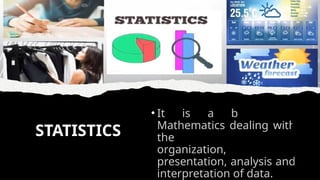
• It is a branch of
Mathematics dealing with
the collection,
organization,
presentation, analysis and
interpretation of data.
STATISTICS
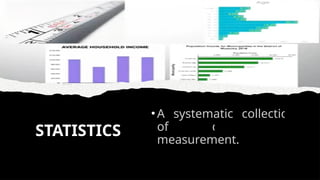
•A systematic collection
of data on
measurement.
DATA
GATHERING
• Direct or Interview
Method
• Indirect or Questionnaire
Method
• Registration Method
• Observation Method
• Experimental Method
Direct or
Interview Method
• Person to person
encounter between the
source of information,
the interviewee and the
one gathers
information, the
interviewer.
Personal Interview
Telephonic Interview
Indirect or
Questionnaire
Method
• Technique in which
questionnaire is used to
elicit the information or
data needed.
• The questionnaire is
consisting of questions
printed or type written
in the definite order on a
form or a set of forms.
Registration
Method
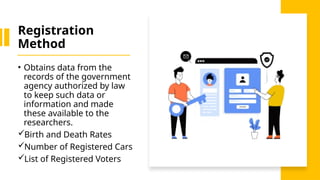
• Obtains data from the
records of the government
agency authorized by law
to keep such data or
information and made
these available to the
researchers.
Birth and Death Rates
Number of Registered Cars
List of Registered Voters
Observation
Method
• Technique in which data particularly
those pertaining to the behaviors of
individuals or group of individuals
during the given situation.
Example:
Allowing children to play with
selected toys to determine which is
most popular
Children’s Behavior
Costumer’s Movement
Number of costumers visiting to
the store
Costumers’ responses in a retail
store
Experimental
Method
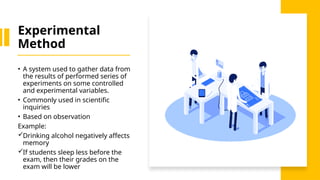
• A system used to gather data from
the results of performed series of
experiments on some controlled
and experimental variables.
• Commonly used in scientific
inquiries
• Based on observation
Example:
Drinking alcohol negatively affects
memory
If students sleep less before the
exam, then their grades on the
exam will be lower
CLASSIFICATIO
N OF
VARIABLES
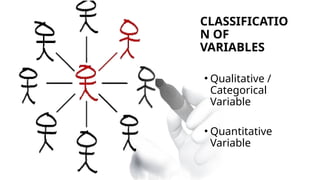
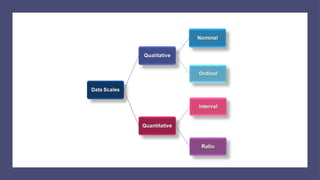
• Qualitative /
Categorical
Variable
• Quantitative
Variable
Qualitative /
Categorical Variable
• A variable that yields
categorical responses
Example:
Names
Color
Marital Status
Quantitative
Variable
• A variable that takes on
numerical values
representing the
amount or quantity.
Example:
Height
Weight
Number of Siblings
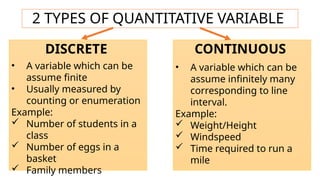
2 TYPES OF QUANTITATIVE VARIABLE
DISCRETE CONTINUOUS
• A variable which can be
assume finite
• Usually measured by
counting or enumeration
Example:
 Number of students in a
class
 Number of eggs in a
basket
 Family members
• A variable which can be
assume infinitely many
corresponding to line
interval.
Example:
 Weight/Height
 Windspeed
 Time required to run a
mile
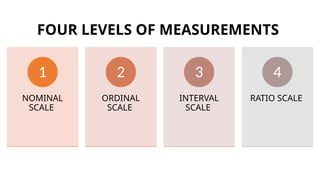
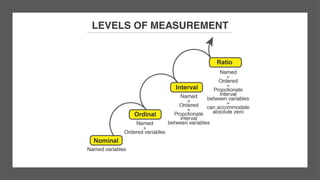
FOUR LEVELS OF MEASUREMENTS
NOMINAL
SCALE
1
ORDINAL
SCALE
2
INTERVAL
SCALE
3
RATIO SCALE
4
NOMINAL
• Assign names or labels to observation in purely arbitrary sequence
• Labels are used to classify the respondents or objects without
ordering
Examples:
Gender
Brand of Cellphones
Religion
Civil Status
Phone Number
Main Source of Allowance
ORDINAL
• Assign numbers or labels to observation with
implied ordering
• Ranking on respondents' preferences
Examples:
Stage of Cancer
T-Shirt Size
Educational Level
Satisfaction Level
INTERVAL
• Reflect distance between rank position of the respondents or
objects in equal units
• This scale gives the distance between any two numbers of
known sizes
• No true absolute zero point
• Can be manipulated algebraically by addition and subtraction
but not multiplication and division
Examples:
Temperature
SAT Scores
RATIO
• Reflect the existence of true absolute zero point as its origin
• Doesn’t have negative number unlike interval
• Ratio of two scale point is independent of the unit of
measurement
• Can be manipulated algebraically by multiplication and division
and has all properties of Interval data
Examples:
Distance
Height
Weight
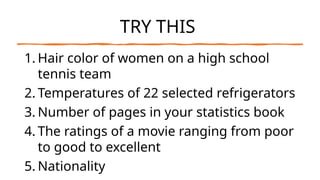
TRY THIS
1. Hair color of women on a high school
tennis team
2. Temperatures of 22 selected refrigerators
3. Number of pages in your statistics book
4. The ratings of a movie ranging from poor
to good to excellent
5. Nationality
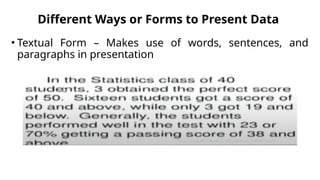
Different Ways or Forms to Present Data
• Textual Form – Makes use of words, sentences, and
paragraphs in presentation
Different Ways or Forms to Present Data
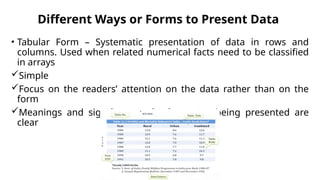
• Tabular Form – Systematic presentation of data in rows and
columns. Used when related numerical facts need to be classified
in arrays
Simple
Focus on the readers’ attention on the data rather than on the
form
Meanings and significance of information being presented are
clear
Different Ways or Forms to Present Data
• Graphical Form – Shows numerical values or relationship
in pictorial form. Makes use of graph, symbols or visual
aids
Accurate – Reflect the highest degree accuracy
Simple – Basic design should be simple and straight
forward
Clear – It should be easily read and understood
Attractive – Holding a neat, dignified and professional
appearance
TYPES OF
GRAPHS
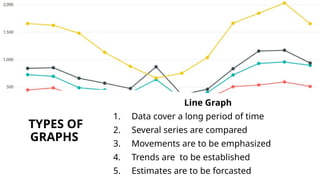
Line Graph
1. Data cover a long period of time
2. Several series are compared
3. Movements are to be emphasized
4. Trends are to be established
5. Estimates are to be forcasted
TYPES OF
GRAPHS
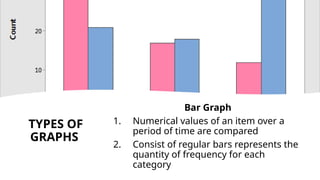
Bar Graph
1. Numerical values of an item over a
period of time are compared
2. Consist of regular bars represents the
quantity of frequency for each
category
TYPES OF
GRAPHS
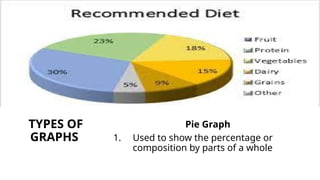
Pie Graph
1. Used to show the percentage or
composition by parts of a whole
TYPES OF
GRAPHS
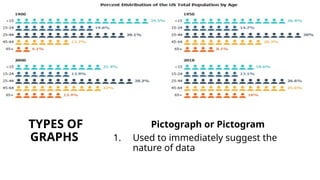
Pictograph or Pictogram
1. Used to immediately suggest the
nature of data

DATA-MANAGEMENTDATA-MANAGEMENTDATA-MANAGEMENTDATA-MANAGEMENT

  • 1.
  • 2.
    STATISTICS • It isa branch of Mathematics dealing with the collection, organization, presentation, analysis and interpretation of data.
  • 3.
  • 4.
    DATA GATHERING • Direct orInterview Method • Indirect or Questionnaire Method • Registration Method • Observation Method • Experimental Method
  • 5.
    Direct or Interview Method •Person to person encounter between the source of information, the interviewee and the one gathers information, the interviewer. Personal Interview Telephonic Interview
  • 6.
    Indirect or Questionnaire Method • Techniquein which questionnaire is used to elicit the information or data needed. • The questionnaire is consisting of questions printed or type written in the definite order on a form or a set of forms.
  • 7.
    Registration Method • Obtains datafrom the records of the government agency authorized by law to keep such data or information and made these available to the researchers. Birth and Death Rates Number of Registered Cars List of Registered Voters
  • 8.
    Observation Method • Technique inwhich data particularly those pertaining to the behaviors of individuals or group of individuals during the given situation. Example: Allowing children to play with selected toys to determine which is most popular Children’s Behavior Costumer’s Movement Number of costumers visiting to the store Costumers’ responses in a retail store
  • 9.
    Experimental Method • A systemused to gather data from the results of performed series of experiments on some controlled and experimental variables. • Commonly used in scientific inquiries • Based on observation Example: Drinking alcohol negatively affects memory If students sleep less before the exam, then their grades on the exam will be lower
  • 10.
    CLASSIFICATIO N OF VARIABLES • Qualitative/ Categorical Variable • Quantitative Variable
  • 11.
    Qualitative / Categorical Variable •A variable that yields categorical responses Example: Names Color Marital Status
  • 12.
    Quantitative Variable • A variablethat takes on numerical values representing the amount or quantity. Example: Height Weight Number of Siblings
  • 13.
    2 TYPES OFQUANTITATIVE VARIABLE DISCRETE CONTINUOUS • A variable which can be assume finite • Usually measured by counting or enumeration Example:  Number of students in a class  Number of eggs in a basket  Family members • A variable which can be assume infinitely many corresponding to line interval. Example:  Weight/Height  Windspeed  Time required to run a mile
  • 14.
    FOUR LEVELS OFMEASUREMENTS NOMINAL SCALE 1 ORDINAL SCALE 2 INTERVAL SCALE 3 RATIO SCALE 4
  • 15.
    NOMINAL • Assign namesor labels to observation in purely arbitrary sequence • Labels are used to classify the respondents or objects without ordering Examples: Gender Brand of Cellphones Religion Civil Status Phone Number Main Source of Allowance
  • 16.
    ORDINAL • Assign numbersor labels to observation with implied ordering • Ranking on respondents' preferences Examples: Stage of Cancer T-Shirt Size Educational Level Satisfaction Level
  • 17.
    INTERVAL • Reflect distancebetween rank position of the respondents or objects in equal units • This scale gives the distance between any two numbers of known sizes • No true absolute zero point • Can be manipulated algebraically by addition and subtraction but not multiplication and division Examples: Temperature SAT Scores
  • 18.
    RATIO • Reflect theexistence of true absolute zero point as its origin • Doesn’t have negative number unlike interval • Ratio of two scale point is independent of the unit of measurement • Can be manipulated algebraically by multiplication and division and has all properties of Interval data Examples: Distance Height Weight
  • 19.
    TRY THIS 1. Haircolor of women on a high school tennis team 2. Temperatures of 22 selected refrigerators 3. Number of pages in your statistics book 4. The ratings of a movie ranging from poor to good to excellent 5. Nationality
  • 22.
    Different Ways orForms to Present Data • Textual Form – Makes use of words, sentences, and paragraphs in presentation
  • 23.
    Different Ways orForms to Present Data • Tabular Form – Systematic presentation of data in rows and columns. Used when related numerical facts need to be classified in arrays Simple Focus on the readers’ attention on the data rather than on the form Meanings and significance of information being presented are clear
  • 24.
    Different Ways orForms to Present Data • Graphical Form – Shows numerical values or relationship in pictorial form. Makes use of graph, symbols or visual aids Accurate – Reflect the highest degree accuracy Simple – Basic design should be simple and straight forward Clear – It should be easily read and understood Attractive – Holding a neat, dignified and professional appearance
  • 25.
    TYPES OF GRAPHS Line Graph 1.Data cover a long period of time 2. Several series are compared 3. Movements are to be emphasized 4. Trends are to be established 5. Estimates are to be forcasted
  • 26.
    TYPES OF GRAPHS Bar Graph 1.Numerical values of an item over a period of time are compared 2. Consist of regular bars represents the quantity of frequency for each category
  • 27.
    TYPES OF GRAPHS Pie Graph 1.Used to show the percentage or composition by parts of a whole
  • 28.
    TYPES OF GRAPHS Pictograph orPictogram 1. Used to immediately suggest the nature of data