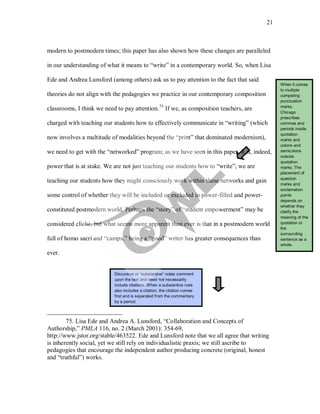
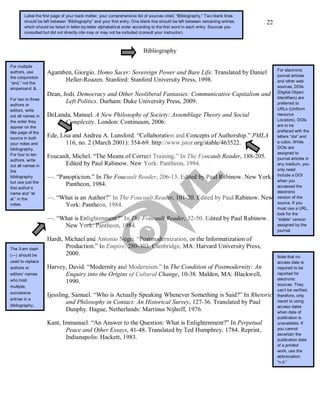
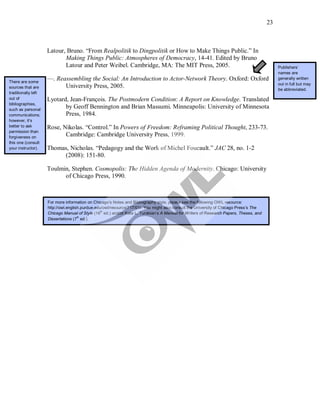
This summary provides an overview of the evolution of social theories from modernism to postmodernism. Modernism was characterized by Enlightenment thinking that emphasized unity, objective science, universal morality and reason as driving humanity towards a common goal. Later modernists acknowledged more fragmentation but still believed in linear progress and rational social orders. Postmodern theorists like Lyotard rejected grand narratives and argued that knowledge is produced locally through diverse language games rather than being a tool for authorities. The document traces this shift from theories of a unified social reality and global understanding to pluralistic theories embracing local networks and differences.
![MOVING “NETWORKS” INTO THE COMPOSITION CLASSROOM
Jessica Clements
English 626: Postmodernism, Rhetoric, Composition
March 7, 2010
Class papers often
include a title page,
but consult with your
instructor (it’s
acceptable to include
the title on the first
page of text). The
title should be
centered a third of
the way down the
page, and your name
and class information
should follow several
lines later. When
subtitles apply, end
the title with a colon
and place the subtitle
on the line below the
title. Different
practices apply for
theses and
dissertations (see
Kate L. Turabian’s A
Manual for Writers of
Research Papers,
Theses, and
Dissertations [7
th
ed.], 373-408).
Blue boxes contain
directions for writing
and citing in Chicago’s
Notes and
Bibliography style.
Green text boxes
contain explanations of
Chicago style
guidelines.
Double-space all text
in the paper, with the
following exceptions:
Single-space block
quotations as well as
table titles and figure
captions. Single-
space notes and
bibliographies
internally, but leave
an extra line space
externally between
note and
bibliographic entries.
Margins should be
set at no less than 1”
and no greater than
1.5”. Margins in this
sample paper have
been set at 1.25” to
accommodate
explanatory
comment boxes.
The recommended
typeface is
something readable,
such as Times New
Roman or Palatino.
Use no less than ten-
point type, but the
preference is for
twelve-point font.
Most importantly, be
consistent!](https://image.slidesharecdn.com/samplechicagopaper-150105122103-conversion-gate01/85/Sample-chicago-paper-1-320.jpg)
![MOVING “NETWORKS” INTO THE COMPOSITION CLASSROOM
Jessica Clements
English 626: Postmodernism, Rhetoric, Composition
March 7, 2010
Class papers often
include a title page,
but consult with your
instructor (it’s
acceptable to include
the title on the first
page of text). The
title should be
centered a third of
the way down the
page, and your name
and class information
should follow several
lines later. When
subtitles apply, end
the title with a colon
and place the subtitle
on the line below the
title. Different
practices apply for
theses and
dissertations (see
Kate L. Turabian’s A
Manual for Writers of
Research Papers,
Theses, and
Dissertations [7
th
ed.], 373-408).
Blue boxes contain
directions for writing
and citing in Chicago’s
Notes and
Bibliography style.
Green text boxes
contain explanations of
Chicago style
guidelines.
Double-space all text
in the paper, with the
following exceptions:
Single-space block
quotations as well as
table titles and figure
captions. Single-
space notes and
bibliographies
internally, but leave
an extra line space
externally between
note and
bibliographic entries.
Margins should be
set at no less than 1”
and no greater than
1.5”. Margins in this
sample paper have
been set at 1.25” to
accommodate
explanatory
comment boxes.
The recommended
typeface is
something readable,
such as Times New
Roman or Palatino.
Use no less than ten-
point type, but the
preference is for
twelve-point font.
Most importantly, be
consistent!](https://image.slidesharecdn.com/samplechicagopaper-150105122103-conversion-gate01/75/Sample-chicago-paper-1-2048.jpg)
![1
In Democracy and Other Neoliberal Fantasies, Jodi Dean argues that “imagining
a rhizome might be nice, but rhizomes don’t describe the underlying structure of real
networks,”1
rejecting the idea that there is such a thing as a nonhierarchical
interconnectedness that structures our contemporary world and means of communication.
Michael Hardt and Antonio Negri, on the other hand, argue that the Internet is an
exemplar of the rhizome: a nonhierarchical, noncentered network—a democratic network
with “an indeterminate and potentially unlimited number of interconnected nodes [that]
communicate with no central point of control.”2
Our journey begins with early modernism, and if early modernism had a theme, it
was oneness. This focus on oneness or unity, on the whole rather than on individual parts,
What is at stake in settling this dispute?
Being. And, knowledge and power in that being. More specifically, this paper explores
how a theory of social ontology has evolved to theories of social ontologies, how the
modernist notion of global understanding of individuals working toward a common
(rationalized and objectively knowable) goal became pluralistic postmodern theories
embracing the idea of local networks. Furthermore, what this summary journey of
theoretical evolution allows for is a consideration of why understandings of a world
comprising emergent networks need be of concern to composition instructors and their
practical activities in the classroom: networks produce knowledge.
1. Jodi Dean, Democracy and Other Neoliberal Fantasies: Communicative
Capitalism and Left Politics (Durham: Duke University Press, 2009), 30.
2. Michael Hardt and Antonio Negri, “Postmodernization, or the Informatization
of Production,” in Empire (Cambridge, MA: Harvard University Press, 2000), 299.
Footnote 1 comprises a complete bibliographic “note” citation for a book, which corresponds to a slightly differently formatted
bibliography entry. Subsequent note citations can and should be shortened to Dean, Democracy and Other Neoliberal
Fantasies, 30. When all sources are cited in full in a bibliography, the shortened version can and should be used from the first
note forward. “Shortening” usually comprises the author’s last name and a “keyword” version of the work’s title in four or fewer
words.
In the text,
note numbers
are
superscripted.
In the notes
themselves,
note numbers
are full sized,
not raised, and
followed by a
period.
Superscripting
numbers in
both places is
also an
acceptable
practice.
Arabic page numbers
begin in the header of
the first page of text.
Chicago’s
Notes and
Bibliography
style is
recommended
for those in the
humanities
and some
social
sciences. It
requires using
notes to cite
sources and/or
to provide
relevant
commentary.
Note numbers
should be placed
at the end of the
clause or
sentence to
which they refer
and should be
placed after any
and all
punctuation
except the dash.
Note numbers
should begin with
“1” and follow
consecutively
throughout a
given paper,
article, or
chapter.](https://image.slidesharecdn.com/samplechicagopaper-150105122103-conversion-gate01/85/Sample-chicago-paper-2-320.jpg)
![2
derived from Enlightenment thinking: “The project [of modernity] amounted to an
extraordinary intellectual effort on the part of Enlightenment thinkers to develop
objective science, universal morality and law, and autonomous art according to their
inner logic.”3
Science, so the story went, stood as inherently objective inquiry that could
reveal truth—universal truth at that. Enlightenment thinkers, such as Kant, believed in the
“universal, eternal, and . . . immutable qualities of all of humanity”;4
by extension,
“equality, liberty, faith in human intelligence . . . and universal reason” were widely held
beliefs and seen as unifying forces.5
In fact, Kant believed that Enlightenment (freedom
from self-imposed immaturity, otherwise known as the ability to use one’s understanding
on his or her own toward greater ends)6
was a divine right7
bestowed upon and meant to
be exercised by the masses. Later modernists began to acknowledge the fragmentation,
ambiguity and larger chaos that characterized modern life8
3. David Harvey, “Modernity and Modernism,” in The Condition of
Postmodernity: An Enquiry into the Origins of Cultural Change (Malden, MA:
Blackwell, 1990), 12.
but, perhaps ironically, only
so they might better reconcile their disunified state. This later modernism was labeled
“heroic” modernism and was based on the precedent set by romantic thinkers and artists,
4. Ibid.
5. Ibid., 13.
6. Immanuel Kant, “An Answer to the Question: What is Enlightenment?” in
Perpetual Peace and Other Essays, trans. Ted Humphrey (1784; repr., Indianapolis:
Hackett, 1983), 41.
7. Ibid., 44.
8. Harvey, The Condition of Postmodernity, 22.
When an editor’s
or translator’s
name appears in
addition to an
author’s, the
former appears
after the latter in
notes and
bibliography.
Bibliographic
“Edited by” or
“Translated by”
should be
shortened to
“ed.” and “trans.”
in notes. Plural
forms, such as
“eds.,” are never
used.
Chicago takes
a minimalist
approach to
capitalization;
therefore, while
terms used to
describe a
period are
usually
lowercased
except in the
case of proper
nouns (e.g.,
“the colonial
period,” vs.
“the Victorian
era”),
convention
dictates that
some period
names be
capitalized
(e.g., the
Enlightenment)
. See the
University of
Chicago
Press’s The
Chicago
Manual of Style
(16
th
ed.),
section 8.72.](https://image.slidesharecdn.com/samplechicagopaper-150105122103-conversion-gate01/85/Sample-chicago-paper-3-320.jpg)
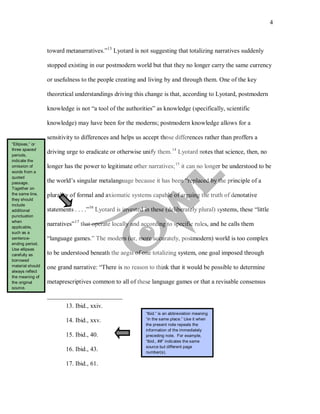
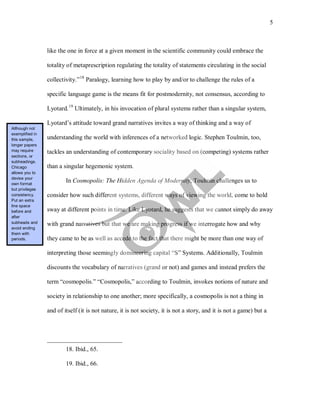
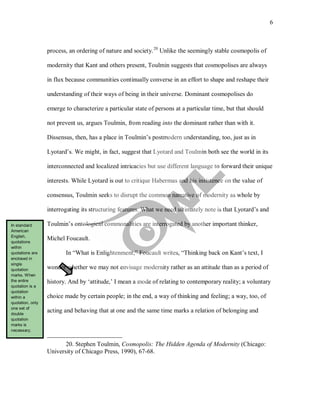
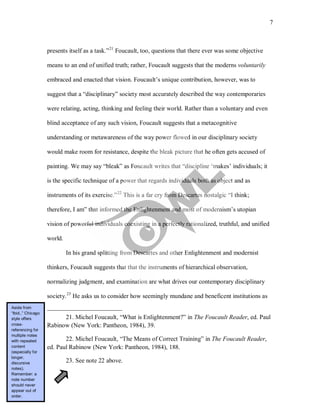
![8
hospitals and schools (and also asylums and prisons) enact these instruments. Even
architecturally, he insists, these institutions are built to “permit an internal, articulated
and detailed control . . . to make it possible to know [individuals], to alter them.”24
Such
systems work as networks, according to Foucault: “[disciplinary society’s] functioning is
that of a network of relations from top to bottom, but also to a certain extent from bottom
to top and laterally; this network ‘holds’ the whole together and traverses it in its entirety
with effects of power that derive from one another: supervisors, perpetually
supervised.”25
Yes, this represents a hierarchical network (hospitals and schools have
administrators, asylums and prisons have their own care staff and guards, too), but the
important thing Foucault wants us to remember is that power is never possessed; it flows
“like a piece of machinery” through the network.26
Further, Foucault suggests that the threat of penalty lies at the heart of a
disciplinary system.27
It is a “perpetual penalty that traverses all points and supervises
every instant in the disciplinary institutions”; that penalty “compares, differentiates,
hierarchies, homogenizes, excludes. In short, it normalizes.”28
24. Ibid., 190.
In the end the disciplinary
system is interested in creating well-behaved objects (not subjects, per se). It does the
work of unification and disunification at the same time: “In a sense, the power of
25. Ibid., 192.
26. Ibid.
27. Ibid., 193.
28. Ibid., 195.
Use square
brackets to
add clarifying
words,
phrases, or
punctuation to
direct
quotations
when
necessary,
but, before
altering a
direct
quotation, ask
yourself if you
might just as
easily
paraphrase or
weave one or
more shorter
quotations into
the text.](https://image.slidesharecdn.com/samplechicagopaper-150105122103-conversion-gate01/85/Sample-chicago-paper-9-320.jpg)
![11
diminishing its political and moral fallout. It also makes resistance more difficult . . . [;]
actuarial practices . . . minimize the possibilities for resistance in the name of . . .
identity.”36
In a control society, deviants are targeted as a collective, and techniques of
control, rather than those of discipline, are meant to preempt crime and risk.37
Foucault
did not get it quite right, says Rose, because “. . . the idea of a maximum security society
is misleading. Rather than the tentacles of the state spreading across everyday life, the
securitization of identity is dispersed and is organized. And rather than totalizing
surveillance, it is better seen as conditional access to circuits of consumption and civility,
constant scrutiny of the right of individuals to access certain kinds of flows of
consumption of goods.”38
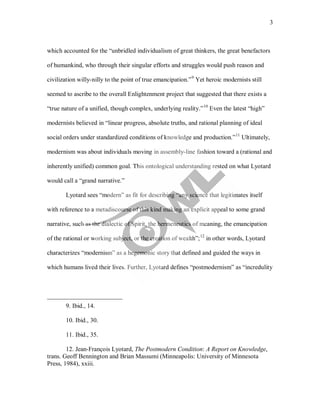
Rose eloquently sums up his argument in the following quotation:
We are our own tentacles of surveillance; we grant our own
access to being, knowledge, and power.
In a society of control, a politics of conduct is designed into the fabric of
existence itself, into the organization of space, time, visibility, circuits of
communication. And these enwrap each individual life decision and action—
about labour [sic], purchases, debts, credits, lifestyle, sexual contracts and the
like—in a web of incitements, rewards, current sanctions and foreboding of future
sanctions which serve to enjoin citizens to maintain particular types of control
over their conduct. These assemblages which entail the securitization of identity
are not unified, but dispersed, not hierarchical but rhizomatic, not totalized but
connected in a web or relays and relations.39
36. Ibid., 236.
37. Ibid.
38. Ibid., 243.
39. Ibid., 246.
A prose
quotation of five
or more lines
should be
“blocked.” The
block quotation
is singled-
spaced and
takes no
quotation marks,
but you should
leave an extra
line space
immediately
before and after.
Indent the entire
quotation .5”
(the same as
you would the
start of a new
paragraph).
“Sic” is italicized
and put in
brackets
immediately after
a word that is
misspelled or
otherwise
wrongly used in
an original
quotation. You
should do this
only when
clarification is
necessary
(especially when
the mistake is
more likely to be
charged to the
transcriptionist
than to the author
of the original
quotation).](https://image.slidesharecdn.com/samplechicagopaper-150105122103-conversion-gate01/85/Sample-chicago-paper-12-320.jpg)