1.Vineet Bhagoji (B.tech 2nd year,Electronics and
communications)
2.Nirnay teja (B.tech 2ndyear,Mechanical Engineering)
3.Abhishek kulkarni (B.tech 2nd year,Computer science)
4.Mohammad saif (B.tech 2nd year,Mechanical Engineering)
5.Shanmukh srinivas (B.tech 2nd year,Mechanical Engineering)
-Employabilty has been a major crisis
since a long time. The main reasons
for this crisis are
Demand and supply ratio of
unemployed youth is more (Increasing
population)
Defective education system (Lack of
dignity of labour)
Lack of infrastrucure and support
from the government for the cottage
industries and start ups
Many pros and cons in agriculture
secotor
More and more stress on the vote
bank not on the development of the
country
Liberalisation of economy should
be encouraged but the company
should not be given 100% investment
opportunities ,but should be done in a
phased and a controlled manner.
Encouragement should be given to
swadeshi goods.
Why is the government
investing crores of rupees on so
called elite government
instititutions ?
Is it to improve the foreign
economy by our resources?
BUILDING SKILLSET : HOW TO INCREASE
EMPLOYABILTY IN INDIA
Over view
UNEMPLOYMENT
-In rural areas, the unemployment rate for both male and female is almost at the same level, 2%. But,
in, urban areas, women are more unemployed than men. The rate is 5% for women and 2% for men.
-These are some findings of the 68th Round Survey by the National Sample Survey Office ( NSSO),
ministry of statistics and programme implementation.
-India has witnessed a work force (activity status determined on the basis of reference period of one
year) growth of 13.9 million in just two years, between 2010 and 2012.
As per the NSS 66 th round survey, as on January 2010,the workforce at the all-India level, was about
459 million (rural men - 231.9, rural women - 104.5 ; urban men - 99.8 million and urban women -
22.8 million) . As on January 2012 (present survey), it has increased to 472.9 millions (rural men -
234.6, rural women - 101.8 million; urban men -- 109.2 million and urban women - 27.3 million).
-The current workforce at the all-India level is 47.2 crore. More than half the population (52%) is
self-employed, while 18% work as regular wage/salaried employees and 30% as casual laborers. More
people are self-employed (56%) and work as casual laborers (35%) in rural India. -In Urban India, it
is the waged/salaried (43%) who constitute a majority. They are followed by the self-employed (42%)
and casual laborers (15%).
-Nearly half the population (49%) is engaged in agriculture, while 24% are working in secondary
sector and 27% in tertiary sector
Control in Population growth
SOLUTION
-The first and foremost thing we have to do
arrest the high rate a unemployment and
provide employment opportunities to our
masses is to check the population growth.
-As the gap between the employment
opportunities created in the country and yearly
output from the educational institutions is too
wide, it is very difficult to absorb the large
number of fresher.
- Even though the Government is spending
crores of rupees towards control of population
through the various schemes, the rate of
population growth has not drastically reduced.
To tope it, the Government has decided to
abandon the 2-child norm.
Vocational Education
- The current education system
does not lay much emphasis- on
the vocational education. Even
though a National Policy on
Education has been adopted by
giving high priority to
vocationalisation of the secondary
education, but the quality of these
vocational courses is far from
satisfactory and hence the
progress on this front is very slow.
-The Government must look into
it much more seriously and there
should be a continuous
monitoring mechanism to evaluate
the implementation of these
programmes.
-Only vocationalisation can help in
diverting a part of the youthful
workforce and ease the pressure
on the white-collar jobs.
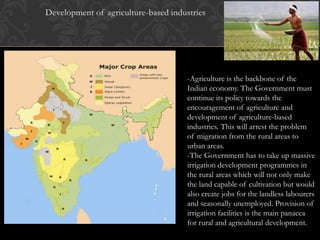
Development of agriculture-based industries
-Agriculture is the backbone of the
Indian economy. The Government must
continue its policy towards the
encouragement of agriculture and
development of agriculture-based
industries. This will arrest the problem
of migration from the rural areas to
urban areas.
-The Government has to take up massive
irrigation development programmes in
the rural areas which will not only make
the land capable of cultivation but would
also create jobs for the landless labourers
and seasonally unemployed. Provision of
irrigation facilities is the main panacea
for rural and agricultural development.
Development of Rural areas
- In order to check the
rural migration to urban
areas, there is an urgent
need for the development
of the small towns’
intermediate cities. This
will ease the pressure on
the urban cities and such
restructuring helps in the
development and use of
the vast unutilized
markets within the
country rather than
excessive dependence
upon the report activities
Economic Growth
-The economic growth of the
country has a bearing on the job
market. When higher economic
growth is achieved through more
productive use of all resources it
results in higher per capita income
which in turn results in more savings
and investment activities creating
greater employment opportunities in
the country.
-Even though we had targeted a
growth rate of 8 percent during the
10th Plan period, we may end up
with a growth of 7 percent because
of slow down of the agricultural
growth and international oil prices
Give it a thought, Consider the
case of an IITian
Government spends crores of
rupees to select the cream students
from all over the country to educate
them in the country’s most
distinguished and elite institutions
and then invest 12.5 cores(approx)
for the education of an IITian , so
that this cream can help the country
with the knowledge they have gained
from these elite institutions, but only
a handfull of them stay back in India
serve the country.
Rest of them go abroad to get
more money, luxuries and the
government which invests crores of
money dosen’t get it’s due returns
and more over these imbecile’s go
and improve the foreign economies.
SUGGESTED ALTERNATIVE:
To deal with these major crisis of
knowledge bankruptcy ,the
government should ask these people
to sign a five years bond with the
government so that the government
gets its due , as in the case of
Nunyang university Singapore !
WHY IS THE GOVERNMENT INVESTING CRORES OF RUPEES ON SO
CALLED ELITE GOVERNMENT INSTITITUTIONS ?
LIBERALISTAION OF THE ECONOMY SHOULD BE ENCOURAGED BUT
100% FDI IS NOT ACCEPTABLE ,IF IT IS DONE IT SHOULD BE DONE IN
A PHASED AND CONTROLLED MANNER ,AND A COMPANY SHOULD
HAVE AN INDIAN COUNTERPART TO SETUP THE BUSINESS IN INDIA .
EXAMPLE: IN THE WALMART BHARTI DEAL 70% OF THE SHARES ARE
OWNED BY WALMART AND 30% BY BHARTI INDIA.
Liberalisation of the economy

samhitha

  • 1.
    1.Vineet Bhagoji (B.tech2nd year,Electronics and communications) 2.Nirnay teja (B.tech 2ndyear,Mechanical Engineering) 3.Abhishek kulkarni (B.tech 2nd year,Computer science) 4.Mohammad saif (B.tech 2nd year,Mechanical Engineering) 5.Shanmukh srinivas (B.tech 2nd year,Mechanical Engineering)
  • 2.
    -Employabilty has beena major crisis since a long time. The main reasons for this crisis are Demand and supply ratio of unemployed youth is more (Increasing population) Defective education system (Lack of dignity of labour) Lack of infrastrucure and support from the government for the cottage industries and start ups Many pros and cons in agriculture secotor More and more stress on the vote bank not on the development of the country Liberalisation of economy should be encouraged but the company should not be given 100% investment opportunities ,but should be done in a phased and a controlled manner. Encouragement should be given to swadeshi goods. Why is the government investing crores of rupees on so called elite government instititutions ? Is it to improve the foreign economy by our resources? BUILDING SKILLSET : HOW TO INCREASE EMPLOYABILTY IN INDIA Over view
  • 3.
    UNEMPLOYMENT -In rural areas,the unemployment rate for both male and female is almost at the same level, 2%. But, in, urban areas, women are more unemployed than men. The rate is 5% for women and 2% for men. -These are some findings of the 68th Round Survey by the National Sample Survey Office ( NSSO), ministry of statistics and programme implementation. -India has witnessed a work force (activity status determined on the basis of reference period of one year) growth of 13.9 million in just two years, between 2010 and 2012. As per the NSS 66 th round survey, as on January 2010,the workforce at the all-India level, was about 459 million (rural men - 231.9, rural women - 104.5 ; urban men - 99.8 million and urban women - 22.8 million) . As on January 2012 (present survey), it has increased to 472.9 millions (rural men - 234.6, rural women - 101.8 million; urban men -- 109.2 million and urban women - 27.3 million). -The current workforce at the all-India level is 47.2 crore. More than half the population (52%) is self-employed, while 18% work as regular wage/salaried employees and 30% as casual laborers. More people are self-employed (56%) and work as casual laborers (35%) in rural India. -In Urban India, it is the waged/salaried (43%) who constitute a majority. They are followed by the self-employed (42%) and casual laborers (15%). -Nearly half the population (49%) is engaged in agriculture, while 24% are working in secondary sector and 27% in tertiary sector
  • 4.
    Control in Populationgrowth SOLUTION -The first and foremost thing we have to do arrest the high rate a unemployment and provide employment opportunities to our masses is to check the population growth. -As the gap between the employment opportunities created in the country and yearly output from the educational institutions is too wide, it is very difficult to absorb the large number of fresher. - Even though the Government is spending crores of rupees towards control of population through the various schemes, the rate of population growth has not drastically reduced. To tope it, the Government has decided to abandon the 2-child norm.
  • 5.
    Vocational Education - Thecurrent education system does not lay much emphasis- on the vocational education. Even though a National Policy on Education has been adopted by giving high priority to vocationalisation of the secondary education, but the quality of these vocational courses is far from satisfactory and hence the progress on this front is very slow. -The Government must look into it much more seriously and there should be a continuous monitoring mechanism to evaluate the implementation of these programmes. -Only vocationalisation can help in diverting a part of the youthful workforce and ease the pressure on the white-collar jobs.
  • 6.
    Development of agriculture-basedindustries -Agriculture is the backbone of the Indian economy. The Government must continue its policy towards the encouragement of agriculture and development of agriculture-based industries. This will arrest the problem of migration from the rural areas to urban areas. -The Government has to take up massive irrigation development programmes in the rural areas which will not only make the land capable of cultivation but would also create jobs for the landless labourers and seasonally unemployed. Provision of irrigation facilities is the main panacea for rural and agricultural development.
  • 7.
    Development of Ruralareas - In order to check the rural migration to urban areas, there is an urgent need for the development of the small towns’ intermediate cities. This will ease the pressure on the urban cities and such restructuring helps in the development and use of the vast unutilized markets within the country rather than excessive dependence upon the report activities
  • 8.
    Economic Growth -The economicgrowth of the country has a bearing on the job market. When higher economic growth is achieved through more productive use of all resources it results in higher per capita income which in turn results in more savings and investment activities creating greater employment opportunities in the country. -Even though we had targeted a growth rate of 8 percent during the 10th Plan period, we may end up with a growth of 7 percent because of slow down of the agricultural growth and international oil prices
  • 9.
    Give it athought, Consider the case of an IITian Government spends crores of rupees to select the cream students from all over the country to educate them in the country’s most distinguished and elite institutions and then invest 12.5 cores(approx) for the education of an IITian , so that this cream can help the country with the knowledge they have gained from these elite institutions, but only a handfull of them stay back in India serve the country. Rest of them go abroad to get more money, luxuries and the government which invests crores of money dosen’t get it’s due returns and more over these imbecile’s go and improve the foreign economies. SUGGESTED ALTERNATIVE: To deal with these major crisis of knowledge bankruptcy ,the government should ask these people to sign a five years bond with the government so that the government gets its due , as in the case of Nunyang university Singapore ! WHY IS THE GOVERNMENT INVESTING CRORES OF RUPEES ON SO CALLED ELITE GOVERNMENT INSTITITUTIONS ?
  • 10.
    LIBERALISTAION OF THEECONOMY SHOULD BE ENCOURAGED BUT 100% FDI IS NOT ACCEPTABLE ,IF IT IS DONE IT SHOULD BE DONE IN A PHASED AND CONTROLLED MANNER ,AND A COMPANY SHOULD HAVE AN INDIAN COUNTERPART TO SETUP THE BUSINESS IN INDIA . EXAMPLE: IN THE WALMART BHARTI DEAL 70% OF THE SHARES ARE OWNED BY WALMART AND 30% BY BHARTI INDIA. Liberalisation of the economy