12/24/2025
4
INTRODUCTION
Definition
TheWorld Health Organization defines
malnutrition as:
"The cellular imbalance between supply of nutrients
and energy and the body's demand for them to
ensure growth, maintenance, and specific
functions.“
5.
12/24/2025
5
Cont…
Nutritional deficienciesconstitute major public
health problems in the tropical and subtropical
regions of the world.
It affects mostly children under five years of age,
As their nutritional requirements are relatively greater than
those of older children.
As cultural reason they are given small amount and less
nutritious diet.
As they are highly dependent on their care taker.
As the incidence of infection is high in this age group.
12/24/2025
8
Human, Economic, and
InstitutionalResources
Nutritional Status
Health
Diet
Household
Food Security
Potential Resources
Ecological Conditions
Care of Mother
and Child
Environ. Health,
Hygiene & Sanitation
Political and Ideological Structure Root
Causes
Manifestations
Immediate
Causes
Underlying
Causes
Functional Consequences: Mortality,
Morbidity, Lost Productivity, etc.
Consequences
9.
12/24/2025
9
Etiology of edemain SAM
There are different theories
1. Dietary protein – calorie ratio
2. Adaptation theory and Hormonal theory
3. Free radical theory
4. Renal insufficiency
5. Electrolyte imbalance
10.
12/24/2025
10
TYPES
Under nutrition:
Protein Energy Malnutrition (PEM)
- Marasmus
- Kwashiorkor
- Marasmic-Kwashiorkor
Micronutrient deficiencies
- Vitamin A deficiency - preventable blindness
- Iron deficiency – anaemia
- Iodine deficiency - brain damage
- Vit B - …
- Vit C - scurvy
- Vitamin D deficiency - rickets
- Over nutrition:
Obesity
12/24/2025
12
Peripheral signs ofmalnutrition
Clinical presentation Edematous Non edematous
Peak age 12 – 36 months 6 – 12months
Growth retardation Absent Present
Mental changes Apathy Irritable
Appetite Poor Good
Kwash – dermatosis Present Absent
Hair color and skin change Common Infrequent
Moon face Present Absent
Hepatomegaly Present Absent
Long and curled eye lash Present Present
Anemia Present Present
Pot belly abdomen Present Present
Diarrhea Present Present
13.
12/24/2025
13
OTHER CLASSIFICATION
Severalmethods have been suggested for the
classification of PEM.
Based on the etiology of PEM
Primary malnutrition
malnutrition resulting from inadequate food
intake or lack of food. e.g. poverty, drought
14.
12/24/2025
14
Conte…
Secondary malnutritionrefers to malnutrition
resulting from
increased nutrient needs
decreased nutrient absorption and/or
increased nutrient losses.
Mixed - Both primary and secondary malnutrition
12/24/2025
16
additional
the extentof dermatosis can be described in the
following way:
+ (mild): discoloration or a few rough patches of
skin
+ + (moderate): multiple patches on arms and/or
legs
+ + + (severe): flaking skin, raw skin, fissures
(openings in the skin)
12/24/2025
Dr Sentayehu S
18
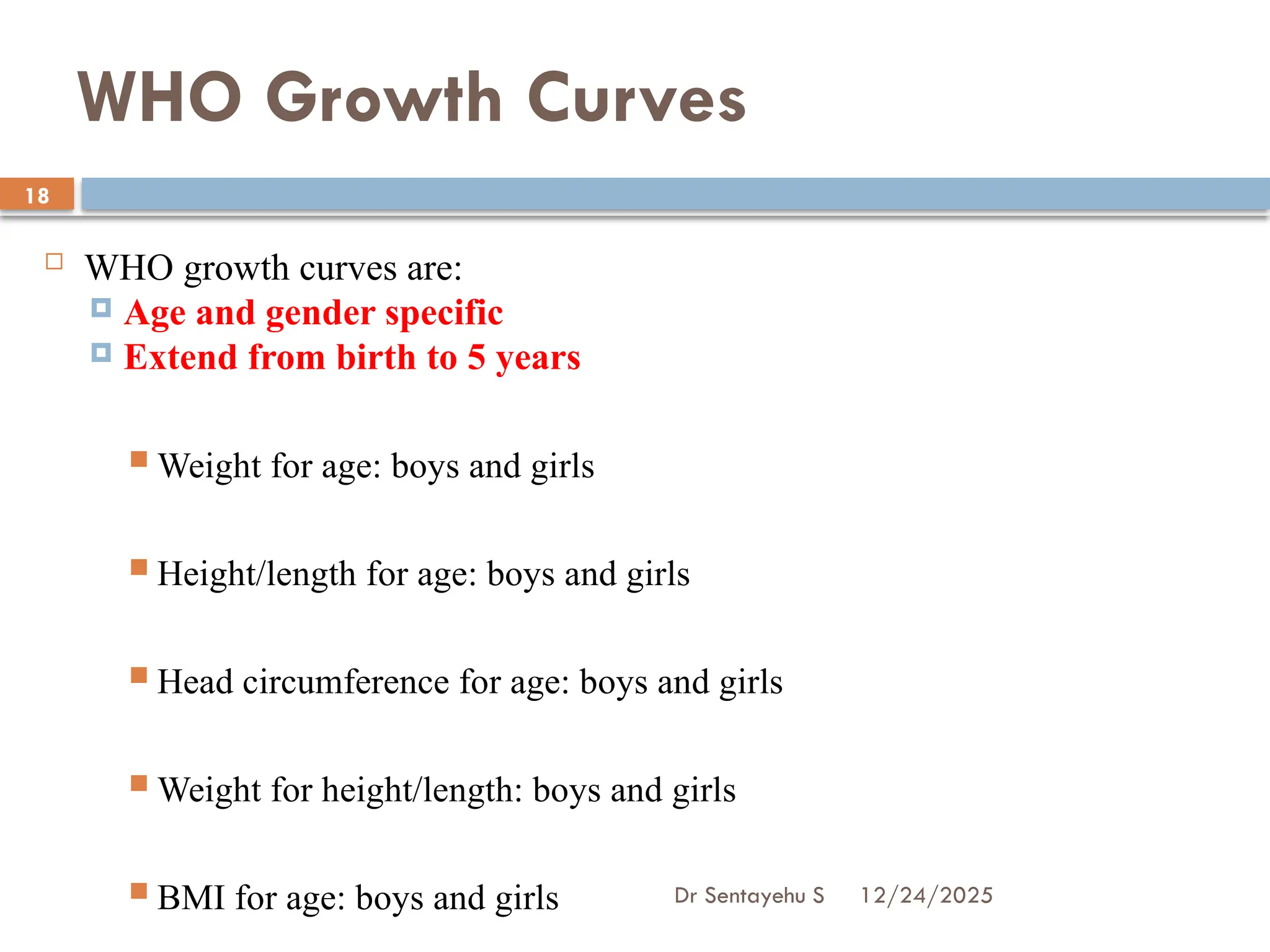
WHOGrowth Curves
WHO growth curves are:
Age and gender specific
Extend from birth to 5 years
Weight for age: boys and girls
Height/length for age: boys and girls
Head circumference for age: boys and girls
Weight for height/length: boys and girls
BMI for age: boys and girls
12/24/2025
22
Infants 0-6 monthsof age should be managed and
follow up
Any grade of bilateral pitting oedema
WFL < -3 z-score
Any medical complications
Recent weight loss or failure to gain weight
Ineffective feeding
Any medical or social issue needing more detailed
assessment or intensive support
23.
12/24/2025
23
MANAGEMENT PRINCIPLES
Dietarymanagement
Manage macronutrient deficiency and Include
Correction of associated micronutrient deficiencies
Treatment of complications
Including deworming for parasites
Monitoring and follow -up
Stimulation
Prevention of relapse: Health education
Immunization
24.
12/24/2025
24
Conte…
Phase 1
Theformula used during this phase (F75) promotes
recovery of normal metabolic function and nutrition-
electrolytic balance.
Rapid weight gain at this stage is dangerous.
12/24/2025
26
Conte…
Transition Phase
Duringthis period, introduce RUTF gradually
alongside F-75.
Some children may initially refuse the RUTF;
continue to offer RUTF at every feed until they
begin to eat the prescribed amounts.
27.
12/24/2025
27
Criteria to RehabilitationPhase(phase- 2) in SC
A good appetite: Takes all the F-100 prescribed for the
transition phase (150 kcal/kg/day).
Oedema reduced to moderate (++) or mild (+). If wasting
with bilateral pitting oedema, oedema should completely
disappear.
Medical complications are resolving.
Clinically well and alert.
28.
12/24/2025
28
Feeding in infant< 6 months
The objective is to supplement the child’s breastfeeding
with therapeutic milk while stimulating breast milk
production.
The infant should be breastfed as frequently as possible.
Breastfeed every 3 hours for at least 20 minutes (more
if the child cries or demands more).
Give F-100-Diluted to breastfed infants without
bilateral pitting oedema..
29.
12/24/2025
29
Conte…
Give F-75to infants with bilateral pitting oedema and
change to F-100-Diluted when the oedema is resolved.
Never give full strength F-100 to infants 0-6 months old.
Use the reference tables for amounts of F-100-Diluted or
F-75 to give to infant.
Use the supplementary suckling technique.
12/24/2025
34
prevention of Malnutrition
Breast feeding
Complementary feeding
Nutrition
supplementation
Vitamin A
supplementation
PMTCT
Measles vaccination
Family Planning
Management of severe
malnutrition
Zinc supplement
Nutrition advice
35.
12/24/2025
35
REFERENCE
Food andnutrition technical assistance III project
WHO. Guideline: Updates on the management of
severe acute malnutrition in infants and children.
Geneva: World Health Organization; 2013
MEDSTAR Clinical guide and synopsis 2ND EDITION
PEDIATRICS.