S&OP
Outline
• Common Problems of Companies.
• Need for S&OP.
• S&OP PROCESS
• Benefits of S&OP
• Challenges of S&OP
• Tips
Common Problems of Companies:
• Absence of team work (finger pointing).
• Supply Interruption.
• Lack of resources.
• Lack of confidence in planning systems.
Conflicts among the departments:
• Sales want to increase sales. (plenty of inventory)
• Operations want a long run of machines with few
changeovers.
• Finance want high profits and low
working capital.
Need for S&OP:
• Bring different views together.
• Meeting customer demands, profitability and the
company’s strategic agenda.
• Manage the supply chain, optimize resources, and
maximize profits.
S&OP IS:
A set of decision-making processes to balance
demand and supply, to integrate financial
planning and prerational planning and
to link high-level strategic
plans to day-to-day operations.
Demand Planning Case Video
Sales:
• Sales increase between over-forecast and under-
forecast.
• Managers must focus on uncertainty about decision
making horizons in sales.
Finance:
• Planning process must be transparent with clear
communication.
Role: Monetize demand and supply.
Actual
Result Plan
Deviation
Finance
Scenario
Planning
And
Business cases
Variance
analysis
Financial
Reconciliation
Co-owner-
ship of
forecast
Periodic
Financial
outlook
Performance
Management
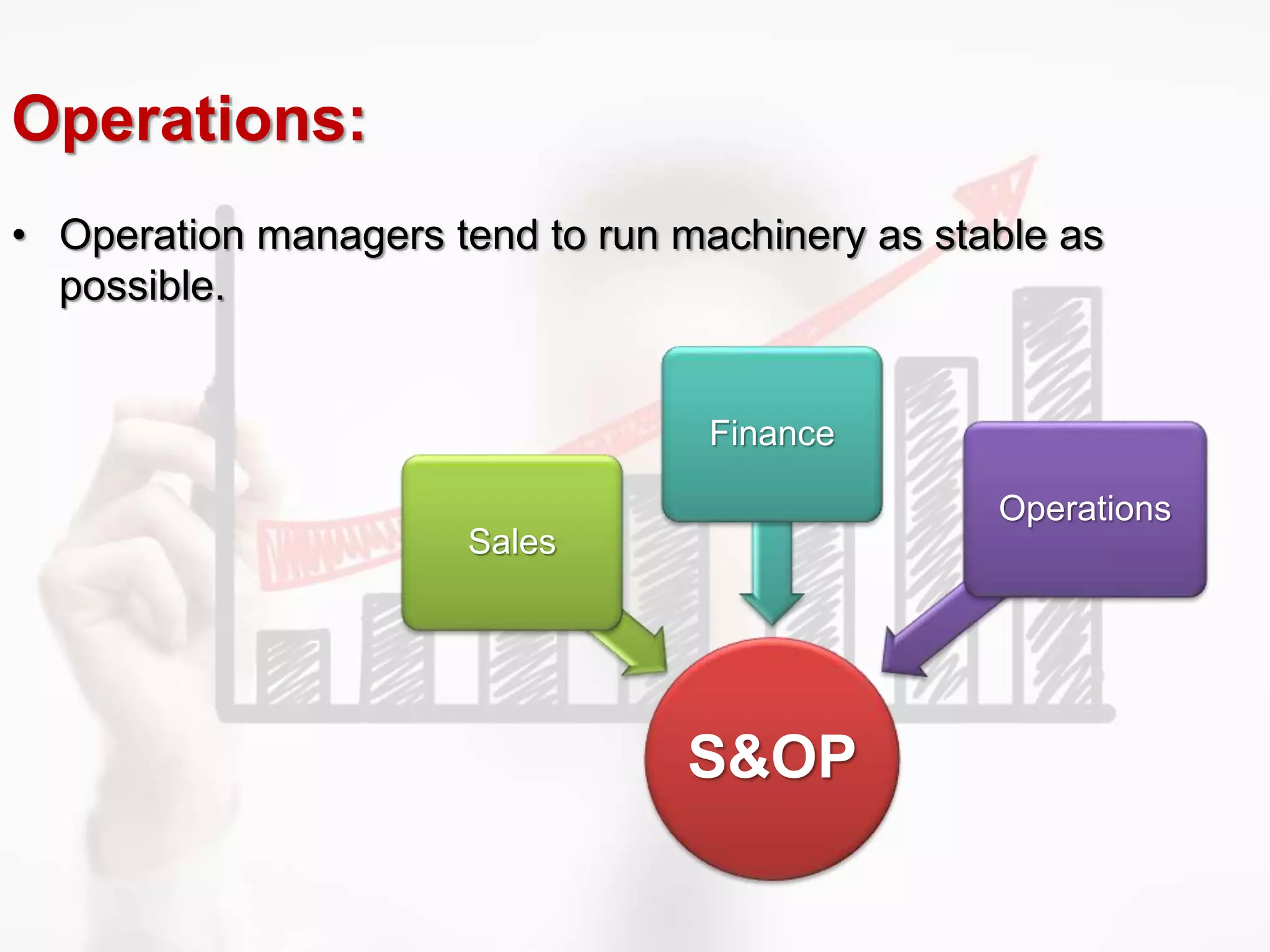
Operations:
• Operation managers tend to run machinery as stable as
possible.
S&OP
Sales
Finance
Operations
S&OP PROCESS:
PRODUCT
REVIEW
DEMAND
REVIEW
SUPPLY
CHAIN
REVIEW
FINANCIAL
REVIEW
MANAGEMENT
BUSINESS
REVIEW
Benefits of S&OP:
• Better data and collaboration between departments.
• Companies can better optimize resources.
• Improved inventory and backlog management.
• S&OP can fuel a resurgence by finding ways to adjust to
changing internal or external conditions.
• More actionable data can lead to better Key Performance
Indicators (KPIs) for each department.
• As data flows more seamlessly between departments, it
is more timely and accurate.
Challenges of S&OP:
• Achieving process compliance.
• Adapting the process to the organization.
• Data accuracy and integrity.
• IT functionally enabling the process.
• Establishing S&OP meetings as the business
priority.
• Acceptance of the roles and responsibilities.
• Identifying S&OP expert to lead the
implementation.
Tips For Implementing S&OP:
Suresh Dalai is a retail operations
professional based in Singapore, 20 years
experience working on S&OP.
He advices focusing on:
• People.
• Process.
• Practice.
People:
• Ensure that the implementation is heavily cross-
functional.
• Ensure that people are engaged in the process.
• Develop an environment for open discussions.
Process:
• Clearly define the end-to-end process steps.
• Develop a calendar so that activities are done timely.
Practice:
• Well-executed S&OP process does not happen
overnight, while instilling a culture of continuous
improvement is key.
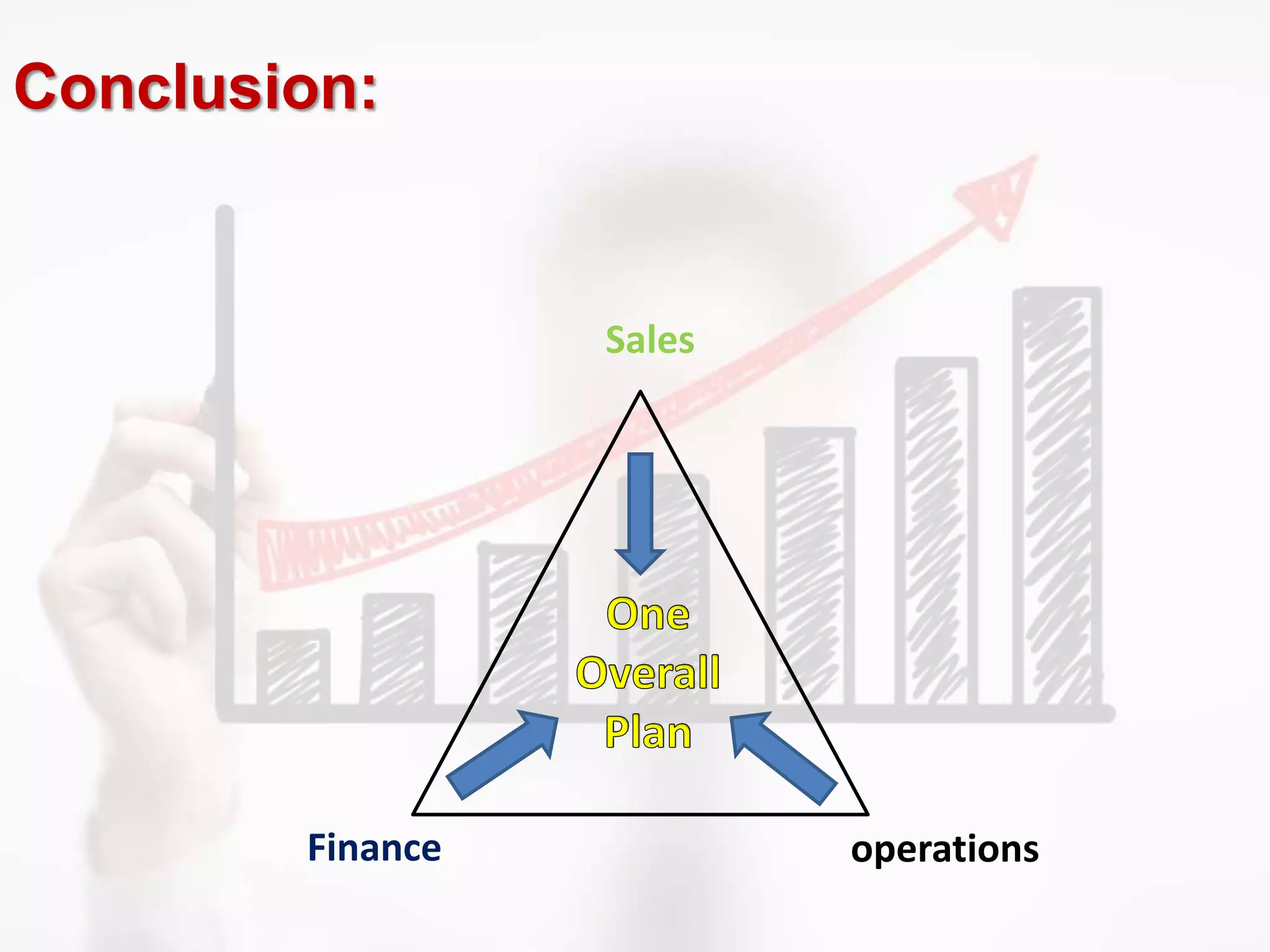
Conclusion:
Sales
Finance operations
Sales &
Operations
Planning
Strategic
Objective
Operations Plan Sales Plan
Capacity Constrains
Budget/ Financial Constrain
Demand Forecast
Clear Company Policies
Policies, Roles
and Parameters
Actual Planning data
Strategic Planning
5 years
Sales and Operations Planning
2- 18 month
Tactical Planning
1-3 month
Operations Planning
0-6 Weeks
Questions?

Sales and Operations Planning