Sales Lessons For Start Ups
Session - 4
Review From First Webinar
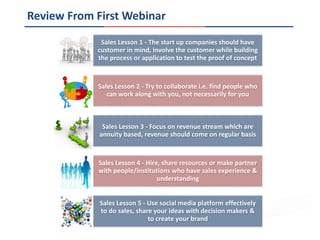
Sales Lesson 1 - The start up companies should have
customer in mind, involve the customer while building
the process or application to test the proof of concept
Sales Lesson 2 - Try to collaborate i.e. find people who
can work along with you, not necessarily for you
Sales Lesson 3 - Focus on revenue stream which are
annuity based, revenue should come on regular basis
Sales Lesson 4 - Hire, share resources or make partner
with people/institutions who have sales experience &
understanding
Sales Lesson 5 - Use social media platform effectively
to do sales, share your ideas with decision makers &
to create your brand
Review From Our Last Webinar
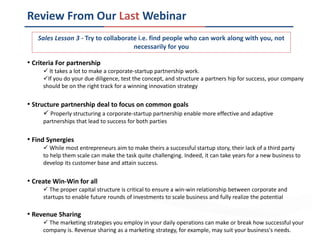
• Criteria For partnership
 It takes a lot to make a corporate-startup partnership work.
If you do your due diligence, test the concept, and structure a partners hip for success, your company
should be on the right track for a winning innovation strategy
• Structure partnership deal to focus on common goals
 Properly structuring a corporate-startup partnership enable more effective and adaptive
partnerships that lead to success for both parties
• Find Synergies
 While most entrepreneurs aim to make theirs a successful startup story, their lack of a third party
to help them scale can make the task quite challenging. Indeed, it can take years for a new business to
develop its customer base and attain success.
• Create Win-Win for all
 The proper capital structure is critical to ensure a win-win relationship between corporate and
startups to enable future rounds of investments to scale business and fully realize the potential
• Revenue Sharing
 The marketing strategies you employ in your daily operations can make or break how successful your
company is. Revenue sharing as a marketing strategy, for example, may suit your business's needs.
Sales Lesson 3 - Try to collaborate i.e. find people who can work along with you, not
necessarily for you
Our Today’s Webinar Will
Focus On
Sales Lesson – 3
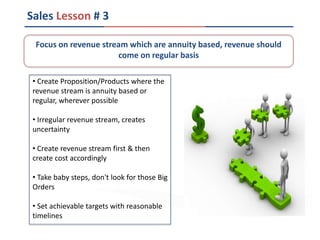
Sales Lesson # 3
• Create Proposition/Products where the
revenue stream is annuity based or
regular, wherever possible
• Irregular revenue stream, creates
uncertainty
• Create revenue stream first & then
create cost accordingly
• Take baby steps, don't look for those Big
Orders
• Set achievable targets with reasonable
timelines
Focus on revenue stream which are annuity based, revenue should
come on regular basis
What is “Revenue Stream” And “Revenue Model”
Before We Start
Before we delve into the different types of revenue models, we should
spend a little time differentiating between the terms, "revenue model",
and "revenue stream”, as they are very often used interchangeably.
A revenue stream is a company’s single source of revenue. A company
can have zero or many revenue streams, depending on its size.
A revenue model is the strategy of managing a company’s revenue
streams and the resources required for each revenue stream.
Types Of Revenue Models
Ad-Based Revenue Model
 It entail creating ads for a specific website, service, app, or other product,
and placing them on strategic, high-traffic channels.
Affiliate Revenue Model
It works by promoting links to relevant products and collecting commission
on the sales of those products, and can even work in conjunction with ads or
separately
Transactional Revenue Model
 it entails a company providing a service or product and customers paying
them for it.
Subscription Revenue Model
 It entails offering customers a product or service that customers can pay for
over a longer period of time,
There are numerous types of revenue models that countless recently
launched startups use to generate their first sales
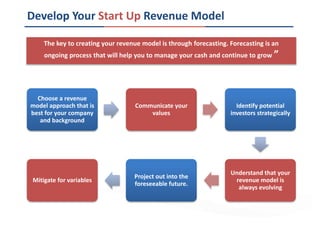
The key to creating your revenue model is through forecasting. Forecasting is an
ongoing process that will help you to manage your cash and continue to grow ”
Develop Your Start Up Revenue Model
Choose a revenue
model approach that is
best for your company
and background
Communicate your
values
Identify potential
investors strategically
Understand that your
revenue model is
always evolving
Project out into the
foreseeable future.
Mitigate for variables
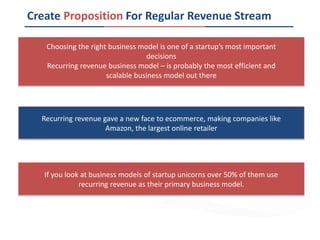
Create Proposition For Regular Revenue Stream
Choosing the right business model is one of a startup’s most important
decisions
Recurring revenue business model – is probably the most efficient and
scalable business model out there
Recurring revenue gave a new face to ecommerce, making companies like
Amazon, the largest online retailer
If you look at business models of startup unicorns over 50% of them use
recurring revenue as their primary business model.
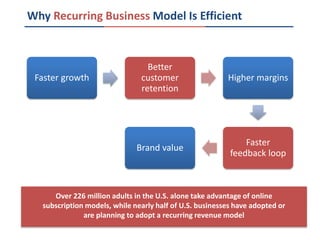
Why Recurring Business Model Is Efficient
Over 226 million adults in the U.S. alone take advantage of online
subscription models, while nearly half of U.S. businesses have adopted or
are planning to adopt a recurring revenue model
Faster growth
Better
customer
retention
Higher margins
Faster
feedback loop
Brand value
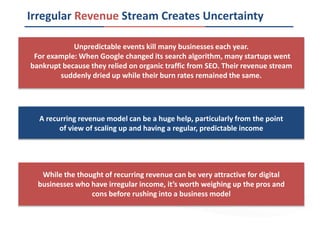
Irregular Revenue Stream Creates Uncertainty
Unpredictable events kill many businesses each year.
For example: When Google changed its search algorithm, many startups went
bankrupt because they relied on organic traffic from SEO. Their revenue stream
suddenly dried up while their burn rates remained the same.
A recurring revenue model can be a huge help, particularly from the point
of view of scaling up and having a regular, predictable income
While the thought of recurring revenue can be very attractive for digital
businesses who have irregular income, it’s worth weighing up the pros and
cons before rushing into a business model
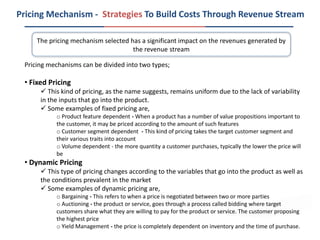
Pricing Mechanism - Strategies To Build Costs Through Revenue Stream
Pricing mechanisms can be divided into two types;
• Fixed Pricing
 This kind of pricing, as the name suggests, remains uniform due to the lack of variability
in the inputs that go into the product.
 Some examples of fixed pricing are,
o Product feature dependent - When a product has a number of value propositions important to
the customer, it may be priced according to the amount of such features
o Customer segment dependent - This kind of pricing takes the target customer segment and
their various traits into account
o Volume dependent - the more quantity a customer purchases, typically the lower the price will
be
• Dynamic Pricing
 This type of pricing changes according to the variables that go into the product as well as
the conditions prevalent in the market
 Some examples of dynamic pricing are,
o Bargaining - This refers to when a price is negotiated between two or more parties
o Auctioning - the product or service, goes through a process called bidding where target
customers share what they are willing to pay for the product or service. The customer proposing
the highest price
o Yield Management - the price is completely dependent on inventory and the time of purchase.
The pricing mechanism selected has a significant impact on the revenues generated by
the revenue stream
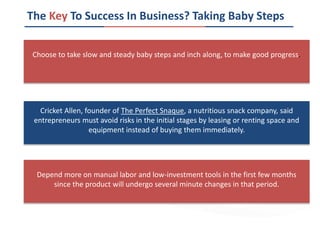
The Key To Success In Business? Taking Baby Steps
Depend more on manual labor and low-investment tools in the first few months
since the product will undergo several minute changes in that period.
Cricket Allen, founder of The Perfect Snaque, a nutritious snack company, said
entrepreneurs must avoid risks in the initial stages by leasing or renting space and
equipment instead of buying them immediately.
Choose to take slow and steady baby steps and inch along, to make good progress.
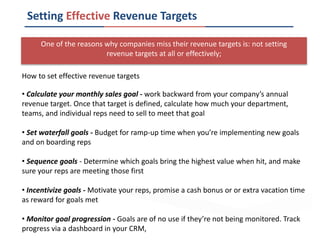
One of the reasons why companies miss their revenue targets is: not setting
revenue targets at all or effectively;
Setting Effective Revenue Targets
How to set effective revenue targets
• Calculate your monthly sales goal - work backward from your company’s annual
revenue target. Once that target is defined, calculate how much your department,
teams, and individual reps need to sell to meet that goal
• Set waterfall goals - Budget for ramp-up time when you’re implementing new goals
and on boarding reps
• Sequence goals - Determine which goals bring the highest value when hit, and make
sure your reps are meeting those first
• Incentivize goals - Motivate your reps, promise a cash bonus or or extra vacation time
as reward for goals met
• Monitor goal progression - Goals are of no use if they’re not being monitored. Track
progress via a dashboard in your CRM,
Next Upcoming Webinar
Section
Upcoming Webinar Sessions
By end of Sales Lessons Webinar Sessions, we will create
the following,
• A tribe of all Indian start ups with #indianstartups
wherein, start up firms list their problems and get
solutions to their problems through blogs
• Create project and sales campaign on Indian cuisine
focusing on one product line
My next Webinar session will cover the remaining sales
lessons 4 and 5
For any further queries, kindly reach me @
+91 8826313737 or email me @
munish@vsstechnology.com
Sales lesson for start ups 3

Sales lesson for start ups 3

  • 1.
    Sales Lessons ForStart Ups Session - 4
  • 2.
    Review From FirstWebinar Sales Lesson 1 - The start up companies should have customer in mind, involve the customer while building the process or application to test the proof of concept Sales Lesson 2 - Try to collaborate i.e. find people who can work along with you, not necessarily for you Sales Lesson 3 - Focus on revenue stream which are annuity based, revenue should come on regular basis Sales Lesson 4 - Hire, share resources or make partner with people/institutions who have sales experience & understanding Sales Lesson 5 - Use social media platform effectively to do sales, share your ideas with decision makers & to create your brand
  • 3.
    Review From OurLast Webinar • Criteria For partnership  It takes a lot to make a corporate-startup partnership work. If you do your due diligence, test the concept, and structure a partners hip for success, your company should be on the right track for a winning innovation strategy • Structure partnership deal to focus on common goals  Properly structuring a corporate-startup partnership enable more effective and adaptive partnerships that lead to success for both parties • Find Synergies  While most entrepreneurs aim to make theirs a successful startup story, their lack of a third party to help them scale can make the task quite challenging. Indeed, it can take years for a new business to develop its customer base and attain success. • Create Win-Win for all  The proper capital structure is critical to ensure a win-win relationship between corporate and startups to enable future rounds of investments to scale business and fully realize the potential • Revenue Sharing  The marketing strategies you employ in your daily operations can make or break how successful your company is. Revenue sharing as a marketing strategy, for example, may suit your business's needs. Sales Lesson 3 - Try to collaborate i.e. find people who can work along with you, not necessarily for you
  • 4.
    Our Today’s WebinarWill Focus On Sales Lesson – 3
  • 5.
    Sales Lesson #3 • Create Proposition/Products where the revenue stream is annuity based or regular, wherever possible • Irregular revenue stream, creates uncertainty • Create revenue stream first & then create cost accordingly • Take baby steps, don't look for those Big Orders • Set achievable targets with reasonable timelines Focus on revenue stream which are annuity based, revenue should come on regular basis
  • 6.
    What is “RevenueStream” And “Revenue Model” Before We Start Before we delve into the different types of revenue models, we should spend a little time differentiating between the terms, "revenue model", and "revenue stream”, as they are very often used interchangeably. A revenue stream is a company’s single source of revenue. A company can have zero or many revenue streams, depending on its size. A revenue model is the strategy of managing a company’s revenue streams and the resources required for each revenue stream.
  • 7.
    Types Of RevenueModels Ad-Based Revenue Model  It entail creating ads for a specific website, service, app, or other product, and placing them on strategic, high-traffic channels. Affiliate Revenue Model It works by promoting links to relevant products and collecting commission on the sales of those products, and can even work in conjunction with ads or separately Transactional Revenue Model  it entails a company providing a service or product and customers paying them for it. Subscription Revenue Model  It entails offering customers a product or service that customers can pay for over a longer period of time, There are numerous types of revenue models that countless recently launched startups use to generate their first sales
  • 8.
    The key tocreating your revenue model is through forecasting. Forecasting is an ongoing process that will help you to manage your cash and continue to grow ” Develop Your Start Up Revenue Model Choose a revenue model approach that is best for your company and background Communicate your values Identify potential investors strategically Understand that your revenue model is always evolving Project out into the foreseeable future. Mitigate for variables
  • 9.
    Create Proposition ForRegular Revenue Stream Choosing the right business model is one of a startup’s most important decisions Recurring revenue business model – is probably the most efficient and scalable business model out there Recurring revenue gave a new face to ecommerce, making companies like Amazon, the largest online retailer If you look at business models of startup unicorns over 50% of them use recurring revenue as their primary business model.
  • 10.
    Why Recurring BusinessModel Is Efficient Over 226 million adults in the U.S. alone take advantage of online subscription models, while nearly half of U.S. businesses have adopted or are planning to adopt a recurring revenue model Faster growth Better customer retention Higher margins Faster feedback loop Brand value
  • 11.
    Irregular Revenue StreamCreates Uncertainty Unpredictable events kill many businesses each year. For example: When Google changed its search algorithm, many startups went bankrupt because they relied on organic traffic from SEO. Their revenue stream suddenly dried up while their burn rates remained the same. A recurring revenue model can be a huge help, particularly from the point of view of scaling up and having a regular, predictable income While the thought of recurring revenue can be very attractive for digital businesses who have irregular income, it’s worth weighing up the pros and cons before rushing into a business model
  • 12.
    Pricing Mechanism -Strategies To Build Costs Through Revenue Stream Pricing mechanisms can be divided into two types; • Fixed Pricing  This kind of pricing, as the name suggests, remains uniform due to the lack of variability in the inputs that go into the product.  Some examples of fixed pricing are, o Product feature dependent - When a product has a number of value propositions important to the customer, it may be priced according to the amount of such features o Customer segment dependent - This kind of pricing takes the target customer segment and their various traits into account o Volume dependent - the more quantity a customer purchases, typically the lower the price will be • Dynamic Pricing  This type of pricing changes according to the variables that go into the product as well as the conditions prevalent in the market  Some examples of dynamic pricing are, o Bargaining - This refers to when a price is negotiated between two or more parties o Auctioning - the product or service, goes through a process called bidding where target customers share what they are willing to pay for the product or service. The customer proposing the highest price o Yield Management - the price is completely dependent on inventory and the time of purchase. The pricing mechanism selected has a significant impact on the revenues generated by the revenue stream
  • 13.
    The Key ToSuccess In Business? Taking Baby Steps Depend more on manual labor and low-investment tools in the first few months since the product will undergo several minute changes in that period. Cricket Allen, founder of The Perfect Snaque, a nutritious snack company, said entrepreneurs must avoid risks in the initial stages by leasing or renting space and equipment instead of buying them immediately. Choose to take slow and steady baby steps and inch along, to make good progress.
  • 14.
    One of thereasons why companies miss their revenue targets is: not setting revenue targets at all or effectively; Setting Effective Revenue Targets How to set effective revenue targets • Calculate your monthly sales goal - work backward from your company’s annual revenue target. Once that target is defined, calculate how much your department, teams, and individual reps need to sell to meet that goal • Set waterfall goals - Budget for ramp-up time when you’re implementing new goals and on boarding reps • Sequence goals - Determine which goals bring the highest value when hit, and make sure your reps are meeting those first • Incentivize goals - Motivate your reps, promise a cash bonus or or extra vacation time as reward for goals met • Monitor goal progression - Goals are of no use if they’re not being monitored. Track progress via a dashboard in your CRM,
  • 16.
  • 17.
    Upcoming Webinar Sessions Byend of Sales Lessons Webinar Sessions, we will create the following, • A tribe of all Indian start ups with #indianstartups wherein, start up firms list their problems and get solutions to their problems through blogs • Create project and sales campaign on Indian cuisine focusing on one product line My next Webinar session will cover the remaining sales lessons 4 and 5
  • 18.
    For any furtherqueries, kindly reach me @ +91 8826313737 or email me @ munish@vsstechnology.com

Editor's Notes

  • #3 Summary – Review of our last webinar
  • #6 7289843488
  • #13 Pricing Mechanism - Strategies to Build Costs through revenue stream