Group Presentation
• Ayesha Bashir ( Roll no. 3)
• Maryam Bashir ( Roll no. 4)
• Saima Naz ( Roll no.3o)
• Shabina Rehman ( Roll no. 5)
CRRICULUM
Target Student: Class two
Classroom: Interactive
Teachers’ role: Instructor, model, facilitator.
Students’ role: Active participant.
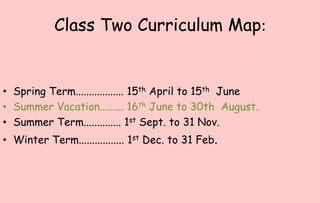
Class Two Curriculum Map:
• Spring Term.................. 15th April to 15th June
• Summer Vacation......... 16th June to 30th August.
• Summer Term.............. 1st Sept. to 31 Nov.
• Winter Term................. 1st Dec. to 31 Feb.
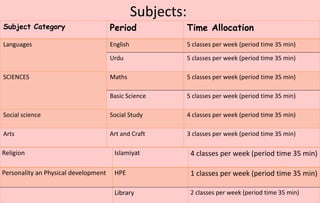
Subjects:
Subject Category Period Time Allocation
Languages English 5 classes per week (period time 35 min)
Urdu 5 classes per week (period time 35 min)
SCIENCES Maths 5 classes per week (period time 35 min)
Basic Science 5 classes per week (period time 35 min)
Social science Social Study 4 classes per week (period time 35 min)
Arts Art and Craft 3 classes per week (period time 35 min)
Religion Islamiyat 4 classes per week (period time 35 min)
Personality an Physical development HPE 1 classes per week (period time 35 min)
Library 2 classes per week (period time 35 min)
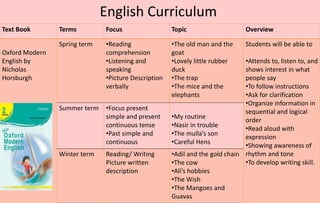
English Curriculum
Text Book Terms Focus Topic Overview
Oxford Modern
English by
Nicholas
Horsburgh
Spring term •Reading
comprehension
•Listening and
speaking
•Picture Description
verbally
•The old man and the
goat
•Lovely little rubber
duck
•The trap
•The mice and the
elephants
Students will be able to
•Attends to, listen to, and
shows interest in what
people say
•To follow instructions
•Ask for clarification
•Organize information in
sequential and logical
order
•Read aloud with
expression
•Showing awareness of
rhythm and tone
•To develop writing skill.
Summer term •Focus present
simple and present
continuous tense
•Past simple and
continuous
•My routine
•Nasir in trouble
•The mulla’s son
•Careful Hens
Winter term Reading/ Writing
Picture written
description
•Adil and the gold chain
•The cow
•Ali’s hobbies
•The Wish
•The Mangoes and
Guavas
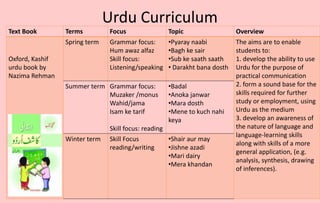
Urdu Curriculum
Text Book Terms Focus Topic Overview
Oxford, Kashif
urdu book by
Nazima Rehman
Spring term Grammar focus:
Hum awaz alfaz
Skill focus:
Listening/speaking
•Pyaray naabi
•Bagh ke sair
•Sub ke saath saath
• Darakht bana dosth
The aims are to enable
students to:
1. develop the ability to use
Urdu for the purpose of
practical communication
2. form a sound base for the
skills required for further
study or employment, using
Urdu as the medium
3. develop an awareness of
the nature of language and
language-learning skills
along with skills of a more
general application, (e.g.
analysis, synthesis, drawing
of inferences).
Summer term Grammar focus:
Muzaker /monus
Wahid/jama
Isam ke tarif
Skill focus: reading
•Badal
•Anoka janwar
•Mara dosth
•Mene to kuch nahi
keya
Winter term Skill Focus
reading/writing
•Shair aur may
•Jishne azadi
•Mari dairy
•Mera khandan
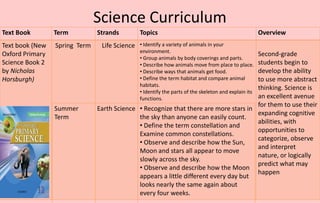
Science Curriculum
Text Book Term Strands Topics Overview
Text book (New
Oxford Primary
Science Book 2
by Nicholas
Horsburgh)
Spring Term Life Science • Identify a variety of animals in your
environment.
• Group animals by body coverings and parts.
• Describe how animals move from place to place.
• Describe ways that animals get food.
• Define the term habitat and compare animal
habitats.
• Identify the parts of the skeleton and explain its
functions.
Second-grade
students begin to
develop the ability
to use more abstract
thinking. Science is
an excellent avenue
for them to use their
expanding cognitive
abilities, with
opportunities to
categorize, observe
and interpret
nature, or logically
predict what may
happen
Summer
Term
Earth Science • Recognize that there are more stars in
the sky than anyone can easily count.
• Define the term constellation and
Examine common constellations.
• Observe and describe how the Sun,
Moon and stars all appear to move
slowly across the sky.
• Observe and describe how the Moon
appears a little different every day but
looks nearly the same again about
every four weeks.
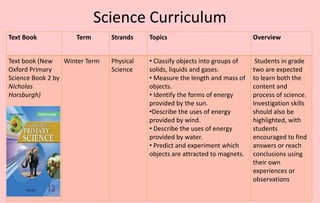
Science Curriculum
Text Book Term Strands Topics Overview
Text book (New
Oxford Primary
Science Book 2 by
Nicholas
Horsburgh)
Winter Term Physical
Science
• Classify objects into groups of
solids, liquids and gases.
• Measure the length and mass of
objects.
• Identify the forms of energy
provided by the sun.
•Describe the uses of energy
provided by wind.
• Describe the uses of energy
provided by water.
• Predict and experiment which
objects are attracted to magnets.
Students in grade
two are expected
to learn both the
content and
process of science.
Investigation skills
should also be
highlighted, with
students
encouraged to find
answers or reach
conclusions using
their own
experiences or
observations
Maths Curriculum
Text Book Terms Strands Topic Overview
(Oxford: New
Enjoying
Mathematics
Practice Book with
Mental Maths) by
Aashalata Badami
Spring term Number Counting and numeration
Comparing and ordering
Place value
Operations
Addition
Subtraction
Fractions
The aims of the
primary
mathematics
curriculum are
to develop a
positive attitude
towards
mathematics and
an appreciation
of both its practical
and its aesthetic
aspects
to develop
problem-solving
Summer term Algebra Exploring and using
patterns
Shapes and
Space
Spatial awareness
2-D shapes
3-D shapes
Symmetry
Angles
Maths Curriculum
Text Book Terms Strands Topic Overview
(Oxford: New
Enjoying
Mathematics
Practice Book with
Mental Maths)
Winter Measures Length
Area
Weight
Capacity
Time
Money
abilities and a facility for the
application of
mathematics to everyday life
• to enable the child to use
mathematical language
effectively and accurately
• to enable the child to acquire
an understanding of
mathematical concepts and
processes to his/her
appropriate level of
development and ability
• to enable the child to acquire
proficiency in fundamental
mathematical skills and in
recalling basic number facts.
Data Representing and
interpreting data
Art and Craft Curriculum
Text Book Terms Strands Topic Overview
( Oxford Art Club for
class 2 by Huma
Nasir and Adnan
Lotia)
Spring term Drawing Making drawings
Looking and responding
The child will be
enabled :
• to experiment with the
marks that can be made
with different drawing
instruments on a range
of surfaces
• make drawings based
on vividly recalled
feelings, real and
imaginative experiences
and stories
• discover and draw line
and shape as seen
in natural and
manufactured objects
and discover that lines
can make shapes
•explore the relationship
between how things feel
and how they look
Paint and colour Painting
Looking and responding
Summer term Print Making prints
Looking and responding
Clay Developing form in clay
Looking and responding
Winter term Construction Making constructions
Looking and responding
Cards Making Creating greeting, welcome,
invitation cards etc.
Looking and responding
Islamiyat Curriculum
Text Book Terms Strands Topic Overview
Oxford Salam
Isalmiyat Book 2, by
Nazma Rehman
Spring term Surahs and
Islam basics
student will learn
fourth,fifth, and sixth kalma
four surahs (Surah feel,
surah qurash, surah maaon,
surah kosar with translation
five Arkaans of Islam
• students will be
able to understand
the basics of their
religion.
•they will know
about the good traits
of life from the lives
of prophets and
caliphs.
•students will be
able to recite the last
ten Surahs of Quran.
Summer term Islam
personalities
lifestyle of Prophets (Hazrat
Adam A.S, Ibrahim A.S, Ayub
A.S, Muhammad P.B.U.H)
first four Caliphs (Abu Bakr
as-Siddiq, Umar ibn al-
Khattab, Uthman ibn Affan,
Ali ibn Abi Talib)
Winter term Angels and
surahs
four angels in Islam and the
works assign to them
Last six surahs with
translation
Physical Education Curriculum
Text Book Terms Strands Topic Overview
Physical Education
for Lifelong Fitness
by Suzan F. Aywes
Spring term Athletics Running,
jumping and
throwing
The aims of the physical education
curriculum are
• to promote the physical, social,
emotional and intellectual development
of the child
•to develop positive personal qualities
•to promote understanding and
knowledge of the various aspects of
movement
•to develop an appreciation of
movement and the use of the body as an
instrument of expression and creativity
•to promote enjoyment of, and positive
attitudes towards, physical
activity and its contribution to lifelong
health-related fitness, thus
preparing the child for the active and
purposeful use of leisure time.
Summer term games sending,
receiving,
creating and
playing games
Winter term Outdoor
activities
walking,
Orienteering,
outdoor
challenges
Social Studies Curriculum
Text Book Terms Strands Topic Overview
New Oxford Social
Studies for Pakistan
by Nicholas
Horsburgh
Spring term Civics • Citizenship
• Rules
• Patriotic symbols
The students will
learn
•To relate locations
and climate.
• Change in self,
families and
communities
•Will help them to
know their identity
•Result in
behaviour, rules
rights, and
responsibilities
Summer term Geography •Map terms, symbols and
its use
•Climate
•Physical surroundings
Winter History •Pakistani Heroes
•Local historical events (
residents, artifacts and
photographs)
Students Evaluation:
• Students will evaluated on the basis of daily
and weekly assessment (through
worksheets', quizzes, students
participation, terminal projects)
• Students will not be taken formal exams i.e
the assessment is formative.
• Their worksheets, quizzes, terminal projects
etc. and their grades will be compiled in a
portfolio.
Summer Vacation Work
Subject Projects
English Making Dictionary including categories of fruits
names, vegetables names, classroom objects etc
Urdu Making Dictionary of 10 pages
Making flash cards of vegetables, fruit etc
Maths Making timetable
Science Drawing Solar system on charts
pasting plants samples in noteboook
Social Studies Pasting pictures of pakistani heroes
Pasting samples of pakistani famous crops
•Teacher will add further to summer vacation work on the basis of class and individual needs.
Teaching Aids
English White board, charts, posters,
worksheets, etc
Urdu White board, charts, worksheets,
posters etc
Maths Counting beads, shapes, measuring
instruments, worksheets etc
Science Skeleton, measuring instruments,
microscope, plant and animal
samples, worksheets etc
Art and Craft Charts, painting boards, water
colour, scissors, glue etc
Social Studies Maps, symbols charts, national
heroes pictures, worksheets etc
Teaching Aids
Islamiyat Surahs on charts, posters,
worksheets etc
Physical Education Skipping rope, weight machine,
sports kits etc

Class Two Curriculum

  • 1.
    Group Presentation • AyeshaBashir ( Roll no. 3) • Maryam Bashir ( Roll no. 4) • Saima Naz ( Roll no.3o) • Shabina Rehman ( Roll no. 5)
  • 3.
    CRRICULUM Target Student: Classtwo Classroom: Interactive Teachers’ role: Instructor, model, facilitator. Students’ role: Active participant.
  • 4.
    Class Two CurriculumMap: • Spring Term.................. 15th April to 15th June • Summer Vacation......... 16th June to 30th August. • Summer Term.............. 1st Sept. to 31 Nov. • Winter Term................. 1st Dec. to 31 Feb.
  • 5.
    Subjects: Subject Category PeriodTime Allocation Languages English 5 classes per week (period time 35 min) Urdu 5 classes per week (period time 35 min) SCIENCES Maths 5 classes per week (period time 35 min) Basic Science 5 classes per week (period time 35 min) Social science Social Study 4 classes per week (period time 35 min) Arts Art and Craft 3 classes per week (period time 35 min) Religion Islamiyat 4 classes per week (period time 35 min) Personality an Physical development HPE 1 classes per week (period time 35 min) Library 2 classes per week (period time 35 min)
  • 6.
    English Curriculum Text BookTerms Focus Topic Overview Oxford Modern English by Nicholas Horsburgh Spring term •Reading comprehension •Listening and speaking •Picture Description verbally •The old man and the goat •Lovely little rubber duck •The trap •The mice and the elephants Students will be able to •Attends to, listen to, and shows interest in what people say •To follow instructions •Ask for clarification •Organize information in sequential and logical order •Read aloud with expression •Showing awareness of rhythm and tone •To develop writing skill. Summer term •Focus present simple and present continuous tense •Past simple and continuous •My routine •Nasir in trouble •The mulla’s son •Careful Hens Winter term Reading/ Writing Picture written description •Adil and the gold chain •The cow •Ali’s hobbies •The Wish •The Mangoes and Guavas
  • 7.
    Urdu Curriculum Text BookTerms Focus Topic Overview Oxford, Kashif urdu book by Nazima Rehman Spring term Grammar focus: Hum awaz alfaz Skill focus: Listening/speaking •Pyaray naabi •Bagh ke sair •Sub ke saath saath • Darakht bana dosth The aims are to enable students to: 1. develop the ability to use Urdu for the purpose of practical communication 2. form a sound base for the skills required for further study or employment, using Urdu as the medium 3. develop an awareness of the nature of language and language-learning skills along with skills of a more general application, (e.g. analysis, synthesis, drawing of inferences). Summer term Grammar focus: Muzaker /monus Wahid/jama Isam ke tarif Skill focus: reading •Badal •Anoka janwar •Mara dosth •Mene to kuch nahi keya Winter term Skill Focus reading/writing •Shair aur may •Jishne azadi •Mari dairy •Mera khandan
  • 8.
    Science Curriculum Text BookTerm Strands Topics Overview Text book (New Oxford Primary Science Book 2 by Nicholas Horsburgh) Spring Term Life Science • Identify a variety of animals in your environment. • Group animals by body coverings and parts. • Describe how animals move from place to place. • Describe ways that animals get food. • Define the term habitat and compare animal habitats. • Identify the parts of the skeleton and explain its functions. Second-grade students begin to develop the ability to use more abstract thinking. Science is an excellent avenue for them to use their expanding cognitive abilities, with opportunities to categorize, observe and interpret nature, or logically predict what may happen Summer Term Earth Science • Recognize that there are more stars in the sky than anyone can easily count. • Define the term constellation and Examine common constellations. • Observe and describe how the Sun, Moon and stars all appear to move slowly across the sky. • Observe and describe how the Moon appears a little different every day but looks nearly the same again about every four weeks.
  • 9.
    Science Curriculum Text BookTerm Strands Topics Overview Text book (New Oxford Primary Science Book 2 by Nicholas Horsburgh) Winter Term Physical Science • Classify objects into groups of solids, liquids and gases. • Measure the length and mass of objects. • Identify the forms of energy provided by the sun. •Describe the uses of energy provided by wind. • Describe the uses of energy provided by water. • Predict and experiment which objects are attracted to magnets. Students in grade two are expected to learn both the content and process of science. Investigation skills should also be highlighted, with students encouraged to find answers or reach conclusions using their own experiences or observations
  • 10.
    Maths Curriculum Text BookTerms Strands Topic Overview (Oxford: New Enjoying Mathematics Practice Book with Mental Maths) by Aashalata Badami Spring term Number Counting and numeration Comparing and ordering Place value Operations Addition Subtraction Fractions The aims of the primary mathematics curriculum are to develop a positive attitude towards mathematics and an appreciation of both its practical and its aesthetic aspects to develop problem-solving Summer term Algebra Exploring and using patterns Shapes and Space Spatial awareness 2-D shapes 3-D shapes Symmetry Angles
  • 11.
    Maths Curriculum Text BookTerms Strands Topic Overview (Oxford: New Enjoying Mathematics Practice Book with Mental Maths) Winter Measures Length Area Weight Capacity Time Money abilities and a facility for the application of mathematics to everyday life • to enable the child to use mathematical language effectively and accurately • to enable the child to acquire an understanding of mathematical concepts and processes to his/her appropriate level of development and ability • to enable the child to acquire proficiency in fundamental mathematical skills and in recalling basic number facts. Data Representing and interpreting data
  • 12.
    Art and CraftCurriculum Text Book Terms Strands Topic Overview ( Oxford Art Club for class 2 by Huma Nasir and Adnan Lotia) Spring term Drawing Making drawings Looking and responding The child will be enabled : • to experiment with the marks that can be made with different drawing instruments on a range of surfaces • make drawings based on vividly recalled feelings, real and imaginative experiences and stories • discover and draw line and shape as seen in natural and manufactured objects and discover that lines can make shapes •explore the relationship between how things feel and how they look Paint and colour Painting Looking and responding Summer term Print Making prints Looking and responding Clay Developing form in clay Looking and responding Winter term Construction Making constructions Looking and responding Cards Making Creating greeting, welcome, invitation cards etc. Looking and responding
  • 13.
    Islamiyat Curriculum Text BookTerms Strands Topic Overview Oxford Salam Isalmiyat Book 2, by Nazma Rehman Spring term Surahs and Islam basics student will learn fourth,fifth, and sixth kalma four surahs (Surah feel, surah qurash, surah maaon, surah kosar with translation five Arkaans of Islam • students will be able to understand the basics of their religion. •they will know about the good traits of life from the lives of prophets and caliphs. •students will be able to recite the last ten Surahs of Quran. Summer term Islam personalities lifestyle of Prophets (Hazrat Adam A.S, Ibrahim A.S, Ayub A.S, Muhammad P.B.U.H) first four Caliphs (Abu Bakr as-Siddiq, Umar ibn al- Khattab, Uthman ibn Affan, Ali ibn Abi Talib) Winter term Angels and surahs four angels in Islam and the works assign to them Last six surahs with translation
  • 14.
    Physical Education Curriculum TextBook Terms Strands Topic Overview Physical Education for Lifelong Fitness by Suzan F. Aywes Spring term Athletics Running, jumping and throwing The aims of the physical education curriculum are • to promote the physical, social, emotional and intellectual development of the child •to develop positive personal qualities •to promote understanding and knowledge of the various aspects of movement •to develop an appreciation of movement and the use of the body as an instrument of expression and creativity •to promote enjoyment of, and positive attitudes towards, physical activity and its contribution to lifelong health-related fitness, thus preparing the child for the active and purposeful use of leisure time. Summer term games sending, receiving, creating and playing games Winter term Outdoor activities walking, Orienteering, outdoor challenges
  • 15.
    Social Studies Curriculum TextBook Terms Strands Topic Overview New Oxford Social Studies for Pakistan by Nicholas Horsburgh Spring term Civics • Citizenship • Rules • Patriotic symbols The students will learn •To relate locations and climate. • Change in self, families and communities •Will help them to know their identity •Result in behaviour, rules rights, and responsibilities Summer term Geography •Map terms, symbols and its use •Climate •Physical surroundings Winter History •Pakistani Heroes •Local historical events ( residents, artifacts and photographs)
  • 16.
    Students Evaluation: • Studentswill evaluated on the basis of daily and weekly assessment (through worksheets', quizzes, students participation, terminal projects) • Students will not be taken formal exams i.e the assessment is formative. • Their worksheets, quizzes, terminal projects etc. and their grades will be compiled in a portfolio.
  • 17.
    Summer Vacation Work SubjectProjects English Making Dictionary including categories of fruits names, vegetables names, classroom objects etc Urdu Making Dictionary of 10 pages Making flash cards of vegetables, fruit etc Maths Making timetable Science Drawing Solar system on charts pasting plants samples in noteboook Social Studies Pasting pictures of pakistani heroes Pasting samples of pakistani famous crops •Teacher will add further to summer vacation work on the basis of class and individual needs.
  • 18.
    Teaching Aids English Whiteboard, charts, posters, worksheets, etc Urdu White board, charts, worksheets, posters etc Maths Counting beads, shapes, measuring instruments, worksheets etc Science Skeleton, measuring instruments, microscope, plant and animal samples, worksheets etc Art and Craft Charts, painting boards, water colour, scissors, glue etc Social Studies Maps, symbols charts, national heroes pictures, worksheets etc
  • 19.
    Teaching Aids Islamiyat Surahson charts, posters, worksheets etc Physical Education Skipping rope, weight machine, sports kits etc