
 There are no secrets!
 The Navy tells you what to do!
 Bibliography
 Precept Letters
 Evaluations (traits provide the
standards)
 An ongoing process throughout the
evaluation period. Usually 12 months.
 Work on deficiencies to improve.
 Take off your blinders. See the whole Sailor.
 Develop your writing style and comply with
the style of the reporting senior.
 Make your case for the Sailor in block 43!
 Use allotted space wisely.
 KEEP THE ENTIRE CHAIN OF COMMAND
IN THE PROCESS!
 Advanced to Petty Officer Second Class.
 Career Development Board.
 Don’t be afraid to ask questions! This is how we
learn.
 Learn the evaluation process, it’s your path to
success.
 Five Questions:
 Why did you join the Navy?
 Why did you pick your rate?
 What did you expect to get from the Navy?
 What do you think of the Command?
 Where do you want to be 5-10 years from now?
 BUPERSINST 1610.10C
 OPNAVINST 6110.10J
 SECNAVINST 5210.2 (SSIC)
 SECNAVINST 5216.5 (Correspondence)
 Mentors
 Study Guides
 A Mentor! Someone who is where you
want to be!
 Learn your rate and how the Navy
works.
 Exercise your knowledge and ability.
 It’s ok if you don’t know
something, you can learn!
 Observe CDB, mid-term counseling, etc.
 Demonstrate the Sailor’s technical skill and
ability.
 Demonstrate the Sailor’s progress as a leader
and technical expert.
 Utilize the mid-term counseling as the
foundation for the Sailor’s evaluation.
 Has the Sailor improved? If not, is there
counseling to document the deficiency and
improvement?
 Are you providing an objective evaluation of
the Sailor’s ability in the traits?
 Are you observing the Sailor and asking the
Sailor about their job and what they do?
 Are you documenting pertinent information
in block 43? Good and not so good.
 Does the write-up support the grades?
 Do the grades support the write-up.
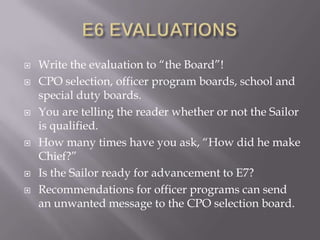
 Write the evaluation to “the Board”!
 CPO selection, officer program
boards, school and special duty boards.
 You are telling the reader whether or
not the Sailor is qualified.
 Is the Sailor ready for advancement to
E6?
 Professional Knowledge vs Institutional &
Technical Expertise
 Quality of Work vs Professionalism
 Command Climate/EO vs Character
 Military Bearing vs Character/Heritage
 Job Accomplishment/Intiative vs
Professionalism/Communication
 Team Work vs Loyalty/Communication
 Leadership vs Deckplate Leadership
 Observed CDBs and has developed into an
excellent member of the CDT.
 Demonstrated mentoring/leadership ability
in the cross-training of personnel within the
department.
 Maintained active communication up and
down the chain of command which provided
increased understanding and development of
personnel.
 Demonstrate the Sailor’s technical expertise.
 Document proven leadership ability.
 Identify knowledge of Navy heritage and
ability to share information with
subordinates.
 Document accomplishments with regard to
collateral duties.
 Actions taken to develop Sailors into
technical experts and leaders.
 Are you providing an objective evaluations of the
Sailor’s ability in the traits?
 Are you observing the Sailor in the performance
of “your” job and asking the Sailor about their
job and what they do?
 Are you documenting pertinent information in
block 43? Good and not so good.
 Does the write-up support the grades?
 Do the grades support the write-up.
 Are you allowing this Sailor to grow as a leader?
 Write the evaluation to “the Board”!
 CPO selection, officer program boards, school and
special duty boards.
 You are telling the reader whether or not the Sailor
is qualified.
 How many times have you ask, “How did he make
Chief?”
 Is the Sailor ready for advancement to E7?
 Recommendations for officer programs can send
an unwanted message to the CPO selection board.
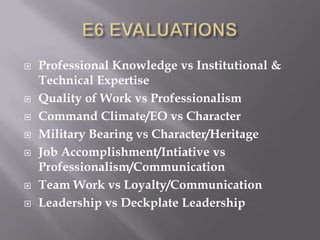
 Professional Knowledge vs Institutional &
Technical Expertise
 Quality of Work vs Professionalism
 Command Climate/EO vs Character
 Military Bearing vs Character/Heritage
 Job Accomplishment/Intiative vs
Professionalism/Communication
 Team Work vs Loyalty/Communication
 Leadership vs Deckplate Leadership
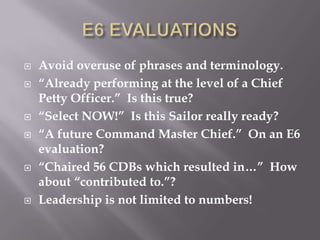
 Avoid overuse of phrases and terminology.
 “Already performing at the level of a Chief
Petty Officer.” Is this true?
 “Select NOW!” Is this Sailor really ready?
 “A future Command Master Chief.” On an E6
evaluation?
 “Chaired 56 CDBs which resulted in…” How
about “contributed to.”?
 Leadership is not limited to numbers!
 It takes a commitment to the Navy.
 If you want “it” you have to go out there and
get “it” for yourself.
 Diversity of Navy experience and knowledge.
 Sailor first, rating second, NEC third.
 Get out of the box.
 The more senior you are the more you need to
know. Get started now and beat the rush.
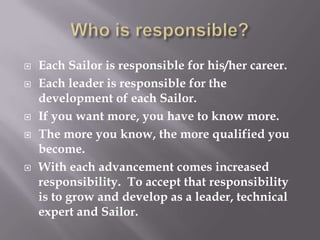
 Each Sailor is responsible for his/her career.
 Each leader is responsible for the
development of each Sailor.
 If you want more, you have to know more.
 The more you know, the more qualified you
become.
 With each advancement comes increased
responsibility. To accept that responsibility
is to grow and develop as a leader, technical
expert and Sailor.
 Each Sailor should be groomed.
 Grooming is not “doing for” it is “teaching
how” and letting the Sailor demonstrate their
ability.
 Follow the Navy’s career path.
 Lose the just get it done mentality.
 This is about leadership!
Navy Evaluation and Fitness Report Writing

Navy Evaluation and Fitness Report Writing

  • 2.
     There areno secrets!  The Navy tells you what to do!  Bibliography  Precept Letters  Evaluations (traits provide the standards)
  • 3.
     An ongoingprocess throughout the evaluation period. Usually 12 months.  Work on deficiencies to improve.  Take off your blinders. See the whole Sailor.  Develop your writing style and comply with the style of the reporting senior.  Make your case for the Sailor in block 43!  Use allotted space wisely.  KEEP THE ENTIRE CHAIN OF COMMAND IN THE PROCESS!
  • 4.
     Advanced toPetty Officer Second Class.  Career Development Board.  Don’t be afraid to ask questions! This is how we learn.  Learn the evaluation process, it’s your path to success.  Five Questions:  Why did you join the Navy?  Why did you pick your rate?  What did you expect to get from the Navy?  What do you think of the Command?  Where do you want to be 5-10 years from now?
  • 5.
     BUPERSINST 1610.10C OPNAVINST 6110.10J  SECNAVINST 5210.2 (SSIC)  SECNAVINST 5216.5 (Correspondence)  Mentors  Study Guides
  • 6.
     A Mentor!Someone who is where you want to be!  Learn your rate and how the Navy works.  Exercise your knowledge and ability.  It’s ok if you don’t know something, you can learn!  Observe CDB, mid-term counseling, etc.
  • 7.
     Demonstrate theSailor’s technical skill and ability.  Demonstrate the Sailor’s progress as a leader and technical expert.  Utilize the mid-term counseling as the foundation for the Sailor’s evaluation.  Has the Sailor improved? If not, is there counseling to document the deficiency and improvement?
  • 8.
     Are youproviding an objective evaluation of the Sailor’s ability in the traits?  Are you observing the Sailor and asking the Sailor about their job and what they do?  Are you documenting pertinent information in block 43? Good and not so good.  Does the write-up support the grades?  Do the grades support the write-up.
  • 9.
     Write theevaluation to “the Board”!  CPO selection, officer program boards, school and special duty boards.  You are telling the reader whether or not the Sailor is qualified.  Is the Sailor ready for advancement to E6?
  • 10.
     Professional Knowledgevs Institutional & Technical Expertise  Quality of Work vs Professionalism  Command Climate/EO vs Character  Military Bearing vs Character/Heritage  Job Accomplishment/Intiative vs Professionalism/Communication  Team Work vs Loyalty/Communication  Leadership vs Deckplate Leadership
  • 11.
     Observed CDBsand has developed into an excellent member of the CDT.  Demonstrated mentoring/leadership ability in the cross-training of personnel within the department.  Maintained active communication up and down the chain of command which provided increased understanding and development of personnel.
  • 12.
     Demonstrate theSailor’s technical expertise.  Document proven leadership ability.  Identify knowledge of Navy heritage and ability to share information with subordinates.  Document accomplishments with regard to collateral duties.  Actions taken to develop Sailors into technical experts and leaders.
  • 13.
     Are youproviding an objective evaluations of the Sailor’s ability in the traits?  Are you observing the Sailor in the performance of “your” job and asking the Sailor about their job and what they do?  Are you documenting pertinent information in block 43? Good and not so good.  Does the write-up support the grades?  Do the grades support the write-up.  Are you allowing this Sailor to grow as a leader?
  • 14.
     Write theevaluation to “the Board”!  CPO selection, officer program boards, school and special duty boards.  You are telling the reader whether or not the Sailor is qualified.  How many times have you ask, “How did he make Chief?”  Is the Sailor ready for advancement to E7?  Recommendations for officer programs can send an unwanted message to the CPO selection board.
  • 15.
     Professional Knowledgevs Institutional & Technical Expertise  Quality of Work vs Professionalism  Command Climate/EO vs Character  Military Bearing vs Character/Heritage  Job Accomplishment/Intiative vs Professionalism/Communication  Team Work vs Loyalty/Communication  Leadership vs Deckplate Leadership
  • 16.
     Avoid overuseof phrases and terminology.  “Already performing at the level of a Chief Petty Officer.” Is this true?  “Select NOW!” Is this Sailor really ready?  “A future Command Master Chief.” On an E6 evaluation?  “Chaired 56 CDBs which resulted in…” How about “contributed to.”?  Leadership is not limited to numbers!
  • 17.
     It takesa commitment to the Navy.  If you want “it” you have to go out there and get “it” for yourself.  Diversity of Navy experience and knowledge.  Sailor first, rating second, NEC third.  Get out of the box.  The more senior you are the more you need to know. Get started now and beat the rush.
  • 18.
     Each Sailoris responsible for his/her career.  Each leader is responsible for the development of each Sailor.  If you want more, you have to know more.  The more you know, the more qualified you become.  With each advancement comes increased responsibility. To accept that responsibility is to grow and develop as a leader, technical expert and Sailor.
  • 19.
     Each Sailorshould be groomed.  Grooming is not “doing for” it is “teaching how” and letting the Sailor demonstrate their ability.  Follow the Navy’s career path.  Lose the just get it done mentality.  This is about leadership!