





NONRESIDENT
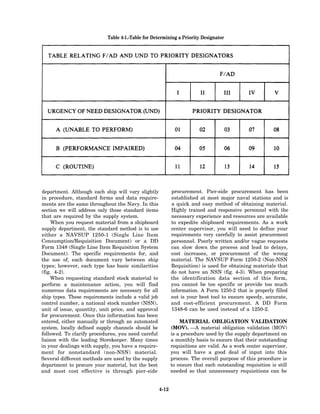
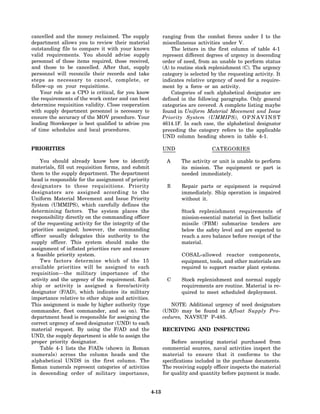
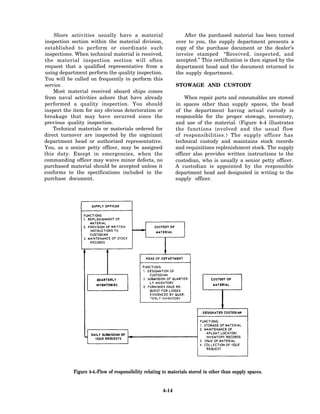
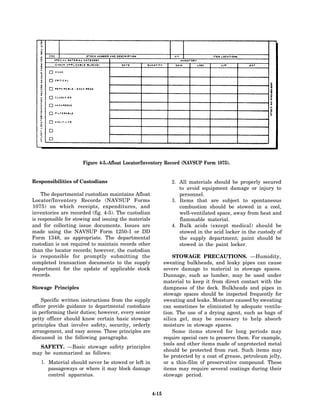
                                  TRAINING
                                  COURSE


Military Requirements
For Chief Petty Officer
NAVEDTRA 14144


    Notice: NETPDTC is no longer responsible for the content accuracy of the
    NRTCs.

    For content issues, contact the servicing Center of Excellence: Center for Naval
    Leadership (CNL); (757) 462-1537 or DSN: 253-1537.


DISTRIBUTION STATEMENT A: Approved for public release; distribution is unlimited.
PREFACE
About this course:

This is a self-study course. By studying this course, you can improve your professional/military knowledge,
as well as prepare for the Navywide advancement-in-rate examination. It contains subject matter about day-
to-day occupational knowledge and skill requirements and includes text, tables, and illustrations to help you
understand the information. An additional important feature of this course is its reference to useful
information found in other publications. The well-prepared Sailor will take the time to look up the
additional information.

History of the course:

     Sep 1991: Original edition released. Authored by DSC Randy L. Harris.
     Nov 2003: Administrative update released. Technical content was not reviewed or revised.


                                                                 NAVSUP Logistics Tracking Number
                                                                                  0504-LP-026-7980
TABLE OF CONTENTS

CHAPTER                                                                                                                                          PAGE

                1. Naval Tradition ......................................................................................................          1-1

                2. Military Conduct and Justice .................................................................................                  2-1

                3. Leadership ..............................................................................................................       3-1

                4. Management Information.......................................................................................                   4-1

                5. Career Information and Training............................................................................                     5-1

                6. Programs and Policies ............................................................................................              6-1

                7. Military Requirements ...........................................................................................               7-1

                8. Safety and Damage Control ...................................................................................                   8-1

                9. Security ..................................................................................................................     9-1

INDEX.........................................................................................................................................INDEX-1

                                            ASSIGNMENT QUESTIONS follow Index.
INTRODUCTION TO MILITARY
                        REQUIREMENTS AND THE
                          NAVAL STANDARDS
    The United States Navy has always placed              required of all enlisted personnel in the Navy.
great emphasis on the pride and professionalism           Your knowledge of NAVSTDS will be tested on
of its personnel. In keeping with this strong             the military/leadership examination. Unlike the
tradition, the Navy has taken a different approach        Navy occupational standards, which state the
in teaching military subjects by developing               tasks enlisted personnel are required to perform,
individual military requirements training manuals.        naval standards, for the most part, state the
These manuals are divided into the basic military         knowledge required.
requirements (BMR) for apprenticeships and                    NAVSTDS encompass military requirements,
advanced requirements for third class, second             essential virtues of professionalism and pride of
class, first class, chief petty officers, and senior      service in support of the oath of enlistment, and
and master chief petty officers. These manuals            maintenance of good order and discipline. They
cover the MINIMUM naval standards required                also include knowledges pertaining to the well-
for advancement in rate.                                  being of Navy personnel that directly contribute
    The purpose of the separate manuals for each          to the mission of the Navy.
rate is to define more clearly the duties and                 NAVSTDS apply to all personnel at the
responsibilities of the petty officer at each             specified paygrade except where specific limita-
rate. That simply means if you are studying for           tions are indicated. Primarily two factors make
advancement to chief petty officer, you will study        these qualifications necessary—the basic require-
material that applies to the chief petty officer.         ments of duty at sea and the requirements of
This is not to say that a chief petty officer             duty in an armed force. For example, all Navy
performs only at the chief petty officer level.           personnel must know certain elements of seaman-
Many times the needs of the service require a chief       ship and must be prepared to assume battle
petty officer to fill the billet of a more senior petty   station duties. Both men and women must learn
officer or a commissioned officer. That has               the general orders for a sentry, be able to stand
always been the case and will continue to be true.        a security watch, and possess certain skills and
    Because the manuals have been separated               knowledges needed for their own protection and
according to rate, you can now study the required         survival. Certain other qualifications, mainly
material at the appropriate e time in your career.        in clerical and administrative duties, have been
                                                          added to the military and seagoing requirements
                                                          because knowledge of them is important for all
                                                          enlisted personnel regardless of occupational
             NAVAL STANDARDS                              specialty.
                                                              This training manual covers the naval stan-
    Naval standards (NAVSTDs) are those qualifi-          dards (military requirements) for chief petty
cations which specify the minimum knowledge               officer.
CHAPTER 1

                                NAVAL TRADITION
                                      LEARNING OBJECTIVES


             Learning objectives are stated at the beginning of each chapter. These learning
             objectives serve as a preview of the information you are expected to learn
             in the chapter. By successfully completing the nonresident training course
             (NRTC), you indicate you have met the objectives and have learned the
             information. The learning objectives for chapter 1 are listed below.


             Upon completion of this chapter, you should be able to do the following:

1. Identify the challenges to United States sea             5. Recognize the purpose and importance of arms
   power.                                                      control in maintaining a balance of power
                                                               between the United States and the Union of
2. Describe the mission of the U.S. Navy in                    Soviet Socialist Republics (U.S.S.R.).
   peacetime and wartime.
3. Describe the importance of naval presence, sea           6. Compare the naval forces of the United States
   control, and power projection in carrying out               and the U.S.S.R.
   the Navy’s mission.
4. Recognize the various theaters of operations             7. Describe the cause and effect of chemical war-
   for U.S. naval forces.                                      fare in the Middle East.


    Today the two major military superpowers in             legislation created, in effect, the Continental
the world are the United States of America and              navy. Congress authorized two battalions of
the Union of Soviet Socialist Republics (U.S.S.R.).         Marines on 10 November 1775. From these
Both countries have large navies. They use their            humble beginnings we have become a force of
navies to meet the national interest and political          over 500,000 personnel and 500 ships capable of
goals of their countries. This chapter will provide         global power projection on a moment’s notice.
an overview of the U.S. and Soviet navies and the
Third World countries having an impact on world             NAVAL PRESENCE
stability.
                                                                Almost every U.S. sailor has experienced some
                                                            type of major deployment. In the past several
   CHALLENGES TO U.S. SEA POWER                             years, most deployments have been to areas of
                                                            the world in which hostilities were in progress.
    The naval affairs of the United States began            Naval presence, by simple definition, is having a
with the War for Independence, the American                 naval force in a specific location. We have been
Revolution. On 13 October 1775 Congress passed              called on countless times in the past years to
legislation to purchase and arm two ships. This             “show the flag.” Deployments place naval forces


                                                      1-1
in positions to achieve three purposes. First, forces         essential to our use of the seas to support our
can engage the enemy promptly at the start of                 national policies. The concepts of sea control and
hostilities. Second, they can provide protection              power projection are closely interrelated. A naval
and support to friendly, allied, and U.S. forces              force must have some degree of sea control in the
in time of war. Third, they can stop the advance              sea areas from which it is to project power,
of the enemy as soon as possible. However, the                depending on the type of force to be used.
positioning of these naval forces for warfare in              However, a naval force must have the capability
sensitive areas of the world also provides a side             to project power before it can realize any degree
benefit known as presence. Because of the inter-              of sea control.
national character of the high seas, deployed U.S.
forces have a unique ability to make U.S. military
presence known in a time of crisis. The United                Sea Control
States can modify that presence to exert the degree
and type of influence best suited to resolve the                  Sea control is the basic function of the U.S.
situation.                                                    Navy. It involves control of designated air,
                                                              surface, and subsurface areas. Sea control is
    A show of force by U.S. naval warships can                of crucial importance to the U.S. strategy of
restore stability to a friendly nation that is unable         using both oceans as barriers for defense and
to control a hostile situation. The U.S. fleet can            as avenues to extend our influence overseas. It
remain out of sight, over the horizon, ready to               does not imply simultaneous control over all
respond in a matter of minutes to any crisis. Naval           70 percent of the earth covered by international
presence can be visible or invisible, large or small,         waters; it is a selective function, exercised
forceful or peaceful, depending on what best suits            only when and where necessary. Because of new
U.S. interests.                                               technology developed in the United States and
                                                              in other countries, total control of the seas
    Naval forces can remain in a crisis area for              for our use and the denial of the seas for the
indefinite periods to communicate their capability            enemy’s use are impossible. With continuing
for action. Ground and air forces can duplicate               technological developments, such as the strategic
that capability only by landing or entering the               defense initiative, total sea control is expected
sovereign air space of another nation.                        to become even more difficult.

    We cannot consider the effectiveness of our                  Sea control assures the buildup and resupply
naval presence separately from our warfare                    of allied forces and the free flow of needed
capability. To encourage friends, deter enemies,              supplies. Sea control also enhances security for
or influence neutrals, forces deployed to crisis              the nation’s sea-based strategic deterrent.
areas must possess a fighting capability.
                                                                  We must have sea control to conduct sustained
    Our naval presence must also reflect the degree           U.S. Army and U.S. Air Force operations abroad.
of U.S. interests in the area relative to the number          Modern land warfare requires large quantities
of naval forces in the area. To be effective in the           of supplies; most of them must be supplied
presence role, U.S. naval forces must reflect a               by sea.
ready combat capability to carry out their
mission against ANY implied threat.                               We maintain sea control by destroying or
                                                              neutralizing hostile forces in maritime areas the
                                                              United States must use. Hostile forces include
THE NAVY’S WARTIME MISSION                                    aircraft, surface ships, and submarines that
                                                              threaten U.S. or friendly forces operating in those
    Should the United States fail in its peacetime            areas.
efforts, the Navy must shift from a peacetime to
a wartime posture. In its wartime posture, the                   The Navy achieves or supports sea control
Navy has two areas of responsibility. It must be              through the following operations:
able to function in a hostile environment, and it
must be able to exercise sea control and power                   1. Locating and destroying hostile naval
projection. Sea control and power projection are                    combat units


                                                        1-2
2. Using geographic choke points to prevent                  Another major advantage of a naval force is
      enemy access to open oceans or specific               that it can begin combat operations immediately
      areas                                                 upon reaching a crisis location. Land or air
                                                            forces often require the construction of staging
   3. Clearing sea areas by using escorts to                areas before they can begin combat operations.
      surround ships in transit, such as military           That is especially true when the conflict takes
      or commercial convoys and amphibious or               place in a remote location and when facilities
      support forces                                        needed for combat are unavailable. The United
                                                            States is diminishing its military base structure
   4. Using mines in areas such as harbor                   overseas. Therefore, the ability of naval forces
      entrances and choke points                            to arrive in an area fully prepared to conduct
                                                            sustained combat operations has taken on added
    Carrier forces and Marine amphibious forces             importance.
can project military power to ensure control of
the high seas and the continued safe use of land
areas essential to sea control. That entails                THEATERS OF OPERATIONS
destruction of enemy naval forces at their home
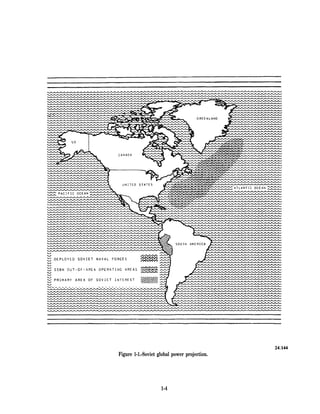
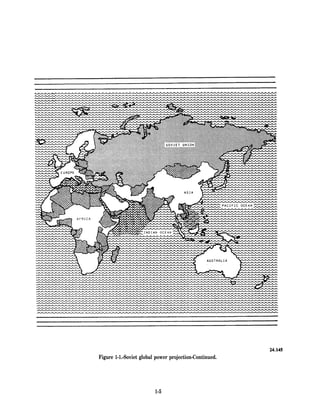
bases or en route to those ocean areas the United                The Soviet Union confines its power projection
States desires to protect. Power projection also            (fig. 1-1 ) to areas close to the Soviet Union with
includes destroying the supply lines of the enemy           one exception. Soviet fleet ballistic missile sub-
and preventing enemy forces from advancing                  marines (nuclear propulsion) (SSBNs) patrol the
within range to use their weapons against U.S.              sea area off the east coast of the United States.
forces.                                                          The traditional U.S. Navy theaters of opera-
                                                            tions include Europe, the Middle East, Africa, the
                                                            Far East, and the Americas. The continuing
Power Projection                                            economic and political changes in those areas now
                                                            and in the future will have an impact on the
    Power projection is the ability to project              Navy’s mission and goals.
military power from the sea worldwide in a timely
and precise manner to accomplish a given
objective. Naval power projection, as an                    Europe
independent mission, is a means of supporting
land or air campaigns. An essential element of                  With the fall of the Berlin Wall and the
power projection is the Navy’s amphibious ships             reunification of Germany, Europe has changed.
that carry U.S. ground forces to enemy shores.              Many of the old boundary lines that separated east
                                                            and west have been removed, which has made
    Power projection covers a broad spectrum of             travel between countries easier. Since the outcome
offensive naval operations. These operations                of the changes in Europe is difficult to predict,
include nuclear response by fleet ballistic missile         let’s look at some trends that have taken place
submarines and use of carrier-based aircraft and            over the last few years.
amphibious assault forces. They also include naval              As the Warsaw Pact navies have been growing
bombardment of enemy targets ashore in support              smaller, North Atlantic Treaty Organization
of air or land campaigns.                                   (NATO) naval forces have been maintaining their
                                                            size. NATO naval forces have also significantly
    Naval forces have unrestricted global mobility          upgraded their antisubmarine warfare, antisurface
based on the traditional and time-honored                   warfare, and air defense capability. The German
concept of the free use of international seas. In           navy replaced its F-104s with the Tornado and
many cases, naval forces can perform assigned               upgraded NATO’s defense capability of the Baltic
missions while remaining beyond the range of the            approaches. U.S. Navy and Marine upgrades
local enemy threat. The mobility of naval forces            include the F/A-18, F-14D, and AV-8B. The
seriously complicates the enemy’s detection and             United States upgrade provides Supreme Allied
targeting capability. Mobility also permits the             Commander, Atlantic (SACLANT), with more
concentration of naval forces and the element of            offensive and defensive capability in the
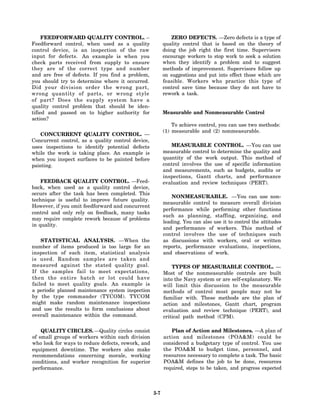
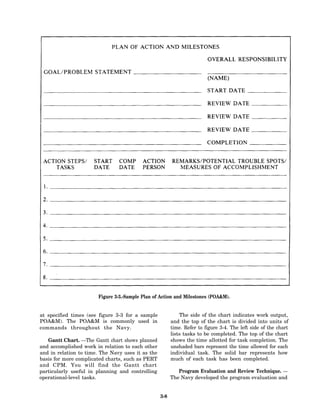
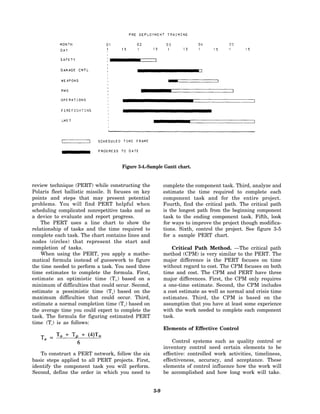
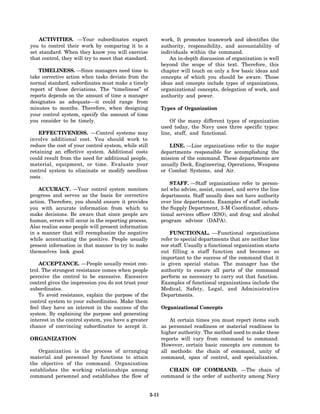
surprise.                                                   Norwegian and Mediterranean Seas.


                                                      1-3
Figure 1-1.-Soviet global power projection.


                    1-4
Figure 1-1.-Soviet global power projection-Continued.


                         1-5
anticipation of future arms control talks.
                                                                 Although the Soviets may increase future with-
                                                                 drawals of troops from the European theater, they
                                                                 still have an impressive reserve and mobilization
                                                                 capacity. The Soviets are reducing their total force
                                                                 numbers and using the best of their excess equip-
                                                                 ment to modernize their remaining forces.
                                                                      The Soviets have taken on a long-range
                                                                 strategic nuclear modernization program to
                                                                comply with strategic arms reduction treaty
                                                                constraints expected in the future. The Soviets are
                                                                replacing their large, out-of-date missiles with
                                                                newer, more efficient and accurate missile
                                                                systems. The Soviets will continue to upgrade their
                                                                land- and sea-based ballistic missiles and bombers.
                                                                     As a whole, the Soviet Union is the maritime
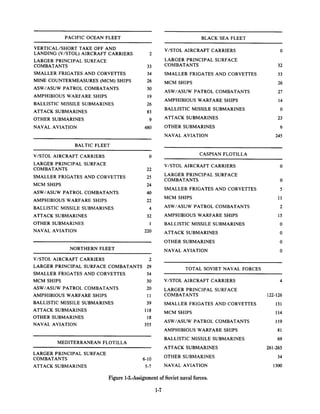
                                                                power (refer to figure 1-3 for assignment of Soviet
                                                                forces) of the Warsaw Pact countries. The U.S.
                                                                Navy’s role in combating that threat is to limit
                                                                the Soviet Northern and Black Sea Fleets in their
                                                                ability to deploy. Surface ships and submarines
                                                                stationed at Severodvinsk must transit the Barents
                                                                Straits and one of three other choke points to
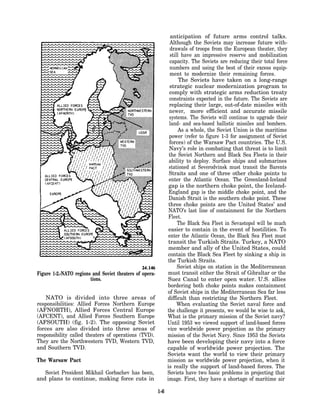
                                                                enter the Atlantic Ocean. The Greenland-Iceland
                                                                gap is the northern choke point, the Iceland-
                                                                England gap is the middle choke point, and the
                                                                Danish Strait is the southern choke point. These
                                                                three choke points are the United States’ and
                                                                NATO’s last line of containment for the Northern
                                                                Fleet.
                                                                     The Black Sea Fleet in Sevastopol will be much
                                                                easier to contain in the event of hostilities. To
                                                                enter the Atlantic Ocean, the Black Sea Fleet must
                                                                transit the Turkish Straits. Turkey, a NATO
                                                                member and ally of the United States, could
                                                                contain the Black Sea Fleet by sinking a ship in
                                                               the Turkish Straits.
                                                                     Soviet ships on station in the Mediterranean
Figure 1-2.-NATO regions and Soviet theaters of opera-         must transit either the Strait of Gibraltar or the
                        tions.                                 Suez Canal to enter open water. U.S. allies
                                                               bordering both choke points makes containment
                                                               of Soviet ships in the Mediterranean Sea far less
    NATO is divided into three areas of                        difficult than restricting the Northern Fleet.
responsibilities: Allied Forces Northern Europe                      When evaluating the Soviet naval force and
(AFNORTH), Allied Forces Central Europe                        the challenge it presents, we would be wise to ask,
(AFCENT), and Allied Forces Southern Europe                    What is the primary mission of the Soviet navy?
(AFSOUTH) (fig. 1-2). The opposing Soviet                      Until 1953 we viewed support of land-based forces
forces are also divided into three areas of                    vice worldwide power projection as the primary
responsibility called theaters of operations (TVD).            mission of the Soviet Navy. Since 1953 the Soviets
They are the Northwestern TVD, Western TVD,                    have been developing their navy into a force
and Southern TVD.                                              capable of worldwide power projection. The
                                                               Soviets want the world to view their primary
The Warsaw Pact                                                mission as worldwide power projection, when it
                                                               is really the support of land-based forces. The
   Soviet President Mikhail Gorbachev has been,                Soviets have two basic problems in projecting that
and plans to continue, making force cuts in                    image. First, they have a shortage of maritime air

                                                         1-6
Figure 1-3.-Assignment of Soviet naval forces.

                     1-7
Ocean or between the oil-rich gulf states and the
                                                              rest of the world.
                                                                  About 10 percent of the world’s sea trade
                                                              passes through the Suez Canal at the choke point
                                                              of Babel Mandeb. Most of the Persian Gulf oil
                                                              passes through the choke point at the Strait of
                                                              Hormuz. Persian Gulf states are expanding
                                                              overland oil pipe routes to lessen the importance
                                                              of commerce through the Straits of Hormuz. The
                                                              overland oil pipes will connect to terminals out-
                                                              side the Persian Gulf.

                                                                  POSSIBLE ADVERSARIES. —The United
                                                              States’ major goals in this region are to provide
                                                              stability and unrestricted seaborne commerce and
                                                              to ensure Western access to regional oil supplies.
                                                              The United States also has strong ties to Israel
                                                              and is committed to ensuring it remains strong
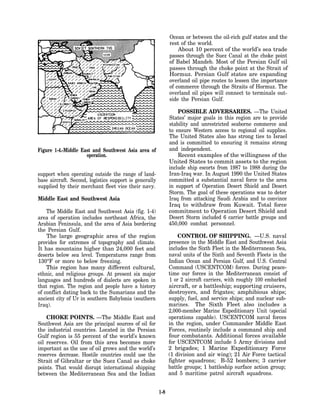
Figure 1-4.-Middle East and Southwest Asia area of            and independent.
                     operation.                                   Recent examples of the willingness of the
                                                              United States to commit assets to the region
                                                              include ship escorts from 1987 to 1988 during the
support when operating outside the range of land-             Iran-Iraq war. In August 1990 the United States
base aircraft. Second, logistics support is generally         committed a substantial naval force to the area
supplied by their merchant fleet vice their navy.             in support of Operation Desert Shield and Desert
                                                              Storm. The goal of these operations was to deter
Middle East and Southwest Asia                                Iraq from attacking Saudi Arabia and to convince
                                                              Iraq to withdraw from Kuwait. Total force
    The Middle East and Southwest Asia (fig. 1-4)             commitment to Operation Desert Shield and
area of operation includes northeast Africa, the              Desert Storm included 6 carrier battle groups and
Arabian Peninsula, and the area of Asia bordering             450,000 combat personnel.
the Persian Gulf.
    The large geographic area of the region                       CONTROL OF SHIPPING. —U.S. naval
provides for extremes of topography and climate.              presence in the Middle East and Southwest Asia
It has mountains higher than 24,000 feet and                  includes the Sixth Fleet in the Mediterranean Sea,
deserts below sea level. Temperatures range from              naval units of the Sixth and Seventh Fleets in the
130°F or more to below freezing.                              Indian Ocean and Persian Gulf, and U.S. Central
    This region has many different cultural,                  Command (USCENTCOM) forces. During peace-
ethnic, and religious groups. At present six major            time our forces in the Mediterranean consist of
languages and hundreds of dialects are spoken in              1 or 2 aircraft carriers, with roughly 100 embarked
that region. The region and people have a history             aircraft, or a battleship; supporting cruisers,
of conflict dating back to the Sumarians and the              destroyers, and frigates; amphibious ships;
ancient city of Ur in southern Babylonia (southern            supply, fuel, and service ships; and nuclear sub-
Iraq).                                                        marines. The Sixth Fleet also includes a
                                                              2,000-member Marine Expeditionary Unit (special
    CHOKE POINTS. —The Middle East and                        operations capable). USCENTCOM naval forces
Southwest Asia are the principal sources of oil for           in the region, under Commander Middle East
the industrial countries. Located in the Persian              Forces, routinely include a command ship and
Gulf region is 55 percent of the world’s known                four combatants. Additional forces available
oil reserves. Oil from this area becomes more                 for USCENTCOM include 5 Army divisions and
important as the use of oil grows and the world’s             2 brigades; 1 Marine Expeditionary Force
reserves decrease. Hostile countries could use the            (1 division and air wing); 21 Air Force tactical
Strait of Gibraltar or the Suez Canal as choke                fighter squadrons; B-52 bombers; 3 carrier
points. That would disrupt international shipping             battle groups; 1 battleship surface action group;
between the Mediterranean Sea and the Indian                  and 5 maritime patrol aircraft squadrons.


                                                        1-8
The routine standing force ensures inter-                   The main mission of the Navy in the North
national waterways remain open to shipping in               African region is to keep the sea-lanes open. The
the region and provides forward deployed U.S.               secondary mission is to support interest and
forces during hostilities. The optional forces              political goals in the region. The major challenger
available to USCENTCOM are used in crisis                   to U.S. sea power in the African theater of
situations. They were deployed in support of                operations is the Soviet Union. Minor challengers
Operation Desert Shield when Iraq invaded                   include Libya (31-42 ships) and Guinea (2-3 ships).
Kuwait in August 1990.
                                                               SOUTHERN AFRICA. —The Soviets wish to
Africa                                                      increase their influence in southern Africa.
                                                            Countries currently friendly to the Soviets include
    Looking at the strategic importance of Africa,          Tanzania, Mozambique, Zambia, Zimbabwe,
we need to divide Africa into northern Africa and           Botswana, Angola, and Namibia.
southern Africa. From a naval viewpoint,
northern Africa is important because it borders                 STRATEGIC RESOURCES. —Africa is
the Mediterranean Sea and the Red Sea. From an              among the world’s richest continents in known
economic or strategic resources viewpoint,                  mineral wealth. It has a large share of the world’s
southern Africa is important because of the vast            mineral resources in coal, petroleum, natural gas,
wealth in minerals it exports to developed                  uranium, radium, low-cost thorium, and other
countries.                                                  valuable ores.
                                                                The abundant natural resources available in
    NORTHERN AFRICA. —Countries receiving                   Africa make it strategically important to Western
Soviet military aid in northern Africa include              nations. The Navy may now appear to have no
Guinea, Mali, Algeria, Libya, Egypt, and                    role in this area except in the Mediterranean Sea
Ethiopia. Of those countries, only Libya has been           and Red Sea. However, we may be called upon
openly hostile to the United States.                        to support U.S. interest in the many regional
    For many years Libya openly sponsored                   conflicts happening in Africa. An example of one
terrorist groups and carried out acts of aggression         of the regional conflicts is the civil war in Liberia,
in the Gulf of Sidra. However, Libya has                    on Africa’s western coast. President Bush ordered
decreased its level of aggression since the U.S.            a Marine amphibious group to that area in May
Navy lead Operation El Dorado on 15 April 1986.             1990 to evacuate personnel. Through September
    Operation El Dorado was a joint Air Force               1990, the Marines evacuated more than 2,100
and Navy mission composed of strike aircraft                people, including over 200 U.S. citizens.
based aboard the USS America (CV66) and USS
Coral Sea (CV43) and F-111 Air Force bombers                The Far East
based in England. Using a high-speed, low-
altitude approach, 12 Navy A-6Es struck the                     Subic Bay Naval Base and Clark Air Base are
Benin airfield and Benghazi military barracks. At           strategically important to U.S. interests in the
the same time, 12 F-111s struck the Aziziyah                Far East. We could lose both bases because their
barracks, the Sidi Bilal terrorist training camp,           leases must be periodically renegotiated with the
and the Tripoli military airport. Navy and Marine           Philippine government. These bases are on the
F/A-18s destroyed surface-to-air missile sites,             sea-lanes and air routes to the Indian Ocean and
while Navy E-2Ds, Navy and Marine EA-6Bs, and               the Persian Gulf. Both bases played a vital role
Air Force F-11 1s provided electronic counter-              in Operation Desert Shield. The bases also play
measures and command and control support.                   a vital role in extending the range of U.S. forces.
Navy F-14s and F/A-18s were on station to                   Much of the world’s oil that travels by ship
provide fighter support.                                    through the various straits in the Indonesian area
    The successful attack caught the Libyans by             are within range of U.S. bases in the Philippines.
surprise. Except for sporadic surface-to-air                    The U.S. strategic objective in the East Asia
missiles, the Libyans did not engage the U.S.               and Pacific area is to deter war. Strategic strike
strike force. The United States’ display of force           capability, Pacific Command (PACOM) forces,
and stated willingness to strike again has played           bilateral defense treaties, forward deployment and
a major role in deterring Libyan President                  basing, and weapons technology all contribute to
Muammar Muhammad al-Qaddafi from sponsoring                 deterrence in the region. If deterrence fails, the
further terrorist attacks against Americans.                United States and the Soviet Union could become


                                                      1-9
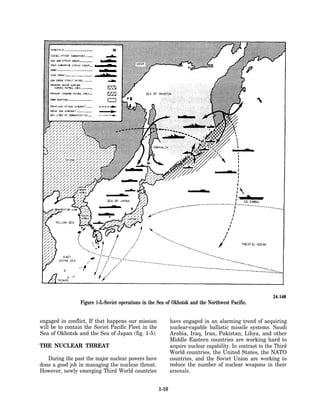
Figure 1-5.-Soviet operations in the Sea of Okhotsk and the Northwest Pacific.


engaged in conflict, If that happens our mission            have engaged in an alarming trend of acquiring
will be to contain the Soviet Pacific Fleet in the          nuclear-capable ballistic missile systems. Saudi
Sea of Okhotsk and the Sea of Japan (fig. 1-5).             Arabia, Iraq, Iran, Pakistan, Libya, and other
                                                            Middle Eastern countries are working hard to
THE NUCLEAR THREAT                                          acquire nuclear capability. In contrast to the Third
                                                            World countries, the United States, the NATO
   During the past the major nuclear powers have            countries, and the Soviet Union are working to
done a good job in managing the nucIear threat.             reduce the number of nuclear weapons in their
However, newly emerging Third World countries               arsenals.


                                                     1-10
Arms Control                                                  Present Posture

    The American quest for stability and the                      The Soviet navy could pose the greatest
willingness of the Soviets to bargain have led to             potential threat to the U.S. Navy. Realistically,
arms control negotiations. That is not a new                  however, small Third World navies now pose
effort. A history of arms control agreements                  more of an actual threat to U.S. naval forces.
exists between the two superpowers stretching                 Since the U.S. Navy is primarily prepared to
back to 1959.                                                 engage the Soviet navy, we will compare U.S. and
    The first round of Strategic Arms Limitation              Soviet maritime missions.
Talks (SALT), concluded in 1972, produced the                     The Soviet navy’s primary mission is to be
Antiballistic Missile (ABM) Treaty that severely              prepared to conduct strategic nuclear strikes from
restricts the deployment of ABM systems by either             SSBNs operating in protected waters close to the
country. The SALT I also produced the Interim                 Soviet Union. The key to carrying out that
Agreement on Strategic Offensive Arms that                    mission is strategic defense of seaward approaches
placed limits on the number of strategic nuclear              to the Soviet Union. The Soviet navy, air
weapons. That agreement was to remain in effect               force, and army will try to control the Soviet
for 5 years, but both countries pledged to abide              Union’s peripheral seas and key land masses.
by its provisions until further negotiations were             The Soviets’ aim in controlling these areas
concluded.                                                    is to deny Western access to areas needed to
    In 1974 both countries agreed to maintain an              threaten Soviet SSBNs. The Soviets usually
equal number of strategic delivery vehicles.                  create sea denial zones up to 2,000 kilometers
Additionally, they agreed to sublimit the number              from the Soviet mainland. The primary targets
of delivery vehicles they could equip with                    in the sea denial zones are sea-launched cruise-
multiple independently targetable reentry vehicle             missile-equipped submarines, surface ships, and
(MIRV) warheads. Those agreements formed the                  aircraft carriers.
basis for the SALT II agreement in 1979. SALT II
continued the agreement of equal limits but                       Disruption of U.S. supply lines to Europe and
lowered the level of limitation on strategic                  Asia is another Soviet objective. The Soviets will
weapons delivery systems. That new agreement                  attempt to interdict sea lines of communications
forced the Soviet Union to dismantle several                  (SLOC) and establish sea denial zones. During
hundred missile launchers. In addition, the                   conflict the Soviets are expected to attack critical
SALT II agreement placed sublimits on MIR V                   SLOCs that link the United States and its allies.
ballistic missiles in general and on MIR V                    The Soviet submarine force plays a primary role
intercontinental ballistic missiles (ICBMs) in                in the disruption of SLOCs.
particular. A provision, which accompanies                        The U.S. national security strategy is based
the basic treaty, imposes restraints on the                   on deterrence, forward defense, and collective
development of new and more sophisticated                     security. Forward-deployed U.S. and allied
weapons.                                                      combat ready naval forces can provide a visible
    The United States sees arms control as an                 deterrent to any country bordered by an ocean
important complement to the strategy of                       or a sea. These forces operate globally in support
deterrence. We are seeking to reach an agreement              of bilateral and multilateral commitments and
with the Soviet Union on a Strategic Arms                     project military power in support of national
Reduction Treaty (START). Our objective is to                 policy and interest. U.S. naval forces have four
enhance strategic stability through equal and                 primary peacetime objectives:
verifiable limitations on both sides. Despite some
key differences on issues, we are confident an                   1. Defending the continental United States
agreement can be reached.                                           (CONUS) from attack
    In negotiations the United States will continue              2. Assuring freedom of the seas and pro-
to try to limit American-Soviet competition in                      tecting important SLOCs from adversaries
strategic nuclear forces. The United States will                 3. Providing regional stability by supporting
continue to pursue the basic objectives of strategic                friends and deterring aggression
deterrence, adequate stability, and equivalence.                 4. Functioning as a visible power projection
That process began with the SALT I agreement                        force capable of responding to crises and
and has progressed through the SALT II and                          low-intensity conflicts on short notice
START.                                                              anywhere in the world


                                                       1-11
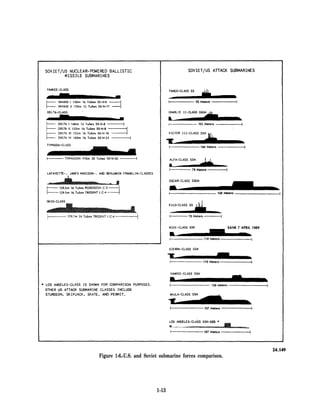
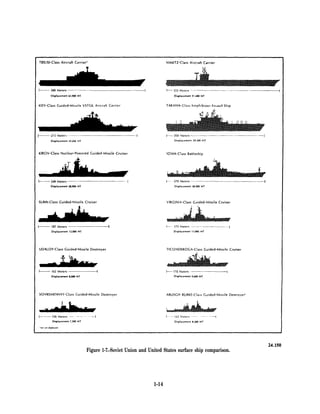
Should deterrence fail, the U.S. Navy’s                       SURFACE SHIPS. —The Soviet Union and
mission is the forward defense of the United States           the U.S. naval surface forces have different
and its allies. The key objective is protection of            missions (fig. 1-7). The Soviets are primarily a
SLOCs from the United States to Europe and                    coastal navy emerging into a blue water fleet.
Asia. To accomplish that objective, the U.S. Navy             The Soviets can provide only limited long-range
will engage Soviet naval forces in the Soviet “sea            power projection of surface forces or naval air
control” and “sea denial” zones. The overall                  superiority. These limitations result from their
objective of the engagement will be to remove the             primary mission of providing protection to the
enemy’s offensive and defensive capabilities and              mainland and defending the ballistic missile
ensure freedom of the seas for the United States              submarine force close to the mainland.
and its allies while deterring Soviet use of nuclear              The principle weakness of the Soviet navy is
weapons at sea.                                               its relative lack of priority in providing underway
                                                              replenishment. The Soviets rely on their extensive
                                                              merchant fleet to provide supplies to ships
    SUBMARINES. —The last U.S. diesel sub-
                                                              engaged in sustained long-range operations.
marine, the USS Blueback (SS 581), was
                                                                  Another weakness of the Soviet surface navy
decommissioned on 1 October 1990. The remaining
                                                              is the lack of long-range air power like that
U.S. attack submarine force is composed of
                                                              provided by a U.S. carrier battle group. That
Sturgeon-, Skipjack-, Skate-, Permit-, and
                                                              situation will change somewhat as aircraft carriers
Los Angeles-class nuclear-powered submarines                  now under construction are brought into service
(SSNs). The United States SSBNs form the sea
                                                              during the 1990s.
leg of the U.S. Trident nuclear deterrent. The
SSBN force includes the Lafayette-, James
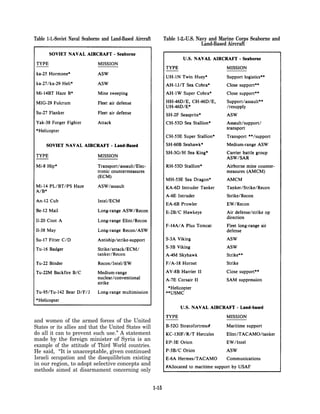
                                                                  AIRCRAFT. —Soviet shipborne capable air-
Madison-, Benjamin Franklin-, and Ohio-class
                                                              craft are primarily limited to helicopters and
submarines (fig. 1-6).                                        vertical/short takeoff and landing (V/STOL)
    The United States has a smaller, but more                 aircraft. The Soviets are increasing their air
effective, submarine force than the Soviets                   capability with the introduction of the new Tbilisi-
because of a superior knowledge of submarine                  class aircraft carrier that will include the new
technology. That technology has resulted in                   Yak-41 V/STOL fighter and the Su-27 Flanker.
superior submarine quieting systems, combat                   Despite the introduction of that class of aircraft
systems, and antisubmarine warfare (ASW) open                 carrier, Soviet naval aviation (refer to table 1-1)
ocean acoustic surveillance and detection systems.            will remain primarily a land-based force.
These systems enable the United States and its                    U.S. naval aviation (refer to table 1-2) is a
allies to maintain a superior technological and               versatile multimission force capable of providing
numerical advantage over the Soviet submarine                 fleet defense, ASW, and long-range strike and
force.                                                        attack capability. The United States should
    The principle Soviet platform for both                    continue to retain a significant advantage in
offensive and defensive naval warfare is the                  seaborne air power for the foreseeable future.
submarine. The Soviets use the SSBN as their
principle strategic platform. They use attack (SS             CHEMICAL AND
and SSN) and cruise missile (SSGN) submarines                 BIOLOGICAL WEAPONS
to counter submarine and surface ship threats.
The SS, SSN, and SSGN submarines are the                          The increase of chemical and biological
primary threat to U.S. and allied sea lines of                weapons has become a global problem. To date,
communications (SLOCs). The Soviet navy has                   more countries than ever have chemical and
the world’s largest general-purpose submarine                 biological weapons. It is alarming that many of
force, totaling about 300 active units. We expect             these countries are in areas of strategic importance
the Soviets to decrease their submarine force in              to the United States. In the Middle East the
number during the 1990s and beyond. That                      problem is particularly acute.
decrease will occur as they replace older sub-                    Third World countries view the use of
marines with newer diesel and nuclear-powered                 chemical and biological weapons differently than
submarines. The decrease in the total number of               the United States. The United States’ stance on
submarines will not lessen the threat of their                chemical and biological weapons is “that it is
submarine force because of improvements in                    abhorrent, reprehensible, and unacceptable that
design, stealth, and combat capability.                       chemical weapons ever be used against the men


                                                       1-12
Figure 1-6.-U.S. and Soviet submarine forces comparison.


                          1-13
Figure 1-7.-Soviet Union and United States surface ship comparison.


                               1-14
Table 1-1.-Soviet Naval Seaborne and Land-Based Aircraft          Table 1-2.-U.S. Navy and Marine Corps Seaborne and
                                                                                    Land-Based Aircraft -


and women of the armed forces of the United
States or its allies and that the United States will
do all it can to prevent such use.” A statement
made by the foreign minister of Syria is an
example of the attitude of Third World countries.
He said, “It is unacceptable, given continued
Israeli occupation and the disequilibrium existing
in our region, to adopt selective concepts and
methods aimed at disarmament concerning only


                                                           1-15
one kind of mass destruction weapon without                   of the leaders of Iran, Iraq, and Libya in their
taking into account the need of disarmament                   use of chemical weapons.
concerning other forms.” Clearly, these countries
consider chemical and biological weapons as an                Iran
economical alternative to nuclear weapons. They
are unwilling to talk of disarmament without                       Iran has been hostile toward the United States
linking chemical and biological weapons to                    since radical, religious forces overthrew the
nuclear weapons.                                              government in 1979. Iran is an Islamic Republic
     The rise of chemical and biological weapons              with ties to the Soviet Union, from whom it buys
in the Middle East has been linked to Israel and              many of its military weapons.
France. Israel and France were joint partners in                  During the 8-year Iraq-Iran war, the United
a nuclear warhead development program from                    States supported Iraqi President Saddam Hussein
 1957 to 1959. France successfully tested a nuclear           in an attempt to topple the Iranian government.
device in 1960. Israel used its connection with               In a strange turn of events, the United States
France to obtain a research reactor from France.              asked Iran for support of Operation Desert
Israel will neither confirm nor deny that it has              Shield.
nuclear weapons, but for many years Israel was                    Also during 1987 to 1988, U.S. warships
thought to possess between 20 to 25 devices of                ensured freedom of passage to tankers carrying
20-kiloton size. New evidence suggests that Israel            oil through the Persian Gulf. U.S. forces engaged
has between 100 and 200 nuclear warheads and                  elements of the Iranian navy and attacked Iranian
can produce thermonuclear devices. Israel also has            oil platforms in the Persian Gulf.
weapons delivery systems in the form of aircraft,                 The Iranians have an arsenal of Soviet SS-1
the Lance missile (mobile, 100-kilometer range),              (Scud-B) missiles and would like to develop
and the Jerico 2 missile (mobile, 1500-kilometer              their surface-to-surface missile capability. Iran
range).                                                       wants to purchase the Chinese M-9 missile
    In an attempt to decrease the number of                   (600-kilometer range). The Iranians claim they can
nuclear weapons in the Middle East, countries in              produce their own version of the SS-1. They have
that region have conducted preemptive strikes on              produced a version of the Chinese Type 53
nuclear reactors. In September 1980 the Iranians              artillery rocket, called the Oghab, that has a
led a strike against an Iraqi reactor at Osarik. The          40-kilometer range. Iran is also perfecting an
attack damaged the reactor but did not destroy                unguided rocket called the Iran 130, which has
it. The Israelis destroyed the Osarik reactor with            a range of 130 kilometers. These missiles and
an air strike in June 1981.                                   rockets can be fitted with chemical warheads
    The chemical agent most likely to be used by              as well as conventional warheads. The United
countries desiring to produce chemical weapons                States believes Iran has a stockpile of mustard
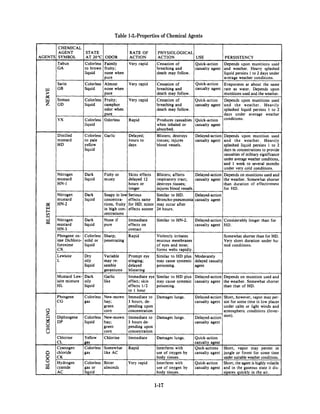
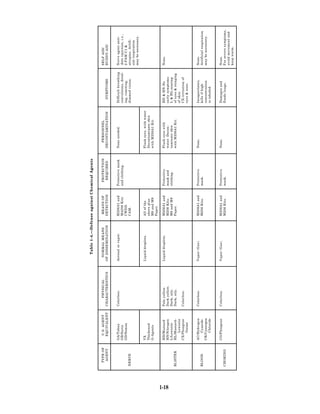
is the nerve agent Tabun. (Refer to tables 1-3 and            gas and phosgene and may be trying to obtain
1-4 for a description of chemical agents and                  nerve gas.
defenses.)
    Any country that has the capability of                    Iraq
producing organophosphorus pesticides can easily
produce Tabun. Other types of nerve agents are                    Iraq is a Soviet client state in the Middle East.
more difficult to produce, but could be done with             From 1980 to 1990 Iraq built up its military until
help from industrialized countries. Countries in              it became the sixth largest military power in the
the Middle East with known or suspected chemical              world. In August 1990 Iraq invaded Kuwait. The
weapons capability include Israel, Egypt, Libya,              stated Iraqi reason for the invasion was a policy
Syria, Iran, and Iraq.                                        difference with Kuwait concerning the price and
                                                              production quota of Kuwaiti oil. The United
                                                              States intervened on behalf of Saudi Arabia to
EMERGENCE OF THIRD                                            stop the Iraqi advance short of the Saudi oil
WORLD COUNTRIES                                               fields.
                                                                  Iraq is working to purchase the technology to
   Of the emerging Third World countries, Iran,               build nuclear weapons. The customs agents of the
Iraq, Libya, and Syria deserve a special look                 United States and England have worked together
because of their past hostility toward the United             to slow the Iraqi effort. They recently intercepted
States. More alarming than the past hostility                 a shipment of electronic components, suitable for
towards the United States is the cavalier attitude            use in nuclear weapons, bound for Iraq.

                                                       1-16
Table 1-3.-Properties of Chemical Agents


                 1-17
Table 1-4.—Defense against Chemical Agents


        TYPE OF     U.S. AGENT      PHYSICAL         NORMAL MEANS       MEANS OF       PROTECTION        PERSONNEL                                    SELF AID/
         AGENT      EQUIVALENT   CHARACTERISTICS   OF DISSEMINATION    DETECTION        REQUIRED       DECONTAMINATION            SYMPTOMS            BUDDY-AID


                  GA/Tabun       Colorless.        Aerosal or vapor.   M256A1 and    Protective mask   None needed.             Difficult breathing   Nerve agent anti-
                  GB/Sarin                                             M4256 Kits    and clothing.                              convulsions, drool-   dote injection, i.e.,
                  GD/Soman                                             CWDD.                                                    ing, vomiting,        2-PAM C1 &
       NERVE                                                           CAM.                                                     dimmed vision.        atropine. Artifi-
                                                                                                                                                      cial respiration
                                                                                                                                                      may be necessary.

                  VX                               Liquid droplets.    All of the                      Flush eyes. with water
                  Thickened                                            above plus                      Decontaminate skin
                  G-Agents                                             M8 and M9                       with M258A1 Kit.
                                                                       Paper.

                  HD/Mustard     Pale yellow.      Liquid droplets.    M256A1 and    Protective        Flush eyes with          HD & HN-No            None.


1-18
                  HN/Nitrogen    Dark yellow.                          M256 Kits.    mask and          water. Decon-            early symptoms.
                  L/Lewisite     Dark, oily.                           M8 and M9     clothing.         taminate skin            L & HL-searing
       BLISTER    HL/Mustard-    Dark, oily.                           Paper.                          with M256A1 Kit.         of eyes & stinging
                      Lewisite                                                                                                  of skin.
                  CX/Phosgene    Colorless.                                                                                     CX-irritation of
                      Oxime                                                                                                     eyes & nose.


                  AC/Hydrogen    Colorless.        Vapor (Gas).        M256A1 and    Protective        None.                    Incapacitates;        None.
       BLOOD          Cyanide                                          M256 Kits.    mask.                                      kills if high         Artificial respiration
                  CK/Cyanogen                                                                                                   concentration         may be necessary.
                      Chloride                                                                                                  is inhaled.


                  CG/Phosgene    Colorless.        Vapor (Gas).        M256A1 and    Protective        None.                    Damages and           None.
       CHOKING                                                         M256 Kits.    mask.                                      floods lungs.         For severe symptoms,
                                                                                                                                                      avoid movement and
                                                                                                                                                      keep warm.
The Iraqis have chemical weapons and have                 East, and the Americas. These areas are changing,
used them both inside their country and against               and the outcome of the changes could have an
Iran. Iran claimed to be victim to 253 chemical               impact on the Navy’s mission and goals.
attacks during its war with Iraq. The United                      The United States, NATO, and the Soviet
Nations investigated the Iranian claims and found             Union have been negotiating treaties to reduce the
evidence to confirm Iraq’s widespread use of                  amount of nuclear weapons they own. In contrast,
mustard gas and nerve agent GA (Tabun).                       many newly emerging Third World countries are
    The Iraqis possess a stockpile of SS-1 (Scud-B)           trying to obtain the technology to produce
and Frog 7 missiles. They may also have the SS-12             chemical, biological, and nuclear weapons.
missile, capable of carrying both nuclear and
chemical warheads. The addition of the SS-12
missile has allowed Iraq to carry out long-range                              REFERENCES
missile attacks against its enemies, including
Israel. Iraq has developed two surface-to-surface             Cheney, Dick, “The Heart of the Soviet Threat,”
missiles: the al-Husayn (650-kilometer range) and                Defense, Volume 90, January/February 1990,
the al-Abos (900-kilometer range).                               pp. 2-7.

Libya                                                         Harristy, Admiral Huntington, “Pacific Watch-
                                                                word is Change,” Defense, Volume 90,
    Libya openly sponsored terrorist attacks                    May/June 1990, pp. 16-23.
against U.S. military personnel in Europe. After              Miller, A. J., “Towards Armageddon: The
the United States attacked Libya in response to                  Proliferation of Unconventional Weapons and
a terrorist attack, terrorist attacks worldwide have             Ballistic Missiles in the Middle East, ” The
decreased. Libya has not recently challenged the                 Journal of Strategic Studies, December 1989,
United States; however, it remains a threat                      pp. 387-401.
because of its large chemical weapon capability.
    Libya may have used chemical weapons                      Powell, General Colin L., “Changes and Chal-
against Chad in 1986. Libya has also drawn inter-                lenges: An Overview,” Defense, Volume 90,
national attention over its efforts to secure nerve              May/June 1990, pp. 8-15.
gas technology. German companies supplying
                                                              —, “Is the Future What It Used to Be?”, Defense,
Libya with technology unknowingly helped Libya
                                                                 Volume 90, January/February 1990, pp. 3-7.
develop its present chemical warfare capability.
                                                              —, “U.S. Military Doctrine: The Way We
Syria                                                           Were—and Are,” Defense, Volume 90,
                                                                March/April 1990, pp. 16-20.
    Syria may be the United States’ most formida-
ble opponent in the Middle East because of its                —, “The Middle East and Southwest Asia,”
offensive chemical weapons capabilities. Syria is               Defense, Volume 90, January/February 1990,
thought to own a wide range of chemical weapons                  pp. 17-22.
including the nerve agent GB (Sarin).                         Schwarzkopf, General H. Norman, ‘‘Turmoil-
    The Syrian arsenal includes the Soviet SS-1,                 Middle East Business as Usual,” Defense,
SS-12 (with warheads for chemical agents                         Volume 90, May/June 1990, pp. 24-30.
including nerve agent VX), and possibly the
Chinese M-9 missiles.                                         Soviet Military Power: Prospects for Changes
                                                                 1989, Superintendent of Documents, U.S.
                                                                 Government Printing Office, Washington,
                   SUMMARY                                       D.C., 1989.
                                                              Welch, Thomas J., “The Growing Global Menace
    Over the last 200 years, the Navy has                        of Chemical and Biological Warfare,”
progressed from a small force of two ships to one                Defense, Volume 90, July/August 1989, pp.
of the largest navies in the world. The mission of               19-27.
the Navy includes naval presence, sea control, and
power projection.                                             Wolfowitz, Paul D., “Strategic Thinking in
    The Navy’s traditional theaters of operations               Today’s Dynamic Times,” Defense, Volume
include Europe, the Middle East, Africa, the Far                90, January/February 1990, pp. 9-11.


                                                       1-19
CHAPTER 2

               MILITARY CONDUCT AND JUSTICE
                                      LEARNING OBJECTIVES

             Upon completion of this chapter, you should be able to do the following:

1. Describe how to conduct a preliminary investi-           3. Describe the content of the Standard Organiza-
   gation of offenses.                                         tion and Regulations of the U. S. Navy.

2. Recognize the purpose and content of U.S.                4. Explain the Status of Forces Agreement
   Navy Regulations.                                           concerning members of the armed forces in
                                                               foreign countries.


   The topics in this chapter deal primarily with            against someone goes through a series of steps
regulations that senior enlisted personnel should            from the time it leaves the initiator to the time
be aware of to perform their job with consistency.           of the preliminary inquiry.
We will first examine the procedures for con-                    The legal officer receives the complaint and
ducting a preliminary investigation of offenses.             drafts charges and specifications against the
Then we will introduce you to the purpose and                accused on a locally prepared report chit form.
content of both U.S. Navy Regulations and                    Following the guidelines of part IV of the Manual
Standard Organization and Regulations of the                for Courts-Martial, 1984 (MCM), the legal officer
U.S. Navy. We will close the chapter with a                  writes the charges and specifications using court-
discussion of the Status of Forces Agreement                 martial language. The charges and specifications
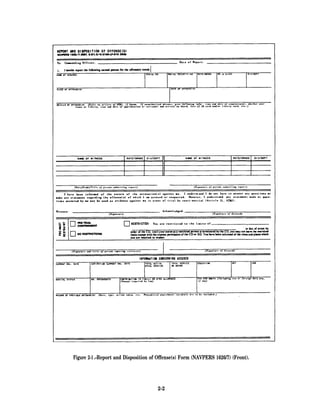
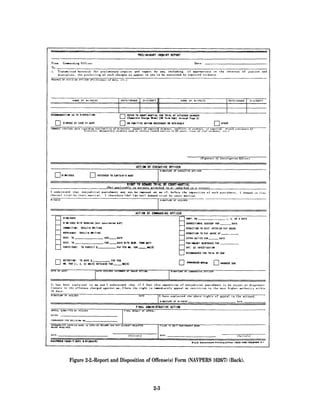
(SOFA).                                                      are then typed on the NAVPERS 1626/7, Report
                                                             and Disposition of Offense(s) form (figs. 2-1
                                                             and 2-2). The accused’s service record supplies
             THE PRELIMINARY                                 the information required on the front of the
              INVESTIGATION                                  report chit. The legal officer or the person who
                                                             submitted the complaint then signs the report.
    At some point in your career, the legal officer              The legal officer conducts a personal interview
may assign you to serve as a preliminary inquiry             with the accused to inform, the person of his
officer (PIO). As the PIO you will conduct an                or her rights under article 31(b) of the Uniform
investigation of offenses before a captain’s mast            Code of Military Justice (UCMJ). When the
takes place. You will only investigate relatively            accused acknowledges he or she understands
minor offenses that are not under investigation              his or her rights, he or she then signs the
by the Naval Investigative Service (NIS) or a fact-          ACKNOWLEDGED block and the disciplinary
finding body.                                                or legal officer signs the WITNESSED block.

REPORT AND DISPOSITION OF                                       THE ACCUSED SHOULD NOT BE INTER-
OFFENSE(S) (REPORT CHIT)                                    ROGATED AT THIS TIME. The legal officer
                                                            should determine and recommend to the com-
    Naval personnel may be reported for offenses            manding officer or executive officer what
involving military conduct or justice. A complaint          restraint, if any, should be imposed at this time.


                                                      2-1
Figure 2-1 .-Report and Disposition of Offense(s) Form (NAVPERS 1626/7) (Front).


                                      2-2
Figure 2-2.-Report and Disposition of Offense(s) Form (NAVPERS 1626/7) (Back).


                                     2-3
PRELIMINARY INQUIRY                                           4. Originals or copies of documentary
                                                                  evidence
   The legal officer forwards the report chit to              5. If the accused waives all his or her rights,
you. Once you receive it, you can begin conducting                a signed sworn statement by the accused;
the preliminary inquiry of the reported offense.                  or a summary of the interrogation of
You shouId usually conduct the inquiry informally.                the accused, signed and sworn to by the
Your final report on the preliminary inquiry                      accused; or both
should consist of the following items:                        6. Any additional comments you feel are
                                                                  necessary
   1. Report and Disposition of Offense(s)
      (NAVPERS 1626/7)                                     Objective
   2. Investigator’s Report (fig. 2-3)
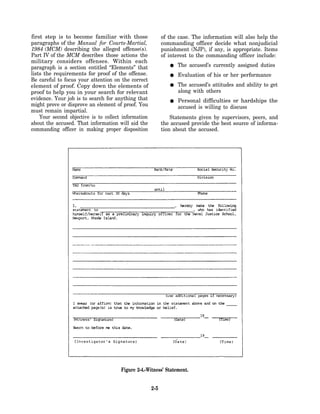
   3. Statements or summaries of interviews with               Your primary objective in conducting the
      all witnesses; sworn statements, if possible         preliminary inquiry is to collect all available
      (fig. 2-4)                                           evidence pertaining to the alleged offense(s). Your


                                    Figure 2-3.-lnvestigator’s Report.


                                                     2-4
first step is to become familiar with those                 of the case. The information will also help the
paragraphs of the Manual for Courts-Martial,                commanding officer decide what nonjudicial
1984 (MCM) describing the alleged offense(s).               punishment (NJP), if any, is appropriate. Items
Part IV of the MCM describes those actions the              of interest to the commanding officer include:
military considers offenses. Within each
paragraph is a section entitled “Elements” that                   The accused’s currently assigned duties
lists the requirements for proof of the offense.                  Evaluation of his or her performance
Be careful to focus your attention on the correct
element of proof. Copy down the elements of                       The accused’s attitudes and ability to get
proof to help you in your search for relevant                     along with others
evidence. Your job is to search for anything that                 Personal difficulties or hardships the
might prove or disprove an element of proof. You                  accused is willing to discuss
must remain impartial.
    Your second objective is to collect information             Statements given by supervisors, peers, and
about the accused. That information will aid the            the accused provide the best source of informa-
commanding officer in making proper disposition             tion about the accused.


                                       Figure 2-4.-Witness’ Statement.


                                                      2-5
Interrogate Witnesses                                          Request that witnesses who have relevant
                                                           information make a sworn statement. If you
   You can obtain a significant amount of infor-           interview a witness by telephone, write a summary
mation from the witnesses. Start by interrogating          of the interview and certify it to be true.
the person who initiated the report and the                    Elicit all relevant information during your
people listed as witnesses. You may discover               interview of a witness. One method is to start with
other persons having relevant information when             a general survey question. Ask the witness to relate
questioning these people.                                  everything he or she knows about the case. Then
                                                           follow-up with more specific questions. After
    Don’t begin the inquiry by interrogating the           speaking with the witness, help the witness write
accused. The accused has the greatest motive for           a statement that is thorough, relevant, orderly,
lying or distorting the truth—if the accused is            and clear. The substance of the statement must
guilty. Leave the interrogation of the accused             consist of the witness’s thoughts, knowledge, or
until last. Even when the accused has admitted             beliefs about the accused. Limit your assistance
guilt, you should first collect all other evidence         to helping the witness express himself or herself
collaborating the confession of the accused.               accurately and effectively in writing.


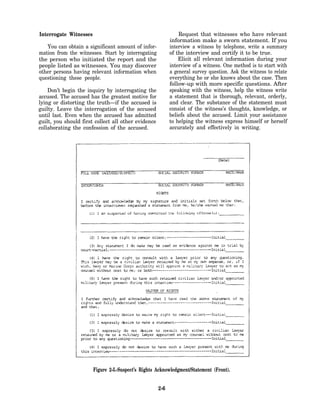
                        Figure 2-5.-Suspect’s Rights Acknowledgment/Statement (Front).


                                                     2-6
Collecting Documentary Evidence                               familiar with the Military Rules of Evidence
                                                              concerning searches and seizures. The Manual for
    Collect documentary evidence such as Shore                Courts-Martial, 1984 contains the Military Rules
Patrol reports, log entries, watch bills, service             of Evidence. Take photographs of an object if it
record entries, local instructions, or organizational         is too large to bring to NJP proceedings. Leave
manuals. Attach the original or a certified copy              real evidence in the custody of a law enforcement
of relevant documents to the investigator’s report.           agency unless otherwise directed; however,
Check to see if you, as investigator, have the                personally examine the evidence.
authority to certify relevant documents. If you do,
                                                              Advise the Accused
write on the documents the words certified to be
a true copy, and sign your name.                                  Before questioning the accused, have the
                                                              accused sign the acknowledgement line on the
Collecting Real Evidence
                                                              front of the report chit and initial any attached
    Real evidence is a physical object, such as a             pages.
knife used in an assault or a stolen camera in a                  Use the Suspect’s Rights Acknowledgment/
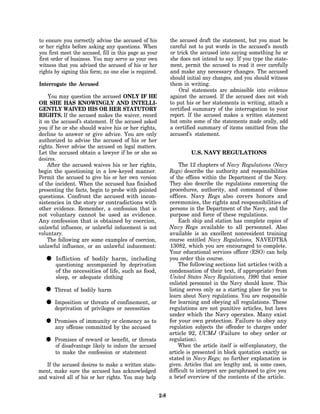
theft case. Before seeking real evidence, become              Statement form (figs. 2-5 and 2-6) as a checklist


                         Figure 2-6.-Suspect’s Rights Acknowledgment/Statement (Back).


                                                        2-7
to ensure you correctly advise the accused of his             the accused draft the statement, but you must be
or her rights before asking any questions. When               careful not to put words in the accused’s mouth
you first meet the accused, fill in this page as your         or trick the accused into saying something he or
first order of business. You may serve as your own            she does not intend to say. If you type the state-
witness that you advised the accused of his or her            ment, permit the accused to read it over carefully
rights by signing this form; no one else is required.         and make any necessary changes. The accused
                                                              should initial any changes, and you should witness
Interrogate the Accused                                       them in writing.
                                                                  Oral statements are admissible into evidence
    You may question the accused ONLY IF HE                   against the accused. If the accused does not wish
OR SHE HAS KNOWINGLY AND INTELLI-                             to put his or her statements in writing, attach a
GENTLY WAIVED HIS OR HER STATUTORY                            certified summary of the interrogation to your
RIGHTS. If the accused makes the waiver, record               report. If the accused makes a written statement
it on the accused’s statement. If the accused asked           but omits some of the statements made orally, add
you if he or she should waive his or her rights,              a certified summary of items omitted from the
decline to answer or give advice. You are only                accused’s statement.
authorized to advise the accused of his or her
rights. Never advise the accused on legal matters.
Let the accused obtain a lawyer if he or she so                        U.S. NAVY REGULATIONS
desires.
    After the accused waives his or her rights,                    The 12 chapters of Navy Regulations (Navy
begin the questioning in a low-keyed manner.                  Regs) describe the authority and responsibilities
Permit the accused to give his or her own version             of the offices within the Department of the Navy.
of the incident. When the accused has finished                They also describe the regulations concerning the
presenting the facts, begin to probe with pointed             procedures, authority, and command of those
questions. Confront the accused with incon-                   offices. Navy Regs also covers honors and
sistencies in the story or contradictions with                ceremonies, the rights and responsibilities of
other evidence. Remember, a confession that is                persons in the Department of the Navy, and the
not voluntary cannot be used as evidence.                     purpose and force of these regulations.
Any confession that is obtained by coercion,                       Each ship and station has complete copies of
unlawful influence, or unlawful inducement is not             Navy Regs available to all personnel. Also
voluntary.                                                    available is an excellent nonresident training
    The following are some examples of coercion,              course entitled Navy Regulations, NAVEDTRA
unlawful influence, or an unlawful inducement:                13082, which you are encouraged to complete.
                                                              Your educational services officer (ESO) can help
  • questioning ofaccompanied by deprivation
    Infliction      bodily harm, including                    you order this course.
                                                                   The following sections list articles (with a
       of the necessities of life, such as food,              condensation of their text, if appropriate) from
       sleep, or adequate clothing                            United States Navy Regulations, 1990 that senior
                                                              enlisted personnel in the Navy should know. This
  • Threat of bodily harm                                     listing serves only as a starting place for you to
                                                              learn about Navy regulations. You are responsible
  • deprivation or threats of or necessities or
    Imposition
                of privileges
                              confinement,                    for learning and obeying all regulations. These
                                                              regulations are not punitive articles, but laws
                                                              under which the Navy operates. Many exist
  • Promises of committed or clemency as to
    any offense
                 immunity
                            by the accused
                                                              for your own protection. Failure to obey any
                                                              regulation subjects the offender to charges under
                                                              article 92, UCMJ (Failure to obey order or
  • Promises of reward ortobenefit,the threats
    of disadvantage likely  induce
                                    or
                                       accused
                                                              regulation).
                                                                   When the article itself is self-explanatory, the
       to make the confession or statement                    article is presented in block quotation exactly as
                                                              stated in Navy Regs; no further explanation is
   If the accused desires to make a written state-            given. Articles that are lengthy and, in some cases,
ment, make sure the accused has acknowledged                  difficult to interpret are paraphrased to give you
and waived all of his or her rights. You may help             a brief overview of the contents of the article.


                                                        2-8
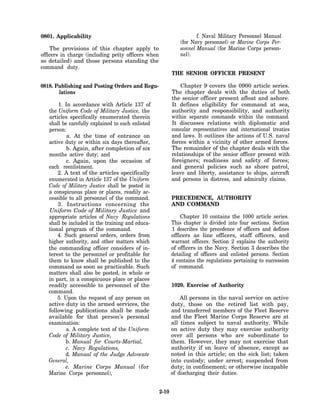
STATUTORY AUTHORITY FOR                                      Secretary of the Navy. Section 2B outlines the
UNITED STATES NAVY                                           responsibilities of staff assistants within the
REGULATIONS                                                  Department of the Navy.

    Chapter 1 contains the 0100 article series. This         THE CHIEF OF NAVAL OPERATIONS
chapter discusses the origin of Navy Regs, the
statutory authority, issuance of other directives,              Chapter 4 contains the 0400 article series. This
and maintenance of Navy regulations.                         chapter describes the responsibilities of the Chief
                                                             of Naval Operations.
0103. Purpose and Effect of United States Navy               THE COMMANDANT OF THE
       Regulations                                           MARINE CORPS
       United States Navy Regulations is the                    Chapter 5 covers the 0500 article series. This
   principle regulatory document of the                      chapter outlines the responsibilities of the
   Department of the Navy, endowed with                      Commandant of the Marine Corps.
   the sanction of law, as to duty, authority,
   distinctions and relationships of various                 THE UNITED STATES COAST
   commands, officials and individuals.                      GUARD (WHEN OPERATING AS A
   Other directives issued within the Depart-                SERVICE IN THE NAVY)
   ment of the Navy shall not conflict with,
   alter or amend any provision of Navy                          Chapter 6 covers the 0600 article series.
   Regulations.                                              The United States Coast Guard is normally a
                                                             component of the Department of Transportation;
                                                             however, upon declaration of war or when
0107. Maintenance of Navy Regulations                        directed by the President, the Coast Guard
                                                             operates as a component within the Department
    The Chief of Naval Operations is responsible
                                                             of the Navy. This chapter assigns the duties of
for maintaining Navy Regulations. Whenever                   the Commandant of the Coast Guard and outlines
any person in the Navy believes a change to Navy             the duties and responsibilities of the office of the
Regulations is needed, that person should forward
                                                             Commandant.
a draft of the change through the chain of
command along with a statement of the reasons                COMMANDERS IN CHIEF
for the change. The Secretary of the Navy must               AND OTHER COMMANDERS
approve all additions, changes or deletions to
Navy Regulations.                                                 Chapter 7 covers the 0700 article series. This
                                                             chapter is divided into three sections. Section 1
                                                             describes the titles and duties of commanders.
THE DEPARTMENT OF THE NAVY                                   Section 2 explains the organization of a staff and
                                                             the authority and responsibility of the staff
   Chapter 2 covers the 0200 article series. This            officers. Section 3 outlines the administration and
chapter discusses the origin and authority of the            discipline of the staff of a commander or a
Department of the Navy and briefly covers its                separate and detached command.
mission and composition.
                                                             THE COMMANDING OFFICER
THE SECRETARY OF THE NAVY                                        Chapter 8 contains the 0800 article series. This
                                                             chapter is divided into three sections. Section 1
    Chapter 3 covers the 0300 article series. This           describes the general authority and responsibilities
chapter is divided into two sections and two                 of the commanding officer. Section 2 outlines the
subsections. Section 1 outlines the responsibilities         additional responsibilities of commanding officers
of the Secretary of the Navy. Section 2 describes            afloat. Section 3, divided into two subsections,
the composition, responsibility, and authority of            covers special circumstances. Subsection A
the Office of the Secretary of the Navy. Section             concerns ships in naval stations and shipyards,
2A outlines the responsibilities of civilian                 and subsection B contains regulations governing
executive assistants within the Office of the                prospective commanding officers.


                                                       2-9
0801. Applicability                                                  f. Naval Military Personnel Manual
                                                              (for Navy personnel) or Marine Corps Per-
    The provisions of this chapter apply to                   sonnel Manual (for Marine Corps person-
officers in charge (including petty officers when             nel).
so detailed) and those persons standing the
command duty.
                                                           THE SENIOR OFFICER PRESENT

0818. Publishing and Posting Orders and Regu-                  Chapter 9 covers the 0900 article series.
       lations                                             The chapter deals with the duties of both
                                                           the senior officer present afloat and ashore.
       1. In accordance with Article 137 of                It defines eligibility for command at sea,
   the Uniform Code of Military Justice, the               authority and responsibility, and authority
   articles specifically enumerated therein                within separate commands within the command.
   shall be carefully explained to each enlisted           It discusses relations with diplomatic and
   person:                                                 consular representatives and international treaties
           a. At the time of entrance on                   and laws. It outlines the actions of U.S. naval
   active duty or within six days thereafter,              forces within a vicinity of other armed forces.
           b. Again, after completion of six               The remainder of the chapter deals with the
   months active duty; and                                 relationships of the senior officer present with
           c. Again, upon the occasion of                  foreigners; readiness and safety of forces;
   each reenlistment.                                      and general policies such as shore patrol,
       2. A text of the articles specifically              leave and liberty, assistance to ships, aircraft
   enumerated in Article 137 of the Uniform                and persons in distress, and admiralty claims.
   Code of Military Justice shall be posted in
   a conspicuous place or places, readily ac-
   cessible to all personnel of the command.               PRECEDENCE, AUTHORITY
       3. Instructions concerning the                      AND COMMAND
   Uniform Code of Military Justice and
   appropriate articles of Navy Regulations                    Chapter 10 contains the 1000 article series.
   shall be included in the training and educa-            This chapter is divided into four sections. Section
   tional program of the command.                          1 describes the precedence of officers and defines
       4. Such general orders, orders from                 officers as line officers, staff officers, and
   higher authority, and other matters which               warrant officers. Section 2 explains the authority
   the commanding officer considers of in-                 of officers in the Navy. Section 3 describes the
   terest to the personnel or profitable for               detailing of officers and enlisted persons. Section
   them to know shall be published to the                  4 contains the regulations pertaining to succession
   command as soon as practicable. Such                    of command.
   matters shall also be posted, in whole or
   in part, in a conspicuous place or places
   readily accessible to personnel of the                  1020. Exercise of Authority
   command.
       5. Upon the request of any person on                    All persons in the naval service on active
   active duty in the armed services, the                  duty, those on the retired list with pay,
   following publications shall be made                    and transferred members of the Fleet Reserve
   available for that person’s personal                    and the Fleet Marine Corps Reserve are at
   examination:                                            all times subject to naval authority. While
           a. A complete text of the Uniform               on active duty they may exercise authority
   Code of Military Justice,                               over all persons who are subordinate to
           b. Manual for Courts-Martial,                   them. However, they may not exercise that
           c. Navy Regulations,                            authority if on leave of absence, except as
          d. Manual of the Judge Advocate                  noted in this article; on the sick list; taken
   General,                                                into custody; under arrest; suspended from
          e. Marine Corps Manual (for                      duty; in confinement; or otherwise incapable
   Marine Corps personnel),                                of discharging their duties.


                                                    2-10
1021. Authority Over Subordinates                           1038. Authority of a Sentry

   This article gives officers the authority                      A sentry, within the limits stated in his
necessary to perform their duties.                             or her orders, has authority over all per-
                                                               sons on his or her post.
1022. Delegation of Authority
                                                            1039. Authority of Juniors To Issue Orders
       The delegation of authority and issu-                       to Seniors
   ance of orders and instructions by a per-
   son in the naval service shall not relieve                      No member of the armed forces is
   such person from any responsibility imposed                 authorized by virtue of his or her rank
   upon him or her. He or she shall ensure                     alone to give any order or grant any
   that the delegated authority is properly                    privilege, permission, or liberty to any of-
   exercised and that his or her orders and                    ficer senior to him or her. A member is not
   instructions are properly executed.                         required to receive such order, privilege,
                                                               permission, or liberty from a junior, unless
1023. Abuse of Authority                                       such junior is at the time:
                                                                   a. in command of the ship or other
       Persons in authority are forbidden to                   command to which the senior is attached
   injure their subordinates by tyrannical or                      b. in command or direction of the
   capricious conduct, or by abusive                           military expedition or duty on which such
   language.                                                   senior is serving
                                                                   c. an executive officer executing an
1024. Contradictory and Conflicting Orders                     order of the commanding officer

    An enlisted person who receives an order                GENERAL REGULATIONS
that annuls, suspends, or modifies one received
from another superior will immediately relate                   Chapter 11 contains the 1100 article series.
that fact to the superior from whom the last                This chapter is divided into five sections. Section
order was received. If, after receiving that                1 covers the topic of administration of discipline.
information, the superior from whom the last                Section 2 outlines the standards of conduct.
order was received should insist upon the                   Section 3 contains regulations governing official
execution of that order, the person must obey               records. Section 4 explains the general duties of
it. The person receiving and executing such                 individuals within the Navy. Section 5 defines the
order will report the circumstances as soon                 rights and restrictions of persons in the naval
as practicable to the superior from whom the                service.
original order was received.
                                                            1111. Pecuniary Dealings With Enlisted Persons
1033. Authority in a Boat
                                                               No officer should have any dealings involving
    This article provides the senior line officer           money with enlisted persons except as may be
eligible for command at sea the authority over all          required in the performance of the officer’s
persons embarked in a boat. It also delegates the           duties or as involved in the sale of personal
officer responsibility for the safety and manage-           property. An officer may be designated by
ment of the boat.                                           superior authority to accept deposits from
                                                            enlisted personnel for the purpose of safe-
1037. Authority of Warrant Officers, Noncom-                guarding these funds under emergency or
       missioned Officers, and Petty Officers               operational situations.

       Chief warrant officers, warrant of-                  1112. Lending Money and Engaging in a Trade
   ficers, noncommissioned officers and petty                       or Business
   officers shall have, under their superiors,
   all necessary authority for the proper per-                 Naval personnel are not permitted to lend
   formance of their duties, and they shall be              money to another member of the armed services
   obeyed accordingly.                                      at an interest rate, for the period of the loan,


                                                     2-11
that exceeds 18 percent simple interest                   1134. Exchange of Duty
    per year. Personnel may not act as a
    salesperson or an agent or engage in a                          An assigned duty may not be changed
    business on board without permission of                      with another person (such as trading
    the commanding officer.                                      watches) without permission from proper
                                                                 authority.
1115. Report of Fraud
                                                              1137. Obligation To Report Offenses
   Any suspicions of fraud, collusion, or
improper conduct in matters concerning supplies
                                                                    All offenses observed should be
and repairs should be reported to proper                         reported to the proper authority.
authority.

1125. Inspection of the Record of a Person in                 1138. Responsibilities Concerning Marijuana,
      the Naval Service                                              Narcotics, and Other Controlled Substances

    A person’s naval record is maintained                         Personnel may not bring on board any naval
by the Chief of Naval Personnel or the                        activity, or have in their possession at any
Commandant of the Marine Corps. The record                    time, marijuana, narcotics, or any controlled
must be available for inspection by that person               substances.
or an authorized agent designated in writing by
that person.
                                                              1143. Report of a Communicable Disease
1130. Officer’s Duties Relative to Laws, Orders
      and Regulations                                             Personnel should report any suspicions of
                                                              communicable disease to their medical represent-
    All officers in the naval service will acquaint           ative.
themselves with and obey the laws, regulations,
and orders relating to the Department of the
Navy. They will also, as far as their authority               1144. Immunization
extends, enforce these laws, regulations, and
orders. They should faithfully and truthfully                     Personnel must take the immunizations pre-
discharge the duties of their office to the best              scribed for them as scheduled.
of their ability in conformance with existing orders
and regulations and their solemn profession
of the oath of office. In the absence of                      1145. Service Examinations
instructions, they will act in conformity with
the policies and customs of the service to protect               No persons in the Navy, without proper
the public interest.                                          authority, should have or attempt to have in their
                                                              possession, any examination papers, any part or
                                                              copy thereof, or any examination answer sheets.
1132. Compliance With Lawful Orders                           They also will not obtain, sell, publish, give,
                                                              purchase, receive, or reproduce any of these
       All persons in the naval service are                   examination products.
   required to obey readily and strictly, and
   to execute promptly, the lawful orders of
   their superiors.
                                                              1150. Redress of Wrong Committed by a
                                                                    Superior
1133. Language Reflecting on a Superior
                                                                  A person who believes a superior exercises
       Do not use language that diminishes                    authority in an unjust or cruel manner or is
   the confidence and respect due superior                    guilty of misconduct should submit a complaint
   officers.                                                  to his or her commanding officer.


                                                       2-12
1151. Direct Communication With the Com-                      1159. Possession of Weapons
       manding Officer
                                                                 Personnel may not have any weapons or
                                                              explosives in their possession without proper
    The right of any person in the naval service
                                                              authority.
to communicate with the commanding officer in
a proper manner, and at a proper time and place,
shall not be denied or restricted.                            1160. Possession of Government Property

                                                                 Personnel will not possess, without permission,
1154. Communications to the Congress                          any property of the United States except what is
                                                              needed in the performance of their duty.
    Personnel may not, in their official capacity,
apply to Congress for congressional action of                 1162. Alcoholic Beverages
any kind or provide information requested by
Congress. The only exception to this regulation                   The personal possession of any alcoholic
is such communication as authorized by the                    beverages aboard any ship is prohibited. The
Secretary of the Navy or as provided by                       transportation aboard ship of alcoholic beverages
law.                                                          for personal use ashore is authorized subject to
                                                              the discretion of, and under regulations established
                                                              by, the commanding officer.
1155. Dealings With Members of Congress

                                                              FLAGS, PENNANTS, HONORS,
   All persons may write to their congressmen
                                                              CEREMONIES, AND CUSTOMS
on any subject as long as they do not violate
security regulations or the law.
                                                                  Chapter 12 covers the 1200 article series. This
                                                              chapter is divided into 10 sections and a listing
                                                              of tables pertinent to the 1200 article series.
1156. Forwarding Individual Requests
                                                              Section 1 contains general regulations governing
                                                              honors. Section 2 outlines honors to national
       Requests from persons in the naval                     anthems and national ensigns. Section 3 explains
   service shall be acted upon promptly.                      hand salutes and other marks of respect. Section
   When addressed to higher authority,                        4 pertains to gun salutes. Section 5 covers
   requests shall be forwarded without delay.                 passing honors. Section 6 contains regulations that
   The reason should be stated when a request                 govern official visits and calls. Section 7 defines
   is not approved or recommended.                            formal occasions other than official visits.
                                                              Section 8 explains the display of flags and
                                                              pennants. Section 9 defines special ceremonies,
1157. Leave and Liberty                                       anniversaries, and solemnities. Section 10 addresses
                                                              deaths and funerals.
     Leave and liberty will be granted to the
   maximum extent practicable.
                                                                  STANDARD ORGANIZATION AND
                                                                  REGULATIONS OF THE U.S. NAVY
1158. Quality and Quantity of Rations
                                                                 The Standard Organization and Regulations
    Meals served in the general mess will be                  of the U.S. Navy (SORN), OPNAVINST
sampled regularly by an officer detailed by the               3120.32B, provides regulations and guidance
commanding officer. If the officer finds the                  governing the conduct of all members of the
quality or quantity of the food unsatisfactory                Navy. This publication specifies duties and
or any member of the mess objects to the quality              responsibilities of personnel within a unit
or quantity of the food, the officer will notify the          organization—from the commanding officer
commanding officer.                                           down to the messenger of the watch.


                                                       2-13
Failure to comply with the provisions of the                      EMI maybe assigned at a reasonable time
regulatory material in chapter 5 of the SORN is                       outside of normal working hours.
punishable in accordance with the Uniform Code
of Military Justice ( UCMJ). Regulatory articles                      EMI will not be conducted over a period
are printed on large posters, which are posted in                     that is longer than necessary to correct the
conspicuous locations aboard naval units.                             performance deficiency.

    When the article itself is self-explanatory,                      EMI should not be conducted on a
the article is presented in block quotation                           members sabbath.
exactly as stated in the SORN; no further
explanation is given. Articles that are lengthy                       EMI will not be used as a method of
and, in some cases, difficult to interpret are                        depriving normal liberty. Normal liberty
paraphrased to give you a brief overview of the                       may commence upon completion of EMI.
contents of the article.
                                                                  The authority to assign EMI rests with the
                                                              commanding officer. Normally, you may assign
UNIT ADMINISTRATION                                           EMI during working hours if the commanding
                                                              officer delegates the authority. However, the
    Chapter 1 covers the administration of a                  commanding officer usually chooses not to
unit and the limits of authority of personnel                 delegate the authority to assign EMI after
in management positions. It also discusses                    working hours; that limits your actions to
organizational theory and defines terms such as               recommending EMI. Refer to the SORN and your
unity of command, span of control, a n d                      command regulations regarding assignment of
leadership.                                                   EMI.

100.1 Relationship to Other Guidance                              WITHHOLDING OF PRIVILEGES —Tem-
                                                              porary withholding of privileges is authorized as
    The SORN issues regulations and standard                  an administrative measure to correct minor
organizational requirements applicable to the                 infractions of military regulations or performance
administration of naval units. Type commanders                deficiencies when punitive action is deemed in-
or higher authority issues additional requirements            appropriate. Privileges that may be temporarily
to supplement the Navywide guidance provided                  withheld include special liberty, exchange of
by the SORN. Guidance is intended to assist                   duty, special pay, special command programs,
commanding officers in administering their unit               bases or ship libraries and movies, command
in the best possible manner.                                  parking, and special services events.

                                                                  PRIVILEGES CAN ONLY BE TEMPO-
142.2 Policy Guidance
                                                              RARILY WITHHELD BY THE PERSON WITH
                                                              THE AUTHORITY TO GRANT THE PRIVI-
   The guidance provided by the SORN helps the
                                                              LEGE —Your action should normally be limited
Navy set policies consistently. A complete policy
                                                              to a recommendation to the chain of command
statement concerning the following items is
                                                              to temporarily withhold a privilege. For further
beyond the scope of this text. You should consult
                                                              guidance, consult the SORN and local regulations
the SORN for specific details. The following is
                                                              concerning withholding of privileges.
a brief look at Navy policies covered by the
SORN; consult the SORN for specific details
                                                                  EXTENSION OF WORKING HOURS —
about each policy:
                                                              Deprivation of normal liberty as punishment
                                                              except as specifically authorized by the UCMJ is
    EXTRA MILITARY INSTRUCTION (EMI) —                        illegal. However, lawful deprivation of normal
This is instruction intended to correct a deficiency          liberty is authorized in certain situations such as
of a person in a phase of military duty. General              pretrial restraint or in a foreign country when such
guidelines are as follows:                                    action is deemed necessary. Working hours may
                                                              be extended for official functions, accomplish-
   • EMI will nothours per day. assigned for
     more than 2
                  normally be                                 ment of essential work, or the achievement of the
                                                              currently required level of operational readiness.


                                                       2-14
You are expected to keep your superiors informed                365.     Division damage control petty officer
when planning to direct your subordinates to work
beyond normal working hours.                                    366.     Work center supervisor (other than
                                                                         aviation units)
    CONTROL THROUGH RECOGNITION
OF PERFORMANCE —You have a basic respon-                     WATCH ORGANIZATION
sibility to recognize initiative and exemplary
performance of your subordinates. Give public                    Chapter 4 describes the responsibilities of the
recognition when appropriate. Make the extra                 watches required for safe and proper operation
effort to provide the following forms of                     of a unit. Refer to the following articles of chapter
recognition:                                                 4 for further information:

  • Award lettersorofrecommend such and
    appreciation
                       commendation
                                     for
                                                                403.     General duties of watch officers and
                                                                         watch standers
       signature of higher authority.
                                                                404.     Watchstanding principles
  • awards. recommendation for higher
    Initiate
                                                                405.     Orders to sentries
                                                                406.     Circumstances under which deadly
  •    Initiate recommendations for sailor of the
       month, quarter, year, force, fleet, and
                                                                         force may be used by security force
                                                                         personnel
       Navy.
                                                                414.     Relieving the watch
  •   Make recommendations for reenlistment,
      assignment to training schools, and educa-                420.     The deck and engineering logs
      tion or advancement programs; document
                                                                421.     The deck log
      exceptional performance in enlisted evalua-
      tions.                                                    441.3 Officer of the deck in-port
STANDARD UNIT ORGAN1ZATION                                      441.7    Department duty officer

    Chapter 2 covers the process and basis for a                442.     Quarterdeck watches
standard unit organization. It includes require-                443.     Security watches
ments for shipboard divisions, aviation units, and
concepts of organization. Refer to the following                444.     Additional watches
articles of chapter 2 for an in-depth explanation:
                                                             REGULATIONS
   230.    Promoting understanding of the organ-
           ization                                              Chapter 5 is an extension of Navy Regs that
                                                             provides greater coverage on general subjects
   231.    Organizational charts                             required for the smooth operation of a unit.

   232.    Functional guides                                 510.5 Armed Forces Identification Cards and
                                                                    Leave Papers
THE UNIT ORGANIZATION
                                                                 No person without proper authority shall:
    Chapter 3 describes the responsibilities of the
various billets within an organization. Refer to                      a. Have in his/her possession more than
the following articles of chapter 3 for an in-depth              one properly validated Armed Forces Iden-
explanation:                                                     tification Card.
                                                                      b. Depart on liberty without his/her
   351.    Department duty officer                               own properly validated identification card;
                                                                 or, in the case of leave, without his/her own
   364.    Division leading chief petty officer                  properly validated leave papers and iden-
           (LCPO)                                                tification card.


                                                      2-15
c. Have in his/her possession a false                  b. Engage in any card games or other
   or unauthorized identification card; or a               games during prescribed working hours or
   mutilated, erased, altered, or not properly             during the hours between taps and reveille,
   validated identification card; or an iden-              or during divine services.
   tification card bearing false or inaccurate
   information concerning a name, grade,                   510.10 Civilian Clothing
   service number, or date of birth.
        d. Return from leave without                         You may wear civilian clothing based on the
   depositing his/her leave papers with the             following regulations unless the privilege has been
   proper authority. Any person returning               suspended.
   without an identification card shall report
   the loss to the OOD in person.
                                                          •    You are permitted to wear civilian clothing
                                                        when leaving or returning to a naval unit, awaiting
510.7 Berthing                                          transportation to leave the unit, while on authorized
                                                        leave of absence, liberty, or in any off-duty status
   No person will:                                      on shore.
      a. Sleep in any spaces or use any bunk
  or berth other than that to which assigned,              •   Your dress and personal appearance must
                                                        be appropriate for the occasion and not bring
  except as authorized by proper authority.             discredit on the naval service. Uniform items may
      b. Sleep or lie on any bunk or berth              not be worn with civilian clothing except as
  while clothed in dungarees or working                 provided in U.S. Navy Uniform Regulations.
  clothes or while wearing shoes.
      c. Smoke while sitting or lying on any
  bunk or berth, or smoke in any berthing                  510.18 Emergency Equipment
  space during the night hours between taps
  and reveille.                                                NO PERSON shall use emergency
      d. Remove any mattress from any                      equipment for any purpose other than that
  bunk or place of stowage or place such                   for which it is intended. Emergency equip-
  mattress on the deck or in any place other               ment includes items such as battle lanterns,
  than a bunk, except as authorized by                     EMERGENCY FIRST AID boxes, shoring,
  proper authority.                                        wrenches, life rings, equipment in life rafts
      e. Create a disturbance or turn on any               and boats, portable fire pumps, fire hoses,
  white light in any berthing or living space              and fuel for emergency machinery.
  during the night hours between taps and
  reveille, except as required to perform                  510.21 Government Property
  assigned duties.
       f. Fail to turn out of his/her bunk at              No person shall:
  reveille, except when he/she is on the sick
  list or authorized to late bunk.                             a. Conceal or fail to report to proper
      g. Be authorized late bunk privileges                authority the loss, removal, destruction,
  unless he/she has had a midwatch or made                 or damage of Government property en-
  a boat trip as a crew member after 2200                  trusted to his/her care or custody.
  the previous day or is specifically author-                  b. Remove without proper authority
  ized late bunk privileges by the Executive               from its regular place of stowage or
  Officer or Command Duty Officer. All                     location, for any purpose whatever, any
  late bunk sleepers will turn out at 0700.                article of Government property, including
                                                           hull and damage control fittings, first aid
510.9 Card Games and Gambling                              equipment, life saving and emergency
                                                           equipment, and stores and foodstuffs.
   No person will:                                             c. Have in his/her possession any
                                                           article of Government property except as
      a. Gamble for money with playing                     may be necessary for the performance of
  cards, dice, or other apparatus or methods               his/her duty or as may be authorized by
  on board naval units.                                    proper authority.


                                                 2-16
510.22 Grooming and Personal Appearance                       service number of another person which
                                                              has not been marked “DC” by the Chief
     It is the responsibility of officers in com-             Master-At-Arms and recorded in the DC
  mand to ensure their personnel are neat                     clothing record book.
  and well groomed at all times. (See U.S.                        e. Sell, barter, exchange, lend, or give
  Navy Uniform Regulations, NAVPERS                           away clothing, arms, military outfits, or
  15665G, for current standards.)                             equipment furnished by the government.
                                                              No names, designs, or marks except the
510.24 Hitchhiking                                            number prescribed for official identifica-
                                                              tion will be placed on any foul weather
      No naval personnel will, on a public                    clothing or other equipment furnished by
  road, street, or highway, endeavor by                       the government.
  words, gestures, or otherwise to beg,                           f. Wear or have exposed upon the
  solicit, or hitchhike a ride in or on any                   uniform, articles such as watch chains,
  motor vehicle. Accepting rides at established               fobs, pins, jewelry, handkerchiefs, combs,
  service personnel pickup stations is                        cigars, cigarettes, pipes, or similar items,
  authorized.                                                 except that tie clasp, cuff links, shirt studs,
                                                              and earrings will be worn as prescribed in
510.25 Indebtedness                                           Uniform Regulations. Wearing of wrist
                                                              watches, identification bracelets, and
       Since indebtedness brings a discredit                  inconspicuous rings is permitted. No
   to the naval service, debts shall not be                   eccentricities in dress will be permitted.
   incurred when there is no reasonable
   expectation of repaying them. The Com-                  510.40 Personal Effects
   manding Officer’s interest in the matter of
   indebtedness of personnel attached to a                       The command and individuals have a
   naval unit will be directed principally to                 shared responsibility to safeguard the
   the establishment of facts so that corrective              personal property of members of the unit.
   or disciplinary measures may be taken.
                                                                  a. No person will maintain personal
510.32 Mess Gear                                              belongings or other articles in any locker
                                                              closet, peacoat locker, or space other than
       The removal of mess gear from the                      that regularly assigned to him/her or
   mess decks is prohibited. The senior petty                 authorized by proper authority to use.
   officer in charge of the compartment in                        b. Each person is responsible for
   which mess gear is found will ensure its                   obtaining a lock and keeping his/her
   immediate return to the mess decks.                        locker locked at all times. Any evidence of
                                                              tampering with locks or unauthorized
510.37 Outfits, Uniforms, and Clothing                        entry into a personal locker will be
                                                              reported to the Chief Master-At-Arms
   No person will:                                            immediately.
                                                                  c. When any enlisted person on board
       a. Wear frayed, torn, dirty, or other-                 a naval unit is declared a deserter or
   wise mutilated clothing.                                   becomes mentally or physically incapaci-
       b. Wear any article of clothing which                  tated to the extent that he/she can no
   is not prescribed as a part of the uniform                 longer care for his/her personal effects,
   of the day.                                                they will be collected, inventoried, and
       c. Wear any article of a naval uniform                 sealed by a division petty officer in the
   in a manner that would bring discredit to                  presence of the division officer and a
   the naval service.                                         master-at-arms and delivered to the Chief
       d. If that person is enlisted, have any                Master-At-Arms for safekeeping and dis-
   article of uniform clothing which is not                   position in accordance with current
   legibly marked with his/her name and/or                    instructions. Only personnel designated
   service number; or any article of clothing                 will handle or disturb in any way the
   or bedding marked with the name and/or                     personal effects of another person.


                                                    2-17
d. The personal effects of an absent or          Additional Regulatory Articles of Interest
   incapacitated officer will be inventoried
   and packed by two officers designated by                The following is a list of regulatory articles
   the Executive Officer and will be delivered          you should be familiar with:
   to the supply office for safekeeping and
   disposition per current instructions.                   510.47 Refuse, rubbish, trash, garbage,
                                                                  hazardous waste, oils, and oily waste
510.44 Photographic Equipment                                     disposal

   No person shall:                                        510.48 Removal of equipment from ship

       a. Possess or introduce on board a                  510.52 Safe combinations
   naval unit any camera or other photo-
   graphic equipment capable of exposing a                 510.54 Search and seizure
   photographic plate or film without
   permission of the Commanding Officer or                 510.59 Smartness
   his authorized representative.
       b. Make photographs of a naval unit                 510.61 Special clothing
   or its equipment, or of objects from the
   unit, without permission of the Com-                    510.68 Unauthorized articles
   manding Officer, and then only of the
   objects for which permission was specifi-
   cally given.                                         UNIT BILLS
       c. While on watch or duty as a sentry
   or member of a patrol, knowingly permit                  Chapter 6 provides the guidelines for estab-
   the introduction of any camera or photo-             lishing administrative, operational, emergency,
   graphic equipment on board a naval unit              and special unit bills.
   unless such equipment is authorized by
   the Commanding Officer or authorized                 SAFETY
   represent ative.
                                                           Chapter 7 provides for a safety program and
510.45 Plan of the Day                                  covers the internal reporting of mishaps and
                                                        hazards.
       A plan of the day will be published
   daily by the Executive Officer or an
   authorized representative and will issue             TRAINING
   such orders and directives as the Executive
   Officer may issue. When the Executive                   Chapter 8 establishes the elements and pro-
   Officer is absent from the unit it will be           cedures for an effective training program.
   issued by the Command Duty Officer.
                                                        SHIP MAINTENANCE
      a. The Plan of the Day will be posted             AND MODERNIZATION
  on all department and division bulletin
  boards.                                                  Chapter 9 explains the Ship Maintenance and
      b. All persons will read the Plan of the          Modernization program aimed at providing the
  Day each day. They are responsible for                maximum operational availability to fleet
  obeying applicable orders contained                   commanders.
  therein. In port, the Plan of the Day will
  be read at quarters.
                                                        UNIT DIRECTIVES SYSTEM
510.46 Profane Language
                                                            Chapter 10 sets forth and explains the pro-
      No person will use profane, obscene,              cedures and purpose of the unit directives system
   or vulgar words or gestures on board a               the Navy uses to communicate plans and policies
   naval unit.                                          throughout the Navy.


                                                 2-18
STATUS OF FORCES AGREEMENTS                                      The development of a collective defense in
                                                                peacetime requires that forces of various countries
    Many persons are under the impression that                  be stationed in the territory of other treaty
because they are attached to a ship visiting a                  countries. Those forces form an integrated force
foreign port, they are immune from jurisdiction                 for the defense of those countries involved. The
of the local government. That is true as long as                forces must be free to move from one country to
they remain aboard or go ashore only on official                another under the demands of strategy. There-
business. When they go ashore on liberty,                       fore, uniformity of arrangements and procedures
however, they are subject to the jurisdiction of                governing the status of such forces in countries
the foreign sovereign for any infractions of the                other than their own and their relationship to the
law, whether criminal or civil. The Department                  civilian authorities is essential. The Status of
of Defense protects your rights as much as                      Forces Agreements, accordingly, try to regulate
possible if you are brought to criminal trial by                that relationship in two ways. First, they
foreign courts. To be allowed to protect your                   guarantee the armed forces adequate legal
rights, the United States entered into agreements               protection without infringing on the authority of
with several of our allied countries. The                       the military command. Second, they fully
agreements are called the Status of Forces                      recognize the peacetime rights and responsibilities
Agreements (SOFAs).                                             of the civilian authorities in the host countries.
    A Status of Forces Agreement contains a                         The United States must receive consent from
complex package of treaties, protocol, and                      the host country to station troops on that foreign
executive agreements between the United States                  soil. We must also agree to the conditions under
and the individual country involved. It defines the             which our troops may remain.
rights and duties of U. S. service personnel, civilian              The original intent of the Status of Forces
components, and their dependents while they are                 Agreements by the United States was to get the
stationed in that foreign country.                              most favorable conditions from the host country
    The agreements are by no means identical in                 for our own forces.
all countries. To a large measure, the differences                  The agreements apply to personnel belonging
in agreements resulted from the contrasting                     to the land, sea, and air armed forces, as well as
political realities that faced the negotiators of               civilian personnel accompanying an armed force.
different countries.                                            Article II of the NATO Status of Forces Agree-
                                                                ment sets forth the basic principle to be observed
PURPOSE OF SOFA                                                 by any force in a country other than its own:

    The main purpose of SOFAs is to clearly                            It is the duty of a force and its civilian
define the status of one country’s military                        component and the members thereof as
personnel stationed in the territory of another.                   well as their dependents to respect the law
The SOFAs say, in part, that the country we are                    of the receiving State, and to abstain from
visiting will give up some jurisdiction to the                     any activity inconsistent with the spirit of
visiting country in some criminal and civil cases.                 the present Agreement, and in particular,
Some topics covered by the Status of Forces                        from any political activity in the receiving
Agreements are as follows:                                         State. It is also the duty of the sending
                                                                   State to take necessary measures to that
        Freedom of troop movements within the                      end.
        host country
                                                                DEVELOPMENT OF SOFA
        Passport requirements
                                                                    Why does the United States station large
        Criminal jurisdiction                                   contingents of forces in foreign countries, and
                                                                why does the status of these forces have to be
        Taxes
                                                                defined by agreements?
        Imposition of customs duties                                The United States has accepted the fact that
                                                                the only true security available in this modern
        Regulations covering driver’s license                   world is collective security. Congress has
                                                                demonstrated time and again its recognition of
        Exchange privileges                                     this proposition. We have entered into alliances


                                                         2-19
with many countries throughout the world, not                     to hard-pressed nations. For example, when the
 just to protect other nations, but to protect                     fate of Britain was at stake, England was in no
 ourselves. Our NATO allies have raised sizable                    position to argue over criminal jurisdiction; and
 military forces. They are producing military                      when a sending state, such as the United States,
 equipment and supplies in significant quantities.                 insisted on exclusive jurisdiction over all criminal
 They provide many important ports and bases for                   offenses of its forces and accompanying civilians,
 common defense. They are supplying more                           Britain quickly agreed. The same has been true
 military power to supplement and reinforce                       in other countries.
 American defense efforts than we can find                             After the war, large numbers of United States
 anywhere else in the world. NATO represents our                  military forces remained in foreign countries. At
 first line of defense; the degree of its effectiveness            first, they remained as occupying forces. Later,
 has a tremendous impact upon the dependability                   with the permission of the foreign governments,
of our own national defense system.                               they remained while these countries recovered,
     As part of our contribution to the NATO                      economically and politically, from the aftereffects
partnership, we have stationed a large number of                  of the war. Once these countries regained their
United States military forces in Europe. While                    independence and sovereignty, the United States
those forces are a minority of the total, their                   no longer could claim it was entitled to exclusive
presence is indispensable to NATO. In political                   jurisdiction over the members of our own-armed
and psychological terms, they represent a body                    forces.
of trained and skilled persons for which no                            Today, a basic principle of international law
substitution from European sources is practical.                  is that a country has a right to try all offenders
They operate ports and air bases and other                        for crimes committed within its territory. There
technical facilities that are vital to effective                  are a few exceptions to that rule, the best known
defense in modern warfare. Our allies want these                  one being the immunity of diplomatic personnel
troops to stay in Europe. We recognize the need                   from the jurisdiction of the host country. Some
to have them there. They are part of an overall                   other exceptions are based on special treaties and
pattern of defense that could not be disrupted                    agreements.
without injury to the entire structure.                                We object to trial of United States personnel
     The important point for us to remember is that               in foreign courts. We feel that a member of our
American troops are not in Europe as a favor to                   forces, tried in a foreign court under a different
our allies. They are there because we know we can                 legal system and in a language he or she may not
get more total protection by combining our                        understand, might not receive a fair trial.
strength with that of other nations than by                            The purpose of the Status of Forces Agree-
standing alone. They are there because we want                    ments is not to grant jurisdiction to foreign courts
to prevent war altogether—to stop it before it                   over cases not normally under their jurisdiction.
starts. If war comes despite our best efforts to                  On the contrary, in some cases the objective of
prevent it, those military forces are in the place               the agreement is to gain the same right of
where they can do the most good—where they can                   jurisdiction as the foreign court. This equal right
help to halt an enemy attack and to retaliate with               of jurisdiction is called concurrent jurisdiction.
immediate effect. No credit is given today to the                 In other cases, the objective of the agreement is
idea that American armed forces can best protect                 to acquire waiver of jurisdiction by the foreign
American citizens by staying at home and waiting                 court.
for an enemy to strike the United States.                              Most countries generally yield jurisdiction to
                                                                 our military courts because of the Status of Forces
JURISDICTIONAL ARRANGEMENTS                                      Agreements. Therefore, we cannot object too
                                                                 strongly to the trial of those Americans who have
    In peacetime, before 1939, many troops were                  committed offenses which that country believes
stationed in colonies and territories of their own               should be under their jurisdiction. We cannot
countries, but military forces were not stationed                expect to gain concessions to criminal jurisdiction
in sovereign foreign countries on a large scale.                 within a foreign country nor to obtain guarantees
    During World War II, unprecedented numbers                   beyond those available to the citizens of that
of military persons were stationed in foreign                    country.
countries, particularly those of the Western                           Military commanders of overseas commands
powers; but jurisdiction over their alleged                      have reported that the jurisdictional arrangements
criminal offenses seemed relatively unimportant                  in the countries under their responsibility have


                                                          2-20
worked well in practice. They have had no adverse             to have an official observer (legal representative)
effect upon the military mission of the armed                 at the trial. (The legal representative’s duty is to
forces or the morale and discipline of its members.           determine whether the accused military member
                                                              received all the rights guaranteed by the Status
PUNISHMENTS IMPOSED                                           of Forces Agreement.) The legal representative
                                                              also determines if the member received all other
    When we hear the term Status of Forces                    rights of due process of law that the person would
Agreements, many of us think of the trial of our              have had if tried in a U.S. state court.
military personnel by foreign courts for crimes                   A military member tried in a foreign court has
committed overseas. That association of thought               one significant advantage over fellow military
is natural. Criminal jurisdiction is one of the most          members facing trial in the United States.
important aspects of the Status of Forces                     Congress has passed legislation that allows the
Agreements, and certainly the one that has always             armed services to pay attorney fees and court costs
received the most publicity. Each publicized report           as well as to provide bail in appropriate cases. The
of an American service member being tried for                 Department of Defense has liberally followed that
a serious crime by a foreign court brings public              statute, and large numbers of military members
outcry from Americans. Most Americans believe                 have taken advantage of its provisions.
the offender should be tried by United States                     When you are in a foreign port, remember you
military authorities.                                         are a guest in that country and are subject to
    Comparisons have shown that normally a                    that country’s laws and legal procedures. Also
sentence imposed by a foreign court has been                  remember that whatever privileges service
extremely lenient. There have been no instances               members possess, as compared with ordinary
of cruel or unusual punishment. If you consider               visitors or tourists in that country, they possess
the large number of United States personnel                   them only by special consent oft he host country.
stationed overseas and the small number of                    Because of the host country’s special consent, you
persons confined in foreign jails at any one time,            are allowed to drive in that country based on your
you can see that the number confined is minimal.              U.S. driver’s license. You do not have to pay
In all but the most serious offenses, confinement             customs duty or taxes when bringing household
is suspended and the offender is returned to the              goods and personal belongings, including your
United States for reassignment or discharge.                  car, into the host country. You are allowed to
                                                              enter and leave the country on military orders
CONFINEMENT AND CUSTODY                                       alone without a passport or visa.
                                                                  Remember that as a guest in a foreign country,
    Equally lenient has been the attitude of the              you are subject to that country’s criminal laws and
foreign governments with regard to confinement                procedures. If you violate those laws, you may
and custody. Most SOFAs provide that the United               find yourself on trial before a foreign court.
States military authorities may retain custody of             Only by the consent of the host country can you
an accused military member until all judicial                 be tried by the courts of your own service for
proceedings, including the appeal, have been                  offenses committed on foreign soil. That is
completed. If a person is eventually sentenced to             permitted only because of the Status of Forces
confinement in a foreign prison, American                     Agreements, not as a matter of absolute right.
authorities are permitted frequent visits to ensure
the person is being well treated. In addition, the
person is allowed to receive health-benefitting                                  SUMMARY
items, items of comfort, and food items
considered a necessary part of an American’s diet.                The preliminary inquiry is an important part
                                                              of the premast procedure. You are an impartial
RIGHTS OF SERVICE MEMBERS                                     investigator and should seek to find all the
                                                              relevant facts of the case. Your job is to provide
    The Department of Defense protects to the                 the commanding officer with all the information
maximum extent possible the rights of American                so that he or she can make a decision concerning
personnel who may be subject to trial by foreign              the accused.
courts and imprisonment in foreign prisons. One                   United States Navy Regulations, 1990
of the most significant safeguards afforded a                 describes the procedures, authority, and com-
military member is the right of the United States             mand of offices within the Department of the


                                                       2-21
Navy. It also discusses honors and ceremonies,                           REFERENCES
the rights and responsibilities of persons in
the Navy, and the purpose and force of the               Basic Military Justice Handbook, Naval Justice
regulations.                                                School Press, Newport, R.I., 1987.

    Standard Organization and Regulations of the         Standard Organization and Regulations of the
U.S. Navy contains regulations to supplement                U.S. Navy, OPNNAVINST 3120.32B, Office
Navy Regs and provides standard administrative              of the Chief of Naval Operations, Washing-
and organizational guidelines for naval units. The          ton, D.C., 1986.
regulations and guidelines are designed to increase
the organizational and administrative effectiveness      Status of Forces Policies, Procedures, and
of naval units.                                             lnformation, Army Regulation 27-50, Secretary
                                                            of the Navy Instruction 5820.4G, Departments
    Status of Forces Agreements clearly define              of the Army and Navy, Washington, D.C.,
the status of one country’s military personnel              1990.
stationed in the territory of another country. The
host country usually gives up some jurisdiction          U.S. Navy Regulations, 1990, Office of the
to the visiting country in some criminal and civil          Secretary of the Navy, Washington, D.C.,
cases.                                                      1990.


                                                  2-22
CHAPTER 3

                                        LEADERSHIP
                                      LEARNING OBJECTIVES

             Upon completion of this chapter, you should be able to do the following:

   1. Describe how to apply sound leadership                   4. Identify the steps necessary to monitor the
      practices to managerial abilities.                          progress of overall division work efforts.
   2. Interpret command or departmental instruc-
                                                               5. Identify the methods used to determine
       tions and documents used to formulate
                                                                  division timelines.
       division work requirements.
   3. Analyze division material and personnel                  6. Identify the methods used to monitor the
      readiness.                                                  assignment of division personnel.


    This chapter addresses the topics of leadership         A Guide for Senior and Master Chief Petty
and management. The chapter should provide you              Officers, NAVEDTRA 10049, gives an excellent
with an introduction to the fundamentals of                 general overview of leadership and management
leadership and management required at the chief             fundamentals used by chief petty officers.
petty officer level. Topics covered in this chapter
include effective management, leadership, personal
                                                                SUPERVISORY RESPONSIBILITIES
characteristics, and Total Quality Management
(TQM). An in-depth discussion of the topics                     Within the formal Navy management structure,
presented in this chapter is beyond the scope of            management begins at the chief petty officer level
this text. However, Management Fundamentals:                (fig. 3-1). Top-level management is composed of


                                     Figure 3-1.-Levels of management.


                                                      3-1
executive officers and above. Those officers are                    ORGANIZATIONAL OBJECTIVES. —
responsible for setting the direction and vision of             Organizational objectives are long-range objec-
the command. In short, they set the major goals                 tives. They serve as the goals for management in
the command is to accomplish.                                   achieving the organizational mission. The type
    Middle management is composed of department                 commander or squadron-level commanders set
heads. The department heads determine which                     organizational objectives. You can find those
elements of their department are required to meet               objectives in your command’s five-year plan,
each of the specific goals set by upper manage-                 yearly schedule, and quarterly schedule. Examples
ment. Department heads also assist in coordinating              of organizational objectives are the board of
action between their divisions or interaction with              inspection and survey (INSURV), the operational
other departments.                                              propulsion plant examination (OPPE), the
    Operating-level management is composed of                   operational readiness inspection (ORI), and
division officers and chief petty officers. Personnel           deployment schedules.
at that level are responsible for fulfilling the super-             You can use those long-range objectives to
visory function of management. The operating                    assist you in planning your work center objectives.
level of management is responsible for taking the               An example of a work center objective is preparing
goals and determining a plan of action to                       for an upcoming board of inspection and survey
accomplish the goals. The operating level is also               (INSURV) visit.
responsible for ensuring the workers accomplish                     As a work center supervisor, you will probably
the goals in a timely manner. The elements of                   discover an upcoming inspection the month before
management chief petty officers are involved in                 it occurs. You could, however, find out the
include planning, staffing, controlling, organizing,            approximate date of the inspection 2 or more
and leading.                                                    years in advance so that you could begin correcting
                                                                or documenting discrepancies. That type of planning
PLANS                                                           eliminates crisis management.

    Plans are methods devised to achieve a goal.                Standing Plans
They are like road maps—they set the course the
command will follow. All levels of management                       Standing plans are those the Navy uses for
are involved in one type of planning or another.                recurring or long-range activities. They include
At the chief petty officer level, you will probably             United States Navy Regulations, 1990 (Navy
be involved in only one type of planning.                       Regs), Standard Organization and Regulations of
    All plans fall into one of three general groups:            the U.S. Navy (SORN), SORM, S E C N A V
strategic plans, standing plans, and single-use                 instructions, OPNAV instructions, captain’s night
plans. Although you will normally be involved in                orders, technical manuals, and so forth. Chief
single-use plans, understanding all levels of                   petty officers use standing plans to determine
planning will help you meet your planning require-              routine work requirements within the division or
ments.                                                          work center.

Strategic Plans                                                     POLICIES. —Policies are broad general
                                                                statements of expected behavior. You should
    Strategic plans involve activities that will take
                                                                become familiar with the command policies stated
place in 2 to 5 years. The type commander
                                                                in the SORM. You could be tasked with helping
(TYCOM) or higher authority uses the strategic
                                                                the division officer develop divisional policies.
plans of an organization to set its organizational
                                                                Divisional policies involve areas such as the com-
mission and objectives. The commanding officer
                                                                mand sponsor program, extra military instruction
may set additional organizational objectives such
                                                                (EMI), extension of work hours, and routing of
as receiving the Golden Anchor Award or pass-
                                                                request chits. As a general rule, your division will
ing the operational propulsion plant examination
                                                                already have division and command policy state-
(OPPE) with no discrepancies.
                                                                ments; your job is to ensure your subordinates
    ORGANIZATIONAL MISSION. — T h e                             carry out those policies.
organizational mission states the intended purpose
of the command. The S h i p ’ s / C o m m a n d ’ s                 PROCEDURES. —Procedures are detailed
Organization and Regulation Manual (SORM)                       standing plans. Procedures define the exact steps
contains the organizational mission.                            in sequence personnel should take to achieve the


                                                          3-2
organizational objective. Examples are an                        BUDGETS. —Budgets are planned revenue
electrical tag-out procedure, a maintenance                  and expenditures of money, time, personnel,
requirement card (MRC), or a command check-                  equipment, and so forth, expressed in numerical
in/out sheet. Ensure personnel comply with your              terms, usually by category and over a period of
division’s established procedures, and submit                time. Most people think of budgets only in relation
requests for correction whenever a procedure                 to money. You should think of a budget as a
becomes outdated or is in error.                             detailed plan of how you will use all of your
                                                             resources,
    RULES AND REGULATIONS. —Rules and                            When you plan a project, make a budget of
regulations are standing plans that specifically             the time allowed, the personnel assigned, and the
state what personnel can and cannot do in a given            material resources and funding required.
circumstance. Commands use them to ensure
personnel adhere to policy. Navy Regs, SORN,                 MANAGEMENT BY OBJECTIVES
and command regulations fall into this category.
    Although you should enforce rules and regula-                Management by objectives (MBO) is a fancy
tions, you don’t have to place everyone who                  term for the type of management most commands
violates a rule or regulation on report. As a chief          use. MBO means supervisors and subordinates
petty officer, you have some latitude in applying            take part in setting overall goals for the organiza-
corrective measures, depending on the severity of            tion. Each individual has a responsibility for
the infraction.                                              meeting a major area of the goal. The command
                                                             expresses that responsibility as those steps it
Single-Use Plans                                             expects individuals to take in meeting those goals.
                                                             The command then uses those expectations as a
    Single-use plans are those used for short-range          measuring device to gauge the successful
nonrecurring activities. You should excel in this            completion of the job.
area of planning. Make short-range planning a                    The Navy Leader Development Program
part of your daily activity. Use strategic plans and         (NAVLEAD) is based on MBO. It teaches Navy
standing plans to determine short-range planning             leaders to set goals. The leaders use management
requirements. Short-range plans should include               and supervisory skills, outlined later in this
monthly, weekly, and daily plans. Types of single-           chapter, to achieve desired results in the work
use plans you will develop include programs,                 center or division.
projects, and budgets.
                                                             Objectives
    PROGRAMS. —Programs are single-use plans
that state a specific goal and give the major steps,            The purpose of MBO is to set clearly defined
the timing of those steps, and the resources                 goals that all participants can easily understand.
required to meet the stated goal. Examples of                MBO helps managers plan, define jobs, motivate
programs include the Personal Excellence Program,            subordinates, interact with subordinates, evaluate
the National Apprenticeship Program, and the                 worker performance, and link command objectives
Overseas Duty Support Program.                               to division or work center objectives.

    PROJECTS. —Projects are the separate tasks               Basic Principles
you must plan to meet program goals. When you
make plans to paint divisional spaces, you are                   MBO is based on two basic principles. The
planning a project required to meet the goals of             first is that if you get people committed to a goal,
the Habitability Program. When you fill out a                they are more willing to work toward that goal.
training schedule, you are planning a project                The second is that if you allow people to set the
required to meet the goals of your command training          goal, they will do everything possible to achieve
program.                                                     that goal.
    Become familiar with the Navy’s programs.                    As a manager, your first job is to get people
Doing so can help you to lead and manage your                committed to a goal through joint decision
work center more efficiently because you will be             making. When done correctly, your subordinates
aware of what is expected of you. You will also              will have a personal interest in accomplishing the
have steps to follow in reaching program goals.              goal. The goal will no longer be just what the chief
You can then devise projects to meet those goals,            wants to do, but what your subordinates told you


                                                       3-3
they were capable of accomplishing. At that point             requirements outlined in your command’s various
the goal has become the personal goal of your                 plans. In this case, you need to revise the
subordinates.                                                 division work requirements to conform to the
    Your second job is to work with your                      command’s plans. Or you may find your division
subordinates to set a goal. Goals should be                   has the correct work requirements, but the goals
realistic and attainable. When subordinates                   for those requirements are not being met. In this
participate in goal setting, they help to set the             case, you need to revise the division’s goals for
standards and criteria you will use to evaluate their         accomplishing the work requirements.
performance in reaching that goal.
                                                                 The real-ideal model (fig. 3-2) is a flow chart
Advantages and Disadvantages                                  you can use in setting new goals for your division’s
                                                              work requirements. The exact sequence of setting
    MBO provides some advantages over other                   goals for work requirements should be done in
types of management styles. It involves subor-                the following order:
dinates in setting goals, forces leaders to focus on
important objectives, increases communication,                       Recognize the real situation in your
and establishes measurable performance goals.                        division.
    However, MBO also has some disadvantages.
An organization can use it only in certain                           Review strategic, standing, and single-use
situations. It requires more time to use, increases                  plans to determine the ideal situation for
paperwork, and may overlook objectives that                          your division.
cannot be measured. In addition, MBO will work
only if top leaders support it and people
communicate as required. When leaders don’t
support MBO, the disadvantages can cripple an
organization.

DETERMINING WORK
REQUIREMENTS AND
SETTING PRIORITIES

    One of the most difficult and often overlooked
jobs of the chief petty officer is to determine
divisional work requirements and priorities. You
will find the work requirements in your division’s
strategic plans, rules and regulations, and single-
use plans. Once you have determined the require-
ments, you must determine the tasks needed to
complete them. Then you will set priorities based
on the order in which the division needs to
complete each task.

Determining Work Requirements

    To determine work requirements, you need a
starting point to establish what your division is
presently accomplishing (the real situation) in
relation to what the division should be accom-
plishing (the ideal situation).
    The work requirements your division should
be accomplishing are outlined in your command’s
strategic, standing, and single-use plans. You
should compare these work requirements to what
your division is currently accomplishing. You may
find your division is not following the work                             Figure 3-2.-Real-ideal model.


                                                        3-4
• and idealthe differences between the real
      Identify
                  situation.
                                                             to subordinates. Delegate those in the nonroutine
                                                             column if possible; however, monitor job progress
                                                             closely.
    • ideal is largethe gap between thecorrective
      Determine if
                     enough to require
                                         real and                Ensure you have trained your subordinates
                                                             before delegating any work to them. When you
         measures.                                           delegate work, let your subordinates know you
                                                             are available to help with any problems.
    • Make a commitment to change if so
      required.                                              STRENGTHS, WEAKNESSES,
                                                             OPPORTUNITIES, AND THREATS
    • Set the goals for accomplishing the change.            (SWOT)

    • Develop a single-use plan to implement the
      change.
                                                                 You can use the strengths, weaknesses,
                                                             opportunities, and threats (SWOT) analysis to
                                                             help you determine the needs of the division. The
    After your goals for the work requirements               objective of the SWOT analysis is to help you
are set, you should review them to ensure they               identify those areas in which the division (1) needs
will be effective. Effective goals for work require-         improvement (2) has available opportunities and
ments should meet four criteria:                             (3) must overcome certain obstacles.
                                                                 To perform a SWOT analysis, first take an
   1. Be behavior specific—specify the necessary             objective look at your division. Make a list of its
      action to take                                         strengths. Those are the areas in which the
   2. Be measurable—specify criteria or check-               division does a good job. Second, make a list of
      points for accomplishing the goal                      the division’s weaknesses. Those are the areas in
   3. Be realistic but challenging—test your                 which the division needs to improve. Third, make
      ability, but have at least a 50-percent                a list of opportunities. Those are areas that could
      chance of being attained                               help the division, such as unfilled school quotas,
   4. Be time-phased—provide a time schedule                 surplus supply funds, personnel due to report, and
      or deadline for reaching the goal                      maintenance availabilities. Last, make a list of
                                                             threats. Those could be upcoming inspections,
Priorities                                                   personnel losses, and cuts in funding. Perform the
                                                             SWOT analysis before the beginning of each
    You should now have determined your                      quarter, and then use it in developing your short-
division or work center work requirements by                 range plans.
using the real-ideal model. The next step is to
prioritize the work requirements. To determine
priorities, ask the question What is the purpose             STAFF
of my division? Then use the answer to this
question to set your number one priority.                        Every job the Navy has requires people. Each
    Next, at the top of a sheet of paper, write two          person is important to the overall mission of the
headings: ROUTINE and NONROUTINE. In the                     Navy. Therefore, the staffing of personnel is an
routine column, list tasks that take place on a              important part of your job. In determining
recurring basis. In the nonroutine column, list              personnel needs and qualifications to keep your
tasks that do not occur often and need your                  division running smoothly, remember that people
special attention. Within each column, label each            are your most important resource.
task Important, Urgent, or Important/Urgent as
appropriate. Important/urgent tasks require                  Personnel Needs
immediate attention; do those first. Do the Urgent
tasks next and the Important tasks last. Some                    You will assist the division officer in reviewing
tasks may not fit any of the categories; do those            the ship manning document to determine future
tasks when you have time.                                    manning requirements. Since your command may
    You have now divided all tasks into two                  periodically request additional billets to cover
columns and prioritized them. Which tasks do you             personnel shortages, be sure to document your
do? You do only those which require your special             division’s personnel requirements to justify those
skills. Delegate the tasks in the routine column             requests.


                                                       3-5
Additionally, you may be required to solicit            of control is when the officer of the deck
or provide additional manpower from or to other             (OOD) makes course changes during navigation
divisions to accomplish assigned tasks. Careful             detail.
planning and cooperation with other divisions can
result in benefits for both divisions. Never ask
for more people than you need, but be sure you              Feedback
have enough people on hand to meet special
requirements.                                                   Feedback involves making corrections after an
                                                            event has happened. You monitor the event and
                                                            then evaluate how to improve the outcome the
Personnel Qualifications                                    next time. Examples of this type of control
                                                            include performance evaluations, inspections, and
    You need more than just people to accomplish            captain’s mast.
tasks—you need qualified people. Review
personnel qualifications to ensure you assign
qualified people to do jobs. When people are not            Inventory Control
qualified, assign a qualified person to help them
in task accomplishment.                                         The Navy supply system is designed to be an
                                                            effective inventory control system when used
   When reviewing personnel qualifications,                 correctly. However, most supervisors often
make sure their service records document those              overlook inventory control until they go to
qualifications. A person is not qualified until the         supply to request a part. Make sure you perform
required entries have been made in his or her               inventory control by monitoring division supplies.
service record. Don’t put yourself in the position          Ensure your coordinated shipboard allowance list
of having to endure a mishap investigation                  (COSAL) is current and that supply has all the
because your people were unqualified.                       spare parts or required supplies listed in your
                                                            COSAL inventory.

CONTROLLING
                                                            Quality Control
   Controlling is another term for monitoring.
Control ensures the Navy and your command,                      Quality control is a method of ensuring that
department, and division meet their goals. You              your customers receive a product that meets
must use different types of control to maintain             performance expectations. Your customers are
stability within your division.                             divisions or departments that use your division’s
                                                            work output. Your customers also include other
                                                            commands and the American taxpayer. A basic
Feedforward                                                 quality control system involves some or all of the
                                                            following measures:
    Feedforward control is a way of trying to
anticipate problems and make adjustments before
the problems occur. You try to foresee possible
                                                               • Setting standardsand that quality goals can
                                                                 be established
                                                                                   so
                                                                                       then measuring or
problems and apply a solution to prevent them                      evaluating those goals
from occurring. The planned maintenance system
(PMS) used aboard ship is an example of feed-
forward control.                                               • and services tocomparing materials, parts,
                                                                 Inspecting and
                                                                                 a set standard


Concurrent                                                     • Using statistics to measure deviation and
                                                                 determine if quality is within set standards
   Concurrent control involves making changes
while an event is taking place. You constantly
make little changes to keep your division moving
                                                               • Using measurements actual quality to
                                                                 evaluate or compare
                                                                                     or inspections to

toward your stated goal. An example of this type                   division goals for quality


                                                      3-6
FEEDFORWARD QUALITY CONTROL. –                          ZERO DEFECTS. —Zero defects is a type of
Feedforward control, when used as a quality              quality control that is based on the theory of
control device, is an inspection of the raw              doing the job right the first time. Supervisors
input for defects. An example is when you                encourage workers to stop work to seek a solution
check parts received from supply to ensure               when they identify a problem and to suggest
they are of the correct type and number                  methods of improvement. Supervisors follow up
and are free of defects. If you find a problem,          on suggestions and put into effect those which are
you should try to determine where it occurred.           feasible. Workers who practice this type of
Did your division order the wrong part,                  control save time because they do not have to
wrong quantity of parts, or wrong style                  rework a task.
of part? Does the supply system have a
quality control problem that should be iden-
tified and passed on to higher authority for             Measurable and Nonmeasurable Control
action?
                                                             To achieve control, you can use two methods:
                                                         (1) measurable and (2) nonmeasurable.
   CONCURRENT QUALITY CONTROL. —
Concurrent control, as a quality control device,
uses inspections to identify potential defects              MEASURABLE CONTROL. —You can use
while the work is taking place. An example is            measurable control to determine the quality and
when you inspect surfaces to be painted before           quantity of the work output. This method of
painting.                                                control involves the use of specific information
                                                         and measurements, such as budgets, audits or
                                                         inspections, Gantt charts, and performance
    FEEDBACK QUALITY CONTROL. —Feed-                     evaluation and review techniques (PERT).
back, when used as a quality control device,
occurs after the task has been completed. This
                                                             NONMEASURABLE. —You can use non-
technique is useful to improve future quality.
                                                         measurable control to measure overall division
However, if you omit feedforward and concurrent
                                                         performance while performing other functions
control and only rely on feedback, many tasks
                                                         such as planning, staffing, organizing, and
may require complete rework because of problems
                                                         leading. You can also use it to control the attitudes
in quality.
                                                         and performance of workers. This method of
                                                         control involves the use of techniques such
    STATISTICAL ANALYSIS. —When the                      as discussions with workers, oral or written
number of items produced is too large for an             reports, performance evaluations, inspections,
inspection of each item, statistical analysis            and observations of work.
is used. Random samples are taken and
measured against the stated quality goal.                    TYPES OF MEASURABLE CONTROL. —
If the samples fail to meet expectations,                Most of the nonmeasurable controls are built
then the entire batch or lot could have                  into the Navy system or are self-explanatory. We
failed to meet quality goals. An example is              will limit this discussion to the measurable
a periodic planned maintenance system inspection         methods of control most people may not be
by the type commander (TYCOM). TYCOM                     familiar with. These methods are the plan of
might make random maintenance inspections                action and milestones, Gantt chart, program
and use the results to form conclusions about            evaluation and review technique (PERT), and
overall maintenance within the command.                  critical path method (CPM).

    QUALITY CIRCLES. —Quality circles consist               Plan of Action and Milestones. —A plan of
of small groups of workers within each division          action and milestones (POA&M) could be
who look for ways to reduce defects, rework, and         considered a budgetary type of control. You use
equipment downtime. The workers also make                the POA&M to budget time, personnel, and
recommendations concerning morale, working               resources necessary to complete a task. The basic
conditions, and worker recognition for superior          POA&M defines the job to be done, resources
performance.                                             required, steps to be taken, and progress expected


                                                   3-7
Figure 3-3.-Sample Plan of Action and Milestones (POA&M).


at specified times (see figure 3-3 for a sample              The side of the chart indicates work output,
POA&M). The POA&M is commonly used in                    and the top of the chart is divided into units of
commands throughout the Navy.                            time. Refer to figure 3-4. The left side of the chart
                                                         lists tasks to be completed. The top of the chart
   Gantt Chart. —The Gantt chart shows planned           shows the time allotted for task completion. The
and accomplished work in relation to each other          unshaded bars represent the time allowed for each
and in relation to time. The Navy uses it as the         individual task. The solid bar represents how
basis for more complicated charts, such as PERT          much of each task has been completed.
and CPM. You will find the Gantt chart
particularly useful in planning and controlling             Program Evaluation and Review Technique. —
operational-level tasks.                                 The Navy developed the program evaluation and


                                                   3-8
Figure 3-4.-Sample Gantt chart.


review technique (PERT) while constructing the             complete the component task. Third, analyze and
Polaris fleet ballistic missile. It focuses on key         estimate the time required to complete each
points and steps that may present potential                component task and for the entire project.
problems. You will find PERT helpful when                  Fourth, find the critical path. The critical path
scheduling complicated nonrepetitive tasks and as          is the longest path from the beginning component
a device to evaluate and report progress.                  task to the ending component task. Fifth, look
    The PERT uses a line chart to show the                 for ways to improve the project though modifica-
relationship of tasks and the time required to             tions. Sixth, control the project. See figure 3-5
complete each task. The chart contains lines and           for a sample PERT chart.
nodes (circles) that represent the start and
completion of tasks.                                           Critical Path Method. —The critical path
    When using the PERT, you apply a mathe-                method (CPM) is very similar to the PERT. The
matical formula instead of guesswork to figure             major difference is the PERT focuses on time
the time needed to perform a task. You need three          without regard to cost. The CPM focuses on both
time estimates to complete the formula. First,             time and cost. The CPM and PERT have three
estimate an optimistic time (T O ) based on a              major differences. First, the CPM only requires
minimum of difficulties that could occur. Second,          a one-time estimate. Second, the CPM includes
estimate a pessimistic time (Tp) based on the              a cost estimate as well as normal and crisis time
maximum difficulties that could occur. Third,              estimates. Third, the CPM is based on the
estimate a normal completion time (T n) based on           assumption that you have at least some experience
the average time you could expect to complete the          with the work needed to complete each component
task. The formula for figuring estimated PERT              task.
time (Te) is as follows:
                                                           Elements of Effective Control

                                                               Control systems such as quality control or
                                                           inventory control need certain elements to be
   To construct a PERT network, follow the six             effective: controlled work activities, timeliness,
basic steps applied to all PERT projects. First,           effectiveness, accuracy, and acceptance. These
identify the component task you will perform.              elements of control influence how the work will
Second, define the order in which you need to              be accomplished and how long work will take.


                                                     3-9
3-10
ACTIVITIES. —Your subordinates expect                    work, It promotes teamwork and identifies the
you to control their work by comparing it to a               authority, responsibility, and accountability of
set standard. When they know you will exercise               individuals within the command.
that control, they will try to meet that standard.               An in-depth discussion of organization is well
                                                             beyond the scope of this text. Therefore, this
   TIMELINESS. —Since managers need time to                  chapter will touch on only a few basic ideas and
take corrective action when tasks deviate from the           concepts of which you should be aware. Those
normal standard, subordinates must make a timely             ideas and concepts include types of organizations,
report of those deviations. The “timeliness” of              organizational concepts, delegation of work, and
reports depends on the amount of time a manager              authority and power.
designates as adequate—it could range from
minutes to months. Therefore, when designing                 Types of Organization
your control system, specify the amount of time
you consider to be timely.                                       Of the many different types of organization
                                                             used today, the Navy uses three specific types:
    EFFECTIVENESS. —Control systems may                      line, staff, and functional.
involve additional cost. You should work to
reduce the cost of your control system, while still             LINE. —Line organizations refer to the major
retaining an effective system. Additional costs              departments responsible for accomplishing the
could result from the need for additional people,            mission of the command. These departments are
material, equipment, or time. Evaluate your                  usually Deck, Engineering, Operations, Weapons
control system to eliminate or modify needless               or Combat Systems, and Air.
costs .
                                                                 STAFF. —Staff organizations refer to person-
    ACCURACY. —Your control system monitors                  nel who advise, assist, counsel, and serve the line
progress and serves as the basis for corrective              departments. Staff usually does not have authority
action. Therefore, you should ensure it provides             over line departments. Examples of staff include
you with accurate information from which to                  the Supply Department, 3-M Coordinator, educa-
make decisions. Be aware that since people are               tional services officer (ESO), and drug and alcohol
human, errors will occur in the reporting process.           program advisor (DAPA).
Also realize some people will present information
in a manner that will reemphasize the negative                   FUNCTIONAL. —Functional organizations
while accentuating the positive. People usually              refer to special departments that are neither line
present information in that manner to try to make            nor staff. Usually a functional organization starts
themselves look good.                                        out filling a staff function and becomes so
                                                             important to the success of the command that it
    ACCEPTANCE. —People usually resist con-                  is given special status. The manager has the
trol. The strongest resistance comes when people             authority to ensure all parts of the command
perceive the control to be excessive. Excessive              perform as necessary to carry out that function.
control gives the impression you do not trust your           Examples of functional organizations include the
subordinates.                                                Medical, Safety, Legal, and Administrative
    To avoid resistance, explain the purpose of the          Departments.
control system to your subordinates. Make them
feel they have an interest in the success of the             Organizational Concepts
system. By explaining the purpose and generating
interest in the control system, you have a greater               At certain times you must report items such
chance of convincing subordinates to accept it.              as personnel readiness or material readiness to
                                                             higher authority. The method used to make these
ORGANIZATION                                                 reports will vary from command to command.
                                                             However, certain basic concepts are common to
   Organization is the process of arranging                  all methods: the chain of command, unity of
material and personnel by functions to attain                command, span of control, and specialization.
the objective of the command. Organization
establishes the working relationships among                     CHAIN OF COMMAND. —The chain of
command personnel and establishes the flow of                command is the order of authority among Navy


                                                      3-11
members. The chain of command begins with the                 wrong decisions, they will learn from their
commanding officer (CO) and flows down to the                 mistakes. However, encourage and train your
seaman recruit. All members use the chain of                  subordinates to come to you if they need help in
command when they communicate about orders,                   making a decision. Since you are training your
responsibilities, reports, and requests from higher           subordinates to fill a higher position of authority,
to lower authority or lower to higher authority.              help them, but do not do the delegated work
Members also use the chain of command when                    yourself.
they communicate with others who have the same
level of authority, such as a counterpart in another              WHY YOU SHOULD DELEGATE. —
division.                                                     Delegating allows you to accomplish more than
                                                              if you try to complete every task yourself. It allows
    UNITY OF COMMAND. —Unity of command                       you to focus your attention where it is most
is the order of control of an organization. It gives          needed and to train and develop subordinates.
one person control over one segment of the                    Delegation also allows you to make good
organization. It ensures that a person reports                decisions outside your area of expertise. For
directly to and receives orders from only one                 example, because of specialization, you may not
individual. The person in control issues all orders           have the knowledge level required to make the
and receives all reports from his or her segment              correct decision about how to complete a task.
of the organization. To ensure all personnel know             In that case, you would be wise to delegate the
whom they direct and to whom they report,                     task and have the subordinate report back to you
commands should have clearly set lines of                     with alternative courses of action. You would then
authority.                                                    review the alternatives and make your decision
    Use of the chain of command and an                        based on the information presented.
organizational chart will help you maintain unity
of command. Be sure you clarify your position
both to your superiors and subordinates.                          FAILURE TO DELEGATE. —Many super-
                                                              visors fail to delegate, or they delegate poorly.
    SPAN OF CONTROL. —Span of control                         Some people refuse to delegate because they feel
refers to the ideal number of people one person               more powerful when they make all the decisions.
can effectively supervise. The ideal number is                Others avoid delegating because they think subor-
based on the scope of the assigned functional                 dinates might exercise poor judgement. Some
responsibilities and the time available to the                supervisors have a fear of letting subordinates
supervisor. Normally a supervisor is responsible              make decisions they will be responsible for. Some
for at least three but not more than seven people.            supervisors are afraid the subordinate will be more
                                                              effective and thus threaten their position. Still
    SPECIALIZATION. —Specialization refers                    other supervisors do not believe subordinates want
to the division of work. The organizational chart             the opportunity to have more authority and
normally shows the division of work. Work                     decision-making responsibility.
centers are highly specialized by ratings. Divisions              Make sure you train your subordinates
usually contain personnel in similar ratings, and             through delegation of authority. Both you and
departments contain personnel in ratings that                 your subordinates will be happier and have more
perform similar tasks.                                        time.

Delegation of Authority                                           SUBORDINATES’ ROLE IN DELEGA-
                                                              TION. —When you delegate the authority to
    The American citizens delegate authority to               complete a task, your subordinates’ role is to
the President, who, in turn, delegates authority              accept that authority. Along with that authority,
down the chain of command to you. You delegate                they must accept the additional responsibility and
authority to the lowest level competent to handle             accountability that go with it.
the specific responsibility. Although you may                     Subordinates sometimes are unwilling to
delegate authority for a task, you have the final             accept authority for the following reasons:
responsibility for the completion of that task.
    When you delegate authority to your subor-
dinates, let them make their own decisions about
                                                                 •    They don’t want to risk making a decision.

how to handle problems that arise. If they make                  •     They have a fear of being criticized.


                                                       3-12
•     They have a lack of self-confidence.                 not, however, have the authority to enter your
                                                              work center or division and make changes that
   •     They want to avoid the pressure of addi-
         tional responsibility.
                                                              only you and your superiors have the authority
                                                              to make.
                                                                  FUNCTIONAL AUTHORITY. —Certain staff
    Counsel any of your subordinates who show
                                                              organizations are granted functional authority to
these signs of unwillingness. Help them overcome
                                                              direct line units within the area of the staff's
their fears and learn to accept authority and
                                                              specialty. Examples of staff organizations with
responsibility.
                                                              functional authority include the Legal, Equal
                                                              Opportunity, and Safety Departments.
AUTHORITY AND POWER
                                                              Power
    With authority comes power. Power is the
ability to influence people toward organizational
                                                                  In conjunction with your authority, you use
objectives. However, you have limits on your
                                                              power to influence others toward the accomplish-
authority and power. View your authority and
                                                              ment of command goals. You can use power for
power as a funnel, broad at the top and narrow
                                                              personal gain or for the good of the organization.
at the bottom. Always assume you have enough
                                                              However, if your subordinates believe you use
authority and power to meet your obligations, but
                                                              power for personal gain, you will soon suffer an
do not exceed that limit.
                                                              erosion of that power. On the other hand, if
                                                              subordinates believe you use power to accomplish
Authority
                                                              the organizational goals, your power to influence
                                                              them will become stronger. Your power will also
    Authority only exists when subordinates
                                                              become stronger when you share it through
accept the idea that the supervisor has authority
                                                              delegation of authority.
over them. Subordinates can fail to recognize
                                                                  Of the six types of power—reward, coercive,
authority through disobedience, denial, or work
                                                              legitimate, informational, referent, and expert—
delays. Subordinates usually accept authority
                                                              you may use one or more in various combinations.
readily; however, abusing your authority as a
                                                              Each situation will determine the one or ones you
supervisor can make you ineffective.
                                                              use.
    Although most authority in the Navy results
from a member’s rank or position in the chain                     REWARD POWER. —Reward power stems
of command, many types of authority exist. Most               from your use of positive and negative rewards
authority in the Navy is delegated.                           to influence subordinates. Positive rewards range
                                                              from a smile or kind word to recommendations
    LINE AUTHORITY. —Line authority is the                    for awards. Negative rewards range from corrective-
authority you have over subordinates in your                  type counseling to placing a person on report.
chain of command. This type of authority                          You will find one of the best ways to influence
corresponds directly to your place within the chain           your subordinates is through the use of your
of command and does not exist outside the chain               reward power. As a chief, you are responsible for
of command.                                                   starting the positive reward process. First, write
                                                              a recommendation for the award. Once the
    STAFF AUTHORITY. —Staff authority is                      recommendation is typed in the command’s
the right of staff to counsel, advise, or make                standard award letter format, forward it up the
recommendations to line personnel. This type of               chain of command for approval. Your job does
authority does not give staff the right to give line          not end here. Always follow-up on the recommen-
personnel orders that affect the mission of the line          dation, using your influence and persuasion to get
organization.                                                 the award to the proper command level.
    A chief from another work center or division                  Frequent use of positive rewards will amplify
could, by virtue of his or her rank, exercise staff           the effect of a negative reward. Give positive
authority over a person in your work center or                rewards freely, but use restraint in giving negative
division by counseling or advising him or her to              rewards. If you use negative rewards frequently,
get a haircut. Failure to follow the advice or                subordinates will begin to expect a negative
counsel may result in nonjudicial punishment                  reward. Their expectation of a negative reward
(NJP) for the subordinate. The other chief would              will lessen your power.


                                                       3-13
COERCIVE POWER. —Coercive power                           said. . ." Phrase and present the order in a
results from the expectation of a negative reward             manner that leaves no doubt you initiated it.
if your wishes are not obeyed. For example,                       Rely on your own resources to stay fully informed
suppose you have counseled a subordinate twice                instead of depending on others. Subordinates may
for minor infractions of regulations. At the third            present unreliable information in a manner that
counseling session, you threaten the subordinate              makes it appear to be true. Superiors may become
with NJP. At the next occurrence of the un-                   so involved with projects they forget to keep you
desirable behavior, you place the subordinate on              informed of tasks being assigned or upcoming
report.                                                       inspections. Information is power. Stay informed!
    Coercive power works, but is not the preferred
                                                                  REFERENT POWER. —Referent power
method of leading subordinates. It works best if
                                                              derives from your subordinates’ identification or
used when all else fails and you feel sure you can
                                                              association with you. You have this power by
carry through with a threat. Before giving a
                                                              simply being "the chief." People identify with the
threat, you should have some insight as to how
                                                              ideals you stand for.
the CO will handle the case. You do not want to
                                                                  The chief has a pre-established image. You can
recommend maximum punishment only to have
                                                              enhance that image by exhibiting charisma,
the CO dismiss the case at mast.
                                                              courage, and charm. An improved image increases
    LEGITIMATE POWER. —Legitimate power                       your referent power. Always be aware of how
comes from the authority of your rate and                     others will perceive your actions. A negative image
position in the chain of command. You use this                in the eyes of others will lessen your power and
power in day-to-day business. Although legitimate             render you ineffective. Maintain a positive image!
power increases with added responsibilities, you
                                                                  EXPERT POWER. —Expert power comes
can decrease that power if you fail to meet all of
                                                              from your knowledge in a specific area through
your responsibilities.
                                                              which you influence others. You have expert
    To increase your legitimate power, assume
                                                              power because your subordinates regard you as
some of the division officer’s responsibilities. At
                                                              an expert in your rating. Subordinates may also
first, the division officer will be glad to have the
                                                              have this type of power. When you combine
help. In time, the division officer will view the
                                                              expert power with other types of power, you will
responsibilities as yours and formally delegate
                                                              find it an effective tool in influencing others.
additional authority to you. That would increase
                                                              However, when you use it by itself, you will find
your legitimate power without diminishing the
                                                              it ineffective.
power of the division officer.
    Just as you can increase your legitimate power
                                                              LEADERSHIP
by assuming more responsibility, you can decrease
that power by losing responsibility. For example,
if you permit the division officer to assume some                    Good leadership is of primary impor-
of your responsibilities, the division officer will              tance in that it provides the motivating
eventually begin to view your responsibilities as                force which leads to coordinated action
his or hers. You will then have less legitimate                  and unity of effort. Personnel leadership
power. However, when a subordinate wishes to                     must be fused with authority since a leader
assume some of your responsibilities, formally                   must encourage, inspire, teach, stimulate,
delegate those responsibilities to the subordinate.              and motivate all individuals of the organi-
That makes the subordinate accountable to you.                   zation to perform their respective assign-
You then increase the subordinate’s power while                  ments well, enthusiastically, and as a team.
retaining your power.                                            Leadership must ensure equity for each
                                                                 member of the organization. Concerning
    INFORMATIONAL POWER. —Informational
                                                                 actions in his or her area of responsibility,
power depends on your giving or withholding of
                                                                 the leader should never allow a subordinate
information or having knowledge that others do
                                                                 to be criticized or penalized except by
not have. Use informational power when giving
                                                                 himself or herself or such other authority
orders to subordinates. Give orders in such a
                                                                 as the law prescribes.
manner that your subordinates presume the order
originated at your level. When forced to comply                              —Standard Organization and
with orders you do not agree with, don’t introduce                            Regulations of the U.S. Navy
the order by saying "The division officer


                                                       3-14
Leadership is often talked about and discussed              leaders plan well, establish an effective organiza-
without thoroughly being explained. Exactly,                    tion, set up an efficient and effective control
what is leadership? Are leaders born or can they                system, and staff required jobs with the right
be trained? Management specialists have been                    people. Finally the leader excels at inspiring and
searching for the correct answers for over 90                   motivating subordinates.
years.
    The Navy defines leadership as the ability to               Leadership Styles
influence others toward achieving the goals and
objectives of the organization. Leadership                          What’s your style of leadership? Do you
involves inspiring, motivating, and developing                  practice one style of leadership all the time, or
others.                                                         do you vary your actions according to the
    Many theories have been developed to explain                particular situation or type of people with whom
the leadership process. The theories range from                 you are working? You might have asked yourself,
Douglas McGregor’s Theory X and Theory Y to                     How do I maintain respect for my position of
William Ouchi’s Theory Z. The Japanese used                     authority and at the same time allow my people
Theory Z to develop the Total Quality Manage-                   to voice their opinions? How can I take the time
ment (TQM) leadership style, discussed later in                 to get their point of view when I’m under pressure
this chapter.                                                   to get the job done? These questions are puzzling,
    Based on Theory X, the leader assumes people                and they have no easy answers. A leader must
are basically lazy; will avoid working if possible;             walk a tightrope when it comes to solving these
must be coerced, controlled, directed, or                       dilemmas of leadership.
threatened; wish to avoid responsibility; have no                   As a leader, you can practice leadership in
ambition; and want security. People who base                    many ways. Research on leaders and leadership
their leadership style on that theory use threats               has identified several leadership styles. Most
to motivate subordinates.                                       people have a preferred range of styles. No one
    Theory Y proposes that the leader assumes                   leadership style is right or wrong; the appropriate
people like to work; will seek additional                       style depends on the people being led, the
responsibility when the proper work environment                 situation, and the requirements of the job.
exists; will exercise self-direction and self-control;              In any situation, a leader must perform six
and have a high level of imagination, ingenuity,                tasks that in some way involve or affect subor-
and creativity. People who pattern their leadership             dinates. A good leader takes the following actions:
style after this theory help subordinates perform
work assignments.
    According to Theory Z, people who don’t fit
                                                                   •     Listens to subordinates to diagnose or
                                                                         solve problems
either Theory X or Theory Y are really a
combination of the two. People who develop a
leadership style based on Theory Z use different
                                                                   •     Sets goals and develops short- and long-
                                                                         range action plans
styles of leadership with different people,
depending on the situation.
                                                                   •     Gives directions about who is to do which
                                                                         tasks to what standards
Relation to Management

    Civilian management sees leadership as just
                                                                   •     Provides feedback on task performance

one of its five functions. It expects its managers
to plan, organize, control, staff, and then apply
                                                                   •     Rewards or disciplines task performance
                                                                         and personal characteristics
leadership to motivate employees. The Navy sees
leadership as all-encompassing. The Navy leader
first and foremost motivates subordinates. The
                                                                   •    Develops subordinates

Navy then applies the management functions of                      The way these six tasks are handled at any one
planning, organizing, controlling, and staffing as              time varies with the nature of the jobs. A different
needed to meet organizational goals.                            leadership style should be used for routine tasks
    Although the views of the civilians and the                 than for innovative tasks or for situations that
Navy seem to be different, both have one element                require crisis management. Similarly, tasks of
in common. Effective leadership involves planning,              short duration often warrant a different style from
organizing, controlling, and staffing. Good                     those that extend over long periods.


                                                         3-15
You can adapt the six different leadership               Democratic leaders usually reward average
styles (coercer, authoritarian, affiliator, demo-            performance and rarely give negative feedback or
cratic, pacesetter, and coach) to meet the                   punishment.
requirements of different situations.
                                                                 PACESETTER. —Pacesetter leaders would
    COERCER. —In this style of leadership,                   rather do the job themselves. They set high
subordinates are expected to do the job the way              standards, and they lead by example. They are
the leader tells them to do it. Coercer leaders              loners. They expect self-direction of themselves
provide clear directions by telling subordinates             and others. Pacesetter leaders have trouble
what to do and how to do it. They don’t listen               delegating because they believe they can do the
to the subordinates nor permit much subordinate              job much better than their subordinates. They
input. They expect immediate compliance and                  become coercive when their subordinates have
obedience to orders, and they control the jobs very          difficulty or when things go wrong. Pacesetter
tightly. This style of leadership requires many              leaders don’t develop subordinates because they
detailed reports on the job, including progress and          are continually taking away the subordinates’
problems with the job. Coercer leaders give more             responsibility and exerting their own authority.
negative and personalized feedback than positive
feedback and frequently resort to name calling to                COACH. —In the coach style of leadership,
accomplish the job. They motivate their subor-               leaders are concerned with the development of
dinates by threats of discipline or punishment.              their subordinates. They are concerned with high
                                                             standards but have trouble communicating these
    AUTHORITARIAN. —Authoritarian leaders                    high standards to subordinates. Coach leaders see
are firm but fair. They tactfully provide clear              their job as developing and improving the
direction but leave no doubt about what is                   performance of their subordinates. They direct
expected or who makes the final decisions. They              by having subordinates set their own goals. They
solicit some input from subordinates on how to               get their workers to develop plans and identify
do the job and ways to make the job easier.                  solutions instead of giving them clear, concise
Authoritarian leaders see their influence as a key           instructions on what to do and how to do it.
part of their job. They persuade subordinates to
do the job by explaining the “whys” behind                   Advantages and Disadvantages
decisions. They monitor all jobs closely and                 of the Leadership Styles
provide negative and positive feedback to their
subordinates.                                                    Each of the six leadership styles has advantages
                                                             and disadvantages. Usually a good leader is a
    AFFILIATOR. —In this leadership style the                combination of several of these styles. You must
people are the leader’s first concern. Affiliator            tailor your personal leadership style to fit each
leaders consider concern for subordinates and                situation.
personal popularity as the most important aspect                 The coercer style is especially effective during
of their job. They don’t provide clear direction,            a wartime situation when the command is in
standards, or goals. They provide for job security           combat or under fire. However, this style of
and fringe benefits to keep their subordinates               leadership can have some negative effects if the
happy. Affiliators avoid conflicts that might cause          command, work center, or individual is performing
hard feelings. They reward personal characteristics          at a high rate of efficiency. Subordinates will not
rather than job performance, and they rarely                 respond well to the repeated use of threats during
punish subordinates.                                         normal situations.
                                                                 You might find the authoritarian leadership
    DEMOCRATIC. —This style of leadership                    style useful when seeking information on a particular
relies on participation of the group. Democratic             situation or before inspections. However, it is
leaders believe subordinates should take part in             normally not a good style to use in personal
the decision-making process. They base decisions             counseling sessions. This leadership style doesn’t
on the consensus of opinion of the entire group.             allow enough flexibility to provide alternative
They consider specific direction and close super-            solutions to subordinates’ personal problems.
vision unnecessary in completing the job when                Using this style by jumping in and taking over in
trust has been established. They frequently hold             situations when you have technically competent
meetings and listen to their subordinates.                   workers is counterproductive.


                                                      3-16
The affiliator style of leadership is especially          important. If power is important to you, you may
well adapted to the role of counselor. It is also             emphasize the coercer style of leadership. If you
effective when you need to recognize someone for              value friendship, you may tend to emphasize the
doing a good job. However, the affiliator has a               democratic or affiliator style of leadership.
negative effect when the work center has a tight
deadline or when you are in a leadership role for                 PAST EXPERIENCES. —If a particular
long periods.                                                 leadership style has worked in the past, you will
    People who use the democratic leadership style            probably use it again in similar situations. If a
listen to subordinates. Therefore, you could                  certain style didn’t work, you will avoid using it
benefit from this style when showing a new                    again. Therefore, past experiences influence your
maintenance procedure or how a new piece of                   leadership style.
equipment works. You would also find it helpful
when planning social events based on a consensus                 PAST AND PRESENT SUPERVISORS. —
of opinion. Using this style when preparing for               Since supervisors serve as role models, subor-
an inspection would be harmful because you                    dinates frequently imitate their behavior;
would lack control. It would also be harmful                  therefore, your supervisors influence your
during drills or combat because you would not                 dominant leadership style.
have time to hold meetings. You would have to
                                                                  JOBS OR TASKS. —The job or task your
tell subordinates what to do or the entire
                                                              work center performs affects your leadership
command could be lost.
                                                              style. A new procedure or the installation of a
    Using the pacesetter style of leadership is
                                                              piece of equipment may call for the pacesetter
helpful when you are working with a new work
                                                              style of leadership. An emergency situation may
center or teaching a new maintenance procedure
                                                              cause you to be coercive.
by example. However, if you begin doing other
people’s work, rather than training, monitoring,                  ORGANIZATIONAL CULTURES AND
and developing subordinates, the pacesetter style             NORMS. —Civilian businesses provide a service
becomes harmful to the work center.                           or product to society. Since the products and
    The coach style of leadership is helpful when             services provided by businesses differ, the needs
a worker is attempting to learn a new procedure               and requirements of their workers also differ. The
or master a new technique. It is also effective               same is true for the Navy. The Navy provides a
when you need to counsel a subordinate who                    service to its country. Each organizational level
frequently arrives late at the work center.                   of the Navy performs a specific job or provides
However, this style of leadership has no effect on            a product that contributes to that service.
a subordinate who knows how to perform a job                  Therefore, the needs and requirements of the
or task but refuses to do the work.                           workers at each level also differ. This difference
                                                              creates different work environments (cultures) and
Factors Affecting Leadership Styles                           different relationships (norms) between the
                                                              workers. The culture of your organization has a
   The following six elements interact to deter-              great impact on your leadership style. Your
mine your leadership style:                                   leadership style changes to fit the organizational
                                                              culture of your work center. In short, you will
   •     Motives and values                                   change your leadership style to meet the
                                                              expectations of your superiors.
   •    Past experiences
                                                                  SITUATIONS. —Specific situations determine
   •     Past and present supervisors                         your leadership style because each one could
                                                              involve a different number of people and a
   •     Jobs or tasks                                        different amount of pressure or stress. For
                                                              example, you might use the democratic style when
   •     Organizational culture and norms                     assigning a daily task because you would have
                                                              time to explain the "why" of doing it. However,
   •     Situations                                           you would be unable to use that style during an
                                                              emergency. Can you imagine explaining why you
    MOTIVES AND VALUES. —Your leadership                      want the electrical power secured during a fire
style reflects those motives and values you see as            aboard ship?


                                                       3-17
Management and Supervisory Skills                                Use the skills of planning and organizing to
                                                             determine the status and impact of your division
    Maintaining an effective and efficient work              work on the work of other divisions. Become
center or division requires five management and              proficient in your planning of divisional work by
supervisory skills. Those skills are a concern for           applying the strategic, standing, and single-use
standards, a concern for efficiency, planning and            plans discussed earlier in this chapter. Become
organizing, supervising for effective performance,           efficient at setting goals, and then analyze your
and monitoring. Develop these skills in super-               plans to reach those goals by using the SWOT
vising your people.                                          analysis.

   CONCERN FOR STANDARDS. —Emphasize                             SUPERVISING FOR EFFECTIVE PER-
the importance of doing a job right and enforce              FORMANCE. —Get the best results from your
high standards by doing the following:                       subordinates by coordinating their actions. Set
                                                             challenging standards and demand high levels of
    • according to regulations safely and
      Ensuring tasks are done                                performance; then supervise your subordinates’
                                                             performance as follows:

    • updatedthat required documentation is
      Seeing                                                     • tations for the level of performance expec-
                                                                   Set and clearly communicate your
                                                                                                        in your
                                                                      work center or division.

    •    Being intolerant of poor performance
                                                                 •    State up front the consequences for
                                                                      violations of conduct or nonperformance.
    CONCERN FOR EFFICIENCY. —Define
and organize each task to best use your work
center’s or division’s time and resources as                     •    Hold subordinates accountable for poor
                                                                      performance.
follows:
                                                                 •     Match people and jobs to get the best
    •   Identify inefficiencies.                                       performance.

    • Improve the efficiency of existing systems.                •    Promote cooperation and teamwork for
                                                                      effective performance.

    • Delegate tasks to improve efficiency.                      MONITORING. —Develop the habit of

    • Encourage superiors to use efficient ways
      to accomplish tasks.
                                                             routinely gathering information and keeping track
                                                             of ongoing work to monitor work center progress
                                                             by doing the following:

    • day-to-day routine for the work centerthe
      Build preparations
                          of
                             inspections into
                                              or                 • Observe procedures and processes.
        division.
                                                                 • resources. records, equipment, and
                                                                   Monitor

    PLANNING AND ORGANIZING. —Take
the following steps to carefully and systematically
develop thorough and specific plans and
                                                                 • your questions to assess the readiness of
                                                                   Ask
                                                                         subordinates.
schedules:
                                                                Monitoring is a control function of manage-
    •   Set priorities, goals, and deadlines.                ment, as previously discussed in this chapter. You
                                                             can use inventory control, one of the six types of
    • Develop detailed, step-by-step plans.                  quality control, or a control method such as the
                                                             POA&M, the Gantt chart, CPM, or PERT to help
    • allocated schedules that optimize the
      Develop
                 manpower.
                                                             you in monitoring.

                                                             Effective Leadership
    •   Coordinate schedules with others.
                                                                To be an effective leader requires certain skills.
    • Anticipate obstacles and plan accordingly.             The Navy has identified six skills effective leaders


                                                      3-18
have in common. These skills area commitment                       Using threats or your authority to
to the command’s mission, self-image as a leader,                  influence others
communication, influencing, development of
others, and a concern for subordinates. Let’s look                 Presenting logical reasons or information
at how you should apply those skills in leading                    to persuade
others,
                                                                   Using the proper setting and timing for
   COMMITMENT TO COMMAND’S MIS-                                    optimum impact
SION. —Take the following steps to show subor-
dinates you have a strong dedication to the Navy,                  Acting to motivate subordinates
the command, and the work center:
                                                                   Giving reasons for your decisions
  • Actmind. the best interest of the command
    in
        with
                                                                   Devising and using a strategy for influ-
                                                                   encing others
  • Put the Navy, the command, and the work
    center needs above concern for any
                                                                DEVELOPMENT OF OTHERS. —Use routine
       individual.
                                                            tasks to train division personnel to function
                                                            effectively in your absence. Give enough guidance
    SELF-IMAGE AS A LEADER. —Identify
                                                            to the leading petty officer (LPO) to allow him
yourself as a leader and a key factor in the
                                                            or her to complete delegated tasks proficiently.
successful performance of the command or work
                                                            Train the LPO to assume your job so that when
center as follows:
                                                            his or her turn comes to make chief, he or she
  • Clearly define your role and respon-
    sibilities to both superiors and subor-
                                                            will be ready. Develop the performance of your
                                                            subordinates through the following methods:
       dinates.
                                                                   Making training opportunities, different
  •    See yourself as a leader.                                   jobs, and expert help available

  • Set the example for subordinates.                              Providing constructive feedback

  • happen. as someone who makes things
    See yourself
                                                                   Using delegation as a tool to develop
                                                                   subordinates
   COMMUNICATION. —Use the chain of
                                                                   Using the opportunities presented by
command to provide and receive information to
                                                                   routine tasks to train subordinates
help all levels of the chain of command under-
stand task-related issues more easily. Improve
                                                               CONCERN FOR SUBORDINATES. —Actively
communication throughout the chain of com-
                                                            support subordinates who must overcome problems
mand in the following ways:
                                                            by showing concern for them as follows:
       Keep others informed.
       Give clear directions and assign specific
                                                              •    Expressing positive expectations

       responsibilities when delegating.
                                                              •    Taking the action required to provide
                                                                   rewards, recognition, or special liberty for
       Listen to suggestions from subordinates.
                                                                   your subordinates
       Make yourself available to answer
       questions.                                                  Helping your subordinates in overcoming
                                                                   problems
    INFLUENCING. —Influence others toward
task accomplishment by using a variety of                   Effective Personal Characteristics
strategies, such as the following:
                                                                Successful chief petty officers exhibit certain
   •   Persuading others by pointing out how
       they will benefit
                                                            personal characteristics that support command
                                                            leadership and management policies. You should


                                                     3-19
develop these characteristics and make them part                   INITIATIVE. —Taking the initiative means
of your personality profile. Effective personal               you are a self-starter who sees problems and takes
characteristics include concern for achievement,              action to correct them without being told. If
analytical problem solving, interpersonal aware-              needed, you take action to make changes in
ness, initiative, persistence, and assertiveness.             work center operations. You don’t hesitate to
                                                              investigate and tackle difficult situations. The
   CONCERN FOR ACHIEVEMENT. —If you                           following are some other traits that show you have
have concern for achievement, you seek new                    initiative:
challenges and work to reach higher levels of
accomplishment. Four traits show you have a
concern for achievement:
                                                                • accomplish out informationdecisions to
                                                                  Searching
                                                                             tasks or make
                                                                                              needed


       Taking on new challenges with enthusiasm
                                                                • systems new plans, procedures, or
                                                                  Developing
       Trying to persuade your work center or
       division to outperform others or to exceed
       the set standard                                         • Taking calculated risks
       Assessing the work center’s level of per-
       formance using comparative measures
                                                                • and exhibiting the pacesettersituations
                                                                  Taking an active role in critical
                                                                                                    style of
                                                                     leadership when required
       Feeling frustrated when situations or other
       people prevent you from completing your
       assigned task in a timely and effective                    PERSISTENCE. —You show persistence
       manner                                                 when you expend extraordinary effort to complete
                                                              a task or overcome an obstacle. You usually get
   ANALYTICAL PROBLEM SOLVING. —                              your own way by showing persistence because
Analytical problem solving involves analyzing                 people become tired of listening to you and will
complex situations and evaluating information to              do anything to help solve your problem. The
choose the best solution to a problem. The follow-            following traits show you are a person with
ing are some traits you will exhibit when using               persistence:
analytical problem solving:

   • Identifying theproblem or central issues
                      causes                                    • complete a job is ethically needed to
                                                                  Doing whatever

     involved in a

   • Weighing the prosactioncons of each alter-
     native course of
                        and                                     •    Taking repeated action to overcome
                                                                     obstacles and ensure your goals are met

   • tions of problems and seeing the implica-
     Drawing inferences and
                             solutions
                                                                • Making yourself and your subordinates
                                                                                -
                                                                  available to work the hours needed to

   • experiences situations to similar past
     Relating present                                                accomplish your goals


                                                                  ASSERTIVENESS. —When you show assertive-
    INTERPERSONAL AWARENESS. —When                            ness, you confront issues directly and insist others
dealing with subordinates with whom you have                  recognize your place in the chain of command.
problems, try to anticipate their behavior before             You do not become emotionally involved in
deciding on a course of action. Anticipating their            stressful situations and show restraint when
behavior requires a sense of interpersonal awareness          required. The following traits indicate you are a
through which you gain insight into what is causing           person with assertiveness:
the behavior. The following traits show that you
have a keen sense of interpersonal awareness:
                                                                • Addressingother issues and conflicts you
                                                                  have with
                                                                             key
                                                                                   people
   •    Thinking about the impact of your actions
        or the actions of other people
                                                                • Actingyou are dealing with superiors or
                                                                          forcefully and with confidence
   •    Trying to assess the motives or perspectives
        of other people
                                                                  when
                                                                     peers


                                                       3-20
•    Always insisting on having full respon-
        sibility for each task you are assigned
                                                             develop the ability to ferret out these improve-
                                                             ments and incorporate them into standard
                                                             procedures. That serves a dual purpose. First, it
   •    Demonstrating self-control in a conflict or
        when you are provoked
                                                             ensures the recommended improvement is usable
                                                             and meets all applicable standards. Second, the
                                                             improved method is made available to everyone
Total Quality Management (TQM)                               involved in that process. Both of these purposes
                                                             serve a practical application of "working smarter,
    A major problem facing the armed services                not harder."
today is a lack of money. The budgets of our
forces are not going to increase in the foreseeable          Benefits of TQM
future. Indeed, they will probably continue to
shrink. Although our present system of doing                     A popular myth among military managers
business is adequate, it doesn’t allow for many              holds that increased quality results in increased
improvements in productivity. We have done an                costs and decreased productivity. In reality,
excellent job with our present system. To wring              improved quality ultimately results in decreased
any more bang from our buck, however, will                   costs and increased productivity. How can this be?
mean a change in the way we do business.                     A focus on quality extends the time between
    Management by objectives is a time-honored               failures on equipment and improves the efficiency
principle of management. However, we now must                of our operations. It reduces rework requirements
change our objectives. Today’s managers must set             as well as the need for special waivers of
their sights on a larger, system-wide objective.             standards. It also reduces mistakes and produces
That objective is increased productivity through             monetary savings through more efficient use of
better quality.                                              scarce resources.
    The Department of the Navy (DON) has                         Direct benefits of TQM are as follows:
recently adopted the concept of Total Quality
Management (TQM) as the means of meeting
DON needs into the 21st century. Executive Order
                                                                •    Increased pride of workmanship among
                                                                     individual workers
12637, signed April 27, 1988, establishes the
Productivity Improvement Program for the
federal government. TQM IS THE NAVY’S
                                                                •    Increased readiness

ANSWER TO THAT ORDER. The Navy has
adopted the civilian TQM concept and changed
                                                                •    Improved sustainability caused by extended
                                                                     time between equipment failures
the name to a more military sounding name—
Total Quality Leadership (TQL).
                                                                •    Greater mission survivability

TQM, What Is It?
                                                                •    Better justification for budgets because of
                                                                     more efficient operations
    TQM focuses on the process by which work
gets done. The person most familiar with that
process is the individual worker responsible for
                                                                •    Streamlined maintenance and production
                                                                     processes
making it work. Often, a process is either
unmanageable or just plain unworkable. In a rigid               The bottom line of TQM is “more bang for
bureaucracy, for workers to persuade upper                   the buck.”
echelons of a need to change a procedure is
nearly impossible. Under TQM, management is                  The Concept of Quality Management
responsible for making a particular job as easy
as possible for workers. Supervisors and managers               The concept behind quality management
monitor the work process and respond to                      revolves around a change from management by
suggestions from the work force concerning                   results to management by process (quality)
unworkable procedures. Sailors in particular are             improvement. Managers are tasked with con-
infamous for coming up with nonstandard (but                 tinuously improving each and every process
workable) solutions to problems. In some cases,              in their organization. That means combining
this results in unsafe practices. However, these             quantitative methods and human resource manage-
solutions are often extremely practical. We must             ment techniques to improve customer-supplier


                                                      3-21
relations and internal processes. This cultural              working arrangement with a squadron that clearly
change in management practices has certain basic             defines each department’s needs and realistic
elements:                                                    expectations. A career counselor must ensure
                                                             customers’ needs are met. On the other hand,
       Management must clearly state the                     customers must have a realistic understanding of
       organization’s mission. It must state the             the service the career counselor can render. This
       mission clearly and make it available to all          mutual understanding of needs and capabilities
       employees, suppliers, and customers. A                is needed to achieve customer satisfaction.
       clear, public-mission statement prevents
       individuals from generating their own                 Leadership and TQM
       definitions of work priorities.
                                                                  The essential ingredient of TQM success is
       Managers and supervisors must ensure                  leadership involvement. Management controls the
       their actions clearly support the organiza-           process that accomplishes the mission. Quality,
       tion’s mission. This support includes                 however, is in the hands of the workers who do
       setting priorities and assigning tasks.               the job. Management, therefore, has the respon-
                                                             sibility to drive out the natural fear of change and
       Management must focus its efforts toward              innovation that is part of most people’s basic
       a common goal. This focus is an important             psychology. TQM must be supported from the top
       part of team building.                                down. That doesn’t mean the department head
                                                             level. TQM must start with SECNAV/CNO-level
       Management must make a long-term                      support and be supported and carried out all the
       commitment to quality improvement. In-                way to the bottom of the chain of command.
       dividual managers must set an example by              From admiral to deck seaman, TQM requires a
       providing consistent, focused leadership.             total effort.

TQM Focus on Process
                                                                                SUMMARY
    Quality management achieves results by
focusing on the procedures and processes that get                 Effective management involves the use of
the work done. Under TQM, management must                    planning, staffing, controlling, organizing, and
strive continuously to improve the work process.             leading. Planning is the use of strategic plans,
The primary emphasis of this effort is the                   standing plans, and single-use plans. Effective
prevention of defects through quality improve-               planning requires you to determine work require-
ment rather than quality inspections. Quality                ments; set priorities; and use the strengths,
cannot be inspected; it must be managed from the             weaknesses, opportunities, and threats (SWOT)
beginning. Conforming to established specifica-              analysis.
tions is only part of quality improvement.                        Staffing is a means by which you match the
Management must not be satisfied with minimum                correct person to the job for optimum perform-
standards. As standards are met, we, as managers,            ance. You should continually evaluate your
must look for new ways to improve our product.               personnel needs and make sure documentation is
Find the means to further tighten standards and              updated when subordinates complete personnel
improve quality. That’s your job.                            qualifications standards.
                                                                  You use control to monitor your division or
Customer-Supplier Relationship                               work center. Types of control include feed-
                                                             forward, concurrent, and feedback. Control also
   Another aspect of the TQM concept is the                  includes inventory control and quality control.
necessary relationship between customer and                  Types of quality control include feedforward,
supplier. No matter what your job, it probably               concurrent, feedback, statistical, quality circle and
involves a customer-supplier relationship. The               zero defects. Methods of control include the plan
Intermediate Maintenance Department of a                     of action and milestones, Gantt chart, program
command is a customer of and supplier to the                 evaluation and review technique (PERT), and
Supply Department. Aircraft squadrons and                    critical path method (CPM). Elements of effective
supply departments have the same dual roles. At              control are activities, timeliness, effectiveness,
one point, a supply department must establish a              accuracy, and acceptance.


                                                      3-22
Organization refers to the relationships of               name to Total Quality Leadership (TQL). The
people within the command or work center. The                  basis of TQL is quality control. Through TQL,
types of organization common to the Navy are                   your work center or division can provide out-
line, staff, and functional organizations. Organiza-           standing service to the person or organization
tion functions are based on organizational                     receiving your products.
concepts. The Navy uses the organizational
concepts of the chain of command, unity of
command, span of control, and specialization.
     The delegation of work is an important part                              REFERENCES
of management and leadership. Delegating work
frees you to concentrate on the most important                 Megginson, Leon C., Donald C. Mosley, and
tasks and trains your subordinates for higher                    Paul H. Pietri, Jr., Management: Concepts
levels of responsibility.                                        and Applications, 3rd ed., Harper & Row,
     The Navy recognizes three types of authority:               New York, 1989.
line, staff, and functional. Authority involves six
types of power: reward, coercive, legitimate,                  Navy Leader Development Program, Chief Petty
informational, referent, and expert. Your power                   Officer Student Guide, NAVEDTRA 38222,
is limited by the perception subordinates have of                 Chief of Naval Technical Program, Memphis,
you. Misuse of power for personal gain can render                 Tenn., 1990.
you ineffective.
     Leadership involves influencing others toward             Standard Organization and Regulations of the
accomplishing goals. You may use one or more                      U.S. Navy, OPNAVINST 3120.32B, Office
of the six leadership styles: coercer, authoritarian,             of the Chief of Naval Operations, Washing-
affiliator, democratic, pacesetter, and coach. You                ton, D.C., 1986.
will find each leadership style effective when
matched with the proper situation.                             Total Quality Management, Department of the
     The Navy used to manage tasks and people                     Navy, Washington, D.C., 1989.
based on Management by Objectives (MBO).
Today the Navy has made a commitment to a                      U.S. Navy Regulations, 1990, Office of the
management program called Total Quality                           Secretary of the Navy, Washington, D.C.,
Management (TQM). The Navy has changed the                        1990.


                                                        3-23
CHAPTER 4

                   MANAGEMENT INFORMATION
                                      LEARNING OBJECTIVES

              Upon completion of this chapter, you should be able to do the following:

1. Explain the procedure for preparing and sub-             5. Recognize the procedures for staffing and
   mitting a budget request.                                   evaluating personnel.

2. Recognize the steps involved in effective goal           6. Describe how to prepare and present a brief.
   setting.                                                 7. Describe how to review naval correspondence
                                                               and messages.
3. Identify the supervisory responsibilities for
   maintenance and material management.                     8. Identify the steps used to review and submit
                                                               corrections to the command S t a n d a r d
4. Explain the procedure used in counseling                    Organization and Regulations Manual
   personnel.                                                  (SORM).


    This chapter begins with a description of the           prepare and present a military brief. You should
budget process. You will then be shown how you              also have a working knowledge of naval
can influence the local budget process through              correspondence and messages.
preparation of a divisional budget. The divisional              The last topic discussed in this chapter is your
budget will then be discussed as a control device           role in reviewing and submitting changes to the
to reach divisional goals and objectives.                   command’s Standard Organization and Regula-
    Supply is an important part of your job as a            tions Manual (SORM).
chief. You are responsible for the procurement,
care, preservation, stowage, inventory, and
disposal of stores, equipment, and repair parts.                  PREPARING AND SUBMITTING
Along with supply responsibilities, you are also                      A BUDGET REQUEST
responsible for supervising the maintenance and
material management (3-M) systems in your                       Preparing and submitting a budget request is
division. Both of these areas are interrelated and          a form of long-range planning. The Navy budget
will be discussed.                                          year runs from 01 October through 30 September.
    Counseling personnel is an important super-             You should plan your divisional budget for the
visory role the chief becomes involved in. You will         same period of time. This 1-year plan will allow
be expected to counsel personnel in professional,           you to schedule important events your division
personal, and performance matters. You will                 will be involved in such as overhauls, intermediate
perform the staff function of management by                 maintenance availabilities, and special projects.
interviewing, assigning, and evaluating division            You can also determine your budget using the plan
personnel.                                                  of action and milestones, program evaluation and
    You will become more involved in the                    review technique (PERT), or Gantt charts as
communication process as your responsibilities              discussed in chapter 3. This section of the chapter
increase. You should be familiar with how to                will examine the budget process, preparation of


                                                      4-1
the divisional budget, divisional goals and                 authorize the program. The Navy’s A-6F Intruder
objectives, and different types of budgeting.               is an example of a program that was appropriated
                                                            but not authorized.
THE BUDGET PROCESS                                               The next step in the budget process is called
                                                            execution. Execution is when the Navy can actually
    The budget process starts when the President            spend money. During execution, apportionment
submits his budget to Congress in mid-January.              takes place. Apportionment is when the Office of
Congress can accept the budget as is, or make               Management and Budget (OMB) places the Con-
changes to the budget through a series of Con-              gressionally appropriated funds into the Navy’s
gressional committees. Congress develops a                  account. See figure 4-1 for the fund flow of the
budget resolution or an outline of the budget with          operation and maintenance account.
spending targets set. Next, Congress passes an                  The cost center or operating target (OPTAR)
authorization bill which gives authorization to the         holder at the bottom of figure 4-1 is your ship,
various programs in the budget. Still, no money             squadron, or unit. Your commanding officer is
has been allocated. Money is allocated by the               responsible for ensuring the OPTAR is met. He
appropriations bill. The appropriations bill gives          also must make periodic reports to the type
money to the various programs authorized under              commander showing the status of the ship or unit
the authorizations bill. Once given both authoriza-         funds.
tion and appropriations, the Navy can begin to                  The Navy recognizes that commanding
spend money. Sometimes Congress will authorize              officers need help in administering their budget.
a program but not provide appropriations.                   Comptrollers or budget administrators, depending
Congress can also provide appropriations but not            on the size of the command, are assigned to assist


                            Figure 4-1.-Fund flow for operation and maintenance.


                                                      4-2
the commanding officer in the accounting and                 year. Things like replacing bunk curtains, mattress
reporting of expenditures. Commanding officers               covers, lagging, and tile or painting are routine
usually delegate the authority to approve                    tasks that should be budgeted to make sure
expenditures to the department head.                         funding is available. Other types of periodic
    We have now arrived at the point in the budget           repairs include time-based maintenance. Engines,
process where you become involved. Department                pumps, and life critical systems are examples of
heads, like commanding officers, need help in                items to be replaced on a recurring basis. Certain
identifying budget priorities. Division officers and         operating equipment has a life cycle. Items such
leading chief petty officers need to determine both          as typewriters, computers, and printers need to
the long- and short -term needs of their division.           be replaced every 3 to 5 years.
Some of the factors you should consider when                     The last items to budget are non-essential
planning a budget are as follows:                            items. These are things you would like to have
                                                             if the money is available, but could live without.
   • losses, leave of personneland schoolplanned
     The number
                   schedules,
                                assigned,
                                          assign-
                                                             Examples include replacing worn but serviceable
                                                             furniture or purchasing servmart items in excess
       ments.                                                of absolutely essential quantities.
                                                                 The remainder of this section will be devoted
   • overhaul, maintenance scheduled regular
     Unit operating schedule,
                              availability, and
                                                             to divisional goals and types of budgeting. An
                                                             understanding of these two topics will assist you
       scheduled inspections.                                in the preparation of your budget.

   • to doyour work? Should you havebe trained
     Can
           the
               division do the work or
                                       an inter-
                                                             Divisional Goals

       mediate maintenance activity, shipyard, or                Knowing the divisional goals is essential to
       contractor do the work?                               effective supervision of your division. Many of
                                                             the goals will be imposed by the department head,
  • availability ofof OPTAR funding, or the
    Availability
                    special funding provided by
                                                             commanding officer, or higher authority. Again,
                                                             look to the five-year plan, yearly plan, and
       type commander (TYCOM) or higher                      quarterly plan to define goals of the command.
       authority.                                            Your goals should be the same as those for the
                                                             command.
PREPARATION OF THE                                               Examples of concurrent goals include passing
DIVISIONAL BUDGET                                            a supply department inspection even though you
                                                             are in engineering department. How? you might
    In preparing the divisional budget, you must             ask. You could assist supply by making sure your
have an idea of the command and departmental                 pre-expended bins have the required number
goals and objectives. A good place to start is the           parts, your ready service spares are accounted for,
command’s five-year plan. The period 01 October              and you have turned in all required repairable
through 30 September in the coming year should               items that you are accountable for. Another
indicate upcoming events with a fair degree of               example is helping the medical department pass
certainty. The events indicated are the upcoming             their inspection. Have all of your subordinates
goals that the command must meet. Budget these               had their shot records updated? Have all medical
items first. Remember that the budget is a                   records been returned? You get the idea. Your
control device used to measure performance and               division plays a role in assisting other divisions
includes manpower, material, time, and cost.                 and departments meet their goals.
    Next, budget the command objectives. The
objectives could be receiving the Golden Anchor                  DEVELOPING. —Why should you develop
Award, the Meritorious Unit Citation, or passing             divisional goals if the Navy and the command
all inspections with no major discrepancies. Talk            have already established them for you? The Navy
with the division officer, department head, and              and command goals discussed in this chapter and
command master chief to find out what the                    chapter 3 have been part of “the big picture.”
objectives are and what you need to do to meet               That is to say, they are broad and general in
them.                                                        nature. To help the Navy and command reach
     You should have a feel for what type of repairs         their goals, you should focus on the specific steps
will be necessary in your division in the coming             you need to take within your division.


                                                       4-3
Periodically, you and your division officer             if they are to be achieved. The importance
should discuss the division’s progress toward the           of establishing your divisional goals has been
division’s goals. And every year before submitting          achieved. You now have set a course of action
your budget, you should decide on where to focus            and a method to measure your progress.
your energies in the coming year. Do the
strengths, weaknesses, opportunities, and threats               MONITORING. —The final step of the
analyses for your division. This is the first step          budget process is to use the budget to monitor
in preparing your budget.                                   divisional progress throughout the year. Monitor-
                                                            ing is important because it lets you know when
    ESTABLISHING. —You and the division                     to shift resources. Monitoring can be done by any
officer have now identified the areas of your               number of control types or methods, such as feed-
division that require attention. Now you should             forward, concurrent, feedback, inventory control,
prioritize your goals. Obviously, high-priority             or quality control.
items will need the greatest resources and
attention. This is where you and the division               Types of Budgeting
officer need to make some sound decisions.
    If at all possible, have your subordinates                  Two types of budgeting are in use in the Navy.
contribute to the planning during this stage.               You will find it useful to use both types in
Present what you and the division officer perceive          estimating your annual budget.
as problems and let the subordinates present
solutions. Subordinates are closer to the work and              INCREMENTAL. —Incremental budgeting is
may identify additional problems and alternatives           the primary budget used by the Navy. You have
that you and the division officer may have over-            a certain amount of money as a beginning budget
looked. This process lets the subordinates become           and then increase the amount of money received
involved and personalizes the goals.                        in later years. A good way to visualize this type
    You and the division officer should evaluate            of budget is to think of the budget as increasing
the problems and proposed solutions. Select the             by the amount of inflation each year. The
best solution for each problem and re-prioritize            incremental factor could be tied to growth,
the goals if required. Place your goals in writing          operating schedule, increase in personnel, or any
and post them where your subordinates can see               number of factors that may increase (or decrease)
them. Communication of goals and priorities is              the amount of funds budgeted.
extremely important to your success.                            In your budget, the incremental method of
    At this point you know what you want to do,             budgeting would apply to your recurring cost. As
how you want to do it, and the priority you have            the cost of inflation drives up the cost of
set. You should now budget time, materials,                 consumable and repair parts, your budget would
people, and costs to meet your goals. This is the           increase to match inflation.
second step in preparing the divisional budget.
    The third step in preparing your budget is to               ZERO-BASED. —The Navy uses zero-based
examine recurring cost. You should be able to               budgeting when figuring the cost of major
produce a fair estimate for the cost of necessary           material purchases, such as a ship or airplane.
supplies, repair costs, and so forth, that have             Congress authorizes and appropriates the money
occurred over the last 3 years. The supply officer          in the first year, and then the Navy is able to make
can supply the information required.                        a draw against the account to pay for work being
    The fourth step in preparing your budget is             done. This type of budget eliminates worry that
to combine the cost of reaching your goals with             an authorized purchase will not have appropriated
your recurring costs. You are now ready to submit           money in follow-on years.
your budget request to the department head.                     In general, zero-based budgeting is starting
Goals, objectives, recurring costs, and priorities          from zero every year and figuring out the cost of
should be outlined to provide the department head           doing business in the coming year. The dis-
with the ammunition required to achieve the                 advantage of this type of budget is the great deal
desired level of funding for the coming year.               of time and accuracy required to perform
    You and the division officer should reevaluate          economic forecasting analysis so that all expenses
your goals after the command has decided on                 can be predicted.
funding. Unfunded goals and objectives may                      You should use this type of budgeting for one
require initiative and resourcefulness on your part         time expenses. The divisional goals and objectives


                                                      4-4
that are not of the recurring type would fall into               Ashore, standardizing supply procedures is
this category.                                               difficult because of the physical layout of a
                                                             station and the variety of missions assigned to a
                                                             station. Therefore, a good deal of freedom is
    SUPERVISING RESPONSIBILITIES                             given each command to choose the supply
      FOR STORES, EQUIPMENT,                                 procedures that best meet its needs. Aboard ship,
         AND REPAIR PARTS                                    procedures are becoming more standardized
                                                             because of the adoption of the Ships’ Maintenance
    As you already know, all petty officers need             and Material Management (3-M) program; how-
some knowledge of supply procedures to help                  ever, some variations between ships still exist.
them function effectively with the supply                        You must become thoroughly familiar with
department. As a chief petty officer, you will               local instructions that detail the various pro-
find yourself with greater supply-related respon-            cedures for supply support. An understanding of
sibilities; therefore, you will need additional              these instructions will answer most questions
knowledge of the supply organization and                     about the relationship and responsibility between
procedures.                                                  the supply department and the customer.
    In the past, you needed to know how to
identify material and how to complete a requisi-             Supply Departments Ashore
tion form. You also needed a knowledge of the
ship’s Coordinated Shipboard Allowance List                      A supply department, like all other depart-
(COSAL) to determine what materials were,                    ments ashore, is organizationally composed of
required to complete a job. You may have been                several divisions, branches, and sections. Only the
responsible for the stowage and custody of various           organizational components that are of primary
materials in your department. In the future, you             interest to you (the customer) are discussed here.
will be working closer with supply department                The components of the supply department you
personnel in estimating supply needs and pro-                will have the most contact with are the control
viding the input data needed for procurement.                division, material division, and retail issue
    You have probably participated in depart-                organization. The retail issue organization (usually
mental preparation for a shipyard overhaul,                  a component of the material division) is treated
including validation of installed equipment. As              separately here because it is the most frequent
a CPO, you could become a member of an                       point-of-contact between you and the supply
integrated logistics overhaul (ILO) team during              department.
a period of shipyard availability. If so, you will
contribute to the process that the supply depart-                RETAIL ISSUE ORGANIZATION. —Most
ment uses to ensure your ship’s material readiness           shore activities have supply support respon-
when it goes to sea after overhaul.                          sibilities for multiple departments and units,
    This section does not attempt to make you an             and frequently have off-station support respon-
expert in supply—we will leave that detail to the            sibilities. To meet the requirements of on-station
Storekeeper. It does, however, provide informa-              customers, the Navy has established a retail-issue
tion to expand your knowledge of the supply                  organization. This organization may be found
organization ashore and afloat. This section also            ashore in the form of a shop store, a self-service
outlines the procedures and steps of the various             store, a rapid communication and delivery system,
operations that you are expected to follow when              or a combination of these services. The objective
dealing with supply department personnel.                    is a ready supply of materials and simplified issue
                                                             procedures that will provide quick delivery of
SUPPLY DEPARTMENTS                                           material requirements to the customer.

    Supply departments ashore and afloat are                     Shop Stores. —Shop stores are usually
responsible for the supply support of the activity           established to support some type of specialized
or ship. The supply department procures material;            operation, such as public works activities and
maintains storerooms and warehouses; and issues,             ground electronics shops. The shop store is a
accounts for, and collects analytical data for all           storeroom located close to the user activities.
the material under its cognizance. The supply                Shops that are widely dispersed may have several
department is responsible for establishing the local         shop stores. These stores are stocked with items
requisitioning channels and procedures.                      normally used by the shops being supported.


                                                       4-5
Most shop stores use simplified issue pro-              supply department, the issue control branch
cedures that require a minimum of paperwork by              maintains records of each requisition received and
the customer. Typically, the customer tells the             the action taken. This allows you to trace a
Storekeeper in the shop store what item is needed.          requisition for material that has not been
The Storekeeper issues the material and prepares            received.
the requisition. The customer receives the material             The stock control branch is responsible for
and returns to work. The remainder of the paper-            maintaining stock records and assuring adequate
work is completed by the shop store supply                  stock levels to support station operations. Any
personnel.                                                  information that would alter the material require-
                                                            ments for future support should be brought to the
    Self-Service Stores. —Self-service stores are           attention of this branch.
commonly referred to as servmarts. They are                     The receipt control branch monitors and
normally established to furnish nontechnical types          expedites material from outside sources. The
of materials, such as office supplies, tools, and           method used to receive or transmit information
janitorial supplies. These stores are operated on           to these various supply internal components is
a self-service basis that permits the customer to           usually found in a local instruction.
select material from shelf stock. The customer
presents a requisition in payment at a checkout
counter for the materials selected. The customers           Shipboard Supply Departments
can shop at their own convenience, selecting
substitute items for those items that are                       Supply departments afloat are generally
temporarily out of stock.                                   organized into five divisions: S-1 through S-5, The
                                                            S-1 division (stores division) is the only division
    Rapid Communication and Delivery Systems. —             discussed here; the other divisions are concerned
Rapid communication and delivery systems are                with food service, disbursing, ship’s store, and the
established on several shore stations. Customers            wardroom. Depending on the ship’s size, it could
use the telephone or some other rapid communica-            have additional supply divisions. For example, on
tion system to request needed material. The                 a large ship such as an aircraft carrier, S-6
material is then delivered to the work area. This           provides aviation stores, and S-7 is the data
type of system is commonly established to                   processing division.
support the aviation maintenance program at
naval air stations.                                             STORES DIVISION. —The stores division
                                                            orders, receives, stows, and issues general stores
    MATERIAL DIVISION. —The material                        and repair parts and maint sins related records.
division is concerned with the physical handling            Under the Ships’ Maintenance and Material
of the supply department’s stock of materials.              Management (3-M) program, a supply support
This division maintains warehouses and                      center may be established within the stores
storerooms and receives, stores, and issues                 division as a single point of contact between
material. The labor and equipment branch of the             supply and maintenance personnel. The specific
material division is responsible for all material-          duties of a supply support center are detailed in
handling equipment, such as forklifts, trucks, and          the Ships’ Maintenance and Material Management
trailers.                                                   (3-M) Manual, OPNAVINST 4790.4B. Generally,
    When a retail issue organization is not                 the supply support center receives requests and
established, all material is issued from warehouses         provides material identification and status
or storerooms operated by the material division.            information.
The customers should become familiar with the                   In ships without a supply support center, these
types of materials that are stored in each                  duties are normally performed by storeroom
warehouse or storeroom.                                     personnel and the supply office. The supply
                                                            office further processes requisitions for “not
   CONTROL DIVISION. —The major compo-                      carried” and “not in stock” items and furnishes
nent of a control division is the stock control             status information to the customer.
branch. If a retail issue organization cannot
provide the requested material, the stock control              MATERIAL CATEGORIES. —Let us briefly
branch will forward your requisition to the main            review the categories of material for which the
supply department for procurement action. In the            supply department afloat is responsible.


                                                      4-6
Equipment includes any functional unit                       3. Medical stores, including drugs and
of hull, mechanical, electrical, electronic, or                     pharmaceutical supplies, surgical instru-
ordnance types of materials that are operated                       ments, and other professional medical
independently or as a component of a system or                      equipment are the responsibility of the
subsystem; it is identified by an Allowance Parts                   senior medical representative. The supply
List (APL) number. Examples of equipment are                        department procures medical supplies and
the ship’s sonar and radar, the anchor windlasses,                  equipage, but has no responsibility over
and the main reduction gears.                                       inventory control.
                                                                 4. Marine Corps stores (when a Marine Corps
     Equipage is a general term that includes items
                                                                    detachment is aboard) is the responsibility
of a durable nature listed in the Equipage
                                                                    of the officer in charge of the detachment,
Category Numbered Allowance Parts List,
Allowance Equipment Lists, or other authorized
listings issued by appropriate authority. Equipage            DETERMINATION OF
does not encompass installed electronic, electrical,          REQUIREMENTS
mechanical, or ordnance equipment, components,
or systems, These items are considered to be                      The supply officer is responsible for main-
equipment. Equipage consists of items such as fire            taining stocks of general stores, subsistence items,
hoses, nozzles, applicators, anchors, anchor                  ship’s store, and clothing store stocks. These
chains, chain stoppers, and bulkhead fans.                    stocks should be maintained at levels sufficient
                                                              to meet probable demands and within limits
    Some selected items are termed Controlled
                                                              established by operations plans. Therefore, the
Equipage and require increased management
                                                              supply officer, with other supply personnel,
control because they are expensive, vulnerable to
                                                              should be able to accurately determine the
pilferage, or essential to the ship’s mission. A list
                                                              requirements for these items.
of these designated items can be found in Afloat
                                                                  The supply officer is jointly responsible with
Supply Procedures, NAVSUP P-485.
                                                              each department head for maintaining a full
   Repair parts are any items, including modules              allowance of equipage on board. Because of main-
and consumable material, that have an equipment               taining the equipage records, the supply officer
application and appear in an Allowance Parts                  exercises control over the overall ship’s equipage
List, an Allowance Appendix Page, a Stock                     allowance; however, the supply officer should be
Number Sequence List (SNSL), an Integrated                    advised by the heads of departments of known
Stock List (ISL), or a manufacturer’s handbook.               or anticipated requirements and replacements.
                                                                  Most repair parts are in the custody of the
   Consumables are administrative and
                                                              supply officer. The supply officer is responsible
housekeeping items, such as general-purpose
                                                              for submitting replenishment requisitions to
hardware, common tools, or any other items not
                                                              replace material that has been issued. Department
specifically defined as equipment, equipage, or
                                                              heads are responsible for submitting a NAVSUP
repair parts.
                                                              Form 1250-1 requisition to the supply officer each
    Some services are also procured by the supply             time a repair part is needed. Department heads
department for the ship. They include such                    expect your cooperation in maintaining records
requirements as commercial telephone service,                 and anticipating requirements.
pilotage, tug hire, repairs of office equipment, and
the rental of certain types of equipment.
                                                              Factors in Determining Requirements
   Some material is NOT controlled by the supply
department. Certain material categories afloat are                Before the types and quantities of items
not under the control of the supply department.               carried can be determined, a desired endurance
They include the following items:                             should be established for general categories of
                                                              material. Endurance is the period of time required
    1. Ammunition and ammunition containers                   for a ship to use a definite quantity of supplies.
       are the responsibility of the ship’s weapons           Endurance is based on the amount of available
       officer.                                               storeroom space and the allocation of that space
    2. Nuclear weapons obtained through opera-                among the types of stores. The space is then
       tional channels are the responsibility of the          converted to the number of days that the ship can
       weapons officer.                                       be maintained by capacity loading. The supply


                                                        4-7
officer normally tries to equalize the endurance                 ALLOWANCE LISTS, INITIAL OUTFIT-
of the various types of stores.                              TING LISTS, AND USAGE DATA TABLES. –
                                                             Allowance lists, initial outfitting lists, and usage
    The storerooms are not necessarily loaded to             data tables are prepared to help supply officers
maximum capacity, since endurance limitations                of new or recommissioned ships determine
are set by various commands. These limitations               quantities of supplies to stock. Since these ships
are expressed as the actual number of days of                have no prior usage to rely on, these lists and
endurance and are applied to individual items                tables help you and the supply department
rather than to types of stores. For example, if the          determine requirements for consumable supplies,
supply officer wants to stock the storerooms at              subsistence, and ship’s store stock. These lists
a 90-day endurance level, one requisition for a              provide restrictive controls on the types and
90-day supply of general stores cannot be sub-               quantities of equipage allowed and serve as guides
mitted. Each item must be reviewed to determine              for types and quantities of supplies required.
a sufficient quantity to last the ship for 90 days.          Allowance lists as used here do not include the
                                                             COSAL Stock Number Sequence List—Storeroom
    Another factor supply personnel must consider            Item (SNSL—SRI) for repair parts.
is the total weight limitation of stores that may
be brought aboard. Each ship is allowed a specific
weight limitation so that it can maintain proper                 SHIP’S OPERATIONS. —Operating factors
stability and buoyancy.                                      may require the review of stock records and the
                                                             reevaluation of the requirements for some or all
   When the desired number of days of endurance              items stocked. These factors are the expected
has been reached for a type of store, then                   length of a cruise, type of operation (combat or
that endurance is converted into quantities of               training), expected climate during the operation,
individual items.                                            and available supply support.

                                                                 If the length of a cruise is less than the normal
    AVAILABLE SPACE. —The amount of                          endurance load, no major adjustment is necessary.
storage space available for an item is an obvious            However, if the operation is expected to last
limiting factor. You cannot stow 100 cubic feet              longer, the ship’s stock of fast-moving and
of material in a 50-cubic-foot space. For this               essential items is reviewed to determine if an
reason, some extremely bulky items may have to               increase is needed.
be carried in a quantity less than the desired level
and reordered frequently. On the other hand,                     A ship rescheduled from a hot or temperate
items of low cost and low bulk may be carried                climate to an arctic climate should review
at a high level to reduce the time spent in                  materials needed for cold-weather operations.
ordering and stowing.
                                                                 An important factor to consider when the ship
   PERISHABILITY. —Highly perishable items                   is preparing for deployment is the availability of
may also be stocked at a lower level than other-             supply support during the cruise. Will your ship
wise desired so that deterioration is kept to a              be operating independently? Will it be in the
minimum.                                                     company of similar ships? Can your ship obtain
                                                             materials from mobile logistic support ships or
                                                             ashore activities? All of these questions must be
    SHIP’S EXPERIENCE. —The most accurate                    answered before you can determine the division
guide in the determination of requirements is past           or department requirements. You will usually find
stock records. You adjust the figures obtained               this information in the operations orders.
from past usage to cover a specified period in the
future. For example, a 3-month endurance rate
is computed as follows:                                          ADVICE OF DEPARTMENTS. —Your depart-
                                                             ment may require special material or an item in
   Fast-moving items—multiply the past month’s               a greater quantity than is usually stocked in the
usage by 3.                                                  storeroom. For example, electrical fittings are
                                                             replaced periodically for general station or ship’s
   Slow-moving items—divide the past 6 months’               maintenance. Average usage of these fittings may
usage by 2.                                                  be 16 per month. By using the formula described,


                                                       4-8
the supply officer can easily calculate the number          used in the troubleshooting of electronic equip-
of fittings to maintain in stock. If, however, all          ment and are not intended to be used as a repair
of these fittings are being replaced by new and             part.
more reliable fittings, you should inform supply
of this requirement before the need arises. The                 READY SERVICE SPARES (RSS). —Ready
new fittings can then be stocked before a work              service spares are repair parts in the custody of
delay results because of a lack of parts.                   the cognizant department head and will be located
                                                            in the appropriate operating and maintenance
    To carry this one step further, assume that             spaces under the subcustody of the operating or
these new fittings are significantly more reliable          maintenance personnel.
and that the replacement requirement is expected
to be only one per month. The supply department                 SHIPS WITHOUT SUPPLY CORPS OF-
can then reduce the number of fittings needed for           FICERS. —Most ships have one or more Supply
endurance. On receiving this information, the               Corps officers assigned. Certain small ships, such
supply department will purge its stock of the old           as minesweepers, have no Supply Corps officer
type of fitting and establish a realistic stock of          assigned. In this case a line officer heads the
the new item.                                               supply department. The line officer usually has
                                                            other duties as well as supply duties, and general
                                                            storerooms are usually small in ships of this type;
Routine Requirements                                        therefore, more material is turned over to the
                                                            cognizant department upon receipt for storage
    Most material procurement falls under the               and custody. On ships without a Supply Corps
heading “routine requirements.” The factors                 officer, department heads are responsible for
discussed above apply chiefly to new ships and              determining the ship’s requirements for general
to special circumstances. The requirements for              stores. Each department head must submit a
an item are initially established when a ship is            NAVSUP Form 1250-1 or DD Form 1348 to the
commissioned or when the item is first stocked.             supply officer for preparation of a DTO (direct
Requirements are reestablished each time your               turnover) requisition. Each department head is
ship undergoes supply overhaul.                             also responsible for maintaining current allowance
                                                            lists of repair parts pertaining to equipment used
                                                            by the department. The department head is
    OPERATING SPACE ITEMS. —Generally,
                                                            responsible for maintaining an adequate stock of
each department is not required to estimate future
                                                            repair parts to support the equipment of the
requirements for repair parts and consumables.
                                                            department, Each time a repair part is used, a
Normally the supply department replenishes
                                                            NAVSUP Form 1250-1, DD Form 1348, or NAV-
stocks either on the basis of authorized allowances
                                                            SUP Form 1250-2 should be submitted to the
or on past demand history. An exception is the
                                                            supply officer so that a replacement can be
replenishment of operating space items. These are
                                                            requisitioned. Figure 4-2 shows both the Single
items (for example, hand-tools and test kits) that
                                                            Line Item Consumption/Requisition Document
are required to maintain installed hull,
                                                            (Manual), NAVSUP Form 1250-1, and the DOD
mechanical, electrical, and ordnance equipment.
                                                            Single Line Item Requisition System Document
These items support the mission of the ship.
                                                            (Manual), DD Form 1348. Figure 4-3 shows the
Department heads are responsible for requesting
                                                            Non-NSN Requisition, NAVSUP Form 1250-2.
these items for known requirements, but they are
                                                            This form consolidates, on one form, information
not authorized to maintain storeroom stocks that
                                                            previously submitted on two forms (NAVSUP
duplicate those of the supply department. Part
                                                            Form 1250-1 and DD Form 1348-6) for non-NSN
IIIB of the COSAL is a consolidated list of
                                                            requirements. You will play an important role in
operating space items.
                                                            the reordering of these materials and parts.

    MAINTENANCE ASSISTANCE MODULES                              SHIPBOARD MATERIAL REQUEST PRO-
(MAMs). —Maintenance assistance modules are                 CEDURES. —As the division chief you will be
in the custody of the cognizant department head             responsible for ensuring that the equipment under
and located in the appropriate operating and                your cognizance is maintained and repaired in a
maintenance spaces under the subcustody of the              timely manner. To accomplish this goal, you
operating or maintenance personnel. MAMs are                will need to obtain material from the supply


                                                      4-9
Figure 4-2.-Single Line Item Consumption/Requisition Document (Manual), NAVSUP Form 1250-1, and DOD Single Line
                             Item Requisition System Document (Manual), DD Form 1348.


                                                     4-10
Figure 4-3.-Non-NSN Requisition, NAVSUP Form 1250-2.


                       4-11
Table 4-1.-Table for Determining a Priority Designator


department. Although each ship will vary slightly           procurement. Pier-side procurement has been
in procedure, standard forms and data require-              established at most major naval stations and is
ments are the same throughout the Navy. In this             a quick and easy method of obtaining material.
section we will address only those standard items           Highly trained and responsive personnel with the
that are required by the supply system.                     necessary experience and resources are available
     When you request material from a shipboard             to expedite shipboard requirements. As a work
supply department, the standard method is to use            center supervisor, you will need to define your
either a NAVSUP 1250-1 (Single Line Item                    requirements very carefully to assist procurement
Consumption/Requisition Document) or a DD                   personnel. Poorly written and/or vague requests
Form 1348 (Single Line Item Requisition System              can slow down the process and lead to delays,
Document). The specific requirements for, and               cost increases, or procurement of the wrong
the use of, each document vary between ship                 material. The NAVSUP Form 1250-2 (Non-NSN
types; however, each type has basic similarities            Requisition) is used for obtaining materials that
(fig. 4-2).                                                 do not have an NSN (fig. 4-3). When preparing
     When requesting standard stock material to             the identification data section of this form,
perform a maintenance action, you will find                 you cannot be too specific or provide too much
numerous data requirements are necessary for all            information. A Form 1250-2 that is properly filled
ship types. These requirements include a valid job          out is your best tool to ensure speedy, accurate,
control number, a national stock number (NSN),              and cost-efficient procurement. A DD Form
unit of issue, quantity, unit price, and approval           1348-6 can be used instead of a 1250-2.
for procurement. Once this information has been
entered, either manually or through an automated                MATERIAL OBLIGATION VALIDATION
system, locally defined supply channels should be           (MOV). —A material obligation validation (MOV)
followed. To clarify procedures, you need careful           is a procedure used by the supply department on
liaison with the leading Storekeeper. Many times            a monthly basis to ensure that their outstanding
in your dealings with supply, you have a require-           requisitions are valid. As a work center supervisor,
ment for nonstandard (non-NSN) material.                    you will have a good deal of input into this
Several different methods are used by the supply            process. The overall purpose of this procedure is
department to procure your material, but the best           to ensure that each outstanding requisition is still
and most cost effective is through pier-side                needed so that unnecessary requisitions can be


                                                     4-12
cancelled and the money reclaimed. The supply                ranging from the combat forces under I to the
department allows you to review their material               miscellaneous activities under V.
outstanding file to compare it with your known                   The letters in the first column of table 4-1
valid requirements. You should advise supply                 represent different degrees of urgency in descending
personnel of those items required, those received,           order of need, from an unable to perform status
and those to be cancelled. After that, supply                (A) to routine stock replenishment (C). The urgency
personnel will reconcile their records and take              category is selected by the requesting activity. It
steps as necessary to cancel, complete, or                   indicates relative urgency of need for a require-
follow-up on your requisitions.                              ment by a force or an activity.
    Your role as a CPO is critical, for you know                 Categories of each alphabetical designator are
the requirements of the work center and can best             defined in the following paragraphs. Only general
determine requisition validity. Close cooperation            categories are covered. A complete listing maybe
with supply department personnel is necessary to             found in Uniform Material Movement and Issue
ensure the accuracy of the MOV procedure. Your               Priority System (UMMIPS), O P N A V I N S T
leading Storekeeper is best qualified to advise you          4614.1F. In each case, the alphabetical designator
of time schedules and local procedures.                      preceding the category refers to the applicable
                                                             UND column heading shown in table 4-1.

PRIORITIES                                                   UND                  CATEGORIES

    You should already know how to identify                   A      The activity or unit is unable to perform
materials, fill out requisition forms, and submit                    its mission. The equipment or part is
them to the supply department. The department                        needed immediately.
head is responsible for the assignment of priority
designators to these requisitions. Priority                    B     Repair parts or equipment is required
designators are assigned according to the                            immediately. Ship operation is impaired
Uniform Material Movement and Issue Priority                         without it.
System (UMMIPS), which carefully defines the
determining factors. The system places the                           Stock replenishment requirements of
responsibility directly on the commanding officer                    mission-essential material in fleet ballistic
of the requesting activity for the integrity of the                  missile (FBM) submarine tenders are
priorities assigned; however, the commanding                         below the safety level and are expected to
officer usually delegates this authority to the                      reach a zero balance before receipt of the
supply officer. This system should make the                          material.
assignment of inflated priorities rare and ensure
a feasible priority system.                                          COSAL-allowed reactor components,
    Two factors determine which of the 15                            equipment, tools, and other materials are
available priorities will be assigned to each                        required to support reactor plant systems.
requisition—the military importance of the
activity and the urgency of the requirement. Each              C     Stock replenishment and normal supply
ship or activity is assigned a force/activity                        requirements are routine. Material is re-
designator (F/AD), which indicates its military                      quired to meet scheduled deployment.
importance relative to other ships and activities.
This assignment is made by higher authority (type               NOTE: Additional urgency of need designators
commander, fleet commander, and so on). The                  (UND) may be found in Afloat Supply Pro-
department head is responsible for assigning the             cedures, NAVSUP P-485.
correct urgency of need designator (UND) to each
material request. By using the F/AD and the                  RECEIVING AND INSPECTING
UND, the supply department is able to assign the
proper priority designator.                                      Before accepting material purchased from
    Table 4-1 lists the F/ADs (shown in Roman                commercial sources, naval activities inspect the
numerals) across the column heads and the                    material to ensure that it conforms to the
alphabetical UNDS in the first column. The                   specifications included in the purchase documents.
Roman numerals represent categories of activities            The receiving supply officer inspects the material
in descending order of military importance,                  for quality and quantity before payment is made.


                                                      4-13
Shore activities usually have a material                      After the purchased material has been turned
inspection section within the material division,              over to you, the supply department presents a
established to perform or coordinate such                     copy of the purchase document or the dealer’s
inspections. When technical material is received,             invoice stamped “Received, inspected, and
the material inspection section will often                    accepted.” This certification is then signed by the
request that a qualified representative from a                department head and the document returned to
using department perform the quality inspection.              the supply department.
You will be called on frequently to perform this
service.                                                      STOWAGE AND CUSTODY
    Most material received aboard ships comes
from naval activities ashore that have already                    When repair parts and consumables are stowed
performed a quality inspection. You should                    in spaces other than supply spaces, the head
inspect the item for any obvious deterioration or             of the department having actual custody is
breakage that may have occurred since the                     responsible for the proper stowage, inventory,
previous quality inspection.                                  and use of the material. (Figure 4-4 illustrates
    Technical materials or materials ordered for              the functions involved and the usual flow
direct turnover are inspected by the cognizant                of responsibilities.) The supply officer has
department head or authorized representative.                 technical custody and maintains stock records
You, as a senior petty officer, may be assigned               and requisitions replenishment stock. The supply
this duty. Except in emergencies, when the                    officer also provides written instructions to the
commanding officer may waive minor defects, no                custodian, who is usually a senior petty officer.
purchased material should be accepted unless it               A custodian is appointed by the responsible
conforms to the specifications included in the                department head and designated in writing to the
purchase document.                                            supply officer.


            Figure 4-4.-Flow of responsibility relating to materials stored in other than supply spaces.


                                                       4-14
Figure 4-5.-Afloat Locator/Inventory Record (NAVSUP Form 1075).


Responsibilities of Custodians                                   2. All materials should be properly secured
                                                                    to avoid equipment damage or injury to
    The departmental custodian maintains Afloat                     personnel.
Locator/Inventory Records (NAVSUP Forms                          3. Items that are subject to spontaneous
1075) on which receipts, expenditures, and                          combustion should be stowed in a cool,
inventories are recorded (fig. 4-5). The custodian                  well-ventilated space, away from heat and
is responsible for stowing and issuing the materials                flammable material.
and for collecting issue documents. Issues are                   4. Bulk acids (except medical) should be
made using the NAVSUP Form 1250-1 or DD                             stowed in the acid locker in the custody of
Form 1348, as appropriate. The departmental                         the supply department; paint should be
custodian is not required to maintain records other                 stowed in the paint locker.
than the locator records; however, the custodian
is responsible for promptly submitting the                        STOWAGE PRECAUTIONS. —Humidity,
completed transaction documents to the supply                 sweating bulkheads, and leaky pipes can cause
department for the update of applicable stock                 severe damage to material in stowage spaces.
records.                                                      Dunnage, such as lumber, may be used under
                                                              material to keep it from direct contact with the
Stowage Principles                                            dampness of the deck. Bulkheads and pipes in
                                                              stowage spaces should be inspected frequently for
     Specific written instructions from the supply            sweating and leaks. Moisture caused by sweating
officer provide guidance to departmental custodians           can sometimes be eliminated by adequate ventila-
in performing their duties; however, every senior             tion. The use of a drying agent, such as bags of
petty officer should know certain basic stowage               silica gel, may be necessary to help absorb
principles that involve safety, security, orderly             moisture in stowage spaces.
arrangement, and easy access. These principles are                Some items stowed for long periods may
discussed in the following paragraphs.                        require special care to preserve them. For example,
                                                              tools and other items made of unprotected metal
  SAFETY. —Basic stowage safety principles
                                                              should be protected from rust. Such items may
may be summarized as follows:
                                                              be protected by a coat of grease, petroleum jelly,
    1. Material should never be stowed or left in             or a thin-film of preservative compound. These
       passageways or where it may block damage               items may require several coatings during their
       control apparatus.                                     stowage period.


                                                       4-15
HANDLING AND STOWAGE OF HAZARD-                             SECURITY. —Designated departmental supply
OUS MATERIALS. —A hazardous material is                     custodians are responsible for safeguarding the
any substance or mixture of substances that could           material under their control; therefore, security
result in the injury or death of a person. These            is always an important consideration. Storerooms
substances are divided into toxic, irritating,              must be kept locked when not in use. The number
flammable, pressurized, or sensitizing agents. The          of people having direct access to a storeroom
hazardous material could also result in damage              should be kept to a minimum; otherwise, material
to equipment or personnel through corrosion,                could disappear and the custodian would have no
oxidation, pressurization, or heat-generation.              record of its issuance. Control and responsibility
    As you were climbing the advancement ladder,            should be clear-cut; that is, clear-cut decisions on
your major concern about safety was your own                the following questions should be made and
well-being. As a senior petty officer, you should           enforced within the responsible department:
be concerned not only about your own safety but
also the safety of others. You should make sure                1. Who is primarily responsible for keeping
all personnel observe the following general                       the keys to each storeroom?
precautions when handling and stowing hazardous                2. To whom are the keys given when the
materials:                                                        custodian goes ashore?
                                                               3. Where may personnel on watch find the
 •     Keep stowage compartments clean and
       dry.
                                                                  keys (or duplicate keys) if a storeroom has
                                                                  to be entered in case of emergency?
                                                               4. Who else, if anyone, should have direct
 •     Provide adequate ventilation in the storage
       area.
                                                                  access to the storeroom?


 •     Provide separate storage areas for
       materials that would become dangerous if
                                                                 PHYSICAL ARRANGEMENT. —The physical
                                                            arrangement of storerooms depends on the
       mixed or combined.                                   construction of the portions of the ship in which
                                                            the storerooms are located. Each stowage area
 •     Avoid stowing materials in direct sunlight
       if the sun rays could cause a harmful or
                                                            presents particular problems and should be
                                                            considered separately to ensure that the available
       an unstable effect to the material.                  stowage space is used to full capacity.

 •    DO NOT allow unauthorized personnel in
      the stowage area.
                                                                 Material should be segregated into arrange-
                                                            ments best suited for purposes of issue and
                                                            inventory, with special attention to placement of

 •     Make sure the precautionary label remains
       intact after each use or when transferring
                                                            fast-moving items for convenience of issue. When
                                                            repair parts are stowed in boxes, consideration
       the material to another container.                   should be given to the department’s planned
                                                            maintenance program. In most cases, material
 •     Inventory the containers quarterly.                  should not be stowed in stock number sequence,
                                                            since national stock numbers assigned are
 •    Inspect the containers for tightness of
      cover seal, corrosion, leakage, improper
                                                            not necessarily related to item characteristics.
                                                            For maximum stowage life, stowage should be
      or inadequate labeling, and shelf life                planned so that the oldest material is issued
      expiration date.                                      first.
                                                                Small ships do not usually have suitable
 •    NEVER allow open flames in the stowage
      or handling area.
                                                            stowage space. Material has to be stowed in small
                                                            spaces that are irregular in shape and size.
 •    Monitor the stowage area for oxygen
      depletion or toxic gas buildup (this check
                                                            Orderliness may have to be sacrificed to put
                                                            materials in the spaces that best fit them. For
      must be accomplished by a gas-free                    example, bulky items may have to be stowed in
      engineer).                                            inconvenient, out-of-the-way spaces because the
                                                            size of hatches and passageways prevents their
 •    ALWAYS use electrical equipment that is
      authorized for use in an explosive
                                                            stowage with related items. However, do not
                                                            overload the bins at the expense of safety and
      atmosphere.                                           accessibility.


                                                     4-16
The custodian should develop an effective                   life or that are relatively valuable and easily
locator system so that specific items of stock may              convertible to personal use.
be located without delay. Storeroom areas, units                    Excluded from the CEIL are those equipage
of shelving, bins, or other easily identified and               items adequately managed through other ship-
defined sectors should be assigned numerical or                 board programs. The items managed as controlled
alphabetical designators indicating the fore-and-               equipage are categorized and listed as “signature-
aft and athwartship location of sectors within the              required items” and “non-signature-required
storeroom. The location of each item or box of                  items” in appendix 11 of NAVSUP P-485.
repair parts should be recorded on the applicable                   Signature-required items require the signature
Afloat Locator/Inventory Record.                                of the responsible department head in the original
    Material needed in a hurry (even if not                     custody records maintained by the supply depart-
needed frequently) should always be immediately                 ment. These items also require the signature of
accessible. In actual emergencies, accessibility of             the actual custodian in the department head’s
vital material has enabled a ship to regain full                duplicate custody records. Signature-required
capability almost immediately. Common items                     items annotated with the # symbol in appendix
that are frequently used should be kept near at                 11 of NAVSUP P-485 also require that the serial
hand. The once-a-month item, usually not needed                 number of each unit be listed in the original and
in a hurry, should not clutter up bins near the door            duplicate custody records.
of a stowage space.
    Sufficient passageways should be provided in                Items Designated by the Commanding
stowage areas so that even the most infrequently                Officer or Type Commander
used items can be removed with little or no
shifting of other material. Stowage spaces should                   When commanding officers or type com-
be kept orderly, clean, and in good condition.                  manders do not consider the CEIL in appendix
    You should consult the supply officer if special            11 to be sufficiently inclusive, they may designate
stowage problems arise aboard your ship.                        additional items as controlled equipage (either as
                                                                signature-required or non-signature-required).
CONTROLLED EQUIPAGE                                             They may also change non-signature-required
                                                                items listed in appendix 11 to signature-required
   Controlled equipage are specific items that                  items when additional control is necessary.
require special management control because their                    A list of items designated and changed by a
use is essential for the protection of life; for                commanding officer is prepared by the supply
example, lifeboats, first-aid boxes, firearms,                  officer and approved by the commanding officer.
binoculars, or items that are pilferable and                    The original of the list is retained by the supply
easily converted to personal use.                               officer, and a copy is provided to each depart-
   A list of items designated as controlled                     ment head concerned. When items are designated
equipage is contained in various supply procedural              by the type commander, the supply officer retains
publications. Items designated as controlled                    a copy of the type commander’s directive and pro-
equipage are carried on board in allowance                      vides a copy to each department head concerned.
quantity only. They are generally under the
custodial responsibility of the department head.                Department Head Records
   When you are a work center supervisor,
controlled equipage may be subcustodied by                          Your department’s basic custody record for
your department head to you. You will then be                   controlled equipage is the duplicate of the
responsible for maintaining that piece of                       NAVSUP Form 306 furnished by the supply
equipage, accounting for it, and inventorying it                officer. Receipts, expenditures, and inventories
as necessary.                                                   are posted to the duplicate records as they occur.
                                                                The supply officer and the custodial department
Designation of Items to be                                      head are jointly responsible for ensuring that the
Managed as Controlled Equipage                                  original and duplicate custody records are in
                                                                agreement. A comparison of the original and
    The Controlled Equipage Item List (CEIL) is                 duplicate copies is required incident to inventories;
an item listing that fleet commanders developed                 however, a comparison of the original and
jointly for special inventory control; that is, a list          duplicate of an individual record should be made
of items that are essential for the protection of               each time a receipt or expenditure entry is posted.


                                                         4-17
RECORDS OF EXPENDING AND                                     improve the Navy’s physical security program and
RECOVERING ACCOUNTABLE                                       to provide a method for entering serialized
MATERIAL                                                     material into a computer. The M-L-S-R program
                                                             also establishes an official interface with the FBI’s
    Accounting for the expending and recovering              National Crime Information Center (NCIC).
of supply materials is an important supply                   Further guidance, including a detailed list of items
function. Two areas of expenditures, issue and               to be reported and how to report these items, is
transfer, have already been covered in this                  contained in Reporting of Missing, Lost, Stolen,
chapter. We will now discuss the turn-in of                  or Recovered (M-L-S-R) Government Property,
items; the precious-metal recovery program; the              SECNAVINST 5500.4E.
missing, lost, stolen, or recovered government
property program; and material survey.                       SURVEY PROCEDURES

Turn-In Items                                                    When circumstances warrant, such as when
                                                             criminal action or gross negligence is indicated,
    Material in excess of allowance or department            the commanding officer’s designated represent-
needs should be returned promptly to the supply              ative may appoint a surveying officer or a survey
department. You should make every attempt to                 board. Persons who are accountable or respon-
return material in a ready-for-issue condition. If           sible for the material being surveyed should not
the preservation has been destroyed or is marginal,          be appointed as surveying officers.
re-preservation should be accomplished before                    Research action is not required when, in the
turn-in. Material returned to the supply depart-             opinion of the commanding officer or designated
ment is documented on a NAVSUP Form 1250-1                   representative, negligence is not indicated in the
(for manual afloat activities) or a DD Form 1348-1           loss, damage, or destruction of government
(for automated afloat and ashore activities).                property. It is not required if, for reasons
                                                             known to the commanding officer, negligence or
Precious-Metals Recovery                                     responsibility cannot be determined. It is also
                                                             not required if research under those conditions
    Many times in your day-to-day work, you will             would be an unnecessary administrative burden.
be working with equipment that contains precious             Research action is not usually required when a
metals. This is especially true in the Dental                person accepts responsibility for the loss, damage,
Technician, Hospital Corpsman, Photographer’s                or destruction of government property and
Mate, electronic and electrical, and some                    volunteers to reimburse the government. At the
engineering ratings. Precious metals and metal-              discretion of the commanding officer or the
bearing scraps should be separated by generic                designated representative, investigative reports
category; for example, gold, silver, and platinum.           required by other appropriate DOD component
They should then be turned in to the nearest DOD             regulations may be used in lieu of the research
property disposal facility. Further guidance on the          under the following circumstances:
reuse of precious metals and the recovery of
precious metals can be found in Recovery and
Utilization of Precious Metals, NAVSUPINST
                                                                • No death or injury is involved.
4570.23.
                                                                • exists. Itemsclaimdetermined to government
                                                                  No possible
                                                                                are
                                                                                     against the
                                                                                                  be scrap by
Missing, Lost, Stolen, or Recovered                                 an inventory manager.
Government Property Program

    The Department of the Navy has long
                                                                • unaccounted for in the repairordepartment.
                                                                  Material is cannibalized        otherwise

recognized the importance of maintaining
statistics on where, when, and how government
property was lost, stolen, or found missing and
                                                                • repair department iscannibalizedtoinhave
                                                                  Residue of material
                                                                                       considered
                                                                                                       the

how it was recovered.                                               scrap value only.
    To provide a medium for recording this
information, the government began the Missing,
Lost, Stolen or Recovered (M-L-S-R) Program in
                                                                • aSamples of petroleum productsand testing.
                                                                    laboratory for examination
                                                                                                 are sent to

1973. The ultimate goal of this program is to                       These samples are not normally returned.


                                                      4-18
• be defective by thehas beenofdeterminedand
     Medical material
                         Bureau    Medicine
                                             to              whether in use or in storage. Such command
                                                             responsibility requires a thorough observation
      Surgery.                                               of the activities of subordinate units. It also
                                                             requires the enforcement of security, safety,
   • that the value of thediscrepancies (provided
     Material quantity
                           loss or shortage is less
                                                             and accounting requirements by appropriate
                                                             administrative or disciplinary measures.
      than $50 per line item and it does not
      involve sensitive items) transferred to                    As the supervisor, you are responsible for the
      disposal are discovered.                               loss, damage, or destruction of material by
                                                             subordinates under your supervision when the
   • action. is lost in transit because of enemy
     Material                                                action or lack of action can be directly connected
                                                             to the loss, damage, or destruction of government
                                                             property.
   The criteria for performing further research
on unresolved discrepancies are as follows:                     You are also responsible for supply stocks that
                                                             are stored and used within your division spaces.
   • precious research when any discrepancy
     Further
               metals
                       is required on drugs or               Government property may not be converted to
                                                             personal use without specific permission or
      occurs, regardless of dollar value.                    proper authority.

   • value. are classified, regardless of dollar
     All items
                                                             Report of Survey

   • pilferable items $500 or more concerning
     Discrepancy of
                      is reported.
                                                                 As a CPO, you may encounter a time when
                                                             you will need to expend accountable material from
                                                             your records because of loss, destruction, or
   • or negligence exists about any fraud, theft,
     An indication or suspicion of
                                    discrepancy.
                                                             absorption. In most cases you will be required to
                                                             initiate a Report of Survey (DD Form 200) to
                                                             document the expenditure. The Report of Survey
   • tion, includingconcerns armsarms,ammuni-
     A discrepancy
                     all personal
                                   and
                                        whether
                                                             is an official report explaining the situation.
                                                             Depending upon the circumstances, it may also
      or not pecuniary liability is admitted.                provide the results of an investigation into the
                                                             matter (figs. 4-6A and 4-6B).
   • adjustmentlosses and or exceedsvalue of the
     Repetitive
                  equals
                          the dollar
                                      projected                  NAVSUP P-485 (paragraphs 5125-5128)
      costs of the report of investigation.                  provides specific guidance concerning the prepara-
                                                             tion and responsibility for the submission of the
   • allowance. losses exceed the stated
     Bulk petroleum                                          Report of Survey. Your responsibility as a CPO
                                                             is to document losses or destruction in your work
                                                             center as follows:
   • including items that have been invoiced
     Items are mandatory turn-in repairable,
                                                                1. Inform your chain of command immediately.
      and shipped but not received.                             2. Begin researching the cause and circum-
                                                                    stances leading to the situation.
   • Discrepancies are over $50,000 (all items).                3. Try to reconstruct the situation to deter-
                                                                    mine whether further investigation is
   • accountable officer. is requested by the
     Further research                                               necessary.
                                                                4. Initiate a Report of Survey (DD Form 200)
                                                                    to document loss or destruction of govern-
                                                                    ment property.
Responsibility for Survey
                                                                Remember, if you are the custodian of loss
   The commanding officer of a ship or unit has              or destroyed material, you are responsible and
command responsibility for the security of all               accountable. Make sure all your research is
U.S. government property within the command,                 thorough.


                                                      4-19
Figure 4-6A.-Report of Survey, DD Form 200 (Front).


                       4-20
Figure 4-6B.-Report of Survey, DD Form 200 (Reverse).


                        4-21
Distribution of the Report of                                      After the above procedures have been
Survey Form After Final Action                                 accomplished, the following additional actions are
                                                               required:
    The original report with all attachments is
retained at the activity if copies are not required                1. Shortages and unserviceable items dis-
by higher authority.                                                  covered incident to inventory are promptly
    A duplicate is returned to the appropriate                        surveyed.
property officer to replace the quadruplicate copy,                2. Inventory adjustments are posted to the
which may then be destroyed if not required by                        custody card.
higher authority.                                                  3. Issue requests are prepared and submitted
    The triplicate copy is destroyed if pecuniary                     to the supply officer for procurement of
liability is not assessed. If pecuniary liability is                  any replacement items required.
assessed, send a copy to the disbursing officer.                   4. A report of inventory completion is sub-
                                                                      mitted to the commanding officer.

INVENTORIES                                                        Upon completion of a controlled equipage
                                                               inventory, each department head submits a letter
    Inventories should be conducted at regular                 report to the commanding officer, with a copy
intervals, following prescribed procedures.                    to the supply officer. When controlled equipage
                                                               is inventoried incident to a change of department
                                                               head, the letter report is signed by both the
Controlled Equipage Inventory                                  relieved and relieving department heads. Letter
                                                               reports should include a list of excess controlled
     All items of controlled equipage are inventoried          equipage items. This list should include justifica-
on an annual basis during the period 15 February               tion or authority for any excess items you want
to 15 March.                                                   to retain. Letter reports should include
     At least 1 month before 15 February, the
                                                                  1. completion of the controlled equipage
supply officer prepares an official notice advising
                                                                     inventory,
all department heads of procedural details to be
                                                                  2. submission of shortages and unserviceable
followed when conducting their annual inventories
                                                                     items,
of controlled equipage. The notice is signed by
                                                                  3. replenishment of shortages and unservice-
the commanding officer or by an officer with
                                                                     able items, and
delegated authority.
                                                                  4. justification or authority for any excess
     Heads of departments are responsible for                        items to be retained.
conducting the inventory of items for which they
have custody. The file of duplicate NAVSUP                     Other Inventories
Forms 306, as well as subcustody records, can be
used as a basis for conducting and recording                       Physical inventories of stores in the technical
physical inventories of controlled equipage.                   custody of the supply department but in the
    All items are sighted and inspected for service-           physical custody of other departments are taken
ability by the officer conducting the inventory.               at the end of each quarter or when prescribed by
Binoculars, small arms, and other equipment                    the supply officer. The inventory is checked
identified by serial numbers are checked by those              against the stock record cards, signed by the
numbers during the inventory. As each item is                  custodian department head, and submitted to the
inventoried, the inventorying officer enters the               supply officer. The following are examples of how
date and quantity and signs the reverse side of the            you should prepare the space for inventory:
department copy of the custody card.
    As the inventory progresses or immediately                    1. Ensure the stowage is orderly and follows
after completion, the inventory record is                            a prearranged stowage plan.
transcribed to the original card held by the                      2. Ensure unopened boxes and other containers
supply officer. When the inventoried quantity of                     are stowed with labels and other identifying
an item differs from the verified custody record                     information facing outward.
balance, a recount or an investigative research or                3. Ensure loose items are repackaged in
both is required.                                                    standard bulk lots when practical.


                                                        4-22
4. Ensure all stock is labeled or otherwise                ILO process begins months before the shipyard
      clearly identified.                                     period and continues at a reduced level until the
                                                              next ILO.
     Shortages identified by the inventory are                    The Ship Equipment Configuration Accounting
covered by receipted issue documents. The supply              System (SECAS) validation is one of the first steps
officer charges shortages against the budget of the           in an ILO. This validation is performed by
department concerned.                                         TYCOM personnel. The TYCOM personnel
                                                              board your ship and site-validate all electronic and
Selected Item Management                                      ordnance material and certain hull, mechanical,
(SIM)/Non-SIM Procedures                                      and electrical equipment (HM&E).
                                                                  Personnel assignments to the ILO generally
     Analysis of shipboard usage data has shown               include people from several different technical
that a small percentage of the total number of                ratings, as well as Storekeepers. Each person has
repair parts is in frequent demand. However,                  a specific assignment related to the configuration
all items require the same degree of management               analysis within his or her area of specialty. The
attention: annual inventory, stock record review,             team should work together to ensure that the
and updating. Under the SIM concept, only those               “integrated” portion of ILO brings all parts
items designated SIM receive this attention on a              together as a whole. The assignment of people to
regular basis; non-SIM items are inventoried,                 the ILO team is a critical factor in the final
reviewed, and updated only when transactions                  outcome. You should assign the most conscientious
occur. A stock item is designated SIM after it has            people from the work center to the ILO team.
had two demands (regardless of quantity issued)                   Several of the major evolutions involved in an
within a 6-month period; it loses that designation            ILO are outlined below:
when no demands have been recorded for 6
months consecutively.                                                Develop a plan of action and milestones
     You should remember that the designation of                     (POA&M).
a stock item as either SIM or non-SIM is not
permanent. When a non-SIM item experiences its                       Train all personnel involved in the ILO
second demand within 6 months, it should be                          process.
redesignated as SIM. An item maybe designated
as SIM if it has a predictable demand of two or                      Off-load all repair parts, technical
more based on expected seasonal or deployed                          manuals, and PMS documentation at the
usage.                                                               ILO site.
     SIM items are inventoried at 6-month intervals.
The inventory should be completed and posted                         Compare the SECAS validation to the
within 2 weeks after it is started. The inventory                    current COSAL and inventory and catalog
should be conducted before deployment.                               repair parts at the same time.

INTEGRATED LOGISTICS                                                 Analyze the applicability of repair parts,
OVERHAUL (ILO)                                                       technical manuals, and PMS to update the
                                                                     configuration.
    The ILO improves readiness by providing a
ship with logistics support that accurately reflects                 Coordinate the reorder of repair parts,
the ship’s true equipment and operating needs.                       technical manuals, and PMS programs.
The term logistics support refers to the repair
parts, Planned Maintenance System (PMS),                             On-load updated products.
technical manuals, and personnel training
necessary to operate and sustain the ship. As you                    Follow-up adjust. and validate the entire
can see, an ILO includes much more than just                         ILO process This step continues during
repair parts and involves more than just supply                      the entire operating cycle.
functions. An ILO is a shipboard evolution that
involves every department and is important for                    The result of an ILO will never be perfect, but
a ship’s overhaul. A properly executed ILO can                this process does eliminate most of the support
greatly benefit the future operations of the ship,            problems encountered during the previous
but a poorly executed ILO can be disastrous. The              operating cycle. Because an ILO is a self-help


                                                       4-23
project, the product will only be as good as the            assistant must be trained in and knowledgeable
input from you and your personnel. You, as a                of the 3-M Systems. The assistant will provide
CPO, will have a great deal of influence over this          assistance and supervision in all administrative
procedure.                                                  facets of the department’s 3-M Systems program.

                                                            DIVISION OFFICER
              THE 3-M SYSTEMS
                                                                The division officer is responsible to the
    The average work center aboard ship is                  department head and must be trained in the 3-M
involved in the 3-M Systems through the Planned             Systems. The division officer assists in managing
Maintenance System (PMS) and the Maintenance                the maintenance required for the equipment
Data System (MDS). Your position in the work                within the division. The division officer’s respon-
center or division will require you to have a good          sibilities include the following:
working knowledge of the 3-M Systems. Basic
3-M responsibilities of the chief include the                      Ensuring division MDS documents are
following:                                                         complete, accurate, and promptly prepared
                                                                   and submitted
  •    Training the division officer and subor-
       dinates                                                     Ensuring qualified senior personnel review
                                                                   PMS maintenance requirement documents

  •    Supervising preventive maintenance admin-
       istrative procedures
                                                                   such as maintenance index pages (MIPs)
                                                                   or maintenance requirement cards (MRCs)
                                                                   for completeness, applicability, and ac-

  •    Supervising corrective maintenance admin-
       istrative procedures
                                                                   curacy

                                                                   Supervising preparation, reviewing, and
                                                                   signing of the divisions’s weekly PMS
  •    Submitting equipment configuration
       changes to update the weapons system file
                                                                   schedules

                                                                   Conducting weekly spot-checks to make
  •    Managing the division or work center
       maintenance through use of the current
                                                                   sure maintenance requirements are per-
                                                                   formed as indicated on the maintenance
       ship’s maintenance project (CSMP)                           requirement card (MRC)

    An in-depth explanation of the 3-M Systems                     Ensuring the department quarterly
is beyond the scope of this chapter. Exact pro-                    schedule is properly updated each week
cedures for administering the 3-M Systems vary
depending upon TYCOM instructions, type of                         Including 3-M Systems training in divisional
command, or special programs such as nuclear                       training plan
weapons or nuclear power.
                                                                   Working in association with the ship’s 3-M
    This section will cover the general respon-
                                                                   coordinator
sibilities of the positions you should be familiar
with as a chief. These positions are the depart-                   Meeting the work center supervisors each
mental 3-M Systems assistant, division officer,                    week and then informing the department
group supervisor, and work center supervisor.                      head of 3-M Systems status within the
    A more detailed description of the 3-M                         division
Systems can be found in the Ships’ Maintenance
and Material Management (3-M) Systems                              Ensuring division 3-M Systems files,
Manual, OPNAVINST 4790.4B, and your                                publications, MRC decks, tag guide list
TYCOM 3-M Systems instruction.                                     (TGL), and equipment guide list (EGL) are
                                                                   complete and current
DEPARTMENTAL 3-M SYSTEMS
ASSISTANT                                                   GROUP SUPERVISOR

   The department head will assign an officer or                Sometimes the leading chief is responsible for
a petty officer as a 3-M Systems assistant. The             the proper operation of two or more work centers.


                                                     4-24
When this occurs the leading chief is referred to                   Reviewing maintenance requirement cards
as the group supervisor. The group supervisor is                    and submitting a PMS feedback report
responsible for the proper performance of the 3-M                   when maintenance requirements are not
Systems in the work centers under their control.                    fully understood; errors are believed to
                                                                    exist; maintenance requirements are believed
WORK CENTER SUPERVISOR                                              to be inadequate or excessive or when
                                                                    performance would cause a hazardous
    The senior chief petty officer (or senior petty                 condition to exist; or replacement
officer if no chief is assigned) within the work                    documents are required.
center is the work center supervisor. The work
center supervisor is responsible for the effective                  Maintaining an accurate and current list
operation of the 3-M Systems in his or her work                     of effective pages (LOEP) by comparing
center. The responsibility can not be delegated to                  PMS documentation to actual work center
subordinate maintenance personnel. The work                         equipment configuration.
center supervisor will receive 3-M Systems training
and is responsible for the following:                               Ensuring periodic maintenance requirements
                                                                    (PMR) scheduled for the work center are
       Scheduling and supervising accomplish-                       completed and reported as stated on the
       ment of weekly work center maintenance                       PMS, MRC, or PMR.
       tasks.
                                                                    Ensuring proper tests and inspections prior
       Ensuring preventive maintenance status is                    to acceptance of work done by outside
       shown correctly on work center PMS                           activities.
       schedules.
                                                                    Ensuring delivery of test, measurement, or
       Informing the division officer or group                      other portable equipments to testing and
       supervisor of MDS or PMS actions within                      calibration work centers as indicated on
       the work center.                                             scheduling reports.

       Maintaining an adequate supply of 3-M
       Systems materials for the work center.                      SHIPBOARD NONTACTICAL
       Ensuring prompt documentation of all                      AUTOMATED DATA PROCESSING
                                                                   (ADP) PROGRAM: SYSTEMS
       noted material deficiencies in the work
                                                                      (SNAP I AND SNAP II)
       center work list/job sequence number
       (JSN) log and on OPNAV 4790/CK Form
       if required.                                              The Shipboard Nontactical ADP Program
                                                             (SNAP) concept takes the power of computers
       Documenting completed maintenance                     with their ability to process information and puts
       actions promptly using OPNAV 4790/2K                  that power in the hands of the work center
       or OPNAV 4790/CK forms when required.                 personnel. The SNAP computer systems are
                                                             highly useful systems. The Navy uses two different
       Reviewing all 3-M documentation leaving               SNAP computer systems to accomplish the same
       the work center to make sure it is correct,           basic functions. SNAP I systems are installed at
       legible, and prepared and submitted                   Shore Intermediate Maintenance Activities
       promptly. Persons discovering deficiencies            (SIMAs) and on board larger vessels such as
       are responsible for completing required               aircraft carriers, tenders, amphibious command
       documentation.                                        ships, and amphibious assault ships. SNAP II
       Ensuring maximum use of PMS as a                      systems are installed only on smaller vessels such
       maintenance training aid for work center              as frigates, destroyers, and cruisers.
                                                                 The main objectives of SNAP I and SNAP II
       personnel.
                                                             systems are to accomplish the following:
       Maintaining control and accountability of
       work center job sequence numbers (JSNs).                 • Reduce theassociatedshipboard administrative
                                                                  workload
                                                                             current
                                                                                       with equipment mainte-
       Verifying that the work center CSMP is                       nance, supply and financial management,
       current and complete.                                        and personnel administration


                                                      4-25
• Provide on-line managementresponsive and
      flexible
               supervisors with a
                                  tool for main-
                                                          during counseling. The things the counselor may
                                                          view as unimportant may be of paramount
        tenance, supply, and manpower functions           importance to the counselee. We tend to view the

    • existing the accuracy and timeliness of
      Improve
               off-ship data reports without
                                                          world through our own values, and this can
                                                          present problems when we are confronted with
                                                          values that are at odds with our own. If persons
        increasing user workload
                                                          in your unit think something is causing them a
                                                          problem, then it is a problem to them, regardless
                                                          of how insignificant you might believe the pro-
         COUNSELING PERSONNEL
                                                          blem to be.
      One of the most important aspects of the chief          The objective of counseling is to give your
 petty officer’s job is providing advice and              personnel support in dealing with problems so that
 counseling to subordinates. CPOs who make                they will regain the ability to work effectively in
 themselves accessible to subordinates will find          the organization. Counseling effectiveness is
 they are in great demand to provide information          achieved through performance of one or more of
 and to help in finding solutions to problems.            the following counseling objectives: advice,
      The purpose of this section of the chapter is       reassurance, release of emotional tension, clarified
 to present an overview of the basic principles and       thinking, and reorientation.
 techniques of counseling. This section is not
 intended to be a course in problem solving, nor          Advice
 is it intended to provide a catalog of answers to
 all questions. This section will, however, give you           Many persons think of counseling as primarily
 an overview of general counseling procedures,            an advice-giving activity, but in reality it is but
 some guidelines to use in the counseling process,        one of several functions that counselors perform.
 and a listing of resources available as references.      The giving of advice requires that a counselor
     A point to remember is that counseling should        make judgments about a counselee’s problems
 not be meddlesome, and the extreme, of playing           and lay out a course of action. Herein lies the
psychiatrist, should be avoided. But neither              difficulty, because understanding another person’s
should counseling be reserved only for a                  complicated emotions is almost impossible.
subordinate that is having problems; you should                Advice-giving may breed a relationship in
also counsel subordinates for their achievements          which the counselee feels inferior and emotionally
and outstanding performance. Counseling of a              dependent on the counselor. In spite of its ills,
subordinate who is doing a good job reinforces            advice-giving occurs in routine counseling sessions
this type of job performance and ensures                  because members expect it and counselors tend
continued good work. Counseling of this type also         to provide it.
provides an opening for you to point out ways
that a subordinate might improve an already good          Reassurance
job performance.
     Counseling the subordinate who is doing a                Counseling can provide members with re-
good job is relatively easy, but a different              assurance, which is a way of giving them courage
type of counseling is required for a subordinate          to face a problem or confidence that they are
whose performance does not meet set standards.            pursuing a suitable course of action. Reassurance
This section teaches you how to counsel the               can be a valuable, though sometimes temporary,
subordinate whose performance does not meet               cure for a member’s emotional upsets. Sometimes
established job standards.                                just the act of talking with someone about a
     In general, this section can be used as a guide      problem can bring about a sense of relief that will
to counseling personnel on professional, personal,        allow the member to function normally again.
and performance matters. Also, the basics
presented here apply to counseling subordinates           Release of Emotional Tension
on their enlisted evaluations.
                                                              People tend to get emotional release from their
PRINCIPLES OF COUNSELING                                  frustrations and other problems whenever they
                                                          have an opportunity to tell someone about them.
    Counselors should set aside their own value           Counseling history consistently shows that as
system in order to empathize with the person              persons begin to explain their problems to a


                                                   4-26
sympathetic listener, their tensions begin to                 and it is easy to do. But is it effective? Does
subside. They become more relaxed and tend to                 the counselor really understand the member’s
become more coherent and rational. The release                problem? Does the counselor have the technical
of tensions does not necessarily mean that the                knowledge of human behavior and the judgment
solution to the problem has been found, but it                to make the “right” decision? If the decision is
does help remove mental blocks in the way of a                right, will the member follow it? The answer to
solution.                                                     these questions is often no, and that is why advice-
                                                              giving is sometimes an unwise act in counseling.
Clarified Thinking                                            Although advice-giving is of questionable value,
                                                              some of the other functions achieved by directive
    Clarified thinking tends to be a normal result            counseling are worthwhile. If the counselor is a
of emotional release. The fact is that not all                good listener, then the member should experience
clarified thinking takes place while the counselor            some emotional release. As the result of the
and counselee are talking. All or part of it may              emotional release, plus ideas that the counselor
take place later as a result of developments                  imparts, the member may also clarify thinking.
during the counseling relationship. The net result            Both advice and reassurance may be worthwhile
of clarified thinking is that a person is encouraged          if they give the member more courage to take a
to accept responsibility for problems and to be               workable course of action that the member
more realistic in solving them.                               supports.

Reorientation                                                 Nondirective Counseling

    Reorientation is more than mere emotional                     Nondirective, or client-centered, counseling is
release or clear thinking about a problem. It                 the process of skillfully listening to a counselee,
involves a change in the member’s emotional self              encouraging the person to explain bothersome
through a change in basic goals and aspirations.              problems, and helping him or her to understand
Very often it requires a revision of the member’s             those problems and determine courses of action.
level of aspiration to bring it more in line with             This type of counseling focuses on the member,
actual attainment. It causes people to recognize              rather than on the counselor as a judge and
and accept their own limitations. The counselor’s             advisor; hence, it is “client-centered.” This type
job is to recognize those in need of reorientation            of counseling is used by professional counselors,
before their need becomes severe, so that they can            but nonprofessionals may use its techniques to
be referred to professional help. Reorientation is            work more effectively with service members. The
the kind of function needed to help alcoholics                unique advantage of nondirective counseling is its
return to normalcy or to treat those with mental              ability to cause the member’s reorientation. It
disorders.                                                    stresses changing the person, instead of dealing
                                                              only with the immediate problem in the usual
TYPES OF COUNSELING                                           manner of directive counseling. The counselor
                                                              attempts to ask discerning questions, restate ideas,
    Counseling should be looked upon in terms                 clarify feelings, and attempts to understand why
of the amount of direction that the counselor gives           these feelings exist. Professional counselors treat
the counselee. This direction ranges from full                each counselee as a social and organizational
direction (directive counseling) to no direction              equal. They primarily listen and try to help their
(nondirective counseling).                                    client discover and follow improved courses of
                                                              action. They especially “listen between the lines”
Directive Counseling                                          to learn the full meaning of their client’s feelings.
                                                              They look for assumptions underlying the
    Directive counseling is the process of listening          counselee’s statements and for the events the
to a member’s problem, deciding with the member               counselee may, at first, have avoided talking
what should be done, and then encouraging and                 about. A person’s feelings can be likened to an
motivating the person to do it. This type of                  iceberg. The counselor will usually only see the
counseling accomplishes the function of advice;               revealed feelings and emotions. Underlying these
but it may also reassure; give emotional release;             surface indications is the true problem that the
and, to a minor extent, clarify thinking. Most                member is almost always initially reluctant to
everyone likes to give advice, counselors included,           reveal.


                                                       4-27
PERSONAL COUNSELING                                            officer, and medical officer. The effective CPO
                                                               should be able to recognize situations in which
    All personal problems should not be referred               referral is necessary and to assist the counselee
to a specialist. Your first duty as a chief is to              in obtaining maximum benefit from these
recognize whether the problem is beyond your                   referrals. Examples of situations in which
ability to help or not. Many times you can solve               referral would be appropriate include drug
personal problems with a telephone call. If the                and alcohol abuse, psychological problems or
problem is beyond your ability to solve, then give             behavioral disorders, medical problems, personal
the division officer a chance to solve the problem.            limitations, such as a personality conflict with the
Stay informed of the progress made toward                      counselor and the inability of the counselor to
solving the problem. If the problem requires                   relate to or comprehend a counselee’s problem.
assistance from outside the command, you can                       In each instance, the key to successful referral
smooth the process by making appointments and                  lies not in the ability to diagnose a problem but
ensuring the counselee gets help. Keep informed                rather in the ability to recognize those signs or
of progress and follow-up!                                     symptoms that indicate referral to appropriate
    As a CPO, you may encounter situations in                  sources.
which persons being counseled must be referred                     To assist CPOs in fulfilling their advising and
to other sources for assistance. There will be times           counseling responsibilities with regard to referral,
when a person will have special problems that will             the Navy has developed an impressive array of
require special help. These problems should be                 helping resources. A listing of these helping
handled by such specialists as the chaplain, legal             resources is provided for reference.


                Helping Resource                                                  Capability

Alcohol Rehabilitation Centers/Alcohol                        Alcohol abuse and related physical disorders
Rehabilitation Departments (ARCs and ARDs)
Counseling and Assistance Centers (CAACs)                     Drug abuse, alcohol abuse, and psychological
                                                              disorders

Drug and Alcohol Program Advisor (DAPA)                       Primary command point of contact for drug and
                                                              alcohol abuse problems

Navy Alcohol and Drug Safety Action Pro-                      Education program for those with drug/alcohol
gram (NADSAP)                                                 abuse problems

Navy Relief                                                   Financial counseling

Chaplain Corps                                                Personal problem and religious counseling

Command Ombudsman                                             Community orientation and family orientation to
                                                              the command and Navy life

Family Service Centers (FSC)                              Comprehensive family-related information, pro-
                                                          grams, and services for Navy families and single
                                                          service members

Federal Credit Unions                                         Financial assistance, to include savings and loan
                                                              advice as well as family financial planning

Educational Services                                      Educational assistance, to include degree-granting
                                                          programs, correspondence courses, and in-service
                                                          educational benefits


                                                       4-28
Helping Resource                                                 Capability

Navy Relief Society                                        Loans and outright grants to alleviate financial
                                                           emergencies; also family budget counseling

Naval Legal Service Offices                                Legal advice, to include wills, powers of attorney,
                                                           and notarizing services

American Red Cross                                         Emergency assistance of all types, to include
                                                           emergency leave verification and travel assistance

Naval Hospitals                                            Physical and psychological problems and disorders
                                                           diagnosed and treated

Veterans Administration (VA)                               Veterans benefits and survivors benefits advice

Civilian Health and Medical Program of the                 Health care benefits and eligibility advice
Uniformed Services (CHAMPUS)

Command Career Counselor                                   Career information, to include Navy rights and
                                                           benefits


PROFESSIONAL, PERFORMANCE,                                     performers or cause more capable performers to
AND ENLISTED EVALUATION                                        become bored. Remember to individualize the
COUNSELING                                                     target performance. An example would be giving
                                                               your star performer 1 week to complete a specific
    Professional, performance, and enlisted                    personnel qualification standard (PQS). The
evaluation counseling all have several things in               1-week target may be too difficult for your least
common. Standards should be set; standards                     capable performer, so you might allow him or her
should be clear and understood by the counselee;               1 month to complete the PQS. All other personnel
targets should be set for each individual; and                 would fall somewhere within this range, depending
both good and poor performance of subor-                       upon their capabilities.
dinates should be documented and the subor-                        As your personnel progress, you will need to
dinates counseled. Professional and performance                adjust the targets to keep them challenging but
counseling takes place throughout the year.                    realistic. Counsel your personnel on their good
Enlisted evaluation counseling should take place               and poor performance. Document the counseling
once a quarter to allow personnel a chance to                  sessions for at least 3 months.
improve before receiving the formal evaluation.                    You have been documenting the professional
    A good place to start is at the end of the                 and performance counseling for the last 3 months.
formal evaluation period. You can outline the                  Now it is time to conduct an enlisted evaluation
minimum required performance you expect from                   counseling session. Write a rough evaluation on
each paygrade and rating within the work center                each subordinate, using their counseling sheets
or division. This is setting a clear standard                  and other documentation taken from personal
of performance. Professional and performance                   observation over the last 3 months. Do not refer
counseling will be based on these standards.                   to the last formal evaluation (or rough evaluation
Ensure each subordinate understands the required               for latter sessions).
level of performance you expect from him or her.                   These quarterly counseling sessions will allow
    Set performance targets for each individual.               you to provide positive reinforcement for correct
People are different and have different capabilities.          behavior and corrective action for substandard
By setting performance targets above the required              behavior. You will also be able to document
minimum, you will be able to maximize subor-                   items that are sometimes forgotten at the yearly
dinate output. Setting a standard target of                    evaluation. Schools attended, courses completed,
performance could discourage less capable                      and assistance provided are sometimes overlooked


                                                        4-29
or forgotten if the supervisor or subordinate fails         Information to be Obtained
to document them.
    At the end of the formal evaluation period,                 During the interview, the interviewer obtains
you should have enough documentation to write               all the information possible about the member’s
an objective evaluation on each subordinate.                education, personal interests, and occupational
                                                            experience.

      INTERVIEWING, ASSIGNING,                                  EDUCATIONAL INFORMATION. –Educa-
     AND EVALUATING PERSONNEL                               tional information includes the kind and extent
                                                            of formal education; where and when it was
    As a chief petty officer, your administrative           acquired; subjects liked and disliked and why, and
duties will include interviewing personnel,                 the amount of time spent studying each; any
assigning them to jobs, and evaluating their                occupation followed during the period of educa-
performance. The purpose of interviewing is to              tion; and an explanation of unusual features of
obtain information that will help you make the              education.
most effective use of the skills and abilities of
naval personnel. The best way you can do this is                Educational attainment indicates to a certain
to assign people to work they do well and enjoy;            degree the member’s ability to absorb training.
people who enjoy their work usually put forth               Success in technical or special subjects in high
their best efforts in doing the job. The end result         school usually indicates aptitude for continued
of proper interviewing and assignment is a positive         training in related subjects in Navy schools. Trade
evaluation for the subordinate.                             schools, business schools, and correspondence
                                                            courses are important, especially if they are related
                                                            to a Navy rating.
INTERVIEWING
                                                                Do not assume, however, because a person has
    The interview has three major objectives: to            been trained in a certain field, that the occupa-
establish your position of leadership and respon-           tion is necessarily suitable or desirable for that
sibility in the sailor’s mind, to discover special          person. The person may have been urged to enter
characteristics or aptitudes about the member that          a field by parents or teachers without particularly
may not be included in the records, and to show             desiring it. Or the person may have chosen a field
that you have a personal interest in the person.            without sufficient knowledge of the work involved.
The interview should be friendly, not too formal,           It is also possible that after actually working in
but thorough.                                               a job, the person did not like it or was not suited
                                                            for it.
Beginning the Interview                                        Here are some questions to help you obtain
                                                            a more accurate picture of a member’s educational
    To obtain all the necessary information from            and training background.
a member during an interview, you must put the
member at ease and in the mood to talk. This is                    Why did the person choose this particular
accomplished by using a pleasant, easy manner                      field of study?
and by making it clear that you are interested in,
and responsible for, finding the member a suitable                 What progress was made? What grades
job assignment.                                                    were received?
    Before beginning, you should have had a
chance to read whatever information is available                   Would the member choose this field
on the member. From this, facts can be found to                    today?
open the interview, such as the location of the
member’s home.                                                     Did the person obtain, or attempt to
    The interview is not only for the purpose of                   obtain, employment related to this par-
giving you information, but also to help members                   ticular study field?
understand themselves. You and the member
should work as a team to find the most                             If given the opportunity, would the
satisfactory assignment possible within the Navy’s                 person choose a vocation that would make
needs.                                                             use of this study field?


                                                     4-30
PERSONAL INTERESTS. –You should ask                      as to kinds of ability, but they all require a
questions to find out the personal interests of the          considerable amount of ability.
member. This could include questions about
                                                                 Do not close the door to training on the
leisure time activities, sports in which the member
                                                             member because the cutting scores required for
has participated, the level of achievement in each
                                                             a school have not been achieved. If a member is
sport, any talents for public entertainment, and
                                                             genuinely interested in a type of work, the member
positions of leadership held. The latter usually
                                                             will probably be able to get on-the-job training.
refers to office or committee jobs in organizations
                                                             This process, which is quite likely to be available
to which the person has belonged. These activities,
                                                             to a member as a striker aboard ship, may be
being largely voluntary, sometimes present a truer
                                                             within the member’s capabilities even though the
picture of the person’s interests than the educa-
                                                             member could not keep up the speed required in
tion or work experience. In any case, they add
                                                             a school.
to a complete picture of the person.

    OCCUPATIONAL INFORMATION. –You                               CLOSING THE lNTERVIEW. –Before closing
should obtain a brief record of the person’s                 the interview, you should summarize the
experience on jobs held since entering the Navy              member’s qualifications and inform the member
and before entering the Navy, length of time held,           of his or her assignment. Show the member all
interests in each job, and success in each job.              the advantages that can be gained from the assign-
Care must be exercised both in recording work                ment. It is part of your duty to help the member
experience and interpreting it. With experience,             see all the ways in which the assignment can be
as with education, you should not assume that an             used in furthering long-range ambitions. You
occupation is suitable for a member merely                   should make certain that the member understands
because some background in it has been shown.                all the duties and responsibilities of the assign-
The member’s interest and success in an occupa-              ment and that the person has been given helpful
tion must be considered before you decide whether            information. You should help the member
to assign similar work to the person.                        develop a positive attitude toward the new assign-
                                                             ment; this will promote the person’s effectiveness
    GIVE THE PERSON HONEST ANSWERS. –                        in the immediate job and his or her own best
Remember that it is your responsibility to guide             interest in the future.
and assist the person as much as possible. At times
you may be tempted to evade or give indefinite
answers because you expect the person to react               Some Final Thoughts for the Interviewer
unfavorably to what you have to say. Keep in
mind, however, that even though working out a                   As a brief review, here are some recommen-
solution to a member’s problems means a lot of               dations to keep in mind for successful inter-
hard work, it is your job.                                   viewing:
    Look at the situation from the member’s point
of view. Few situations are more discouraging                   — Get a mental picture of the WHOLE
than attempting to get information and receiving             person, not just one side.
evasive answers or no help from the person who
should be helping you. In other words, if you are                — Be alert for the possibility that the person
supposed to be a counselor, tackle the problem               may be suffering from some physical or mental
and try to do something to help. Tell the person             illness. Navy people are generally fine physical
when you do not know the answers, but try to                 specimens and well adjusted mentally, but your
help find them.                                              job may put you in contact with exceptional cases.
                                                             These belong to the professional specialist—the
    EMPHASIZE THE PERSON’S ABILITY. –                        medical officer.
You will be most effective as a counselor and an
interviewer if you take a positive approach,                     — Be more concerned with the causes than
putting emphasis on the abilities of personnel and           wit h surface symptoms. Do not assume that all
the kinds of jobs in which they can best be put              members OUGHT TO BEHAVE in a certain way,
to use. The more you learn about the various types           and do not condemn the nonconformists. Try to
of Navy duty, the greater respect you are likely             find out what makes a member behave in a certain
to acquire for all the various jobs. They differ             way.


                                                      4-31
— Keep the emphasis on the positive aspects               are evaluating. You should pay careful attention
of the person’s abilities and character. Show that            to detail and treat each evaluation as if it were
you appreciate the member’s good qualities and                going in your service record.
show the person how to take advantage of these                     Military standards indicate that the evaluation
qualities.                                                    writing process should begin at the petty officer
                                                              second class level. Delegate the initial preparation
    — In your efforts to be friendly and under-               of evaluations to the petty officer second class or
standing, do not give the impression that you                 one level above the person being evaluated. Have
are an easy mark or that friendly talk is all you             the next level in the chain of command review the
have to offer. Do what you can, definitely and                evaluation.
positively. Expect members to do their part.                      You should use your counseling file to double
                                                              check the evaluation. Make sure the marks given
  — Remember that it is your duty to help the                 are realistic. Some discrete checking in your
Navy make the best use of its personnel.                      command will reveal the appropriate marking
                                                              range for personnel. Do not be afraid to give 4.0
   — Above all, remember that you are dealing                 marks if they are called for and can be justified.
with HUMAN BEINGS. An interview that is just                  Your job is to give an objective evaluation based
one event in a day’s work to you may be the                   on facts. Bullets for blocks 54,55, and 56 of the
turning point of a member’s life.                             evaluation should come from your counseling file,
                                                              the subordinate’s service record, and the division
ASSIGNING                                                     officer’s record.
                                                                  Providing evaluation comments for block 56
    Assigning personnel is a staffing function as             is a problem for most people. Give a brief
discussed in chapter 3. Your primary objective is             description of the person and his or her job. The
to match the correct person to the job to receive             purpose of block 56 is to amplify information in
maximum efficiency and effectiveness. However,                blocks 27 through 43, 54, and 55. Use bold,
you will also need to account for using on-the-               underline, and CAPITALIZATION to make key
job training (OJT) to cross-train personnel.                  words and phrases standout. Refer to The Navy
You will lose some efficiency in the short term               Enlisted Performance Evaluation System, NAV-
through use of OJT, but the long term result is               MILPERSCOMINST 1616.1A, and the Enlisted
higher divisional or work center efficiency and               Evaluation Manual, BUPERSINST 1616.9, for
effectiveness.                                                additional information.
    There are no firm rules for assigning personnel.
Best results occur when personnel are happy in                Reviewing Enlisted Evaluations
their job. Try to match the personal interest of
the subordinate to the job requirements when                      The leading petty officer (LPO) should submit
possible. At other times you will need to employ              to you the rough evaluation and a copy of the
a skillful use of influence to achieve the desired            enlisted evaluation report-individual input form
outcome.                                                      (NAVPERS 1616/21), or “brag sheet” as it is
                                                              known. You should now prepare the evaluation.
EVALUATING                                                        Your role in the evaluation process is to
                                                              compile the inputs and assure completion,
    Evaluating personnel was discussed in the                 correctness, and consistency among your different
topic on performance counseling. You should be                work centers. Use service records, your notes,
counseling your personnel on a regular basis to               counseling files, and brag sheets to ensure
let them know how they are doing and where they               completion and accuracy of the evaluations.
need to improve. This section focuses on your                     Observe how each work center tends to mark
responsibilities in preparing enlisted performance            the evaluations. Some evaluations may tend to be
evaluations.                                                  skewed higher or lower than the normal standard.
                                                              Make corrections as appropriate.
Preparing Enlisted                                                You should now make sure that written
Performance Evaluations                                       remarks on the evaluation are in the proper
                                                              format and void of grammatical errors. When you
    Enlisted performance evaluations will have a              are happy with the way the evaluations read, then
long-term impact on the career of the person you              pass the rough evaluations to the division officer.


                                                       4-32
Any changes that are made to the evaluation by                    Another thing to consider, which is almost as
the chain of command above you should be                      important as the content, is the technical aspects
discussed with the division officer. As always, stay          of the presentation itself. Your visual aids should
informed!                                                     be as good as you can make them and, above all,
                                                              they should be correct. Slides containing errors
                                                              in spelling, grammar, and computations distract
                                                              your audience and undermine your credibility.
              COMMUNICATION                                   Speak clearly and distinctly to your audience. If
                                                              you do all these things and have your briefing well
    The chief petty officer is often called upon to           organized, you will be successful.
provide briefings, write messages, and prepare
naval correspondence. You may at some point be                Organization of a Briefing
asked to perform these functions also. This
section should provide you with a knowledge base                 The special requirements of a briefing impose
from which you can build your communication                   certain limitations upon the speaker. The
skills.                                                       traditional plan of organization, with an
                                                              introduction, a body, and a conclusion, is
                                                              adaptable to the clarity, accuracy, and brevity
THE MILITARY BRIEFING                                         necessary in a good briefing.

    An additional administrative duty you may                     INTRODUCTION. —Since your listeners
have as a CPO is to prepare a briefing. The                   need and want to know about your subject, you
primary purpose of a briefing is to inform, but               will not need time-consuming, attention-getting
it also may have other purposes: first, to ensure             devices. If another speaker introduces you and
the listener’s understanding of a particular                  your subject, you need only give a quick overview
mission, operation, or concept; second, to enable             of the subject and proceed immediately to
the listener to perform a specific procedure; and             the main points. If you are not introduced, you
third, to provide the listener with information on            might simply say, “Good morning. I’m Chief
which to base decisions.                                      Petty Officer Jones; I’ll be briefing you
    Often several people participate in a briefing.           on _____________ .”
In a briefing for an operational plan, for instance,
one group may cover the administrative, tactical,                  BODY. —The information for the body of
logistical, and operational phases; and another               your briefing requires careful consideration from
group may explain the mission. To enable the                  the standpoint of content as well as delivery. If
listeners to grasp all this information as a                  possible, present only the facts. Your facts should
unit, each briefer must give only the essential               be provable, and you should have the proof with
information in as few words and as few minutes                you in case your listeners ask for it. Because you
as completeness and clarity will permit.                      must be brief, you may have to omit many details
    In preparing to brief others, you must analyze            from your talk. This can cause you to oversimplify
a mass of data, choose the really significant facts,          a difficult subject. One way to avoid over-
and organize them carefully. Your explanation                 simplification is to prepare a folder of’ “documen-
should be simple, precise, and factual. Jokes and             tation” for your listeners to refer to after you
anecdotes rarely have a place in a briefing. The              finish the briefing. In your opening remarks, tell
listeners are ready for a serious talk. They want             them it is available. You gain in several ways from
to hear the vital information on a specific                   letting your listeners know at the outset that they
subject presented as clearly as possible. If you are          will have access to complete information on your
able, however, you may occasionally use humor                 subject. First, your listeners are more apt to
to help you make a point or clarify a problem.                accept the validity of your information because
When you give a briefing, you are likely to face              they know they can check your evidence. Second,
a captive audience. Analyze the rank and                      they are less likely to ask needless questions or
experience of the people you are to brief, and try            to interrupt for other reasons. And third, they will
to determine what your best approach will be. You             go along with very simple visual aids because they
cannot always say what your listeners want to                 know they can get more detailed information if
hear, but you can try to speak in the manner they             they need it. Another way is to prepare “backup”
will most easily understand.                                  slides that present detailed information on specific


                                                       4-33
issues. If questions are asked, you will be ready              either case, organize your material to inform
and will increase the confidence your audience has             as you would for a speech. On the other hand,
in you.                                                        if the purpose is to provide your listeners with
    If certain facts are not available and you must            information on which to base decisions, a
make an assumption, identify the assumption, say               problem-solving plan to organization can be most
that it is necessary, and continue. If your listeners          effective.
wish to challenge the assumption, they can do so                   When you prepare and deliver briefings,
during the question-and-answer period, at which                remember their basic function is to convey
time you should be able to explain your rationale.             information more rapidly and effectively than
Normally, you do not interpret the information                 would be possible by any other means. It takes
in your briefing. Present the facts and let your               practice to become an excellent briefer. Experience
listeners draw the conclusions. Such phrases as                in other types of public speaking and in writing
“In my opinion, ” “I think,” and “I take this to               also helps. As a member of the Navy, you need
mean” are generally signs that the briefer is                  to be adept at stating your ideas accurately,
going beyond the mere presentation of informa-                 briefly, and clearly.
tion and is interpreting the meaning of the
information.                                                   Procedures for Presenting a Briefing
                                                                   When you are giving a prepared briefing, your
    Emotional appeals have no place in a brief-                briefing needs to support four basic areas:
ing. Your listeners will be justified in doubting                  1. You should state the point clearly and
your objectivity if your presentation is charged               concisely at the beginning of your briefing so that
with emotion. This does not mean that your                     your audience knows what they are listening to
delivery should be dry and lifeless—rather, quite              and what they can expect from the rest of your
the contrary. Because you must present pertinent               briefing.
information and nothing more, you should strive                    2. You must amplify the point you are trying
for an animated and interesting delivery. Visual               to make or the area you are trying to cover.
aids can help you show quickly and clearly many                    3. You should support that point. You must
things that you would have trouble putting into                bring the audience enough information to inform
words. One glance at a map would show your                     them or to help them make a decision, whatever
listeners more about air bases in Communist                    the purpose of your presentation happens to be.
China than 15 minutes of words alone. Practice                     4. You must end your briefing appropriately.
the briefing with your visual aids until you can               The conclusion should bring the briefing together
use them smoothly. They should be an integral                  in a concise manner, reviewing the topic but
part of your presentation. If you do not practice              keeping it short.
your briefing, such simple acts as uncovering or
recovering a chart can cause awkward breaks in                 REVIEWING NAVAL MESSAGES
a briefing.                                                    AND CORRESPONDENCE

    CONCLUSION. —This part of a briefing                           An ability to communicate in the written form
should be short but positive. Summarize your                   will serve you well throughout your naval career.
main points if you feel it is necessary. Since a               As you progress more and more people expect you
question-and-answer period usually follows a                   to be able to communicate clearly and concisely.
briefing, a good concluding sentence might be                  This section of the chapter will discuss some of
“Ladies and gentlemen, are there any questions?”               the basic procedures to review messages and
If a question period is not to follow, you might               correspondence prepared by your subordinates.
simply say, “Ladies and gentlemen, this concludes                  Basically you will be reviewing for content,
my briefing. ”                                                 spelling, and punctuation. If your command is
    Clear, logical organization of your material               equipped with personal computers, your job will
will help your listeners understand it. In organizing          be much easier. Unclassified documents can be
the introduction, body, and conclusion of the                  written and edited on the computer. You may use
briefing, keep the purpose in mind. It can be to               programs such as WordPerfect or Wordstar to
give your listeners an understanding of a certain              write, edit, spell check, or substitute words using
mission, operation, or concept. Or it can be to                the thesaurus. Sentence structure can be checked
enable them to perform a specific procedure. In                using a program such as Rightwriter.


                                                        4-34
If your message or correspondence is                     Regulations of the U.S. Navy (SORN). The
classified, you should check the document                   SORM should be arranged in the same manner
manually. A good desk reference set is a must.              as the SORN and contain detailed bills as they
As a minimum you should have:                               apply to your command. This section covers your
                                                            responsibility to keep the SORM current and
       A standard desk dictionary and thesaurus             up-to-date.

       Hedge’s Harbrace College Handbook or
       Chicago Style Manual                                 PURPOSE
       Telecommunications Users Manual, NTP                     The purpose for updating the SORM is to
       3(H)                                                 make sure you are operating your work center or
                                                            division using the most up-to-date information
       U.S. Navy Plain Language Dictionary,                 and procedures available. The SORM should be
       NTP 3, SUPP-1(K)                                     updated at least annually to remain current.
                                                            Reasons for the annual update include the
       Department of the Navy Correspondence                following:
       Manual, SECNAV Instruction 5216.5C
                                                                   Instructions have been issued, deleted,
       Naval Terms Dictionary
                                                                   changed, or revised
    Ensure the message or correspondence is brief,
simple, and clearly written. Elements of well-                     Equipment has been added, deleted, or
written messages or correspondence include the                     changed
following:

       Introduction—state the purpose.                      REVIEWING THE SORM

       Body—discuss the subject.                                 You should review the SORM every time an
                                                            event occurs that effects the normal operation of
       Closing—present your conclusions or                  your work center or division. Review the section
       recommendations.                                     of the SORM relevant to the event to see if a
                                                            change in the SORM is warranted. You are in the
       Appendix or enclosures—include pertinent             best position to determine if and how much
       details (not always required).                       changes in instructions or equipment affect the
                                                            SORM. Do not rely on the commanding officer,
    Begin your review by making sure the docu-              executive officer, department head, or division
ment is in the correct format. Read the document            officer to notice if the SORM needs to be updated.
for content. If you have questions about the                They do not have the time or the detailed
accuracy of the information, ask the petty officer          knowledge that you do.
who wrote the document to clarify your questions.
Check the document for mechanical defects. You
do this by making sure each sentence starts with            PREPARING AND SUBMITTING
a capital letter, each sentence ends with the               CHANGES TO THE SORM
appropriate punctuation, and the appropriate
words begin with capital letters. Make sure                     You have been doing your job and have not
spelling is correct and redundant words or                  had an event that changes the normal operation
sentences are deleted.                                      of your work center during the last year. Do you
                                                            need to review the SORM? Of course you do!
                                                                Review the areas of the SORM that affect your
     SHIP’S ORGANIZATION AND                                work center or division. Compare the listed
    REGULATIONS MANUAL (SORM)                               references in each section to the latest copy of the
                                                            command’s master directives and issuance list.
   Your command’s Standard Organization and                 Your administrative office should have a 5215
Regulations Manual (SORM) is a command-                     master list that contains all instructions applicable
specific version of the Standard Organization and           to your ship.


                                                     4-35
Out-of-date references indicate a need to                   Counseling personnel is one of the most
update the effected ship’s bill or regulation.               important jobs of the chief petty officer. You will
Read and compare the old ship’s bill or                      counsel subordinate personnel on profession,
regulation to the updated references and note                personal, and performance matters. In addition,
the changes. Changes to equipment that affect                you will also provide guidance and review enlisted
ship’s bills also need to be incorporated into the           evaluations. You will also counsel your subor-
SORM.                                                        dinates on their enlisted evaluations.

    Incorporate the changes into the ship’s bill or              The ability to draft different types of official
regulation and update the references listed. You             letters, messages, and reports is one of the
should now send the rough update and new                     many tasks demanded of a CPO. Each type of
references through the chain of command for                  correspondence has its own set of standards.
approval.                                                    These standards are necessary in preparing
                                                             correspondence that includes all of the informa-
                                                             tion necessary to make it complete and under-
                                                             standable. These standards also assist the
                  SUMMARY                                    writer, as well as the reader, in ensuring that
                                                             correspondence gets where it is intended to go.
    This chapter began with a look at the budget             The standards also help the writer in preparing
process, preparation of the divisional budget, and           information that will be clearly understood.
types of budgeting. The budget process begins                Proper format, identification, routing, and filing
with the President and continues down the chain              are all necessary elements of this system.
of command. Although the commanding officer
is responsible for the ship’s budget, you should                 You should review your command Standard
play a major role in determining your division’s             Organization and Regulations Manual (SORM)
requirements and submitting the requirements up              on a periodic basis to make sure it is current
the chain of command.                                        as it applies to your division. Anytime an
                                                             event occurs that affects the operation of
    At the CPO level of management, you will                 your division; an instruction changes; or
find a need for a better understanding of the                equipment is added, removed, or changed,
supply organization and its procedures. You may              you should check the SORM to ensure it
be assigned as a member of an ILO team or as                 is still current.
a department custodian. In these positions, you
must understand budget and quantity require-
ments, ordering procedures, stowage requirements,
and custody records. You will also assist in the                              REFERENCES
assignment of priorities used by your command.
You will have to become familiar with the infor-             Afloat Supply Procedures, NAVSUP Pub. 485,
mation contained in the OPTAR, COSAL, SNSL,                     Naval Supply Systems Command, Washington,
ISL, CEIL, and casualty reports (CASREPs).                      D.C., 1990.
Other procedures you will become familiar with
may include inventory, investigation, and the                Communication Skills, Course 12, Vol. 4,
survey of equipment. Your duties may include                   00012048112, Extension Course Institute, Air
everything from initial budget requests to equip-              Training Command, Gunter Air Force Station,
ment handling or the final disposal of materials               Montgomery, Ala., n.d.
required to keep your ship at its top mission
capability.                                                  Department of the Navy Correspondence Manual,
                                                                SECNAVINST 5216.5C, Office of the
    With the ever-increasing use of automatic data              Secretary of the Navy, Washington, D.C.,
processing (ADP), the Navy has adapted many                     1983.
of its tedious and time-consuming tasks to
automation. The two main systems you will most               Financial Management of Resources, Fund Admin-
likely encounter are the Shipboard Nontactical                  istration, NAVSO P-3013-1, Department of
ADP Program (SNAP I) and the Shipboard Non-                     the Navy, Office of the Comptroller, Wash-
tactical ADP Program (SNAP II).                                 ington, D.C., 1977.


                                                      4-36
Financial Management of Resources, Operating           Standard Organization and Regulations of the
   Procedures, NAVSO P-3013-2, Department of              U.S. Navy, OPNAVINST 3120.32B, Office
   the Navy, Office of the Comptroller, Wash-             of the Chief of Naval Operations, Washing-
   ington, D.C., 1983.                                    ton, D.C., 1986.
The Navy Enlisted Performance Evaluation
  System, NAVMILPERSCOMINST 1616.1A,                   Telecommunications Users Manual, NTP3(H),
  Naval Military Personnel Command, Wash-                 Naval Telecommunications Command, Wash-
  ington, D.C., 1984.                                     ington, D.C., 1990.
Ships’ Maintenance and Material Management
   (3-M) Manual, OPNAVINST 4790.4B, Office             U.S. Navy Regulations, 1990, Office of the
   of the Chief of Naval Operations, Wash-                Secretary of the Navy, Washington, D.C.,
   ington, D.C., 1987.                                    1990.


                                                4-37
CHAPTER 5

         CAREER INFORMATION AND TRAINING
                                       LEARNING OBJECTIVES

             Upon completion of this chapter, you should be able to do the following:

1. Recognize career information to be provided               3. Identify the Navy retirement programs.
   to junior personnel.
                                                             4. Explain how to plan and conduct training.
2. Identify the roles and functions of chief petty
    officers.


    Chief, senior chief, and master chief petty                        CAREER INFORMATION
officers each have a distinct role and function
within the Navy. You should be aware of the                      An important job of a chief petty officer is
responsibilities associated with these positions as          to provide junior personnel with accurate infor-
you advance. One of your responsibilities is to be           mation about the advantages and the development
able to provide junior personnel with career                 of a Navy career. Before you can provide junior
information.                                                 personnel with accurate career information, you
                                                             need to interview them about their background,
    The first part of this chapter presents informa-         their interests, and their qualifications. Based on
tion you and your junior personnel need to know              that information, you can counsel personnel
as you develop your naval career. It explains the            about the various career development programs
traditional benefits, entitlements, education, com-          and training available to help them advance. You
missioning programs, and health care available.              can also counsel with them about the many duty
                                                             assignments, benefits, and entitlements the Navy
    Since you will retire at some point in your              offers. Plan to conduct the first career counseling
career, you also need to know about your retire-             session about 2 years into their career.
ment benefits. You may decide to retire with
only 20 years of service or wait to retire with              THE INTERVIEW
30 years of service. In either case you need to
know what retirement benefits you will have so                   The purpose of an interview with your junior
that you can plan for retirement. This text                  personnel is to inform them about the Navy and
provides a brief overview of the retirement                  the benefits they are entitled to. You may
program. Since junior personnel also need to plan            conduct informal and formal interviews.
for retirement, you should be able to present them               The informal interview often takes place on
with this information.                                       the deck or in a lounge when counselees ask you
                                                             questions about specific programs. This type of
    The last part of this chapter covers training            interview is difficult because you may not know
programs. It explains how you can plan and direct            if they qualify for certain programs. When you
personnel training within your division or work              conduct informal interviews, follow the policy of
center. It also discusses your responsibility in             giving a general overview of programs and getting
training junior officers to conduct Navy business.           back to the counselees with specific details. When


                                                       5-1
you research the specific details of the programs            SELECTIVE TRAINING AND
the people ask about, check to see if they qualify           REENLISTMENT PROGRAM
for those programs.
                                                                 The Selective Training and Reenlistment
    Conduct the formal interview in a quiet                  (STAR) Program offers career designation to
setting, such as a private office. Before you                first-term members who reenlist and establish
interview people, review their service record,               career eligibility for the following incentives:
prepare background information, and identify
programs for which they qualify. At the start of                     Guaranteed assignment to a class A or C
an interview, describe why you are conducting the                    school or C school package
interview. Then follow the same procedure you
would use in conducting a counseling session, as                    Guaranteed advancement to petty officer
described in chapter 4. Ask questions and then                      second class if eligible after completion of
rephrase the answers to ensure you understand                       C school or the C school package listed on
what was said. Let personnel describe their                         the current career school listing
interests and goals. Then be sure you discuss pro-
jected rotation dates (PRDs).                                       Guaranteed advancement to petty officer
                                                                    third class after completion of Phase I of
                                                                    Advanced Electronics Field A school
Status and Goals
                                                                    Selective reenlistment bonus (SRB) if
    Determine the status and goals of your                          eligible
personnel during the interview. What types of
programs is the counselee qualified for? How far
along has the person progressed toward a college             SELECTIVE CONVERSION AND
degree or advancement? Has the individual                    REENLISTMENT PROGRAM
qualified for special schooling?
                                                                 The Selective Conversion and Reenlistment
    Ask counselees to state their career goals. If           (SCORE) Program offers the following career
counselees have set goals they cannot easily reach           incentives to members who reenlist for conversion
or for which they do not qualify, help them                  to critically undermanned ratings:
modify those goals. If a person’s goal is a
college degree, find out how much credit the                        Guaranteed assignment to A school with
individual can receive for Navy schools. See if the                 automatic rating conversion upon gradu-
counselee could receive an associate degree by                      ation
taking one or two Program for Afloat College
Education (PACE) courses? If a person wishes                        Guaranteed assignment to an appropriate
to attend a certain A or C school, determine if                     C school or C school package if available
the person will need to extend his or her enlist-
ment.                                                               Automatic advancement to petty officer
                                                                    second class upon completion of C school
                                                                    or the C school package as indicated on
Sea and Shore PRDs                                                  the current career schools listing in the
                                                                    Naval Military Personnel Manual
    Inform counselees of the sea and shore                          (NAVPERS 15560A)
rotation of their specific rating. The sea and shore
rotation changes periodically, but persons may not                  SRB if eligible
be aware of the change. Also, when personnel
apply for certain programs, such as the Selective
Training and Reenlistment (STAR) Program or                  TRADITIONAL BENEFITS
Selective Conversion and Reenlistment (SCORE)
Program, the sea or shore rotation could change.                 Traditional benefits are for all persons in the
Let counselees know when they are due to rotate              Navy, regardless of rank or rate. These benefits
to a new command. Projected rotation dates                   include leave, recreation, family services, Navy
(PRDs) can be changed to match school quotas.                lodging, and low-cost life insurance.


                                                       5-2
Leave                                                               Emergency services and assistance

    Each person in the naval service earns 30 days                  Special needs family information
of paid leave each year in addition to holidays.
A person would have to work many years to earn                      Retired personnel information
a benefit of that size in the civilian sector.
                                                                    Welcome aboard packages
Recreation
                                                                    Hospitality kits
    Many naval stations, bases, and airfields have
outstanding recreational facilities armed forces                    Wifeline publications
personnel and their families can use at no cost or
at a nominal cost. The quality of facilities varies                 Sponsor Program guidance and assistance
with each site; however, most facilities rival those
found in the civilian sector. Additionally, many             Navy Lodge
commands allow service members to take part in
intramural sports during working hours.                          Navy lodges provide temporary, inexpensive
                                                             housing for military personnel and their families
Family Services                                              for up to 30 days during permanent change of
                                                             station transfers. Under hardship conditions the
    Family Service Centers (FSCs) provide                    local commander may authorize an extension on
services, information, and referral on a full range          a case-by-case basis. Lodging for military
of family-related resources, organizations, and              personnel and their families, relatives, and guests
programs. The many internal and external family              is provided for short visits. Retired military
service programs FSCs offer include the following:           personnel and their families may stay at the Navy
                                                             lodge on a space-available basis. Transient
        American Red Cross                                   military personnel on temporary duty orders may
                                                             use the Navy lodge if the bachelor facilities are
        Navy Sponsor Program                                 full. The toll free telephone number for the Navy
                                                             Lodge is 1-800-Navy-Inn (1-800-628-9466).
        Chamber of Commerce
                                                             Low-Cost Life Insurance
        United Services Organizations (USO)
                                                                 An overlooked benefit of being in the Navy
        Navy League                                          is low-cost life insurance. Many servicemen’s
                                                             benefit organizations offer excellent low-cost life
        Volunteer programs                                   insurance. You should comparison shop to receive
                                                             the best overall value. The Navy officially
        Navy Relief Society                                  recognizes and endorses only two sources of low-
                                                             cost life insurance for active-duty personnel:
        Wives clubs                                          Serviceman’s Group Life Insurance (SGLI) and
                                                             the Navy Mutual Aid Society.
        Family Ombudsman programs
                                                                 SERVICEMAN’S GROUP LIFE INSURANCE
        Family information schools                           (SGLI). —SGLI is available to personnel serving
                                                             on active duty, serving on active duty for training,
        Public Affairs Office                                or performing inactive duty for training. Coverage
                                                             is available while personnel are on active duty and
        Personal and family enrichment programs              up to 120 days after separation. The cost is $.40
                                                             a month per $5,000 of coverage to a maximum
        Financial counseling and education                   of $100,000. Personnel automatically receive
                                                             maximum coverage upon entering the service.
        Child care information and services
                                                                NAVY MUTUAL AID SOCIETY. —The
        Relocation information and services                  Navy Mutual Aid Society is the only organization


                                                       5-3
Table 5-l.-Cost of Term Insurance Offered by the Navy Mutual Aid Society


                                 5-4
offering supplemental insurance formally                        Dependents are allowed transportation at
recognized and endorsed by the Navy. Formed in               government expense whenever you make a
July 1879, the society is a nonprofit, tax exempt,           permanent change of station move.
voluntary membership association of sea service
personnel and their families. The Chief of Naval                 You may be entitled to a dislocation allowance
Operations (CNO) traditionally serves as the                 to partially reimburse you for expenses incurred
Chairman of the Board of Directors.                          during a permanent change of station move.
    The purpose of the Navy Mutual Aid Society               Dislocation allowance is equal to 1 month’s basic
is to provide members, their dependents, or their            allowance for quarters (BAQ) for your dependency
beneficiaries aid through low-cost life insurance.           status and paygrade.
It also helps dependents and beneficiaries secure,               Because the amount of money allowed with a
at no cost, the federal benefits to which they are           permanent change of station move varies, check
entitled.                                                    with your disbursing officer to ensure you receive
    While on active duty, you carry level term               the full amount.
insurance (basic coverage only); after separation,
it changes to decreasing term. Cost varies for                   You and your family can take advantage of
smokers and nonsmokers and includes a yearly                 low-cost air transportation provided by space-
refund (see table 5-1 ). The toll free number for            available (Space-A) flights on military aircraft.
the Navy Mutual Aid Society is 1-800-628-6011.               Since some restrictions apply to Space-A travel,
                                                             you should obtain a Space-A pamphlet from the
ENTITLEMENTS                                                 Air Force or nearest military terminal if you are
                                                             interested.
   Naval personnel are guaranteed certain
benefits not always offered by the civilian
community: shipment of household effects, travel,            Survivor Benefits
survivor benefits, and retirement.
                                                                 Your dependents are entitled to certain
                                                             benefits if you die on active duty. These benefits
Household Effects                                            include a death gratuity, servicemen’s group
                                                             life insurance, dependency and indemnity com-
    The Navy will pay for the movement of house-             pensation (DIC), and social security. Your spouse
hold effects in connection with a permanent                  would receive a one-time payment of $3,000 death
change of station move. You may also elect to                gratuity, $255 social security, and $100,000 service-
move your household effects yourself and be                  men’s group life insurance. Your spouse would
reimbursed by the government. Weight allowances              then receive monthly payments from Social
vary with paygrade. Under certain conditions you             Security and dependency and indemnity compen-
may be authorized to place excess household                  sation. The amount of the monthly payments
goods in storage at government expense.                      depends on the number and age of your children,
    Personnel authorized travel for dependents               your paygrade, and your base pay. Your local
and those persons who own a house trailer may                Family Service Center or professional organiza-
be authorized a trailer allowance. Generally,                tion can compute the monthly payments your
payment is limited to the cost of moving the trailer         spouse would receive.
and cannot exceed the cost to move the member’s
authorized household goods weight allowance.
                                                             Retirement
Travel
                                                                 Everyone on active duty who meets the high-
    During a permanent change of station move,               year tenure requirements has the opportunity to
you are eligible for monetary allowance in lieu of           retire after 20 years of active federal service. All
transportation (MALT) plus per diem. Per diem                personnel on active duty who meet the high-year
is an amount of money used to reimburse you for              tenure requirements must retire after 30 years of
lodging, meals, and other incidental expenses                active federal service unless they have a waiver.
incurred during travel under orders. You receive             Retirement will be discussed in greater detail later
MALT in the form of cash payments when the                   in this chapter under “Fleet Reserve and
government does not provide transportation.                  Retirement.”


                                                       5-5
SELECTIVE REENLISTMENT                                      complexity increases. The Navy offers a wide
BONUS (SRB)                                                 variety of programs designed to assist you in
                                                            pursuing off-duty education.
    Selective reenlistment bonuses are paid to
service members as an incentive to stay in the              Tuition Assistance
Navy. The amount paid depends on how critically
manned the rating is. Service members eligible for               The Tuition Assistance (TA) Program provides
SRB will fall into one of three separate zones.             in-service financial assistance to all personnel
    Zone A is for people who have completed 21              wishing to take part in voluntary off-duty
months of continuous active naval service, but not          education. It does not affect VA educational
more than 6 years of continuous active naval                entitlements. Commissioned and chief warrant
service.                                                    officers who complete a TA-funded course incur
    Zone B is for people who have completed 6               a 2-year obligation following completion of the
but not more than 10 years of active military               course. TA is the major financial support system
service immediately preceding the date of reenlist-         by which active-duty personnel can continue their
ment.                                                       education during off-duty hours.
    Zone C is for people who have completed 10                  Approved institutions include regionally
but not more than 14 years of active military               accredited colleges and universities, trade and
service on the date of reenlistment.                        technical schools accredited by the National
    Check with your career counselor to determine           Association of Trade and Technical Schools
what zone, if any, you are eligible for. The                (NATTS), schools accredited by the Association
amount of money paid varies periodically with the           of Independent Colleges and Schools (AICS),
needs of the Navy. Your career counselor and                and regionally accredited secondary and post
disbursing clerk can help you determine the                 secondary schools. Accredited Institutions of Post
amount of money you are eligible to receive.                Secondary Education, published annually by the
                                                            American Council on Education, contains a
NAVY SCHOOLING                                              complete listing of eligible tuition assistance
                                                            institutions.
    Most people associate Navy schools with A or                The TA Program provides the following
C schools. You can receive many schools of short            funding:
duration through use of the Navy Fleet Training
Centers (FTCs), Mobile Technical Units (MOTUs),                1. Seventy-five percent of tuition costs for all
and Shore Intermediate Maintenance Activities                     active-duty personnel regardless of rank,
(SIMAs). The schools range from 1 day to 2 weeks                  paygrade, or length of service
in duration. You can arrange for classes through               2. One hundred percent of tuition costs for
the quota control office at the school. You need                  courses leading to a high school diploma
only receive permission from your command to                   3. Expenses for instructional fees, such as lab,
attend.                                                           shop, and studio fees, and consumable
    You can arrange to attend class A and C                       materials required for completion of a
schools through your detailer as a condition of                   course, provided these costs are customary
your reenlistment.                                                for like courses on the main campus (The
                                                                  program will not pay for books or other
ADVANCEMENT                                                       administrative fees levied by the
                                                                  institution.)
   Advancement is based on the needs of the
Navy, your advancement examination score, the                  When TA funds are constrained, the Chief of
awards you have received, and your length of                Naval Operations may impose policy changes on
service. E-7 and E-8 advancements are based on              the level of funding and the priorities for
sustained superior performance as evaluated by              authorizing TA.
a selection board.
                                                            Program for Afloat College
EDUCATION                                                   Education (PACE)

  Education is becoming more important to the                  The Navy organized a program of studies for
Navy and American society in general as job                 the crews of Polaris submarines to provide a


                                                      5-6
productive off-duty, off-watch activity. The                 of Defense (DOD) agency that supports the
original program, known as the Program for                   voluntary education programs of each military
Afloat College Education, or PACE, was expanded              service, including Reserve personnel. DANTES
in the 1970s to include surface ships. Through               was authorized by the Department of Defense
PACE, the Navy contracts with civilian colleges              after the disestablishment of the old United States
to provide instructors to teach college courses              Armed Forces Institute (USAFI). DANTES is
aboard deployed ships. PACE is designed to                   located at the Naval Education and Training Pro-
provide shipboard personnel with educational                 gram Management Support Activity, Pensacola,
opportunities comparable to those available to               Florida. The Department of the Navy is
personnel stationed ashore. Whether or not a                 designated as the executive agent for DANTES.
particular ship offers PACE courses is up to the             DANTES services include, but are not limited to,
commanding officer.                                          the following:

National Apprenticeship Program                                     Providing a wide range of examination and
                                                                    certification programs
    The National Apprenticeship Program is
                                                                    Operating an independent study support
designed to provide a way for skilled Navy
                                                                    system
technicians to gain journeyman status with the
Department of Labor in a recognized civilian                        Providing for the evaluation of military
trade. The apprenticeship program has two                           learning experiences
objectives. The first objective is to develop Navy-
oriented journeymen to use their technical skills                   Providing educational and informational
within the Navy. The second is to enable those                      materials
journeymen to qualify for civilian employment
upon retirement or expiration of enlistment.                        Providing support for new educational
Meeting the standards of the apprenticeship                         development activities
program can also lead to an advancement in
                                                                Through DANTES, service members have the
rating. The National Apprenticeship Program
                                                             same nontraditional educational advantages as
benefits the Navy and its personnel in the
                                                             their civilian counterparts. To accomplish its
following ways:
                                                             mission, DANTES has negotiated contracts to
       Provides the opportunity for Navy person-             administer the following services:
       nel to qualify as journeymen in selected
       trades                                                       General and subject examinations for
                                                                    the College Level Examination Program
       Supports advancement in rating                               (CLEP), which allow the member to
                                                                    receive college credit without taking the
       Instills job pride                                           course
       Provides civilian recognition of Navy skills                 Academic and technical college DANTES
       Encourages reenlistment                                      Subject Standardized Tests (DSSTs)

    The Chief of Naval Education and Training                       College entrance examinations including
identifies the trades to be considered as apprentice                Scholastic Aptitude Tests (SAT) and the
occupations within the active-duty Navy.                            American Council on Education (ACE)
Although the Navy ratings eligible for this                         guide series
program are limited, additional ratings are being
                                                                    General Educational Development (GED)
added. For further information about the
                                                                    tests (high school equivalency)
National Apprenticeship Program, see the Educa-
tional Services Officer, NAVEDTRA 10460-A.                          Independent study courses for credit
Defense Activity for Non-Traditional                                Experiential Learning Assessment (ELA)
Education Support (DANTES)                                          Program (used by many colleges and
                                                                    universities to evaluate college-equivalent
   The Defense Activity for Non-Traditional                         prior learning attained by students outside
Education Support (DANTES) is a Department                          the classroom)


                                                       5-7
Servicemembers Opportunity                                      The MGIB provides for basic financial
College (SOC)                                               assistance in the amount of $300 per month for
                                                            36 months. Members may use their educational
    The Servicemembers Opportunity College                  benefits while in service after 2 years of active
(SOC) consists of a national group of more than             duty. Members must use all benefits within 10
450 colleges. These colleges have agreed to                 years after the date of their last discharge or
cooperate with the Department of Defense                    release from active duty.
(DOD), the military services, and the Coast Guard               Those who began active duty after 30 June
to support voluntary education programs. SOC                1985 automatically incur a monthly pay reduction
members include universities, 4-year and 2-year             of $100 per month for 12 months unless they elect
colleges, and technical institutes. SOC members             not to take part in this program. Service members
subscribe to specific principles and criteria to            must make this one-time, irrevocable decision
ensure that high-quality academic programs are              when they begin active duty. Officer candidates
available to military students.                             make this decision at the time of their com-
                                                            missioning. Vietnam Era GI Bill personnel are not
                                                            required to contribute to the program to remain
Navy Associate Degree                                       eligible.
Program (SOCNAV)
                                                                Service members who do not meet the criteria
                                                            to convert benefits retain Vietnam Era GI Bill
    The Navy Associate Degree Program (SOCNAV)
                                                            benefits, which they must use by 31 December
is the associate degree program for the Navy                1989.
coordinated by SOC. It consists of groups of                    Those persons who were on active duty on
accredited colleges offering associate degree               1 July 1988 retain Vietnam Era benefits and are
programs on or accessible to Navy installations             covered by the new GI Bill.
worldwide. The associate degree programs are
                                                                On 1 January 1990 eligible members were
offered in fields of study relating to the members’
                                                            automatically covered by the MGIB at a rate of
ratings. A plan for a 4-year baccalaureate degree
                                                            $300 per month plus one-half of their Vietnam
program, similar to the associate degree program,
                                                            Era GI Bill entitlement rate that was effective
is being considered. Within each of the curriculum
                                                            31 December 1989. This payment may not exceed
areas, the member colleges guarantee to accept              36 months or the number of months of remaining
each others’ credits for transfer, An official              Vietnam Era entitlement, whichever is less. The
evaluation of all prior learning is issued by the
                                                            total entitlement used under both bills cannot
“parent” college as a SOCNAV Student Agree-
                                                            exceed 48 months.
ment. This agreement serves as the student’s
academic plan and contract for the degree.
                                                            DUTY ASSIGNMENTS
    Presently, SOCNAV includes 41 colleges
supporting 10 networks (each consisting of
                                                                You have the opportunity to work with your
separate curriculum areas) at over 100 Navy
                                                            detailer to receive a favorable set of orders. Under
installations. All SOCNAV networks relate to
                                                            the Guaranteed Assignment Retention Detailing
military occupations.
                                                            (Guard) III program, you may be able to receive
                                                            two guaranteed duty assignments. You must use
Montgomery GI Bill (MGIB) Act of 1984                       the first Guard III assignment during your first
                                                            reenlistment. You can use the second Guard III
    Beginning on 1 July 1985, nonprior service              assignment anytime up to your 25th year of
members entering active duty began receiving                service.
educational benefits under the Montgomery GI
Bill (MGIB). Service members eligible for the               COMMISSIONING PROGRAMS
Vietnam Era GI Bill also became eligible to receive
benefits under the MGIB as of 1 January 1990.                  The Navy offers many ways for young enlisted
Service members who entered active duty after               personnel to join the officer ranks. Young sailors
31 December 1976 and are eligible for the                   can apply for the Naval Academy or the
Veterans’ Educational Assistance Program                    Broadened Opportunity for Officer Selection and
(VEAP) are not eligible. Beginning 1 July 1985              Training (BOOST) Program or seek a college
Selected Reserve and National Guard personnel               degree and apply for a direct commission. Senior
also became eligible for certain MGIB benefits.             enlisted personnel can apply for the Chief


                                                      5-8
Warrant Officer Program, Limited Duty Officer              The Chief Warrant Officer
Program, or other commissioning programs if                (CWO) Program
eligible.
                                                               The Chief Warrant Officer Program provides
United States Naval Academy (USNA)                         outstanding active-duty Regular Navy or Naval
                                                           Reserve personnel a direct path of advancement
    The Navy’s own undergraduate professional              to chief warrant officer.
college, the United States Naval Academy (USNA)                To be eligible for appointment, an applicant
in Annapolis, Maryland, is the academic training           must meet the following requirements:
ground for future naval officers. The Academy
prepares young men and women, morally,                            Be a U.S. citizen
mentally, and physically to be professional
officers in the Navy or Marine Corps. The                         Be serving on active duty as a CPO, an
following features are characteristic of the                      SCPO, or an MCPO in the Regular Navy,
Academy:                                                          Naval Reserve, or Training and Admin-
                                                                  istration of Reserves (TAR) program at the
       It is the Navy’s own undergraduate pro-                    time of application
       fessional college.
                                                                  Be physically qualified for appointment as
       Candidates are nominated from several                      a chief warrant officer
       sources.
                                                                  Be a high school graduate or possess the
       It offers 4 years of college leading to a                  service-accepted equivalent
       commission in the Navy or Marine Corps.
                                                                  Have no record of conviction by court-
    The Academy is one of those exceptional                       martial or of conviction by civil court for
education programs available to enlisted men and                  any offenses other than minor traffic viola-
women in the Navy. Keen chief petty officers and                  tions for 4 years preceding 1 October of
good command personnel are required to identify                   the year of application
young enlisted men and women who are potential
                                                                  Be recommended by the commanding
candidates for this program. Even if an applicant
                                                                  officer
is not selected for direct entry into the Naval
Academy, each candidate is automatically                          Must have completed at least 12 years, but
considered for entrance into the Academy’s                        not more than 24 years, of active service
preparatory school.                                               on 1 October of the year application is
    High school students and active-duty military                 made
personnel may be nominated to the Academy by
the President or Vice President of the United              The Limited Duty Officer (LDO) Program
States; a senator; a congressional representative;
or by civil officials of Puerto Rico, the Virgin               The Limited Duty Officer (LDO) Program
Islands, Guam, or American Samoa. High school              provides a path of advancement for PO1s through
students should begin the application process in           SCPOs and chief warrant officers to commissioning
their junior year. Applicants must meet the                as a temporary ensign or lieutenant junior grade
following basic eligibility requirements:                  (as applicable) in the Regular Navy or Naval
                                                           Reserve.
       Be a citizen of the United States
                                                               The applicant must meet the following
       Have good moral character                           eligibility requirements to apply for the LDO
                                                           Program:
       Be unmarried and have no dependents
                                                                  Be a U.S. citizen
       Be at least 17 years of age and not have
       reached the 22nd birthday on 1 July of the                 Be serving on active duty in the Regular
       year of admission to the Naval Academy                     Navy, Naval Reserve, or TAR program at
                                                                  the time of application (If selected, inactive
       Qualify scholastically, physically, and                    Reserve personnel must remain on active
       medically                                                  duty until appointment is tendered.)


                                                     5-9
Be physically qualified for appointment to                  The number of times an LDO/CWO
       LDO                                                         candidate may apply from the same
                                                                   enlisted paygrade is unrestricted.
       Be a high school graduate or possess the
       service-accepted equivalent                                 E-6s, E-7s, and E-8s with 8 to 16 years of
                                                                   service are eligible for LDO Ensign.
       Have no record of conviction by court-
       martial or of conviction by civil court for
       any offense other than minor traffic                        E-7s and E-8s with 12 to 24 years of
       violations for 4 years preceding 1 October                  service are eligible for CW02.
       of the year in which application is made
                                                                   E-9s with 2 years in grade and not more
       Be recommended by the commanding                            than 24 years of service are eligible for
       officer                                                     CWO3.

       Be serving as a PO1, CPO, or SCPO on
                                                                   The time-in-rate date is used to compute
       1 October of the year in which application
                                                                   minimum and maximum eligibility.
       is made (If a PO1, the applicant must have
       served in that capacity for at least 1 year
       as of 1 October of the year in which                        Candidates for CW02 and CW03 compete
       application is made.)                                       on an equal basis.

       Have completed at least 8 years, but not                   After 2 years as a CWO, a person may
       more than 16 years, of active naval service                compete for selection to LDO at paygrade
       on 1 October of the year in which applica-                 O-2.
       tion is made

       (PO1 applicants only) Have completed all                   Prior military service that parallels current
       requirements for advancement to CPO,                       service can count toward minimum eligi-
       with the exception of time in paygrade, and                bility requirements.
       successfully competed in the annual Navy-
       wide advancement examination cycle
       administered in January of the year of               Broadened Opportunity for Officer
       application (A candidate whose final                 Selection and Training (BOOST)
       multiple is equal to, or greater than,
       the minimum final multiple for PASS                      The BOOST Program provides qualified and
       SELECTION BOARD ELIGIBLE will be                     selected candidates a special opportunity. It
       designated LDO SELECTION BOARD                       offers them the educational “boost” they need
       ELIGIBLE. A PO1 who is presently                     to obtain a scholarship to the Naval Reserve
       authorized advancement to CPO is exempt              Officer Training Corps (NROTC) or entry into
       from the CPO Navywide examination                    the Naval Academy. It is designed to accomplish
       qualification.)                                      the following goals:

    CPOs and SCPOs with at least 12 years, but                    Provide an opportunity for educationally
not more than 16 years, of naval service may apply                or financially disadvantaged enlisted per-
for LDO and CWO in the same application year,                     sonnel to apply for either an NROTC
but may request only one designator for each                      scholarship or entry into the Naval
program.                                                          Academy

  The following policies apply to the LDO and
CWO Programs:                                                     Provide college preparatory instruction

       No age stipulation is required for                       Some ambitious young men and women, are
       LDO/CWO candidates.                                  not adequately prepared to compete on an equal


                                                     5-10
basis with other students applying for NROTC                        Meet physical standards as prescribed in
scholarships or admission to the Naval Academy.                     the Manual of the Medical Department,
The BOOST Program gives these young people                          U.S. Navy
every opportunity to succeed. This program is a
major part of the Navy’s affirmative action plan.                   Have no record of conviction by court-
Interested minority personnel are strongly                          martial or by civil court for other than
encouraged to apply.                                                minor traffic violations

   The BOOST Program provides successful                            Have no record of violations of article 15
students with a 4-year undergraduate educa-                         of the Uniform Code of Military Justice
tion. It opens a direct pathway for enlisted                        (UCMJ) for 2 years preceding entry into
personnel to attain professional status as                          BOOST school
Navy officers after graduation from college.
                                                                    Be a high school graduate or possess a
The program helps these people acquire the
                                                                    GED equivalency certificate (Selected
scholastic skills and academic credentials that
                                                                    applicants not meeting this requirement
place the BOOST graduates on a par with
                                                                    will satisfy the requirement during BOOST
their college-bound peers. Before helping per-
                                                                    school based upon their military educa-
sonnel apply for the BOOST Program, you
                                                                    tional experience and GED test results.)
should ensure applicants are genuinely inter-
ested in pursuing a Navy career. Those per-                         Have achieved minimum test scores on the
sons selected are expected to enter college                         Scholastic Aptitude Test (SAT) or the
well prepared to meet the academic challenges                       American College Test (ACT) within 12
and demands of a commissioning education                            months preceding application deadline
program.                                                            date (Article 1020360 of the Naval Military
                                                                    Personnel Manual (MILPERSMAN) con-
    BOOST training is conducted at Service                          tains minimum test scores.)
School Command, NTC, San Diego, California.
The curriculum concentrates on mathematics;                         Be recommended by the commanding
physical and social sciences; and the communica-                    officer
tion skills of reading, writing, listening, and
speaking. Educational and personal counseling,                  The MILPERSMAN contains additional in-
development of study skills, and time manage-                formation on the BOOST Program. OPNAV
ment are also included in the program. The length            Notice 1500 announces eligibility requirements
of BOOST school instruction is normally                      and application procedures yearly, normally
12 months, The basic eligibility y requirements are          around June or July.
as follows:

       Have U.S. citizenship                                 Direct Commission

                                                                 Enlisted personnel who have a baccalaureate
       Be at least 17 years of age (Maximum age              or higher degree from an accredited institution
       requirements for BOOST students are                   are eligible to apply for a direct commission
       contingent upon eligibility for at least one          through the U.S. Naval Reserve Officer Program.
       of the related officer procurement                    Generally the age limit is 30 years; however, some
       programs.)                                            programs allow a maximum age of 36. Refer to
                                                             OPNAVINST 1120.2A and MILPERSMAN,
       Be serving on active duty in the Navy or              article 1020100, for more details; or contact an
       Naval Reserve and have 36 months of                   officer recruiter.
       obligated service as of 1 June of the year
       in which BOOST training commences (If
       selected for NROTC or nominated for                   DEPENDENT CARE POLICY
       appointment to the Naval Academy, the
       member must agree to incur 4 years of                     Dependents of active-duty, retired, or deceased
       obligated service on completion of                    military personnel are eligible for care under the
       BOOST.)                                               Uniformed Services Health Benefits Program


                                                      5-11
Table 5-2.-Eligibility for USHBP


(USHBP) (table 5-2). Dependents can receive                      a nonavailability statement is obtained
health care at military facilities on a space-                   from a military hospital before the patient
available basis or can obtain care through the                   is admitted.
Civilian Health and Medical Program of the
Uniformed Services (CHAMPUS).                                The CHAMPUS Handbook, available from
                                                          your local military hospital, fully explains CHAM-
CHAMPUS                                                   PUS benefits. Consult your local CHAMPUS
                                                          representative if you have questions.
    Through CHAMPUS the government shares
the cost of medical care from civilian hospitals          FINANCIAL COUNSELING
and doctors. Although CHAMPUS is an excellent
health care plan, you need to know the following              Your local command financial counselor,
limitations on its coverage:                              Family Service Center, and credit union provide
                                                          financial counseling. Additionally, many military
   • Pays 80 percent of the allowable cost.               professional organizations provide financial
                                                          counseling to members at no charge.
   • or $300 per deductible ofyear (1per person
     Requires a
                 family each
                               $150
                                      Oct. to 30
                                                              Financial counseling is one of your benefits.
                                                          Use it if you need it or if you would just like to
      Sep.).                                              find a better way of handling your finances. Never
                                                          provide financial counseling to your subordinates,
   • pharmacies when the medicationcivilian
     Pays for prescriptions filled by
                                      is not
                                                          even if they request it. Refer them to one of the
                                                          organizations just mentioned.
      carried at a military hospital.

  • active-duty personnel andcap of $1,000year
    Imposes a catastrophic
                              $10,000 per
                                           for
                                                                   ROLES DURING CAREER
       for retired personnel.                                          PROGRESSION

  • Pays for pays for in-patient in civilian
    hospitals;
               outpatient care
                                 care only if
                                                             Your role and function as a chief petty officer
                                                          will progress through three distinct phases


                                                   5-12
during your career. The three phases are chief,               responsible for carrying out established command
senior chief, and master chief petty officer. This            policy in specific areas as directed by the
section will examine the roles and functions of               commanding officer and the executive officer.
chief petty officers, senior chief petty officers,            The command master chief takes precedence over
master chief petty officers, and command master               all enlisted members within a command.
chief petty officers.

CHIEF PETTY OFFICERS                                                   THE SELECTION PROCESS

    Chief petty officers are the technical                        Military Requirements for Petty Officer Third
authorities, experts, and supervisors within a                Class provided you with a basic explanation of
rating. CPOs have the technical expertise to                  the Navy’s advancement system, requirements for
perform and supervise all tasks normal to their               advancement, and advancement procedures.
rating. CPOs provide the direct supervision,                      The requirements and procedures for advance-
instruction, and training of lower rated personnel.           ment to chief petty officer are essentially the same
                                                              as for all other rates. However, to advance above
SENIOR CHIEF PETTY OFFICERS                                   petty officer first class, you have an additional
                                                              hurdle—the CPO selection board.
    Senior chief petty officers are the senior                    When you are being considered for advance-
technical supervisors within a rating or an                   ment to CPO, you receive credit for how much
occupational field. SCPOs have the primary                    you have achieved in the areas of performance,
responsibility for supervising and training enlisted          knowledge, and seniority. Your final multiple
personnel oriented to system and subsystem                    score is generated from these three factors. If your
maintenance, repair, and operation, rather than               final multiple score is high enough, you will be
individual unit work. Based on wide-ranging                   designated Pass Selection Board Eligible (PASS
experience and specialized training, SCPOs                    SELBD ELIG). That means your name will be
provide the command with a higher level of                    sent to the Chief Petty Officer Selection Board,
technical and managerial expertise than is                    a board charged with considering all eligible
expected at the E-7 level.                                    candidates for advancement to CPO. This board
                                                              issues advancement authorizations for those
MASTER CHIEF PETTY OFFICERS                                   being advanced to CPO.

    Master chief petty officers are the senior                COMPOSITION OF THE E-7 BOARD
enlisted petty officers in the Unites States Navy.
As such, MCPOs are vested with special command                    Each selection board consists of a captain who
trust and confidence extending to administrative              serves as president, a junior officer who serves
and managerial functions involving enlisted                   as recorder, and officers and master chief petty
personnel. Based upon experience, proven                      officers who serve as board/panel members.
performance, and technical knowledge necessary                Additionally, a sufficient number of assistant
for advancement to the grade of MCPO, members                 recorders (E-7s, E-8s, or E-9s) ensure the smooth
of that rate within a command hold the senior                 handling and accounting of records. The exact size
enlisted positions. They help to form and execute             of the board varies, but each board usually
policy within their occupational field or across the          consists of about 50 members. The recorder
full Navy spectrum.                                           divides the board members into panels. Each
                                                              panel is responsible for reviewing the records of
COMMAND MASTER CHIEF                                          candidates in one general professional area; that
                                                              is, deck, construction, medical/dental, and so on.
     The title of command master chief does not               Each panel consists of at least one officer and one
reflect a paygrade higher than E-9. Instead the               master chief.
title identifies the MCPO who serves as the senior                The Chief of Naval Personnel (CNP)
enlisted adviser in setting command policies about            establishes a maximum quota for each rating and
the morale, use, and training of all enlisted                 gives the number of selection possibilities to each
personnel. As such, the command master chief                  panel. Each panel must fill the quota with the best
has direct access to the commanding officer.                  qualified candidates competing for advancement,
Additionally, the command master chief is                     but must not exceed the quota. However, if a


                                                       5-13
board finds that not enough candidates are “best              evaluation to be considered for advancement;
qualified,” the panel may leave part of the quota              however, records should show the candidate has
unfilled.                                                      acted in a professional manner and has proven
    Across the Navy, advancement depends on                   to be a good manager at sea or in isolated duty
vacancies. That applies not only to E-7 and                   assignments. Persons who have had a variety of
E-8/E-9 advancement, but to E-4 through E-6                   duty assignments, especially sea duty, are highly
advancement as well. Several significant factors              desirable candidates because of their broader
are considered when quotas are established. Two               professional experience. Those having less variety
of these factors are current inventory and the total          of duty assignments but demanding tours maybe
projected losses and gains.                                   equally “best qualified.” Navy members can be
                                                              assured that assignments for extended periods to
Current Inventory                                             meet the needs of the Navy will not adversely
                                                              affect their careers.
    Current inventory is the current number of                    Candidates presented to the board compete
personnel on board versus the CNO requirements                within their individual ratings. However, the Navy
for a rating. Only a certain percentage of the                recognizes that candidates are frequently detailed
Navy’s total end strength may be chief petty                  to duty outside of their rating specialties. Many
officers in each rating.                                      such types of duty require selectivity in assignment
                                                              and special qualifications. Therefore, special
Total Projected Losses and Gains                              consideration is given to those candidates who
                                                              have served in special assignments outside of their
    Losses reflect the personnel who will be leaving          rating or who have experienced demanding tours
the Navy during the advancement cycle; for                    of duty, such as instructor or recruiter.
example, those entering the LDO/CWO Program                       Special consideration is also given to can-
or those who are lost because of demotion or                  didates who improve their educational level.
death. Gains reflect those who will enter a                   Personnel may take part in either academic or
paygrade during the advancement cycle, such as                vocational training and may participate of their
those on voluntary recall to active duty and                  own initiative during off-duty hours or in a Navy-
those remaining to be advanced from the previous              sponsored program.
advancement cycle.                                                The transfers and receipts page of the service
                                                              record and the job descriptions on the evaluations
EARLY SELECTEE QUOTAS                                         show a person’s duty assignments and a history
                                                              of the duties performed. Using this information,
    The Department of Defense has established                 board members can tell whether or not persons
the total active federal military service (TAFMS)             are performing the required duties of their
requirement. For example, the TAFMS require-                  individual rates and are meeting professional
ment for E-7 is 11 years. However, the Depart-                growth expectancies.
ment of Defense allows some candidates to                         Failure to meet the Navy’s weight standards
advance early. An early advancement candidate                 does not hinder selection opportunity. However,
is one who does not meet the TAFMS require-                   if a person is selected, advancement is withheld
ment.                                                         until current weight standards are met.
    The number of early selectee quotas available                 Advancement will not be denied solely on the
to the selection board is limited. No more than               basis of prior alcoholism or alcohol abuse if the
10 percent of the total number of sailors in the              member has taken part in successful treatment and
E-7, E-8, and E-9 paygrades may have less than                recovery.
the prescribed TAFMS. The Chief of Naval Per-                     Some persons might have a record of discipli-
sonnel closely monitors this requirement. The                 nary problems. They might have received letters
Chief of Naval Personnel informs the board of                 of indebtedness or have been involved in other
the percentage that can advance early without                 behavioral difficulties, such as drug abuse or
exceeding the quota set by the Department of                  racial, sexual, or religious discrimination. Those
Defense. The percentage is an overall board                   persons will find the path to chief petty officer
figure, not a quota for each.                                 more difficult than those with clear records.
    The Navy places significant emphasis on                   However, once they overcome these problems, the
professional performance at sea. A candidate need             single most important selection factor is still
not be serving in a sea duty billet at the time of            sustained superior performance.


                                                       5-14
Test scores on the examination are also taken            Career History
into account since they give the member’s relative
standing as compared to that of the other can-                  Sea/shore duty mix. Any sea duty? When? If
didates. Therefore, be sure you STUDY for the                   not, then overseas or isolated duty?
examination.
    The single most important factor influencing                Leadership position ever held?
selection is sustained superior performance of
duty. Sustained superior performance is a “total                No opportunity yet to supervise. Is this
person” concept. The board looks at how the                     compensated for by leadership in job or non-
member performs under various circumstances,                    job related activities (chairman for Navy
duty assignments, job assignments within the                    Relief, Combined Federal Campaign, and so
command, and so on. It also considers personal                  on; office held in PTA, civic organization,
decorations, letters of commendation and                        church organizations, and so on)?
appreciation, and command and community
involvement. Performing well in all assignments                 Special skills (SEAL, EOD, diver, recruiter,
is important regardless of how difficult or boring              recruit company commander, human goals,
an assignment may be.                                           NECs, and so on).

                                                                Special qualifications (officer of the deck,
OTHER AREAS CONSIDERED                                          training PO/CPO, aircrew, surface warfare
IN THE SELECTION PROCESS                                        qualified, submarine qualified, and so on).

   The following outlines other areas the board                 Special duty (Diego Garcia, Personnel Ex-
considers in the selection process:                             change Program, embassy duty, White House,
                                                                major staff, and so on).
The Performance Evaluation
                                                             Potential
   Objective Review:
                                                                Leadership/performance trend
       Overall marks for a specified period; for
       example, all service in current paygrade for                 Surfaces early?
       a period of 5 years
                                                                    Newcomer?
       Leadership/interpersonal relations traits
                                                                    Latecomer?
       Disciplinary record
                                                                    Bounced back after problems resolved?
   Subjective Review:
                                                                Personal initiative as demonstrated by the
       Marks too high or low?                                   following:

       How closely do marks and narrative agree?                    Command/community involvement

       How well did the candidate perform in and                    Educational achievement (of any sort)
       out of rating in special assignments?
                                                                    Personal awards, commendations, benefi-
       If candidate had supervisory experience,                     cial suggestions, awards from civilian
       how well did the person perform as a                         community, and so on
       supervisor?
                                                             SLATING
       Number of people supervised and under
       what conditions.                                         Once scoring of each rating is completed, the
                                                             panel arranges the names of all the candidates by
       Working in a position above, below, or in             their numerical score from the highest to the
       paygrade.                                             lowest. That is called slating. The panel then


                                                      5-15
decides what the cutoff score will be for non-                a head start with selection boards. Here are some
promotable (those who do not warrant promotion                things you can do to improve your chances before
even if the quota would allow it), promotable                 the board:
(those who warrant promotion), and selectees.
Once slating is completed, the entire board is                      1. Remember that sustained superior per-
briefed on the structure of the rating, its job, its           formance is the single most important factor
peculiarities, the number of candidates, and the               influencing your advancement opportunities.
background of those selected and not selected for                  2. Use your Enlisted Duty Preference Form
promotion. The names of the candidates are not                 wisely. You will be better off to request a
used during this briefing; the entire board votes              demanding job assignment instead of just a
on the slate. The slate must be accepted by a                  geographic location you would like. Try to get
majority vote of the board. The slate is then                  into a supervisory position, or request a small duty
turned over to the president of the board.                     station where your potential can be recognized
                                                               early. Once your potential is documented, shoot
SUBSTANDARD RECORDS                                            for larger stations where the operating tempo is
BEFORE THE BOARD                                               greater and where you will supervise a larger
                                                               number of subordinates. Request sea duty and
    During the course of the deliberations, the                overseas shore duty assignments. Do your best in
board may encounter records that clearly indicate              each job. Go that extra step for professional
substandard performance or, in the board’s                     excellence.
judgment, questionable advancement recommen-                       3. Try to rotate following the pattern of your
dations. In these cases, the board is directed                rating. If you are due duty outside of the United
to identify and list those candidates. This list              States (OUTUS), go overseas. If you are due sea
includes the candidate’s name, activity, reporting            duty, go. Don’t try to avoid it. Going to sea
senior, and a concise summary of circumstances.               and performing well will help your chances of
Depending on the circumstances, either such can-              promotion if your prior performance was out-
didates will be referred to the Quality Control               standing. One outstanding evaluation at sea,
Review Board or the commands of the candidates                however, will not get you promoted if your per-
will be identified to senior echelon commanders               formance before going to sea duty was marginal.
for appropriate action.                                            4. Keep a personal record of your accomplish-
                                                              ments throughout the evaluation period. When
                                                              you are asked for input to your evaluation,
NAVOP TO THE FLEET/REPORT                                     submit a NAVPERS 1616/21 on which you
TO CHIEF OF NAVAL PERSONNEL                                   summarize your activities for the year. Be sure
                                                              your input addresses all the accomplishments you
    After all of the ratings have been completed              feel are significant, such as self-improvements,
and approved by the board, a NAVOP (message)                  accomplishments, your supervisory ability, and
is prepared to announce the selectees. Before                 your initiative. Make sure you submit factual
release of the board’s findings, the board                    input and provide details. That will decrease the
president and all board members sign a written                chances of your omitting pertinent information
report of the findings and submit it to the Chief             when your input is translated into a smooth on
of Naval Personnel (CNP) for approval. The                    the evaluation report. The purpose of the evalua-
content of the report must certify that the board             tion is to provide a comprehensive and objective
complied with all instructions and directions                 analysis of you and your performance. Be sure
contained in the precept and that the board                   your input to the smooth evaluation clearly depicts
carefully considered the case of every candidate              specific accomplishments.
whose name was furnished for review. If CNP                        5. The importance of the enlisted evaluation
approves the NAVOP, it is then transmitted to                 cannot be overstressed. From the beginning of the
the fleet.                                                    selection board process, the evaluation is as critical
                                                              to the upward mobility of personnel to senior
WHAT YOU CAN DO TO IMPROVE                                    enlisted grades as is the fitness report to officer
YOUR CHANCES OF SELECTION                                     promotion. Ensure your evaluations are typed
                                                              properly with no misspellings or other clerical
   Sailors who decide to make a career of the                 errors. Remember that you are going to sign your
Navy and immediately start “turning to” can get               evaluation; clerical errors, misspellings, and so on,


                                                       5-16
are as much your fault as your command’s. Make                FICHE     ROW
sure your evaluation covers the correct period of
time. Be sure to list all collateral duties, awards,            2E              PERFORMANCE EVALUA-
education (both military and off-duty), special                                 TION AND TRAINING DATA
qualifications, outside activities, community
involvements, and so on. Emphasize your                                 A-C     Enlisted performance data
abilities, potential, and willingness to accept                          D      Training and education
positions of leadership and management. Do not
write about how well the ship did on a deploy-                            E     Awards, medals, and commenda-
ment, an inspection E award, a unit commenda-                                   tions
tion, and so on; but tell exactly what jobs you had
and how well you performed them.                                        F-G     Adverse information, nonjudicial
    6. Very important! Get a copy of your Bureau                                punishment (NJP), courts-martial
of Naval Personnel (BUPERS) official microform
service record, and ensure it is up to date and in              3E              PERSONAL DATA
proper order. Do that at least 6 months before
the date the board is to convene and at least once                       A      Record of emergency data/bene-
                                                                                ficiary slip
during each enlistment. To request a FREE copy
of your record, write to the following address:                           B     Record changes
   Bureau of Naval Personnel                                              C     Security clearances and investiga-
   Attn: PERS 313D                                                              tions
   Navy Department
   Washington, DC 20370                                                   D     Security miscellaneous
                                                                          E     Medical data
    Refer to MILPERSMAN, article 5030150, for
additional ordering instructions.                                         F     Out-of-service inquiries/responses
    In your letter of request, include your full
name, rate, social security number (SSN), and the                         G     Miscellaneous
address where you wish the record to be mailed.
Be sure to sign your full name to the letter. You                 If you have broken service, you may have a
should receive the microform record in about 6                microfiche page 4E. This fiche contains documents
weeks. When it arrives, look it over carefully;               received after your discharge. The documents do
make sure your SSN and name are correct on each               not appear in any particular order. Not all
microfiche page. Then review the contents of the              personnel with broken service have a page 4E
record to make sure each service record page is               fiche.
yours.
                                                                 NOTE: The 3E and 4E microfiche are not
MICROFORM RECORDS                                             routinely given to the selection boards but may
                                                              be obtained if deemed necessary.
    The microform record is broken down into
three separate microfiche as follows:                            The following information is provided to help
                                                              you put your record in order. Refer to Document
FICHE     ROW                                                 Submission Guidelines for Military Personnel
                                                              Records System (NMPCINST 1070.1A) for
  1E                PROFESSIONAL SERVICE                      specifics.
                    HISTORY
            A       Procurement                                  1. Enlisted microform records are normally
                                                                    updated at the end of each enlistment or
            B       Classification and assignment                   reenlistment. At that time, your local
                                                                    command takes the old page 4s, 5s, 9s, 13s,
           C-D     Administrative remarks                           and so on, from your paper record and
           E-F      Separation and retirement                       forwards them to BUPERS for filming in
                                                                    the master record. Letters of commendation
            G       Miscellaneous                                   or appreciation are not in your master


                                                       5-17
microform record if they were issued after                Documents submitted to the board will be
      1976. They should be mentioned in your                 reviewed with your record and then discarded
      evaluation.                                            upon adjournment of the board. These documents
   2. Only E-5 and above evaluations are filmed              are not forwarded to micromation for filming in
      in your official record. Make sure they are            your record.
      all there.
   3. All personal decorations, unit commenda-               PREPARING FOR THE
      tions, and letters for Sailor of the Month/            EXAMINATION AND SELECTION
      Quarter/Year should be in your record.                 BOARD
   4. Remember that poor quality documents
      cannot be filmed. Copies should be legible                 Now is the time to start studying for the
      and of standard size (not reduced) to ensure           exam for CPO, even if you don’t plan to take
      the best copy.                                         it for a year or so. Keep notes on the changes
                                                             that occur in your rating until You are eligible
How To Update Your Record                                    for the exam; then get a bibliography and
                                                             STUDY. Remember, your exam score does count.
    If you find errors or missing documents that             The E-7 paygrade is considered to be the senior
qualify for inclusion in your record, you need to            “technical” rate in the Navy. No plans are afoot
assemble a corrected package to send to BUPERS.              to eliminate the professional test that qualifies you
If you are selection board eligible, you should              as a selection board eligible candidate.
submit a duplicate package to the board. Make
sure each document is legible and your name and
SSN appear on each. Outline any other errors                                FLEET RESERVE
found in your record on a letter of transmittal and                        AND RETIREMENT
mail to the following address:
                                                                 One of the major attractions of the military
   Bureau of Naval Personnel                                 career has always been the military retirement
   Attn: PERS 313D, Room 3038                                package. Most members become eligible for retire-
   Navy Department                                           ment after 20 years of service, regardless of age,
   Washington, DC 20370                                      rate, or rank. Military rights and benefits provide
                                                             not only an element of security, but also an
The Selection Board Package                                  opportunity to embark on a second career while
                                                             still enjoying many benefits of the first.
    The selection board package should contain                   In this section, we will discuss the Fleet
copies of any documents sent to update your                  Reserve and retirement. We will present the
microfiche record. It should also contain any                benefits you will receive upon retirement and tell
others you feel are pertinent to the board’s                 you where to go for help or information.
consideration, including page 4s, 9s, and so on,                 Before making a decision to retire, you should
from your current enlistment and letters of                  talk with your career counselor about your retire-
commendation and appreciation. (NOTE: If you                 ment rights and benefits and how to apply for
desire confirmation of receipt of your package by            retirement or transfer to Fleet Reserve. You
the selection board, make sure you enclose a                 should also make every effort to attend a retire-
second copy of your forwarding letter and a self-            ment seminar given at your command. You will
addressed stamped envelope.) Send this package               be given useful information that may help you in
to the following address:                                    making your decision.
   President, FY - E-7 or E-8/E-9 (as applicable)                Certain changes to the military retirement
   Selection Board (Active)                                  system have been proposed. To ensure your retire-
   Bureau of Naval Personnel                                 ment rights and benefits information is up to date,
   (Attn: PERS 262, Room 4631)                               contact your command career counselor.
   Navy Department
   Washington, DC 20370                                      CATEGORIES OF RETIREMENT

   The Bureau of Naval Personnel recommends                      There are different categories of retirement.
you mail your microfiche update and selection                This section will briefly describe the Fleet Reserve,
board packages separately and by certified mail.             the Regular Navy Retired List, the Naval Reserve


                                                      5-18
Retired List, the Retired Reserve, Temporary                   Temporary Disability Retired List
Disability Retired List, and the Permanent
Disability Retired List.                                           The Temporary Disability Retired List consists
                                                               of members who are temporarily unable to per-
                                                               form the duties of their rank or rating because
Fleet Reserve                                                  of a permanent physical disability. See Disability
                                                               Separation, NAVEDTRA 46601F, for more
    The Fleet Reserve was established to provide               information.
experienced personnel in the first stages of
mobilization during an emergency or in time of                 Permanent Disability Retired List
war. Therefore, the Fleet Reserve is made up of
former enlisted members of the Regular Navy or                     The Permanent Disability Retired List consists
Naval Reserve who can fill such billets without                of members who are permanently unable to per-
further training.                                              form the duties of their rank or rating because
    As an enlisted member of the Regular Navy                  of a physical disability. See Disability Separation,
and Naval Reserve, you are eligible for transfer               NAVEDTRA 46601F, for more information.
to the Fleet Reserve upon the completion of at
least 20 years of active service in the armed forces.          BENEFITS OF RETIREMENT
While serving as a Member of the Fleet Reserve,
you may be ordered to active duty without your                     Retirement benefits available at the conclusion
consent. After you have completed 30 years of                  of a Navy career are, in many respects, superior
service (which includes active-duty and Fleet                  to similar plans in civilian life. On a day-to-day
Reserve time combined), you will be transferred                basis, the most important difference is that service
to the retired list.                                           members pay nothing toward the accumulation
                                                               of their benefits.
Regular Navy Retired List                                          Retired personnel and their dependents are
                                                               entitled for life to many of the same medical and
    Any enlisted member of the Regular Navy who                dental services provided their active-duty counter-
has completed at least 30 years of active federal              parts. However, these benefits have been severely
service may be retired upon application. Unlike                curtailed during recent years. They also have the
transfer to the Fleet Reserve, the 30-year retire-             privilege of making purchases in commissaries,
ment is a right guaranteed by law. As a retired                exchanges, and ship’s service stores. Retired
member, you may be ordered to active duty in                   members have the privilege to use U.S. armed
time of war or national emergency at the                       forces’ base facilities subject to the availability of
discretion of the Secretary of the Navy. You may               space and facilities, the capabilities of the
not be ordered to active duty under any other                  command, and any overseas agreements.
conditions without your consent.                                   Retired personnel often do not realize they
                                                               may be entitled to many benefits from the
                                                               Department of Veterans Affairs (VA) and from
Naval Reserve Retired List
                                                               the state in which they reside. These benefits
                                                               may include employment counseling, home and
    The Naval Reserve Retired List is composed
                                                               farm loans, unemployment compensation, burial
of members of the Naval Reserve who are entitled
                                                               rights, and VA benefits for veterans with dis-
to receive retired pay. Retired members of the
                                                               abilities.
Naval Reserve may be ordered to active duty
without their consent. However, this may only be
                                                               Medical Care
done if the Secretary of the Navy, with the
approval of the Secretary of Defense, determines                   As a retired service member, you and your
that the Navy does not have enough qualified                   dependents remain eligible for the Uniformed
reservists in an active status.                                Services Health Benefits Program (USHBP). This
                                                               program provides medical care through uniformed
Retired Reserve                                                services medical facilities on a space-available
                                                               basis. That means if the facilities and their staffs
   The Retired Reserve consists of reservists who              are available after the treatment of active-duty
have been transferred to the Retired Reserve List              members, they may provide care for retired
without pay.                                                   service members and their dependents.


                                                        5-19
If space is not available or if a facility does             As a prospective retiree, your family is
not exist close to a retired member or a dependent,         automatically covered under SBP at the time of
CHAMPUS provides for partial payment of                     your retirement. You may elect SBP coverage to
civilian health care. Through CHAMPUS,                      guarantee you family receives 55 percent of your
uniformed services retired members and their                maximum retired pay to a minimum amount
families have one of the best health plans available        designated by law. You also have the option to
anywhere. CHAMPUS shares most health care                   decline any coverage under this plan. If you have
costs from civilian hospitals and doctors when a            no spouse or dependent child at retirement time,
person can’t get care through a military hospital           you can join the plan at that time by naming as
or clinic. CHAMPUS covers most health care that             beneficiary a person who has an insurable interest
is medically necessary.                                     in you. You can begin participation later if you
    You may want to consider purchasing a supple-           acquire a spouse or child after retiring.
mental CHAMPUS insurance plan when you                          If you elect not to participate in SBP or elect
retire, if you do not already have one. Your                a lesser coverage, your spouse must sign a spousal
coverage under CHAMPUS is slightly different                concurrence statement.
from that you had while on active duty; you need                Several SBP options are available to you. You
to know those differences before using it. Once             may select only one of the following options:
you retire, CHAMPUS coverage for you and your
dependents is limited as follows:                                  Spouse only or former spouse only—These
                                                            two choices provide a monthly SBP check to your
       Pays up to 75 percent of the outpatient              spouse or former spouse for life in the event of
       charges for you and your dependents, once            your death. If your spouse or former spouse
       a $150 per person or $300 per family                 remarries before age 55, the payments are
       deductible is met; pays up to 75 percent             suspended; but if that marriage ends, the SBP
       of inpatient (hospital) charges, with no             payments start again. Former spouse elections
       deductible                                           must be voluntary. If you agree to make former
                                                            spouse election as part of a divorce agreement or
       Does not cover all health care                       court decree, then that election can be enforced
                                                            and you must honor that election.
       Pays only for medically necessary care and
       services provided at an appropriate level                   Spouse and children or former spouse and
       of care                                              children—In these two cases, your spouse or
                                                            former spouse is the primary beneficiary; the
       Does not cover certain people (active-duty           children are paid an annuity only if your spouse
       service members, parents, parents-in-law,            or former spouse remarries before age 55 or dies.
       and persons eligible for Medicare)                           Children only—Your children are covered
                                                            until age 18, or age 22 if full-time students.
Survivor Benefit Plan                                       Disabled children are paid for life if their disability
                                                            causes them to be incapable of self-support. The
    A program that assures financial protection             disability must have been incurred when the child
for survivors of retired uniformed service                  was under the age of 18 or before age 22 while
members went into effect on September 21, 1972,             attending school full time.
as Public Law 92-425. This program, called the
Survivor Benefit Plan (SBP), provides an annuity                    Persons with insurable interest—You may
income for survivors of retired uniformed service           elect SBP to cover a beneficiary who has a
members.                                                    legitimate financial interest in your continued life.
    Until passage of this law, the retired pay of           This beneficiary is normally a close family
retired members of the uniformed services ended             member, such as a parent or sibling. The
with their death, unless they had elected                   beneficiary receives 55 percent of the retired pay
voluntarily to participate in the Retired Service-          remaining after the premium deduction is made.
man’s Family Protection Plan. Therefore,
surviving members of a retiree’s family often                  Since the federal government pays a substantial
found themselves with little or no income                   part of the SBP cost, you give up only a small
following the retiree’s death. SBP fills that               part of your retired pay to provide maximum
financial gap in the area of service benefits.              coverage for dependents.


                                                     5-20
TRANSFER TO FLEET RESERVE                                     fitness that would result in their transfer to a
                                                              retired list. Reservists found unfit for duty are
    A transfer to the Fleet Reserve requires that             transferred from the Fleet Reserve to the retired
you complete 2 years at your duty station and                 list of the Regular Navy or Retired Reserve as
submit the application no sooner than 6 months                appropriate, See MILPERSMAN, article 3855260,
or later than 12 months before your requested                 for more information.
transfer date. Send applications for Fleet Reserve
to the Chief of Naval Personnel (PERS-273).                   PHYSICAL EXAMINATION IN
Submit NAVPERS 1830/1 in quadruplicate and                    CONNECTION WITH RETIREMENT
NAVPERS 1070/621 (Agreement to Extend) or
NAVPERS 1070/622 (Agreement to Recall or                          You must have a physical examination 6
Extend Active Duty) as appropriate. Refer to                  months before your retirement date to allow for
MILPERSMAN, article 3855180, for more                         the treatment of minor health problems or to
detailed information.                                         identify health problems that would qualify you
                                                              for a disability retirement. See MILPERSMAN,
TRANSFER TO FLEET RESERVE                                     article 3860160, for more information.
AND RELEASE FROM ACTIVE DUTY
                                                              MATERIALS AVAILABLE TO ASSIST
    You will be transferred to Fleet Reserve on the           MEMBERS SCHEDULED FOR FLEET
last day of the month (date stated on NAVPERS                 RESERVE OR TRANSFER TO FLEET
1830/2) only upon the authority of BUPERS                     RESERVE
except as follows:
                                                                  Your command career counselor or Family
        You are undergoing medical treatment not              Service Center should have available publications
involving Physical Evaluation Board proceedings               about retirement. Many commands conduct a
or appearance before a medical board requiring                mandatory retirement seminar that personnel
departmental action and you consent to remain                 must attend within 6 months of their retirement
on active duty.                                               date (see OPNAVINST 1720.3D). The retirement
                                                              seminar is an excellent source of information.
       You request or are involved in a Physical                  The following are some publications about
Evaluation Board or appearance before a medical               retirement that you can get through the Navy
board requiring departmental action; you will be              supply system:
transferred only after final action is completed
                                                                     Disability Separation, NAVEDTRA
and instructions are received from BUPERS.
                                                                     46601 F; national stock number (NSN):
                                                                     0503-LP-212-6100
         You are awaiting disciplinary proceedings,
serving a sentence of a court-martial, awaiting                      Once a Veteran, NAVEDTRA 46602D;
civil action, awaiting action on an administrative                   NSN: 0503-LP-211-8400
discharge, or awaiting a checkage of pay on date
                                                                     SBP Made Easy, The Survivor Benefit
of transfer.
                                                                     Plan, NAVEDTRA 46605E; NSN: 0503-
                                                                     LP-003-0295
        Your service is required because of urgent
operational commitments; commanding officers                         Navy Guide for Retired Personnel and
may defer the transfer to Fleet Reserve for 30                       Their Families, NAVPERS 15891F; NSN:
days.                                                                0500-LP-345-1022

    MILPERSMAN, article 3855240, provides an                  PRESEPARATION CEREMONY
in-depth explanation.
                                                                 If desired, a person may request a pre-
PHYSICAL FITNESS REGARDING                                    separation ceremony before transfer to the Fleet
FLEET RESERVISTS                                              Reserve or the Retired List; however, participation
                                                              in a formal ceremony is not mandatory.
   Fleet reservists must notify the Commanding                MILPERSMAN, article 3810200, lists items to be
Officer, Naval Reserve Personnel Center, New                  presented to a person transferring to the Fleet
Orleans, of any significant change in their physical          Reserve or the Retired List.


                                                       5-21
COMPUTATION OF RETAINER PAY                                       You may sell back up to 60 days’ leave during
                                                              your career. Leave accrued before 1 September
   Various methods are used to compute retainer               1976 (saved leave) includes base pay, basic
pay. The method used depends on the date a                    allowance for quarters (BAQ), and basic allow-
person entered the Navy. Your local career                    ance for subsistence (BAS) when sold back. Leave
counselor can help you compute your retainer                  accrued after 1 September 1976 includes base pay
pay. Direct questions about retainer pay to the               only when sold back. See MILSPERSMAN, article
Defense Finance Center, Retired Pay Division.                 3860220, for more information.

TRAVEL OR RESIDENCE OUTSIDE                                                      TRAINING
OF THE UNITED STATES
                                                                  As a chief petty officer, one of your most
    Fleet reservists not on active duty must inform           important administrative duties will be to plan and
the Commanding Officer, Naval Reserve Personnel               direct training programs. The Navy suffers from
Center, of their plans to travel or reside outside            a rapid turnover of personnel; therefore, if we are
of the United States for a period of 30 days or               to have properly trained people, we must make
more. Fleet reservists who plan to travel or reside           training a continuing program.
in a given country for 6 months or more must                      You, as a chief petty officer, will be
report their plans to the Naval Attache, Senior               responsible for planning and directing personnel
Naval Officer, or Senior Military Attache of                  training and training junior officers within your
the United States as appropriate. A change of                 division.
permanent mailing address must be reported
to Defense Finance and Accounting Service,                    TRAINING PLAN
Cleveland Center, Retired Pay Division, Cleveland.
See MILPERSMAN, article 3855280, for more                         You will need to develop a training plan if
information.                                                  your command does not have one already. If a
                                                              training plan is in place, you may only need to
PLACE OF SEPARATION                                           periodically update the plan to keep it current.
                                                              Training plans can be divided into long-range and
    MILPERSMAN, article 3640476, describes                    short-range plans.
the requirements for a command to serve as the                    The department head and training officer are
place of separation for persons transferring to the           responsible for the long-range training plan. Your
Fleet Reserve or retiring. Whether a command can              role is to provide input to the department head
serve as the place of separation depends on three             through the division officer. The long-range
conditions: (1) if the command can process for                training plan consists of general military training
separation, (2) if the command is inside or outside           and unit level training. The training officer
of CONUS, and (3) if the person takes retirement              consolidates the training requirements for the unit
or separation leave. Basically, persons transferring          and presents the plan to the executive officer for
to the Fleet Reserve or retiring will receive                 review. The long-range training plan is then
reimbursement for expenses to move to the place               presented to the commanding officer for
where they entered the Navy or to their permanent             approval.
home of choice.                                                   The short-range plan is used to schedule
                                                              training within your division. Pay careful
                                                              attention to scheduling to avoid conflicts with
RETIREMENT LEAVE                                              other divisions. The short-range training plan
                                                              should include the following documents:
   Retirement leave is normally granted depending
upon the needs of the Navy. If you desire retire-                    The Quarterly Employment Schedule
ment leave, submit a notification to BUPERS
(PERS-27) at the same time you submit your                           The Quarterly Training Plan
request for transfer. That will ensure retirement
orders are issued before your leave begins. Your                      The Monthly Training Plan
commanding officer or reporting senior must
grant approval of retirement leave.                                   The Weekly Training Schedule


                                                       5-22
Refer to Standard Organization and Regula-                       Positive leadership—Show an interest in
tions of the U. S. Navy, OPNAVINST 3120.32B,                 the training program. Make sure persons giving
for a detailed explanation of how to prepare the             the lectures and signing qualifications can com-
Quarterly and Monthly Training Plan and Weekly               municate well with others and have the practical
Schedule.                                                    skills needed.

PLANNING AND DIRECTING                                               Personal interest—Set realistic training
TRAINING                                                     goals and monitor individual progress. Determine
                                                             why a person is below standard and take remedial
    Before you begin planning, set a training goal.          action as require to bring the person to the
Then plan divisional training to meet that goal.             proper level of training. Acknowledge personal
Be sure to allow time for training in personnel              achievements with rewards, if appropriate, at
qualification standards (PQS) and the planned                divisional quarters.
maintenance system (PMS). Also allow time for
general military training (GMT).                                   Quality control—Encourage the chain of
   GMT is training of a general nature in areas              command to become involved in the training
such as financial responsibility, sex education,             process by testing individuals or having them
Family Service Center services, and Navy Relief.             demonstrate the knowledge level they are credited
Your command’s training officer should have a                with having.
set of GMT lectures and the schedule for the
command GMT. Conduct additional GMT when                            Technical support—Make sure manuals,
needed.                                                      technical publications, operating procedures,
                                                             safety precautions, and other references required
An Effective Training Program                                for training are available and current.

    An effective training program has three basic                  Regular schedule—Set aside a time every
features: (1) compatibility, (2) evaluation and              week for training, preferably on the same day and
instruction, and (3) analysis and improvement.               time.
    Compatibility means the training program
must work within the command’s framework and
schedule. Make sure the type of training required            Methods of Training
will fit into the future schedule of your command.
    Instruction involves the actual training of                  Although you can use various methods to
personnel. Make sure the instructors responsible             conduct training, you should use a method of
for conducting the training or signing qualifica-            training that meets your objective. When con-
tions are knowledgeable and capable of clearly               ducting formal, structured training, use standard
communicating the subject matter. Evaluation                 lesson plans. You will find the following methods
checks the progress of each person and the ability           effective aboard ship:
of division personnel to function together
efficiently and safely as a team. Evaluate the                  On-the-job-training—Use on-the-job training
instruction to be sure personnel are being properly          (OJT) as a personalized means of teaching and
trained.                                                     developing professional skills. Use it to teach
    Analysis consists of observing group and                 personnel how to perform daily tasks such as
individual performance and comparing the results             those involved in making Planned Maintenance
with standard criteria. Improvements consist of              System (PMS) checks and meeting Personnel
steps needed to make training more effective.                Qualification Standards (PQS). One of the
    To develop an effective division training                benefits of OJT is that you can quickly measure
program, make sure it includes the following                 results. Taking time to log the amount of time
elements:                                                    your subordinates spend on OJT provides a more
                                                             accurate measure of division training.
        Dynamic instruction—Provide instructors
who give well-prepared and professional presenta-               Team Training—Conduct team training in
tions. The instructor should give the impression             watch or battle station assignments through drills
of having a high degree of knowledge on the                  and exercises in port or under way. Take
subject.                                                     advantage of training offered by local fleet


                                                      5-23
training centers. Also, schedule team training               provide the foundation for them to develop into
through your command’s planning board for                    commanding officers you would enjoy working
training if appropriate.                                     for as a chief. Teach junior officers how to be
                                                             a division officer. Running the division while your
    Self-study—Encourage subordinates to obtain
                                                             junior officers work on qualifications is part of
training through self-study. Self-study materials
                                                             your job. Take time to explain the proper steps
include correspondence courses, onboard training
                                                             involved in specific tasks. Do not criticize the
packages, and computer-guided instruction.
                                                             junior officers lack of knowledge. Any complaints
Arrange for tutoring if necessary.
                                                             you have with your junior officers could be your
    Classroom—Conduct classroom training when                fault because you failed to teach them properly.
you need a controlled environment for formalized
instruction. Use formalized lesson plans and be
sure you have enough reference material for the                                  SUMMARY
students. Conducting classroom training aboard
                                                                  Since you will provide informal counseling to
ship is difficult because of space restrictions,
                                                             junior personnel on career information, take time
noise, and interruptions.
                                                              to learn the various programs available. Checking
                                                              the details of the program in question before
                                                              giving an answer will save you embarrassment.
TRAINING JUNIOR OFFICERS
                                                              The most effective counseling takes place in a
                                                              formal setting. You can then check the qualifica-
    Commanding officers are charged with the
                                                             tions of the person and review the programs he
responsibility of training junior officers under
                                                              or she is interested in.
their command by U.S. Navy Regulations, 1990,
                                                                  Chief petty officers progress through well-
article 821, “Training and Education.” Your
                                                             defined roles during their career. The chief is a
responsibility is to ensure the junior officer is
                                                             technical expert. The senior chief becomes more
trained properly.
                                                             involved in personnel management and is a
                                                             systems expert. The master chief is primarily
                                                             involved with personnel management on a ship-
Purpose
                                                             board level.
                                                                  After 20 years of service, Regular Navy
     Your first question may be “If training junior
                                                             personnel become eligible for transfer to the Fleet
officers is not part of my job description, then
                                                             Reserve. After a 30-year total of active and
why should I?” The answer is to prepare the
                                                             inactive service, they are placed on the retired list.
junior officer to fulfill the role of division
                                                             Navy personnel are placed on one of six basic
officer, department head, executive officer, and
                                                             types of retired lists: Regular Navy Retired List,
commanding officer. How you treat and train
                                                             Naval Reserve Retired List, Retired Reserve, Fleet
junior officers has an impact on how they view
                                                             Reserve, Temporary Disability Retired List, and
both the chiefs’ community and the enlisted ranks.
                                                             the Permanent Disability Retired List.
                                                                  Training is an important part of every chief’s
                                                             job. The Navy has a high rate of turnover within
Scope of Training
                                                             commands. Commands must conduct training to
                                                             be operationally ready at all times. As a chief petty
    Your role is to train junior officers to make
                                                             officer, you will also train junior officers. Your
competent decisions in your professional area and
                                                             objective is to provide the junior officer with the
to give them confidence in your expertise as the
                                                             knowledge gained from your years of experience.
chief. Show your junior officers how to carry out
                                                             The officers you train today will have an impact
duties in a professional manner; that is, by doing
                                                             on the Navy’s future as they progress in grade.
jobs the “NAVY” way. Be diplomatic in your ap-
proach, and preach doing things by ‘‘the book.”
                                                                               REFERENCES
Responsibility of the Chief                                  Administration of the Navy’s Apprenticeship
                                                               Program, OPNAVINST 1560.10, Office of
   Your responsibility is to keep junior officers              the Chief of Naval Operations, Washington,
from making mistakes in judgment. You also                     D.C., 1990.


                                                      5-24
Enlisted Commissioning Program, OPNAVNOTE                   Overseas Duty Support Program, OPNAVINST
    1530, Office of the Chief of Naval Operations,             5352.1, Office of the Chief of Naval Opera-
   Washington, D.C., 1990.                                     tions, Washington, D.C., 1985.
Enlisted Transfer Manual, NAVPERS 15909D,                   Regulations Governing the Navy Enlisted Educa-
   Naval Military Personnel Command, Wash-                     tion Advancement Program (EEAP), OP-
   ington, D.C., 1990.                                         NAVINST 1560.8A, Office of the Chief of
Family Service Center Program, OPNAVINST                       Naval Operations, Washington, D.C., 1990.
   1754.1A, Office of the Chief of Naval Opera-
  tions, Washington, D.C., 1985.                            Responsibility for Morale, Welfare, and Recreation
                                                               (MWR) in the Navy, OPNAVINST 1700.7D,
In-Service Procurement for Appointment Under                   Office of the Chief of Naval Operations,
   the Active and Inactive Limited Duty Officer                Washington, D.C., 1988.
   and Chief Warrant Officer Programs, NAV -
   MILPERSCOMINST 1131.1A, Naval Military                   Retention Team Manual, NAVPERS 15878,
   Personnel Command, Washington, D.C., 1986.                  Naval Military Personnel Command, Washing-
Naval Military Personnel Manual, NAVPERS                       ton, D.C., n.d.
   15560A, Naval Military Personnel Command,
  Washington, D.C., 1987.                                   Standard Organization and Regulations Manual
                                                               of the U.S. Navy, OPNAVINST 3120.32B,
Navy Family OMBUDSMAN Program, OPNAV-                          Office of the Chief of Naval Operations,
   INST 1750.lC, Office of the Chief of Naval                  Washington, D.C., 1986.
   Operations, Washington, D.C., 1990.
                                                            U.S. Naval Reserve Officer Programs Open to
Navy Sponsor Program, OPNAVINST 1740.3,
                                                               Active Duty Naval Enlisted Personnel, OP-
   Office of the Chief of Naval Operations,
                                                               NAVINST 1120.2A, Office of the Chief of
   Washington, D.C., 1982.
                                                               Naval Operations, Washington, D.C., 1987.
Navy Voluntary Education Programs (Navy
  Campus), OPNAVINST 1560.9, Office of the                  U.S. Navy Regulations, 1990, Office of the
  Chief of Naval Operations, Washington,                       Secretary of the Navy, Washington, D.C.,
  D.C., 1988.                                                  1990.


                                                     5-25
CHAPTER 6

                        PROGRAMS AND POLICIES
                                       LEARNING OBJECTIVES

             Upon completion of this chapter, you should be able to do the following:

1. Identify the Navy programs affecting the                  2. State the function and purpose of the Navy’s
   welfare and morale of Navy personnel and                     integrity and efficiency programs.
   their families.


   The assistance programs covered in this                          Navy Sponsor Program
chapter are important to the welfare of our sailors
and their families. You, as the leading chief                       Overseas Duty Support Program
petty officer (LCPO), should have an under-
standing of these programs so that you can                          Additional assistance organizations
advise and support your division. Also included
are the Navy’s Pride and Professionalism                     SINGLE PARENTING
Program, Personal Excellence Program, and the
Integrity and Efficiency Program.                                Many of our Sailors today are single sponsors
                                                             or military couples with dependents. These family
                                                             situations cause these Sailors to make plans
         ASSISTANCE PROGRAMS                                 that will ensure adequate dependent care while
                                                             allowing them to travel worldwide. All single
   Assistance programs included in this chapter              sponsors and military couples with dependents
provide Navy policy, guidance, and, in some                  must have a formalized dependent care plan. The
cases, professional help in a variety of areas. This         plan provides regular counseling for all single
chapter provides information and references                  sponsors and military couples with dependents on
about the following programs:                                the full scope of their responsibilities. Completion
                                                             of the Dependent Care Certificate (OPNAV
       Single Parenting                                      1740/1) identifies designated custodians who
                                                             will assume responsibility for the members’
       Family Advocacy                                       dependents in their absence.
                                                                 Success of this policy depends upon positive
       Family Service Centers                                command support. Coordination of sponsor,
                                                             overseas screening, and family service programs
       Ombudsman Program                                     is essential.
                                                                 U.S. Navy Single Sponsor/Military Couple
       Casualty Assistance
                                                             with Dependent(s) Dependent Care Policy, OP-
       Navy Welfare/Recreation/Afloat Recreation             NAVINST 1740.4, outlines command and
                                                             individual responsibilities. This instruction pro-
       Personal Financial Planning                           vides a dependent care counseling checklist. This
                                                             checklist is useful in helping your personnel with
       Housing Entitlements                                  their planning.


                                                       6-1
Consult with your command master chief and                 Family Service Center functions include the
review related command, ship/station, and area             following:
instructions for additional guidance.
                                                                   Information and referral
FAMILY ADVOCACY
                                                                   Family assistance
    During the early 1970s, the Navy developed
an increased awareness of child abuse and neglect.                 Family education
This prompted the Navy surgeon general to
                                                                   Financial education counseling
advocate a program that dealt with both the
medical and social aspects of the problem. In 1976
                                                                   Deployment support
the Navy set up the Child Advocacy Program
within the Navy Medical Department to protect
                                                                   Family advocacy
abused, neglected, or abandoned dependent
children. In 1979 the Navy redesignated the                        Special needs family support
program as the Family Advocacy Program. It
expanded the program to include spouse abuse                       Employment aid
and neglect, sexual assault, and rape. Soon after,
the Navy began to develop formal, service-wide                     Relocation aid
Family Support Programs designed to improve
the quality of life for the Navy family.                           Overseas duty support
    Family Advocacy Program (FAP), O P -
NAVINST 1752.2, defines policy and outlines the                    Support for Command Sponsor Program
key elements of the program.
    Check local and area instructions about family                 Support for Command Ombudsman
advocacy for additional information. Another                       Program
good idea is to visit your local medical treatment
facility and base Family Service Center to discuss
services they offer your people.                           Centers (FSCs) is the prevention of problems and
                                                           the enhancement of family life. FSCs offer
FAMILY SERVICE CENTERS                                     informational, educational, and preventive
                                                           programs on a continuing basis.
    Navy Family Service Centers (FSCs) are an                 Family Service Center Program, OPNAV-
organizational component within Navy shore                 INST 1754.1A, defines Navy policy and assign-
activities and commands. Family Service Centers            ment responsibilities for the administration and
are responsible for the following:                         support of the Navy Family Service Center
                                                           Program.
       Providing comprehensive information pro-               You should visit your local Family Service
       grams and referral services for Navy                Center and set up points of contact. Also ask for
       families and single service members                 the names and phone numbers of local civilian
       Providing Navy personnel and Navy                   agencies that are available for help.
       families with opportunities to achieve a
       more satisfying quality of life in the Navy         OMBUDSMAN PROGRAM

       Ensuring continuing awareness of the                    The Ombudsman Program was first set up in
       importance of the relationship between              the Navy in 1970. Since its start, it has undergone
       Navy families and the Navy’s ability to             continual evolution to adapt to the changing needs
       execute its mission                                 of Navy commands and their families. The
                                                           Ombudsman role has changed in its respon-
       Bringing about close coordination among
                                                           sibilities for the morale and welfare of the families
       existing Navy and civilian family support
                                                           of the command by serving less in the role of
       services
                                                           grievance processing. It now serves more as an
       Serving all eligible personnel and their            appropriate resource to help commands in
       families as set forth in SECNAVINST                 discharging the commanding officer’s (CO’s)
       1754.1                                              responsibilities in this area.


                                                     6-2
The Command Family Ombudsman Program                         The Navy seeks to accomplish this through
belongs to the command. To a great extent, the              personal visits by a uniformed Navy representative
shape and direction of the program depend on the            called a Casualty Assistance Calls Officer
commanding officer’s perceptions of the needs of            (CACO). (Only an officer with a minimum of 2
the command. The CO appoints the Ombudsman,                 years of active duty or a qualified senior enlisted
who works under his/her guidance. The CO                    member of paygrade E-7 or above may serve as
determines the priorities of the program, the roles         a CACO.) Persons given the task of CACO
and relationships of those involved in it, and the          normally assume this responsibility as their
type and level of support it will receive. The ef-          primary duty; it takes precedence over all
fectiveness of the Ombudsman Program is                     other assigned duties. Casualty Assistance Calls
measured by the service it provides to the                  Program (CACP) Manual, NAVMILPERSCOM-
command and the command’s families.                         INST 1770.1, explains the detailed responsibilities
    The Navy Family Ombudsman Manual,                       of the CACO and the procedures for operating
NAVPERS 15571, provides a section containing                the program. Casualty Assistance Calls and
suggestions on how to help maximize the benefits            Funeral Honors Support (CAC/FHS) Program
of an Ombudsman Program through your support                Coordination, OPNAVINST 1770.1, contains the
of the Ombudsman. You only have to make one                 command coordination responsibilities for the
deployment to appreciate the efforts of an                  Casualty Assistance Calls and Funeral Honors
Ombudsman.                                                  Support Program. The Casually Assistance Calls
    The Navy Family Ombudsman Program, OP-                  Officer Manual, NAVPERS 15607, provides
NAVINST 1750. 1B, and the Navy Family                       detailed duties of the CACO, provides a check
Ombudsman Manual, NAVPERS 15571, outline                    list for use when visiting next of kin, and provides
the policies and procedures of the Navy Family              a list of helping resources.
Ombudsman Program.
                                                            Duties of the CACO
CASUALTY ASSISTANCE                                             The duties of the CACO range from making
CALLS PROGRAM                                               an initial personal visit to the family to helping
                                                            the family fill out all required paper work for
   You may be asked to serve as the Casualty                entitlements.
Assistance Calls Officer (CACO) at some point                   Specific responsibilities include the following:
in your career. This section of the chapter will
explain the purpose of the program and the                          to make personal notification to the
general duties of the CACO.                                 next of kin that their relative is dead, un-
                                                            accounted for—duty status-whereabouts unknown
                                                            (DUSTWUN), or reported missing; to provide a
Purpose of the Program                                      brief explanation of the circumstances; to provide
                                                            updated information regarding remains of deceased
    The broad purpose of the Casualty Assistance            or search efforts for a DUSTWUN person.
Calls Program (CACP) is to offer support to the
next of kin of Navy members involved in a                          to express to the next of kin of those who
casualty. The CACP offers support in the                    have died, the Navy’s condolences, concern in the
following ways:                                             case of members in a DUSTWUN or missing
                                                            status, and continued support for the next of kin
       Assuring the next of kin of the Navy’s               during their adjustment to their unfortunate
       interest in their well-being                         circumstances.
                                                                  to extend assistance to the next of kin
       Showing concern for members reported                 by assessing the need for immediate financial
       missing while the search for them is                 assistance and follow-up arrangements as
       underway                                             necessary.

       Extending sympathy in the case of death              NAVY WELFARE/RECREATION/
                                                            AFLOAT RECREATION
       Helping survivors adjust to the new
       conditions these tragic circumstances have             Morale, welfare, and recreation programs
       imposed upon them                                    (MWR) provide a comprehensive approach to the


                                                      6-3
improved quality of life of military personnel                  a lack of basic consumer skills and resultant
(active and retired), their families, and civilian              mismanagement of available income, all con-
personnel associated with the armed forces. DOD                 tribute to financial difficulties met by a growing
policy advocates a comprehensive MWR program                    number of Navy personnel. About 50 percent of
for activities that accomplishes the following:                 all military members experience some level of
                                                                financial difficulty at one or more times in their
        Maintains a high level of esprit de corps               career. Financial problems force some sailors
                                                                into bankruptcy. Financial problems have a
        Enhances job skills                                     serious negative effect on Navy members and their
                                                                families. Since these problems also adversely
        Contributes to military effectiveness                   affect unit morale, retention, and readiness, the
                                                                Secretary of the Navy directed development of a
        Aids in recruitment and retention                       program to address this issue.
                                                                    The Navy’s Personal Financial Management
        Aids in transition from civilian to military            Education, Training, and Counseling Program is
        life                                                    a comprehensive and integrated program. This
                                                                program helps Navy personnel develop sound
        Promotes and maintains physical, mental,                financial skills. It provides a cohesive, stan-
        and social well-being                                   dardized, and proactive approach to helping
                                                                members with financial concerns.
        Encourages constructive use of off-duty
        leisure time                                                The program consists of three major elements:
                                                                financial education, training, and counseling. The
        Provides community support programs                     program introduces basic financial management
        and activities for military families                    principles at officer and enlisted accession points.
                                                                These principles are reinforced and enhanced at
    Responsibility for Morale, Welfare, and                     the command or unit level. Each command has
Recreation (MWR) Programs in the Navy, OP-                      a trained command financial specialist (collateral
NAVINST 1700.7D, defines the responsibility for                 duty) to coordinate the program and aid in
policy, overall coordination, and execution of                  providing financial information, training, and
Morale, Welfare, and Recreation (MWR) Pro-                      counseling to command members. Some Family
grams within the Navy.        Administration of                 Service Centers serve as training sites for the
Recreation Programs Afloat NAVMILPERS-                          command financial specialists in partnership with
COMINST 1710.31, provides policy and guidance                   Navy Relief. All Family Service Centers serve in
for the administration and management of afloat                 a counseling and education role for members and
recreation services and funds.                                  their spouses.
    Encourage your division personnel to take                       The Navy and its members have a joint
advantage of the many opportunities offered by                  financial management responsibility. We expect
these welfare and retreat ion programs. Develop                 sailors to pay their just financial debts. The Navy
ideas that encourage participation. Remember, a                 promotes financial practices and habits of thrift
good idea is one that works for you. The problem                among its members. It also provides them the
isn’t the program. The problem is lack of                       tools with which to develop these practices and
participation. So generate some enthusiasm. Be                  habits. The Personal Financial Management Pro-
creative. Get those sailors out from in front of                gram is set up to meet the Navy’s responsibilities.
those televisions and involved in a sport or hobby.

NAVY PERSONAL FINANCIAL                                         HOUSING ENTITLEMENTS
MANAGEMENT PROGRAM (PFM)
                                                                    The Navy provides berthing for 130,000 single
    Management of personal finances is becoming                 sailors at 179 shore/overseas shore locations at
increasingly difficult for Navy members in today’s              an annual cost of $125 million. The Secretary of
complex and sophisticated marketplace. Easy                     the Navy and the Chief of Naval Operations
credit, high-pressure sales tactics, clever advertising         are dedicated to the modernization and new
techniques, and other consumer gimmicks compete                 construction of single quarters to meet current and
for our hard-earned resources. These factors, plus              future housing requirements.


                                                          6-4
Adequacy, Assignment, Utilization, and                  political objectives. Through formal international
Occupancy of Navy Unaccompanied Personnel                   agreement, deployed United States naval forces
Housing (UPH), OPNAVINST 11103.1, outlines                  are provided facilities, logistics support, and
Navy policy on the adequacy, assignment,                    mutual security. Navy personnel based overseas
utilization, and occupancy of single quarters.              and those ashore on leave or liberty can either
Naval base/naval air station (local) instructions           enhance or degrade the effectiveness of these
contain guidance for assigning voluntary separated          arrangements by the image they create. Inadequate
personnel (VSP) to single quarters.                         preparation and the inability of people to make
    The principal goal of the Department of                 a positive adjustment to the foreign country’s
Defense (DOD) Family Housing Program is to                  laws, customs, cultures, and traditions can result
make sure members of the armed forces with                  in costly consequences. These consequences may
dependents have suitable housing. To achieve this,          affect unit readiness, unplanned reassignments,
DOD has adopted a policy of relying on the local            attrition, good order and discipline, future
civilian housing market in communities near                 availability y of ports of call, and retention of U.S.
military installations as the primary source of             overseas bases.
housing for military families. Military family                  The policy of the Navy is to ensure that each
housing is constructed only in locations where the          unit that visits foreign ports and each established
civilian housing market cannot meet the needs of            overseas activity is supported in the host country.
the local military community. Construction is               The Overseas Duty Support Program (ODSP)
approved by the Secretary of Defense and                    addresses three specific groups:
appropriated by Congress.
    Assignment and Utilization of Navy-Managed                     Personnel stationed at overseas shore
Military Family Housing (MFH), OPNAVINST                           activities and home-ported units
11101.13H, outlines assignment procedures and
utilization criteria for family housing. Your local                 Personnel aboard ships (active and
family housing office can provide you with                          Reserve) and other deploying U.S. Navy
additional local rules and guidelines.                              units that visit foreign ports

NAVY SPONSOR PROGRAM                                                Personnel serving in high-impact positions
                                                                    (attache, embassy, PEP, and so on)
    The Navy Sponsor Program was set up by the
Chief of Naval Operations in 1970 to ease the                   The ODSP helps Navy personnel and their
move of naval personnel and their families when             families deal with various overseas cultures. Three
transferred on permanent change of station (PCS)            major goals of this program are (1) to provide
orders. Navy Sponsor Program, OPNAVINST                     training and cross-cultural relations; (2) to supply
1740.3A, provides guidance for all commands and             information through publications, video tapes,
units in taking an active part in the Navy Sponsor          and direct personal assistance; and (3) to operate
Program.                                                    a telephone hotline known as the Overseas
    A well-administrated program can ease the               Transfer Information Service (OTIS). The mission
difficulties met by naval personnel and their               of the program is to help you be more effective
families during each PCS move. A dynamic                    in your job, to help you adjust to your tour of
command Navy Sponsor Program shows new                      duty, and to help you enjoy visits to foreign ports.
members that the command believes they are                      You, the supervisor, should know where
important. It has a positive impact on the attitude         information about foreign countries and their
of the new members and their families.                      customs and traditions can be obtained. You
Remember, first impressions are usually lasting             should encourage your personnel to read all
ones.                                                       available information about the foreign ports they
                                                            are going to visit. In addition, give general
OVERSEAS DUTY                                               lectures about these ports to point out local
SUPPORT PROGRAM                                             customs. Explain that most host nationals
                                                            welcome the opportunity to learn from our sailors
   The Navy can better accomplish its mission               and are more than willing to teach our sailors
and tasks by having forward deployed forces.                about their countries. Above all, you should be
Such forces support U.S. allies and provide the             informed and encourage your personnel to be
host nation with a capability to support its                informed.


                                                      6-5
The Navy has established the following goals                   providing Navy personnel (and their
to support the Navy’s Overseas Duty Support                       families) with adequate information and
Program:                                                          training to avoid or deal with unfavorable
                                                                  situations;
   — To increase command knowledge,
     readiness, and effectiveness in the ODSP                     guaranteeing host nationals are treated
     by                                                           with dignity and equality;

      optimizing ODSP support and working                         ensuring that all Navy personnel are aware
      relations between Navy commands, host                       of the security and operational reasons for
      national officials, and logistic suppliers                  the Navy’s overseas presence;
      and
                                                                  ensuring that all Navy personnel and their
      supporting protocol requirements between                    families are aware of their responsibilities
      host national officials and Navy personnel.                 as representatives of the United States and
                                                                  the Navy;
   — To improve individual and family ex-
     periences in the unique environment of the                   observing local customs (within the limits
     host country by                                              of operational requirements);
      increasing the ability of individuals                       initiating and maintaining liaison with host
      assigned to overseas activities to adapt                    nationals personally, professionally, and
      quickly to the laws, customs, cultures, and                 diplomatically;
      traditions of a foreign country;
                                                                  assisting Navy personnel and their families
      providing up-to-date prearrival informa-
                                                                  in understanding local culture, customs,
      tion;
                                                                  laws, and traditions; and
      establishing a functioning sponsor pro-
      gram;                                                       establishing professional and social ex-
                                                                  change programs.
      establishing physical and/or psychological
      support immediately upon arrival;                        The Overseas Transfer Information Service
                                                           (OTIS) is a telephone hot line that provides Navy
      presenting predeparture and postarrival              members and their families with a central source
      adaptation training for personnel and                of information on nearly all overseas duty
      families;                                            stations. OTIS gives advice and information on
                                                           such topics as climate, location, passports,
      increasing individual leave and liberty              housing, educational services, shipment of
      satisfaction;                                        automobiles, quarantine requirements for pets,
                                                           dental facilities, and spouse employment. The hot-
      providing active off-duty programs and               line number is AUTOVON 286-5932/5934,
      events;                                              commercial (202) 746-5932/5934, or toll free
                                                           1-800-327-8197. OTIS will accept collect calls
      ensuring that foreign language training
                                                           within CONUS. During nonworking hours, leave
      programs are used to the greatest extent
                                                           a message on the answering machine and you will
      possible.
                                                           receive a return call the next working day. You
   — To develop and maintain positive relations            can also write to OTIS at the following address:
     between the Navy and the countries in
     which the Navy operates by                               Chief of Naval Personnel (PERS 662D)
                                                              Overseas Transfer Information Service
      decreasing the possibilities for U.S. and/or            Navy Department
      host nation incidents;                                  Washington, DC 20370

      preassignment screening and selection                  Before calling OTIS, you might find that
      before issuance of orders;                           many of your questions about an overseas duty


                                                     6-6
station may be answered by reading Overseas                 traits of pride and professionalism described in
Living Conditions; Information Concerning,                  the following paragraphs.
NAVMILPERSCOMINST 1720.1A. The instruc-
tion contains brief sheets on approximately 40
                                                            LOYALTY
duty stations abroad. This instruction should be
available through your local PSD or personnel
                                                                This is a true, faithful, strong devotion to your
office.
                                                            country, commitments, or obligations. In a Navy
                                                            environment, it also includes devotion to your
                                                            superiors and subordinates. While you may be
ASSISTANCE ORGANIZATIONS
                                                            willing, even eager, to extend loyalty within your
                                                            organization, you must continuously strive to keep
    You can obtain additional assistance for
                                                            the loyalty of others. You can do this by showing
service members and their families from the
                                                            loyalty to the command and your subordinates.
following groups:

       Chaplain Corps                                       DEVOTION TO DUTY

       Navy Relief                                              This is dedication to your job. You must at
                                                            all times do your job to the best of your ability
       Red Cross                                            and place duty above self. Refusal to do so
                                                            increases the burden of others.
       USO
                                                            PROFESSIONAL KNOWLEDGE
       YMCA/YWCA
                                                                At this point in your career, professional
       Wives Clubs
                                                            knowledge consists of more than just technical
                                                            knowledge; it also consists of job know-how. You
   Visit the local offices of these organizations
                                                            will increase this job know-how with experience
and discuss the services they provide for your
                                                            and by being open-minded to new ideas and the
personnel and their families. Then place notes in
                                                            suggestions of others.
your division’s files about these organizations and
the services they provide. You can use the notes
to conduct General Military Training (GMT)                  SELF-CONFIDENCE
during morning quarters.
                                                                This means you feel sure of your ability,
                                                            judgment, power, and decisions. Professional
                                                            knowledge is meaningless without the confidence
     PRIDE AND PROFESSIONALISM                              to use it.


                                                            INITIATIVE AND INGENUITY
   Pride and professionalism have taken their
   rightful place in today’s Navy. Gone is
                                                                You need these qualities to help you develop
   mediocrity; permissiveness is about to
                                                            your abilities to the fullest. Initiative is an
   follow. Enter professionalism.
                                                            introductory act leading to an action. Ingenuity
                                                            is a skill or cleverness in devising or combining
             —Admiral Thomas B. Hayward
                                                            ways to get the job done. Opportunities for
                                                            initiative and ingenuity often arise, but we fail to
                                                            take advantage of them.
    In 1980 Admiral Thomas B. Hayward, the 21st
Chief of Naval Operations (CNO), initiated the
Navy’s pride and professionalism program. This              COURAGE
program reemphasized and reinforced the
traditions and values that have been a part of our              This is the mental or moral strength that
Navy for over 200 years. Since this program is              enables you to meet danger, stand up for your
just as important today, you should develop those           beliefs, be honest, and admit mistakes.


                                                      6-7
THE ABILITY TO ORGANIZE                                     Integrity
AND MAKE DECISIONS
                                                                Integrity is the soundness of moral character
    The ability to organize means you can plan              and ethical principles. You should recognize this
and coordinate specific steps to complete simple            as a fundamental part of being an effective leader
or complex jobs. The ability to make decisions              and manager. As a chief petty officer, you will
means you can identify possible obstacles or                be expected to make moral and ethical decisions
problems, establish priorities, and choose the best         for which you will be held accountable. The basic
way to overcome these problems. A fear of failure           elements of integrity are honesty, honor, and
does not interfere with your ability to organize            responsibility.
and make decisions.
                                                            Professionalism
PERSONAL EXAMPLE
                                                               Professionalism is the conduct, aim, or quality
    This quality is an inherent part of leadership.         that marks a profession or professional person.
It means you exhibit good behavior, a professional          As a chief petty officer who is recognized as a
appearance, and outstanding performance as a                professional, you must ensure your people
role model for others. It will have a positive              conduct themselves in a professional manner. The
impact on your subordinates and the image of the            elements of professionalism are competence,
CPO community.                                              teamwork, and loyalty.

                                                            Tradition

         PERSONAL EXCELLENCE                                    Tradition is the handing down of beliefs and
                                                            customs from generation to generation. As a
    The Personal Excellence Program was initiated           member of the Navy, you have inherited a rich
by Admiral James D. Watkins, the 22d CNO, as a              and proud tradition of patriotism, courage,
follow-on program to pride and professionalism.             spiritual heritage, and concern for people. As a
The emphasis of this program-Navy involvement               chief petty officer, you have also inherited an
in the civilian community—has become a positive             obligation to your predecessors and successors to
and effective program. Through this program the             uphold this tradition.
Navy supports local Parent-Teacher Associations
(PTAs), churches, charities, and youth activities.
The program also includes the Navy’s support of                   INTEGRITY AND EFFICIENCY
alcohol abuse, drug testing, physical fitness, and                        PROGRAM
family advocacy programs. The involvement of
naval personnel with these community programs                   The policy of the Department of the Navy
helps to maintain the Navy’s image of pride and             (DON) is to eliminate mismanagement of its
professionalism.                                            resources. DON takes vigorous actions to detect,
                                                            deter, and eliminate fraud, waste, and abuse, as
CORE VALUES                                                 well as the appearance of improper conduct in the
                                                            Navy. DON also takes actions to prevent such
    The latest addition to the pride and pro-               occurrences in the future. All naval personnel,
fessionalism program was initiated by Admiral               military and civilians, having knowledge of fraud,
Carlisle A. H. Trost, the 23d CNO, to reenforce             waste, and abuse are required by law to make a
and strengthen existing programs. The objective             full disclosure of such activities to the proper
of this program is for senior and junior naval              authority.
personnel to serve as models of ethical behavior                Mismanagement, disclosure, fraud, waste, and
and personal values. Role models who reflect the            abuse are terms that you should be familiar with
Navy’s core values set an example for all Navy              in carrying out your responsibilities toward the
personnel. They also serve as an image of the               Integrity and Efficiency Program. These terms are
Navy’s pride and professionalism to the local               defined below:
community and the nation. The following
paragraphs describe the core values the Navy                      Mismanagement—To manage incompetently
expects of its people.                                            or dishonestly


                                                      6-8
Disclosure—The identification and reporting          which is usually the chain of command. This
       of fraud, waste, and abuse                           duty applies equally to all DON civilian and
                                                            military personnel. United States Navy Regula-
       Fraud—Intentional misleading or deceitful            tions states:
       conduct that deprives the government of
       its resources or rights                                 Persons in the Department of the Navy
                                                               shall report to proper authority offenses
       Waste—The extravagant, careless, or need-               committed by persons in the Department
       less expenditure of government resources,               of the Navy which come under their
       resulting from improper or deficient                    observation.
       practices, systems, controls, or decisions

       Abuse—The intentional, wrongful, or                     This means that Navy law requires you, your
       improper use of government resources;                subordinates, and your superiors to report observ-
       that is, misuse of rank, position, or                ed misconduct.
       authority
                                                               You should provide factual information when
    The Chief of Naval Operations (CNO) is                  making a report. The use of who, what, where,
responsible for carrying out the Navy’s Integrity           when, and how should be part of your report.
and Efficiency (I & E) Program. This program
is designed to strengthen and focus efforts to                  Be sure that all information is given, including
combat fraud, waste, and abuse throughout the               any proof. Confidentiality is ensured by federal
Navy. The Naval Inspector General (NAVINS-                  law. The person reporting can request confiden-
GEN) supports the CNO in carrying out these                 tiality, if desired, at the time of disclosure;
responsibilities. NAVINSGEN coordinates audits,             however, as the person making the report, your
inspections, and investigations, and provides               name and duty/work station should be included
positive initiatives to reduce fraud, waste, and            in the report so that more information can be
abuse within the DON. Commanders, commanding                obtained if needed.
officers, and supervisors/managers are required
to support the I & E Program by reporting                       The key points of your disclosure should
violations; ensuring prompt, responsible, impartial         include the following information:
processing of disclosures; and taking proper
action to prevent recurrence, thus ensuring that                   Factual statements
violators have amended their ways.
    Naval personnel may report fraud, waste, and                   Clear and concise statements
abuse, which are Standards of Conduct violations,
through the following systems:                                     Documentation

       Chain of command                                         These disclosures should be made through
                                                            your chain of command. As a Navy manager
       Navy hot line                                        and/or supervisor, you are primarily responsible
                                                            for taking corrective action; therefore, having the
       Naval Investigative Service (NIS)
                                                            first opportunity to resolve the problem is not
       Congressional    communications                      unreasonable.

    The following paragraphs explain the primary               The chain of command should be used for
function of each of these reporting systems. They           reporting matters involving fraud, waste, and
also tell you which reporting systems you and               mismanagement, unless the chain of command is
those you supervise should use to report violations         part of the problem. Then, and only then, would
of Standards of Conduct.                                    you and your personnel be justified in using the
                                                            other reporting systems.
THE CHAIN OF COMMAND
REPORTING SYSTEM                                               Supervisors are responsible for their employees
                                                            and therefore are accountable for their job-related
    It is your duty and obligation to report all            conduct. For this reason; it would usually be
fraud, waste, and abuse to proper authority,                considered improper for supervisors to initiate or


                                                      6-9
direct investigations into disclosures lodged                  hot-line information posted on it. You may
against themselves or those that report directly to            contact hot line by either telephone or mail, as
them. If more information is needed, a neutral                 follows:
party should carry out the investigation and make
suggestions for correction.                                        1. The phone numbers for DOD activity con-
                                                                      tact points are as follows:
    The following are the chain-of-command steps
for properly handling matters of fraud, waste, or                      1-800-424-9098 Toll Free
mismanagement:                                                        (202) 693-5080 Commercial
                                                                      223-5080 Autovon
    1. Discuss the issue with the person committing
       the alleged violation so that they will have
                                                                   Or you can write to the following address:
       the first opportunity of correction; if not
       resolved, then
                                                                      DOD Hot Line
    2. report the facts to the employee’s super-
       visor; if still not resolved, then                             The Pentagon
    3. report the problem to the next higher                          Washington, DC 20301
       supervisor.
                                                                   2. The phone numbers for DON activity con-
                                                                      tact points are as follows:
THE HOT-LINE REPORTING
SYSTEM                                                                1-800-522-3451 Toll Free
                                                                      (202) 433-6743 Commercial
    When a disclosure indicates the issue involves
                                                                      288-6743 Autovon
a unit of the command and the commanding
officer or key management officials are aware of
                                                                   Or you can write to the following address:
the problem, the hot-line reporting system should
be used.
                                                                      The Naval Inspector General
    Hot-line disclosures are screened by the                          Attn: Navy Hot Line, Bldg. 200
NAVINSGEN and directed to the proper activity.                        Washington Navy Yard
This is usually the chain of command where the                        Washington, DC 20374
disclosure originated. The command is responsible
to the NAVINSGEN for making a proper                               3. Check your official bulletin board or your
investigation and taking appropriate corrective                       local naval telephone directory for the
action. The investigation and corrective action                       numbers and addresses of your command
must be completed within 60 days, unless the                          hot line.
NAVINSGEN allows more time. Confidentiality
is also available when using the hot-line reporting                Check your local Navy exchange, the local
system to report fraud, waste, abuse, and mis-                 base newspaper, and your local naval telephone
management. Give your name and be specific with                directory for other special hot lines for particular
dates, places, names, and facts. All disclosures,              programs.
regardless of how major or minor, will be
investigated. No lead is too small. The Navy wants
you to help in its fight against fraud, waste, abuse,          THE NAVAL INVESTIGATIVE
and mismanagement. In fact, incentive awards are               SERVICE REPORTING SYSTEM
given for information that saves the government
money and/or its resources.                                        The Naval Investigative Service (NIS) is the
                                                               criminal and investigative organization for the
    You should have proof to substantiate your                 Department of the Navy. NIS primarily in-
report; however, the DON will investigate all                  vestigates major crimes and fraud committed
disclosures. Some Navy commands have set up                    against the government. Essentially, major crimes
their own local hot-line system. All Navy personnel            are those for which the maximum penalty required
are encouraged to use the Navy hot-line program.               by law is more than 1 year’s imprisonment or a
Your official bulletin board should have the                   loss valued at more than $500.


                                                        6-10
The types of criminal misconduct that NIS in-             MORAL, WELFARE, AND
vestigates include the following:                            RECREATION (MWR) DEPARTMENT
                                                             AND THE NAVY RESALE SYSTEM
   Theft of government property
   Embezzlement of government funds                              Sailors should work hard and play hard. Part
   Making false official statements                          of your job is to ensure the Sailors get their
   Bribery                                                   money’s worth during play. Your local MWR
                                                             department is the place to begin looking for
   Submitting false travel claims
                                                             bargains in recreation, recreation equipment, and
   Accepting kickbacks from contractors                      recreation facilities.
   Accepting gratuities
   Misuse of public funds                                        The Navy Resale System contributes funds for
                                                             the MWR program. Tax-free items bought at the
   Fraudulent/illegal contracting procedures for             Exchange, Optical Shop, or other facility can
   personal gain                                             provide significant savings over prices offered out
   Misuse of government equipment, materials,                in town.
   or personnel
                                                               The general types of services offered by the
NIS is listed under INVESTIGATIONS in your
                                                             Navy resale system include the following:
local naval base telephone directory.

THE CONGRESSIONAL                                                   Retail merchandise sales outlets
COMMUNICATIONS REPORTING
SYSTEM                                                              Name brand fast-food franchises and
                                                                    concessions; and over-the-counter food
    Naval personnel may communicate with a                          service including delicatessens, ice cream
member of Congress on any subject, at any time,                     shops, snack bar and fast-food facilities,
unless that communication violates a law or                         cafeterias, refreshment stands, beer bars,
security regulation. Federal law allows any                         automatic snack bars, and mobile canteens
person of the armed forces to communicate with
a congressman without going through official                        Package liquor, wine, malt, and
channels. No member of DON may interfere with,                      nonalcoholic beverage products
or deny, a person’s right to communicate with a
member of Congress; however, supervisors should
                                                                    Sales and rentals of video cassette tapes
advise their people of their access to the chain of
                                                                    and video cassette recorders
command to resolve problems. Experience has
shown that many situations can be rectified
                                                                    Taxi service, auto rental, truck rental,
through the chain of command, thereby saving
                                                                    nonrecreational trailer rental, car carrier
the time and cost involved in a congressional
inquiry.                                                            top rental, manned phone centers, mini-
    For military personnel, such as supervisors                     storage facilities, locker clubs, lodges, new
                                                                    U. S. auto sales in overseas locations, and
and/or managers, interference, before or after the
fact, is chargeable under the Uniform Code of                       other personal services
Military Justice (UCMJ), article 92(a). While
civilian personnel are not accountable under the                    General equipment rentals (see table 6-1)
U C M J , they are subject to appropriate
disciplinary or administrative action if they                       Vending machines
interfere.
    The address and phone number where your                         Concessions or contract services         not
congressman can be reached is as follows:                           provided by Recreational Services
   (Name of local congressman)
   The Capitol                                                      Coin operated amusement machines not
   Washington, DC 20515                                             operated by Recreational Services
   Phone:
   (202) 224-3121 Commercial                                        Pay telephones


                                                      6-11
Table 6-1.–General Equipment Rental Items


Hospitality Items          Hand Tools                        Lawn and Garden

Banquet table              Bar clamp                         Weed cutter

Folding table              Crosscut saw                      Tamp

Bathroom items             File                              Pruning shears

Bedroom items             Crowbar                            Wheelbarrow

Card table and chairs     Claw hammer                        Tree trimmer

Chafing dish              Ball peen hammer                   Tree and crosscut saw

Coffee maker              Pry bar                            Lawn edger

COT                       Wood drill                         Wedge

Electric frying pan       Hacksaw                            Split maul

High chair                Hand planer                        Weed cutter

Ice crusher               Tape measure                       Fence post driver

Kitchen items             Level                              Fertilizer spreader

Porta crib                Miter box and saw                  Flower spade

Chair                     Plumber’s snake                    Grass snips

Bowl set                  Propane torch kit                  Hedge trimmer (hand)

Rollaway bed              Socket set                         Hedge trimmer (elec.)

Round table               Droplight                          Hoe

Miscellaneous             Square                             Stepladder

Television                Level                              Ladder

Snowblower                Wood chisel                        Lawn roller

Santa Claus suit          Keyhole saw                        Lawn mower

Roller massage            C-clamp                            Pickax

Child restraint seat      Pipe wrench                        Pitchfork spade

Electric heater           Tin shears                         Post-hole digger

Polaroid camera           Tap and die set                    Pruning saw

Instamatic camera                                            Rakes


                                          6-12
Table 6-1.-General Equipment Rental Items—Continued


Hospitality Items                   Power Tools                        Lawn and Garden

GI can                              Auto buffer                        Rototiller

Hand truck                          Belt sander                        Shovel and spades

Metal detector                      Electric drill                     Sledge hammer

Movie projector                     Electric planer

Movie screen                        Extension cord

Slide projector                     Hammer drill

Refrigerator dolly                  Hydraulic log splitter

Electric fan                        Jigsaw

Cleaning Equipment                  Sander vibrator

Floor edger                         Sawsall

Floor sander                        Skill saw

Floor buffer                        Submersible pump

Wet and dry vac                     Router

Upholstery head

Rug shampooer


 The general types of services offered by recrea-
 tional services include the following:
                                                              • Recreational equipment rental (see table
                                                                6-2)

    Bowling centers, golf courses, tennis
    complexes, and physical fitness complexes                 • lounges, T.V. lounges, and gamereading
                                                                Social recreation centers including
                                                                                                    rooms
    Food service operations in bowling centers,
    golf courses, child development centers,
    youth centers, and fitness or sports com-                 • Child development centers
    plexes

    Theaters and theater snack bars (less
                                                              • reservations including tickets, tours, and
                                                                Travel services

    vending machines)

    Hobby shops including automotive hobby
    shops
                                                              •   Carnivals, circuses, flea markets, and
                                                                  special entertainment events

    Sailing facilities, riding stables, golf driving
    ranges, boat marinas, fishing boats, skeet                • Vehicle storage
    ranges, recreational camping areas, and
    other similar facilities                                  • Officer and enlisted clubs and messes
                                                       6-13
Table 6.2.-Recreational Services Equipment Rentals              MWR facilities afloat vary with the size of the
                                                            command. See your local recreational services
                                                            officer for specific services offered at your
Athletic/Recreation                                         command.
Balls
Bats
Gloves                                                                        SUMMARY

Racquets                                                        Assistance programs provide Navy policy,
Games                                                       guidance, and help in a variety of areas.
                                                            Assistance programs are important to the welfare
Snow ski and water ski equipment                            and morale of your subordinates and their
Swim and snorkel gear                                       families. You should have an understanding of
                                                            assistance programs so you can advise and assist
Ice/roller skates                                           your division.
Bicycles
                                                                The Navy’s Pride and Professionalism pro-
Toboggans                                                   gram and Core Values provide all naval personnel
                                                            with ethical standards of conduct and guidelines
Golf club sets
                                                            to use in the conduct of their jobs. The Personal
Surfboards                                                  Excellence program stresses individual excellence
                                                            in a variety of programs from community involve-
Camping and Picnic                                          ment to Drug and Alcohol Abuse prevention.
Overnight backpack equipment                                    The Integrity and Efficiency program is
Camping trailers and tents                                  designed to reduce mismanagement of Navy
                                                            resources. All naval personnel, military and
Car luggage racks, trailer hitches, and                     civilian having knowledge of fraud, waste, and
safety accessories                                          abuse, are required by law to make full disclosure
Camping gear (example: sleeping bags,                       of such activities to the proper authority.
cooking equipment, cots, lanterns, ice                          The Moral, Welfare, and Recreation depart-
chests, propane/catalytic heaters, and fuel)                ment and the Navy Resale System combine to
Barbecue grills                                             provide recreation and top quality merchandise
                                                            to naval personnel at a reduced cost.
Portable gas grills

Fishing and Boating
Fishing boats, motors, and trailers                                          REFERENCES
Canoes and paddles
                                                            Administration of Recreation Programs Afloat,
Rafts and paddles                                             NAVMILPERSCOM 1710.3, Naval Military
Oars and locks                                                Personnel Command, Washington, D.C.,
                                                               1983.
Life jackets
Boat anchors                                                Assignment of Responsibilities to Counteract
                                                               Fraud, Waste, and Related Improprieties
Fishing equipment
                                                                Within the Department of the Navy, SEC-
Rod and reel sets                                              NAVINST 5430.92H, Office of the Secretary
Fish cleaning sets                                             of the Navy, Washington, D.C., 1987.

Tackle boxes                                                Casualty Assistance Calls and Funeral Honors
Fishing guide books                                            Support (CAC/FHS) Program Coordination,
                                                               OPNAVINST 1770.1, Office of the Chief of
Bait                                                           Naval Operations, Washington, D.C., 1987.


                                                     6-14
Naval Military Personnel Manual, NAVPERS                Personal Excellence Program, OPNAVINST
   15560A, Naval Military Personnel Command,               5350.6, Office of the Chief of Naval Opera-
   Washington, D.C., 1990.                                 tions, Washington, D.C., 1990.

Navy Family OMBUDSMAN Program, O P -
  NAVINST 1750.1C, Office of the Chief of               Responsibilities for Morale, Welfare, and Recrea-
  Naval Operations, Washington, D.C., 1990.                tion (MWR) Programs in the Navy, O P -
                                                           NAVINST 1700.7D, Office of the Chief
Navy Sponsor Program, OPNAVINST 1740.3,                    of Naval Operations, Washington, D.C.,
   Office of the Chief of Naval Operations,                1988.
   Washington, D.C., 1982.

Overseas Duty Support Program, OPNAVINST                Standards of Conduct and Government Ethics,
   5352.1, Office of the Chief of Naval Opera-             SECNAVINST 5370.2J, Office of the Secretary
   tions, Washington, D.C., 1985.                          of the Navy, Washington, D.C., 1989.


                                                 6-15
CHAPTER 7

                          MILITARY REQUIREMENTS
                                           LEARNING OBJECTIVES

              Upon completion of this chapter, you should be able to do the following:

1. State how to assign personnel to the watch,                    4. State the purpose and function of the general
   quarter, and station bill.                                        mess advisory board and mess audit board.

2. Recognize the procedures to present personnel                  5. Recognize how to mark, wear, and maintain
   at inspections and how to conduct personnel                       CPO uniforms.
   inspections.

3. Identify the procedures for standing duty as the
   division duty officer and officer of the deck in port.


   The topics presented in this chapter should                    division personnel must have a ready reference to
sound familiar to you, You have been required                     make sure they report for their assigned duties
to know these items since you first entered                       when required.
boot camp. This chapter reviews specifics you
may have forgotten and presents additional infor-                     It is important that you verify the personnel
mation required at the chief petty officer level.                 qualification standards (PQS) of each person in
The topics in this chapter include the watch,                     your division before making assignments to the
quarter, and station bill; drill and formation;                   watch, quarter, and station bill. Ideally, you want
watch standing; the command general mess; and                     to assign the most qualified person to each billet.
CPO uniforms.
                                                                      You should begin making assignments by
                                                                  referencing your ship’s personnel assignment bill.
          WATCH, QUARTER, AND
                                                                  This will provide you with billet numbers for each
              STATION BILL
                                                                  person assigned to your division. Next fill in the
    The watch, quarter, and station bill is a                     rate; name; conditions I, II, III and so forth;
summary of assignments of the various ship’s                      abandon ship; and cleaning station columns. The
bills. Your division officer is responsible for                   other columns, such as special sea detail, fire,
making the watch, quarter, and station bill assign-               and landing force, are taken from the ship’s bills.
ments within your division. However, we know                      The senior watch officer will request that your
chiefs train the division officer. You must be                    division provide people to fill these details. After
aware of the division officer’s duties in order to                you have completed your division’s watch,
train him or her.                                                 quarter, and station bill, provide each person in
                                                                  your division with a billet slip (fig. 7-2). The last
CONSIDERATIONS IN
                                                                  step is to provide a copy of the watch, quarter,
ASSIGNING PERSONNEL
                                                                  and station bill to the senior watch officer for
   The watch, quarter, and station bill (fig. 7-1)                approval and incorporation into the ship’s master
should be posted in a conspicuous place. All                      watch, quarter, and station bill.


                                                            7-1
Figure 7-1.-Watch, quarter, and station bill.


     PROCEDURES FOR CHANGE TO                               personnel. Make appropriate changes to your
      THE WATCH, QUARTER, AND                               division’s watch, quarter, and station bill and
            STATION BILL                                    notify your division personnel of any changes.
                                                            Next, forward the changes to the ship’s senior
   Frequent personnel turnover is a fact of life            watch officer so he or she can update the ship’s
in the Navy. You should check your watch,                   master watch, quarter, and station bill.
quarter, and station bill every time someone
transfers, goes on leave or temporary additional
duty (TAD), and before each underway period.
The reason for checking is to make sure qualified                     DRILL AND FORMATION
personnel from your division are assigned to meet
the requirements placed on the division by the                  Since many of your division personnel may
various ship’s bills.                                       have just reported from boot camp, they may be
                                                            more familiar with the basic drill and formation
    When a person transfers, the easy way to                movements than you are. Therefore, this section
update the watch, quarter, and station bill would           reviews basic commands used in drill and forma-
be to place the person’s relief in the billet. That         tion. It also presents the basic procedures for
may be possible for a minor job assignment, but             presenting personnel and conducting inspections.
a more complicated job assignment may require
a shifting of three or four people just to fill the             Many military functions, such as morning
vacancy caused by one person’s transfer. The                quarters and personnel inspections, require that
same type of problems can be encountered when               you assemble in formation. The terms used to
a person is on leave or TAD. Make a temporary               identify these formations may vary at different
shift of personnel to cover the individual’s                commands. For example, the term squad o r
absence.                                                    platoon at one command may be a detail,
                                                            division, or class at another. In this chapter, the
   Make all the necessary shifts required to fill           term squad is used to represent a basic formation.
a transferring person’s billet with qualified               Study the diagram in figure 7-3 as you review the


                                                      7-2
following basic terms used to describe positions
                                             within a formation:

                                                 ELEMENT: An individual, squad, section,
                                             platoon, company, or other unit that is part of
                                             a larger unit.

                                                FORMATION: An arrangement of elements
                                             in line, in column, or in any other prescribed
                                             manner.

                                                RANK or LINE: A formation of elements or
                                             persons abreast or side by side.

                                                FILE or COLUMN: A formation of elements
                                             or persons placed one behind the other.

                                                 FLANK: The extreme right or left of a unit,
                                             either in line or in column. The element on the
                                             extreme right or left of the rank. A direction at
                                             a right angle to the direction an element or a
                                             formation is facing.

                                                 DISTANCE: Within ranks, the space between
                                             the chest of one person and the back of the person
                                             ahead. Distance between ranks is 40 inches.

                                                INTERVAL: Normally, one arm’s length
                                             measured between individuals from shoulder to
                                             shoulder.

                                                 GUIDE: The individual on whom a formation
                                             or element regulates its alignment. The guide is
                                             usually positioned to the right.

                                                PACE: The length of a full step (30 inches for
Figure 7-2.-Billet slip.                     men and 24 inches for women).


                           Figure 7-3.-Basic formation.


                                       7-3
STEP: The distance from heel to heel between                 To bring a formation to attention again when
the feet of a marching person. The half step and            it is in any one of the four positions of rest, the
back step are 15 inches. The right and left steps           person issuing commands gives a preparatory
are 12 inches.                                              command (such as C o m p a n y ) before the
                                                            command ATTENTION. If at rest or at ease,
BASIC DRILL COMMANDS                                        come to the position of parade rest on the
                                                            preparatory command.
   Remember that the members of any formation
must respond in unison (together) to the                         RIGHT FACE: Right face is a two-count
commands given. Let’s review the basic drill                movement started on the commands Right,
commands:                                                   FACE. On the command FACE: (1) Raise your
                                                            left heel and right toe slightly and turn 90 degrees
    ATTENTION: The position of attention is the             to the right. Keep your left leg straight but not
basic military position. It indicates you are alert         stiff. (2) Bring your left heel smartly alongside the
and ready for instruction. On the command                   right heel and stand at attention.
ATTENTION, stand with your heels together,
feet forming an angle of 45 degrees, head and                   EYES RIGHT: When given the commands
body erect, hips and shoulders level, and chest             Eyes, RIGHT, smartly turn your head 45 degrees
lifted. Allow your arms to hang naturally—                  to the right on the command RIGHT. The
thumbs along skirt or trouser seams and fingers             commands to turn your head back to the position
joined and in their natural curl. Keep your legs            of attention are R e a d y , FRONT. On the
straight, but not stiff at the knees. Direct your           command FRONT, snap your head to the front.
head and eyes to the front. Keep your mouth                 During reviews at which the reviewing officer
closed, and pull your chin in slightly. When called         troops (passes down) the line, Ready, FRONT is
to attention, bring the heel of your left foot to           not given after Eyes, RIGHT. At such times, your
the heel of your right foot.                                head and eyes should follow the progress of the
    PARADE REST: The commands Parade,                       reviewing officer until you are looking straight
REST are given only when the formation is at                ahead. Remain in that position as the officer
attention; the movement is executed in one count.           continues down the line.
On the command REST, move your left foot
smartly 12 inches to the left. At the same time,                ABOUT FACE: About face is a two-count
join your hands behind your back with your right            movement performed on the command: About,
hand inside the left, holding the left thumb. Keep          FACE. On the command About, shift your
your fingers straight while resting your hands in           weight to your left leg without noticeable move-
the small of your back. Stand with both legs                ment. On the command FACE, (1) place your
straight allowing your weight to rest equally on            right toe about 6 inches behind and slightly to the
each foot. Do not move and do not talk. Direct              left of your left heel; (2) on the ball of the right
your head and eyes as you would in the position             foot and the heel of the left foot, turn smartly
of attention.                                               to the right until you are facing the rear. Your
                                                            feet will be in the position of attention when the
    AT EASE: On the command AT EASE, you                    turn is completed if you place your right toe
can relax and shift about, but keep your right foot         properly behind your left heel.
in place. Do not talk. This command may also
be given when you are not in ranks, as in a                     FALL IN: On the command FALL IN, the
classroom. You must not talk, but you may                   squad forms in line on the left of the right flank
remain relaxed.                                             member (squad leader). Each member of the
    REST: On the command REST, follow the                   squad, except the left flank member, raises the
                                                            left arm shoulder high in line with the body.
same movement restrictions as you would when
                                                            Fingers are straight and touching each other, palm
at ease, but you may talk.
                                                            down. Each member, except the right flank
   FALL OUT: (This command is not a dismissal               member, turns the head and looks to the right.
order.) Upon the command FALL OUT, leave                    To obtain a normal interval, move in line so that
your position in ranks but remain nearby. On the            your right shoulder touches the fingertips of the
command FALL IN, resume your place in ranks,                person to your right. As soon as you are in line
and come to attention.                                      with the person to your right and the person on


                                                      7-4
your left has obtained normal interval, return               approximate close interval, halt, and face to the
smartly and quickly to the position of attention.            left. They then form at close interval, as already
                                                             described. All members lower their arms when the
    CLOSE INTERVAL: Close interval is the                    member on their left has obtained the proper
horizontal distance between the shoulder and                 interval.
elbow when the left hand is placed on the left hip.
The command At Close Interval requires the same                  FROM CLOSE TO NORMAL INTERVAL:
movements as for normal interval. The only                   The commands Extend, MARCH tell members
exception is that each member places the left hand           to change from close interval to normal interval
on the beltline above the left hip with the elbow            while in line. On MARCH, all members, except
in line with the body. The heel of the hand rests            the right flank member, pivot to the left on the
on the hip with fingers straight, touching each              ball of the right foot and step off on the left foot
other, and pointing down. The left flank member              (one count). They march forward until they ob-
makes the adjustment without moving the arms.                tain an approximate normal interval, halt, and
                                                             face to the right. Then they form at normal
    TO ALIGN THE SQUAD: On the commands                      interval. Each member drops the left arm when
Dress Right, DRESS (normal interval) or                      the member to the left has obtained the proper
At Close Interval Dress Right, DRESS (close                  interval.
interval), members of the squad align themselves
with each other.                                                 DOUBLE-ARM INTERVAL: The commands
                                                             Take Interval To The Left, MARCH tell members
    On the command DRESS, all members, except                at either close or normal interval to form a double-
the right flank member, smartly turn their heads,            arm interval. At the command MARCH,
look, and align themselves to the right. At the              members move as when extending ranks, except
same time, all members, except the left flank                that each member raises both arms and touches
member, smartly raise their left arm shoulder high           the fingertips of the members on either side to
(normal interval) or place their left hand on their          obtain the double-arm interval. (The right flank
hip (close interval). The right flank member stands          member raises only the left arm, and the left flank
fast and looks to the front. Using the right flank           member raises only the right arm.) Each member
member as a guide and taking short steps, the                smartly lowers the right arm after obtaining
other members align themselves and obtain the                proper interval to the right and lowers the left arm
proper interval. Whether commanded to dress to               when the member on the left lowers the right arm.
the right or to the left, use only the left arm to
obtain the interval, and hold that position until                FROM DOUBLE-ARM TO NORMAL IN-
the next command is given.                                   TERVAL: The commands Assemble To The Right,
                                                             MARCH instruct members to obtain normal in-
   When the alignment is correct, the commands               terval from double-arm interval. Execute this
Ready, FRONT are given. On FRONT, heads                      movement as you would in closing, but form at
snap to the front and arms drop to the side.                 normal interval.

   TO COVER OFF: This command is given                           TO COUNT OFF: The commands Count,
when the formation is in column or in two or more            OFF instruct members to count off while in a rank
ranks. On the command COVER, the forward                     or line. On the command OFF, all members,
member or forward rank stands fast. You then                 except the right flank member, smartly turn their
move, left or right, to position yourself directly           heads and look to the right. The right flank
behind the person in front of you while                      member shouts ONE, the next member in rank
maintaining a 40-inch distance.                              or line shouts TWO, and so on, in quick cadence
                                                             on down the line through the left flank member.
    FROM NORMAL TO CLOSE INTERVAL:                           As each member shouts the appropriate number,
The commands Close, MARCH tell members to                    he or she turns the head smartly to the front.
move from normal interval to close interval while
in line. On MARCH, all members, except the                      Members in a file or column count off when
right flank member, pivot to the right on the ball           given the commands From Front To Rear,
of the right foot and step off on the left foot (one         Count, OFF. Each member, starting with the
count). They march forward until they obtain an              squad leader, turns the head to the right and


                                                       7-5
shouts the appropriate number while turning the             PRESENTING PERSONNEL
head back to the front.
                                                                You should now feel secure in issuing the basic
    TO OPEN RANKS: The commands O p e n                     drill commands to your division; you are ready
Ranks, MARCH are given when more distance                   to present the division at an inspection, quarters,
between ranks is required; for example, for a               or a ceremonial event. Additional information on
personnel inspection. On the command MARCH,                 drill can be found in Drill and Ceremonies Manual
the front rank takes two paces forward, the                 and Interior Guard Manual, S E C N A V I N S T
second rank takes one pace (30 inches) forward,             5060.22.
and the third rank stands fast. Each succeeding
rank takes two, four, or six (15-inch) steps
backward. Each rank automatically dresses right             Inspections
as soon as it halts. When the alignment is
completed, the commands Ready, FRONT are                         Your division should fall into a formation of
given.                                                      two or four ranks. The ranks should be formed
                                                            according to height with the tallest personnel
    TO CLOSE RANKS: The commands Close                      on the end of the formation from which the
Ranks, MARCH tell members to close ranks. On                inspecting party will arrive. Usually, the tallest
the command MARCH, the front rank stands                    person will be on your left as you face the
fast, the second rank takes one pace forward, the           formation. Have the division open ranks and
third rank takes two paces forward, the fourth              stand at parade rest while awaiting the inspecting
rank takes three paces forward, and so on. You              party to arrive. You or the division officer should
will halt and cover without command.                        fall in so that the inspecting party will approach
                                                            from the right. Call the division to attention
    HAND SALUTE: Begin a salute on the com-                 when the inspecting party approaches. When the
mands Hand, SALUTE, and complete the salute                 inspecting party is approximately six paces from
on the command TWO. On the command                          you, order “HAND SALUTE.” Greet the
SALUTE, raise your right hand smartly. At the               inspecting officer with “Good Morning (After-
command TWO, return to attention by moving                  noon) Commander (Captain, Commodore,
your hand smartly in the most direct manner back            Admiral).” The inspecting officer will then return
to its normal position at your side. (If you are in         your salute, you should now order “TWO.”
formation, the preparatory command Ready will                   You should now address the inspecting officer
be given before the command of execution,                   as follows: “                   division, ready for
TWO.)                                                       your inspection, sir/ma’am.                 person-
                                                            nel, no authorized absentees (or the number of
    UNCOVER: Many religious ceremonies, and                 authorized absentees).” You should be prepared
usually inspections, require you to remove your             to give the inspecting officer an exact breakdown
hat when given the commands Uncover, TWO.                   of your personnel, if requested.
On the command Uncover, raise your right hand
                                                                As your division is being inspected, you should
as in the hand salute, but grasp the brim of your
                                                            fall in just behind the inspecting officer, on the
hat with your fingers instead of touching your
                                                            side away from the rank being inspected.
forehead. Hold this position until the command
TWO is given (you may lift your hat slightly so                 Some inspecting officers may request the
as not to muss your hair); then return your hand            division to be uncovered. At the request give the
and your hat to your side in the most direct                commands “About Face,” “Uncover,” and
manner, but do not remove it with an exaggerated            “Two.” At the completion of the inspection, give
or sweeping motion. On the command Cover,                   the commands to “Cover,” “Two,” “About
grasp your hat with both hands and place it                 Face,” and “Close Ranks.”
squarely on your head. Drop your left hand                      You should then place your division at
holding the hat brim. On the command TWO,                   “Parade Rest” until the inspecting party has
drop your right hand to your side.                          finished inspecting the next division, you may then
                                                            place the division “at ease.” Unless given orders
    DISMISSED: The single command DIS-                      otherwise, your division should remain at
MISSED is used to secure an individual or an                “Division Parade” until the entire inspection has
entire formation.                                           been completed.


                                                      7-6
Quarters                                                      You will be responsible for the overall operation
                                                              of your division or department. This section
    Quarters is a little more informal than an                describes the additional responsibilities you will
inspection. You still need to have the division fall          have when standing divisional duty officer and
in to ranks of two or four. When the division                 officer of the deck (in port).
officer approaches, have the division come to
“Attention.” Salute the division officer and greet            DIVISIONAL DUTY OFFICER
him or her with “Good morning sir/ma'am.” The
division officer will then return your salute. You                The divisional duty officer is responsible for
will then inform the division officer of the disposi-         representing the division officer and the function
tion of the division, and he or she will sign the             of the division during the division officer’s
muster report. The division officer will then pass            absence.
on any word received at officer’s call. At this time,             Basic duties and responsibilities include the
if he or she desires to inspect the division, you             following:
should call the division to “Attention.” Give the
command to “Open Ranks,” then “Uncover,”
and "Two" (if required). You should follow the
                                                                 •   Fulfilling the function of division officer
                                                                     during his or her absence
division officer during the inspection and record
any deficiencies he or she may notice. At the
conclusion of the inspection, give the commands
                                                                • Frequently inspecting divisional spaces to
                                                                  ensure physical security and good order
“Cover, “ “ T w o , ” and “Close Ranks.” If the                      and discipline
division officer desires, he or she may go over the
discrepancies. At the conclusion of quarters give
the command “Dismissed.”
                                                                •    Making eight o’clock reports to the depart-
                                                                     ment head

Ceremonies                                                       •   Performing other duties as required by
                                                                     your division and command
    Covering every type of ceremonial presentation
you may make is outside the scope of this text.               OFFICER OF THE DECK IN PORT
You can, however, review the specific ceremony
in Drill and Ceremonies Manual and Interior                       The officer of the deck (OOD) in port is an
Guard Manual, SECNAVINST 5060.22. There                       officer or petty officer who has been designated
are a few general guidelines you can follow. Your             by the commanding officer to be in charge of the
division should fall in to formation just as they             command. When standing OOD, you can be
are to be inspected. Your department head will                relieved by the command duty officer (CDO) if he
generally be out in front of the formation and                or she deems it necessary for the safety of the com-
require a report. The department head will call               mand. The chain of command is twofold. First,
the department to Attention and say “division                 the OOD reports directly to the commanding
officer’s report.” At the appropriate time you                officer for the safety and general duties of the
should salute and reply with ‘‘           division,           command. Second, the OOD reports to the CDO
no authorized absences (or the number of                      for carrying out the ship’s routine. The following
absentees), ” The department head will return your            personnel report directly to the OOD:
salute. The department head will also place the
department “At Ease,” “Parade Rest,” or
“Attention” at the appropriate times.
                                                                •    The junior officer of the watch for training
                                                                     and assigned duties
    At ceremonial events the national anthem is
usually played, You will place the division at
“Attention” (if not already at “Attention”) and
                                                                •    The communications watch officer for
                                                                     transmission and receipt of operational
salute the flag on the first note of the anthem.                     and general messages


              WATCH STANDING
                                                                •    The quartermaster of the watch for assigned
                                                                     duties

    Your watch standing responsibilities will
increase upon advancement to chief petty officer.
                                                                •    The boat coxswains or boat officer for the
                                                                     safe and proper operation of ship’s boats


                                                        7-7
• gangway watch for officer assigned to of a
     The officer or petty
                          the maintenance
                                            the                     (5) Initiate and supervise unit’s evolutions
                                                               or operations as necessary.
       properly posted and alert watch on the                       (6) Attend one of the unit’s gangways,
       crew’s brow or accommodation ladder                     and supervise watch personnel assigned to
                                                               attend other gangways.
   • vising theofficer of the watch for anchor
     The petty
                 quarterdeck watch,
                                        super-
                                                                    (7) Supervise the operation of the unit’s
                                                               boats in accordance with the boat schedule
       watch, fog lookouts, brow and dock
                                                               published by the executive officer and the
       sentries, and security watches and patrols              orders of the commanding officer and other
       under the control of the OOD                            proper authority.
   • of good order and discipline and security
     The duty master-at-arms for maintenance                        (8) Ensure that all boats are operated safely
                                                              and all boat safety regulations are observed.
       and processing of prisoners                            Give particular attention to changes in wind
                                                              or sea conditions and notify the CDO (in-port)
   • the guard in performing their directionif of
     The sergeant of the guard for
                                   duties, a
                                                              when the suspension of boating is advisable.
                                                              Ensure that boats are not overloaded, and
       Marine Detachment is assigned                          reduce the allowed loading capacity when
    The duties, responsibilities, and authority of            weather conditions require caution. Recom-
the OOD are clearly defined in the Standard                   mend use of boat officers to the CDO when
Organization and Regulations of the U.S. Navy                 weather or other conditions warrant. Require
(SORN), OPNAVINST 3120.32B. You should                        boat passengers to wear life jackets when
periodically review the duties, responsibilities, and         conditions are hazardous; ensure
authority of the OOD to make sure they have not               that all boats assigned trips are fully equipped,
changed. The following list of OOD duties,                    manned, fueled, and in working order; pro-
responsibilities, and authority is an excerpt from            vide harbor charts to boat coxswains; give
article 441.3, Officer of the Deck (In Port):                 boat coxswains trip orders and orders to shove
                                                              off.
       (1) Keep continually informed of the                         (9) Supervise the general announcing
   unit’s position, mooring lines or ground                   system, the general and chemical alarms, and
   tackle in use, tide and weather informa-                   the whistle, gong, and bell in accordance with
   tion, the status of the engineering plant,                 the orders of the commanding officer and
   the status of the unit’s boats, and all other              U.S. Coast Guard Navigation Rules of the
   matters affecting the safety and security                  Road.
   of the unit; and take appropriate action to                    (10) Permit no person to go aloft on mast
   prevent grounding, collision, dragging or                  or stacks or to work over the side of the ship
   other danger in accordance with the U.S.                   except when wind and sea conditions permit,
   Coast Guard Navigation Rules of the Road                   and then only when all safety precautions are
   and the orders of the commanding officer                   observed.
   and other proper authority.                                    (11) Display required absentee pennants,
       (2) Ensure that required reports to                    colors, and general information signals, and
   the OOD (in-port) concerning tests and                     supervise the rendering of honors.
   inspections and the routine reports of                         (12) Make all required reports to the CDO
   patrols, watches, and sentries are promptly                (in-port), executive officer, and commanding
   originated and that the quarterdeck watch,                 officer as directed by standing orders to the
   lookouts, anchor watch, and other sentries                 OOD.
   or patrols are properly posted and alert.                      (13) Supervise and conduct on-the-job
       (3) Ensure all required entries are                    training for the JOOW, the JOOD, and
   made in the deck log, and sign the log at                  enlisted personnel of the quarterdeck watch.
   the conclusion of the watch.                                   (14) Assume other responsibilities as the
       (4) Carry out the routine as published                 commanding officer may assign.
   in the” plan of the day, ensuring the ex-                      (15) Supervise striking of the ship’s bell
   ecutive officer, CDO (in-port), and depart-                to denote the hours and half-hours from
   ment heads are informed of circumstances                   reveille to taps, requesting permission of the
   which require changes in routine or other                  commanding officer to strike eight bells at
   action on their part.                                      0800, 1200, and 2000.


                                                        7-8
COMMAND GENERAL                                       The audit board is governed by U.S. Navy
             MESS ADVISORY                                   Regulations, 1990, while auditing the books of
                                                             accounts and records of the mess. Guidance
    As the leading chief petty officer in your               relative to performance audits of local messes
division, you may need to represent your division            are provided in NAVAUDSVCINST 7540.6
on the general mess advisory board or explain its            (NOTAL), Audit Program No.39, Local Audits
function to your division representative. Addi-              of Messes Afloat.
tionally, as a chief petty officer, you may also be
detailed to serve as a member on the mess audit
board.
                                                                            CPO UNIFORMS
    This section reviews both the command
                                                                 The styles of the CPO uniform have changed
general mess advisory board and the mess audit
                                                             since the founding days of the U.S. Navy.
board to assist you in fulfilling your respon-
                                                             However, the caliber of the people who wear the
sibilities as a chief.
                                                             uniform and the pride and professionalism they
                                                             display have not changed.
                                                                 You undergo one of the most significant
GENERAL MESS ADVISORY BOARD
                                                             changes of your naval career the day you put on
                                                             the hat. Just as your responsibilities change, your
    The command general mess advisory board
                                                             uniform and accessories also change.
solicits recommendations from the command’s
                                                                 This section describes the uniforms and
enlisted personnel regarding operation of the
                                                             accessories you will wear on different occasions.
mess. The board considers suggestions, comments,
                                                             It also tells you how to maintain your uniforms
and any other matters relating to the operation
                                                             so that they reflect your pride and professionalism
of the mess. In general, the objective is to improve
                                                             in the Navy.
the operation of the mess.
                                                                 Before actually being advanced or frocked,
                                                             you will attend the Chief Petty Officer Indoctrina-
    The board consists of one enlisted represen-
                                                             tion Course. This course will provide you with an
tative from each department or division ensuring
                                                             in-depth, up-to-date, and hands-on introduction
adequate representation of the crew’s enlisted
                                                             to your new uniform requirements.
personnel. The board is chaired by the food
services officer. Additional board members may
be assigned at the discretion of the commanding
officer.                                                                THE HISTORY OF THE
                                                                        CHIEF PETTY OFFICER

MESS AUDIT BOARD                                                 When was the term chief petty officer first
                                                             used? Where did our uniform styles originate?
    The mess audit board is responsible for                  These questions have generated many discussions
auditing the mess treasurer’s account in the                 in CPO messes over the years.
chief petty officer’s mess and the wardroom                      According to naval records, the first mention
mess. Audit board members cannot be con-                     of the chief petty officer was on a ship’s muster
nected with management of the mess they                      roll in 1775. This brief mention of the CPO title
audit. The audit board is composed of at                     did not resurface in naval history for almost 100
least three members. The senior member                       years.
is an officer and should be senior to the                        The history and design of our uniform date
custodian of the mess funds. The other mem-                  back to the 18th-century Continental Navy of
bers may be commissioned officers, warrant                   1776. With the colonization of the new world, a
officers, chief petty officers, or qualified petty           need for a navy became apparent. Many of the
officers.                                                    people that settled our nation learned their
                                                             seafaring skills in England. These sailors brought
    The audits are conducted monthly. The audit              not only their seafaring skills, but also their
report is then forwarded to the commanding                   customs, traditions, and uniform similarities to
officer via the executive officer before the 10th            this country. Many of our uniform styles can be
day of the following month.                                  traced to the British Royal Navy. As you can see


                                                       7-9
Figure 7-4.-Evolution of the CPO uniform.


in figure 7-4, many of the original uniform styles              obeyed by all petty officers and others of
have remained throughout the years.                             the crew. But he shall have no right to
    In 1865 a Navy regulation reestablished                     succession in command, and shall exercise
the term chief petty officer. The term was                      no authority in matters not specified
first used for the ship’s master-at-arms. It made               above.
him responsible for preservation of order and
obedience to all regulations. An excerpt from an                This, however, did not establish the term chief
1865 regulation tasked the senior enlisted person           as a rate. It was merely a function rather than a
with the following responsibility:                          rate. Petty officers were divided into petty officers
                                                            of the line and petty officers of the staff. Chief
   The Master-at-Arms will be the chief petty               referred to the principal petty officer of the ship.
   officer of the ship in which he shall serve.                 The next reference to the term chief was in
   All orders from him in regard to the police              U .S. Navy Regulation Circular Number 41 dated
   of the vessel, the preservation of order,                8 January 1885 (fig. 7-5). Here again the term
   and the obedience to regulations must be                 chief refers to a function or title rather than a rate.

                                                     7-10
Figure 7-5.-U.S. Navy Regulation Circular No. 41.

                      7-11
Figure 7-6.-Navy Department General Order No. 409.

                      7-12
The men filling these chief billets were actually               or rockers. This jacket along with the master-at-
first and second class petty officers. The classifica-          arms rating badge falsely led many people to
tion of these ratings can be seen in figure 7-5.                believe this was a chief petty officer uniform.
    A significant change to uniforms and rating                     On 25 February 1893, President Benjamin
badges occurred in 1886. The first class petty                  Harrison issued an executive order outlining the
officer wore a double-breasted, sack-style jacket,              pay scale for Navy enlisted personnel. This
while petty officers second class and below                     executive order was issued to the Navy as General
retained the traditional jumper-style uniform. The              Order Number 409 (fig. 7-6). This general order
first class rating badge consisted of an eagle, three           divided the pay scale into rates and for the first
chevrons, and a specialty mark. The master-at-                  time listed CPOS. Both General Order Number
arms rating badge, however, consisted of an eagle,              409 and U.S. Navy Regulation Circular Number
three chevrons, a specialty mark, and three arcs                1 (fig. 7-7) listed chief petty officers as distinct


                                Figure 7-7.-U.S. Navy Regulation Circular No. 1.

                                                         7-13
rates, These documents went into effect on                                THE CPO UNIFORM
 1 April 1893. All evidence indicates this as the
                                                              You should consider a neat, clean uniform to
date the chief petty officer rate was actually
                                                          be a tool of your trade. As a CPO, your trade
established.
                                                          has changed to the business of getting things done
    So, what is the answer to the question, When
                                                          by your subordinates. A CPO who presents a
was the term chief petty officer first used in the
                                                          sharp military appearance usually gets things done
Navy? Based on U.S. Navy Regulation Circular
                                                          better than the nonprofessional who presents a
Number 1, the majority of first class petty officer
                                                          poor appearance. Think about who receives the
ratings were automatically reclassified as chief
                                                          most respect: the person who presents a sloppy
petty officer ratings.
                                                          appearance or the one who wears the uniform with
    On 24 September 1894 General Order Number
                                                          pride. A person who rates respect looks the part.
431 was issued. This general order changed the
three rockers on the master-at-arms rating badge
                                                          REQUIRED AND OPTIONAL
to one rocker. We know this as the rating badge
                                                          UNIFORMS
of the CPO today. This general order also
changed first, second, and third class chevrons to            The uniforms prescribed for you as a CPO are
their present-day form,                                   divided into four separate categories. They are


                                     Figure 7-8.-Dinner dress uniforms.

                                                   7-14
dinner dress, ceremonial, service dress, and                 Full dress blue and full dress white are
working uniforms.                                        variations of the service dress blue and service
    Figure 7-8 shows dinner dress uniforms. You          dress white uniforms. You wear medals on these
normally wear these uniforms to the types of             uniforms instead of the ribbons that you wear on
official functions that are equivalent to your           service dress uniforms.
civilian counterpart’s black tie function. The               You normally wear full dress uniforms on
dinner dress blue jacket and dinner dress white          ceremonial occasions. Such occasions include
jacket uniforms are optional. If the official            change of command, official visits with honors,
function calls for this type of uniform, you should      and visits to foreign men-of-war and official
wear it if you have one. If you do not have the          dignitaries.
uniform, you may wear another prescribed                     Figure 7-9 shows service dress white and
uniform. You should already have combinations            service dress blue uniforms. You normally wear
of the dinner dress. blue, dinner dress white, and       this uniform to official functions that do not
tropical dinner dress blue uniforms. Although you        prescribe formal dress, dinner dress, or full dress
may not always wear the same components for              uniforms. The civilian equivalent would be a coat-
these functions, you will wear the same basic            and-tie function. Service dress blue yankee (fig.
uniform.                                                 7-9), an optional uniform made up of components


                                  Figure 7-9.-Full and service dress uniforms.

                                                      7-15
from required uniforms, may be prescribed for            watch standing, liberty, and business ashore.
official functions. The service dress blue uniform       These uniforms may be prescribed as the uniform
is authorized for travel during any uniform              of the day. You normally wear the tropical white
season unless civilian clothing is required for          uniform in tropical climates. You may also wear
safety.                                                  it for the same occasions as the other service
    Figure 7-10 shows summer white, winter blue,         uniforms.
summer khaki, and tropical white uniforms. You               Figure 7-11 shows the working uniforms—
normally wear these uniforms for office work,            working khaki, winter working blue, and tropical


                                      Figure 7-10.-Service uniforms.

                                                  7-16
khaki. You wear these uniforms when working                  activities, flying, or aboard vessels servicing
conditions for service uniforms are unsafe or the            aircraft. You may also wear this uniform at
service uniform would become unduly soiled. You              advanced bases when prescribed by the senior
normally wear the tropical khaki uniform in                  officer present.
tropical climates.
                                                             CORRECT WEARING OF
    If you are assigned to an aviation command,
                                                             THE CPO UNIFORM
you have the option of wearing the aviation working
green uniform (fig. 7-11). You may wear this uni-               As a member of the United States Navy, you
form, if authorized, when working at aviation                should set and maintain the highest standards of


                                       Figure 7-11.-Working uniforms.

                                                      7-17
uniform appearance. Your attention to detail                  CPO Caps and Their Insignias
reflects the Navy’s image to the public. You
                                                                  The most dramatic change to your uniform
should keep your uniform scrupulously clean.
                                                              is your cap. As a CPO, you wear a combination
The gold bullion lace, devices, and insignia should
                                                              cap similar to the type worn by commissioned
be bright and free from tarnish and corrosion.
                                                              officers except with minor changes. One of these
When you are in uniform, no articles, such as
                                                              changes is the cap device, the CPO insignia. This
pencils, pens, jewelry, combs, large wallets,
                                                              insignia is a fouled anchor with the silver letters
cigarettes, or pipes, should protrude or be
                                                              USN superimposed on the anchor shank. Instead
visible on your uniform. If you wear a cross,
                                                              of a gold chin strap, as on the officer’s cap, the
pendant, or some other emblem, you should make
                                                              chin strap on the CPO cap is leather, covered with
sure it is not visible. You may wear wristwatches,
                                                              black vinyl. This black vinyl gives the appearance
bracelets, and rings while in uniform, but they
                                                              of patent leather. The strap adjusts by two
should be in good taste. You may wear tie clasps,
                                                              adjusting loops, one on either end. The chin strap
cuff links, and shirt studs as outlined in U.S. Navy
                                                              attaches to the cap with two small Navy eagle gilt
Uniform Regulations (Uniform Regs).
                                                              buttons. When you wear the cap, the eagles on
    When wearing jewelry you should not wear                  these buttons should be upright. When assembling
something that would create a safety hazard for               the combination cap, you should make sure the
you or one of your workers. You should avoid                  rivet (centered in the adjustment loop) will be on
wearing any eccentric or faddish articles that may            your left when wearing the cap. You wear the cap
bring attention to you in either a negative or                squarely on the head, 1 1/2 inches above the
positive manner.                                              eyebrow. You may also wear a garrison cap or
                                                              tropical helmet if it is prescribed by proper
    You may wear sunglasses when not in military              authority. You wear a tropical helmet with a
formation, but they should be conservative in                 miniature cap device centered on the front of the
style.                                                        helmet in tropical climates. Women CPOs may
                                                              wear either a tiara or the combination cap with
   You should wear undergarments that preserve
                                                              the formal dinner dress white and blue uniform.
the dignity and appearance of your uniform,
                                                              (See fig. 7-12 for the required CPO caps.)

                                                              Rating Badges
                                                                  The CPO rating badge is similar to the first
                                                              class rating badge. The basic difference is the
                                                              position of the eagle. On the CPO badge, it is
                                                              perched on the center point of the rocker or arc.
                                                              The chevrons on the male rating badge measure
                                                              3 1/4 inches across; on the female rating badge,
                                                              they measure 2 1/2 inches across or about 3/4 the
                                                              size of the male rating badge. The color of the
                                                              rocker and chevrons depends on each particular
                                                              uniform. (See fig. 7-13 for the CPO rating badge.)
                                                                  The rating badge worn on the dress blue
                                                              uniform has a navy blue background with the


              Figure 7-12.-CPO caps.                                    Figure 7-13.-CPO rating badge.

                                                       7-18
eagle and specialty mark embroidered in silver                the chief petty officer’s rating badge. The senior
thread. The rating badge and service stripes are              chief petty officer rating badge has a silver star
either scarlet or gold, depending on the length and           centered about 1 inch above the head of the eagle.
type of service. Service stripes are discussed later          On the cap and collar devices, the star is in the
in this section.                                              ring of the stock. The master chief petty officer
    The white dinner dress jacket rating badge has            rating badge has a star placed about 1 inch above
a white background. The rating badge and                      each wing tip. The stars on the cap and collar
service stripes are blue or gold, depending on the            devices are placed on the upper edge of the stock.
length and type of service. The specialty mark is             The stars for senior and master chief are made
silver. The aviation working green uniform rating             of embroidered silver thread. When a master chief
badge has a forest green background. The rating               petty officer is assigned as the command master
badge, service stripes, and specialty mark are navy           chief, the specialty mark is replaced with a silver
blue. You do not wear a rating badge on the                   star. If assigned to a billet as fleet or force master
tropical dinner dress blue, summer white, service             chief, the stars will be of embroidered gold thread.
dress white, full dress white, dinner dress white,            The master chief petty officer of the Navy wears
or khaki uniforms.                                            three gold stars in a line above the eagle. A gold
                                                              star replaces the rating specialty mark. The
Senior and Master Chief Petty Officer
                                                              collar and cap devices also have three stars, but
   The rating badge of a senior or master                     the center star is slightly higher than the other
chief petty officer varies only slightly from                 two (see fig. 7-14).


Figure 7-14.-Rating badges and collar devices worn by senior, master, command, and fleet/force chiefs and the master
                                           chief petty officer of the Navy.

                                                       7-19
Collar Devices

                                                       Figure 7-15 shows the CPO collar device. On
                                                   short-sleeved shirts, wear the device with the
                                                   crown pointing toward the corner of the collar.
                                                   Center the device on a vertical axis intersecting
                                                   the USN insignia 1 inch from the front and
                                                   lower edges of the collar. Figure 7-16 shows an
                                                   example of the collar device on short-sleeved
                                                   khaki and summer white shirts.
                                                       You position collar devices differently on long-
                                                   sleeved shirts. On these shirts wear the collar
                                                   device parallel to the forward edge of the collar.
                                                   Center it at a point 1 inch from the forward edge
                                                   and 1 inch down from the top. Figure 7-16 shows
                                                   an example of the positioning of the collar devices
Figure 7-15.-CPO collar device.                    on the blue and long-sleeve khaki shirts and the
                                                   short-sleeve white and khaki shirts.
                                                       You wear service stripes, or hash marks, for
                                                   each 4 years of service. The service stripe for the


                         Figure 7-16.-Positioning of collar devices.


                                            7-20
male CPO is 7 inches long and 3/8 inch wide. The                   MILITARY DECORATION. —A person
female CPO’s service stripe is 5 1/4 inches long               receives this award for an act of exceptional
and 1/4 inch wide. When you wear more than one                 bravery or heroism or for particularly meritorious
service stripe, position them 1/4 inch apart. The              service. These awards receive the highest
color of the service stripe differs with various               precedence and include the following decorations:
uniform requirements and the years of service.
CPOs wear scarlet service stripes when they have
less than 12 years’ total military service or have
                                                                 • Medal of Honor
a break in their good conduct eligibility require-
ments. Receiving the Navy’s Good Conduct
                                                                 • Navy Cross
Medal, the Reserve Meritorious Service Award,
or the Marine Corps Good Conduct Medal
                                                                 • Purple Heart
depends on your conduct, performance, and
reliability. Gold hash marks require that you have
                                                                 • Navy Commendation Medal
at least three service stripes. To continue
wearing the gold hash marks requires that you
                                                                 • Navy Achievement Medal
continue to meet the eligibility requirements                      UNIT AWARDS. —These awards are similar
throughout your career. If you fail to maintain                to military decorations. You may receive these
the eligibility requirements for the continued                 awards for a particular time period specified in
wearing of gold, the 12-year eligibility requirement           a citation. They are usually worn by all personnel
will be reestablished. A courts-martial conviction             who were attached to a unit or command during
also terminates your eligibility to wear gold hash             a particular time period specified in the
marks.                                                         citation. You may wear unit awards below
    A person who was authorized to wear gold                   military decorations. They include the following
hash marks upon transfer to the Fleet Reserve may              decorations:
retain this right if recalled to active duty. In this
case, Fleet Reserve time is considered neutral time                   Presidential Unit Citation Ribbon
for determining additional service stripes.
                                                                      Navy Unit Commendation Ribbon
Awards
                                                                      Meritorious Unit Commendation Ribbon
    An award is a term used to denote any                             Navy E
decoration, medal, badge, ribbon, or attachment
given to a person. Personnel wear all awards in                    NONMILITARY DECORATIONS. —You
a certain precedence or order as part of the                   receive these decorations for various personal
uniform. Precedence indicates relative importance              actions. If you are awarded more than one non-
of the award. Awards are divided into the                      military decoration, the dates the awards are
following five categories:                                     accepted will establish their precedence. One
                                                               exception to this rule is when two or more awards
   • Military decorations                                      for the same agency are authorized. The rules for
                                                               precedence established within that agency will then
   • Unit awards                                               apply. Additionally you may wear a nonmilitary
                                                               award on your uniform only if you wear it
   • Nonmilitary decorations                                   with at least one military award. Nonmilitary
                                                               decorations rank next in line after unit awards in
   • Campaign and service awards                               order of precedence. A partial listing of non-
                                                               military decorations follows:
   • awards decorations and non-U. S, service
     Foreign
                                                                      Presidential Medal of Freedom

   PRECEDENCE. —You may wear all awards                               Gold Lifesaving Medal
according to their order of precedence as shown
in chapter 10 of Uniform Regs. Awards and                             Silver Lifesaving Medal
United States decorations received from other
services may be worn below all naval awards.                          Medal of Merit


                                                        7-21
CAMPAIGN AND SERVICE AWARDS. —                              You wear non-U.S. service awards immediately
You may receive these awards for participation              below all foreign unit awards. Some of them are
in a war, campaign, or expedition, or to denote             as follows:
creditable service requirements. The following are
some of the service awards:                                    • Philippine Defense Ribbon
       Good Conduct Medal                                      • United Nations Service Medal
       Naval Reserve Meritorious Service Medal                 • United Nations Medal
                                                                You wear foreign service awards below non-
       Expeditionary Medals                                 U.S. service awards. You wear at least one U.S.
                                                            award when wearing a foreign service award.
       Sea Service Deployment Ribbon                            Some foreign awards are attached to long
                                                            ribbons or sashes that you wear around your neck;
       Armed Forces Reserve Medal                           others are designed as pins that attach to your
                                                            uniform. You may wear these types of awards on
       Naval Reserve Medal                                  sevice dress or full dress uniforms while serving
                                                            in that country. You are not authorized to wear
                                                            foreign awards after completion of that tour of
   FOREIGN DECORATIONS AND NON-                             duty.
U.S. SERVICE AWARDS. —You are authorized
to accept military decorations from foreign                     MARKSMANSHIP AWARDS. —If authorized
governments. You may wear these decorations in              to wear marksmanship awards, you wear them
the order you receive them below all other U.S.             immediately above the left pocket. You should
awards, provided these awards are listed in                 arrange them according to their seniority, from
chapter 10 of Uniform Regs. If unlisted, you may            inboard to outboard, except for the President’s
request permission to wear the award from the               Hundred Award, which you wear on the left
Navy Board of Awards and Decorations or the                 shoulder. You may wear up to three authorized
Navy Uniform Matters Office. The country                    badges in a row. You may wear only two
awarding the decoration determines the preced-              Excellence in Competition Badges for a specific
ence of the awards if you have earned two or                weapon if you have not earned the Distinguished
more. The following examples are authorized                 Badge for the same weapon. You may wear
decorations awarded by Vietnam:                             Distinguished Badges or Excellence in Competition
                                                            Badges received while in another service. When
   • National Order of Vietnam                              wearing ribbons, place the badges directly below
                                                            the bottom row of ribbons. If you are wearing
   • Military Merit Medal                                   large medals, place the badges immediately below
                                                            the bottom row of medals so that only the
   • Army Distinguished Service Order                       medallion of each badge is visible. You should
                                                            not wear badges with miniature medals. The order
   • Air Force Distinguished Service Order                  of precedence for marksmanship badges is listed
                                                            below:
   Foreign unit awards are awards that do not
require individual legislative authorization. You                  U.S. Distinguished International Shooter
wear them below all other foreign personal                         Badge
decorations. The following lists foreign unit
                                                                   Distinguished Marksman Badge
awards in order of precedence:
                                                                   Distinguished Pistol Shot Badge
    • Philippine Republic Presidential Unit Cita-
      tion                                                         National Trophy Match Rifleman Ex-
                                                                   cellence in Competition (Gold) Badge
    • Korean Presidential Unit Citation                        IDENTIFICATION BADGE AND BREAST
    • Vietnam Presidential Unit Citation                    INSIGNIA. —In addition to your awards and


                                                     7-22
decorations, you may have qualified for a specialty              RIBBONS. –You wear one, two, or three
insignia or be assigned to a special unit or duty.           ribbons in a single row. When authorized more
The specialty insignia is awarded for a warfare              than three ribbons, you wear them in horizontal
specialty or other specialties in which you may              rows of three each. If not in multiples of three,
have qualified. Identification badges represent the          the uppermost row contains the lesser number.
present unit or job to which you are assigned. An            Arrange the center of this row over the center of
identification badge might identify a special                the one below it. Wear your ribbons without inter-
command or a function within a command. (For                 vals between ribbons or rows of ribbons. Arrange
example, if you are assigned to recruiting duty,             the lower edge of the bottom row centered 1/4
you would wear a recruiting command badge.                   inch above the left breast pocket and parallel to
Another example could be a command career                    the floor. To prevent covering the ribbons by the
counselor or command chief petty officer badge.)             coat lapel, align them so that their border aligns
A complete listing of badges and insignias, and              with the left side of the pocket. The upper rows
the guidelines for wearing them, may be found                may also contain two ribbons each. Align these
in chapter 10 of the Uniform Regs. T h e                     two rows with the left border of the lower rows
following special rules apply to the wearing of              to prevent covering them by the coat lapels also.
badges and insignia:                                         Arrange ribbons on the right breast with the lower
                                                             edge of the bottom row centered 1/4 inch above
  • You may not wear another armed service
    badge awarded by
                     a breast insignia or a                  the right breast pocket and parallel to the floor.
                                                             On uniforms with no right breast pocket, arrange
       or nation unless authorized by the                    ribbons in the same relative position as if there
       Secretary of the Navy.                                were a pocket.
                                                                 You may sew ribbons to uniforms or arrange
  • You mayIfwear than two are earned, you
    insignias. more
                    two warfare specialty                    them on bars to be attached to the uniform. Do
                                                             not impregnate ribbons with preservatives that
       have the option to choose which two you               change their appearance or enclose them with a
       will wear.                                            transparent covering of any sort.
                                                                 Arrange ribbons in order of precedence in
  • Theymay wear a be two warfare insignias,
    You
         can either
                    maximum of two awards.                   rows from top down and inboard to outboard
                                                             within rows. If you possess three or more ribbons,
       or one warfare specialty insignia and one             wear the three senior ribbons; you may wear all
       other insignia, such as the Aircrewman,               if desired. If you only wear one row of ribbons,
       Explosive Ordnance Disposal, or Under-                wear the three senior ribbons.
       water insignia. (A badge may also be worn
       in addition to the two insignias.)                        WEARING OF RIBBONS WITH MEDALS. –
                                                             When large medals are prescribed, center awards
    Consult chapter 10 of Uniform Regs for the               not having large medals on the right breast. Place
proper wearing and positioning of badges and                 them in the same relative position as the holding
insignias.                                                   bar of the lowest row of medals. If awarded more
                                                             than one ribbon of this type, wear the senior
                                                             ribbon.
Wearing of Awards                                                Ribbons with medals include the Presidential
                                                             Unit Citation, the Navy Unit Commendation, the
    You should wear any decoration, medal,                   Meritorious Unit Commendation, the Navy E, the
badge, ribbon or attachment awarded to you in                Combat Action Ribbon, foreign unit awards, and
the order of precedence and in the manner                    marksmanship ribbons. Arrange these ribbons
described in U.S. Navy Uniform Regulations. You              in order of precedence in rows from top down
should proudly display all awards presented to               and inboard to outboard within rows. If you
you.                                                         possess three or more ribbons, wear a minimum
    You should be constantly aware of the                    of three; you may wear all if desired. If you wear
appearance of your awards. Are the awards                    only one row of ribbons, wear the three senior
frayed? Do they present an unsightly appearance?             ribbons.
It is a good idea to have an extra set of ribbons                When miniature medals are prescribed, do
for inspections and routine replacement.                     not wear ribbons for which no medals are
Remember—you’re a professional—look the part!                provided.


                                                      7-23
Table 7-1.-Table for Wearing Large or Miniature Medals


    LARGE MEDALS. —You may wear large                          dress jackets, position the holding bar of the
medals on your full dress uniforms. When you                   lowest row of miniature medals 3 inches below
wear more than one medal, suspend them from                    the notch and centered on the lapel.
a holding bar of metal or other material of                        On the male’s blue or white service coats,
sufficient strength to support their weight. Locate            center the holding bar for the miniature medals
the holding bar of the lowest row of medals in                 immediately above the left breast pocket. On the
the same position as was previously described for              women’s blue or white coats, center the holding
the lowest ribbon bar. The bar is 4 1/8 inches                 bar immediately above the left pocket flap. On
wide; each row of medals is 3 1/4 inches long from             the women’s dinner dress jacket uniforms, place
the top of the ribbons to the bottom of the medals.            the holding bar in the same relative position that
The bottoms of the medals dress in a horizontal                it would be placed on the maIe’s dinner dress
line. When you wear more than one row, no row                  jackets. Each row of miniature medals is 2 1/4
should contain a lesser number of medals than                  inches long from the top of the ribbons to the
the row above. Except for the uppermost row, all               bottom of the medals. The bottoms of the medals
rows should contain the same number of                         dress in a horizontal line. Position upper rows of
medals—three medals side by side or up to five                 medals so that they cover the ribbons of the
medals overlapping (see table 7-1).                            medals below. Arrange medals in order of
    Arrange medals in order of precedence in rows              precedence in rows from top down and inboard
from top down and inboard to outboard within                   to outboard within rows. If you possess five or
rows. If you possess five or more medals, wear                 more medals, wear a minimum of five medals;
a minimum of five; you may wear all if desired.                you may wear all if desired. If you only wear one
If you wear only one row of medals, the row                    row of medals, the row should consist of the five
should consist of the five senior medals (fig. 7-17).          senior medals (fig. 7-18).
                                                               MAINTENANCE OF YOUR UNIFORM
   MINIATURE MEDALS. —You may wear
miniature medals with all formal dress uniforms                   To obtain the maximum service from your
and dinner dress uniforms. On the male dinner                  uniforms, you should maintain and care for them


                                                        7-24
Figure 7-17.-Wearing of large medals.


                                Figure 7-18.-Wearing of miniature medals.


properly. Even new, properly fitted uniforms will        Clean and store unused uniforms in elastic, air-
not continue to look their best or keep their shape      tight bags. For maximum preservation, place a
unless you properly care for them. Carrying large        small packet of desiccant (drying agent) inside the
or heavy items in your pockets quickly destroys          plastic bag with the uniform.
the shape of your uniform. When not wearing                  You may find that the plating on your buttons
your uniform, you should store it on a hanger.           wears off. When this happens the copper base


                                                  7-25
becomes exposed to moist air and a green copper                 Watch standing outlined your responsibilities
 carbonate may develop. This is especially true              when standing divisional duty officer or officer
 if the salt content of the air is high. To remove           of the deck (in port).
this green carbonate, gently rub the buttons with
                                                                 Command general advisory presented the
 an acetic acid or a solution containing acetic
                                                             basic function, purpose, and membership of both
 acid, such as vinegar or Worcestershire sauce.
                                                             the command mess advisory board and the mess
Commercial products are also available for this
                                                             audit board.
purpose. After rubbing with acetic acid solution,
thoroughly wash the buttons with clean water. To                The chapter concluded with a review of CPO
keep your embroidered insignia clean and bright,             uniform history and requirements and how to
occasionally scrub it with a nail brush and a                maintain your uniform.
diluted solution of ammonia. You should do this
as soon as tarnish or corrosion appears, as once
it has gained a foothold, the device may not be
restorable.                                                                  REFERENCES
     Gold bullion lace tarnishes rapidly and may
deteriorate when placed in contact with, or hung             Drill and Ceremonies Manual and Interior Guard
near, any substance containing sulphur. Some                    Manual; Promulgation of, SECNAVINST
items that may contain sulphur are rubber and                   5060.22, Office of the Secretary of the Navy,
ordinary manila or kraft paper. Gold bullion                    Washington, D.C., 1986.
should be cleaned by an experienced tailor. If you
clean it yourself, you can use commercial non-               Personnel Qualification Standard for Deck
toxic preparations and liquid cleaners. For best                Watches in Port, NAVEDTRA 43397A, Chief
results when using these commercial preparations                of Naval Education and Training, Pensacola,
or cleaners, follow the manufacturer’s instructions             Fla., 1987.
on the label.
     Clean gold-filled and sterling silver rhodium           Standard   Organization and Regulations of the
finished parts of the metal insignia by washing                 Navy,   OPNAVINST 3120.32B, Office of the
with soap and water.                                            Chief   of Naval Operations, Washington,
                                                                D.C.,   1986.

                  SUMMARY                                    Surface Warfare Division Officer Course, CIN
                                                                4-AHA-0118, Volume 27, Chief of Naval
    This chapter began with a review of the watch,              Education and Training, Pensacola, Fla.,
quarter, and station bill. Your responsibilities                1990.
concerning making assignments to and updating
the watch, quarter, and station bill were also               U.S, Navy Regulations, 1990, Office of the
discussed.                                                      Secretary of the Navy, Washington, D.C.,
    Drill and formation was a review of basic drill             1990.
commands you need to know when presenting the
division during inspection. The procedure used               United States Navy Uniform Regulations, NAV-
in presenting the division during inspections,                  PERS 15665G, Naval Military Personnel
quarters, and ceremonial events was reviewed.                   Command, Washington, D.C., 1988.


                                                      7-26
CHAPTER 8

                 SAFETY AND DAMAGE CONTROL
                                       LEARNING OBJECTIVES

             Upon completion of this chapter, you should be able to do the following:

1. Describe the procedure for conducting a                    3. Describe how to conduct survival training.
   preliminary investigation involving personal
   injury or death.                                           4. Identify the duties of the departmental damage
                                                                 control chief petty officer (DDCCPO).
2. Describe the supervisor’s responsibilities for
   the Navy’s safety program.


    This chapter covers areas of safety and                   RESPONSIBILITIES
damage control not included in the Basic Military
Requirements through Military Requirements for                    The commanding officer will appoint a
First Class training manuals. It includes the                 qualified investigator of the appropriate paygrade.
procedure for conducting an investigation in the              In many cases, the appropriate paygrade means
case of personal injury or death and a review of              the division leading chief petty officer (LCPO).
supervisory responsibilities in the safety program.           The LCPO is often appointed because of his or
It also covers the damage control requirements                her special qualifications. For example, the LCPO
of the departmental damage control chief petty                may have a highly specialized knowledge of the
officer (DDCCPO). Since safety is related to                  equipment that failed or a personal knowledge of
survival, this chapter also introduces you to the             the people and procedures used. The commanding
survival training you are expected to conduct as              officer is also responsible for ensuring a thorough
a chief petty officer.                                        and complete investigation is conducted.
                                                                  Your responsibilities include answering the
                                                              following questions: What? Where? When? How?
     PRELIMINARY INVESTIGATION                                and Why? Notice that you are not trying to find
       OF INJURY OR FATALITY                                  WHO caused the mishap. Your job is to make
                                                              an objective inquiry to learn the circumstances and
    One of the many potential jobs you may be                 causes, not place the blame.
required to undertake is to conduct a safety                      Each mishap indicates a failure or defect in
investigation of a mishap, personal injury, or                a person, a piece of equipment, an environmental
fatality. The requirements for safety investigations          condition, a procedure, or a combination of these
are set forth in OPNAVINST 5102.1C. The proce-                items. You should thoroughly examine each
dures you, the investigator, should follow are                situation to determine all causes, both primary
contained in the Handbook for the Conduct of                  and contributory.
Forces Afloat Safety Investigations, N A V -
SAFECEN 5102/29. This section of the chapter                      An important concept for you to understand
will provide a brief description of the investigative         is that mishaps and injuries are two separate and
procedures for a mishap.                                      distinct occurrences. An injury is not the mishap;


                                                        8-1
it is the result of the mishap. The cause of a                  You should begin your investigation as soon
mishap is usually discovered during an investiga-           as possible after the mishap. The sooner you
tion of an injury or damage.                                begin, the better the investigation will be.
                                                            Witnesses will be present. More accurate facts can
                                                            be gathered because of the possibility that the
DEFINITIONS                                                 damage or materials should be in the same relative
                                                            position as when the mishap occurred.
   Before continuing, let’s define some of the
terms with which you as an investigator need to                  You will have very little time to plan your
be familiar:                                                investigation. You should be ready to proceed
                                                            with the collection of facts and circumstances with
   Mishap —Any unplanned or unexpected event                little prior notification.
causing material loss or damage or causing
personnel injury or death; or an occurrence that,               Real evidence, such as photographs, records,
except for proximity or timely action, would have           operating logs, and damaged equipment or
resulted in damage or injury.                               material, can be shared by the investigative bodies.
                                                            Items that fail to meet military or manufacturer’s
    Mishap investigation —A check of the facts              standards should be marked for investigation by
surrounding the causes of a mishap; conducted               the appropriate technical authority.
by the command involved using the procedures
outlined in OPNAVINST 5102.1C.                                  Photographs can provide invaluable evidence.
                                                            They should be clear and provide enough detail
    JAG Manual investigation —A check that                  to actually depict the situation. Color photographs
provides official, factual documentation of all             should be used if possible, but black and white
matters pertaining to a mishap, which can be used           will suffice. Polaroid instant prints present an
for legal or administrative action.                         accurate representation of the scene. However,
                                                            Polaroid type prints are difficult to reproduce or
    Naval Safety Center investigation —An inde-             enlarge. You should take the photographs from
pendent check conducted based on the guidelines             at least two different angles and use a ruler in the
of a mishap investigation. It is in addition to,            photographs to show exact dimensions.
but not a substitution for, either a JAG Manual
investigation or the mishap investigation conducted            Sketches may be used instead of or in
by the local command.                                       conjunction with photographs. Sketches should
                                                            be drawn to scale. Use graph paper if it is
    Protection of information —The requirement              available.
that prevents individuals who are conducting a
separate mishap investigation from divulging                    Pieces of equipment or material should be
information obtained or from providing an                   carefully handled to ensure physical evidence is
opinion based on that information to any other              not destroyed. Each item should be tagged with
fact-finding body. The limitations on the use of            a full descriptive relationship to the accident. A
statistical mishap reports. The prevention of any           photograph or sketch should be included with
part of Personnel Injury/Death/Occupational                 items sent out for laboratory testing to show the
Illness Report (OPNAV Form 5102/1) or Material              “as found” location or condition.
(Property) Damage Mishap Report (OPNAV
Form 5102/2) being used in any other investiga-                 Verbatim copies of operating logs, records,
tion. Protection of information is based on                 directives, and so forth, should be made. If
OPNAVINST 5102.1C.                                          possible, make a photocopy or photograph. Make
                                                            notations of obvious erasures and mark-overs,
                                                            and make sure the notations appear in the photo-
INVESTIGATIVE PROCEDURES                                    copy or photograph.

    Your investigation should answer the questions              Since testimony in a safety investigation is
of What? Where? When? How? and Why? Your                    unsworn, all verbal information must be fully
investigative procedures should be geared toward            evaluated. You should always remember that this
these questions as well.                                    information is to be used for the single purpose


                                                      8-2
of improving safety. Never try to obtain written            Next you must investigate the how and why.
statements or record the information verbatim.              Review the evidence gathered in an analytical
                                                            fashion to determine if you can answer how and
                                                            why the mishap occurred. DON'T OVERLOOK
                                                            THE OBVIOUS. Since most mishaps are caused
   INDIVIDUALS INTERVIEWED DURING
                                                            by people, look to see if the personnel involved
   INVESTIGATIONS CONDUCTED PUR-
                                                            were affected by any of the following conditions:
   SUANT TO OPNAVINST 5102.1C SHALL
   NOT TESTIFY UNDER OATH AND                                      Physical condition: drunk, hangover, drug
   SHALL BE ADVISED THAT THEIR                                     affected (prescribed or unauthorized),
   STATEMENTS ARE FOR ONE PUR-                                     tired, ill, or hungry
   POSE ONLY—THE PREVENTION OF
   FURTHER MISHAPS. INFORMATION                                    Mental attitude: worried, frightened,
   OBTAINED DURING ANY INVESTIGA-                                  bored, depressed, distracted, day dream-
   TION PURSUANT TO OPNAVINST                                      ing, confused, or complacent
   5102.1C SHALL NOT BE USED AS THE                                Attitude toward shipmates: distrustful,
   BASIS FOR ANY ADMINISTRATIVE,                                   overtrusting, or contemptuous
   REGULATORY, DISCIPLINARY, OR
   CRIMINAL PROCEEDING WITHIN                                      State of training for the task: formally
   THE DEPARTMENT OF THE NAVY.                                     trained, trained on-the-job, team trained,
                                                                   overtrained, or insufficient mental ability
                —Handbook for the Conduct                          for needed training
                    of Forces Afloat Safety                     Next, look to see if any of the following
                              Investigations                environmental conditions could have contributed
                                                            to the mishap:

                                                                   Environment: hot, cold, humid, dusty,
   The following are some basic guidelines you
                                                                   too bright, too dark, too noisy, smokey,
should observe during your investigation:
                                                                   windy, or cramped

  •    Never delay medical treatment to interview
       a person.
                                                                   Equipment being operated: controls poorly
                                                                   located, instruments unreadable, design
                                                                   non-standard, operating procedure inade-
  •    Let the witness tell you what happened.                     quate, maintenance manual incomplete, or
                                                                   access difficult
  •    Interview witnesses separately.
                                                                   Clothing and outfits: adequate, burden-
  •    Ask only one question at a time.                            some, or clumsy

  •    If a witness refers to “they,” determine
       exactly who “they” are. If nothing else,
                                                            TYPES OF MISHAP REPORTS

       get a description and send an investigation              Mishap Investigation and Reporting, OP-
       team out to locate “they.”                           NAVINST 5102.1C, prescribes the format to be
                                                            used in reporting most mishaps. It defines the
    Sometimes you will find that reconstructing
                                                            various categories of reportable circumstances, the
the mishap will help you get a clear picture of how
                                                            format used for specific categories, and the
the mishap occurred. Have those who take part
                                                            entries required in each section of the report.
in recreating the mishap proceed up to the point
                                                            The formats discussed in this instruction are
of the mishap. Beyond the point of the mishap,
                                                            designed to assist the investigator in determining
talk about the action taken and walk through the
                                                            all the factors previously mentioned, with
steps. Many times you will discover the cause of
                                                            particular emphasis on the question why. A brief
the mishap through the reconstruction.
                                                            description of these reports and their uses follows:
CAUSE FACTORS                                                   1. Personnel Injury/Death/Occupational
                                                            Illness Report, OPNAV 5102-1—Used to report
   Your investigative procedures should have                mishap injury, death, or occupational illness of
answered the what, when, and where questions.               all military personnel attached to Navy units or


                                                      8-3
Figure 8-1.-SAFETYGRAM, OPNAV 5102/4.


of civilian employees of the Navy in occupationally         cost of $10,000 or more. Reports of material
related mishaps.                                            damage involving a repair/replacement cost of less
    2. Material (Property) Damage Mishap Report,            than $10,000 are retrieved from the Ship’s
OPNAV 5102-2–Used to report mishap material                 Maintenance Action Form (OPNAV 4790/2K)
(property) damage involving a repair/replacement            data bank of the Maintenance Data System.

                                                      8-4
However, cases of flooding, collision, grounding,             2. Nuclear weapons mishaps/incidents. OP-
explosion, or fire are investigated and reported                 NAVINST 3100.6E and Procedures of Joint
regardless of the cost involved. One exception is                Reporting Structure, JCS Publication 6.
small trash fires or similar fires involving no               3. Mishaps associated with naval nuclear pro-
personnel injuries and material damage limited                   pulsion plants. Procedures and Reporting
to the container in which the fire originated.                   Requirements for Nuclear and Radiological
    3. Explosive Mishaps Supplement Report                       Accidents, OPNAVINST 3040.5B and OP-
DD-MIL(AR) 1020 (5102)—Used to report                            NAVINST 3100.6E.
mishaps, incidents, and malfunctions (collectively
                                                                Other special cases may require more than one
referred to as explosive mishaps) involving non-
                                                           type of report under separate instructions. An
nuclear explosives, explosive ordnance, chemical
                                                           example of such a case is an aircraft mishap or
agents, and systems. This report is submitted as
                                                           a fire at a naval shore activity. The N a v a l
a supplement to the Material (Property) Damage
                                                           Aviation Safety Program, OPNAVINST 3750.6P,
Mishap Report, OPNAV 5102-2; it represents an
                                                           provides for the reporting of crew members,
extension of the cause factors section of that
                                                           passengers, and other persons (nonoccupants)
report.
                                                           injured or killed in an aircraft mishap. Damage
    4. Motor Vehicle Mishap Report, OPNAV
                                                           to naval aircraft is also reported. However, when
5102-4—Used to report a motor vehicle mishap
                                                           an aircraft mishap causes material damage to a
involving a government motor vehicle or private
                                                           ship or shore activity, except for aviation facilities
motor vehicle (on Navy property) if it results in
                                                           in the flight deck or runway areas, a material
the following:
                                                           property damage report is submitted. The ship or
        a. An injury or a death of any occupant
                                                           shore activity submits the report. The report
or nonoccupant of the motor vehicle involved or
                                                           details the damage sustained, the damage control
property damage of $1,000 or more. Damage
                                                           and fire-fighting procedures used, and the equip-
should include damage to all motor vehicles
                                                           ment used to control or limit the damage.
involved, their contents, and all other government
                                                                Fires at naval shore activities are reported
or private property.
                                                           using the Standard Organization and Regulations
       b. A motor vehicle mishap not on Navy
                                                           of the U.S. Navy (SORN). However, all injuries
property involving a private motor vehicle and
                                                           or deaths associated with these fires are reported
resulting in injury or death to Navy military or
                                                           following OPNAVINST 5102.1C. When explosives
civilian personnel. A mishap involving Navy
                                                           are involved in either of these special cases, the
civilian personnel requires a report only when
                                                           additional reports required by OPNAVINST
the injury occurs because of or during the
                                                           5102.1C. will be submitted.
performance of job-related duties. Travel to and
from work does not meet, the criterion for such            PREPARING THE REPORT
a report.
    5. SAFETYGRAM, OPNAV 5102/4 (fig.                          The final part of the investigation is your
8-1)—Used to describe any situation that has               report containing your recommendations to
mishap-causing potential or to make recommen-              eliminate or control the causal factors in the
dations to improve safety. That includes near              mishap. Your report will contain any or all of
mishap and hazardous conditions which, if                  completed OPNAV Forms 5102/1, 5102/2, or
allowed to go unchecked or uncorrected, could              5102/3. Appendix II of NAVSAFECEN 5102/29,
cause a mishap. When submitting a Material                 Handbook for the Conduct of Forces Afloat Safety
(Property) Damage Report, OPNAV 5102-2, you                Investigations, contains checklists for use in the
may also use an unofficial correspondence                  investigation of the most common types of mishaps.
SAFETYGRAM to report these situations.                         Your report should provide a word picture of
                                                           the entire mishap. It should be a detailed,
    Certain categories of mishaps require the              concise account rather than a brief report of
submission of special reports. These special               the incident. When you complete your report,
reports are specifically excluded from the                 forward it to the commanding officer for
reporting requirements of OPNAVINST 5102.1C.               signature; then forward the report to the Naval
These categories and their corresponding reporting         Safety Center.
instructions are as follows:
                                                           MISHAP PREVENTION
   1. Damage, injuries, or death as a direct
      result of hostile action. Special Incident              A mishap is always unplanned by the person
      Reporting, OPNAVINST 3100.6E.                        whom it affects; otherwise, the mishap would not

                                                     8-5
happen. A person who expects a mishap will do               and the causes go uncorrected. Sooner or later the
something to avoid it.                                       same conditions could occur and result in serious
    The idea that mishaps are unplanned or                   injury.
 unintended implies two things. First, you should                 Consider the case of a person who fell several
train people to understand what can and might                feet from a ladder after slipping on a worn ladder
happen so that preventive measures can be taken.             tread. The person was slightly shaken but without
For example, suppose you were an Electrician’s               injury. The fact that the sailor escaped injury was
Mate and understood that someone could turn on               purely circumstantial. If the causes of the near
a power switch without checking first to see if it           mishap had not been corrected, the next victim
were safe to do so. You would be more likely to              could have suffered serious injury.
protect yourself by removing the fuses in the                     Some near mishaps involve equipment failure
power supply circuit and properly tagging out the            of some kind, such as a line parting, a control
switch. Knowing what might happen could                      mechanism malfunctioning, or the brakes of a
prevent a possible mishap. Second, you should                vehicle not holding. Some are instances of
believe the unexpected will occur sooner or later            personnel failure. Take for example a sailor who
unless you take appropriate precautions. For                 had just finished hooking up a poorly loaded skip
example, suppose you are convinced that sooner               box full of used boiler firebricks. After stepping
or later you will get a foreign body in your eye             clear of the skip box, the sailor signaled the crane
unless you wear goggles. You will then probably              operator to hoist away. As the load was about
wear goggles when using a power tool. Believing               10 feet off the deck and being swung over the side,
the mishap may occur will prompt you to protect              the bricks shifted and several fell to the deck.
yourself.                                                    Being clear of the load, the sailor was not struck
    When a person has a mishap, production is                by the falling bricks. Another near mishap.
always interrupted. The interruption may only                    Near mishaps should be investigated whenever
involve a half an hour to get a minor injury treated         reported or observed. They are forewarnings of
at sick bay. At the other extreme, a disabling               what might happen again. A mishap is almost
injury may mean the loss of a person for several             certain to follow when such forewarnings are
weeks or months and, therefore, the loss of a                ignored.
needed skill. All these possibilities mean lost
man-hours; lost man-hours means a delay in
completing the task for which the section or
                                                                   THE NAVY SAFETY PROGRAM
division is responsible.
    Why the concern about mishaps being
                                                                 The objective of the Navy’s safety program
production losses? Mishap prevention is as much
                                                             is to enhance operational readiness. That is done
a part of your job as assuring productivity.
                                                             by reducing the number of deaths and injuries to
Experience has shown that the two go hand in
                                                             personnel and losses and damage to material
hand—when safety is improved, productivity is
                                                             because of mishaps. The safety program is based
also improved, and vice versa. Mishaps are
                                                             on the issuance of general safety precautions to
symptoms of inefficient methods, tools, equip-
                                                             each person in the command. These include
ment, machines, materials, or work areas. As a
                                                             mishap prevention precautions and instructions
supervisor, once you accept this viewpoint, you
                                                             regarding special hazards encountered in the daily
will also agree that promoting safety is part of
                                                             work environment. The general safety precautions
your job.
                                                             also include supervision in matters of safety,
    Promoting safety involves more than reporting
                                                             including continuing action and command interest
mishaps and correcting dangerous situations after
                                                             in mishap prevention, and evaluation of the
someone has been injured, property has been
                                                             effectiveness of the program.
damaged, or work has been interrupted. Mishap
prevention also requires alertness for, and
response to, situations we shall call near mishaps.          RESPONSIBILITY FOR THE
A near mishap is an event that was prevented from            SAFETY PROGRAM
resulting in property damage or personnel injury
by a fraction of time or someone’s timely action.               The responsibility and authority for the
    Because no injury or damage results in near              administration of the safety program lies within
mishaps, some supervisors fail to investigate them.          the normal unit organization. Figure 8-2 shows
Hence, the facts are not made a matter of record             a typical safety organization.


                                                       8-6
8-7
Safety is a command responsibility and should              organizations. Members of the safety organiza-
be carried out through the chain of command.                   tion have clear-cut responsibilities with regard to
Each level of command has responsibilities, both               monitoring and evaluating mishap prevention.
in training and in day-to-day supervision of both              However, that in no way relieves the members of
routine and specialized tasks. The safety program              the administrative and watch assignments for
itself does not make a unit or crew safer; rather,             which they are responsible.
the planned and coordinated activities of the
crew acting as teams and subteams within the
                                                               THE SAFETY OFFICER
framework of the safety program make them
safer.
                                                                    The safety officer is directly under the
    The commanding officer has the ultimate
                                                               executive officer in the chain of command
responsibility for all safety matters within the unit.
                                                               regarding the safety program. However, this
To provide day-to-day staff assistance, the
                                                               person has direct access to the commanding
commanding officer appoints a safety officer.
                                                               officer in matters of safety. Normally, the safety
Using policies and goals established by the
                                                               officer has department head status and is
commanding officer, the safety officer formulates
                                                               responsible for enacting a comprehensive safety
a safety program based on the SORN a n d
                                                               program. This program is based on objectives
directives of higher authority. The safety officer
                                                               established by the commanding officer. The safety
monitors the crew’s activities and exercises the
                                                               officer is responsible for promoting maximum
coordination necessary to make all hands aware
                                                               cooperation in safety matters at all levels and
of the program and to keep it vital. The evalua-
                                                               ensuring wide distribution of safety information.
tion of the results of the program provides the
                                                               The safety officer is also responsible for
commanding officer with a report about the
                                                               monitoring the timely submission and accuracy
progress of the command’s mishap prevention
                                                               of safety reports and for maintaining appropriate
goals. It also provides a report on the effectiveness
                                                               safety records and statistics. The safety officer
of the unit’s safety program.
                                                               may be military or civilian and the head of a safety
                                                               department, depending on the size and mission
SAFETY ORGANIZATION
                                                               of the command.
                                                                   The safety officer collaborates with all depart-
    The standard unit organization for carrying
                                                               ment heads and departmental/divisional safety
out a safety program is based on chapter 7 of the
                                                               officers in matters concerning safety.
Standard Organization and Regulations of the
U.S. Navy (OPNAVINST 3120.32B).
    To coordinate monitoring and evaluating                    Department Safety Officer
efforts of the safety program without relieving
personnel of assigned responsibilities, activities                 The department safety officer keeps the
should establish a safety organization. The safety             department head advised on the status of the
organization should be established following the               department safety program within the unit. The
guidelines in figure 8-2. The purpose of this                  department safety officer also performs the
organization is to monitor mishap prevention                   following duties:
standards and to evaluate the effectiveness of the
safety program. The safety organization also
coordinates the distribution of safety information
                                                                 • the department head may assign as
                                                                   Performs mishap prevention functions

regarding general mishap prevention, motor
vehicle safety, and recreational safety.                         • Actscoordinating and evaluating of contact
                                                                   for
                                                                         as the departmental point
                                                                                                   the ship’s
                                                                      safety program
        RELATIONSHIP BETWEEN
        ADMINISTRATIVE/WATCH
        ORGANIZATIONS AND THE
                                                                 • conditions revealed by safetyallhazard reports
                                                                   Ensures correction of             hazardous

         SAFETY ORGANIZATION

   The primary responsibility for safety lies in the
                                                                 • Maintains records of mishaps and safety
                                                                   hazards within the department, and main-
chain of command and rests with the appropriate                       tains direct liaison with the unit safety
members of the administrative and watch                               officer


                                                         8-8
Division Safety Officer                                      committee and, by endorsement of the com-
                                                             manding officer, indicates which actions are
     The division officer is the designated safety           being considered.
officer for a particular division. This person keeps
the department safety officer advised on the status          Enlisted Safety Committee
of the safety program within the division. The
division officer also acts as the divisional point               The enlisted safety committee makes recom-
of contact in coordinating and evaluating the unit           mendations concerning safety programs to the
safety program. A senior petty officer, E-6 or               safety council. It also makes recommendations to
above, should be designated as division safety               promote interdepartmental communication in
petty officer. The division safety officer investi-          mishap prevention at division and work center
gates divisional mishaps and near-mishaps.                   levels.
This officer ensures corrective action is taken                  The enlisted safety committee consists of the
immediately on hazardous situations revealed by              unit’s safety officer (senior member), the division
mishap, hazard, and mishap/injury reports. The               safety petty officers, the chief master-at-arms, and
division safety officer develops a program that              a recorder.
ensures divisional personnel receive mishap                      The enlisted safety committee meets monthly
prevention training.                                         to exchange information, improve communica-
                                                             tions, and review safety conditions. It suggests
Division Safety Petty Officer                                improvements and makes its views and recom-
                                                             mendations known to the safety council and the
    As the division safety petty officer, you should         commanding officer.
become familiar with all safety directives and
precautions concerning the division. In this                 SAFETY STANDARDS
position, you conduct assigned divisional mishap             AND REGULATIONS
prevention training and maintain appropriate
records. You help to investigate safety mishaps,                As a minimum, the safety program should
recommend safety program improvements, and                   provide the following basic elements:
serve on the enlisted safety committee. You also
help the division officer execute safety duties by              1.   Safety standards and regulations
acting as the technical adviser on matters of                   2.   Mishap prevention education and training
mishap prevention within the division.                          3.   Maintenance
                                                                4.   Safety enforcement
Safety Council                                                  5.   Mishap investigating and reporting

    The safety council convenes monthly to                   SAFETY STANDARDS
develop recommendations for policy in safety                 AND REGULATIONS
matters and to analyze progress of the overall
safety program. The safety council is composed                   Safety standards and regulations are based on
of the commanding officer or executive officer               standard procedures and precautions designed to
(chairman), the unit safety officer (recorder, when          minimize risks. These standards are based on
not the executive officer), department heads, and            guidance and directives from higher authority.
a medical department representative.                         They are contained in the SORN, in various unit
    The safety officer prepares an agenda in                 instructions, technical publications, instructions
advance of each meeting of the safety council. The           for the watches, and unit regulations. These
agenda shows the extent of any problem(s) and                standards and regulations are monitored to
the need to take action. It also suggests ways to            determine their adequacy and to recommend new
resolve problems as submitted by the safety                  standards to correct hazardous conditions.
committee or any other unit members. The safety
council reviews all statistics compiled by the
safety officer and hears reports from the medical                         SURVIVAL TRAINING
department representative on injuries. It also                              REQUIREMENTS
hears from department heads on all other mishaps
that occur within their departments. Further, it                If an accident occurs at sea, you could have
reviews the recommendations of the enlisted safety           a direct effect on whether your personnel will


                                                       8-9
survive or perish. Proper training in survival               officers. Your general responsibilities include the
techniques will provide your personnel with the              following:
tools to survive. You should consider survival
training an important part of your shipboard                     1. Coordinating the training, relieving, and
training program. Basic survival training is                        qualifying of your DDCPO
outlined in Airman (NAVEDTRA 12000) and
Basic Military Requirements ( N A V E D T R A                    2. Informing the DCA and fire marshal when
12043).                                                             you change your assignment of the DDCPO

                                                                 3. Ensuring your DDCPO performs his or her
    The types of survival training to be conducted                  assigned duties
are defined in the Military Personnel Manual
(MILPERSMAN), articles 6610140 and 6610160.                     4. Coordinating division damage control
Training generally includes the following                          training and maintenance with the DCA
categories:                                                        and fire marshall to improve overall division
                                                                   damage control readiness
       Swimming

       Personal life saving equipment
                                                                               SUMMARY
       Abandoning ship or aircraft
                                                                 As a chief petty officer, you may be called
       Leaving assigned spaces                               upon to investigate routine mishaps because of
                                                             your unique knowledge and leadership. You
       Survival equipment                                    should be objective in trying to determine the
                                                             cause of the mishap and not overlook the obvious.
       Fundamental first aid (fireman’s lift and             The injury of a person is not a mishap, but the
       tied hands crawl, controlling bleeding,               result of a mishap. Most mishaps are the result
       shock, burns, and administering morphine)             of human error or an environmental condition at
                                                             the time of the mishap.

                                                                 The Navy’s safety program is designed to
      DEPARTMENTAL DAMAGE                                    enhance operational readiness. Operational
    CONTROL CHIEF PETTY OFFICER                              readiness is enhanced by a reduction in the
                                                             number of deaths and injuries to personnel and
    On large ships, a departmental damage                    losses and damage to material because of mishaps.
control chief petty officer (DDCCPO) is assigned.            Ensuring every person in your division follows
The DDCCPO assists the damage control assistant              general safety guidelines in the conduct of every-
(DCA) in carrying out the following duties and               day division business is an important part of the
responsibilities:                                            safety program.

   1. Coordinates the training, relieving, and                   Survival training is an important part of the
      qualifying of the division damage control              shipboard training program. You should be aware
      petty officers (DDCPOs) within the                     of the various types of survival training required
      department                                             by the Navy.
   2. Informs the DCA and fire marshal of any
      changes of personnel assigned as DDCPO                     On large ships, a departmental damage control
   3. Ensures the DDCPO performs his or her                  chief petty officer is usually assigned. He or she
      assigned duties                                        trains and qualifies the division damage control
   4. Performs other duties as directed by the               petty officers within the department and assists
      DCA, the fire marshal, and the commanding              the ship’s damage control assistant as required.
      officer                                                On smaller ships, the department and division
                                                             leading chief petty officers ensure the division
   On small ships a DDCCPO is not assigned;                  damage control petty officers are qualified and
the job is part of the everyday responsibilities of          maintain a high degree of damage control
the department and division leading chief petty              readiness.


                                                      8-10
REFERENCES                               Standard Organization and Regulations of the
                                                           U.S. Navy, OPNAVINST 3120.32B, Office
Handbook for the Conduct of Forces Afloat                  of the Chief of Naval Operations, Washing-
  Safety Investigations, NAVSAFECEN 5102/29,               ton, D.C., 1986.
  Naval Safety Center, Norfolk, Va., 1979.

Naval Military Personnel Manual, NAVPERS                Surface Ship Survivability, NWP 62-1 (Rev. C),
   15560A, Naval Military Personnel Command,               Office of the Chief of Naval Operations,
   Washington, D.C., 1987.                                 Washington, D.C., 1989.

Naval Ships’ Technical Manual, S-9086-CN-               U.S. Navy Regulations, 1990, Office of the
  STM-030, Damage Control—Practical Damage                 Secretary of the Navy, Washington, D.C.,
  Control, Chapter 079, Volume 2, Naval Sea                1990.
  Systems Command, Washington, D.C., 1977.

Navy Occupational Safety and Health (NAVOSH)            United States Navy Chemical, Biological, and
  Program Manual for Forces Afloat, Volume 1,             Radiological Defense Handbook for Training,
  OPNAVINST 5100.19B, Office of the Chief of               S-5080-AA-J-HBK-010, Naval Sea Systems
  of Naval Operations, Washington, D.C., 1989.             Command, Washington, D,C., 1985.


                                                 8-11
CHAPTER 9

                                           SECURITY
                                      LEARNING OBJECTIVES

             Upon completion of this chapter, you should be able to do the following:

1. Recognize the Navy policy for training per-
   sonnel in the content of the U.S. Navy
   Information and Personnel Security Program.


    Security violations discovered at various               the Personnel Reliability Program. This program
military and government establishments world-               impacts on every command that is nuclear
wide reveal a need to upgrade the security                  powered or has nuclear weapons capability. If the
awareness of every service member. Consider the             program is not properly administrated, it can have
tragedies that have occurred to our diplomatic              a devastating effect on the security of your
corps, military personnel, and other officials over         command and its ability to perform its assigned
the past several years. Many of these tragedies             mission. Remember—only YOU can be responsible
can be directly attributed to a lack of security,           for the security and protection of your country.
a lack of security education, or lax security                   Although this chapter deals chiefly with the
measures. As you advance in rate, your knowledge            security of classified materials, you can apply the
of security measures and the security education             basic concepts to other areas to increase security
of your personnel increasingly affect the security          within your command.
of your command.
    This chapter begins with an explanation of the
Naval Information and Personnel Security Pro-                  THE DEPARTMENT OF THE NAVY
gram. It outlines the basic policies and security              INFORMATION AND PERSONNEL
procedures involved in management of the                            SECURITY PROGRAM
program.
                                                                The Information and Personnel Security
    Next the chapter explains classified materials
                                                            Program safeguards the disclosure of classified
and the assignment of classified material designa-
                                                            information and materials to unauthorized per-
tions. It covers the different types of restricted
                                                            sons. The following persons must comply with the
areas used to safeguard and store classified
                                                            basic policies of this program:
materials and the amount of security needed in
each area. Department of the Navy Information
and Personnel Security Program Regulation
                                                               • Navy and Reserve)Corps personnel (active-
                                                                 duty
                                                                       and Marine

provides detailed procedures for the safeguarding
and proper storage of classified materials.                    • Othera v y o r servicesnmemberssassigned oto
                                                                 a N
                                                                        armed
                                                                                 Mari e Corp unit r
    The chapter concludes with discussions of
                                                                   installation
personnel-security clearances, access to classified
materials, and automatic data processing (ADP)
security. It explains the different types of
                                                               • Civilian employees of the federal govern-
                                                                 ment, including employees of the Office
clearances and the required investigations for each                of Personnel Management (OPM), as well
clearance. It also discusses the guidelines for                    as civilian contract employees


                                                      9-1
BASIC POLICY                                                may request information or materials from the
                                                            Department of the Navy when an organization
    The Information and Personnel Security Pro-             needs that information to perform its functions.
gram protects national security in two basic areas.              The Office of Personnel Management prescribes
First, it monitors security in the appointment or           the requirements (including investigations) for
retention of Department of the Navy civilian                civilian government employment.
employees. Second, it oversees security in the                   The Director of Central Intelligence (DCI)
acceptance or retention of Navy or Marine Corps             serves as the chairman of the National Foreign
personnel. The program also ensures the national            Intelligence Board. As chairman, the DCI issues
security when personnel are granted access to               instructions affecting intelligence policies and
classified information or are assigned to other             activities. These instructions are based on
sensitive duties. Access to classified information          Director of Central Intelligence directives (DCIDs)
is granted on a strict, need-to-know basis.                 or Director of Central Intelligence policy
                                                            statements.
Authority                                                        The Federal Bureau of Investigation (FBI) is
                                                            the chief internal security agency of the federal
    The Secretary of the Navy is responsible                government. It has jurisdiction over more than
for setting up and maintaining an Information               170 different investigative matters, which include
Security Program and a Personnel Security                   espionage, sabotage, treason, and other subversive
Program. The Secretary of the Navy has made                 activities. The Naval Investigative Service is the
the Chief of Naval Operations responsible for               Department of the Navy’s sole liaison with the
information and personnel security. The Special             FBI on internal security matters.
Assistant for Naval Security and Investigative                  The CNO office (OP-09N) serves as the liaison
Matters who carries the Chief of Naval Operation            about information and personnel security matters
(CNO) staff code OP-09N ensures the effective-              between the Department of the Navy and the
ness of the security program. OP-09N also serves            Office of the Secretary of Defense. The CNO
as the Commander, Naval Security and In-                    office also serves as the liaison between the
vestigative Command (COMNAVSECINVCOM).                      Department of the Navy and other components
COMNAVSECINVCOM devises information                         of the Department of Defense and other federal
and personnel security policies and procedures              agencies.
based on directives from higher authority and                   The following is a list of organizations with
issues directives for the program. Under the                which OP-09N has a close security relationship:
Director of Naval Intelligence, CNO (OP-092),
the Commander, Naval Intelligence Command,                      Headquarters, Marine Corps, Naval Military
administers the sensitive compartmented informa-                Personnel Command and Naval Civilian Per-
tion (SCI) system for the Navy.                                 sonnel Command in their responsibilities for
    The Department of the Navy Information and                  administering personnel security
Personnel Security Program Regulation, OP-                      Naval Intelligence Command (NIC-04) in its
NAVINST 5510.1H, contains COMNAVSEC-                            responsibility for the management of the
INVCOM guidelines. Those guidelines serve as                    sensitive compartmented information (SCI)
the minimum requirements for management of
the program. Commanding officers may impose                    Naval Security Group Command in its respon-
more stringent requirements within their own                   sibility for the security and administration of
commands. However, they may not establish                      SCI programs
requirements that are contradictory to OPNAV-
INST 5510.1H.                                                   The Commander, Naval Security and Investi-
                                                            gative Command (COMNAVSECINVCOM), is
Program Management                                          responsible for the Department of the Navy’s in-
                                                            vestigative, law enforcement, counterintelligence,
    The National Security Council (NSC) provides            and physical security policies and programs.
overall policy guidance on information and                  (However, COMNAVSECINVCOM is not
personnel security. The Director, Information               responsible for the physical protection of classified
Security Oversight Office (ISOO), has respon-               materials. ) The Naval Investigative Service
sibility for setting up and monitoring the security         supports COMNAVSECINVCOM in these
program for classified information. The ISOO                responsibilities.


                                                      9-2
Command Security Procedures                                    4. Preparing written command security proce-
                                                                   dures
    If your command handles classified informa-                5. Preparing an emergency plan for the
tion, it prepares and keeps current written                        protection of classified materials
command security procedures. The procedures                    6. Reviewing and inspecting the effectiveness
specify how the command is to accomplish the                       of the program in subordinate commands
requirements of OPNAVINST 5510.1H.
    The command’s security procedures cover
what will be done, who will do it, and who will             Security Manager
supervise it. General statements, such as “Secret
material will be accounted for using OPNAV-                     Each command in the Navy and Marine Corps
INST 5510.lH,” do not satisfy this requirement.             eligible to receive classified information is required
The written procedures must be specific, based              to designate a security manager. The command
on the OPNAVINST 5510.1H requirements that                  makes this appointment in writing.
apply to your command.
    Your command may not be involved with all                   The security manager position may be assigned
phases of the Information and Personnel Security            as a full-time, part-time, or collateral duty. The
program. However, all commands share some                   person designated is an officer or a civilian
elements in the security of classified information.         employee, GS-11 or above, with sufficient
They all follow security procedures in the                  authority and staff to manage the command
accounting and control, physical security,                  program. The security manager is a U.S. citizen
reproduction, and destruction of classified                 and has a satisfactory background investigation
materials. All take security measures in granting           (BI). The rank and grade requirements are firm.
and recording access to classified materials and            Designation of enlisted personnel or civilians
the control of visitors to classified areas. All            below the grade of GS-11 is not allowed unless
ensure the proper classification, marking, down-            a waiver is granted. Waiver of the rank and grade
grading, and declassification of classified                 requirements is rarely granted. Requests for
materials. In addition, all must provide security           waiver of the BI requirements, pending completion
education.                                                  of the investigation, are usually granted.

Responsibility for Compliance                                   Commands must designate and identify the
                                                            security manager by name to all members of the
    The commanding officer is responsible for the           command. The security manager’s name should
effective management of the Department of the               appear on organization charts, telephone listings,
Navy Information and Personnel Security                     rosters, and so forth. Where the security manager
Program within the command. Every person,                   appears on the organization chart depends on
military or civilian, in the Navy and Marine Corps          the command organization. In the shipboard
is responsible for obeying the Department of the            organization recommended in the Standard
Navy Information and Personnel Security Pro-                Organization and Regulations of the U.S. Navy,
gram Regulation, OPNAVINST 5510.lH.                         the security manager is the executive officer’s
                                                            assistant. The security manager is responsible to
Command Management                                          the commanding officer on matters of security but
                                                            reports to the executive officer for the administra-
   Command security management, discussed in                tion of the Information and Personnel Security
the following paragraphs, includes the following            Program. A clear-cut organization is extremely
responsibilities:                                           important for a collateral duty security manager.

   1. Designating a security manager                            The effectiveness of command management
   2. Designating a Top Secret control officer if           of the program depends on the importance the
      the command handles Top Secret informa-               commanding officer gives it. One area of concern
      tion                                                  in security management is security manager
   3. Designating an ADP security officer (or               tenure. Without a formal training program for
      Information Systems security officer) if the          security managers, on-the-job training must
      command is involved in processing data in             suffice. For a security manager to develop a high
      an automated system                                   degree of expertise takes time.


                                                      9-3
The security manager is the command’s
principal adviser on information and personnel
                                                           • guides in the command of classification
                                                             Coordinate the preparation

security. The security manager is responsible for
the management of the program. That doesn’t
necessarily mean the security manager personally
                                                           • affairs officer concerning command review
                                                             Maintain liaison with the
                                                                                         security
                                                                                                  public

handles all the security duties. Many commands                 of information proposed for public release
are organized to assign like duties to the same
person. The personnel officer may handle
personnel security, the training officer may be
                                                           • for classified materials, including receipt,
                                                             Set accounting and control requirements

responsible for security education sessions, and               distribution, inventory, reproduction, and
so forth. Those persons assigned security duties               disposition
could be senior to the security manager. However,
the security manager should know what is going
on in all areas of security within the command.
                                                           • physical security measures for protection
                                                             Coordinate, with the security officer,

Having this knowledge helps the security manager               of classified materials
ensure the various pieces of the security program
fit together properly. It also helps the security
manager make sure those in the command who
                                                           • equipment meets the requirements for con-
                                                             Ensure electrical or electronic processing

have security duties are kept abreast of policy                trol of compromising emanations
changes and procedures. In addition, the security
manager needs to know what is going on to help
solve security problems. The job may involve close
                                                           • to and from thecontrol of classified visits
                                                             Ensure security
                                                                               command
supervision, minor direction, or a combination
of both. However the command is organized, the
security manager is the key in developing and
                                                           • during visits to the classified information
                                                             Ensure protection of
                                                                                   command when the
administering the command’s Information and                    visitor is not authorized access to classified
Personnel Security Program.                                    information
    Effective management of the program requires
the security manager to perform the following
functions:
                                                           • Prepare recommendations for the govern-
                                                             of classified information to foreign
                                                                                                  release

                                                               ments
  •    Serve as the commanding officer’s adviser
       and direct representative in matters per-
       taining to the security of classified
                                                           • ment of classified(DOD) contractorsDepart-
                                                             Ensure
                                                                     Defense
                                                                                 contracts with
                                                                                                 comply
       information and personnel security                      with the Industrial Security Program

  •    Develop written command information
       and personnel security procedures and               • Ensure all personnelassigned to sensitive
                                                             information or are
                                                                                  who handle classified

       integrate emergency destruction bills with              duties are appropriately cleared
       the emergency plan

  • security education program a command
    Formulate and coordinate                               •   Ensure requests for personnel security
                                                               investigations are properly prepared, sub-
                                                               mitted, and monitored

  • and other security violations compromises,
    Ensure threats to security,
                                   are reported,           • limited access to with the need to knowis
                                                             Ensure             classified information
       recorded, and investigated                                     to those


   • tive jurisdiction of the Naval the investiga-
     Ensure incidents falling under
                                     Investigative
                                                           • tions, clearances, and access to investiga-
                                                             Ensure all personnel security
                                                                                                classified
       Service (NIS) are immediately referred to               information are recorded
       the nearest NIS office
                                                           • continuous evaluation of eligibility for
                                                             Coordinate the command program
  •    Administer the command program for
       classification, declassification, and down-
                                                                                                  for
                                                               access to classified information or assign-
       grading of classified information                       ment to sensitive duties


                                                     9-4
• Maintain officer concerningcommand special
    security
              liaison with the
                                 investigations,
                                                            but the materials should be delivered directly to
                                                            the person who will assume responsibility for
        access to sensitive compartmented infor-            them. Top Secret materials should never be
        mation (SCI), continuous evaluation of              dropped in an “in” basket.
        eligibility, and changes to information and
        personnel security policies and procedures              •    Maintains a continuous collection of
                                                            signed receipts and disclosure records for all Top
  • Maintainbycontrol of personnel travel
    reported     assigned
                          all foreign                       Secret materials. Person-to-person contact is
                                                            mandatory for the receipting.

  • Coordinate with(ADP)command automatic
    data processing
                     the
                          officer and physical
                                                                •   Ensures physical inventories of Top Secret
                                                            materials are conducted at least once annually.
       security officer on areas of mutual concern
                                                                • Maintains a current roster of persons
                                                            within the command who are authorized access
Top Secret Control Officer                                  to Top Secret information. The TSCO should
                                                            know who requires access and be able to assist
   Each command that handles Top Secret infor-              the security manager in determining access granted
mation designates, in writing, a Top Secret                 by the command.
control officer (TSCO). The security manager
may also be designated as the TSCO.                             •   Ensures all Top Secret materials are
                                                            accounted for and properly transferred when
    The person designated as TSCO is an officer;            custodians are relieved of their duties. This
a chief petty officer; a senior noncommissioned             requirement applies to the subcustodians of the
officer (E-7, E-8, or E-9); or a civilian employee,         command as well as the TSCO.
GS-7 or above. The TSCO is a U.S. citizen with
a final Top Secret clearance. Only a reliable
person of mature judgment is chosen as TSCO.                Security Assistants
The TSCO should be completely familiar with the
requirements for protection of Top Secret                        Large commands often assign assistant security
information.                                                managers or departmental security coordinators.
                                                            Too often, command security managers assume
    The TSCO is responsible to the security                 that by designating different levels of security
manager (if not the same person) for Top Secret             managers in the command, they have discharged
materials in the command. This responsibility               their responsibilities. Inspections of major
includes the receipt, custody, accounting for, and          commands have shown that the security manager
disposition of Top Secret materials.                        of an element within a command is usually doing
                                                            little more than classified material control. The
   The TSCO performs the following duties:                  size or complexity of the command may demand
                                                            delegation. In such cases, command security
    •     Maintains a system of accountability for
all Top Secret materials in the command. Records
                                                            managers should realize they are still responsible
                                                            for the command’s Information and Personnel
the source, downgrading, movement from one                  Security Program as a whole. The command
office to another, current custodian, and destruc-          security manager should provide the guidance,
tion or other disposition of the Top Secret                 coordination, and direction necessary to ensure
materials.                                                  all of the program is being administered
                                                            effectively.
    •   Keeps dissemination of Top Secret infor-
mation to the absolute minimum necessary for                    The assistant security manager is a U.S.
proper planning or action. No “standatd routing”            citizen; an officer or an enlisted person, E-6 or
of Top Secret materials is allowed in a command.            above; or a civilian employee, GS-6 or above. The
                                                            assistant security manager is designated in writing.
    •   Transmits Top Secret materials within the
command by direct personal contact. The TSCO
                                                            The assistant security manager needs a back-
                                                            ground investigation only when authorized to
doesn’t have to deliver the materials personally,           issue security clearances (that is, sign the clearance


                                                      9-5
Figure 9-l.-Sample 0PNAV Form 5520/20.


                 9-6
entry on the OPNAV Form 5520/20). Figure 9-1                is an officer or a civilian employee, GS-9 or above.
shows a sample OPNAV Form 5520/20. Other-                   All matters relating to SCI or SSO requirements
wise, the investigative and clearance requirements          are referred to SSO.
depend on the level of access to classified                     For additional information on commands
information needed.                                         authorized to receive, process, and store SCI
    Security clerks may be assigned without regard          materials, consult OPNAVINST 5510.lH.
to rate or grade as long as they have the clearance
needed for the access they will have.                       Security Education
    Top Secret control assistants (TSCA) maybe
assigned as needed and are designated in writing.               Each command that handles classified infor-
The TSCA is a U.S. citizen, E-5 or above, or a              mation establishes and maintains an active
civilian employee, GS-5 or above who has a final            security education program to instruct all
Top Secret clearance. TSCAs maybe authorized                personnel in security policies and procedures.
to take the following actions:                                  Commands need a security education program
                                                            to teach the proper way to protect classified
   Sign courier receipts and transfer of custody            information from hostile threats. The purpose of
   receipts for Top Secret materials                        this program is to ensure we understand the
                                                            need to protect classified information and know
   Certify materials being transferred into                 how to safeguard it. The goal is to develop
   Defense Courier Service and sign on behalf of            fundamental habits of security to the point that
   the Top Secret control officer                           we automatically exercise proper discretion. Once
                                                            we develop the proper habits, the security of
   Transmit Top Secret materials                            classified information becomes a natural element
                                                            of every task.
   Conduct required page checks of Top Secret                   COMNAVSECINVCOM (OP-09N) is respon-
   documents                                                sible for policy guidance, education requirements,
                                                            and source support for the security education
   Top Secret couriers, or others who handle Top            program. The development of security education
Secret materials, are not considered to be TSCAs.           materials for use in the Navy or Marine Corps
They must have a Top Secret clearance, an                   should be coordinated with OP-09N. You do not
understanding of the importance of the materials,           have to coordinate development with OP-09N
and familiarity with the procedures for handling            if you are preparing the materials for use
Top Secret materials. No grade or rate restrictions         in your command program. OP-09N reviews any
apply to Top Secret couriers.                               curriculum material being prepared for a formal
                                                            training environment to make sure current policies
    AUTOMATED DATA PROCESSING (ADP)                         and procedures are being taught.
SECURITY OFFICER. —Each command involved                        Training commands indoctrinate personnel
in processing data in an automated system                   entering the Navy and Marine Corps about
designates an ADP security officer.                         classified information. They indoctrinate new
    The ADP security officer is responsible to the          members to ensure they have a basic under-
security manager for the protection of classified           standing of what is meant by classified informa-
information being processed in the automated                tion and why and how it is protected. Civilians
system. The ADP security officer is responsible             being employed by the Department of Defense for
to the physical security officer for the protection         the first time also receive this basic indoctrination.
of personnel, equipment, and related resources.                 The security manager is responsible to the
                                                            commanding officer for security education. As
   SPECIAL SECURITY OFFICER. —Certain                       a supervisor you must identify the security
commands in the Department of the Navy are                  requirements for your work center functions.
accredited for and authorized to receive, process,          Once you do that, ensure your personnel are
and store sensitive compartmented information               familiar with those requirements. Make on-the-
(SCI). These commands have a designated                     job training an essential part of command security
sensitive compartmented information facility                education.
(SCIF). A special security officer (SSO) is                     Provide security education to all personnel,
responsible for the operation of that SCIF and              whether they have access to classified information
the security, control, and use of SCI. The SS0              or not. Provide more extensive education for


                                                      9-7
those who do have access. Tailor your education                   9. The strict prohibition against discussing
efforts to meet the needs of the command.                            classified information over an unsecured
    In developing your command security educa-                       telephone or in any manner that may
tion program, provide the minimum briefing                           permit interception by unauthorized
requirements. Make sure the program does not                         persons
evolve into a system of meeting formal require-                  10. The techniques employed by foreign
ments without achieving the real goals. For                          intelligence activities in attempting to
instance, giving the same lecture or showing the                     obtain classified information
same film every year would satisfy the require-                  11. The penalties for engaging in espionage
ment for an annual refresher briefing. However,                      activities and for mishandling classified
it would not enhance security awareness.                             information or materials
    The objective of the overall program is to                   12. Their obligation to report counterintelli-
advise personnel of the following facts about                        gence activities as outlined in chapter 5 of
security:                                                            OPNAVINST 5510.1H

    1. The adverse effects to the national security
        that could result from unauthorized dis-                 BASIC SECURITY EDUCATION. —All
        closure of classified information; their             persons attend basic security education indoctrina-
        personal, moral, and legal obligation to             tion or orientation classes after their initial entry
        protect classified information within their          into the service. The indoctrination classes are
        knowledge, possession, or control                    designed to give every person in the Navy a basic
   2. Their responsibility to adhere to those                understanding of classified materials and how and
        standards of conduct required by persons             why this information should be protected.
        holding positions of trust and to avoid              Orientation training is designed for those persons
        personal behavior that could render them             who will have access to classified material, The
        ineligible for access to classified informa-         following guidelines are the minimum require-
        tion or assignment to sensitive duties               ments for basic security education:
   3. Their obligation to notify their super-
        visor or command security manager of a                  1. Indoctrination in basic principles of security
        potentially serious security violation by                  upon entering the Navy
        someone who has access to classified                    2. Orientation of those persons who will have
        information or is assigned to sensitive                    access to classified information at the time
       duties                                                      of their duty assignment
   4. The requirement of supervisors to continu-                3. On-the-job training in specific require-
       ously evaluate the eligibility of personnel                 ments for the duties assigned
        for access to classified information or                 4. Annual refresher briefings for those who
       assignment to sensitive duties                              have access to classified information
   5. The principles, criteria, and procedures for              5. Special briefings as circumstances dictate
       classification, downgrading, declassifica-               6. Debriefing each time a security termination
       tion, marking, control and accountability,                  statement is executed
       storage, destruction, and transmission of                7. Counterespionage briefings once every 2
       classified information and materials; the                   years for those who have access to infor-
       strict prohibitions against the improper use                mation classified Secret or above
       and abuse of the classified system
   6. The procedures for challenging classifica-                 When you indoctrinate personnel, teach them
       tion decisions they believe to be improper            to take the following security precautions:
   7. The security requirements of their particular
       assignments                                              1. Protect information essential to the national
   8. How to determine, before disseminating                       security from disclosure to unauthorized
       classified information, that the prospective                persons
       recipient has been authorized access by                  2. Mark all classified materials to show the
       competent authority, needs the informa-                     level of classification
       tion to perform his or her official duties,              3. Allow access to classified information only
       and can properly protect (store) the                        to officially and specifically authorized
       information                                                 persons


                                                       9-8
4. Store and use classified material only in             duties they perform. On-the-job training is the
      secure areas, protect it during transfer from         phase of security education in which personnel
      one area (or command) to another, and                 learn to apply specific security procedures.
      destroy it only by authorized means
   5. Report any breach of security                             Compromised reports often show that breaches
   6. Report any contact with citizens of                   of security are caused by supervisors who assume
      Communist-controlled or hostile countries             subordinates know what they are supposed to do.
   7. Report any attempt by an unauthorized                 Examples include assigning people to mail rooms
      person to solicit classified information              without training them in the preparation and
                                                            transmission of classified material or designating
    Make sure each person who will have access              a Top Secret control officer without reviewing
to classified information receives orientation and          control requirements. Allowing subordinates to
signs a nondisclosure agreement. Provide the                learn by the trial-and-error method risks security
orientation and have the person sign the statement          as much as assuming they know how to protect
as soon as possible after reporting aboard or               classified information.
before their assignment to duties involving access
to classified information.
                                                                Refresher Briefings. —Once a year, make sure
                                                            all personnel who have access to classified infor-
    The timing and format for orientation will
                                                            mation receive a refresher briefing. The refresher
vary, depending on the size of the command.
                                                            briefing should enhance security awareness—it
However, having persons certify that they have
                                                            should not rehash the basics or be a repeat of the
“read and understand” the provisions of security
                                                            same program year after year.
matters is not adequate orientation. Describe the
command security organization and identify the
                                                                Once every 2 years, an NIS agent should give
security manager by name. Give personnel enough
                                                            a counterespionage briefing to those persons who
information to make them realize they are an
                                                            have access to materials classified as Secret or
essential link in the security structure of the
                                                            above. The security manager is responsible for
command. Make sure you tell new members about
                                                            arranging the briefing with the local NIS office.
any special security precautions for your
                                                                Arrange for various types of special briefings
command. For instance, if your command has
                                                            as needed. They could include briefings on foreign
foreign national students or personnel in exchange
                                                            travel, the North Atlantic Treaty Organization
programs, alert new members to the restrictions
                                                            (NATO), and single integrated operational plan-
on access by foreign nationals. If your command
                                                            extremely sensitive information and sensitive
has a coded badge system, explain the significance
                                                            compartmented information.
of the different codes.

   The security orientation should fit the                     Debriefings. —Persons who have had access
command and the person receiving it. Place more             to classified information should receive a
emphasis on security procedures when a new                  debriefing at the following times:
member has not had previous experience with
handling classified information.                                1. Before termination of active military
                                                                   service or civilian employment or temporary
                                                                   separation for a period of 60 days or more,
    CONTINUING SECURITY EDUCATION.—
                                                                   including sabbaticals and leave without
Once personnel have received the basic security
                                                                   pay
education training, make sure they take part in
a continuing security education training program.
                                                               2. At the conclusion of an access period, when
Guarding against security compromises and other
                                                                  a Limited Access Authorization has been
violations is vital to our nation’s security.
                                                                  granted
The various programs that protect our security
include on-the-job training, refresher and special
                                                               3. When the person’s security clearance is
briefings, and debriefings.
                                                                  revoked for cause

    On-The-Job Training. —Your personnel need                  4. When a person’s security clearance is
to know the security procedures required for the                  administratively withdrawn


                                                      9-9
Figure 9-2.-Security Termination Statement.


                   9-10
Members are also debriefed and required to                 Discovery of Compromise
sign a Security Termination Statement (fig. 9-2)
if they inadvertently gain access to information                  If you discover a compromise of classified
they aren’t qualified to receive.                              material, you should regain custody of the
                                                               material, if possible, and give it the proper
   The debriefing should clearly stress the following
                                                               protection. Then notify NIS, who may begin an
security precautions:
                                                               investigation independent of command inquiries.
   1. Personnel are to return all classified
                                                                   PRELIMINARY INQUIRY. —A preliminary
      materials in their possession.
                                                               inquiry will be conducted when classified infor-
   2. Personnel are no longer eligible for access
                                                               mation has been compromised or subjected to
      to classified information.
                                                               compromise. The inquiry should be completed
   3. Personnel may never divulge classified
                                                               quickly, usually within 2 or 3 days.
      information; orally or in writing, to any
                                                                   Every effort should be made to keep the
      unauthorized person or in judicial, quasi-
                                                               inquiry Unclassified. The occurrence of a
      judicial, or administrative proceedings
                                                               compromise does not necessarily require a
      without first receiving written permission
                                                               classified inquiry.
      from OP-09N.
                                                                   The inquiry may reveal that the compromise
   4. Personnel may receive severe penalties for
                                                               presents a minimal risk. If you find no signifi-
      disclosure.
                                                               cant command security weaknesses, you do not
   5. Personnel are to report to NIS any attempt
                                                               have to take formal disciplinary action. In such
      by an unauthorized person to solicit
                                                               cases, send the report of preliminary inquiry, by
      classified information. (Any attempts are
                                                               endorsement, to the next senior in the admin-
      reported to the FBI or nearest DOD
                                                               istrative chain and who has Top Secret classifica-
      component if personnel are no longer
                                                               tion authority.
      affiliated with the Department of the
      Navy.)
                                                                   JUDGE ADVOCATE GENERAL (JAG)
                                                               MANUAL INVESTIGATION. —A JAG Manual
    When a clearance is being revoked, a person
                                                               investigation is an administrative investigation
occasionally may refuse to sign the Security
                                                               based on chapters II through VI of the Manual
Termination Statement during the debriefing. If
                                                               of the Judge Advocate General. The command
that happens, stress that the refusal to sign doesn’t
                                                               having custodial responsibility for the material
change the person’s obligation to protect classified
                                                               compromised convenes the investigation. The
information from unauthorized disclosure. Send
                                                               purpose of a JAG Manual investigation is to
a copy of the termination statement, which shows
                                                               answer, in detail, questions about the who, what,
that the person refused to sign the statement, to
                                                               where, when, and why of the security violation.
OP-09.
                                                               The JAG Manual investigation gives the command
                                                               an opportunity to make a critical review of its
                                                               security posture.
COMPROMISE AND OTHER
SECURITY VIOLATIONS
                                                               Other Security Violations
    Two types of security violations occur. One
                                                                   The commanding officer may act without
involves the compromise or possible compromise
                                                               reporting to higher authority on a violation of a
of classified information. The other involves a
                                                               security regulation not resulting in compromise
violation of security regulations, but does not
                                                               or subjection to compromise. However, the
involve a compromise.
                                                               commanding officer must ensure that type of
    Compromise is the disclosure of classified                 security violation is investigated just as thoroughly
information to a person who is not authorized                  as one resulting in a compromise because it
access to that information. The unauthorized                   shows a weakness within the security program.
disclosure may have occurred knowingly, willfully,             Commanding officers may decide if the occurrence
or through negligence. Conclusive evidence that                of that security violation justifies some form of
classified information has been disclosed to an                corrective action. The possibility of persons
unauthorized person confirms the existence of a                receiving disciplinary action for that type of
compromise.                                                    violation is just as great as it is for a violation


                                                        9-11
Figure 9-3.-Security Discrepancy Notice, OPNAV Form 5511/51.


                           9-12
leading to compromise. Those responsible for                 COUNTERINTELLIGENCE MATTERS
security violations may be reevaluated to deter-             TO BE REPORTED TO THE NAVAL
mine if they should remain eligible for access to            INVESTIGATIVE SERVICE
classified information.
                                                                  Certain matters affecting national security
                                                             must be reported to the NIS so that appropriate
    If you find assigned personnel have left
                                                             counterintelligence action can be taken. All
unattended and unlocked a container in which
                                                             Department of the Navy employees, military and
classified material is stored, report the incident
                                                             civilian, should report to their commanding
immediately to the senior duty officer. The
                                                             officers or to the nearest command any suspicious
container will be guarded until the duty
                                                             activities. Suspicious activities include possible
officer arrives at the location of the unlocked
                                                             acts of sabotage, espionage, or compromise or
container. The duty officer will then inspect
                                                             contact with citizens of hostile countries.
the classified material involved, lock the con-
                                                             Personnel should report such activities if they
tainer, and make a security violation report
                                                             involve themselves, their dependents, or others,
to the commanding officer. If a possibility
                                                             whether or not they have access to classified
of compromise exists, the person responsible
                                                             information. Commanding officers should, in
for the container is required to return to
                                                             turn, notify the nearest Naval Investigative
the ship or station to make a complete inventory
                                                             Service office immediately.
of its contents.
                                                             Sabotage, Espionage, or
    When you receive classified material that                Deliberate Compromise
shows improper handling, but no compromise has
                                                                 Report all available information about possible
occurred, promptly notify the commanding
                                                             acts of sabotage, espionage, deliberate com-
officer of the sending activity. Improper handling
                                                             promise, or other subversive activities to your
of classified material, such as improper mailing,
                                                             commanding officer. If you are away from your
shipping, wrapping, addressing, packaging, or
                                                             command, report such activities to the most
transmitting, can result in security discrepancies.
                                                             readily available command. Your commanding
The following are other security discrepancies that
                                                             officer or the command to which you report the
can result from improper handling:
                                                             activity will, in turn, notify the nearest NIS
                                                             office. If you cannot immediately contact NIS
       Sending classified information in single
                                                             when sabotage, espionage, or a person’s immediate
       containers
                                                             flight or defection threatens security, notify COM-
                                                             NAVSECINVCOM by classified IMMEDIATE
       Failing to enclose a return receipt for
                                                             message. List the CNO as an information
       Secret material
                                                             addressee.
                                                                 Notify the servicing NIS office immediately
       Sending Confidential information by First
                                                             of any requests, through other than official
       Class instead of Registered mail to FPO/
                                                             channels, for classified defense information,
       APO addresses
                                                             Report anyone who makes such requests, regard-
                                                             less of nationality. Report any requests for
       Failing to mark the classification on the
                                                             information from any person believed to be in
       inner container
                                                             contact with a foreign intelligence service. Also
                                                             report requests for information such as the
Report such violations on a Security Discrepancy
                                                             following:
Notice, OPNAV Form 5511/51 (fig. 9-3).
                                                                    Names, duties, personal data, and
    Classified material that enters a foreign                       characterizations of Department of the
postal system because of improper addressing or                     Navy personnel
other mishandling is considered to have been
                                                                    Technical orders, manuals, regulations,
compromised. Similarly, when containers of
                                                                    base directories, personnel rosters; and
classified information are damaged in shipment
                                                                    unit manning tables
to the extent that the contents are exposed, the
possibility of compromise again exists. Both of                     The designation, strength, mission, combat
these two situations require a preliminary inquiry                  posture, and development of ships, aircraft,
and a JAG Manual investigation.                                     and weapons systems


                                                      9-13
NIS will advise you of any further action to              unauthorized absence status, the commanding
take and will coordinate other actions with                   officer conducts an inquiry. The purpose of the
members of the U.S. intelligence community. In                inquiry is to determine if the member’s activities,
remote locations where you cannot contact NIS                 behavior, or associations may be detrimental to
quickly enough, you may contact field represent-              the interest of national security. If such indica-
atives of other U.S. intelligence agencies.                   tions exist, the commanding officer reports all
                                                              available information by the quickest means to
Contacts With Citizens                                        the nearest NIS office. COMNAVSECINVCOM
of Hostile Countries                                          also receives a report of the information.

     Report to NIS any form of contact, intentional           Foreign Travel
or otherwise, with any citizen of a Communist-
controlled country or country hostile to the United               Persons with a security clearance should report
States. The term contact means any form of                    to their security office before performing any
encounter, association, or communication with                 foreign travel. Failure to report trips abroad or
any citizen of a Communist-controlled or hostile              frequent foreign travel should be investigated.
country. That includes cent acts in person or by              Any unusual circumstances involving foreign
radio, telephone, letter, or other forms of                   travel should be referred to the nearest NIS
communication for social, official, private, or any           office and to COMNAVSECINVVOM.
other reasons. Report to NIS any visits you make
to embassies, consulates, trade or press offices,
or other official establishments of these countries.                     CLASSIFIED MATERIAL
     Contacts and other associations with citizens
of Communist-controlled or hostile countries are                  Classified material is any product containing
not, in themselves, wrong, against regulations, or            information that could adversely affect the
illegal. However, report the contact immediately              national security if disclosed without authoriza-
so that NIS may evaluate the contacts to protect              tion. Although the Department of the Navy must
the Department of the Navy from hostile in-                   prevent the release of classified material to the
telligence activities. This policy applies to all             public, it releases as much information about its
Department of the Navy personnel, military and                activities as possible. Therefore, commands only
civilian, including active-duty Reserve personnel.            assign security classifications to information as
                                                              needed to protect national security.
Suicide or Attempted Suicide                                      When assigning security classifications, avoid
                                                              classifying information unnecessarily or giving it
    If a Department of the Navy member who had                a higher than necessary classification. If you have
access to classified information commits suicide              reasonable doubt about the need to classify
or attempts suicide, the commanding officer                   information, safeguard it as if it were classified
immediately reports the incident to the nearest               at least Confidential. You may then request that
NIS office. The commanding officer forwards all               the original classification authority (OCA) deter-
available information about the incident by the               mine if the classification should be changed. The
quickest means possible. COMNAVSECINVCOM                      same logic applies to the appropriate level of
receives an information copy of the report. The               classification. Safeguard the information as if it
report explains the nature and extent of the                  were classified at the higher level until the OCA
classified information to which the individual had            can make a determination. The OCA should make
access.                                                       a determination within 30 days.
    The NIS office receiving the report coordinates
the investigation with the commanding officer.                CLASSIFICATION DESIGNATIONS
If NIS assumes immediate investigative respon-
sibility, command investigative efforts are subor-                Information that requires protection against
dinate to those of the NIS.                                   unauthorized disclosure in the interest of national
                                                              security receives one of three classification
Unauthorized Absence                                          designations: Top Secret, Secret, or Confidential.
                                                              Do not use the markings For Official Use Only
   When a Department of the Navy member who                   and Limited Official Use to identify classified
had access to classified information is in an                 information. Neither use modifying terms, such


                                                       9-14
as sensitive, in conjunction with authorized                  DECLASSIFICATION AND
classification designations.                                  DOWNGRADING AUTHORITY

    Designate a Top Secret classification to                     The following officials are authorized to
information that could cause grave damage to our              declassify and downgrade information:
national security upon unauthorized disclosure,
such as the following:                                           1. The Secretary of the Navy with respect to
                                                                    all information over which the Department
       Armed hostilities against the United States                  of the Navy exercises final classification
       or its allies                                                authority
                                                                 2. The original classification authority as
       Disruption of foreign relations vitally                      designated by the Secretary of the Navy,
       affecting the national security                              a successor to the original classification
                                                                    authority, or a supervisor of either
       Compromise of vital national defense                      3. The Deputies or Chiefs of Staff to those
       plans or complex cryptologic and com-                        original classification authorities for
       munications intelligence systems                             classified information in their functional
                                                                    areas
       Disclosure of sensitive intelligence opera-
       tions                                                      Only the Secretary of Defense or the Secretary
                                                              of the Navy may decide that specific information
       Disclosure of scientific or technological              no longer requires the protection originally
       developments vital to national security                assigned. That is, they may change the original
                                                              classification, which will change the classification
                                                              guidance for that information. Do not confuse
    Designate a Secret classification to informa-
                                                              the authority to downgrade or declassify with the
tion that could cause serious damage to the
                                                              authority for administrative responsibility. The
national security upon unauthorized disclosure,
                                                              person who has administrative responsibility may
such as the following:
                                                              downgrade or declassify information as directed
                                                              by a classification guide, the continued protection
       Disruption of foreign relations significantly          guidelines, or the declassification instructions on
       affecting national security                            a document.

       Significant impairment of a program or                 Systematic Declassification Review
       policy directly related to the national
       security                                                   As classified (permanently valuable) records
                                                              in the National Archives become 30 years old, the
       Disclosure of significant military plans or            Archivist of the United States reviews them for
       intelligence operations                                declassification.
                                                                  The CNO, OP-09N, specifies which 30-year
       Compromise of significant scientific or                old Department of the Navy information requires
       technological developments relating to                 continued protection. In coordination with Navy
       national security                                      and Marine Corps commands, OP-09N has
                                                              developed continued protection guidelines for the
    Designate a Confidential classification to                Archivist. The Director, Naval Historical Center,
information that could cause damage to our                    designates experienced personnel to guide and help
national security upon unauthorized disclosure,               the Archivist. These personnel guide and assist
such as the following:                                        National Archives employees in identifying and
                                                              separating documents that require continued
       Information indicating strength of ground,             classification. The Director, Naval Historical
       air, and naval forces                                  Center, refers doubtful cases to the command
                                                              having original classification jurisdiction.
       Performance characteristics, test data,                    The CNO, OP-09N, reviews the continued
       design, and production data on U.S.                    protection guidelines at least every 5 years. This
       weapons systems and munitions                          review identifies additional information becoming


                                                       9-15
30 years old that requires continued protection                   Original classification authorities may classify
and confirms the continued need for classifica-                information previously determined to be
tion of previously identified information.                     Unclassified only under the following conditions:
    Certain categories of information transferred
to the National Archives are exempted from                         1. When all known holders of the informa-
30-year systematic review; instead, the Archivist                     tion can be promptly notified
reviews the information when it becomes 50 years                   2. When all known holders of the informa-
old. These categories consist of intelligence                         tion are authorized access to the higher
(including special activities), intelligence sources                  level of classification or the information
or methods created after 1945, and cryptology                         can be retrieved from the known holders
created after 1945. The Archivist reviews restricted                  not authorized access to the higher level of
data and formerly restricted data upon request.                       classification
Foreign government information is declassified                     3. When control of the information has not
only if specified or agreed to by the foreign entity.                 been lost
    Special procedures developed by the Director,                  4. When loss of control can still be prevented
National Security Agency, in consultation with
affected agencies, govern the systematic review                    Make every effort to retrieve, safeguard, and
and declassification of classified cryptologic                 properly mark and control properly classified
information. The Secretary of Defense must                     information that has been underclassified or
approve the procedures.                                        disseminated as Unclassified.
                                                                   Notices are not issued to downgrade or de-
Mandatory Declassification Review                              classify materials that contain instructions for
                                                               downgrading or declassification. All original
    A United States citizen or immigrant alien, a              addressees will be notified of changes that shorten
federal agency, or a state or local government may             or lengthen the duration of classification of the
request a review for declassification of Depart-               material or that change the classification level. A
ment of the Navy information. Information                      notice assigning classification to currently
originated by the following people are exempt                  Unclassified information will be classified
from these provisions for mandatory review for                 Confidential, unless the notice itself contains
declassification:                                              information at a higher level. You may use OP-
                                                               NAV Form 5511-11 (fig. 9-4) for that purpose.
       The President
                                                               REPRODUCTION OF
       The White House Staff
                                                               CLASSIFIED MATERIAL
       Committees, commissions, or boards ap-
       pointed by the President                                     Because so many reproduction machines are
                                                               used throughout the Navy, the problems
       Others specifically providing advice and                associated with reproducing classified material
       counsel to the President                                have continued to grow. Therefore, commanding
                                                               officers control the number of copies of classified
UPGRADING                                                      documents reproduced within their commands.
                                                               Personnel must have proper authorization to
    Original classification authorities may upgrade            reproduce classified material on reproduction
classified information, within their functional                machines. The originating activity or higher
areas of interest, only under the following                    authority must consent to the reproduction of Top
conditions:                                                    Secret information.
                                                                    Commanding officers designate certain officials
   1. When all known holders of the informa-                   to approve all requests to reproduce Top Secret
      tion can be promptly notified                            and Secret materials. These officials, in turn,
   2. When all known holders of the informa-                   ensure that security procedures for the reproduc-
      tion are authorized access to the higher                 tion of classified materials are followed and that
      level of classification or the information               such reproduction is kept to a minimum. Make
      can be retrieved from the known holders                  certain your personnel are aware of the require-
      not authorized access to the higher level of             ment for approval by one of these designated
      classification                                           officials before reproducing classified material.


                                                        9-16
Figure 9-4.-Notice of Change in Classification, OPNAV Form 5511-11.


Where possible, two people will    be involved in            MUST BE APPROVED BY (designated official).
reproducing classified material    to ensure the             If you have machines that are not authorized for
positive control and safeguard     of reproduced             the reproduction of classified material, post a
material.                                                    warning notice, such as the following, on the
    Commands maintain records      for 2 years to            machine: THIS MACHINE IS LIMITED TO
show the number and distribution   of all reproduc-          REPRODUCTION OF UNCLASSIFIED
tions of classified documents,     including the             MATERIAL. Make sure a designated official can
following:                                                   easily see the area to ensure the authorization of
                                                             copies and reproduction of the minimum number
   Top Secret documents                                      of copies.
                                                                 Some equipment may use extremely sensitive
   Classified documents covered by special                   reproduction paper. Use and store the paper in
   access programs distributed outside the                   a manner to prevent image transfer of classified
   originating agency                                        information.
                                                                 When reproducing material, make sure it
   Secret and Confidential documents marked                  shows the classification and other special markings
   with special dissemination and reproduction               that appear on the original material. Double check
   limitations                                               all reproduced material, and remark reproduced
                                                             copies that have unclear markings.
   Your command should designate specific areas                  Safeguard all samples, waste, or overruns
and equipment for there production ofclassified              resulting from the reproduction process according
material. Prominently display signs on or near the           to the classification of the information involved.
equipment to advise users of the designation. For            Destroy the materials promptly as classified waste.
example, a sign may read, THIS MACHINE                       Check areas surrounding reproduction equipment
MAY BE USED FOR REPRODUCTION OF                              for classified materials that may have been left
MATERIAL UP TO SECRET. REPRODUCTION                          on nearby desks or thrown in wastebaskets. If the


                                                      9-17
machine malfunctions, check to see that all copies          security equipment whenever the material is not
have been removed. After reproducing classified             in use. Follow procedures that ensure unauthorized
materials, make sure the original and all copies            persons cannot gain access to the classified
have been removed from the machine.                         information by sight, sound, or other means.
                                                            Never discuss classified information with or in the
SAFEGUARDING OF
                                                            presence of unauthorized persons.
CLASSIFIED MATERIAL
                                                                When working with Top Secret information,
    Classified information or material is used only         observe the two-person rule. That rule requires
where facilities or conditions are adequate to              two persons to handle Top Secret material.
prevent unauthorized persons from gaining access            However, the rule allows one person to be left
to it. The exact nature of security requirements            alone with the material for a short period of time
depends on a thorough security evaluation of local          during normal working hours.
conditions and circumstances. Chapter 13 of OP-                 Remove classified material from a designated
NAVINST 5510.1H contains specific details for               office or working area ONLY in the performance
safeguarding classified material.                           of your official duties. Remove classified material
                                                            from designated areas to work on it during off-
Responsibility for Safeguarding
                                                            duty hours, or for any other purpose, ONLY with
    If you have possession of classified material,          specific approval of the Chief of Naval Opera-
safeguard it at all times. Lock it in appropriate           tions (OP-09N) or appropriate authority. You will


                        Figure 9-5.-Classified material cover sheet, Standard Form 703.


                                                     9-18
receive approval only when an overriding need               is prevalent, display Restricted Area warning
occurs and you can provide the required physical            notices in English and the local language.
safeguards, including approved storage. Your                   Do not designate controlled areas, limited
command must keep a list of the materials                   areas, and exclusion areas in any way that
removed. You will receive approval for the                  outwardly notes their relative sensitivity. Identify
removal of classified material overnight only when          any such area only as a “Restricted Area.”
you have access to a secure government or cleared
industrial facility for storage.                            Care During Working Hours
Restricted Areas
                                                               During working hours, take the following pre-
    Different areas within a command may have               cautions to prevent access to classified information
varying degrees of security importance depending            by unauthorized persons:
on the purpose and nature of the work, informa-
tion, and materials concerned. In some cases,
the entire area of a command may have a
                                                               •   After removing classified documents from
                                                            storage, keep them under constant surveillance
uniform degree of security importance. In others,           and face down or covered when not in use.
differences in degree of security importance will           Classified material cover sheets, shown in figures
require further segregation of certain activities.          9-5, 9-6, and 9-7, are the only forms authorized
In locations where a language other than English            for covering classified documents.


                        Figure 9-6.-Classified material cover sheet, Standard Form 704.


                                                     9-19
-
                          Figure 9-7.-Classified material cover sheet, Standard Form 705.


   •   Discuss classified information only if un-
authorized persons cannot overhear the discussion.
                                                                  2. If it is a fabric ribbon, even if it is later used
                                                                      for classified work
Take particular care and alert fellow workers                     3. If it remains stationary in the typewriter for
when visitors, repair persons, or maintenance                         at least five consecutive impressions
workers are present.
                                                                   Place an Activity Security Checklist, Standard
   •    Protect preliminary drafts, carbon sheets,
plates, stencils, stenographic notes, worksheets,
                                                               Form 701 (fig. 9-8), in security areas to help you
                                                               safeguard classified material.
and all similar items containing classified informa-
tion. Either destroy them using an approved method             Storage Requirements
or give them the same classification and safe-                     Commanding officers are responsible for the
guarding as the original classified material held.
                                                               safeguarding of all classified information within

   •    Protect typewriter ribbons used in typing
classified material the same as for the highest level
                                                               their commands. That includes ensuring classified
                                                               material is either in use or under the personal
of classification for which they have been used.               observation of cleared persons as authorized by
Also, destroy them as classified waste. Typewriter             OPNAVINST 5510.lH.
ribbons are exempt from destruction under the                      Figure 9-9 charts the requirements for
following conditions:                                          protecting classified material in storage. Report
                                                               any weakness or deficiency in equipment being
    1. If the upper and lower sections have been               used to store or safeguard classified material to
       cycled through the machine five times in                OP-09N. Fully describe the problem and how you
       the course of regular typing                            discovered it.

                                                        9-20
Figure 9-8.-Activity Security Checklist, Standard Form 701.


   Figure 9-9.-Classified material storage requirements.

                           9-21
Storing valuables, such as money, jewels,                 someone getting the combination by secretly
precious metals, or narcotics, in the same                     watching it being used.
container with classified material risks the security              To help ensure the effectiveness of combina-
of that material. Someone could open or steal the              tion locks, comply with the following security
container, resulting in the compromise of the                  requirements:
information contained in it.
                                                                   1. Allow only those persons who are cleared
     For identification purposes in the event of
                                                                       for the highest level of classified material
emergency destruction or evacuation, place a
                                                                       stored in the container to change combina-
number or symbol indicating its priority on the
                                                                       tions.
exterior of each security container: However,
                                                                  2. Give the combination only to those persons
conceal the level of classification of the material
                                                                       whose official duties demand access to the
stored inside the container.
                                                                       cent airier.
     Store Top Secret material in a safe-type steel
                                                                  3. Change combinations when placed in use,
filing container having a built-in, three-position,
                                                                       at least annually thereafter, and when any
dial-type combination lock approved by the
                                                                       of the following occurs:
General Services Administration. Alarm systems
                                                                       a. An individual knowing the combination
or guards who are U.S. citizens protect storage
                                                                           no longer requires access.
containers, vaults, or vault-type rooms located in
                                                                       b. The combination has been compromised
areas or structures controlled by another country.
                                                                           or the security container has been
     The physical barrier of an alarmed area used
                                                                           discovered unlocked and unattended.
for the storage of Top Secret material prevents
                                                                      c. The container (with built-in lock) or the
the following: (1) secret removal of the material
                                                                           padlock is taken out of service. (When
and (2) observation that would result in the
                                                                           that happens, reset built-in combination
compromise of the material. The physical barrier
                                                                           locks to the standard combination
is such that a forcible attack will leave evidence
                                                                           50-25-50.) Reset combination padlocks
of an attempted entry into the room or area. The
                                                                           to the standard combination 10-20-30.
alarm system immediately notifies the U.S. security
                                                                  4. In selecting combination numbers, do not
force of an attempted entry.
                                                                      use multiples of 5; simple ascending or
                                                                      descending arithmetical series; and per-
    COMBINATION LOCKS AND KEYS. —The
                                                                      sonal data, such as birth dates and social
development of the manipulation-proof (MP) and
                                                                      security numbers.
the manipulation-resistive (MR) locks in 1950
                                                                  5. Do not use the same combination for more
advanced security awareness to the point that
                                                                      than one container in any one area.
secure locking devices now exist. A security
                                                                  6. In setting a combination, use numbers that
filing cabinet, vault, or strong room is now
                                                                      are widely separated by dividing the dial
fitted with a lock that resists opening of the
                                                                      into three parts and using a number from
container by unauthorized persons. This lock is
                                                                      each third as one of the combination
a vast improvement over the antiquated methods
                                                                      numbers.
of safeguarding before the MP and MR locks were
                                                                  7. To prevent a lockout, have two different
developed.
                                                                      people try a new combination before closing
    The MP and MR locks have more advanced
                                                                      the container or vault door.
features designed to protect against expert
                                                                  8. Assign a security classification to the
manipulation than those found in conventional
                                                                      combination equal to the highest category
locks. These locks have at least 100 graduations
                                                                      of classified materials authorized to be
on the dial, which provide a choice of at least 1
                                                                      stored in the vault or container.
million combinations. A three-tumbler lock
                                                                  9. Seal records of combinations in the
prevents them from being unlocked when more
                                                                      envelope provided wit h Standard Form 700
than one full dial graduation occurs on either side
                                                                      (fig. 9-10), Give the envelope to the security
of the proper number for each tumbler wheel.
                                                                      manager, duty officer, communication
    Federal specifications governing the manu-
                                                                      officer, or any other person designated by
facture of security filing cabinets and security
                                                                      the command to keep the records on file.
vault doors require that units be equipped with
a top-reading changeable combination lock. The                     When key-operated, high-security padlocks
top-reading design replaced the front-reading                  are used, control the keys at the highest level of
design to provide increased protection against                 classification of the material being protected.


                                                        9-22
9-23
Maintain a record for each vault, secure room,            will unlock when the dial is turned back in the
or container used for storing classified materials.           opposite direction. Make sure all drawers of safes
Show the location, names, home addresses, and                 and file cabinets are held firmly in the locked
home telephone numbers of the persons having                  position after securing them.
knowledge of the combination. Attach a Standard                   After each entry and closure of a security
Form 700, Part 1, to the inside of the container              container, document the time opened and time
to indicate the responsible custodian.                        closed. Enter these times and other required
    Electrically actuated locks (for example, cipher          information on a Security Container Check Sheet,
and magnetic strip card locks) do not afford the              Standard Form 702 (fig, 9-11).
degree of protection required for classified
information. The Navy forbids the use of this type            DESTRUCTION OF
of lock to safeguard classified material.                     CLASSIFIED MATERIAL

    SECURING SECURITY CONTAINERS. —                              Destroy classified material using the method
Rotate the dial of combination locks at least                 authorized by the instruction governing disposal
four complete turns in the same direction when                of Navy and Marine Corps records.
securing safes, files, or cabinets. Most locks,                  Destroy all classified materials as soon as
if their dial has been given only a quick twist,              they are no longer required. Early disposal of


                       Figure 9-11.-Security Container Check Sheet, Standard Form 702.


                                                       9-24
unnecessary classified materials can assist in                Give classified material awaiting destruction the
reducing security costs, preparing for emergency          same protection you would give the information
situations, and protecting classified materials.          it contains. Safeguard burn bags at the same level
                                                          of classification of the materials the burn bags
Destruction Procedures
                                                          contain until they are completely destroyed.
   Destruction of classified material maybe done              Record the destruction of Top Secret and
only by authorized means and by two persons               Secret materials on the Classified Material
cleared to the level of the material being                Destruction Report, OPNAV Form 5511/12 (fig,
destroyed.                                                9-12). You may record the destruction on any


                 Figure 9-12.-Classified Material Destruction Report, OPNAV Form 5511/12.


                                                   9-25
other form that includes complete identification                cross-cut shredder. The strip shredder cuts the
of the materials, the number of copies destroyed,               material into strips no greater than 1/32 inch in
and the date of destruction. The two officials                  width. The cross-cut shredding machine reduces
responsible for destroying Top Secret and Secret                the material to shreds.
materials will sign and date the record of destruc-                 You may shred intermixed classified and
tion. Retain records of destruction for a period                Unclassified materials to prevent recognition or
of 2 years. An originator’s statement that a                    reconstruction of the classified material. You may
document may be destroyed without report                        use the strip shredder to destroy classified material
doesn’t change the requirement to record the                    and then handle the residue as Unclassified waste
destruction. It only means you don’t have to tell               except when destroying communications security
the originator the document was destroyed.                      (COMSEC) and SCI materials.
    The two witnessing officials will sign the                      Pulverizers and disintegrators designed for
record of destruction when Top Secret and Secret               destroying classified material are usually too noisy
materials are actually placed in the burn bag.                  and dusty for office use. The Navy authorizes the
When the burn bags are destroyed, appropriately                use of some pulverizers and disintegrators to
cleared personnel should again witness the                     destroy photographs, film, typewriter ribbons,
destruction.                                                   glass slides, and offset printing plates. It
    Appropriately cleared personnel may destroy                authorizes the use of others only to destroy paper
Confidential material and classified waste by an               products.
authorized means without recording destruction.                     Use wet-process pulpers to destroy classified
    Those personnel destroying classified material             water-soluble material. Since pulpers only destroy
do not have to meet any rank, rate, or grade                   paper products, make sure you remove staples,
requirements. However, personnel must be                       paper clips, and other fasteners to prevent
familiar with the regulations and procedures for               clogging of the security screen.
safeguarding classified information.                                Destroy microform by using an incinerator
    A command operating a central destruction                  (where permitted by local environmental regula-
facility posts the security responsibilities of users          tions) or a shredder approved for the destruction
and assumes any unassigned responsibilities itself.            of classified microform. Aboard ships at sea, you
The central destruction facility may deny users the            may also destroy classified microform (except
right to watch the complete destruction of the                 COMSEC and SCI materials) by cross-cut
material or to check the residue after it is                   shredding provided the shreds are no larger than
burned. In such cases, the central destruction                 3/64 inch by 1/2 inch. You may then throw the
facility is responsible for assuring destruction is            shreds into the ship’s wake.
complete and reconstruction is impossible.                          Unclassified messages and materials, including
                                                               formerly classified materials that have been
Methods of Destruction                                         declassified, do not require the assurance of
                                                               complete destruction. Normally, do not destroy
    Burning has been the traditional method for                Unclassified materials by the classified material
destroying classified material because destruction             destruction system. However, the commanding
is complete and disposition of the remaining ash               officer or higher authority sometimes may
is relatively simple. The remaining ash need only              approve its use because of unusual security
be stirred to ensure destruction is complete and               factors or for efficiency. One exception is
reconstruction is impossible. However, pre-                    the destruction of Unclassified naval nuclear
cautions have to be taken to prevent material or               propulsion information (NNPI). If possible,
burning portions from being carried away by the                destroy these materials by methods authorized for
wind. Incinerators can destroy most types of                   destruction of classified material. If not possible,
classified material, but the Clean Air Act has                 use an alternative that provides a reasonable
restricted burning. In some areas, state or                    degree of control during and after disposal.
municipal legislation prohibits burning.                       Specific methods depend on local conditions, but
    Shredding machines are relatively quiet and                the method used should protect against un-
require little skill to operate. Shredders vary in             authorized recovery of naval nuclear propulsion
their degree of effectiveness, depending on the                information (NNPI).
mechanical condition of the equipment.                             Contrary to widespread opinion, no security
    The Navy allows the use of two types of                    policy exists requiring destruction of Unclassified
shredding machines: the strip shredder and the                 messages (except NNPI). Some telecommunications


                                                        9-26
and major distribution centers have high volumes            personnel must use. It clearly identifies the exact
of classified and Unclassified message traffic.             location of all classified materials. It includes
These centers may find that destroying all                  priorities for destruction, billet designations of
messages and intermingled files as if all the               personnel responsible for the destruction, and the
information were classified is more efficient.              prescribed place and method of the destruction.
Some units, such as commands located in foreign             If more than one activity will use a particular
countries or ships operating in foreign waters,             destruction site or piece of equipment, the plan
need to take extra precautions in disposing of              sets priorities for its use. The equipment used for
accumulated message traffic. However, the                   routine destruction of classified material is a
method of destruction is left to the discretion of          major factor in the development of the emergency
the commanding officer. The commanding officer              destruction plan.
may authorize these messages to be torn into small              The plan names the person who will make the
pieces (as with For Official Use Only [FOUO]                decision to begin emergency destruction. It also
material), defaced before discarding, or destroyed          specifies how this decision will be communicated
by classified destruction methods.                          to all other elements or units maintaining
                                                            classified information.
Emergency Destruction
                                                               The plan also assigns priorities for emergency
    All commands located outside the United                 evacuation and destruction of classified holdings.
States and its territories, those capable of                Priorities are based on the potential effect on the
deploying, and those holding COMSEC materials               national security should holdings fall into hostile
must address the destruction of classified                  hands.
information in their command emergency plan.                   The priorities for emergency destruction are
They must conduct emergency destruction drills              as follows:
periodically to ensure personnel are familiar with
the plan and associated equipment.
    Commands should take into account the
                                                               • Priority One—Top Secret material
following factors to develop practical, reasonable
emergency destruction plans:
                                                               • Priority Two—Secret material
       Volume, level, and sensitivity of the
                                                               • Priority Three—Confidential material
       classified material held by the activity
                                                            Reporting Emergency Destruction
       Proximity to hostile or potentially hostile
       countries with unstable governments and                  Accurate information about the extent of
       the degree of defense the command and                emergency destruction of classified material is
       readily available supporting forces can              second in importance only to the destruction of
       provide                                              the material itself. Report the facts surrounding
                                                            the destruction to the Chief of Naval Operations
       Flight schedule or ship deployments in the           (OP-09N) and other interested commands by the
       proximity of hostile or potentially hostile          quickest means available. Include the following
       environments                                         information in the report:

       Size and armament of land-based com-                    1. The items of classified material that may
       mands and ships                                             not have been destroyed
                                                               2. The items presumed to have been destroyed
       Sensitivity of operational assignment                   3. The items of classified material destroyed
       (Contingency planning should also be                    4. The method of destruction
       considered.)
                                                                Additionally, write a statement describing the
       Potential for aggressive action by hostile           character of the records and when and where the
       forces                                               destruction was accomplished. Submit the state-
                                                            ment to the Commander, Naval Computer and
   The emergency destruction plan emphasizes                Telecommunications Command, within 6 months
the procedures and methods of destruction                   after destruction.


                                                     9-27
Commands include the requirement for                        MARKING OF
reporting of emergency destruction of classified               CLASSIFIED MATERIAL
material as part of their emergency plan.
                                                                   Classified markings and annotations or other
                                                               means of identifying classified information reveal
DISSEMINATION OF                                               the classification level and degree of protection
CLASSIFIED MATERIAL                                            required for material. They also show the level
                                                               of protection required for extracted and para-
    Commanding officers establish procedures to                phrased information and help to determine the
distribute classified material originated or received          need to downgrade and declassify material.
by commands. They also establish procedures to                 Therefore, mark all classified materials in a
limit outside distribution to those activities                 manner that leaves no doubt about the level of
having a need to know and to reflect any restric-              classification assigned. Use classification markings
tions imposed by originators or higher authority.              that leave no doubt as to which parts contain or
    Review material prepared for public release                reveal classified information or how long the
to ensure it reveals no classified or sensitive                materials should remain classified. Take any
Unclassified information. SECNAVINST 5720.44A                  additional measures needed to protect the
outlines the policies and procedures governing                 materials.
public release of official information and the
conditions under which a security review is                        The word document, as used in this text,
required. Certain categories of information                    means publications, correspondence (such as
require review and clearance by the Assistant                  military and business letters and memoranda), and
Secretary of Defense (Public Affairs).                         other printed or written products (such as charts
                                                               and maps). Although you can easily mark most
                                                               documents, you may have difficulty marking
Top Secret Material                                            materials such as hardware, recordings, and
                                                               photographs. If the makeup of materials prevent
    Top Secret material originated within DOD                  you from marking on them, affix the markings
can be disseminated outside DOD only if the                    by means of a tag, sticker, decal, or similar
originating department or agency gives its consent.            device. Affix classification markings so that
                                                               they are obvious on documents and other
                                                               types of materials, including containers for
Secret and Confidential Material                               storage.

    Originators may prohibit the dissemination of                  Classified marking and application require-
their classified materials. Otherwise, you may                 ments vary, depending on the kind of material to
disseminate Secret and Confidential materials to               which you must apply the markings. Include the
other departments and agencies of the executive                following basic markings on all classified
branch of the government.                                      materials:


Naval Nuclear Propulsion Information
                                                                 • The identity of the original classification
                                                                   authority

    The protection of all strategically important
information is essential to national security.
                                                                 • The agency or office of origin
However, because nuclear-powered ships and the
naval nuclear propulsion program are major
                                                                 • The overall classification
deterrents to war, information about them is a
target for hostile intelligence organizations.
                                                                 • The declassification dateAgency’s Deter-
                                                                   notation “Originating
                                                                                              or event or the

Therefore, commands need to maintain rigid                            mination Required (OADR)”
control over all information about these subjects,
whether classified or Unclassified. Unnecessary
dissemination, cursory security review, and
                                                                 • Any downgrading instructions
careless handling of this information help hostile                 The overall classification is the highest
agents in their collection of intelligence.                    classification of any information contained in or


                                                        9-28
revealed by the material. Overall markings                       The classification authority, the office
consist of the following:                                    of origin, downgrading and declassification
                                                             instructions, warning notices, and intelligence
  The overall classification of the material
                                                             control markings are referred to as associated
  The most restrictive downgrading/declassifica-             markings.
  tion instructions applied to any information
  in the material                                                Figures 9-13 through 9-18 show the correct
                                                             marking procedures for classified material. Table
  All warning notices or intelligence control mark-          9-1 is a detailed marking guide for publications
  ings that apply to information in the material             and correspondence.


                                    Figure 9-13.-Cover of a publication.


                                                      9-29
Figure 9-14.-Interior pages of a document.


                  9-30
Table 9-l.-Marking Guide for Publications and Correspondence


                           9-31
Table 9-1.-Marking Guide for Publications and Correspondence-Continued


                                9-32
Table 9-1.-Marking Guide for Publications and Correspondence—Continued


OVERALL AND PAGE MARKINGS                                         Mark major components of a document,
FOR CORRESPONDENCE                                            which can be-used independently, as individual
                                                              documents. Examples are appendices and annexes
    Place the basic markings on the first page of             to plans or operations orders. Always mark an
all correspondence (fig. 9-15). Type the overall              enclosure to a letter of transmittal as an individual
classification on the first page in the upper left            document.
corner and stamp it at the top and bottom center.
Place the classification authority and down-                  Subject and Titles
grading and declassification instructions in the
lower left corner. Spell out warning notices after                Whenever possible, use Unclassified subjects
the typed classification in the upper left corner,            or titles of documents to simplify referencing
except for Restricted Data or Formerly Restricted             the subject or title in Unclassified documents
Data. Type “Restricted Data” or “Formerly                     or indexes. If you need a classified subject
Restricted Data” after the classification in the              to convey meaning, add an Unclassified short
upper left corner and the full warning notice in              title for reference purposes. Mark subjects
the lower left corner. Type the intelligence                  or titles with the appropriate parenthetical
control markings after the classification in the              symbol immediately following the subject
upper left corner.                                            or title. The parenthetical symbols are (TS)
    On the second and succeeding pages, stamp                 for Top Secret, (S) for Secret, (C) for Con-
the classification on the top and bottom center.              fidential, (FOUO) for For Official Use Only,
Use either the overall classification or the highest          and (U) for Unclassified. When you include
classification of information on that page.                   the subject or title of a classified document
Examples of correspondence markings are shown                 in the reference line, the enclosure line, or
in figures 9-15 and 9-16.                                     the body of a document, follow with a


                                                       9-33
Figure 9-15.-Naval letter.


          9-34
Figure 9-16.-Memorandum.


          9-35
similar subject or title classification (fig.            classification on the basis of its content and its
9-17).                                                   association with other information. Place the
                                                         appropriate parenthetical symbol immediately
Portion Markings
                                                         following the portion letter or number. In the
     Mark each portion (section, part, paragraph,        absence of letters or numbers, place the
or subparagraph) of a classified document to             appropriate symbol immediately before the
show its level of classification or the fact that        beginning of the portion.
it is Unclassified. These markings eliminate any             When a major numbered or lettered paragraph
doubt as to which portions of a document contain         and all of its subparagraphs are Unclassified, you
or reveal information requiring protection.              don’t need to mark each paragraph. Marking the
However, be sure you consider each portion for           lead-in paragraph with a (U) is sufficient.


                                   Figure 9-17.-Letter of transmittal.


                                                  9-36
Except in those cases where an intelligence                   Include the overall classification, spelled out,
source or method would be revealed, mark                     as the first item of information in the text of a
portions of United States documents containing               classified message. Spell out the identification for
foreign government information. Make sure the                Restricted Data, Formerly Restricted Data, or
marking reflects the country or international                Critical Nuclear Weapons Design Information
organization of origin as well as the appropriate            following the classification; but use the short form
classification such as (NATO-S) or (UK-C).                   for intelligence control markings.
    In certain situations, parenthetical portion                  Show the date or event for declassification or
marking is impractical. In such cases, include               the notation “Originating Agency’s Determina-
on the face of the document a statement that                 tion Required” (fig. 9-18) on the last line of text
identifies the exact information that is classified          of a classified, electrically transmitted message.
and the classification level assigned.                            You may omit the downgrading or declassifi-
    Mark the classification in full, not in an               cation annotation on messages containing Re-
abbreviated form, on figures, tables, graphs,                stricted Data or Formerly Restricted Data;
charts, photographs, and similar illustrations               however, show the basis of the classification on
incorporated in classified documents. Ideally, you           the originator’s record copy.
should center the classification marking just below               Show the full marking on copies of messages
the illustration. Special situations may dictate             not electrically transmitted (such as mail or courier
placement of the marking above or actually within            copies).
the general area of the illustration. If the
information requires a caption, place the                    Training or Testing Material
abbreviated classification marking for the caption
immediately before the text of the caption. When                 Mark classified material used for training or
figure or table numbers identify the caption, place          testing purposes and handle as appropriate for
the abbreviated marking after the number and                 that level of classification.
before the text.                                                 When Unclassified matter is used for training
                                                             purposes, mark it with the following notation:
                                                             “(insert the type of classification) for training,
Transmittals
                                                             otherwise Unclassified.” You may purposely
                                                             mark incorrectly as classified any Unclassified
    A transmittal document or endorsement carries
                                                             material used to test automated communications
the highest classification of the information it
                                                             systems. Annotate the material as “classified for
transmits. It also contains a statement showing
                                                             test purposes only” and handle as Unclassified
the classification of the transmittal document. An
                                                             material.
example is an Unclassified letter that transmits a
classification of the enclosure and the notation
                                                             Special Access Program Material
“Unclassified upon removal of enclosure.” Also
show on the transmittal document any warning
                                                                 When warranted, material containing infor-
notices, intelligence control markings, or special
                                                             mation subject to the special access program
notations on enclosures. Include downgrading and
                                                             receives additional marks. Mark special access
declassification instructions only when the
                                                             program material as prescribed in directives,
transmittal itself is classified. Otherwise, the
                                                             regulations, and instructions relating to approved
notation that the transmittal is “Unclassified upon
                                                             special access programs. You may change or
removal of the enclosure” is the only instruction
                                                             remove the markings only by direction of the
needed. Figure 9-17 shows a sample of a letter of
                                                             authority responsible for the special access
transmittal.
                                                             program concerned.

Electrically Transmitted Messages                            Nuclear Propulsion Information

    Mark classified messages at the top and                      Classified naval nuclear propulsion informa-
bottom with the overall classification; also,                tion (NNPI) is exempt from the requirements for
portion mark as prescribed for other documents.              portion markings.
You may use the automated system that prints a                   In documents containing both classified NNPI
message to print the classification markings also,           and other classified information, mark those
as long as the markings are legible.                         portions containing classified information other


                                                      9-37
Figure 9-18.-Message.


        9-38
than NNPI. Do not mark those containing NNPI.                  consistent with the interests of national security.
Include the following statement in the body of the             This assumption applies to the appointment or
document to explain the absence of markings:                   retention of civilian personnel in government
                                                               positions and acceptance or retention of military
      Those paragraphs which are not marked                    personnel in the Navy and Marine Corps.
   for classification contain naval nuclear
   propulsion information (NNPI) which is                      CITIZENSHIP
   exempt from the requirement for portion
   marking set forth in the Department of the                      Only United States citizens are granted access
   Navy Information and Personnel Security                     to classified information or assigned to sensitive
   Program Regulation.                                         duties. Sensitive duties are those in which an
                                                               assigned military member or civilian employee
    Place the following downgrading and de-                    could bring about an adverse effect on the
classification markings on documents containing                national security. Any duties requiring access to
classified NNPI that is not Restricted Data or                 classified information are sensitive duties.
Formerly Restricted Data:                                          Reference to U.S. citizens in this text includes
                                                               all U.S. citizens. It includes those who are U.S.
      Classified by DOE-DOD Classification                     citizens by birth, those who are naturalized
   Guide CG-RN-1 dated January 1977.                           citizens, and those who are U.S. nationals.
                                                               Reference to non-U.S. citizens in this text
       Declassify On: Originating Agency’s                     relates to immigrant aliens and foreign nationals.
   Determination Required. This document                       Immigrant aliens are those who have been lawfully
   shall not be used as a basis for derivative                 admitted to the United States for permanent
   classification.                                             residence. Foreign nationals are defined, for
                                                               security purposes, as the following:
Miscellaneous Materials

    Treat materials developed in connection with
                                                                  • Those whoorare not U.S.aliens U.S.
                                                                    nationals,   immigrant
                                                                                             citizens,

the handling, processing, production and use of
classified information in a manner that ensures
adequate protection. Such materials include
                                                                  • Those immigrant aliens who have failed to
                                                                    become citizens
rejected copy, typewriter ribbons, carbons, and
similar items. Destroy these materials at the
earliest practical time. Omit marks, stamps, or
                                                                  • Thoserepresent a foreign government,
                                                                    who
                                                                          U.S. citizens or immigrant aliens

other indications that the recorded information                       foreign private interests, or foreign
is classified unless needed to ensure its protection.                 nationals when they are acting in that
                                                                      capacity

           PERSONNEL SECURITY                                      With few exceptions, the Navy and Marine
               CLEARANCES                                      Corps will accept only U.S. citizens as officers but
                                                               will accept immigrant aliens as enlisted. Under a
    The basic policy of the Department of the                  U.S.-Republic of the Philippines agreement, the
Navy Personnel Security Program designates the                 Navy may enlist nonimmigrant aliens. Enlisted
Chief of Naval Operations (OP-09N) as the                      immigrant aliens (and Philippine nonimmigrant
official responsible for managing the security                 aliens) may not enter into ratings or military
clearance program. The CNO (OP-09N) deter-                     occupational specialties (MOS) that generally
mines policy for granting access to classified                 require access to classified information. They
material.                                                      are allowed access to classified information or
    Persons are granted access to classified                   assigned to sensitive duties only when specifically
material only if that access is clearly consistent             authorized by OP-09N. The Navy and Marine
with the interests of national security. Competent             Corps considers all other foreign nationals to
authority may determine a reasonable basis for                 be foreign representatives. They are governed by
doubting a military or civilian person’s loyalty to            the foreign disclosure policies and procedures
the government of the United States. If no doubt               in OPNAVINST 5510.48J and OPNAVINST
is determined, a person’s loyalty is assumed to be             S5510.155C.


                                                        9-39
VERIFICATION OF CITIZENSHIP                                      The following documentation is required to
                                                              prove U.S. citizenship; it is generally the same as
    Citizenship status affects the requirements               that required for U.S. passport purposes:
involved in a security clearance investigation.
Consider the clearance eligibility and the access                 1. If the person was born in the United States,
a person will be granted before you start that                a birth certificate is required. A certificate in the
person’s security processing. Personnel are                   form officially issued and certified by the state
required to submit evidence of citizenship to                 or county agency is acceptable if it shows the birth
receive a security clearance. However, to retain              record was filed shortly after birth and it bears
a clearance at their present level, personnel who             the signature of the registrar.
hold a current, valid clearance issued by the Navy                   a. A delayed birth certificate (a record
or Marine Corps are exempt from this require-                 filed more than 1 year after the date of birth) is
ment. Verification is required for first-time                 acceptable.
clearance candidates and candidates for clearance
                                                                      b. Verification of birth (DD Form 372) is
at a higher level than currently held if citizenship
was not verified previously.                                  acceptable for military members if the birth data
                                                              listed is verified by the registrar.
    Navy and Marine Corps officers must submit                        c. A hospital birth certificate is acceptable
proof of citizenship before their commissioning.              if all of the vital information is given and it has
Unless a person’s record specifically notes that he           an authenticating seal or signature. The hospital
or she is not a U.S. citizen, you may assume that             must be fully recognized and credentialed by a
an officer is a U.S. citizen. Enlistees must                  recognized authority.
submit documentation verifying their citizenship                      d. If primary evidence cannot be obtained,
status during enlistment processing.                          a notice from the registrar that no birth record
                                                              exists should be submitted. The registrar’s notice
    Civilians must provide documentation proving              must be accompanied by the best combination of
the citizenship claimed on their application during           secondary evidence obtainable. Secondary
the hiring process. Never assume a former officer             evidence includes a baptismal certificate; a
is a U.S. citizen. The former officer must                    certificate of circumcision; affidavits of persons
provide evidence of citizenship if the personnel              having personal knowledge of the facts of the
record is unavailable.                                        birth; or other documents, such as an early
                                                              census, school or family bible records, newspaper
    The following conditions may satisfy the                  files, and insurance papers. The secondary
requirement for a service member to verify U.S.               evidence should have been created as close to the
citizenship for a clearance at a higher level than            time of birth as possible.
currently held:
                                                                     e. All documents submitted as evidence of
    1. The person has a valid background                      birth in the United States must be original or
investigation (BI) or special background investiga-           certified copies. Uncertified copies are not
tion (SBI) completed before 1 September 1979,                 acceptable.
provided U.S. citizenship was claimed at that                     2. If citizenship was acquired by birth abroad
time.                                                         to a U.S. citizen parent, one of the following is
   2. The person is an officer in the Navy or                 acceptable:
Marine Corps, although the record does not                           a. Certificate of Citizenship issued by the
contain evidence of noncitizenship.                           Immigration and Naturalization Service
    3. An enlisted member’s service record                           b. A. Report of Birth Abroad of a Citizen
contains a DD Form 1966 (Application for                      of the United States of America (Form FS-240)
Enlistment—Armed Forces of the United States)                       c. A Certification of Birth (Form FS-545
with a certification that the documents verifying             or DS-1350) issued by a U .S, Consulate or the
citizenship have been sighted; or for Navy                    Department of State
members, a NAVPERS 1070/601 (Immediate
Reenlistment Contract) reflecting that the                    For personnel born in the Canal Zone, a
documentation has been sighted and the person                 certificate of birth issued by the Canal Zone
is a U.S. citizen.                                            government indicating U.S. citizenship and


                                                       9-40
verified with the Canal Zone Commission is                   but are not PSIs. Examples are investigations of
acceptable.                                                  compromise, criminal activity, sabotage, espionage,
                                                             or subversion.
     3. If the person claims U.S. citizenship by                 Because the Navy uses various levels of infor-
naturalization, a Certificate of Naturalization is           mation, it must have a system of protecting all
required. A Certificate of Citizenship is required           types of information that could jeopardize our
if the person claims to have derived U.S. citizen-           national security. Some materials could have a
ship through the naturalization of the parent(s).            more devastating effect on our nation than others.
If the person does not have a Certificate of                 For that reason, the Navy conducts personnel
Citizenship, the Certificate of Naturalization of            security investigations before granting a security
the parent(s) may be accepted if the naturaliza-             clearance to persons who handle sensitive infor-
tion occurred before the age of 18 (or before the            mation. These investigations fall into one of the
age of 16 before 5 October 1978) and the person              seven categories described in the following
was a permanent U.S. resident. Certificates                  paragraphs.
presented must be originals; making copies is
illegal.                                                         NATIONAL AGENCY CHECK. —A national
     4. A U.S. passport issued to the person or one          agency check (NAC) is a check of federal agency
in which the person was included (that is, a child           files on persons who apply for employment by
and parent on a passport photograph) is                      federal agencies. The check, conducted by DIS,
acceptable.                                                  includes a check of the Defense Central Index of
                                                             Investigations (DCII) and a check of FBI files.
PERSONNEL SECURITY                                           An NAC includes a check on other agencies when
INVESTIGATIONS                                               the information on the applicant’s investigative
                                                             forms indicates a need for one. The NAC
    Persons are given access to classified informa-          conducted on a first-term enlistee in the Navy
tion or assigned to sensitive duties only if their           or Marine Corps is called an entrance NAC
loyalty, reliability, trustworthiness, and judgment          (ENTNAC). The primary reason for an ENTNAC
is determined. The initial determination is based            is to determine a person’s suitability for entry
on a personnel security investigation (PSI)                  into the service. It is requested only at the time
appropriate to the access required or to other               of initial entry, not at reenlistment or at a later
factors involving the sensitivity of the duties              date. An NAC is also required for each person
assigned.                                                    accepting a commission in the naval service or a
    Although commanding officers may request                 Reserve component commissioned officer status.
PSIs on personnel under their jurisdiction, they             The NAC is an integral part of each background
may request only the minimum investigation to                investigation (BI), special BI (SBI), or periodic
satisfy a requirement.                                       reinvestigation (PR). When an NAC discloses
    The Defense Investigative Service (DIS) or,              information that DIS must investigate further to
where specified, the Office of Personnel Manage-             resolve, the result is called an expanded NAC
ment (OPM) conducts or controls all PSIs for the             (ENAC).
Department of the Navy. You are prohibited from
conducting PSIs, including local public agency                   NATIONAL AGENCY CHECK AND IN-
inquiries, without a specific request from DIS.              QUIRY. —A national agency check and inquiry
    Keep PSI requests to the absolute minimum.               (NACI) is a check of the files of civilian applicants
Do not use them as a means of identifying                    for employment by federal agencies (an NAC),
problem personnel security cases.                            which includes written inquiries about the
                                                             applicants. The Office of Personnel Management
Types of Personnel Security                                  (OPM) conducts this check. It sends inquiries,
Investigations                                               covering the person’s last 5 years before
                                                             application, to law enforcement agencies, former
    A personnel security investigation(PSI) is an            employers, supervisors, references, and schools.
inquiry by an investigative agency into a person’s
activities conducted for the purpose of making a                DOD NATIONAL AGENCY CHECK PLUS
personnel security determination. Investigations             WRITTEN INQUIRIES. —A DOD national
conducted for other purposes may affect a                    agency check plus written inquiries (DNACI),
person’s employment, clearance, or assignment,               conducted by DIS, consists of an NAC, credit


                                                      9-41
bureau checks, and written inquiries to current                   Assignments requiring access to sensitive
and former employers covering a 5-year period.                    compartmented information (SCI)

                                                                  Assignment to Presidential support duties
    BACKGROUND INVESTIGATION. —DIS
conducts a background investigation (BI) to
                                                                  Assignment to investigative agencies as special
gather information on a person’s loyalty,
                                                                  agents or investigative support personnel
character, emotional stability, and reliability.
                                                                  requiring continuous access to investigate files
It consists of an NAC plus a field investigation
                                                                  and materials
consisting of an interview and a written inquiry.
Standard BI elements include checks of employ-
ment; education; organization affiliations; local                 PERIODIC REINVESTIGATION . —A periodic
agencies; where the subject has lived, worked, or             reinvestigation (PR) updates a valid investigation
gone to school; and interviews with persons who               conducted by DIS. It consists of a personal
know the individual. Depending on the informa-                interview, an NAC, local checks, credit checks,
tion disclosed, the BI may also include credit and            and interviews with employment references and
neighborhood checks and an interview of the                   character references. A periodic reinvestigation
subject to resolve any questionable or derogatory             also includes a command review of all available
information. The scope of a BI usually covers a               records when warranted by the facts of the
period that extends back 5 years or begins at the             case.
18th birthday, whichever is the shorter period;
however, at least the last 2 years are covered, with
                                                                  SPECIAL INVESTIGATIVE INQUIRY. —A
the exception that no investigation is conducted
                                                              special investigative inquiry (SII), conducted by
before a person’s 16th birthday. No time limit
                                                              DIS, has two purposes. The first purpose is to
is set for the resolution of questionable or
                                                              prove or disprove allegations about a person on
derogatory information. The scope of a BI for
                                                              whom a personnel security determination has been
persons assigned to NATO billets and for
                                                              made. The second is to assess the current eligibility
non-U. S. citizens is 10 years (with the restriction
                                                              of an individual on whom an unfavorable person-
on investigation before the 16th birthday). A full
                                                              nel security determination had previously been
field investigation (FFI) conducted by the FBI or
                                                              made. An SII consists of a limited inquiry, a
OPM is the equivalent of a BI.
                                                              post-judicatory investigation, or some other
                                                              type of DIS inquiry. SIIs do not investigate
    SPECIAL BACKGROUND INVESTIGA-                             current criminal activity, sabotage, espionage, or
TION. —A special background investigation                     subversion. The Naval Security and Investigative
(SBI), conducted by DIS, extends coverage of the              Command investigates those matters.
person’s background to provide a greater depth                    Since SIIs supplement the basic PSI, they are
of knowledge than a standard BI. An SBI includes              not entered as investigations on the Certificate of
an NAC on the member’s spouse or cohabitant.                  Personnel Security Investigation Clearance and
It also includes an NAC on any immediate family               Access (OPNAV Form 5520/20).
members 18 years of age or older who are U.S.
citizens other than by birth or who are not U.S.
citizens. The scope of an SBI covers a period that            The Nuclear Weapons Personnel
extends back 15 years or begins at the 18th                   Reliability Program
birthday, whichever is the shorter period;
however, at least the last 2 years are covered, with              Investigative requirements for the Nuclear
the exception that no investigation is conducted              Weapons Personnel Reliability Program (PRP)
before the person’s 16 birthday. At the present               are based on the sensitivity of the position
time, CNO authorizes SBIs only on personnel who               occupied. The position may or may not reflect the
have access to certain information or who are                 classification level of information to which the
assigned to certain duties. The following                     person may have access. Positions in the PRP are
assignments presently require an SBI:                         designated as Critical or Controlled.
                                                                  A Critical position in the PRP requires a BI
   Assignments requiring access to single inte-               within the past 5 years before initial assignment.
   grated operational plan—extremely sensitive                Continued assignment to a PRP position is
   information (SIOP-ESI)                                     allowed without an update of the investigation.


                                                       9-42
A Controlled position in the PRP requires an              GRANTING ACCESS
NACI or DNACI investigation within the past 5
years before assignment. Continued assignment                     Commanding officers have the authority to
to a Controlled position is also allowed with an              grant access to classified information and are
update of the investigation.                                  responsible for the security of the information or
    Initial assignment in the program is interpreted          materials in their command. They may grant
as the first time a person is screened and qualified          access to classified information to persons who
for the program, regardless of the position                   have an official need to know or a valid security
occupied. Subsequent assignments in the PRP                   clearance. They may also grant access if local
require a reinvestigation under the following                 disqualifying information is unavailable about a
conditions:                                                   person.
                                                                  The commanding officer should take the
   1. When the person has been out of the                     following steps in granting access to a member
      program more than 5 years                               of a command:
   2. When the requirements for the PRP
      position currently being considered have                   1. Determine the level of access necessary for
      not been satisfied by an investigation within                 the person to perform his or her official
      the last 5 years                                              duties (need to know).
                                                                 2. Check the person’s official personnel
    When military personnel have a break in                         record and determine if he or she has, or
active duty of more than 1 year, investigations                     is eligible for, the proper clearance.
completed before the break become invalid for                    3. Review the available command records
assignments to the PRP. However, they may be                        and reports for possible disqualifying
used to determine if a person is eligible for a                     information.
clearance. Included are persons who transfer from                4. Grant the access and record it if the
active duty into the Reserves for over a year and                   person has the proper clearance and, dis-
then return to active duty. An investigation                        qualifying information is unavailable.
completed in the previous tour of active duty is
also invalid for PRP assignments.                                  Since granting access is a command respon-
                                                              sibility, access is terminated automatically when
                                                              the person transfers from the command, is
                                                              discharged, or is separated from federal service.
               ACCESS TO                                      It is also terminated when a security clearance is
          CLASSIFIED MATERIAL                                 withdrawn, denied, or revoked for any reason.
                                                                  When questionable or unfavorable informa-
    The Department of Defense uses the simple                 tion becomes available on a person who has been
principle of circulation control to maintain                  granted access, commanding officers may decide
security of classified information. Circulation               to restrict or suspend access. They may use a
control means that knowledge or possession of                 restriction or suspension of access for cause
classified information is permitted only by                   only as a temporary measure until the person’s
persons requiring access in the interest of national          eligibility for access is resolved.
security. Only personnel who are eligible are
granted access.                                               LIMITED ACCESS AUTHORIZATION
    No one is granted access to classified                        Commanding officers may sometimes grant
information solely because of rank, position, or
                                                              access to classified information to a person who
a security clearance. The person authorized to
                                                              is ineligible. The person maybe someone outside
have possession, knowledge, or control of
                                                              the executive branch of the government or
classified information has the final responsibility           someone who is otherwise ineligible for a security
for deciding whether a person requires access to              clearance. Commanding officers may grant such
that information.
                                                              access only in the interest of national security.
    The preceding security precautions also apply             Those commanding officers who decide to grant
to access by another federal agency, a defense                access to such a person should submit a request
contractor, a foreign government, or an organiza-             to CNO (OP-09N) for a limited access authoriza-
tion such as a command.                                       tion (LAA). The CNO (OP-09N) will accept LAA


                                                       9-43
requests only from active-duty commanding                     ACCESS BY RETIRED PERSONNEL
officers. When OP-09N grants an LAA, com-
manding officers then assume responsibility for                   Retired personnel, including those on the
briefing the person. They also have the respon-               temporary disability retired list, are not entitled
sibility of limiting the person’s access to that              to access to classified information because of their
information authorized and debriefing the person              present or former status. Commanding officers
at the end of the access period.                              grant retired personnel access to classified
    The CNO (OP-09N) will authorize access only               information only when it will promote national
for the specific purpose and the specific classified          security. Commanding officers may submit a
information stated in the request. In the case of             request for access authorization to OP-09N.
non-U. S. citizens, the information requires release
from the country of origin. The authorization will
be effective for the period of time necessary,                RECORDING ACCESS
subject to reinvestigation every 5 years. Physical
custody of classified material is normally refused.               Record access granted by a command, prefer-
Unlike a security clearance or a command-granted              ably on the Certificate of Personnel Security
access, an LAA is not entered on the Certificate              Investigation, Clearance, and Access, OPNAV
of Personnel Security Investigation, Clearance,               Form 5520/20. The commanding officer or his
and Access.                                                   or her designated representative must sign all
                                                              access entries.
ACCESS BY RESERVE PERSONNEL                                      The commanding officer makes certain the
                                                              Comments section of OPNAV Form 5520/20
    Reserve personnel who have an appropriate                 contains any access restrictions that apply to
clearance may be granted access to classified                 personnel.
information for active-duty training or inactive-
duty training. The clearing authority or the
authority with the information to be disclosed
determines the need for access. Access granted for                            ADP SECURITY
inactive-duty training should be recorded on the
Certificate of Personnel Security Investigation,                  Automated data processing (ADP) security is
Clearance, and Access.                                        a Navywide responsibility. It includes security
    Inactive Reserve personnel are ineligible for             aspects that contribute to the protection of the
access to classified information unless they are              total ADP activity, office information system, or
specifically authorized by OP-09N under limited               network. It involves the following elements:
clearance procedures.
    Reserve personnel are granted access to training                 Physical security, administrative proce-
editions of the following documents as required                      dures, operating procedures, and personnel
to maintain proficiency in their specialties:
                                                                     Communications and emanations
   Codes
   Cipher systems                                                    Hardware, software, and data
   Authentication systems
                                                                  The level of data processed by an ADP activity
   Call-sign encryption systems
                                                              or network and the cost of carrying out an ADP
   Operation instructions                                     security program require careful management of
   Maintenance manuals                                        ADP security. All Department of the Navy (DON)
                                                              activities must regularly review and continuously
They are also granted access to COMSEC publica-               monitor their ADP security program.
tions listed as study materials for advancement                   The ADP security program will protect ADP
in rate. Additionally, selected units are authorized          activities, office information systems, and net-
access to operational COMSEC materials. Properly              works and the data they process as outlined in
cleared inactive-duty personnel taking part in unit           appropriate directives.
drills with these selected units are given access to              Refer to the ADP Security Manual, O P -
COMSEC materials as required in the perform-                  NAVINST 5239.1A, for a thorough description
ance of their duties.                                         of ADP security policies and procedures.


                                                       9-44
SUMMARY                                      classified information rests not with the person
                                                                 needing it, but with the person holding the
    As you advance in rate to chief petty officer,               material. You must consider the best interests of
your responsibility to your subordinates and to                  both the nation and the Navy in making intelligent
your country increases. By the time you have                     decisions regarding access to classified material.
attained the rate of petty officer first class or chief              Remember, that stranger who is inquisitive
petty officer, the Navy realizes you have matured                about your work during a friendly conversation
and can accept more responsibility. That is                      could be an enemy agent. Be careful to avoid
apparent when your division officer or depart-                   discussions from which anyone could gather
ment head shares schedule changes or other                       information that could risk our national security.
sensitive information with you so that you can                   A conversation of this type could be your last if
adjust your divisional work schedule.                            you unknowingly divulge classified information
    This chapter is only an introduction to the                  to an enemy agent.
security requirements you are responsible for
enforcing. You will find specific security require-
ments in the Department of the Navy Information
and Personnel Security Program Regulation,                                       REFERENCES
OPNAVINST 5510.1H.
    You, the experienced first class or the seasoned
chief, will teach your junior personnel the details              ADP Security Manual, OPNAVINST 5239.1A,
of the security program. Therefore, you need to                    Office of the, Chief of Naval Operations,
know the Navy’s basic security requirements and                    Washington, D.C., 1982.
be aware of those actions considered as security
violations. Your life and the lives of your ship-                Department of the Navy Information and Person-
mates may depend on information that could fall                     nel Security Program Regulation, OPNAV-
into the hands of a hostile country. Report                         INST 5510.1H, Office of the Chief of Naval
any counterintelligence matters to a Naval                          Operations, Washington, D.C., 1984.
Investigative Service office.
    You will be responsible for marking proper                   Standard Organization and Regulations of the
security classifications on classified cor-                         Navy, OPNAVINST 3120.32B, Chief of
respondence. Many of these markings are also                        Naval Operations, Washington, D.C., 1986.
used in the marking of classified publications. You
need to understand the different personnel                       U.S. Navy Regulations, 1990, Office of the
clearances and the required investigations for                      Secretary of the Navy, Washington, D.C.,
each. Remember that the necessity for access to                     1990.


                                                          9-45
INDEX
A                                             Career information-----Continued
                                                                    -                       Controlling-----Continued
                                                                                                           -
                                                  Fleet Reserve and retirement, 5-18            measurable and nonmeasurable
ADP security, 9-44
                                                  interview, 5-1                                     control, 3-7
ADP security officer, 9-7
                                                  Selective Conversion and                      plan of action and milestones, 3-7
Adversaries, possible, 1-8
                                                       Reenlistment Program, 5-2                program evaluation and review
Africa, 1-9
                                                  Selective Training and Reenlistment                technique, 3-8
    Northern Africa, 1-9
                                                       Program, 5-2                                  quality control, 3-6
     Southern Africa, 1-9
                                              Casualty Assistance Calls Program, 6-3         Counseling, 4-26
     strategic importance, 1-9
                                              Chain of command reporting system, the, 6-9       personal, 4-28
Aircraft, 1-12
                                              CHAMPUS, 5-12                                     principles of, 4-26
Arms control, 1-11
                                              Chemical and biological weapons, 1-12             professional, performance, and
Assistance organizations, 6-7
                                                  defense against, 1-18                              enlisted evaluation, 4-29
Assistance programs, 6-1
                                                  Iran, 1-16                                    types of, 4-27
     assistance organizations, 6-7
                                                  Iraq, 1-16                                Counterintelligence, 9-13
     Casualty Assistance Calls Program, 6-3
                                                  Israel, 1-16                              CPO uniforms, 7-9
     family advocacy, 6-2
                                                  Libya, 1-19                                   awards, 7-21
     Family Service Centers, 6-2
                                                  properties of, 1-17                           caps and their insignias, 7-18
     housing entitlements, 6-4
                                                  Syria, 1-19                                   collar devices, 7-20
     morale, welfare, and recreation, 6-3
                                              Chief of Naval Operations, the, 2-9               history of, 7-9
          and 6-11
                                              Chief Warrant Officer (CWO) Program, 5-9          maintenance of, 7-24
     Navy Personal Financial Management
                                              Classification designations, 9-14                 rating badges, 7-18
         Program (PFM), 6-4
                                              Classified material, 9-14,                        required and optional, 7-14
     Navy Sponsor Program, 6-5
                                                  access to, 9-43
     Ombudsman Program, 6-2                                                                 D
                                                  classification designations, 9-14
     Overseas Duty Support Program, 6-5
                                                  declassification and downgrading          Declassification and downgrading
     single parenting, 6-1
                                                       authority, 9-15                               authority, 9-15
Authority, 2-10 and 3-12
                                                  destruction of, 9-24                      Defense Activity for Non-Traditional
Awards, 7-21
                                                  dissemination of, 9-28                             Education Support, 5-7
     campaign and service, 7-22
                                                  limited access authorization, 9-43        Delegation of authority, 2-11 and 3-12
     foreign decorations and non-U.S.
                                                  marking, 9-28                             Department of the Navy, 2-9
          service, 7-22
                                                  markings for correspondence, 9-33         Departmental 3-M systems assistant, 4-24
     identification badge and breast
                                                  methods of destruction, 9-26              Departmental damage control chief petty
          insignia, 7-22
                                                  recording access to, 9-44                           officer, 8-10
     marksmanship, 7-22
                                                  reproduction of, 9-16                     Dependent care, 5-11
     medals, large and miniature, 7-24
                                                  safeguarding, 9-18                             CHAMPUS, 5-12
     military decorations, 7-21
                                                  storage requirements, 9-20                     financial counseling, 5-12
     nonmilitary decorations, 7-21
                                              Commandant of the Marine Corps, the, 2-9      Direct commission, 5-11
     precedence, 7-21
                                              Commanders in Chief and other                 Division officer, 4-24
     ribbons, 7-23
                                                       commanders, 2-9                      Divisional duty officer, 7-7
     unit, 7-21
                                              Commanding officer, 2-9                       Divisional goals, 4-3
     wearing of, 7-23
                                                  applicability, 2-10                            developing, 4-3
B                                                 publishing and posting orders and              establishing, 4-4
                                                       regulations, 2-10                         monitoring, 4-4
Benefits, 5-2 and 5-19
                                              Commissioning programs, 5-8                   Documentary evidence, 2-7
    family services, 5-3
                                                  Broadened Opportunity for Officer         Drill and formation, 7-2
    leave, 5-3
                                                       Selection and Training, 5-10         Drill commands, 7-4
    life insurance, 5-3
                                                  Chief Warrant Officer (CWO)
    medical care, 5-19                                                                      E
                                                       Program, 5-9
    Navy lodge, 5-3
                                                  direct commission, 5-11                   Education, 5-6
    recreation, 5-3, 6-3, and 6-11
                                                  Limited Duty Officer (LDO) Program,           Defense Activity for Non-Traditional
    Survivor Benefit Plan, 5-20
                                                       5-9                                           Education Support, 5-7
Broadened Opportunity for Officer
                                                  United States Naval Academy, 5-9              Montgomery GI Bill (MGIB) Act of 1984, 5-8
          Selection and Training
                                              Communication, 4-33                               National Apprenticeship Program, 5-7
          (BOOST), 5-10
                                                  military briefing, 4-33                       Navy Associate Degree Program, 5-8
Budgets, 4-1
                                                  naval messages and correspondence, 4-34       Program for Afloat College Education, 5-6
    budge process, the, 4-2
                                              Compromise, 9-11                                  Servicemembers Opportunity College, 5-8
    budget requests, 4-1
                                              Confinement and custody, 2-21                     tuition assistance, 5-6
    division goals, 4-3
                                              Congressional communications reporting        Entitlements, 5-5
    preparation of, 4-3
                                                       system, the, 6-11                        household effects, 5-5
    types of, 4-4
                                              Control, elements of effective, 3-9               Navy schooling, 5-6
C                                             Controlling, 3-6                                  retirement, 5-5
                                                  concurrent, 3-6                               selective reenlistment bonus, 5-6
Career information, 5-1                           critical path method, 3-9                     survivor benefits, 5-5
    benefits, 5-2 and 5-19                        elements of effective control, 3-9            travel, 5-5
    commissioning programs, 5-8                   feedback, 3-6                             Equipage, controlled, 4-17
    dependent care, 5-11                          feedforward, 3-6                              inventory, 4-22
    education, 5-6                                Gantt chart, 3-8                              items, designation of, 4-17
    entitlements, 5-5                             inventory control, 3-6                        records, 4-17


                                                           INDEX-1
Europe, 1-3                                    Integrated logistics overhaul (ILO), 4-23      Montgomery GI Bill (MGIB) Act of 1984, 5-8
Evaluations, 4-32                              Integrity and Efficiency Program, 6-8          Morale, welfare, and recreation, 6-3 and 6-11
    preparing, 4-32                                 chain of command reporting system,
                                                                                              N
    reviewing, 4-32                                      the, 6-9
Extension of working hours, 2-14                    congressional communications              National Apprenticeship Program, 5-7
Extra military instruction, 2-14                         reporting system, the, 6-11          Naval Investigative Service reporting
                                                    hot-line reporting system, the, 6-10                system, 6-10
F
                                                    Naval Investigative Service reporting     Naval presence, 1-1
Family advocacy, 6-2                                     system, the, 6-10                    Navy Associate Degree Program, 5-8
Family Service Centers, 5-3 and 6-2            Interview, 4-30 and 5-1                        Navy lodge, 5-3
Far East, the, 1-9 Financial counseling, 5-12       goals, 5-2                                Navy Mutual Aid Society, 5-3
Flags, pennants, honors, ceremonies, and            sea and shore PRDs, 5-2                   Navy Personal Financial Management
         customs, 2-13                              status, 5-2                                         Program (PFM), 6-4
Fleet Reserve and retirement, 5-18             Inventories, 4-22                              Navy Regulations, 2-8
    benefits, 5-19                                  controlled equipage, 4-22                     Chief of Naval Operations, 2-9
    categories of retirement, 5-18                  other, 4-22                                   Commandant of the Marine Corps, 2-9
    computation of retainer pay, 5-22               selected item management (SIM)/non-SIM        Commanders in Chief and other
    materials available, 5-21                            procedures, 4-23                               commanders, 2-9
    physical examination, 5-21                 Investigation of injury or fatality, 8-1           commanding officer, 2-9
    physical fitness, 5-21                         definitions, 8-2                               Department of the Navy, 2-9
    place of separation, 5-22                      factors, 8-3                                   flags, pennants, honors, ceremonies,
    preseparation ceremony, 5-21                   investigative procedures, 8-2                        and customs, 2-13
    retirement leave, 5-22                         mishap reports, 8-3                            general regulations, 2-11
    transfer to Fleet Reserve and release          responsibilities, 8-1                          precedence, authority and command, 2-10
         from active duty, 5-21                Investigative procedures, 8-2                      purpose and effect of, 2-9
    travel or residence outside of the         Iran, 1-16                                         Secretary of the Navy, 2-9
         United States, 5-22                   Iraq, 1-16                                         senior officer present, 2-10
                                               Israel, 1-16                                       statutory authority for, 2-9
G
                                                                                                  United States Coast Guard, 2-9
                                               J
General regulations, 2-11                                                                     Navy Resale System, 6-11
    alcoholic beverages, 2-13                  Junior officers, training of 5-24              Navy Sponsor Program, 6-5
    communications to the Congress, 2-13       Jurisdictional arrangements, 2-20              Northern Africa, 1-9
    compliance with lawful orders, 2-12                                                       Nuclear threat, 1-10
                                               L
    dealings with members of Congress, 2-13                                                        arms control, 1-11
    direct communication with the              Leadership, 3-14                                    nuclear warhead development, 1-16
         commanding officer, 2-13                   advantages and disadvantages of the            present posture, 1-11
    exchange of duty, 2-12                               leadership styles, 3-16                   weapons delivery systems, 1-16
    forwarding individual requests, 2-13            effective, 3-18                           Nuclear warhead development, 1-16
    immunization, 2-12                              factors affecting leadership styles, 3-17
                                                                                              O
    inspection of the record of a person in         relation to management, 3-15
         the naval service, 2-12                    styles of, 3-15                           Officer of the deck in port, 7-7
    language reflecting on a superior, 2-12    Leave, 5-3                                     Ombudsman Program, 6-2
    leave and liberty, 2-13                    Libya, 1-19                                    Orders, publishing and posting, 2-10
    lending money and engaging in a            Limited Duty Officer (LDO) Program, the,       Organization, 3-11
         trade or business, 2-11                         5-9                                       delegation of authority, 3-12
    obligation to report offenses, 2-12                                                            organizational concepts, 3-11
                                               M
    officer’s duties relative to laws, orders,                                                     types of, 3-11
         and regulations, 2-12                 Management and supervisory skills, 3-18        Overseas Duty Support Program, 6-5
    pecuniary dealings with enlisted           Management by objectives, 3-3
                                                                                              P
         persons, 2-11                              advantages and disadvantages, 3-4
    possession of government property, 2-13         basic principles, 3-3                     Personal characteristics, effective, 3-19
    possession of weapons, 2-13                     objectives, 3-3                           Personal excellence, 6-8
    quality and quantity of rations, 2-13           personnel needs, 3-5                      Personnel assignments, 4-32 and 7-1
    redress of wrong committed by a                 personnel qualifications, 3-6             Personnel Reliability Program, 9-42
         superior, 2-12                        Material obligation validation (MOV), 4-12     Plan of action and milestones, 3-7
    report of a communicable disease, 2-12     Material request procedures, shipboard 4-9     Plans, 3-2
    report of fraud, 2-12                      Measurable and nonmeasurable control, 3-7           single-use, 3-3
    responsibilities concerning marijuana,     Medals, large and miniature, 7-24                   standing, 3-2
         narcotics, and other controlled       Medical care, 5-19                                  strategic, 3-2
         substances, 2-12                      Mess advisory board, 7-9                       Policy guidance, 2-14
    service examinations, 2-12                 Mess audit board, 7-9                          Power, 3-13,
Group supervisor, 4-24                         Middle East and Southwest Asia, 1-8                 coercive, 3-14
                                                    choke points, 1-8,                             expert, 3-14
H
                                                    control of shipping, 1-8                       informational, 3-14
Hot-line reporting system, the, 6-10                possible adversaries, 1-8                      legitimate, 3-14
Household effects, 5-5                         Military briefing, 4-33                             referent, 3-14
Housing entitlements, 6-4                           body, 4-33                                     reward, 3-13
                                                    conclusion, 4-34                          Power projection, 1-2
I
                                                    introduction, 4-33                        Precedence, authority and command, 2-10
Insurance, life, 5-3                                procedures for presenting a, 4-34              abuse of authority, 2-11
    Navy Mutual Aid Society, 5-3               Mishap prevention, 8-5                              authority in a boat, 2-11
    Serviceman’s Group Life Insurance, 5-3 Mishap reports, 8-3                                     authority of a sentry, 2-11


                                                             INDEX-2
Precedence, authority and command----- -         Regulations-----Continued
                                                                -                               Selective Conversion and Reenlistment
         Continued                                   photographic equipment, 2-18                        Program, 5-2
    authority of juniors to issue orders to          plan of the day, 2-18                      Selective reenlistment bonus, 5-6
         seniors, 2-11                               profane Language, 2-18                     Selective Training and Reenlistment
    authority of warrant officers,                   publishing and posting, 2-10                        Program, 5-2
         noncommissioned officers, and               regulatory articles of interest, 2-18      Senior officer present, 2-10
         petty officers, 2-11                    Report chit, 2-1                               Serviceman’s Group Life Insurance, 5-3
    authority over subordinates, 2-11            Report of survey, 4-19                         Servicemembers Opportunity College, 5-8
    contradictory and conflicting orders, 2-11   Reproduction of classified material, 9-16      Ship maintenance and modernization, 2-18
    delegation of authority, 2-11                Retirement, 5-5 and 5-18                       Ship’s Organization and Regulations
    exercise of authority, 2-10                      benefits, 5-19                                      Manual (SORM), 4-35
Preliminary inquiry, 2-4                             categories of, 5-18                        Shipboard Nontactical Automated Data
    advising the accused, 2-7                        computation of retainer pay, 5-22                   Processing (ADP) Program (SNAP I
    collecting documentary evidence, 2-7             leave, 5-22                                         and SNAP II), 4-25
    collecting real evidence, 2-7                    materials available, 5-21                  Shipping, control of, 1-8
    interrogating the accused, 2-8                   physical examination, 5-21                 Single parenting, 6-1
    interrogating witnesses, 2-6                     physical fitness, 5-21                     Single-use plans, 3-3
    objective of, 2-4                                place of separation, 5-22                  Southern Africa, 1-9
Preliminary investigation, 2-1                       plans to travel or reside outside of the   Special security officer, 9-7
    preliminary inquiry, 2-4                              United States, 5-22                   Standard Organization and Regulations of
    report chit, 2-1                                 preseparation ceremony, 5-21                        the U.S. Navy (SORN), 2-13
Presenting personnel, 7-6                        Ribbons, 7-23                                      regulations, 2-15
    ceremonies, 7-7                                                                                 safety, 2-18
    inspections, 7-6                             S                                                  ship maintenance and modernization,
    quarters, 7-7                                                                                        2-18
                                           Safeguarding classified material, 9-18
Pride and professionalism, 6-7                                                                      standard unit organization, 2-15
                                           Safety, 2-18
Privileges, withholding of, 2-14                                                                    training, 2-18
                                           Safety organization, 8-8
Program for Afloat College Education, 5-6                                                           unit administration, 2-14
                                           Safety program, 8-6
Programs and policies, 6-1                                                                          unit bills, 2-18
                                                department safety officer, 8-8
    assistance programs, 6-1                                                                        unit directives system, 2-18
                                                division safety officer, 8-9
    Integrity and Efficiency Program, 6-8                                                           unit organization, 2-15
                                                division safety petty officer, 8-9
    morale, welfare, and recreation, 6-3                                                            watch organization, 2-15
                                                enlisted safety committee, 8-9
         and 6-11                                                                               Standard unit organization, 2-15
                                                responsibility for, 8-6
    Navy Resale System, 6-11                                                                    Standing plans, 3-2
                                                safety council, 8-9
    personal excellence, 6-8                                                                    Status of Forces Agreements (SOFA), 2-19
                                                safety officer, 8-8
    pride and professionalism, 6-7                                                                  arrangements, 2-20
                                                safety organization, 8-8
                                                                                                    confinement and custody, 2-21
Q                                          Sea control, 1-2
                                                                                                    development of, 2-19
                                           Secretary of the Navy, 2-9
Quality control, 3-6                                                                                punishments, 2-21
                                           Security, 9-1
    concurrent, 3-7                                                                                 purpose of, 2-19
                                               access to classified material, 9-43
    feedback, 3-7                                                                                   rights, 2-21
                                               ADP, 9-44
    feedforward, 3-7                                                                            Statutory authority for U.S. Navy
                                               classified material, 9-14
    quality circles, 3-7                                                                                 Regulations, 2-9
                                               compromise, 9-11
    statistical analysis, 3-7                                                                       maintenance of Navy Regulations, 2-9
                                               counterintelligence matters, 9-13
    zero defects, 3-7                                                                               purpose and effect of U.S. Navy
                                               Personnel Reliability Program, 9-42
                                                                                                         Regulations, 2-9
R                                              personnel security clearances, 9-39
                                                                                                Stores, equipment, and repair parts, 4-5
                                           Security assistants, 9-5
Real evidence, 2-7                                                                                   controlled equipage, 4-17
                                           Security clearances, 9-39
Recognition of performance, 2-15                                                                    determination of requirements, 4-7
                                               citizenship, 9-39
Records, 5-16                                                                                       integrated logistics overhaul (ILO), 4-23
                                               investigations, 9-41
    microform, 5-17                                                                                 inventories, 4-22
                                               verification of citizenship, 9-40
    of expending and recovering                                                                     priorities, 4-13
                                           Security manager, 9-3
          accountable material, 4-18                                                                receiving and inspecting, 4-13
                                           Security Program, 9-1
    substandard, 5-16                                                                               records of expending and recovering
                                               automated data processing (ADP)
    updating, 5-18                                                                                       accountable material, 4-18
                                                    security officer, 9-7
    within selection board package, 5-18                                                            responsibilities of custodians, 4-15
                                               basic policy, 9-2
Redress of wrong committed by a superior,                                                           routine requirements, 4-9
                                               command management, 9-3
         2-12                                                                                       stowage and custody, 4-14
                                               program management, 9-2
Regulations, 2-15                                                                                   stowage principles, 4-15
                                               security assistants, 9-5
    armed forces identification cards and                                                           supply departments, 4-5
                                               security education, 9-7
         leave papers, 2-15                                                                         survey procedures, 4-18
                                               security manager, 9-3
    berthing, 2-16                                                                              Stowage, 4-14
                                               special security officer, 9-7
    card games and gambling, 2-16                                                                   principles of, 4-15
                                               Top Secret control officer, 9-5
    civilian clothing, 2-16                                                                         responsibilities of custodians, 4-15
                                           Selected item management (SIM)/non-SIM
    emergency equipment, 2-16                                                                   Strategic plans, 3-2
                                                    procedures, 4-23
    government property, 2-16                                                                   Strategic resources, 1-9
                                           Selection board, 5-13
    grooming and personal appearance, 2-17                                                      Strengths, weaknesses, opportunities, and
                                               composition of E-7, 5-13
    hitchhiking, 2-17                                                                                    threats (SWOT), 3-5
                                               microform records, review of, 5-17
    indebtedness, 2-17                                                                          Submarines, 1-12
                                               package, 5-18
    mess gear; 2-17                                                                             Supervisory responsibilities, 3-1
                                               quotas, 5-14
    outfits, uniforms, and clothing, 2-17                                                           authority and power, 3-13
                                               record update, 5-18
    personal effects, 2-17                                                                          controlling, 3-6
                                               substandard records, 5-16

                                                                INDEX-3
Supervisory responsibilities-----Continued
                                -              Theaters of operations-----Continued
                                                                          -               Uniforms-----Continued
                                                                                                       -
    determining work requirements and              Far East, the, 1-9                         maintenance of, 7-24
         setting priorities, 3-4                   Middle East and Southwest Asia, 1-8        rating badges, 7-18
    effective leadership, 3-18                     Warsaw Pact, 1-6
                                                                                              required and optional, 7-14
    effective personal characteristics, 3-19   3-M systems, the, 4-24
    leadership, 3-14                               departmental 3-M systems assistant,    Unit administration, 2-14
    management and supervisory skills, 3-18              4-24                                 policy guidance, 2-14
    organization, 3-11                             division officer, 4-24                     relationship to other guidance, 2-14
    plans, 3-2                                     group supervisor, 4-24                 Unit bills, 2-18
    staff, 3-5                                     work center supervisor, 4-25           Unit directives system, 2-18
Supply departments, 4-5                        Top Secret control officer, 9-5            Unit organization, 2-15
    maintenance assistance modules             Total quality management (TQM), 3-21
                                                                                          United States Coast Guard, the, 2-9
         (MAMs), 4-9                               benefits of, 3-21
                                                                                          United States Naval Academy, 5-9
    material obligation validation (MOV),          concept of, 3-21
         4-12                                      customer-supplier relationship, 3-22   W
    operating space items; 4-9                     work process, focus on, 3-22
    ready service spares (RSS), 4-9                leadership and, 3-22                   Warsaw Pact, 1-6
    routine requirements, 4-9                  Training, 2-18 and 5-22                    Wartime mission, the Navy’s, 1-2
    shipboard, 4-6                                  directing, 5-23                          power projection, 1-2
    shipboard material request                      effective, 5-23                          sea control, 1-2
         procedures, 4-9                            methods of, 5-23                      Watch organization, 2-15
Supply priorities, 4-13                             of junior officers, 5-24              Watch, quarter, and station bill, 7-1
Surface ships, 1-12                                 plan, 5-22                               assigning personnel to, 7-1
Survey, 4-18                                   Training plan, 5-22
                                                                                             procedures for change to, 7-2
    report of, 4-19                            Travel, 5-5
    responsibility for, 4-19                   Tuition assistance, 5-6                    Watch standing, 7-7,
Survival training, 8-9                                                                        divisional duty officer, 7-7,
Survivor Benefit Plan, 5-20                    U                                              officer of the deck in port, 7-7
Survivor benefits, 5-5                                                                    Weapons delivery systems, 1-16
Syria, 1-19                                    U.S. sea power, 1-1                        Witnesses, 2-6
                                               Uniforms, 7-9                              Work center supervisor, 4-25
T
                                                   awards, 7-21                           Work requirements, determining and
Theaters of operations, 1-3                        caps and their insignias, 7-18
                                                                                                   setting priorities, 3-4
   Africa, 1-9                                     collar devices, 7-20
                                                                                          Working hours, extension of, 2-14
   Europe, 1-3                                     history of, 7-9


                                                             INDEX-4
ASSIGNMENT 1

Textbook    Assignment:      Chapter 1, “Naval             Tradition,” pages 1-1 through 1-16.


1-1.   When was the first time Congress                            1-6.   What requirement must U.S. naval
       p a s s e d l e g i s l a t i o n to purchase and                  forces reflect to be effective in a
       arm naval vessels?                                                 presence role?

       1.    10   May 1774                                                1.   Friendliness toward the host
       2.     4   July 1776                                                    country and its allies
       3.    13   October 1775                                            2.   Ready combat capability to
       4.    10   November 1775                                                respond to any threat
                                                                          3.   Current U.S. policy
1-2.   Almost every U.S. Sailor has                                       4.   Current technology
       experienced some type of major
       deployment.                                                 1-7.   Which of the following
                                                                          responsibilities belongs to the
       1.    True                                                         Navy during wartime?
       2.    False
                                                                          1.   Functioning in a hostile
1-3.   Which, i f a n y , o f t h e f o l l o w i n g                          environment
       factors defines naval presence?                                    2.   Power projection
                                                                          3.   Sea control
       1.    A major deployment                                           4.   All of the above
       2.    Having a naval force in a
             specific location                                     1-8.   Sea control means having
       3.    Deploying to a hostile area to                               simultaneous control over the
             confront adversaries                                         world’s international waters.
       4.    None of the above
                                                                          1.   True
1-4.   Deployments place naval forces in                                  2.   False
       position for which of the following
       purposes?                                                   1-9.   What basic military function
                                                                          p r o v i d e s U . S . forces with the
       1.    To provide protection and                                    ability to conduct sustained
             support to Allied Forces in                                  operations abroad?
             time of war
       2.    To stop the advance of the                                   1.   Acquiring large amounts of the
             enemy as soon as possible                                         enemy’s territory
       3.    To engage the enemy promptly at                              2.   Large numbers of ground forces
             the start of hostilities                                     3.   Naval presence
       4.    All of the above                                             4.   Sea control

1-5.   What is the maximum time U.S. naval                        1-10.   Denying the enemy the ability to
       forces can sustain operations in a                                 advance close enough to use weapons
       crisis area?                                                       is called

       1.    30 days                                                      1.   intermediate hostile
       2.    6 months                                                          interdiction
       3.    1 year                                                       2.   power projection
       4.    Indefinitely                                                 3.   naval presence
                                                                          4.   sea control


                                                              1
1-11.   An essential element of power              1-17.   Which of the following areas of
        projection is identified by which                  responsibility belongs to NATO?
        of the following requirements?
                                                           1.   Northwestern TVD
        1.   Amphibious ships                              2.   Western TVD
        2.   Counter insurgency warfare                    3.   AFCENT
        3.   Intermediate hostile                          4.   All of the above
             interdiction
        4.   Forward deployed propositioning       1-18.   Which of the following areas of
             of ships                                      responsibility is a Soviet theater
                                                           of operation?
1-12.   The use of fleet ballistic missile
        submarines to provide a nuclear                    1.   Northwestern TVD
        strike is an example of sea                        2.   Southern TVD
        control.                                           3.   Western TVD
                                                           4.   Each of the above
        1.   True
        2.   False                                 1-19.   Why are the Soviets conducting a
                                                           long–range strategic nuclear
1-13.   The unrestricted global mobility of                modernization program?
        naval forces is based on which of
        the following items?                               1.   To prove they are the world
                                                                leaders in arms technology and
        1.   Treaties                                           to provide third world
        2.   Tradition                                          countries with new weapons
        3.   International agreement                       2.   To replace every out-of-date
        4.   Difficulty of detection                            nuclear warhead with a newer
                                                                more efficient warhead
1–14.   The Soviets restrict their naval                   3.   To comply with expected future
        power projection to the waters                          strategic arms reduction treaty
        around the Soviet Union and the                         constraints
        East Coast of the United States.                   4.   To reduce the chance of
                                                                accidental war
        1.   True
        2.   False                                 1-20.   Which of the following choke points
                                                           is NOT applicable to Soviet ships
1-15.   The German navy has upgraded NATO’s                deploying from Severodvinsk?
        air defense through the purchase of
        which of the following aircraft?                   1.   Danish Straits
                                                           2.   Barents Straits
        1.   F–14D                                         3.   Turkish Straits
        2.   F–104                                         4.   Iceland-England gap
        3.   F/A–18
        4.   Tornado                               1-21.   The Soviet Black Sea Fleet could be
                                                           contained by sinking a ship in
1-16.   Who is responsible for NATO’s                      which of the following choke
        offensive and defensive capability                 points?
        in the Norwegian and Mediterranean
        Seas?                                              1.   Danish Straits
                                                           2.   Barents Straits
        1.   CINCLANT                                      3.   Turkish Straits
        2.   CINCMED                                       4.   Greenland–Iceland   gap
        3.   SACLANT
        4.   SACPAC


                                               2
1-22.   Which of the following cities is          1-28.   Persian Gulf states are building
        the home port of the Soviet Black                 overland oil–pipe routes to lessen
        Sea Fleet?                                        the importance of the Israeli
                                                          controlled Suez Canal.
        1.   Severodvinsk
        2.   Sevastopol                                   1.   True
        3.   Tripoli                                      2.   False
        4.   Ur
                                                  1-29.   USCENTCOM naval forces in the
1-23.   What is the primary mission of the                Middle East and Southwest Asia are
        Soviet navy?                                      under which of the following
                                                          commands?
        1.   World–wide power projection
        2.   To provide security for Soviet               1.   Commander Sixth Fleet
             shipping                                     2.   Commander Seventh Fleet
        3.   To provide security for third                3.   Commander Middle East Forces
             world allies                                 4.   Supreme Allied Commander NATO
        4.   To provide support for Soviet
             land–based forces                    1-30.   Which, if any, of the following
                                                          statements describes why Africa is
1-24.   The bulk of Soviet naval air power                strategically important to western
        is derived by which of the                        nations?
        following methods of providing air
        power?                                            1.   It is very suitable for weapons
                                                               testing because large areas of
        1.   Land–based aircraft                               land are uninhabited
        2.   Aircraft carriers                            2.   It has port facilities suitable
        3.   Helo carriers                                     for naval bases
        4.   Destroyers                                   3.   It has a wealth of natural
                                                               resources
1-25.   Which of the following Soviet                     4.   None of the above
        fleets contain aircraft carriers?
                                                  1-31.   Operation El Dorado involved which
        1.   Pacific Ocean Fleet                          of the following countries?
        2.   Black Sea Fleet
        3.   Caspian Fleet                                1.   United   States   and Mozambique
        4.   Baltic Fleet                                 2.   United   States   and Grenada
                                                          3.   United   States    and Libya
1-26.   Which of the following Soviet                     4.   United   States    and Iraq
        fleets does NOT contain fleet
        ballistic missile submarines?             1-32.   The U.S. could lose Philippine
                                                          bases for which of the following
        1.   Pacific Ocean Fleet                          reasons?
        2.   Black Sea Fleet
        3.   Northern Fleet                               1.   The leases must be periodically
        4.   Baltic Fleet                                      renegotiated with the
                                                               Philippine government
1-27.   Approximately 10 percent of the                   2.   Recent base realignment has
        world’s sea trade passes through                       indicated the bases are not
        the Suez Canal at which of the                         cost effective
        following points?                                 3.   The Philippine government has
                                                               cut off aid
        1.   Hormuz                                       4.   The U.S. r e f u s e s t o p a y r e n t
        2.   Hormel
        3.   Abul Nabul
        4.   Babel Mandeb


                                              3
1-33.   Which of the following factors            1-39.   In the event of a nuclear war
        contribute(s) to deterrence in the                between the U.S. and the Soviet
        Pacific and East Asian regions?                   Union, what is the primary mission
                                                          of the Soviet navy?
        1.   Bilateral defense treaties
        2.   Weapons technology                           1.   To sink as many U.S. submarines
        3.   PACOM forces                                      as possible
        4.   All of the above                             2.   To disrupt sea lines of
                                                               communication
1-34.   Which of the following countries is               3.   To shoot down incoming U.S.
        NOT working toward acquiring                           planes and cruise missiles
        nuclear weapons capability?                       4.   To conduct nuclear strikes from
                                                               SSBNs operating in protected
        1.   Saudi Arabia                                      waters
        2.   France
        3.   Iraq                                 1-40.   How far from the Soviet mainland do
        4.   Iran                                         the Soviet sea denial zones usually
                                                          extend?
1-35.   Which of the following countries
        was a joint partner with Israel in                1.   1,000   miles
        developing nuclear weapons?                       2.   1,000   kilometers
                                                          3.   2,000   miles
        1.   United States                                4.   2,000   kilometers
        2.   Soviet Union
        3.   France                               1-41.   U.S national security is based on
        4.   Spain                                        deterrence, propositioning of
                                                          f o r c e s , and creating sea denial
1-36.   What country(ies) conducted                       zones.
        preemptive strikes against an Iraqi
        nuclear reactor?                                  1.   True
                                                          2.   False
        1.   United States
        2.   Israel                               1–42.   How many diesel submarines, if any,
        3.   Iran                                         does the U.S. Navy maintain in
        4.   Both 2 and 3 above                           active service?

1-37.   Which of the following arms                       1.   1
        reduction talks resulted in an                    2.   2
        antiballistic missile treaty                      3.   10
        between the U.S. and the Soviet                   4.   None
        Union?
                                                  1-43.   The U.S. submarine force includes
        1.   SALT                                         which of the following attack
        2.   PEPPER                                       submarine classes?
        3.   SALT IA
        4.   SALT II                                      1.   Permit
                                                          2.   Lafayette
1-38.   In arms reduction talks, the U.S.                 3.   James Madison
        will try to limit which of the                    4.   Benjamin Franklin
        following items?

        1.   American–Soviet competition in
             strategic nuclear forces
        2.   American treaty compliance
        3.   Soviet treaty compliance
        4.   Strategic deterrence


                                              4
1-44.   Which of the following weapons                    1-49.   What stance does the U.S. take on
        platforms do the Soviets use as                           chemical and biological weapons?
        their primary platform for
        conducting naval warfare?                                 1.   The U.S. encourages their use
                                                                       by our allies because they are
        1.   Aircraft carriers                                         less expensive than nuclear
        2.   Submarines                                                weapons
        3.   Destroyers                                           2.   Nuclear weapons are more
        4.   Aircraft                                                  efficient so we don’t stock
                                                                       chemical weapons
1-45.   When compared to the U.S., the                            3.   We will do all we can to
        Soviet submarine force has what                                prevent their use
        size and effectiveness?                                   4.   We will retaliate in kind

        1.   Smaller size, more effective                 1-50.   Which of the following nerve agents
        2.   Larger size, less effective                          is most likely to be produced by a
        3.   Smaller size, less effective                         third world country?
        4.   Larger size, more effective
                                                                  1.   GD
1-46.   Which of the following types of                           2.   GB
        Soviet submarines carries cruise                          3.   GA
        missiles as a primary weapon?                             4.   VX

        1.   SSGN                                         1-51.   Countries with known or suspected
        2.   SSN                                                  chemical weapons capabilities
        3.   SS                                                   include which of the following
        4.   ALL of the above                                     Middle Eastern countries?

1-47.   What is the principle weakness of                         1.   I s r a e l , Egypt, Lebanon, Syria,
        the Soviet navy?                                               Iraq, and Iran
                                                                  2.   Egypt, Iran, Syria, Libya,
        1.   Lack of aircraft carriers                                 I s r a e l , and Iraq
        2.   Lack of long–range aircraft                          3.   Saudi Arabia, E g y p t , I s r a e l ,
        3.   Dependence on submarines to                               I r a n , Iraq. and Libya
             counter U.S. s u r f a c e f o r c e s               4.   Kuwait, Saudi Arabia, Egypt,
        4.   A very low priority in                                    I s r a e l , Libya, Lebanon
             providing underway
             replenishment                                1-52.   The United States supported Iraq
                                                                  during the Iran-Iraq War.
1-48.   What is the newest class of Soviet
        aircraft carrier?
                                                                  1. True
        1. T b i l i s i                                          2. False
        2 . Okhotsk
        3 . Nikolayev
        4. Ouagadougou


                                                      5
1-53.   The job of the U.S. Navy in the            1-58.    The chemical agent diphosgene, DP,
        Persian Gulf, from 1987 to 1988, is                 belongs to which of the following
        best described by which of the                      families of agents?
        following statements?
                                                            1.    Choking
        1.   The primary mission was in                     2.    Blister
             support of the Iraqi navy                      3.    Nerve
        2.   The mission of the U.S. Navy                   4.    Blood
             was to seek out and destroy
             Iranian naval units                   1-59.    The chemical agent cyanogen
        3.   The primary mission was to                     c h l o r i d e , CK, belongs to which of
             ensure freedom of passage to                   the following families of agents?
             oil tankers
        4.   The primary mission was to act                 1.    Choking
             as decoys while elements of the                2.    Blister
             British and French navies                      3.    Nerve
             attacked terrorist camps                       4.    Blood

1-54.   Which of the following countries           1-60.    The chemical agent VX belongs to
        could be the United States most                     which of the f o l l o w i n g f a m i l i e s o f
        formidable opponent in the Middle                   agents?
        East?
                                                            1.    Choking
        1.   Iraq                                           2.    Blister
        2.   Iran                                           3.    Nerve
        3.   Syria                                          4.    Blood
        4.   Libya
                                                   1-61.    Which of the following chemical
1-55.   Which of the following countries                    agents has a dark yellow
        claims to be the victim of numerous                 appearance?
        Iraqi chemical attacks?
                                                            1.    Soman, GD
        1.   Iran                                           2.    Nitrogen, HN
        2.   Libya                                          3.    Mustard–Lewisite, HL
        3.   Syria                                          4.    Cyanogen Chloride, CK
        4.   Israel
                                                   1-62.    Any c o u n t r y c a p a b l e o f p r o d u c i n g
1-56.   Which of the following countries is                 organophosphorus pesticides can
        known to have stockpiles of Soviet                  produce which of the following
        SS-1 missiles?                                      chemical agents?

        1 . Iran                                            1.   Tabun
        2. Iraq                                             2.   Chlorine
        3. Syria                                            3.   Lewisite
        4. All of the above                                 4.   Phosgene

1-57.   The chemical agent distilled               1–63 .   The Oghab is a version of which of
        mustard, HD, belongs to which of                    the following weapons?
        the following families of agents?
                                                            1.   Soviet SS-1
        1.   Choking                                        2.   Chinese M-9
        2.   Blister                                        3.   Soviet SS-12
        3.   Nerve                                          4.   Chinese Type 53 artillery
        4.   Blood                                               rocket


                                               6
1-64.   Which of the following countries is
        thought to have nuclear weapons in
        its arsenal?

        1.   Iran
        2.   Iraq
        3.   Israel
        4.   Lebanon

1-65.   The Jerico 2 missile is a (a) type
        with a (b) range.

        1.   (a)   Mobile    (b)    1,000   kilometer
        2.   (a)   Mobile    (b)    1,500   kilometer
        3.   (a)   Fixed    (b)    1,000    kilometer
        4.   (a)   Fixed    (b)    1,500    kilometer


                                                        7
ASSIGNMENT 2

Textbook      Assignment:      Chapter 2, “ M i l i t a r y C o n d u c t a n d J u s t i c e , ” p a g e s 2 - 1 t h r o u g h 2 - 2 2 .


 2-1.   When assigned as the preliminary                                    2-6.      Who has the greatest motive for
        inquiry officer, you will usually                                             lying or distorting the truth?
        investigate which of the following
        offenses?                                                                     1.    The witnesses
                                                                                      2.    The accused, if guilty
         1.    Offenses under investigation by                                        3.    The accused, if innocent
               a f a c t f i n d i n g body                                           4.    The person who initiated the
        2.     O f f e n s e s u n d e r invest.igation b y                                 report chit
               NIS
        3.     Major offenses                                               2-7.      A copy of the Ship’s Organization
        4.     Minor offenses                                                         and Regulations Manual is considered
                                                                                      t o be what type of evidence?
2-2.    The legal officer uses what part of
        the Manual for Courts–Martial, 1984                                           1.    Documentary evidence
        in preparing a report chit?                                                   2.    Regulatory evidence
                                                                                      3.    Physical evidence
        1.     Part    I                                                              4.    Real evidence
        2.     Part     III
        3.     Part    IV                                                   2-8.     The preliminary investigation
        4.     Part    VI                                                            officer should conduct an interview
                                                                                     with the accused at which of the
2-3.    The accused is informed of his or                                            following times?
        her rights under which of the
        following articles?                                                          1.     As soon as the report chit is
                                                                                            filled out
        1.     Article 31(a) of the Manual for                                       2.     After examining the real and
               Courts–Martial, 1984                                                         documentary evidence
        2.     Article 31(b) of the Uniform                                          3.     After the accused has been
               Code of Military Justice                                                     advised of article 31(b) of the
        3.     Article 30(a) of the Manual for                                              UCMJ and makes a waiver of
               Courts-Martial, 1984                                                         rights
        4.     Article 30(b) of the Uniform                                          4.     After advising the accused on
               Code of Military Justice                                                     the legal technicalities of the
                                                                                            case
2-4.    When serving as the preliminary
        investigation officer, you should                                  2-9.      The United States Coast Guard is
        remain impartial.                                                            assigned to the Navy at which of the
                                                                                     following times?
        1.     True
        2.     False                                                                 1.    Upon declaration of war
                                                                                     2.    When directed by the president
2-5.    What source of information provides                                          3.    Both 1 and 2 above
        the best facts about the accused?                                            4.    When requested by the Chief of
                                                                                           Naval Operations
        1.     Service record of the accused
        2.     An informal interview with the
               witnesses
        3.     The person who initiated the
               report chit
        4.     Supervisors and peers of the
               accused

                                                                   8
2-10.   What is the primary regulatory                   2-14.   The articles specifically enumerated
        document of the Navy?                                    in article 137 of the Uniform Code
                                                                 of Military Justice should be
        1.   Standard Organization and                           explained to each enlisted person at
             Regulations of the U.S. Navy                        which of the following times?
        2.   Uniform Code of Military Justice
        3.   Manual for Courts-Martial, 1984                     1.   After completion of six months
        4.   U.S. Navy Regulations                                    active duty
                                                                 2.   At the time of each PCS move
2-11.   Chapter 8 of U.S. Navy Regulations,                      3.   Before each deployment
        1 9 9 0 , a p p l i e s to which of the                  4.   Three months before separation
        following people?                                             from the Navy

        1.   Commanding officers                         2-15.   Which of the following publications
        2.   Pros p ective command ing offi c er s               is NOT required to be made available
        3.   Petty officers detailed as                          to any person on active duty?
             officer in charge or command
             duty officer                                        1.   Navy Regulations
        4.   All of the above                                    2.   Uniform Code of Military Justice
                                                                 3.   Pay and Personnel Procedures
2-12.   Which of the following chapters of                            Manual
        U.S. Navy Regulations, 1990,                             4.   Navy Military Personnel Manual
        outlines the actions of U.S. naval
        forces when in the vicinity of other             2-16.   Which of the following statements
        armed forces?                                            concerning the exercise of authority
                                                                 is true?
        1.   The Senior Officer Present
        2.   P r e c e d e n c e , Authority and                 1.   A retired Navy captain may
             Command                                                  exercise authority over all
        3.   Commanders in Chief and Other                            subordinate personnel
             Commanders                                          2.   A master chief petty officer in
        4.   Statutory Authority for United                           the Fleet Reserve may exercise
             States Navy Regulations                                  authority over all subordinates
                                                                 3.   A commander on the sick list may
2-13.   Which chapter in U.S. Navy                                    exercise authority over all
        Regulations, 1990, provides                                   subordinates
        information on detailing officers                        4.   A second class petty officer on
        and enlisted persons?                                         active duty, capable of
                                                                      discharging all duties may
        1.   The Senior Officer Present                               exercise authority over all
        2.   Precedence, Authority and                                subordinate personnel
             Comm and
        3.   Commanders in Chief and Other               2-17.   When an enlisted person receives an
             Commanders                                          order that conflicts with a
        4.   Statutory Authority for United                      previously received order, which of
             States Navy Regulations                             the following actions should that
                                                                 person take?

                                                                 1.   Obey   the first Order
                                                                 2.   Obey   the last order
                                                                 3.   Obey   neither order
                                                                 4.   Obey   both orders


                                                     9
2-18.   Which of the following officers                            2-23.   A chief petty officer loans money to
        would have authority over all                                      a n o t h e r c h i e f p e t t y o f f i c e r . What,
        persons embarked in a boat?                                        i f a n y , is the maximum interest rate
                                                                           that can be charged?
        1.   A chaplain who is a captain
        2.   A Supply Corps commander                                      1.    10 percent
        3.   A naval aviator who is a                                      2.    14 percent
             lieutenant cormmander                                         3.    18 percent
        4.   A Chief Warrant Boatswain                                     4.    None

2-19.   The department head assigns a job to                       2-24.   Which of the following persons may
        a chief.  The chief is busy and                                    inspect your record held by the
        assigns the job to the leading petty                               Chief of Naval Personnel?
        officer (LPO).  The LPO forgets
        about the job and goes on liberty.                                 1.    You
        Who was responsible for completing                                 2.    Your designated agent
        the job?                                                           3.    Both 1 and 2 above
                                                                           4.    Your division officer
        1.   The LPO only
        2.   The chief only                                        2-25.   Which of the following Navy
        3.   The LPO, chief, and division                                  personnel are required to report all
             officer                                                       offenses to proper authority?
        4.   The LPO, chief, and department
             head                                                          1.   Officers
                                                                           2.   Petty officers
2-20.   A sentry would NOT have authority                                  3.   Nonrated personnel
        over which, i f a n y , o f t h e f o l l o w i n g                4.   All of the above
        persons on his or her post?
                                                                   2-26.   If you believe one of your personnel
        1.   A line officer                                                has a communicable disease, who
        2.   A staff officer                                               should you report it to?
        3.   The command master chief
        4.   None of the above                                             1.   The command's medical
                                                                                representative
2-21.   When, i f e v e r , may a junior person                            2.   The commanding officer
        give an order to an officer who is                                 3.   The executive officer
        senior to him or her?                                              4.   The division officer

        1.   When the junior is the petty                      2-27.       Which, i f a n y , o f t h e f o l l o w i n g
             officer of the watch                                          statements concerning exchange of
        2.   When the junior is serving on                                 duty is c o r r e c t ?
             the staff of a rear admiral
        3.   When the junior is an executive                               1.   You and another person only need
             officer executing an order of                                      to show up for each other’s
             the commanding officer                                             watch
        4.   Never                                                         2.   You only need to notify the
                                                                                officer of the deck
2-22.   When may an officer accept money                                   3.   You and the other person should
        from an enlisted person?                                                prepare a special request chit
                                                                                requesting an exchange of duty
        1.   When the officer has sold an                                       and route it throuqh proper
             item of personal property to the                                   authority
             enlisted person                                               4.   None of the above
        2.   Only when on liberty
        3.   As a birthday gift
        4.   Only as a loan


                                                              10
2-28.   Which of the following statements           2-31.   When a request is not approved or
        concerning Navy examinations is                     recommended, you should state the
        correct?                                            reason on the request.

        1.   Members may use old examinations               1.   True
             as study guides for future                     2.   False
             examinations
        2.   Members taking examinations may        2-32.   Meals served in the general mess are
             discuss questions among                        sampled regularly by an officer
             themselves prior to answering                  detailed by the commanding officer.
             them                                           What course of action should the
        3.   Members may develop study guides               officer take if discrepancies are
             from prior examinations to use                 discovered?
             in preparing for future
             examinations                                   1.   Notify the food service officer
        4.   None of the above                              2.   Notify the supply officer
                                                            3.   Notify the commanding officer
2-29.   Normally, a person in the Navy may                  4.   Advise personnel not to eat in
        communicate with a member of                             the general mess
        Congress with no restrictions.
        However, should the service member,         2-33.   In which of the following
        in an official capacity, desire                     publications would you find the
        congressional action of any type, he                definition for unity of command?
        or she must
                                                            1.   Standard Organization and
        1.   receive prior approval from the                     Regulations of the U.S. Navy
             Chief of Naval Operations                      2.   U.S. Navy Regulations, 1990
        2.   inform the Secretary of the Navy               3.   Both 1 and 2
             of the intention to communicate                4.   Uniform Code of Military Justice
             and receive the former’s consent
             to proceed                             2-34.   Which of the following statements
        3.   inform the Secretary of the Navy               concerning extra military
             of the intent to communicate and               instruction (EMI) is true?
             the former must get the consent
             of the Secretary of Defense to                 1.   Only the commanding officer has
             proceed                                             the authority to assign EMI
        4.   inform the Secretary of the Navy               2.   EMI will normally be assigned
             of the intention to communicate                     for more than 2 hours per day
             and then proceed with the                      3.   EMI may not be assigned at a
             application                                         reasonable hour outside of
                                                                 normal working hours
2-30.   A person may be denied the right to                 4.   EMI will be conducted over a
        communicate with a member of                             period that is longer than
        Congress under which, if any, of the                     necessary to correct the
        following conditions?                                    performance discrepancy

        1.   When the communication is              2-35.   Which, i f a n y , o f t h e f o l l o w i n g
             critical of Navy policy                        privileges can you, as a chief petty
        2.   When the communication alleges                 o f f i c e r , withhold from your
             misconduct of a superior                       subordinates?
        3.   When the communication would
             violate security regulations                   1.   Special liberty
        4.   None of the above                              2.   Exchange of duty
                                                            3.   Special services events
                                                            4.   None of the above


                                               11
2-36.   You are required to have your ship                    2-41.   A person departing on leave must
        ready to get underway in the                                  possess which of the following
        morning.   It is nearing liberty call                         documents?
        and most of the work has not been
        accomplished.   Which of the                                  1.   Properly validated leave papers
        following administrative actions                                   and ID card
        should you apply?                                             2.   Armed forces liberty pass
                                                                      3.   Both 1 and 2 above
        1.    Withholding of privileges                               4.   Geneva Convention card
        2.    Extra military instruction
        3.    Extension of working hours                      2-42.   Without proper authority, a person
        4.    Control through recognition of                          shall not remove which of the
              performance                                             following items from the regular
                                                                      place of stowage or location?
2-37.   You have a basic responsibility to
        recognize initiative and exemplary                            1.   First–aid equipment
        performance of your subordinates.                             2.   Stores and foodstuffs
                                                                      3.   Hull and damage control fittings
        1.    True                                                    4.   Each of the above
        2.    False
                                                              2-43.   Which of following statements is NOT
2-38.   Which, i f a n y , o f t h e f o l l o w i n g                true concerning berthing?
        chapters in the SORN contain
        organizational requirements for                               1.   You may be placed on report for
        aviation units?                                                    failing to get up at reveille
                                                                      2.   You may sleep or lie on your
        1.   Standard unit organization                                    bunk in working clothes
        2.   T he unit o r ganiza tio n                               3.   You may not sleep in your work
        3.   Watch organization                                            spaces unless authorized
        4.   None of the above                                        4.   You may turn on white lights in
                                                                           berthing any time you want
2-39.   You are a work center supervisor and                               between reveille and taps
        would like to find out what your
        LCPO responsibilities consist of.                     2-44.   You pass the ship’s library after
        Which, i f a n y , o f t h e f o l l o w i n g                taps and notice some Sailors playing
        chapters in the SORN would provide                            monopoly.  Which of the following
        guidance?                                                     actions should you take?

        1.   Standard unit organization                               1.   Ask the Sailors to follow you to
        2.   T he unit o r ga nizatio n                                    the chief’s quarters and have
        3.   Watch organization                                            them wait while you fill out a
        4.   None of the above                                             report chit for violating
                                                                           article 510.01 of the SORN
2-40.   Which of the following chapters in                            2.   Stop and watch the Sailors play
        the SORN should the departmental                                   the game
        duty officer review?                                          3.   Remind the Sailors it is against
                                                                           regulations to engage in games
        1.   Standard unit organization                                    of any type after taps and
        2.   T he unit o r ga nizatio n                                    ensure they quit
        3.   Watch organization                                       4.   Continue on to the chief ’ s
        4.   Both 2 and 3 above                                            quarters without stopping

                                                          2-45.       While in a liberty status aboard
                                                                      ship, you may wear civilian clothes
                                                                      while dining in the crew’s mess.

                                                                      1.   True
                                                                      2.   False

                                                         12
2-46.   Aboard ship mess gear is often found        2-51.   The use of profane, obscene, or
        in the work center.  By regulation,                 vulgar words or gestures aboard
        which of the following persons                      naval units is an accepted practice
        is/are charged with ensuring the                    and doesn’t violate any regulations.
        mess gear is immediately returned to
        the mess decks?                                     1.   True
                                                            2.   False
        1.   The division officer
        2.   The person who took the mess           2-52.   Chapter 7 of the SORN covers which
             gear                                           of the following topics?
        3.   The senior petty officer in
             charge of the space                            1.   Safety
        4.   All of the above                               2.   Training
                                                            3.   Unit Bills
2-47.   Which of the following statements                   4.   Unit directives system
        concerning uniforms and clothing is
        true?                                       2-53.   What chapter in the SORN covers
                                                            guidelines for establishing
        1.   You may wear frayed or dirty                   operational bills?
             uniforms
        2.   You may wear an article that is                1.   Unit Bills
             not prescribed as part of the                  2.   Watch Organization
             uniform of the day                             3.   The Unit Organization
        3.   You may wear the uniform in a                  4.   Standard Unit Organization
             manner that would bring
             discredit to the Navy                  2-54.   What is the equal right of
        4.   No names or marks may be placed                jurisdiction called?
             on foul weather clothing except
             the number prescribed for                      1.   Jurisprudence jurisdiction
             official designation                           2.   Equilateral jurisdiction
                                                            3.   Concurrent jurisdiction
2-48.   Each person is responsible for                      4.   Disparate jurisdiction
        keeping his or her locker locked at
        all times.                                  2-55.   When a military member is tried in a
                                                            U . S . c o u r t , the military will pay
        1.   True                                           the attorney fees and court cost.
        2.   False
                                                            1.   True
2-49.   You may bring your personal camera                  2.   False
        aboard ship without first obtaining
        permis s ion.                               2-56.   American troops are stationed in
                                                            Europe for which of the following
        1.   True                                           reasons?
        2.   False
                                                            1.   To benefit our allies
2-50.   Which of the following statements                   2.   To recognize the need for
        is/are applicable to the plan of the                     collective strength
        day?                                                3.   Both 1 and 2 above
                                                            4.   Europe pays the U.S. for
        1.   It will be posted on division                       stationing the troops in NATO
             bulletin boards                                     countries
        2.   In port, it will be read at
             quarters                               2-57.   Status of Forces Agreements only
        3.   It will be published daily by                  apply to active duty military
             the XO                                         personnel.
        4.   All of the above
                                                            1.   True
                                                            2.   False

                                               13
2-58.   Status of Forces Agreements are a               2-63.   Which of the following topics are
        package of which of the following                       generally covered by SOFAs?
        agreements?
                                                                1.   Freedom of troop movement
        1.   Treaties                                           2.   Exchange privileges
        2.   Protocol agreements                                3.   Both 1 and 2 above
        3.   Executive agreements                               4.   Marriage licenses
        4.   All of the above
                                                        2-64.   When did countries first recognize
2-59.   What is the primary purpose of the                      the need to develop Status of Forces
        Status of Forces Agreements?                            Agreements?

        1.   To define the status of one’s                      1.   Before World War I
             military forces stationed in                       2.   During peacetime, 1919 to 1939
             another country                                    3.   During World War II
        2.   To allow the host country                          4.   After countries had recovered
             jurisdiction over foreign                               from World War II
             personnel
        3.   To provide for the common                  2-65.   Our Allies want us to remove our
             defense against communist                          troops from Europe.
             aggressors
        4.   To give NATO forces the right to                   1.   True
             operate anywhere in Europe                         2.   False

2-60.   You are stationed aboard a ship in a
        f o r e i g n p o r t . When are you exempt
        from prosecution by local
        authorities?

        1.   When you come back aboard after
             going on liberty
        2.   When ashore on official business
        3.   Both 1 and 2 above
        4.   Naval personnel enjoy diplomatic
             immunity because of SOFA and are
             always exempt from prosecution

2-61.   Experience has shown that sentences
        imposed by foreign courts on U.S.
        service members are unusually harsh.

        1.   True
        2.   False

2-62.   Which of the following privileges
        a r e a l l o w e d . under SOFA, by special
        consent of the host country?

        1.   Use of a U.S. driver’s license
        2.   Waiver of taxes or import duty
             on household goods
        3.   Entering and leaving the country
             on military orders
        4.   All of the above


                                                       14
ASSIGNMENT 3

Textbook      Assignment:   Chapter 3, “ L e a d e r s h i p , ”   pages 3-1 through 3-23.


 3-1.    Which, i f a n y , o f t h e f o l l o w i n g               3-6.   What type of organizational document
         levels of management contains chief                                 should you use to help avoid crisis
         petty officers?                                                     management?

         1.    Top                                                           1.   The command policies
         2.    Middle                                                        2.   The command procedures
         3.    Operating                                                     3.   The command organizational
         4.    None of the above                                                  objectives
                                                                             4.   The command’s rules and
 3-2 .   In which of the following types of                                       regulations
         planning are chiefs normally
         involved?                                                    3-7.   Which of the following statements
                                                                             concerning rules and regulations is
         1.    Single–use                                                    true?
         2.    Standing
         3.    Strategic                                                     1.   They are standing plans
         4.    Both 2 and 3 above                                            2.   They state what you may or may
                                                                                  not do in a given situation
 3-3.    What type of planning involves                                      3.   Commands use them to ensure
         activities that will occur in 2 to 5                                     personnel comply with command
         years?                                                                   policy
                                                                             4.   Each of the above
         1.    Strategic
         2.    Standing                                               3-8.   Which of the following types of
         3.    Procedures                                                    control is expressed in numerical
         4.    Single-use                                                    terms, usually by category and over
                                                                             a period of time?
 3-4.    Which of the following plans gives
         broad general statements of expected                                1.   Budget
         behavior?                                                           2.   Policy
                                                                             3.   Program
         1.    Policies                                                      4.   Project
         2.    Procedures
         3.    Rules and regulations                                  3-9.   Single-use plans are developed from
         4.    Organizational objectives                                     which of the following plans?

 3-5.    Which of the following plans are                                    1.   Strategic
         detailed standing plans?                                            2.   Programs
                                                                             3.   Projects
         1.     Policies                                                     4.   Budgets
         2.     Procedures
         3.     Rules and regulations
         4.     Organizational objectives


                                                             15
3-10.    Which of the following statements                          3-15.   What is the first step in setting
         defines management by objectives                                   goals for work requirements?
         (MBO)?
                                                                            1.   Identify the difference between
         1.   MBO states a specific goal and                                     the real and ideal situation
              gives the major steps, the                                    2.   Develop a single–use plan to
              timing of the steps, and the                                       implement the change
              resources required                                            3.   Recognize the real situation in
         2.   Supervisors set the goals and                                      your division
              subordinates have no input to                                 4.   Make a commitment to change
              the planning process
         3.   S u p e r v i s o r s and subordinates set            3-16.   Which of the following statements
              overall goals for the                                         defines the goal setting criteria of
              organization together                                         being behavior specific?
         4.   MBO states the amount of time,
              money, personnel, and other                                   1.   Specifies the necessary action
              resources to be used                                               to take
                                                                            2.   Provides a time schedule or
3-11 .   The purpose of MBO is to set clearly                                    deadline for reaching the goal
         defined goals everyone can                                         3.   Specifies criteria or check
         understand.                                                             points for accomplishing the
                                                                                 goal
         1.   True                                                          4.   Tests your ability, but has at.
         2.   False                                                              least a 50 percent chance of
                                                                                 being attained
3-12.    What principle is MBO based on?
                                                                3-17.       The goal setting criteria of being
         1.   People are more willing to work                               measurable is defined by which of
              toward a goal they are committed                              the following statements?
              to
         2.   People will do everything                                     1.   The goal tests your ability, but
              possible to meet the goals they                                    has at least a 50 percent chance
              set                                                                of being attained
         3.   Both 1 and 2 above                                            2.   The goal specifies criteria or
         4.   S u p e r v i s o r s should set all the                           check points for accomplishing
              goals because workers are                                          the goal
              basically lazy                                                3.   The goal provides a time
                                                                                 schedule or deadline for
3-13.    Which of the following items is NOT                                     reaching the goal
         a disadvantage of management by                                    4.   The goal specifies the necessary
         objectives?                                                             action to take

         1.   It may cause l e a d e r s t o o v e r l o o k    3-18.       Which of the following statements
              objectives that cannot be                                     defines realistic but challenging
              measured                                                      goal setting criteria?
         2.   It forces leaders to focus on
              important objectives                                          1.   Tests your ability, but has at
         3.   It requires more time to use                                       least a 50 percent chance of
         4.   It increases paperwork                                             being attained
                                                                            2.   Specifies criteria or check
3-14.    You will find the work requirements                                     points for accomplishing the
         for your division in which of the                                       goal
         following divisional documents?                                    3.   Provides a time schedule or
                                                                                 deadline for reaching the goal
         1.   Strategic     plans                                           4.   Specifies the necessary action
         2.   Single-use     plans                                               to take
         3.   Rules and      regulations
         4.   All of the     above

                                                               16
3-19.   Which of the following statements           3-23.   You must assign a person to a billet
        defines time-phased goal setting                    that requires completion of a
        criteria?                                           personnel qualification standard.
                                                            When, i f e v e r , i s t h e p e r s o n
        1.   Tests your ability, but has at                 considered qualified to fill the
             least a 50 percent chance of                   billet?
             being attained
        2.   Specifies criteria or check                    1.   When the assignment is made
             points for accomplishing the                   2.   When the person completes the
             goal                                                personnel qualification standard
        3.   Provides a time schedule or                    3.   When the service record entry
             deadline for reaching the goal                      documenting completion of the
        4.   Specifies the necessary action                      personnel qualification standard
             to take                                             is made
                                                            4.   Never
3-20.   If a task does not fit into the
        priority of urgent, important, or           3-24.   Trying to anticipate problems and
        important/urgent, when should you do                making corrections before problems
        the task?                                           occur requires which of the
                                                            following types of control?
        1.   Whenever you find time
        2.   Before the urgent task                         1.   Quality
        3.   Before the important task                      2.   Feedback
        4.   Before the urgent/important task               3.   Concurrent
                                                            4.   Feedforward
3-21.   Why should you use strengths,
        weaknesses, opportunities, and              3-25.   Which of the following types of
        threats (SWOT) analysis?                            control involves making corrections
                                                            after an event happens?
        1.   To determine where the division
             needs improvement                              1.   Feedforward
        2.   To determine opportunities                     2.   Concurrent
             available to the division                      3.   Feedback
        3.   To determine if there are any                  4.   Quality
             obstacles the division must
             overcome                               3-26.   Which of the following types of
        4.   All of the above                               control involves making changes as
                                                            an event occurs?
3-22.   What would an available school quota
        be classified as during a SWOT                      1.   Quality
        analysis?                                           2.   Feedback
                                                            3.   Concurrent
        1.   Strength                                       4.   Feed forward
        2.   Weakness
        3.   Opportunity                            3-27.   An inspection of the raw input for
        4.   Threat                                         defects is what type of quality
                                                            control?

                                                            1.   Quality circle
                                                            2.   Zero defects
                                                            3.   Feedforward
                                                            4.   Feedback


                                               17
3-28.   Which of the following types of             3-34.   When you     evaluate your control
        quality control is based on doing                   system to    eliminate unnecessary
        the job right the first time?                       costs, you    are using which of the
                                                            following    elements of effective
        1.   Quality circle                                 control?
        2.   Zero defects
        3.   Feedforward                                    1.   Effectiveness
        4.   Feedback                                       2.   Acceptance
                                                            3.   Timeliness
3-29.   Which of the following types of                     4.   Accuracy
        control is measurable?
                                                    3-35.   A person who gives advice to the
        1.   Plan of action and milestones                  commanding officer would belong to
        2.   Critical path method                           which, i f a n y , o f t h e f o l l o w i n g
        3.   Gantt chart                                    types of organization?
        4.   Each of the above
                                                            1.   Line
3-30.   Which of the following types of                     2.   Staff
        control was developed by the Navy                   3.   Functional
        while constructing the Polaris                      4.   None of the above
        missile?
                                                    3-36.   A major department responsible for
        1.   Plan of action and milestones                  accomplishing the mission of the
        2.   Critical path method                           command belongs to which of the
        3.   Gantt Chart                                    following types of organization?
        4.   PERT
                                                            1.   Line
3-31.   When constructing a PERT network,                   2.   Staff
        what is the fourth step?                            3.   Functional
                                                            4.   Each of the above
        1.   Control the project
        2.   Find the critical path             3-37.       A functional organization is defined
        3.   Look for ways to improve the                   by which of the following
             project                                        statements?
        4.   Define the order needed to
             complete the component task                    1.   Does not have authority over
                                                                 line departments
3-32.   Which of the following statements                   2.   Is responsible for accomplishing
        identifies the basic difference                          the command mission
        between PERT and CPM?                               3.   Has authority over all parts of
                                                                 the command in ensuring its
        1.   CPM requires only one time                          special function is met
             estimate                                       4.   Gives advice to line departments
        2.   CPM includes a cost estimate as
             well as time estimates             3-38.       The division of work is explained by
        3.   CPM assumes you have some                      which of the following
             experience in performing each                  organizational concepts?
             component task
        4.   Each of the above                              1.   Chain of command
                                                            2.   Unity of command
3-33.   As an element of effective control,                 3.   Span of control
        your subordinates expect you to                     4.   Specialization
        control their work by comparing it
        to a set standard.

        1.   True
        2.   False


                                               18
3-39.   The order of control within an           3-45.   The use of threats or negative
        organization is defined by which of              rewards is the use of which of the
        the following terms?                             following types of power?

        1.   Chain of command                            1.   Expert
        2.   Unity of command                            2.   Referent
        3.   Span of control                             3.   Coercive
        4.   Specialization                              4.   Informational

3-40.   How many people can one person           3-46.   When you influence others through
        effectively supervise?                           the use of your specialized
                                                         knowledge, you are exercising which
        1.    5                                          of the following types of power?
        2.   10
        3.   12                                          1.   Expert
        4.   13                                          2.   Referent
                                                         3.   Coercive
3-41.   The order of authority within an                 4.   Informational
        organization is explained by which
        of the following organizational          3-47.   Which of the following types of
        concepts?                                        power do you have simply because
                                                         people identify with you being a
        1.   Chain of command                            chief?
        2.   Unity of command
        3.   Span of control                             1.   Expert
        4.   Specialization                              2.   Referent
                                                         3.   Coercive
3-42.   Delegating your authority is an                  4.   Informational
        outstanding way to train
        subordinates for positions of            3-48.   Which of the following statements
        greater authority.                               concerning leadership is true?

        1.   True                                        1.   It is the motivating force that
        2.   False                                            leads to coordinated action and
                                                              unity of effort
3-43.   Which of the following statements                2.   Leaders must encourage, inspire,
        concerning authority is correct?                      teach, stimulate, and motivate
                                                              all individuals of the
        1.   Most authority in the Navy is                    organization
             delegated                                   3.   You should never let a
        2.   Subordinates usually accept                      subordinate be criticized or
             authority readily                                penalized by anyone but yourself
        3.   Subordinates must recognize you             4.   Each of the above
             have authority over them before
             your authority exist                3-49.   A leader who believes people must be
        4.   Each of the above                           coerced, controlled, directed, or
                                                         threatened is using which of the
3-44.   W h e n you tell a junior enlisted               following leadership theories?
        person in another division or work
        center to get a haircut, you are                 1.   W
        exercising which, if any, of the                 2.   X
        following types of authority?                    3.   Y
                                                         4.   Z
        1.   Line
        2.   Staff
        3.   Functional
        4.   None of the above


                                            19
3-50.   Immediate compliance to orders,                      3-54.   W h a t leadership style is well suited
        tight job control, and numerous                              to a counselor but would have a
        detailed reports on jobs are                                 negative effect on a work center
        characteristics of which of the                              operating on a tight schedule?
        following leadership styles?
                                                                     1.   Authoritarian
        1.   Coach                                                   2.   Affiliator
        2.   Coercer                                                 3.   Democratic
        3.   Affiliatior                                             4.   Coach
        4.   Pacesetter
                                                             3-55.   When you prepare your work center
3-51.   Which of the following definitions                           for inspection by incorporating
        identifies the authoritarian style                           preparation for inspection into the
        of leadership?                                               daily routine, you are demonstrating
                                                                     which of the following management
        1.   Negative feedback is given and                          skills?
             name calling is frequent
        2.   Motivation is generated through                         1.   Concern for standards
             threats of discipline or                                2.   Concern for efficiency
             punishment                                              3.   Planning and organizing
        3.   Rewards are given for personal                          4.   Supervising for effective
             characteristics and punishment                               performance
             is rare
        4.   Clear direction is given with no                3-56.   You would exhibit the leadership
             doubt about who makes the final                         skill commitment to the command's
             decisions                                               mission by taking which of the
                                                                     following actions?
3-52.   Leaders who would rather do the job
        themselves, s e t h i g h s t a n d a r d s ,                1.   Seeing yourself as a leader
        expect self–direction, and have                              2.   Making yourself available to
        trouble delegating authority,                                     answer questions
        exercise which of the following                              3.   Using threats or your authority
        leadership styles?                                                to influence others
                                                                     4.   Acting with the best interest of
        1.   Affiliator                                                   the command in mind
        2.   Pacesetter
        3.   Democratic                                      3-57.   Which of the following statements
        4.   Coach                                                   describes the action you should take
                                                                     in developing others?
3-53.   A democratic leadership style would
        be particularly harmful in a drill                           1.   Use the proper setting and
        or battle condition for which of the                              timing for optimum impact
        following reasons?                                           2.   See yourself as someone who
                                                                          makes things happen
        1.   It requires time for meetings                           3.   Provide constructive feedback to
        2.   The leader lacks control of the                              subordinates
             group                                                   4.   See yourself as a leader
        3.   Both 1 and 2 above
        4.   It takes authority away from                    3-58.   Which of the following personal
             subordinates                                            characteristics is defined as
                                                                     confronting issues directly and
                                                                     insisting others recognize your
                                                                     place in the chain of command?

                                                                     1.   Concern for achievement
                                                                     2.   Analytical problem solving
                                                                     3.   Persistence
                                                                     4.   Assertiveness

                                                        20
3-59.   Which of the following personal
        characteristics is defined as being
        a s e l f – s t a r t e r , seeing problems, and
        taking action to correct the
        problems without being told?

        1.   Interpersonal awareness
        2.   Assertiveness
        3.   Persistence
        4.   Initiative

3-60.   Which of the following is a benefit
        of Total Quality Management?

        1.   Increased pride of workmanship
             among individual workers
        2.   Improved sustainability caused
             by extended time between
             equipment failures
        3.   Streamlined maintenance and
             production processes
        4.   Each of the above


                                                           21
ASSIGNMENT 4

Textbook     Assignment:   Chapter 4,   “Management Information," pages 4-1 through 4-36 and
                           Chapter 5,   “Career Information and Training,” pages 5-1 through 5-25.


 4-1.   Preparing and submitting a budget                4-6.   Which of the following supply
        request is what form of planning?                       establishments is responsible for
                                                                expediting material from outside
        1.    Long-range                                        sources?
        2.    Medium-range
        3.    Short-range                                       1.   Rapid communication and delivery
        4.    Micro                                                  systems
                                                                2.   Retail issue organizations
4-2.    Who develops the budget resolution                      3.   Material division
        each year?                                              4.   Receipt control branch

        1.    The President                              4-7.   Which of the following items is
        2.    Congress                                          considered equipage?
        3.    The General Accounting Office
        4.    The Office of Management and                      1.   Electronic computer
              Budget                                            2.   Missile launcher
                                                                3.   Diesel engine
4-3.    When forecasting your yearly budget,                    4.   Anchor
        the period of 1 October to 30
        September can be viewed with a great             4-8.   You could figure the three-month
        deal of uncertainty.                                    usage rate for fast-moving items by
                                                                using which of the following
        1.    True                                              formulas?
        2.    False
                                                                1.   Multiplying last month’s usage
4-4.    When purchasing a ship, the Navy                             by 2.
        uses what type of budgeting to                          2.   Dividing last month’s usage by 2
        figure the cost?                                        3.   Multiplying last month’s usage
                                                                     by 3
        1.    Incremental                                       4.   Dividing last month’s usage by 3
        2.    Zero-based
        3.    Both 1 and 2 above                         4-9.   Which of the following terms applies
        4.    Additional                                        to specific repair parts intended to
                                                                be used when troubleshooting
4-5.    Supply facilities established to                        electronic equipment?
        support public works departments or
        ground electronics shops are called                     1.   Ready service spares
                                                                2.   Maintenance assist modules
        1.    stock control branches                            3.   Maintenance repair modules
        2.    self-service stores                               4.   Operating space repair spares
        3.    shop stores
        4.    rapid communication and delivery          4-10.   What officer assigns the force
                                                                activity designator?

                                                                1.   Supply officer
                                                                2.   Department head
                                                                3.   Fleet commander
                                                                4.   Commanding officer


                                                   22
4-11.   Who is responsible for assigning the              4-17.   What is the purpose of using dunnage
        correct urgency–of–need designator                        under material being stowed on deck?
        to a material request?
                                                                  1.   To protect against excessive
        1.   Material officer                                          shock
        2.   Executive officer                                    2.   To provide more economical use
        3.   Department head                                           of space
        4.   Supply officer                                       3.   To protect against moisture
                                                                  4.   To aid in handling
4-12.   An authorized coordinated shipboard
        allowance list reactor part would                 4-18.   In the physical arrangement of
        have which of the following urgency                       material for stowage, which of the
        of need designators assigned?                             following factors should you give
                                                                  primary consideration?
        1.   A
        2.   B                                                    1.   Suitability for issue and
        3.   C                                                         inventory
        4.   D                                                    2.   Size and weight distribution
                                                                  3.   Stock number sequence
4-13.   Who is responsible for inspecting                         4.   Orderliness
        items purchased from a commercial
        source prior to payment being made?               4-19.   Which of the following precautions
                                                                  should be observed when handling and
        1.   Division chief                                       stowing hazardous materials?
        2.   Supply officer
        3.   Division officer                                     1.   Ventilate adequately
        4.   Department head                                      2.   Provide separate stowage areas
                                                                       to prevent mixing of materials
4-14.   What person must sign the copy of                         3.   Allow only authorized personnel
        the purchase document stamped                                  in stowage area
        “received, inspected, and accepted”?                      4.   Each of the above

        1.   Division officer                             4-20.   Who generally has custodial
        2.   Department head                                      responsibility for binoculars?
        3.   Division chief
        4.   Supply officer                                       1.   The   leading Quartermaster
                                                                  2.   The   senior Signalman
4-15.   The supply officer has which of the                       3.   The   operations department head
        following types of control over                           4.   The    executive officer
        consumables and repair parts that
        are stowed in departmental spaces?                4–21.   For signature-required items of
                                                                  controlled equipage in the custody
        1.   S tock record control                                of a department, which of the
        2.   Inventory control                                    following persons should sign (a)
        3.   Stowage control                                      the custody records and (b) the
        4.   Use control                                          duplicate custody records?

4-16.   The r e c o r d i n q o f r e c e i p t s ,               1.   (a)   Commanding officer
        e x p e n d i t u r e s , a n d inventories of                 (b)   Department head
        spare parts and consumables within a                      2.   (a)   Department head
        department is the direct                                       (b)   Actual custodian
        responsibility of which of the                            3.   (a)   Department head
        following persons?                                             (b)   Division officer
                                                                  4.   (a)   Commanding officer
        1.   Senior CPO of the department                              (b)   Supply officer
        2.   Division officer
        3.   Designated custodian
        4.   Department head

                                                         23
4-22.   Which of the following persons                   4-27.   The process of listening to a
        is/are authorized to convert                             person’s problems, then encouraging
        nonsignature-required items to                           and motivating that person to solve
        signature-required items?                                them, accomplishes which of the
                                                                 following counseling functions?
        1.   The     actual custodian
        2.   The    type commander only                          1.   Reorientation
        3.   The    commanding officer only                      2.   Reassurance
        4.   The    commanding officer and the                   3.   Advice
             type   commander                                    4.   Both 2 and 3 above

4-23.   Which of the following circumstances             4-28.   Trying to change the person rather
        requires the use of the DD Form 200                      than dealing with the immediate
        (Report of Survey)?                                      problem is an example of which of
                                                                 the following types of counseling?
        1.   When circumstances warrant
        2.   When gross negligence is evident                    1.   Nondirective
        3.   When criminal activity is                           2.   Professional
             indicated                                           3.   Military
        4.   Each of the above                                   4.   Directive

4-24.   Who is responsible for ensuring                  4-29.   The major objective in interviewing
        proper tests and inspections are                         your subordinates is to accomplish
        completed before the acceptance of                       which of the following results?
        work by outside activities?
                                                                 1.   To discover special
        1.   The    work center supervisor                            characteristics, aptitudes, or
        2.   The     division officer                                 skills
        3.   The    department head                              2.   To show a personal interest in
        4.   The    3–M coordinator                                   the subordinate
                                                                 3.   To establish your position of
4-25.   Counseling is an important                                    leadership
        responsibility.       Which of the                       4.   All of the above
        following statements best describes
        the most important aspect of                     4-30.   The primary purpose of the military
        super vi s o r c o unse ling?                            briefing is to accomplish which of
                                                                 the following functions?
        1.   To provide guidance to your
             average performer                                   1.   To teach
        2.   To provide support to a person                      2.   To inform
             having problems                                     3.   To entertain
        3.   To provide professional guidance                    4.   To allow the person presenting
             to a superior performer                                  the brief to express his or her
        4.   To provide professional                                  opinion
             assistance to a personal problem
                                                        4-31.    Which of the following persons is in
4-26.   C o u n s e l i n g i s divided into which of            the best position to notice if the
        the following types?                                     SORM needs updating?

        1.   Situational and conditional                         1.   The   commanding officer
        2.   Directive and nondirective                          2.   The   executive officer
        3.   Military and paramilitary                           3.   The   department head
        4.   Personal and clandestine                            4.   The   leading chief petty officer


                                                        24
4-32.   You should conduct career                    4-38.   When, if ever, are you allowed MALT
        information interviews with junior                   payments?
        personnel for which of the following
        purposes?                                            1.   When you use government
                                                                  transportation
        1.   To inform them about the Navy                   2.   When you travel by privately
        2.   To inform them of their benefits                     owed vehicle during a PCS move
        3.   Both 1 and 2 above                              3.   When you travel by privately
        4.   To meet the requirements of the                      owned vehicle while on TAD
             career retention program                             orders
                                                             4.   Never
4-33.   Which of the following types of
        reenlistment applies to personnel            4-39.   If you die on active duty, your
        who desire to convert to a                           spouse would receive a lump sum
        critically undermanned rating?                       payment of up to $3,000 in which of
                                                             the following payments?
        1.   Regular
        2.   Guard III                                       1.   Death gratuity
        3.   STAR                                            2.   SGLI
        4.   SCORE                                           3.   DIC
CPO BMR  (NAVEDTRA 14144)

CPO BMR (NAVEDTRA 14144)

  • 1.
    NONRESIDENT TRAINING COURSE Military Requirements For Chief Petty Officer NAVEDTRA 14144 Notice: NETPDTC is no longer responsible for the content accuracy of the NRTCs. For content issues, contact the servicing Center of Excellence: Center for Naval Leadership (CNL); (757) 462-1537 or DSN: 253-1537. DISTRIBUTION STATEMENT A: Approved for public release; distribution is unlimited.
  • 2.
    PREFACE About this course: Thisis a self-study course. By studying this course, you can improve your professional/military knowledge, as well as prepare for the Navywide advancement-in-rate examination. It contains subject matter about day- to-day occupational knowledge and skill requirements and includes text, tables, and illustrations to help you understand the information. An additional important feature of this course is its reference to useful information found in other publications. The well-prepared Sailor will take the time to look up the additional information. History of the course: Sep 1991: Original edition released. Authored by DSC Randy L. Harris. Nov 2003: Administrative update released. Technical content was not reviewed or revised. NAVSUP Logistics Tracking Number 0504-LP-026-7980
  • 3.
    TABLE OF CONTENTS CHAPTER PAGE 1. Naval Tradition ...................................................................................................... 1-1 2. Military Conduct and Justice ................................................................................. 2-1 3. Leadership .............................................................................................................. 3-1 4. Management Information....................................................................................... 4-1 5. Career Information and Training............................................................................ 5-1 6. Programs and Policies ............................................................................................ 6-1 7. Military Requirements ........................................................................................... 7-1 8. Safety and Damage Control ................................................................................... 8-1 9. Security .................................................................................................................. 9-1 INDEX.........................................................................................................................................INDEX-1 ASSIGNMENT QUESTIONS follow Index.
  • 4.
    INTRODUCTION TO MILITARY REQUIREMENTS AND THE NAVAL STANDARDS The United States Navy has always placed required of all enlisted personnel in the Navy. great emphasis on the pride and professionalism Your knowledge of NAVSTDS will be tested on of its personnel. In keeping with this strong the military/leadership examination. Unlike the tradition, the Navy has taken a different approach Navy occupational standards, which state the in teaching military subjects by developing tasks enlisted personnel are required to perform, individual military requirements training manuals. naval standards, for the most part, state the These manuals are divided into the basic military knowledge required. requirements (BMR) for apprenticeships and NAVSTDS encompass military requirements, advanced requirements for third class, second essential virtues of professionalism and pride of class, first class, chief petty officers, and senior service in support of the oath of enlistment, and and master chief petty officers. These manuals maintenance of good order and discipline. They cover the MINIMUM naval standards required also include knowledges pertaining to the well- for advancement in rate. being of Navy personnel that directly contribute The purpose of the separate manuals for each to the mission of the Navy. rate is to define more clearly the duties and NAVSTDS apply to all personnel at the responsibilities of the petty officer at each specified paygrade except where specific limita- rate. That simply means if you are studying for tions are indicated. Primarily two factors make advancement to chief petty officer, you will study these qualifications necessary—the basic require- material that applies to the chief petty officer. ments of duty at sea and the requirements of This is not to say that a chief petty officer duty in an armed force. For example, all Navy performs only at the chief petty officer level. personnel must know certain elements of seaman- Many times the needs of the service require a chief ship and must be prepared to assume battle petty officer to fill the billet of a more senior petty station duties. Both men and women must learn officer or a commissioned officer. That has the general orders for a sentry, be able to stand always been the case and will continue to be true. a security watch, and possess certain skills and Because the manuals have been separated knowledges needed for their own protection and according to rate, you can now study the required survival. Certain other qualifications, mainly material at the appropriate e time in your career. in clerical and administrative duties, have been added to the military and seagoing requirements because knowledge of them is important for all enlisted personnel regardless of occupational NAVAL STANDARDS specialty. This training manual covers the naval stan- Naval standards (NAVSTDs) are those qualifi- dards (military requirements) for chief petty cations which specify the minimum knowledge officer.
  • 5.
    CHAPTER 1 NAVAL TRADITION LEARNING OBJECTIVES Learning objectives are stated at the beginning of each chapter. These learning objectives serve as a preview of the information you are expected to learn in the chapter. By successfully completing the nonresident training course (NRTC), you indicate you have met the objectives and have learned the information. The learning objectives for chapter 1 are listed below. Upon completion of this chapter, you should be able to do the following: 1. Identify the challenges to United States sea 5. Recognize the purpose and importance of arms power. control in maintaining a balance of power between the United States and the Union of 2. Describe the mission of the U.S. Navy in Soviet Socialist Republics (U.S.S.R.). peacetime and wartime. 3. Describe the importance of naval presence, sea 6. Compare the naval forces of the United States control, and power projection in carrying out and the U.S.S.R. the Navy’s mission. 4. Recognize the various theaters of operations 7. Describe the cause and effect of chemical war- for U.S. naval forces. fare in the Middle East. Today the two major military superpowers in legislation created, in effect, the Continental the world are the United States of America and navy. Congress authorized two battalions of the Union of Soviet Socialist Republics (U.S.S.R.). Marines on 10 November 1775. From these Both countries have large navies. They use their humble beginnings we have become a force of navies to meet the national interest and political over 500,000 personnel and 500 ships capable of goals of their countries. This chapter will provide global power projection on a moment’s notice. an overview of the U.S. and Soviet navies and the Third World countries having an impact on world NAVAL PRESENCE stability. Almost every U.S. sailor has experienced some type of major deployment. In the past several CHALLENGES TO U.S. SEA POWER years, most deployments have been to areas of the world in which hostilities were in progress. The naval affairs of the United States began Naval presence, by simple definition, is having a with the War for Independence, the American naval force in a specific location. We have been Revolution. On 13 October 1775 Congress passed called on countless times in the past years to legislation to purchase and arm two ships. This “show the flag.” Deployments place naval forces 1-1
  • 6.
    in positions toachieve three purposes. First, forces essential to our use of the seas to support our can engage the enemy promptly at the start of national policies. The concepts of sea control and hostilities. Second, they can provide protection power projection are closely interrelated. A naval and support to friendly, allied, and U.S. forces force must have some degree of sea control in the in time of war. Third, they can stop the advance sea areas from which it is to project power, of the enemy as soon as possible. However, the depending on the type of force to be used. positioning of these naval forces for warfare in However, a naval force must have the capability sensitive areas of the world also provides a side to project power before it can realize any degree benefit known as presence. Because of the inter- of sea control. national character of the high seas, deployed U.S. forces have a unique ability to make U.S. military presence known in a time of crisis. The United Sea Control States can modify that presence to exert the degree and type of influence best suited to resolve the Sea control is the basic function of the U.S. situation. Navy. It involves control of designated air, surface, and subsurface areas. Sea control is A show of force by U.S. naval warships can of crucial importance to the U.S. strategy of restore stability to a friendly nation that is unable using both oceans as barriers for defense and to control a hostile situation. The U.S. fleet can as avenues to extend our influence overseas. It remain out of sight, over the horizon, ready to does not imply simultaneous control over all respond in a matter of minutes to any crisis. Naval 70 percent of the earth covered by international presence can be visible or invisible, large or small, waters; it is a selective function, exercised forceful or peaceful, depending on what best suits only when and where necessary. Because of new U.S. interests. technology developed in the United States and in other countries, total control of the seas Naval forces can remain in a crisis area for for our use and the denial of the seas for the indefinite periods to communicate their capability enemy’s use are impossible. With continuing for action. Ground and air forces can duplicate technological developments, such as the strategic that capability only by landing or entering the defense initiative, total sea control is expected sovereign air space of another nation. to become even more difficult. We cannot consider the effectiveness of our Sea control assures the buildup and resupply naval presence separately from our warfare of allied forces and the free flow of needed capability. To encourage friends, deter enemies, supplies. Sea control also enhances security for or influence neutrals, forces deployed to crisis the nation’s sea-based strategic deterrent. areas must possess a fighting capability. We must have sea control to conduct sustained Our naval presence must also reflect the degree U.S. Army and U.S. Air Force operations abroad. of U.S. interests in the area relative to the number Modern land warfare requires large quantities of naval forces in the area. To be effective in the of supplies; most of them must be supplied presence role, U.S. naval forces must reflect a by sea. ready combat capability to carry out their mission against ANY implied threat. We maintain sea control by destroying or neutralizing hostile forces in maritime areas the United States must use. Hostile forces include THE NAVY’S WARTIME MISSION aircraft, surface ships, and submarines that threaten U.S. or friendly forces operating in those Should the United States fail in its peacetime areas. efforts, the Navy must shift from a peacetime to a wartime posture. In its wartime posture, the The Navy achieves or supports sea control Navy has two areas of responsibility. It must be through the following operations: able to function in a hostile environment, and it must be able to exercise sea control and power 1. Locating and destroying hostile naval projection. Sea control and power projection are combat units 1-2
  • 7.
    2. Using geographicchoke points to prevent Another major advantage of a naval force is enemy access to open oceans or specific that it can begin combat operations immediately areas upon reaching a crisis location. Land or air forces often require the construction of staging 3. Clearing sea areas by using escorts to areas before they can begin combat operations. surround ships in transit, such as military That is especially true when the conflict takes or commercial convoys and amphibious or place in a remote location and when facilities support forces needed for combat are unavailable. The United States is diminishing its military base structure 4. Using mines in areas such as harbor overseas. Therefore, the ability of naval forces entrances and choke points to arrive in an area fully prepared to conduct sustained combat operations has taken on added Carrier forces and Marine amphibious forces importance. can project military power to ensure control of the high seas and the continued safe use of land areas essential to sea control. That entails THEATERS OF OPERATIONS destruction of enemy naval forces at their home bases or en route to those ocean areas the United The Soviet Union confines its power projection States desires to protect. Power projection also (fig. 1-1 ) to areas close to the Soviet Union with includes destroying the supply lines of the enemy one exception. Soviet fleet ballistic missile sub- and preventing enemy forces from advancing marines (nuclear propulsion) (SSBNs) patrol the within range to use their weapons against U.S. sea area off the east coast of the United States. forces. The traditional U.S. Navy theaters of opera- tions include Europe, the Middle East, Africa, the Far East, and the Americas. The continuing Power Projection economic and political changes in those areas now and in the future will have an impact on the Power projection is the ability to project Navy’s mission and goals. military power from the sea worldwide in a timely and precise manner to accomplish a given objective. Naval power projection, as an Europe independent mission, is a means of supporting land or air campaigns. An essential element of With the fall of the Berlin Wall and the power projection is the Navy’s amphibious ships reunification of Germany, Europe has changed. that carry U.S. ground forces to enemy shores. Many of the old boundary lines that separated east and west have been removed, which has made Power projection covers a broad spectrum of travel between countries easier. Since the outcome offensive naval operations. These operations of the changes in Europe is difficult to predict, include nuclear response by fleet ballistic missile let’s look at some trends that have taken place submarines and use of carrier-based aircraft and over the last few years. amphibious assault forces. They also include naval As the Warsaw Pact navies have been growing bombardment of enemy targets ashore in support smaller, North Atlantic Treaty Organization of air or land campaigns. (NATO) naval forces have been maintaining their size. NATO naval forces have also significantly Naval forces have unrestricted global mobility upgraded their antisubmarine warfare, antisurface based on the traditional and time-honored warfare, and air defense capability. The German concept of the free use of international seas. In navy replaced its F-104s with the Tornado and many cases, naval forces can perform assigned upgraded NATO’s defense capability of the Baltic missions while remaining beyond the range of the approaches. U.S. Navy and Marine upgrades local enemy threat. The mobility of naval forces include the F/A-18, F-14D, and AV-8B. The seriously complicates the enemy’s detection and United States upgrade provides Supreme Allied targeting capability. Mobility also permits the Commander, Atlantic (SACLANT), with more concentration of naval forces and the element of offensive and defensive capability in the surprise. Norwegian and Mediterranean Seas. 1-3
  • 8.
    Figure 1-1.-Soviet globalpower projection. 1-4
  • 9.
    Figure 1-1.-Soviet globalpower projection-Continued. 1-5
  • 10.
    anticipation of futurearms control talks. Although the Soviets may increase future with- drawals of troops from the European theater, they still have an impressive reserve and mobilization capacity. The Soviets are reducing their total force numbers and using the best of their excess equip- ment to modernize their remaining forces. The Soviets have taken on a long-range strategic nuclear modernization program to comply with strategic arms reduction treaty constraints expected in the future. The Soviets are replacing their large, out-of-date missiles with newer, more efficient and accurate missile systems. The Soviets will continue to upgrade their land- and sea-based ballistic missiles and bombers. As a whole, the Soviet Union is the maritime power (refer to figure 1-3 for assignment of Soviet forces) of the Warsaw Pact countries. The U.S. Navy’s role in combating that threat is to limit the Soviet Northern and Black Sea Fleets in their ability to deploy. Surface ships and submarines stationed at Severodvinsk must transit the Barents Straits and one of three other choke points to enter the Atlantic Ocean. The Greenland-Iceland gap is the northern choke point, the Iceland- England gap is the middle choke point, and the Danish Strait is the southern choke point. These three choke points are the United States’ and NATO’s last line of containment for the Northern Fleet. The Black Sea Fleet in Sevastopol will be much easier to contain in the event of hostilities. To enter the Atlantic Ocean, the Black Sea Fleet must transit the Turkish Straits. Turkey, a NATO member and ally of the United States, could contain the Black Sea Fleet by sinking a ship in the Turkish Straits. Soviet ships on station in the Mediterranean Figure 1-2.-NATO regions and Soviet theaters of opera- must transit either the Strait of Gibraltar or the tions. Suez Canal to enter open water. U.S. allies bordering both choke points makes containment of Soviet ships in the Mediterranean Sea far less NATO is divided into three areas of difficult than restricting the Northern Fleet. responsibilities: Allied Forces Northern Europe When evaluating the Soviet naval force and (AFNORTH), Allied Forces Central Europe the challenge it presents, we would be wise to ask, (AFCENT), and Allied Forces Southern Europe What is the primary mission of the Soviet navy? (AFSOUTH) (fig. 1-2). The opposing Soviet Until 1953 we viewed support of land-based forces forces are also divided into three areas of vice worldwide power projection as the primary responsibility called theaters of operations (TVD). mission of the Soviet Navy. Since 1953 the Soviets They are the Northwestern TVD, Western TVD, have been developing their navy into a force and Southern TVD. capable of worldwide power projection. The Soviets want the world to view their primary The Warsaw Pact mission as worldwide power projection, when it is really the support of land-based forces. The Soviet President Mikhail Gorbachev has been, Soviets have two basic problems in projecting that and plans to continue, making force cuts in image. First, they have a shortage of maritime air 1-6
  • 11.
    Figure 1-3.-Assignment ofSoviet naval forces. 1-7
  • 12.
    Ocean or betweenthe oil-rich gulf states and the rest of the world. About 10 percent of the world’s sea trade passes through the Suez Canal at the choke point of Babel Mandeb. Most of the Persian Gulf oil passes through the choke point at the Strait of Hormuz. Persian Gulf states are expanding overland oil pipe routes to lessen the importance of commerce through the Straits of Hormuz. The overland oil pipes will connect to terminals out- side the Persian Gulf. POSSIBLE ADVERSARIES. —The United States’ major goals in this region are to provide stability and unrestricted seaborne commerce and to ensure Western access to regional oil supplies. The United States also has strong ties to Israel and is committed to ensuring it remains strong Figure 1-4.-Middle East and Southwest Asia area of and independent. operation. Recent examples of the willingness of the United States to commit assets to the region include ship escorts from 1987 to 1988 during the support when operating outside the range of land- Iran-Iraq war. In August 1990 the United States base aircraft. Second, logistics support is generally committed a substantial naval force to the area supplied by their merchant fleet vice their navy. in support of Operation Desert Shield and Desert Storm. The goal of these operations was to deter Middle East and Southwest Asia Iraq from attacking Saudi Arabia and to convince Iraq to withdraw from Kuwait. Total force The Middle East and Southwest Asia (fig. 1-4) commitment to Operation Desert Shield and area of operation includes northeast Africa, the Desert Storm included 6 carrier battle groups and Arabian Peninsula, and the area of Asia bordering 450,000 combat personnel. the Persian Gulf. The large geographic area of the region CONTROL OF SHIPPING. —U.S. naval provides for extremes of topography and climate. presence in the Middle East and Southwest Asia It has mountains higher than 24,000 feet and includes the Sixth Fleet in the Mediterranean Sea, deserts below sea level. Temperatures range from naval units of the Sixth and Seventh Fleets in the 130°F or more to below freezing. Indian Ocean and Persian Gulf, and U.S. Central This region has many different cultural, Command (USCENTCOM) forces. During peace- ethnic, and religious groups. At present six major time our forces in the Mediterranean consist of languages and hundreds of dialects are spoken in 1 or 2 aircraft carriers, with roughly 100 embarked that region. The region and people have a history aircraft, or a battleship; supporting cruisers, of conflict dating back to the Sumarians and the destroyers, and frigates; amphibious ships; ancient city of Ur in southern Babylonia (southern supply, fuel, and service ships; and nuclear sub- Iraq). marines. The Sixth Fleet also includes a 2,000-member Marine Expeditionary Unit (special CHOKE POINTS. —The Middle East and operations capable). USCENTCOM naval forces Southwest Asia are the principal sources of oil for in the region, under Commander Middle East the industrial countries. Located in the Persian Forces, routinely include a command ship and Gulf region is 55 percent of the world’s known four combatants. Additional forces available oil reserves. Oil from this area becomes more for USCENTCOM include 5 Army divisions and important as the use of oil grows and the world’s 2 brigades; 1 Marine Expeditionary Force reserves decrease. Hostile countries could use the (1 division and air wing); 21 Air Force tactical Strait of Gibraltar or the Suez Canal as choke fighter squadrons; B-52 bombers; 3 carrier points. That would disrupt international shipping battle groups; 1 battleship surface action group; between the Mediterranean Sea and the Indian and 5 maritime patrol aircraft squadrons. 1-8
  • 13.
    The routine standingforce ensures inter- The main mission of the Navy in the North national waterways remain open to shipping in African region is to keep the sea-lanes open. The the region and provides forward deployed U.S. secondary mission is to support interest and forces during hostilities. The optional forces political goals in the region. The major challenger available to USCENTCOM are used in crisis to U.S. sea power in the African theater of situations. They were deployed in support of operations is the Soviet Union. Minor challengers Operation Desert Shield when Iraq invaded include Libya (31-42 ships) and Guinea (2-3 ships). Kuwait in August 1990. SOUTHERN AFRICA. —The Soviets wish to Africa increase their influence in southern Africa. Countries currently friendly to the Soviets include Looking at the strategic importance of Africa, Tanzania, Mozambique, Zambia, Zimbabwe, we need to divide Africa into northern Africa and Botswana, Angola, and Namibia. southern Africa. From a naval viewpoint, northern Africa is important because it borders STRATEGIC RESOURCES. —Africa is the Mediterranean Sea and the Red Sea. From an among the world’s richest continents in known economic or strategic resources viewpoint, mineral wealth. It has a large share of the world’s southern Africa is important because of the vast mineral resources in coal, petroleum, natural gas, wealth in minerals it exports to developed uranium, radium, low-cost thorium, and other countries. valuable ores. The abundant natural resources available in NORTHERN AFRICA. —Countries receiving Africa make it strategically important to Western Soviet military aid in northern Africa include nations. The Navy may now appear to have no Guinea, Mali, Algeria, Libya, Egypt, and role in this area except in the Mediterranean Sea Ethiopia. Of those countries, only Libya has been and Red Sea. However, we may be called upon openly hostile to the United States. to support U.S. interest in the many regional For many years Libya openly sponsored conflicts happening in Africa. An example of one terrorist groups and carried out acts of aggression of the regional conflicts is the civil war in Liberia, in the Gulf of Sidra. However, Libya has on Africa’s western coast. President Bush ordered decreased its level of aggression since the U.S. a Marine amphibious group to that area in May Navy lead Operation El Dorado on 15 April 1986. 1990 to evacuate personnel. Through September Operation El Dorado was a joint Air Force 1990, the Marines evacuated more than 2,100 and Navy mission composed of strike aircraft people, including over 200 U.S. citizens. based aboard the USS America (CV66) and USS Coral Sea (CV43) and F-111 Air Force bombers The Far East based in England. Using a high-speed, low- altitude approach, 12 Navy A-6Es struck the Subic Bay Naval Base and Clark Air Base are Benin airfield and Benghazi military barracks. At strategically important to U.S. interests in the the same time, 12 F-111s struck the Aziziyah Far East. We could lose both bases because their barracks, the Sidi Bilal terrorist training camp, leases must be periodically renegotiated with the and the Tripoli military airport. Navy and Marine Philippine government. These bases are on the F/A-18s destroyed surface-to-air missile sites, sea-lanes and air routes to the Indian Ocean and while Navy E-2Ds, Navy and Marine EA-6Bs, and the Persian Gulf. Both bases played a vital role Air Force F-11 1s provided electronic counter- in Operation Desert Shield. The bases also play measures and command and control support. a vital role in extending the range of U.S. forces. Navy F-14s and F/A-18s were on station to Much of the world’s oil that travels by ship provide fighter support. through the various straits in the Indonesian area The successful attack caught the Libyans by are within range of U.S. bases in the Philippines. surprise. Except for sporadic surface-to-air The U.S. strategic objective in the East Asia missiles, the Libyans did not engage the U.S. and Pacific area is to deter war. Strategic strike strike force. The United States’ display of force capability, Pacific Command (PACOM) forces, and stated willingness to strike again has played bilateral defense treaties, forward deployment and a major role in deterring Libyan President basing, and weapons technology all contribute to Muammar Muhammad al-Qaddafi from sponsoring deterrence in the region. If deterrence fails, the further terrorist attacks against Americans. United States and the Soviet Union could become 1-9
  • 14.
    Figure 1-5.-Soviet operationsin the Sea of Okhotsk and the Northwest Pacific. engaged in conflict, If that happens our mission have engaged in an alarming trend of acquiring will be to contain the Soviet Pacific Fleet in the nuclear-capable ballistic missile systems. Saudi Sea of Okhotsk and the Sea of Japan (fig. 1-5). Arabia, Iraq, Iran, Pakistan, Libya, and other Middle Eastern countries are working hard to THE NUCLEAR THREAT acquire nuclear capability. In contrast to the Third World countries, the United States, the NATO During the past the major nuclear powers have countries, and the Soviet Union are working to done a good job in managing the nucIear threat. reduce the number of nuclear weapons in their However, newly emerging Third World countries arsenals. 1-10
  • 15.
    Arms Control Present Posture The American quest for stability and the The Soviet navy could pose the greatest willingness of the Soviets to bargain have led to potential threat to the U.S. Navy. Realistically, arms control negotiations. That is not a new however, small Third World navies now pose effort. A history of arms control agreements more of an actual threat to U.S. naval forces. exists between the two superpowers stretching Since the U.S. Navy is primarily prepared to back to 1959. engage the Soviet navy, we will compare U.S. and The first round of Strategic Arms Limitation Soviet maritime missions. Talks (SALT), concluded in 1972, produced the The Soviet navy’s primary mission is to be Antiballistic Missile (ABM) Treaty that severely prepared to conduct strategic nuclear strikes from restricts the deployment of ABM systems by either SSBNs operating in protected waters close to the country. The SALT I also produced the Interim Soviet Union. The key to carrying out that Agreement on Strategic Offensive Arms that mission is strategic defense of seaward approaches placed limits on the number of strategic nuclear to the Soviet Union. The Soviet navy, air weapons. That agreement was to remain in effect force, and army will try to control the Soviet for 5 years, but both countries pledged to abide Union’s peripheral seas and key land masses. by its provisions until further negotiations were The Soviets’ aim in controlling these areas concluded. is to deny Western access to areas needed to In 1974 both countries agreed to maintain an threaten Soviet SSBNs. The Soviets usually equal number of strategic delivery vehicles. create sea denial zones up to 2,000 kilometers Additionally, they agreed to sublimit the number from the Soviet mainland. The primary targets of delivery vehicles they could equip with in the sea denial zones are sea-launched cruise- multiple independently targetable reentry vehicle missile-equipped submarines, surface ships, and (MIRV) warheads. Those agreements formed the aircraft carriers. basis for the SALT II agreement in 1979. SALT II continued the agreement of equal limits but Disruption of U.S. supply lines to Europe and lowered the level of limitation on strategic Asia is another Soviet objective. The Soviets will weapons delivery systems. That new agreement attempt to interdict sea lines of communications forced the Soviet Union to dismantle several (SLOC) and establish sea denial zones. During hundred missile launchers. In addition, the conflict the Soviets are expected to attack critical SALT II agreement placed sublimits on MIR V SLOCs that link the United States and its allies. ballistic missiles in general and on MIR V The Soviet submarine force plays a primary role intercontinental ballistic missiles (ICBMs) in in the disruption of SLOCs. particular. A provision, which accompanies The U.S. national security strategy is based the basic treaty, imposes restraints on the on deterrence, forward defense, and collective development of new and more sophisticated security. Forward-deployed U.S. and allied weapons. combat ready naval forces can provide a visible The United States sees arms control as an deterrent to any country bordered by an ocean important complement to the strategy of or a sea. These forces operate globally in support deterrence. We are seeking to reach an agreement of bilateral and multilateral commitments and with the Soviet Union on a Strategic Arms project military power in support of national Reduction Treaty (START). Our objective is to policy and interest. U.S. naval forces have four enhance strategic stability through equal and primary peacetime objectives: verifiable limitations on both sides. Despite some key differences on issues, we are confident an 1. Defending the continental United States agreement can be reached. (CONUS) from attack In negotiations the United States will continue 2. Assuring freedom of the seas and pro- to try to limit American-Soviet competition in tecting important SLOCs from adversaries strategic nuclear forces. The United States will 3. Providing regional stability by supporting continue to pursue the basic objectives of strategic friends and deterring aggression deterrence, adequate stability, and equivalence. 4. Functioning as a visible power projection That process began with the SALT I agreement force capable of responding to crises and and has progressed through the SALT II and low-intensity conflicts on short notice START. anywhere in the world 1-11
  • 16.
    Should deterrence fail,the U.S. Navy’s SURFACE SHIPS. —The Soviet Union and mission is the forward defense of the United States the U.S. naval surface forces have different and its allies. The key objective is protection of missions (fig. 1-7). The Soviets are primarily a SLOCs from the United States to Europe and coastal navy emerging into a blue water fleet. Asia. To accomplish that objective, the U.S. Navy The Soviets can provide only limited long-range will engage Soviet naval forces in the Soviet “sea power projection of surface forces or naval air control” and “sea denial” zones. The overall superiority. These limitations result from their objective of the engagement will be to remove the primary mission of providing protection to the enemy’s offensive and defensive capabilities and mainland and defending the ballistic missile ensure freedom of the seas for the United States submarine force close to the mainland. and its allies while deterring Soviet use of nuclear The principle weakness of the Soviet navy is weapons at sea. its relative lack of priority in providing underway replenishment. The Soviets rely on their extensive merchant fleet to provide supplies to ships SUBMARINES. —The last U.S. diesel sub- engaged in sustained long-range operations. marine, the USS Blueback (SS 581), was Another weakness of the Soviet surface navy decommissioned on 1 October 1990. The remaining is the lack of long-range air power like that U.S. attack submarine force is composed of provided by a U.S. carrier battle group. That Sturgeon-, Skipjack-, Skate-, Permit-, and situation will change somewhat as aircraft carriers Los Angeles-class nuclear-powered submarines now under construction are brought into service (SSNs). The United States SSBNs form the sea during the 1990s. leg of the U.S. Trident nuclear deterrent. The SSBN force includes the Lafayette-, James AIRCRAFT. —Soviet shipborne capable air- Madison-, Benjamin Franklin-, and Ohio-class craft are primarily limited to helicopters and submarines (fig. 1-6). vertical/short takeoff and landing (V/STOL) The United States has a smaller, but more aircraft. The Soviets are increasing their air effective, submarine force than the Soviets capability with the introduction of the new Tbilisi- because of a superior knowledge of submarine class aircraft carrier that will include the new technology. That technology has resulted in Yak-41 V/STOL fighter and the Su-27 Flanker. superior submarine quieting systems, combat Despite the introduction of that class of aircraft systems, and antisubmarine warfare (ASW) open carrier, Soviet naval aviation (refer to table 1-1) ocean acoustic surveillance and detection systems. will remain primarily a land-based force. These systems enable the United States and its U.S. naval aviation (refer to table 1-2) is a allies to maintain a superior technological and versatile multimission force capable of providing numerical advantage over the Soviet submarine fleet defense, ASW, and long-range strike and force. attack capability. The United States should The principle Soviet platform for both continue to retain a significant advantage in offensive and defensive naval warfare is the seaborne air power for the foreseeable future. submarine. The Soviets use the SSBN as their principle strategic platform. They use attack (SS CHEMICAL AND and SSN) and cruise missile (SSGN) submarines BIOLOGICAL WEAPONS to counter submarine and surface ship threats. The SS, SSN, and SSGN submarines are the The increase of chemical and biological primary threat to U.S. and allied sea lines of weapons has become a global problem. To date, communications (SLOCs). The Soviet navy has more countries than ever have chemical and the world’s largest general-purpose submarine biological weapons. It is alarming that many of force, totaling about 300 active units. We expect these countries are in areas of strategic importance the Soviets to decrease their submarine force in to the United States. In the Middle East the number during the 1990s and beyond. That problem is particularly acute. decrease will occur as they replace older sub- Third World countries view the use of marines with newer diesel and nuclear-powered chemical and biological weapons differently than submarines. The decrease in the total number of the United States. The United States’ stance on submarines will not lessen the threat of their chemical and biological weapons is “that it is submarine force because of improvements in abhorrent, reprehensible, and unacceptable that design, stealth, and combat capability. chemical weapons ever be used against the men 1-12
  • 17.
    Figure 1-6.-U.S. andSoviet submarine forces comparison. 1-13
  • 18.
    Figure 1-7.-Soviet Unionand United States surface ship comparison. 1-14
  • 19.
    Table 1-1.-Soviet NavalSeaborne and Land-Based Aircraft Table 1-2.-U.S. Navy and Marine Corps Seaborne and Land-Based Aircraft - and women of the armed forces of the United States or its allies and that the United States will do all it can to prevent such use.” A statement made by the foreign minister of Syria is an example of the attitude of Third World countries. He said, “It is unacceptable, given continued Israeli occupation and the disequilibrium existing in our region, to adopt selective concepts and methods aimed at disarmament concerning only 1-15
  • 20.
    one kind ofmass destruction weapon without of the leaders of Iran, Iraq, and Libya in their taking into account the need of disarmament use of chemical weapons. concerning other forms.” Clearly, these countries consider chemical and biological weapons as an Iran economical alternative to nuclear weapons. They are unwilling to talk of disarmament without Iran has been hostile toward the United States linking chemical and biological weapons to since radical, religious forces overthrew the nuclear weapons. government in 1979. Iran is an Islamic Republic The rise of chemical and biological weapons with ties to the Soviet Union, from whom it buys in the Middle East has been linked to Israel and many of its military weapons. France. Israel and France were joint partners in During the 8-year Iraq-Iran war, the United a nuclear warhead development program from States supported Iraqi President Saddam Hussein 1957 to 1959. France successfully tested a nuclear in an attempt to topple the Iranian government. device in 1960. Israel used its connection with In a strange turn of events, the United States France to obtain a research reactor from France. asked Iran for support of Operation Desert Israel will neither confirm nor deny that it has Shield. nuclear weapons, but for many years Israel was Also during 1987 to 1988, U.S. warships thought to possess between 20 to 25 devices of ensured freedom of passage to tankers carrying 20-kiloton size. New evidence suggests that Israel oil through the Persian Gulf. U.S. forces engaged has between 100 and 200 nuclear warheads and elements of the Iranian navy and attacked Iranian can produce thermonuclear devices. Israel also has oil platforms in the Persian Gulf. weapons delivery systems in the form of aircraft, The Iranians have an arsenal of Soviet SS-1 the Lance missile (mobile, 100-kilometer range), (Scud-B) missiles and would like to develop and the Jerico 2 missile (mobile, 1500-kilometer their surface-to-surface missile capability. Iran range). wants to purchase the Chinese M-9 missile In an attempt to decrease the number of (600-kilometer range). The Iranians claim they can nuclear weapons in the Middle East, countries in produce their own version of the SS-1. They have that region have conducted preemptive strikes on produced a version of the Chinese Type 53 nuclear reactors. In September 1980 the Iranians artillery rocket, called the Oghab, that has a led a strike against an Iraqi reactor at Osarik. The 40-kilometer range. Iran is also perfecting an attack damaged the reactor but did not destroy unguided rocket called the Iran 130, which has it. The Israelis destroyed the Osarik reactor with a range of 130 kilometers. These missiles and an air strike in June 1981. rockets can be fitted with chemical warheads The chemical agent most likely to be used by as well as conventional warheads. The United countries desiring to produce chemical weapons States believes Iran has a stockpile of mustard is the nerve agent Tabun. (Refer to tables 1-3 and gas and phosgene and may be trying to obtain 1-4 for a description of chemical agents and nerve gas. defenses.) Any country that has the capability of Iraq producing organophosphorus pesticides can easily produce Tabun. Other types of nerve agents are Iraq is a Soviet client state in the Middle East. more difficult to produce, but could be done with From 1980 to 1990 Iraq built up its military until help from industrialized countries. Countries in it became the sixth largest military power in the the Middle East with known or suspected chemical world. In August 1990 Iraq invaded Kuwait. The weapons capability include Israel, Egypt, Libya, stated Iraqi reason for the invasion was a policy Syria, Iran, and Iraq. difference with Kuwait concerning the price and production quota of Kuwaiti oil. The United States intervened on behalf of Saudi Arabia to EMERGENCE OF THIRD stop the Iraqi advance short of the Saudi oil WORLD COUNTRIES fields. Iraq is working to purchase the technology to Of the emerging Third World countries, Iran, build nuclear weapons. The customs agents of the Iraq, Libya, and Syria deserve a special look United States and England have worked together because of their past hostility toward the United to slow the Iraqi effort. They recently intercepted States. More alarming than the past hostility a shipment of electronic components, suitable for towards the United States is the cavalier attitude use in nuclear weapons, bound for Iraq. 1-16
  • 21.
    Table 1-3.-Properties ofChemical Agents 1-17
  • 22.
    Table 1-4.—Defense againstChemical Agents TYPE OF U.S. AGENT PHYSICAL NORMAL MEANS MEANS OF PROTECTION PERSONNEL SELF AID/ AGENT EQUIVALENT CHARACTERISTICS OF DISSEMINATION DETECTION REQUIRED DECONTAMINATION SYMPTOMS BUDDY-AID GA/Tabun Colorless. Aerosal or vapor. M256A1 and Protective mask None needed. Difficult breathing Nerve agent anti- GB/Sarin M4256 Kits and clothing. convulsions, drool- dote injection, i.e., GD/Soman CWDD. ing, vomiting, 2-PAM C1 & NERVE CAM. dimmed vision. atropine. Artifi- cial respiration may be necessary. VX Liquid droplets. All of the Flush eyes. with water Thickened above plus Decontaminate skin G-Agents M8 and M9 with M258A1 Kit. Paper. HD/Mustard Pale yellow. Liquid droplets. M256A1 and Protective Flush eyes with HD & HN-No None. 1-18 HN/Nitrogen Dark yellow. M256 Kits. mask and water. Decon- early symptoms. L/Lewisite Dark, oily. M8 and M9 clothing. taminate skin L & HL-searing BLISTER HL/Mustard- Dark, oily. Paper. with M256A1 Kit. of eyes & stinging Lewisite of skin. CX/Phosgene Colorless. CX-irritation of Oxime eyes & nose. AC/Hydrogen Colorless. Vapor (Gas). M256A1 and Protective None. Incapacitates; None. BLOOD Cyanide M256 Kits. mask. kills if high Artificial respiration CK/Cyanogen concentration may be necessary. Chloride is inhaled. CG/Phosgene Colorless. Vapor (Gas). M256A1 and Protective None. Damages and None. CHOKING M256 Kits. mask. floods lungs. For severe symptoms, avoid movement and keep warm.
  • 23.
    The Iraqis havechemical weapons and have East, and the Americas. These areas are changing, used them both inside their country and against and the outcome of the changes could have an Iran. Iran claimed to be victim to 253 chemical impact on the Navy’s mission and goals. attacks during its war with Iraq. The United The United States, NATO, and the Soviet Nations investigated the Iranian claims and found Union have been negotiating treaties to reduce the evidence to confirm Iraq’s widespread use of amount of nuclear weapons they own. In contrast, mustard gas and nerve agent GA (Tabun). many newly emerging Third World countries are The Iraqis possess a stockpile of SS-1 (Scud-B) trying to obtain the technology to produce and Frog 7 missiles. They may also have the SS-12 chemical, biological, and nuclear weapons. missile, capable of carrying both nuclear and chemical warheads. The addition of the SS-12 missile has allowed Iraq to carry out long-range REFERENCES missile attacks against its enemies, including Israel. Iraq has developed two surface-to-surface Cheney, Dick, “The Heart of the Soviet Threat,” missiles: the al-Husayn (650-kilometer range) and Defense, Volume 90, January/February 1990, the al-Abos (900-kilometer range). pp. 2-7. Libya Harristy, Admiral Huntington, “Pacific Watch- word is Change,” Defense, Volume 90, Libya openly sponsored terrorist attacks May/June 1990, pp. 16-23. against U.S. military personnel in Europe. After Miller, A. J., “Towards Armageddon: The the United States attacked Libya in response to Proliferation of Unconventional Weapons and a terrorist attack, terrorist attacks worldwide have Ballistic Missiles in the Middle East, ” The decreased. Libya has not recently challenged the Journal of Strategic Studies, December 1989, United States; however, it remains a threat pp. 387-401. because of its large chemical weapon capability. Libya may have used chemical weapons Powell, General Colin L., “Changes and Chal- against Chad in 1986. Libya has also drawn inter- lenges: An Overview,” Defense, Volume 90, national attention over its efforts to secure nerve May/June 1990, pp. 8-15. gas technology. German companies supplying —, “Is the Future What It Used to Be?”, Defense, Libya with technology unknowingly helped Libya Volume 90, January/February 1990, pp. 3-7. develop its present chemical warfare capability. —, “U.S. Military Doctrine: The Way We Syria Were—and Are,” Defense, Volume 90, March/April 1990, pp. 16-20. Syria may be the United States’ most formida- ble opponent in the Middle East because of its —, “The Middle East and Southwest Asia,” offensive chemical weapons capabilities. Syria is Defense, Volume 90, January/February 1990, thought to own a wide range of chemical weapons pp. 17-22. including the nerve agent GB (Sarin). Schwarzkopf, General H. Norman, ‘‘Turmoil- The Syrian arsenal includes the Soviet SS-1, Middle East Business as Usual,” Defense, SS-12 (with warheads for chemical agents Volume 90, May/June 1990, pp. 24-30. including nerve agent VX), and possibly the Chinese M-9 missiles. Soviet Military Power: Prospects for Changes 1989, Superintendent of Documents, U.S. Government Printing Office, Washington, SUMMARY D.C., 1989. Welch, Thomas J., “The Growing Global Menace Over the last 200 years, the Navy has of Chemical and Biological Warfare,” progressed from a small force of two ships to one Defense, Volume 90, July/August 1989, pp. of the largest navies in the world. The mission of 19-27. the Navy includes naval presence, sea control, and power projection. Wolfowitz, Paul D., “Strategic Thinking in The Navy’s traditional theaters of operations Today’s Dynamic Times,” Defense, Volume include Europe, the Middle East, Africa, the Far 90, January/February 1990, pp. 9-11. 1-19
  • 25.
    CHAPTER 2 MILITARY CONDUCT AND JUSTICE LEARNING OBJECTIVES Upon completion of this chapter, you should be able to do the following: 1. Describe how to conduct a preliminary investi- 3. Describe the content of the Standard Organiza- gation of offenses. tion and Regulations of the U. S. Navy. 2. Recognize the purpose and content of U.S. 4. Explain the Status of Forces Agreement Navy Regulations. concerning members of the armed forces in foreign countries. The topics in this chapter deal primarily with against someone goes through a series of steps regulations that senior enlisted personnel should from the time it leaves the initiator to the time be aware of to perform their job with consistency. of the preliminary inquiry. We will first examine the procedures for con- The legal officer receives the complaint and ducting a preliminary investigation of offenses. drafts charges and specifications against the Then we will introduce you to the purpose and accused on a locally prepared report chit form. content of both U.S. Navy Regulations and Following the guidelines of part IV of the Manual Standard Organization and Regulations of the for Courts-Martial, 1984 (MCM), the legal officer U.S. Navy. We will close the chapter with a writes the charges and specifications using court- discussion of the Status of Forces Agreement martial language. The charges and specifications (SOFA). are then typed on the NAVPERS 1626/7, Report and Disposition of Offense(s) form (figs. 2-1 and 2-2). The accused’s service record supplies THE PRELIMINARY the information required on the front of the INVESTIGATION report chit. The legal officer or the person who submitted the complaint then signs the report. At some point in your career, the legal officer The legal officer conducts a personal interview may assign you to serve as a preliminary inquiry with the accused to inform, the person of his officer (PIO). As the PIO you will conduct an or her rights under article 31(b) of the Uniform investigation of offenses before a captain’s mast Code of Military Justice (UCMJ). When the takes place. You will only investigate relatively accused acknowledges he or she understands minor offenses that are not under investigation his or her rights, he or she then signs the by the Naval Investigative Service (NIS) or a fact- ACKNOWLEDGED block and the disciplinary finding body. or legal officer signs the WITNESSED block. REPORT AND DISPOSITION OF THE ACCUSED SHOULD NOT BE INTER- OFFENSE(S) (REPORT CHIT) ROGATED AT THIS TIME. The legal officer should determine and recommend to the com- Naval personnel may be reported for offenses manding officer or executive officer what involving military conduct or justice. A complaint restraint, if any, should be imposed at this time. 2-1
  • 26.
    Figure 2-1 .-Reportand Disposition of Offense(s) Form (NAVPERS 1626/7) (Front). 2-2
  • 27.
    Figure 2-2.-Report andDisposition of Offense(s) Form (NAVPERS 1626/7) (Back). 2-3
  • 28.
    PRELIMINARY INQUIRY 4. Originals or copies of documentary evidence The legal officer forwards the report chit to 5. If the accused waives all his or her rights, you. Once you receive it, you can begin conducting a signed sworn statement by the accused; the preliminary inquiry of the reported offense. or a summary of the interrogation of You shouId usually conduct the inquiry informally. the accused, signed and sworn to by the Your final report on the preliminary inquiry accused; or both should consist of the following items: 6. Any additional comments you feel are necessary 1. Report and Disposition of Offense(s) (NAVPERS 1626/7) Objective 2. Investigator’s Report (fig. 2-3) 3. Statements or summaries of interviews with Your primary objective in conducting the all witnesses; sworn statements, if possible preliminary inquiry is to collect all available (fig. 2-4) evidence pertaining to the alleged offense(s). Your Figure 2-3.-lnvestigator’s Report. 2-4
  • 29.
    first step isto become familiar with those of the case. The information will also help the paragraphs of the Manual for Courts-Martial, commanding officer decide what nonjudicial 1984 (MCM) describing the alleged offense(s). punishment (NJP), if any, is appropriate. Items Part IV of the MCM describes those actions the of interest to the commanding officer include: military considers offenses. Within each paragraph is a section entitled “Elements” that The accused’s currently assigned duties lists the requirements for proof of the offense. Evaluation of his or her performance Be careful to focus your attention on the correct element of proof. Copy down the elements of The accused’s attitudes and ability to get proof to help you in your search for relevant along with others evidence. Your job is to search for anything that Personal difficulties or hardships the might prove or disprove an element of proof. You accused is willing to discuss must remain impartial. Your second objective is to collect information Statements given by supervisors, peers, and about the accused. That information will aid the the accused provide the best source of informa- commanding officer in making proper disposition tion about the accused. Figure 2-4.-Witness’ Statement. 2-5
  • 30.
    Interrogate Witnesses Request that witnesses who have relevant information make a sworn statement. If you You can obtain a significant amount of infor- interview a witness by telephone, write a summary mation from the witnesses. Start by interrogating of the interview and certify it to be true. the person who initiated the report and the Elicit all relevant information during your people listed as witnesses. You may discover interview of a witness. One method is to start with other persons having relevant information when a general survey question. Ask the witness to relate questioning these people. everything he or she knows about the case. Then follow-up with more specific questions. After Don’t begin the inquiry by interrogating the speaking with the witness, help the witness write accused. The accused has the greatest motive for a statement that is thorough, relevant, orderly, lying or distorting the truth—if the accused is and clear. The substance of the statement must guilty. Leave the interrogation of the accused consist of the witness’s thoughts, knowledge, or until last. Even when the accused has admitted beliefs about the accused. Limit your assistance guilt, you should first collect all other evidence to helping the witness express himself or herself collaborating the confession of the accused. accurately and effectively in writing. Figure 2-5.-Suspect’s Rights Acknowledgment/Statement (Front). 2-6
  • 31.
    Collecting Documentary Evidence familiar with the Military Rules of Evidence concerning searches and seizures. The Manual for Collect documentary evidence such as Shore Courts-Martial, 1984 contains the Military Rules Patrol reports, log entries, watch bills, service of Evidence. Take photographs of an object if it record entries, local instructions, or organizational is too large to bring to NJP proceedings. Leave manuals. Attach the original or a certified copy real evidence in the custody of a law enforcement of relevant documents to the investigator’s report. agency unless otherwise directed; however, Check to see if you, as investigator, have the personally examine the evidence. authority to certify relevant documents. If you do, Advise the Accused write on the documents the words certified to be a true copy, and sign your name. Before questioning the accused, have the accused sign the acknowledgement line on the Collecting Real Evidence front of the report chit and initial any attached Real evidence is a physical object, such as a pages. knife used in an assault or a stolen camera in a Use the Suspect’s Rights Acknowledgment/ theft case. Before seeking real evidence, become Statement form (figs. 2-5 and 2-6) as a checklist Figure 2-6.-Suspect’s Rights Acknowledgment/Statement (Back). 2-7
  • 32.
    to ensure youcorrectly advise the accused of his the accused draft the statement, but you must be or her rights before asking any questions. When careful not to put words in the accused’s mouth you first meet the accused, fill in this page as your or trick the accused into saying something he or first order of business. You may serve as your own she does not intend to say. If you type the state- witness that you advised the accused of his or her ment, permit the accused to read it over carefully rights by signing this form; no one else is required. and make any necessary changes. The accused should initial any changes, and you should witness Interrogate the Accused them in writing. Oral statements are admissible into evidence You may question the accused ONLY IF HE against the accused. If the accused does not wish OR SHE HAS KNOWINGLY AND INTELLI- to put his or her statements in writing, attach a GENTLY WAIVED HIS OR HER STATUTORY certified summary of the interrogation to your RIGHTS. If the accused makes the waiver, record report. If the accused makes a written statement it on the accused’s statement. If the accused asked but omits some of the statements made orally, add you if he or she should waive his or her rights, a certified summary of items omitted from the decline to answer or give advice. You are only accused’s statement. authorized to advise the accused of his or her rights. Never advise the accused on legal matters. Let the accused obtain a lawyer if he or she so U.S. NAVY REGULATIONS desires. After the accused waives his or her rights, The 12 chapters of Navy Regulations (Navy begin the questioning in a low-keyed manner. Regs) describe the authority and responsibilities Permit the accused to give his or her own version of the offices within the Department of the Navy. of the incident. When the accused has finished They also describe the regulations concerning the presenting the facts, begin to probe with pointed procedures, authority, and command of those questions. Confront the accused with incon- offices. Navy Regs also covers honors and sistencies in the story or contradictions with ceremonies, the rights and responsibilities of other evidence. Remember, a confession that is persons in the Department of the Navy, and the not voluntary cannot be used as evidence. purpose and force of these regulations. Any confession that is obtained by coercion, Each ship and station has complete copies of unlawful influence, or unlawful inducement is not Navy Regs available to all personnel. Also voluntary. available is an excellent nonresident training The following are some examples of coercion, course entitled Navy Regulations, NAVEDTRA unlawful influence, or an unlawful inducement: 13082, which you are encouraged to complete. Your educational services officer (ESO) can help • questioning ofaccompanied by deprivation Infliction bodily harm, including you order this course. The following sections list articles (with a of the necessities of life, such as food, condensation of their text, if appropriate) from sleep, or adequate clothing United States Navy Regulations, 1990 that senior enlisted personnel in the Navy should know. This • Threat of bodily harm listing serves only as a starting place for you to learn about Navy regulations. You are responsible • deprivation or threats of or necessities or Imposition of privileges confinement, for learning and obeying all regulations. These regulations are not punitive articles, but laws under which the Navy operates. Many exist • Promises of committed or clemency as to any offense immunity by the accused for your own protection. Failure to obey any regulation subjects the offender to charges under article 92, UCMJ (Failure to obey order or • Promises of reward ortobenefit,the threats of disadvantage likely induce or accused regulation). When the article itself is self-explanatory, the to make the confession or statement article is presented in block quotation exactly as stated in Navy Regs; no further explanation is If the accused desires to make a written state- given. Articles that are lengthy and, in some cases, ment, make sure the accused has acknowledged difficult to interpret are paraphrased to give you and waived all of his or her rights. You may help a brief overview of the contents of the article. 2-8
  • 33.
    STATUTORY AUTHORITY FOR Secretary of the Navy. Section 2B outlines the UNITED STATES NAVY responsibilities of staff assistants within the REGULATIONS Department of the Navy. Chapter 1 contains the 0100 article series. This THE CHIEF OF NAVAL OPERATIONS chapter discusses the origin of Navy Regs, the statutory authority, issuance of other directives, Chapter 4 contains the 0400 article series. This and maintenance of Navy regulations. chapter describes the responsibilities of the Chief of Naval Operations. 0103. Purpose and Effect of United States Navy THE COMMANDANT OF THE Regulations MARINE CORPS United States Navy Regulations is the Chapter 5 covers the 0500 article series. This principle regulatory document of the chapter outlines the responsibilities of the Department of the Navy, endowed with Commandant of the Marine Corps. the sanction of law, as to duty, authority, distinctions and relationships of various THE UNITED STATES COAST commands, officials and individuals. GUARD (WHEN OPERATING AS A Other directives issued within the Depart- SERVICE IN THE NAVY) ment of the Navy shall not conflict with, alter or amend any provision of Navy Chapter 6 covers the 0600 article series. Regulations. The United States Coast Guard is normally a component of the Department of Transportation; however, upon declaration of war or when 0107. Maintenance of Navy Regulations directed by the President, the Coast Guard operates as a component within the Department The Chief of Naval Operations is responsible of the Navy. This chapter assigns the duties of for maintaining Navy Regulations. Whenever the Commandant of the Coast Guard and outlines any person in the Navy believes a change to Navy the duties and responsibilities of the office of the Regulations is needed, that person should forward Commandant. a draft of the change through the chain of command along with a statement of the reasons COMMANDERS IN CHIEF for the change. The Secretary of the Navy must AND OTHER COMMANDERS approve all additions, changes or deletions to Navy Regulations. Chapter 7 covers the 0700 article series. This chapter is divided into three sections. Section 1 describes the titles and duties of commanders. THE DEPARTMENT OF THE NAVY Section 2 explains the organization of a staff and the authority and responsibility of the staff Chapter 2 covers the 0200 article series. This officers. Section 3 outlines the administration and chapter discusses the origin and authority of the discipline of the staff of a commander or a Department of the Navy and briefly covers its separate and detached command. mission and composition. THE COMMANDING OFFICER THE SECRETARY OF THE NAVY Chapter 8 contains the 0800 article series. This chapter is divided into three sections. Section 1 Chapter 3 covers the 0300 article series. This describes the general authority and responsibilities chapter is divided into two sections and two of the commanding officer. Section 2 outlines the subsections. Section 1 outlines the responsibilities additional responsibilities of commanding officers of the Secretary of the Navy. Section 2 describes afloat. Section 3, divided into two subsections, the composition, responsibility, and authority of covers special circumstances. Subsection A the Office of the Secretary of the Navy. Section concerns ships in naval stations and shipyards, 2A outlines the responsibilities of civilian and subsection B contains regulations governing executive assistants within the Office of the prospective commanding officers. 2-9
  • 34.
    0801. Applicability f. Naval Military Personnel Manual (for Navy personnel) or Marine Corps Per- The provisions of this chapter apply to sonnel Manual (for Marine Corps person- officers in charge (including petty officers when nel). so detailed) and those persons standing the command duty. THE SENIOR OFFICER PRESENT 0818. Publishing and Posting Orders and Regu- Chapter 9 covers the 0900 article series. lations The chapter deals with the duties of both the senior officer present afloat and ashore. 1. In accordance with Article 137 of It defines eligibility for command at sea, the Uniform Code of Military Justice, the authority and responsibility, and authority articles specifically enumerated therein within separate commands within the command. shall be carefully explained to each enlisted It discusses relations with diplomatic and person: consular representatives and international treaties a. At the time of entrance on and laws. It outlines the actions of U.S. naval active duty or within six days thereafter, forces within a vicinity of other armed forces. b. Again, after completion of six The remainder of the chapter deals with the months active duty; and relationships of the senior officer present with c. Again, upon the occasion of foreigners; readiness and safety of forces; each reenlistment. and general policies such as shore patrol, 2. A text of the articles specifically leave and liberty, assistance to ships, aircraft enumerated in Article 137 of the Uniform and persons in distress, and admiralty claims. Code of Military Justice shall be posted in a conspicuous place or places, readily ac- cessible to all personnel of the command. PRECEDENCE, AUTHORITY 3. Instructions concerning the AND COMMAND Uniform Code of Military Justice and appropriate articles of Navy Regulations Chapter 10 contains the 1000 article series. shall be included in the training and educa- This chapter is divided into four sections. Section tional program of the command. 1 describes the precedence of officers and defines 4. Such general orders, orders from officers as line officers, staff officers, and higher authority, and other matters which warrant officers. Section 2 explains the authority the commanding officer considers of in- of officers in the Navy. Section 3 describes the terest to the personnel or profitable for detailing of officers and enlisted persons. Section them to know shall be published to the 4 contains the regulations pertaining to succession command as soon as practicable. Such of command. matters shall also be posted, in whole or in part, in a conspicuous place or places readily accessible to personnel of the 1020. Exercise of Authority command. 5. Upon the request of any person on All persons in the naval service on active active duty in the armed services, the duty, those on the retired list with pay, following publications shall be made and transferred members of the Fleet Reserve available for that person’s personal and the Fleet Marine Corps Reserve are at examination: all times subject to naval authority. While a. A complete text of the Uniform on active duty they may exercise authority Code of Military Justice, over all persons who are subordinate to b. Manual for Courts-Martial, them. However, they may not exercise that c. Navy Regulations, authority if on leave of absence, except as d. Manual of the Judge Advocate noted in this article; on the sick list; taken General, into custody; under arrest; suspended from e. Marine Corps Manual (for duty; in confinement; or otherwise incapable Marine Corps personnel), of discharging their duties. 2-10
  • 35.
    1021. Authority OverSubordinates 1038. Authority of a Sentry This article gives officers the authority A sentry, within the limits stated in his necessary to perform their duties. or her orders, has authority over all per- sons on his or her post. 1022. Delegation of Authority 1039. Authority of Juniors To Issue Orders The delegation of authority and issu- to Seniors ance of orders and instructions by a per- son in the naval service shall not relieve No member of the armed forces is such person from any responsibility imposed authorized by virtue of his or her rank upon him or her. He or she shall ensure alone to give any order or grant any that the delegated authority is properly privilege, permission, or liberty to any of- exercised and that his or her orders and ficer senior to him or her. A member is not instructions are properly executed. required to receive such order, privilege, permission, or liberty from a junior, unless 1023. Abuse of Authority such junior is at the time: a. in command of the ship or other Persons in authority are forbidden to command to which the senior is attached injure their subordinates by tyrannical or b. in command or direction of the capricious conduct, or by abusive military expedition or duty on which such language. senior is serving c. an executive officer executing an 1024. Contradictory and Conflicting Orders order of the commanding officer An enlisted person who receives an order GENERAL REGULATIONS that annuls, suspends, or modifies one received from another superior will immediately relate Chapter 11 contains the 1100 article series. that fact to the superior from whom the last This chapter is divided into five sections. Section order was received. If, after receiving that 1 covers the topic of administration of discipline. information, the superior from whom the last Section 2 outlines the standards of conduct. order was received should insist upon the Section 3 contains regulations governing official execution of that order, the person must obey records. Section 4 explains the general duties of it. The person receiving and executing such individuals within the Navy. Section 5 defines the order will report the circumstances as soon rights and restrictions of persons in the naval as practicable to the superior from whom the service. original order was received. 1111. Pecuniary Dealings With Enlisted Persons 1033. Authority in a Boat No officer should have any dealings involving This article provides the senior line officer money with enlisted persons except as may be eligible for command at sea the authority over all required in the performance of the officer’s persons embarked in a boat. It also delegates the duties or as involved in the sale of personal officer responsibility for the safety and manage- property. An officer may be designated by ment of the boat. superior authority to accept deposits from enlisted personnel for the purpose of safe- 1037. Authority of Warrant Officers, Noncom- guarding these funds under emergency or missioned Officers, and Petty Officers operational situations. Chief warrant officers, warrant of- 1112. Lending Money and Engaging in a Trade ficers, noncommissioned officers and petty or Business officers shall have, under their superiors, all necessary authority for the proper per- Naval personnel are not permitted to lend formance of their duties, and they shall be money to another member of the armed services obeyed accordingly. at an interest rate, for the period of the loan, 2-11
  • 36.
    that exceeds 18percent simple interest 1134. Exchange of Duty per year. Personnel may not act as a salesperson or an agent or engage in a An assigned duty may not be changed business on board without permission of with another person (such as trading the commanding officer. watches) without permission from proper authority. 1115. Report of Fraud 1137. Obligation To Report Offenses Any suspicions of fraud, collusion, or improper conduct in matters concerning supplies All offenses observed should be and repairs should be reported to proper reported to the proper authority. authority. 1125. Inspection of the Record of a Person in 1138. Responsibilities Concerning Marijuana, the Naval Service Narcotics, and Other Controlled Substances A person’s naval record is maintained Personnel may not bring on board any naval by the Chief of Naval Personnel or the activity, or have in their possession at any Commandant of the Marine Corps. The record time, marijuana, narcotics, or any controlled must be available for inspection by that person substances. or an authorized agent designated in writing by that person. 1143. Report of a Communicable Disease 1130. Officer’s Duties Relative to Laws, Orders and Regulations Personnel should report any suspicions of communicable disease to their medical represent- All officers in the naval service will acquaint ative. themselves with and obey the laws, regulations, and orders relating to the Department of the Navy. They will also, as far as their authority 1144. Immunization extends, enforce these laws, regulations, and orders. They should faithfully and truthfully Personnel must take the immunizations pre- discharge the duties of their office to the best scribed for them as scheduled. of their ability in conformance with existing orders and regulations and their solemn profession of the oath of office. In the absence of 1145. Service Examinations instructions, they will act in conformity with the policies and customs of the service to protect No persons in the Navy, without proper the public interest. authority, should have or attempt to have in their possession, any examination papers, any part or copy thereof, or any examination answer sheets. 1132. Compliance With Lawful Orders They also will not obtain, sell, publish, give, purchase, receive, or reproduce any of these All persons in the naval service are examination products. required to obey readily and strictly, and to execute promptly, the lawful orders of their superiors. 1150. Redress of Wrong Committed by a Superior 1133. Language Reflecting on a Superior A person who believes a superior exercises Do not use language that diminishes authority in an unjust or cruel manner or is the confidence and respect due superior guilty of misconduct should submit a complaint officers. to his or her commanding officer. 2-12
  • 37.
    1151. Direct CommunicationWith the Com- 1159. Possession of Weapons manding Officer Personnel may not have any weapons or explosives in their possession without proper The right of any person in the naval service authority. to communicate with the commanding officer in a proper manner, and at a proper time and place, shall not be denied or restricted. 1160. Possession of Government Property Personnel will not possess, without permission, 1154. Communications to the Congress any property of the United States except what is needed in the performance of their duty. Personnel may not, in their official capacity, apply to Congress for congressional action of 1162. Alcoholic Beverages any kind or provide information requested by Congress. The only exception to this regulation The personal possession of any alcoholic is such communication as authorized by the beverages aboard any ship is prohibited. The Secretary of the Navy or as provided by transportation aboard ship of alcoholic beverages law. for personal use ashore is authorized subject to the discretion of, and under regulations established by, the commanding officer. 1155. Dealings With Members of Congress FLAGS, PENNANTS, HONORS, All persons may write to their congressmen CEREMONIES, AND CUSTOMS on any subject as long as they do not violate security regulations or the law. Chapter 12 covers the 1200 article series. This chapter is divided into 10 sections and a listing of tables pertinent to the 1200 article series. 1156. Forwarding Individual Requests Section 1 contains general regulations governing honors. Section 2 outlines honors to national Requests from persons in the naval anthems and national ensigns. Section 3 explains service shall be acted upon promptly. hand salutes and other marks of respect. Section When addressed to higher authority, 4 pertains to gun salutes. Section 5 covers requests shall be forwarded without delay. passing honors. Section 6 contains regulations that The reason should be stated when a request govern official visits and calls. Section 7 defines is not approved or recommended. formal occasions other than official visits. Section 8 explains the display of flags and pennants. Section 9 defines special ceremonies, 1157. Leave and Liberty anniversaries, and solemnities. Section 10 addresses deaths and funerals. Leave and liberty will be granted to the maximum extent practicable. STANDARD ORGANIZATION AND REGULATIONS OF THE U.S. NAVY 1158. Quality and Quantity of Rations The Standard Organization and Regulations Meals served in the general mess will be of the U.S. Navy (SORN), OPNAVINST sampled regularly by an officer detailed by the 3120.32B, provides regulations and guidance commanding officer. If the officer finds the governing the conduct of all members of the quality or quantity of the food unsatisfactory Navy. This publication specifies duties and or any member of the mess objects to the quality responsibilities of personnel within a unit or quantity of the food, the officer will notify the organization—from the commanding officer commanding officer. down to the messenger of the watch. 2-13
  • 38.
    Failure to complywith the provisions of the EMI maybe assigned at a reasonable time regulatory material in chapter 5 of the SORN is outside of normal working hours. punishable in accordance with the Uniform Code of Military Justice ( UCMJ). Regulatory articles EMI will not be conducted over a period are printed on large posters, which are posted in that is longer than necessary to correct the conspicuous locations aboard naval units. performance deficiency. When the article itself is self-explanatory, EMI should not be conducted on a the article is presented in block quotation members sabbath. exactly as stated in the SORN; no further explanation is given. Articles that are lengthy EMI will not be used as a method of and, in some cases, difficult to interpret are depriving normal liberty. Normal liberty paraphrased to give you a brief overview of the may commence upon completion of EMI. contents of the article. The authority to assign EMI rests with the commanding officer. Normally, you may assign UNIT ADMINISTRATION EMI during working hours if the commanding officer delegates the authority. However, the Chapter 1 covers the administration of a commanding officer usually chooses not to unit and the limits of authority of personnel delegate the authority to assign EMI after in management positions. It also discusses working hours; that limits your actions to organizational theory and defines terms such as recommending EMI. Refer to the SORN and your unity of command, span of control, a n d command regulations regarding assignment of leadership. EMI. 100.1 Relationship to Other Guidance WITHHOLDING OF PRIVILEGES —Tem- porary withholding of privileges is authorized as The SORN issues regulations and standard an administrative measure to correct minor organizational requirements applicable to the infractions of military regulations or performance administration of naval units. Type commanders deficiencies when punitive action is deemed in- or higher authority issues additional requirements appropriate. Privileges that may be temporarily to supplement the Navywide guidance provided withheld include special liberty, exchange of by the SORN. Guidance is intended to assist duty, special pay, special command programs, commanding officers in administering their unit bases or ship libraries and movies, command in the best possible manner. parking, and special services events. PRIVILEGES CAN ONLY BE TEMPO- 142.2 Policy Guidance RARILY WITHHELD BY THE PERSON WITH THE AUTHORITY TO GRANT THE PRIVI- The guidance provided by the SORN helps the LEGE —Your action should normally be limited Navy set policies consistently. A complete policy to a recommendation to the chain of command statement concerning the following items is to temporarily withhold a privilege. For further beyond the scope of this text. You should consult guidance, consult the SORN and local regulations the SORN for specific details. The following is concerning withholding of privileges. a brief look at Navy policies covered by the SORN; consult the SORN for specific details EXTENSION OF WORKING HOURS — about each policy: Deprivation of normal liberty as punishment except as specifically authorized by the UCMJ is EXTRA MILITARY INSTRUCTION (EMI) — illegal. However, lawful deprivation of normal This is instruction intended to correct a deficiency liberty is authorized in certain situations such as of a person in a phase of military duty. General pretrial restraint or in a foreign country when such guidelines are as follows: action is deemed necessary. Working hours may be extended for official functions, accomplish- • EMI will nothours per day. assigned for more than 2 normally be ment of essential work, or the achievement of the currently required level of operational readiness. 2-14
  • 39.
    You are expectedto keep your superiors informed 365. Division damage control petty officer when planning to direct your subordinates to work beyond normal working hours. 366. Work center supervisor (other than aviation units) CONTROL THROUGH RECOGNITION OF PERFORMANCE —You have a basic respon- WATCH ORGANIZATION sibility to recognize initiative and exemplary performance of your subordinates. Give public Chapter 4 describes the responsibilities of the recognition when appropriate. Make the extra watches required for safe and proper operation effort to provide the following forms of of a unit. Refer to the following articles of chapter recognition: 4 for further information: • Award lettersorofrecommend such and appreciation commendation for 403. General duties of watch officers and watch standers signature of higher authority. 404. Watchstanding principles • awards. recommendation for higher Initiate 405. Orders to sentries 406. Circumstances under which deadly • Initiate recommendations for sailor of the month, quarter, year, force, fleet, and force may be used by security force personnel Navy. 414. Relieving the watch • Make recommendations for reenlistment, assignment to training schools, and educa- 420. The deck and engineering logs tion or advancement programs; document 421. The deck log exceptional performance in enlisted evalua- tions. 441.3 Officer of the deck in-port STANDARD UNIT ORGAN1ZATION 441.7 Department duty officer Chapter 2 covers the process and basis for a 442. Quarterdeck watches standard unit organization. It includes require- 443. Security watches ments for shipboard divisions, aviation units, and concepts of organization. Refer to the following 444. Additional watches articles of chapter 2 for an in-depth explanation: REGULATIONS 230. Promoting understanding of the organ- ization Chapter 5 is an extension of Navy Regs that provides greater coverage on general subjects 231. Organizational charts required for the smooth operation of a unit. 232. Functional guides 510.5 Armed Forces Identification Cards and Leave Papers THE UNIT ORGANIZATION No person without proper authority shall: Chapter 3 describes the responsibilities of the various billets within an organization. Refer to a. Have in his/her possession more than the following articles of chapter 3 for an in-depth one properly validated Armed Forces Iden- explanation: tification Card. b. Depart on liberty without his/her 351. Department duty officer own properly validated identification card; or, in the case of leave, without his/her own 364. Division leading chief petty officer properly validated leave papers and iden- (LCPO) tification card. 2-15
  • 40.
    c. Have inhis/her possession a false b. Engage in any card games or other or unauthorized identification card; or a games during prescribed working hours or mutilated, erased, altered, or not properly during the hours between taps and reveille, validated identification card; or an iden- or during divine services. tification card bearing false or inaccurate information concerning a name, grade, 510.10 Civilian Clothing service number, or date of birth. d. Return from leave without You may wear civilian clothing based on the depositing his/her leave papers with the following regulations unless the privilege has been proper authority. Any person returning suspended. without an identification card shall report the loss to the OOD in person. • You are permitted to wear civilian clothing when leaving or returning to a naval unit, awaiting 510.7 Berthing transportation to leave the unit, while on authorized leave of absence, liberty, or in any off-duty status No person will: on shore. a. Sleep in any spaces or use any bunk or berth other than that to which assigned, • Your dress and personal appearance must be appropriate for the occasion and not bring except as authorized by proper authority. discredit on the naval service. Uniform items may b. Sleep or lie on any bunk or berth not be worn with civilian clothing except as while clothed in dungarees or working provided in U.S. Navy Uniform Regulations. clothes or while wearing shoes. c. Smoke while sitting or lying on any bunk or berth, or smoke in any berthing 510.18 Emergency Equipment space during the night hours between taps and reveille. NO PERSON shall use emergency d. Remove any mattress from any equipment for any purpose other than that bunk or place of stowage or place such for which it is intended. Emergency equip- mattress on the deck or in any place other ment includes items such as battle lanterns, than a bunk, except as authorized by EMERGENCY FIRST AID boxes, shoring, proper authority. wrenches, life rings, equipment in life rafts e. Create a disturbance or turn on any and boats, portable fire pumps, fire hoses, white light in any berthing or living space and fuel for emergency machinery. during the night hours between taps and reveille, except as required to perform 510.21 Government Property assigned duties. f. Fail to turn out of his/her bunk at No person shall: reveille, except when he/she is on the sick list or authorized to late bunk. a. Conceal or fail to report to proper g. Be authorized late bunk privileges authority the loss, removal, destruction, unless he/she has had a midwatch or made or damage of Government property en- a boat trip as a crew member after 2200 trusted to his/her care or custody. the previous day or is specifically author- b. Remove without proper authority ized late bunk privileges by the Executive from its regular place of stowage or Officer or Command Duty Officer. All location, for any purpose whatever, any late bunk sleepers will turn out at 0700. article of Government property, including hull and damage control fittings, first aid 510.9 Card Games and Gambling equipment, life saving and emergency equipment, and stores and foodstuffs. No person will: c. Have in his/her possession any article of Government property except as a. Gamble for money with playing may be necessary for the performance of cards, dice, or other apparatus or methods his/her duty or as may be authorized by on board naval units. proper authority. 2-16
  • 41.
    510.22 Grooming andPersonal Appearance service number of another person which has not been marked “DC” by the Chief It is the responsibility of officers in com- Master-At-Arms and recorded in the DC mand to ensure their personnel are neat clothing record book. and well groomed at all times. (See U.S. e. Sell, barter, exchange, lend, or give Navy Uniform Regulations, NAVPERS away clothing, arms, military outfits, or 15665G, for current standards.) equipment furnished by the government. No names, designs, or marks except the 510.24 Hitchhiking number prescribed for official identifica- tion will be placed on any foul weather No naval personnel will, on a public clothing or other equipment furnished by road, street, or highway, endeavor by the government. words, gestures, or otherwise to beg, f. Wear or have exposed upon the solicit, or hitchhike a ride in or on any uniform, articles such as watch chains, motor vehicle. Accepting rides at established fobs, pins, jewelry, handkerchiefs, combs, service personnel pickup stations is cigars, cigarettes, pipes, or similar items, authorized. except that tie clasp, cuff links, shirt studs, and earrings will be worn as prescribed in 510.25 Indebtedness Uniform Regulations. Wearing of wrist watches, identification bracelets, and Since indebtedness brings a discredit inconspicuous rings is permitted. No to the naval service, debts shall not be eccentricities in dress will be permitted. incurred when there is no reasonable expectation of repaying them. The Com- 510.40 Personal Effects manding Officer’s interest in the matter of indebtedness of personnel attached to a The command and individuals have a naval unit will be directed principally to shared responsibility to safeguard the the establishment of facts so that corrective personal property of members of the unit. or disciplinary measures may be taken. a. No person will maintain personal 510.32 Mess Gear belongings or other articles in any locker closet, peacoat locker, or space other than The removal of mess gear from the that regularly assigned to him/her or mess decks is prohibited. The senior petty authorized by proper authority to use. officer in charge of the compartment in b. Each person is responsible for which mess gear is found will ensure its obtaining a lock and keeping his/her immediate return to the mess decks. locker locked at all times. Any evidence of tampering with locks or unauthorized 510.37 Outfits, Uniforms, and Clothing entry into a personal locker will be reported to the Chief Master-At-Arms No person will: immediately. c. When any enlisted person on board a. Wear frayed, torn, dirty, or other- a naval unit is declared a deserter or wise mutilated clothing. becomes mentally or physically incapaci- b. Wear any article of clothing which tated to the extent that he/she can no is not prescribed as a part of the uniform longer care for his/her personal effects, of the day. they will be collected, inventoried, and c. Wear any article of a naval uniform sealed by a division petty officer in the in a manner that would bring discredit to presence of the division officer and a the naval service. master-at-arms and delivered to the Chief d. If that person is enlisted, have any Master-At-Arms for safekeeping and dis- article of uniform clothing which is not position in accordance with current legibly marked with his/her name and/or instructions. Only personnel designated service number; or any article of clothing will handle or disturb in any way the or bedding marked with the name and/or personal effects of another person. 2-17
  • 42.
    d. The personaleffects of an absent or Additional Regulatory Articles of Interest incapacitated officer will be inventoried and packed by two officers designated by The following is a list of regulatory articles the Executive Officer and will be delivered you should be familiar with: to the supply office for safekeeping and disposition per current instructions. 510.47 Refuse, rubbish, trash, garbage, hazardous waste, oils, and oily waste 510.44 Photographic Equipment disposal No person shall: 510.48 Removal of equipment from ship a. Possess or introduce on board a 510.52 Safe combinations naval unit any camera or other photo- graphic equipment capable of exposing a 510.54 Search and seizure photographic plate or film without permission of the Commanding Officer or 510.59 Smartness his authorized representative. b. Make photographs of a naval unit 510.61 Special clothing or its equipment, or of objects from the unit, without permission of the Com- 510.68 Unauthorized articles manding Officer, and then only of the objects for which permission was specifi- cally given. UNIT BILLS c. While on watch or duty as a sentry or member of a patrol, knowingly permit Chapter 6 provides the guidelines for estab- the introduction of any camera or photo- lishing administrative, operational, emergency, graphic equipment on board a naval unit and special unit bills. unless such equipment is authorized by the Commanding Officer or authorized SAFETY represent ative. Chapter 7 provides for a safety program and 510.45 Plan of the Day covers the internal reporting of mishaps and hazards. A plan of the day will be published daily by the Executive Officer or an authorized representative and will issue TRAINING such orders and directives as the Executive Officer may issue. When the Executive Chapter 8 establishes the elements and pro- Officer is absent from the unit it will be cedures for an effective training program. issued by the Command Duty Officer. SHIP MAINTENANCE a. The Plan of the Day will be posted AND MODERNIZATION on all department and division bulletin boards. Chapter 9 explains the Ship Maintenance and b. All persons will read the Plan of the Modernization program aimed at providing the Day each day. They are responsible for maximum operational availability to fleet obeying applicable orders contained commanders. therein. In port, the Plan of the Day will be read at quarters. UNIT DIRECTIVES SYSTEM 510.46 Profane Language Chapter 10 sets forth and explains the pro- No person will use profane, obscene, cedures and purpose of the unit directives system or vulgar words or gestures on board a the Navy uses to communicate plans and policies naval unit. throughout the Navy. 2-18
  • 43.
    STATUS OF FORCESAGREEMENTS The development of a collective defense in peacetime requires that forces of various countries Many persons are under the impression that be stationed in the territory of other treaty because they are attached to a ship visiting a countries. Those forces form an integrated force foreign port, they are immune from jurisdiction for the defense of those countries involved. The of the local government. That is true as long as forces must be free to move from one country to they remain aboard or go ashore only on official another under the demands of strategy. There- business. When they go ashore on liberty, fore, uniformity of arrangements and procedures however, they are subject to the jurisdiction of governing the status of such forces in countries the foreign sovereign for any infractions of the other than their own and their relationship to the law, whether criminal or civil. The Department civilian authorities is essential. The Status of of Defense protects your rights as much as Forces Agreements, accordingly, try to regulate possible if you are brought to criminal trial by that relationship in two ways. First, they foreign courts. To be allowed to protect your guarantee the armed forces adequate legal rights, the United States entered into agreements protection without infringing on the authority of with several of our allied countries. The the military command. Second, they fully agreements are called the Status of Forces recognize the peacetime rights and responsibilities Agreements (SOFAs). of the civilian authorities in the host countries. A Status of Forces Agreement contains a The United States must receive consent from complex package of treaties, protocol, and the host country to station troops on that foreign executive agreements between the United States soil. We must also agree to the conditions under and the individual country involved. It defines the which our troops may remain. rights and duties of U. S. service personnel, civilian The original intent of the Status of Forces components, and their dependents while they are Agreements by the United States was to get the stationed in that foreign country. most favorable conditions from the host country The agreements are by no means identical in for our own forces. all countries. To a large measure, the differences The agreements apply to personnel belonging in agreements resulted from the contrasting to the land, sea, and air armed forces, as well as political realities that faced the negotiators of civilian personnel accompanying an armed force. different countries. Article II of the NATO Status of Forces Agree- ment sets forth the basic principle to be observed PURPOSE OF SOFA by any force in a country other than its own: The main purpose of SOFAs is to clearly It is the duty of a force and its civilian define the status of one country’s military component and the members thereof as personnel stationed in the territory of another. well as their dependents to respect the law The SOFAs say, in part, that the country we are of the receiving State, and to abstain from visiting will give up some jurisdiction to the any activity inconsistent with the spirit of visiting country in some criminal and civil cases. the present Agreement, and in particular, Some topics covered by the Status of Forces from any political activity in the receiving Agreements are as follows: State. It is also the duty of the sending State to take necessary measures to that Freedom of troop movements within the end. host country DEVELOPMENT OF SOFA Passport requirements Why does the United States station large Criminal jurisdiction contingents of forces in foreign countries, and why does the status of these forces have to be Taxes defined by agreements? Imposition of customs duties The United States has accepted the fact that the only true security available in this modern Regulations covering driver’s license world is collective security. Congress has demonstrated time and again its recognition of Exchange privileges this proposition. We have entered into alliances 2-19
  • 44.
    with many countriesthroughout the world, not to hard-pressed nations. For example, when the just to protect other nations, but to protect fate of Britain was at stake, England was in no ourselves. Our NATO allies have raised sizable position to argue over criminal jurisdiction; and military forces. They are producing military when a sending state, such as the United States, equipment and supplies in significant quantities. insisted on exclusive jurisdiction over all criminal They provide many important ports and bases for offenses of its forces and accompanying civilians, common defense. They are supplying more Britain quickly agreed. The same has been true military power to supplement and reinforce in other countries. American defense efforts than we can find After the war, large numbers of United States anywhere else in the world. NATO represents our military forces remained in foreign countries. At first line of defense; the degree of its effectiveness first, they remained as occupying forces. Later, has a tremendous impact upon the dependability with the permission of the foreign governments, of our own national defense system. they remained while these countries recovered, As part of our contribution to the NATO economically and politically, from the aftereffects partnership, we have stationed a large number of of the war. Once these countries regained their United States military forces in Europe. While independence and sovereignty, the United States those forces are a minority of the total, their no longer could claim it was entitled to exclusive presence is indispensable to NATO. In political jurisdiction over the members of our own-armed and psychological terms, they represent a body forces. of trained and skilled persons for which no Today, a basic principle of international law substitution from European sources is practical. is that a country has a right to try all offenders They operate ports and air bases and other for crimes committed within its territory. There technical facilities that are vital to effective are a few exceptions to that rule, the best known defense in modern warfare. Our allies want these one being the immunity of diplomatic personnel troops to stay in Europe. We recognize the need from the jurisdiction of the host country. Some to have them there. They are part of an overall other exceptions are based on special treaties and pattern of defense that could not be disrupted agreements. without injury to the entire structure. We object to trial of United States personnel The important point for us to remember is that in foreign courts. We feel that a member of our American troops are not in Europe as a favor to forces, tried in a foreign court under a different our allies. They are there because we know we can legal system and in a language he or she may not get more total protection by combining our understand, might not receive a fair trial. strength with that of other nations than by The purpose of the Status of Forces Agree- standing alone. They are there because we want ments is not to grant jurisdiction to foreign courts to prevent war altogether—to stop it before it over cases not normally under their jurisdiction. starts. If war comes despite our best efforts to On the contrary, in some cases the objective of prevent it, those military forces are in the place the agreement is to gain the same right of where they can do the most good—where they can jurisdiction as the foreign court. This equal right help to halt an enemy attack and to retaliate with of jurisdiction is called concurrent jurisdiction. immediate effect. No credit is given today to the In other cases, the objective of the agreement is idea that American armed forces can best protect to acquire waiver of jurisdiction by the foreign American citizens by staying at home and waiting court. for an enemy to strike the United States. Most countries generally yield jurisdiction to our military courts because of the Status of Forces JURISDICTIONAL ARRANGEMENTS Agreements. Therefore, we cannot object too strongly to the trial of those Americans who have In peacetime, before 1939, many troops were committed offenses which that country believes stationed in colonies and territories of their own should be under their jurisdiction. We cannot countries, but military forces were not stationed expect to gain concessions to criminal jurisdiction in sovereign foreign countries on a large scale. within a foreign country nor to obtain guarantees During World War II, unprecedented numbers beyond those available to the citizens of that of military persons were stationed in foreign country. countries, particularly those of the Western Military commanders of overseas commands powers; but jurisdiction over their alleged have reported that the jurisdictional arrangements criminal offenses seemed relatively unimportant in the countries under their responsibility have 2-20
  • 45.
    worked well inpractice. They have had no adverse to have an official observer (legal representative) effect upon the military mission of the armed at the trial. (The legal representative’s duty is to forces or the morale and discipline of its members. determine whether the accused military member received all the rights guaranteed by the Status PUNISHMENTS IMPOSED of Forces Agreement.) The legal representative also determines if the member received all other When we hear the term Status of Forces rights of due process of law that the person would Agreements, many of us think of the trial of our have had if tried in a U.S. state court. military personnel by foreign courts for crimes A military member tried in a foreign court has committed overseas. That association of thought one significant advantage over fellow military is natural. Criminal jurisdiction is one of the most members facing trial in the United States. important aspects of the Status of Forces Congress has passed legislation that allows the Agreements, and certainly the one that has always armed services to pay attorney fees and court costs received the most publicity. Each publicized report as well as to provide bail in appropriate cases. The of an American service member being tried for Department of Defense has liberally followed that a serious crime by a foreign court brings public statute, and large numbers of military members outcry from Americans. Most Americans believe have taken advantage of its provisions. the offender should be tried by United States When you are in a foreign port, remember you military authorities. are a guest in that country and are subject to Comparisons have shown that normally a that country’s laws and legal procedures. Also sentence imposed by a foreign court has been remember that whatever privileges service extremely lenient. There have been no instances members possess, as compared with ordinary of cruel or unusual punishment. If you consider visitors or tourists in that country, they possess the large number of United States personnel them only by special consent oft he host country. stationed overseas and the small number of Because of the host country’s special consent, you persons confined in foreign jails at any one time, are allowed to drive in that country based on your you can see that the number confined is minimal. U.S. driver’s license. You do not have to pay In all but the most serious offenses, confinement customs duty or taxes when bringing household is suspended and the offender is returned to the goods and personal belongings, including your United States for reassignment or discharge. car, into the host country. You are allowed to enter and leave the country on military orders CONFINEMENT AND CUSTODY alone without a passport or visa. Remember that as a guest in a foreign country, Equally lenient has been the attitude of the you are subject to that country’s criminal laws and foreign governments with regard to confinement procedures. If you violate those laws, you may and custody. Most SOFAs provide that the United find yourself on trial before a foreign court. States military authorities may retain custody of Only by the consent of the host country can you an accused military member until all judicial be tried by the courts of your own service for proceedings, including the appeal, have been offenses committed on foreign soil. That is completed. If a person is eventually sentenced to permitted only because of the Status of Forces confinement in a foreign prison, American Agreements, not as a matter of absolute right. authorities are permitted frequent visits to ensure the person is being well treated. In addition, the person is allowed to receive health-benefitting SUMMARY items, items of comfort, and food items considered a necessary part of an American’s diet. The preliminary inquiry is an important part of the premast procedure. You are an impartial RIGHTS OF SERVICE MEMBERS investigator and should seek to find all the relevant facts of the case. Your job is to provide The Department of Defense protects to the the commanding officer with all the information maximum extent possible the rights of American so that he or she can make a decision concerning personnel who may be subject to trial by foreign the accused. courts and imprisonment in foreign prisons. One United States Navy Regulations, 1990 of the most significant safeguards afforded a describes the procedures, authority, and com- military member is the right of the United States mand of offices within the Department of the 2-21
  • 46.
    Navy. It alsodiscusses honors and ceremonies, REFERENCES the rights and responsibilities of persons in the Navy, and the purpose and force of the Basic Military Justice Handbook, Naval Justice regulations. School Press, Newport, R.I., 1987. Standard Organization and Regulations of the Standard Organization and Regulations of the U.S. Navy contains regulations to supplement U.S. Navy, OPNNAVINST 3120.32B, Office Navy Regs and provides standard administrative of the Chief of Naval Operations, Washing- and organizational guidelines for naval units. The ton, D.C., 1986. regulations and guidelines are designed to increase the organizational and administrative effectiveness Status of Forces Policies, Procedures, and of naval units. lnformation, Army Regulation 27-50, Secretary of the Navy Instruction 5820.4G, Departments Status of Forces Agreements clearly define of the Army and Navy, Washington, D.C., the status of one country’s military personnel 1990. stationed in the territory of another country. The host country usually gives up some jurisdiction U.S. Navy Regulations, 1990, Office of the to the visiting country in some criminal and civil Secretary of the Navy, Washington, D.C., cases. 1990. 2-22
  • 47.
    CHAPTER 3 LEADERSHIP LEARNING OBJECTIVES Upon completion of this chapter, you should be able to do the following: 1. Describe how to apply sound leadership 4. Identify the steps necessary to monitor the practices to managerial abilities. progress of overall division work efforts. 2. Interpret command or departmental instruc- 5. Identify the methods used to determine tions and documents used to formulate division timelines. division work requirements. 3. Analyze division material and personnel 6. Identify the methods used to monitor the readiness. assignment of division personnel. This chapter addresses the topics of leadership A Guide for Senior and Master Chief Petty and management. The chapter should provide you Officers, NAVEDTRA 10049, gives an excellent with an introduction to the fundamentals of general overview of leadership and management leadership and management required at the chief fundamentals used by chief petty officers. petty officer level. Topics covered in this chapter include effective management, leadership, personal SUPERVISORY RESPONSIBILITIES characteristics, and Total Quality Management (TQM). An in-depth discussion of the topics Within the formal Navy management structure, presented in this chapter is beyond the scope of management begins at the chief petty officer level this text. However, Management Fundamentals: (fig. 3-1). Top-level management is composed of Figure 3-1.-Levels of management. 3-1
  • 48.
    executive officers andabove. Those officers are ORGANIZATIONAL OBJECTIVES. — responsible for setting the direction and vision of Organizational objectives are long-range objec- the command. In short, they set the major goals tives. They serve as the goals for management in the command is to accomplish. achieving the organizational mission. The type Middle management is composed of department commander or squadron-level commanders set heads. The department heads determine which organizational objectives. You can find those elements of their department are required to meet objectives in your command’s five-year plan, each of the specific goals set by upper manage- yearly schedule, and quarterly schedule. Examples ment. Department heads also assist in coordinating of organizational objectives are the board of action between their divisions or interaction with inspection and survey (INSURV), the operational other departments. propulsion plant examination (OPPE), the Operating-level management is composed of operational readiness inspection (ORI), and division officers and chief petty officers. Personnel deployment schedules. at that level are responsible for fulfilling the super- You can use those long-range objectives to visory function of management. The operating assist you in planning your work center objectives. level of management is responsible for taking the An example of a work center objective is preparing goals and determining a plan of action to for an upcoming board of inspection and survey accomplish the goals. The operating level is also (INSURV) visit. responsible for ensuring the workers accomplish As a work center supervisor, you will probably the goals in a timely manner. The elements of discover an upcoming inspection the month before management chief petty officers are involved in it occurs. You could, however, find out the include planning, staffing, controlling, organizing, approximate date of the inspection 2 or more and leading. years in advance so that you could begin correcting or documenting discrepancies. That type of planning PLANS eliminates crisis management. Plans are methods devised to achieve a goal. Standing Plans They are like road maps—they set the course the command will follow. All levels of management Standing plans are those the Navy uses for are involved in one type of planning or another. recurring or long-range activities. They include At the chief petty officer level, you will probably United States Navy Regulations, 1990 (Navy be involved in only one type of planning. Regs), Standard Organization and Regulations of All plans fall into one of three general groups: the U.S. Navy (SORN), SORM, S E C N A V strategic plans, standing plans, and single-use instructions, OPNAV instructions, captain’s night plans. Although you will normally be involved in orders, technical manuals, and so forth. Chief single-use plans, understanding all levels of petty officers use standing plans to determine planning will help you meet your planning require- routine work requirements within the division or ments. work center. Strategic Plans POLICIES. —Policies are broad general statements of expected behavior. You should Strategic plans involve activities that will take become familiar with the command policies stated place in 2 to 5 years. The type commander in the SORM. You could be tasked with helping (TYCOM) or higher authority uses the strategic the division officer develop divisional policies. plans of an organization to set its organizational Divisional policies involve areas such as the com- mission and objectives. The commanding officer mand sponsor program, extra military instruction may set additional organizational objectives such (EMI), extension of work hours, and routing of as receiving the Golden Anchor Award or pass- request chits. As a general rule, your division will ing the operational propulsion plant examination already have division and command policy state- (OPPE) with no discrepancies. ments; your job is to ensure your subordinates ORGANIZATIONAL MISSION. — T h e carry out those policies. organizational mission states the intended purpose of the command. The S h i p ’ s / C o m m a n d ’ s PROCEDURES. —Procedures are detailed Organization and Regulation Manual (SORM) standing plans. Procedures define the exact steps contains the organizational mission. in sequence personnel should take to achieve the 3-2
  • 49.
    organizational objective. Examplesare an BUDGETS. —Budgets are planned revenue electrical tag-out procedure, a maintenance and expenditures of money, time, personnel, requirement card (MRC), or a command check- equipment, and so forth, expressed in numerical in/out sheet. Ensure personnel comply with your terms, usually by category and over a period of division’s established procedures, and submit time. Most people think of budgets only in relation requests for correction whenever a procedure to money. You should think of a budget as a becomes outdated or is in error. detailed plan of how you will use all of your resources, RULES AND REGULATIONS. —Rules and When you plan a project, make a budget of regulations are standing plans that specifically the time allowed, the personnel assigned, and the state what personnel can and cannot do in a given material resources and funding required. circumstance. Commands use them to ensure personnel adhere to policy. Navy Regs, SORN, MANAGEMENT BY OBJECTIVES and command regulations fall into this category. Although you should enforce rules and regula- Management by objectives (MBO) is a fancy tions, you don’t have to place everyone who term for the type of management most commands violates a rule or regulation on report. As a chief use. MBO means supervisors and subordinates petty officer, you have some latitude in applying take part in setting overall goals for the organiza- corrective measures, depending on the severity of tion. Each individual has a responsibility for the infraction. meeting a major area of the goal. The command expresses that responsibility as those steps it Single-Use Plans expects individuals to take in meeting those goals. The command then uses those expectations as a Single-use plans are those used for short-range measuring device to gauge the successful nonrecurring activities. You should excel in this completion of the job. area of planning. Make short-range planning a The Navy Leader Development Program part of your daily activity. Use strategic plans and (NAVLEAD) is based on MBO. It teaches Navy standing plans to determine short-range planning leaders to set goals. The leaders use management requirements. Short-range plans should include and supervisory skills, outlined later in this monthly, weekly, and daily plans. Types of single- chapter, to achieve desired results in the work use plans you will develop include programs, center or division. projects, and budgets. Objectives PROGRAMS. —Programs are single-use plans that state a specific goal and give the major steps, The purpose of MBO is to set clearly defined the timing of those steps, and the resources goals that all participants can easily understand. required to meet the stated goal. Examples of MBO helps managers plan, define jobs, motivate programs include the Personal Excellence Program, subordinates, interact with subordinates, evaluate the National Apprenticeship Program, and the worker performance, and link command objectives Overseas Duty Support Program. to division or work center objectives. PROJECTS. —Projects are the separate tasks Basic Principles you must plan to meet program goals. When you make plans to paint divisional spaces, you are MBO is based on two basic principles. The planning a project required to meet the goals of first is that if you get people committed to a goal, the Habitability Program. When you fill out a they are more willing to work toward that goal. training schedule, you are planning a project The second is that if you allow people to set the required to meet the goals of your command training goal, they will do everything possible to achieve program. that goal. Become familiar with the Navy’s programs. As a manager, your first job is to get people Doing so can help you to lead and manage your committed to a goal through joint decision work center more efficiently because you will be making. When done correctly, your subordinates aware of what is expected of you. You will also will have a personal interest in accomplishing the have steps to follow in reaching program goals. goal. The goal will no longer be just what the chief You can then devise projects to meet those goals, wants to do, but what your subordinates told you 3-3
  • 50.
    they were capableof accomplishing. At that point requirements outlined in your command’s various the goal has become the personal goal of your plans. In this case, you need to revise the subordinates. division work requirements to conform to the Your second job is to work with your command’s plans. Or you may find your division subordinates to set a goal. Goals should be has the correct work requirements, but the goals realistic and attainable. When subordinates for those requirements are not being met. In this participate in goal setting, they help to set the case, you need to revise the division’s goals for standards and criteria you will use to evaluate their accomplishing the work requirements. performance in reaching that goal. The real-ideal model (fig. 3-2) is a flow chart Advantages and Disadvantages you can use in setting new goals for your division’s work requirements. The exact sequence of setting MBO provides some advantages over other goals for work requirements should be done in types of management styles. It involves subor- the following order: dinates in setting goals, forces leaders to focus on important objectives, increases communication, Recognize the real situation in your and establishes measurable performance goals. division. However, MBO also has some disadvantages. An organization can use it only in certain Review strategic, standing, and single-use situations. It requires more time to use, increases plans to determine the ideal situation for paperwork, and may overlook objectives that your division. cannot be measured. In addition, MBO will work only if top leaders support it and people communicate as required. When leaders don’t support MBO, the disadvantages can cripple an organization. DETERMINING WORK REQUIREMENTS AND SETTING PRIORITIES One of the most difficult and often overlooked jobs of the chief petty officer is to determine divisional work requirements and priorities. You will find the work requirements in your division’s strategic plans, rules and regulations, and single- use plans. Once you have determined the require- ments, you must determine the tasks needed to complete them. Then you will set priorities based on the order in which the division needs to complete each task. Determining Work Requirements To determine work requirements, you need a starting point to establish what your division is presently accomplishing (the real situation) in relation to what the division should be accom- plishing (the ideal situation). The work requirements your division should be accomplishing are outlined in your command’s strategic, standing, and single-use plans. You should compare these work requirements to what your division is currently accomplishing. You may find your division is not following the work Figure 3-2.-Real-ideal model. 3-4
  • 51.
    • and idealthedifferences between the real Identify situation. to subordinates. Delegate those in the nonroutine column if possible; however, monitor job progress closely. • ideal is largethe gap between thecorrective Determine if enough to require real and Ensure you have trained your subordinates before delegating any work to them. When you measures. delegate work, let your subordinates know you are available to help with any problems. • Make a commitment to change if so required. STRENGTHS, WEAKNESSES, OPPORTUNITIES, AND THREATS • Set the goals for accomplishing the change. (SWOT) • Develop a single-use plan to implement the change. You can use the strengths, weaknesses, opportunities, and threats (SWOT) analysis to help you determine the needs of the division. The After your goals for the work requirements objective of the SWOT analysis is to help you are set, you should review them to ensure they identify those areas in which the division (1) needs will be effective. Effective goals for work require- improvement (2) has available opportunities and ments should meet four criteria: (3) must overcome certain obstacles. To perform a SWOT analysis, first take an 1. Be behavior specific—specify the necessary objective look at your division. Make a list of its action to take strengths. Those are the areas in which the 2. Be measurable—specify criteria or check- division does a good job. Second, make a list of points for accomplishing the goal the division’s weaknesses. Those are the areas in 3. Be realistic but challenging—test your which the division needs to improve. Third, make ability, but have at least a 50-percent a list of opportunities. Those are areas that could chance of being attained help the division, such as unfilled school quotas, 4. Be time-phased—provide a time schedule surplus supply funds, personnel due to report, and or deadline for reaching the goal maintenance availabilities. Last, make a list of threats. Those could be upcoming inspections, Priorities personnel losses, and cuts in funding. Perform the SWOT analysis before the beginning of each You should now have determined your quarter, and then use it in developing your short- division or work center work requirements by range plans. using the real-ideal model. The next step is to prioritize the work requirements. To determine priorities, ask the question What is the purpose STAFF of my division? Then use the answer to this question to set your number one priority. Every job the Navy has requires people. Each Next, at the top of a sheet of paper, write two person is important to the overall mission of the headings: ROUTINE and NONROUTINE. In the Navy. Therefore, the staffing of personnel is an routine column, list tasks that take place on a important part of your job. In determining recurring basis. In the nonroutine column, list personnel needs and qualifications to keep your tasks that do not occur often and need your division running smoothly, remember that people special attention. Within each column, label each are your most important resource. task Important, Urgent, or Important/Urgent as appropriate. Important/urgent tasks require Personnel Needs immediate attention; do those first. Do the Urgent tasks next and the Important tasks last. Some You will assist the division officer in reviewing tasks may not fit any of the categories; do those the ship manning document to determine future tasks when you have time. manning requirements. Since your command may You have now divided all tasks into two periodically request additional billets to cover columns and prioritized them. Which tasks do you personnel shortages, be sure to document your do? You do only those which require your special division’s personnel requirements to justify those skills. Delegate the tasks in the routine column requests. 3-5
  • 52.
    Additionally, you maybe required to solicit of control is when the officer of the deck or provide additional manpower from or to other (OOD) makes course changes during navigation divisions to accomplish assigned tasks. Careful detail. planning and cooperation with other divisions can result in benefits for both divisions. Never ask for more people than you need, but be sure you Feedback have enough people on hand to meet special requirements. Feedback involves making corrections after an event has happened. You monitor the event and then evaluate how to improve the outcome the Personnel Qualifications next time. Examples of this type of control include performance evaluations, inspections, and You need more than just people to accomplish captain’s mast. tasks—you need qualified people. Review personnel qualifications to ensure you assign qualified people to do jobs. When people are not Inventory Control qualified, assign a qualified person to help them in task accomplishment. The Navy supply system is designed to be an effective inventory control system when used When reviewing personnel qualifications, correctly. However, most supervisors often make sure their service records document those overlook inventory control until they go to qualifications. A person is not qualified until the supply to request a part. Make sure you perform required entries have been made in his or her inventory control by monitoring division supplies. service record. Don’t put yourself in the position Ensure your coordinated shipboard allowance list of having to endure a mishap investigation (COSAL) is current and that supply has all the because your people were unqualified. spare parts or required supplies listed in your COSAL inventory. CONTROLLING Quality Control Controlling is another term for monitoring. Control ensures the Navy and your command, Quality control is a method of ensuring that department, and division meet their goals. You your customers receive a product that meets must use different types of control to maintain performance expectations. Your customers are stability within your division. divisions or departments that use your division’s work output. Your customers also include other commands and the American taxpayer. A basic Feedforward quality control system involves some or all of the following measures: Feedforward control is a way of trying to anticipate problems and make adjustments before the problems occur. You try to foresee possible • Setting standardsand that quality goals can be established so then measuring or problems and apply a solution to prevent them evaluating those goals from occurring. The planned maintenance system (PMS) used aboard ship is an example of feed- forward control. • and services tocomparing materials, parts, Inspecting and a set standard Concurrent • Using statistics to measure deviation and determine if quality is within set standards Concurrent control involves making changes while an event is taking place. You constantly make little changes to keep your division moving • Using measurements actual quality to evaluate or compare or inspections to toward your stated goal. An example of this type division goals for quality 3-6
  • 53.
    FEEDFORWARD QUALITY CONTROL.– ZERO DEFECTS. —Zero defects is a type of Feedforward control, when used as a quality quality control that is based on the theory of control device, is an inspection of the raw doing the job right the first time. Supervisors input for defects. An example is when you encourage workers to stop work to seek a solution check parts received from supply to ensure when they identify a problem and to suggest they are of the correct type and number methods of improvement. Supervisors follow up and are free of defects. If you find a problem, on suggestions and put into effect those which are you should try to determine where it occurred. feasible. Workers who practice this type of Did your division order the wrong part, control save time because they do not have to wrong quantity of parts, or wrong style rework a task. of part? Does the supply system have a quality control problem that should be iden- tified and passed on to higher authority for Measurable and Nonmeasurable Control action? To achieve control, you can use two methods: (1) measurable and (2) nonmeasurable. CONCURRENT QUALITY CONTROL. — Concurrent control, as a quality control device, uses inspections to identify potential defects MEASURABLE CONTROL. —You can use while the work is taking place. An example is measurable control to determine the quality and when you inspect surfaces to be painted before quantity of the work output. This method of painting. control involves the use of specific information and measurements, such as budgets, audits or inspections, Gantt charts, and performance FEEDBACK QUALITY CONTROL. —Feed- evaluation and review techniques (PERT). back, when used as a quality control device, occurs after the task has been completed. This NONMEASURABLE. —You can use non- technique is useful to improve future quality. measurable control to measure overall division However, if you omit feedforward and concurrent performance while performing other functions control and only rely on feedback, many tasks such as planning, staffing, organizing, and may require complete rework because of problems leading. You can also use it to control the attitudes in quality. and performance of workers. This method of control involves the use of techniques such STATISTICAL ANALYSIS. —When the as discussions with workers, oral or written number of items produced is too large for an reports, performance evaluations, inspections, inspection of each item, statistical analysis and observations of work. is used. Random samples are taken and measured against the stated quality goal. TYPES OF MEASURABLE CONTROL. — If the samples fail to meet expectations, Most of the nonmeasurable controls are built then the entire batch or lot could have into the Navy system or are self-explanatory. We failed to meet quality goals. An example is will limit this discussion to the measurable a periodic planned maintenance system inspection methods of control most people may not be by the type commander (TYCOM). TYCOM familiar with. These methods are the plan of might make random maintenance inspections action and milestones, Gantt chart, program and use the results to form conclusions about evaluation and review technique (PERT), and overall maintenance within the command. critical path method (CPM). QUALITY CIRCLES. —Quality circles consist Plan of Action and Milestones. —A plan of of small groups of workers within each division action and milestones (POA&M) could be who look for ways to reduce defects, rework, and considered a budgetary type of control. You use equipment downtime. The workers also make the POA&M to budget time, personnel, and recommendations concerning morale, working resources necessary to complete a task. The basic conditions, and worker recognition for superior POA&M defines the job to be done, resources performance. required, steps to be taken, and progress expected 3-7
  • 54.
    Figure 3-3.-Sample Planof Action and Milestones (POA&M). at specified times (see figure 3-3 for a sample The side of the chart indicates work output, POA&M). The POA&M is commonly used in and the top of the chart is divided into units of commands throughout the Navy. time. Refer to figure 3-4. The left side of the chart lists tasks to be completed. The top of the chart Gantt Chart. —The Gantt chart shows planned shows the time allotted for task completion. The and accomplished work in relation to each other unshaded bars represent the time allowed for each and in relation to time. The Navy uses it as the individual task. The solid bar represents how basis for more complicated charts, such as PERT much of each task has been completed. and CPM. You will find the Gantt chart particularly useful in planning and controlling Program Evaluation and Review Technique. — operational-level tasks. The Navy developed the program evaluation and 3-8
  • 55.
    Figure 3-4.-Sample Ganttchart. review technique (PERT) while constructing the complete the component task. Third, analyze and Polaris fleet ballistic missile. It focuses on key estimate the time required to complete each points and steps that may present potential component task and for the entire project. problems. You will find PERT helpful when Fourth, find the critical path. The critical path scheduling complicated nonrepetitive tasks and as is the longest path from the beginning component a device to evaluate and report progress. task to the ending component task. Fifth, look The PERT uses a line chart to show the for ways to improve the project though modifica- relationship of tasks and the time required to tions. Sixth, control the project. See figure 3-5 complete each task. The chart contains lines and for a sample PERT chart. nodes (circles) that represent the start and completion of tasks. Critical Path Method. —The critical path When using the PERT, you apply a mathe- method (CPM) is very similar to the PERT. The matical formula instead of guesswork to figure major difference is the PERT focuses on time the time needed to perform a task. You need three without regard to cost. The CPM focuses on both time estimates to complete the formula. First, time and cost. The CPM and PERT have three estimate an optimistic time (T O ) based on a major differences. First, the CPM only requires minimum of difficulties that could occur. Second, a one-time estimate. Second, the CPM includes estimate a pessimistic time (Tp) based on the a cost estimate as well as normal and crisis time maximum difficulties that could occur. Third, estimates. Third, the CPM is based on the estimate a normal completion time (T n) based on assumption that you have at least some experience the average time you could expect to complete the with the work needed to complete each component task. The formula for figuring estimated PERT task. time (Te) is as follows: Elements of Effective Control Control systems such as quality control or inventory control need certain elements to be To construct a PERT network, follow the six effective: controlled work activities, timeliness, basic steps applied to all PERT projects. First, effectiveness, accuracy, and acceptance. These identify the component task you will perform. elements of control influence how the work will Second, define the order in which you need to be accomplished and how long work will take. 3-9
  • 56.
  • 57.
    ACTIVITIES. —Your subordinatesexpect work, It promotes teamwork and identifies the you to control their work by comparing it to a authority, responsibility, and accountability of set standard. When they know you will exercise individuals within the command. that control, they will try to meet that standard. An in-depth discussion of organization is well beyond the scope of this text. Therefore, this TIMELINESS. —Since managers need time to chapter will touch on only a few basic ideas and take corrective action when tasks deviate from the concepts of which you should be aware. Those normal standard, subordinates must make a timely ideas and concepts include types of organizations, report of those deviations. The “timeliness” of organizational concepts, delegation of work, and reports depends on the amount of time a manager authority and power. designates as adequate—it could range from minutes to months. Therefore, when designing Types of Organization your control system, specify the amount of time you consider to be timely. Of the many different types of organization used today, the Navy uses three specific types: EFFECTIVENESS. —Control systems may line, staff, and functional. involve additional cost. You should work to reduce the cost of your control system, while still LINE. —Line organizations refer to the major retaining an effective system. Additional costs departments responsible for accomplishing the could result from the need for additional people, mission of the command. These departments are material, equipment, or time. Evaluate your usually Deck, Engineering, Operations, Weapons control system to eliminate or modify needless or Combat Systems, and Air. costs . STAFF. —Staff organizations refer to person- ACCURACY. —Your control system monitors nel who advise, assist, counsel, and serve the line progress and serves as the basis for corrective departments. Staff usually does not have authority action. Therefore, you should ensure it provides over line departments. Examples of staff include you with accurate information from which to the Supply Department, 3-M Coordinator, educa- make decisions. Be aware that since people are tional services officer (ESO), and drug and alcohol human, errors will occur in the reporting process. program advisor (DAPA). Also realize some people will present information in a manner that will reemphasize the negative FUNCTIONAL. —Functional organizations while accentuating the positive. People usually refer to special departments that are neither line present information in that manner to try to make nor staff. Usually a functional organization starts themselves look good. out filling a staff function and becomes so important to the success of the command that it ACCEPTANCE. —People usually resist con- is given special status. The manager has the trol. The strongest resistance comes when people authority to ensure all parts of the command perceive the control to be excessive. Excessive perform as necessary to carry out that function. control gives the impression you do not trust your Examples of functional organizations include the subordinates. Medical, Safety, Legal, and Administrative To avoid resistance, explain the purpose of the Departments. control system to your subordinates. Make them feel they have an interest in the success of the Organizational Concepts system. By explaining the purpose and generating interest in the control system, you have a greater At certain times you must report items such chance of convincing subordinates to accept it. as personnel readiness or material readiness to higher authority. The method used to make these ORGANIZATION reports will vary from command to command. However, certain basic concepts are common to Organization is the process of arranging all methods: the chain of command, unity of material and personnel by functions to attain command, span of control, and specialization. the objective of the command. Organization establishes the working relationships among CHAIN OF COMMAND. —The chain of command personnel and establishes the flow of command is the order of authority among Navy 3-11
  • 58.
    members. The chainof command begins with the wrong decisions, they will learn from their commanding officer (CO) and flows down to the mistakes. However, encourage and train your seaman recruit. All members use the chain of subordinates to come to you if they need help in command when they communicate about orders, making a decision. Since you are training your responsibilities, reports, and requests from higher subordinates to fill a higher position of authority, to lower authority or lower to higher authority. help them, but do not do the delegated work Members also use the chain of command when yourself. they communicate with others who have the same level of authority, such as a counterpart in another WHY YOU SHOULD DELEGATE. — division. Delegating allows you to accomplish more than if you try to complete every task yourself. It allows UNITY OF COMMAND. —Unity of command you to focus your attention where it is most is the order of control of an organization. It gives needed and to train and develop subordinates. one person control over one segment of the Delegation also allows you to make good organization. It ensures that a person reports decisions outside your area of expertise. For directly to and receives orders from only one example, because of specialization, you may not individual. The person in control issues all orders have the knowledge level required to make the and receives all reports from his or her segment correct decision about how to complete a task. of the organization. To ensure all personnel know In that case, you would be wise to delegate the whom they direct and to whom they report, task and have the subordinate report back to you commands should have clearly set lines of with alternative courses of action. You would then authority. review the alternatives and make your decision Use of the chain of command and an based on the information presented. organizational chart will help you maintain unity of command. Be sure you clarify your position both to your superiors and subordinates. FAILURE TO DELEGATE. —Many super- visors fail to delegate, or they delegate poorly. SPAN OF CONTROL. —Span of control Some people refuse to delegate because they feel refers to the ideal number of people one person more powerful when they make all the decisions. can effectively supervise. The ideal number is Others avoid delegating because they think subor- based on the scope of the assigned functional dinates might exercise poor judgement. Some responsibilities and the time available to the supervisors have a fear of letting subordinates supervisor. Normally a supervisor is responsible make decisions they will be responsible for. Some for at least three but not more than seven people. supervisors are afraid the subordinate will be more effective and thus threaten their position. Still SPECIALIZATION. —Specialization refers other supervisors do not believe subordinates want to the division of work. The organizational chart the opportunity to have more authority and normally shows the division of work. Work decision-making responsibility. centers are highly specialized by ratings. Divisions Make sure you train your subordinates usually contain personnel in similar ratings, and through delegation of authority. Both you and departments contain personnel in ratings that your subordinates will be happier and have more perform similar tasks. time. Delegation of Authority SUBORDINATES’ ROLE IN DELEGA- TION. —When you delegate the authority to The American citizens delegate authority to complete a task, your subordinates’ role is to the President, who, in turn, delegates authority accept that authority. Along with that authority, down the chain of command to you. You delegate they must accept the additional responsibility and authority to the lowest level competent to handle accountability that go with it. the specific responsibility. Although you may Subordinates sometimes are unwilling to delegate authority for a task, you have the final accept authority for the following reasons: responsibility for the completion of that task. When you delegate authority to your subor- dinates, let them make their own decisions about • They don’t want to risk making a decision. how to handle problems that arise. If they make • They have a fear of being criticized. 3-12
  • 59.
    They have a lack of self-confidence. not, however, have the authority to enter your work center or division and make changes that • They want to avoid the pressure of addi- tional responsibility. only you and your superiors have the authority to make. FUNCTIONAL AUTHORITY. —Certain staff Counsel any of your subordinates who show organizations are granted functional authority to these signs of unwillingness. Help them overcome direct line units within the area of the staff's their fears and learn to accept authority and specialty. Examples of staff organizations with responsibility. functional authority include the Legal, Equal Opportunity, and Safety Departments. AUTHORITY AND POWER Power With authority comes power. Power is the ability to influence people toward organizational In conjunction with your authority, you use objectives. However, you have limits on your power to influence others toward the accomplish- authority and power. View your authority and ment of command goals. You can use power for power as a funnel, broad at the top and narrow personal gain or for the good of the organization. at the bottom. Always assume you have enough However, if your subordinates believe you use authority and power to meet your obligations, but power for personal gain, you will soon suffer an do not exceed that limit. erosion of that power. On the other hand, if subordinates believe you use power to accomplish Authority the organizational goals, your power to influence them will become stronger. Your power will also Authority only exists when subordinates become stronger when you share it through accept the idea that the supervisor has authority delegation of authority. over them. Subordinates can fail to recognize Of the six types of power—reward, coercive, authority through disobedience, denial, or work legitimate, informational, referent, and expert— delays. Subordinates usually accept authority you may use one or more in various combinations. readily; however, abusing your authority as a Each situation will determine the one or ones you supervisor can make you ineffective. use. Although most authority in the Navy results from a member’s rank or position in the chain REWARD POWER. —Reward power stems of command, many types of authority exist. Most from your use of positive and negative rewards authority in the Navy is delegated. to influence subordinates. Positive rewards range from a smile or kind word to recommendations LINE AUTHORITY. —Line authority is the for awards. Negative rewards range from corrective- authority you have over subordinates in your type counseling to placing a person on report. chain of command. This type of authority You will find one of the best ways to influence corresponds directly to your place within the chain your subordinates is through the use of your of command and does not exist outside the chain reward power. As a chief, you are responsible for of command. starting the positive reward process. First, write a recommendation for the award. Once the STAFF AUTHORITY. —Staff authority is recommendation is typed in the command’s the right of staff to counsel, advise, or make standard award letter format, forward it up the recommendations to line personnel. This type of chain of command for approval. Your job does authority does not give staff the right to give line not end here. Always follow-up on the recommen- personnel orders that affect the mission of the line dation, using your influence and persuasion to get organization. the award to the proper command level. A chief from another work center or division Frequent use of positive rewards will amplify could, by virtue of his or her rank, exercise staff the effect of a negative reward. Give positive authority over a person in your work center or rewards freely, but use restraint in giving negative division by counseling or advising him or her to rewards. If you use negative rewards frequently, get a haircut. Failure to follow the advice or subordinates will begin to expect a negative counsel may result in nonjudicial punishment reward. Their expectation of a negative reward (NJP) for the subordinate. The other chief would will lessen your power. 3-13
  • 60.
    COERCIVE POWER. —Coercivepower said. . ." Phrase and present the order in a results from the expectation of a negative reward manner that leaves no doubt you initiated it. if your wishes are not obeyed. For example, Rely on your own resources to stay fully informed suppose you have counseled a subordinate twice instead of depending on others. Subordinates may for minor infractions of regulations. At the third present unreliable information in a manner that counseling session, you threaten the subordinate makes it appear to be true. Superiors may become with NJP. At the next occurrence of the un- so involved with projects they forget to keep you desirable behavior, you place the subordinate on informed of tasks being assigned or upcoming report. inspections. Information is power. Stay informed! Coercive power works, but is not the preferred REFERENT POWER. —Referent power method of leading subordinates. It works best if derives from your subordinates’ identification or used when all else fails and you feel sure you can association with you. You have this power by carry through with a threat. Before giving a simply being "the chief." People identify with the threat, you should have some insight as to how ideals you stand for. the CO will handle the case. You do not want to The chief has a pre-established image. You can recommend maximum punishment only to have enhance that image by exhibiting charisma, the CO dismiss the case at mast. courage, and charm. An improved image increases LEGITIMATE POWER. —Legitimate power your referent power. Always be aware of how comes from the authority of your rate and others will perceive your actions. A negative image position in the chain of command. You use this in the eyes of others will lessen your power and power in day-to-day business. Although legitimate render you ineffective. Maintain a positive image! power increases with added responsibilities, you EXPERT POWER. —Expert power comes can decrease that power if you fail to meet all of from your knowledge in a specific area through your responsibilities. which you influence others. You have expert To increase your legitimate power, assume power because your subordinates regard you as some of the division officer’s responsibilities. At an expert in your rating. Subordinates may also first, the division officer will be glad to have the have this type of power. When you combine help. In time, the division officer will view the expert power with other types of power, you will responsibilities as yours and formally delegate find it an effective tool in influencing others. additional authority to you. That would increase However, when you use it by itself, you will find your legitimate power without diminishing the it ineffective. power of the division officer. Just as you can increase your legitimate power LEADERSHIP by assuming more responsibility, you can decrease that power by losing responsibility. For example, if you permit the division officer to assume some Good leadership is of primary impor- of your responsibilities, the division officer will tance in that it provides the motivating eventually begin to view your responsibilities as force which leads to coordinated action his or hers. You will then have less legitimate and unity of effort. Personnel leadership power. However, when a subordinate wishes to must be fused with authority since a leader assume some of your responsibilities, formally must encourage, inspire, teach, stimulate, delegate those responsibilities to the subordinate. and motivate all individuals of the organi- That makes the subordinate accountable to you. zation to perform their respective assign- You then increase the subordinate’s power while ments well, enthusiastically, and as a team. retaining your power. Leadership must ensure equity for each member of the organization. Concerning INFORMATIONAL POWER. —Informational actions in his or her area of responsibility, power depends on your giving or withholding of the leader should never allow a subordinate information or having knowledge that others do to be criticized or penalized except by not have. Use informational power when giving himself or herself or such other authority orders to subordinates. Give orders in such a as the law prescribes. manner that your subordinates presume the order originated at your level. When forced to comply —Standard Organization and with orders you do not agree with, don’t introduce Regulations of the U.S. Navy the order by saying "The division officer 3-14
  • 61.
    Leadership is oftentalked about and discussed leaders plan well, establish an effective organiza- without thoroughly being explained. Exactly, tion, set up an efficient and effective control what is leadership? Are leaders born or can they system, and staff required jobs with the right be trained? Management specialists have been people. Finally the leader excels at inspiring and searching for the correct answers for over 90 motivating subordinates. years. The Navy defines leadership as the ability to Leadership Styles influence others toward achieving the goals and objectives of the organization. Leadership What’s your style of leadership? Do you involves inspiring, motivating, and developing practice one style of leadership all the time, or others. do you vary your actions according to the Many theories have been developed to explain particular situation or type of people with whom the leadership process. The theories range from you are working? You might have asked yourself, Douglas McGregor’s Theory X and Theory Y to How do I maintain respect for my position of William Ouchi’s Theory Z. The Japanese used authority and at the same time allow my people Theory Z to develop the Total Quality Manage- to voice their opinions? How can I take the time ment (TQM) leadership style, discussed later in to get their point of view when I’m under pressure this chapter. to get the job done? These questions are puzzling, Based on Theory X, the leader assumes people and they have no easy answers. A leader must are basically lazy; will avoid working if possible; walk a tightrope when it comes to solving these must be coerced, controlled, directed, or dilemmas of leadership. threatened; wish to avoid responsibility; have no As a leader, you can practice leadership in ambition; and want security. People who base many ways. Research on leaders and leadership their leadership style on that theory use threats has identified several leadership styles. Most to motivate subordinates. people have a preferred range of styles. No one Theory Y proposes that the leader assumes leadership style is right or wrong; the appropriate people like to work; will seek additional style depends on the people being led, the responsibility when the proper work environment situation, and the requirements of the job. exists; will exercise self-direction and self-control; In any situation, a leader must perform six and have a high level of imagination, ingenuity, tasks that in some way involve or affect subor- and creativity. People who pattern their leadership dinates. A good leader takes the following actions: style after this theory help subordinates perform work assignments. According to Theory Z, people who don’t fit • Listens to subordinates to diagnose or solve problems either Theory X or Theory Y are really a combination of the two. People who develop a leadership style based on Theory Z use different • Sets goals and develops short- and long- range action plans styles of leadership with different people, depending on the situation. • Gives directions about who is to do which tasks to what standards Relation to Management Civilian management sees leadership as just • Provides feedback on task performance one of its five functions. It expects its managers to plan, organize, control, staff, and then apply • Rewards or disciplines task performance and personal characteristics leadership to motivate employees. The Navy sees leadership as all-encompassing. The Navy leader first and foremost motivates subordinates. The • Develops subordinates Navy then applies the management functions of The way these six tasks are handled at any one planning, organizing, controlling, and staffing as time varies with the nature of the jobs. A different needed to meet organizational goals. leadership style should be used for routine tasks Although the views of the civilians and the than for innovative tasks or for situations that Navy seem to be different, both have one element require crisis management. Similarly, tasks of in common. Effective leadership involves planning, short duration often warrant a different style from organizing, controlling, and staffing. Good those that extend over long periods. 3-15
  • 62.
    You can adaptthe six different leadership Democratic leaders usually reward average styles (coercer, authoritarian, affiliator, demo- performance and rarely give negative feedback or cratic, pacesetter, and coach) to meet the punishment. requirements of different situations. PACESETTER. —Pacesetter leaders would COERCER. —In this style of leadership, rather do the job themselves. They set high subordinates are expected to do the job the way standards, and they lead by example. They are the leader tells them to do it. Coercer leaders loners. They expect self-direction of themselves provide clear directions by telling subordinates and others. Pacesetter leaders have trouble what to do and how to do it. They don’t listen delegating because they believe they can do the to the subordinates nor permit much subordinate job much better than their subordinates. They input. They expect immediate compliance and become coercive when their subordinates have obedience to orders, and they control the jobs very difficulty or when things go wrong. Pacesetter tightly. This style of leadership requires many leaders don’t develop subordinates because they detailed reports on the job, including progress and are continually taking away the subordinates’ problems with the job. Coercer leaders give more responsibility and exerting their own authority. negative and personalized feedback than positive feedback and frequently resort to name calling to COACH. —In the coach style of leadership, accomplish the job. They motivate their subor- leaders are concerned with the development of dinates by threats of discipline or punishment. their subordinates. They are concerned with high standards but have trouble communicating these AUTHORITARIAN. —Authoritarian leaders high standards to subordinates. Coach leaders see are firm but fair. They tactfully provide clear their job as developing and improving the direction but leave no doubt about what is performance of their subordinates. They direct expected or who makes the final decisions. They by having subordinates set their own goals. They solicit some input from subordinates on how to get their workers to develop plans and identify do the job and ways to make the job easier. solutions instead of giving them clear, concise Authoritarian leaders see their influence as a key instructions on what to do and how to do it. part of their job. They persuade subordinates to do the job by explaining the “whys” behind Advantages and Disadvantages decisions. They monitor all jobs closely and of the Leadership Styles provide negative and positive feedback to their subordinates. Each of the six leadership styles has advantages and disadvantages. Usually a good leader is a AFFILIATOR. —In this leadership style the combination of several of these styles. You must people are the leader’s first concern. Affiliator tailor your personal leadership style to fit each leaders consider concern for subordinates and situation. personal popularity as the most important aspect The coercer style is especially effective during of their job. They don’t provide clear direction, a wartime situation when the command is in standards, or goals. They provide for job security combat or under fire. However, this style of and fringe benefits to keep their subordinates leadership can have some negative effects if the happy. Affiliators avoid conflicts that might cause command, work center, or individual is performing hard feelings. They reward personal characteristics at a high rate of efficiency. Subordinates will not rather than job performance, and they rarely respond well to the repeated use of threats during punish subordinates. normal situations. You might find the authoritarian leadership DEMOCRATIC. —This style of leadership style useful when seeking information on a particular relies on participation of the group. Democratic situation or before inspections. However, it is leaders believe subordinates should take part in normally not a good style to use in personal the decision-making process. They base decisions counseling sessions. This leadership style doesn’t on the consensus of opinion of the entire group. allow enough flexibility to provide alternative They consider specific direction and close super- solutions to subordinates’ personal problems. vision unnecessary in completing the job when Using this style by jumping in and taking over in trust has been established. They frequently hold situations when you have technically competent meetings and listen to their subordinates. workers is counterproductive. 3-16
  • 63.
    The affiliator styleof leadership is especially important. If power is important to you, you may well adapted to the role of counselor. It is also emphasize the coercer style of leadership. If you effective when you need to recognize someone for value friendship, you may tend to emphasize the doing a good job. However, the affiliator has a democratic or affiliator style of leadership. negative effect when the work center has a tight deadline or when you are in a leadership role for PAST EXPERIENCES. —If a particular long periods. leadership style has worked in the past, you will People who use the democratic leadership style probably use it again in similar situations. If a listen to subordinates. Therefore, you could certain style didn’t work, you will avoid using it benefit from this style when showing a new again. Therefore, past experiences influence your maintenance procedure or how a new piece of leadership style. equipment works. You would also find it helpful when planning social events based on a consensus PAST AND PRESENT SUPERVISORS. — of opinion. Using this style when preparing for Since supervisors serve as role models, subor- an inspection would be harmful because you dinates frequently imitate their behavior; would lack control. It would also be harmful therefore, your supervisors influence your during drills or combat because you would not dominant leadership style. have time to hold meetings. You would have to JOBS OR TASKS. —The job or task your tell subordinates what to do or the entire work center performs affects your leadership command could be lost. style. A new procedure or the installation of a Using the pacesetter style of leadership is piece of equipment may call for the pacesetter helpful when you are working with a new work style of leadership. An emergency situation may center or teaching a new maintenance procedure cause you to be coercive. by example. However, if you begin doing other people’s work, rather than training, monitoring, ORGANIZATIONAL CULTURES AND and developing subordinates, the pacesetter style NORMS. —Civilian businesses provide a service becomes harmful to the work center. or product to society. Since the products and The coach style of leadership is helpful when services provided by businesses differ, the needs a worker is attempting to learn a new procedure and requirements of their workers also differ. The or master a new technique. It is also effective same is true for the Navy. The Navy provides a when you need to counsel a subordinate who service to its country. Each organizational level frequently arrives late at the work center. of the Navy performs a specific job or provides However, this style of leadership has no effect on a product that contributes to that service. a subordinate who knows how to perform a job Therefore, the needs and requirements of the or task but refuses to do the work. workers at each level also differ. This difference creates different work environments (cultures) and Factors Affecting Leadership Styles different relationships (norms) between the workers. The culture of your organization has a The following six elements interact to deter- great impact on your leadership style. Your mine your leadership style: leadership style changes to fit the organizational culture of your work center. In short, you will • Motives and values change your leadership style to meet the expectations of your superiors. • Past experiences SITUATIONS. —Specific situations determine • Past and present supervisors your leadership style because each one could involve a different number of people and a • Jobs or tasks different amount of pressure or stress. For example, you might use the democratic style when • Organizational culture and norms assigning a daily task because you would have time to explain the "why" of doing it. However, • Situations you would be unable to use that style during an emergency. Can you imagine explaining why you MOTIVES AND VALUES. —Your leadership want the electrical power secured during a fire style reflects those motives and values you see as aboard ship? 3-17
  • 64.
    Management and SupervisorySkills Use the skills of planning and organizing to determine the status and impact of your division Maintaining an effective and efficient work work on the work of other divisions. Become center or division requires five management and proficient in your planning of divisional work by supervisory skills. Those skills are a concern for applying the strategic, standing, and single-use standards, a concern for efficiency, planning and plans discussed earlier in this chapter. Become organizing, supervising for effective performance, efficient at setting goals, and then analyze your and monitoring. Develop these skills in super- plans to reach those goals by using the SWOT vising your people. analysis. CONCERN FOR STANDARDS. —Emphasize SUPERVISING FOR EFFECTIVE PER- the importance of doing a job right and enforce FORMANCE. —Get the best results from your high standards by doing the following: subordinates by coordinating their actions. Set challenging standards and demand high levels of • according to regulations safely and Ensuring tasks are done performance; then supervise your subordinates’ performance as follows: • updatedthat required documentation is Seeing • tations for the level of performance expec- Set and clearly communicate your in your work center or division. • Being intolerant of poor performance • State up front the consequences for violations of conduct or nonperformance. CONCERN FOR EFFICIENCY. —Define and organize each task to best use your work center’s or division’s time and resources as • Hold subordinates accountable for poor performance. follows: • Match people and jobs to get the best • Identify inefficiencies. performance. • Improve the efficiency of existing systems. • Promote cooperation and teamwork for effective performance. • Delegate tasks to improve efficiency. MONITORING. —Develop the habit of • Encourage superiors to use efficient ways to accomplish tasks. routinely gathering information and keeping track of ongoing work to monitor work center progress by doing the following: • day-to-day routine for the work centerthe Build preparations of inspections into or • Observe procedures and processes. division. • resources. records, equipment, and Monitor PLANNING AND ORGANIZING. —Take the following steps to carefully and systematically develop thorough and specific plans and • your questions to assess the readiness of Ask subordinates. schedules: Monitoring is a control function of manage- • Set priorities, goals, and deadlines. ment, as previously discussed in this chapter. You can use inventory control, one of the six types of • Develop detailed, step-by-step plans. quality control, or a control method such as the POA&M, the Gantt chart, CPM, or PERT to help • allocated schedules that optimize the Develop manpower. you in monitoring. Effective Leadership • Coordinate schedules with others. To be an effective leader requires certain skills. • Anticipate obstacles and plan accordingly. The Navy has identified six skills effective leaders 3-18
  • 65.
    have in common.These skills area commitment Using threats or your authority to to the command’s mission, self-image as a leader, influence others communication, influencing, development of others, and a concern for subordinates. Let’s look Presenting logical reasons or information at how you should apply those skills in leading to persuade others, Using the proper setting and timing for COMMITMENT TO COMMAND’S MIS- optimum impact SION. —Take the following steps to show subor- dinates you have a strong dedication to the Navy, Acting to motivate subordinates the command, and the work center: Giving reasons for your decisions • Actmind. the best interest of the command in with Devising and using a strategy for influ- encing others • Put the Navy, the command, and the work center needs above concern for any DEVELOPMENT OF OTHERS. —Use routine individual. tasks to train division personnel to function effectively in your absence. Give enough guidance SELF-IMAGE AS A LEADER. —Identify to the leading petty officer (LPO) to allow him yourself as a leader and a key factor in the or her to complete delegated tasks proficiently. successful performance of the command or work Train the LPO to assume your job so that when center as follows: his or her turn comes to make chief, he or she • Clearly define your role and respon- sibilities to both superiors and subor- will be ready. Develop the performance of your subordinates through the following methods: dinates. Making training opportunities, different • See yourself as a leader. jobs, and expert help available • Set the example for subordinates. Providing constructive feedback • happen. as someone who makes things See yourself Using delegation as a tool to develop subordinates COMMUNICATION. —Use the chain of Using the opportunities presented by command to provide and receive information to routine tasks to train subordinates help all levels of the chain of command under- stand task-related issues more easily. Improve CONCERN FOR SUBORDINATES. —Actively communication throughout the chain of com- support subordinates who must overcome problems mand in the following ways: by showing concern for them as follows: Keep others informed. Give clear directions and assign specific • Expressing positive expectations responsibilities when delegating. • Taking the action required to provide rewards, recognition, or special liberty for Listen to suggestions from subordinates. your subordinates Make yourself available to answer questions. Helping your subordinates in overcoming problems INFLUENCING. —Influence others toward task accomplishment by using a variety of Effective Personal Characteristics strategies, such as the following: Successful chief petty officers exhibit certain • Persuading others by pointing out how they will benefit personal characteristics that support command leadership and management policies. You should 3-19
  • 66.
    develop these characteristicsand make them part INITIATIVE. —Taking the initiative means of your personality profile. Effective personal you are a self-starter who sees problems and takes characteristics include concern for achievement, action to correct them without being told. If analytical problem solving, interpersonal aware- needed, you take action to make changes in ness, initiative, persistence, and assertiveness. work center operations. You don’t hesitate to investigate and tackle difficult situations. The CONCERN FOR ACHIEVEMENT. —If you following are some other traits that show you have have concern for achievement, you seek new initiative: challenges and work to reach higher levels of accomplishment. Four traits show you have a concern for achievement: • accomplish out informationdecisions to Searching tasks or make needed Taking on new challenges with enthusiasm • systems new plans, procedures, or Developing Trying to persuade your work center or division to outperform others or to exceed the set standard • Taking calculated risks Assessing the work center’s level of per- formance using comparative measures • and exhibiting the pacesettersituations Taking an active role in critical style of leadership when required Feeling frustrated when situations or other people prevent you from completing your assigned task in a timely and effective PERSISTENCE. —You show persistence manner when you expend extraordinary effort to complete a task or overcome an obstacle. You usually get ANALYTICAL PROBLEM SOLVING. — your own way by showing persistence because Analytical problem solving involves analyzing people become tired of listening to you and will complex situations and evaluating information to do anything to help solve your problem. The choose the best solution to a problem. The follow- following traits show you are a person with ing are some traits you will exhibit when using persistence: analytical problem solving: • Identifying theproblem or central issues causes • complete a job is ethically needed to Doing whatever involved in a • Weighing the prosactioncons of each alter- native course of and • Taking repeated action to overcome obstacles and ensure your goals are met • tions of problems and seeing the implica- Drawing inferences and solutions • Making yourself and your subordinates - available to work the hours needed to • experiences situations to similar past Relating present accomplish your goals ASSERTIVENESS. —When you show assertive- INTERPERSONAL AWARENESS. —When ness, you confront issues directly and insist others dealing with subordinates with whom you have recognize your place in the chain of command. problems, try to anticipate their behavior before You do not become emotionally involved in deciding on a course of action. Anticipating their stressful situations and show restraint when behavior requires a sense of interpersonal awareness required. The following traits indicate you are a through which you gain insight into what is causing person with assertiveness: the behavior. The following traits show that you have a keen sense of interpersonal awareness: • Addressingother issues and conflicts you have with key people • Thinking about the impact of your actions or the actions of other people • Actingyou are dealing with superiors or forcefully and with confidence • Trying to assess the motives or perspectives of other people when peers 3-20
  • 67.
    Always insisting on having full respon- sibility for each task you are assigned develop the ability to ferret out these improve- ments and incorporate them into standard procedures. That serves a dual purpose. First, it • Demonstrating self-control in a conflict or when you are provoked ensures the recommended improvement is usable and meets all applicable standards. Second, the improved method is made available to everyone Total Quality Management (TQM) involved in that process. Both of these purposes serve a practical application of "working smarter, A major problem facing the armed services not harder." today is a lack of money. The budgets of our forces are not going to increase in the foreseeable Benefits of TQM future. Indeed, they will probably continue to shrink. Although our present system of doing A popular myth among military managers business is adequate, it doesn’t allow for many holds that increased quality results in increased improvements in productivity. We have done an costs and decreased productivity. In reality, excellent job with our present system. To wring improved quality ultimately results in decreased any more bang from our buck, however, will costs and increased productivity. How can this be? mean a change in the way we do business. A focus on quality extends the time between Management by objectives is a time-honored failures on equipment and improves the efficiency principle of management. However, we now must of our operations. It reduces rework requirements change our objectives. Today’s managers must set as well as the need for special waivers of their sights on a larger, system-wide objective. standards. It also reduces mistakes and produces That objective is increased productivity through monetary savings through more efficient use of better quality. scarce resources. The Department of the Navy (DON) has Direct benefits of TQM are as follows: recently adopted the concept of Total Quality Management (TQM) as the means of meeting DON needs into the 21st century. Executive Order • Increased pride of workmanship among individual workers 12637, signed April 27, 1988, establishes the Productivity Improvement Program for the federal government. TQM IS THE NAVY’S • Increased readiness ANSWER TO THAT ORDER. The Navy has adopted the civilian TQM concept and changed • Improved sustainability caused by extended time between equipment failures the name to a more military sounding name— Total Quality Leadership (TQL). • Greater mission survivability TQM, What Is It? • Better justification for budgets because of more efficient operations TQM focuses on the process by which work gets done. The person most familiar with that process is the individual worker responsible for • Streamlined maintenance and production processes making it work. Often, a process is either unmanageable or just plain unworkable. In a rigid The bottom line of TQM is “more bang for bureaucracy, for workers to persuade upper the buck.” echelons of a need to change a procedure is nearly impossible. Under TQM, management is The Concept of Quality Management responsible for making a particular job as easy as possible for workers. Supervisors and managers The concept behind quality management monitor the work process and respond to revolves around a change from management by suggestions from the work force concerning results to management by process (quality) unworkable procedures. Sailors in particular are improvement. Managers are tasked with con- infamous for coming up with nonstandard (but tinuously improving each and every process workable) solutions to problems. In some cases, in their organization. That means combining this results in unsafe practices. However, these quantitative methods and human resource manage- solutions are often extremely practical. We must ment techniques to improve customer-supplier 3-21
  • 68.
    relations and internalprocesses. This cultural working arrangement with a squadron that clearly change in management practices has certain basic defines each department’s needs and realistic elements: expectations. A career counselor must ensure customers’ needs are met. On the other hand, Management must clearly state the customers must have a realistic understanding of organization’s mission. It must state the the service the career counselor can render. This mission clearly and make it available to all mutual understanding of needs and capabilities employees, suppliers, and customers. A is needed to achieve customer satisfaction. clear, public-mission statement prevents individuals from generating their own Leadership and TQM definitions of work priorities. The essential ingredient of TQM success is Managers and supervisors must ensure leadership involvement. Management controls the their actions clearly support the organiza- process that accomplishes the mission. Quality, tion’s mission. This support includes however, is in the hands of the workers who do setting priorities and assigning tasks. the job. Management, therefore, has the respon- sibility to drive out the natural fear of change and Management must focus its efforts toward innovation that is part of most people’s basic a common goal. This focus is an important psychology. TQM must be supported from the top part of team building. down. That doesn’t mean the department head level. TQM must start with SECNAV/CNO-level Management must make a long-term support and be supported and carried out all the commitment to quality improvement. In- way to the bottom of the chain of command. dividual managers must set an example by From admiral to deck seaman, TQM requires a providing consistent, focused leadership. total effort. TQM Focus on Process SUMMARY Quality management achieves results by focusing on the procedures and processes that get Effective management involves the use of the work done. Under TQM, management must planning, staffing, controlling, organizing, and strive continuously to improve the work process. leading. Planning is the use of strategic plans, The primary emphasis of this effort is the standing plans, and single-use plans. Effective prevention of defects through quality improve- planning requires you to determine work require- ment rather than quality inspections. Quality ments; set priorities; and use the strengths, cannot be inspected; it must be managed from the weaknesses, opportunities, and threats (SWOT) beginning. Conforming to established specifica- analysis. tions is only part of quality improvement. Staffing is a means by which you match the Management must not be satisfied with minimum correct person to the job for optimum perform- standards. As standards are met, we, as managers, ance. You should continually evaluate your must look for new ways to improve our product. personnel needs and make sure documentation is Find the means to further tighten standards and updated when subordinates complete personnel improve quality. That’s your job. qualifications standards. You use control to monitor your division or Customer-Supplier Relationship work center. Types of control include feed- forward, concurrent, and feedback. Control also Another aspect of the TQM concept is the includes inventory control and quality control. necessary relationship between customer and Types of quality control include feedforward, supplier. No matter what your job, it probably concurrent, feedback, statistical, quality circle and involves a customer-supplier relationship. The zero defects. Methods of control include the plan Intermediate Maintenance Department of a of action and milestones, Gantt chart, program command is a customer of and supplier to the evaluation and review technique (PERT), and Supply Department. Aircraft squadrons and critical path method (CPM). Elements of effective supply departments have the same dual roles. At control are activities, timeliness, effectiveness, one point, a supply department must establish a accuracy, and acceptance. 3-22
  • 69.
    Organization refers tothe relationships of name to Total Quality Leadership (TQL). The people within the command or work center. The basis of TQL is quality control. Through TQL, types of organization common to the Navy are your work center or division can provide out- line, staff, and functional organizations. Organiza- standing service to the person or organization tion functions are based on organizational receiving your products. concepts. The Navy uses the organizational concepts of the chain of command, unity of command, span of control, and specialization. The delegation of work is an important part REFERENCES of management and leadership. Delegating work frees you to concentrate on the most important Megginson, Leon C., Donald C. Mosley, and tasks and trains your subordinates for higher Paul H. Pietri, Jr., Management: Concepts levels of responsibility. and Applications, 3rd ed., Harper & Row, The Navy recognizes three types of authority: New York, 1989. line, staff, and functional. Authority involves six types of power: reward, coercive, legitimate, Navy Leader Development Program, Chief Petty informational, referent, and expert. Your power Officer Student Guide, NAVEDTRA 38222, is limited by the perception subordinates have of Chief of Naval Technical Program, Memphis, you. Misuse of power for personal gain can render Tenn., 1990. you ineffective. Leadership involves influencing others toward Standard Organization and Regulations of the accomplishing goals. You may use one or more U.S. Navy, OPNAVINST 3120.32B, Office of the six leadership styles: coercer, authoritarian, of the Chief of Naval Operations, Washing- affiliator, democratic, pacesetter, and coach. You ton, D.C., 1986. will find each leadership style effective when matched with the proper situation. Total Quality Management, Department of the The Navy used to manage tasks and people Navy, Washington, D.C., 1989. based on Management by Objectives (MBO). Today the Navy has made a commitment to a U.S. Navy Regulations, 1990, Office of the management program called Total Quality Secretary of the Navy, Washington, D.C., Management (TQM). The Navy has changed the 1990. 3-23
  • 71.
    CHAPTER 4 MANAGEMENT INFORMATION LEARNING OBJECTIVES Upon completion of this chapter, you should be able to do the following: 1. Explain the procedure for preparing and sub- 5. Recognize the procedures for staffing and mitting a budget request. evaluating personnel. 2. Recognize the steps involved in effective goal 6. Describe how to prepare and present a brief. setting. 7. Describe how to review naval correspondence and messages. 3. Identify the supervisory responsibilities for maintenance and material management. 8. Identify the steps used to review and submit corrections to the command S t a n d a r d 4. Explain the procedure used in counseling Organization and Regulations Manual personnel. (SORM). This chapter begins with a description of the prepare and present a military brief. You should budget process. You will then be shown how you also have a working knowledge of naval can influence the local budget process through correspondence and messages. preparation of a divisional budget. The divisional The last topic discussed in this chapter is your budget will then be discussed as a control device role in reviewing and submitting changes to the to reach divisional goals and objectives. command’s Standard Organization and Regula- Supply is an important part of your job as a tions Manual (SORM). chief. You are responsible for the procurement, care, preservation, stowage, inventory, and disposal of stores, equipment, and repair parts. PREPARING AND SUBMITTING Along with supply responsibilities, you are also A BUDGET REQUEST responsible for supervising the maintenance and material management (3-M) systems in your Preparing and submitting a budget request is division. Both of these areas are interrelated and a form of long-range planning. The Navy budget will be discussed. year runs from 01 October through 30 September. Counseling personnel is an important super- You should plan your divisional budget for the visory role the chief becomes involved in. You will same period of time. This 1-year plan will allow be expected to counsel personnel in professional, you to schedule important events your division personal, and performance matters. You will will be involved in such as overhauls, intermediate perform the staff function of management by maintenance availabilities, and special projects. interviewing, assigning, and evaluating division You can also determine your budget using the plan personnel. of action and milestones, program evaluation and You will become more involved in the review technique (PERT), or Gantt charts as communication process as your responsibilities discussed in chapter 3. This section of the chapter increase. You should be familiar with how to will examine the budget process, preparation of 4-1
  • 72.
    the divisional budget,divisional goals and authorize the program. The Navy’s A-6F Intruder objectives, and different types of budgeting. is an example of a program that was appropriated but not authorized. THE BUDGET PROCESS The next step in the budget process is called execution. Execution is when the Navy can actually The budget process starts when the President spend money. During execution, apportionment submits his budget to Congress in mid-January. takes place. Apportionment is when the Office of Congress can accept the budget as is, or make Management and Budget (OMB) places the Con- changes to the budget through a series of Con- gressionally appropriated funds into the Navy’s gressional committees. Congress develops a account. See figure 4-1 for the fund flow of the budget resolution or an outline of the budget with operation and maintenance account. spending targets set. Next, Congress passes an The cost center or operating target (OPTAR) authorization bill which gives authorization to the holder at the bottom of figure 4-1 is your ship, various programs in the budget. Still, no money squadron, or unit. Your commanding officer is has been allocated. Money is allocated by the responsible for ensuring the OPTAR is met. He appropriations bill. The appropriations bill gives also must make periodic reports to the type money to the various programs authorized under commander showing the status of the ship or unit the authorizations bill. Once given both authoriza- funds. tion and appropriations, the Navy can begin to The Navy recognizes that commanding spend money. Sometimes Congress will authorize officers need help in administering their budget. a program but not provide appropriations. Comptrollers or budget administrators, depending Congress can also provide appropriations but not on the size of the command, are assigned to assist Figure 4-1.-Fund flow for operation and maintenance. 4-2
  • 73.
    the commanding officerin the accounting and year. Things like replacing bunk curtains, mattress reporting of expenditures. Commanding officers covers, lagging, and tile or painting are routine usually delegate the authority to approve tasks that should be budgeted to make sure expenditures to the department head. funding is available. Other types of periodic We have now arrived at the point in the budget repairs include time-based maintenance. Engines, process where you become involved. Department pumps, and life critical systems are examples of heads, like commanding officers, need help in items to be replaced on a recurring basis. Certain identifying budget priorities. Division officers and operating equipment has a life cycle. Items such leading chief petty officers need to determine both as typewriters, computers, and printers need to the long- and short -term needs of their division. be replaced every 3 to 5 years. Some of the factors you should consider when The last items to budget are non-essential planning a budget are as follows: items. These are things you would like to have if the money is available, but could live without. • losses, leave of personneland schoolplanned The number schedules, assigned, assign- Examples include replacing worn but serviceable furniture or purchasing servmart items in excess ments. of absolutely essential quantities. The remainder of this section will be devoted • overhaul, maintenance scheduled regular Unit operating schedule, availability, and to divisional goals and types of budgeting. An understanding of these two topics will assist you scheduled inspections. in the preparation of your budget. • to doyour work? Should you havebe trained Can the division do the work or an inter- Divisional Goals mediate maintenance activity, shipyard, or Knowing the divisional goals is essential to contractor do the work? effective supervision of your division. Many of the goals will be imposed by the department head, • availability ofof OPTAR funding, or the Availability special funding provided by commanding officer, or higher authority. Again, look to the five-year plan, yearly plan, and type commander (TYCOM) or higher quarterly plan to define goals of the command. authority. Your goals should be the same as those for the command. PREPARATION OF THE Examples of concurrent goals include passing DIVISIONAL BUDGET a supply department inspection even though you are in engineering department. How? you might In preparing the divisional budget, you must ask. You could assist supply by making sure your have an idea of the command and departmental pre-expended bins have the required number goals and objectives. A good place to start is the parts, your ready service spares are accounted for, command’s five-year plan. The period 01 October and you have turned in all required repairable through 30 September in the coming year should items that you are accountable for. Another indicate upcoming events with a fair degree of example is helping the medical department pass certainty. The events indicated are the upcoming their inspection. Have all of your subordinates goals that the command must meet. Budget these had their shot records updated? Have all medical items first. Remember that the budget is a records been returned? You get the idea. Your control device used to measure performance and division plays a role in assisting other divisions includes manpower, material, time, and cost. and departments meet their goals. Next, budget the command objectives. The objectives could be receiving the Golden Anchor DEVELOPING. —Why should you develop Award, the Meritorious Unit Citation, or passing divisional goals if the Navy and the command all inspections with no major discrepancies. Talk have already established them for you? The Navy with the division officer, department head, and and command goals discussed in this chapter and command master chief to find out what the chapter 3 have been part of “the big picture.” objectives are and what you need to do to meet That is to say, they are broad and general in them. nature. To help the Navy and command reach You should have a feel for what type of repairs their goals, you should focus on the specific steps will be necessary in your division in the coming you need to take within your division. 4-3
  • 74.
    Periodically, you andyour division officer if they are to be achieved. The importance should discuss the division’s progress toward the of establishing your divisional goals has been division’s goals. And every year before submitting achieved. You now have set a course of action your budget, you should decide on where to focus and a method to measure your progress. your energies in the coming year. Do the strengths, weaknesses, opportunities, and threats MONITORING. —The final step of the analyses for your division. This is the first step budget process is to use the budget to monitor in preparing your budget. divisional progress throughout the year. Monitor- ing is important because it lets you know when ESTABLISHING. —You and the division to shift resources. Monitoring can be done by any officer have now identified the areas of your number of control types or methods, such as feed- division that require attention. Now you should forward, concurrent, feedback, inventory control, prioritize your goals. Obviously, high-priority or quality control. items will need the greatest resources and attention. This is where you and the division Types of Budgeting officer need to make some sound decisions. If at all possible, have your subordinates Two types of budgeting are in use in the Navy. contribute to the planning during this stage. You will find it useful to use both types in Present what you and the division officer perceive estimating your annual budget. as problems and let the subordinates present solutions. Subordinates are closer to the work and INCREMENTAL. —Incremental budgeting is may identify additional problems and alternatives the primary budget used by the Navy. You have that you and the division officer may have over- a certain amount of money as a beginning budget looked. This process lets the subordinates become and then increase the amount of money received involved and personalizes the goals. in later years. A good way to visualize this type You and the division officer should evaluate of budget is to think of the budget as increasing the problems and proposed solutions. Select the by the amount of inflation each year. The best solution for each problem and re-prioritize incremental factor could be tied to growth, the goals if required. Place your goals in writing operating schedule, increase in personnel, or any and post them where your subordinates can see number of factors that may increase (or decrease) them. Communication of goals and priorities is the amount of funds budgeted. extremely important to your success. In your budget, the incremental method of At this point you know what you want to do, budgeting would apply to your recurring cost. As how you want to do it, and the priority you have the cost of inflation drives up the cost of set. You should now budget time, materials, consumable and repair parts, your budget would people, and costs to meet your goals. This is the increase to match inflation. second step in preparing the divisional budget. The third step in preparing your budget is to ZERO-BASED. —The Navy uses zero-based examine recurring cost. You should be able to budgeting when figuring the cost of major produce a fair estimate for the cost of necessary material purchases, such as a ship or airplane. supplies, repair costs, and so forth, that have Congress authorizes and appropriates the money occurred over the last 3 years. The supply officer in the first year, and then the Navy is able to make can supply the information required. a draw against the account to pay for work being The fourth step in preparing your budget is done. This type of budget eliminates worry that to combine the cost of reaching your goals with an authorized purchase will not have appropriated your recurring costs. You are now ready to submit money in follow-on years. your budget request to the department head. In general, zero-based budgeting is starting Goals, objectives, recurring costs, and priorities from zero every year and figuring out the cost of should be outlined to provide the department head doing business in the coming year. The dis- with the ammunition required to achieve the advantage of this type of budget is the great deal desired level of funding for the coming year. of time and accuracy required to perform You and the division officer should reevaluate economic forecasting analysis so that all expenses your goals after the command has decided on can be predicted. funding. Unfunded goals and objectives may You should use this type of budgeting for one require initiative and resourcefulness on your part time expenses. The divisional goals and objectives 4-4
  • 75.
    that are notof the recurring type would fall into Ashore, standardizing supply procedures is this category. difficult because of the physical layout of a station and the variety of missions assigned to a station. Therefore, a good deal of freedom is SUPERVISING RESPONSIBILITIES given each command to choose the supply FOR STORES, EQUIPMENT, procedures that best meet its needs. Aboard ship, AND REPAIR PARTS procedures are becoming more standardized because of the adoption of the Ships’ Maintenance As you already know, all petty officers need and Material Management (3-M) program; how- some knowledge of supply procedures to help ever, some variations between ships still exist. them function effectively with the supply You must become thoroughly familiar with department. As a chief petty officer, you will local instructions that detail the various pro- find yourself with greater supply-related respon- cedures for supply support. An understanding of sibilities; therefore, you will need additional these instructions will answer most questions knowledge of the supply organization and about the relationship and responsibility between procedures. the supply department and the customer. In the past, you needed to know how to identify material and how to complete a requisi- Supply Departments Ashore tion form. You also needed a knowledge of the ship’s Coordinated Shipboard Allowance List A supply department, like all other depart- (COSAL) to determine what materials were, ments ashore, is organizationally composed of required to complete a job. You may have been several divisions, branches, and sections. Only the responsible for the stowage and custody of various organizational components that are of primary materials in your department. In the future, you interest to you (the customer) are discussed here. will be working closer with supply department The components of the supply department you personnel in estimating supply needs and pro- will have the most contact with are the control viding the input data needed for procurement. division, material division, and retail issue You have probably participated in depart- organization. The retail issue organization (usually mental preparation for a shipyard overhaul, a component of the material division) is treated including validation of installed equipment. As separately here because it is the most frequent a CPO, you could become a member of an point-of-contact between you and the supply integrated logistics overhaul (ILO) team during department. a period of shipyard availability. If so, you will contribute to the process that the supply depart- RETAIL ISSUE ORGANIZATION. —Most ment uses to ensure your ship’s material readiness shore activities have supply support respon- when it goes to sea after overhaul. sibilities for multiple departments and units, This section does not attempt to make you an and frequently have off-station support respon- expert in supply—we will leave that detail to the sibilities. To meet the requirements of on-station Storekeeper. It does, however, provide informa- customers, the Navy has established a retail-issue tion to expand your knowledge of the supply organization. This organization may be found organization ashore and afloat. This section also ashore in the form of a shop store, a self-service outlines the procedures and steps of the various store, a rapid communication and delivery system, operations that you are expected to follow when or a combination of these services. The objective dealing with supply department personnel. is a ready supply of materials and simplified issue procedures that will provide quick delivery of SUPPLY DEPARTMENTS material requirements to the customer. Supply departments ashore and afloat are Shop Stores. —Shop stores are usually responsible for the supply support of the activity established to support some type of specialized or ship. The supply department procures material; operation, such as public works activities and maintains storerooms and warehouses; and issues, ground electronics shops. The shop store is a accounts for, and collects analytical data for all storeroom located close to the user activities. the material under its cognizance. The supply Shops that are widely dispersed may have several department is responsible for establishing the local shop stores. These stores are stocked with items requisitioning channels and procedures. normally used by the shops being supported. 4-5
  • 76.
    Most shop storesuse simplified issue pro- supply department, the issue control branch cedures that require a minimum of paperwork by maintains records of each requisition received and the customer. Typically, the customer tells the the action taken. This allows you to trace a Storekeeper in the shop store what item is needed. requisition for material that has not been The Storekeeper issues the material and prepares received. the requisition. The customer receives the material The stock control branch is responsible for and returns to work. The remainder of the paper- maintaining stock records and assuring adequate work is completed by the shop store supply stock levels to support station operations. Any personnel. information that would alter the material require- ments for future support should be brought to the Self-Service Stores. —Self-service stores are attention of this branch. commonly referred to as servmarts. They are The receipt control branch monitors and normally established to furnish nontechnical types expedites material from outside sources. The of materials, such as office supplies, tools, and method used to receive or transmit information janitorial supplies. These stores are operated on to these various supply internal components is a self-service basis that permits the customer to usually found in a local instruction. select material from shelf stock. The customer presents a requisition in payment at a checkout counter for the materials selected. The customers Shipboard Supply Departments can shop at their own convenience, selecting substitute items for those items that are Supply departments afloat are generally temporarily out of stock. organized into five divisions: S-1 through S-5, The S-1 division (stores division) is the only division Rapid Communication and Delivery Systems. — discussed here; the other divisions are concerned Rapid communication and delivery systems are with food service, disbursing, ship’s store, and the established on several shore stations. Customers wardroom. Depending on the ship’s size, it could use the telephone or some other rapid communica- have additional supply divisions. For example, on tion system to request needed material. The a large ship such as an aircraft carrier, S-6 material is then delivered to the work area. This provides aviation stores, and S-7 is the data type of system is commonly established to processing division. support the aviation maintenance program at naval air stations. STORES DIVISION. —The stores division orders, receives, stows, and issues general stores MATERIAL DIVISION. —The material and repair parts and maint sins related records. division is concerned with the physical handling Under the Ships’ Maintenance and Material of the supply department’s stock of materials. Management (3-M) program, a supply support This division maintains warehouses and center may be established within the stores storerooms and receives, stores, and issues division as a single point of contact between material. The labor and equipment branch of the supply and maintenance personnel. The specific material division is responsible for all material- duties of a supply support center are detailed in handling equipment, such as forklifts, trucks, and the Ships’ Maintenance and Material Management trailers. (3-M) Manual, OPNAVINST 4790.4B. Generally, When a retail issue organization is not the supply support center receives requests and established, all material is issued from warehouses provides material identification and status or storerooms operated by the material division. information. The customers should become familiar with the In ships without a supply support center, these types of materials that are stored in each duties are normally performed by storeroom warehouse or storeroom. personnel and the supply office. The supply office further processes requisitions for “not CONTROL DIVISION. —The major compo- carried” and “not in stock” items and furnishes nent of a control division is the stock control status information to the customer. branch. If a retail issue organization cannot provide the requested material, the stock control MATERIAL CATEGORIES. —Let us briefly branch will forward your requisition to the main review the categories of material for which the supply department for procurement action. In the supply department afloat is responsible. 4-6
  • 77.
    Equipment includes anyfunctional unit 3. Medical stores, including drugs and of hull, mechanical, electrical, electronic, or pharmaceutical supplies, surgical instru- ordnance types of materials that are operated ments, and other professional medical independently or as a component of a system or equipment are the responsibility of the subsystem; it is identified by an Allowance Parts senior medical representative. The supply List (APL) number. Examples of equipment are department procures medical supplies and the ship’s sonar and radar, the anchor windlasses, equipage, but has no responsibility over and the main reduction gears. inventory control. 4. Marine Corps stores (when a Marine Corps Equipage is a general term that includes items detachment is aboard) is the responsibility of a durable nature listed in the Equipage of the officer in charge of the detachment, Category Numbered Allowance Parts List, Allowance Equipment Lists, or other authorized listings issued by appropriate authority. Equipage DETERMINATION OF does not encompass installed electronic, electrical, REQUIREMENTS mechanical, or ordnance equipment, components, or systems, These items are considered to be The supply officer is responsible for main- equipment. Equipage consists of items such as fire taining stocks of general stores, subsistence items, hoses, nozzles, applicators, anchors, anchor ship’s store, and clothing store stocks. These chains, chain stoppers, and bulkhead fans. stocks should be maintained at levels sufficient to meet probable demands and within limits Some selected items are termed Controlled established by operations plans. Therefore, the Equipage and require increased management supply officer, with other supply personnel, control because they are expensive, vulnerable to should be able to accurately determine the pilferage, or essential to the ship’s mission. A list requirements for these items. of these designated items can be found in Afloat The supply officer is jointly responsible with Supply Procedures, NAVSUP P-485. each department head for maintaining a full Repair parts are any items, including modules allowance of equipage on board. Because of main- and consumable material, that have an equipment taining the equipage records, the supply officer application and appear in an Allowance Parts exercises control over the overall ship’s equipage List, an Allowance Appendix Page, a Stock allowance; however, the supply officer should be Number Sequence List (SNSL), an Integrated advised by the heads of departments of known Stock List (ISL), or a manufacturer’s handbook. or anticipated requirements and replacements. Most repair parts are in the custody of the Consumables are administrative and supply officer. The supply officer is responsible housekeeping items, such as general-purpose for submitting replenishment requisitions to hardware, common tools, or any other items not replace material that has been issued. Department specifically defined as equipment, equipage, or heads are responsible for submitting a NAVSUP repair parts. Form 1250-1 requisition to the supply officer each Some services are also procured by the supply time a repair part is needed. Department heads department for the ship. They include such expect your cooperation in maintaining records requirements as commercial telephone service, and anticipating requirements. pilotage, tug hire, repairs of office equipment, and the rental of certain types of equipment. Factors in Determining Requirements Some material is NOT controlled by the supply department. Certain material categories afloat are Before the types and quantities of items not under the control of the supply department. carried can be determined, a desired endurance They include the following items: should be established for general categories of material. Endurance is the period of time required 1. Ammunition and ammunition containers for a ship to use a definite quantity of supplies. are the responsibility of the ship’s weapons Endurance is based on the amount of available officer. storeroom space and the allocation of that space 2. Nuclear weapons obtained through opera- among the types of stores. The space is then tional channels are the responsibility of the converted to the number of days that the ship can weapons officer. be maintained by capacity loading. The supply 4-7
  • 78.
    officer normally triesto equalize the endurance ALLOWANCE LISTS, INITIAL OUTFIT- of the various types of stores. TING LISTS, AND USAGE DATA TABLES. – Allowance lists, initial outfitting lists, and usage The storerooms are not necessarily loaded to data tables are prepared to help supply officers maximum capacity, since endurance limitations of new or recommissioned ships determine are set by various commands. These limitations quantities of supplies to stock. Since these ships are expressed as the actual number of days of have no prior usage to rely on, these lists and endurance and are applied to individual items tables help you and the supply department rather than to types of stores. For example, if the determine requirements for consumable supplies, supply officer wants to stock the storerooms at subsistence, and ship’s store stock. These lists a 90-day endurance level, one requisition for a provide restrictive controls on the types and 90-day supply of general stores cannot be sub- quantities of equipage allowed and serve as guides mitted. Each item must be reviewed to determine for types and quantities of supplies required. a sufficient quantity to last the ship for 90 days. Allowance lists as used here do not include the COSAL Stock Number Sequence List—Storeroom Another factor supply personnel must consider Item (SNSL—SRI) for repair parts. is the total weight limitation of stores that may be brought aboard. Each ship is allowed a specific weight limitation so that it can maintain proper SHIP’S OPERATIONS. —Operating factors stability and buoyancy. may require the review of stock records and the reevaluation of the requirements for some or all When the desired number of days of endurance items stocked. These factors are the expected has been reached for a type of store, then length of a cruise, type of operation (combat or that endurance is converted into quantities of training), expected climate during the operation, individual items. and available supply support. If the length of a cruise is less than the normal AVAILABLE SPACE. —The amount of endurance load, no major adjustment is necessary. storage space available for an item is an obvious However, if the operation is expected to last limiting factor. You cannot stow 100 cubic feet longer, the ship’s stock of fast-moving and of material in a 50-cubic-foot space. For this essential items is reviewed to determine if an reason, some extremely bulky items may have to increase is needed. be carried in a quantity less than the desired level and reordered frequently. On the other hand, A ship rescheduled from a hot or temperate items of low cost and low bulk may be carried climate to an arctic climate should review at a high level to reduce the time spent in materials needed for cold-weather operations. ordering and stowing. An important factor to consider when the ship PERISHABILITY. —Highly perishable items is preparing for deployment is the availability of may also be stocked at a lower level than other- supply support during the cruise. Will your ship wise desired so that deterioration is kept to a be operating independently? Will it be in the minimum. company of similar ships? Can your ship obtain materials from mobile logistic support ships or ashore activities? All of these questions must be SHIP’S EXPERIENCE. —The most accurate answered before you can determine the division guide in the determination of requirements is past or department requirements. You will usually find stock records. You adjust the figures obtained this information in the operations orders. from past usage to cover a specified period in the future. For example, a 3-month endurance rate is computed as follows: ADVICE OF DEPARTMENTS. —Your depart- ment may require special material or an item in Fast-moving items—multiply the past month’s a greater quantity than is usually stocked in the usage by 3. storeroom. For example, electrical fittings are replaced periodically for general station or ship’s Slow-moving items—divide the past 6 months’ maintenance. Average usage of these fittings may usage by 2. be 16 per month. By using the formula described, 4-8
  • 79.
    the supply officercan easily calculate the number used in the troubleshooting of electronic equip- of fittings to maintain in stock. If, however, all ment and are not intended to be used as a repair of these fittings are being replaced by new and part. more reliable fittings, you should inform supply of this requirement before the need arises. The READY SERVICE SPARES (RSS). —Ready new fittings can then be stocked before a work service spares are repair parts in the custody of delay results because of a lack of parts. the cognizant department head and will be located in the appropriate operating and maintenance To carry this one step further, assume that spaces under the subcustody of the operating or these new fittings are significantly more reliable maintenance personnel. and that the replacement requirement is expected to be only one per month. The supply department SHIPS WITHOUT SUPPLY CORPS OF- can then reduce the number of fittings needed for FICERS. —Most ships have one or more Supply endurance. On receiving this information, the Corps officers assigned. Certain small ships, such supply department will purge its stock of the old as minesweepers, have no Supply Corps officer type of fitting and establish a realistic stock of assigned. In this case a line officer heads the the new item. supply department. The line officer usually has other duties as well as supply duties, and general storerooms are usually small in ships of this type; Routine Requirements therefore, more material is turned over to the cognizant department upon receipt for storage Most material procurement falls under the and custody. On ships without a Supply Corps heading “routine requirements.” The factors officer, department heads are responsible for discussed above apply chiefly to new ships and determining the ship’s requirements for general to special circumstances. The requirements for stores. Each department head must submit a an item are initially established when a ship is NAVSUP Form 1250-1 or DD Form 1348 to the commissioned or when the item is first stocked. supply officer for preparation of a DTO (direct Requirements are reestablished each time your turnover) requisition. Each department head is ship undergoes supply overhaul. also responsible for maintaining current allowance lists of repair parts pertaining to equipment used by the department. The department head is OPERATING SPACE ITEMS. —Generally, responsible for maintaining an adequate stock of each department is not required to estimate future repair parts to support the equipment of the requirements for repair parts and consumables. department, Each time a repair part is used, a Normally the supply department replenishes NAVSUP Form 1250-1, DD Form 1348, or NAV- stocks either on the basis of authorized allowances SUP Form 1250-2 should be submitted to the or on past demand history. An exception is the supply officer so that a replacement can be replenishment of operating space items. These are requisitioned. Figure 4-2 shows both the Single items (for example, hand-tools and test kits) that Line Item Consumption/Requisition Document are required to maintain installed hull, (Manual), NAVSUP Form 1250-1, and the DOD mechanical, electrical, and ordnance equipment. Single Line Item Requisition System Document These items support the mission of the ship. (Manual), DD Form 1348. Figure 4-3 shows the Department heads are responsible for requesting Non-NSN Requisition, NAVSUP Form 1250-2. these items for known requirements, but they are This form consolidates, on one form, information not authorized to maintain storeroom stocks that previously submitted on two forms (NAVSUP duplicate those of the supply department. Part Form 1250-1 and DD Form 1348-6) for non-NSN IIIB of the COSAL is a consolidated list of requirements. You will play an important role in operating space items. the reordering of these materials and parts. MAINTENANCE ASSISTANCE MODULES SHIPBOARD MATERIAL REQUEST PRO- (MAMs). —Maintenance assistance modules are CEDURES. —As the division chief you will be in the custody of the cognizant department head responsible for ensuring that the equipment under and located in the appropriate operating and your cognizance is maintained and repaired in a maintenance spaces under the subcustody of the timely manner. To accomplish this goal, you operating or maintenance personnel. MAMs are will need to obtain material from the supply 4-9
  • 80.
    Figure 4-2.-Single LineItem Consumption/Requisition Document (Manual), NAVSUP Form 1250-1, and DOD Single Line Item Requisition System Document (Manual), DD Form 1348. 4-10
  • 81.
    Figure 4-3.-Non-NSN Requisition,NAVSUP Form 1250-2. 4-11
  • 82.
    Table 4-1.-Table forDetermining a Priority Designator department. Although each ship will vary slightly procurement. Pier-side procurement has been in procedure, standard forms and data require- established at most major naval stations and is ments are the same throughout the Navy. In this a quick and easy method of obtaining material. section we will address only those standard items Highly trained and responsive personnel with the that are required by the supply system. necessary experience and resources are available When you request material from a shipboard to expedite shipboard requirements. As a work supply department, the standard method is to use center supervisor, you will need to define your either a NAVSUP 1250-1 (Single Line Item requirements very carefully to assist procurement Consumption/Requisition Document) or a DD personnel. Poorly written and/or vague requests Form 1348 (Single Line Item Requisition System can slow down the process and lead to delays, Document). The specific requirements for, and cost increases, or procurement of the wrong the use of, each document vary between ship material. The NAVSUP Form 1250-2 (Non-NSN types; however, each type has basic similarities Requisition) is used for obtaining materials that (fig. 4-2). do not have an NSN (fig. 4-3). When preparing When requesting standard stock material to the identification data section of this form, perform a maintenance action, you will find you cannot be too specific or provide too much numerous data requirements are necessary for all information. A Form 1250-2 that is properly filled ship types. These requirements include a valid job out is your best tool to ensure speedy, accurate, control number, a national stock number (NSN), and cost-efficient procurement. A DD Form unit of issue, quantity, unit price, and approval 1348-6 can be used instead of a 1250-2. for procurement. Once this information has been entered, either manually or through an automated MATERIAL OBLIGATION VALIDATION system, locally defined supply channels should be (MOV). —A material obligation validation (MOV) followed. To clarify procedures, you need careful is a procedure used by the supply department on liaison with the leading Storekeeper. Many times a monthly basis to ensure that their outstanding in your dealings with supply, you have a require- requisitions are valid. As a work center supervisor, ment for nonstandard (non-NSN) material. you will have a good deal of input into this Several different methods are used by the supply process. The overall purpose of this procedure is department to procure your material, but the best to ensure that each outstanding requisition is still and most cost effective is through pier-side needed so that unnecessary requisitions can be 4-12
  • 83.
    cancelled and themoney reclaimed. The supply ranging from the combat forces under I to the department allows you to review their material miscellaneous activities under V. outstanding file to compare it with your known The letters in the first column of table 4-1 valid requirements. You should advise supply represent different degrees of urgency in descending personnel of those items required, those received, order of need, from an unable to perform status and those to be cancelled. After that, supply (A) to routine stock replenishment (C). The urgency personnel will reconcile their records and take category is selected by the requesting activity. It steps as necessary to cancel, complete, or indicates relative urgency of need for a require- follow-up on your requisitions. ment by a force or an activity. Your role as a CPO is critical, for you know Categories of each alphabetical designator are the requirements of the work center and can best defined in the following paragraphs. Only general determine requisition validity. Close cooperation categories are covered. A complete listing maybe with supply department personnel is necessary to found in Uniform Material Movement and Issue ensure the accuracy of the MOV procedure. Your Priority System (UMMIPS), O P N A V I N S T leading Storekeeper is best qualified to advise you 4614.1F. In each case, the alphabetical designator of time schedules and local procedures. preceding the category refers to the applicable UND column heading shown in table 4-1. PRIORITIES UND CATEGORIES You should already know how to identify A The activity or unit is unable to perform materials, fill out requisition forms, and submit its mission. The equipment or part is them to the supply department. The department needed immediately. head is responsible for the assignment of priority designators to these requisitions. Priority B Repair parts or equipment is required designators are assigned according to the immediately. Ship operation is impaired Uniform Material Movement and Issue Priority without it. System (UMMIPS), which carefully defines the determining factors. The system places the Stock replenishment requirements of responsibility directly on the commanding officer mission-essential material in fleet ballistic of the requesting activity for the integrity of the missile (FBM) submarine tenders are priorities assigned; however, the commanding below the safety level and are expected to officer usually delegates this authority to the reach a zero balance before receipt of the supply officer. This system should make the material. assignment of inflated priorities rare and ensure a feasible priority system. COSAL-allowed reactor components, Two factors determine which of the 15 equipment, tools, and other materials are available priorities will be assigned to each required to support reactor plant systems. requisition—the military importance of the activity and the urgency of the requirement. Each C Stock replenishment and normal supply ship or activity is assigned a force/activity requirements are routine. Material is re- designator (F/AD), which indicates its military quired to meet scheduled deployment. importance relative to other ships and activities. This assignment is made by higher authority (type NOTE: Additional urgency of need designators commander, fleet commander, and so on). The (UND) may be found in Afloat Supply Pro- department head is responsible for assigning the cedures, NAVSUP P-485. correct urgency of need designator (UND) to each material request. By using the F/AD and the RECEIVING AND INSPECTING UND, the supply department is able to assign the proper priority designator. Before accepting material purchased from Table 4-1 lists the F/ADs (shown in Roman commercial sources, naval activities inspect the numerals) across the column heads and the material to ensure that it conforms to the alphabetical UNDS in the first column. The specifications included in the purchase documents. Roman numerals represent categories of activities The receiving supply officer inspects the material in descending order of military importance, for quality and quantity before payment is made. 4-13
  • 84.
    Shore activities usuallyhave a material After the purchased material has been turned inspection section within the material division, over to you, the supply department presents a established to perform or coordinate such copy of the purchase document or the dealer’s inspections. When technical material is received, invoice stamped “Received, inspected, and the material inspection section will often accepted.” This certification is then signed by the request that a qualified representative from a department head and the document returned to using department perform the quality inspection. the supply department. You will be called on frequently to perform this service. STOWAGE AND CUSTODY Most material received aboard ships comes from naval activities ashore that have already When repair parts and consumables are stowed performed a quality inspection. You should in spaces other than supply spaces, the head inspect the item for any obvious deterioration or of the department having actual custody is breakage that may have occurred since the responsible for the proper stowage, inventory, previous quality inspection. and use of the material. (Figure 4-4 illustrates Technical materials or materials ordered for the functions involved and the usual flow direct turnover are inspected by the cognizant of responsibilities.) The supply officer has department head or authorized representative. technical custody and maintains stock records You, as a senior petty officer, may be assigned and requisitions replenishment stock. The supply this duty. Except in emergencies, when the officer also provides written instructions to the commanding officer may waive minor defects, no custodian, who is usually a senior petty officer. purchased material should be accepted unless it A custodian is appointed by the responsible conforms to the specifications included in the department head and designated in writing to the purchase document. supply officer. Figure 4-4.-Flow of responsibility relating to materials stored in other than supply spaces. 4-14
  • 85.
    Figure 4-5.-Afloat Locator/InventoryRecord (NAVSUP Form 1075). Responsibilities of Custodians 2. All materials should be properly secured to avoid equipment damage or injury to The departmental custodian maintains Afloat personnel. Locator/Inventory Records (NAVSUP Forms 3. Items that are subject to spontaneous 1075) on which receipts, expenditures, and combustion should be stowed in a cool, inventories are recorded (fig. 4-5). The custodian well-ventilated space, away from heat and is responsible for stowing and issuing the materials flammable material. and for collecting issue documents. Issues are 4. Bulk acids (except medical) should be made using the NAVSUP Form 1250-1 or DD stowed in the acid locker in the custody of Form 1348, as appropriate. The departmental the supply department; paint should be custodian is not required to maintain records other stowed in the paint locker. than the locator records; however, the custodian is responsible for promptly submitting the STOWAGE PRECAUTIONS. —Humidity, completed transaction documents to the supply sweating bulkheads, and leaky pipes can cause department for the update of applicable stock severe damage to material in stowage spaces. records. Dunnage, such as lumber, may be used under material to keep it from direct contact with the Stowage Principles dampness of the deck. Bulkheads and pipes in stowage spaces should be inspected frequently for Specific written instructions from the supply sweating and leaks. Moisture caused by sweating officer provide guidance to departmental custodians can sometimes be eliminated by adequate ventila- in performing their duties; however, every senior tion. The use of a drying agent, such as bags of petty officer should know certain basic stowage silica gel, may be necessary to help absorb principles that involve safety, security, orderly moisture in stowage spaces. arrangement, and easy access. These principles are Some items stowed for long periods may discussed in the following paragraphs. require special care to preserve them. For example, tools and other items made of unprotected metal SAFETY. —Basic stowage safety principles should be protected from rust. Such items may may be summarized as follows: be protected by a coat of grease, petroleum jelly, 1. Material should never be stowed or left in or a thin-film of preservative compound. These passageways or where it may block damage items may require several coatings during their control apparatus. stowage period. 4-15
  • 86.
    HANDLING AND STOWAGEOF HAZARD- SECURITY. —Designated departmental supply OUS MATERIALS. —A hazardous material is custodians are responsible for safeguarding the any substance or mixture of substances that could material under their control; therefore, security result in the injury or death of a person. These is always an important consideration. Storerooms substances are divided into toxic, irritating, must be kept locked when not in use. The number flammable, pressurized, or sensitizing agents. The of people having direct access to a storeroom hazardous material could also result in damage should be kept to a minimum; otherwise, material to equipment or personnel through corrosion, could disappear and the custodian would have no oxidation, pressurization, or heat-generation. record of its issuance. Control and responsibility As you were climbing the advancement ladder, should be clear-cut; that is, clear-cut decisions on your major concern about safety was your own the following questions should be made and well-being. As a senior petty officer, you should enforced within the responsible department: be concerned not only about your own safety but also the safety of others. You should make sure 1. Who is primarily responsible for keeping all personnel observe the following general the keys to each storeroom? precautions when handling and stowing hazardous 2. To whom are the keys given when the materials: custodian goes ashore? 3. Where may personnel on watch find the • Keep stowage compartments clean and dry. keys (or duplicate keys) if a storeroom has to be entered in case of emergency? 4. Who else, if anyone, should have direct • Provide adequate ventilation in the storage area. access to the storeroom? • Provide separate storage areas for materials that would become dangerous if PHYSICAL ARRANGEMENT. —The physical arrangement of storerooms depends on the mixed or combined. construction of the portions of the ship in which the storerooms are located. Each stowage area • Avoid stowing materials in direct sunlight if the sun rays could cause a harmful or presents particular problems and should be considered separately to ensure that the available an unstable effect to the material. stowage space is used to full capacity. • DO NOT allow unauthorized personnel in the stowage area. Material should be segregated into arrange- ments best suited for purposes of issue and inventory, with special attention to placement of • Make sure the precautionary label remains intact after each use or when transferring fast-moving items for convenience of issue. When repair parts are stowed in boxes, consideration the material to another container. should be given to the department’s planned maintenance program. In most cases, material • Inventory the containers quarterly. should not be stowed in stock number sequence, since national stock numbers assigned are • Inspect the containers for tightness of cover seal, corrosion, leakage, improper not necessarily related to item characteristics. For maximum stowage life, stowage should be or inadequate labeling, and shelf life planned so that the oldest material is issued expiration date. first. Small ships do not usually have suitable • NEVER allow open flames in the stowage or handling area. stowage space. Material has to be stowed in small spaces that are irregular in shape and size. • Monitor the stowage area for oxygen depletion or toxic gas buildup (this check Orderliness may have to be sacrificed to put materials in the spaces that best fit them. For must be accomplished by a gas-free example, bulky items may have to be stowed in engineer). inconvenient, out-of-the-way spaces because the size of hatches and passageways prevents their • ALWAYS use electrical equipment that is authorized for use in an explosive stowage with related items. However, do not overload the bins at the expense of safety and atmosphere. accessibility. 4-16
  • 87.
    The custodian shoulddevelop an effective life or that are relatively valuable and easily locator system so that specific items of stock may convertible to personal use. be located without delay. Storeroom areas, units Excluded from the CEIL are those equipage of shelving, bins, or other easily identified and items adequately managed through other ship- defined sectors should be assigned numerical or board programs. The items managed as controlled alphabetical designators indicating the fore-and- equipage are categorized and listed as “signature- aft and athwartship location of sectors within the required items” and “non-signature-required storeroom. The location of each item or box of items” in appendix 11 of NAVSUP P-485. repair parts should be recorded on the applicable Signature-required items require the signature Afloat Locator/Inventory Record. of the responsible department head in the original Material needed in a hurry (even if not custody records maintained by the supply depart- needed frequently) should always be immediately ment. These items also require the signature of accessible. In actual emergencies, accessibility of the actual custodian in the department head’s vital material has enabled a ship to regain full duplicate custody records. Signature-required capability almost immediately. Common items items annotated with the # symbol in appendix that are frequently used should be kept near at 11 of NAVSUP P-485 also require that the serial hand. The once-a-month item, usually not needed number of each unit be listed in the original and in a hurry, should not clutter up bins near the door duplicate custody records. of a stowage space. Sufficient passageways should be provided in Items Designated by the Commanding stowage areas so that even the most infrequently Officer or Type Commander used items can be removed with little or no shifting of other material. Stowage spaces should When commanding officers or type com- be kept orderly, clean, and in good condition. manders do not consider the CEIL in appendix You should consult the supply officer if special 11 to be sufficiently inclusive, they may designate stowage problems arise aboard your ship. additional items as controlled equipage (either as signature-required or non-signature-required). CONTROLLED EQUIPAGE They may also change non-signature-required items listed in appendix 11 to signature-required Controlled equipage are specific items that items when additional control is necessary. require special management control because their A list of items designated and changed by a use is essential for the protection of life; for commanding officer is prepared by the supply example, lifeboats, first-aid boxes, firearms, officer and approved by the commanding officer. binoculars, or items that are pilferable and The original of the list is retained by the supply easily converted to personal use. officer, and a copy is provided to each depart- A list of items designated as controlled ment head concerned. When items are designated equipage is contained in various supply procedural by the type commander, the supply officer retains publications. Items designated as controlled a copy of the type commander’s directive and pro- equipage are carried on board in allowance vides a copy to each department head concerned. quantity only. They are generally under the custodial responsibility of the department head. Department Head Records When you are a work center supervisor, controlled equipage may be subcustodied by Your department’s basic custody record for your department head to you. You will then be controlled equipage is the duplicate of the responsible for maintaining that piece of NAVSUP Form 306 furnished by the supply equipage, accounting for it, and inventorying it officer. Receipts, expenditures, and inventories as necessary. are posted to the duplicate records as they occur. The supply officer and the custodial department Designation of Items to be head are jointly responsible for ensuring that the Managed as Controlled Equipage original and duplicate custody records are in agreement. A comparison of the original and The Controlled Equipage Item List (CEIL) is duplicate copies is required incident to inventories; an item listing that fleet commanders developed however, a comparison of the original and jointly for special inventory control; that is, a list duplicate of an individual record should be made of items that are essential for the protection of each time a receipt or expenditure entry is posted. 4-17
  • 88.
    RECORDS OF EXPENDINGAND improve the Navy’s physical security program and RECOVERING ACCOUNTABLE to provide a method for entering serialized MATERIAL material into a computer. The M-L-S-R program also establishes an official interface with the FBI’s Accounting for the expending and recovering National Crime Information Center (NCIC). of supply materials is an important supply Further guidance, including a detailed list of items function. Two areas of expenditures, issue and to be reported and how to report these items, is transfer, have already been covered in this contained in Reporting of Missing, Lost, Stolen, chapter. We will now discuss the turn-in of or Recovered (M-L-S-R) Government Property, items; the precious-metal recovery program; the SECNAVINST 5500.4E. missing, lost, stolen, or recovered government property program; and material survey. SURVEY PROCEDURES Turn-In Items When circumstances warrant, such as when criminal action or gross negligence is indicated, Material in excess of allowance or department the commanding officer’s designated represent- needs should be returned promptly to the supply ative may appoint a surveying officer or a survey department. You should make every attempt to board. Persons who are accountable or respon- return material in a ready-for-issue condition. If sible for the material being surveyed should not the preservation has been destroyed or is marginal, be appointed as surveying officers. re-preservation should be accomplished before Research action is not required when, in the turn-in. Material returned to the supply depart- opinion of the commanding officer or designated ment is documented on a NAVSUP Form 1250-1 representative, negligence is not indicated in the (for manual afloat activities) or a DD Form 1348-1 loss, damage, or destruction of government (for automated afloat and ashore activities). property. It is not required if, for reasons known to the commanding officer, negligence or Precious-Metals Recovery responsibility cannot be determined. It is also not required if research under those conditions Many times in your day-to-day work, you will would be an unnecessary administrative burden. be working with equipment that contains precious Research action is not usually required when a metals. This is especially true in the Dental person accepts responsibility for the loss, damage, Technician, Hospital Corpsman, Photographer’s or destruction of government property and Mate, electronic and electrical, and some volunteers to reimburse the government. At the engineering ratings. Precious metals and metal- discretion of the commanding officer or the bearing scraps should be separated by generic designated representative, investigative reports category; for example, gold, silver, and platinum. required by other appropriate DOD component They should then be turned in to the nearest DOD regulations may be used in lieu of the research property disposal facility. Further guidance on the under the following circumstances: reuse of precious metals and the recovery of precious metals can be found in Recovery and Utilization of Precious Metals, NAVSUPINST • No death or injury is involved. 4570.23. • exists. Itemsclaimdetermined to government No possible are against the be scrap by Missing, Lost, Stolen, or Recovered an inventory manager. Government Property Program The Department of the Navy has long • unaccounted for in the repairordepartment. Material is cannibalized otherwise recognized the importance of maintaining statistics on where, when, and how government property was lost, stolen, or found missing and • repair department iscannibalizedtoinhave Residue of material considered the how it was recovered. scrap value only. To provide a medium for recording this information, the government began the Missing, Lost, Stolen or Recovered (M-L-S-R) Program in • aSamples of petroleum productsand testing. laboratory for examination are sent to 1973. The ultimate goal of this program is to These samples are not normally returned. 4-18
  • 89.
    • be defectiveby thehas beenofdeterminedand Medical material Bureau Medicine to whether in use or in storage. Such command responsibility requires a thorough observation Surgery. of the activities of subordinate units. It also requires the enforcement of security, safety, • that the value of thediscrepancies (provided Material quantity loss or shortage is less and accounting requirements by appropriate administrative or disciplinary measures. than $50 per line item and it does not involve sensitive items) transferred to As the supervisor, you are responsible for the disposal are discovered. loss, damage, or destruction of material by subordinates under your supervision when the • action. is lost in transit because of enemy Material action or lack of action can be directly connected to the loss, damage, or destruction of government property. The criteria for performing further research on unresolved discrepancies are as follows: You are also responsible for supply stocks that are stored and used within your division spaces. • precious research when any discrepancy Further metals is required on drugs or Government property may not be converted to personal use without specific permission or occurs, regardless of dollar value. proper authority. • value. are classified, regardless of dollar All items Report of Survey • pilferable items $500 or more concerning Discrepancy of is reported. As a CPO, you may encounter a time when you will need to expend accountable material from your records because of loss, destruction, or • or negligence exists about any fraud, theft, An indication or suspicion of discrepancy. absorption. In most cases you will be required to initiate a Report of Survey (DD Form 200) to document the expenditure. The Report of Survey • tion, includingconcerns armsarms,ammuni- A discrepancy all personal and whether is an official report explaining the situation. Depending upon the circumstances, it may also or not pecuniary liability is admitted. provide the results of an investigation into the matter (figs. 4-6A and 4-6B). • adjustmentlosses and or exceedsvalue of the Repetitive equals the dollar projected NAVSUP P-485 (paragraphs 5125-5128) costs of the report of investigation. provides specific guidance concerning the prepara- tion and responsibility for the submission of the • allowance. losses exceed the stated Bulk petroleum Report of Survey. Your responsibility as a CPO is to document losses or destruction in your work center as follows: • including items that have been invoiced Items are mandatory turn-in repairable, 1. Inform your chain of command immediately. and shipped but not received. 2. Begin researching the cause and circum- stances leading to the situation. • Discrepancies are over $50,000 (all items). 3. Try to reconstruct the situation to deter- mine whether further investigation is • accountable officer. is requested by the Further research necessary. 4. Initiate a Report of Survey (DD Form 200) to document loss or destruction of govern- ment property. Responsibility for Survey Remember, if you are the custodian of loss The commanding officer of a ship or unit has or destroyed material, you are responsible and command responsibility for the security of all accountable. Make sure all your research is U.S. government property within the command, thorough. 4-19
  • 90.
    Figure 4-6A.-Report ofSurvey, DD Form 200 (Front). 4-20
  • 91.
    Figure 4-6B.-Report ofSurvey, DD Form 200 (Reverse). 4-21
  • 92.
    Distribution of theReport of After the above procedures have been Survey Form After Final Action accomplished, the following additional actions are required: The original report with all attachments is retained at the activity if copies are not required 1. Shortages and unserviceable items dis- by higher authority. covered incident to inventory are promptly A duplicate is returned to the appropriate surveyed. property officer to replace the quadruplicate copy, 2. Inventory adjustments are posted to the which may then be destroyed if not required by custody card. higher authority. 3. Issue requests are prepared and submitted The triplicate copy is destroyed if pecuniary to the supply officer for procurement of liability is not assessed. If pecuniary liability is any replacement items required. assessed, send a copy to the disbursing officer. 4. A report of inventory completion is sub- mitted to the commanding officer. INVENTORIES Upon completion of a controlled equipage inventory, each department head submits a letter Inventories should be conducted at regular report to the commanding officer, with a copy intervals, following prescribed procedures. to the supply officer. When controlled equipage is inventoried incident to a change of department head, the letter report is signed by both the Controlled Equipage Inventory relieved and relieving department heads. Letter reports should include a list of excess controlled All items of controlled equipage are inventoried equipage items. This list should include justifica- on an annual basis during the period 15 February tion or authority for any excess items you want to 15 March. to retain. Letter reports should include At least 1 month before 15 February, the 1. completion of the controlled equipage supply officer prepares an official notice advising inventory, all department heads of procedural details to be 2. submission of shortages and unserviceable followed when conducting their annual inventories items, of controlled equipage. The notice is signed by 3. replenishment of shortages and unservice- the commanding officer or by an officer with able items, and delegated authority. 4. justification or authority for any excess Heads of departments are responsible for items to be retained. conducting the inventory of items for which they have custody. The file of duplicate NAVSUP Other Inventories Forms 306, as well as subcustody records, can be used as a basis for conducting and recording Physical inventories of stores in the technical physical inventories of controlled equipage. custody of the supply department but in the All items are sighted and inspected for service- physical custody of other departments are taken ability by the officer conducting the inventory. at the end of each quarter or when prescribed by Binoculars, small arms, and other equipment the supply officer. The inventory is checked identified by serial numbers are checked by those against the stock record cards, signed by the numbers during the inventory. As each item is custodian department head, and submitted to the inventoried, the inventorying officer enters the supply officer. The following are examples of how date and quantity and signs the reverse side of the you should prepare the space for inventory: department copy of the custody card. As the inventory progresses or immediately 1. Ensure the stowage is orderly and follows after completion, the inventory record is a prearranged stowage plan. transcribed to the original card held by the 2. Ensure unopened boxes and other containers supply officer. When the inventoried quantity of are stowed with labels and other identifying an item differs from the verified custody record information facing outward. balance, a recount or an investigative research or 3. Ensure loose items are repackaged in both is required. standard bulk lots when practical. 4-22
  • 93.
    4. Ensure allstock is labeled or otherwise ILO process begins months before the shipyard clearly identified. period and continues at a reduced level until the next ILO. Shortages identified by the inventory are The Ship Equipment Configuration Accounting covered by receipted issue documents. The supply System (SECAS) validation is one of the first steps officer charges shortages against the budget of the in an ILO. This validation is performed by department concerned. TYCOM personnel. The TYCOM personnel board your ship and site-validate all electronic and Selected Item Management ordnance material and certain hull, mechanical, (SIM)/Non-SIM Procedures and electrical equipment (HM&E). Personnel assignments to the ILO generally Analysis of shipboard usage data has shown include people from several different technical that a small percentage of the total number of ratings, as well as Storekeepers. Each person has repair parts is in frequent demand. However, a specific assignment related to the configuration all items require the same degree of management analysis within his or her area of specialty. The attention: annual inventory, stock record review, team should work together to ensure that the and updating. Under the SIM concept, only those “integrated” portion of ILO brings all parts items designated SIM receive this attention on a together as a whole. The assignment of people to regular basis; non-SIM items are inventoried, the ILO team is a critical factor in the final reviewed, and updated only when transactions outcome. You should assign the most conscientious occur. A stock item is designated SIM after it has people from the work center to the ILO team. had two demands (regardless of quantity issued) Several of the major evolutions involved in an within a 6-month period; it loses that designation ILO are outlined below: when no demands have been recorded for 6 months consecutively. Develop a plan of action and milestones You should remember that the designation of (POA&M). a stock item as either SIM or non-SIM is not permanent. When a non-SIM item experiences its Train all personnel involved in the ILO second demand within 6 months, it should be process. redesignated as SIM. An item maybe designated as SIM if it has a predictable demand of two or Off-load all repair parts, technical more based on expected seasonal or deployed manuals, and PMS documentation at the usage. ILO site. SIM items are inventoried at 6-month intervals. The inventory should be completed and posted Compare the SECAS validation to the within 2 weeks after it is started. The inventory current COSAL and inventory and catalog should be conducted before deployment. repair parts at the same time. INTEGRATED LOGISTICS Analyze the applicability of repair parts, OVERHAUL (ILO) technical manuals, and PMS to update the configuration. The ILO improves readiness by providing a ship with logistics support that accurately reflects Coordinate the reorder of repair parts, the ship’s true equipment and operating needs. technical manuals, and PMS programs. The term logistics support refers to the repair parts, Planned Maintenance System (PMS), On-load updated products. technical manuals, and personnel training necessary to operate and sustain the ship. As you Follow-up adjust. and validate the entire can see, an ILO includes much more than just ILO process This step continues during repair parts and involves more than just supply the entire operating cycle. functions. An ILO is a shipboard evolution that involves every department and is important for The result of an ILO will never be perfect, but a ship’s overhaul. A properly executed ILO can this process does eliminate most of the support greatly benefit the future operations of the ship, problems encountered during the previous but a poorly executed ILO can be disastrous. The operating cycle. Because an ILO is a self-help 4-23
  • 94.
    project, the productwill only be as good as the assistant must be trained in and knowledgeable input from you and your personnel. You, as a of the 3-M Systems. The assistant will provide CPO, will have a great deal of influence over this assistance and supervision in all administrative procedure. facets of the department’s 3-M Systems program. DIVISION OFFICER THE 3-M SYSTEMS The division officer is responsible to the The average work center aboard ship is department head and must be trained in the 3-M involved in the 3-M Systems through the Planned Systems. The division officer assists in managing Maintenance System (PMS) and the Maintenance the maintenance required for the equipment Data System (MDS). Your position in the work within the division. The division officer’s respon- center or division will require you to have a good sibilities include the following: working knowledge of the 3-M Systems. Basic 3-M responsibilities of the chief include the Ensuring division MDS documents are following: complete, accurate, and promptly prepared and submitted • Training the division officer and subor- dinates Ensuring qualified senior personnel review PMS maintenance requirement documents • Supervising preventive maintenance admin- istrative procedures such as maintenance index pages (MIPs) or maintenance requirement cards (MRCs) for completeness, applicability, and ac- • Supervising corrective maintenance admin- istrative procedures curacy Supervising preparation, reviewing, and signing of the divisions’s weekly PMS • Submitting equipment configuration changes to update the weapons system file schedules Conducting weekly spot-checks to make • Managing the division or work center maintenance through use of the current sure maintenance requirements are per- formed as indicated on the maintenance ship’s maintenance project (CSMP) requirement card (MRC) An in-depth explanation of the 3-M Systems Ensuring the department quarterly is beyond the scope of this chapter. Exact pro- schedule is properly updated each week cedures for administering the 3-M Systems vary depending upon TYCOM instructions, type of Including 3-M Systems training in divisional command, or special programs such as nuclear training plan weapons or nuclear power. Working in association with the ship’s 3-M This section will cover the general respon- coordinator sibilities of the positions you should be familiar with as a chief. These positions are the depart- Meeting the work center supervisors each mental 3-M Systems assistant, division officer, week and then informing the department group supervisor, and work center supervisor. head of 3-M Systems status within the A more detailed description of the 3-M division Systems can be found in the Ships’ Maintenance and Material Management (3-M) Systems Ensuring division 3-M Systems files, Manual, OPNAVINST 4790.4B, and your publications, MRC decks, tag guide list TYCOM 3-M Systems instruction. (TGL), and equipment guide list (EGL) are complete and current DEPARTMENTAL 3-M SYSTEMS ASSISTANT GROUP SUPERVISOR The department head will assign an officer or Sometimes the leading chief is responsible for a petty officer as a 3-M Systems assistant. The the proper operation of two or more work centers. 4-24
  • 95.
    When this occursthe leading chief is referred to Reviewing maintenance requirement cards as the group supervisor. The group supervisor is and submitting a PMS feedback report responsible for the proper performance of the 3-M when maintenance requirements are not Systems in the work centers under their control. fully understood; errors are believed to exist; maintenance requirements are believed WORK CENTER SUPERVISOR to be inadequate or excessive or when performance would cause a hazardous The senior chief petty officer (or senior petty condition to exist; or replacement officer if no chief is assigned) within the work documents are required. center is the work center supervisor. The work center supervisor is responsible for the effective Maintaining an accurate and current list operation of the 3-M Systems in his or her work of effective pages (LOEP) by comparing center. The responsibility can not be delegated to PMS documentation to actual work center subordinate maintenance personnel. The work equipment configuration. center supervisor will receive 3-M Systems training and is responsible for the following: Ensuring periodic maintenance requirements (PMR) scheduled for the work center are Scheduling and supervising accomplish- completed and reported as stated on the ment of weekly work center maintenance PMS, MRC, or PMR. tasks. Ensuring proper tests and inspections prior Ensuring preventive maintenance status is to acceptance of work done by outside shown correctly on work center PMS activities. schedules. Ensuring delivery of test, measurement, or Informing the division officer or group other portable equipments to testing and supervisor of MDS or PMS actions within calibration work centers as indicated on the work center. scheduling reports. Maintaining an adequate supply of 3-M Systems materials for the work center. SHIPBOARD NONTACTICAL Ensuring prompt documentation of all AUTOMATED DATA PROCESSING (ADP) PROGRAM: SYSTEMS noted material deficiencies in the work (SNAP I AND SNAP II) center work list/job sequence number (JSN) log and on OPNAV 4790/CK Form if required. The Shipboard Nontactical ADP Program (SNAP) concept takes the power of computers Documenting completed maintenance with their ability to process information and puts actions promptly using OPNAV 4790/2K that power in the hands of the work center or OPNAV 4790/CK forms when required. personnel. The SNAP computer systems are highly useful systems. The Navy uses two different Reviewing all 3-M documentation leaving SNAP computer systems to accomplish the same the work center to make sure it is correct, basic functions. SNAP I systems are installed at legible, and prepared and submitted Shore Intermediate Maintenance Activities promptly. Persons discovering deficiencies (SIMAs) and on board larger vessels such as are responsible for completing required aircraft carriers, tenders, amphibious command documentation. ships, and amphibious assault ships. SNAP II Ensuring maximum use of PMS as a systems are installed only on smaller vessels such maintenance training aid for work center as frigates, destroyers, and cruisers. The main objectives of SNAP I and SNAP II personnel. systems are to accomplish the following: Maintaining control and accountability of work center job sequence numbers (JSNs). • Reduce theassociatedshipboard administrative workload current with equipment mainte- Verifying that the work center CSMP is nance, supply and financial management, current and complete. and personnel administration 4-25
  • 96.
    • Provide on-linemanagementresponsive and flexible supervisors with a tool for main- during counseling. The things the counselor may view as unimportant may be of paramount tenance, supply, and manpower functions importance to the counselee. We tend to view the • existing the accuracy and timeliness of Improve off-ship data reports without world through our own values, and this can present problems when we are confronted with values that are at odds with our own. If persons increasing user workload in your unit think something is causing them a problem, then it is a problem to them, regardless of how insignificant you might believe the pro- COUNSELING PERSONNEL blem to be. One of the most important aspects of the chief The objective of counseling is to give your petty officer’s job is providing advice and personnel support in dealing with problems so that counseling to subordinates. CPOs who make they will regain the ability to work effectively in themselves accessible to subordinates will find the organization. Counseling effectiveness is they are in great demand to provide information achieved through performance of one or more of and to help in finding solutions to problems. the following counseling objectives: advice, The purpose of this section of the chapter is reassurance, release of emotional tension, clarified to present an overview of the basic principles and thinking, and reorientation. techniques of counseling. This section is not intended to be a course in problem solving, nor Advice is it intended to provide a catalog of answers to all questions. This section will, however, give you Many persons think of counseling as primarily an overview of general counseling procedures, an advice-giving activity, but in reality it is but some guidelines to use in the counseling process, one of several functions that counselors perform. and a listing of resources available as references. The giving of advice requires that a counselor A point to remember is that counseling should make judgments about a counselee’s problems not be meddlesome, and the extreme, of playing and lay out a course of action. Herein lies the psychiatrist, should be avoided. But neither difficulty, because understanding another person’s should counseling be reserved only for a complicated emotions is almost impossible. subordinate that is having problems; you should Advice-giving may breed a relationship in also counsel subordinates for their achievements which the counselee feels inferior and emotionally and outstanding performance. Counseling of a dependent on the counselor. In spite of its ills, subordinate who is doing a good job reinforces advice-giving occurs in routine counseling sessions this type of job performance and ensures because members expect it and counselors tend continued good work. Counseling of this type also to provide it. provides an opening for you to point out ways that a subordinate might improve an already good Reassurance job performance. Counseling the subordinate who is doing a Counseling can provide members with re- good job is relatively easy, but a different assurance, which is a way of giving them courage type of counseling is required for a subordinate to face a problem or confidence that they are whose performance does not meet set standards. pursuing a suitable course of action. Reassurance This section teaches you how to counsel the can be a valuable, though sometimes temporary, subordinate whose performance does not meet cure for a member’s emotional upsets. Sometimes established job standards. just the act of talking with someone about a In general, this section can be used as a guide problem can bring about a sense of relief that will to counseling personnel on professional, personal, allow the member to function normally again. and performance matters. Also, the basics presented here apply to counseling subordinates Release of Emotional Tension on their enlisted evaluations. People tend to get emotional release from their PRINCIPLES OF COUNSELING frustrations and other problems whenever they have an opportunity to tell someone about them. Counselors should set aside their own value Counseling history consistently shows that as system in order to empathize with the person persons begin to explain their problems to a 4-26
  • 97.
    sympathetic listener, theirtensions begin to and it is easy to do. But is it effective? Does subside. They become more relaxed and tend to the counselor really understand the member’s become more coherent and rational. The release problem? Does the counselor have the technical of tensions does not necessarily mean that the knowledge of human behavior and the judgment solution to the problem has been found, but it to make the “right” decision? If the decision is does help remove mental blocks in the way of a right, will the member follow it? The answer to solution. these questions is often no, and that is why advice- giving is sometimes an unwise act in counseling. Clarified Thinking Although advice-giving is of questionable value, some of the other functions achieved by directive Clarified thinking tends to be a normal result counseling are worthwhile. If the counselor is a of emotional release. The fact is that not all good listener, then the member should experience clarified thinking takes place while the counselor some emotional release. As the result of the and counselee are talking. All or part of it may emotional release, plus ideas that the counselor take place later as a result of developments imparts, the member may also clarify thinking. during the counseling relationship. The net result Both advice and reassurance may be worthwhile of clarified thinking is that a person is encouraged if they give the member more courage to take a to accept responsibility for problems and to be workable course of action that the member more realistic in solving them. supports. Reorientation Nondirective Counseling Reorientation is more than mere emotional Nondirective, or client-centered, counseling is release or clear thinking about a problem. It the process of skillfully listening to a counselee, involves a change in the member’s emotional self encouraging the person to explain bothersome through a change in basic goals and aspirations. problems, and helping him or her to understand Very often it requires a revision of the member’s those problems and determine courses of action. level of aspiration to bring it more in line with This type of counseling focuses on the member, actual attainment. It causes people to recognize rather than on the counselor as a judge and and accept their own limitations. The counselor’s advisor; hence, it is “client-centered.” This type job is to recognize those in need of reorientation of counseling is used by professional counselors, before their need becomes severe, so that they can but nonprofessionals may use its techniques to be referred to professional help. Reorientation is work more effectively with service members. The the kind of function needed to help alcoholics unique advantage of nondirective counseling is its return to normalcy or to treat those with mental ability to cause the member’s reorientation. It disorders. stresses changing the person, instead of dealing only with the immediate problem in the usual TYPES OF COUNSELING manner of directive counseling. The counselor attempts to ask discerning questions, restate ideas, Counseling should be looked upon in terms clarify feelings, and attempts to understand why of the amount of direction that the counselor gives these feelings exist. Professional counselors treat the counselee. This direction ranges from full each counselee as a social and organizational direction (directive counseling) to no direction equal. They primarily listen and try to help their (nondirective counseling). client discover and follow improved courses of action. They especially “listen between the lines” Directive Counseling to learn the full meaning of their client’s feelings. They look for assumptions underlying the Directive counseling is the process of listening counselee’s statements and for the events the to a member’s problem, deciding with the member counselee may, at first, have avoided talking what should be done, and then encouraging and about. A person’s feelings can be likened to an motivating the person to do it. This type of iceberg. The counselor will usually only see the counseling accomplishes the function of advice; revealed feelings and emotions. Underlying these but it may also reassure; give emotional release; surface indications is the true problem that the and, to a minor extent, clarify thinking. Most member is almost always initially reluctant to everyone likes to give advice, counselors included, reveal. 4-27
  • 98.
    PERSONAL COUNSELING officer, and medical officer. The effective CPO should be able to recognize situations in which All personal problems should not be referred referral is necessary and to assist the counselee to a specialist. Your first duty as a chief is to in obtaining maximum benefit from these recognize whether the problem is beyond your referrals. Examples of situations in which ability to help or not. Many times you can solve referral would be appropriate include drug personal problems with a telephone call. If the and alcohol abuse, psychological problems or problem is beyond your ability to solve, then give behavioral disorders, medical problems, personal the division officer a chance to solve the problem. limitations, such as a personality conflict with the Stay informed of the progress made toward counselor and the inability of the counselor to solving the problem. If the problem requires relate to or comprehend a counselee’s problem. assistance from outside the command, you can In each instance, the key to successful referral smooth the process by making appointments and lies not in the ability to diagnose a problem but ensuring the counselee gets help. Keep informed rather in the ability to recognize those signs or of progress and follow-up! symptoms that indicate referral to appropriate As a CPO, you may encounter situations in sources. which persons being counseled must be referred To assist CPOs in fulfilling their advising and to other sources for assistance. There will be times counseling responsibilities with regard to referral, when a person will have special problems that will the Navy has developed an impressive array of require special help. These problems should be helping resources. A listing of these helping handled by such specialists as the chaplain, legal resources is provided for reference. Helping Resource Capability Alcohol Rehabilitation Centers/Alcohol Alcohol abuse and related physical disorders Rehabilitation Departments (ARCs and ARDs) Counseling and Assistance Centers (CAACs) Drug abuse, alcohol abuse, and psychological disorders Drug and Alcohol Program Advisor (DAPA) Primary command point of contact for drug and alcohol abuse problems Navy Alcohol and Drug Safety Action Pro- Education program for those with drug/alcohol gram (NADSAP) abuse problems Navy Relief Financial counseling Chaplain Corps Personal problem and religious counseling Command Ombudsman Community orientation and family orientation to the command and Navy life Family Service Centers (FSC) Comprehensive family-related information, pro- grams, and services for Navy families and single service members Federal Credit Unions Financial assistance, to include savings and loan advice as well as family financial planning Educational Services Educational assistance, to include degree-granting programs, correspondence courses, and in-service educational benefits 4-28
  • 99.
    Helping Resource Capability Navy Relief Society Loans and outright grants to alleviate financial emergencies; also family budget counseling Naval Legal Service Offices Legal advice, to include wills, powers of attorney, and notarizing services American Red Cross Emergency assistance of all types, to include emergency leave verification and travel assistance Naval Hospitals Physical and psychological problems and disorders diagnosed and treated Veterans Administration (VA) Veterans benefits and survivors benefits advice Civilian Health and Medical Program of the Health care benefits and eligibility advice Uniformed Services (CHAMPUS) Command Career Counselor Career information, to include Navy rights and benefits PROFESSIONAL, PERFORMANCE, performers or cause more capable performers to AND ENLISTED EVALUATION become bored. Remember to individualize the COUNSELING target performance. An example would be giving your star performer 1 week to complete a specific Professional, performance, and enlisted personnel qualification standard (PQS). The evaluation counseling all have several things in 1-week target may be too difficult for your least common. Standards should be set; standards capable performer, so you might allow him or her should be clear and understood by the counselee; 1 month to complete the PQS. All other personnel targets should be set for each individual; and would fall somewhere within this range, depending both good and poor performance of subor- upon their capabilities. dinates should be documented and the subor- As your personnel progress, you will need to dinates counseled. Professional and performance adjust the targets to keep them challenging but counseling takes place throughout the year. realistic. Counsel your personnel on their good Enlisted evaluation counseling should take place and poor performance. Document the counseling once a quarter to allow personnel a chance to sessions for at least 3 months. improve before receiving the formal evaluation. You have been documenting the professional A good place to start is at the end of the and performance counseling for the last 3 months. formal evaluation period. You can outline the Now it is time to conduct an enlisted evaluation minimum required performance you expect from counseling session. Write a rough evaluation on each paygrade and rating within the work center each subordinate, using their counseling sheets or division. This is setting a clear standard and other documentation taken from personal of performance. Professional and performance observation over the last 3 months. Do not refer counseling will be based on these standards. to the last formal evaluation (or rough evaluation Ensure each subordinate understands the required for latter sessions). level of performance you expect from him or her. These quarterly counseling sessions will allow Set performance targets for each individual. you to provide positive reinforcement for correct People are different and have different capabilities. behavior and corrective action for substandard By setting performance targets above the required behavior. You will also be able to document minimum, you will be able to maximize subor- items that are sometimes forgotten at the yearly dinate output. Setting a standard target of evaluation. Schools attended, courses completed, performance could discourage less capable and assistance provided are sometimes overlooked 4-29
  • 100.
    or forgotten ifthe supervisor or subordinate fails Information to be Obtained to document them. At the end of the formal evaluation period, During the interview, the interviewer obtains you should have enough documentation to write all the information possible about the member’s an objective evaluation on each subordinate. education, personal interests, and occupational experience. INTERVIEWING, ASSIGNING, EDUCATIONAL INFORMATION. –Educa- AND EVALUATING PERSONNEL tional information includes the kind and extent of formal education; where and when it was As a chief petty officer, your administrative acquired; subjects liked and disliked and why, and duties will include interviewing personnel, the amount of time spent studying each; any assigning them to jobs, and evaluating their occupation followed during the period of educa- performance. The purpose of interviewing is to tion; and an explanation of unusual features of obtain information that will help you make the education. most effective use of the skills and abilities of naval personnel. The best way you can do this is Educational attainment indicates to a certain to assign people to work they do well and enjoy; degree the member’s ability to absorb training. people who enjoy their work usually put forth Success in technical or special subjects in high their best efforts in doing the job. The end result school usually indicates aptitude for continued of proper interviewing and assignment is a positive training in related subjects in Navy schools. Trade evaluation for the subordinate. schools, business schools, and correspondence courses are important, especially if they are related to a Navy rating. INTERVIEWING Do not assume, however, because a person has The interview has three major objectives: to been trained in a certain field, that the occupa- establish your position of leadership and respon- tion is necessarily suitable or desirable for that sibility in the sailor’s mind, to discover special person. The person may have been urged to enter characteristics or aptitudes about the member that a field by parents or teachers without particularly may not be included in the records, and to show desiring it. Or the person may have chosen a field that you have a personal interest in the person. without sufficient knowledge of the work involved. The interview should be friendly, not too formal, It is also possible that after actually working in but thorough. a job, the person did not like it or was not suited for it. Beginning the Interview Here are some questions to help you obtain a more accurate picture of a member’s educational To obtain all the necessary information from and training background. a member during an interview, you must put the member at ease and in the mood to talk. This is Why did the person choose this particular accomplished by using a pleasant, easy manner field of study? and by making it clear that you are interested in, and responsible for, finding the member a suitable What progress was made? What grades job assignment. were received? Before beginning, you should have had a chance to read whatever information is available Would the member choose this field on the member. From this, facts can be found to today? open the interview, such as the location of the member’s home. Did the person obtain, or attempt to The interview is not only for the purpose of obtain, employment related to this par- giving you information, but also to help members ticular study field? understand themselves. You and the member should work as a team to find the most If given the opportunity, would the satisfactory assignment possible within the Navy’s person choose a vocation that would make needs. use of this study field? 4-30
  • 101.
    PERSONAL INTERESTS. –Youshould ask as to kinds of ability, but they all require a questions to find out the personal interests of the considerable amount of ability. member. This could include questions about Do not close the door to training on the leisure time activities, sports in which the member member because the cutting scores required for has participated, the level of achievement in each a school have not been achieved. If a member is sport, any talents for public entertainment, and genuinely interested in a type of work, the member positions of leadership held. The latter usually will probably be able to get on-the-job training. refers to office or committee jobs in organizations This process, which is quite likely to be available to which the person has belonged. These activities, to a member as a striker aboard ship, may be being largely voluntary, sometimes present a truer within the member’s capabilities even though the picture of the person’s interests than the educa- member could not keep up the speed required in tion or work experience. In any case, they add a school. to a complete picture of the person. OCCUPATIONAL INFORMATION. –You CLOSING THE lNTERVIEW. –Before closing should obtain a brief record of the person’s the interview, you should summarize the experience on jobs held since entering the Navy member’s qualifications and inform the member and before entering the Navy, length of time held, of his or her assignment. Show the member all interests in each job, and success in each job. the advantages that can be gained from the assign- Care must be exercised both in recording work ment. It is part of your duty to help the member experience and interpreting it. With experience, see all the ways in which the assignment can be as with education, you should not assume that an used in furthering long-range ambitions. You occupation is suitable for a member merely should make certain that the member understands because some background in it has been shown. all the duties and responsibilities of the assign- The member’s interest and success in an occupa- ment and that the person has been given helpful tion must be considered before you decide whether information. You should help the member to assign similar work to the person. develop a positive attitude toward the new assign- ment; this will promote the person’s effectiveness GIVE THE PERSON HONEST ANSWERS. – in the immediate job and his or her own best Remember that it is your responsibility to guide interest in the future. and assist the person as much as possible. At times you may be tempted to evade or give indefinite answers because you expect the person to react Some Final Thoughts for the Interviewer unfavorably to what you have to say. Keep in mind, however, that even though working out a As a brief review, here are some recommen- solution to a member’s problems means a lot of dations to keep in mind for successful inter- hard work, it is your job. viewing: Look at the situation from the member’s point of view. Few situations are more discouraging — Get a mental picture of the WHOLE than attempting to get information and receiving person, not just one side. evasive answers or no help from the person who should be helping you. In other words, if you are — Be alert for the possibility that the person supposed to be a counselor, tackle the problem may be suffering from some physical or mental and try to do something to help. Tell the person illness. Navy people are generally fine physical when you do not know the answers, but try to specimens and well adjusted mentally, but your help find them. job may put you in contact with exceptional cases. These belong to the professional specialist—the EMPHASIZE THE PERSON’S ABILITY. – medical officer. You will be most effective as a counselor and an interviewer if you take a positive approach, — Be more concerned with the causes than putting emphasis on the abilities of personnel and wit h surface symptoms. Do not assume that all the kinds of jobs in which they can best be put members OUGHT TO BEHAVE in a certain way, to use. The more you learn about the various types and do not condemn the nonconformists. Try to of Navy duty, the greater respect you are likely find out what makes a member behave in a certain to acquire for all the various jobs. They differ way. 4-31
  • 102.
    — Keep theemphasis on the positive aspects are evaluating. You should pay careful attention of the person’s abilities and character. Show that to detail and treat each evaluation as if it were you appreciate the member’s good qualities and going in your service record. show the person how to take advantage of these Military standards indicate that the evaluation qualities. writing process should begin at the petty officer second class level. Delegate the initial preparation — In your efforts to be friendly and under- of evaluations to the petty officer second class or standing, do not give the impression that you one level above the person being evaluated. Have are an easy mark or that friendly talk is all you the next level in the chain of command review the have to offer. Do what you can, definitely and evaluation. positively. Expect members to do their part. You should use your counseling file to double check the evaluation. Make sure the marks given — Remember that it is your duty to help the are realistic. Some discrete checking in your Navy make the best use of its personnel. command will reveal the appropriate marking range for personnel. Do not be afraid to give 4.0 — Above all, remember that you are dealing marks if they are called for and can be justified. with HUMAN BEINGS. An interview that is just Your job is to give an objective evaluation based one event in a day’s work to you may be the on facts. Bullets for blocks 54,55, and 56 of the turning point of a member’s life. evaluation should come from your counseling file, the subordinate’s service record, and the division ASSIGNING officer’s record. Providing evaluation comments for block 56 Assigning personnel is a staffing function as is a problem for most people. Give a brief discussed in chapter 3. Your primary objective is description of the person and his or her job. The to match the correct person to the job to receive purpose of block 56 is to amplify information in maximum efficiency and effectiveness. However, blocks 27 through 43, 54, and 55. Use bold, you will also need to account for using on-the- underline, and CAPITALIZATION to make key job training (OJT) to cross-train personnel. words and phrases standout. Refer to The Navy You will lose some efficiency in the short term Enlisted Performance Evaluation System, NAV- through use of OJT, but the long term result is MILPERSCOMINST 1616.1A, and the Enlisted higher divisional or work center efficiency and Evaluation Manual, BUPERSINST 1616.9, for effectiveness. additional information. There are no firm rules for assigning personnel. Best results occur when personnel are happy in Reviewing Enlisted Evaluations their job. Try to match the personal interest of the subordinate to the job requirements when The leading petty officer (LPO) should submit possible. At other times you will need to employ to you the rough evaluation and a copy of the a skillful use of influence to achieve the desired enlisted evaluation report-individual input form outcome. (NAVPERS 1616/21), or “brag sheet” as it is known. You should now prepare the evaluation. EVALUATING Your role in the evaluation process is to compile the inputs and assure completion, Evaluating personnel was discussed in the correctness, and consistency among your different topic on performance counseling. You should be work centers. Use service records, your notes, counseling your personnel on a regular basis to counseling files, and brag sheets to ensure let them know how they are doing and where they completion and accuracy of the evaluations. need to improve. This section focuses on your Observe how each work center tends to mark responsibilities in preparing enlisted performance the evaluations. Some evaluations may tend to be evaluations. skewed higher or lower than the normal standard. Make corrections as appropriate. Preparing Enlisted You should now make sure that written Performance Evaluations remarks on the evaluation are in the proper format and void of grammatical errors. When you Enlisted performance evaluations will have a are happy with the way the evaluations read, then long-term impact on the career of the person you pass the rough evaluations to the division officer. 4-32
  • 103.
    Any changes thatare made to the evaluation by Another thing to consider, which is almost as the chain of command above you should be important as the content, is the technical aspects discussed with the division officer. As always, stay of the presentation itself. Your visual aids should informed! be as good as you can make them and, above all, they should be correct. Slides containing errors in spelling, grammar, and computations distract your audience and undermine your credibility. COMMUNICATION Speak clearly and distinctly to your audience. If you do all these things and have your briefing well The chief petty officer is often called upon to organized, you will be successful. provide briefings, write messages, and prepare naval correspondence. You may at some point be Organization of a Briefing asked to perform these functions also. This section should provide you with a knowledge base The special requirements of a briefing impose from which you can build your communication certain limitations upon the speaker. The skills. traditional plan of organization, with an introduction, a body, and a conclusion, is adaptable to the clarity, accuracy, and brevity THE MILITARY BRIEFING necessary in a good briefing. An additional administrative duty you may INTRODUCTION. —Since your listeners have as a CPO is to prepare a briefing. The need and want to know about your subject, you primary purpose of a briefing is to inform, but will not need time-consuming, attention-getting it also may have other purposes: first, to ensure devices. If another speaker introduces you and the listener’s understanding of a particular your subject, you need only give a quick overview mission, operation, or concept; second, to enable of the subject and proceed immediately to the listener to perform a specific procedure; and the main points. If you are not introduced, you third, to provide the listener with information on might simply say, “Good morning. I’m Chief which to base decisions. Petty Officer Jones; I’ll be briefing you Often several people participate in a briefing. on _____________ .” In a briefing for an operational plan, for instance, one group may cover the administrative, tactical, BODY. —The information for the body of logistical, and operational phases; and another your briefing requires careful consideration from group may explain the mission. To enable the the standpoint of content as well as delivery. If listeners to grasp all this information as a possible, present only the facts. Your facts should unit, each briefer must give only the essential be provable, and you should have the proof with information in as few words and as few minutes you in case your listeners ask for it. Because you as completeness and clarity will permit. must be brief, you may have to omit many details In preparing to brief others, you must analyze from your talk. This can cause you to oversimplify a mass of data, choose the really significant facts, a difficult subject. One way to avoid over- and organize them carefully. Your explanation simplification is to prepare a folder of’ “documen- should be simple, precise, and factual. Jokes and tation” for your listeners to refer to after you anecdotes rarely have a place in a briefing. The finish the briefing. In your opening remarks, tell listeners are ready for a serious talk. They want them it is available. You gain in several ways from to hear the vital information on a specific letting your listeners know at the outset that they subject presented as clearly as possible. If you are will have access to complete information on your able, however, you may occasionally use humor subject. First, your listeners are more apt to to help you make a point or clarify a problem. accept the validity of your information because When you give a briefing, you are likely to face they know they can check your evidence. Second, a captive audience. Analyze the rank and they are less likely to ask needless questions or experience of the people you are to brief, and try to interrupt for other reasons. And third, they will to determine what your best approach will be. You go along with very simple visual aids because they cannot always say what your listeners want to know they can get more detailed information if hear, but you can try to speak in the manner they they need it. Another way is to prepare “backup” will most easily understand. slides that present detailed information on specific 4-33
  • 104.
    issues. If questionsare asked, you will be ready either case, organize your material to inform and will increase the confidence your audience has as you would for a speech. On the other hand, in you. if the purpose is to provide your listeners with If certain facts are not available and you must information on which to base decisions, a make an assumption, identify the assumption, say problem-solving plan to organization can be most that it is necessary, and continue. If your listeners effective. wish to challenge the assumption, they can do so When you prepare and deliver briefings, during the question-and-answer period, at which remember their basic function is to convey time you should be able to explain your rationale. information more rapidly and effectively than Normally, you do not interpret the information would be possible by any other means. It takes in your briefing. Present the facts and let your practice to become an excellent briefer. Experience listeners draw the conclusions. Such phrases as in other types of public speaking and in writing “In my opinion, ” “I think,” and “I take this to also helps. As a member of the Navy, you need mean” are generally signs that the briefer is to be adept at stating your ideas accurately, going beyond the mere presentation of informa- briefly, and clearly. tion and is interpreting the meaning of the information. Procedures for Presenting a Briefing When you are giving a prepared briefing, your Emotional appeals have no place in a brief- briefing needs to support four basic areas: ing. Your listeners will be justified in doubting 1. You should state the point clearly and your objectivity if your presentation is charged concisely at the beginning of your briefing so that with emotion. This does not mean that your your audience knows what they are listening to delivery should be dry and lifeless—rather, quite and what they can expect from the rest of your the contrary. Because you must present pertinent briefing. information and nothing more, you should strive 2. You must amplify the point you are trying for an animated and interesting delivery. Visual to make or the area you are trying to cover. aids can help you show quickly and clearly many 3. You should support that point. You must things that you would have trouble putting into bring the audience enough information to inform words. One glance at a map would show your them or to help them make a decision, whatever listeners more about air bases in Communist the purpose of your presentation happens to be. China than 15 minutes of words alone. Practice 4. You must end your briefing appropriately. the briefing with your visual aids until you can The conclusion should bring the briefing together use them smoothly. They should be an integral in a concise manner, reviewing the topic but part of your presentation. If you do not practice keeping it short. your briefing, such simple acts as uncovering or recovering a chart can cause awkward breaks in REVIEWING NAVAL MESSAGES a briefing. AND CORRESPONDENCE CONCLUSION. —This part of a briefing An ability to communicate in the written form should be short but positive. Summarize your will serve you well throughout your naval career. main points if you feel it is necessary. Since a As you progress more and more people expect you question-and-answer period usually follows a to be able to communicate clearly and concisely. briefing, a good concluding sentence might be This section of the chapter will discuss some of “Ladies and gentlemen, are there any questions?” the basic procedures to review messages and If a question period is not to follow, you might correspondence prepared by your subordinates. simply say, “Ladies and gentlemen, this concludes Basically you will be reviewing for content, my briefing. ” spelling, and punctuation. If your command is Clear, logical organization of your material equipped with personal computers, your job will will help your listeners understand it. In organizing be much easier. Unclassified documents can be the introduction, body, and conclusion of the written and edited on the computer. You may use briefing, keep the purpose in mind. It can be to programs such as WordPerfect or Wordstar to give your listeners an understanding of a certain write, edit, spell check, or substitute words using mission, operation, or concept. Or it can be to the thesaurus. Sentence structure can be checked enable them to perform a specific procedure. In using a program such as Rightwriter. 4-34
  • 105.
    If your messageor correspondence is Regulations of the U.S. Navy (SORN). The classified, you should check the document SORM should be arranged in the same manner manually. A good desk reference set is a must. as the SORN and contain detailed bills as they As a minimum you should have: apply to your command. This section covers your responsibility to keep the SORM current and A standard desk dictionary and thesaurus up-to-date. Hedge’s Harbrace College Handbook or Chicago Style Manual PURPOSE Telecommunications Users Manual, NTP The purpose for updating the SORM is to 3(H) make sure you are operating your work center or division using the most up-to-date information U.S. Navy Plain Language Dictionary, and procedures available. The SORM should be NTP 3, SUPP-1(K) updated at least annually to remain current. Reasons for the annual update include the Department of the Navy Correspondence following: Manual, SECNAV Instruction 5216.5C Instructions have been issued, deleted, Naval Terms Dictionary changed, or revised Ensure the message or correspondence is brief, simple, and clearly written. Elements of well- Equipment has been added, deleted, or written messages or correspondence include the changed following: Introduction—state the purpose. REVIEWING THE SORM Body—discuss the subject. You should review the SORM every time an event occurs that effects the normal operation of Closing—present your conclusions or your work center or division. Review the section recommendations. of the SORM relevant to the event to see if a change in the SORM is warranted. You are in the Appendix or enclosures—include pertinent best position to determine if and how much details (not always required). changes in instructions or equipment affect the SORM. Do not rely on the commanding officer, Begin your review by making sure the docu- executive officer, department head, or division ment is in the correct format. Read the document officer to notice if the SORM needs to be updated. for content. If you have questions about the They do not have the time or the detailed accuracy of the information, ask the petty officer knowledge that you do. who wrote the document to clarify your questions. Check the document for mechanical defects. You do this by making sure each sentence starts with PREPARING AND SUBMITTING a capital letter, each sentence ends with the CHANGES TO THE SORM appropriate punctuation, and the appropriate words begin with capital letters. Make sure You have been doing your job and have not spelling is correct and redundant words or had an event that changes the normal operation sentences are deleted. of your work center during the last year. Do you need to review the SORM? Of course you do! Review the areas of the SORM that affect your SHIP’S ORGANIZATION AND work center or division. Compare the listed REGULATIONS MANUAL (SORM) references in each section to the latest copy of the command’s master directives and issuance list. Your command’s Standard Organization and Your administrative office should have a 5215 Regulations Manual (SORM) is a command- master list that contains all instructions applicable specific version of the Standard Organization and to your ship. 4-35
  • 106.
    Out-of-date references indicatea need to Counseling personnel is one of the most update the effected ship’s bill or regulation. important jobs of the chief petty officer. You will Read and compare the old ship’s bill or counsel subordinate personnel on profession, regulation to the updated references and note personal, and performance matters. In addition, the changes. Changes to equipment that affect you will also provide guidance and review enlisted ship’s bills also need to be incorporated into the evaluations. You will also counsel your subor- SORM. dinates on their enlisted evaluations. Incorporate the changes into the ship’s bill or The ability to draft different types of official regulation and update the references listed. You letters, messages, and reports is one of the should now send the rough update and new many tasks demanded of a CPO. Each type of references through the chain of command for correspondence has its own set of standards. approval. These standards are necessary in preparing correspondence that includes all of the informa- tion necessary to make it complete and under- standable. These standards also assist the SUMMARY writer, as well as the reader, in ensuring that correspondence gets where it is intended to go. This chapter began with a look at the budget The standards also help the writer in preparing process, preparation of the divisional budget, and information that will be clearly understood. types of budgeting. The budget process begins Proper format, identification, routing, and filing with the President and continues down the chain are all necessary elements of this system. of command. Although the commanding officer is responsible for the ship’s budget, you should You should review your command Standard play a major role in determining your division’s Organization and Regulations Manual (SORM) requirements and submitting the requirements up on a periodic basis to make sure it is current the chain of command. as it applies to your division. Anytime an event occurs that affects the operation of At the CPO level of management, you will your division; an instruction changes; or find a need for a better understanding of the equipment is added, removed, or changed, supply organization and its procedures. You may you should check the SORM to ensure it be assigned as a member of an ILO team or as is still current. a department custodian. In these positions, you must understand budget and quantity require- ments, ordering procedures, stowage requirements, and custody records. You will also assist in the REFERENCES assignment of priorities used by your command. You will have to become familiar with the infor- Afloat Supply Procedures, NAVSUP Pub. 485, mation contained in the OPTAR, COSAL, SNSL, Naval Supply Systems Command, Washington, ISL, CEIL, and casualty reports (CASREPs). D.C., 1990. Other procedures you will become familiar with may include inventory, investigation, and the Communication Skills, Course 12, Vol. 4, survey of equipment. Your duties may include 00012048112, Extension Course Institute, Air everything from initial budget requests to equip- Training Command, Gunter Air Force Station, ment handling or the final disposal of materials Montgomery, Ala., n.d. required to keep your ship at its top mission capability. Department of the Navy Correspondence Manual, SECNAVINST 5216.5C, Office of the With the ever-increasing use of automatic data Secretary of the Navy, Washington, D.C., processing (ADP), the Navy has adapted many 1983. of its tedious and time-consuming tasks to automation. The two main systems you will most Financial Management of Resources, Fund Admin- likely encounter are the Shipboard Nontactical istration, NAVSO P-3013-1, Department of ADP Program (SNAP I) and the Shipboard Non- the Navy, Office of the Comptroller, Wash- tactical ADP Program (SNAP II). ington, D.C., 1977. 4-36
  • 107.
    Financial Management ofResources, Operating Standard Organization and Regulations of the Procedures, NAVSO P-3013-2, Department of U.S. Navy, OPNAVINST 3120.32B, Office the Navy, Office of the Comptroller, Wash- of the Chief of Naval Operations, Washing- ington, D.C., 1983. ton, D.C., 1986. The Navy Enlisted Performance Evaluation System, NAVMILPERSCOMINST 1616.1A, Telecommunications Users Manual, NTP3(H), Naval Military Personnel Command, Wash- Naval Telecommunications Command, Wash- ington, D.C., 1984. ington, D.C., 1990. Ships’ Maintenance and Material Management (3-M) Manual, OPNAVINST 4790.4B, Office U.S. Navy Regulations, 1990, Office of the of the Chief of Naval Operations, Wash- Secretary of the Navy, Washington, D.C., ington, D.C., 1987. 1990. 4-37
  • 109.
    CHAPTER 5 CAREER INFORMATION AND TRAINING LEARNING OBJECTIVES Upon completion of this chapter, you should be able to do the following: 1. Recognize career information to be provided 3. Identify the Navy retirement programs. to junior personnel. 4. Explain how to plan and conduct training. 2. Identify the roles and functions of chief petty officers. Chief, senior chief, and master chief petty CAREER INFORMATION officers each have a distinct role and function within the Navy. You should be aware of the An important job of a chief petty officer is responsibilities associated with these positions as to provide junior personnel with accurate infor- you advance. One of your responsibilities is to be mation about the advantages and the development able to provide junior personnel with career of a Navy career. Before you can provide junior information. personnel with accurate career information, you need to interview them about their background, The first part of this chapter presents informa- their interests, and their qualifications. Based on tion you and your junior personnel need to know that information, you can counsel personnel as you develop your naval career. It explains the about the various career development programs traditional benefits, entitlements, education, com- and training available to help them advance. You missioning programs, and health care available. can also counsel with them about the many duty assignments, benefits, and entitlements the Navy Since you will retire at some point in your offers. Plan to conduct the first career counseling career, you also need to know about your retire- session about 2 years into their career. ment benefits. You may decide to retire with only 20 years of service or wait to retire with THE INTERVIEW 30 years of service. In either case you need to know what retirement benefits you will have so The purpose of an interview with your junior that you can plan for retirement. This text personnel is to inform them about the Navy and provides a brief overview of the retirement the benefits they are entitled to. You may program. Since junior personnel also need to plan conduct informal and formal interviews. for retirement, you should be able to present them The informal interview often takes place on with this information. the deck or in a lounge when counselees ask you questions about specific programs. This type of The last part of this chapter covers training interview is difficult because you may not know programs. It explains how you can plan and direct if they qualify for certain programs. When you personnel training within your division or work conduct informal interviews, follow the policy of center. It also discusses your responsibility in giving a general overview of programs and getting training junior officers to conduct Navy business. back to the counselees with specific details. When 5-1
  • 110.
    you research thespecific details of the programs SELECTIVE TRAINING AND the people ask about, check to see if they qualify REENLISTMENT PROGRAM for those programs. The Selective Training and Reenlistment Conduct the formal interview in a quiet (STAR) Program offers career designation to setting, such as a private office. Before you first-term members who reenlist and establish interview people, review their service record, career eligibility for the following incentives: prepare background information, and identify programs for which they qualify. At the start of Guaranteed assignment to a class A or C an interview, describe why you are conducting the school or C school package interview. Then follow the same procedure you would use in conducting a counseling session, as Guaranteed advancement to petty officer described in chapter 4. Ask questions and then second class if eligible after completion of rephrase the answers to ensure you understand C school or the C school package listed on what was said. Let personnel describe their the current career school listing interests and goals. Then be sure you discuss pro- jected rotation dates (PRDs). Guaranteed advancement to petty officer third class after completion of Phase I of Advanced Electronics Field A school Status and Goals Selective reenlistment bonus (SRB) if Determine the status and goals of your eligible personnel during the interview. What types of programs is the counselee qualified for? How far along has the person progressed toward a college SELECTIVE CONVERSION AND degree or advancement? Has the individual REENLISTMENT PROGRAM qualified for special schooling? The Selective Conversion and Reenlistment Ask counselees to state their career goals. If (SCORE) Program offers the following career counselees have set goals they cannot easily reach incentives to members who reenlist for conversion or for which they do not qualify, help them to critically undermanned ratings: modify those goals. If a person’s goal is a college degree, find out how much credit the Guaranteed assignment to A school with individual can receive for Navy schools. See if the automatic rating conversion upon gradu- counselee could receive an associate degree by ation taking one or two Program for Afloat College Education (PACE) courses? If a person wishes Guaranteed assignment to an appropriate to attend a certain A or C school, determine if C school or C school package if available the person will need to extend his or her enlist- ment. Automatic advancement to petty officer second class upon completion of C school or the C school package as indicated on Sea and Shore PRDs the current career schools listing in the Naval Military Personnel Manual Inform counselees of the sea and shore (NAVPERS 15560A) rotation of their specific rating. The sea and shore rotation changes periodically, but persons may not SRB if eligible be aware of the change. Also, when personnel apply for certain programs, such as the Selective Training and Reenlistment (STAR) Program or TRADITIONAL BENEFITS Selective Conversion and Reenlistment (SCORE) Program, the sea or shore rotation could change. Traditional benefits are for all persons in the Let counselees know when they are due to rotate Navy, regardless of rank or rate. These benefits to a new command. Projected rotation dates include leave, recreation, family services, Navy (PRDs) can be changed to match school quotas. lodging, and low-cost life insurance. 5-2
  • 111.
    Leave Emergency services and assistance Each person in the naval service earns 30 days Special needs family information of paid leave each year in addition to holidays. A person would have to work many years to earn Retired personnel information a benefit of that size in the civilian sector. Welcome aboard packages Recreation Hospitality kits Many naval stations, bases, and airfields have outstanding recreational facilities armed forces Wifeline publications personnel and their families can use at no cost or at a nominal cost. The quality of facilities varies Sponsor Program guidance and assistance with each site; however, most facilities rival those found in the civilian sector. Additionally, many Navy Lodge commands allow service members to take part in intramural sports during working hours. Navy lodges provide temporary, inexpensive housing for military personnel and their families Family Services for up to 30 days during permanent change of station transfers. Under hardship conditions the Family Service Centers (FSCs) provide local commander may authorize an extension on services, information, and referral on a full range a case-by-case basis. Lodging for military of family-related resources, organizations, and personnel and their families, relatives, and guests programs. The many internal and external family is provided for short visits. Retired military service programs FSCs offer include the following: personnel and their families may stay at the Navy lodge on a space-available basis. Transient American Red Cross military personnel on temporary duty orders may use the Navy lodge if the bachelor facilities are Navy Sponsor Program full. The toll free telephone number for the Navy Lodge is 1-800-Navy-Inn (1-800-628-9466). Chamber of Commerce Low-Cost Life Insurance United Services Organizations (USO) An overlooked benefit of being in the Navy Navy League is low-cost life insurance. Many servicemen’s benefit organizations offer excellent low-cost life Volunteer programs insurance. You should comparison shop to receive the best overall value. The Navy officially Navy Relief Society recognizes and endorses only two sources of low- cost life insurance for active-duty personnel: Wives clubs Serviceman’s Group Life Insurance (SGLI) and the Navy Mutual Aid Society. Family Ombudsman programs SERVICEMAN’S GROUP LIFE INSURANCE Family information schools (SGLI). —SGLI is available to personnel serving on active duty, serving on active duty for training, Public Affairs Office or performing inactive duty for training. Coverage is available while personnel are on active duty and Personal and family enrichment programs up to 120 days after separation. The cost is $.40 a month per $5,000 of coverage to a maximum Financial counseling and education of $100,000. Personnel automatically receive maximum coverage upon entering the service. Child care information and services NAVY MUTUAL AID SOCIETY. —The Relocation information and services Navy Mutual Aid Society is the only organization 5-3
  • 112.
    Table 5-l.-Cost ofTerm Insurance Offered by the Navy Mutual Aid Society 5-4
  • 113.
    offering supplemental insuranceformally Dependents are allowed transportation at recognized and endorsed by the Navy. Formed in government expense whenever you make a July 1879, the society is a nonprofit, tax exempt, permanent change of station move. voluntary membership association of sea service personnel and their families. The Chief of Naval You may be entitled to a dislocation allowance Operations (CNO) traditionally serves as the to partially reimburse you for expenses incurred Chairman of the Board of Directors. during a permanent change of station move. The purpose of the Navy Mutual Aid Society Dislocation allowance is equal to 1 month’s basic is to provide members, their dependents, or their allowance for quarters (BAQ) for your dependency beneficiaries aid through low-cost life insurance. status and paygrade. It also helps dependents and beneficiaries secure, Because the amount of money allowed with a at no cost, the federal benefits to which they are permanent change of station move varies, check entitled. with your disbursing officer to ensure you receive While on active duty, you carry level term the full amount. insurance (basic coverage only); after separation, it changes to decreasing term. Cost varies for You and your family can take advantage of smokers and nonsmokers and includes a yearly low-cost air transportation provided by space- refund (see table 5-1 ). The toll free number for available (Space-A) flights on military aircraft. the Navy Mutual Aid Society is 1-800-628-6011. Since some restrictions apply to Space-A travel, you should obtain a Space-A pamphlet from the ENTITLEMENTS Air Force or nearest military terminal if you are interested. Naval personnel are guaranteed certain benefits not always offered by the civilian community: shipment of household effects, travel, Survivor Benefits survivor benefits, and retirement. Your dependents are entitled to certain benefits if you die on active duty. These benefits Household Effects include a death gratuity, servicemen’s group life insurance, dependency and indemnity com- The Navy will pay for the movement of house- pensation (DIC), and social security. Your spouse hold effects in connection with a permanent would receive a one-time payment of $3,000 death change of station move. You may also elect to gratuity, $255 social security, and $100,000 service- move your household effects yourself and be men’s group life insurance. Your spouse would reimbursed by the government. Weight allowances then receive monthly payments from Social vary with paygrade. Under certain conditions you Security and dependency and indemnity compen- may be authorized to place excess household sation. The amount of the monthly payments goods in storage at government expense. depends on the number and age of your children, Personnel authorized travel for dependents your paygrade, and your base pay. Your local and those persons who own a house trailer may Family Service Center or professional organiza- be authorized a trailer allowance. Generally, tion can compute the monthly payments your payment is limited to the cost of moving the trailer spouse would receive. and cannot exceed the cost to move the member’s authorized household goods weight allowance. Retirement Travel Everyone on active duty who meets the high- During a permanent change of station move, year tenure requirements has the opportunity to you are eligible for monetary allowance in lieu of retire after 20 years of active federal service. All transportation (MALT) plus per diem. Per diem personnel on active duty who meet the high-year is an amount of money used to reimburse you for tenure requirements must retire after 30 years of lodging, meals, and other incidental expenses active federal service unless they have a waiver. incurred during travel under orders. You receive Retirement will be discussed in greater detail later MALT in the form of cash payments when the in this chapter under “Fleet Reserve and government does not provide transportation. Retirement.” 5-5
  • 114.
    SELECTIVE REENLISTMENT complexity increases. The Navy offers a wide BONUS (SRB) variety of programs designed to assist you in pursuing off-duty education. Selective reenlistment bonuses are paid to service members as an incentive to stay in the Tuition Assistance Navy. The amount paid depends on how critically manned the rating is. Service members eligible for The Tuition Assistance (TA) Program provides SRB will fall into one of three separate zones. in-service financial assistance to all personnel Zone A is for people who have completed 21 wishing to take part in voluntary off-duty months of continuous active naval service, but not education. It does not affect VA educational more than 6 years of continuous active naval entitlements. Commissioned and chief warrant service. officers who complete a TA-funded course incur Zone B is for people who have completed 6 a 2-year obligation following completion of the but not more than 10 years of active military course. TA is the major financial support system service immediately preceding the date of reenlist- by which active-duty personnel can continue their ment. education during off-duty hours. Zone C is for people who have completed 10 Approved institutions include regionally but not more than 14 years of active military accredited colleges and universities, trade and service on the date of reenlistment. technical schools accredited by the National Check with your career counselor to determine Association of Trade and Technical Schools what zone, if any, you are eligible for. The (NATTS), schools accredited by the Association amount of money paid varies periodically with the of Independent Colleges and Schools (AICS), needs of the Navy. Your career counselor and and regionally accredited secondary and post disbursing clerk can help you determine the secondary schools. Accredited Institutions of Post amount of money you are eligible to receive. Secondary Education, published annually by the American Council on Education, contains a NAVY SCHOOLING complete listing of eligible tuition assistance institutions. Most people associate Navy schools with A or The TA Program provides the following C schools. You can receive many schools of short funding: duration through use of the Navy Fleet Training Centers (FTCs), Mobile Technical Units (MOTUs), 1. Seventy-five percent of tuition costs for all and Shore Intermediate Maintenance Activities active-duty personnel regardless of rank, (SIMAs). The schools range from 1 day to 2 weeks paygrade, or length of service in duration. You can arrange for classes through 2. One hundred percent of tuition costs for the quota control office at the school. You need courses leading to a high school diploma only receive permission from your command to 3. Expenses for instructional fees, such as lab, attend. shop, and studio fees, and consumable You can arrange to attend class A and C materials required for completion of a schools through your detailer as a condition of course, provided these costs are customary your reenlistment. for like courses on the main campus (The program will not pay for books or other ADVANCEMENT administrative fees levied by the institution.) Advancement is based on the needs of the Navy, your advancement examination score, the When TA funds are constrained, the Chief of awards you have received, and your length of Naval Operations may impose policy changes on service. E-7 and E-8 advancements are based on the level of funding and the priorities for sustained superior performance as evaluated by authorizing TA. a selection board. Program for Afloat College EDUCATION Education (PACE) Education is becoming more important to the The Navy organized a program of studies for Navy and American society in general as job the crews of Polaris submarines to provide a 5-6
  • 115.
    productive off-duty, off-watchactivity. The of Defense (DOD) agency that supports the original program, known as the Program for voluntary education programs of each military Afloat College Education, or PACE, was expanded service, including Reserve personnel. DANTES in the 1970s to include surface ships. Through was authorized by the Department of Defense PACE, the Navy contracts with civilian colleges after the disestablishment of the old United States to provide instructors to teach college courses Armed Forces Institute (USAFI). DANTES is aboard deployed ships. PACE is designed to located at the Naval Education and Training Pro- provide shipboard personnel with educational gram Management Support Activity, Pensacola, opportunities comparable to those available to Florida. The Department of the Navy is personnel stationed ashore. Whether or not a designated as the executive agent for DANTES. particular ship offers PACE courses is up to the DANTES services include, but are not limited to, commanding officer. the following: National Apprenticeship Program Providing a wide range of examination and certification programs The National Apprenticeship Program is Operating an independent study support designed to provide a way for skilled Navy system technicians to gain journeyman status with the Department of Labor in a recognized civilian Providing for the evaluation of military trade. The apprenticeship program has two learning experiences objectives. The first objective is to develop Navy- oriented journeymen to use their technical skills Providing educational and informational within the Navy. The second is to enable those materials journeymen to qualify for civilian employment upon retirement or expiration of enlistment. Providing support for new educational Meeting the standards of the apprenticeship development activities program can also lead to an advancement in Through DANTES, service members have the rating. The National Apprenticeship Program same nontraditional educational advantages as benefits the Navy and its personnel in the their civilian counterparts. To accomplish its following ways: mission, DANTES has negotiated contracts to Provides the opportunity for Navy person- administer the following services: nel to qualify as journeymen in selected trades General and subject examinations for the College Level Examination Program Supports advancement in rating (CLEP), which allow the member to receive college credit without taking the Instills job pride course Provides civilian recognition of Navy skills Academic and technical college DANTES Encourages reenlistment Subject Standardized Tests (DSSTs) The Chief of Naval Education and Training College entrance examinations including identifies the trades to be considered as apprentice Scholastic Aptitude Tests (SAT) and the occupations within the active-duty Navy. American Council on Education (ACE) Although the Navy ratings eligible for this guide series program are limited, additional ratings are being General Educational Development (GED) added. For further information about the tests (high school equivalency) National Apprenticeship Program, see the Educa- tional Services Officer, NAVEDTRA 10460-A. Independent study courses for credit Defense Activity for Non-Traditional Experiential Learning Assessment (ELA) Education Support (DANTES) Program (used by many colleges and universities to evaluate college-equivalent The Defense Activity for Non-Traditional prior learning attained by students outside Education Support (DANTES) is a Department the classroom) 5-7
  • 116.
    Servicemembers Opportunity The MGIB provides for basic financial College (SOC) assistance in the amount of $300 per month for 36 months. Members may use their educational The Servicemembers Opportunity College benefits while in service after 2 years of active (SOC) consists of a national group of more than duty. Members must use all benefits within 10 450 colleges. These colleges have agreed to years after the date of their last discharge or cooperate with the Department of Defense release from active duty. (DOD), the military services, and the Coast Guard Those who began active duty after 30 June to support voluntary education programs. SOC 1985 automatically incur a monthly pay reduction members include universities, 4-year and 2-year of $100 per month for 12 months unless they elect colleges, and technical institutes. SOC members not to take part in this program. Service members subscribe to specific principles and criteria to must make this one-time, irrevocable decision ensure that high-quality academic programs are when they begin active duty. Officer candidates available to military students. make this decision at the time of their com- missioning. Vietnam Era GI Bill personnel are not required to contribute to the program to remain Navy Associate Degree eligible. Program (SOCNAV) Service members who do not meet the criteria to convert benefits retain Vietnam Era GI Bill The Navy Associate Degree Program (SOCNAV) benefits, which they must use by 31 December is the associate degree program for the Navy 1989. coordinated by SOC. It consists of groups of Those persons who were on active duty on accredited colleges offering associate degree 1 July 1988 retain Vietnam Era benefits and are programs on or accessible to Navy installations covered by the new GI Bill. worldwide. The associate degree programs are On 1 January 1990 eligible members were offered in fields of study relating to the members’ automatically covered by the MGIB at a rate of ratings. A plan for a 4-year baccalaureate degree $300 per month plus one-half of their Vietnam program, similar to the associate degree program, Era GI Bill entitlement rate that was effective is being considered. Within each of the curriculum 31 December 1989. This payment may not exceed areas, the member colleges guarantee to accept 36 months or the number of months of remaining each others’ credits for transfer, An official Vietnam Era entitlement, whichever is less. The evaluation of all prior learning is issued by the total entitlement used under both bills cannot “parent” college as a SOCNAV Student Agree- exceed 48 months. ment. This agreement serves as the student’s academic plan and contract for the degree. DUTY ASSIGNMENTS Presently, SOCNAV includes 41 colleges supporting 10 networks (each consisting of You have the opportunity to work with your separate curriculum areas) at over 100 Navy detailer to receive a favorable set of orders. Under installations. All SOCNAV networks relate to the Guaranteed Assignment Retention Detailing military occupations. (Guard) III program, you may be able to receive two guaranteed duty assignments. You must use Montgomery GI Bill (MGIB) Act of 1984 the first Guard III assignment during your first reenlistment. You can use the second Guard III Beginning on 1 July 1985, nonprior service assignment anytime up to your 25th year of members entering active duty began receiving service. educational benefits under the Montgomery GI Bill (MGIB). Service members eligible for the COMMISSIONING PROGRAMS Vietnam Era GI Bill also became eligible to receive benefits under the MGIB as of 1 January 1990. The Navy offers many ways for young enlisted Service members who entered active duty after personnel to join the officer ranks. Young sailors 31 December 1976 and are eligible for the can apply for the Naval Academy or the Veterans’ Educational Assistance Program Broadened Opportunity for Officer Selection and (VEAP) are not eligible. Beginning 1 July 1985 Training (BOOST) Program or seek a college Selected Reserve and National Guard personnel degree and apply for a direct commission. Senior also became eligible for certain MGIB benefits. enlisted personnel can apply for the Chief 5-8
  • 117.
    Warrant Officer Program,Limited Duty Officer The Chief Warrant Officer Program, or other commissioning programs if (CWO) Program eligible. The Chief Warrant Officer Program provides United States Naval Academy (USNA) outstanding active-duty Regular Navy or Naval Reserve personnel a direct path of advancement The Navy’s own undergraduate professional to chief warrant officer. college, the United States Naval Academy (USNA) To be eligible for appointment, an applicant in Annapolis, Maryland, is the academic training must meet the following requirements: ground for future naval officers. The Academy prepares young men and women, morally, Be a U.S. citizen mentally, and physically to be professional officers in the Navy or Marine Corps. The Be serving on active duty as a CPO, an following features are characteristic of the SCPO, or an MCPO in the Regular Navy, Academy: Naval Reserve, or Training and Admin- istration of Reserves (TAR) program at the It is the Navy’s own undergraduate pro- time of application fessional college. Be physically qualified for appointment as Candidates are nominated from several a chief warrant officer sources. Be a high school graduate or possess the It offers 4 years of college leading to a service-accepted equivalent commission in the Navy or Marine Corps. Have no record of conviction by court- The Academy is one of those exceptional martial or of conviction by civil court for education programs available to enlisted men and any offenses other than minor traffic viola- women in the Navy. Keen chief petty officers and tions for 4 years preceding 1 October of good command personnel are required to identify the year of application young enlisted men and women who are potential Be recommended by the commanding candidates for this program. Even if an applicant officer is not selected for direct entry into the Naval Academy, each candidate is automatically Must have completed at least 12 years, but considered for entrance into the Academy’s not more than 24 years, of active service preparatory school. on 1 October of the year application is High school students and active-duty military made personnel may be nominated to the Academy by the President or Vice President of the United The Limited Duty Officer (LDO) Program States; a senator; a congressional representative; or by civil officials of Puerto Rico, the Virgin The Limited Duty Officer (LDO) Program Islands, Guam, or American Samoa. High school provides a path of advancement for PO1s through students should begin the application process in SCPOs and chief warrant officers to commissioning their junior year. Applicants must meet the as a temporary ensign or lieutenant junior grade following basic eligibility requirements: (as applicable) in the Regular Navy or Naval Reserve. Be a citizen of the United States The applicant must meet the following Have good moral character eligibility requirements to apply for the LDO Program: Be unmarried and have no dependents Be a U.S. citizen Be at least 17 years of age and not have reached the 22nd birthday on 1 July of the Be serving on active duty in the Regular year of admission to the Naval Academy Navy, Naval Reserve, or TAR program at the time of application (If selected, inactive Qualify scholastically, physically, and Reserve personnel must remain on active medically duty until appointment is tendered.) 5-9
  • 118.
    Be physically qualifiedfor appointment to The number of times an LDO/CWO LDO candidate may apply from the same enlisted paygrade is unrestricted. Be a high school graduate or possess the service-accepted equivalent E-6s, E-7s, and E-8s with 8 to 16 years of service are eligible for LDO Ensign. Have no record of conviction by court- martial or of conviction by civil court for any offense other than minor traffic E-7s and E-8s with 12 to 24 years of violations for 4 years preceding 1 October service are eligible for CW02. of the year in which application is made E-9s with 2 years in grade and not more Be recommended by the commanding than 24 years of service are eligible for officer CWO3. Be serving as a PO1, CPO, or SCPO on The time-in-rate date is used to compute 1 October of the year in which application minimum and maximum eligibility. is made (If a PO1, the applicant must have served in that capacity for at least 1 year as of 1 October of the year in which Candidates for CW02 and CW03 compete application is made.) on an equal basis. Have completed at least 8 years, but not After 2 years as a CWO, a person may more than 16 years, of active naval service compete for selection to LDO at paygrade on 1 October of the year in which applica- O-2. tion is made (PO1 applicants only) Have completed all Prior military service that parallels current requirements for advancement to CPO, service can count toward minimum eligi- with the exception of time in paygrade, and bility requirements. successfully competed in the annual Navy- wide advancement examination cycle administered in January of the year of Broadened Opportunity for Officer application (A candidate whose final Selection and Training (BOOST) multiple is equal to, or greater than, the minimum final multiple for PASS The BOOST Program provides qualified and SELECTION BOARD ELIGIBLE will be selected candidates a special opportunity. It designated LDO SELECTION BOARD offers them the educational “boost” they need ELIGIBLE. A PO1 who is presently to obtain a scholarship to the Naval Reserve authorized advancement to CPO is exempt Officer Training Corps (NROTC) or entry into from the CPO Navywide examination the Naval Academy. It is designed to accomplish qualification.) the following goals: CPOs and SCPOs with at least 12 years, but Provide an opportunity for educationally not more than 16 years, of naval service may apply or financially disadvantaged enlisted per- for LDO and CWO in the same application year, sonnel to apply for either an NROTC but may request only one designator for each scholarship or entry into the Naval program. Academy The following policies apply to the LDO and CWO Programs: Provide college preparatory instruction No age stipulation is required for Some ambitious young men and women, are LDO/CWO candidates. not adequately prepared to compete on an equal 5-10
  • 119.
    basis with otherstudents applying for NROTC Meet physical standards as prescribed in scholarships or admission to the Naval Academy. the Manual of the Medical Department, The BOOST Program gives these young people U.S. Navy every opportunity to succeed. This program is a major part of the Navy’s affirmative action plan. Have no record of conviction by court- Interested minority personnel are strongly martial or by civil court for other than encouraged to apply. minor traffic violations The BOOST Program provides successful Have no record of violations of article 15 students with a 4-year undergraduate educa- of the Uniform Code of Military Justice tion. It opens a direct pathway for enlisted (UCMJ) for 2 years preceding entry into personnel to attain professional status as BOOST school Navy officers after graduation from college. Be a high school graduate or possess a The program helps these people acquire the GED equivalency certificate (Selected scholastic skills and academic credentials that applicants not meeting this requirement place the BOOST graduates on a par with will satisfy the requirement during BOOST their college-bound peers. Before helping per- school based upon their military educa- sonnel apply for the BOOST Program, you tional experience and GED test results.) should ensure applicants are genuinely inter- ested in pursuing a Navy career. Those per- Have achieved minimum test scores on the sons selected are expected to enter college Scholastic Aptitude Test (SAT) or the well prepared to meet the academic challenges American College Test (ACT) within 12 and demands of a commissioning education months preceding application deadline program. date (Article 1020360 of the Naval Military Personnel Manual (MILPERSMAN) con- BOOST training is conducted at Service tains minimum test scores.) School Command, NTC, San Diego, California. The curriculum concentrates on mathematics; Be recommended by the commanding physical and social sciences; and the communica- officer tion skills of reading, writing, listening, and speaking. Educational and personal counseling, The MILPERSMAN contains additional in- development of study skills, and time manage- formation on the BOOST Program. OPNAV ment are also included in the program. The length Notice 1500 announces eligibility requirements of BOOST school instruction is normally and application procedures yearly, normally 12 months, The basic eligibility y requirements are around June or July. as follows: Have U.S. citizenship Direct Commission Enlisted personnel who have a baccalaureate Be at least 17 years of age (Maximum age or higher degree from an accredited institution requirements for BOOST students are are eligible to apply for a direct commission contingent upon eligibility for at least one through the U.S. Naval Reserve Officer Program. of the related officer procurement Generally the age limit is 30 years; however, some programs.) programs allow a maximum age of 36. Refer to OPNAVINST 1120.2A and MILPERSMAN, Be serving on active duty in the Navy or article 1020100, for more details; or contact an Naval Reserve and have 36 months of officer recruiter. obligated service as of 1 June of the year in which BOOST training commences (If selected for NROTC or nominated for DEPENDENT CARE POLICY appointment to the Naval Academy, the member must agree to incur 4 years of Dependents of active-duty, retired, or deceased obligated service on completion of military personnel are eligible for care under the BOOST.) Uniformed Services Health Benefits Program 5-11
  • 120.
    Table 5-2.-Eligibility forUSHBP (USHBP) (table 5-2). Dependents can receive a nonavailability statement is obtained health care at military facilities on a space- from a military hospital before the patient available basis or can obtain care through the is admitted. Civilian Health and Medical Program of the Uniformed Services (CHAMPUS). The CHAMPUS Handbook, available from your local military hospital, fully explains CHAM- CHAMPUS PUS benefits. Consult your local CHAMPUS representative if you have questions. Through CHAMPUS the government shares the cost of medical care from civilian hospitals FINANCIAL COUNSELING and doctors. Although CHAMPUS is an excellent health care plan, you need to know the following Your local command financial counselor, limitations on its coverage: Family Service Center, and credit union provide financial counseling. Additionally, many military • Pays 80 percent of the allowable cost. professional organizations provide financial counseling to members at no charge. • or $300 per deductible ofyear (1per person Requires a family each $150 Oct. to 30 Financial counseling is one of your benefits. Use it if you need it or if you would just like to Sep.). find a better way of handling your finances. Never provide financial counseling to your subordinates, • pharmacies when the medicationcivilian Pays for prescriptions filled by is not even if they request it. Refer them to one of the organizations just mentioned. carried at a military hospital. • active-duty personnel andcap of $1,000year Imposes a catastrophic $10,000 per for ROLES DURING CAREER for retired personnel. PROGRESSION • Pays for pays for in-patient in civilian hospitals; outpatient care care only if Your role and function as a chief petty officer will progress through three distinct phases 5-12
  • 121.
    during your career.The three phases are chief, responsible for carrying out established command senior chief, and master chief petty officer. This policy in specific areas as directed by the section will examine the roles and functions of commanding officer and the executive officer. chief petty officers, senior chief petty officers, The command master chief takes precedence over master chief petty officers, and command master all enlisted members within a command. chief petty officers. CHIEF PETTY OFFICERS THE SELECTION PROCESS Chief petty officers are the technical Military Requirements for Petty Officer Third authorities, experts, and supervisors within a Class provided you with a basic explanation of rating. CPOs have the technical expertise to the Navy’s advancement system, requirements for perform and supervise all tasks normal to their advancement, and advancement procedures. rating. CPOs provide the direct supervision, The requirements and procedures for advance- instruction, and training of lower rated personnel. ment to chief petty officer are essentially the same as for all other rates. However, to advance above SENIOR CHIEF PETTY OFFICERS petty officer first class, you have an additional hurdle—the CPO selection board. Senior chief petty officers are the senior When you are being considered for advance- technical supervisors within a rating or an ment to CPO, you receive credit for how much occupational field. SCPOs have the primary you have achieved in the areas of performance, responsibility for supervising and training enlisted knowledge, and seniority. Your final multiple personnel oriented to system and subsystem score is generated from these three factors. If your maintenance, repair, and operation, rather than final multiple score is high enough, you will be individual unit work. Based on wide-ranging designated Pass Selection Board Eligible (PASS experience and specialized training, SCPOs SELBD ELIG). That means your name will be provide the command with a higher level of sent to the Chief Petty Officer Selection Board, technical and managerial expertise than is a board charged with considering all eligible expected at the E-7 level. candidates for advancement to CPO. This board issues advancement authorizations for those MASTER CHIEF PETTY OFFICERS being advanced to CPO. Master chief petty officers are the senior COMPOSITION OF THE E-7 BOARD enlisted petty officers in the Unites States Navy. As such, MCPOs are vested with special command Each selection board consists of a captain who trust and confidence extending to administrative serves as president, a junior officer who serves and managerial functions involving enlisted as recorder, and officers and master chief petty personnel. Based upon experience, proven officers who serve as board/panel members. performance, and technical knowledge necessary Additionally, a sufficient number of assistant for advancement to the grade of MCPO, members recorders (E-7s, E-8s, or E-9s) ensure the smooth of that rate within a command hold the senior handling and accounting of records. The exact size enlisted positions. They help to form and execute of the board varies, but each board usually policy within their occupational field or across the consists of about 50 members. The recorder full Navy spectrum. divides the board members into panels. Each panel is responsible for reviewing the records of COMMAND MASTER CHIEF candidates in one general professional area; that is, deck, construction, medical/dental, and so on. The title of command master chief does not Each panel consists of at least one officer and one reflect a paygrade higher than E-9. Instead the master chief. title identifies the MCPO who serves as the senior The Chief of Naval Personnel (CNP) enlisted adviser in setting command policies about establishes a maximum quota for each rating and the morale, use, and training of all enlisted gives the number of selection possibilities to each personnel. As such, the command master chief panel. Each panel must fill the quota with the best has direct access to the commanding officer. qualified candidates competing for advancement, Additionally, the command master chief is but must not exceed the quota. However, if a 5-13
  • 122.
    board finds thatnot enough candidates are “best evaluation to be considered for advancement; qualified,” the panel may leave part of the quota however, records should show the candidate has unfilled. acted in a professional manner and has proven Across the Navy, advancement depends on to be a good manager at sea or in isolated duty vacancies. That applies not only to E-7 and assignments. Persons who have had a variety of E-8/E-9 advancement, but to E-4 through E-6 duty assignments, especially sea duty, are highly advancement as well. Several significant factors desirable candidates because of their broader are considered when quotas are established. Two professional experience. Those having less variety of these factors are current inventory and the total of duty assignments but demanding tours maybe projected losses and gains. equally “best qualified.” Navy members can be assured that assignments for extended periods to Current Inventory meet the needs of the Navy will not adversely affect their careers. Current inventory is the current number of Candidates presented to the board compete personnel on board versus the CNO requirements within their individual ratings. However, the Navy for a rating. Only a certain percentage of the recognizes that candidates are frequently detailed Navy’s total end strength may be chief petty to duty outside of their rating specialties. Many officers in each rating. such types of duty require selectivity in assignment and special qualifications. Therefore, special Total Projected Losses and Gains consideration is given to those candidates who have served in special assignments outside of their Losses reflect the personnel who will be leaving rating or who have experienced demanding tours the Navy during the advancement cycle; for of duty, such as instructor or recruiter. example, those entering the LDO/CWO Program Special consideration is also given to can- or those who are lost because of demotion or didates who improve their educational level. death. Gains reflect those who will enter a Personnel may take part in either academic or paygrade during the advancement cycle, such as vocational training and may participate of their those on voluntary recall to active duty and own initiative during off-duty hours or in a Navy- those remaining to be advanced from the previous sponsored program. advancement cycle. The transfers and receipts page of the service record and the job descriptions on the evaluations EARLY SELECTEE QUOTAS show a person’s duty assignments and a history of the duties performed. Using this information, The Department of Defense has established board members can tell whether or not persons the total active federal military service (TAFMS) are performing the required duties of their requirement. For example, the TAFMS require- individual rates and are meeting professional ment for E-7 is 11 years. However, the Depart- growth expectancies. ment of Defense allows some candidates to Failure to meet the Navy’s weight standards advance early. An early advancement candidate does not hinder selection opportunity. However, is one who does not meet the TAFMS require- if a person is selected, advancement is withheld ment. until current weight standards are met. The number of early selectee quotas available Advancement will not be denied solely on the to the selection board is limited. No more than basis of prior alcoholism or alcohol abuse if the 10 percent of the total number of sailors in the member has taken part in successful treatment and E-7, E-8, and E-9 paygrades may have less than recovery. the prescribed TAFMS. The Chief of Naval Per- Some persons might have a record of discipli- sonnel closely monitors this requirement. The nary problems. They might have received letters Chief of Naval Personnel informs the board of of indebtedness or have been involved in other the percentage that can advance early without behavioral difficulties, such as drug abuse or exceeding the quota set by the Department of racial, sexual, or religious discrimination. Those Defense. The percentage is an overall board persons will find the path to chief petty officer figure, not a quota for each. more difficult than those with clear records. The Navy places significant emphasis on However, once they overcome these problems, the professional performance at sea. A candidate need single most important selection factor is still not be serving in a sea duty billet at the time of sustained superior performance. 5-14
  • 123.
    Test scores onthe examination are also taken Career History into account since they give the member’s relative standing as compared to that of the other can- Sea/shore duty mix. Any sea duty? When? If didates. Therefore, be sure you STUDY for the not, then overseas or isolated duty? examination. The single most important factor influencing Leadership position ever held? selection is sustained superior performance of duty. Sustained superior performance is a “total No opportunity yet to supervise. Is this person” concept. The board looks at how the compensated for by leadership in job or non- member performs under various circumstances, job related activities (chairman for Navy duty assignments, job assignments within the Relief, Combined Federal Campaign, and so command, and so on. It also considers personal on; office held in PTA, civic organization, decorations, letters of commendation and church organizations, and so on)? appreciation, and command and community involvement. Performing well in all assignments Special skills (SEAL, EOD, diver, recruiter, is important regardless of how difficult or boring recruit company commander, human goals, an assignment may be. NECs, and so on). Special qualifications (officer of the deck, OTHER AREAS CONSIDERED training PO/CPO, aircrew, surface warfare IN THE SELECTION PROCESS qualified, submarine qualified, and so on). The following outlines other areas the board Special duty (Diego Garcia, Personnel Ex- considers in the selection process: change Program, embassy duty, White House, major staff, and so on). The Performance Evaluation Potential Objective Review: Leadership/performance trend Overall marks for a specified period; for example, all service in current paygrade for Surfaces early? a period of 5 years Newcomer? Leadership/interpersonal relations traits Latecomer? Disciplinary record Bounced back after problems resolved? Subjective Review: Personal initiative as demonstrated by the Marks too high or low? following: How closely do marks and narrative agree? Command/community involvement How well did the candidate perform in and Educational achievement (of any sort) out of rating in special assignments? Personal awards, commendations, benefi- If candidate had supervisory experience, cial suggestions, awards from civilian how well did the person perform as a community, and so on supervisor? SLATING Number of people supervised and under what conditions. Once scoring of each rating is completed, the panel arranges the names of all the candidates by Working in a position above, below, or in their numerical score from the highest to the paygrade. lowest. That is called slating. The panel then 5-15
  • 124.
    decides what thecutoff score will be for non- a head start with selection boards. Here are some promotable (those who do not warrant promotion things you can do to improve your chances before even if the quota would allow it), promotable the board: (those who warrant promotion), and selectees. Once slating is completed, the entire board is 1. Remember that sustained superior per- briefed on the structure of the rating, its job, its formance is the single most important factor peculiarities, the number of candidates, and the influencing your advancement opportunities. background of those selected and not selected for 2. Use your Enlisted Duty Preference Form promotion. The names of the candidates are not wisely. You will be better off to request a used during this briefing; the entire board votes demanding job assignment instead of just a on the slate. The slate must be accepted by a geographic location you would like. Try to get majority vote of the board. The slate is then into a supervisory position, or request a small duty turned over to the president of the board. station where your potential can be recognized early. Once your potential is documented, shoot SUBSTANDARD RECORDS for larger stations where the operating tempo is BEFORE THE BOARD greater and where you will supervise a larger number of subordinates. Request sea duty and During the course of the deliberations, the overseas shore duty assignments. Do your best in board may encounter records that clearly indicate each job. Go that extra step for professional substandard performance or, in the board’s excellence. judgment, questionable advancement recommen- 3. Try to rotate following the pattern of your dations. In these cases, the board is directed rating. If you are due duty outside of the United to identify and list those candidates. This list States (OUTUS), go overseas. If you are due sea includes the candidate’s name, activity, reporting duty, go. Don’t try to avoid it. Going to sea senior, and a concise summary of circumstances. and performing well will help your chances of Depending on the circumstances, either such can- promotion if your prior performance was out- didates will be referred to the Quality Control standing. One outstanding evaluation at sea, Review Board or the commands of the candidates however, will not get you promoted if your per- will be identified to senior echelon commanders formance before going to sea duty was marginal. for appropriate action. 4. Keep a personal record of your accomplish- ments throughout the evaluation period. When you are asked for input to your evaluation, NAVOP TO THE FLEET/REPORT submit a NAVPERS 1616/21 on which you TO CHIEF OF NAVAL PERSONNEL summarize your activities for the year. Be sure your input addresses all the accomplishments you After all of the ratings have been completed feel are significant, such as self-improvements, and approved by the board, a NAVOP (message) accomplishments, your supervisory ability, and is prepared to announce the selectees. Before your initiative. Make sure you submit factual release of the board’s findings, the board input and provide details. That will decrease the president and all board members sign a written chances of your omitting pertinent information report of the findings and submit it to the Chief when your input is translated into a smooth on of Naval Personnel (CNP) for approval. The the evaluation report. The purpose of the evalua- content of the report must certify that the board tion is to provide a comprehensive and objective complied with all instructions and directions analysis of you and your performance. Be sure contained in the precept and that the board your input to the smooth evaluation clearly depicts carefully considered the case of every candidate specific accomplishments. whose name was furnished for review. If CNP 5. The importance of the enlisted evaluation approves the NAVOP, it is then transmitted to cannot be overstressed. From the beginning of the the fleet. selection board process, the evaluation is as critical to the upward mobility of personnel to senior WHAT YOU CAN DO TO IMPROVE enlisted grades as is the fitness report to officer YOUR CHANCES OF SELECTION promotion. Ensure your evaluations are typed properly with no misspellings or other clerical Sailors who decide to make a career of the errors. Remember that you are going to sign your Navy and immediately start “turning to” can get evaluation; clerical errors, misspellings, and so on, 5-16
  • 125.
    are as muchyour fault as your command’s. Make FICHE ROW sure your evaluation covers the correct period of time. Be sure to list all collateral duties, awards, 2E PERFORMANCE EVALUA- education (both military and off-duty), special TION AND TRAINING DATA qualifications, outside activities, community involvements, and so on. Emphasize your A-C Enlisted performance data abilities, potential, and willingness to accept D Training and education positions of leadership and management. Do not write about how well the ship did on a deploy- E Awards, medals, and commenda- ment, an inspection E award, a unit commenda- tions tion, and so on; but tell exactly what jobs you had and how well you performed them. F-G Adverse information, nonjudicial 6. Very important! Get a copy of your Bureau punishment (NJP), courts-martial of Naval Personnel (BUPERS) official microform service record, and ensure it is up to date and in 3E PERSONAL DATA proper order. Do that at least 6 months before the date the board is to convene and at least once A Record of emergency data/bene- ficiary slip during each enlistment. To request a FREE copy of your record, write to the following address: B Record changes Bureau of Naval Personnel C Security clearances and investiga- Attn: PERS 313D tions Navy Department Washington, DC 20370 D Security miscellaneous E Medical data Refer to MILPERSMAN, article 5030150, for additional ordering instructions. F Out-of-service inquiries/responses In your letter of request, include your full name, rate, social security number (SSN), and the G Miscellaneous address where you wish the record to be mailed. Be sure to sign your full name to the letter. You If you have broken service, you may have a should receive the microform record in about 6 microfiche page 4E. This fiche contains documents weeks. When it arrives, look it over carefully; received after your discharge. The documents do make sure your SSN and name are correct on each not appear in any particular order. Not all microfiche page. Then review the contents of the personnel with broken service have a page 4E record to make sure each service record page is fiche. yours. NOTE: The 3E and 4E microfiche are not MICROFORM RECORDS routinely given to the selection boards but may be obtained if deemed necessary. The microform record is broken down into three separate microfiche as follows: The following information is provided to help you put your record in order. Refer to Document FICHE ROW Submission Guidelines for Military Personnel Records System (NMPCINST 1070.1A) for 1E PROFESSIONAL SERVICE specifics. HISTORY A Procurement 1. Enlisted microform records are normally updated at the end of each enlistment or B Classification and assignment reenlistment. At that time, your local command takes the old page 4s, 5s, 9s, 13s, C-D Administrative remarks and so on, from your paper record and E-F Separation and retirement forwards them to BUPERS for filming in the master record. Letters of commendation G Miscellaneous or appreciation are not in your master 5-17
  • 126.
    microform record ifthey were issued after Documents submitted to the board will be 1976. They should be mentioned in your reviewed with your record and then discarded evaluation. upon adjournment of the board. These documents 2. Only E-5 and above evaluations are filmed are not forwarded to micromation for filming in in your official record. Make sure they are your record. all there. 3. All personal decorations, unit commenda- PREPARING FOR THE tions, and letters for Sailor of the Month/ EXAMINATION AND SELECTION Quarter/Year should be in your record. BOARD 4. Remember that poor quality documents cannot be filmed. Copies should be legible Now is the time to start studying for the and of standard size (not reduced) to ensure exam for CPO, even if you don’t plan to take the best copy. it for a year or so. Keep notes on the changes that occur in your rating until You are eligible How To Update Your Record for the exam; then get a bibliography and STUDY. Remember, your exam score does count. If you find errors or missing documents that The E-7 paygrade is considered to be the senior qualify for inclusion in your record, you need to “technical” rate in the Navy. No plans are afoot assemble a corrected package to send to BUPERS. to eliminate the professional test that qualifies you If you are selection board eligible, you should as a selection board eligible candidate. submit a duplicate package to the board. Make sure each document is legible and your name and SSN appear on each. Outline any other errors FLEET RESERVE found in your record on a letter of transmittal and AND RETIREMENT mail to the following address: One of the major attractions of the military Bureau of Naval Personnel career has always been the military retirement Attn: PERS 313D, Room 3038 package. Most members become eligible for retire- Navy Department ment after 20 years of service, regardless of age, Washington, DC 20370 rate, or rank. Military rights and benefits provide not only an element of security, but also an The Selection Board Package opportunity to embark on a second career while still enjoying many benefits of the first. The selection board package should contain In this section, we will discuss the Fleet copies of any documents sent to update your Reserve and retirement. We will present the microfiche record. It should also contain any benefits you will receive upon retirement and tell others you feel are pertinent to the board’s you where to go for help or information. consideration, including page 4s, 9s, and so on, Before making a decision to retire, you should from your current enlistment and letters of talk with your career counselor about your retire- commendation and appreciation. (NOTE: If you ment rights and benefits and how to apply for desire confirmation of receipt of your package by retirement or transfer to Fleet Reserve. You the selection board, make sure you enclose a should also make every effort to attend a retire- second copy of your forwarding letter and a self- ment seminar given at your command. You will addressed stamped envelope.) Send this package be given useful information that may help you in to the following address: making your decision. President, FY - E-7 or E-8/E-9 (as applicable) Certain changes to the military retirement Selection Board (Active) system have been proposed. To ensure your retire- Bureau of Naval Personnel ment rights and benefits information is up to date, (Attn: PERS 262, Room 4631) contact your command career counselor. Navy Department Washington, DC 20370 CATEGORIES OF RETIREMENT The Bureau of Naval Personnel recommends There are different categories of retirement. you mail your microfiche update and selection This section will briefly describe the Fleet Reserve, board packages separately and by certified mail. the Regular Navy Retired List, the Naval Reserve 5-18
  • 127.
    Retired List, theRetired Reserve, Temporary Temporary Disability Retired List Disability Retired List, and the Permanent Disability Retired List. The Temporary Disability Retired List consists of members who are temporarily unable to per- form the duties of their rank or rating because Fleet Reserve of a permanent physical disability. See Disability Separation, NAVEDTRA 46601F, for more The Fleet Reserve was established to provide information. experienced personnel in the first stages of mobilization during an emergency or in time of Permanent Disability Retired List war. Therefore, the Fleet Reserve is made up of former enlisted members of the Regular Navy or The Permanent Disability Retired List consists Naval Reserve who can fill such billets without of members who are permanently unable to per- further training. form the duties of their rank or rating because As an enlisted member of the Regular Navy of a physical disability. See Disability Separation, and Naval Reserve, you are eligible for transfer NAVEDTRA 46601F, for more information. to the Fleet Reserve upon the completion of at least 20 years of active service in the armed forces. BENEFITS OF RETIREMENT While serving as a Member of the Fleet Reserve, you may be ordered to active duty without your Retirement benefits available at the conclusion consent. After you have completed 30 years of of a Navy career are, in many respects, superior service (which includes active-duty and Fleet to similar plans in civilian life. On a day-to-day Reserve time combined), you will be transferred basis, the most important difference is that service to the retired list. members pay nothing toward the accumulation of their benefits. Regular Navy Retired List Retired personnel and their dependents are entitled for life to many of the same medical and Any enlisted member of the Regular Navy who dental services provided their active-duty counter- has completed at least 30 years of active federal parts. However, these benefits have been severely service may be retired upon application. Unlike curtailed during recent years. They also have the transfer to the Fleet Reserve, the 30-year retire- privilege of making purchases in commissaries, ment is a right guaranteed by law. As a retired exchanges, and ship’s service stores. Retired member, you may be ordered to active duty in members have the privilege to use U.S. armed time of war or national emergency at the forces’ base facilities subject to the availability of discretion of the Secretary of the Navy. You may space and facilities, the capabilities of the not be ordered to active duty under any other command, and any overseas agreements. conditions without your consent. Retired personnel often do not realize they may be entitled to many benefits from the Department of Veterans Affairs (VA) and from Naval Reserve Retired List the state in which they reside. These benefits may include employment counseling, home and The Naval Reserve Retired List is composed farm loans, unemployment compensation, burial of members of the Naval Reserve who are entitled rights, and VA benefits for veterans with dis- to receive retired pay. Retired members of the abilities. Naval Reserve may be ordered to active duty without their consent. However, this may only be Medical Care done if the Secretary of the Navy, with the approval of the Secretary of Defense, determines As a retired service member, you and your that the Navy does not have enough qualified dependents remain eligible for the Uniformed reservists in an active status. Services Health Benefits Program (USHBP). This program provides medical care through uniformed Retired Reserve services medical facilities on a space-available basis. That means if the facilities and their staffs The Retired Reserve consists of reservists who are available after the treatment of active-duty have been transferred to the Retired Reserve List members, they may provide care for retired without pay. service members and their dependents. 5-19
  • 128.
    If space isnot available or if a facility does As a prospective retiree, your family is not exist close to a retired member or a dependent, automatically covered under SBP at the time of CHAMPUS provides for partial payment of your retirement. You may elect SBP coverage to civilian health care. Through CHAMPUS, guarantee you family receives 55 percent of your uniformed services retired members and their maximum retired pay to a minimum amount families have one of the best health plans available designated by law. You also have the option to anywhere. CHAMPUS shares most health care decline any coverage under this plan. If you have costs from civilian hospitals and doctors when a no spouse or dependent child at retirement time, person can’t get care through a military hospital you can join the plan at that time by naming as or clinic. CHAMPUS covers most health care that beneficiary a person who has an insurable interest is medically necessary. in you. You can begin participation later if you You may want to consider purchasing a supple- acquire a spouse or child after retiring. mental CHAMPUS insurance plan when you If you elect not to participate in SBP or elect retire, if you do not already have one. Your a lesser coverage, your spouse must sign a spousal coverage under CHAMPUS is slightly different concurrence statement. from that you had while on active duty; you need Several SBP options are available to you. You to know those differences before using it. Once may select only one of the following options: you retire, CHAMPUS coverage for you and your dependents is limited as follows: Spouse only or former spouse only—These two choices provide a monthly SBP check to your Pays up to 75 percent of the outpatient spouse or former spouse for life in the event of charges for you and your dependents, once your death. If your spouse or former spouse a $150 per person or $300 per family remarries before age 55, the payments are deductible is met; pays up to 75 percent suspended; but if that marriage ends, the SBP of inpatient (hospital) charges, with no payments start again. Former spouse elections deductible must be voluntary. If you agree to make former spouse election as part of a divorce agreement or Does not cover all health care court decree, then that election can be enforced and you must honor that election. Pays only for medically necessary care and services provided at an appropriate level Spouse and children or former spouse and of care children—In these two cases, your spouse or former spouse is the primary beneficiary; the Does not cover certain people (active-duty children are paid an annuity only if your spouse service members, parents, parents-in-law, or former spouse remarries before age 55 or dies. and persons eligible for Medicare) Children only—Your children are covered until age 18, or age 22 if full-time students. Survivor Benefit Plan Disabled children are paid for life if their disability causes them to be incapable of self-support. The A program that assures financial protection disability must have been incurred when the child for survivors of retired uniformed service was under the age of 18 or before age 22 while members went into effect on September 21, 1972, attending school full time. as Public Law 92-425. This program, called the Survivor Benefit Plan (SBP), provides an annuity Persons with insurable interest—You may income for survivors of retired uniformed service elect SBP to cover a beneficiary who has a members. legitimate financial interest in your continued life. Until passage of this law, the retired pay of This beneficiary is normally a close family retired members of the uniformed services ended member, such as a parent or sibling. The with their death, unless they had elected beneficiary receives 55 percent of the retired pay voluntarily to participate in the Retired Service- remaining after the premium deduction is made. man’s Family Protection Plan. Therefore, surviving members of a retiree’s family often Since the federal government pays a substantial found themselves with little or no income part of the SBP cost, you give up only a small following the retiree’s death. SBP fills that part of your retired pay to provide maximum financial gap in the area of service benefits. coverage for dependents. 5-20
  • 129.
    TRANSFER TO FLEETRESERVE fitness that would result in their transfer to a retired list. Reservists found unfit for duty are A transfer to the Fleet Reserve requires that transferred from the Fleet Reserve to the retired you complete 2 years at your duty station and list of the Regular Navy or Retired Reserve as submit the application no sooner than 6 months appropriate, See MILPERSMAN, article 3855260, or later than 12 months before your requested for more information. transfer date. Send applications for Fleet Reserve to the Chief of Naval Personnel (PERS-273). PHYSICAL EXAMINATION IN Submit NAVPERS 1830/1 in quadruplicate and CONNECTION WITH RETIREMENT NAVPERS 1070/621 (Agreement to Extend) or NAVPERS 1070/622 (Agreement to Recall or You must have a physical examination 6 Extend Active Duty) as appropriate. Refer to months before your retirement date to allow for MILPERSMAN, article 3855180, for more the treatment of minor health problems or to detailed information. identify health problems that would qualify you for a disability retirement. See MILPERSMAN, TRANSFER TO FLEET RESERVE article 3860160, for more information. AND RELEASE FROM ACTIVE DUTY MATERIALS AVAILABLE TO ASSIST You will be transferred to Fleet Reserve on the MEMBERS SCHEDULED FOR FLEET last day of the month (date stated on NAVPERS RESERVE OR TRANSFER TO FLEET 1830/2) only upon the authority of BUPERS RESERVE except as follows: Your command career counselor or Family You are undergoing medical treatment not Service Center should have available publications involving Physical Evaluation Board proceedings about retirement. Many commands conduct a or appearance before a medical board requiring mandatory retirement seminar that personnel departmental action and you consent to remain must attend within 6 months of their retirement on active duty. date (see OPNAVINST 1720.3D). The retirement seminar is an excellent source of information. You request or are involved in a Physical The following are some publications about Evaluation Board or appearance before a medical retirement that you can get through the Navy board requiring departmental action; you will be supply system: transferred only after final action is completed Disability Separation, NAVEDTRA and instructions are received from BUPERS. 46601 F; national stock number (NSN): 0503-LP-212-6100 You are awaiting disciplinary proceedings, serving a sentence of a court-martial, awaiting Once a Veteran, NAVEDTRA 46602D; civil action, awaiting action on an administrative NSN: 0503-LP-211-8400 discharge, or awaiting a checkage of pay on date SBP Made Easy, The Survivor Benefit of transfer. Plan, NAVEDTRA 46605E; NSN: 0503- LP-003-0295 Your service is required because of urgent operational commitments; commanding officers Navy Guide for Retired Personnel and may defer the transfer to Fleet Reserve for 30 Their Families, NAVPERS 15891F; NSN: days. 0500-LP-345-1022 MILPERSMAN, article 3855240, provides an PRESEPARATION CEREMONY in-depth explanation. If desired, a person may request a pre- PHYSICAL FITNESS REGARDING separation ceremony before transfer to the Fleet FLEET RESERVISTS Reserve or the Retired List; however, participation in a formal ceremony is not mandatory. Fleet reservists must notify the Commanding MILPERSMAN, article 3810200, lists items to be Officer, Naval Reserve Personnel Center, New presented to a person transferring to the Fleet Orleans, of any significant change in their physical Reserve or the Retired List. 5-21
  • 130.
    COMPUTATION OF RETAINERPAY You may sell back up to 60 days’ leave during your career. Leave accrued before 1 September Various methods are used to compute retainer 1976 (saved leave) includes base pay, basic pay. The method used depends on the date a allowance for quarters (BAQ), and basic allow- person entered the Navy. Your local career ance for subsistence (BAS) when sold back. Leave counselor can help you compute your retainer accrued after 1 September 1976 includes base pay pay. Direct questions about retainer pay to the only when sold back. See MILSPERSMAN, article Defense Finance Center, Retired Pay Division. 3860220, for more information. TRAVEL OR RESIDENCE OUTSIDE TRAINING OF THE UNITED STATES As a chief petty officer, one of your most Fleet reservists not on active duty must inform important administrative duties will be to plan and the Commanding Officer, Naval Reserve Personnel direct training programs. The Navy suffers from Center, of their plans to travel or reside outside a rapid turnover of personnel; therefore, if we are of the United States for a period of 30 days or to have properly trained people, we must make more. Fleet reservists who plan to travel or reside training a continuing program. in a given country for 6 months or more must You, as a chief petty officer, will be report their plans to the Naval Attache, Senior responsible for planning and directing personnel Naval Officer, or Senior Military Attache of training and training junior officers within your the United States as appropriate. A change of division. permanent mailing address must be reported to Defense Finance and Accounting Service, TRAINING PLAN Cleveland Center, Retired Pay Division, Cleveland. See MILPERSMAN, article 3855280, for more You will need to develop a training plan if information. your command does not have one already. If a training plan is in place, you may only need to PLACE OF SEPARATION periodically update the plan to keep it current. Training plans can be divided into long-range and MILPERSMAN, article 3640476, describes short-range plans. the requirements for a command to serve as the The department head and training officer are place of separation for persons transferring to the responsible for the long-range training plan. Your Fleet Reserve or retiring. Whether a command can role is to provide input to the department head serve as the place of separation depends on three through the division officer. The long-range conditions: (1) if the command can process for training plan consists of general military training separation, (2) if the command is inside or outside and unit level training. The training officer of CONUS, and (3) if the person takes retirement consolidates the training requirements for the unit or separation leave. Basically, persons transferring and presents the plan to the executive officer for to the Fleet Reserve or retiring will receive review. The long-range training plan is then reimbursement for expenses to move to the place presented to the commanding officer for where they entered the Navy or to their permanent approval. home of choice. The short-range plan is used to schedule training within your division. Pay careful attention to scheduling to avoid conflicts with RETIREMENT LEAVE other divisions. The short-range training plan should include the following documents: Retirement leave is normally granted depending upon the needs of the Navy. If you desire retire- The Quarterly Employment Schedule ment leave, submit a notification to BUPERS (PERS-27) at the same time you submit your The Quarterly Training Plan request for transfer. That will ensure retirement orders are issued before your leave begins. Your The Monthly Training Plan commanding officer or reporting senior must grant approval of retirement leave. The Weekly Training Schedule 5-22
  • 131.
    Refer to StandardOrganization and Regula- Positive leadership—Show an interest in tions of the U. S. Navy, OPNAVINST 3120.32B, the training program. Make sure persons giving for a detailed explanation of how to prepare the the lectures and signing qualifications can com- Quarterly and Monthly Training Plan and Weekly municate well with others and have the practical Schedule. skills needed. PLANNING AND DIRECTING Personal interest—Set realistic training TRAINING goals and monitor individual progress. Determine why a person is below standard and take remedial Before you begin planning, set a training goal. action as require to bring the person to the Then plan divisional training to meet that goal. proper level of training. Acknowledge personal Be sure to allow time for training in personnel achievements with rewards, if appropriate, at qualification standards (PQS) and the planned divisional quarters. maintenance system (PMS). Also allow time for general military training (GMT). Quality control—Encourage the chain of GMT is training of a general nature in areas command to become involved in the training such as financial responsibility, sex education, process by testing individuals or having them Family Service Center services, and Navy Relief. demonstrate the knowledge level they are credited Your command’s training officer should have a with having. set of GMT lectures and the schedule for the command GMT. Conduct additional GMT when Technical support—Make sure manuals, needed. technical publications, operating procedures, safety precautions, and other references required An Effective Training Program for training are available and current. An effective training program has three basic Regular schedule—Set aside a time every features: (1) compatibility, (2) evaluation and week for training, preferably on the same day and instruction, and (3) analysis and improvement. time. Compatibility means the training program must work within the command’s framework and schedule. Make sure the type of training required Methods of Training will fit into the future schedule of your command. Instruction involves the actual training of Although you can use various methods to personnel. Make sure the instructors responsible conduct training, you should use a method of for conducting the training or signing qualifica- training that meets your objective. When con- tions are knowledgeable and capable of clearly ducting formal, structured training, use standard communicating the subject matter. Evaluation lesson plans. You will find the following methods checks the progress of each person and the ability effective aboard ship: of division personnel to function together efficiently and safely as a team. Evaluate the On-the-job-training—Use on-the-job training instruction to be sure personnel are being properly (OJT) as a personalized means of teaching and trained. developing professional skills. Use it to teach Analysis consists of observing group and personnel how to perform daily tasks such as individual performance and comparing the results those involved in making Planned Maintenance with standard criteria. Improvements consist of System (PMS) checks and meeting Personnel steps needed to make training more effective. Qualification Standards (PQS). One of the To develop an effective division training benefits of OJT is that you can quickly measure program, make sure it includes the following results. Taking time to log the amount of time elements: your subordinates spend on OJT provides a more accurate measure of division training. Dynamic instruction—Provide instructors who give well-prepared and professional presenta- Team Training—Conduct team training in tions. The instructor should give the impression watch or battle station assignments through drills of having a high degree of knowledge on the and exercises in port or under way. Take subject. advantage of training offered by local fleet 5-23
  • 132.
    training centers. Also,schedule team training provide the foundation for them to develop into through your command’s planning board for commanding officers you would enjoy working training if appropriate. for as a chief. Teach junior officers how to be a division officer. Running the division while your Self-study—Encourage subordinates to obtain junior officers work on qualifications is part of training through self-study. Self-study materials your job. Take time to explain the proper steps include correspondence courses, onboard training involved in specific tasks. Do not criticize the packages, and computer-guided instruction. junior officers lack of knowledge. Any complaints Arrange for tutoring if necessary. you have with your junior officers could be your Classroom—Conduct classroom training when fault because you failed to teach them properly. you need a controlled environment for formalized instruction. Use formalized lesson plans and be sure you have enough reference material for the SUMMARY students. Conducting classroom training aboard Since you will provide informal counseling to ship is difficult because of space restrictions, junior personnel on career information, take time noise, and interruptions. to learn the various programs available. Checking the details of the program in question before giving an answer will save you embarrassment. TRAINING JUNIOR OFFICERS The most effective counseling takes place in a formal setting. You can then check the qualifica- Commanding officers are charged with the tions of the person and review the programs he responsibility of training junior officers under or she is interested in. their command by U.S. Navy Regulations, 1990, Chief petty officers progress through well- article 821, “Training and Education.” Your defined roles during their career. The chief is a responsibility is to ensure the junior officer is technical expert. The senior chief becomes more trained properly. involved in personnel management and is a systems expert. The master chief is primarily involved with personnel management on a ship- Purpose board level. After 20 years of service, Regular Navy Your first question may be “If training junior personnel become eligible for transfer to the Fleet officers is not part of my job description, then Reserve. After a 30-year total of active and why should I?” The answer is to prepare the inactive service, they are placed on the retired list. junior officer to fulfill the role of division Navy personnel are placed on one of six basic officer, department head, executive officer, and types of retired lists: Regular Navy Retired List, commanding officer. How you treat and train Naval Reserve Retired List, Retired Reserve, Fleet junior officers has an impact on how they view Reserve, Temporary Disability Retired List, and both the chiefs’ community and the enlisted ranks. the Permanent Disability Retired List. Training is an important part of every chief’s job. The Navy has a high rate of turnover within Scope of Training commands. Commands must conduct training to be operationally ready at all times. As a chief petty Your role is to train junior officers to make officer, you will also train junior officers. Your competent decisions in your professional area and objective is to provide the junior officer with the to give them confidence in your expertise as the knowledge gained from your years of experience. chief. Show your junior officers how to carry out The officers you train today will have an impact duties in a professional manner; that is, by doing on the Navy’s future as they progress in grade. jobs the “NAVY” way. Be diplomatic in your ap- proach, and preach doing things by ‘‘the book.” REFERENCES Responsibility of the Chief Administration of the Navy’s Apprenticeship Program, OPNAVINST 1560.10, Office of Your responsibility is to keep junior officers the Chief of Naval Operations, Washington, from making mistakes in judgment. You also D.C., 1990. 5-24
  • 133.
    Enlisted Commissioning Program,OPNAVNOTE Overseas Duty Support Program, OPNAVINST 1530, Office of the Chief of Naval Operations, 5352.1, Office of the Chief of Naval Opera- Washington, D.C., 1990. tions, Washington, D.C., 1985. Enlisted Transfer Manual, NAVPERS 15909D, Regulations Governing the Navy Enlisted Educa- Naval Military Personnel Command, Wash- tion Advancement Program (EEAP), OP- ington, D.C., 1990. NAVINST 1560.8A, Office of the Chief of Family Service Center Program, OPNAVINST Naval Operations, Washington, D.C., 1990. 1754.1A, Office of the Chief of Naval Opera- tions, Washington, D.C., 1985. Responsibility for Morale, Welfare, and Recreation (MWR) in the Navy, OPNAVINST 1700.7D, In-Service Procurement for Appointment Under Office of the Chief of Naval Operations, the Active and Inactive Limited Duty Officer Washington, D.C., 1988. and Chief Warrant Officer Programs, NAV - MILPERSCOMINST 1131.1A, Naval Military Retention Team Manual, NAVPERS 15878, Personnel Command, Washington, D.C., 1986. Naval Military Personnel Command, Washing- Naval Military Personnel Manual, NAVPERS ton, D.C., n.d. 15560A, Naval Military Personnel Command, Washington, D.C., 1987. Standard Organization and Regulations Manual of the U.S. Navy, OPNAVINST 3120.32B, Navy Family OMBUDSMAN Program, OPNAV- Office of the Chief of Naval Operations, INST 1750.lC, Office of the Chief of Naval Washington, D.C., 1986. Operations, Washington, D.C., 1990. U.S. Naval Reserve Officer Programs Open to Navy Sponsor Program, OPNAVINST 1740.3, Active Duty Naval Enlisted Personnel, OP- Office of the Chief of Naval Operations, NAVINST 1120.2A, Office of the Chief of Washington, D.C., 1982. Naval Operations, Washington, D.C., 1987. Navy Voluntary Education Programs (Navy Campus), OPNAVINST 1560.9, Office of the U.S. Navy Regulations, 1990, Office of the Chief of Naval Operations, Washington, Secretary of the Navy, Washington, D.C., D.C., 1988. 1990. 5-25
  • 135.
    CHAPTER 6 PROGRAMS AND POLICIES LEARNING OBJECTIVES Upon completion of this chapter, you should be able to do the following: 1. Identify the Navy programs affecting the 2. State the function and purpose of the Navy’s welfare and morale of Navy personnel and integrity and efficiency programs. their families. The assistance programs covered in this Navy Sponsor Program chapter are important to the welfare of our sailors and their families. You, as the leading chief Overseas Duty Support Program petty officer (LCPO), should have an under- standing of these programs so that you can Additional assistance organizations advise and support your division. Also included are the Navy’s Pride and Professionalism SINGLE PARENTING Program, Personal Excellence Program, and the Integrity and Efficiency Program. Many of our Sailors today are single sponsors or military couples with dependents. These family situations cause these Sailors to make plans ASSISTANCE PROGRAMS that will ensure adequate dependent care while allowing them to travel worldwide. All single Assistance programs included in this chapter sponsors and military couples with dependents provide Navy policy, guidance, and, in some must have a formalized dependent care plan. The cases, professional help in a variety of areas. This plan provides regular counseling for all single chapter provides information and references sponsors and military couples with dependents on about the following programs: the full scope of their responsibilities. Completion of the Dependent Care Certificate (OPNAV Single Parenting 1740/1) identifies designated custodians who will assume responsibility for the members’ Family Advocacy dependents in their absence. Success of this policy depends upon positive Family Service Centers command support. Coordination of sponsor, overseas screening, and family service programs Ombudsman Program is essential. U.S. Navy Single Sponsor/Military Couple Casualty Assistance with Dependent(s) Dependent Care Policy, OP- Navy Welfare/Recreation/Afloat Recreation NAVINST 1740.4, outlines command and individual responsibilities. This instruction pro- Personal Financial Planning vides a dependent care counseling checklist. This checklist is useful in helping your personnel with Housing Entitlements their planning. 6-1
  • 136.
    Consult with yourcommand master chief and Family Service Center functions include the review related command, ship/station, and area following: instructions for additional guidance. Information and referral FAMILY ADVOCACY Family assistance During the early 1970s, the Navy developed an increased awareness of child abuse and neglect. Family education This prompted the Navy surgeon general to Financial education counseling advocate a program that dealt with both the medical and social aspects of the problem. In 1976 Deployment support the Navy set up the Child Advocacy Program within the Navy Medical Department to protect Family advocacy abused, neglected, or abandoned dependent children. In 1979 the Navy redesignated the Special needs family support program as the Family Advocacy Program. It expanded the program to include spouse abuse Employment aid and neglect, sexual assault, and rape. Soon after, the Navy began to develop formal, service-wide Relocation aid Family Support Programs designed to improve the quality of life for the Navy family. Overseas duty support Family Advocacy Program (FAP), O P - NAVINST 1752.2, defines policy and outlines the Support for Command Sponsor Program key elements of the program. Check local and area instructions about family Support for Command Ombudsman advocacy for additional information. Another Program good idea is to visit your local medical treatment facility and base Family Service Center to discuss services they offer your people. Centers (FSCs) is the prevention of problems and the enhancement of family life. FSCs offer FAMILY SERVICE CENTERS informational, educational, and preventive programs on a continuing basis. Navy Family Service Centers (FSCs) are an Family Service Center Program, OPNAV- organizational component within Navy shore INST 1754.1A, defines Navy policy and assign- activities and commands. Family Service Centers ment responsibilities for the administration and are responsible for the following: support of the Navy Family Service Center Program. Providing comprehensive information pro- You should visit your local Family Service grams and referral services for Navy Center and set up points of contact. Also ask for families and single service members the names and phone numbers of local civilian Providing Navy personnel and Navy agencies that are available for help. families with opportunities to achieve a more satisfying quality of life in the Navy OMBUDSMAN PROGRAM Ensuring continuing awareness of the The Ombudsman Program was first set up in importance of the relationship between the Navy in 1970. Since its start, it has undergone Navy families and the Navy’s ability to continual evolution to adapt to the changing needs execute its mission of Navy commands and their families. The Ombudsman role has changed in its respon- Bringing about close coordination among sibilities for the morale and welfare of the families existing Navy and civilian family support of the command by serving less in the role of services grievance processing. It now serves more as an Serving all eligible personnel and their appropriate resource to help commands in families as set forth in SECNAVINST discharging the commanding officer’s (CO’s) 1754.1 responsibilities in this area. 6-2
  • 137.
    The Command FamilyOmbudsman Program The Navy seeks to accomplish this through belongs to the command. To a great extent, the personal visits by a uniformed Navy representative shape and direction of the program depend on the called a Casualty Assistance Calls Officer commanding officer’s perceptions of the needs of (CACO). (Only an officer with a minimum of 2 the command. The CO appoints the Ombudsman, years of active duty or a qualified senior enlisted who works under his/her guidance. The CO member of paygrade E-7 or above may serve as determines the priorities of the program, the roles a CACO.) Persons given the task of CACO and relationships of those involved in it, and the normally assume this responsibility as their type and level of support it will receive. The ef- primary duty; it takes precedence over all fectiveness of the Ombudsman Program is other assigned duties. Casualty Assistance Calls measured by the service it provides to the Program (CACP) Manual, NAVMILPERSCOM- command and the command’s families. INST 1770.1, explains the detailed responsibilities The Navy Family Ombudsman Manual, of the CACO and the procedures for operating NAVPERS 15571, provides a section containing the program. Casualty Assistance Calls and suggestions on how to help maximize the benefits Funeral Honors Support (CAC/FHS) Program of an Ombudsman Program through your support Coordination, OPNAVINST 1770.1, contains the of the Ombudsman. You only have to make one command coordination responsibilities for the deployment to appreciate the efforts of an Casualty Assistance Calls and Funeral Honors Ombudsman. Support Program. The Casually Assistance Calls The Navy Family Ombudsman Program, OP- Officer Manual, NAVPERS 15607, provides NAVINST 1750. 1B, and the Navy Family detailed duties of the CACO, provides a check Ombudsman Manual, NAVPERS 15571, outline list for use when visiting next of kin, and provides the policies and procedures of the Navy Family a list of helping resources. Ombudsman Program. Duties of the CACO CASUALTY ASSISTANCE The duties of the CACO range from making CALLS PROGRAM an initial personal visit to the family to helping the family fill out all required paper work for You may be asked to serve as the Casualty entitlements. Assistance Calls Officer (CACO) at some point Specific responsibilities include the following: in your career. This section of the chapter will explain the purpose of the program and the to make personal notification to the general duties of the CACO. next of kin that their relative is dead, un- accounted for—duty status-whereabouts unknown (DUSTWUN), or reported missing; to provide a Purpose of the Program brief explanation of the circumstances; to provide updated information regarding remains of deceased The broad purpose of the Casualty Assistance or search efforts for a DUSTWUN person. Calls Program (CACP) is to offer support to the next of kin of Navy members involved in a to express to the next of kin of those who casualty. The CACP offers support in the have died, the Navy’s condolences, concern in the following ways: case of members in a DUSTWUN or missing status, and continued support for the next of kin Assuring the next of kin of the Navy’s during their adjustment to their unfortunate interest in their well-being circumstances. to extend assistance to the next of kin Showing concern for members reported by assessing the need for immediate financial missing while the search for them is assistance and follow-up arrangements as underway necessary. Extending sympathy in the case of death NAVY WELFARE/RECREATION/ AFLOAT RECREATION Helping survivors adjust to the new conditions these tragic circumstances have Morale, welfare, and recreation programs imposed upon them (MWR) provide a comprehensive approach to the 6-3
  • 138.
    improved quality oflife of military personnel a lack of basic consumer skills and resultant (active and retired), their families, and civilian mismanagement of available income, all con- personnel associated with the armed forces. DOD tribute to financial difficulties met by a growing policy advocates a comprehensive MWR program number of Navy personnel. About 50 percent of for activities that accomplishes the following: all military members experience some level of financial difficulty at one or more times in their Maintains a high level of esprit de corps career. Financial problems force some sailors into bankruptcy. Financial problems have a Enhances job skills serious negative effect on Navy members and their families. Since these problems also adversely Contributes to military effectiveness affect unit morale, retention, and readiness, the Secretary of the Navy directed development of a Aids in recruitment and retention program to address this issue. The Navy’s Personal Financial Management Aids in transition from civilian to military Education, Training, and Counseling Program is life a comprehensive and integrated program. This program helps Navy personnel develop sound Promotes and maintains physical, mental, financial skills. It provides a cohesive, stan- and social well-being dardized, and proactive approach to helping members with financial concerns. Encourages constructive use of off-duty leisure time The program consists of three major elements: financial education, training, and counseling. The Provides community support programs program introduces basic financial management and activities for military families principles at officer and enlisted accession points. These principles are reinforced and enhanced at Responsibility for Morale, Welfare, and the command or unit level. Each command has Recreation (MWR) Programs in the Navy, OP- a trained command financial specialist (collateral NAVINST 1700.7D, defines the responsibility for duty) to coordinate the program and aid in policy, overall coordination, and execution of providing financial information, training, and Morale, Welfare, and Recreation (MWR) Pro- counseling to command members. Some Family grams within the Navy. Administration of Service Centers serve as training sites for the Recreation Programs Afloat NAVMILPERS- command financial specialists in partnership with COMINST 1710.31, provides policy and guidance Navy Relief. All Family Service Centers serve in for the administration and management of afloat a counseling and education role for members and recreation services and funds. their spouses. Encourage your division personnel to take The Navy and its members have a joint advantage of the many opportunities offered by financial management responsibility. We expect these welfare and retreat ion programs. Develop sailors to pay their just financial debts. The Navy ideas that encourage participation. Remember, a promotes financial practices and habits of thrift good idea is one that works for you. The problem among its members. It also provides them the isn’t the program. The problem is lack of tools with which to develop these practices and participation. So generate some enthusiasm. Be habits. The Personal Financial Management Pro- creative. Get those sailors out from in front of gram is set up to meet the Navy’s responsibilities. those televisions and involved in a sport or hobby. NAVY PERSONAL FINANCIAL HOUSING ENTITLEMENTS MANAGEMENT PROGRAM (PFM) The Navy provides berthing for 130,000 single Management of personal finances is becoming sailors at 179 shore/overseas shore locations at increasingly difficult for Navy members in today’s an annual cost of $125 million. The Secretary of complex and sophisticated marketplace. Easy the Navy and the Chief of Naval Operations credit, high-pressure sales tactics, clever advertising are dedicated to the modernization and new techniques, and other consumer gimmicks compete construction of single quarters to meet current and for our hard-earned resources. These factors, plus future housing requirements. 6-4
  • 139.
    Adequacy, Assignment, Utilization,and political objectives. Through formal international Occupancy of Navy Unaccompanied Personnel agreement, deployed United States naval forces Housing (UPH), OPNAVINST 11103.1, outlines are provided facilities, logistics support, and Navy policy on the adequacy, assignment, mutual security. Navy personnel based overseas utilization, and occupancy of single quarters. and those ashore on leave or liberty can either Naval base/naval air station (local) instructions enhance or degrade the effectiveness of these contain guidance for assigning voluntary separated arrangements by the image they create. Inadequate personnel (VSP) to single quarters. preparation and the inability of people to make The principal goal of the Department of a positive adjustment to the foreign country’s Defense (DOD) Family Housing Program is to laws, customs, cultures, and traditions can result make sure members of the armed forces with in costly consequences. These consequences may dependents have suitable housing. To achieve this, affect unit readiness, unplanned reassignments, DOD has adopted a policy of relying on the local attrition, good order and discipline, future civilian housing market in communities near availability y of ports of call, and retention of U.S. military installations as the primary source of overseas bases. housing for military families. Military family The policy of the Navy is to ensure that each housing is constructed only in locations where the unit that visits foreign ports and each established civilian housing market cannot meet the needs of overseas activity is supported in the host country. the local military community. Construction is The Overseas Duty Support Program (ODSP) approved by the Secretary of Defense and addresses three specific groups: appropriated by Congress. Assignment and Utilization of Navy-Managed Personnel stationed at overseas shore Military Family Housing (MFH), OPNAVINST activities and home-ported units 11101.13H, outlines assignment procedures and utilization criteria for family housing. Your local Personnel aboard ships (active and family housing office can provide you with Reserve) and other deploying U.S. Navy additional local rules and guidelines. units that visit foreign ports NAVY SPONSOR PROGRAM Personnel serving in high-impact positions (attache, embassy, PEP, and so on) The Navy Sponsor Program was set up by the Chief of Naval Operations in 1970 to ease the The ODSP helps Navy personnel and their move of naval personnel and their families when families deal with various overseas cultures. Three transferred on permanent change of station (PCS) major goals of this program are (1) to provide orders. Navy Sponsor Program, OPNAVINST training and cross-cultural relations; (2) to supply 1740.3A, provides guidance for all commands and information through publications, video tapes, units in taking an active part in the Navy Sponsor and direct personal assistance; and (3) to operate Program. a telephone hotline known as the Overseas A well-administrated program can ease the Transfer Information Service (OTIS). The mission difficulties met by naval personnel and their of the program is to help you be more effective families during each PCS move. A dynamic in your job, to help you adjust to your tour of command Navy Sponsor Program shows new duty, and to help you enjoy visits to foreign ports. members that the command believes they are You, the supervisor, should know where important. It has a positive impact on the attitude information about foreign countries and their of the new members and their families. customs and traditions can be obtained. You Remember, first impressions are usually lasting should encourage your personnel to read all ones. available information about the foreign ports they are going to visit. In addition, give general OVERSEAS DUTY lectures about these ports to point out local SUPPORT PROGRAM customs. Explain that most host nationals welcome the opportunity to learn from our sailors The Navy can better accomplish its mission and are more than willing to teach our sailors and tasks by having forward deployed forces. about their countries. Above all, you should be Such forces support U.S. allies and provide the informed and encourage your personnel to be host nation with a capability to support its informed. 6-5
  • 140.
    The Navy hasestablished the following goals providing Navy personnel (and their to support the Navy’s Overseas Duty Support families) with adequate information and Program: training to avoid or deal with unfavorable situations; — To increase command knowledge, readiness, and effectiveness in the ODSP guaranteeing host nationals are treated by with dignity and equality; optimizing ODSP support and working ensuring that all Navy personnel are aware relations between Navy commands, host of the security and operational reasons for national officials, and logistic suppliers the Navy’s overseas presence; and ensuring that all Navy personnel and their supporting protocol requirements between families are aware of their responsibilities host national officials and Navy personnel. as representatives of the United States and the Navy; — To improve individual and family ex- periences in the unique environment of the observing local customs (within the limits host country by of operational requirements); increasing the ability of individuals initiating and maintaining liaison with host assigned to overseas activities to adapt nationals personally, professionally, and quickly to the laws, customs, cultures, and diplomatically; traditions of a foreign country; assisting Navy personnel and their families providing up-to-date prearrival informa- in understanding local culture, customs, tion; laws, and traditions; and establishing a functioning sponsor pro- gram; establishing professional and social ex- change programs. establishing physical and/or psychological support immediately upon arrival; The Overseas Transfer Information Service (OTIS) is a telephone hot line that provides Navy presenting predeparture and postarrival members and their families with a central source adaptation training for personnel and of information on nearly all overseas duty families; stations. OTIS gives advice and information on such topics as climate, location, passports, increasing individual leave and liberty housing, educational services, shipment of satisfaction; automobiles, quarantine requirements for pets, dental facilities, and spouse employment. The hot- providing active off-duty programs and line number is AUTOVON 286-5932/5934, events; commercial (202) 746-5932/5934, or toll free 1-800-327-8197. OTIS will accept collect calls ensuring that foreign language training within CONUS. During nonworking hours, leave programs are used to the greatest extent a message on the answering machine and you will possible. receive a return call the next working day. You — To develop and maintain positive relations can also write to OTIS at the following address: between the Navy and the countries in which the Navy operates by Chief of Naval Personnel (PERS 662D) Overseas Transfer Information Service decreasing the possibilities for U.S. and/or Navy Department host nation incidents; Washington, DC 20370 preassignment screening and selection Before calling OTIS, you might find that before issuance of orders; many of your questions about an overseas duty 6-6
  • 141.
    station may beanswered by reading Overseas traits of pride and professionalism described in Living Conditions; Information Concerning, the following paragraphs. NAVMILPERSCOMINST 1720.1A. The instruc- tion contains brief sheets on approximately 40 LOYALTY duty stations abroad. This instruction should be available through your local PSD or personnel This is a true, faithful, strong devotion to your office. country, commitments, or obligations. In a Navy environment, it also includes devotion to your superiors and subordinates. While you may be ASSISTANCE ORGANIZATIONS willing, even eager, to extend loyalty within your organization, you must continuously strive to keep You can obtain additional assistance for the loyalty of others. You can do this by showing service members and their families from the loyalty to the command and your subordinates. following groups: Chaplain Corps DEVOTION TO DUTY Navy Relief This is dedication to your job. You must at all times do your job to the best of your ability Red Cross and place duty above self. Refusal to do so increases the burden of others. USO PROFESSIONAL KNOWLEDGE YMCA/YWCA At this point in your career, professional Wives Clubs knowledge consists of more than just technical knowledge; it also consists of job know-how. You Visit the local offices of these organizations will increase this job know-how with experience and discuss the services they provide for your and by being open-minded to new ideas and the personnel and their families. Then place notes in suggestions of others. your division’s files about these organizations and the services they provide. You can use the notes to conduct General Military Training (GMT) SELF-CONFIDENCE during morning quarters. This means you feel sure of your ability, judgment, power, and decisions. Professional knowledge is meaningless without the confidence PRIDE AND PROFESSIONALISM to use it. INITIATIVE AND INGENUITY Pride and professionalism have taken their rightful place in today’s Navy. Gone is You need these qualities to help you develop mediocrity; permissiveness is about to your abilities to the fullest. Initiative is an follow. Enter professionalism. introductory act leading to an action. Ingenuity is a skill or cleverness in devising or combining —Admiral Thomas B. Hayward ways to get the job done. Opportunities for initiative and ingenuity often arise, but we fail to take advantage of them. In 1980 Admiral Thomas B. Hayward, the 21st Chief of Naval Operations (CNO), initiated the Navy’s pride and professionalism program. This COURAGE program reemphasized and reinforced the traditions and values that have been a part of our This is the mental or moral strength that Navy for over 200 years. Since this program is enables you to meet danger, stand up for your just as important today, you should develop those beliefs, be honest, and admit mistakes. 6-7
  • 142.
    THE ABILITY TOORGANIZE Integrity AND MAKE DECISIONS Integrity is the soundness of moral character The ability to organize means you can plan and ethical principles. You should recognize this and coordinate specific steps to complete simple as a fundamental part of being an effective leader or complex jobs. The ability to make decisions and manager. As a chief petty officer, you will means you can identify possible obstacles or be expected to make moral and ethical decisions problems, establish priorities, and choose the best for which you will be held accountable. The basic way to overcome these problems. A fear of failure elements of integrity are honesty, honor, and does not interfere with your ability to organize responsibility. and make decisions. Professionalism PERSONAL EXAMPLE Professionalism is the conduct, aim, or quality This quality is an inherent part of leadership. that marks a profession or professional person. It means you exhibit good behavior, a professional As a chief petty officer who is recognized as a appearance, and outstanding performance as a professional, you must ensure your people role model for others. It will have a positive conduct themselves in a professional manner. The impact on your subordinates and the image of the elements of professionalism are competence, CPO community. teamwork, and loyalty. Tradition PERSONAL EXCELLENCE Tradition is the handing down of beliefs and customs from generation to generation. As a The Personal Excellence Program was initiated member of the Navy, you have inherited a rich by Admiral James D. Watkins, the 22d CNO, as a and proud tradition of patriotism, courage, follow-on program to pride and professionalism. spiritual heritage, and concern for people. As a The emphasis of this program-Navy involvement chief petty officer, you have also inherited an in the civilian community—has become a positive obligation to your predecessors and successors to and effective program. Through this program the uphold this tradition. Navy supports local Parent-Teacher Associations (PTAs), churches, charities, and youth activities. The program also includes the Navy’s support of INTEGRITY AND EFFICIENCY alcohol abuse, drug testing, physical fitness, and PROGRAM family advocacy programs. The involvement of naval personnel with these community programs The policy of the Department of the Navy helps to maintain the Navy’s image of pride and (DON) is to eliminate mismanagement of its professionalism. resources. DON takes vigorous actions to detect, deter, and eliminate fraud, waste, and abuse, as CORE VALUES well as the appearance of improper conduct in the Navy. DON also takes actions to prevent such The latest addition to the pride and pro- occurrences in the future. All naval personnel, fessionalism program was initiated by Admiral military and civilians, having knowledge of fraud, Carlisle A. H. Trost, the 23d CNO, to reenforce waste, and abuse are required by law to make a and strengthen existing programs. The objective full disclosure of such activities to the proper of this program is for senior and junior naval authority. personnel to serve as models of ethical behavior Mismanagement, disclosure, fraud, waste, and and personal values. Role models who reflect the abuse are terms that you should be familiar with Navy’s core values set an example for all Navy in carrying out your responsibilities toward the personnel. They also serve as an image of the Integrity and Efficiency Program. These terms are Navy’s pride and professionalism to the local defined below: community and the nation. The following paragraphs describe the core values the Navy Mismanagement—To manage incompetently expects of its people. or dishonestly 6-8
  • 143.
    Disclosure—The identification andreporting which is usually the chain of command. This of fraud, waste, and abuse duty applies equally to all DON civilian and military personnel. United States Navy Regula- Fraud—Intentional misleading or deceitful tions states: conduct that deprives the government of its resources or rights Persons in the Department of the Navy shall report to proper authority offenses Waste—The extravagant, careless, or need- committed by persons in the Department less expenditure of government resources, of the Navy which come under their resulting from improper or deficient observation. practices, systems, controls, or decisions Abuse—The intentional, wrongful, or This means that Navy law requires you, your improper use of government resources; subordinates, and your superiors to report observ- that is, misuse of rank, position, or ed misconduct. authority You should provide factual information when The Chief of Naval Operations (CNO) is making a report. The use of who, what, where, responsible for carrying out the Navy’s Integrity when, and how should be part of your report. and Efficiency (I & E) Program. This program is designed to strengthen and focus efforts to Be sure that all information is given, including combat fraud, waste, and abuse throughout the any proof. Confidentiality is ensured by federal Navy. The Naval Inspector General (NAVINS- law. The person reporting can request confiden- GEN) supports the CNO in carrying out these tiality, if desired, at the time of disclosure; responsibilities. NAVINSGEN coordinates audits, however, as the person making the report, your inspections, and investigations, and provides name and duty/work station should be included positive initiatives to reduce fraud, waste, and in the report so that more information can be abuse within the DON. Commanders, commanding obtained if needed. officers, and supervisors/managers are required to support the I & E Program by reporting The key points of your disclosure should violations; ensuring prompt, responsible, impartial include the following information: processing of disclosures; and taking proper action to prevent recurrence, thus ensuring that Factual statements violators have amended their ways. Naval personnel may report fraud, waste, and Clear and concise statements abuse, which are Standards of Conduct violations, through the following systems: Documentation Chain of command These disclosures should be made through your chain of command. As a Navy manager Navy hot line and/or supervisor, you are primarily responsible for taking corrective action; therefore, having the Naval Investigative Service (NIS) first opportunity to resolve the problem is not Congressional communications unreasonable. The following paragraphs explain the primary The chain of command should be used for function of each of these reporting systems. They reporting matters involving fraud, waste, and also tell you which reporting systems you and mismanagement, unless the chain of command is those you supervise should use to report violations part of the problem. Then, and only then, would of Standards of Conduct. you and your personnel be justified in using the other reporting systems. THE CHAIN OF COMMAND REPORTING SYSTEM Supervisors are responsible for their employees and therefore are accountable for their job-related It is your duty and obligation to report all conduct. For this reason; it would usually be fraud, waste, and abuse to proper authority, considered improper for supervisors to initiate or 6-9
  • 144.
    direct investigations intodisclosures lodged hot-line information posted on it. You may against themselves or those that report directly to contact hot line by either telephone or mail, as them. If more information is needed, a neutral follows: party should carry out the investigation and make suggestions for correction. 1. The phone numbers for DOD activity con- tact points are as follows: The following are the chain-of-command steps for properly handling matters of fraud, waste, or 1-800-424-9098 Toll Free mismanagement: (202) 693-5080 Commercial 223-5080 Autovon 1. Discuss the issue with the person committing the alleged violation so that they will have Or you can write to the following address: the first opportunity of correction; if not resolved, then DOD Hot Line 2. report the facts to the employee’s super- visor; if still not resolved, then The Pentagon 3. report the problem to the next higher Washington, DC 20301 supervisor. 2. The phone numbers for DON activity con- tact points are as follows: THE HOT-LINE REPORTING SYSTEM 1-800-522-3451 Toll Free (202) 433-6743 Commercial When a disclosure indicates the issue involves 288-6743 Autovon a unit of the command and the commanding officer or key management officials are aware of Or you can write to the following address: the problem, the hot-line reporting system should be used. The Naval Inspector General Hot-line disclosures are screened by the Attn: Navy Hot Line, Bldg. 200 NAVINSGEN and directed to the proper activity. Washington Navy Yard This is usually the chain of command where the Washington, DC 20374 disclosure originated. The command is responsible to the NAVINSGEN for making a proper 3. Check your official bulletin board or your investigation and taking appropriate corrective local naval telephone directory for the action. The investigation and corrective action numbers and addresses of your command must be completed within 60 days, unless the hot line. NAVINSGEN allows more time. Confidentiality is also available when using the hot-line reporting Check your local Navy exchange, the local system to report fraud, waste, abuse, and mis- base newspaper, and your local naval telephone management. Give your name and be specific with directory for other special hot lines for particular dates, places, names, and facts. All disclosures, programs. regardless of how major or minor, will be investigated. No lead is too small. The Navy wants you to help in its fight against fraud, waste, abuse, THE NAVAL INVESTIGATIVE and mismanagement. In fact, incentive awards are SERVICE REPORTING SYSTEM given for information that saves the government money and/or its resources. The Naval Investigative Service (NIS) is the criminal and investigative organization for the You should have proof to substantiate your Department of the Navy. NIS primarily in- report; however, the DON will investigate all vestigates major crimes and fraud committed disclosures. Some Navy commands have set up against the government. Essentially, major crimes their own local hot-line system. All Navy personnel are those for which the maximum penalty required are encouraged to use the Navy hot-line program. by law is more than 1 year’s imprisonment or a Your official bulletin board should have the loss valued at more than $500. 6-10
  • 145.
    The types ofcriminal misconduct that NIS in- MORAL, WELFARE, AND vestigates include the following: RECREATION (MWR) DEPARTMENT AND THE NAVY RESALE SYSTEM Theft of government property Embezzlement of government funds Sailors should work hard and play hard. Part Making false official statements of your job is to ensure the Sailors get their Bribery money’s worth during play. Your local MWR department is the place to begin looking for Submitting false travel claims bargains in recreation, recreation equipment, and Accepting kickbacks from contractors recreation facilities. Accepting gratuities Misuse of public funds The Navy Resale System contributes funds for the MWR program. Tax-free items bought at the Fraudulent/illegal contracting procedures for Exchange, Optical Shop, or other facility can personal gain provide significant savings over prices offered out Misuse of government equipment, materials, in town. or personnel The general types of services offered by the NIS is listed under INVESTIGATIONS in your Navy resale system include the following: local naval base telephone directory. THE CONGRESSIONAL Retail merchandise sales outlets COMMUNICATIONS REPORTING SYSTEM Name brand fast-food franchises and concessions; and over-the-counter food Naval personnel may communicate with a service including delicatessens, ice cream member of Congress on any subject, at any time, shops, snack bar and fast-food facilities, unless that communication violates a law or cafeterias, refreshment stands, beer bars, security regulation. Federal law allows any automatic snack bars, and mobile canteens person of the armed forces to communicate with a congressman without going through official Package liquor, wine, malt, and channels. No member of DON may interfere with, nonalcoholic beverage products or deny, a person’s right to communicate with a member of Congress; however, supervisors should Sales and rentals of video cassette tapes advise their people of their access to the chain of and video cassette recorders command to resolve problems. Experience has shown that many situations can be rectified Taxi service, auto rental, truck rental, through the chain of command, thereby saving nonrecreational trailer rental, car carrier the time and cost involved in a congressional inquiry. top rental, manned phone centers, mini- For military personnel, such as supervisors storage facilities, locker clubs, lodges, new U. S. auto sales in overseas locations, and and/or managers, interference, before or after the fact, is chargeable under the Uniform Code of other personal services Military Justice (UCMJ), article 92(a). While civilian personnel are not accountable under the General equipment rentals (see table 6-1) U C M J , they are subject to appropriate disciplinary or administrative action if they Vending machines interfere. The address and phone number where your Concessions or contract services not congressman can be reached is as follows: provided by Recreational Services (Name of local congressman) The Capitol Coin operated amusement machines not Washington, DC 20515 operated by Recreational Services Phone: (202) 224-3121 Commercial Pay telephones 6-11
  • 146.
    Table 6-1.–General EquipmentRental Items Hospitality Items Hand Tools Lawn and Garden Banquet table Bar clamp Weed cutter Folding table Crosscut saw Tamp Bathroom items File Pruning shears Bedroom items Crowbar Wheelbarrow Card table and chairs Claw hammer Tree trimmer Chafing dish Ball peen hammer Tree and crosscut saw Coffee maker Pry bar Lawn edger COT Wood drill Wedge Electric frying pan Hacksaw Split maul High chair Hand planer Weed cutter Ice crusher Tape measure Fence post driver Kitchen items Level Fertilizer spreader Porta crib Miter box and saw Flower spade Chair Plumber’s snake Grass snips Bowl set Propane torch kit Hedge trimmer (hand) Rollaway bed Socket set Hedge trimmer (elec.) Round table Droplight Hoe Miscellaneous Square Stepladder Television Level Ladder Snowblower Wood chisel Lawn roller Santa Claus suit Keyhole saw Lawn mower Roller massage C-clamp Pickax Child restraint seat Pipe wrench Pitchfork spade Electric heater Tin shears Post-hole digger Polaroid camera Tap and die set Pruning saw Instamatic camera Rakes 6-12
  • 147.
    Table 6-1.-General EquipmentRental Items—Continued Hospitality Items Power Tools Lawn and Garden GI can Auto buffer Rototiller Hand truck Belt sander Shovel and spades Metal detector Electric drill Sledge hammer Movie projector Electric planer Movie screen Extension cord Slide projector Hammer drill Refrigerator dolly Hydraulic log splitter Electric fan Jigsaw Cleaning Equipment Sander vibrator Floor edger Sawsall Floor sander Skill saw Floor buffer Submersible pump Wet and dry vac Router Upholstery head Rug shampooer The general types of services offered by recrea- tional services include the following: • Recreational equipment rental (see table 6-2) Bowling centers, golf courses, tennis complexes, and physical fitness complexes • lounges, T.V. lounges, and gamereading Social recreation centers including rooms Food service operations in bowling centers, golf courses, child development centers, youth centers, and fitness or sports com- • Child development centers plexes Theaters and theater snack bars (less • reservations including tickets, tours, and Travel services vending machines) Hobby shops including automotive hobby shops • Carnivals, circuses, flea markets, and special entertainment events Sailing facilities, riding stables, golf driving ranges, boat marinas, fishing boats, skeet • Vehicle storage ranges, recreational camping areas, and other similar facilities • Officer and enlisted clubs and messes 6-13
  • 148.
    Table 6.2.-Recreational ServicesEquipment Rentals MWR facilities afloat vary with the size of the command. See your local recreational services officer for specific services offered at your Athletic/Recreation command. Balls Bats Gloves SUMMARY Racquets Assistance programs provide Navy policy, Games guidance, and help in a variety of areas. Assistance programs are important to the welfare Snow ski and water ski equipment and morale of your subordinates and their Swim and snorkel gear families. You should have an understanding of assistance programs so you can advise and assist Ice/roller skates your division. Bicycles The Navy’s Pride and Professionalism pro- Toboggans gram and Core Values provide all naval personnel with ethical standards of conduct and guidelines Golf club sets to use in the conduct of their jobs. The Personal Surfboards Excellence program stresses individual excellence in a variety of programs from community involve- Camping and Picnic ment to Drug and Alcohol Abuse prevention. Overnight backpack equipment The Integrity and Efficiency program is Camping trailers and tents designed to reduce mismanagement of Navy resources. All naval personnel, military and Car luggage racks, trailer hitches, and civilian having knowledge of fraud, waste, and safety accessories abuse, are required by law to make full disclosure Camping gear (example: sleeping bags, of such activities to the proper authority. cooking equipment, cots, lanterns, ice The Moral, Welfare, and Recreation depart- chests, propane/catalytic heaters, and fuel) ment and the Navy Resale System combine to Barbecue grills provide recreation and top quality merchandise to naval personnel at a reduced cost. Portable gas grills Fishing and Boating Fishing boats, motors, and trailers REFERENCES Canoes and paddles Administration of Recreation Programs Afloat, Rafts and paddles NAVMILPERSCOM 1710.3, Naval Military Oars and locks Personnel Command, Washington, D.C., 1983. Life jackets Boat anchors Assignment of Responsibilities to Counteract Fraud, Waste, and Related Improprieties Fishing equipment Within the Department of the Navy, SEC- Rod and reel sets NAVINST 5430.92H, Office of the Secretary Fish cleaning sets of the Navy, Washington, D.C., 1987. Tackle boxes Casualty Assistance Calls and Funeral Honors Fishing guide books Support (CAC/FHS) Program Coordination, OPNAVINST 1770.1, Office of the Chief of Bait Naval Operations, Washington, D.C., 1987. 6-14
  • 149.
    Naval Military PersonnelManual, NAVPERS Personal Excellence Program, OPNAVINST 15560A, Naval Military Personnel Command, 5350.6, Office of the Chief of Naval Opera- Washington, D.C., 1990. tions, Washington, D.C., 1990. Navy Family OMBUDSMAN Program, O P - NAVINST 1750.1C, Office of the Chief of Responsibilities for Morale, Welfare, and Recrea- Naval Operations, Washington, D.C., 1990. tion (MWR) Programs in the Navy, O P - NAVINST 1700.7D, Office of the Chief Navy Sponsor Program, OPNAVINST 1740.3, of Naval Operations, Washington, D.C., Office of the Chief of Naval Operations, 1988. Washington, D.C., 1982. Overseas Duty Support Program, OPNAVINST Standards of Conduct and Government Ethics, 5352.1, Office of the Chief of Naval Opera- SECNAVINST 5370.2J, Office of the Secretary tions, Washington, D.C., 1985. of the Navy, Washington, D.C., 1989. 6-15
  • 151.
    CHAPTER 7 MILITARY REQUIREMENTS LEARNING OBJECTIVES Upon completion of this chapter, you should be able to do the following: 1. State how to assign personnel to the watch, 4. State the purpose and function of the general quarter, and station bill. mess advisory board and mess audit board. 2. Recognize the procedures to present personnel 5. Recognize how to mark, wear, and maintain at inspections and how to conduct personnel CPO uniforms. inspections. 3. Identify the procedures for standing duty as the division duty officer and officer of the deck in port. The topics presented in this chapter should division personnel must have a ready reference to sound familiar to you, You have been required make sure they report for their assigned duties to know these items since you first entered when required. boot camp. This chapter reviews specifics you may have forgotten and presents additional infor- It is important that you verify the personnel mation required at the chief petty officer level. qualification standards (PQS) of each person in The topics in this chapter include the watch, your division before making assignments to the quarter, and station bill; drill and formation; watch, quarter, and station bill. Ideally, you want watch standing; the command general mess; and to assign the most qualified person to each billet. CPO uniforms. You should begin making assignments by referencing your ship’s personnel assignment bill. WATCH, QUARTER, AND This will provide you with billet numbers for each STATION BILL person assigned to your division. Next fill in the The watch, quarter, and station bill is a rate; name; conditions I, II, III and so forth; summary of assignments of the various ship’s abandon ship; and cleaning station columns. The bills. Your division officer is responsible for other columns, such as special sea detail, fire, making the watch, quarter, and station bill assign- and landing force, are taken from the ship’s bills. ments within your division. However, we know The senior watch officer will request that your chiefs train the division officer. You must be division provide people to fill these details. After aware of the division officer’s duties in order to you have completed your division’s watch, train him or her. quarter, and station bill, provide each person in your division with a billet slip (fig. 7-2). The last CONSIDERATIONS IN step is to provide a copy of the watch, quarter, ASSIGNING PERSONNEL and station bill to the senior watch officer for The watch, quarter, and station bill (fig. 7-1) approval and incorporation into the ship’s master should be posted in a conspicuous place. All watch, quarter, and station bill. 7-1
  • 152.
    Figure 7-1.-Watch, quarter,and station bill. PROCEDURES FOR CHANGE TO personnel. Make appropriate changes to your THE WATCH, QUARTER, AND division’s watch, quarter, and station bill and STATION BILL notify your division personnel of any changes. Next, forward the changes to the ship’s senior Frequent personnel turnover is a fact of life watch officer so he or she can update the ship’s in the Navy. You should check your watch, master watch, quarter, and station bill. quarter, and station bill every time someone transfers, goes on leave or temporary additional duty (TAD), and before each underway period. The reason for checking is to make sure qualified DRILL AND FORMATION personnel from your division are assigned to meet the requirements placed on the division by the Since many of your division personnel may various ship’s bills. have just reported from boot camp, they may be more familiar with the basic drill and formation When a person transfers, the easy way to movements than you are. Therefore, this section update the watch, quarter, and station bill would reviews basic commands used in drill and forma- be to place the person’s relief in the billet. That tion. It also presents the basic procedures for may be possible for a minor job assignment, but presenting personnel and conducting inspections. a more complicated job assignment may require a shifting of three or four people just to fill the Many military functions, such as morning vacancy caused by one person’s transfer. The quarters and personnel inspections, require that same type of problems can be encountered when you assemble in formation. The terms used to a person is on leave or TAD. Make a temporary identify these formations may vary at different shift of personnel to cover the individual’s commands. For example, the term squad o r absence. platoon at one command may be a detail, division, or class at another. In this chapter, the Make all the necessary shifts required to fill term squad is used to represent a basic formation. a transferring person’s billet with qualified Study the diagram in figure 7-3 as you review the 7-2
  • 153.
    following basic termsused to describe positions within a formation: ELEMENT: An individual, squad, section, platoon, company, or other unit that is part of a larger unit. FORMATION: An arrangement of elements in line, in column, or in any other prescribed manner. RANK or LINE: A formation of elements or persons abreast or side by side. FILE or COLUMN: A formation of elements or persons placed one behind the other. FLANK: The extreme right or left of a unit, either in line or in column. The element on the extreme right or left of the rank. A direction at a right angle to the direction an element or a formation is facing. DISTANCE: Within ranks, the space between the chest of one person and the back of the person ahead. Distance between ranks is 40 inches. INTERVAL: Normally, one arm’s length measured between individuals from shoulder to shoulder. GUIDE: The individual on whom a formation or element regulates its alignment. The guide is usually positioned to the right. PACE: The length of a full step (30 inches for Figure 7-2.-Billet slip. men and 24 inches for women). Figure 7-3.-Basic formation. 7-3
  • 154.
    STEP: The distancefrom heel to heel between To bring a formation to attention again when the feet of a marching person. The half step and it is in any one of the four positions of rest, the back step are 15 inches. The right and left steps person issuing commands gives a preparatory are 12 inches. command (such as C o m p a n y ) before the command ATTENTION. If at rest or at ease, BASIC DRILL COMMANDS come to the position of parade rest on the preparatory command. Remember that the members of any formation must respond in unison (together) to the RIGHT FACE: Right face is a two-count commands given. Let’s review the basic drill movement started on the commands Right, commands: FACE. On the command FACE: (1) Raise your left heel and right toe slightly and turn 90 degrees ATTENTION: The position of attention is the to the right. Keep your left leg straight but not basic military position. It indicates you are alert stiff. (2) Bring your left heel smartly alongside the and ready for instruction. On the command right heel and stand at attention. ATTENTION, stand with your heels together, feet forming an angle of 45 degrees, head and EYES RIGHT: When given the commands body erect, hips and shoulders level, and chest Eyes, RIGHT, smartly turn your head 45 degrees lifted. Allow your arms to hang naturally— to the right on the command RIGHT. The thumbs along skirt or trouser seams and fingers commands to turn your head back to the position joined and in their natural curl. Keep your legs of attention are R e a d y , FRONT. On the straight, but not stiff at the knees. Direct your command FRONT, snap your head to the front. head and eyes to the front. Keep your mouth During reviews at which the reviewing officer closed, and pull your chin in slightly. When called troops (passes down) the line, Ready, FRONT is to attention, bring the heel of your left foot to not given after Eyes, RIGHT. At such times, your the heel of your right foot. head and eyes should follow the progress of the PARADE REST: The commands Parade, reviewing officer until you are looking straight REST are given only when the formation is at ahead. Remain in that position as the officer attention; the movement is executed in one count. continues down the line. On the command REST, move your left foot smartly 12 inches to the left. At the same time, ABOUT FACE: About face is a two-count join your hands behind your back with your right movement performed on the command: About, hand inside the left, holding the left thumb. Keep FACE. On the command About, shift your your fingers straight while resting your hands in weight to your left leg without noticeable move- the small of your back. Stand with both legs ment. On the command FACE, (1) place your straight allowing your weight to rest equally on right toe about 6 inches behind and slightly to the each foot. Do not move and do not talk. Direct left of your left heel; (2) on the ball of the right your head and eyes as you would in the position foot and the heel of the left foot, turn smartly of attention. to the right until you are facing the rear. Your feet will be in the position of attention when the AT EASE: On the command AT EASE, you turn is completed if you place your right toe can relax and shift about, but keep your right foot properly behind your left heel. in place. Do not talk. This command may also be given when you are not in ranks, as in a FALL IN: On the command FALL IN, the classroom. You must not talk, but you may squad forms in line on the left of the right flank remain relaxed. member (squad leader). Each member of the REST: On the command REST, follow the squad, except the left flank member, raises the left arm shoulder high in line with the body. same movement restrictions as you would when Fingers are straight and touching each other, palm at ease, but you may talk. down. Each member, except the right flank FALL OUT: (This command is not a dismissal member, turns the head and looks to the right. order.) Upon the command FALL OUT, leave To obtain a normal interval, move in line so that your position in ranks but remain nearby. On the your right shoulder touches the fingertips of the command FALL IN, resume your place in ranks, person to your right. As soon as you are in line and come to attention. with the person to your right and the person on 7-4
  • 155.
    your left hasobtained normal interval, return approximate close interval, halt, and face to the smartly and quickly to the position of attention. left. They then form at close interval, as already described. All members lower their arms when the CLOSE INTERVAL: Close interval is the member on their left has obtained the proper horizontal distance between the shoulder and interval. elbow when the left hand is placed on the left hip. The command At Close Interval requires the same FROM CLOSE TO NORMAL INTERVAL: movements as for normal interval. The only The commands Extend, MARCH tell members exception is that each member places the left hand to change from close interval to normal interval on the beltline above the left hip with the elbow while in line. On MARCH, all members, except in line with the body. The heel of the hand rests the right flank member, pivot to the left on the on the hip with fingers straight, touching each ball of the right foot and step off on the left foot other, and pointing down. The left flank member (one count). They march forward until they ob- makes the adjustment without moving the arms. tain an approximate normal interval, halt, and face to the right. Then they form at normal TO ALIGN THE SQUAD: On the commands interval. Each member drops the left arm when Dress Right, DRESS (normal interval) or the member to the left has obtained the proper At Close Interval Dress Right, DRESS (close interval. interval), members of the squad align themselves with each other. DOUBLE-ARM INTERVAL: The commands Take Interval To The Left, MARCH tell members On the command DRESS, all members, except at either close or normal interval to form a double- the right flank member, smartly turn their heads, arm interval. At the command MARCH, look, and align themselves to the right. At the members move as when extending ranks, except same time, all members, except the left flank that each member raises both arms and touches member, smartly raise their left arm shoulder high the fingertips of the members on either side to (normal interval) or place their left hand on their obtain the double-arm interval. (The right flank hip (close interval). The right flank member stands member raises only the left arm, and the left flank fast and looks to the front. Using the right flank member raises only the right arm.) Each member member as a guide and taking short steps, the smartly lowers the right arm after obtaining other members align themselves and obtain the proper interval to the right and lowers the left arm proper interval. Whether commanded to dress to when the member on the left lowers the right arm. the right or to the left, use only the left arm to obtain the interval, and hold that position until FROM DOUBLE-ARM TO NORMAL IN- the next command is given. TERVAL: The commands Assemble To The Right, MARCH instruct members to obtain normal in- When the alignment is correct, the commands terval from double-arm interval. Execute this Ready, FRONT are given. On FRONT, heads movement as you would in closing, but form at snap to the front and arms drop to the side. normal interval. TO COVER OFF: This command is given TO COUNT OFF: The commands Count, when the formation is in column or in two or more OFF instruct members to count off while in a rank ranks. On the command COVER, the forward or line. On the command OFF, all members, member or forward rank stands fast. You then except the right flank member, smartly turn their move, left or right, to position yourself directly heads and look to the right. The right flank behind the person in front of you while member shouts ONE, the next member in rank maintaining a 40-inch distance. or line shouts TWO, and so on, in quick cadence on down the line through the left flank member. FROM NORMAL TO CLOSE INTERVAL: As each member shouts the appropriate number, The commands Close, MARCH tell members to he or she turns the head smartly to the front. move from normal interval to close interval while in line. On MARCH, all members, except the Members in a file or column count off when right flank member, pivot to the right on the ball given the commands From Front To Rear, of the right foot and step off on the left foot (one Count, OFF. Each member, starting with the count). They march forward until they obtain an squad leader, turns the head to the right and 7-5
  • 156.
    shouts the appropriatenumber while turning the PRESENTING PERSONNEL head back to the front. You should now feel secure in issuing the basic TO OPEN RANKS: The commands O p e n drill commands to your division; you are ready Ranks, MARCH are given when more distance to present the division at an inspection, quarters, between ranks is required; for example, for a or a ceremonial event. Additional information on personnel inspection. On the command MARCH, drill can be found in Drill and Ceremonies Manual the front rank takes two paces forward, the and Interior Guard Manual, S E C N A V I N S T second rank takes one pace (30 inches) forward, 5060.22. and the third rank stands fast. Each succeeding rank takes two, four, or six (15-inch) steps backward. Each rank automatically dresses right Inspections as soon as it halts. When the alignment is completed, the commands Ready, FRONT are Your division should fall into a formation of given. two or four ranks. The ranks should be formed according to height with the tallest personnel TO CLOSE RANKS: The commands Close on the end of the formation from which the Ranks, MARCH tell members to close ranks. On inspecting party will arrive. Usually, the tallest the command MARCH, the front rank stands person will be on your left as you face the fast, the second rank takes one pace forward, the formation. Have the division open ranks and third rank takes two paces forward, the fourth stand at parade rest while awaiting the inspecting rank takes three paces forward, and so on. You party to arrive. You or the division officer should will halt and cover without command. fall in so that the inspecting party will approach from the right. Call the division to attention HAND SALUTE: Begin a salute on the com- when the inspecting party approaches. When the mands Hand, SALUTE, and complete the salute inspecting party is approximately six paces from on the command TWO. On the command you, order “HAND SALUTE.” Greet the SALUTE, raise your right hand smartly. At the inspecting officer with “Good Morning (After- command TWO, return to attention by moving noon) Commander (Captain, Commodore, your hand smartly in the most direct manner back Admiral).” The inspecting officer will then return to its normal position at your side. (If you are in your salute, you should now order “TWO.” formation, the preparatory command Ready will You should now address the inspecting officer be given before the command of execution, as follows: “ division, ready for TWO.) your inspection, sir/ma’am. person- nel, no authorized absentees (or the number of UNCOVER: Many religious ceremonies, and authorized absentees).” You should be prepared usually inspections, require you to remove your to give the inspecting officer an exact breakdown hat when given the commands Uncover, TWO. of your personnel, if requested. On the command Uncover, raise your right hand As your division is being inspected, you should as in the hand salute, but grasp the brim of your fall in just behind the inspecting officer, on the hat with your fingers instead of touching your side away from the rank being inspected. forehead. Hold this position until the command TWO is given (you may lift your hat slightly so Some inspecting officers may request the as not to muss your hair); then return your hand division to be uncovered. At the request give the and your hat to your side in the most direct commands “About Face,” “Uncover,” and manner, but do not remove it with an exaggerated “Two.” At the completion of the inspection, give or sweeping motion. On the command Cover, the commands to “Cover,” “Two,” “About grasp your hat with both hands and place it Face,” and “Close Ranks.” squarely on your head. Drop your left hand You should then place your division at holding the hat brim. On the command TWO, “Parade Rest” until the inspecting party has drop your right hand to your side. finished inspecting the next division, you may then place the division “at ease.” Unless given orders DISMISSED: The single command DIS- otherwise, your division should remain at MISSED is used to secure an individual or an “Division Parade” until the entire inspection has entire formation. been completed. 7-6
  • 157.
    Quarters You will be responsible for the overall operation of your division or department. This section Quarters is a little more informal than an describes the additional responsibilities you will inspection. You still need to have the division fall have when standing divisional duty officer and in to ranks of two or four. When the division officer of the deck (in port). officer approaches, have the division come to “Attention.” Salute the division officer and greet DIVISIONAL DUTY OFFICER him or her with “Good morning sir/ma'am.” The division officer will then return your salute. You The divisional duty officer is responsible for will then inform the division officer of the disposi- representing the division officer and the function tion of the division, and he or she will sign the of the division during the division officer’s muster report. The division officer will then pass absence. on any word received at officer’s call. At this time, Basic duties and responsibilities include the if he or she desires to inspect the division, you following: should call the division to “Attention.” Give the command to “Open Ranks,” then “Uncover,” and "Two" (if required). You should follow the • Fulfilling the function of division officer during his or her absence division officer during the inspection and record any deficiencies he or she may notice. At the conclusion of the inspection, give the commands • Frequently inspecting divisional spaces to ensure physical security and good order “Cover, “ “ T w o , ” and “Close Ranks.” If the and discipline division officer desires, he or she may go over the discrepancies. At the conclusion of quarters give the command “Dismissed.” • Making eight o’clock reports to the depart- ment head Ceremonies • Performing other duties as required by your division and command Covering every type of ceremonial presentation you may make is outside the scope of this text. OFFICER OF THE DECK IN PORT You can, however, review the specific ceremony in Drill and Ceremonies Manual and Interior The officer of the deck (OOD) in port is an Guard Manual, SECNAVINST 5060.22. There officer or petty officer who has been designated are a few general guidelines you can follow. Your by the commanding officer to be in charge of the division should fall in to formation just as they command. When standing OOD, you can be are to be inspected. Your department head will relieved by the command duty officer (CDO) if he generally be out in front of the formation and or she deems it necessary for the safety of the com- require a report. The department head will call mand. The chain of command is twofold. First, the department to Attention and say “division the OOD reports directly to the commanding officer’s report.” At the appropriate time you officer for the safety and general duties of the should salute and reply with ‘‘ division, command. Second, the OOD reports to the CDO no authorized absences (or the number of for carrying out the ship’s routine. The following absentees), ” The department head will return your personnel report directly to the OOD: salute. The department head will also place the department “At Ease,” “Parade Rest,” or “Attention” at the appropriate times. • The junior officer of the watch for training and assigned duties At ceremonial events the national anthem is usually played, You will place the division at “Attention” (if not already at “Attention”) and • The communications watch officer for transmission and receipt of operational salute the flag on the first note of the anthem. and general messages WATCH STANDING • The quartermaster of the watch for assigned duties Your watch standing responsibilities will increase upon advancement to chief petty officer. • The boat coxswains or boat officer for the safe and proper operation of ship’s boats 7-7
  • 158.
    • gangway watchfor officer assigned to of a The officer or petty the maintenance the (5) Initiate and supervise unit’s evolutions or operations as necessary. properly posted and alert watch on the (6) Attend one of the unit’s gangways, crew’s brow or accommodation ladder and supervise watch personnel assigned to attend other gangways. • vising theofficer of the watch for anchor The petty quarterdeck watch, super- (7) Supervise the operation of the unit’s boats in accordance with the boat schedule watch, fog lookouts, brow and dock published by the executive officer and the sentries, and security watches and patrols orders of the commanding officer and other under the control of the OOD proper authority. • of good order and discipline and security The duty master-at-arms for maintenance (8) Ensure that all boats are operated safely and all boat safety regulations are observed. and processing of prisoners Give particular attention to changes in wind or sea conditions and notify the CDO (in-port) • the guard in performing their directionif of The sergeant of the guard for duties, a when the suspension of boating is advisable. Ensure that boats are not overloaded, and Marine Detachment is assigned reduce the allowed loading capacity when The duties, responsibilities, and authority of weather conditions require caution. Recom- the OOD are clearly defined in the Standard mend use of boat officers to the CDO when Organization and Regulations of the U.S. Navy weather or other conditions warrant. Require (SORN), OPNAVINST 3120.32B. You should boat passengers to wear life jackets when periodically review the duties, responsibilities, and conditions are hazardous; ensure authority of the OOD to make sure they have not that all boats assigned trips are fully equipped, changed. The following list of OOD duties, manned, fueled, and in working order; pro- responsibilities, and authority is an excerpt from vide harbor charts to boat coxswains; give article 441.3, Officer of the Deck (In Port): boat coxswains trip orders and orders to shove off. (1) Keep continually informed of the (9) Supervise the general announcing unit’s position, mooring lines or ground system, the general and chemical alarms, and tackle in use, tide and weather informa- the whistle, gong, and bell in accordance with tion, the status of the engineering plant, the orders of the commanding officer and the status of the unit’s boats, and all other U.S. Coast Guard Navigation Rules of the matters affecting the safety and security Road. of the unit; and take appropriate action to (10) Permit no person to go aloft on mast prevent grounding, collision, dragging or or stacks or to work over the side of the ship other danger in accordance with the U.S. except when wind and sea conditions permit, Coast Guard Navigation Rules of the Road and then only when all safety precautions are and the orders of the commanding officer observed. and other proper authority. (11) Display required absentee pennants, (2) Ensure that required reports to colors, and general information signals, and the OOD (in-port) concerning tests and supervise the rendering of honors. inspections and the routine reports of (12) Make all required reports to the CDO patrols, watches, and sentries are promptly (in-port), executive officer, and commanding originated and that the quarterdeck watch, officer as directed by standing orders to the lookouts, anchor watch, and other sentries OOD. or patrols are properly posted and alert. (13) Supervise and conduct on-the-job (3) Ensure all required entries are training for the JOOW, the JOOD, and made in the deck log, and sign the log at enlisted personnel of the quarterdeck watch. the conclusion of the watch. (14) Assume other responsibilities as the (4) Carry out the routine as published commanding officer may assign. in the” plan of the day, ensuring the ex- (15) Supervise striking of the ship’s bell ecutive officer, CDO (in-port), and depart- to denote the hours and half-hours from ment heads are informed of circumstances reveille to taps, requesting permission of the which require changes in routine or other commanding officer to strike eight bells at action on their part. 0800, 1200, and 2000. 7-8
  • 159.
    COMMAND GENERAL The audit board is governed by U.S. Navy MESS ADVISORY Regulations, 1990, while auditing the books of accounts and records of the mess. Guidance As the leading chief petty officer in your relative to performance audits of local messes division, you may need to represent your division are provided in NAVAUDSVCINST 7540.6 on the general mess advisory board or explain its (NOTAL), Audit Program No.39, Local Audits function to your division representative. Addi- of Messes Afloat. tionally, as a chief petty officer, you may also be detailed to serve as a member on the mess audit board. CPO UNIFORMS This section reviews both the command The styles of the CPO uniform have changed general mess advisory board and the mess audit since the founding days of the U.S. Navy. board to assist you in fulfilling your respon- However, the caliber of the people who wear the sibilities as a chief. uniform and the pride and professionalism they display have not changed. You undergo one of the most significant GENERAL MESS ADVISORY BOARD changes of your naval career the day you put on the hat. Just as your responsibilities change, your The command general mess advisory board uniform and accessories also change. solicits recommendations from the command’s This section describes the uniforms and enlisted personnel regarding operation of the accessories you will wear on different occasions. mess. The board considers suggestions, comments, It also tells you how to maintain your uniforms and any other matters relating to the operation so that they reflect your pride and professionalism of the mess. In general, the objective is to improve in the Navy. the operation of the mess. Before actually being advanced or frocked, you will attend the Chief Petty Officer Indoctrina- The board consists of one enlisted represen- tion Course. This course will provide you with an tative from each department or division ensuring in-depth, up-to-date, and hands-on introduction adequate representation of the crew’s enlisted to your new uniform requirements. personnel. The board is chaired by the food services officer. Additional board members may be assigned at the discretion of the commanding officer. THE HISTORY OF THE CHIEF PETTY OFFICER MESS AUDIT BOARD When was the term chief petty officer first used? Where did our uniform styles originate? The mess audit board is responsible for These questions have generated many discussions auditing the mess treasurer’s account in the in CPO messes over the years. chief petty officer’s mess and the wardroom According to naval records, the first mention mess. Audit board members cannot be con- of the chief petty officer was on a ship’s muster nected with management of the mess they roll in 1775. This brief mention of the CPO title audit. The audit board is composed of at did not resurface in naval history for almost 100 least three members. The senior member years. is an officer and should be senior to the The history and design of our uniform date custodian of the mess funds. The other mem- back to the 18th-century Continental Navy of bers may be commissioned officers, warrant 1776. With the colonization of the new world, a officers, chief petty officers, or qualified petty need for a navy became apparent. Many of the officers. people that settled our nation learned their seafaring skills in England. These sailors brought The audits are conducted monthly. The audit not only their seafaring skills, but also their report is then forwarded to the commanding customs, traditions, and uniform similarities to officer via the executive officer before the 10th this country. Many of our uniform styles can be day of the following month. traced to the British Royal Navy. As you can see 7-9
  • 160.
    Figure 7-4.-Evolution ofthe CPO uniform. in figure 7-4, many of the original uniform styles obeyed by all petty officers and others of have remained throughout the years. the crew. But he shall have no right to In 1865 a Navy regulation reestablished succession in command, and shall exercise the term chief petty officer. The term was no authority in matters not specified first used for the ship’s master-at-arms. It made above. him responsible for preservation of order and obedience to all regulations. An excerpt from an This, however, did not establish the term chief 1865 regulation tasked the senior enlisted person as a rate. It was merely a function rather than a with the following responsibility: rate. Petty officers were divided into petty officers of the line and petty officers of the staff. Chief The Master-at-Arms will be the chief petty referred to the principal petty officer of the ship. officer of the ship in which he shall serve. The next reference to the term chief was in All orders from him in regard to the police U .S. Navy Regulation Circular Number 41 dated of the vessel, the preservation of order, 8 January 1885 (fig. 7-5). Here again the term and the obedience to regulations must be chief refers to a function or title rather than a rate. 7-10
  • 161.
    Figure 7-5.-U.S. NavyRegulation Circular No. 41. 7-11
  • 162.
    Figure 7-6.-Navy DepartmentGeneral Order No. 409. 7-12
  • 163.
    The men fillingthese chief billets were actually or rockers. This jacket along with the master-at- first and second class petty officers. The classifica- arms rating badge falsely led many people to tion of these ratings can be seen in figure 7-5. believe this was a chief petty officer uniform. A significant change to uniforms and rating On 25 February 1893, President Benjamin badges occurred in 1886. The first class petty Harrison issued an executive order outlining the officer wore a double-breasted, sack-style jacket, pay scale for Navy enlisted personnel. This while petty officers second class and below executive order was issued to the Navy as General retained the traditional jumper-style uniform. The Order Number 409 (fig. 7-6). This general order first class rating badge consisted of an eagle, three divided the pay scale into rates and for the first chevrons, and a specialty mark. The master-at- time listed CPOS. Both General Order Number arms rating badge, however, consisted of an eagle, 409 and U.S. Navy Regulation Circular Number three chevrons, a specialty mark, and three arcs 1 (fig. 7-7) listed chief petty officers as distinct Figure 7-7.-U.S. Navy Regulation Circular No. 1. 7-13
  • 164.
    rates, These documentswent into effect on THE CPO UNIFORM 1 April 1893. All evidence indicates this as the You should consider a neat, clean uniform to date the chief petty officer rate was actually be a tool of your trade. As a CPO, your trade established. has changed to the business of getting things done So, what is the answer to the question, When by your subordinates. A CPO who presents a was the term chief petty officer first used in the sharp military appearance usually gets things done Navy? Based on U.S. Navy Regulation Circular better than the nonprofessional who presents a Number 1, the majority of first class petty officer poor appearance. Think about who receives the ratings were automatically reclassified as chief most respect: the person who presents a sloppy petty officer ratings. appearance or the one who wears the uniform with On 24 September 1894 General Order Number pride. A person who rates respect looks the part. 431 was issued. This general order changed the three rockers on the master-at-arms rating badge REQUIRED AND OPTIONAL to one rocker. We know this as the rating badge UNIFORMS of the CPO today. This general order also changed first, second, and third class chevrons to The uniforms prescribed for you as a CPO are their present-day form, divided into four separate categories. They are Figure 7-8.-Dinner dress uniforms. 7-14
  • 165.
    dinner dress, ceremonial,service dress, and Full dress blue and full dress white are working uniforms. variations of the service dress blue and service Figure 7-8 shows dinner dress uniforms. You dress white uniforms. You wear medals on these normally wear these uniforms to the types of uniforms instead of the ribbons that you wear on official functions that are equivalent to your service dress uniforms. civilian counterpart’s black tie function. The You normally wear full dress uniforms on dinner dress blue jacket and dinner dress white ceremonial occasions. Such occasions include jacket uniforms are optional. If the official change of command, official visits with honors, function calls for this type of uniform, you should and visits to foreign men-of-war and official wear it if you have one. If you do not have the dignitaries. uniform, you may wear another prescribed Figure 7-9 shows service dress white and uniform. You should already have combinations service dress blue uniforms. You normally wear of the dinner dress. blue, dinner dress white, and this uniform to official functions that do not tropical dinner dress blue uniforms. Although you prescribe formal dress, dinner dress, or full dress may not always wear the same components for uniforms. The civilian equivalent would be a coat- these functions, you will wear the same basic and-tie function. Service dress blue yankee (fig. uniform. 7-9), an optional uniform made up of components Figure 7-9.-Full and service dress uniforms. 7-15
  • 166.
    from required uniforms,may be prescribed for watch standing, liberty, and business ashore. official functions. The service dress blue uniform These uniforms may be prescribed as the uniform is authorized for travel during any uniform of the day. You normally wear the tropical white season unless civilian clothing is required for uniform in tropical climates. You may also wear safety. it for the same occasions as the other service Figure 7-10 shows summer white, winter blue, uniforms. summer khaki, and tropical white uniforms. You Figure 7-11 shows the working uniforms— normally wear these uniforms for office work, working khaki, winter working blue, and tropical Figure 7-10.-Service uniforms. 7-16
  • 167.
    khaki. You wearthese uniforms when working activities, flying, or aboard vessels servicing conditions for service uniforms are unsafe or the aircraft. You may also wear this uniform at service uniform would become unduly soiled. You advanced bases when prescribed by the senior normally wear the tropical khaki uniform in officer present. tropical climates. CORRECT WEARING OF If you are assigned to an aviation command, THE CPO UNIFORM you have the option of wearing the aviation working green uniform (fig. 7-11). You may wear this uni- As a member of the United States Navy, you form, if authorized, when working at aviation should set and maintain the highest standards of Figure 7-11.-Working uniforms. 7-17
  • 168.
    uniform appearance. Yourattention to detail CPO Caps and Their Insignias reflects the Navy’s image to the public. You The most dramatic change to your uniform should keep your uniform scrupulously clean. is your cap. As a CPO, you wear a combination The gold bullion lace, devices, and insignia should cap similar to the type worn by commissioned be bright and free from tarnish and corrosion. officers except with minor changes. One of these When you are in uniform, no articles, such as changes is the cap device, the CPO insignia. This pencils, pens, jewelry, combs, large wallets, insignia is a fouled anchor with the silver letters cigarettes, or pipes, should protrude or be USN superimposed on the anchor shank. Instead visible on your uniform. If you wear a cross, of a gold chin strap, as on the officer’s cap, the pendant, or some other emblem, you should make chin strap on the CPO cap is leather, covered with sure it is not visible. You may wear wristwatches, black vinyl. This black vinyl gives the appearance bracelets, and rings while in uniform, but they of patent leather. The strap adjusts by two should be in good taste. You may wear tie clasps, adjusting loops, one on either end. The chin strap cuff links, and shirt studs as outlined in U.S. Navy attaches to the cap with two small Navy eagle gilt Uniform Regulations (Uniform Regs). buttons. When you wear the cap, the eagles on When wearing jewelry you should not wear these buttons should be upright. When assembling something that would create a safety hazard for the combination cap, you should make sure the you or one of your workers. You should avoid rivet (centered in the adjustment loop) will be on wearing any eccentric or faddish articles that may your left when wearing the cap. You wear the cap bring attention to you in either a negative or squarely on the head, 1 1/2 inches above the positive manner. eyebrow. You may also wear a garrison cap or tropical helmet if it is prescribed by proper You may wear sunglasses when not in military authority. You wear a tropical helmet with a formation, but they should be conservative in miniature cap device centered on the front of the style. helmet in tropical climates. Women CPOs may wear either a tiara or the combination cap with You should wear undergarments that preserve the formal dinner dress white and blue uniform. the dignity and appearance of your uniform, (See fig. 7-12 for the required CPO caps.) Rating Badges The CPO rating badge is similar to the first class rating badge. The basic difference is the position of the eagle. On the CPO badge, it is perched on the center point of the rocker or arc. The chevrons on the male rating badge measure 3 1/4 inches across; on the female rating badge, they measure 2 1/2 inches across or about 3/4 the size of the male rating badge. The color of the rocker and chevrons depends on each particular uniform. (See fig. 7-13 for the CPO rating badge.) The rating badge worn on the dress blue uniform has a navy blue background with the Figure 7-12.-CPO caps. Figure 7-13.-CPO rating badge. 7-18
  • 169.
    eagle and specialtymark embroidered in silver the chief petty officer’s rating badge. The senior thread. The rating badge and service stripes are chief petty officer rating badge has a silver star either scarlet or gold, depending on the length and centered about 1 inch above the head of the eagle. type of service. Service stripes are discussed later On the cap and collar devices, the star is in the in this section. ring of the stock. The master chief petty officer The white dinner dress jacket rating badge has rating badge has a star placed about 1 inch above a white background. The rating badge and each wing tip. The stars on the cap and collar service stripes are blue or gold, depending on the devices are placed on the upper edge of the stock. length and type of service. The specialty mark is The stars for senior and master chief are made silver. The aviation working green uniform rating of embroidered silver thread. When a master chief badge has a forest green background. The rating petty officer is assigned as the command master badge, service stripes, and specialty mark are navy chief, the specialty mark is replaced with a silver blue. You do not wear a rating badge on the star. If assigned to a billet as fleet or force master tropical dinner dress blue, summer white, service chief, the stars will be of embroidered gold thread. dress white, full dress white, dinner dress white, The master chief petty officer of the Navy wears or khaki uniforms. three gold stars in a line above the eagle. A gold star replaces the rating specialty mark. The Senior and Master Chief Petty Officer collar and cap devices also have three stars, but The rating badge of a senior or master the center star is slightly higher than the other chief petty officer varies only slightly from two (see fig. 7-14). Figure 7-14.-Rating badges and collar devices worn by senior, master, command, and fleet/force chiefs and the master chief petty officer of the Navy. 7-19
  • 170.
    Collar Devices Figure 7-15 shows the CPO collar device. On short-sleeved shirts, wear the device with the crown pointing toward the corner of the collar. Center the device on a vertical axis intersecting the USN insignia 1 inch from the front and lower edges of the collar. Figure 7-16 shows an example of the collar device on short-sleeved khaki and summer white shirts. You position collar devices differently on long- sleeved shirts. On these shirts wear the collar device parallel to the forward edge of the collar. Center it at a point 1 inch from the forward edge and 1 inch down from the top. Figure 7-16 shows an example of the positioning of the collar devices Figure 7-15.-CPO collar device. on the blue and long-sleeve khaki shirts and the short-sleeve white and khaki shirts. You wear service stripes, or hash marks, for each 4 years of service. The service stripe for the Figure 7-16.-Positioning of collar devices. 7-20
  • 171.
    male CPO is7 inches long and 3/8 inch wide. The MILITARY DECORATION. —A person female CPO’s service stripe is 5 1/4 inches long receives this award for an act of exceptional and 1/4 inch wide. When you wear more than one bravery or heroism or for particularly meritorious service stripe, position them 1/4 inch apart. The service. These awards receive the highest color of the service stripe differs with various precedence and include the following decorations: uniform requirements and the years of service. CPOs wear scarlet service stripes when they have less than 12 years’ total military service or have • Medal of Honor a break in their good conduct eligibility require- ments. Receiving the Navy’s Good Conduct • Navy Cross Medal, the Reserve Meritorious Service Award, or the Marine Corps Good Conduct Medal • Purple Heart depends on your conduct, performance, and reliability. Gold hash marks require that you have • Navy Commendation Medal at least three service stripes. To continue wearing the gold hash marks requires that you • Navy Achievement Medal continue to meet the eligibility requirements UNIT AWARDS. —These awards are similar throughout your career. If you fail to maintain to military decorations. You may receive these the eligibility requirements for the continued awards for a particular time period specified in wearing of gold, the 12-year eligibility requirement a citation. They are usually worn by all personnel will be reestablished. A courts-martial conviction who were attached to a unit or command during also terminates your eligibility to wear gold hash a particular time period specified in the marks. citation. You may wear unit awards below A person who was authorized to wear gold military decorations. They include the following hash marks upon transfer to the Fleet Reserve may decorations: retain this right if recalled to active duty. In this case, Fleet Reserve time is considered neutral time Presidential Unit Citation Ribbon for determining additional service stripes. Navy Unit Commendation Ribbon Awards Meritorious Unit Commendation Ribbon An award is a term used to denote any Navy E decoration, medal, badge, ribbon, or attachment given to a person. Personnel wear all awards in NONMILITARY DECORATIONS. —You a certain precedence or order as part of the receive these decorations for various personal uniform. Precedence indicates relative importance actions. If you are awarded more than one non- of the award. Awards are divided into the military decoration, the dates the awards are following five categories: accepted will establish their precedence. One exception to this rule is when two or more awards • Military decorations for the same agency are authorized. The rules for precedence established within that agency will then • Unit awards apply. Additionally you may wear a nonmilitary award on your uniform only if you wear it • Nonmilitary decorations with at least one military award. Nonmilitary decorations rank next in line after unit awards in • Campaign and service awards order of precedence. A partial listing of non- military decorations follows: • awards decorations and non-U. S, service Foreign Presidential Medal of Freedom PRECEDENCE. —You may wear all awards Gold Lifesaving Medal according to their order of precedence as shown in chapter 10 of Uniform Regs. Awards and Silver Lifesaving Medal United States decorations received from other services may be worn below all naval awards. Medal of Merit 7-21
  • 172.
    CAMPAIGN AND SERVICEAWARDS. — You wear non-U.S. service awards immediately You may receive these awards for participation below all foreign unit awards. Some of them are in a war, campaign, or expedition, or to denote as follows: creditable service requirements. The following are some of the service awards: • Philippine Defense Ribbon Good Conduct Medal • United Nations Service Medal Naval Reserve Meritorious Service Medal • United Nations Medal You wear foreign service awards below non- Expeditionary Medals U.S. service awards. You wear at least one U.S. award when wearing a foreign service award. Sea Service Deployment Ribbon Some foreign awards are attached to long ribbons or sashes that you wear around your neck; Armed Forces Reserve Medal others are designed as pins that attach to your uniform. You may wear these types of awards on Naval Reserve Medal sevice dress or full dress uniforms while serving in that country. You are not authorized to wear foreign awards after completion of that tour of FOREIGN DECORATIONS AND NON- duty. U.S. SERVICE AWARDS. —You are authorized to accept military decorations from foreign MARKSMANSHIP AWARDS. —If authorized governments. You may wear these decorations in to wear marksmanship awards, you wear them the order you receive them below all other U.S. immediately above the left pocket. You should awards, provided these awards are listed in arrange them according to their seniority, from chapter 10 of Uniform Regs. If unlisted, you may inboard to outboard, except for the President’s request permission to wear the award from the Hundred Award, which you wear on the left Navy Board of Awards and Decorations or the shoulder. You may wear up to three authorized Navy Uniform Matters Office. The country badges in a row. You may wear only two awarding the decoration determines the preced- Excellence in Competition Badges for a specific ence of the awards if you have earned two or weapon if you have not earned the Distinguished more. The following examples are authorized Badge for the same weapon. You may wear decorations awarded by Vietnam: Distinguished Badges or Excellence in Competition Badges received while in another service. When • National Order of Vietnam wearing ribbons, place the badges directly below the bottom row of ribbons. If you are wearing • Military Merit Medal large medals, place the badges immediately below the bottom row of medals so that only the • Army Distinguished Service Order medallion of each badge is visible. You should not wear badges with miniature medals. The order • Air Force Distinguished Service Order of precedence for marksmanship badges is listed below: Foreign unit awards are awards that do not require individual legislative authorization. You U.S. Distinguished International Shooter wear them below all other foreign personal Badge decorations. The following lists foreign unit Distinguished Marksman Badge awards in order of precedence: Distinguished Pistol Shot Badge • Philippine Republic Presidential Unit Cita- tion National Trophy Match Rifleman Ex- cellence in Competition (Gold) Badge • Korean Presidential Unit Citation IDENTIFICATION BADGE AND BREAST • Vietnam Presidential Unit Citation INSIGNIA. —In addition to your awards and 7-22
  • 173.
    decorations, you mayhave qualified for a specialty RIBBONS. –You wear one, two, or three insignia or be assigned to a special unit or duty. ribbons in a single row. When authorized more The specialty insignia is awarded for a warfare than three ribbons, you wear them in horizontal specialty or other specialties in which you may rows of three each. If not in multiples of three, have qualified. Identification badges represent the the uppermost row contains the lesser number. present unit or job to which you are assigned. An Arrange the center of this row over the center of identification badge might identify a special the one below it. Wear your ribbons without inter- command or a function within a command. (For vals between ribbons or rows of ribbons. Arrange example, if you are assigned to recruiting duty, the lower edge of the bottom row centered 1/4 you would wear a recruiting command badge. inch above the left breast pocket and parallel to Another example could be a command career the floor. To prevent covering the ribbons by the counselor or command chief petty officer badge.) coat lapel, align them so that their border aligns A complete listing of badges and insignias, and with the left side of the pocket. The upper rows the guidelines for wearing them, may be found may also contain two ribbons each. Align these in chapter 10 of the Uniform Regs. T h e two rows with the left border of the lower rows following special rules apply to the wearing of to prevent covering them by the coat lapels also. badges and insignia: Arrange ribbons on the right breast with the lower edge of the bottom row centered 1/4 inch above • You may not wear another armed service badge awarded by a breast insignia or a the right breast pocket and parallel to the floor. On uniforms with no right breast pocket, arrange or nation unless authorized by the ribbons in the same relative position as if there Secretary of the Navy. were a pocket. You may sew ribbons to uniforms or arrange • You mayIfwear than two are earned, you insignias. more two warfare specialty them on bars to be attached to the uniform. Do not impregnate ribbons with preservatives that have the option to choose which two you change their appearance or enclose them with a will wear. transparent covering of any sort. Arrange ribbons in order of precedence in • Theymay wear a be two warfare insignias, You can either maximum of two awards. rows from top down and inboard to outboard within rows. If you possess three or more ribbons, or one warfare specialty insignia and one wear the three senior ribbons; you may wear all other insignia, such as the Aircrewman, if desired. If you only wear one row of ribbons, Explosive Ordnance Disposal, or Under- wear the three senior ribbons. water insignia. (A badge may also be worn in addition to the two insignias.) WEARING OF RIBBONS WITH MEDALS. – When large medals are prescribed, center awards Consult chapter 10 of Uniform Regs for the not having large medals on the right breast. Place proper wearing and positioning of badges and them in the same relative position as the holding insignias. bar of the lowest row of medals. If awarded more than one ribbon of this type, wear the senior ribbon. Wearing of Awards Ribbons with medals include the Presidential Unit Citation, the Navy Unit Commendation, the You should wear any decoration, medal, Meritorious Unit Commendation, the Navy E, the badge, ribbon or attachment awarded to you in Combat Action Ribbon, foreign unit awards, and the order of precedence and in the manner marksmanship ribbons. Arrange these ribbons described in U.S. Navy Uniform Regulations. You in order of precedence in rows from top down should proudly display all awards presented to and inboard to outboard within rows. If you you. possess three or more ribbons, wear a minimum You should be constantly aware of the of three; you may wear all if desired. If you wear appearance of your awards. Are the awards only one row of ribbons, wear the three senior frayed? Do they present an unsightly appearance? ribbons. It is a good idea to have an extra set of ribbons When miniature medals are prescribed, do for inspections and routine replacement. not wear ribbons for which no medals are Remember—you’re a professional—look the part! provided. 7-23
  • 174.
    Table 7-1.-Table forWearing Large or Miniature Medals LARGE MEDALS. —You may wear large dress jackets, position the holding bar of the medals on your full dress uniforms. When you lowest row of miniature medals 3 inches below wear more than one medal, suspend them from the notch and centered on the lapel. a holding bar of metal or other material of On the male’s blue or white service coats, sufficient strength to support their weight. Locate center the holding bar for the miniature medals the holding bar of the lowest row of medals in immediately above the left breast pocket. On the the same position as was previously described for women’s blue or white coats, center the holding the lowest ribbon bar. The bar is 4 1/8 inches bar immediately above the left pocket flap. On wide; each row of medals is 3 1/4 inches long from the women’s dinner dress jacket uniforms, place the top of the ribbons to the bottom of the medals. the holding bar in the same relative position that The bottoms of the medals dress in a horizontal it would be placed on the maIe’s dinner dress line. When you wear more than one row, no row jackets. Each row of miniature medals is 2 1/4 should contain a lesser number of medals than inches long from the top of the ribbons to the the row above. Except for the uppermost row, all bottom of the medals. The bottoms of the medals rows should contain the same number of dress in a horizontal line. Position upper rows of medals—three medals side by side or up to five medals so that they cover the ribbons of the medals overlapping (see table 7-1). medals below. Arrange medals in order of Arrange medals in order of precedence in rows precedence in rows from top down and inboard from top down and inboard to outboard within to outboard within rows. If you possess five or rows. If you possess five or more medals, wear more medals, wear a minimum of five medals; a minimum of five; you may wear all if desired. you may wear all if desired. If you only wear one If you wear only one row of medals, the row row of medals, the row should consist of the five should consist of the five senior medals (fig. 7-17). senior medals (fig. 7-18). MAINTENANCE OF YOUR UNIFORM MINIATURE MEDALS. —You may wear miniature medals with all formal dress uniforms To obtain the maximum service from your and dinner dress uniforms. On the male dinner uniforms, you should maintain and care for them 7-24
  • 175.
    Figure 7-17.-Wearing oflarge medals. Figure 7-18.-Wearing of miniature medals. properly. Even new, properly fitted uniforms will Clean and store unused uniforms in elastic, air- not continue to look their best or keep their shape tight bags. For maximum preservation, place a unless you properly care for them. Carrying large small packet of desiccant (drying agent) inside the or heavy items in your pockets quickly destroys plastic bag with the uniform. the shape of your uniform. When not wearing You may find that the plating on your buttons your uniform, you should store it on a hanger. wears off. When this happens the copper base 7-25
  • 176.
    becomes exposed tomoist air and a green copper Watch standing outlined your responsibilities carbonate may develop. This is especially true when standing divisional duty officer or officer if the salt content of the air is high. To remove of the deck (in port). this green carbonate, gently rub the buttons with Command general advisory presented the an acetic acid or a solution containing acetic basic function, purpose, and membership of both acid, such as vinegar or Worcestershire sauce. the command mess advisory board and the mess Commercial products are also available for this audit board. purpose. After rubbing with acetic acid solution, thoroughly wash the buttons with clean water. To The chapter concluded with a review of CPO keep your embroidered insignia clean and bright, uniform history and requirements and how to occasionally scrub it with a nail brush and a maintain your uniform. diluted solution of ammonia. You should do this as soon as tarnish or corrosion appears, as once it has gained a foothold, the device may not be restorable. REFERENCES Gold bullion lace tarnishes rapidly and may deteriorate when placed in contact with, or hung Drill and Ceremonies Manual and Interior Guard near, any substance containing sulphur. Some Manual; Promulgation of, SECNAVINST items that may contain sulphur are rubber and 5060.22, Office of the Secretary of the Navy, ordinary manila or kraft paper. Gold bullion Washington, D.C., 1986. should be cleaned by an experienced tailor. If you clean it yourself, you can use commercial non- Personnel Qualification Standard for Deck toxic preparations and liquid cleaners. For best Watches in Port, NAVEDTRA 43397A, Chief results when using these commercial preparations of Naval Education and Training, Pensacola, or cleaners, follow the manufacturer’s instructions Fla., 1987. on the label. Clean gold-filled and sterling silver rhodium Standard Organization and Regulations of the finished parts of the metal insignia by washing Navy, OPNAVINST 3120.32B, Office of the with soap and water. Chief of Naval Operations, Washington, D.C., 1986. SUMMARY Surface Warfare Division Officer Course, CIN 4-AHA-0118, Volume 27, Chief of Naval This chapter began with a review of the watch, Education and Training, Pensacola, Fla., quarter, and station bill. Your responsibilities 1990. concerning making assignments to and updating the watch, quarter, and station bill were also U.S, Navy Regulations, 1990, Office of the discussed. Secretary of the Navy, Washington, D.C., Drill and formation was a review of basic drill 1990. commands you need to know when presenting the division during inspection. The procedure used United States Navy Uniform Regulations, NAV- in presenting the division during inspections, PERS 15665G, Naval Military Personnel quarters, and ceremonial events was reviewed. Command, Washington, D.C., 1988. 7-26
  • 177.
    CHAPTER 8 SAFETY AND DAMAGE CONTROL LEARNING OBJECTIVES Upon completion of this chapter, you should be able to do the following: 1. Describe the procedure for conducting a 3. Describe how to conduct survival training. preliminary investigation involving personal injury or death. 4. Identify the duties of the departmental damage control chief petty officer (DDCCPO). 2. Describe the supervisor’s responsibilities for the Navy’s safety program. This chapter covers areas of safety and RESPONSIBILITIES damage control not included in the Basic Military Requirements through Military Requirements for The commanding officer will appoint a First Class training manuals. It includes the qualified investigator of the appropriate paygrade. procedure for conducting an investigation in the In many cases, the appropriate paygrade means case of personal injury or death and a review of the division leading chief petty officer (LCPO). supervisory responsibilities in the safety program. The LCPO is often appointed because of his or It also covers the damage control requirements her special qualifications. For example, the LCPO of the departmental damage control chief petty may have a highly specialized knowledge of the officer (DDCCPO). Since safety is related to equipment that failed or a personal knowledge of survival, this chapter also introduces you to the the people and procedures used. The commanding survival training you are expected to conduct as officer is also responsible for ensuring a thorough a chief petty officer. and complete investigation is conducted. Your responsibilities include answering the following questions: What? Where? When? How? PRELIMINARY INVESTIGATION and Why? Notice that you are not trying to find OF INJURY OR FATALITY WHO caused the mishap. Your job is to make an objective inquiry to learn the circumstances and One of the many potential jobs you may be causes, not place the blame. required to undertake is to conduct a safety Each mishap indicates a failure or defect in investigation of a mishap, personal injury, or a person, a piece of equipment, an environmental fatality. The requirements for safety investigations condition, a procedure, or a combination of these are set forth in OPNAVINST 5102.1C. The proce- items. You should thoroughly examine each dures you, the investigator, should follow are situation to determine all causes, both primary contained in the Handbook for the Conduct of and contributory. Forces Afloat Safety Investigations, N A V - SAFECEN 5102/29. This section of the chapter An important concept for you to understand will provide a brief description of the investigative is that mishaps and injuries are two separate and procedures for a mishap. distinct occurrences. An injury is not the mishap; 8-1
  • 178.
    it is theresult of the mishap. The cause of a You should begin your investigation as soon mishap is usually discovered during an investiga- as possible after the mishap. The sooner you tion of an injury or damage. begin, the better the investigation will be. Witnesses will be present. More accurate facts can be gathered because of the possibility that the DEFINITIONS damage or materials should be in the same relative position as when the mishap occurred. Before continuing, let’s define some of the terms with which you as an investigator need to You will have very little time to plan your be familiar: investigation. You should be ready to proceed with the collection of facts and circumstances with Mishap —Any unplanned or unexpected event little prior notification. causing material loss or damage or causing personnel injury or death; or an occurrence that, Real evidence, such as photographs, records, except for proximity or timely action, would have operating logs, and damaged equipment or resulted in damage or injury. material, can be shared by the investigative bodies. Items that fail to meet military or manufacturer’s Mishap investigation —A check of the facts standards should be marked for investigation by surrounding the causes of a mishap; conducted the appropriate technical authority. by the command involved using the procedures outlined in OPNAVINST 5102.1C. Photographs can provide invaluable evidence. They should be clear and provide enough detail JAG Manual investigation —A check that to actually depict the situation. Color photographs provides official, factual documentation of all should be used if possible, but black and white matters pertaining to a mishap, which can be used will suffice. Polaroid instant prints present an for legal or administrative action. accurate representation of the scene. However, Polaroid type prints are difficult to reproduce or Naval Safety Center investigation —An inde- enlarge. You should take the photographs from pendent check conducted based on the guidelines at least two different angles and use a ruler in the of a mishap investigation. It is in addition to, photographs to show exact dimensions. but not a substitution for, either a JAG Manual investigation or the mishap investigation conducted Sketches may be used instead of or in by the local command. conjunction with photographs. Sketches should be drawn to scale. Use graph paper if it is Protection of information —The requirement available. that prevents individuals who are conducting a separate mishap investigation from divulging Pieces of equipment or material should be information obtained or from providing an carefully handled to ensure physical evidence is opinion based on that information to any other not destroyed. Each item should be tagged with fact-finding body. The limitations on the use of a full descriptive relationship to the accident. A statistical mishap reports. The prevention of any photograph or sketch should be included with part of Personnel Injury/Death/Occupational items sent out for laboratory testing to show the Illness Report (OPNAV Form 5102/1) or Material “as found” location or condition. (Property) Damage Mishap Report (OPNAV Form 5102/2) being used in any other investiga- Verbatim copies of operating logs, records, tion. Protection of information is based on directives, and so forth, should be made. If OPNAVINST 5102.1C. possible, make a photocopy or photograph. Make notations of obvious erasures and mark-overs, and make sure the notations appear in the photo- INVESTIGATIVE PROCEDURES copy or photograph. Your investigation should answer the questions Since testimony in a safety investigation is of What? Where? When? How? and Why? Your unsworn, all verbal information must be fully investigative procedures should be geared toward evaluated. You should always remember that this these questions as well. information is to be used for the single purpose 8-2
  • 179.
    of improving safety.Never try to obtain written Next you must investigate the how and why. statements or record the information verbatim. Review the evidence gathered in an analytical fashion to determine if you can answer how and why the mishap occurred. DON'T OVERLOOK THE OBVIOUS. Since most mishaps are caused INDIVIDUALS INTERVIEWED DURING by people, look to see if the personnel involved INVESTIGATIONS CONDUCTED PUR- were affected by any of the following conditions: SUANT TO OPNAVINST 5102.1C SHALL NOT TESTIFY UNDER OATH AND Physical condition: drunk, hangover, drug SHALL BE ADVISED THAT THEIR affected (prescribed or unauthorized), STATEMENTS ARE FOR ONE PUR- tired, ill, or hungry POSE ONLY—THE PREVENTION OF FURTHER MISHAPS. INFORMATION Mental attitude: worried, frightened, OBTAINED DURING ANY INVESTIGA- bored, depressed, distracted, day dream- TION PURSUANT TO OPNAVINST ing, confused, or complacent 5102.1C SHALL NOT BE USED AS THE Attitude toward shipmates: distrustful, BASIS FOR ANY ADMINISTRATIVE, overtrusting, or contemptuous REGULATORY, DISCIPLINARY, OR CRIMINAL PROCEEDING WITHIN State of training for the task: formally THE DEPARTMENT OF THE NAVY. trained, trained on-the-job, team trained, overtrained, or insufficient mental ability —Handbook for the Conduct for needed training of Forces Afloat Safety Next, look to see if any of the following Investigations environmental conditions could have contributed to the mishap: Environment: hot, cold, humid, dusty, The following are some basic guidelines you too bright, too dark, too noisy, smokey, should observe during your investigation: windy, or cramped • Never delay medical treatment to interview a person. Equipment being operated: controls poorly located, instruments unreadable, design non-standard, operating procedure inade- • Let the witness tell you what happened. quate, maintenance manual incomplete, or access difficult • Interview witnesses separately. Clothing and outfits: adequate, burden- • Ask only one question at a time. some, or clumsy • If a witness refers to “they,” determine exactly who “they” are. If nothing else, TYPES OF MISHAP REPORTS get a description and send an investigation Mishap Investigation and Reporting, OP- team out to locate “they.” NAVINST 5102.1C, prescribes the format to be used in reporting most mishaps. It defines the Sometimes you will find that reconstructing various categories of reportable circumstances, the the mishap will help you get a clear picture of how format used for specific categories, and the the mishap occurred. Have those who take part entries required in each section of the report. in recreating the mishap proceed up to the point The formats discussed in this instruction are of the mishap. Beyond the point of the mishap, designed to assist the investigator in determining talk about the action taken and walk through the all the factors previously mentioned, with steps. Many times you will discover the cause of particular emphasis on the question why. A brief the mishap through the reconstruction. description of these reports and their uses follows: CAUSE FACTORS 1. Personnel Injury/Death/Occupational Illness Report, OPNAV 5102-1—Used to report Your investigative procedures should have mishap injury, death, or occupational illness of answered the what, when, and where questions. all military personnel attached to Navy units or 8-3
  • 180.
    Figure 8-1.-SAFETYGRAM, OPNAV5102/4. of civilian employees of the Navy in occupationally cost of $10,000 or more. Reports of material related mishaps. damage involving a repair/replacement cost of less 2. Material (Property) Damage Mishap Report, than $10,000 are retrieved from the Ship’s OPNAV 5102-2–Used to report mishap material Maintenance Action Form (OPNAV 4790/2K) (property) damage involving a repair/replacement data bank of the Maintenance Data System. 8-4
  • 181.
    However, cases offlooding, collision, grounding, 2. Nuclear weapons mishaps/incidents. OP- explosion, or fire are investigated and reported NAVINST 3100.6E and Procedures of Joint regardless of the cost involved. One exception is Reporting Structure, JCS Publication 6. small trash fires or similar fires involving no 3. Mishaps associated with naval nuclear pro- personnel injuries and material damage limited pulsion plants. Procedures and Reporting to the container in which the fire originated. Requirements for Nuclear and Radiological 3. Explosive Mishaps Supplement Report Accidents, OPNAVINST 3040.5B and OP- DD-MIL(AR) 1020 (5102)—Used to report NAVINST 3100.6E. mishaps, incidents, and malfunctions (collectively Other special cases may require more than one referred to as explosive mishaps) involving non- type of report under separate instructions. An nuclear explosives, explosive ordnance, chemical example of such a case is an aircraft mishap or agents, and systems. This report is submitted as a fire at a naval shore activity. The N a v a l a supplement to the Material (Property) Damage Aviation Safety Program, OPNAVINST 3750.6P, Mishap Report, OPNAV 5102-2; it represents an provides for the reporting of crew members, extension of the cause factors section of that passengers, and other persons (nonoccupants) report. injured or killed in an aircraft mishap. Damage 4. Motor Vehicle Mishap Report, OPNAV to naval aircraft is also reported. However, when 5102-4—Used to report a motor vehicle mishap an aircraft mishap causes material damage to a involving a government motor vehicle or private ship or shore activity, except for aviation facilities motor vehicle (on Navy property) if it results in in the flight deck or runway areas, a material the following: property damage report is submitted. The ship or a. An injury or a death of any occupant shore activity submits the report. The report or nonoccupant of the motor vehicle involved or details the damage sustained, the damage control property damage of $1,000 or more. Damage and fire-fighting procedures used, and the equip- should include damage to all motor vehicles ment used to control or limit the damage. involved, their contents, and all other government Fires at naval shore activities are reported or private property. using the Standard Organization and Regulations b. A motor vehicle mishap not on Navy of the U.S. Navy (SORN). However, all injuries property involving a private motor vehicle and or deaths associated with these fires are reported resulting in injury or death to Navy military or following OPNAVINST 5102.1C. When explosives civilian personnel. A mishap involving Navy are involved in either of these special cases, the civilian personnel requires a report only when additional reports required by OPNAVINST the injury occurs because of or during the 5102.1C. will be submitted. performance of job-related duties. Travel to and from work does not meet, the criterion for such PREPARING THE REPORT a report. 5. SAFETYGRAM, OPNAV 5102/4 (fig. The final part of the investigation is your 8-1)—Used to describe any situation that has report containing your recommendations to mishap-causing potential or to make recommen- eliminate or control the causal factors in the dations to improve safety. That includes near mishap. Your report will contain any or all of mishap and hazardous conditions which, if completed OPNAV Forms 5102/1, 5102/2, or allowed to go unchecked or uncorrected, could 5102/3. Appendix II of NAVSAFECEN 5102/29, cause a mishap. When submitting a Material Handbook for the Conduct of Forces Afloat Safety (Property) Damage Report, OPNAV 5102-2, you Investigations, contains checklists for use in the may also use an unofficial correspondence investigation of the most common types of mishaps. SAFETYGRAM to report these situations. Your report should provide a word picture of the entire mishap. It should be a detailed, Certain categories of mishaps require the concise account rather than a brief report of submission of special reports. These special the incident. When you complete your report, reports are specifically excluded from the forward it to the commanding officer for reporting requirements of OPNAVINST 5102.1C. signature; then forward the report to the Naval These categories and their corresponding reporting Safety Center. instructions are as follows: MISHAP PREVENTION 1. Damage, injuries, or death as a direct result of hostile action. Special Incident A mishap is always unplanned by the person Reporting, OPNAVINST 3100.6E. whom it affects; otherwise, the mishap would not 8-5
  • 182.
    happen. A personwho expects a mishap will do and the causes go uncorrected. Sooner or later the something to avoid it. same conditions could occur and result in serious The idea that mishaps are unplanned or injury. unintended implies two things. First, you should Consider the case of a person who fell several train people to understand what can and might feet from a ladder after slipping on a worn ladder happen so that preventive measures can be taken. tread. The person was slightly shaken but without For example, suppose you were an Electrician’s injury. The fact that the sailor escaped injury was Mate and understood that someone could turn on purely circumstantial. If the causes of the near a power switch without checking first to see if it mishap had not been corrected, the next victim were safe to do so. You would be more likely to could have suffered serious injury. protect yourself by removing the fuses in the Some near mishaps involve equipment failure power supply circuit and properly tagging out the of some kind, such as a line parting, a control switch. Knowing what might happen could mechanism malfunctioning, or the brakes of a prevent a possible mishap. Second, you should vehicle not holding. Some are instances of believe the unexpected will occur sooner or later personnel failure. Take for example a sailor who unless you take appropriate precautions. For had just finished hooking up a poorly loaded skip example, suppose you are convinced that sooner box full of used boiler firebricks. After stepping or later you will get a foreign body in your eye clear of the skip box, the sailor signaled the crane unless you wear goggles. You will then probably operator to hoist away. As the load was about wear goggles when using a power tool. Believing 10 feet off the deck and being swung over the side, the mishap may occur will prompt you to protect the bricks shifted and several fell to the deck. yourself. Being clear of the load, the sailor was not struck When a person has a mishap, production is by the falling bricks. Another near mishap. always interrupted. The interruption may only Near mishaps should be investigated whenever involve a half an hour to get a minor injury treated reported or observed. They are forewarnings of at sick bay. At the other extreme, a disabling what might happen again. A mishap is almost injury may mean the loss of a person for several certain to follow when such forewarnings are weeks or months and, therefore, the loss of a ignored. needed skill. All these possibilities mean lost man-hours; lost man-hours means a delay in completing the task for which the section or THE NAVY SAFETY PROGRAM division is responsible. Why the concern about mishaps being The objective of the Navy’s safety program production losses? Mishap prevention is as much is to enhance operational readiness. That is done a part of your job as assuring productivity. by reducing the number of deaths and injuries to Experience has shown that the two go hand in personnel and losses and damage to material hand—when safety is improved, productivity is because of mishaps. The safety program is based also improved, and vice versa. Mishaps are on the issuance of general safety precautions to symptoms of inefficient methods, tools, equip- each person in the command. These include ment, machines, materials, or work areas. As a mishap prevention precautions and instructions supervisor, once you accept this viewpoint, you regarding special hazards encountered in the daily will also agree that promoting safety is part of work environment. The general safety precautions your job. also include supervision in matters of safety, Promoting safety involves more than reporting including continuing action and command interest mishaps and correcting dangerous situations after in mishap prevention, and evaluation of the someone has been injured, property has been effectiveness of the program. damaged, or work has been interrupted. Mishap prevention also requires alertness for, and response to, situations we shall call near mishaps. RESPONSIBILITY FOR THE A near mishap is an event that was prevented from SAFETY PROGRAM resulting in property damage or personnel injury by a fraction of time or someone’s timely action. The responsibility and authority for the Because no injury or damage results in near administration of the safety program lies within mishaps, some supervisors fail to investigate them. the normal unit organization. Figure 8-2 shows Hence, the facts are not made a matter of record a typical safety organization. 8-6
  • 183.
  • 184.
    Safety is acommand responsibility and should organizations. Members of the safety organiza- be carried out through the chain of command. tion have clear-cut responsibilities with regard to Each level of command has responsibilities, both monitoring and evaluating mishap prevention. in training and in day-to-day supervision of both However, that in no way relieves the members of routine and specialized tasks. The safety program the administrative and watch assignments for itself does not make a unit or crew safer; rather, which they are responsible. the planned and coordinated activities of the crew acting as teams and subteams within the THE SAFETY OFFICER framework of the safety program make them safer. The safety officer is directly under the The commanding officer has the ultimate executive officer in the chain of command responsibility for all safety matters within the unit. regarding the safety program. However, this To provide day-to-day staff assistance, the person has direct access to the commanding commanding officer appoints a safety officer. officer in matters of safety. Normally, the safety Using policies and goals established by the officer has department head status and is commanding officer, the safety officer formulates responsible for enacting a comprehensive safety a safety program based on the SORN a n d program. This program is based on objectives directives of higher authority. The safety officer established by the commanding officer. The safety monitors the crew’s activities and exercises the officer is responsible for promoting maximum coordination necessary to make all hands aware cooperation in safety matters at all levels and of the program and to keep it vital. The evalua- ensuring wide distribution of safety information. tion of the results of the program provides the The safety officer is also responsible for commanding officer with a report about the monitoring the timely submission and accuracy progress of the command’s mishap prevention of safety reports and for maintaining appropriate goals. It also provides a report on the effectiveness safety records and statistics. The safety officer of the unit’s safety program. may be military or civilian and the head of a safety department, depending on the size and mission SAFETY ORGANIZATION of the command. The safety officer collaborates with all depart- The standard unit organization for carrying ment heads and departmental/divisional safety out a safety program is based on chapter 7 of the officers in matters concerning safety. Standard Organization and Regulations of the U.S. Navy (OPNAVINST 3120.32B). To coordinate monitoring and evaluating Department Safety Officer efforts of the safety program without relieving personnel of assigned responsibilities, activities The department safety officer keeps the should establish a safety organization. The safety department head advised on the status of the organization should be established following the department safety program within the unit. The guidelines in figure 8-2. The purpose of this department safety officer also performs the organization is to monitor mishap prevention following duties: standards and to evaluate the effectiveness of the safety program. The safety organization also coordinates the distribution of safety information • the department head may assign as Performs mishap prevention functions regarding general mishap prevention, motor vehicle safety, and recreational safety. • Actscoordinating and evaluating of contact for as the departmental point the ship’s safety program RELATIONSHIP BETWEEN ADMINISTRATIVE/WATCH ORGANIZATIONS AND THE • conditions revealed by safetyallhazard reports Ensures correction of hazardous SAFETY ORGANIZATION The primary responsibility for safety lies in the • Maintains records of mishaps and safety hazards within the department, and main- chain of command and rests with the appropriate tains direct liaison with the unit safety members of the administrative and watch officer 8-8
  • 185.
    Division Safety Officer committee and, by endorsement of the com- manding officer, indicates which actions are The division officer is the designated safety being considered. officer for a particular division. This person keeps the department safety officer advised on the status Enlisted Safety Committee of the safety program within the division. The division officer also acts as the divisional point The enlisted safety committee makes recom- of contact in coordinating and evaluating the unit mendations concerning safety programs to the safety program. A senior petty officer, E-6 or safety council. It also makes recommendations to above, should be designated as division safety promote interdepartmental communication in petty officer. The division safety officer investi- mishap prevention at division and work center gates divisional mishaps and near-mishaps. levels. This officer ensures corrective action is taken The enlisted safety committee consists of the immediately on hazardous situations revealed by unit’s safety officer (senior member), the division mishap, hazard, and mishap/injury reports. The safety petty officers, the chief master-at-arms, and division safety officer develops a program that a recorder. ensures divisional personnel receive mishap The enlisted safety committee meets monthly prevention training. to exchange information, improve communica- tions, and review safety conditions. It suggests Division Safety Petty Officer improvements and makes its views and recom- mendations known to the safety council and the As the division safety petty officer, you should commanding officer. become familiar with all safety directives and precautions concerning the division. In this SAFETY STANDARDS position, you conduct assigned divisional mishap AND REGULATIONS prevention training and maintain appropriate records. You help to investigate safety mishaps, As a minimum, the safety program should recommend safety program improvements, and provide the following basic elements: serve on the enlisted safety committee. You also help the division officer execute safety duties by 1. Safety standards and regulations acting as the technical adviser on matters of 2. Mishap prevention education and training mishap prevention within the division. 3. Maintenance 4. Safety enforcement Safety Council 5. Mishap investigating and reporting The safety council convenes monthly to SAFETY STANDARDS develop recommendations for policy in safety AND REGULATIONS matters and to analyze progress of the overall safety program. The safety council is composed Safety standards and regulations are based on of the commanding officer or executive officer standard procedures and precautions designed to (chairman), the unit safety officer (recorder, when minimize risks. These standards are based on not the executive officer), department heads, and guidance and directives from higher authority. a medical department representative. They are contained in the SORN, in various unit The safety officer prepares an agenda in instructions, technical publications, instructions advance of each meeting of the safety council. The for the watches, and unit regulations. These agenda shows the extent of any problem(s) and standards and regulations are monitored to the need to take action. It also suggests ways to determine their adequacy and to recommend new resolve problems as submitted by the safety standards to correct hazardous conditions. committee or any other unit members. The safety council reviews all statistics compiled by the safety officer and hears reports from the medical SURVIVAL TRAINING department representative on injuries. It also REQUIREMENTS hears from department heads on all other mishaps that occur within their departments. Further, it If an accident occurs at sea, you could have reviews the recommendations of the enlisted safety a direct effect on whether your personnel will 8-9
  • 186.
    survive or perish.Proper training in survival officers. Your general responsibilities include the techniques will provide your personnel with the following: tools to survive. You should consider survival training an important part of your shipboard 1. Coordinating the training, relieving, and training program. Basic survival training is qualifying of your DDCPO outlined in Airman (NAVEDTRA 12000) and Basic Military Requirements ( N A V E D T R A 2. Informing the DCA and fire marshal when 12043). you change your assignment of the DDCPO 3. Ensuring your DDCPO performs his or her The types of survival training to be conducted assigned duties are defined in the Military Personnel Manual (MILPERSMAN), articles 6610140 and 6610160. 4. Coordinating division damage control Training generally includes the following training and maintenance with the DCA categories: and fire marshall to improve overall division damage control readiness Swimming Personal life saving equipment SUMMARY Abandoning ship or aircraft As a chief petty officer, you may be called Leaving assigned spaces upon to investigate routine mishaps because of your unique knowledge and leadership. You Survival equipment should be objective in trying to determine the cause of the mishap and not overlook the obvious. Fundamental first aid (fireman’s lift and The injury of a person is not a mishap, but the tied hands crawl, controlling bleeding, result of a mishap. Most mishaps are the result shock, burns, and administering morphine) of human error or an environmental condition at the time of the mishap. The Navy’s safety program is designed to DEPARTMENTAL DAMAGE enhance operational readiness. Operational CONTROL CHIEF PETTY OFFICER readiness is enhanced by a reduction in the number of deaths and injuries to personnel and On large ships, a departmental damage losses and damage to material because of mishaps. control chief petty officer (DDCCPO) is assigned. Ensuring every person in your division follows The DDCCPO assists the damage control assistant general safety guidelines in the conduct of every- (DCA) in carrying out the following duties and day division business is an important part of the responsibilities: safety program. 1. Coordinates the training, relieving, and Survival training is an important part of the qualifying of the division damage control shipboard training program. You should be aware petty officers (DDCPOs) within the of the various types of survival training required department by the Navy. 2. Informs the DCA and fire marshal of any changes of personnel assigned as DDCPO On large ships, a departmental damage control 3. Ensures the DDCPO performs his or her chief petty officer is usually assigned. He or she assigned duties trains and qualifies the division damage control 4. Performs other duties as directed by the petty officers within the department and assists DCA, the fire marshal, and the commanding the ship’s damage control assistant as required. officer On smaller ships, the department and division leading chief petty officers ensure the division On small ships a DDCCPO is not assigned; damage control petty officers are qualified and the job is part of the everyday responsibilities of maintain a high degree of damage control the department and division leading chief petty readiness. 8-10
  • 187.
    REFERENCES Standard Organization and Regulations of the U.S. Navy, OPNAVINST 3120.32B, Office Handbook for the Conduct of Forces Afloat of the Chief of Naval Operations, Washing- Safety Investigations, NAVSAFECEN 5102/29, ton, D.C., 1986. Naval Safety Center, Norfolk, Va., 1979. Naval Military Personnel Manual, NAVPERS Surface Ship Survivability, NWP 62-1 (Rev. C), 15560A, Naval Military Personnel Command, Office of the Chief of Naval Operations, Washington, D.C., 1987. Washington, D.C., 1989. Naval Ships’ Technical Manual, S-9086-CN- U.S. Navy Regulations, 1990, Office of the STM-030, Damage Control—Practical Damage Secretary of the Navy, Washington, D.C., Control, Chapter 079, Volume 2, Naval Sea 1990. Systems Command, Washington, D.C., 1977. Navy Occupational Safety and Health (NAVOSH) United States Navy Chemical, Biological, and Program Manual for Forces Afloat, Volume 1, Radiological Defense Handbook for Training, OPNAVINST 5100.19B, Office of the Chief of S-5080-AA-J-HBK-010, Naval Sea Systems of Naval Operations, Washington, D.C., 1989. Command, Washington, D,C., 1985. 8-11
  • 189.
    CHAPTER 9 SECURITY LEARNING OBJECTIVES Upon completion of this chapter, you should be able to do the following: 1. Recognize the Navy policy for training per- sonnel in the content of the U.S. Navy Information and Personnel Security Program. Security violations discovered at various the Personnel Reliability Program. This program military and government establishments world- impacts on every command that is nuclear wide reveal a need to upgrade the security powered or has nuclear weapons capability. If the awareness of every service member. Consider the program is not properly administrated, it can have tragedies that have occurred to our diplomatic a devastating effect on the security of your corps, military personnel, and other officials over command and its ability to perform its assigned the past several years. Many of these tragedies mission. Remember—only YOU can be responsible can be directly attributed to a lack of security, for the security and protection of your country. a lack of security education, or lax security Although this chapter deals chiefly with the measures. As you advance in rate, your knowledge security of classified materials, you can apply the of security measures and the security education basic concepts to other areas to increase security of your personnel increasingly affect the security within your command. of your command. This chapter begins with an explanation of the Naval Information and Personnel Security Pro- THE DEPARTMENT OF THE NAVY gram. It outlines the basic policies and security INFORMATION AND PERSONNEL procedures involved in management of the SECURITY PROGRAM program. The Information and Personnel Security Next the chapter explains classified materials Program safeguards the disclosure of classified and the assignment of classified material designa- information and materials to unauthorized per- tions. It covers the different types of restricted sons. The following persons must comply with the areas used to safeguard and store classified basic policies of this program: materials and the amount of security needed in each area. Department of the Navy Information and Personnel Security Program Regulation • Navy and Reserve)Corps personnel (active- duty and Marine provides detailed procedures for the safeguarding and proper storage of classified materials. • Othera v y o r servicesnmemberssassigned oto a N armed Mari e Corp unit r The chapter concludes with discussions of installation personnel-security clearances, access to classified materials, and automatic data processing (ADP) security. It explains the different types of • Civilian employees of the federal govern- ment, including employees of the Office clearances and the required investigations for each of Personnel Management (OPM), as well clearance. It also discusses the guidelines for as civilian contract employees 9-1
  • 190.
    BASIC POLICY may request information or materials from the Department of the Navy when an organization The Information and Personnel Security Pro- needs that information to perform its functions. gram protects national security in two basic areas. The Office of Personnel Management prescribes First, it monitors security in the appointment or the requirements (including investigations) for retention of Department of the Navy civilian civilian government employment. employees. Second, it oversees security in the The Director of Central Intelligence (DCI) acceptance or retention of Navy or Marine Corps serves as the chairman of the National Foreign personnel. The program also ensures the national Intelligence Board. As chairman, the DCI issues security when personnel are granted access to instructions affecting intelligence policies and classified information or are assigned to other activities. These instructions are based on sensitive duties. Access to classified information Director of Central Intelligence directives (DCIDs) is granted on a strict, need-to-know basis. or Director of Central Intelligence policy statements. Authority The Federal Bureau of Investigation (FBI) is the chief internal security agency of the federal The Secretary of the Navy is responsible government. It has jurisdiction over more than for setting up and maintaining an Information 170 different investigative matters, which include Security Program and a Personnel Security espionage, sabotage, treason, and other subversive Program. The Secretary of the Navy has made activities. The Naval Investigative Service is the the Chief of Naval Operations responsible for Department of the Navy’s sole liaison with the information and personnel security. The Special FBI on internal security matters. Assistant for Naval Security and Investigative The CNO office (OP-09N) serves as the liaison Matters who carries the Chief of Naval Operation about information and personnel security matters (CNO) staff code OP-09N ensures the effective- between the Department of the Navy and the ness of the security program. OP-09N also serves Office of the Secretary of Defense. The CNO as the Commander, Naval Security and In- office also serves as the liaison between the vestigative Command (COMNAVSECINVCOM). Department of the Navy and other components COMNAVSECINVCOM devises information of the Department of Defense and other federal and personnel security policies and procedures agencies. based on directives from higher authority and The following is a list of organizations with issues directives for the program. Under the which OP-09N has a close security relationship: Director of Naval Intelligence, CNO (OP-092), the Commander, Naval Intelligence Command, Headquarters, Marine Corps, Naval Military administers the sensitive compartmented informa- Personnel Command and Naval Civilian Per- tion (SCI) system for the Navy. sonnel Command in their responsibilities for The Department of the Navy Information and administering personnel security Personnel Security Program Regulation, OP- Naval Intelligence Command (NIC-04) in its NAVINST 5510.1H, contains COMNAVSEC- responsibility for the management of the INVCOM guidelines. Those guidelines serve as sensitive compartmented information (SCI) the minimum requirements for management of the program. Commanding officers may impose Naval Security Group Command in its respon- more stringent requirements within their own sibility for the security and administration of commands. However, they may not establish SCI programs requirements that are contradictory to OPNAV- INST 5510.1H. The Commander, Naval Security and Investi- gative Command (COMNAVSECINVCOM), is Program Management responsible for the Department of the Navy’s in- vestigative, law enforcement, counterintelligence, The National Security Council (NSC) provides and physical security policies and programs. overall policy guidance on information and (However, COMNAVSECINVCOM is not personnel security. The Director, Information responsible for the physical protection of classified Security Oversight Office (ISOO), has respon- materials. ) The Naval Investigative Service sibility for setting up and monitoring the security supports COMNAVSECINVCOM in these program for classified information. The ISOO responsibilities. 9-2
  • 191.
    Command Security Procedures 4. Preparing written command security proce- dures If your command handles classified informa- 5. Preparing an emergency plan for the tion, it prepares and keeps current written protection of classified materials command security procedures. The procedures 6. Reviewing and inspecting the effectiveness specify how the command is to accomplish the of the program in subordinate commands requirements of OPNAVINST 5510.1H. The command’s security procedures cover what will be done, who will do it, and who will Security Manager supervise it. General statements, such as “Secret material will be accounted for using OPNAV- Each command in the Navy and Marine Corps INST 5510.lH,” do not satisfy this requirement. eligible to receive classified information is required The written procedures must be specific, based to designate a security manager. The command on the OPNAVINST 5510.1H requirements that makes this appointment in writing. apply to your command. Your command may not be involved with all The security manager position may be assigned phases of the Information and Personnel Security as a full-time, part-time, or collateral duty. The program. However, all commands share some person designated is an officer or a civilian elements in the security of classified information. employee, GS-11 or above, with sufficient They all follow security procedures in the authority and staff to manage the command accounting and control, physical security, program. The security manager is a U.S. citizen reproduction, and destruction of classified and has a satisfactory background investigation materials. All take security measures in granting (BI). The rank and grade requirements are firm. and recording access to classified materials and Designation of enlisted personnel or civilians the control of visitors to classified areas. All below the grade of GS-11 is not allowed unless ensure the proper classification, marking, down- a waiver is granted. Waiver of the rank and grade grading, and declassification of classified requirements is rarely granted. Requests for materials. In addition, all must provide security waiver of the BI requirements, pending completion education. of the investigation, are usually granted. Responsibility for Compliance Commands must designate and identify the security manager by name to all members of the The commanding officer is responsible for the command. The security manager’s name should effective management of the Department of the appear on organization charts, telephone listings, Navy Information and Personnel Security rosters, and so forth. Where the security manager Program within the command. Every person, appears on the organization chart depends on military or civilian, in the Navy and Marine Corps the command organization. In the shipboard is responsible for obeying the Department of the organization recommended in the Standard Navy Information and Personnel Security Pro- Organization and Regulations of the U.S. Navy, gram Regulation, OPNAVINST 5510.lH. the security manager is the executive officer’s assistant. The security manager is responsible to Command Management the commanding officer on matters of security but reports to the executive officer for the administra- Command security management, discussed in tion of the Information and Personnel Security the following paragraphs, includes the following Program. A clear-cut organization is extremely responsibilities: important for a collateral duty security manager. 1. Designating a security manager The effectiveness of command management 2. Designating a Top Secret control officer if of the program depends on the importance the the command handles Top Secret informa- commanding officer gives it. One area of concern tion in security management is security manager 3. Designating an ADP security officer (or tenure. Without a formal training program for Information Systems security officer) if the security managers, on-the-job training must command is involved in processing data in suffice. For a security manager to develop a high an automated system degree of expertise takes time. 9-3
  • 192.
    The security manageris the command’s principal adviser on information and personnel • guides in the command of classification Coordinate the preparation security. The security manager is responsible for the management of the program. That doesn’t necessarily mean the security manager personally • affairs officer concerning command review Maintain liaison with the security public handles all the security duties. Many commands of information proposed for public release are organized to assign like duties to the same person. The personnel officer may handle personnel security, the training officer may be • for classified materials, including receipt, Set accounting and control requirements responsible for security education sessions, and distribution, inventory, reproduction, and so forth. Those persons assigned security duties disposition could be senior to the security manager. However, the security manager should know what is going on in all areas of security within the command. • physical security measures for protection Coordinate, with the security officer, Having this knowledge helps the security manager of classified materials ensure the various pieces of the security program fit together properly. It also helps the security manager make sure those in the command who • equipment meets the requirements for con- Ensure electrical or electronic processing have security duties are kept abreast of policy trol of compromising emanations changes and procedures. In addition, the security manager needs to know what is going on to help solve security problems. The job may involve close • to and from thecontrol of classified visits Ensure security command supervision, minor direction, or a combination of both. However the command is organized, the security manager is the key in developing and • during visits to the classified information Ensure protection of command when the administering the command’s Information and visitor is not authorized access to classified Personnel Security Program. information Effective management of the program requires the security manager to perform the following functions: • Prepare recommendations for the govern- of classified information to foreign release ments • Serve as the commanding officer’s adviser and direct representative in matters per- taining to the security of classified • ment of classified(DOD) contractorsDepart- Ensure Defense contracts with comply information and personnel security with the Industrial Security Program • Develop written command information and personnel security procedures and • Ensure all personnelassigned to sensitive information or are who handle classified integrate emergency destruction bills with duties are appropriately cleared the emergency plan • security education program a command Formulate and coordinate • Ensure requests for personnel security investigations are properly prepared, sub- mitted, and monitored • and other security violations compromises, Ensure threats to security, are reported, • limited access to with the need to knowis Ensure classified information recorded, and investigated to those • tive jurisdiction of the Naval the investiga- Ensure incidents falling under Investigative • tions, clearances, and access to investiga- Ensure all personnel security classified Service (NIS) are immediately referred to information are recorded the nearest NIS office • continuous evaluation of eligibility for Coordinate the command program • Administer the command program for classification, declassification, and down- for access to classified information or assign- grading of classified information ment to sensitive duties 9-4
  • 193.
    • Maintain officerconcerningcommand special security liaison with the investigations, but the materials should be delivered directly to the person who will assume responsibility for access to sensitive compartmented infor- them. Top Secret materials should never be mation (SCI), continuous evaluation of dropped in an “in” basket. eligibility, and changes to information and personnel security policies and procedures • Maintains a continuous collection of signed receipts and disclosure records for all Top • Maintainbycontrol of personnel travel reported assigned all foreign Secret materials. Person-to-person contact is mandatory for the receipting. • Coordinate with(ADP)command automatic data processing the officer and physical • Ensures physical inventories of Top Secret materials are conducted at least once annually. security officer on areas of mutual concern • Maintains a current roster of persons within the command who are authorized access Top Secret Control Officer to Top Secret information. The TSCO should know who requires access and be able to assist Each command that handles Top Secret infor- the security manager in determining access granted mation designates, in writing, a Top Secret by the command. control officer (TSCO). The security manager may also be designated as the TSCO. • Ensures all Top Secret materials are accounted for and properly transferred when The person designated as TSCO is an officer; custodians are relieved of their duties. This a chief petty officer; a senior noncommissioned requirement applies to the subcustodians of the officer (E-7, E-8, or E-9); or a civilian employee, command as well as the TSCO. GS-7 or above. The TSCO is a U.S. citizen with a final Top Secret clearance. Only a reliable person of mature judgment is chosen as TSCO. Security Assistants The TSCO should be completely familiar with the requirements for protection of Top Secret Large commands often assign assistant security information. managers or departmental security coordinators. Too often, command security managers assume The TSCO is responsible to the security that by designating different levels of security manager (if not the same person) for Top Secret managers in the command, they have discharged materials in the command. This responsibility their responsibilities. Inspections of major includes the receipt, custody, accounting for, and commands have shown that the security manager disposition of Top Secret materials. of an element within a command is usually doing little more than classified material control. The The TSCO performs the following duties: size or complexity of the command may demand delegation. In such cases, command security • Maintains a system of accountability for all Top Secret materials in the command. Records managers should realize they are still responsible for the command’s Information and Personnel the source, downgrading, movement from one Security Program as a whole. The command office to another, current custodian, and destruc- security manager should provide the guidance, tion or other disposition of the Top Secret coordination, and direction necessary to ensure materials. all of the program is being administered effectively. • Keeps dissemination of Top Secret infor- mation to the absolute minimum necessary for The assistant security manager is a U.S. proper planning or action. No “standatd routing” citizen; an officer or an enlisted person, E-6 or of Top Secret materials is allowed in a command. above; or a civilian employee, GS-6 or above. The assistant security manager is designated in writing. • Transmits Top Secret materials within the command by direct personal contact. The TSCO The assistant security manager needs a back- ground investigation only when authorized to doesn’t have to deliver the materials personally, issue security clearances (that is, sign the clearance 9-5
  • 194.
    Figure 9-l.-Sample 0PNAVForm 5520/20. 9-6
  • 195.
    entry on theOPNAV Form 5520/20). Figure 9-1 is an officer or a civilian employee, GS-9 or above. shows a sample OPNAV Form 5520/20. Other- All matters relating to SCI or SSO requirements wise, the investigative and clearance requirements are referred to SSO. depend on the level of access to classified For additional information on commands information needed. authorized to receive, process, and store SCI Security clerks may be assigned without regard materials, consult OPNAVINST 5510.lH. to rate or grade as long as they have the clearance needed for the access they will have. Security Education Top Secret control assistants (TSCA) maybe assigned as needed and are designated in writing. Each command that handles classified infor- The TSCA is a U.S. citizen, E-5 or above, or a mation establishes and maintains an active civilian employee, GS-5 or above who has a final security education program to instruct all Top Secret clearance. TSCAs maybe authorized personnel in security policies and procedures. to take the following actions: Commands need a security education program to teach the proper way to protect classified Sign courier receipts and transfer of custody information from hostile threats. The purpose of receipts for Top Secret materials this program is to ensure we understand the need to protect classified information and know Certify materials being transferred into how to safeguard it. The goal is to develop Defense Courier Service and sign on behalf of fundamental habits of security to the point that the Top Secret control officer we automatically exercise proper discretion. Once we develop the proper habits, the security of Transmit Top Secret materials classified information becomes a natural element of every task. Conduct required page checks of Top Secret COMNAVSECINVCOM (OP-09N) is respon- documents sible for policy guidance, education requirements, and source support for the security education Top Secret couriers, or others who handle Top program. The development of security education Secret materials, are not considered to be TSCAs. materials for use in the Navy or Marine Corps They must have a Top Secret clearance, an should be coordinated with OP-09N. You do not understanding of the importance of the materials, have to coordinate development with OP-09N and familiarity with the procedures for handling if you are preparing the materials for use Top Secret materials. No grade or rate restrictions in your command program. OP-09N reviews any apply to Top Secret couriers. curriculum material being prepared for a formal training environment to make sure current policies AUTOMATED DATA PROCESSING (ADP) and procedures are being taught. SECURITY OFFICER. —Each command involved Training commands indoctrinate personnel in processing data in an automated system entering the Navy and Marine Corps about designates an ADP security officer. classified information. They indoctrinate new The ADP security officer is responsible to the members to ensure they have a basic under- security manager for the protection of classified standing of what is meant by classified informa- information being processed in the automated tion and why and how it is protected. Civilians system. The ADP security officer is responsible being employed by the Department of Defense for to the physical security officer for the protection the first time also receive this basic indoctrination. of personnel, equipment, and related resources. The security manager is responsible to the commanding officer for security education. As SPECIAL SECURITY OFFICER. —Certain a supervisor you must identify the security commands in the Department of the Navy are requirements for your work center functions. accredited for and authorized to receive, process, Once you do that, ensure your personnel are and store sensitive compartmented information familiar with those requirements. Make on-the- (SCI). These commands have a designated job training an essential part of command security sensitive compartmented information facility education. (SCIF). A special security officer (SSO) is Provide security education to all personnel, responsible for the operation of that SCIF and whether they have access to classified information the security, control, and use of SCI. The SS0 or not. Provide more extensive education for 9-7
  • 196.
    those who dohave access. Tailor your education 9. The strict prohibition against discussing efforts to meet the needs of the command. classified information over an unsecured In developing your command security educa- telephone or in any manner that may tion program, provide the minimum briefing permit interception by unauthorized requirements. Make sure the program does not persons evolve into a system of meeting formal require- 10. The techniques employed by foreign ments without achieving the real goals. For intelligence activities in attempting to instance, giving the same lecture or showing the obtain classified information same film every year would satisfy the require- 11. The penalties for engaging in espionage ment for an annual refresher briefing. However, activities and for mishandling classified it would not enhance security awareness. information or materials The objective of the overall program is to 12. Their obligation to report counterintelli- advise personnel of the following facts about gence activities as outlined in chapter 5 of security: OPNAVINST 5510.1H 1. The adverse effects to the national security that could result from unauthorized dis- BASIC SECURITY EDUCATION. —All closure of classified information; their persons attend basic security education indoctrina- personal, moral, and legal obligation to tion or orientation classes after their initial entry protect classified information within their into the service. The indoctrination classes are knowledge, possession, or control designed to give every person in the Navy a basic 2. Their responsibility to adhere to those understanding of classified materials and how and standards of conduct required by persons why this information should be protected. holding positions of trust and to avoid Orientation training is designed for those persons personal behavior that could render them who will have access to classified material, The ineligible for access to classified informa- following guidelines are the minimum require- tion or assignment to sensitive duties ments for basic security education: 3. Their obligation to notify their super- visor or command security manager of a 1. Indoctrination in basic principles of security potentially serious security violation by upon entering the Navy someone who has access to classified 2. Orientation of those persons who will have information or is assigned to sensitive access to classified information at the time duties of their duty assignment 4. The requirement of supervisors to continu- 3. On-the-job training in specific require- ously evaluate the eligibility of personnel ments for the duties assigned for access to classified information or 4. Annual refresher briefings for those who assignment to sensitive duties have access to classified information 5. The principles, criteria, and procedures for 5. Special briefings as circumstances dictate classification, downgrading, declassifica- 6. Debriefing each time a security termination tion, marking, control and accountability, statement is executed storage, destruction, and transmission of 7. Counterespionage briefings once every 2 classified information and materials; the years for those who have access to infor- strict prohibitions against the improper use mation classified Secret or above and abuse of the classified system 6. The procedures for challenging classifica- When you indoctrinate personnel, teach them tion decisions they believe to be improper to take the following security precautions: 7. The security requirements of their particular assignments 1. Protect information essential to the national 8. How to determine, before disseminating security from disclosure to unauthorized classified information, that the prospective persons recipient has been authorized access by 2. Mark all classified materials to show the competent authority, needs the informa- level of classification tion to perform his or her official duties, 3. Allow access to classified information only and can properly protect (store) the to officially and specifically authorized information persons 9-8
  • 197.
    4. Store anduse classified material only in duties they perform. On-the-job training is the secure areas, protect it during transfer from phase of security education in which personnel one area (or command) to another, and learn to apply specific security procedures. destroy it only by authorized means 5. Report any breach of security Compromised reports often show that breaches 6. Report any contact with citizens of of security are caused by supervisors who assume Communist-controlled or hostile countries subordinates know what they are supposed to do. 7. Report any attempt by an unauthorized Examples include assigning people to mail rooms person to solicit classified information without training them in the preparation and transmission of classified material or designating Make sure each person who will have access a Top Secret control officer without reviewing to classified information receives orientation and control requirements. Allowing subordinates to signs a nondisclosure agreement. Provide the learn by the trial-and-error method risks security orientation and have the person sign the statement as much as assuming they know how to protect as soon as possible after reporting aboard or classified information. before their assignment to duties involving access to classified information. Refresher Briefings. —Once a year, make sure all personnel who have access to classified infor- The timing and format for orientation will mation receive a refresher briefing. The refresher vary, depending on the size of the command. briefing should enhance security awareness—it However, having persons certify that they have should not rehash the basics or be a repeat of the “read and understand” the provisions of security same program year after year. matters is not adequate orientation. Describe the command security organization and identify the Once every 2 years, an NIS agent should give security manager by name. Give personnel enough a counterespionage briefing to those persons who information to make them realize they are an have access to materials classified as Secret or essential link in the security structure of the above. The security manager is responsible for command. Make sure you tell new members about arranging the briefing with the local NIS office. any special security precautions for your Arrange for various types of special briefings command. For instance, if your command has as needed. They could include briefings on foreign foreign national students or personnel in exchange travel, the North Atlantic Treaty Organization programs, alert new members to the restrictions (NATO), and single integrated operational plan- on access by foreign nationals. If your command extremely sensitive information and sensitive has a coded badge system, explain the significance compartmented information. of the different codes. The security orientation should fit the Debriefings. —Persons who have had access command and the person receiving it. Place more to classified information should receive a emphasis on security procedures when a new debriefing at the following times: member has not had previous experience with handling classified information. 1. Before termination of active military service or civilian employment or temporary separation for a period of 60 days or more, CONTINUING SECURITY EDUCATION.— including sabbaticals and leave without Once personnel have received the basic security pay education training, make sure they take part in a continuing security education training program. 2. At the conclusion of an access period, when Guarding against security compromises and other a Limited Access Authorization has been violations is vital to our nation’s security. granted The various programs that protect our security include on-the-job training, refresher and special 3. When the person’s security clearance is briefings, and debriefings. revoked for cause On-The-Job Training. —Your personnel need 4. When a person’s security clearance is to know the security procedures required for the administratively withdrawn 9-9
  • 198.
  • 199.
    Members are alsodebriefed and required to Discovery of Compromise sign a Security Termination Statement (fig. 9-2) if they inadvertently gain access to information If you discover a compromise of classified they aren’t qualified to receive. material, you should regain custody of the material, if possible, and give it the proper The debriefing should clearly stress the following protection. Then notify NIS, who may begin an security precautions: investigation independent of command inquiries. 1. Personnel are to return all classified PRELIMINARY INQUIRY. —A preliminary materials in their possession. inquiry will be conducted when classified infor- 2. Personnel are no longer eligible for access mation has been compromised or subjected to to classified information. compromise. The inquiry should be completed 3. Personnel may never divulge classified quickly, usually within 2 or 3 days. information; orally or in writing, to any Every effort should be made to keep the unauthorized person or in judicial, quasi- inquiry Unclassified. The occurrence of a judicial, or administrative proceedings compromise does not necessarily require a without first receiving written permission classified inquiry. from OP-09N. The inquiry may reveal that the compromise 4. Personnel may receive severe penalties for presents a minimal risk. If you find no signifi- disclosure. cant command security weaknesses, you do not 5. Personnel are to report to NIS any attempt have to take formal disciplinary action. In such by an unauthorized person to solicit cases, send the report of preliminary inquiry, by classified information. (Any attempts are endorsement, to the next senior in the admin- reported to the FBI or nearest DOD istrative chain and who has Top Secret classifica- component if personnel are no longer tion authority. affiliated with the Department of the Navy.) JUDGE ADVOCATE GENERAL (JAG) MANUAL INVESTIGATION. —A JAG Manual When a clearance is being revoked, a person investigation is an administrative investigation occasionally may refuse to sign the Security based on chapters II through VI of the Manual Termination Statement during the debriefing. If of the Judge Advocate General. The command that happens, stress that the refusal to sign doesn’t having custodial responsibility for the material change the person’s obligation to protect classified compromised convenes the investigation. The information from unauthorized disclosure. Send purpose of a JAG Manual investigation is to a copy of the termination statement, which shows answer, in detail, questions about the who, what, that the person refused to sign the statement, to where, when, and why of the security violation. OP-09. The JAG Manual investigation gives the command an opportunity to make a critical review of its security posture. COMPROMISE AND OTHER SECURITY VIOLATIONS Other Security Violations Two types of security violations occur. One The commanding officer may act without involves the compromise or possible compromise reporting to higher authority on a violation of a of classified information. The other involves a security regulation not resulting in compromise violation of security regulations, but does not or subjection to compromise. However, the involve a compromise. commanding officer must ensure that type of Compromise is the disclosure of classified security violation is investigated just as thoroughly information to a person who is not authorized as one resulting in a compromise because it access to that information. The unauthorized shows a weakness within the security program. disclosure may have occurred knowingly, willfully, Commanding officers may decide if the occurrence or through negligence. Conclusive evidence that of that security violation justifies some form of classified information has been disclosed to an corrective action. The possibility of persons unauthorized person confirms the existence of a receiving disciplinary action for that type of compromise. violation is just as great as it is for a violation 9-11
  • 200.
    Figure 9-3.-Security DiscrepancyNotice, OPNAV Form 5511/51. 9-12
  • 201.
    leading to compromise.Those responsible for COUNTERINTELLIGENCE MATTERS security violations may be reevaluated to deter- TO BE REPORTED TO THE NAVAL mine if they should remain eligible for access to INVESTIGATIVE SERVICE classified information. Certain matters affecting national security must be reported to the NIS so that appropriate If you find assigned personnel have left counterintelligence action can be taken. All unattended and unlocked a container in which Department of the Navy employees, military and classified material is stored, report the incident civilian, should report to their commanding immediately to the senior duty officer. The officers or to the nearest command any suspicious container will be guarded until the duty activities. Suspicious activities include possible officer arrives at the location of the unlocked acts of sabotage, espionage, or compromise or container. The duty officer will then inspect contact with citizens of hostile countries. the classified material involved, lock the con- Personnel should report such activities if they tainer, and make a security violation report involve themselves, their dependents, or others, to the commanding officer. If a possibility whether or not they have access to classified of compromise exists, the person responsible information. Commanding officers should, in for the container is required to return to turn, notify the nearest Naval Investigative the ship or station to make a complete inventory Service office immediately. of its contents. Sabotage, Espionage, or When you receive classified material that Deliberate Compromise shows improper handling, but no compromise has Report all available information about possible occurred, promptly notify the commanding acts of sabotage, espionage, deliberate com- officer of the sending activity. Improper handling promise, or other subversive activities to your of classified material, such as improper mailing, commanding officer. If you are away from your shipping, wrapping, addressing, packaging, or command, report such activities to the most transmitting, can result in security discrepancies. readily available command. Your commanding The following are other security discrepancies that officer or the command to which you report the can result from improper handling: activity will, in turn, notify the nearest NIS office. If you cannot immediately contact NIS Sending classified information in single when sabotage, espionage, or a person’s immediate containers flight or defection threatens security, notify COM- NAVSECINVCOM by classified IMMEDIATE Failing to enclose a return receipt for message. List the CNO as an information Secret material addressee. Notify the servicing NIS office immediately Sending Confidential information by First of any requests, through other than official Class instead of Registered mail to FPO/ channels, for classified defense information, APO addresses Report anyone who makes such requests, regard- less of nationality. Report any requests for Failing to mark the classification on the information from any person believed to be in inner container contact with a foreign intelligence service. Also report requests for information such as the Report such violations on a Security Discrepancy following: Notice, OPNAV Form 5511/51 (fig. 9-3). Names, duties, personal data, and Classified material that enters a foreign characterizations of Department of the postal system because of improper addressing or Navy personnel other mishandling is considered to have been Technical orders, manuals, regulations, compromised. Similarly, when containers of base directories, personnel rosters; and classified information are damaged in shipment unit manning tables to the extent that the contents are exposed, the possibility of compromise again exists. Both of The designation, strength, mission, combat these two situations require a preliminary inquiry posture, and development of ships, aircraft, and a JAG Manual investigation. and weapons systems 9-13
  • 202.
    NIS will adviseyou of any further action to unauthorized absence status, the commanding take and will coordinate other actions with officer conducts an inquiry. The purpose of the members of the U.S. intelligence community. In inquiry is to determine if the member’s activities, remote locations where you cannot contact NIS behavior, or associations may be detrimental to quickly enough, you may contact field represent- the interest of national security. If such indica- atives of other U.S. intelligence agencies. tions exist, the commanding officer reports all available information by the quickest means to Contacts With Citizens the nearest NIS office. COMNAVSECINVCOM of Hostile Countries also receives a report of the information. Report to NIS any form of contact, intentional Foreign Travel or otherwise, with any citizen of a Communist- controlled country or country hostile to the United Persons with a security clearance should report States. The term contact means any form of to their security office before performing any encounter, association, or communication with foreign travel. Failure to report trips abroad or any citizen of a Communist-controlled or hostile frequent foreign travel should be investigated. country. That includes cent acts in person or by Any unusual circumstances involving foreign radio, telephone, letter, or other forms of travel should be referred to the nearest NIS communication for social, official, private, or any office and to COMNAVSECINVVOM. other reasons. Report to NIS any visits you make to embassies, consulates, trade or press offices, or other official establishments of these countries. CLASSIFIED MATERIAL Contacts and other associations with citizens of Communist-controlled or hostile countries are Classified material is any product containing not, in themselves, wrong, against regulations, or information that could adversely affect the illegal. However, report the contact immediately national security if disclosed without authoriza- so that NIS may evaluate the contacts to protect tion. Although the Department of the Navy must the Department of the Navy from hostile in- prevent the release of classified material to the telligence activities. This policy applies to all public, it releases as much information about its Department of the Navy personnel, military and activities as possible. Therefore, commands only civilian, including active-duty Reserve personnel. assign security classifications to information as needed to protect national security. Suicide or Attempted Suicide When assigning security classifications, avoid classifying information unnecessarily or giving it If a Department of the Navy member who had a higher than necessary classification. If you have access to classified information commits suicide reasonable doubt about the need to classify or attempts suicide, the commanding officer information, safeguard it as if it were classified immediately reports the incident to the nearest at least Confidential. You may then request that NIS office. The commanding officer forwards all the original classification authority (OCA) deter- available information about the incident by the mine if the classification should be changed. The quickest means possible. COMNAVSECINVCOM same logic applies to the appropriate level of receives an information copy of the report. The classification. Safeguard the information as if it report explains the nature and extent of the were classified at the higher level until the OCA classified information to which the individual had can make a determination. The OCA should make access. a determination within 30 days. The NIS office receiving the report coordinates the investigation with the commanding officer. CLASSIFICATION DESIGNATIONS If NIS assumes immediate investigative respon- sibility, command investigative efforts are subor- Information that requires protection against dinate to those of the NIS. unauthorized disclosure in the interest of national security receives one of three classification Unauthorized Absence designations: Top Secret, Secret, or Confidential. Do not use the markings For Official Use Only When a Department of the Navy member who and Limited Official Use to identify classified had access to classified information is in an information. Neither use modifying terms, such 9-14
  • 203.
    as sensitive, inconjunction with authorized DECLASSIFICATION AND classification designations. DOWNGRADING AUTHORITY Designate a Top Secret classification to The following officials are authorized to information that could cause grave damage to our declassify and downgrade information: national security upon unauthorized disclosure, such as the following: 1. The Secretary of the Navy with respect to all information over which the Department Armed hostilities against the United States of the Navy exercises final classification or its allies authority 2. The original classification authority as Disruption of foreign relations vitally designated by the Secretary of the Navy, affecting the national security a successor to the original classification authority, or a supervisor of either Compromise of vital national defense 3. The Deputies or Chiefs of Staff to those plans or complex cryptologic and com- original classification authorities for munications intelligence systems classified information in their functional areas Disclosure of sensitive intelligence opera- tions Only the Secretary of Defense or the Secretary of the Navy may decide that specific information Disclosure of scientific or technological no longer requires the protection originally developments vital to national security assigned. That is, they may change the original classification, which will change the classification guidance for that information. Do not confuse Designate a Secret classification to informa- the authority to downgrade or declassify with the tion that could cause serious damage to the authority for administrative responsibility. The national security upon unauthorized disclosure, person who has administrative responsibility may such as the following: downgrade or declassify information as directed by a classification guide, the continued protection Disruption of foreign relations significantly guidelines, or the declassification instructions on affecting national security a document. Significant impairment of a program or Systematic Declassification Review policy directly related to the national security As classified (permanently valuable) records in the National Archives become 30 years old, the Disclosure of significant military plans or Archivist of the United States reviews them for intelligence operations declassification. The CNO, OP-09N, specifies which 30-year Compromise of significant scientific or old Department of the Navy information requires technological developments relating to continued protection. In coordination with Navy national security and Marine Corps commands, OP-09N has developed continued protection guidelines for the Designate a Confidential classification to Archivist. The Director, Naval Historical Center, information that could cause damage to our designates experienced personnel to guide and help national security upon unauthorized disclosure, the Archivist. These personnel guide and assist such as the following: National Archives employees in identifying and separating documents that require continued Information indicating strength of ground, classification. The Director, Naval Historical air, and naval forces Center, refers doubtful cases to the command having original classification jurisdiction. Performance characteristics, test data, The CNO, OP-09N, reviews the continued design, and production data on U.S. protection guidelines at least every 5 years. This weapons systems and munitions review identifies additional information becoming 9-15
  • 204.
    30 years oldthat requires continued protection Original classification authorities may classify and confirms the continued need for classifica- information previously determined to be tion of previously identified information. Unclassified only under the following conditions: Certain categories of information transferred to the National Archives are exempted from 1. When all known holders of the informa- 30-year systematic review; instead, the Archivist tion can be promptly notified reviews the information when it becomes 50 years 2. When all known holders of the informa- old. These categories consist of intelligence tion are authorized access to the higher (including special activities), intelligence sources level of classification or the information or methods created after 1945, and cryptology can be retrieved from the known holders created after 1945. The Archivist reviews restricted not authorized access to the higher level of data and formerly restricted data upon request. classification Foreign government information is declassified 3. When control of the information has not only if specified or agreed to by the foreign entity. been lost Special procedures developed by the Director, 4. When loss of control can still be prevented National Security Agency, in consultation with affected agencies, govern the systematic review Make every effort to retrieve, safeguard, and and declassification of classified cryptologic properly mark and control properly classified information. The Secretary of Defense must information that has been underclassified or approve the procedures. disseminated as Unclassified. Notices are not issued to downgrade or de- Mandatory Declassification Review classify materials that contain instructions for downgrading or declassification. All original A United States citizen or immigrant alien, a addressees will be notified of changes that shorten federal agency, or a state or local government may or lengthen the duration of classification of the request a review for declassification of Depart- material or that change the classification level. A ment of the Navy information. Information notice assigning classification to currently originated by the following people are exempt Unclassified information will be classified from these provisions for mandatory review for Confidential, unless the notice itself contains declassification: information at a higher level. You may use OP- NAV Form 5511-11 (fig. 9-4) for that purpose. The President REPRODUCTION OF The White House Staff CLASSIFIED MATERIAL Committees, commissions, or boards ap- pointed by the President Because so many reproduction machines are used throughout the Navy, the problems Others specifically providing advice and associated with reproducing classified material counsel to the President have continued to grow. Therefore, commanding officers control the number of copies of classified UPGRADING documents reproduced within their commands. Personnel must have proper authorization to Original classification authorities may upgrade reproduce classified material on reproduction classified information, within their functional machines. The originating activity or higher areas of interest, only under the following authority must consent to the reproduction of Top conditions: Secret information. Commanding officers designate certain officials 1. When all known holders of the informa- to approve all requests to reproduce Top Secret tion can be promptly notified and Secret materials. These officials, in turn, 2. When all known holders of the informa- ensure that security procedures for the reproduc- tion are authorized access to the higher tion of classified materials are followed and that level of classification or the information such reproduction is kept to a minimum. Make can be retrieved from the known holders certain your personnel are aware of the require- not authorized access to the higher level of ment for approval by one of these designated classification officials before reproducing classified material. 9-16
  • 205.
    Figure 9-4.-Notice ofChange in Classification, OPNAV Form 5511-11. Where possible, two people will be involved in MUST BE APPROVED BY (designated official). reproducing classified material to ensure the If you have machines that are not authorized for positive control and safeguard of reproduced the reproduction of classified material, post a material. warning notice, such as the following, on the Commands maintain records for 2 years to machine: THIS MACHINE IS LIMITED TO show the number and distribution of all reproduc- REPRODUCTION OF UNCLASSIFIED tions of classified documents, including the MATERIAL. Make sure a designated official can following: easily see the area to ensure the authorization of copies and reproduction of the minimum number Top Secret documents of copies. Some equipment may use extremely sensitive Classified documents covered by special reproduction paper. Use and store the paper in access programs distributed outside the a manner to prevent image transfer of classified originating agency information. When reproducing material, make sure it Secret and Confidential documents marked shows the classification and other special markings with special dissemination and reproduction that appear on the original material. Double check limitations all reproduced material, and remark reproduced copies that have unclear markings. Your command should designate specific areas Safeguard all samples, waste, or overruns and equipment for there production ofclassified resulting from the reproduction process according material. Prominently display signs on or near the to the classification of the information involved. equipment to advise users of the designation. For Destroy the materials promptly as classified waste. example, a sign may read, THIS MACHINE Check areas surrounding reproduction equipment MAY BE USED FOR REPRODUCTION OF for classified materials that may have been left MATERIAL UP TO SECRET. REPRODUCTION on nearby desks or thrown in wastebaskets. If the 9-17
  • 206.
    machine malfunctions, checkto see that all copies security equipment whenever the material is not have been removed. After reproducing classified in use. Follow procedures that ensure unauthorized materials, make sure the original and all copies persons cannot gain access to the classified have been removed from the machine. information by sight, sound, or other means. Never discuss classified information with or in the SAFEGUARDING OF presence of unauthorized persons. CLASSIFIED MATERIAL When working with Top Secret information, Classified information or material is used only observe the two-person rule. That rule requires where facilities or conditions are adequate to two persons to handle Top Secret material. prevent unauthorized persons from gaining access However, the rule allows one person to be left to it. The exact nature of security requirements alone with the material for a short period of time depends on a thorough security evaluation of local during normal working hours. conditions and circumstances. Chapter 13 of OP- Remove classified material from a designated NAVINST 5510.1H contains specific details for office or working area ONLY in the performance safeguarding classified material. of your official duties. Remove classified material from designated areas to work on it during off- Responsibility for Safeguarding duty hours, or for any other purpose, ONLY with If you have possession of classified material, specific approval of the Chief of Naval Opera- safeguard it at all times. Lock it in appropriate tions (OP-09N) or appropriate authority. You will Figure 9-5.-Classified material cover sheet, Standard Form 703. 9-18
  • 207.
    receive approval onlywhen an overriding need is prevalent, display Restricted Area warning occurs and you can provide the required physical notices in English and the local language. safeguards, including approved storage. Your Do not designate controlled areas, limited command must keep a list of the materials areas, and exclusion areas in any way that removed. You will receive approval for the outwardly notes their relative sensitivity. Identify removal of classified material overnight only when any such area only as a “Restricted Area.” you have access to a secure government or cleared industrial facility for storage. Care During Working Hours Restricted Areas During working hours, take the following pre- Different areas within a command may have cautions to prevent access to classified information varying degrees of security importance depending by unauthorized persons: on the purpose and nature of the work, informa- tion, and materials concerned. In some cases, the entire area of a command may have a • After removing classified documents from storage, keep them under constant surveillance uniform degree of security importance. In others, and face down or covered when not in use. differences in degree of security importance will Classified material cover sheets, shown in figures require further segregation of certain activities. 9-5, 9-6, and 9-7, are the only forms authorized In locations where a language other than English for covering classified documents. Figure 9-6.-Classified material cover sheet, Standard Form 704. 9-19
  • 208.
    - Figure 9-7.-Classified material cover sheet, Standard Form 705. • Discuss classified information only if un- authorized persons cannot overhear the discussion. 2. If it is a fabric ribbon, even if it is later used for classified work Take particular care and alert fellow workers 3. If it remains stationary in the typewriter for when visitors, repair persons, or maintenance at least five consecutive impressions workers are present. Place an Activity Security Checklist, Standard • Protect preliminary drafts, carbon sheets, plates, stencils, stenographic notes, worksheets, Form 701 (fig. 9-8), in security areas to help you safeguard classified material. and all similar items containing classified informa- tion. Either destroy them using an approved method Storage Requirements or give them the same classification and safe- Commanding officers are responsible for the guarding as the original classified material held. safeguarding of all classified information within • Protect typewriter ribbons used in typing classified material the same as for the highest level their commands. That includes ensuring classified material is either in use or under the personal of classification for which they have been used. observation of cleared persons as authorized by Also, destroy them as classified waste. Typewriter OPNAVINST 5510.lH. ribbons are exempt from destruction under the Figure 9-9 charts the requirements for following conditions: protecting classified material in storage. Report any weakness or deficiency in equipment being 1. If the upper and lower sections have been used to store or safeguard classified material to cycled through the machine five times in OP-09N. Fully describe the problem and how you the course of regular typing discovered it. 9-20
  • 209.
    Figure 9-8.-Activity SecurityChecklist, Standard Form 701. Figure 9-9.-Classified material storage requirements. 9-21
  • 210.
    Storing valuables, suchas money, jewels, someone getting the combination by secretly precious metals, or narcotics, in the same watching it being used. container with classified material risks the security To help ensure the effectiveness of combina- of that material. Someone could open or steal the tion locks, comply with the following security container, resulting in the compromise of the requirements: information contained in it. 1. Allow only those persons who are cleared For identification purposes in the event of for the highest level of classified material emergency destruction or evacuation, place a stored in the container to change combina- number or symbol indicating its priority on the tions. exterior of each security container: However, 2. Give the combination only to those persons conceal the level of classification of the material whose official duties demand access to the stored inside the container. cent airier. Store Top Secret material in a safe-type steel 3. Change combinations when placed in use, filing container having a built-in, three-position, at least annually thereafter, and when any dial-type combination lock approved by the of the following occurs: General Services Administration. Alarm systems a. An individual knowing the combination or guards who are U.S. citizens protect storage no longer requires access. containers, vaults, or vault-type rooms located in b. The combination has been compromised areas or structures controlled by another country. or the security container has been The physical barrier of an alarmed area used discovered unlocked and unattended. for the storage of Top Secret material prevents c. The container (with built-in lock) or the the following: (1) secret removal of the material padlock is taken out of service. (When and (2) observation that would result in the that happens, reset built-in combination compromise of the material. The physical barrier locks to the standard combination is such that a forcible attack will leave evidence 50-25-50.) Reset combination padlocks of an attempted entry into the room or area. The to the standard combination 10-20-30. alarm system immediately notifies the U.S. security 4. In selecting combination numbers, do not force of an attempted entry. use multiples of 5; simple ascending or descending arithmetical series; and per- COMBINATION LOCKS AND KEYS. —The sonal data, such as birth dates and social development of the manipulation-proof (MP) and security numbers. the manipulation-resistive (MR) locks in 1950 5. Do not use the same combination for more advanced security awareness to the point that than one container in any one area. secure locking devices now exist. A security 6. In setting a combination, use numbers that filing cabinet, vault, or strong room is now are widely separated by dividing the dial fitted with a lock that resists opening of the into three parts and using a number from container by unauthorized persons. This lock is each third as one of the combination a vast improvement over the antiquated methods numbers. of safeguarding before the MP and MR locks were 7. To prevent a lockout, have two different developed. people try a new combination before closing The MP and MR locks have more advanced the container or vault door. features designed to protect against expert 8. Assign a security classification to the manipulation than those found in conventional combination equal to the highest category locks. These locks have at least 100 graduations of classified materials authorized to be on the dial, which provide a choice of at least 1 stored in the vault or container. million combinations. A three-tumbler lock 9. Seal records of combinations in the prevents them from being unlocked when more envelope provided wit h Standard Form 700 than one full dial graduation occurs on either side (fig. 9-10), Give the envelope to the security of the proper number for each tumbler wheel. manager, duty officer, communication Federal specifications governing the manu- officer, or any other person designated by facture of security filing cabinets and security the command to keep the records on file. vault doors require that units be equipped with a top-reading changeable combination lock. The When key-operated, high-security padlocks top-reading design replaced the front-reading are used, control the keys at the highest level of design to provide increased protection against classification of the material being protected. 9-22
  • 211.
  • 212.
    Maintain a recordfor each vault, secure room, will unlock when the dial is turned back in the or container used for storing classified materials. opposite direction. Make sure all drawers of safes Show the location, names, home addresses, and and file cabinets are held firmly in the locked home telephone numbers of the persons having position after securing them. knowledge of the combination. Attach a Standard After each entry and closure of a security Form 700, Part 1, to the inside of the container container, document the time opened and time to indicate the responsible custodian. closed. Enter these times and other required Electrically actuated locks (for example, cipher information on a Security Container Check Sheet, and magnetic strip card locks) do not afford the Standard Form 702 (fig, 9-11). degree of protection required for classified information. The Navy forbids the use of this type DESTRUCTION OF of lock to safeguard classified material. CLASSIFIED MATERIAL SECURING SECURITY CONTAINERS. — Destroy classified material using the method Rotate the dial of combination locks at least authorized by the instruction governing disposal four complete turns in the same direction when of Navy and Marine Corps records. securing safes, files, or cabinets. Most locks, Destroy all classified materials as soon as if their dial has been given only a quick twist, they are no longer required. Early disposal of Figure 9-11.-Security Container Check Sheet, Standard Form 702. 9-24
  • 213.
    unnecessary classified materialscan assist in Give classified material awaiting destruction the reducing security costs, preparing for emergency same protection you would give the information situations, and protecting classified materials. it contains. Safeguard burn bags at the same level of classification of the materials the burn bags Destruction Procedures contain until they are completely destroyed. Destruction of classified material maybe done Record the destruction of Top Secret and only by authorized means and by two persons Secret materials on the Classified Material cleared to the level of the material being Destruction Report, OPNAV Form 5511/12 (fig, destroyed. 9-12). You may record the destruction on any Figure 9-12.-Classified Material Destruction Report, OPNAV Form 5511/12. 9-25
  • 214.
    other form thatincludes complete identification cross-cut shredder. The strip shredder cuts the of the materials, the number of copies destroyed, material into strips no greater than 1/32 inch in and the date of destruction. The two officials width. The cross-cut shredding machine reduces responsible for destroying Top Secret and Secret the material to shreds. materials will sign and date the record of destruc- You may shred intermixed classified and tion. Retain records of destruction for a period Unclassified materials to prevent recognition or of 2 years. An originator’s statement that a reconstruction of the classified material. You may document may be destroyed without report use the strip shredder to destroy classified material doesn’t change the requirement to record the and then handle the residue as Unclassified waste destruction. It only means you don’t have to tell except when destroying communications security the originator the document was destroyed. (COMSEC) and SCI materials. The two witnessing officials will sign the Pulverizers and disintegrators designed for record of destruction when Top Secret and Secret destroying classified material are usually too noisy materials are actually placed in the burn bag. and dusty for office use. The Navy authorizes the When the burn bags are destroyed, appropriately use of some pulverizers and disintegrators to cleared personnel should again witness the destroy photographs, film, typewriter ribbons, destruction. glass slides, and offset printing plates. It Appropriately cleared personnel may destroy authorizes the use of others only to destroy paper Confidential material and classified waste by an products. authorized means without recording destruction. Use wet-process pulpers to destroy classified Those personnel destroying classified material water-soluble material. Since pulpers only destroy do not have to meet any rank, rate, or grade paper products, make sure you remove staples, requirements. However, personnel must be paper clips, and other fasteners to prevent familiar with the regulations and procedures for clogging of the security screen. safeguarding classified information. Destroy microform by using an incinerator A command operating a central destruction (where permitted by local environmental regula- facility posts the security responsibilities of users tions) or a shredder approved for the destruction and assumes any unassigned responsibilities itself. of classified microform. Aboard ships at sea, you The central destruction facility may deny users the may also destroy classified microform (except right to watch the complete destruction of the COMSEC and SCI materials) by cross-cut material or to check the residue after it is shredding provided the shreds are no larger than burned. In such cases, the central destruction 3/64 inch by 1/2 inch. You may then throw the facility is responsible for assuring destruction is shreds into the ship’s wake. complete and reconstruction is impossible. Unclassified messages and materials, including formerly classified materials that have been Methods of Destruction declassified, do not require the assurance of complete destruction. Normally, do not destroy Burning has been the traditional method for Unclassified materials by the classified material destroying classified material because destruction destruction system. However, the commanding is complete and disposition of the remaining ash officer or higher authority sometimes may is relatively simple. The remaining ash need only approve its use because of unusual security be stirred to ensure destruction is complete and factors or for efficiency. One exception is reconstruction is impossible. However, pre- the destruction of Unclassified naval nuclear cautions have to be taken to prevent material or propulsion information (NNPI). If possible, burning portions from being carried away by the destroy these materials by methods authorized for wind. Incinerators can destroy most types of destruction of classified material. If not possible, classified material, but the Clean Air Act has use an alternative that provides a reasonable restricted burning. In some areas, state or degree of control during and after disposal. municipal legislation prohibits burning. Specific methods depend on local conditions, but Shredding machines are relatively quiet and the method used should protect against un- require little skill to operate. Shredders vary in authorized recovery of naval nuclear propulsion their degree of effectiveness, depending on the information (NNPI). mechanical condition of the equipment. Contrary to widespread opinion, no security The Navy allows the use of two types of policy exists requiring destruction of Unclassified shredding machines: the strip shredder and the messages (except NNPI). Some telecommunications 9-26
  • 215.
    and major distributioncenters have high volumes personnel must use. It clearly identifies the exact of classified and Unclassified message traffic. location of all classified materials. It includes These centers may find that destroying all priorities for destruction, billet designations of messages and intermingled files as if all the personnel responsible for the destruction, and the information were classified is more efficient. prescribed place and method of the destruction. Some units, such as commands located in foreign If more than one activity will use a particular countries or ships operating in foreign waters, destruction site or piece of equipment, the plan need to take extra precautions in disposing of sets priorities for its use. The equipment used for accumulated message traffic. However, the routine destruction of classified material is a method of destruction is left to the discretion of major factor in the development of the emergency the commanding officer. The commanding officer destruction plan. may authorize these messages to be torn into small The plan names the person who will make the pieces (as with For Official Use Only [FOUO] decision to begin emergency destruction. It also material), defaced before discarding, or destroyed specifies how this decision will be communicated by classified destruction methods. to all other elements or units maintaining classified information. Emergency Destruction The plan also assigns priorities for emergency All commands located outside the United evacuation and destruction of classified holdings. States and its territories, those capable of Priorities are based on the potential effect on the deploying, and those holding COMSEC materials national security should holdings fall into hostile must address the destruction of classified hands. information in their command emergency plan. The priorities for emergency destruction are They must conduct emergency destruction drills as follows: periodically to ensure personnel are familiar with the plan and associated equipment. Commands should take into account the • Priority One—Top Secret material following factors to develop practical, reasonable emergency destruction plans: • Priority Two—Secret material Volume, level, and sensitivity of the • Priority Three—Confidential material classified material held by the activity Reporting Emergency Destruction Proximity to hostile or potentially hostile countries with unstable governments and Accurate information about the extent of the degree of defense the command and emergency destruction of classified material is readily available supporting forces can second in importance only to the destruction of provide the material itself. Report the facts surrounding the destruction to the Chief of Naval Operations Flight schedule or ship deployments in the (OP-09N) and other interested commands by the proximity of hostile or potentially hostile quickest means available. Include the following environments information in the report: Size and armament of land-based com- 1. The items of classified material that may mands and ships not have been destroyed 2. The items presumed to have been destroyed Sensitivity of operational assignment 3. The items of classified material destroyed (Contingency planning should also be 4. The method of destruction considered.) Additionally, write a statement describing the Potential for aggressive action by hostile character of the records and when and where the forces destruction was accomplished. Submit the state- ment to the Commander, Naval Computer and The emergency destruction plan emphasizes Telecommunications Command, within 6 months the procedures and methods of destruction after destruction. 9-27
  • 216.
    Commands include therequirement for MARKING OF reporting of emergency destruction of classified CLASSIFIED MATERIAL material as part of their emergency plan. Classified markings and annotations or other means of identifying classified information reveal DISSEMINATION OF the classification level and degree of protection CLASSIFIED MATERIAL required for material. They also show the level of protection required for extracted and para- Commanding officers establish procedures to phrased information and help to determine the distribute classified material originated or received need to downgrade and declassify material. by commands. They also establish procedures to Therefore, mark all classified materials in a limit outside distribution to those activities manner that leaves no doubt about the level of having a need to know and to reflect any restric- classification assigned. Use classification markings tions imposed by originators or higher authority. that leave no doubt as to which parts contain or Review material prepared for public release reveal classified information or how long the to ensure it reveals no classified or sensitive materials should remain classified. Take any Unclassified information. SECNAVINST 5720.44A additional measures needed to protect the outlines the policies and procedures governing materials. public release of official information and the conditions under which a security review is The word document, as used in this text, required. Certain categories of information means publications, correspondence (such as require review and clearance by the Assistant military and business letters and memoranda), and Secretary of Defense (Public Affairs). other printed or written products (such as charts and maps). Although you can easily mark most documents, you may have difficulty marking Top Secret Material materials such as hardware, recordings, and photographs. If the makeup of materials prevent Top Secret material originated within DOD you from marking on them, affix the markings can be disseminated outside DOD only if the by means of a tag, sticker, decal, or similar originating department or agency gives its consent. device. Affix classification markings so that they are obvious on documents and other types of materials, including containers for Secret and Confidential Material storage. Originators may prohibit the dissemination of Classified marking and application require- their classified materials. Otherwise, you may ments vary, depending on the kind of material to disseminate Secret and Confidential materials to which you must apply the markings. Include the other departments and agencies of the executive following basic markings on all classified branch of the government. materials: Naval Nuclear Propulsion Information • The identity of the original classification authority The protection of all strategically important information is essential to national security. • The agency or office of origin However, because nuclear-powered ships and the naval nuclear propulsion program are major • The overall classification deterrents to war, information about them is a target for hostile intelligence organizations. • The declassification dateAgency’s Deter- notation “Originating or event or the Therefore, commands need to maintain rigid mination Required (OADR)” control over all information about these subjects, whether classified or Unclassified. Unnecessary dissemination, cursory security review, and • Any downgrading instructions careless handling of this information help hostile The overall classification is the highest agents in their collection of intelligence. classification of any information contained in or 9-28
  • 217.
    revealed by thematerial. Overall markings The classification authority, the office consist of the following: of origin, downgrading and declassification instructions, warning notices, and intelligence The overall classification of the material control markings are referred to as associated The most restrictive downgrading/declassifica- markings. tion instructions applied to any information in the material Figures 9-13 through 9-18 show the correct marking procedures for classified material. Table All warning notices or intelligence control mark- 9-1 is a detailed marking guide for publications ings that apply to information in the material and correspondence. Figure 9-13.-Cover of a publication. 9-29
  • 218.
    Figure 9-14.-Interior pagesof a document. 9-30
  • 219.
    Table 9-l.-Marking Guidefor Publications and Correspondence 9-31
  • 220.
    Table 9-1.-Marking Guidefor Publications and Correspondence-Continued 9-32
  • 221.
    Table 9-1.-Marking Guidefor Publications and Correspondence—Continued OVERALL AND PAGE MARKINGS Mark major components of a document, FOR CORRESPONDENCE which can be-used independently, as individual documents. Examples are appendices and annexes Place the basic markings on the first page of to plans or operations orders. Always mark an all correspondence (fig. 9-15). Type the overall enclosure to a letter of transmittal as an individual classification on the first page in the upper left document. corner and stamp it at the top and bottom center. Place the classification authority and down- Subject and Titles grading and declassification instructions in the lower left corner. Spell out warning notices after Whenever possible, use Unclassified subjects the typed classification in the upper left corner, or titles of documents to simplify referencing except for Restricted Data or Formerly Restricted the subject or title in Unclassified documents Data. Type “Restricted Data” or “Formerly or indexes. If you need a classified subject Restricted Data” after the classification in the to convey meaning, add an Unclassified short upper left corner and the full warning notice in title for reference purposes. Mark subjects the lower left corner. Type the intelligence or titles with the appropriate parenthetical control markings after the classification in the symbol immediately following the subject upper left corner. or title. The parenthetical symbols are (TS) On the second and succeeding pages, stamp for Top Secret, (S) for Secret, (C) for Con- the classification on the top and bottom center. fidential, (FOUO) for For Official Use Only, Use either the overall classification or the highest and (U) for Unclassified. When you include classification of information on that page. the subject or title of a classified document Examples of correspondence markings are shown in the reference line, the enclosure line, or in figures 9-15 and 9-16. the body of a document, follow with a 9-33
  • 222.
  • 223.
  • 224.
    similar subject ortitle classification (fig. classification on the basis of its content and its 9-17). association with other information. Place the appropriate parenthetical symbol immediately Portion Markings following the portion letter or number. In the Mark each portion (section, part, paragraph, absence of letters or numbers, place the or subparagraph) of a classified document to appropriate symbol immediately before the show its level of classification or the fact that beginning of the portion. it is Unclassified. These markings eliminate any When a major numbered or lettered paragraph doubt as to which portions of a document contain and all of its subparagraphs are Unclassified, you or reveal information requiring protection. don’t need to mark each paragraph. Marking the However, be sure you consider each portion for lead-in paragraph with a (U) is sufficient. Figure 9-17.-Letter of transmittal. 9-36
  • 225.
    Except in thosecases where an intelligence Include the overall classification, spelled out, source or method would be revealed, mark as the first item of information in the text of a portions of United States documents containing classified message. Spell out the identification for foreign government information. Make sure the Restricted Data, Formerly Restricted Data, or marking reflects the country or international Critical Nuclear Weapons Design Information organization of origin as well as the appropriate following the classification; but use the short form classification such as (NATO-S) or (UK-C). for intelligence control markings. In certain situations, parenthetical portion Show the date or event for declassification or marking is impractical. In such cases, include the notation “Originating Agency’s Determina- on the face of the document a statement that tion Required” (fig. 9-18) on the last line of text identifies the exact information that is classified of a classified, electrically transmitted message. and the classification level assigned. You may omit the downgrading or declassifi- Mark the classification in full, not in an cation annotation on messages containing Re- abbreviated form, on figures, tables, graphs, stricted Data or Formerly Restricted Data; charts, photographs, and similar illustrations however, show the basis of the classification on incorporated in classified documents. Ideally, you the originator’s record copy. should center the classification marking just below Show the full marking on copies of messages the illustration. Special situations may dictate not electrically transmitted (such as mail or courier placement of the marking above or actually within copies). the general area of the illustration. If the information requires a caption, place the Training or Testing Material abbreviated classification marking for the caption immediately before the text of the caption. When Mark classified material used for training or figure or table numbers identify the caption, place testing purposes and handle as appropriate for the abbreviated marking after the number and that level of classification. before the text. When Unclassified matter is used for training purposes, mark it with the following notation: “(insert the type of classification) for training, Transmittals otherwise Unclassified.” You may purposely mark incorrectly as classified any Unclassified A transmittal document or endorsement carries material used to test automated communications the highest classification of the information it systems. Annotate the material as “classified for transmits. It also contains a statement showing test purposes only” and handle as Unclassified the classification of the transmittal document. An material. example is an Unclassified letter that transmits a classification of the enclosure and the notation Special Access Program Material “Unclassified upon removal of enclosure.” Also show on the transmittal document any warning When warranted, material containing infor- notices, intelligence control markings, or special mation subject to the special access program notations on enclosures. Include downgrading and receives additional marks. Mark special access declassification instructions only when the program material as prescribed in directives, transmittal itself is classified. Otherwise, the regulations, and instructions relating to approved notation that the transmittal is “Unclassified upon special access programs. You may change or removal of the enclosure” is the only instruction remove the markings only by direction of the needed. Figure 9-17 shows a sample of a letter of authority responsible for the special access transmittal. program concerned. Electrically Transmitted Messages Nuclear Propulsion Information Mark classified messages at the top and Classified naval nuclear propulsion informa- bottom with the overall classification; also, tion (NNPI) is exempt from the requirements for portion mark as prescribed for other documents. portion markings. You may use the automated system that prints a In documents containing both classified NNPI message to print the classification markings also, and other classified information, mark those as long as the markings are legible. portions containing classified information other 9-37
  • 226.
  • 227.
    than NNPI. Donot mark those containing NNPI. consistent with the interests of national security. Include the following statement in the body of the This assumption applies to the appointment or document to explain the absence of markings: retention of civilian personnel in government positions and acceptance or retention of military Those paragraphs which are not marked personnel in the Navy and Marine Corps. for classification contain naval nuclear propulsion information (NNPI) which is CITIZENSHIP exempt from the requirement for portion marking set forth in the Department of the Only United States citizens are granted access Navy Information and Personnel Security to classified information or assigned to sensitive Program Regulation. duties. Sensitive duties are those in which an assigned military member or civilian employee Place the following downgrading and de- could bring about an adverse effect on the classification markings on documents containing national security. Any duties requiring access to classified NNPI that is not Restricted Data or classified information are sensitive duties. Formerly Restricted Data: Reference to U.S. citizens in this text includes all U.S. citizens. It includes those who are U.S. Classified by DOE-DOD Classification citizens by birth, those who are naturalized Guide CG-RN-1 dated January 1977. citizens, and those who are U.S. nationals. Reference to non-U.S. citizens in this text Declassify On: Originating Agency’s relates to immigrant aliens and foreign nationals. Determination Required. This document Immigrant aliens are those who have been lawfully shall not be used as a basis for derivative admitted to the United States for permanent classification. residence. Foreign nationals are defined, for security purposes, as the following: Miscellaneous Materials Treat materials developed in connection with • Those whoorare not U.S.aliens U.S. nationals, immigrant citizens, the handling, processing, production and use of classified information in a manner that ensures adequate protection. Such materials include • Those immigrant aliens who have failed to become citizens rejected copy, typewriter ribbons, carbons, and similar items. Destroy these materials at the earliest practical time. Omit marks, stamps, or • Thoserepresent a foreign government, who U.S. citizens or immigrant aliens other indications that the recorded information foreign private interests, or foreign is classified unless needed to ensure its protection. nationals when they are acting in that capacity PERSONNEL SECURITY With few exceptions, the Navy and Marine CLEARANCES Corps will accept only U.S. citizens as officers but will accept immigrant aliens as enlisted. Under a The basic policy of the Department of the U.S.-Republic of the Philippines agreement, the Navy Personnel Security Program designates the Navy may enlist nonimmigrant aliens. Enlisted Chief of Naval Operations (OP-09N) as the immigrant aliens (and Philippine nonimmigrant official responsible for managing the security aliens) may not enter into ratings or military clearance program. The CNO (OP-09N) deter- occupational specialties (MOS) that generally mines policy for granting access to classified require access to classified information. They material. are allowed access to classified information or Persons are granted access to classified assigned to sensitive duties only when specifically material only if that access is clearly consistent authorized by OP-09N. The Navy and Marine with the interests of national security. Competent Corps considers all other foreign nationals to authority may determine a reasonable basis for be foreign representatives. They are governed by doubting a military or civilian person’s loyalty to the foreign disclosure policies and procedures the government of the United States. If no doubt in OPNAVINST 5510.48J and OPNAVINST is determined, a person’s loyalty is assumed to be S5510.155C. 9-39
  • 228.
    VERIFICATION OF CITIZENSHIP The following documentation is required to prove U.S. citizenship; it is generally the same as Citizenship status affects the requirements that required for U.S. passport purposes: involved in a security clearance investigation. Consider the clearance eligibility and the access 1. If the person was born in the United States, a person will be granted before you start that a birth certificate is required. A certificate in the person’s security processing. Personnel are form officially issued and certified by the state required to submit evidence of citizenship to or county agency is acceptable if it shows the birth receive a security clearance. However, to retain record was filed shortly after birth and it bears a clearance at their present level, personnel who the signature of the registrar. hold a current, valid clearance issued by the Navy a. A delayed birth certificate (a record or Marine Corps are exempt from this require- filed more than 1 year after the date of birth) is ment. Verification is required for first-time acceptable. clearance candidates and candidates for clearance b. Verification of birth (DD Form 372) is at a higher level than currently held if citizenship was not verified previously. acceptable for military members if the birth data listed is verified by the registrar. Navy and Marine Corps officers must submit c. A hospital birth certificate is acceptable proof of citizenship before their commissioning. if all of the vital information is given and it has Unless a person’s record specifically notes that he an authenticating seal or signature. The hospital or she is not a U.S. citizen, you may assume that must be fully recognized and credentialed by a an officer is a U.S. citizen. Enlistees must recognized authority. submit documentation verifying their citizenship d. If primary evidence cannot be obtained, status during enlistment processing. a notice from the registrar that no birth record exists should be submitted. The registrar’s notice Civilians must provide documentation proving must be accompanied by the best combination of the citizenship claimed on their application during secondary evidence obtainable. Secondary the hiring process. Never assume a former officer evidence includes a baptismal certificate; a is a U.S. citizen. The former officer must certificate of circumcision; affidavits of persons provide evidence of citizenship if the personnel having personal knowledge of the facts of the record is unavailable. birth; or other documents, such as an early census, school or family bible records, newspaper The following conditions may satisfy the files, and insurance papers. The secondary requirement for a service member to verify U.S. evidence should have been created as close to the citizenship for a clearance at a higher level than time of birth as possible. currently held: e. All documents submitted as evidence of 1. The person has a valid background birth in the United States must be original or investigation (BI) or special background investiga- certified copies. Uncertified copies are not tion (SBI) completed before 1 September 1979, acceptable. provided U.S. citizenship was claimed at that 2. If citizenship was acquired by birth abroad time. to a U.S. citizen parent, one of the following is 2. The person is an officer in the Navy or acceptable: Marine Corps, although the record does not a. Certificate of Citizenship issued by the contain evidence of noncitizenship. Immigration and Naturalization Service 3. An enlisted member’s service record b. A. Report of Birth Abroad of a Citizen contains a DD Form 1966 (Application for of the United States of America (Form FS-240) Enlistment—Armed Forces of the United States) c. A Certification of Birth (Form FS-545 with a certification that the documents verifying or DS-1350) issued by a U .S, Consulate or the citizenship have been sighted; or for Navy Department of State members, a NAVPERS 1070/601 (Immediate Reenlistment Contract) reflecting that the For personnel born in the Canal Zone, a documentation has been sighted and the person certificate of birth issued by the Canal Zone is a U.S. citizen. government indicating U.S. citizenship and 9-40
  • 229.
    verified with theCanal Zone Commission is but are not PSIs. Examples are investigations of acceptable. compromise, criminal activity, sabotage, espionage, or subversion. 3. If the person claims U.S. citizenship by Because the Navy uses various levels of infor- naturalization, a Certificate of Naturalization is mation, it must have a system of protecting all required. A Certificate of Citizenship is required types of information that could jeopardize our if the person claims to have derived U.S. citizen- national security. Some materials could have a ship through the naturalization of the parent(s). more devastating effect on our nation than others. If the person does not have a Certificate of For that reason, the Navy conducts personnel Citizenship, the Certificate of Naturalization of security investigations before granting a security the parent(s) may be accepted if the naturaliza- clearance to persons who handle sensitive infor- tion occurred before the age of 18 (or before the mation. These investigations fall into one of the age of 16 before 5 October 1978) and the person seven categories described in the following was a permanent U.S. resident. Certificates paragraphs. presented must be originals; making copies is illegal. NATIONAL AGENCY CHECK. —A national 4. A U.S. passport issued to the person or one agency check (NAC) is a check of federal agency in which the person was included (that is, a child files on persons who apply for employment by and parent on a passport photograph) is federal agencies. The check, conducted by DIS, acceptable. includes a check of the Defense Central Index of Investigations (DCII) and a check of FBI files. PERSONNEL SECURITY An NAC includes a check on other agencies when INVESTIGATIONS the information on the applicant’s investigative forms indicates a need for one. The NAC Persons are given access to classified informa- conducted on a first-term enlistee in the Navy tion or assigned to sensitive duties only if their or Marine Corps is called an entrance NAC loyalty, reliability, trustworthiness, and judgment (ENTNAC). The primary reason for an ENTNAC is determined. The initial determination is based is to determine a person’s suitability for entry on a personnel security investigation (PSI) into the service. It is requested only at the time appropriate to the access required or to other of initial entry, not at reenlistment or at a later factors involving the sensitivity of the duties date. An NAC is also required for each person assigned. accepting a commission in the naval service or a Although commanding officers may request Reserve component commissioned officer status. PSIs on personnel under their jurisdiction, they The NAC is an integral part of each background may request only the minimum investigation to investigation (BI), special BI (SBI), or periodic satisfy a requirement. reinvestigation (PR). When an NAC discloses The Defense Investigative Service (DIS) or, information that DIS must investigate further to where specified, the Office of Personnel Manage- resolve, the result is called an expanded NAC ment (OPM) conducts or controls all PSIs for the (ENAC). Department of the Navy. You are prohibited from conducting PSIs, including local public agency NATIONAL AGENCY CHECK AND IN- inquiries, without a specific request from DIS. QUIRY. —A national agency check and inquiry Keep PSI requests to the absolute minimum. (NACI) is a check of the files of civilian applicants Do not use them as a means of identifying for employment by federal agencies (an NAC), problem personnel security cases. which includes written inquiries about the applicants. The Office of Personnel Management Types of Personnel Security (OPM) conducts this check. It sends inquiries, Investigations covering the person’s last 5 years before application, to law enforcement agencies, former A personnel security investigation(PSI) is an employers, supervisors, references, and schools. inquiry by an investigative agency into a person’s activities conducted for the purpose of making a DOD NATIONAL AGENCY CHECK PLUS personnel security determination. Investigations WRITTEN INQUIRIES. —A DOD national conducted for other purposes may affect a agency check plus written inquiries (DNACI), person’s employment, clearance, or assignment, conducted by DIS, consists of an NAC, credit 9-41
  • 230.
    bureau checks, andwritten inquiries to current Assignments requiring access to sensitive and former employers covering a 5-year period. compartmented information (SCI) Assignment to Presidential support duties BACKGROUND INVESTIGATION. —DIS conducts a background investigation (BI) to Assignment to investigative agencies as special gather information on a person’s loyalty, agents or investigative support personnel character, emotional stability, and reliability. requiring continuous access to investigate files It consists of an NAC plus a field investigation and materials consisting of an interview and a written inquiry. Standard BI elements include checks of employ- ment; education; organization affiliations; local PERIODIC REINVESTIGATION . —A periodic agencies; where the subject has lived, worked, or reinvestigation (PR) updates a valid investigation gone to school; and interviews with persons who conducted by DIS. It consists of a personal know the individual. Depending on the informa- interview, an NAC, local checks, credit checks, tion disclosed, the BI may also include credit and and interviews with employment references and neighborhood checks and an interview of the character references. A periodic reinvestigation subject to resolve any questionable or derogatory also includes a command review of all available information. The scope of a BI usually covers a records when warranted by the facts of the period that extends back 5 years or begins at the case. 18th birthday, whichever is the shorter period; however, at least the last 2 years are covered, with SPECIAL INVESTIGATIVE INQUIRY. —A the exception that no investigation is conducted special investigative inquiry (SII), conducted by before a person’s 16th birthday. No time limit DIS, has two purposes. The first purpose is to is set for the resolution of questionable or prove or disprove allegations about a person on derogatory information. The scope of a BI for whom a personnel security determination has been persons assigned to NATO billets and for made. The second is to assess the current eligibility non-U. S. citizens is 10 years (with the restriction of an individual on whom an unfavorable person- on investigation before the 16th birthday). A full nel security determination had previously been field investigation (FFI) conducted by the FBI or made. An SII consists of a limited inquiry, a OPM is the equivalent of a BI. post-judicatory investigation, or some other type of DIS inquiry. SIIs do not investigate SPECIAL BACKGROUND INVESTIGA- current criminal activity, sabotage, espionage, or TION. —A special background investigation subversion. The Naval Security and Investigative (SBI), conducted by DIS, extends coverage of the Command investigates those matters. person’s background to provide a greater depth Since SIIs supplement the basic PSI, they are of knowledge than a standard BI. An SBI includes not entered as investigations on the Certificate of an NAC on the member’s spouse or cohabitant. Personnel Security Investigation Clearance and It also includes an NAC on any immediate family Access (OPNAV Form 5520/20). members 18 years of age or older who are U.S. citizens other than by birth or who are not U.S. citizens. The scope of an SBI covers a period that The Nuclear Weapons Personnel extends back 15 years or begins at the 18th Reliability Program birthday, whichever is the shorter period; however, at least the last 2 years are covered, with Investigative requirements for the Nuclear the exception that no investigation is conducted Weapons Personnel Reliability Program (PRP) before the person’s 16 birthday. At the present are based on the sensitivity of the position time, CNO authorizes SBIs only on personnel who occupied. The position may or may not reflect the have access to certain information or who are classification level of information to which the assigned to certain duties. The following person may have access. Positions in the PRP are assignments presently require an SBI: designated as Critical or Controlled. A Critical position in the PRP requires a BI Assignments requiring access to single inte- within the past 5 years before initial assignment. grated operational plan—extremely sensitive Continued assignment to a PRP position is information (SIOP-ESI) allowed without an update of the investigation. 9-42
  • 231.
    A Controlled positionin the PRP requires an GRANTING ACCESS NACI or DNACI investigation within the past 5 years before assignment. Continued assignment Commanding officers have the authority to to a Controlled position is also allowed with an grant access to classified information and are update of the investigation. responsible for the security of the information or Initial assignment in the program is interpreted materials in their command. They may grant as the first time a person is screened and qualified access to classified information to persons who for the program, regardless of the position have an official need to know or a valid security occupied. Subsequent assignments in the PRP clearance. They may also grant access if local require a reinvestigation under the following disqualifying information is unavailable about a conditions: person. The commanding officer should take the 1. When the person has been out of the following steps in granting access to a member program more than 5 years of a command: 2. When the requirements for the PRP position currently being considered have 1. Determine the level of access necessary for not been satisfied by an investigation within the person to perform his or her official the last 5 years duties (need to know). 2. Check the person’s official personnel When military personnel have a break in record and determine if he or she has, or active duty of more than 1 year, investigations is eligible for, the proper clearance. completed before the break become invalid for 3. Review the available command records assignments to the PRP. However, they may be and reports for possible disqualifying used to determine if a person is eligible for a information. clearance. Included are persons who transfer from 4. Grant the access and record it if the active duty into the Reserves for over a year and person has the proper clearance and, dis- then return to active duty. An investigation qualifying information is unavailable. completed in the previous tour of active duty is also invalid for PRP assignments. Since granting access is a command respon- sibility, access is terminated automatically when the person transfers from the command, is discharged, or is separated from federal service. ACCESS TO It is also terminated when a security clearance is CLASSIFIED MATERIAL withdrawn, denied, or revoked for any reason. When questionable or unfavorable informa- The Department of Defense uses the simple tion becomes available on a person who has been principle of circulation control to maintain granted access, commanding officers may decide security of classified information. Circulation to restrict or suspend access. They may use a control means that knowledge or possession of restriction or suspension of access for cause classified information is permitted only by only as a temporary measure until the person’s persons requiring access in the interest of national eligibility for access is resolved. security. Only personnel who are eligible are granted access. LIMITED ACCESS AUTHORIZATION No one is granted access to classified Commanding officers may sometimes grant information solely because of rank, position, or access to classified information to a person who a security clearance. The person authorized to is ineligible. The person maybe someone outside have possession, knowledge, or control of the executive branch of the government or classified information has the final responsibility someone who is otherwise ineligible for a security for deciding whether a person requires access to clearance. Commanding officers may grant such that information. access only in the interest of national security. The preceding security precautions also apply Those commanding officers who decide to grant to access by another federal agency, a defense access to such a person should submit a request contractor, a foreign government, or an organiza- to CNO (OP-09N) for a limited access authoriza- tion such as a command. tion (LAA). The CNO (OP-09N) will accept LAA 9-43
  • 232.
    requests only fromactive-duty commanding ACCESS BY RETIRED PERSONNEL officers. When OP-09N grants an LAA, com- manding officers then assume responsibility for Retired personnel, including those on the briefing the person. They also have the respon- temporary disability retired list, are not entitled sibility of limiting the person’s access to that to access to classified information because of their information authorized and debriefing the person present or former status. Commanding officers at the end of the access period. grant retired personnel access to classified The CNO (OP-09N) will authorize access only information only when it will promote national for the specific purpose and the specific classified security. Commanding officers may submit a information stated in the request. In the case of request for access authorization to OP-09N. non-U. S. citizens, the information requires release from the country of origin. The authorization will be effective for the period of time necessary, RECORDING ACCESS subject to reinvestigation every 5 years. Physical custody of classified material is normally refused. Record access granted by a command, prefer- Unlike a security clearance or a command-granted ably on the Certificate of Personnel Security access, an LAA is not entered on the Certificate Investigation, Clearance, and Access, OPNAV of Personnel Security Investigation, Clearance, Form 5520/20. The commanding officer or his and Access. or her designated representative must sign all access entries. ACCESS BY RESERVE PERSONNEL The commanding officer makes certain the Comments section of OPNAV Form 5520/20 Reserve personnel who have an appropriate contains any access restrictions that apply to clearance may be granted access to classified personnel. information for active-duty training or inactive- duty training. The clearing authority or the authority with the information to be disclosed determines the need for access. Access granted for ADP SECURITY inactive-duty training should be recorded on the Certificate of Personnel Security Investigation, Automated data processing (ADP) security is Clearance, and Access. a Navywide responsibility. It includes security Inactive Reserve personnel are ineligible for aspects that contribute to the protection of the access to classified information unless they are total ADP activity, office information system, or specifically authorized by OP-09N under limited network. It involves the following elements: clearance procedures. Reserve personnel are granted access to training Physical security, administrative proce- editions of the following documents as required dures, operating procedures, and personnel to maintain proficiency in their specialties: Communications and emanations Codes Cipher systems Hardware, software, and data Authentication systems The level of data processed by an ADP activity Call-sign encryption systems or network and the cost of carrying out an ADP Operation instructions security program require careful management of Maintenance manuals ADP security. All Department of the Navy (DON) activities must regularly review and continuously They are also granted access to COMSEC publica- monitor their ADP security program. tions listed as study materials for advancement The ADP security program will protect ADP in rate. Additionally, selected units are authorized activities, office information systems, and net- access to operational COMSEC materials. Properly works and the data they process as outlined in cleared inactive-duty personnel taking part in unit appropriate directives. drills with these selected units are given access to Refer to the ADP Security Manual, O P - COMSEC materials as required in the perform- NAVINST 5239.1A, for a thorough description ance of their duties. of ADP security policies and procedures. 9-44
  • 233.
    SUMMARY classified information rests not with the person needing it, but with the person holding the As you advance in rate to chief petty officer, material. You must consider the best interests of your responsibility to your subordinates and to both the nation and the Navy in making intelligent your country increases. By the time you have decisions regarding access to classified material. attained the rate of petty officer first class or chief Remember, that stranger who is inquisitive petty officer, the Navy realizes you have matured about your work during a friendly conversation and can accept more responsibility. That is could be an enemy agent. Be careful to avoid apparent when your division officer or depart- discussions from which anyone could gather ment head shares schedule changes or other information that could risk our national security. sensitive information with you so that you can A conversation of this type could be your last if adjust your divisional work schedule. you unknowingly divulge classified information This chapter is only an introduction to the to an enemy agent. security requirements you are responsible for enforcing. You will find specific security require- ments in the Department of the Navy Information and Personnel Security Program Regulation, REFERENCES OPNAVINST 5510.1H. You, the experienced first class or the seasoned chief, will teach your junior personnel the details ADP Security Manual, OPNAVINST 5239.1A, of the security program. Therefore, you need to Office of the, Chief of Naval Operations, know the Navy’s basic security requirements and Washington, D.C., 1982. be aware of those actions considered as security violations. Your life and the lives of your ship- Department of the Navy Information and Person- mates may depend on information that could fall nel Security Program Regulation, OPNAV- into the hands of a hostile country. Report INST 5510.1H, Office of the Chief of Naval any counterintelligence matters to a Naval Operations, Washington, D.C., 1984. Investigative Service office. You will be responsible for marking proper Standard Organization and Regulations of the security classifications on classified cor- Navy, OPNAVINST 3120.32B, Chief of respondence. Many of these markings are also Naval Operations, Washington, D.C., 1986. used in the marking of classified publications. You need to understand the different personnel U.S. Navy Regulations, 1990, Office of the clearances and the required investigations for Secretary of the Navy, Washington, D.C., each. Remember that the necessity for access to 1990. 9-45
  • 235.
    INDEX A Career information-----Continued - Controlling-----Continued - Fleet Reserve and retirement, 5-18 measurable and nonmeasurable ADP security, 9-44 interview, 5-1 control, 3-7 ADP security officer, 9-7 Selective Conversion and plan of action and milestones, 3-7 Adversaries, possible, 1-8 Reenlistment Program, 5-2 program evaluation and review Africa, 1-9 Selective Training and Reenlistment technique, 3-8 Northern Africa, 1-9 Program, 5-2 quality control, 3-6 Southern Africa, 1-9 Casualty Assistance Calls Program, 6-3 Counseling, 4-26 strategic importance, 1-9 Chain of command reporting system, the, 6-9 personal, 4-28 Aircraft, 1-12 CHAMPUS, 5-12 principles of, 4-26 Arms control, 1-11 Chemical and biological weapons, 1-12 professional, performance, and Assistance organizations, 6-7 defense against, 1-18 enlisted evaluation, 4-29 Assistance programs, 6-1 Iran, 1-16 types of, 4-27 assistance organizations, 6-7 Iraq, 1-16 Counterintelligence, 9-13 Casualty Assistance Calls Program, 6-3 Israel, 1-16 CPO uniforms, 7-9 family advocacy, 6-2 Libya, 1-19 awards, 7-21 Family Service Centers, 6-2 properties of, 1-17 caps and their insignias, 7-18 housing entitlements, 6-4 Syria, 1-19 collar devices, 7-20 morale, welfare, and recreation, 6-3 Chief of Naval Operations, the, 2-9 history of, 7-9 and 6-11 Chief Warrant Officer (CWO) Program, 5-9 maintenance of, 7-24 Navy Personal Financial Management Classification designations, 9-14 rating badges, 7-18 Program (PFM), 6-4 Classified material, 9-14, required and optional, 7-14 Navy Sponsor Program, 6-5 access to, 9-43 Ombudsman Program, 6-2 D classification designations, 9-14 Overseas Duty Support Program, 6-5 declassification and downgrading Declassification and downgrading single parenting, 6-1 authority, 9-15 authority, 9-15 Authority, 2-10 and 3-12 destruction of, 9-24 Defense Activity for Non-Traditional Awards, 7-21 dissemination of, 9-28 Education Support, 5-7 campaign and service, 7-22 limited access authorization, 9-43 Delegation of authority, 2-11 and 3-12 foreign decorations and non-U.S. marking, 9-28 Department of the Navy, 2-9 service, 7-22 markings for correspondence, 9-33 Departmental 3-M systems assistant, 4-24 identification badge and breast methods of destruction, 9-26 Departmental damage control chief petty insignia, 7-22 recording access to, 9-44 officer, 8-10 marksmanship, 7-22 reproduction of, 9-16 Dependent care, 5-11 medals, large and miniature, 7-24 safeguarding, 9-18 CHAMPUS, 5-12 military decorations, 7-21 storage requirements, 9-20 financial counseling, 5-12 nonmilitary decorations, 7-21 Commandant of the Marine Corps, the, 2-9 Direct commission, 5-11 precedence, 7-21 Commanders in Chief and other Division officer, 4-24 ribbons, 7-23 commanders, 2-9 Divisional duty officer, 7-7 unit, 7-21 Commanding officer, 2-9 Divisional goals, 4-3 wearing of, 7-23 applicability, 2-10 developing, 4-3 B publishing and posting orders and establishing, 4-4 regulations, 2-10 monitoring, 4-4 Benefits, 5-2 and 5-19 Commissioning programs, 5-8 Documentary evidence, 2-7 family services, 5-3 Broadened Opportunity for Officer Drill and formation, 7-2 leave, 5-3 Selection and Training, 5-10 Drill commands, 7-4 life insurance, 5-3 Chief Warrant Officer (CWO) medical care, 5-19 E Program, 5-9 Navy lodge, 5-3 direct commission, 5-11 Education, 5-6 recreation, 5-3, 6-3, and 6-11 Limited Duty Officer (LDO) Program, Defense Activity for Non-Traditional Survivor Benefit Plan, 5-20 5-9 Education Support, 5-7 Broadened Opportunity for Officer United States Naval Academy, 5-9 Montgomery GI Bill (MGIB) Act of 1984, 5-8 Selection and Training Communication, 4-33 National Apprenticeship Program, 5-7 (BOOST), 5-10 military briefing, 4-33 Navy Associate Degree Program, 5-8 Budgets, 4-1 naval messages and correspondence, 4-34 Program for Afloat College Education, 5-6 budge process, the, 4-2 Compromise, 9-11 Servicemembers Opportunity College, 5-8 budget requests, 4-1 Confinement and custody, 2-21 tuition assistance, 5-6 division goals, 4-3 Congressional communications reporting Entitlements, 5-5 preparation of, 4-3 system, the, 6-11 household effects, 5-5 types of, 4-4 Control, elements of effective, 3-9 Navy schooling, 5-6 C Controlling, 3-6 retirement, 5-5 concurrent, 3-6 selective reenlistment bonus, 5-6 Career information, 5-1 critical path method, 3-9 survivor benefits, 5-5 benefits, 5-2 and 5-19 elements of effective control, 3-9 travel, 5-5 commissioning programs, 5-8 feedback, 3-6 Equipage, controlled, 4-17 dependent care, 5-11 feedforward, 3-6 inventory, 4-22 education, 5-6 Gantt chart, 3-8 items, designation of, 4-17 entitlements, 5-5 inventory control, 3-6 records, 4-17 INDEX-1
  • 236.
    Europe, 1-3 Integrated logistics overhaul (ILO), 4-23 Montgomery GI Bill (MGIB) Act of 1984, 5-8 Evaluations, 4-32 Integrity and Efficiency Program, 6-8 Morale, welfare, and recreation, 6-3 and 6-11 preparing, 4-32 chain of command reporting system, N reviewing, 4-32 the, 6-9 Extension of working hours, 2-14 congressional communications National Apprenticeship Program, 5-7 Extra military instruction, 2-14 reporting system, the, 6-11 Naval Investigative Service reporting hot-line reporting system, the, 6-10 system, 6-10 F Naval Investigative Service reporting Naval presence, 1-1 Family advocacy, 6-2 system, the, 6-10 Navy Associate Degree Program, 5-8 Family Service Centers, 5-3 and 6-2 Interview, 4-30 and 5-1 Navy lodge, 5-3 Far East, the, 1-9 Financial counseling, 5-12 goals, 5-2 Navy Mutual Aid Society, 5-3 Flags, pennants, honors, ceremonies, and sea and shore PRDs, 5-2 Navy Personal Financial Management customs, 2-13 status, 5-2 Program (PFM), 6-4 Fleet Reserve and retirement, 5-18 Inventories, 4-22 Navy Regulations, 2-8 benefits, 5-19 controlled equipage, 4-22 Chief of Naval Operations, 2-9 categories of retirement, 5-18 other, 4-22 Commandant of the Marine Corps, 2-9 computation of retainer pay, 5-22 selected item management (SIM)/non-SIM Commanders in Chief and other materials available, 5-21 procedures, 4-23 commanders, 2-9 physical examination, 5-21 Investigation of injury or fatality, 8-1 commanding officer, 2-9 physical fitness, 5-21 definitions, 8-2 Department of the Navy, 2-9 place of separation, 5-22 factors, 8-3 flags, pennants, honors, ceremonies, preseparation ceremony, 5-21 investigative procedures, 8-2 and customs, 2-13 retirement leave, 5-22 mishap reports, 8-3 general regulations, 2-11 transfer to Fleet Reserve and release responsibilities, 8-1 precedence, authority and command, 2-10 from active duty, 5-21 Investigative procedures, 8-2 purpose and effect of, 2-9 travel or residence outside of the Iran, 1-16 Secretary of the Navy, 2-9 United States, 5-22 Iraq, 1-16 senior officer present, 2-10 Israel, 1-16 statutory authority for, 2-9 G United States Coast Guard, 2-9 J General regulations, 2-11 Navy Resale System, 6-11 alcoholic beverages, 2-13 Junior officers, training of 5-24 Navy Sponsor Program, 6-5 communications to the Congress, 2-13 Jurisdictional arrangements, 2-20 Northern Africa, 1-9 compliance with lawful orders, 2-12 Nuclear threat, 1-10 L dealings with members of Congress, 2-13 arms control, 1-11 direct communication with the Leadership, 3-14 nuclear warhead development, 1-16 commanding officer, 2-13 advantages and disadvantages of the present posture, 1-11 exchange of duty, 2-12 leadership styles, 3-16 weapons delivery systems, 1-16 forwarding individual requests, 2-13 effective, 3-18 Nuclear warhead development, 1-16 immunization, 2-12 factors affecting leadership styles, 3-17 O inspection of the record of a person in relation to management, 3-15 the naval service, 2-12 styles of, 3-15 Officer of the deck in port, 7-7 language reflecting on a superior, 2-12 Leave, 5-3 Ombudsman Program, 6-2 leave and liberty, 2-13 Libya, 1-19 Orders, publishing and posting, 2-10 lending money and engaging in a Limited Duty Officer (LDO) Program, the, Organization, 3-11 trade or business, 2-11 5-9 delegation of authority, 3-12 obligation to report offenses, 2-12 organizational concepts, 3-11 M officer’s duties relative to laws, orders, types of, 3-11 and regulations, 2-12 Management and supervisory skills, 3-18 Overseas Duty Support Program, 6-5 pecuniary dealings with enlisted Management by objectives, 3-3 P persons, 2-11 advantages and disadvantages, 3-4 possession of government property, 2-13 basic principles, 3-3 Personal characteristics, effective, 3-19 possession of weapons, 2-13 objectives, 3-3 Personal excellence, 6-8 quality and quantity of rations, 2-13 personnel needs, 3-5 Personnel assignments, 4-32 and 7-1 redress of wrong committed by a personnel qualifications, 3-6 Personnel Reliability Program, 9-42 superior, 2-12 Material obligation validation (MOV), 4-12 Plan of action and milestones, 3-7 report of a communicable disease, 2-12 Material request procedures, shipboard 4-9 Plans, 3-2 report of fraud, 2-12 Measurable and nonmeasurable control, 3-7 single-use, 3-3 responsibilities concerning marijuana, Medals, large and miniature, 7-24 standing, 3-2 narcotics, and other controlled Medical care, 5-19 strategic, 3-2 substances, 2-12 Mess advisory board, 7-9 Policy guidance, 2-14 service examinations, 2-12 Mess audit board, 7-9 Power, 3-13, Group supervisor, 4-24 Middle East and Southwest Asia, 1-8 coercive, 3-14 choke points, 1-8, expert, 3-14 H control of shipping, 1-8 informational, 3-14 Hot-line reporting system, the, 6-10 possible adversaries, 1-8 legitimate, 3-14 Household effects, 5-5 Military briefing, 4-33 referent, 3-14 Housing entitlements, 6-4 body, 4-33 reward, 3-13 conclusion, 4-34 Power projection, 1-2 I introduction, 4-33 Precedence, authority and command, 2-10 Insurance, life, 5-3 procedures for presenting a, 4-34 abuse of authority, 2-11 Navy Mutual Aid Society, 5-3 Mishap prevention, 8-5 authority in a boat, 2-11 Serviceman’s Group Life Insurance, 5-3 Mishap reports, 8-3 authority of a sentry, 2-11 INDEX-2
  • 237.
    Precedence, authority andcommand----- - Regulations-----Continued - Selective Conversion and Reenlistment Continued photographic equipment, 2-18 Program, 5-2 authority of juniors to issue orders to plan of the day, 2-18 Selective reenlistment bonus, 5-6 seniors, 2-11 profane Language, 2-18 Selective Training and Reenlistment authority of warrant officers, publishing and posting, 2-10 Program, 5-2 noncommissioned officers, and regulatory articles of interest, 2-18 Senior officer present, 2-10 petty officers, 2-11 Report chit, 2-1 Serviceman’s Group Life Insurance, 5-3 authority over subordinates, 2-11 Report of survey, 4-19 Servicemembers Opportunity College, 5-8 contradictory and conflicting orders, 2-11 Reproduction of classified material, 9-16 Ship maintenance and modernization, 2-18 delegation of authority, 2-11 Retirement, 5-5 and 5-18 Ship’s Organization and Regulations exercise of authority, 2-10 benefits, 5-19 Manual (SORM), 4-35 Preliminary inquiry, 2-4 categories of, 5-18 Shipboard Nontactical Automated Data advising the accused, 2-7 computation of retainer pay, 5-22 Processing (ADP) Program (SNAP I collecting documentary evidence, 2-7 leave, 5-22 and SNAP II), 4-25 collecting real evidence, 2-7 materials available, 5-21 Shipping, control of, 1-8 interrogating the accused, 2-8 physical examination, 5-21 Single parenting, 6-1 interrogating witnesses, 2-6 physical fitness, 5-21 Single-use plans, 3-3 objective of, 2-4 place of separation, 5-22 Southern Africa, 1-9 Preliminary investigation, 2-1 plans to travel or reside outside of the Special security officer, 9-7 preliminary inquiry, 2-4 United States, 5-22 Standard Organization and Regulations of report chit, 2-1 preseparation ceremony, 5-21 the U.S. Navy (SORN), 2-13 Presenting personnel, 7-6 Ribbons, 7-23 regulations, 2-15 ceremonies, 7-7 safety, 2-18 inspections, 7-6 S ship maintenance and modernization, quarters, 7-7 2-18 Safeguarding classified material, 9-18 Pride and professionalism, 6-7 standard unit organization, 2-15 Safety, 2-18 Privileges, withholding of, 2-14 training, 2-18 Safety organization, 8-8 Program for Afloat College Education, 5-6 unit administration, 2-14 Safety program, 8-6 Programs and policies, 6-1 unit bills, 2-18 department safety officer, 8-8 assistance programs, 6-1 unit directives system, 2-18 division safety officer, 8-9 Integrity and Efficiency Program, 6-8 unit organization, 2-15 division safety petty officer, 8-9 morale, welfare, and recreation, 6-3 watch organization, 2-15 enlisted safety committee, 8-9 and 6-11 Standard unit organization, 2-15 responsibility for, 8-6 Navy Resale System, 6-11 Standing plans, 3-2 safety council, 8-9 personal excellence, 6-8 Status of Forces Agreements (SOFA), 2-19 safety officer, 8-8 pride and professionalism, 6-7 arrangements, 2-20 safety organization, 8-8 confinement and custody, 2-21 Q Sea control, 1-2 development of, 2-19 Secretary of the Navy, 2-9 Quality control, 3-6 punishments, 2-21 Security, 9-1 concurrent, 3-7 purpose of, 2-19 access to classified material, 9-43 feedback, 3-7 rights, 2-21 ADP, 9-44 feedforward, 3-7 Statutory authority for U.S. Navy classified material, 9-14 quality circles, 3-7 Regulations, 2-9 compromise, 9-11 statistical analysis, 3-7 maintenance of Navy Regulations, 2-9 counterintelligence matters, 9-13 zero defects, 3-7 purpose and effect of U.S. Navy Personnel Reliability Program, 9-42 Regulations, 2-9 R personnel security clearances, 9-39 Stores, equipment, and repair parts, 4-5 Security assistants, 9-5 Real evidence, 2-7 controlled equipage, 4-17 Security clearances, 9-39 Recognition of performance, 2-15 determination of requirements, 4-7 citizenship, 9-39 Records, 5-16 integrated logistics overhaul (ILO), 4-23 investigations, 9-41 microform, 5-17 inventories, 4-22 verification of citizenship, 9-40 of expending and recovering priorities, 4-13 Security manager, 9-3 accountable material, 4-18 receiving and inspecting, 4-13 Security Program, 9-1 substandard, 5-16 records of expending and recovering automated data processing (ADP) updating, 5-18 accountable material, 4-18 security officer, 9-7 within selection board package, 5-18 responsibilities of custodians, 4-15 basic policy, 9-2 Redress of wrong committed by a superior, routine requirements, 4-9 command management, 9-3 2-12 stowage and custody, 4-14 program management, 9-2 Regulations, 2-15 stowage principles, 4-15 security assistants, 9-5 armed forces identification cards and supply departments, 4-5 security education, 9-7 leave papers, 2-15 survey procedures, 4-18 security manager, 9-3 berthing, 2-16 Stowage, 4-14 special security officer, 9-7 card games and gambling, 2-16 principles of, 4-15 Top Secret control officer, 9-5 civilian clothing, 2-16 responsibilities of custodians, 4-15 Selected item management (SIM)/non-SIM emergency equipment, 2-16 Strategic plans, 3-2 procedures, 4-23 government property, 2-16 Strategic resources, 1-9 Selection board, 5-13 grooming and personal appearance, 2-17 Strengths, weaknesses, opportunities, and composition of E-7, 5-13 hitchhiking, 2-17 threats (SWOT), 3-5 microform records, review of, 5-17 indebtedness, 2-17 Submarines, 1-12 package, 5-18 mess gear; 2-17 Supervisory responsibilities, 3-1 quotas, 5-14 outfits, uniforms, and clothing, 2-17 authority and power, 3-13 record update, 5-18 personal effects, 2-17 controlling, 3-6 substandard records, 5-16 INDEX-3
  • 238.
    Supervisory responsibilities-----Continued - Theaters of operations-----Continued - Uniforms-----Continued - determining work requirements and Far East, the, 1-9 maintenance of, 7-24 setting priorities, 3-4 Middle East and Southwest Asia, 1-8 rating badges, 7-18 effective leadership, 3-18 Warsaw Pact, 1-6 required and optional, 7-14 effective personal characteristics, 3-19 3-M systems, the, 4-24 leadership, 3-14 departmental 3-M systems assistant, Unit administration, 2-14 management and supervisory skills, 3-18 4-24 policy guidance, 2-14 organization, 3-11 division officer, 4-24 relationship to other guidance, 2-14 plans, 3-2 group supervisor, 4-24 Unit bills, 2-18 staff, 3-5 work center supervisor, 4-25 Unit directives system, 2-18 Supply departments, 4-5 Top Secret control officer, 9-5 Unit organization, 2-15 maintenance assistance modules Total quality management (TQM), 3-21 United States Coast Guard, the, 2-9 (MAMs), 4-9 benefits of, 3-21 United States Naval Academy, 5-9 material obligation validation (MOV), concept of, 3-21 4-12 customer-supplier relationship, 3-22 W operating space items; 4-9 work process, focus on, 3-22 ready service spares (RSS), 4-9 leadership and, 3-22 Warsaw Pact, 1-6 routine requirements, 4-9 Training, 2-18 and 5-22 Wartime mission, the Navy’s, 1-2 shipboard, 4-6 directing, 5-23 power projection, 1-2 shipboard material request effective, 5-23 sea control, 1-2 procedures, 4-9 methods of, 5-23 Watch organization, 2-15 Supply priorities, 4-13 of junior officers, 5-24 Watch, quarter, and station bill, 7-1 Surface ships, 1-12 plan, 5-22 assigning personnel to, 7-1 Survey, 4-18 Training plan, 5-22 procedures for change to, 7-2 report of, 4-19 Travel, 5-5 responsibility for, 4-19 Tuition assistance, 5-6 Watch standing, 7-7, Survival training, 8-9 divisional duty officer, 7-7, Survivor Benefit Plan, 5-20 U officer of the deck in port, 7-7 Survivor benefits, 5-5 Weapons delivery systems, 1-16 Syria, 1-19 U.S. sea power, 1-1 Witnesses, 2-6 Uniforms, 7-9 Work center supervisor, 4-25 T awards, 7-21 Work requirements, determining and Theaters of operations, 1-3 caps and their insignias, 7-18 setting priorities, 3-4 Africa, 1-9 collar devices, 7-20 Working hours, extension of, 2-14 Europe, 1-3 history of, 7-9 INDEX-4
  • 239.
    ASSIGNMENT 1 Textbook Assignment: Chapter 1, “Naval Tradition,” pages 1-1 through 1-16. 1-1. When was the first time Congress 1-6. What requirement must U.S. naval p a s s e d l e g i s l a t i o n to purchase and forces reflect to be effective in a arm naval vessels? presence role? 1. 10 May 1774 1. Friendliness toward the host 2. 4 July 1776 country and its allies 3. 13 October 1775 2. Ready combat capability to 4. 10 November 1775 respond to any threat 3. Current U.S. policy 1-2. Almost every U.S. Sailor has 4. Current technology experienced some type of major deployment. 1-7. Which of the following responsibilities belongs to the 1. True Navy during wartime? 2. False 1. Functioning in a hostile 1-3. Which, i f a n y , o f t h e f o l l o w i n g environment factors defines naval presence? 2. Power projection 3. Sea control 1. A major deployment 4. All of the above 2. Having a naval force in a specific location 1-8. Sea control means having 3. Deploying to a hostile area to simultaneous control over the confront adversaries world’s international waters. 4. None of the above 1. True 1-4. Deployments place naval forces in 2. False position for which of the following purposes? 1-9. What basic military function p r o v i d e s U . S . forces with the 1. To provide protection and ability to conduct sustained support to Allied Forces in operations abroad? time of war 2. To stop the advance of the 1. Acquiring large amounts of the enemy as soon as possible enemy’s territory 3. To engage the enemy promptly at 2. Large numbers of ground forces the start of hostilities 3. Naval presence 4. All of the above 4. Sea control 1-5. What is the maximum time U.S. naval 1-10. Denying the enemy the ability to forces can sustain operations in a advance close enough to use weapons crisis area? is called 1. 30 days 1. intermediate hostile 2. 6 months interdiction 3. 1 year 2. power projection 4. Indefinitely 3. naval presence 4. sea control 1
  • 240.
    1-11. An essential element of power 1-17. Which of the following areas of projection is identified by which responsibility belongs to NATO? of the following requirements? 1. Northwestern TVD 1. Amphibious ships 2. Western TVD 2. Counter insurgency warfare 3. AFCENT 3. Intermediate hostile 4. All of the above interdiction 4. Forward deployed propositioning 1-18. Which of the following areas of of ships responsibility is a Soviet theater of operation? 1-12. The use of fleet ballistic missile submarines to provide a nuclear 1. Northwestern TVD strike is an example of sea 2. Southern TVD control. 3. Western TVD 4. Each of the above 1. True 2. False 1-19. Why are the Soviets conducting a long–range strategic nuclear 1-13. The unrestricted global mobility of modernization program? naval forces is based on which of the following items? 1. To prove they are the world leaders in arms technology and 1. Treaties to provide third world 2. Tradition countries with new weapons 3. International agreement 2. To replace every out-of-date 4. Difficulty of detection nuclear warhead with a newer more efficient warhead 1–14. The Soviets restrict their naval 3. To comply with expected future power projection to the waters strategic arms reduction treaty around the Soviet Union and the constraints East Coast of the United States. 4. To reduce the chance of accidental war 1. True 2. False 1-20. Which of the following choke points is NOT applicable to Soviet ships 1-15. The German navy has upgraded NATO’s deploying from Severodvinsk? air defense through the purchase of which of the following aircraft? 1. Danish Straits 2. Barents Straits 1. F–14D 3. Turkish Straits 2. F–104 4. Iceland-England gap 3. F/A–18 4. Tornado 1-21. The Soviet Black Sea Fleet could be contained by sinking a ship in 1-16. Who is responsible for NATO’s which of the following choke offensive and defensive capability points? in the Norwegian and Mediterranean Seas? 1. Danish Straits 2. Barents Straits 1. CINCLANT 3. Turkish Straits 2. CINCMED 4. Greenland–Iceland gap 3. SACLANT 4. SACPAC 2
  • 241.
    1-22. Which of the following cities is 1-28. Persian Gulf states are building the home port of the Soviet Black overland oil–pipe routes to lessen Sea Fleet? the importance of the Israeli controlled Suez Canal. 1. Severodvinsk 2. Sevastopol 1. True 3. Tripoli 2. False 4. Ur 1-29. USCENTCOM naval forces in the 1-23. What is the primary mission of the Middle East and Southwest Asia are Soviet navy? under which of the following commands? 1. World–wide power projection 2. To provide security for Soviet 1. Commander Sixth Fleet shipping 2. Commander Seventh Fleet 3. To provide security for third 3. Commander Middle East Forces world allies 4. Supreme Allied Commander NATO 4. To provide support for Soviet land–based forces 1-30. Which, if any, of the following statements describes why Africa is 1-24. The bulk of Soviet naval air power strategically important to western is derived by which of the nations? following methods of providing air power? 1. It is very suitable for weapons testing because large areas of 1. Land–based aircraft land are uninhabited 2. Aircraft carriers 2. It has port facilities suitable 3. Helo carriers for naval bases 4. Destroyers 3. It has a wealth of natural resources 1-25. Which of the following Soviet 4. None of the above fleets contain aircraft carriers? 1-31. Operation El Dorado involved which 1. Pacific Ocean Fleet of the following countries? 2. Black Sea Fleet 3. Caspian Fleet 1. United States and Mozambique 4. Baltic Fleet 2. United States and Grenada 3. United States and Libya 1-26. Which of the following Soviet 4. United States and Iraq fleets does NOT contain fleet ballistic missile submarines? 1-32. The U.S. could lose Philippine bases for which of the following 1. Pacific Ocean Fleet reasons? 2. Black Sea Fleet 3. Northern Fleet 1. The leases must be periodically 4. Baltic Fleet renegotiated with the Philippine government 1-27. Approximately 10 percent of the 2. Recent base realignment has world’s sea trade passes through indicated the bases are not the Suez Canal at which of the cost effective following points? 3. The Philippine government has cut off aid 1. Hormuz 4. The U.S. r e f u s e s t o p a y r e n t 2. Hormel 3. Abul Nabul 4. Babel Mandeb 3
  • 242.
    1-33. Which of the following factors 1-39. In the event of a nuclear war contribute(s) to deterrence in the between the U.S. and the Soviet Pacific and East Asian regions? Union, what is the primary mission of the Soviet navy? 1. Bilateral defense treaties 2. Weapons technology 1. To sink as many U.S. submarines 3. PACOM forces as possible 4. All of the above 2. To disrupt sea lines of communication 1-34. Which of the following countries is 3. To shoot down incoming U.S. NOT working toward acquiring planes and cruise missiles nuclear weapons capability? 4. To conduct nuclear strikes from SSBNs operating in protected 1. Saudi Arabia waters 2. France 3. Iraq 1-40. How far from the Soviet mainland do 4. Iran the Soviet sea denial zones usually extend? 1-35. Which of the following countries was a joint partner with Israel in 1. 1,000 miles developing nuclear weapons? 2. 1,000 kilometers 3. 2,000 miles 1. United States 4. 2,000 kilometers 2. Soviet Union 3. France 1-41. U.S national security is based on 4. Spain deterrence, propositioning of f o r c e s , and creating sea denial 1-36. What country(ies) conducted zones. preemptive strikes against an Iraqi nuclear reactor? 1. True 2. False 1. United States 2. Israel 1–42. How many diesel submarines, if any, 3. Iran does the U.S. Navy maintain in 4. Both 2 and 3 above active service? 1-37. Which of the following arms 1. 1 reduction talks resulted in an 2. 2 antiballistic missile treaty 3. 10 between the U.S. and the Soviet 4. None Union? 1-43. The U.S. submarine force includes 1. SALT which of the following attack 2. PEPPER submarine classes? 3. SALT IA 4. SALT II 1. Permit 2. Lafayette 1-38. In arms reduction talks, the U.S. 3. James Madison will try to limit which of the 4. Benjamin Franklin following items? 1. American–Soviet competition in strategic nuclear forces 2. American treaty compliance 3. Soviet treaty compliance 4. Strategic deterrence 4
  • 243.
    1-44. Which of the following weapons 1-49. What stance does the U.S. take on platforms do the Soviets use as chemical and biological weapons? their primary platform for conducting naval warfare? 1. The U.S. encourages their use by our allies because they are 1. Aircraft carriers less expensive than nuclear 2. Submarines weapons 3. Destroyers 2. Nuclear weapons are more 4. Aircraft efficient so we don’t stock chemical weapons 1-45. When compared to the U.S., the 3. We will do all we can to Soviet submarine force has what prevent their use size and effectiveness? 4. We will retaliate in kind 1. Smaller size, more effective 1-50. Which of the following nerve agents 2. Larger size, less effective is most likely to be produced by a 3. Smaller size, less effective third world country? 4. Larger size, more effective 1. GD 1-46. Which of the following types of 2. GB Soviet submarines carries cruise 3. GA missiles as a primary weapon? 4. VX 1. SSGN 1-51. Countries with known or suspected 2. SSN chemical weapons capabilities 3. SS include which of the following 4. ALL of the above Middle Eastern countries? 1-47. What is the principle weakness of 1. I s r a e l , Egypt, Lebanon, Syria, the Soviet navy? Iraq, and Iran 2. Egypt, Iran, Syria, Libya, 1. Lack of aircraft carriers I s r a e l , and Iraq 2. Lack of long–range aircraft 3. Saudi Arabia, E g y p t , I s r a e l , 3. Dependence on submarines to I r a n , Iraq. and Libya counter U.S. s u r f a c e f o r c e s 4. Kuwait, Saudi Arabia, Egypt, 4. A very low priority in I s r a e l , Libya, Lebanon providing underway replenishment 1-52. The United States supported Iraq during the Iran-Iraq War. 1-48. What is the newest class of Soviet aircraft carrier? 1. True 1. T b i l i s i 2. False 2 . Okhotsk 3 . Nikolayev 4. Ouagadougou 5
  • 244.
    1-53. The job of the U.S. Navy in the 1-58. The chemical agent diphosgene, DP, Persian Gulf, from 1987 to 1988, is belongs to which of the following best described by which of the families of agents? following statements? 1. Choking 1. The primary mission was in 2. Blister support of the Iraqi navy 3. Nerve 2. The mission of the U.S. Navy 4. Blood was to seek out and destroy Iranian naval units 1-59. The chemical agent cyanogen 3. The primary mission was to c h l o r i d e , CK, belongs to which of ensure freedom of passage to the following families of agents? oil tankers 4. The primary mission was to act 1. Choking as decoys while elements of the 2. Blister British and French navies 3. Nerve attacked terrorist camps 4. Blood 1-54. Which of the following countries 1-60. The chemical agent VX belongs to could be the United States most which of the f o l l o w i n g f a m i l i e s o f formidable opponent in the Middle agents? East? 1. Choking 1. Iraq 2. Blister 2. Iran 3. Nerve 3. Syria 4. Blood 4. Libya 1-61. Which of the following chemical 1-55. Which of the following countries agents has a dark yellow claims to be the victim of numerous appearance? Iraqi chemical attacks? 1. Soman, GD 1. Iran 2. Nitrogen, HN 2. Libya 3. Mustard–Lewisite, HL 3. Syria 4. Cyanogen Chloride, CK 4. Israel 1-62. Any c o u n t r y c a p a b l e o f p r o d u c i n g 1-56. Which of the following countries is organophosphorus pesticides can known to have stockpiles of Soviet produce which of the following SS-1 missiles? chemical agents? 1 . Iran 1. Tabun 2. Iraq 2. Chlorine 3. Syria 3. Lewisite 4. All of the above 4. Phosgene 1-57. The chemical agent distilled 1–63 . The Oghab is a version of which of mustard, HD, belongs to which of the following weapons? the following families of agents? 1. Soviet SS-1 1. Choking 2. Chinese M-9 2. Blister 3. Soviet SS-12 3. Nerve 4. Chinese Type 53 artillery 4. Blood rocket 6
  • 245.
    1-64. Which of the following countries is thought to have nuclear weapons in its arsenal? 1. Iran 2. Iraq 3. Israel 4. Lebanon 1-65. The Jerico 2 missile is a (a) type with a (b) range. 1. (a) Mobile (b) 1,000 kilometer 2. (a) Mobile (b) 1,500 kilometer 3. (a) Fixed (b) 1,000 kilometer 4. (a) Fixed (b) 1,500 kilometer 7
  • 246.
    ASSIGNMENT 2 Textbook Assignment: Chapter 2, “ M i l i t a r y C o n d u c t a n d J u s t i c e , ” p a g e s 2 - 1 t h r o u g h 2 - 2 2 . 2-1. When assigned as the preliminary 2-6. Who has the greatest motive for inquiry officer, you will usually lying or distorting the truth? investigate which of the following offenses? 1. The witnesses 2. The accused, if guilty 1. Offenses under investigation by 3. The accused, if innocent a f a c t f i n d i n g body 4. The person who initiated the 2. O f f e n s e s u n d e r invest.igation b y report chit NIS 3. Major offenses 2-7. A copy of the Ship’s Organization 4. Minor offenses and Regulations Manual is considered t o be what type of evidence? 2-2. The legal officer uses what part of the Manual for Courts–Martial, 1984 1. Documentary evidence in preparing a report chit? 2. Regulatory evidence 3. Physical evidence 1. Part I 4. Real evidence 2. Part III 3. Part IV 2-8. The preliminary investigation 4. Part VI officer should conduct an interview with the accused at which of the 2-3. The accused is informed of his or following times? her rights under which of the following articles? 1. As soon as the report chit is filled out 1. Article 31(a) of the Manual for 2. After examining the real and Courts–Martial, 1984 documentary evidence 2. Article 31(b) of the Uniform 3. After the accused has been Code of Military Justice advised of article 31(b) of the 3. Article 30(a) of the Manual for UCMJ and makes a waiver of Courts-Martial, 1984 rights 4. Article 30(b) of the Uniform 4. After advising the accused on Code of Military Justice the legal technicalities of the case 2-4. When serving as the preliminary investigation officer, you should 2-9. The United States Coast Guard is remain impartial. assigned to the Navy at which of the following times? 1. True 2. False 1. Upon declaration of war 2. When directed by the president 2-5. What source of information provides 3. Both 1 and 2 above the best facts about the accused? 4. When requested by the Chief of Naval Operations 1. Service record of the accused 2. An informal interview with the witnesses 3. The person who initiated the report chit 4. Supervisors and peers of the accused 8
  • 247.
    2-10. What is the primary regulatory 2-14. The articles specifically enumerated document of the Navy? in article 137 of the Uniform Code of Military Justice should be 1. Standard Organization and explained to each enlisted person at Regulations of the U.S. Navy which of the following times? 2. Uniform Code of Military Justice 3. Manual for Courts-Martial, 1984 1. After completion of six months 4. U.S. Navy Regulations active duty 2. At the time of each PCS move 2-11. Chapter 8 of U.S. Navy Regulations, 3. Before each deployment 1 9 9 0 , a p p l i e s to which of the 4. Three months before separation following people? from the Navy 1. Commanding officers 2-15. Which of the following publications 2. Pros p ective command ing offi c er s is NOT required to be made available 3. Petty officers detailed as to any person on active duty? officer in charge or command duty officer 1. Navy Regulations 4. All of the above 2. Uniform Code of Military Justice 3. Pay and Personnel Procedures 2-12. Which of the following chapters of Manual U.S. Navy Regulations, 1990, 4. Navy Military Personnel Manual outlines the actions of U.S. naval forces when in the vicinity of other 2-16. Which of the following statements armed forces? concerning the exercise of authority is true? 1. The Senior Officer Present 2. P r e c e d e n c e , Authority and 1. A retired Navy captain may Command exercise authority over all 3. Commanders in Chief and Other subordinate personnel Commanders 2. A master chief petty officer in 4. Statutory Authority for United the Fleet Reserve may exercise States Navy Regulations authority over all subordinates 3. A commander on the sick list may 2-13. Which chapter in U.S. Navy exercise authority over all Regulations, 1990, provides subordinates information on detailing officers 4. A second class petty officer on and enlisted persons? active duty, capable of discharging all duties may 1. The Senior Officer Present exercise authority over all 2. Precedence, Authority and subordinate personnel Comm and 3. Commanders in Chief and Other 2-17. When an enlisted person receives an Commanders order that conflicts with a 4. Statutory Authority for United previously received order, which of States Navy Regulations the following actions should that person take? 1. Obey the first Order 2. Obey the last order 3. Obey neither order 4. Obey both orders 9
  • 248.
    2-18. Which of the following officers 2-23. A chief petty officer loans money to would have authority over all a n o t h e r c h i e f p e t t y o f f i c e r . What, persons embarked in a boat? i f a n y , is the maximum interest rate that can be charged? 1. A chaplain who is a captain 2. A Supply Corps commander 1. 10 percent 3. A naval aviator who is a 2. 14 percent lieutenant cormmander 3. 18 percent 4. A Chief Warrant Boatswain 4. None 2-19. The department head assigns a job to 2-24. Which of the following persons may a chief. The chief is busy and inspect your record held by the assigns the job to the leading petty Chief of Naval Personnel? officer (LPO). The LPO forgets about the job and goes on liberty. 1. You Who was responsible for completing 2. Your designated agent the job? 3. Both 1 and 2 above 4. Your division officer 1. The LPO only 2. The chief only 2-25. Which of the following Navy 3. The LPO, chief, and division personnel are required to report all officer offenses to proper authority? 4. The LPO, chief, and department head 1. Officers 2. Petty officers 2-20. A sentry would NOT have authority 3. Nonrated personnel over which, i f a n y , o f t h e f o l l o w i n g 4. All of the above persons on his or her post? 2-26. If you believe one of your personnel 1. A line officer has a communicable disease, who 2. A staff officer should you report it to? 3. The command master chief 4. None of the above 1. The command's medical representative 2-21. When, i f e v e r , may a junior person 2. The commanding officer give an order to an officer who is 3. The executive officer senior to him or her? 4. The division officer 1. When the junior is the petty 2-27. Which, i f a n y , o f t h e f o l l o w i n g officer of the watch statements concerning exchange of 2. When the junior is serving on duty is c o r r e c t ? the staff of a rear admiral 3. When the junior is an executive 1. You and another person only need officer executing an order of to show up for each other’s the commanding officer watch 4. Never 2. You only need to notify the officer of the deck 2-22. When may an officer accept money 3. You and the other person should from an enlisted person? prepare a special request chit requesting an exchange of duty 1. When the officer has sold an and route it throuqh proper item of personal property to the authority enlisted person 4. None of the above 2. Only when on liberty 3. As a birthday gift 4. Only as a loan 10
  • 249.
    2-28. Which of the following statements 2-31. When a request is not approved or concerning Navy examinations is recommended, you should state the correct? reason on the request. 1. Members may use old examinations 1. True as study guides for future 2. False examinations 2. Members taking examinations may 2-32. Meals served in the general mess are discuss questions among sampled regularly by an officer themselves prior to answering detailed by the commanding officer. them What course of action should the 3. Members may develop study guides officer take if discrepancies are from prior examinations to use discovered? in preparing for future examinations 1. Notify the food service officer 4. None of the above 2. Notify the supply officer 3. Notify the commanding officer 2-29. Normally, a person in the Navy may 4. Advise personnel not to eat in communicate with a member of the general mess Congress with no restrictions. However, should the service member, 2-33. In which of the following in an official capacity, desire publications would you find the congressional action of any type, he definition for unity of command? or she must 1. Standard Organization and 1. receive prior approval from the Regulations of the U.S. Navy Chief of Naval Operations 2. U.S. Navy Regulations, 1990 2. inform the Secretary of the Navy 3. Both 1 and 2 of the intention to communicate 4. Uniform Code of Military Justice and receive the former’s consent to proceed 2-34. Which of the following statements 3. inform the Secretary of the Navy concerning extra military of the intent to communicate and instruction (EMI) is true? the former must get the consent of the Secretary of Defense to 1. Only the commanding officer has proceed the authority to assign EMI 4. inform the Secretary of the Navy 2. EMI will normally be assigned of the intention to communicate for more than 2 hours per day and then proceed with the 3. EMI may not be assigned at a application reasonable hour outside of normal working hours 2-30. A person may be denied the right to 4. EMI will be conducted over a communicate with a member of period that is longer than Congress under which, if any, of the necessary to correct the following conditions? performance discrepancy 1. When the communication is 2-35. Which, i f a n y , o f t h e f o l l o w i n g critical of Navy policy privileges can you, as a chief petty 2. When the communication alleges o f f i c e r , withhold from your misconduct of a superior subordinates? 3. When the communication would violate security regulations 1. Special liberty 4. None of the above 2. Exchange of duty 3. Special services events 4. None of the above 11
  • 250.
    2-36. You are required to have your ship 2-41. A person departing on leave must ready to get underway in the possess which of the following morning. It is nearing liberty call documents? and most of the work has not been accomplished. Which of the 1. Properly validated leave papers following administrative actions and ID card should you apply? 2. Armed forces liberty pass 3. Both 1 and 2 above 1. Withholding of privileges 4. Geneva Convention card 2. Extra military instruction 3. Extension of working hours 2-42. Without proper authority, a person 4. Control through recognition of shall not remove which of the performance following items from the regular place of stowage or location? 2-37. You have a basic responsibility to recognize initiative and exemplary 1. First–aid equipment performance of your subordinates. 2. Stores and foodstuffs 3. Hull and damage control fittings 1. True 4. Each of the above 2. False 2-43. Which of following statements is NOT 2-38. Which, i f a n y , o f t h e f o l l o w i n g true concerning berthing? chapters in the SORN contain organizational requirements for 1. You may be placed on report for aviation units? failing to get up at reveille 2. You may sleep or lie on your 1. Standard unit organization bunk in working clothes 2. T he unit o r ganiza tio n 3. You may not sleep in your work 3. Watch organization spaces unless authorized 4. None of the above 4. You may turn on white lights in berthing any time you want 2-39. You are a work center supervisor and between reveille and taps would like to find out what your LCPO responsibilities consist of. 2-44. You pass the ship’s library after Which, i f a n y , o f t h e f o l l o w i n g taps and notice some Sailors playing chapters in the SORN would provide monopoly. Which of the following guidance? actions should you take? 1. Standard unit organization 1. Ask the Sailors to follow you to 2. T he unit o r ga nizatio n the chief’s quarters and have 3. Watch organization them wait while you fill out a 4. None of the above report chit for violating article 510.01 of the SORN 2-40. Which of the following chapters in 2. Stop and watch the Sailors play the SORN should the departmental the game duty officer review? 3. Remind the Sailors it is against regulations to engage in games 1. Standard unit organization of any type after taps and 2. T he unit o r ga nizatio n ensure they quit 3. Watch organization 4. Continue on to the chief ’ s 4. Both 2 and 3 above quarters without stopping 2-45. While in a liberty status aboard ship, you may wear civilian clothes while dining in the crew’s mess. 1. True 2. False 12
  • 251.
    2-46. Aboard ship mess gear is often found 2-51. The use of profane, obscene, or in the work center. By regulation, vulgar words or gestures aboard which of the following persons naval units is an accepted practice is/are charged with ensuring the and doesn’t violate any regulations. mess gear is immediately returned to the mess decks? 1. True 2. False 1. The division officer 2. The person who took the mess 2-52. Chapter 7 of the SORN covers which gear of the following topics? 3. The senior petty officer in charge of the space 1. Safety 4. All of the above 2. Training 3. Unit Bills 2-47. Which of the following statements 4. Unit directives system concerning uniforms and clothing is true? 2-53. What chapter in the SORN covers guidelines for establishing 1. You may wear frayed or dirty operational bills? uniforms 2. You may wear an article that is 1. Unit Bills not prescribed as part of the 2. Watch Organization uniform of the day 3. The Unit Organization 3. You may wear the uniform in a 4. Standard Unit Organization manner that would bring discredit to the Navy 2-54. What is the equal right of 4. No names or marks may be placed jurisdiction called? on foul weather clothing except the number prescribed for 1. Jurisprudence jurisdiction official designation 2. Equilateral jurisdiction 3. Concurrent jurisdiction 2-48. Each person is responsible for 4. Disparate jurisdiction keeping his or her locker locked at all times. 2-55. When a military member is tried in a U . S . c o u r t , the military will pay 1. True the attorney fees and court cost. 2. False 1. True 2-49. You may bring your personal camera 2. False aboard ship without first obtaining permis s ion. 2-56. American troops are stationed in Europe for which of the following 1. True reasons? 2. False 1. To benefit our allies 2-50. Which of the following statements 2. To recognize the need for is/are applicable to the plan of the collective strength day? 3. Both 1 and 2 above 4. Europe pays the U.S. for 1. It will be posted on division stationing the troops in NATO bulletin boards countries 2. In port, it will be read at quarters 2-57. Status of Forces Agreements only 3. It will be published daily by apply to active duty military the XO personnel. 4. All of the above 1. True 2. False 13
  • 252.
    2-58. Status of Forces Agreements are a 2-63. Which of the following topics are package of which of the following generally covered by SOFAs? agreements? 1. Freedom of troop movement 1. Treaties 2. Exchange privileges 2. Protocol agreements 3. Both 1 and 2 above 3. Executive agreements 4. Marriage licenses 4. All of the above 2-64. When did countries first recognize 2-59. What is the primary purpose of the the need to develop Status of Forces Status of Forces Agreements? Agreements? 1. To define the status of one’s 1. Before World War I military forces stationed in 2. During peacetime, 1919 to 1939 another country 3. During World War II 2. To allow the host country 4. After countries had recovered jurisdiction over foreign from World War II personnel 3. To provide for the common 2-65. Our Allies want us to remove our defense against communist troops from Europe. aggressors 4. To give NATO forces the right to 1. True operate anywhere in Europe 2. False 2-60. You are stationed aboard a ship in a f o r e i g n p o r t . When are you exempt from prosecution by local authorities? 1. When you come back aboard after going on liberty 2. When ashore on official business 3. Both 1 and 2 above 4. Naval personnel enjoy diplomatic immunity because of SOFA and are always exempt from prosecution 2-61. Experience has shown that sentences imposed by foreign courts on U.S. service members are unusually harsh. 1. True 2. False 2-62. Which of the following privileges a r e a l l o w e d . under SOFA, by special consent of the host country? 1. Use of a U.S. driver’s license 2. Waiver of taxes or import duty on household goods 3. Entering and leaving the country on military orders 4. All of the above 14
  • 253.
    ASSIGNMENT 3 Textbook Assignment: Chapter 3, “ L e a d e r s h i p , ” pages 3-1 through 3-23. 3-1. Which, i f a n y , o f t h e f o l l o w i n g 3-6. What type of organizational document levels of management contains chief should you use to help avoid crisis petty officers? management? 1. Top 1. The command policies 2. Middle 2. The command procedures 3. Operating 3. The command organizational 4. None of the above objectives 4. The command’s rules and 3-2 . In which of the following types of regulations planning are chiefs normally involved? 3-7. Which of the following statements concerning rules and regulations is 1. Single–use true? 2. Standing 3. Strategic 1. They are standing plans 4. Both 2 and 3 above 2. They state what you may or may not do in a given situation 3-3. What type of planning involves 3. Commands use them to ensure activities that will occur in 2 to 5 personnel comply with command years? policy 4. Each of the above 1. Strategic 2. Standing 3-8. Which of the following types of 3. Procedures control is expressed in numerical 4. Single-use terms, usually by category and over a period of time? 3-4. Which of the following plans gives broad general statements of expected 1. Budget behavior? 2. Policy 3. Program 1. Policies 4. Project 2. Procedures 3. Rules and regulations 3-9. Single-use plans are developed from 4. Organizational objectives which of the following plans? 3-5. Which of the following plans are 1. Strategic detailed standing plans? 2. Programs 3. Projects 1. Policies 4. Budgets 2. Procedures 3. Rules and regulations 4. Organizational objectives 15
  • 254.
    3-10. Which of the following statements 3-15. What is the first step in setting defines management by objectives goals for work requirements? (MBO)? 1. Identify the difference between 1. MBO states a specific goal and the real and ideal situation gives the major steps, the 2. Develop a single–use plan to timing of the steps, and the implement the change resources required 3. Recognize the real situation in 2. Supervisors set the goals and your division subordinates have no input to 4. Make a commitment to change the planning process 3. S u p e r v i s o r s and subordinates set 3-16. Which of the following statements overall goals for the defines the goal setting criteria of organization together being behavior specific? 4. MBO states the amount of time, money, personnel, and other 1. Specifies the necessary action resources to be used to take 2. Provides a time schedule or 3-11 . The purpose of MBO is to set clearly deadline for reaching the goal defined goals everyone can 3. Specifies criteria or check understand. points for accomplishing the goal 1. True 4. Tests your ability, but has at. 2. False least a 50 percent chance of being attained 3-12. What principle is MBO based on? 3-17. The goal setting criteria of being 1. People are more willing to work measurable is defined by which of toward a goal they are committed the following statements? to 2. People will do everything 1. The goal tests your ability, but possible to meet the goals they has at least a 50 percent chance set of being attained 3. Both 1 and 2 above 2. The goal specifies criteria or 4. S u p e r v i s o r s should set all the check points for accomplishing goals because workers are the goal basically lazy 3. The goal provides a time schedule or deadline for 3-13. Which of the following items is NOT reaching the goal a disadvantage of management by 4. The goal specifies the necessary objectives? action to take 1. It may cause l e a d e r s t o o v e r l o o k 3-18. Which of the following statements objectives that cannot be defines realistic but challenging measured goal setting criteria? 2. It forces leaders to focus on important objectives 1. Tests your ability, but has at 3. It requires more time to use least a 50 percent chance of 4. It increases paperwork being attained 2. Specifies criteria or check 3-14. You will find the work requirements points for accomplishing the for your division in which of the goal following divisional documents? 3. Provides a time schedule or deadline for reaching the goal 1. Strategic plans 4. Specifies the necessary action 2. Single-use plans to take 3. Rules and regulations 4. All of the above 16
  • 255.
    3-19. Which of the following statements 3-23. You must assign a person to a billet defines time-phased goal setting that requires completion of a criteria? personnel qualification standard. When, i f e v e r , i s t h e p e r s o n 1. Tests your ability, but has at considered qualified to fill the least a 50 percent chance of billet? being attained 2. Specifies criteria or check 1. When the assignment is made points for accomplishing the 2. When the person completes the goal personnel qualification standard 3. Provides a time schedule or 3. When the service record entry deadline for reaching the goal documenting completion of the 4. Specifies the necessary action personnel qualification standard to take is made 4. Never 3-20. If a task does not fit into the priority of urgent, important, or 3-24. Trying to anticipate problems and important/urgent, when should you do making corrections before problems the task? occur requires which of the following types of control? 1. Whenever you find time 2. Before the urgent task 1. Quality 3. Before the important task 2. Feedback 4. Before the urgent/important task 3. Concurrent 4. Feedforward 3-21. Why should you use strengths, weaknesses, opportunities, and 3-25. Which of the following types of threats (SWOT) analysis? control involves making corrections after an event happens? 1. To determine where the division needs improvement 1. Feedforward 2. To determine opportunities 2. Concurrent available to the division 3. Feedback 3. To determine if there are any 4. Quality obstacles the division must overcome 3-26. Which of the following types of 4. All of the above control involves making changes as an event occurs? 3-22. What would an available school quota be classified as during a SWOT 1. Quality analysis? 2. Feedback 3. Concurrent 1. Strength 4. Feed forward 2. Weakness 3. Opportunity 3-27. An inspection of the raw input for 4. Threat defects is what type of quality control? 1. Quality circle 2. Zero defects 3. Feedforward 4. Feedback 17
  • 256.
    3-28. Which of the following types of 3-34. When you evaluate your control quality control is based on doing system to eliminate unnecessary the job right the first time? costs, you are using which of the following elements of effective 1. Quality circle control? 2. Zero defects 3. Feedforward 1. Effectiveness 4. Feedback 2. Acceptance 3. Timeliness 3-29. Which of the following types of 4. Accuracy control is measurable? 3-35. A person who gives advice to the 1. Plan of action and milestones commanding officer would belong to 2. Critical path method which, i f a n y , o f t h e f o l l o w i n g 3. Gantt chart types of organization? 4. Each of the above 1. Line 3-30. Which of the following types of 2. Staff control was developed by the Navy 3. Functional while constructing the Polaris 4. None of the above missile? 3-36. A major department responsible for 1. Plan of action and milestones accomplishing the mission of the 2. Critical path method command belongs to which of the 3. Gantt Chart following types of organization? 4. PERT 1. Line 3-31. When constructing a PERT network, 2. Staff what is the fourth step? 3. Functional 4. Each of the above 1. Control the project 2. Find the critical path 3-37. A functional organization is defined 3. Look for ways to improve the by which of the following project statements? 4. Define the order needed to complete the component task 1. Does not have authority over line departments 3-32. Which of the following statements 2. Is responsible for accomplishing identifies the basic difference the command mission between PERT and CPM? 3. Has authority over all parts of the command in ensuring its 1. CPM requires only one time special function is met estimate 4. Gives advice to line departments 2. CPM includes a cost estimate as well as time estimates 3-38. The division of work is explained by 3. CPM assumes you have some which of the following experience in performing each organizational concepts? component task 4. Each of the above 1. Chain of command 2. Unity of command 3-33. As an element of effective control, 3. Span of control your subordinates expect you to 4. Specialization control their work by comparing it to a set standard. 1. True 2. False 18
  • 257.
    3-39. The order of control within an 3-45. The use of threats or negative organization is defined by which of rewards is the use of which of the the following terms? following types of power? 1. Chain of command 1. Expert 2. Unity of command 2. Referent 3. Span of control 3. Coercive 4. Specialization 4. Informational 3-40. How many people can one person 3-46. When you influence others through effectively supervise? the use of your specialized knowledge, you are exercising which 1. 5 of the following types of power? 2. 10 3. 12 1. Expert 4. 13 2. Referent 3. Coercive 3-41. The order of authority within an 4. Informational organization is explained by which of the following organizational 3-47. Which of the following types of concepts? power do you have simply because people identify with you being a 1. Chain of command chief? 2. Unity of command 3. Span of control 1. Expert 4. Specialization 2. Referent 3. Coercive 3-42. Delegating your authority is an 4. Informational outstanding way to train subordinates for positions of 3-48. Which of the following statements greater authority. concerning leadership is true? 1. True 1. It is the motivating force that 2. False leads to coordinated action and unity of effort 3-43. Which of the following statements 2. Leaders must encourage, inspire, concerning authority is correct? teach, stimulate, and motivate all individuals of the 1. Most authority in the Navy is organization delegated 3. You should never let a 2. Subordinates usually accept subordinate be criticized or authority readily penalized by anyone but yourself 3. Subordinates must recognize you 4. Each of the above have authority over them before your authority exist 3-49. A leader who believes people must be 4. Each of the above coerced, controlled, directed, or threatened is using which of the 3-44. W h e n you tell a junior enlisted following leadership theories? person in another division or work center to get a haircut, you are 1. W exercising which, if any, of the 2. X following types of authority? 3. Y 4. Z 1. Line 2. Staff 3. Functional 4. None of the above 19
  • 258.
    3-50. Immediate compliance to orders, 3-54. W h a t leadership style is well suited tight job control, and numerous to a counselor but would have a detailed reports on jobs are negative effect on a work center characteristics of which of the operating on a tight schedule? following leadership styles? 1. Authoritarian 1. Coach 2. Affiliator 2. Coercer 3. Democratic 3. Affiliatior 4. Coach 4. Pacesetter 3-55. When you prepare your work center 3-51. Which of the following definitions for inspection by incorporating identifies the authoritarian style preparation for inspection into the of leadership? daily routine, you are demonstrating which of the following management 1. Negative feedback is given and skills? name calling is frequent 2. Motivation is generated through 1. Concern for standards threats of discipline or 2. Concern for efficiency punishment 3. Planning and organizing 3. Rewards are given for personal 4. Supervising for effective characteristics and punishment performance is rare 4. Clear direction is given with no 3-56. You would exhibit the leadership doubt about who makes the final skill commitment to the command's decisions mission by taking which of the following actions? 3-52. Leaders who would rather do the job themselves, s e t h i g h s t a n d a r d s , 1. Seeing yourself as a leader expect self–direction, and have 2. Making yourself available to trouble delegating authority, answer questions exercise which of the following 3. Using threats or your authority leadership styles? to influence others 4. Acting with the best interest of 1. Affiliator the command in mind 2. Pacesetter 3. Democratic 3-57. Which of the following statements 4. Coach describes the action you should take in developing others? 3-53. A democratic leadership style would be particularly harmful in a drill 1. Use the proper setting and or battle condition for which of the timing for optimum impact following reasons? 2. See yourself as someone who makes things happen 1. It requires time for meetings 3. Provide constructive feedback to 2. The leader lacks control of the subordinates group 4. See yourself as a leader 3. Both 1 and 2 above 4. It takes authority away from 3-58. Which of the following personal subordinates characteristics is defined as confronting issues directly and insisting others recognize your place in the chain of command? 1. Concern for achievement 2. Analytical problem solving 3. Persistence 4. Assertiveness 20
  • 259.
    3-59. Which of the following personal characteristics is defined as being a s e l f – s t a r t e r , seeing problems, and taking action to correct the problems without being told? 1. Interpersonal awareness 2. Assertiveness 3. Persistence 4. Initiative 3-60. Which of the following is a benefit of Total Quality Management? 1. Increased pride of workmanship among individual workers 2. Improved sustainability caused by extended time between equipment failures 3. Streamlined maintenance and production processes 4. Each of the above 21
  • 260.
    ASSIGNMENT 4 Textbook Assignment: Chapter 4, “Management Information," pages 4-1 through 4-36 and Chapter 5, “Career Information and Training,” pages 5-1 through 5-25. 4-1. Preparing and submitting a budget 4-6. Which of the following supply request is what form of planning? establishments is responsible for expediting material from outside 1. Long-range sources? 2. Medium-range 3. Short-range 1. Rapid communication and delivery 4. Micro systems 2. Retail issue organizations 4-2. Who develops the budget resolution 3. Material division each year? 4. Receipt control branch 1. The President 4-7. Which of the following items is 2. Congress considered equipage? 3. The General Accounting Office 4. The Office of Management and 1. Electronic computer Budget 2. Missile launcher 3. Diesel engine 4-3. When forecasting your yearly budget, 4. Anchor the period of 1 October to 30 September can be viewed with a great 4-8. You could figure the three-month deal of uncertainty. usage rate for fast-moving items by using which of the following 1. True formulas? 2. False 1. Multiplying last month’s usage 4-4. When purchasing a ship, the Navy by 2. uses what type of budgeting to 2. Dividing last month’s usage by 2 figure the cost? 3. Multiplying last month’s usage by 3 1. Incremental 4. Dividing last month’s usage by 3 2. Zero-based 3. Both 1 and 2 above 4-9. Which of the following terms applies 4. Additional to specific repair parts intended to be used when troubleshooting 4-5. Supply facilities established to electronic equipment? support public works departments or ground electronics shops are called 1. Ready service spares 2. Maintenance assist modules 1. stock control branches 3. Maintenance repair modules 2. self-service stores 4. Operating space repair spares 3. shop stores 4. rapid communication and delivery 4-10. What officer assigns the force activity designator? 1. Supply officer 2. Department head 3. Fleet commander 4. Commanding officer 22
  • 261.
    4-11. Who is responsible for assigning the 4-17. What is the purpose of using dunnage correct urgency–of–need designator under material being stowed on deck? to a material request? 1. To protect against excessive 1. Material officer shock 2. Executive officer 2. To provide more economical use 3. Department head of space 4. Supply officer 3. To protect against moisture 4. To aid in handling 4-12. An authorized coordinated shipboard allowance list reactor part would 4-18. In the physical arrangement of have which of the following urgency material for stowage, which of the of need designators assigned? following factors should you give primary consideration? 1. A 2. B 1. Suitability for issue and 3. C inventory 4. D 2. Size and weight distribution 3. Stock number sequence 4-13. Who is responsible for inspecting 4. Orderliness items purchased from a commercial source prior to payment being made? 4-19. Which of the following precautions should be observed when handling and 1. Division chief stowing hazardous materials? 2. Supply officer 3. Division officer 1. Ventilate adequately 4. Department head 2. Provide separate stowage areas to prevent mixing of materials 4-14. What person must sign the copy of 3. Allow only authorized personnel the purchase document stamped in stowage area “received, inspected, and accepted”? 4. Each of the above 1. Division officer 4-20. Who generally has custodial 2. Department head responsibility for binoculars? 3. Division chief 4. Supply officer 1. The leading Quartermaster 2. The senior Signalman 4-15. The supply officer has which of the 3. The operations department head following types of control over 4. The executive officer consumables and repair parts that are stowed in departmental spaces? 4–21. For signature-required items of controlled equipage in the custody 1. S tock record control of a department, which of the 2. Inventory control following persons should sign (a) 3. Stowage control the custody records and (b) the 4. Use control duplicate custody records? 4-16. The r e c o r d i n q o f r e c e i p t s , 1. (a) Commanding officer e x p e n d i t u r e s , a n d inventories of (b) Department head spare parts and consumables within a 2. (a) Department head department is the direct (b) Actual custodian responsibility of which of the 3. (a) Department head following persons? (b) Division officer 4. (a) Commanding officer 1. Senior CPO of the department (b) Supply officer 2. Division officer 3. Designated custodian 4. Department head 23
  • 262.
    4-22. Which of the following persons 4-27. The process of listening to a is/are authorized to convert person’s problems, then encouraging nonsignature-required items to and motivating that person to solve signature-required items? them, accomplishes which of the following counseling functions? 1. The actual custodian 2. The type commander only 1. Reorientation 3. The commanding officer only 2. Reassurance 4. The commanding officer and the 3. Advice type commander 4. Both 2 and 3 above 4-23. Which of the following circumstances 4-28. Trying to change the person rather requires the use of the DD Form 200 than dealing with the immediate (Report of Survey)? problem is an example of which of the following types of counseling? 1. When circumstances warrant 2. When gross negligence is evident 1. Nondirective 3. When criminal activity is 2. Professional indicated 3. Military 4. Each of the above 4. Directive 4-24. Who is responsible for ensuring 4-29. The major objective in interviewing proper tests and inspections are your subordinates is to accomplish completed before the acceptance of which of the following results? work by outside activities? 1. To discover special 1. The work center supervisor characteristics, aptitudes, or 2. The division officer skills 3. The department head 2. To show a personal interest in 4. The 3–M coordinator the subordinate 3. To establish your position of 4-25. Counseling is an important leadership responsibility. Which of the 4. All of the above following statements best describes the most important aspect of 4-30. The primary purpose of the military super vi s o r c o unse ling? briefing is to accomplish which of the following functions? 1. To provide guidance to your average performer 1. To teach 2. To provide support to a person 2. To inform having problems 3. To entertain 3. To provide professional guidance 4. To allow the person presenting to a superior performer the brief to express his or her 4. To provide professional opinion assistance to a personal problem 4-31. Which of the following persons is in 4-26. C o u n s e l i n g i s divided into which of the best position to notice if the the following types? SORM needs updating? 1. Situational and conditional 1. The commanding officer 2. Directive and nondirective 2. The executive officer 3. Military and paramilitary 3. The department head 4. Personal and clandestine 4. The leading chief petty officer 24
  • 263.
    4-32. You should conduct career 4-38. When, if ever, are you allowed MALT information interviews with junior payments? personnel for which of the following purposes? 1. When you use government transportation 1. To inform them about the Navy 2. When you travel by privately 2. To inform them of their benefits owed vehicle during a PCS move 3. Both 1 and 2 above 3. When you travel by privately 4. To meet the requirements of the owned vehicle while on TAD career retention program orders 4. Never 4-33. Which of the following types of reenlistment applies to personnel 4-39. If you die on active duty, your who desire to convert to a spouse would receive a lump sum critically undermanned rating? payment of up to $3,000 in which of the following payments? 1. Regular 2. Guard III 1. Death gratuity 3. STAR 2. SGLI 4. SCORE 3. DIC