Three key technological tools can help
Administrative and Financial Directors navigate
their changing role and environment
Their skills and responsibility are sought out for a wide
range of business projects, extending beyond traditional
job functions. In addition to their historic financial and
managerial duties, Administrative and Financial Directors
now find themselves called upon to provide input for senior
management’s strategic decisions, understand and support
operational departments and drive business models.
Ultimately, they need to look beyond technical aspects and
their role as arbitrators to proactively innovate across all
dimensions of their role.
Firmly focused on steering corporate performance, the
new role of the Administrative and Financial Director
requires involvement in all business projects with financial
implications. They liaise increasingly closely with different
operational and functional departments within the company,
both within their home country and international sites. In fact,
this role has evolved to become an inter-departmental and
multi-country communicator.
These new challenges require Administrative and Financial
Directors to be constantly alert for new information, and
to have rapid access to their data to support meaningful
decisions and manage their responsibilities wherever they
happen to be. So what key technological levers are available
in these changing times?
Technological developments, such as business intelligence,
mobility and SaaS, can bring immediate benefits and added
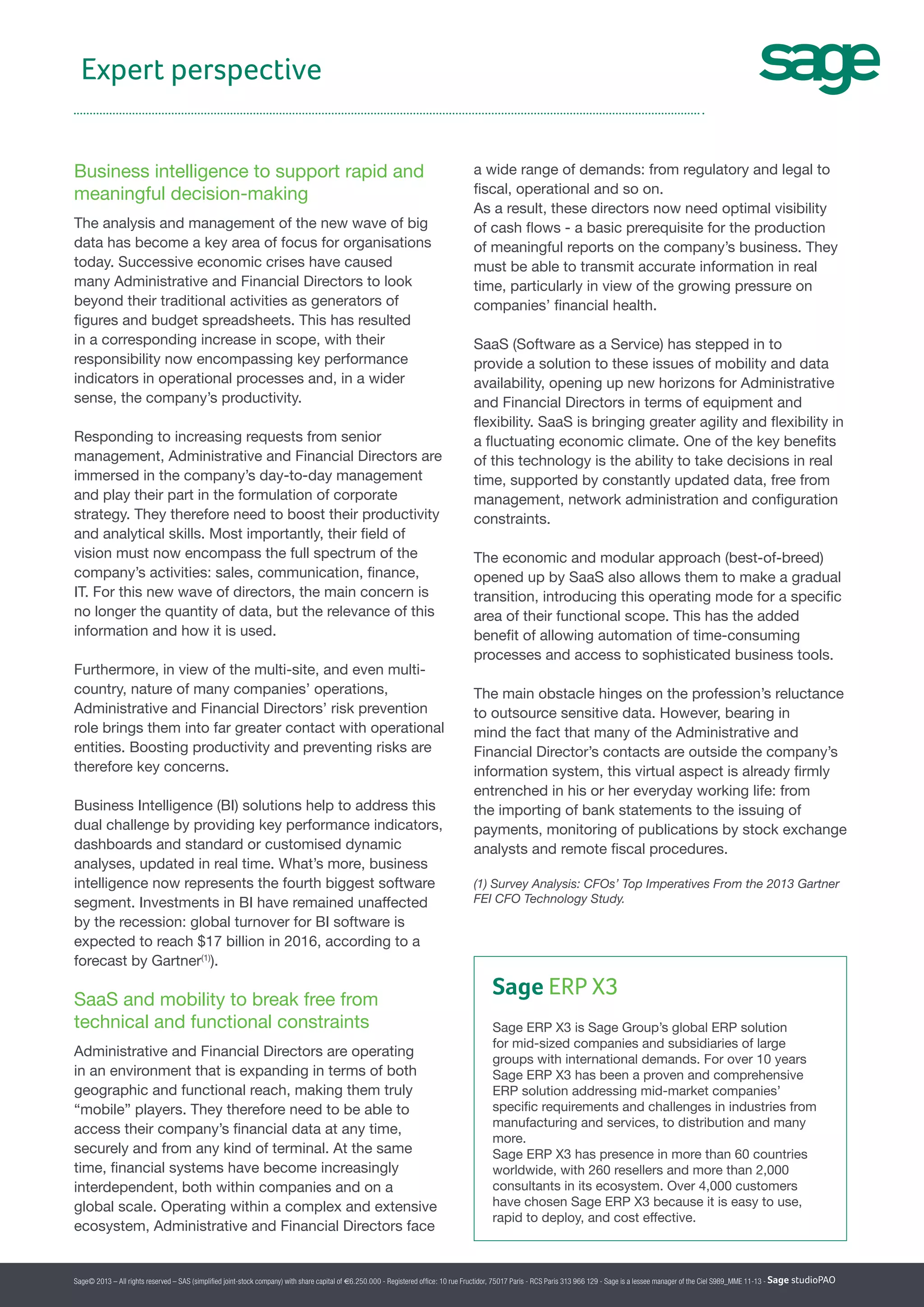
value. Myriam Radi, Cash Management Market Manager
with Sage, takes a more detailed look at the contribution
made by these three technological levers to the work of the
Administrative and Financial Director.
Expert perspective
Following the recent period of recession,
and in an increasingly complex globalised
economy with very uncertain prospects,
the role and scope of the Administrative
and Financial Director have undergone a
radical change. Traditionally concerned with
managing the company’s assets and internal
processes linked to their business function,
they now occupy an increasingly strategic role
within the company.
New operational
challenges call for new
technological solutions
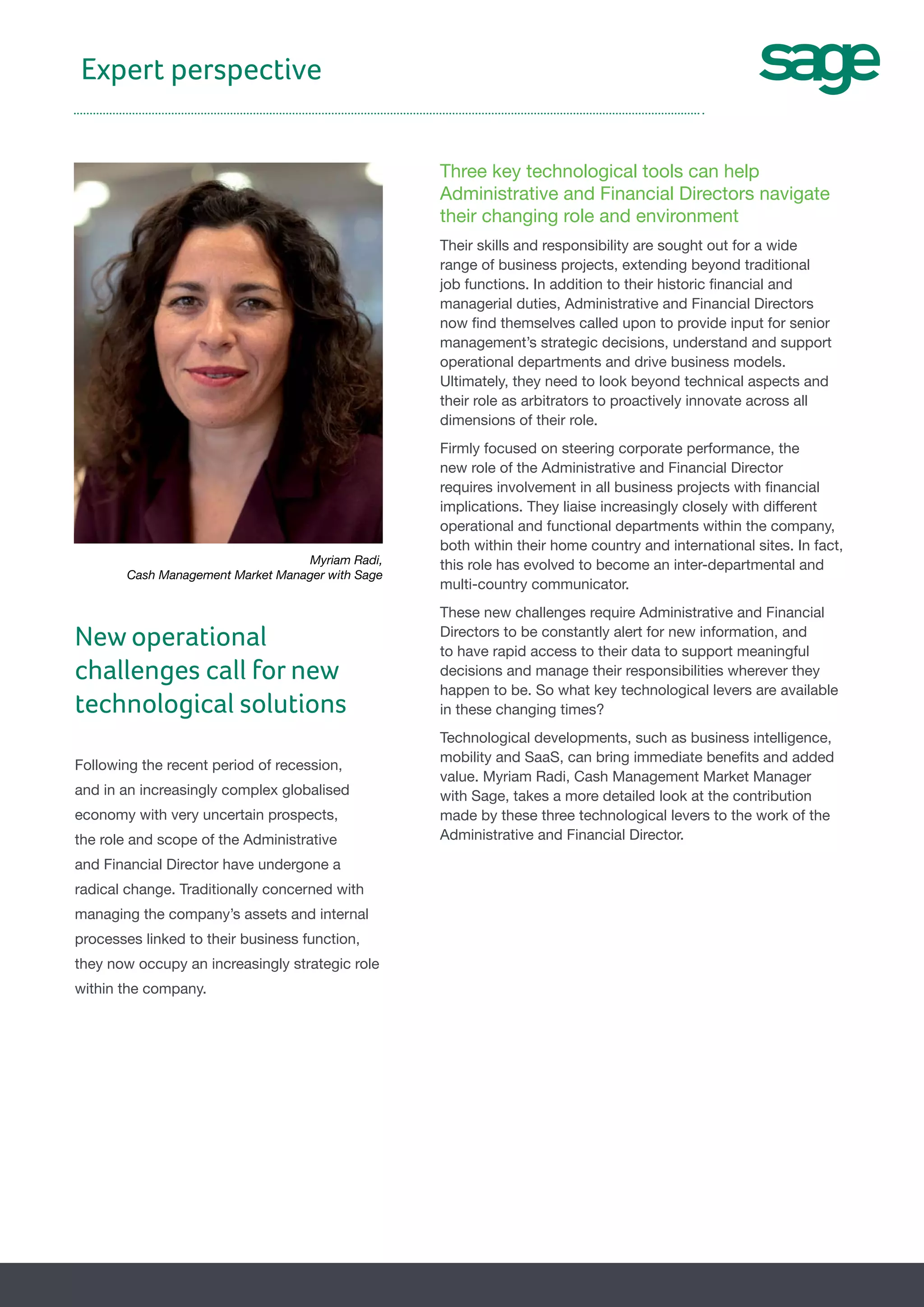
Myriam Radi,
Cash Management Market Manager with Sage
Business intelligence to support rapid and
meaningful decision-making
The analysis and management of the new wave of big
data has become a key area of focus for organisations
today. Successive economic crises have caused
many Administrative and Financial Directors to look
beyond their traditional activities as generators of
figures and budget spreadsheets. This has resulted
in a corresponding increase in scope, with their
responsibility now encompassing key performance
indicators in operational processes and, in a wider
sense, the company’s productivity.
Responding to increasing requests from senior
management, Administrative and Financial Directors are
immersed in the company’s day-to-day management
and play their part in the formulation of corporate
strategy. They therefore need to boost their productivity
and analytical skills. Most importantly, their field of
vision must now encompass the full spectrum of the
company’s activities: sales, communication, finance,
IT. For this new wave of directors, the main concern is
no longer the quantity of data, but the relevance of this
information and how it is used.
Furthermore, in view of the multi-site, and even multi-
country, nature of many companies’ operations,
Administrative and Financial Directors’ risk prevention
role brings them into far greater contact with operational
entities. Boosting productivity and preventing risks are
therefore key concerns.
Business Intelligence (BI) solutions help to address this
dual challenge by providing key performance indicators,
dashboards and standard or customised dynamic
analyses, updated in real time. What’s more, business
intelligence now represents the fourth biggest software
segment. Investments in BI have remained unaffected
by the recession: global turnover for BI software is
expected to reach $17 billion in 2016, according to a
forecast by Gartner(1)
).
SaaS and mobility to break free from
technical and functional constraints
Administrative and Financial Directors are operating
in an environment that is expanding in terms of both
geographic and functional reach, making them truly
“mobile” players. They therefore need to be able to
access their company’s financial data at any time,
securely and from any kind of terminal. At the same
time, financial systems have become increasingly
interdependent, both within companies and on a
global scale. Operating within a complex and extensive
ecosystem, Administrative and Financial Directors face
a wide range of demands: from regulatory and legal to
fiscal, operational and so on.
As a result, these directors now need optimal visibility
of cash flows - a basic prerequisite for the production
of meaningful reports on the company’s business. They
must be able to transmit accurate information in real
time, particularly in view of the growing pressure on
companies’ financial health.
SaaS (Software as a Service) has stepped in to
provide a solution to these issues of mobility and data
availability, opening up new horizons for Administrative
and Financial Directors in terms of equipment and
flexibility. SaaS is bringing greater agility and flexibility in
a fluctuating economic climate. One of the key benefits
of this technology is the ability to take decisions in real
time, supported by constantly updated data, free from
management, network administration and configuration
constraints.
The economic and modular approach (best-of-breed)
opened up by SaaS also allows them to make a gradual
transition, introducing this operating mode for a specific
area of their functional scope. This has the added
benefit of allowing automation of time-consuming
processes and access to sophisticated business tools.
The main obstacle hinges on the profession’s reluctance
to outsource sensitive data. However, bearing in
mind the fact that many of the Administrative and
Financial Director’s contacts are outside the company’s
information system, this virtual aspect is already firmly
entrenched in his or her everyday working life: from
the importing of bank statements to the issuing of
payments, monitoring of publications by stock exchange
analysts and remote fiscal procedures.
(1) Survey Analysis: CFOs’ Top Imperatives From the 2013 Gartner
FEI CFO Technology Study.
Expert perspective
Sage© 2013 – All rights reserved – SAS (simplified joint-stock company) with share capital of e6.250.000 - Registered office: 10 rue Fructidor, 75017 Paris - RCS Paris 313 966 129 - Sage is a lessee manager of the Ciel S989_MME 11-13 -
Sage ERP X3
Sage ERP X3 is Sage Group’s global ERP solution
for mid-sized companies and subsidiaries of large
groups with international demands. For over 10 years
Sage ERP X3 has been a proven and comprehensive
ERP solution addressing mid-market companies’
specific requirements and challenges in industries from
manufacturing and services, to distribution and many
more.
Sage ERP X3 has presence in more than 60 countries
worldwide, with 260 resellers and more than 2,000
consultants in its ecosystem. Over 4,000 customers
have chosen Sage ERP X3 because it is easy to use,
rapid to deploy, and cost effective.

New Operational Challenges Call For New Technological Solutions

  • 1.
    Three key technologicaltools can help Administrative and Financial Directors navigate their changing role and environment Their skills and responsibility are sought out for a wide range of business projects, extending beyond traditional job functions. In addition to their historic financial and managerial duties, Administrative and Financial Directors now find themselves called upon to provide input for senior management’s strategic decisions, understand and support operational departments and drive business models. Ultimately, they need to look beyond technical aspects and their role as arbitrators to proactively innovate across all dimensions of their role. Firmly focused on steering corporate performance, the new role of the Administrative and Financial Director requires involvement in all business projects with financial implications. They liaise increasingly closely with different operational and functional departments within the company, both within their home country and international sites. In fact, this role has evolved to become an inter-departmental and multi-country communicator. These new challenges require Administrative and Financial Directors to be constantly alert for new information, and to have rapid access to their data to support meaningful decisions and manage their responsibilities wherever they happen to be. So what key technological levers are available in these changing times? Technological developments, such as business intelligence, mobility and SaaS, can bring immediate benefits and added value. Myriam Radi, Cash Management Market Manager with Sage, takes a more detailed look at the contribution made by these three technological levers to the work of the Administrative and Financial Director. Expert perspective Following the recent period of recession, and in an increasingly complex globalised economy with very uncertain prospects, the role and scope of the Administrative and Financial Director have undergone a radical change. Traditionally concerned with managing the company’s assets and internal processes linked to their business function, they now occupy an increasingly strategic role within the company. New operational challenges call for new technological solutions Myriam Radi, Cash Management Market Manager with Sage
  • 2.
    Business intelligence tosupport rapid and meaningful decision-making The analysis and management of the new wave of big data has become a key area of focus for organisations today. Successive economic crises have caused many Administrative and Financial Directors to look beyond their traditional activities as generators of figures and budget spreadsheets. This has resulted in a corresponding increase in scope, with their responsibility now encompassing key performance indicators in operational processes and, in a wider sense, the company’s productivity. Responding to increasing requests from senior management, Administrative and Financial Directors are immersed in the company’s day-to-day management and play their part in the formulation of corporate strategy. They therefore need to boost their productivity and analytical skills. Most importantly, their field of vision must now encompass the full spectrum of the company’s activities: sales, communication, finance, IT. For this new wave of directors, the main concern is no longer the quantity of data, but the relevance of this information and how it is used. Furthermore, in view of the multi-site, and even multi- country, nature of many companies’ operations, Administrative and Financial Directors’ risk prevention role brings them into far greater contact with operational entities. Boosting productivity and preventing risks are therefore key concerns. Business Intelligence (BI) solutions help to address this dual challenge by providing key performance indicators, dashboards and standard or customised dynamic analyses, updated in real time. What’s more, business intelligence now represents the fourth biggest software segment. Investments in BI have remained unaffected by the recession: global turnover for BI software is expected to reach $17 billion in 2016, according to a forecast by Gartner(1) ). SaaS and mobility to break free from technical and functional constraints Administrative and Financial Directors are operating in an environment that is expanding in terms of both geographic and functional reach, making them truly “mobile” players. They therefore need to be able to access their company’s financial data at any time, securely and from any kind of terminal. At the same time, financial systems have become increasingly interdependent, both within companies and on a global scale. Operating within a complex and extensive ecosystem, Administrative and Financial Directors face a wide range of demands: from regulatory and legal to fiscal, operational and so on. As a result, these directors now need optimal visibility of cash flows - a basic prerequisite for the production of meaningful reports on the company’s business. They must be able to transmit accurate information in real time, particularly in view of the growing pressure on companies’ financial health. SaaS (Software as a Service) has stepped in to provide a solution to these issues of mobility and data availability, opening up new horizons for Administrative and Financial Directors in terms of equipment and flexibility. SaaS is bringing greater agility and flexibility in a fluctuating economic climate. One of the key benefits of this technology is the ability to take decisions in real time, supported by constantly updated data, free from management, network administration and configuration constraints. The economic and modular approach (best-of-breed) opened up by SaaS also allows them to make a gradual transition, introducing this operating mode for a specific area of their functional scope. This has the added benefit of allowing automation of time-consuming processes and access to sophisticated business tools. The main obstacle hinges on the profession’s reluctance to outsource sensitive data. However, bearing in mind the fact that many of the Administrative and Financial Director’s contacts are outside the company’s information system, this virtual aspect is already firmly entrenched in his or her everyday working life: from the importing of bank statements to the issuing of payments, monitoring of publications by stock exchange analysts and remote fiscal procedures. (1) Survey Analysis: CFOs’ Top Imperatives From the 2013 Gartner FEI CFO Technology Study. Expert perspective Sage© 2013 – All rights reserved – SAS (simplified joint-stock company) with share capital of e6.250.000 - Registered office: 10 rue Fructidor, 75017 Paris - RCS Paris 313 966 129 - Sage is a lessee manager of the Ciel S989_MME 11-13 - Sage ERP X3 Sage ERP X3 is Sage Group’s global ERP solution for mid-sized companies and subsidiaries of large groups with international demands. For over 10 years Sage ERP X3 has been a proven and comprehensive ERP solution addressing mid-market companies’ specific requirements and challenges in industries from manufacturing and services, to distribution and many more. Sage ERP X3 has presence in more than 60 countries worldwide, with 260 resellers and more than 2,000 consultants in its ecosystem. Over 4,000 customers have chosen Sage ERP X3 because it is easy to use, rapid to deploy, and cost effective.