ADVANCING THE HR PROFESSION:
Towards HR Competencies, Benchmarking &
Benchmarks

Marius Meyer, CEO
25 January 2013

marius@sabpp.co.za

@MariusSABPP & @SABPP1
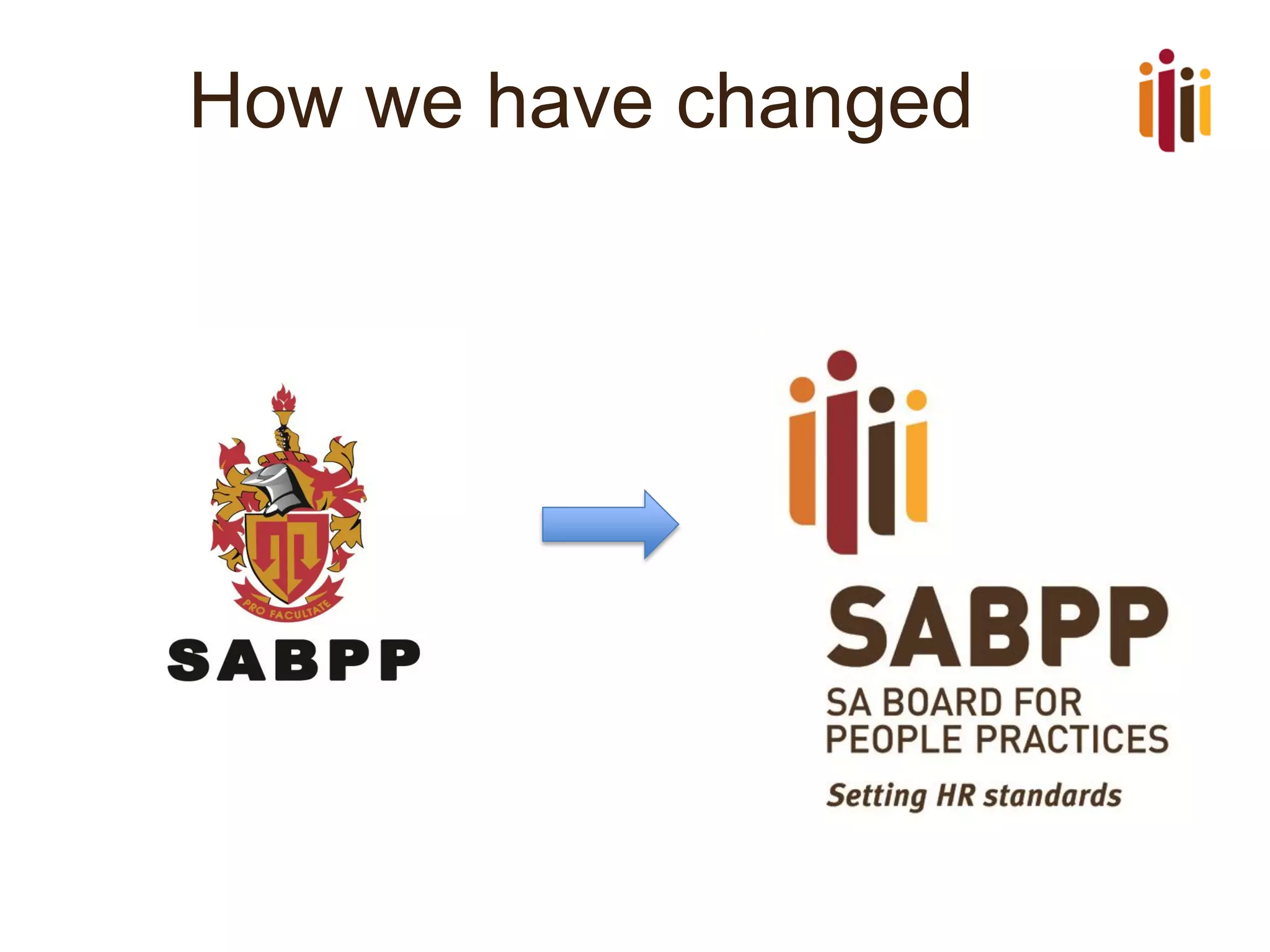
How we have changed
Economic impact on companies
This financial crisis is forcing
government and local agencies
to make some tough decisions.
If things continue for much
longer, there's a real risk that
we may have to lay off Jose.
Agenda
• Part A: HR trends and best practices
• Part B: State of HR profession
• Part C: HR Competency Model
Part A:
HR Trends & Best Practices
Where is HR going globally and in South Africa?
What are the major HR trends and best practices?
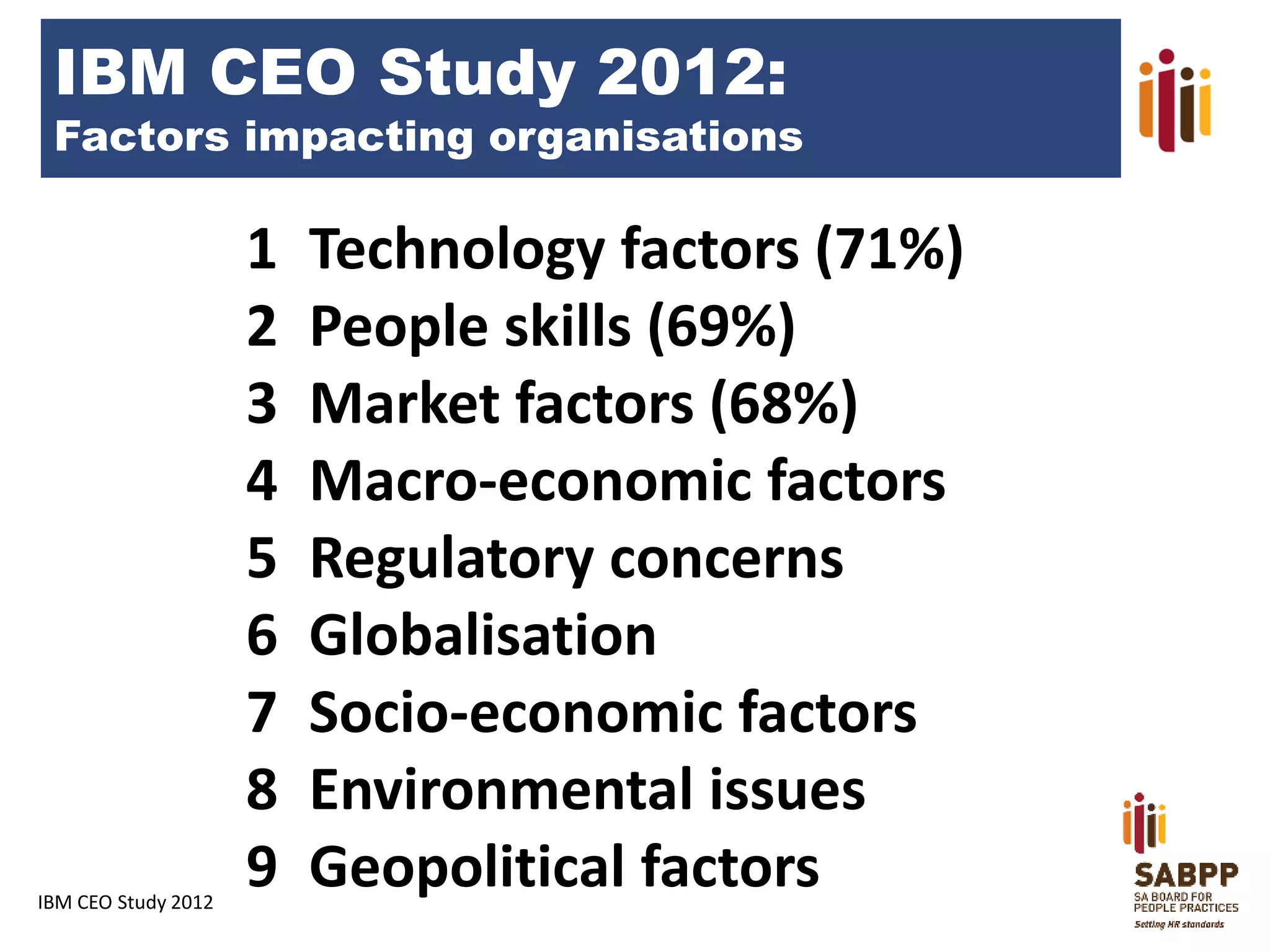
IBM CEO Study 2012:

Factors impacting organisations

IBM CEO Study 2012

1
2
3
4
5
6
7
8
9

Technology factors (71%)
People skills (69%)
Market factors (68%)
Macro-economic factors
Regulatory concerns
Globalisation
Socio-economic factors
Environmental issues
Geopolitical factors
Top 10 HR priorities
1.
2.
3.
4.
5.
6.
7.
8.
9.
10.

Creating a high performance culture / climate
Leadership and management development
Skills development
Focus on corporate values, ethics
Industrial/employee relations
HR Survey
2011
Customer service
Employee engagement
Change Management
Crafting and implementing HR strategy
HR policies and procedures
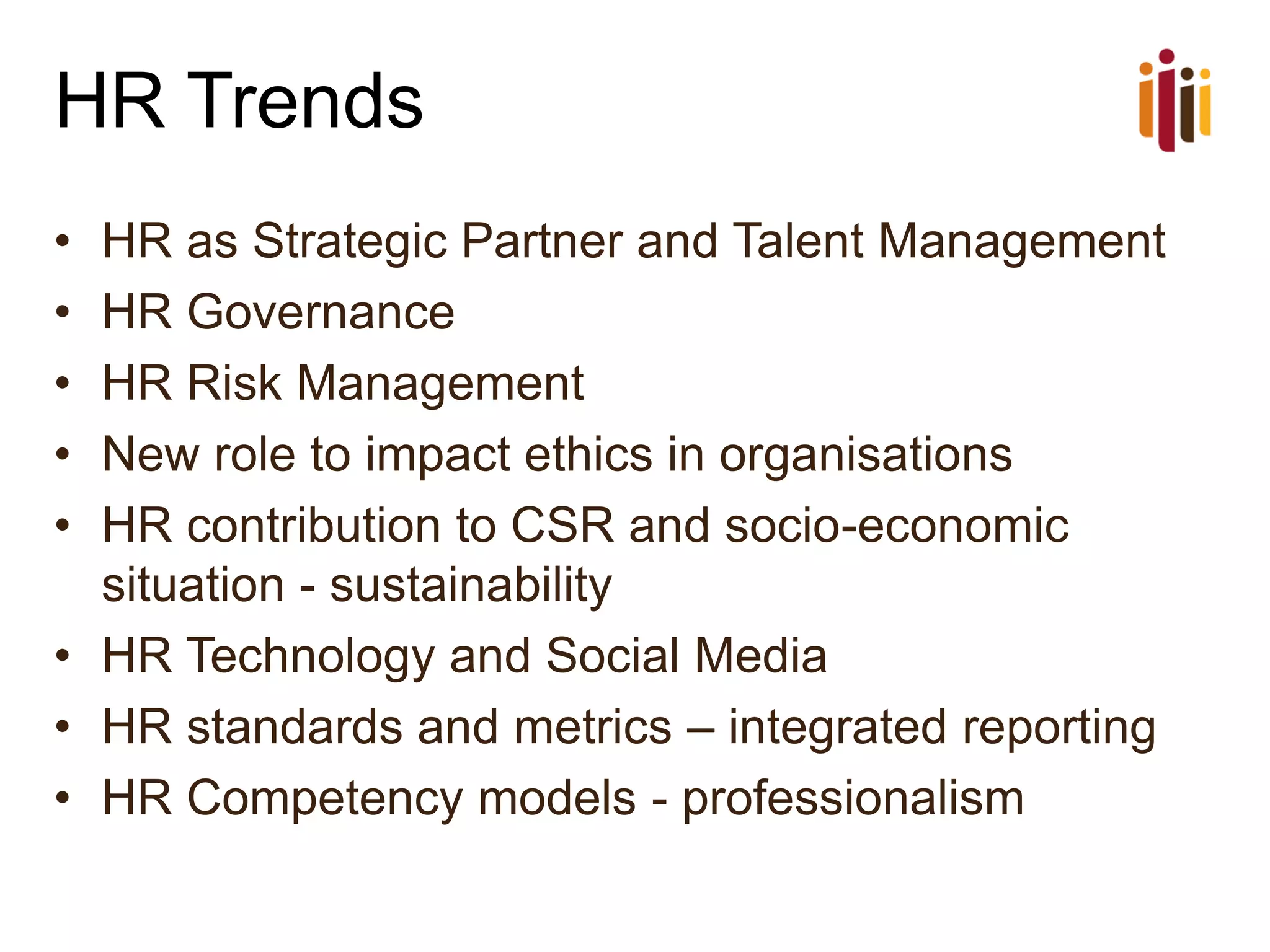
HR Trends
•
•
•
•
•

HR as Strategic Partner and Talent Management
HR Governance
HR Risk Management
New role to impact ethics in organisations
HR contribution to CSR and socio-economic
situation - sustainability
• HR Technology and Social Media
• HR standards and metrics – integrated reporting
• HR Competency models - professionalism
Biggest Opportunities for HR

• Cultivating creative leaders
• Mobilising for greater speed and
flexibility
• Capitalising on collective intelligence
i.e. collaboration
IBM: Working beyond Borders
Use of workforce
analytics remains limited
Measuring collaboration and knowledge sharing across
the organisation

14% 5%

Enhancing workforce productivity

39%

Evaluating workforce performance

40%

15%

38%

19%

Retaining valued talent within the organisation
Sourcing, recruiting and onboarding individuals from
outside the organisation
Developing workforce skills and capabilities
Allocating the workforce across the organisation

14%

40%
30%
35%

Developing strategy linked to business strategy

28%

Developing future leaders

29%

20%
22%
23%
25%
26%

0% 10% 20% 30% 40% 50% 60%

IBM: Working beyond Borders

Can identify
historical
trends and
patterns
Can develop
scenarios and
predict future
outcomes
Planning for growth

Improving operational
efficiency

Developing new
product/service offerings

Expanding into new
markets/geographies

44%

35%

31%

64%

Today
48%

44%

0% 10% 20% 30% 40% 50% 60% 70%

IBM: Working beyond Borders

Three years
Most important organisational
capabilities over the next five years
Leadership

37%

Execution speed

34%

Client connectivity

33%

Innovation

31%
28%

IBM: Working beyond Borders

30%

32%

34%

36%

38%
Most important leadership qualities
over the next five years

Creativity

60%

Integrity

52%

Ability to balance work and life
demands

35%

0%

IBM: Working beyond Borders

10% 20% 30% 40% 50% 60% 70%
Part B:
State of HR Profession in SA
What is the current state of HR in SA?
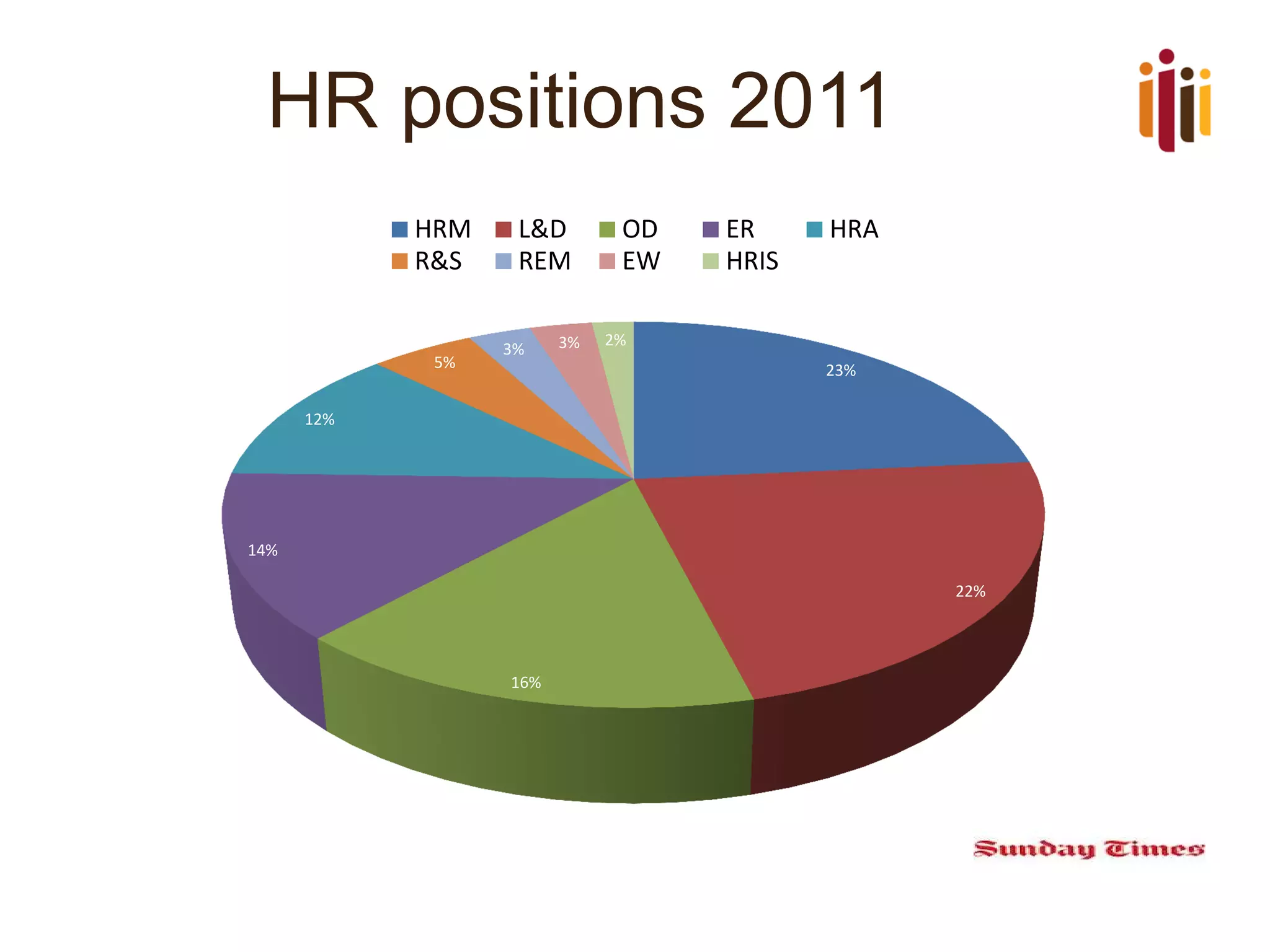
HR positions 2011
HRM
R&S

5%

L&D
REM
3%

3%

OD
EW

ER
HRIS

HRA

2%
23%

12%

14%
22%

16%
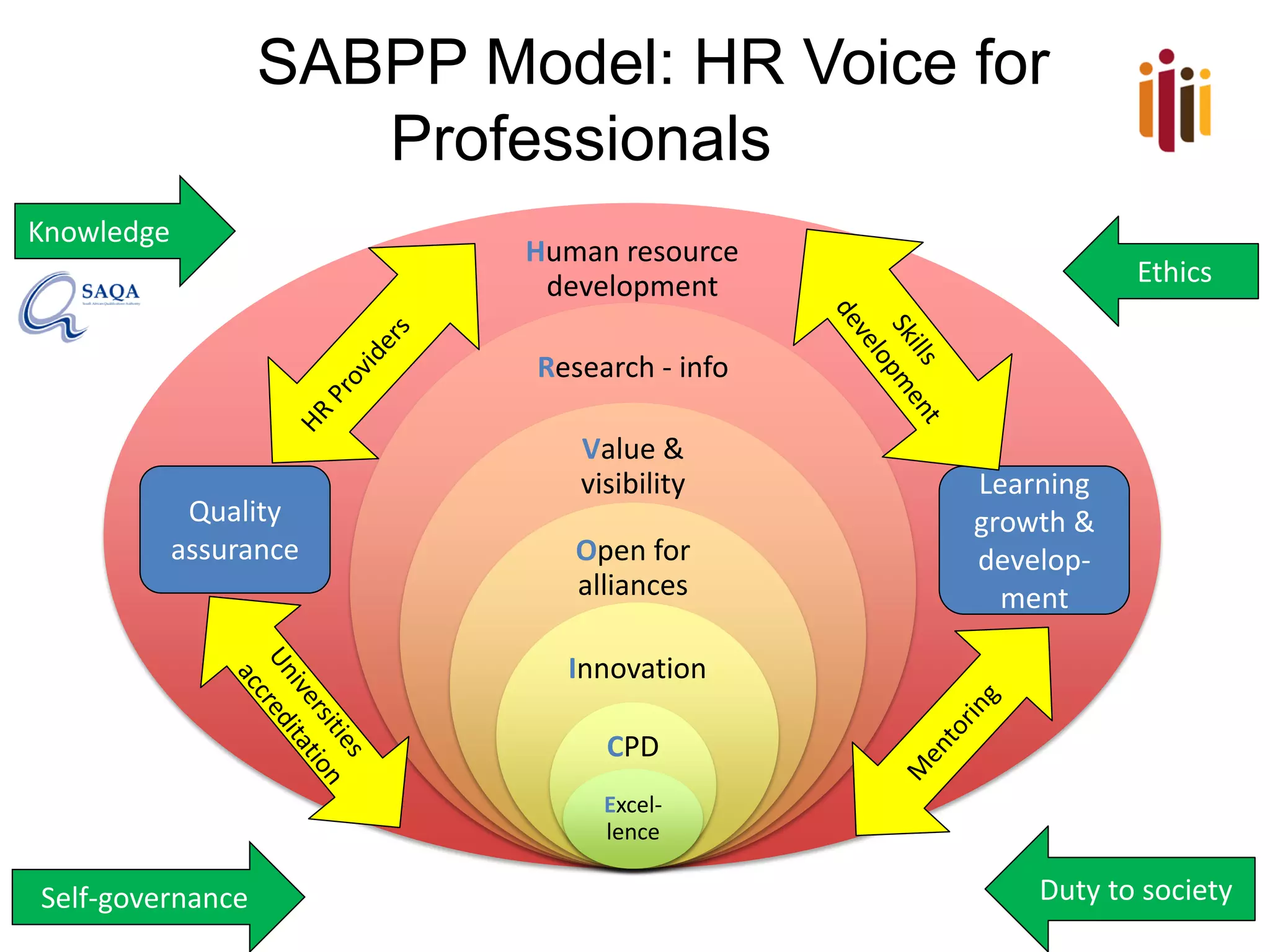
New SABPP Model: HR Voice for
Professionals
Knowledge

Human resource
development

Ethics

Research - info

Quality
assurance

Value &
visibility

Open for
alliances

Learning
growth &
development

Innovation
CPD
Excellence

Self-governance

Duty to society
SABPP BENEFITS
RECOGNITION =
PROFESSIONAL STATUS
•
•
•
•
•
•
•
•

Professional registration
NLRD Upload (SAQA)
RPL
Awards
Advocacy
HR Assessors/Moderators
registration
Accreditation of providers
University accreditation

RESOURCES =
PRODUCTS/SERVICES
•
•
•
•
•
•
•
•
•
•
•
•
•
•
•
•
•
•
•

HR Competency Model
Social media discussions
Knowledge Centre
Booklets/DVDs
Guides/toolkits
Charts/posters
Fact sheets
One-stop info
Updates (laws)
Ethics help-line
Newsletters
Website
HR Internships/jobs
HR policies
Mentoring
Workshops/seminars
Access to alliances
CPD
Students

RESEARCH =
INFORMATION
•
•
•
•
•
•
•
•

Research papers
Position papers
Books
Articles
Cases
Benchmarking
Magazines
Labour market
information
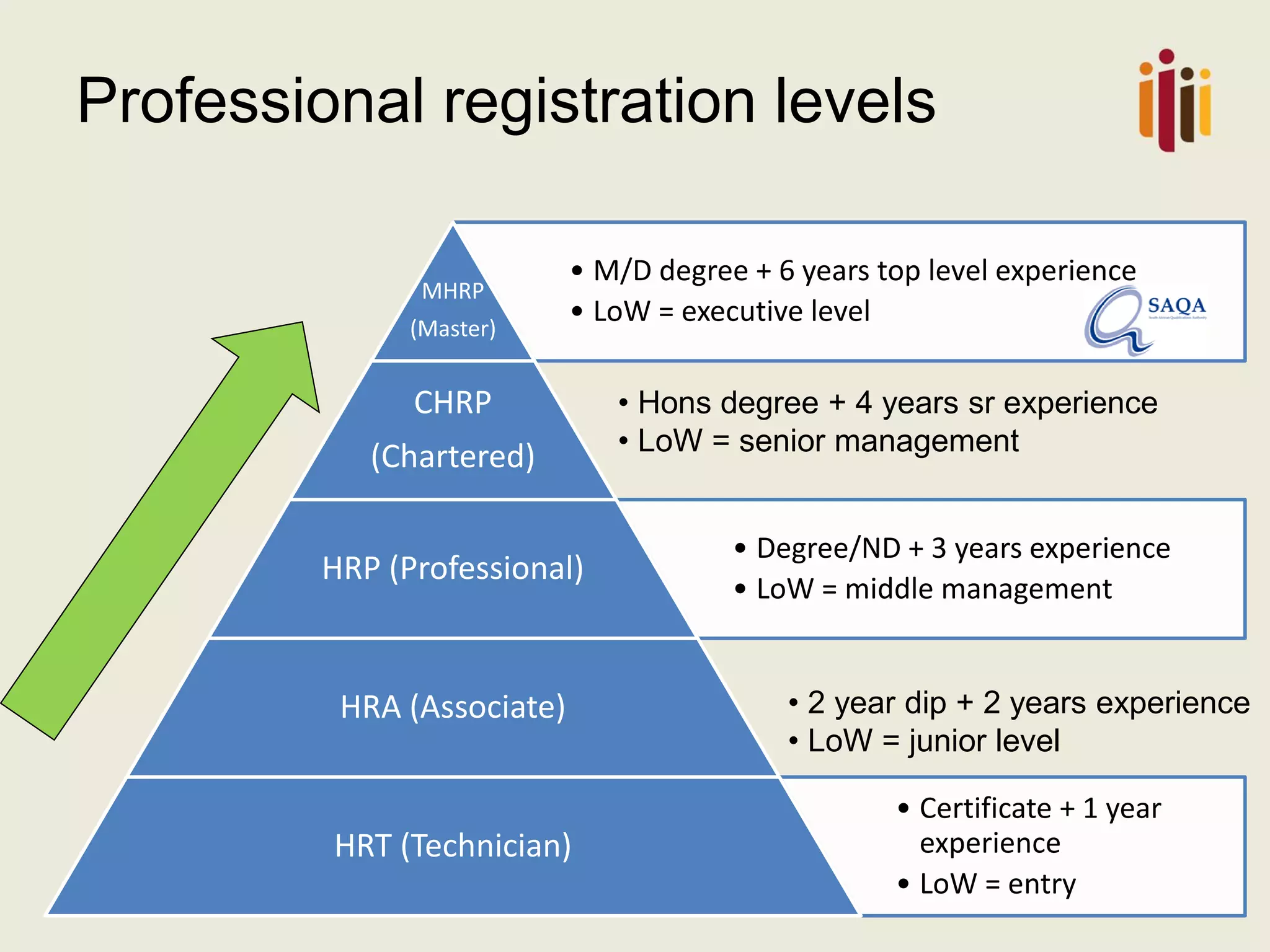
Professional registration levels
MHRP
(Master)

• M/D degree + 6 years top level experience
• LoW = executive level

CHRP
(Chartered)
HRP (Professional)

• Hons degree + 4 years sr experience
• LoW = senior management
• Degree/ND + 3 years experience
• LoW = middle management

HRA (Associate)

• 2 year dip + 2 years experience
• LoW = junior level

HRT (Technician)

• Certificate + 1 year
experience
• LoW = entry
Top 7 SABPP priorities 2013
•
•
•
•
•

Rebranding & visibility (all provinces)
National HR standards & metrics project
National HR competency model
HR social media strategy
SAQA pilot project – professional
designations upload on NLRD
• Professional products & services
• Research papers
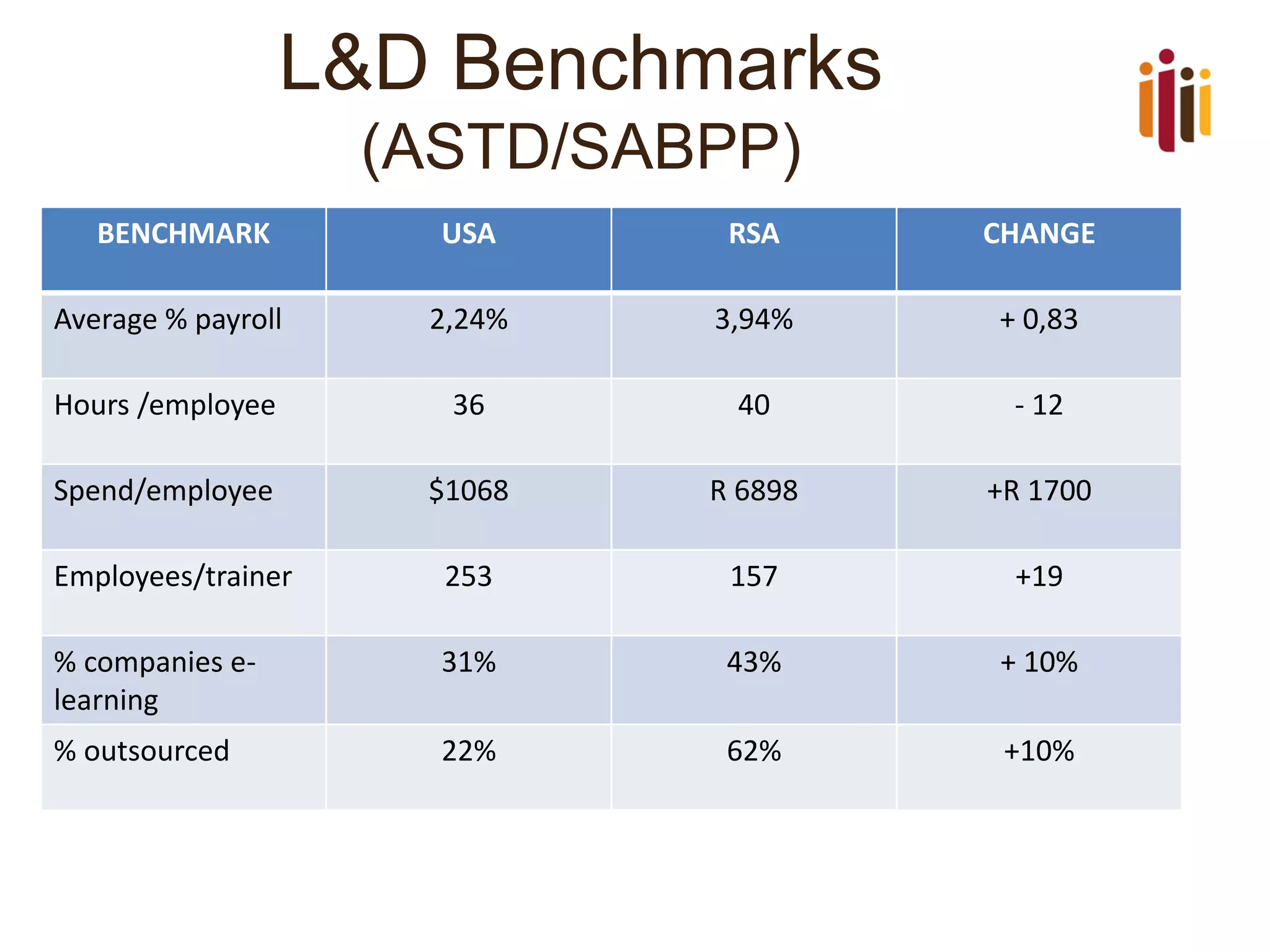
L&D Benchmarks
(ASTD/SABPP)
BENCHMARK

USA

RSA

CHANGE

Average % payroll

2,24%

3,94%

+ 0,83

Hours /employee

36

40

- 12

Spend/employee

$1068

R 6898

+R 1700

Employees/trainer

253

157

+19

% companies elearning

31%

43%

+ 10%

% outsourced

22%

62%

+10%
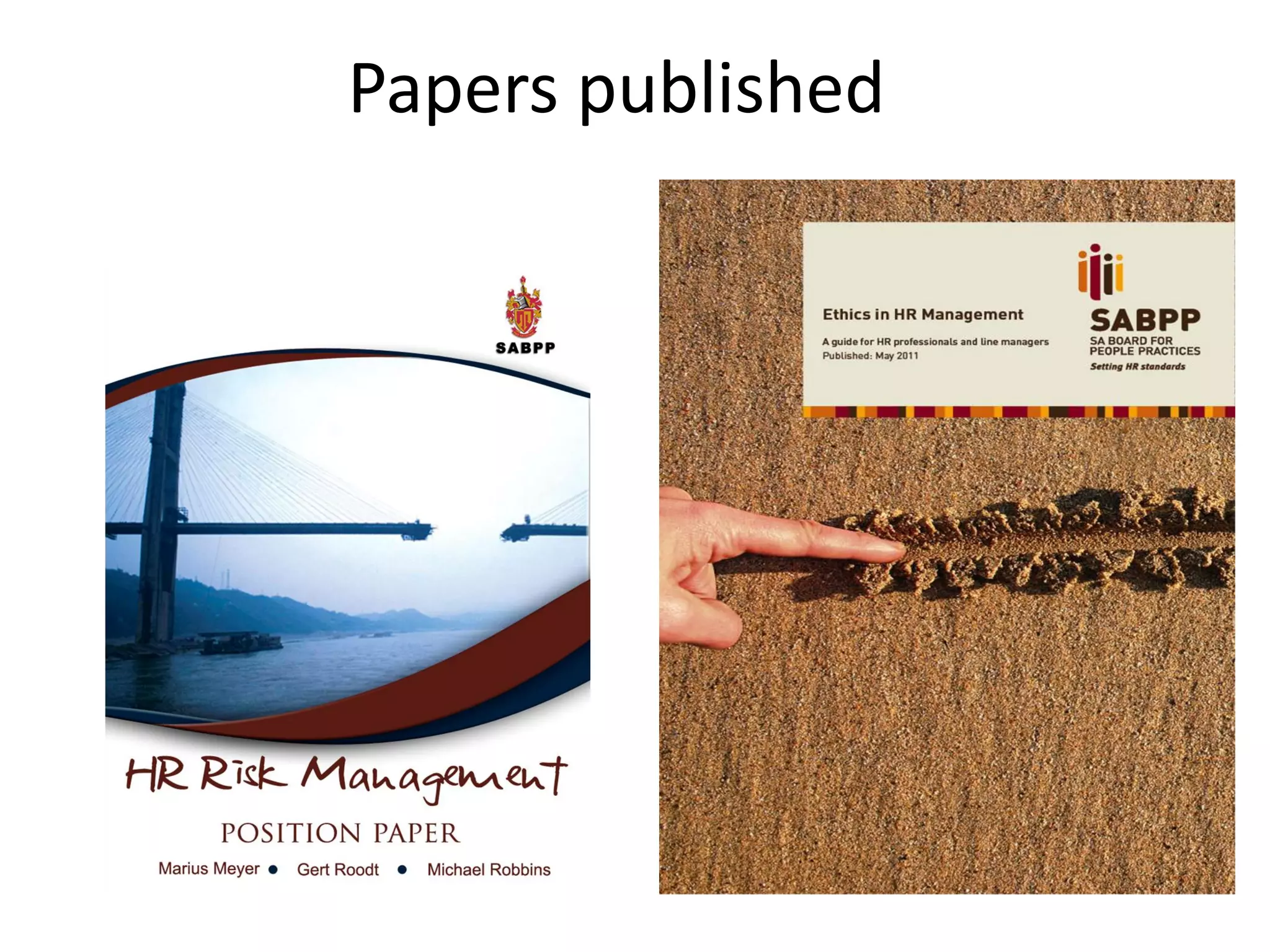
Papers published
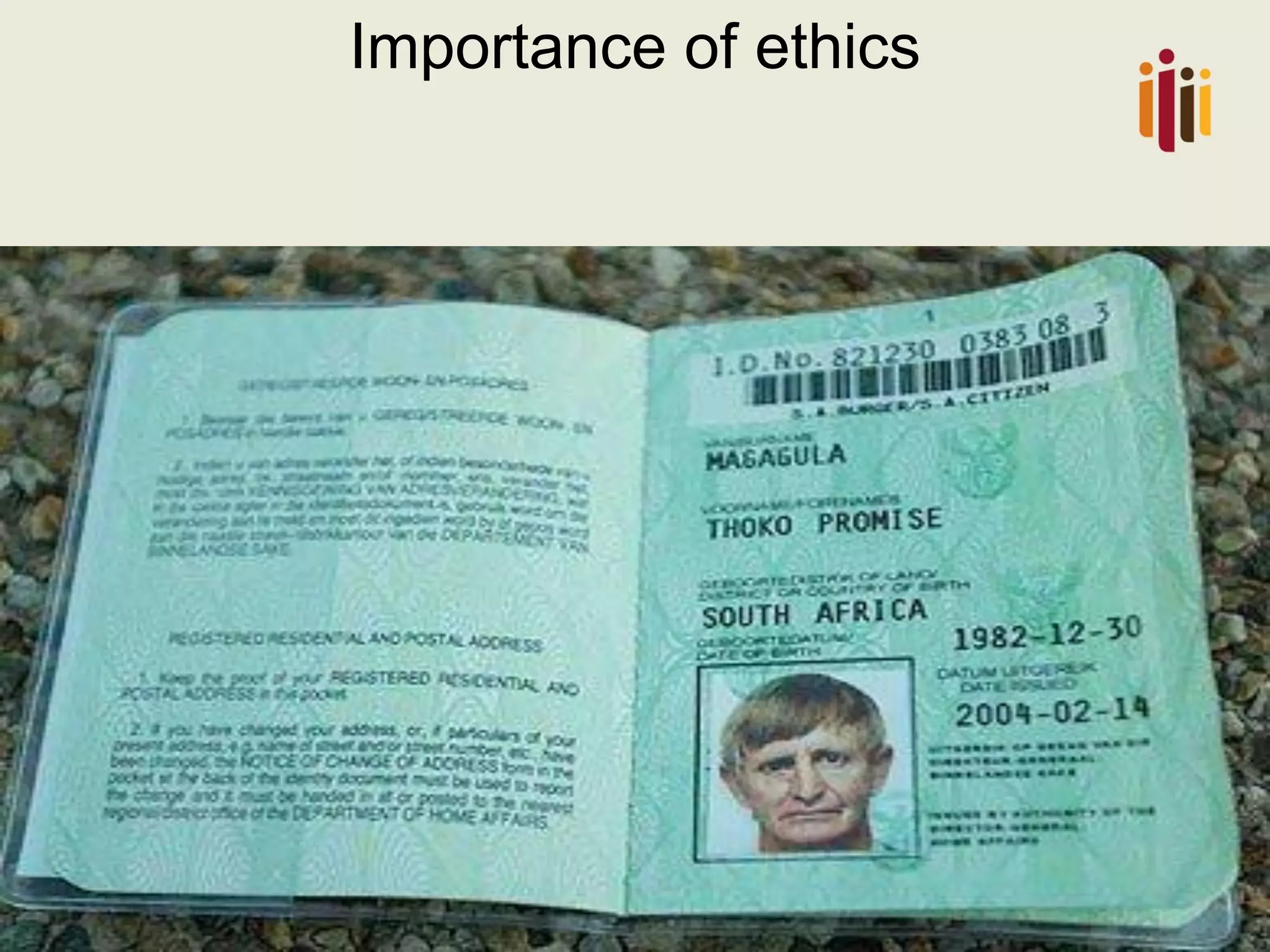
Importance of ethics
Research Projects
•
•
•
•
•
•

Annual HR Survey (completed)
Annual L&D State of Training in SA (ASTD)
Green HR (new)
Talent Survey (new)
HR Social Media (new)
HR Standards & Metrics (new)
For access to our research, contact
Penny Abbott on hrri@sabpp.co.za
Cost of labour as a % of revenue
Too confidential

2%

Not done

4%

Don’t know/Not applicable

25%

61 - 70%

11%

51 - 60%

14%

41 - 50%

9%

31 - 40%

7%

21 - 30%

12%

11 - 20%

7%

> 10%

9%
0%

5%

10%

15%

20%

25%

30%
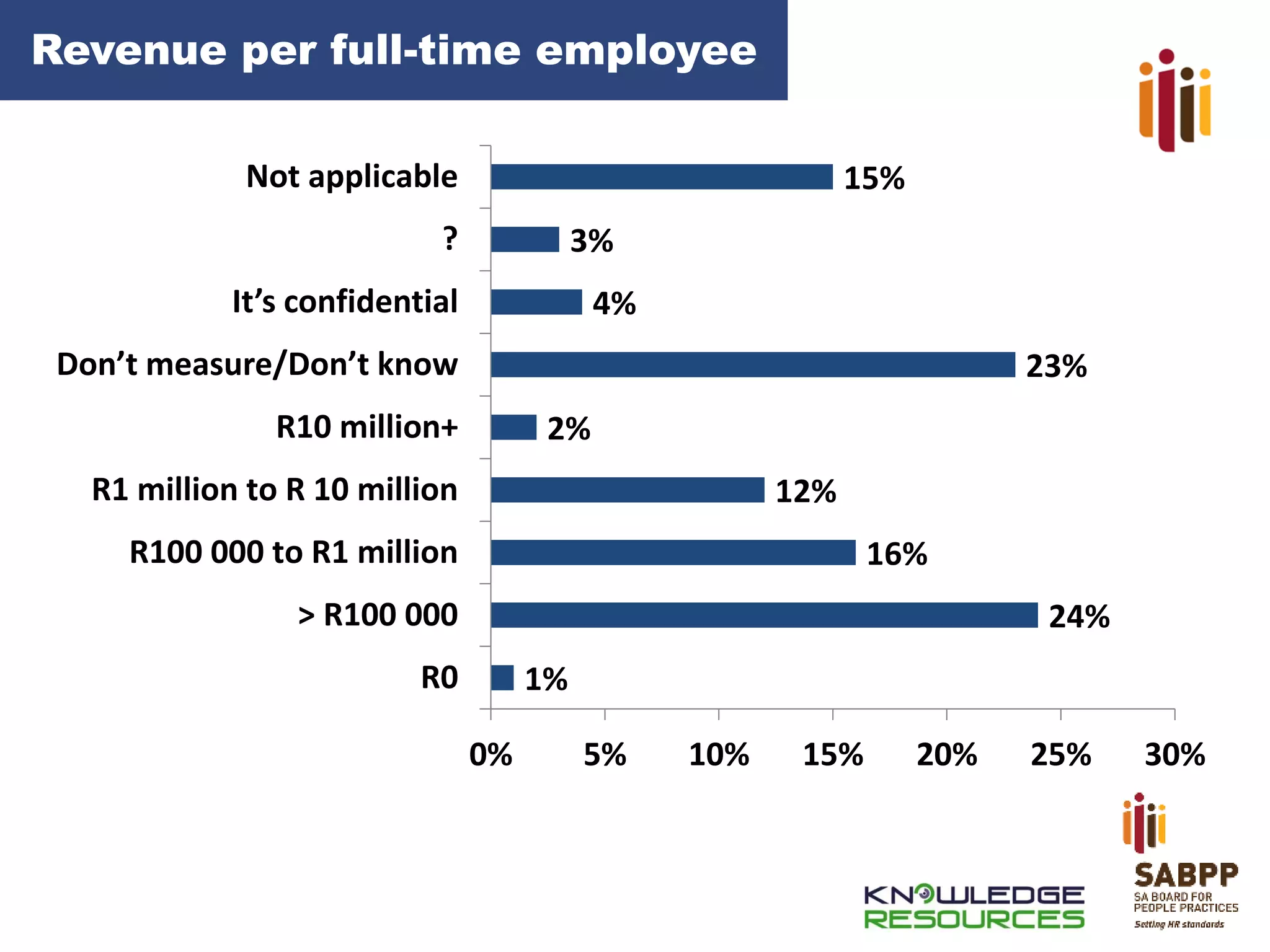
Revenue per full-time employee
Not applicable

15%

?

3%

It’s confidential

4%

Don’t measure/Don’t know

23%

R10 million+

2%

R1 million to R 10 million

12%

R100 000 to R1 million

16%

> R100 000

24%

R0

1%
0%

5%

10%

15%

20%

25%

30%
LTO rate

Indicate LTO rate:

44%

Don't measure

21%

Don't know

35%

0%

10%

20%

30%

40%

50%
Absenteeism rate

Indicate absenteeism rate

35%

Don't measure

31%

Don't know

34%

29%

30%

31%

32%

33%

34%

35%

36%
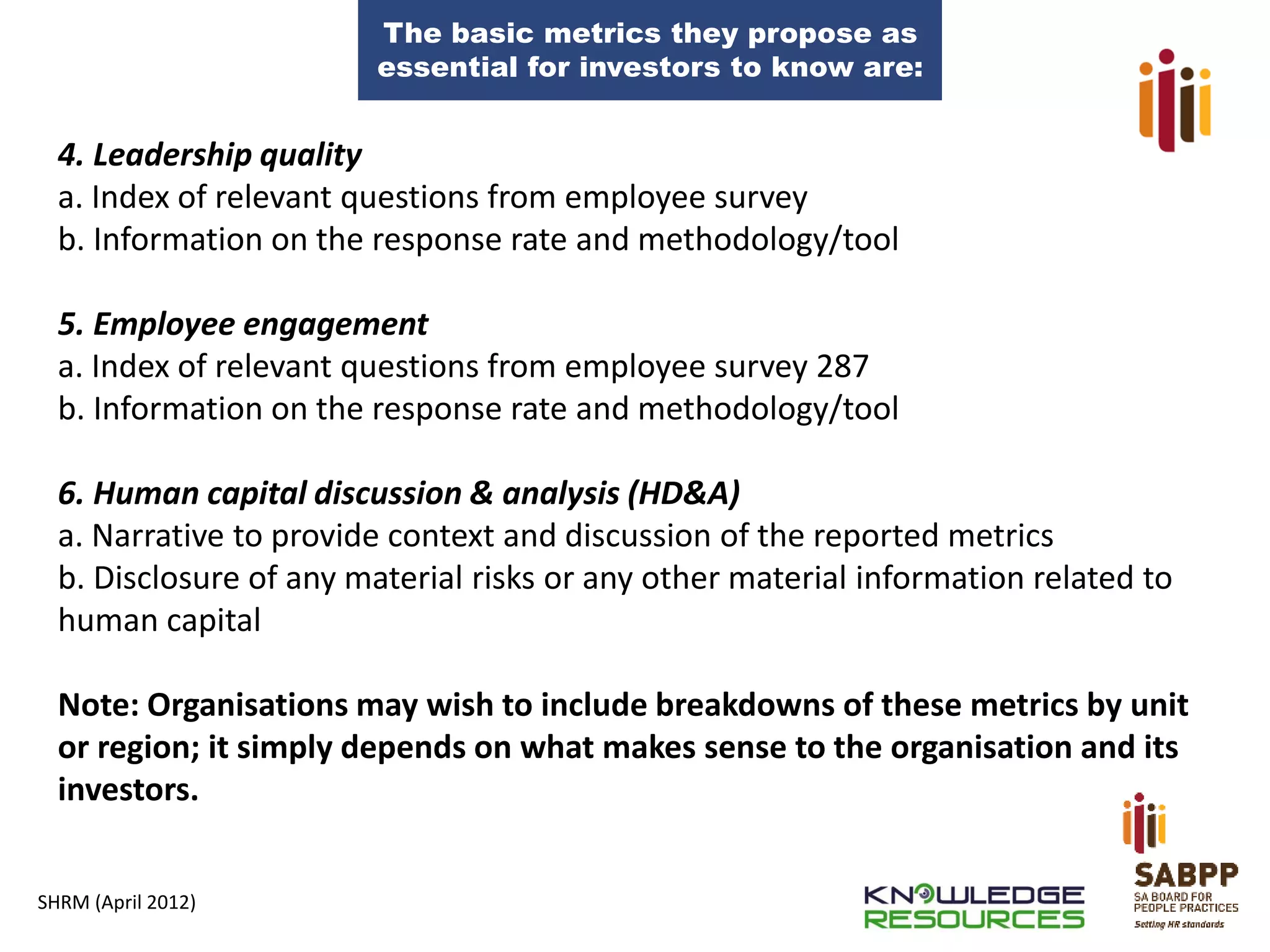
The basic metrics they propose as
essential for investors to know are:

1. Spending on human capital
a. Total amount spent on employees (salaries, benefits, taxes)
b. Total amount spent in support of employees
c. Total amount spent in lieu of employees (contractors, etcetera)
d. Total amount invested in training and development
e. Total headcount and total FTE (full-time equivalents) at the end of the
period
2. Ability to retain talent
a. Voluntary and total turnover
b. Broken down by subset of EEO-1 job types
c. Industry standard formula of (# of terminations during the period) / (average
active headcount during the period)
3. Leadership depth
a. Percentage of defined positions that have an identified successor
b. Percentage of open defined positions filled internally during the period
SHRM (April 2012)
The basic metrics they propose as
essential for investors to know are:

4. Leadership quality
a. Index of relevant questions from employee survey
b. Information on the response rate and methodology/tool
5. Employee engagement
a. Index of relevant questions from employee survey 287
b. Information on the response rate and methodology/tool

6. Human capital discussion & analysis (HD&A)
a. Narrative to provide context and discussion of the reported metrics
b. Disclosure of any material risks or any other material information related to
human capital
Note: Organisations may wish to include breakdowns of these metrics by unit
or region; it simply depends on what makes sense to the organisation and its
investors.
SHRM (April 2012)
HR manager’s response to
metrics?
Change themes for 2012
26%

Finding talent
Developing programmes for retaining talent
Learning and development
Change and transformation
Motivation of the workforce
BEE
Strategic business partnering
Focusing on business growth
New HR Information Systems
Remuneration
Introducing or fine-tuning performance management
Utilising social media
HIV
Strategic alliances
Increasing budget

20%
10%
9%
8%
6%
5%
4%
3%
3%
2%
1%
1%
1%
1%

0%

5%

10%

15%

20%

25%

30%
Changes planned for the
next two years
25%

None

14%

Re-engineering and restructuring

11%
10%
9%
8%
6%
5%
3%
3%
3%
2%
2%

Attracting talent and succession planning
Strategic business partnering
Be more efficient
Training, development, upskilling
HRIS and shared services
Performance management
Leadership development
Talent retention
Outsourcing aspects of HR
Do more transformational work
Use of coaching and mentoring

0%

5%

10%

15%

20%

25%

30%
KR/SABPP HR Survey (2011))
GOOD NEWS

• HR on boards/excos of 81%
of companies
• 74% of HR professionals say
that line management
accepts HR as strategic
partners
• HR professionals in SA is
better qualified than
counterparts in USA
• Talent management is 4th
most important priority for
HR for 2012

•
•

•

•

BAD NEWS
Talent management is only
priority no 17 for HR
Talent management is
ranked HR’s 22nd best
competency area
Only 55% of HR
departments have HR
succession plan
Only 20% of SA companies
have a competency model
for HR
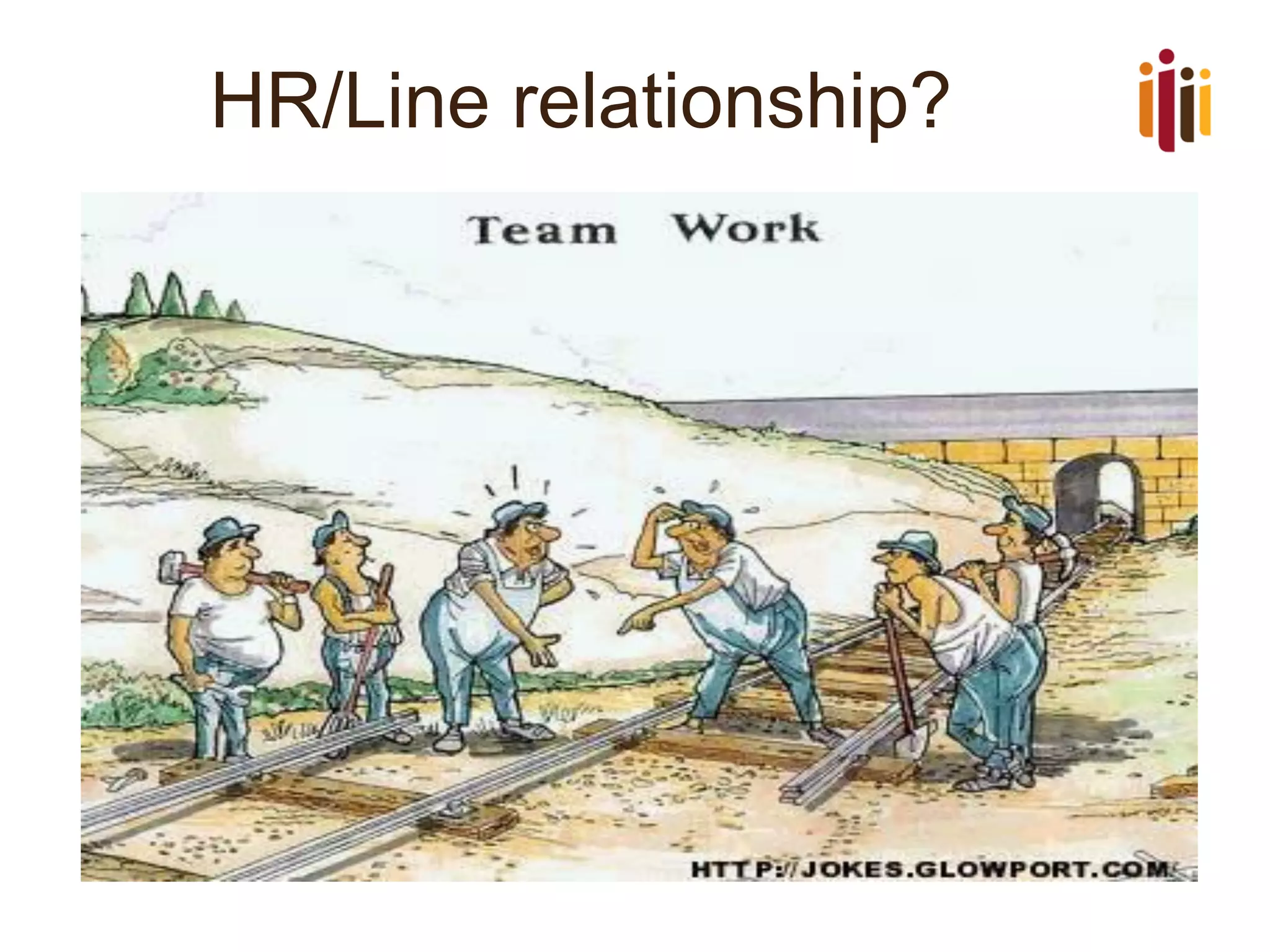
HR/Line relationship?
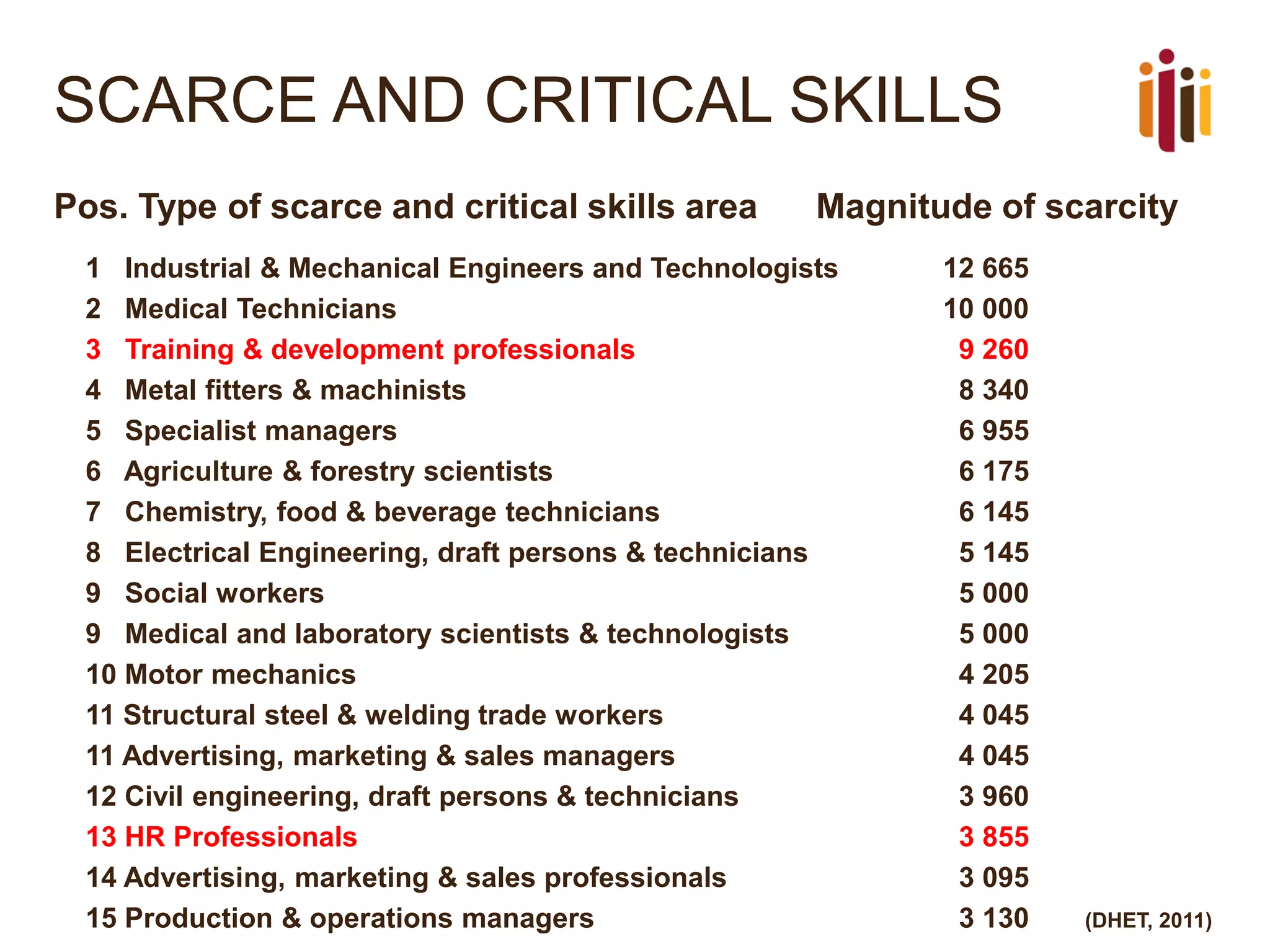
SCARCE AND CRITICAL SKILLS
Pos. Type of scarce and critical skills area

Magnitude of scarcity

1 Industrial & Mechanical Engineers and Technologists
2 Medical Technicians
3 Training & development professionals
4 Metal fitters & machinists
5 Specialist managers
6 Agriculture & forestry scientists
7 Chemistry, food & beverage technicians
8 Electrical Engineering, draft persons & technicians
9 Social workers
9 Medical and laboratory scientists & technologists
10 Motor mechanics
11 Structural steel & welding trade workers
11 Advertising, marketing & sales managers
12 Civil engineering, draft persons & technicians
13 HR Professionals
14 Advertising, marketing & sales professionals
15 Production & operations managers

12 665
10 000
9 260
8 340
6 955
6 175
6 145
5 145
5 000
5 000
4 205
4 045
4 045
3 960
3 855
3 095
3 130

(DHET, 2011)
Risk + readiness
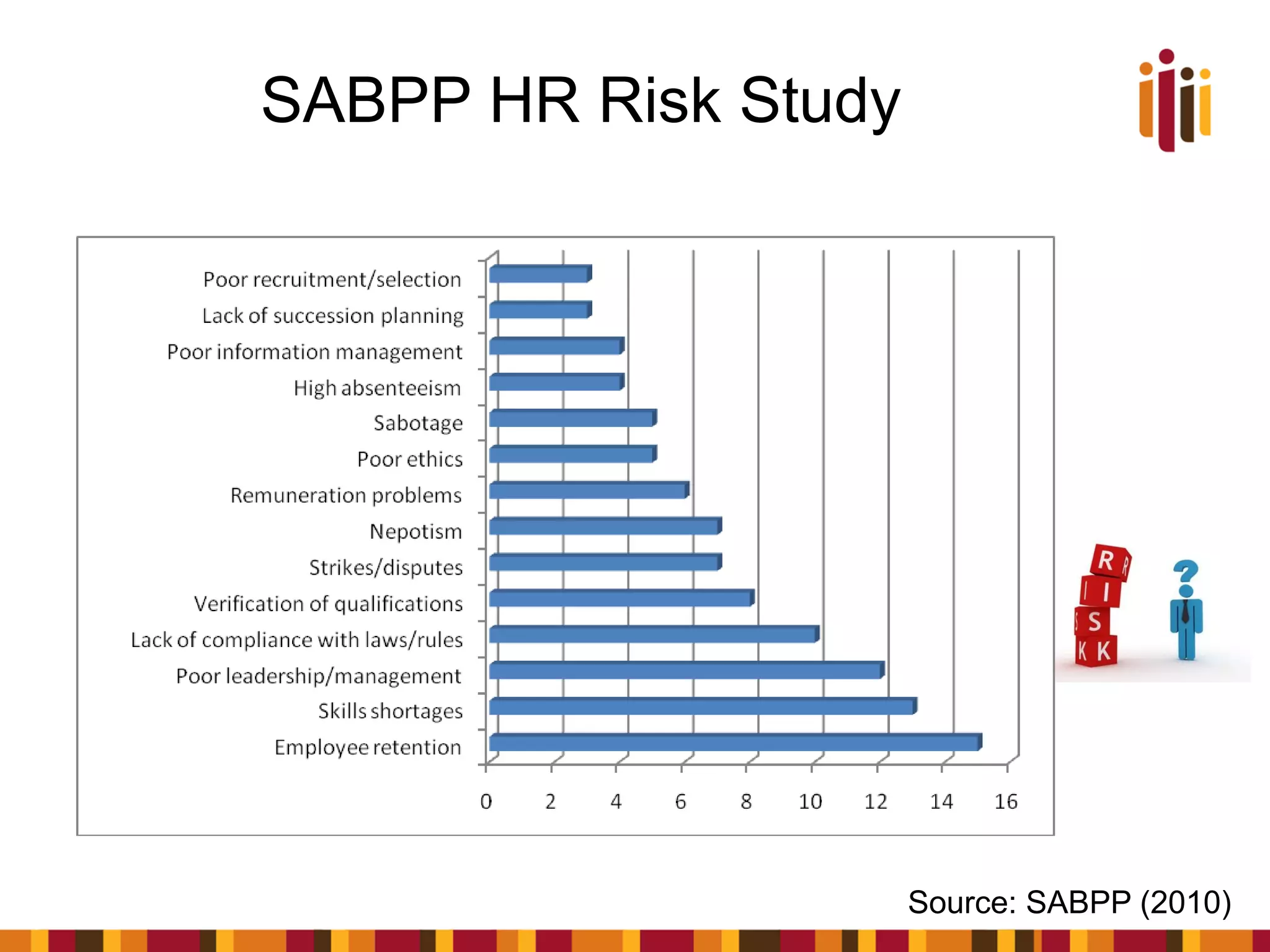
SABPP HR Risk Study

Source: SABPP (2010)
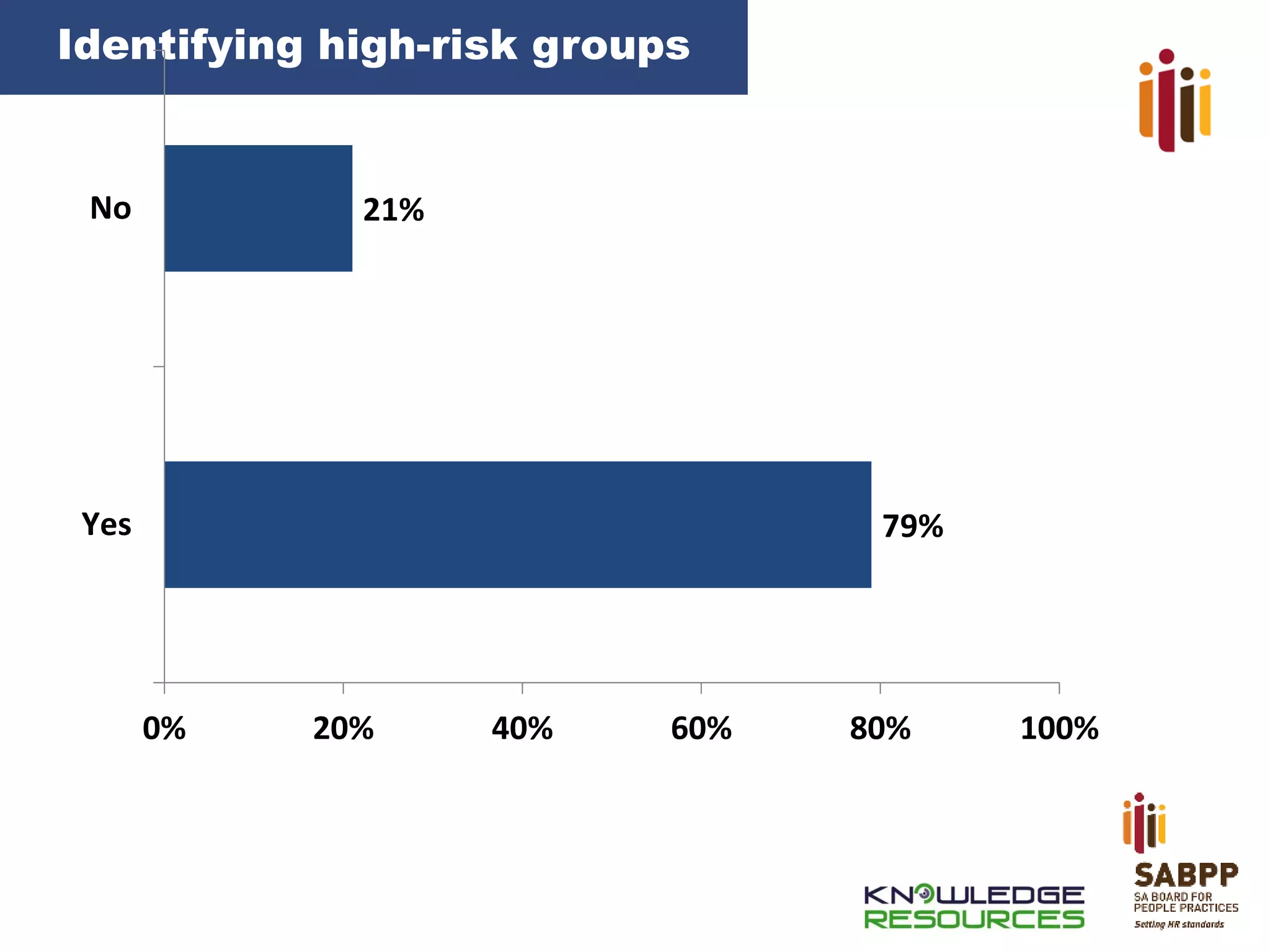
Identifying high-risk groups

No

21%

Yes

79%

0%

20%

40%

60%

80%

100%
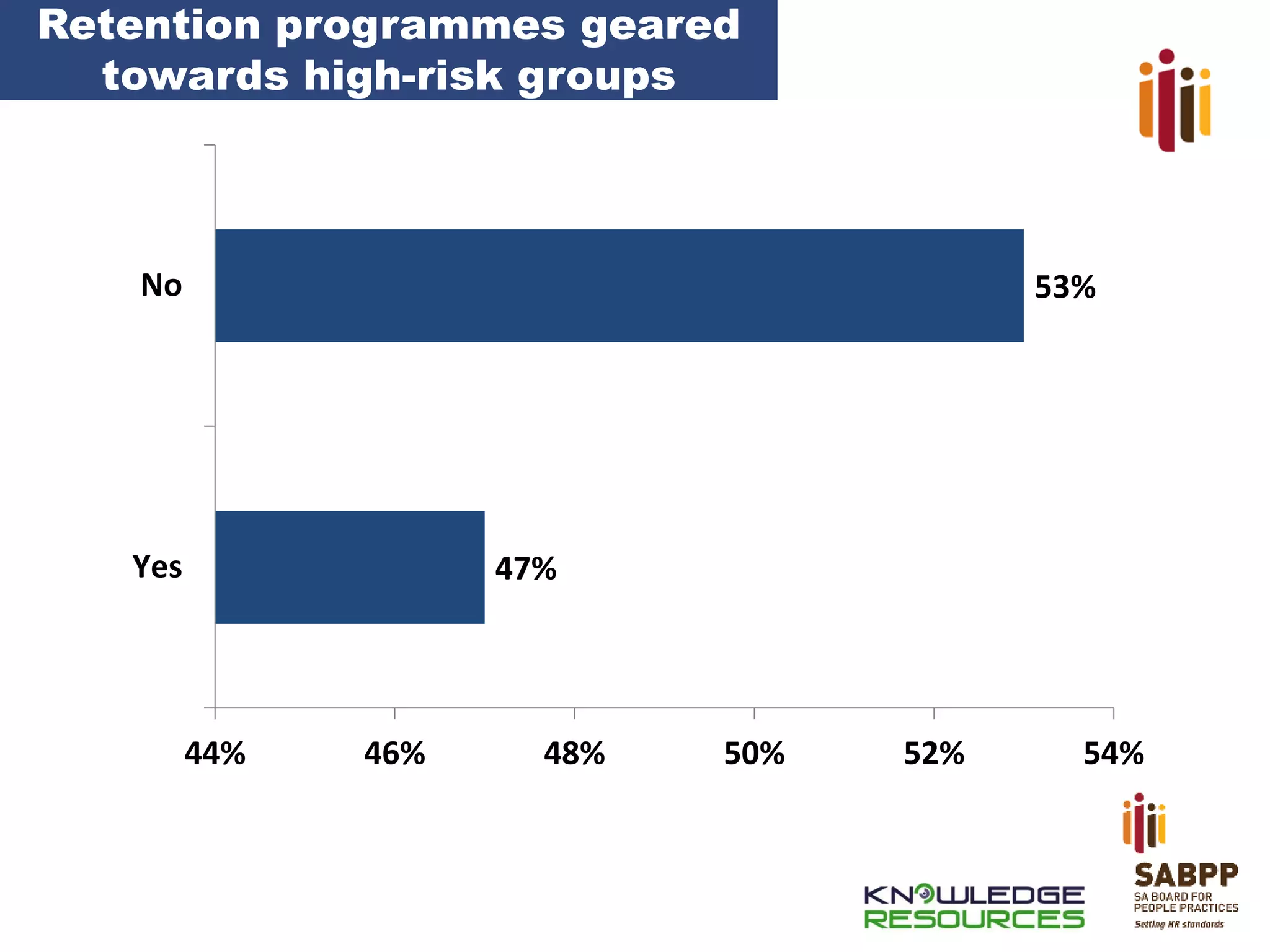
Retention programmes geared
towards high-risk groups

No

53%

Yes

47%

44%

46%

48%

50%

52%

54%
HR Risk Management Framework
CAPABILITIES

RESULTS

People
Human
Factor
Risk
Leadership

Human Factor
Risk Policy &
Strategy

Human
Factor
Risk
Management
Processes

Human
Factor
Risk
Handling

Outcomes

Partnerships

INNOVATION AND LEARNING
Adapted from EFQM & IMOR (Michael Robbins)
Getting the balance right…
Professional
knowledge and
standards
(competence)

Doing good
work
(excellence)

Accountability

Responsibility

Professional ethics
(conscience)

Ethical
behaviour
and conduct
(ethics)

Fairness

Transparency
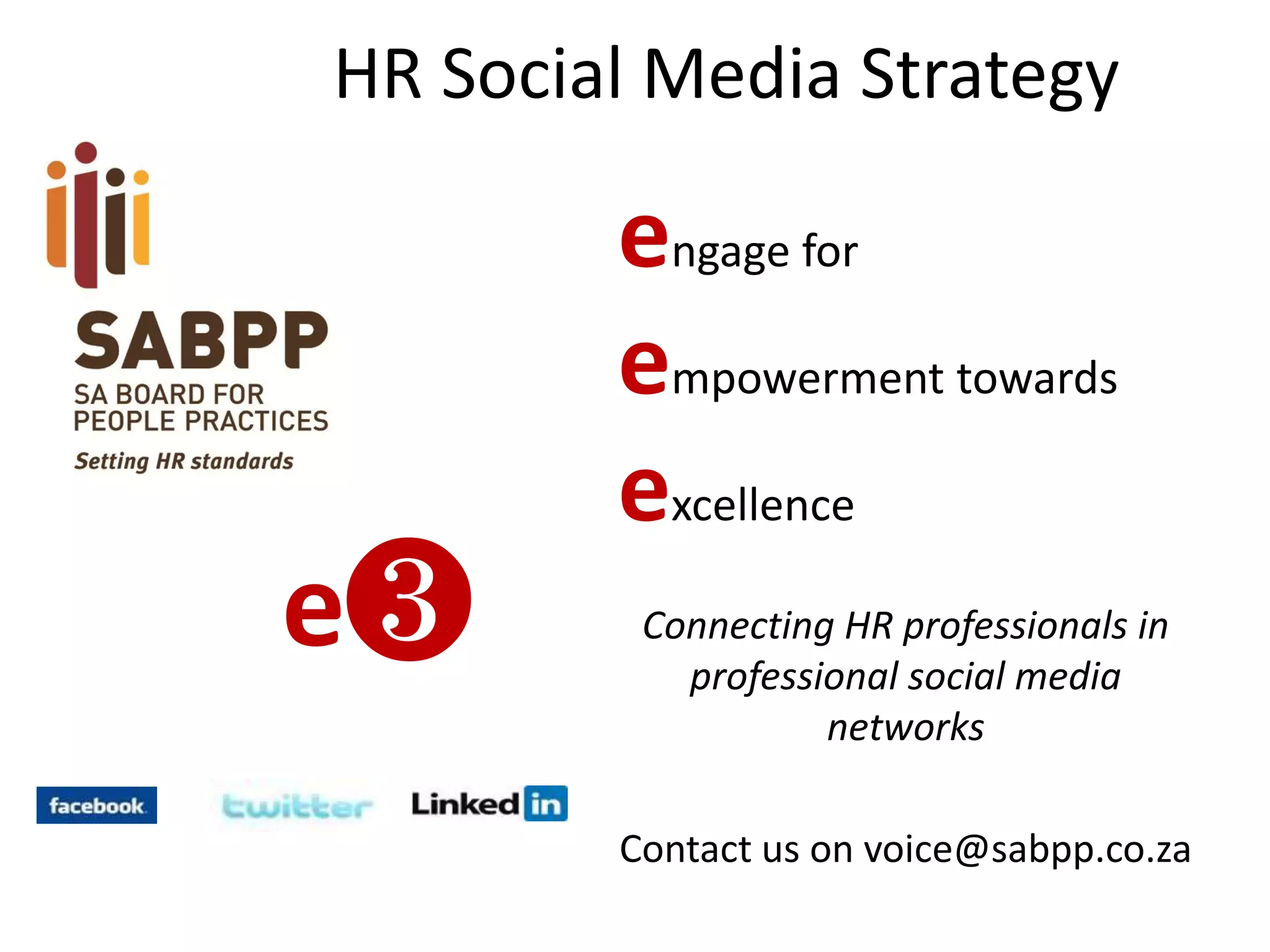
SocialHR Social Media Strategy
media strategy

engage for
empowerment towards
excellence

e❸

Connecting HR professionals in
professional social media
networks
Contact us on voice@sabpp.co.za
Are we ready for s-learning?
Utilisation of social media in HR

120%

100%

3%
13%

6%

11%

2%
11%

17%

80%

16%

28%

18%

17%

20%

0%

21%

9%

18%

22%
22%
19%

18%

25%
21%

Great extent

15%
15%

11%

16%
44%

32%

10%

28%

17%

40%

4%

25%

25%
26%

60%

2%

35%

43%

40%

4
From time to time
2

38%
25%

33%

Not at all
A social media strategy for the
HR department

No

88%

Yes

12%

0%

20%

40%

60%

80%

100%
Social media policies exist

No

62%

Yes

38%

0%

10%

20%

30%

40%

50%

60%

70%
Employees allowed to
access social media

No

60%

Yes

40%

0%

10%

20%

30%

40%

50%

60%

70%
Are people trained?

No

87%

Yes

13%

0%

20%

40%

60%

80%

100%
HR risks of social media
SABPP HR System Standards Model
BUSINESS STRATEGY – HR BUSINESS ALIGNMENT
Prepare

HR Risk
Management

FUNCTIONAL & CROSS FUNCTIONAL HR VALUE CHAIN
Implement

Workforce
planning

Learning

HR Service
Delivery

Review

Performance

Reward

Wellness

HR VALUE & DELIVERY PLATFORM

MEASURING HR SUCCESS
HR Audit: Standards & Metrics

ERM

OD

HR COMPETENCIES

Talent
Management

Strategic
HRM

HR Technology
(HRIS)

Improve
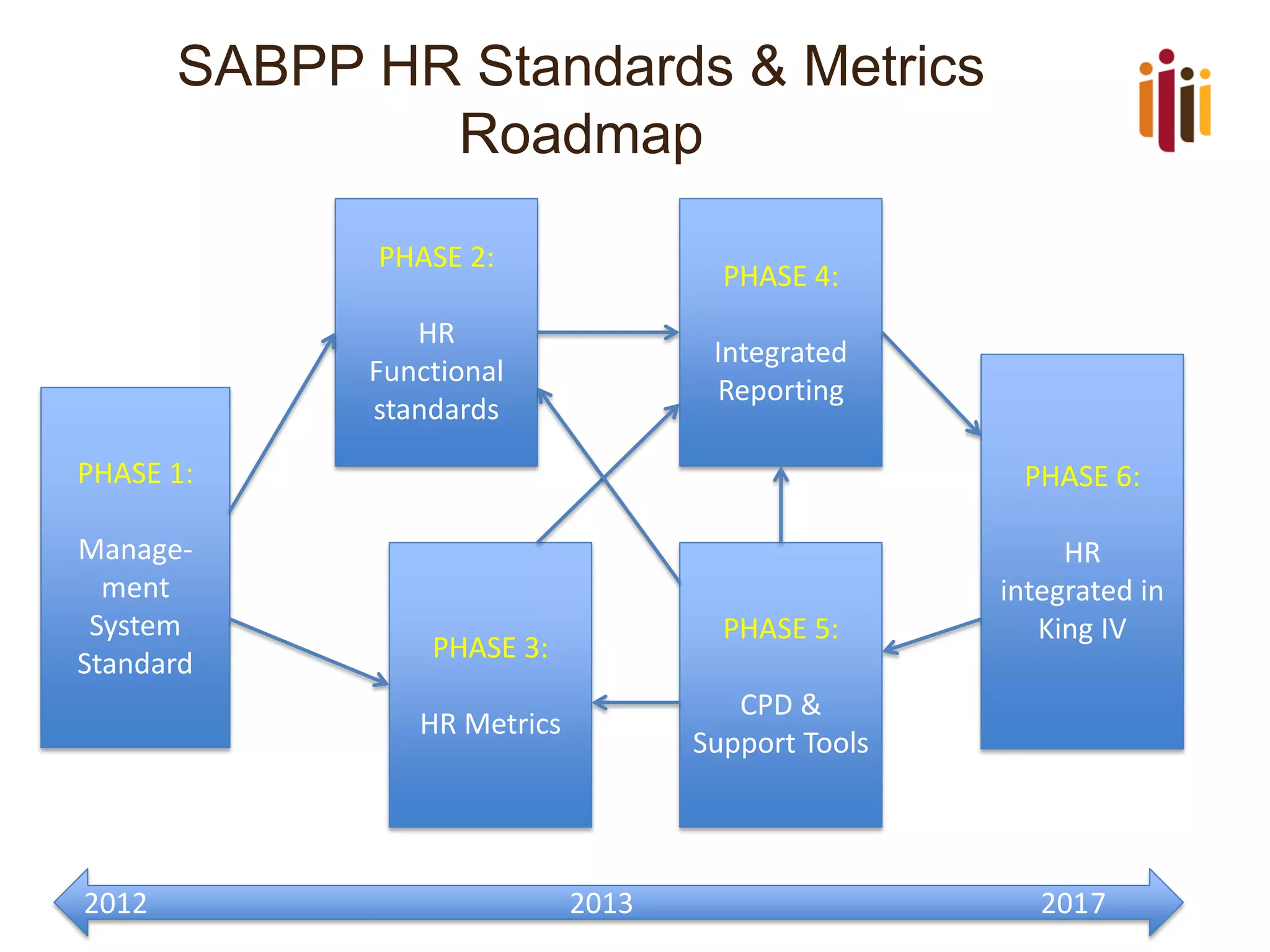
SABPP HR Standards & Metrics
Roadmap
PHASE 2:

PHASE 4:

HR
Functional
standards

Integrated
Reporting

PHASE 1:

PHASE 6:

Management
System
Standard

HR
integrated in
King IV

PHASE 5:

PHASE 3:

CPD &
Support Tools

HR Metrics

2012

2013

2017
The need for consistency and quality
Part C:
HR Competencies
What competencies do we need to deliver worldclass HR work?
Wisdom from the Free State

Prof Jonathan Jansen

“Competence is the quality of
being adequately or well
qualified physically and
intellectually. I have not for a
long time heard that word
used to describe a politician –
or any public servant, for that
matter. Make competence a
respectable word again.”
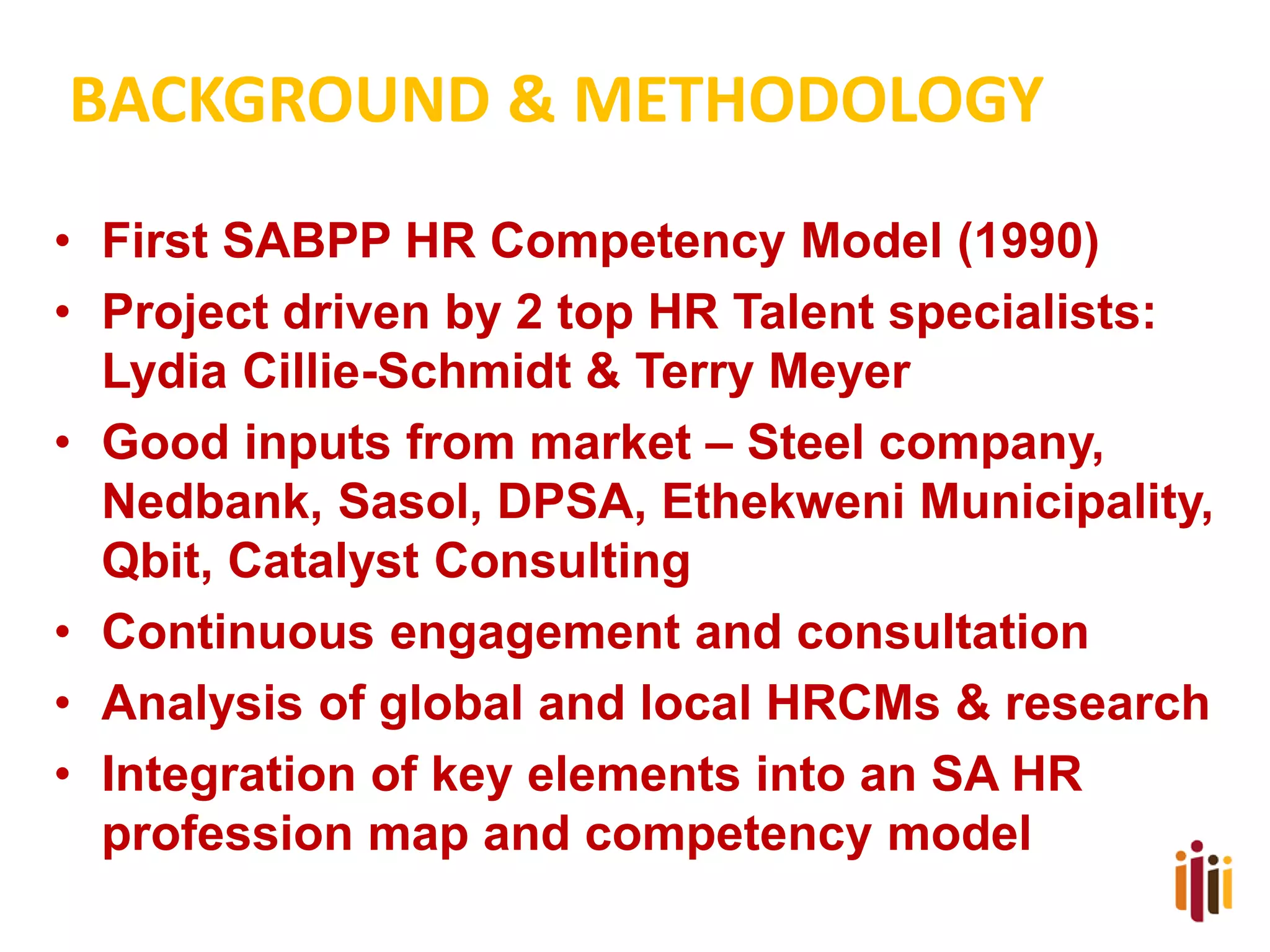
BACKGROUND & METHODOLOGY
• First SABPP HR Competency Model (1990)
• Project driven by 2 top HR Talent specialists:
Lydia Cillie-Schmidt & Terry Meyer
• Good inputs from market – Steel company,
Nedbank, Sasol, DPSA, Ethekweni Municipality,
Qbit, Catalyst Consulting
• Continuous engagement and consultation
• Analysis of global and local HRCMs & research
• Integration of key elements into an SA HR
profession map and competency model
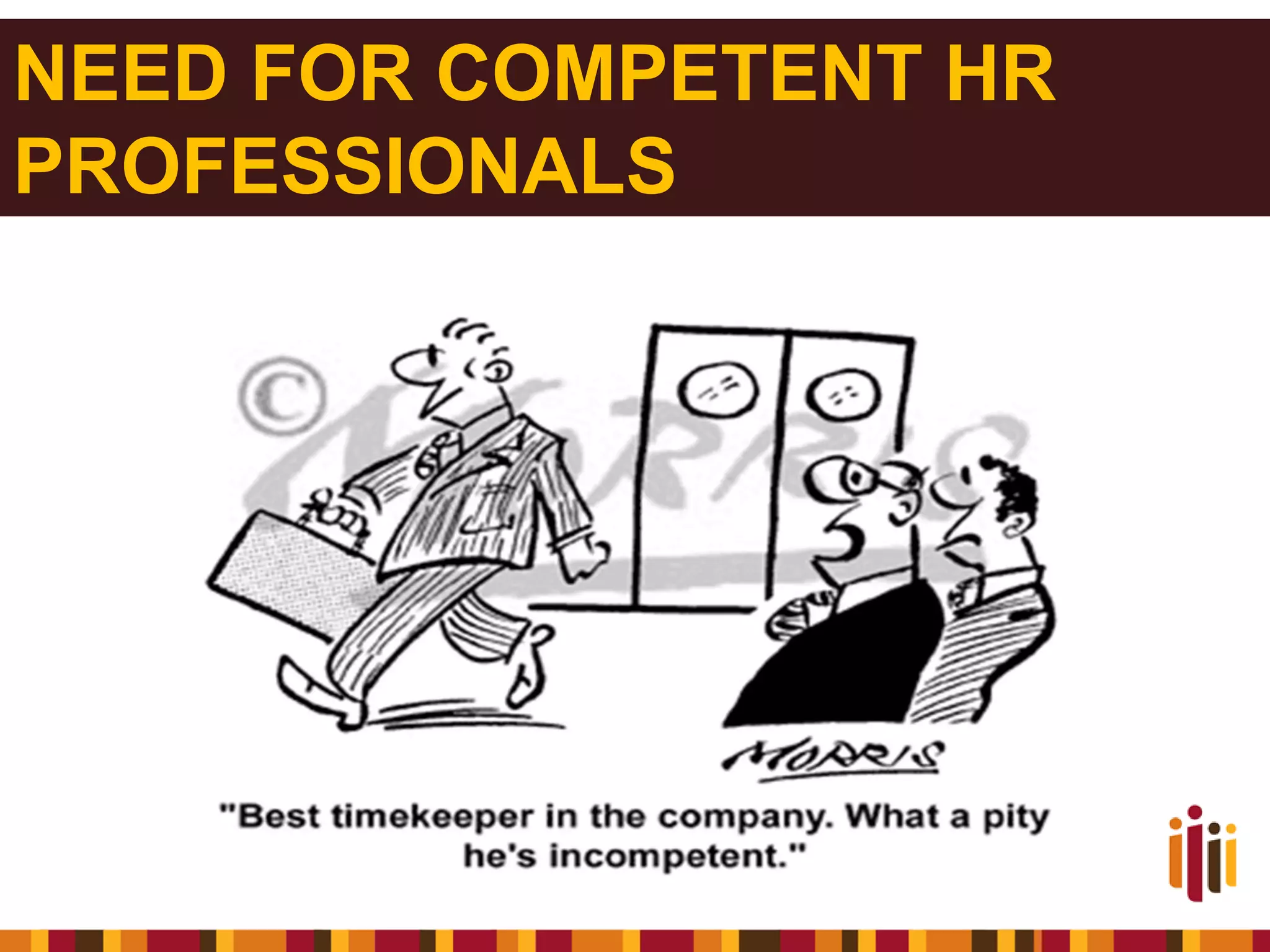
NEED FOR COMPETENT HR
PROFESSIONALS
Design principles
• Based on overarching HR profession map
• Learn from the previous models, integrate best
elements – leading competencies world-wide
• But not copying from global models
• Relevant to South Africa – unique/local
• Alignment of personal and business
competencies and HR competencies
• Focus on present and future
ULRICH MODELS 1 - 4
ULRICH 5.0
CORPORATE LEADERSHIP
COUNCIL
CORPORATE LEADERSHIP
COUNCIL
RBL HR COMPETENCY STUDY
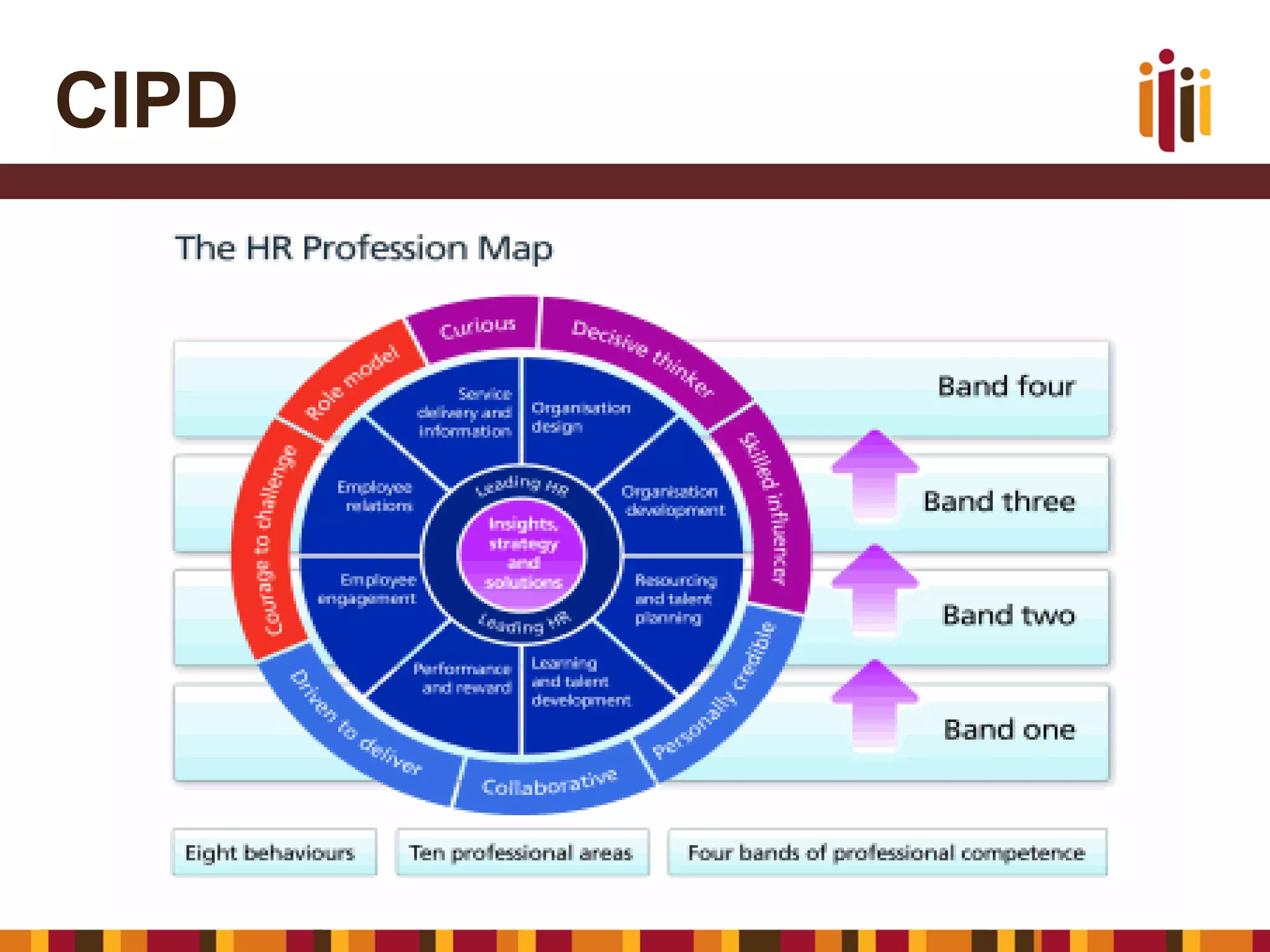
CIPD
Competency levels of the top 10
HR priorities
Priority Area

Priority
Weight

Competency
Weight

Priority
Rank

Competency
Rank

Creating a high-performance culture /
Performance management

3.91

3.42

1

6

Leadership and management
development

3.79

3.36

2

8

Skills development

3.77

3.58

3

3

Focus on corporate values, ethics

3.71

3.45

4

4

Industrial / Employee relations

3.69

3.70

5

2

Customer service / relations

3.68

3.43

6

5

Employee engagement

3.68

3.35

7

9

Change management

3.68

3.22

8

16

Crafting and implementing HR strategy

3.64

3.40

9

7

HR policies and procedures

3.62

3.71

10

1

HR Survey (2011)
HR COMPETENCY HOUSE
Professional seat at the table

“For HR to continue having a
seat at the table, thinking
and behaving like
professionals are
paramount.”

Getty Simelane CHRP
HR Consultant
SABPP/ Knowres:
Wisdom from HR Mentors (2011)
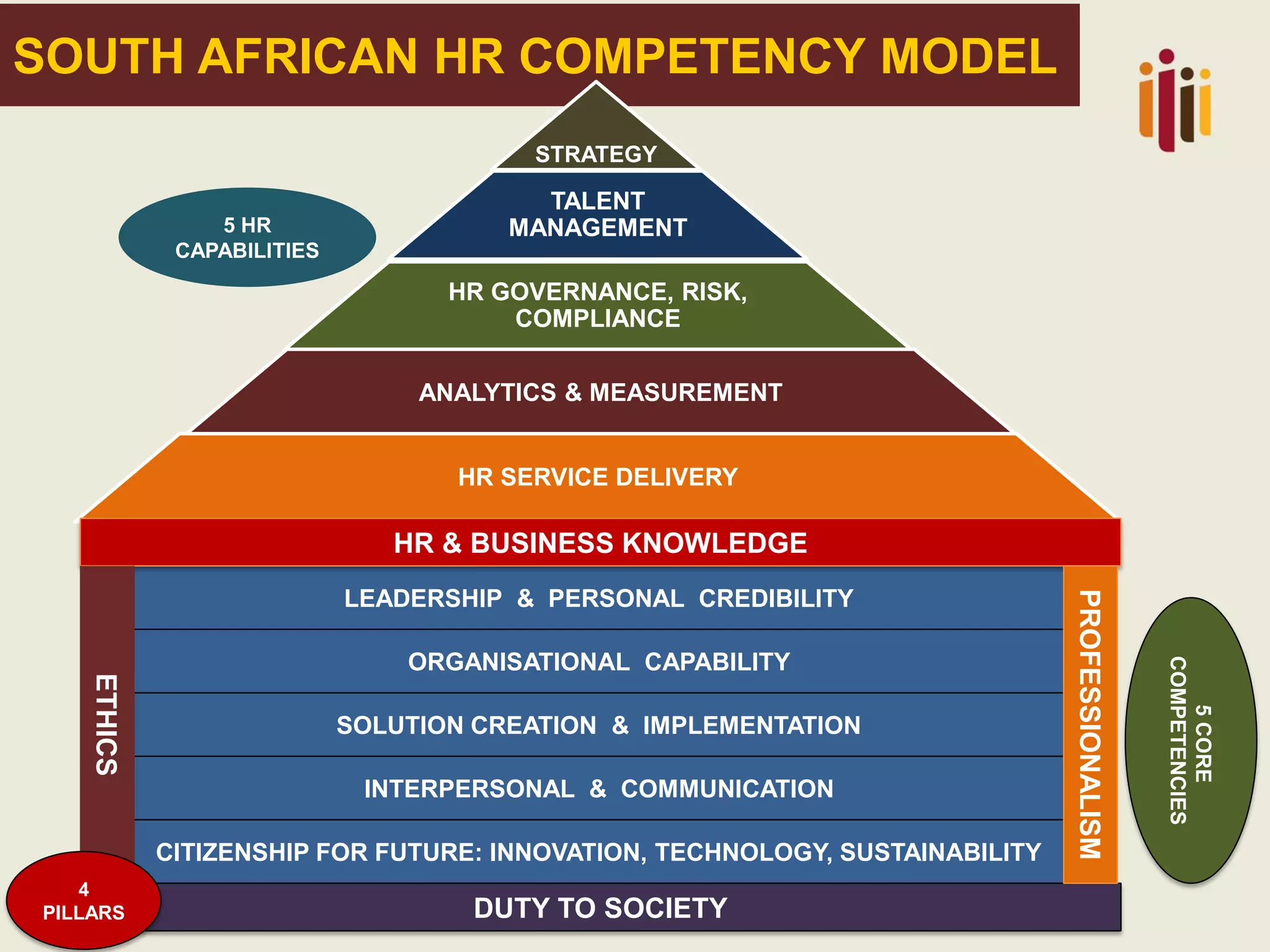
SOUTH AFRICAN HR COMPETENCY MODEL
STRATEGY
5 HR
CAPABILITIES

TALENT
MANAGEMENT
HR GOVERNANCE, RISK,
COMPLIANCE
ANALYTICS & MEASUREMENT
HR SERVICE DELIVERY

HR & BUSINESS KNOWLEDGE

SOLUTION CREATION & IMPLEMENTATION
INTERPERSONAL & COMMUNICATION
CITIZENSHIP FOR FUTURE: INNOVATION, TECHNOLOGY, SUSTAINABILITY

4
PILLARS

DUTY TO SOCIETY

5 CORE
COMPETENCIES

ETHICS

ORGANISATIONAL CAPABILITY

PROFESSIONALISM

LEADERSHIP & PERSONAL CREDIBILITY
Top management perspective
“The human resource professional in
an organisation needs to be an
integral part of the leadership and
the ‘right hand’ of the chief
executive. Establishing and sustaining
an ethical ethos, the HR professional
must work closely with the executive
leadership team to define and
promote the culture of an
organisation based on the underlying
values and then entrench the culture
through all the touch points in the
human capital value chain.”
Edward Kieswetter, CEO: Alexander Forbes
HR excellence: It is all about alignment
Conclusion

Professionalism in HR is important to acquire
and improve knowledge as professionals.
Join us on the journey towards HR
competence and benchmarking.
Let us rise to the challenge and
deliver excellence
Let us build a great HR profession!

professional@sabpp.co.za (Professional Registration)
kenneth@sabpp.co.za (Stakeholder Relations)
penny@sabpp.co.za (Research)
naren@sabpp.co.za (Learning & Quality)
marius@sabpp.co.za (Strategy inputs)
voice@sabpp.co.za (Social media)
Website : www.sabpp.co.za
New office: 8 Sherborne Str, Parktown
Tel: 011 482-8595 Fax: 011 482-4830
Cel: 082 859 3593 (Marius Meyer)

New
office

SABPP - Sanlam 2013

  • 1.
    ADVANCING THE HRPROFESSION: Towards HR Competencies, Benchmarking & Benchmarks Marius Meyer, CEO 25 January 2013 marius@sabpp.co.za @MariusSABPP & @SABPP1
  • 2.
    How we havechanged
  • 3.
    Economic impact oncompanies This financial crisis is forcing government and local agencies to make some tough decisions. If things continue for much longer, there's a real risk that we may have to lay off Jose.
  • 4.
    Agenda • Part A:HR trends and best practices • Part B: State of HR profession • Part C: HR Competency Model
  • 5.
    Part A: HR Trends& Best Practices Where is HR going globally and in South Africa? What are the major HR trends and best practices?
  • 6.
    IBM CEO Study2012: Factors impacting organisations IBM CEO Study 2012 1 2 3 4 5 6 7 8 9 Technology factors (71%) People skills (69%) Market factors (68%) Macro-economic factors Regulatory concerns Globalisation Socio-economic factors Environmental issues Geopolitical factors
  • 7.
    Top 10 HRpriorities 1. 2. 3. 4. 5. 6. 7. 8. 9. 10. Creating a high performance culture / climate Leadership and management development Skills development Focus on corporate values, ethics Industrial/employee relations HR Survey 2011 Customer service Employee engagement Change Management Crafting and implementing HR strategy HR policies and procedures
  • 8.
    HR Trends • • • • • HR asStrategic Partner and Talent Management HR Governance HR Risk Management New role to impact ethics in organisations HR contribution to CSR and socio-economic situation - sustainability • HR Technology and Social Media • HR standards and metrics – integrated reporting • HR Competency models - professionalism
  • 9.
    Biggest Opportunities forHR • Cultivating creative leaders • Mobilising for greater speed and flexibility • Capitalising on collective intelligence i.e. collaboration IBM: Working beyond Borders
  • 10.
    Use of workforce analyticsremains limited Measuring collaboration and knowledge sharing across the organisation 14% 5% Enhancing workforce productivity 39% Evaluating workforce performance 40% 15% 38% 19% Retaining valued talent within the organisation Sourcing, recruiting and onboarding individuals from outside the organisation Developing workforce skills and capabilities Allocating the workforce across the organisation 14% 40% 30% 35% Developing strategy linked to business strategy 28% Developing future leaders 29% 20% 22% 23% 25% 26% 0% 10% 20% 30% 40% 50% 60% IBM: Working beyond Borders Can identify historical trends and patterns Can develop scenarios and predict future outcomes
  • 11.
    Planning for growth Improvingoperational efficiency Developing new product/service offerings Expanding into new markets/geographies 44% 35% 31% 64% Today 48% 44% 0% 10% 20% 30% 40% 50% 60% 70% IBM: Working beyond Borders Three years
  • 12.
    Most important organisational capabilitiesover the next five years Leadership 37% Execution speed 34% Client connectivity 33% Innovation 31% 28% IBM: Working beyond Borders 30% 32% 34% 36% 38%
  • 13.
    Most important leadershipqualities over the next five years Creativity 60% Integrity 52% Ability to balance work and life demands 35% 0% IBM: Working beyond Borders 10% 20% 30% 40% 50% 60% 70%
  • 14.
    Part B: State ofHR Profession in SA What is the current state of HR in SA?
  • 15.
  • 16.
    New SABPP Model:HR Voice for Professionals Knowledge Human resource development Ethics Research - info Quality assurance Value & visibility Open for alliances Learning growth & development Innovation CPD Excellence Self-governance Duty to society
  • 17.
    SABPP BENEFITS RECOGNITION = PROFESSIONALSTATUS • • • • • • • • Professional registration NLRD Upload (SAQA) RPL Awards Advocacy HR Assessors/Moderators registration Accreditation of providers University accreditation RESOURCES = PRODUCTS/SERVICES • • • • • • • • • • • • • • • • • • • HR Competency Model Social media discussions Knowledge Centre Booklets/DVDs Guides/toolkits Charts/posters Fact sheets One-stop info Updates (laws) Ethics help-line Newsletters Website HR Internships/jobs HR policies Mentoring Workshops/seminars Access to alliances CPD Students RESEARCH = INFORMATION • • • • • • • • Research papers Position papers Books Articles Cases Benchmarking Magazines Labour market information
  • 18.
    Professional registration levels MHRP (Master) •M/D degree + 6 years top level experience • LoW = executive level CHRP (Chartered) HRP (Professional) • Hons degree + 4 years sr experience • LoW = senior management • Degree/ND + 3 years experience • LoW = middle management HRA (Associate) • 2 year dip + 2 years experience • LoW = junior level HRT (Technician) • Certificate + 1 year experience • LoW = entry
  • 19.
    Top 7 SABPPpriorities 2013 • • • • • Rebranding & visibility (all provinces) National HR standards & metrics project National HR competency model HR social media strategy SAQA pilot project – professional designations upload on NLRD • Professional products & services • Research papers
  • 20.
    L&D Benchmarks (ASTD/SABPP) BENCHMARK USA RSA CHANGE Average %payroll 2,24% 3,94% + 0,83 Hours /employee 36 40 - 12 Spend/employee $1068 R 6898 +R 1700 Employees/trainer 253 157 +19 % companies elearning 31% 43% + 10% % outsourced 22% 62% +10%
  • 21.
  • 22.
  • 23.
    Research Projects • • • • • • Annual HRSurvey (completed) Annual L&D State of Training in SA (ASTD) Green HR (new) Talent Survey (new) HR Social Media (new) HR Standards & Metrics (new) For access to our research, contact Penny Abbott on hrri@sabpp.co.za
  • 24.
    Cost of labouras a % of revenue Too confidential 2% Not done 4% Don’t know/Not applicable 25% 61 - 70% 11% 51 - 60% 14% 41 - 50% 9% 31 - 40% 7% 21 - 30% 12% 11 - 20% 7% > 10% 9% 0% 5% 10% 15% 20% 25% 30%
  • 25.
    Revenue per full-timeemployee Not applicable 15% ? 3% It’s confidential 4% Don’t measure/Don’t know 23% R10 million+ 2% R1 million to R 10 million 12% R100 000 to R1 million 16% > R100 000 24% R0 1% 0% 5% 10% 15% 20% 25% 30%
  • 26.
    LTO rate Indicate LTOrate: 44% Don't measure 21% Don't know 35% 0% 10% 20% 30% 40% 50%
  • 27.
    Absenteeism rate Indicate absenteeismrate 35% Don't measure 31% Don't know 34% 29% 30% 31% 32% 33% 34% 35% 36%
  • 28.
    The basic metricsthey propose as essential for investors to know are: 1. Spending on human capital a. Total amount spent on employees (salaries, benefits, taxes) b. Total amount spent in support of employees c. Total amount spent in lieu of employees (contractors, etcetera) d. Total amount invested in training and development e. Total headcount and total FTE (full-time equivalents) at the end of the period 2. Ability to retain talent a. Voluntary and total turnover b. Broken down by subset of EEO-1 job types c. Industry standard formula of (# of terminations during the period) / (average active headcount during the period) 3. Leadership depth a. Percentage of defined positions that have an identified successor b. Percentage of open defined positions filled internally during the period SHRM (April 2012)
  • 29.
    The basic metricsthey propose as essential for investors to know are: 4. Leadership quality a. Index of relevant questions from employee survey b. Information on the response rate and methodology/tool 5. Employee engagement a. Index of relevant questions from employee survey 287 b. Information on the response rate and methodology/tool 6. Human capital discussion & analysis (HD&A) a. Narrative to provide context and discussion of the reported metrics b. Disclosure of any material risks or any other material information related to human capital Note: Organisations may wish to include breakdowns of these metrics by unit or region; it simply depends on what makes sense to the organisation and its investors. SHRM (April 2012)
  • 30.
  • 31.
    Change themes for2012 26% Finding talent Developing programmes for retaining talent Learning and development Change and transformation Motivation of the workforce BEE Strategic business partnering Focusing on business growth New HR Information Systems Remuneration Introducing or fine-tuning performance management Utilising social media HIV Strategic alliances Increasing budget 20% 10% 9% 8% 6% 5% 4% 3% 3% 2% 1% 1% 1% 1% 0% 5% 10% 15% 20% 25% 30%
  • 32.
    Changes planned forthe next two years 25% None 14% Re-engineering and restructuring 11% 10% 9% 8% 6% 5% 3% 3% 3% 2% 2% Attracting talent and succession planning Strategic business partnering Be more efficient Training, development, upskilling HRIS and shared services Performance management Leadership development Talent retention Outsourcing aspects of HR Do more transformational work Use of coaching and mentoring 0% 5% 10% 15% 20% 25% 30%
  • 33.
    KR/SABPP HR Survey(2011)) GOOD NEWS • HR on boards/excos of 81% of companies • 74% of HR professionals say that line management accepts HR as strategic partners • HR professionals in SA is better qualified than counterparts in USA • Talent management is 4th most important priority for HR for 2012 • • • • BAD NEWS Talent management is only priority no 17 for HR Talent management is ranked HR’s 22nd best competency area Only 55% of HR departments have HR succession plan Only 20% of SA companies have a competency model for HR
  • 34.
  • 35.
    SCARCE AND CRITICALSKILLS Pos. Type of scarce and critical skills area Magnitude of scarcity 1 Industrial & Mechanical Engineers and Technologists 2 Medical Technicians 3 Training & development professionals 4 Metal fitters & machinists 5 Specialist managers 6 Agriculture & forestry scientists 7 Chemistry, food & beverage technicians 8 Electrical Engineering, draft persons & technicians 9 Social workers 9 Medical and laboratory scientists & technologists 10 Motor mechanics 11 Structural steel & welding trade workers 11 Advertising, marketing & sales managers 12 Civil engineering, draft persons & technicians 13 HR Professionals 14 Advertising, marketing & sales professionals 15 Production & operations managers 12 665 10 000 9 260 8 340 6 955 6 175 6 145 5 145 5 000 5 000 4 205 4 045 4 045 3 960 3 855 3 095 3 130 (DHET, 2011)
  • 36.
  • 37.
    SABPP HR RiskStudy Source: SABPP (2010)
  • 38.
  • 39.
    Retention programmes geared towardshigh-risk groups No 53% Yes 47% 44% 46% 48% 50% 52% 54%
  • 40.
    HR Risk ManagementFramework CAPABILITIES RESULTS People Human Factor Risk Leadership Human Factor Risk Policy & Strategy Human Factor Risk Management Processes Human Factor Risk Handling Outcomes Partnerships INNOVATION AND LEARNING Adapted from EFQM & IMOR (Michael Robbins)
  • 41.
    Getting the balanceright… Professional knowledge and standards (competence) Doing good work (excellence) Accountability Responsibility Professional ethics (conscience) Ethical behaviour and conduct (ethics) Fairness Transparency
  • 42.
    SocialHR Social MediaStrategy media strategy engage for empowerment towards excellence e❸ Connecting HR professionals in professional social media networks Contact us on voice@sabpp.co.za
  • 43.
    Are we readyfor s-learning?
  • 44.
    Utilisation of socialmedia in HR 120% 100% 3% 13% 6% 11% 2% 11% 17% 80% 16% 28% 18% 17% 20% 0% 21% 9% 18% 22% 22% 19% 18% 25% 21% Great extent 15% 15% 11% 16% 44% 32% 10% 28% 17% 40% 4% 25% 25% 26% 60% 2% 35% 43% 40% 4 From time to time 2 38% 25% 33% Not at all
  • 45.
    A social mediastrategy for the HR department No 88% Yes 12% 0% 20% 40% 60% 80% 100%
  • 46.
    Social media policiesexist No 62% Yes 38% 0% 10% 20% 30% 40% 50% 60% 70%
  • 47.
    Employees allowed to accesssocial media No 60% Yes 40% 0% 10% 20% 30% 40% 50% 60% 70%
  • 48.
  • 49.
    HR risks ofsocial media
  • 50.
    SABPP HR SystemStandards Model BUSINESS STRATEGY – HR BUSINESS ALIGNMENT Prepare HR Risk Management FUNCTIONAL & CROSS FUNCTIONAL HR VALUE CHAIN Implement Workforce planning Learning HR Service Delivery Review Performance Reward Wellness HR VALUE & DELIVERY PLATFORM MEASURING HR SUCCESS HR Audit: Standards & Metrics ERM OD HR COMPETENCIES Talent Management Strategic HRM HR Technology (HRIS) Improve
  • 51.
    SABPP HR Standards& Metrics Roadmap PHASE 2: PHASE 4: HR Functional standards Integrated Reporting PHASE 1: PHASE 6: Management System Standard HR integrated in King IV PHASE 5: PHASE 3: CPD & Support Tools HR Metrics 2012 2013 2017
  • 52.
    The need forconsistency and quality
  • 53.
    Part C: HR Competencies Whatcompetencies do we need to deliver worldclass HR work?
  • 54.
    Wisdom from theFree State Prof Jonathan Jansen “Competence is the quality of being adequately or well qualified physically and intellectually. I have not for a long time heard that word used to describe a politician – or any public servant, for that matter. Make competence a respectable word again.”
  • 55.
    BACKGROUND & METHODOLOGY •First SABPP HR Competency Model (1990) • Project driven by 2 top HR Talent specialists: Lydia Cillie-Schmidt & Terry Meyer • Good inputs from market – Steel company, Nedbank, Sasol, DPSA, Ethekweni Municipality, Qbit, Catalyst Consulting • Continuous engagement and consultation • Analysis of global and local HRCMs & research • Integration of key elements into an SA HR profession map and competency model
  • 56.
    NEED FOR COMPETENTHR PROFESSIONALS
  • 57.
    Design principles • Basedon overarching HR profession map • Learn from the previous models, integrate best elements – leading competencies world-wide • But not copying from global models • Relevant to South Africa – unique/local • Alignment of personal and business competencies and HR competencies • Focus on present and future
  • 58.
  • 59.
  • 60.
  • 61.
  • 62.
  • 63.
  • 64.
    Competency levels ofthe top 10 HR priorities Priority Area Priority Weight Competency Weight Priority Rank Competency Rank Creating a high-performance culture / Performance management 3.91 3.42 1 6 Leadership and management development 3.79 3.36 2 8 Skills development 3.77 3.58 3 3 Focus on corporate values, ethics 3.71 3.45 4 4 Industrial / Employee relations 3.69 3.70 5 2 Customer service / relations 3.68 3.43 6 5 Employee engagement 3.68 3.35 7 9 Change management 3.68 3.22 8 16 Crafting and implementing HR strategy 3.64 3.40 9 7 HR policies and procedures 3.62 3.71 10 1 HR Survey (2011)
  • 65.
  • 66.
    Professional seat atthe table “For HR to continue having a seat at the table, thinking and behaving like professionals are paramount.” Getty Simelane CHRP HR Consultant SABPP/ Knowres: Wisdom from HR Mentors (2011)
  • 67.
    SOUTH AFRICAN HRCOMPETENCY MODEL STRATEGY 5 HR CAPABILITIES TALENT MANAGEMENT HR GOVERNANCE, RISK, COMPLIANCE ANALYTICS & MEASUREMENT HR SERVICE DELIVERY HR & BUSINESS KNOWLEDGE SOLUTION CREATION & IMPLEMENTATION INTERPERSONAL & COMMUNICATION CITIZENSHIP FOR FUTURE: INNOVATION, TECHNOLOGY, SUSTAINABILITY 4 PILLARS DUTY TO SOCIETY 5 CORE COMPETENCIES ETHICS ORGANISATIONAL CAPABILITY PROFESSIONALISM LEADERSHIP & PERSONAL CREDIBILITY
  • 68.
    Top management perspective “Thehuman resource professional in an organisation needs to be an integral part of the leadership and the ‘right hand’ of the chief executive. Establishing and sustaining an ethical ethos, the HR professional must work closely with the executive leadership team to define and promote the culture of an organisation based on the underlying values and then entrench the culture through all the touch points in the human capital value chain.” Edward Kieswetter, CEO: Alexander Forbes
  • 69.
    HR excellence: Itis all about alignment
  • 70.
    Conclusion Professionalism in HRis important to acquire and improve knowledge as professionals. Join us on the journey towards HR competence and benchmarking.
  • 71.
    Let us riseto the challenge and deliver excellence
  • 72.
    Let us builda great HR profession! professional@sabpp.co.za (Professional Registration) kenneth@sabpp.co.za (Stakeholder Relations) penny@sabpp.co.za (Research) naren@sabpp.co.za (Learning & Quality) marius@sabpp.co.za (Strategy inputs) voice@sabpp.co.za (Social media) Website : www.sabpp.co.za New office: 8 Sherborne Str, Parktown Tel: 011 482-8595 Fax: 011 482-4830 Cel: 082 859 3593 (Marius Meyer) New office