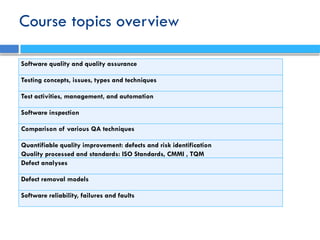
Course topics overview
Softwarequality and quality assurance
Testing concepts, issues, types and techniques
Test activities, management, and automation
Software inspection
Comparison of various QA techniques
Quantifiable quality improvement: defects and risk identification
Quality processed and standards: ISO Standards, CMMI , TQM
Defect analyses
Defect removal models
Software reliability, failures and faults
3.
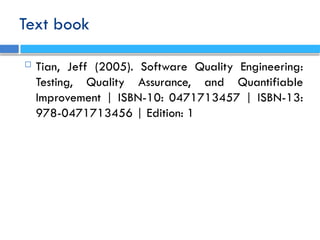
Text book
Tian,Jeff (2005). Software Quality Engineering:
Testing, Quality Assurance, and Quantifiable
Improvement | ISBN-10: 0471713457 | ISBN-13:
978-0471713456 | Edition: 1
4.
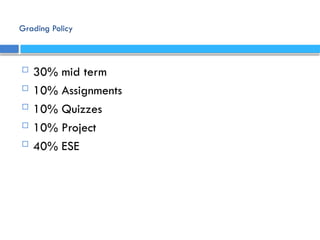
Grading Policy
30%mid term
10% Assignments
10% Quizzes
10% Project
40% ESE
5.
Class Policy
Assignments:
Each assignment will count towards the total.
Late assignments will not be accepted / graded.
Quiz policy:
Quizzes may be announced or unannounced.
No best of quizzes policy.
6.
Software errors costthe U.S. economy $60
billion annually in rework, lost productivity and
actual damages. We all know software bugs can be
annoying, but faulty software can also be expensive,
embarrassing, destructive and deadly. Following are
some of the famous software “disasters”:
Why Software Quality Assurance?
6
7.
1. Mariner BugsOut (1962)
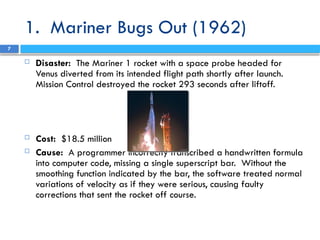
Disaster: The Mariner 1 rocket with a space probe headed for
Venus diverted from its intended flight path shortly after launch.
Mission Control destroyed the rocket 293 seconds after liftoff.
Cost: $18.5 million
Cause: A programmer incorrectly transcribed a handwritten formula
into computer code, missing a single superscript bar. Without the
smoothing function indicated by the bar, the software treated normal
variations of velocity as if they were serious, causing faulty
corrections that sent the rocket off course.
7
8.
2. CIA Givesthe Soviets Gas (1982)
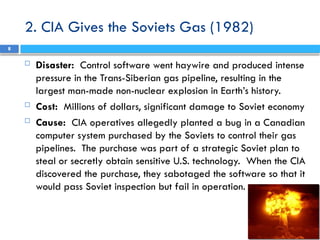
Disaster: Control software went haywire and produced intense
pressure in the Trans-Siberian gas pipeline, resulting in the
largest man-made non-nuclear explosion in Earth’s history.
Cost: Millions of dollars, significant damage to Soviet economy
Cause: CIA operatives allegedly planted a bug in a Canadian
computer system purchased by the Soviets to control their gas
pipelines. The purchase was part of a strategic Soviet plan to
steal or secretly obtain sensitive U.S. technology. When the CIA
discovered the purchase, they sabotaged the software so that it
would pass Soviet inspection but fail in operation.
8
9.
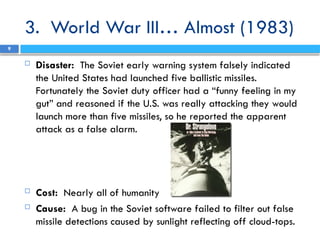
3. World WarIII… Almost (1983)
Disaster: The Soviet early warning system falsely indicated
the United States had launched five ballistic missiles.
Fortunately the Soviet duty officer had a “funny feeling in my
gut” and reasoned if the U.S. was really attacking they would
launch more than five missiles, so he reported the apparent
attack as a false alarm.
Cost: Nearly all of humanity
Cause: A bug in the Soviet software failed to filter out false
missile detections caused by sunlight reflecting off cloud-tops.
9
10.
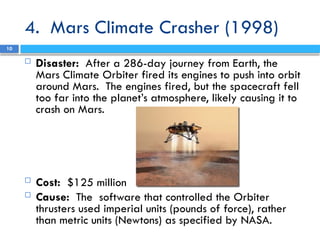
4. Mars ClimateCrasher (1998)
Disaster: After a 286-day journey from Earth, the
Mars Climate Orbiter fired its engines to push into orbit
around Mars. The engines fired, but the spacecraft fell
too far into the planet’s atmosphere, likely causing it to
crash on Mars.
Cost: $125 million
Cause: The software that controlled the Orbiter
thrusters used imperial units (pounds of force), rather
than metric units (Newtons) as specified by NASA.
10
General Expectations
Goodsoftware quality
People: Consumers vs producers
quality expectations by consumers
to be satisfied by producers through software quality
engineering (SQE)
Deliver software system that...
does what it is supposed to do
needs to be “validated”
does the things correctly
needs to be “verified”
13.
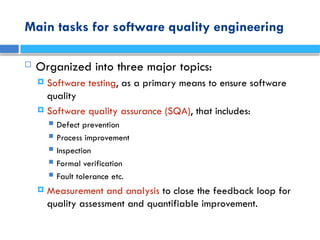
Main tasks forsoftware quality engineering
Organized into three major topics:
Software testing, as a primary means to ensure software
quality
Software quality assurance (SQA), that includes:
Defect prevention
Process improvement
Inspection
Formal verification
Fault tolerance etc.
Measurement and analysis to close the feedback loop for
quality assessment and quantifiable improvement.
14.
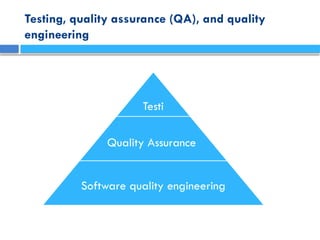
Testing, quality assurance(QA), and quality
engineering
Testi
ng
Quality Assurance
Software quality engineering
15.
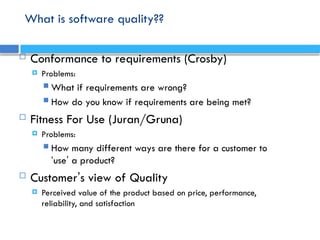
What is softwarequality??
Conformance to requirements (Crosby)
Problems:
What if requirements are wrong?
How do you know if requirements are being met?
Fitness For Use (Juran/Gruna)
Problems:
How many different ways are there for a customer to
‘use’ a product?
Customer’s view of Quality
Perceived value of the product based on price, performance,
reliability, and satisfaction
16.
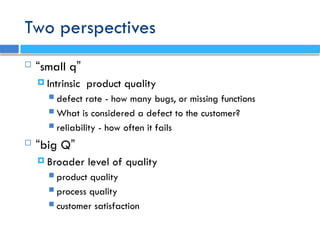
Two perspectives
“smallq”
Intrinsic product quality
defect rate - how many bugs, or missing functions
What is considered a defect to the customer?
reliability - how often it fails
“big Q”
Broader level of quality
product quality
process quality
customer satisfaction
17.
Two perspectives
Willa good ‘q’ guarantee customer satisfaction?
Can you achieve a good “Q” without a good “q”?
18.
Two perspectives
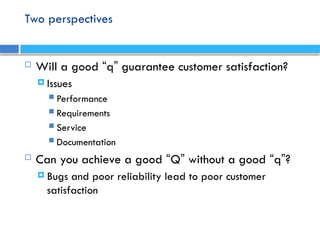
Willa good “q” guarantee customer satisfaction?
Issues
Performance
Requirements
Service
Documentation
Can you achieve a good “Q” without a good “q”?
Bugs and poor reliability lead to poor customer
satisfaction
19.
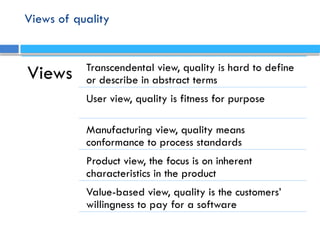
Views of quality
ViewsTranscendental view, quality is hard to define
or describe in abstract terms
User view, quality is fitness for purpose
Manufacturing view, quality means
conformance to process standards
Product view, the focus is on inherent
characteristics in the product
Value-based view, quality is the customers’
willingness to pay for a software
Defects
Defect definition– a problem with the software,
either with its external behavior or internal
characteristics
What does Quality Assurance do?
Focuses on ‘Correctness’ aspect of quality
Focuses on defect prevention, detection, removal and
containment
Focuses on testing activities
22.
Correctness
Many definitions:
The degree to which a software entity's behavior
matches its specification
The degree to which a system is free from defects
in its specification, design and implementation.
The ability of software products to perform their
exact tasks as defined by their specification.
Free from error, accurate, in accordance with
specifications.
23.
Correctness and defects
Highquality ≈ low defect
intuitive notion related to correctness
quality problem ≈ defect impact
widely accepted, but need better definitions
24.
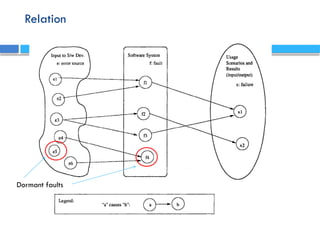
Error, fault, failure,and defect
Failure: The inability of a system or component
to perform its required functions within
specified performance requirements.
Fault: An incorrect step, process, or data
definition in a computer program.
Error: A human action that produces an
incorrect result.
Cost of removingdefects
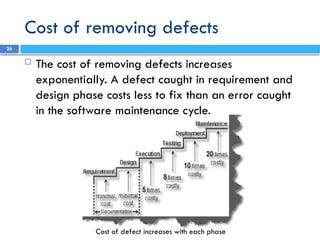
26
The cost of removing defects increases
exponentially. A defect caught in requirement and
design phase costs less to fix than an error caught
in the software maintenance cycle.
Cost of defect increases with each phase
27.
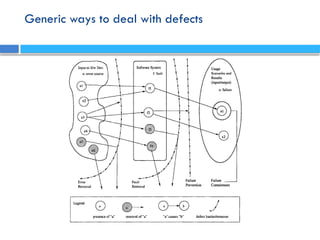
How do wedeal with defects ?
Defect Prevention
Defect Detection and Removal
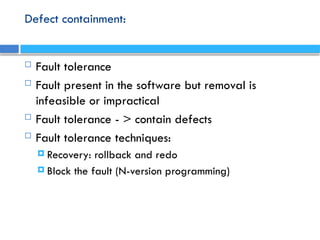
Defect Containment
28.
Defect Prevention
Eliminatingcertain error sources, such as
eliminating ambiguities or correcting human
misconceptions
Fault prevention or blocking by directly
correcting or blocking these missing or incorrect
human actions
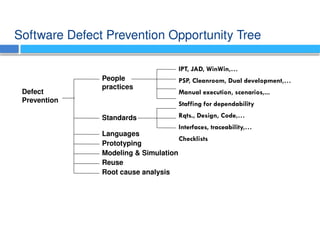
Software Defect PreventionOpportunity Tree
IPT, JAD, WinWin,…
PSP, Cleanroom, Dual development,…
Manual execution, scenarios,...
Staffing for dependability
Rqts., Design, Code,…
Interfaces, traceability,…
Checklists
Defect
Prevention
People
practices
Standards
Languages
Prototyping
Modeling & Simulation
Reuse
Root cause analysis
31.
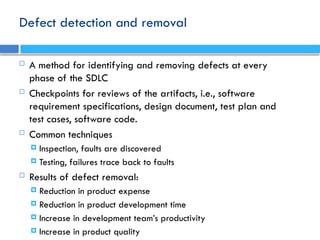
Defect detection andremoval
A method for identifying and removing defects at every
phase of the SDLC
Checkpoints for reviews of the artifacts, i.e., software
requirement specifications, design document, test plan and
test cases, software code.
Common techniques
Inspection, faults are discovered
Testing, failures trace back to faults
Results of defect removal:
Reduction in product expense
Reduction in product development time
Increase in development team’s productivity
Increase in product quality
Class activity (Groupof 2)
Write down two methods (other than those given in
slides) for each of the below with their examples:
defect prevention
defect removal
defect containment
#30 IPT = [Integrated Project Team] used in IPPD which has been mandated for the Department of Defense. IPPD is a management technique that simultaneously integrates all essential acquisition activities through the use of multidisciplinary teams to optimize the design, manufacturing, business, and supportability processes.
Winwin:
The WinWin spiral software engineering methodology expands the Boehm-Spiral methodology by adding a priority setting step, the WinWin process, at the beginning of each spiral cycle and by introducing intermediate goals, called anchor points.
PSP [Personal software Process]: PSP training follows an evolutionary improvement approach: an engineer learning to integrate the PSP into his or her process begins at the first level - PSP0 - and progresses in process maturity to the final level - PSP2. PSP2 adds two new phases: design review and code review. Defect prevention and removal of them are the focus at the PSP2. Engineers learn to evaluate and improve their process by measuring how long tasks take and the number of defects they inject and remove in each phase of development.
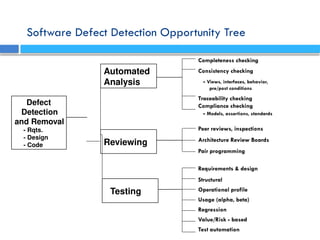
#32 Pair programming (sometimes referred to as peer programming) is an agile software development technique in which two programmers work as a pair together on one workstation. One, the driver, writes code while the other, the observer,pointer or navigator,[1] reviews each line of code as it is typed in
The intent of regression testing is to ensure, that a change, such as a bug fix, did not introduce new faults.”
#33 N-version programming: N-version programing is defined as the independent generation of N>2 functionally equivalent programs from the same initial specification. A methodology of N-version programing has been devised and three types of special mechanisms have been identified that are needed to coordinate the execution of an N-version software unit and to compare the correspondent results generated by each version.
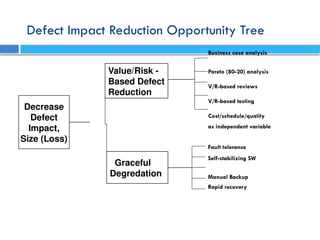
#34 Business case analysis includes mostly the cost benefit analysis:
Pareto analysis: "80/20" rule, under the assumption that, in all situations, 20% of causes determine 80% of problems, this ratio is merely a convenient rule of thumb and is not nor should it be considered immutable law of nature.
the Pareto Principle (also known as the 80/20 rule) the idea that by doing 20% of the work you can generate 80% of the benefit of doing the entire job.
Self-stabilization is a concept of fault-tolerance in distributed computing. A distributed system that is self-stabilizing will end up in a correct state no matter what state it is initialized with. That correct state is reached after a finite number of execution steps.