UCjmCXXIjd03JQad8-rUzs0Q
This video is designed to help students preparing for the GRE QUANT SECTION
Do subscribe to my channel
Visit my page
https://www.mathmadeeasy.co/about-1
You can contact me for personal classes.
What are permutations?
What are combinations?
How do we use them in selection and arrangements?
Learn all this and much more in this presentation.
Number of ways of arranging r objects out of n objects = 𝑛 𝑃𝑟
=
𝑛!
𝑛−𝑟 !
5 𝑃2
= 5 4 = 20
Number of ways of selecting r out of n objects = 𝑛 𝐶 𝑟
=
𝑛!
𝑟! 𝑛−𝑟 !
5 𝐶2
=
5(4)
1(2)
= 10
Question 1
6 points lie in a circle. How many quadrilaterals can be formed by joining these
points.
We need to choose 4 out of 6 points since a quadrilateral has 4 vertices.
Total number of quadrilaterals =6 𝐶4
= 6 𝑐2
=
6×5
1×2
= 15
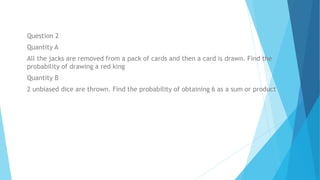
Question 2
Quantity A
All the jacks are removed from a pack of cards and then a card is drawn. Find the
probability of drawing a red king
Quantity B
2 unbiased dice are thrown. Find the probability of obtaining 6 as a sum or product
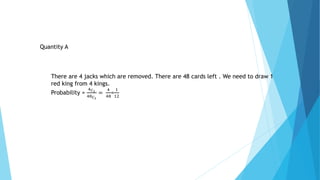
Quantity A
There are 4 jacks which are removed. There are 48 cards left . We need to draw 1
red king from 4 kings.
Probability =
4 𝐶1
48 𝐶1
=
4
48
=
1
12
Quantity B
We need 6 as a sum or product
Favourable outcomes are = {(1,5), (1,6),(2,4),(2,3), (3,3),(3,2),(4,2),(5,1),(6,1)}
𝑝𝑟𝑜𝑏𝑎𝑏𝑖𝑙𝑖𝑡𝑦 =
9
36
=
1
4
A B
1
12
1
4
Cross multiplying, we get
A B
4 12
B is greater
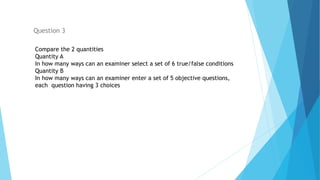
Question 3
Compare the 2 quantities
Quantity A
In how many ways can an examiner select a set of 6 true/false conditions
Quantity B
In how many ways can an examiner enter a set of 5 objective questions,
each question having 3 choices
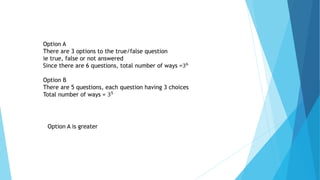
Option A
There are 3 options to the true/false question
ie true, false or not answered
Since there are 6 questions, total number of ways =36
Option B
There are 5 questions, each question having 3 choices
Total number of ways = 35
Option A is greater
Question 4
An urn contains 5 blue, 5 red, 5 green and 5 yellow balls. Find the probability
that if 2 balls are drawn at random, both are blue.
Bl R G Y
5 5 5 5
𝑃robability =
5 𝐶2
20 𝐶2
=
5
65
Question 5
In how many ways can 5 children be seated in a row so that 2 children
never sit together
Treat the 2 children as one.
There are now 5 -2 +1 =4 children
These can be arranged in 4! =24 ways
Number of arrangements of n objects = n!
The 2 children within themselves can be seated in 2 ways
Total number of ways = (24)(2)=48
Question 6
How many 5 digit numbers can be formed using 0,2,3,4 and 5 such that repetition
is allowed and the number is divisible by 2 or 5
The last digit can be 0,2 or 5.
The last digit can be filled in 3 ways --- --- ----- ----- -----
The first digit cannot be 0
The first digit can be filled in 4 ways
Since there is no restriction, the remaining 3 digits can be filled in 53 𝑤𝑎𝑦𝑠(5 × 5 × 5)
Answer = 125(3)(4)=1500 ways
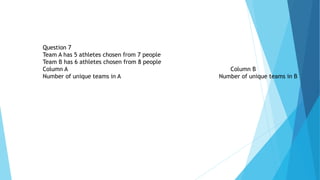
Question 7
Team A has 5 athletes chosen from 7 people
Team B has 6 athletes chosen from 8 people
Column A Column B
Number of unique teams in A Number of unique teams in B
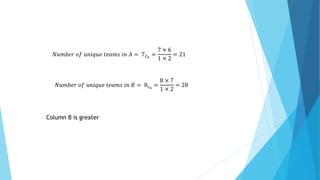
𝑁𝑢𝑚𝑏𝑒𝑟 𝑜𝑓 𝑢𝑛𝑖𝑞𝑢𝑒 𝑡𝑒𝑎𝑚𝑠 𝑖𝑛 𝐴 = 7 𝐶5
=
7 × 6
1 × 2
= 21
𝑁𝑢𝑚𝑏𝑒𝑟 𝑜𝑓 𝑢𝑛𝑖𝑞𝑢𝑒 𝑡𝑒𝑎𝑚𝑠 𝑖𝑛 𝐵 = 8 𝑐6
=
8 × 7
1 × 2
= 28
Column B is greater
Question 8
If the odds in favour of an event are 4:5, find the probability that it will occur.
𝑜𝑑𝑑𝑠 𝑖𝑛 𝑓𝑎𝑣𝑜𝑢𝑟 𝑜𝑓 𝑎𝑛 𝑒𝑣𝑒𝑛𝑡 ℎ𝑎𝑣𝑖𝑛𝑔 probability p =
𝑝
1−𝑝
𝑜𝑑𝑑𝑠 𝑎𝑔𝑎𝑖𝑛𝑠𝑡 𝑡ℎ𝑒 𝑒𝑣𝑒𝑛𝑡 =
1 − 𝑝
𝑝
𝑝
1 − 𝑝
=
4
5
𝑠𝑜𝑙𝑣𝑖𝑛𝑔 , 𝑤𝑒 𝑔𝑒𝑡 𝑝 =
4
9
Question 8
The probability that A solves the problem is
1
9
𝑎𝑛𝑑 𝑡ℎ𝑒 𝑝𝑟𝑜𝑏𝑎𝑏𝑖𝑙𝑖𝑡𝑦 𝑡ℎ𝑎𝑡
B solves it is
5
18.
. 𝐹𝑖𝑛𝑑 𝑡ℎ𝑒 𝑝𝑟𝑜𝑏𝑎𝑏𝑖𝑙𝑖𝑡𝑦 𝑡ℎ𝑎𝑡 𝑜𝑛𝑙𝑦 1 𝑝𝑒𝑟𝑠𝑜𝑛 𝑠𝑜𝑙𝑣𝑒𝑠 𝑡ℎ𝑒 𝑝𝑟𝑜𝑏𝑙𝑒𝑚
Required answer = P(A𝐵) + 𝑃 𝐴𝐵 =
1
9
13
18
+
8
9
5
18
=
53
18
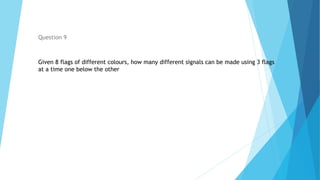
Question 9
Given 8 flags of different colours, how many different signals can be made using 3 flags
at a time one below the other
The first flag can be arranged in 8 ways.
Since they are of different colours, the 2nd flag can be arranged in7 ways.
The 3rd flag can be arranged in 6 ways.
Total number of ways = 8 × 7 × 6 = 336
Question 10
An urn contains balls numbered 6 to 20. Find the probability that the ball drawn is a multiple
of 4 or 5
Multiples of 4 : 8, 12, 16,20
Multiples of 5 : 10,15,20
A- multiple of 4 , 𝑃 𝐴 =
4
15
B: multiple of 5, P(B)=
3
15
𝑃 𝐴 ∩ 𝐵 =
1
15
Multiple of 4 and 5 : 20
P(A∪ 𝐵) = 𝑃(𝐴) + 𝑃(𝐵) − 𝑃(𝐴 ∩ 𝐵)
=
4
15
+
3
15
−
1
15
=
6
15
=
2
5
Question 11
An urn contains 5 red, 6 blue, and 1 green ball. Another urn contains 6 red,
8 blue and 2 green balls. One ball is drawn at random from each urn. Find the
probability that both are green.
R BLUE G
5 6 1
R B G
6 8 2
P(𝐺1 𝐺2) = 𝑃 𝐺1 𝑃(𝐺2)=
1
12
2
16
=
1
96
What did we learn?
How to apply permutations
and
Combinations to solve
problems
GRE QUANTITATIVE: PERMUTATIONS, COMBINATIONS AND PROBABILITY

GRE QUANTITATIVE: PERMUTATIONS, COMBINATIONS AND PROBABILITY

  • 1.
  • 2.
    This video isdesigned to help students preparing for the GRE QUANT SECTION Do subscribe to my channel Visit my page https://www.mathmadeeasy.co/about-1 You can contact me for personal classes.
  • 3.
    What are permutations? Whatare combinations? How do we use them in selection and arrangements? Learn all this and much more in this presentation.
  • 4.
    Number of waysof arranging r objects out of n objects = 𝑛 𝑃𝑟 = 𝑛! 𝑛−𝑟 ! 5 𝑃2 = 5 4 = 20 Number of ways of selecting r out of n objects = 𝑛 𝐶 𝑟 = 𝑛! 𝑟! 𝑛−𝑟 ! 5 𝐶2 = 5(4) 1(2) = 10
  • 5.
    Question 1 6 pointslie in a circle. How many quadrilaterals can be formed by joining these points.
  • 6.
    We need tochoose 4 out of 6 points since a quadrilateral has 4 vertices. Total number of quadrilaterals =6 𝐶4 = 6 𝑐2 = 6×5 1×2 = 15
  • 7.
    Question 2 Quantity A Allthe jacks are removed from a pack of cards and then a card is drawn. Find the probability of drawing a red king Quantity B 2 unbiased dice are thrown. Find the probability of obtaining 6 as a sum or product
  • 8.
    Quantity A There are4 jacks which are removed. There are 48 cards left . We need to draw 1 red king from 4 kings. Probability = 4 𝐶1 48 𝐶1 = 4 48 = 1 12
  • 9.
    Quantity B We need6 as a sum or product Favourable outcomes are = {(1,5), (1,6),(2,4),(2,3), (3,3),(3,2),(4,2),(5,1),(6,1)} 𝑝𝑟𝑜𝑏𝑎𝑏𝑖𝑙𝑖𝑡𝑦 = 9 36 = 1 4 A B 1 12 1 4 Cross multiplying, we get A B 4 12 B is greater
  • 11.
    Question 3 Compare the2 quantities Quantity A In how many ways can an examiner select a set of 6 true/false conditions Quantity B In how many ways can an examiner enter a set of 5 objective questions, each question having 3 choices
  • 12.
    Option A There are3 options to the true/false question ie true, false or not answered Since there are 6 questions, total number of ways =36 Option B There are 5 questions, each question having 3 choices Total number of ways = 35 Option A is greater
  • 13.
    Question 4 An urncontains 5 blue, 5 red, 5 green and 5 yellow balls. Find the probability that if 2 balls are drawn at random, both are blue.
  • 14.
    Bl R GY 5 5 5 5 𝑃robability = 5 𝐶2 20 𝐶2 = 5 65
  • 16.
    Question 5 In howmany ways can 5 children be seated in a row so that 2 children never sit together
  • 17.
    Treat the 2children as one. There are now 5 -2 +1 =4 children These can be arranged in 4! =24 ways Number of arrangements of n objects = n! The 2 children within themselves can be seated in 2 ways Total number of ways = (24)(2)=48
  • 18.
    Question 6 How many5 digit numbers can be formed using 0,2,3,4 and 5 such that repetition is allowed and the number is divisible by 2 or 5
  • 19.
    The last digitcan be 0,2 or 5. The last digit can be filled in 3 ways --- --- ----- ----- ----- The first digit cannot be 0 The first digit can be filled in 4 ways Since there is no restriction, the remaining 3 digits can be filled in 53 𝑤𝑎𝑦𝑠(5 × 5 × 5) Answer = 125(3)(4)=1500 ways
  • 20.
    Question 7 Team Ahas 5 athletes chosen from 7 people Team B has 6 athletes chosen from 8 people Column A Column B Number of unique teams in A Number of unique teams in B
  • 21.
    𝑁𝑢𝑚𝑏𝑒𝑟 𝑜𝑓 𝑢𝑛𝑖𝑞𝑢𝑒𝑡𝑒𝑎𝑚𝑠 𝑖𝑛 𝐴 = 7 𝐶5 = 7 × 6 1 × 2 = 21 𝑁𝑢𝑚𝑏𝑒𝑟 𝑜𝑓 𝑢𝑛𝑖𝑞𝑢𝑒 𝑡𝑒𝑎𝑚𝑠 𝑖𝑛 𝐵 = 8 𝑐6 = 8 × 7 1 × 2 = 28 Column B is greater
  • 23.
    Question 8 If theodds in favour of an event are 4:5, find the probability that it will occur.
  • 24.
    𝑜𝑑𝑑𝑠 𝑖𝑛 𝑓𝑎𝑣𝑜𝑢𝑟𝑜𝑓 𝑎𝑛 𝑒𝑣𝑒𝑛𝑡 ℎ𝑎𝑣𝑖𝑛𝑔 probability p = 𝑝 1−𝑝 𝑜𝑑𝑑𝑠 𝑎𝑔𝑎𝑖𝑛𝑠𝑡 𝑡ℎ𝑒 𝑒𝑣𝑒𝑛𝑡 = 1 − 𝑝 𝑝 𝑝 1 − 𝑝 = 4 5 𝑠𝑜𝑙𝑣𝑖𝑛𝑔 , 𝑤𝑒 𝑔𝑒𝑡 𝑝 = 4 9
  • 25.
    Question 8 The probabilitythat A solves the problem is 1 9 𝑎𝑛𝑑 𝑡ℎ𝑒 𝑝𝑟𝑜𝑏𝑎𝑏𝑖𝑙𝑖𝑡𝑦 𝑡ℎ𝑎𝑡 B solves it is 5 18. . 𝐹𝑖𝑛𝑑 𝑡ℎ𝑒 𝑝𝑟𝑜𝑏𝑎𝑏𝑖𝑙𝑖𝑡𝑦 𝑡ℎ𝑎𝑡 𝑜𝑛𝑙𝑦 1 𝑝𝑒𝑟𝑠𝑜𝑛 𝑠𝑜𝑙𝑣𝑒𝑠 𝑡ℎ𝑒 𝑝𝑟𝑜𝑏𝑙𝑒𝑚
  • 26.
    Required answer =P(A𝐵) + 𝑃 𝐴𝐵 = 1 9 13 18 + 8 9 5 18 = 53 18
  • 27.
    Question 9 Given 8flags of different colours, how many different signals can be made using 3 flags at a time one below the other
  • 28.
    The first flagcan be arranged in 8 ways. Since they are of different colours, the 2nd flag can be arranged in7 ways. The 3rd flag can be arranged in 6 ways. Total number of ways = 8 × 7 × 6 = 336
  • 29.
    Question 10 An urncontains balls numbered 6 to 20. Find the probability that the ball drawn is a multiple of 4 or 5 Multiples of 4 : 8, 12, 16,20 Multiples of 5 : 10,15,20 A- multiple of 4 , 𝑃 𝐴 = 4 15 B: multiple of 5, P(B)= 3 15 𝑃 𝐴 ∩ 𝐵 = 1 15 Multiple of 4 and 5 : 20
  • 30.
    P(A∪ 𝐵) =𝑃(𝐴) + 𝑃(𝐵) − 𝑃(𝐴 ∩ 𝐵) = 4 15 + 3 15 − 1 15 = 6 15 = 2 5
  • 31.
    Question 11 An urncontains 5 red, 6 blue, and 1 green ball. Another urn contains 6 red, 8 blue and 2 green balls. One ball is drawn at random from each urn. Find the probability that both are green.
  • 32.
    R BLUE G 56 1 R B G 6 8 2 P(𝐺1 𝐺2) = 𝑃 𝐺1 𝑃(𝐺2)= 1 12 2 16 = 1 96
  • 33.
    What did welearn? How to apply permutations and Combinations to solve problems