Struggle to Strength
Reclaiming Lives, Rebuilding Communities
National Rx Drug Abuse Summit
Presented by:
Sharon Bird
Director, Public Policy, Community Ventures
Milt Sharp, Jr.
President, Ehome America, Community Ventures
Agenda
I. Intro
II. Economic
Impact of
Addiction on
Addicts and
Communities
III. Financial
Capability
IV. Tools
and Resources
ECONOMIC IMPACT OF
ADDICTION
Struggle to Strength: Reclaiming Lives, Rebuilding Communities
The Problem
• The Centers for Disease Control and Prevention now labels the problem
an "epidemic."
• Deaths from drug overdose is the leading cause of injury death in the
United States.
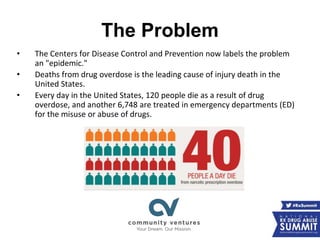
• Every day in the United States, 120 people die as a result of drug
overdose, and another 6,748 are treated in emergency departments (ED)
for the misuse or abuse of drugs.
The Cost
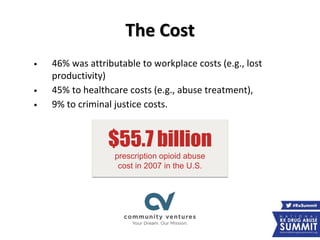
• 46% was attributable to workplace costs (e.g., lost
productivity)
• 45% to healthcare costs (e.g., abuse treatment),
• 9% to criminal justice costs.
$55.7 billion
prescription opioid abuse
cost in 2007 in the U.S.
The Unfortunate Outcome
• Substance abuse is expensive.
Maintaining even a moderate habit of
drug abuse can cost thousands of dollars
annually.
• Funds to maintain a drug abuse habit are
taken from savings accounts, retirement
accounts, child education funds and
other living expenses.
The Unfortunate Outcome
Addictive behavior is often associated with:
• Economic instability
• Divorce
• Child/Spousal
• Missed Rent or Mortgage or Car Payments
• Carelessness with Spending Habits
• Increased Debt
• Hefty Fines for Legal Consequences
ADDICTION RUINS LIVES!
FINANCIAL CAPABILITY
Struggle to Strength: Reclaiming Lives, Rebuilding Communities
Financial Literacy
• Gaining financial literacy is a long-
term process that, for most people,
requires the assistance of institutions
outside the home.
• Results in more stable communities.
• Improved financial literacy results in a
higher standard of living over the long
term, including retirement.
Financial Coaching
A financial coach focuses on 3 key tasks to help their clients
become more financially independent and secure:
1. Assisting clients to set realistic goals.
2. Providing accountability by monitoring progress toward
those goals.
3. Helping clients “practice” by achieving key milestones
along the way to the larger goal
Adapted from: “Using a Financial Coaching Approach to Help Low-Income Families Achieve Economic Success” by J. Michael Collins
and Karen Murrell. July 2010.
Best Practice
As part of a patients recovery process identify financial
capability programs and services and integrate it as part
of the recovery plan
• Foreclosure Mitigation
• Credit Repair
• Homeownership Education and
Counseling
• Financial Literacy and Financial
Coaching
• Non Profits Certified by HUD to deliver
financial education, foreclosure
counseling and homeownership
education and counseling
• Non Profit Credit Repair Organizations
• Employer Assisted Programs
Tools
Tools
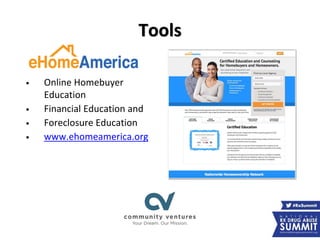
• Online Homebuyer
Education
• Financial Education and
• Foreclosure Education
• www.ehomeamerica.org
In Conclusion
Financial Capability as a part of the recovery process can:
• Help rebuild and recover a person’s financial life
• Reduce an individual’s financial barriers to recovery
• Allows for better financial decisions over the life course
Struggle to Strength
Reclaiming Lives, Rebuilding Communities
National Rx Drug Abuse Summit
Presented by:
Sharon Bird
Director, Public Policy, Community Ventures
Milt Sharp, Jr.
President, Ehome America, Community Ventures

Rx15 vision wed_200_community_ventures

  • 1.
    Struggle to Strength ReclaimingLives, Rebuilding Communities National Rx Drug Abuse Summit Presented by: Sharon Bird Director, Public Policy, Community Ventures Milt Sharp, Jr. President, Ehome America, Community Ventures
  • 2.
    Agenda I. Intro II. Economic Impactof Addiction on Addicts and Communities III. Financial Capability IV. Tools and Resources
  • 3.
    ECONOMIC IMPACT OF ADDICTION Struggleto Strength: Reclaiming Lives, Rebuilding Communities
  • 4.
    The Problem • TheCenters for Disease Control and Prevention now labels the problem an "epidemic." • Deaths from drug overdose is the leading cause of injury death in the United States. • Every day in the United States, 120 people die as a result of drug overdose, and another 6,748 are treated in emergency departments (ED) for the misuse or abuse of drugs.
  • 5.
    The Cost • 46%was attributable to workplace costs (e.g., lost productivity) • 45% to healthcare costs (e.g., abuse treatment), • 9% to criminal justice costs. $55.7 billion prescription opioid abuse cost in 2007 in the U.S.
  • 6.
    The Unfortunate Outcome •Substance abuse is expensive. Maintaining even a moderate habit of drug abuse can cost thousands of dollars annually. • Funds to maintain a drug abuse habit are taken from savings accounts, retirement accounts, child education funds and other living expenses.
  • 7.
    The Unfortunate Outcome Addictivebehavior is often associated with: • Economic instability • Divorce • Child/Spousal • Missed Rent or Mortgage or Car Payments • Carelessness with Spending Habits • Increased Debt • Hefty Fines for Legal Consequences ADDICTION RUINS LIVES!
  • 8.
    FINANCIAL CAPABILITY Struggle toStrength: Reclaiming Lives, Rebuilding Communities
  • 9.
    Financial Literacy • Gainingfinancial literacy is a long- term process that, for most people, requires the assistance of institutions outside the home. • Results in more stable communities. • Improved financial literacy results in a higher standard of living over the long term, including retirement.
  • 10.
    Financial Coaching A financialcoach focuses on 3 key tasks to help their clients become more financially independent and secure: 1. Assisting clients to set realistic goals. 2. Providing accountability by monitoring progress toward those goals. 3. Helping clients “practice” by achieving key milestones along the way to the larger goal Adapted from: “Using a Financial Coaching Approach to Help Low-Income Families Achieve Economic Success” by J. Michael Collins and Karen Murrell. July 2010.
  • 11.
    Best Practice As partof a patients recovery process identify financial capability programs and services and integrate it as part of the recovery plan • Foreclosure Mitigation • Credit Repair • Homeownership Education and Counseling • Financial Literacy and Financial Coaching
  • 12.
    • Non ProfitsCertified by HUD to deliver financial education, foreclosure counseling and homeownership education and counseling • Non Profit Credit Repair Organizations • Employer Assisted Programs Tools
  • 13.
    Tools • Online Homebuyer Education •Financial Education and • Foreclosure Education • www.ehomeamerica.org
  • 14.
    In Conclusion Financial Capabilityas a part of the recovery process can: • Help rebuild and recover a person’s financial life • Reduce an individual’s financial barriers to recovery • Allows for better financial decisions over the life course
  • 15.
    Struggle to Strength ReclaimingLives, Rebuilding Communities National Rx Drug Abuse Summit Presented by: Sharon Bird Director, Public Policy, Community Ventures Milt Sharp, Jr. President, Ehome America, Community Ventures

Editor's Notes

  • #5 References Centers for Disease Control and Prevention. National Vital Statistics System mortality data. (2015) Available from URL: http://www.cdc.gov/nchs/deaths.htm. Substance Abuse and Mental Health Services Administration. Highlights of the 2011 Drug Abuse Warning Network (DAWN) findings on drug-related emergency department visits. The DAWN Report. Rockville, MD: US Department of Health and Human Services, Substance Abuse and Mental Health Services Administration; 2013. Available from URL: http://www.samhsa.gov/data/2k13/DAWN127/sr127-DAWN-highlights.htm Paulozzi LJ. Prescription drug overdoses: a review. Journal of Safety Research, 2012; http://dx.doi.org/10.1016/j.jsr.2012.08.009
  • #6 Workplace costs accounted for $25.6 billion (46%), health care costs accounted for $25.0 billion (45%), and criminal justice costs accounted for $5.1 billion (9%). Workplace costs were driven by lost earnings from premature death ($11.2 billion) and reduced compensation/lost employment ($7.9 billion). Health care costs consisted primarily of excess medical and prescription costs ($23.7 billion). Criminal justice costs were largely comprised of correctional facility ($2.3 billion) and police costs ($1.5 billion). The average "doctor shopper" -- costs insurers $10,000 to $15,000 a year, according to the Coalition Against Insurance Fraud. When it comes to Medicare, ultimately these are taxpayer dollars that are being stolen. Dealers also stockpile the drugs using bogus prescriptions and insurance claims. These costs get passed on to average Americans in the form of higher premiums
  • #12 Integrating financial capability services into a comprehensive set of complementary services which can include financial capability