Putting It Into Practice: Weaving Activation and
Health Literacy Into Community Organizations
Daphne Klein, Executive Director, On Our Own Prince George's County
โ—ป We are working towards a fully integrated
Behavioral Health System.
โ—ป We have just started to break the barriers of
stigma. Our maturation has been slow.
โ—ป It has been trial and error, and trial again.
โ—ปHealth Literacy is "the degree to which
individuals have the capacity to obtain,
process, and understand basic health
information and services needed to make
appropriate health decisions.โ€
National Network of Libraries of Medicine
โ—ปHealth Literacy is an prerequisite to Health
Activation
Health Literacy
โ—ปHealth Activation is having the knowledge, skills, and confidence
to manage one's health (prevention, unhealthy behaviors, clinical
indicators, and costly utilization).
Health Activation
โ—ป Improve decision-making and choices.
โ—ป Improve self-esteem and self-confidence.
โ—ป Helps people gather information about
Mental Health and Substance Abuse.
โ—ป Create and initiate a plan.
โ—ป Develop skills to moves towards a goal.
โ—ป Help keep people out of crisis.
โ—ป Cost effective.
Why is health activation important
in the community?
โ—ป Recovery is difficult.
โ—ป Feeling overwhelmed with the smallest task.
โ—ป Lack of understanding of the process.
โ—ป Difficulty making a choice.
โ—ป Lack of skills.
โ—ป Experience with repeated failure.
โ—ป They would rather just not think about their health.
โ—ป Changes due to aging, new diagnosis, changing of the DSM, new
illegal drugs coming out, trauma, hopelessness, and changes in
life expectancy.
โ—ป Internalized-stigma and stigma in everyday speech.
โ—ป Madelineโ€™s story.
What prevents people from
managing their own health?
โ—ป How do we instill confidence and knowledge
in someoneโ€™s ability to help them manage
their own healthcare?
โ—ป How do we get somebody to understand the
care process so that they feel capable
managing their own health/recovery?
โ—ป How do we get a personโ€™s involvement and
actively engage participation?
Purpose and Objectives
โ—ป The most important quality characteristic
commonality is trust.
โ—ป How do you promote cooperation?
(We need โ€œbuy-inโ€ every time we see them.)
โ—ป You canโ€™t dictate other peopleโ€™s priorities and
tell people what to do.
Involvement and Participation
โ—ป Obstacle: We live in an underdeveloped
healthcare system, where needs are
immediate, and the community resources are
ill-equipped to respond at top speed.
โ—ป The Hassle: It takes executive functioning to
access services and navigate both the system
and the life changes that come with recovery.
โ—ป Thereโ€™s not one place to get every single thing
that you need, but that hassle is important for
building skills necessary for better health.
The Benefit of the Hassle
1. People tend to be passive and overwhelmed by
the thought of managing their own health. They
do not understand their role, or the process.
2. People have a lack of knowledge and skill of how
to manage their own health.
3. People appear to be taking action, but lack
confidence and self-esteem to truly participate
in their own health care management.
4. People have incorporated and adapted different
behaviors to support their recovery needs. They
still need assistance maintaining their health.
Different Levels of Activation
โ—ป Patient activation has been found to be highly
relevant to the outcomes of people with
mental health disorders, including
depression, post-traumatic stress disorder,
bipolar disorder, anxiety, and schizophrenia
(Cabassa et al 2013; Kukla et al 2013)
Fact-based Thought
โ—ป Invite discussion of best practices.
โ—ป Suggest what to do next (strategies).
โ—ป Identify action items.
For Consideration
โ—ป Itโ€™s imperative that we work collaboratively as a
community, and motivate each other to be part
of the change.
โ—ป The person in need of services is the only
person who can effect the changes in their lives
that they need.
โ—ป When that person trusts the community that
provides the resources, success happens.
ACMHA
ACTIVATION OF RECOVERY
PRINCIPLES AND PRACTICES
FOR HEALTH LITERACY
Joe Powell LCDC, PRSS
President/CEO
APAA - Association of Persons
Affected by Addiction
PRINCIPLES
โ€ข ALL PATHS/ROADS OF RECOVERY HAS PRINCIPLES
โ€ข Honesty about how healthy am I (Step 1)
โ€ข Hope (Step II)
โ€ข Do I believe that a power greater than me could restore my
physical health
โ€ข Do I believe that I have sane thinking about my health
โ€ข Willingness to change my health status (Step III)
โ€ข Am I willing to connect and communicate my mental, physical
emotional self/health with my healthcare provider, Peer support,
family, friends for my wellbriety
โ€ข Trust the process
โ€ข How did I get here?
โ€ข How am I staying clean and sober
โ€ข Uncover to discover, how we Recover
PRACTICE
โ€ข WHAT WE ARE TAUGHT, WE LEARN
โ€ข WHAT WE LEARN, WE PRACTICE
โ€ข WHAT WE PRACTICE, WE BECOME
โ€ข WHAT WE BECOME HAS CONSEQUENCES,
โ€ข GOOD OR BAD
โ€ข THE CHOICE IS OURS
โ€ข WHAT ARE WE TEACHING? HEALTH LITERACY
โ€ข PEERS LEARN FROM PEERS
HEALTH LITERACY
ACCORDING TO HEALTHY PEOPLE 2010, AN INDIVIDUAL IS
CONSIDERED TO BE "HEALTH
LITERATE" WHEN HE OR SHE POSSESSES THE SKILLS TO
UNDERSTAND INFORMATION
AND SERVICES AND USE THEM TO MAKE APPROPRIATE DECISIONS
ABOUT HEALTH.
LACK OF HEALTH LITERACY IS ESTIMATED TO COST $106-$236
BILLION ANNUALLY.
ACTIVATION GOES BEYOND SEEING A HEALTH CARE PROVIDER AND
UNDERSTANDING
HOW TO PROMOTE RECOVERY; ITโ€™S THE ART AND SCIENCE OF
TAKING ACTION ON THE INFORMATION YOU HAVE BEEN GIVEN. ITโ€™S
DOING THE THINGS NECESSARY TO MOVE TOWARD RECOVERY AND
WELLNESS.
Welcome to Recovery:
5 Aโ€™s of Activation
Available โ€“ be of service and support how peers live their lives,
Strong Peer Network, โ€Peers go where no man has gone beforeโ€
Consumer Choice
Accessible โ€“ Easy Access, Referral process, wait time for appointment,
No wait time for service, hours and days of operation, travel time, travel access- by
car, parking, public transportation
Affordable โ€“ No Cost to explore recovery, Peer driven
Appropriateness โ€“1)offer โ€“ Screening, tools, take cultural issues
into account in recovery plans, implementation and recovery 2) Self-
Assess health for literacy status, including assess medications to
achieve recovery outcomes
Acceptable community services are Culturally Congruent with 16
year history of recovery principles, practices, performance of Peer
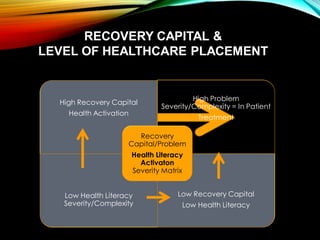
RECOVERY CAPITAL &
LEVEL OF HEALTHCARE PLACEMENT
High Recovery Capital
Health Activation
High Problem
Severity/Complexity = In Patient
Treatment
Low Health Literacy
Severity/Complexity
Low Recovery Capital
Low Health Literacy
Recovery
Capital/Problem
Health Literacy
Activaton
Severity Matrix
โ€ข 1ST SAMHSA funded Peer to Peer Recovery
Community Organization in Texas - 1998
โ€ข Value Options Peer Provider - 2007
โ€ข America Honors Recovery Award -2010
โ€ข Currently the only RCO with a National
Accreditation for Peer Recovery Support
Services (CAPRSS 2014) in Texas
โ€ข Texas DSHS Trainers for Peer Specialist and Peer
Recovery Support Specialist
โ€ข Million Hearts Collaboration 2014
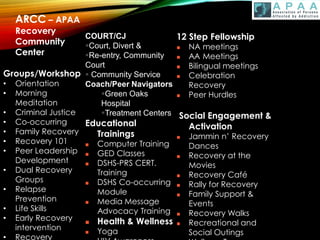
ARCC โ€“ APAA
Recovery
Community
Center
Groups/Workshop
โ€ข Orientation
โ€ข Morning
Meditation
โ€ข Criminal Justice
โ€ข Co-occurring
โ€ข Family Recovery
โ€ข Recovery 101
โ€ข Peer Leadership
Development
โ€ข Dual Recovery
Groups
โ€ข Relapse
Prevention
โ€ข Life Skills
โ€ข Early Recovery
intervention
โ€ข Recovery
12 Step Fellowship
๏ฎ NA meetings
๏ฎ AA Meetings
๏ฎ Bilingual meetings
๏ฎ Celebration
Recovery
๏ฎ Peer Hurdles
Social Engagement &
Activation
๏ฎ Jammin nโ€™ Recovery
Dances
๏ฎ Recovery at the
Movies
๏ฎ Recovery Cafรฉ
๏ฎ Rally for Recovery
๏ฎ Family Support &
Events
๏ฎ Recovery Walks
๏ฎ Recreational and
Social Outings
COURT/CJ
๏‚งCourt, Divert &
๏‚งRe-entry, Community
Court
๏‚ง Community Service
Coach/Peer Navigators
๏‚งGreen Oaks
Hospital
๏‚งTreatment Centers
Educational
Trainings
๏ฎ Computer Training
๏ฎ GED Classes
๏ฎ DSHS-PRS CERT.
Training
๏ฎ DSHS Co-occurring
Module
๏ฎ Media Message
Advocacy Training
๏ฎ Health & Wellness
๏ฎ Yoga
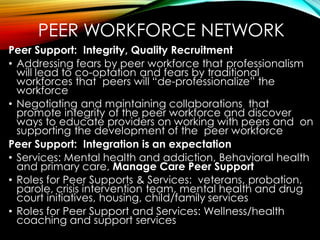
PEER WORKFORCE NETWORK
Peer Support: Integrity, Quality Recruitment
โ€ข Addressing fears by peer workforce that professionalism
will lead to co-optation and fears by traditional
workforces that peers will โ€œde-professionalizeโ€ the
workforce
โ€ข Negotiating and maintaining collaborations that
promote integrity of the peer workforce and discover
ways to educate providers on working with peers and on
supporting the development of the peer workforce
Peer Support: Integration is an expectation
โ€ข Services: Mental health and addiction, Behavioral health
and primary care, Manage Care Peer Support
โ€ข Roles for Peer Supports & Services: veterans, probation,
parole, crisis intervention team, mental health and drug
court initiatives, housing, child/family services
โ€ข Roles for Peer Support and Services: Wellness/health
coaching and support services
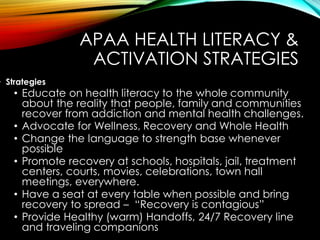
APAA HEALTH LITERACY &
ACTIVATION STRATEGIES
โ€ข Strategies
โ€ข Educate on health literacy to the whole community
about the reality that people, family and communities
recover from addiction and mental health challenges.
โ€ข Advocate for Wellness, Recovery and Whole Health
โ€ข Change the language to strength base whenever
possible
โ€ข Promote recovery at schools, hospitals, jail, treatment
centers, courts, movies, celebrations, town hall
meetings, everywhere.
โ€ข Have a seat at every table when possible and bring
recovery to spread โ€“ โ€œRecovery is contagiousโ€
โ€ข Provide Healthy (warm) Handoffs, 24/7 Recovery line
and traveling companions
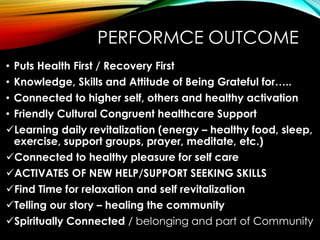
PERFORMCE OUTCOME
โ€ข Puts Health First / Recovery First
โ€ข Knowledge, Skills and Attitude of Being Grateful forโ€ฆ..
โ€ข Connected to higher self, others and healthy activation
โ€ข Friendly Cultural Congruent healthcare Support
๏ƒผLearning daily revitalization (energy โ€“ healthy food, sleep,
exercise, support groups, prayer, meditate, etc.)
๏ƒผConnected to healthy pleasure for self care
๏ƒผACTIVATES OF NEW HELP/SUPPORT SEEKING SKILLS
๏ƒผFind Time for relaxation and self revitalization
๏ƒผTelling our story โ€“ healing the community
๏ƒผSpiritually Connected / belonging and part of Community
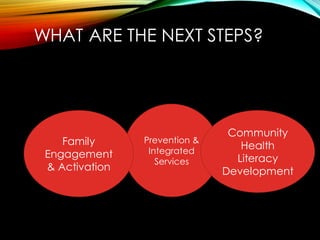
WHAT ARE THE NEXT STEPS?
Prevention &
Integrated
Services
Community
Health
Literacy
Development
Family
Engagement
& Activation

Weaving Health Activation into the community

  • 1.
    Putting It IntoPractice: Weaving Activation and Health Literacy Into Community Organizations Daphne Klein, Executive Director, On Our Own Prince George's County
  • 2.
    โ—ป We areworking towards a fully integrated Behavioral Health System. โ—ป We have just started to break the barriers of stigma. Our maturation has been slow. โ—ป It has been trial and error, and trial again.
  • 3.
    โ—ปHealth Literacy is"the degree to which individuals have the capacity to obtain, process, and understand basic health information and services needed to make appropriate health decisions.โ€ National Network of Libraries of Medicine โ—ปHealth Literacy is an prerequisite to Health Activation Health Literacy
  • 4.
    โ—ปHealth Activation ishaving the knowledge, skills, and confidence to manage one's health (prevention, unhealthy behaviors, clinical indicators, and costly utilization). Health Activation
  • 5.
    โ—ป Improve decision-makingand choices. โ—ป Improve self-esteem and self-confidence. โ—ป Helps people gather information about Mental Health and Substance Abuse. โ—ป Create and initiate a plan. โ—ป Develop skills to moves towards a goal. โ—ป Help keep people out of crisis. โ—ป Cost effective. Why is health activation important in the community?
  • 6.
    โ—ป Recovery isdifficult. โ—ป Feeling overwhelmed with the smallest task. โ—ป Lack of understanding of the process. โ—ป Difficulty making a choice. โ—ป Lack of skills. โ—ป Experience with repeated failure. โ—ป They would rather just not think about their health. โ—ป Changes due to aging, new diagnosis, changing of the DSM, new illegal drugs coming out, trauma, hopelessness, and changes in life expectancy. โ—ป Internalized-stigma and stigma in everyday speech. โ—ป Madelineโ€™s story. What prevents people from managing their own health?
  • 7.
    โ—ป How dowe instill confidence and knowledge in someoneโ€™s ability to help them manage their own healthcare? โ—ป How do we get somebody to understand the care process so that they feel capable managing their own health/recovery? โ—ป How do we get a personโ€™s involvement and actively engage participation? Purpose and Objectives
  • 8.
    โ—ป The mostimportant quality characteristic commonality is trust. โ—ป How do you promote cooperation? (We need โ€œbuy-inโ€ every time we see them.) โ—ป You canโ€™t dictate other peopleโ€™s priorities and tell people what to do. Involvement and Participation
  • 9.
    โ—ป Obstacle: Welive in an underdeveloped healthcare system, where needs are immediate, and the community resources are ill-equipped to respond at top speed. โ—ป The Hassle: It takes executive functioning to access services and navigate both the system and the life changes that come with recovery. โ—ป Thereโ€™s not one place to get every single thing that you need, but that hassle is important for building skills necessary for better health. The Benefit of the Hassle
  • 11.
    1. People tendto be passive and overwhelmed by the thought of managing their own health. They do not understand their role, or the process. 2. People have a lack of knowledge and skill of how to manage their own health. 3. People appear to be taking action, but lack confidence and self-esteem to truly participate in their own health care management. 4. People have incorporated and adapted different behaviors to support their recovery needs. They still need assistance maintaining their health. Different Levels of Activation
  • 12.
    โ—ป Patient activationhas been found to be highly relevant to the outcomes of people with mental health disorders, including depression, post-traumatic stress disorder, bipolar disorder, anxiety, and schizophrenia (Cabassa et al 2013; Kukla et al 2013) Fact-based Thought
  • 13.
    โ—ป Invite discussionof best practices. โ—ป Suggest what to do next (strategies). โ—ป Identify action items. For Consideration
  • 14.
    โ—ป Itโ€™s imperativethat we work collaboratively as a community, and motivate each other to be part of the change. โ—ป The person in need of services is the only person who can effect the changes in their lives that they need. โ—ป When that person trusts the community that provides the resources, success happens.
  • 15.
    ACMHA ACTIVATION OF RECOVERY PRINCIPLESAND PRACTICES FOR HEALTH LITERACY Joe Powell LCDC, PRSS President/CEO APAA - Association of Persons Affected by Addiction
  • 16.
    PRINCIPLES โ€ข ALL PATHS/ROADSOF RECOVERY HAS PRINCIPLES โ€ข Honesty about how healthy am I (Step 1) โ€ข Hope (Step II) โ€ข Do I believe that a power greater than me could restore my physical health โ€ข Do I believe that I have sane thinking about my health โ€ข Willingness to change my health status (Step III) โ€ข Am I willing to connect and communicate my mental, physical emotional self/health with my healthcare provider, Peer support, family, friends for my wellbriety โ€ข Trust the process โ€ข How did I get here? โ€ข How am I staying clean and sober โ€ข Uncover to discover, how we Recover
  • 17.
    PRACTICE โ€ข WHAT WEARE TAUGHT, WE LEARN โ€ข WHAT WE LEARN, WE PRACTICE โ€ข WHAT WE PRACTICE, WE BECOME โ€ข WHAT WE BECOME HAS CONSEQUENCES, โ€ข GOOD OR BAD โ€ข THE CHOICE IS OURS โ€ข WHAT ARE WE TEACHING? HEALTH LITERACY โ€ข PEERS LEARN FROM PEERS
  • 18.
    HEALTH LITERACY ACCORDING TOHEALTHY PEOPLE 2010, AN INDIVIDUAL IS CONSIDERED TO BE "HEALTH LITERATE" WHEN HE OR SHE POSSESSES THE SKILLS TO UNDERSTAND INFORMATION AND SERVICES AND USE THEM TO MAKE APPROPRIATE DECISIONS ABOUT HEALTH. LACK OF HEALTH LITERACY IS ESTIMATED TO COST $106-$236 BILLION ANNUALLY. ACTIVATION GOES BEYOND SEEING A HEALTH CARE PROVIDER AND UNDERSTANDING HOW TO PROMOTE RECOVERY; ITโ€™S THE ART AND SCIENCE OF TAKING ACTION ON THE INFORMATION YOU HAVE BEEN GIVEN. ITโ€™S DOING THE THINGS NECESSARY TO MOVE TOWARD RECOVERY AND WELLNESS.
  • 19.
    Welcome to Recovery: 5Aโ€™s of Activation Available โ€“ be of service and support how peers live their lives, Strong Peer Network, โ€Peers go where no man has gone beforeโ€ Consumer Choice Accessible โ€“ Easy Access, Referral process, wait time for appointment, No wait time for service, hours and days of operation, travel time, travel access- by car, parking, public transportation Affordable โ€“ No Cost to explore recovery, Peer driven Appropriateness โ€“1)offer โ€“ Screening, tools, take cultural issues into account in recovery plans, implementation and recovery 2) Self- Assess health for literacy status, including assess medications to achieve recovery outcomes Acceptable community services are Culturally Congruent with 16 year history of recovery principles, practices, performance of Peer
  • 20.
    RECOVERY CAPITAL & LEVELOF HEALTHCARE PLACEMENT High Recovery Capital Health Activation High Problem Severity/Complexity = In Patient Treatment Low Health Literacy Severity/Complexity Low Recovery Capital Low Health Literacy Recovery Capital/Problem Health Literacy Activaton Severity Matrix
  • 21.
    โ€ข 1ST SAMHSAfunded Peer to Peer Recovery Community Organization in Texas - 1998 โ€ข Value Options Peer Provider - 2007 โ€ข America Honors Recovery Award -2010 โ€ข Currently the only RCO with a National Accreditation for Peer Recovery Support Services (CAPRSS 2014) in Texas โ€ข Texas DSHS Trainers for Peer Specialist and Peer Recovery Support Specialist โ€ข Million Hearts Collaboration 2014
  • 22.
    ARCC โ€“ APAA Recovery Community Center Groups/Workshop โ€ขOrientation โ€ข Morning Meditation โ€ข Criminal Justice โ€ข Co-occurring โ€ข Family Recovery โ€ข Recovery 101 โ€ข Peer Leadership Development โ€ข Dual Recovery Groups โ€ข Relapse Prevention โ€ข Life Skills โ€ข Early Recovery intervention โ€ข Recovery 12 Step Fellowship ๏ฎ NA meetings ๏ฎ AA Meetings ๏ฎ Bilingual meetings ๏ฎ Celebration Recovery ๏ฎ Peer Hurdles Social Engagement & Activation ๏ฎ Jammin nโ€™ Recovery Dances ๏ฎ Recovery at the Movies ๏ฎ Recovery Cafรฉ ๏ฎ Rally for Recovery ๏ฎ Family Support & Events ๏ฎ Recovery Walks ๏ฎ Recreational and Social Outings COURT/CJ ๏‚งCourt, Divert & ๏‚งRe-entry, Community Court ๏‚ง Community Service Coach/Peer Navigators ๏‚งGreen Oaks Hospital ๏‚งTreatment Centers Educational Trainings ๏ฎ Computer Training ๏ฎ GED Classes ๏ฎ DSHS-PRS CERT. Training ๏ฎ DSHS Co-occurring Module ๏ฎ Media Message Advocacy Training ๏ฎ Health & Wellness ๏ฎ Yoga
  • 23.
    PEER WORKFORCE NETWORK PeerSupport: Integrity, Quality Recruitment โ€ข Addressing fears by peer workforce that professionalism will lead to co-optation and fears by traditional workforces that peers will โ€œde-professionalizeโ€ the workforce โ€ข Negotiating and maintaining collaborations that promote integrity of the peer workforce and discover ways to educate providers on working with peers and on supporting the development of the peer workforce Peer Support: Integration is an expectation โ€ข Services: Mental health and addiction, Behavioral health and primary care, Manage Care Peer Support โ€ข Roles for Peer Supports & Services: veterans, probation, parole, crisis intervention team, mental health and drug court initiatives, housing, child/family services โ€ข Roles for Peer Support and Services: Wellness/health coaching and support services
  • 24.
    APAA HEALTH LITERACY& ACTIVATION STRATEGIES โ€ข Strategies โ€ข Educate on health literacy to the whole community about the reality that people, family and communities recover from addiction and mental health challenges. โ€ข Advocate for Wellness, Recovery and Whole Health โ€ข Change the language to strength base whenever possible โ€ข Promote recovery at schools, hospitals, jail, treatment centers, courts, movies, celebrations, town hall meetings, everywhere. โ€ข Have a seat at every table when possible and bring recovery to spread โ€“ โ€œRecovery is contagiousโ€ โ€ข Provide Healthy (warm) Handoffs, 24/7 Recovery line and traveling companions
  • 25.
    PERFORMCE OUTCOME โ€ข PutsHealth First / Recovery First โ€ข Knowledge, Skills and Attitude of Being Grateful forโ€ฆ.. โ€ข Connected to higher self, others and healthy activation โ€ข Friendly Cultural Congruent healthcare Support ๏ƒผLearning daily revitalization (energy โ€“ healthy food, sleep, exercise, support groups, prayer, meditate, etc.) ๏ƒผConnected to healthy pleasure for self care ๏ƒผACTIVATES OF NEW HELP/SUPPORT SEEKING SKILLS ๏ƒผFind Time for relaxation and self revitalization ๏ƒผTelling our story โ€“ healing the community ๏ƒผSpiritually Connected / belonging and part of Community
  • 26.
    WHAT ARE THENEXT STEPS? Prevention & Integrated Services Community Health Literacy Development Family Engagement & Activation