RUSSIAN MISSIONS
Presented by:Suroj Dahal
Email:suroj.rocks@gmail.com
Geomatics Engineer
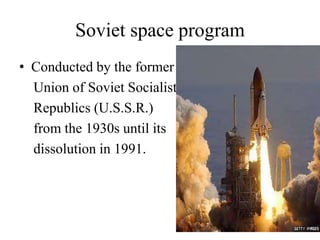
Soviet space program
• Conducted by the former
Union of Soviet Socialist
Republics (U.S.S.R.)
from the 1930s until its
dissolution in 1991.
Development
• Initially boosted by the assistance of captured
scientists from the advanced German rocket
program
• Performed mainly by Soviet engineers and
scientists after 1955, and was based on some
unique Soviet and Imperial Russian theoretical
developments
Development
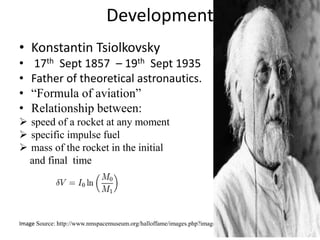
• Konstantin Tsiolkovsky
• 17th Sept 1857 – 19th Sept 1935
• Father of theoretical astronautics.
• “Formula of aviation”
• Relationship between:
 speed of a rocket at any moment
 specific impulse fuel
 mass of the rocket in the initial
and final time
Image Source: http://www.nmspacemuseum.org/halloffame/images.php?image_id=27
• Thirsty for knowledge though handicapped by
deafness due to scarlet fever at age of 10.
• Interested in both science and mathematics
• Introduced problem of controlling a rocket as
it moved between gravitational fields.
• Published theoretical papers on gyroscopes,
escape velocities, the principle of action and
reaction, and the use of liquid propellant
rockets.
• Designed a monoplane in 1894
• Built the first Russian wind tunnel in 1897
• Author of Investigations of Outer Space by
Rocket Devices (1911) and Aims of Astronauts
(1914)
• In 1903 published rocket equation. This
equation is the basis of much of the spacecraft
engineering done today
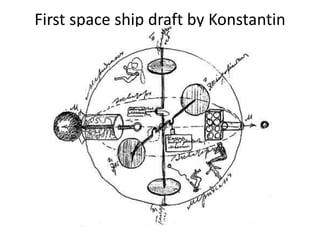
First space ship draft by Konstantin
Tsiolkovsky
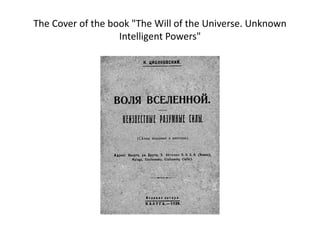
The Cover of the book "The Will of the Universe. Unknown
Intelligent Powers"
Development
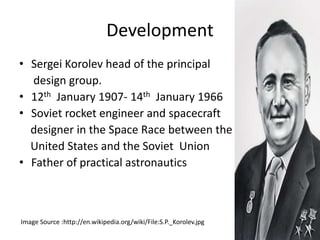
• Sergei Korolev head of the principal
design group.
• 12th January 1907- 14th January 1966
• Soviet rocket engineer and spacecraft
designer in the Space Race between the
United States and the Soviet Union
• Father of practical astronautics
Image Source :http://en.wikipedia.org/wiki/File:S.P._Korolev.jpg
• Primarily interested in aeronautical engineering
• In 1923 joined the Society of Aviation and Aerial
Navigation of Ukraine
• In 1925 allowed to fly the training glider on
which he worked
• During 1929 Communist Party had decided that
the education of engineers be accelerated to
meet the country's urgent need for their skills
• In 1930,earned his pilot's license
• He was good at design integration,
organization and strategic planning. Arrested
for mismanagement of funds
• Imprisoned in 1938 for almost six years
• Following his release, he became a recognized
rocket designer
• Then appointed to lead the Soviet space
program
• Chief designer of Sputnik 1
Awards
• Twice Hero of Socialist Labor in 1956 and 1961.
• Lenin Prize winner in 1971
• Order of Lenin three times
• Order of the Badge of Honour
• Medal "For Labour Valour”
• A street in Moscow was named after Korolev
• In 1976 he was inducted into the International
Space Hall of Fame
• and many more……
First Satellite Construction
• On 17 December 1954, Sergei Korolev addressed Minister
of Defence , proposing the development of an artificial
satellite
• On 29 July 1955 the U.S announced, that the U.S would
launch an artificial satellite soon
• That press statement troubled Russia.
• On 30 January 1956 the Council of Ministers approved
practical work on an artificial Earth-orbiting satellite. This
satellite, named "Object D", was planned to be completed
in 1957–58.
• Problems in assembly, low impulse caused delay.
• Fearing US would launch satellite before USSR a new
simple, light and easy to construct with a simple radio
transmitter proposed named R-7.
First Satellite Construction
• First launch of R-7 rocket (8K71 No.5) on 15 May 1957. The
flight was controlled until the 98th second, but a fire in a
strap-on rocket led to crash 400 km from the site
• 3 attempts to launch the second rocket (8K71 No.6) made
on 10–11 June also failed because assembly problem.
• Unsuccessful launch of the third R-7 rocket (8K71 No.7) took
place on 12 July. The rocket rotate about its longitudinal axis
and its engines were automatically turned off.
• The launch of the fourth rocket (8K71 No.8), on 21 August
was successful. Its head part separated, reached the defined
region, entered the atmosphere, and was destroyed at a
height of 10 km because of thermodynamic overload after
traveling 6,000 km
First satellite construction
• On 22 September a modified R-7 rocket,
named Sputnik proposed
• M. S. Khomyakov-the chief constructor of
Sputnik 1
• Donald B. Gillies – one of the first to calculate
the Sputnik 1 orbit
• Kerim Kerimov – one of the lead architects
behind Sputnik 1
Sputnik 1
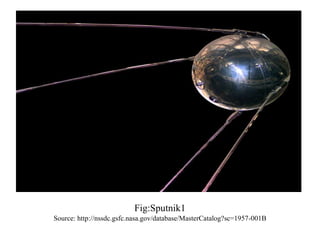
• First artificial earth satellite
• 58 cm diameter polished metal sphere, with four external
radio antennas to broadcast radio pulses
• Launched into an elliptical low Earth orbit on 4 October 1957
• Travelled at about 29,000 kilometers per hour taking 96.2
minutes to complete each orbit.
• Signal transmitted on 20.005 and 40.002 MHz which were
monitored by amateur radio operators throughout the world.
• Signals continued for 22 days until the transmitter batteries
ran out on 26 October 1957.
• Burned up on 4 January 1958, after travelling about 70
million km and spending 3 months in orbit.
Fig:Sputnik1
Source: http://nssdc.gsfc.nasa.gov/database/MasterCatalog?sc=1957-001B
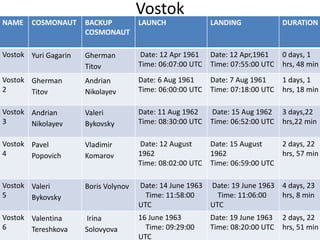
Vostok
NAME COSMONAUT BACKUP
COSMONAUT
LAUNCH LANDING DURATION
Vostok Yuri Gagarin Gherman
Titov
Date: 12 Apr 1961
Time: 06:07:00 UTC
Date: 12 Apr,1961
Time: 07:55:00 UTC
0 days, 1
hrs, 48 min
Vostok
2
Gherman
Titov
Andrian
Nikolayev
Date: 6 Aug 1961
Time: 06:00:00 UTC
Date: 7 Aug 1961
Time: 07:18:00 UTC
1 days, 1
hrs, 18 min
Vostok
3
Andrian
Nikolayev
Valeri
Bykovsky
Date: 11 Aug 1962
Time: 08:30:00 UTC
Date: 15 Aug 1962
Time: 06:52:00 UTC
3 days,22
hrs,22 min
Vostok
4
Pavel
Popovich
Vladimir
Komarov
Date: 12 August
1962
Time: 08:02:00 UTC
Date: 15 August
1962
Time: 06:59:00 UTC
2 days, 22
hrs, 57 min
Vostok
5
Valeri
Bykovsky
Boris Volynov Date: 14 June 1963
Time: 11:58:00
UTC
Date: 19 June 1963
Time: 11:06:00
UTC
4 days, 23
hrs, 8 min
Vostok
6
Valentina
Tereshkova
Irina
Solovyova
16 June 1963
Time: 09:29:00
UTC
Date: 19 June 1963
Time: 08:20:00 UTC
2 days, 22
hrs, 51 min
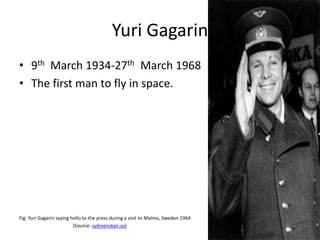
Yuri Gagarin
• 9th March 1934-27th March 1968
• The first man to fly in space.
Fig: Yuri Gagarin saying hello to the press during a visit to Malmo, Sweden 1964
(Source: sydsvenskan.se)
• Graduated from Lyberts School in 1951
• Trained at Saratov Aeroclub Aerotechnical School till
1955
• Joined Military Fighter School in 1957
• Served in fighter units with the Northern Fleet
• Selected as a cosmonaut in 1960
• Named commander of the cosmonaut group in
1963 after being the first person to fly in space
• On 27 March 1968, while on a routine training flight
he died.
Awards
• Jubilee Medal "40 Years of the Armed Forces of the
USSR" (USSR, 1958)
• Hero of the Soviet Union (14 April 1961)
• Order of Lenin (USSR, 14 April 1961)
• Hero of Socialist Labour (Czechoslovak Socialist
Republic, 29 April 1961)
• Hero of Socialist Labour, (People's Republic of Bulgaria,
24 May 1961)
• Order of Georgi Dimitrov (Bulgaria, 24 May 1961)
• Order of the Star, 2nd Class (Indonesia, 10 June 1961)
• Cross of Grunwald, 1st class (Poland, 20 June 1961)
• Pilot-Cosmonaut of the USSR (27 June 1961)
• And many more
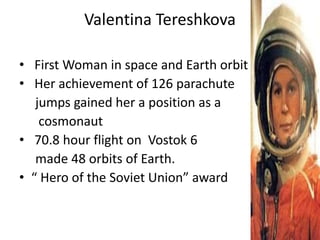
Valentina Tereshkova
• First Woman in space and Earth orbit
• Her achievement of 126 parachute
jumps gained her a position as a
cosmonaut
• 70.8 hour flight on Vostok 6
made 48 orbits of Earth.
• “ Hero of the Soviet Union” award
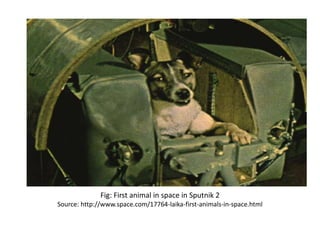
Fig: First animal in space in Sputnik 2
Source: http://www.space.com/17764-laika-first-animals-in-space.html
Lunar missions
• 5 consecutives failures of unmanned missions
• First unmanned Moon landing in 1959 with
the Luna 2 spacecraft
• Luna 3 collects first photos of lunar far side
• After the success of Luna 3, series of 13
missions failure till 1965.
Lunar missions
• Landing on the surface of the Moon before 1970-
the main goal of the US space program.
• On Aug. 3, 1964, the Soviet government finally gave
full go ahead to the manned lunar landing effort.
• Political and technical problems
• In 1966, the Soviet lunar program recieved blow
with the death of its legendary leader Sergei
Korolev.
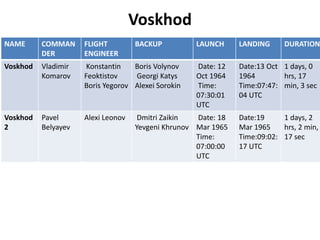
Voskhod
NAME COMMAN
DER
FLIGHT
ENGINEER
BACKUP LAUNCH LANDING DURATION
Voskhod Vladimir
Komarov
Konstantin
Feoktistov
Boris Yegorov
Boris Volynov
Georgi Katys
Alexei Sorokin
Date: 12
Oct 1964
Time:
07:30:01
UTC
Date:13 Oct
1964
Time:07:47:
04 UTC
1 days, 0
hrs, 17
min, 3 sec
Voskhod
2
Pavel
Belyayev
Alexi Leonov Dmitri Zaikin
Yevgeni Khrunov
Date: 18
Mar 1965
Time:
07:00:00
UTC
Date:19
Mar 1965
Time:09:02:
17 UTC
1 days, 2
hrs, 2 min,
17 sec
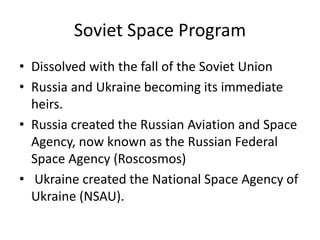
Soviet Space Program
• Dissolved with the fall of the Soviet Union
• Russia and Ukraine becoming its immediate
heirs.
• Russia created the Russian Aviation and Space
Agency, now known as the Russian Federal
Space Agency (Roscosmos)
• Ukraine created the National Space Agency of
Ukraine (NSAU).
Russian Federal Space Agency
• Government agency responsible for the
Russian space science program and general
aerospace research
• Headquarters of Roscosmos are located in
Moscow
Funding and support
• Soviet leader did have an unusually close
relationship with Korolev and other chief
designers
• Government and the Communist Party
encourage the program's successes
• Systematic plans for missions based on political
reasons were rare, 351 Missions were planned
based on rocket availability reasons, rather than
scientific purposes.
• The 1990s - financial problems due to
decreased cash flow
• Thus they focus on commercial satellite
launches and space tourism.
• The Russian economy boomed throughout 2005 from
high prices for exports, such as oil and gas, the outlook
for future funding in 2006 appeared more favorable.
• This resulted in approving a budget of 11 billion USD
for the Space Agency from 2006 January to 2015
• In 2006 a 33% increase of budget from the 2005
budget.
• Under the current 10-year budget approved, the
budget of the Space Agency shall increase 5–10% per
year
• 5 billion USD flowing into its budget by industry
investments and commercial space launches.
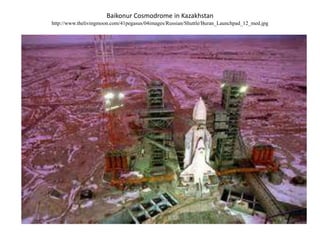
Launch Sites
• Baikonur Cosmodrome in Kazakhstan
• measuring 90 kilometres east to west, by 85
kilometres north to south
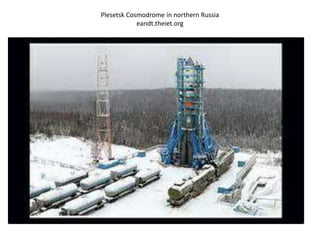
• Plesetsk Cosmodrome in northern Russia
Baikonur Cosmodrome in Kazakhstan
http://www.thelivingmoon.com/41pegasus/04images/Russian/Shuttle/Buran_Launchpad_12_med.jpg
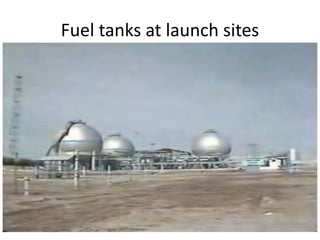
Fuel tanks at launch sites
Plesetsk Cosmodrome in northern Russia
eandt.theiet.org
RSA work with NASA and others..
• Sharing launch sites
• Providing rockets on rent
• But still though competition among them
Mission Failures
• Loss of three GLONASS navigation/positioning
satellites in a launch failure(june,2013)
• An unmanned Proton-M crashed shortly after
blasting off on destroying three navigation
satellites worth a total of nearly $200 million
• The failure of a Russian Mars mission that
crashed back to Earth was due to testing
errors and engineering flaws(Jan 19, 2012)
Causes of failures
Engine shutdown at launch
Equipment failure
Separation failure
Engine malfunction
Fire in launch vehicle
Spacesuit puncture
References
• http://www.universetoday.com/105409/rocket-failures-may-
spur-change-in-russian-federal-space-agency-report
• http://www.astronautix.com/astros/gagarin.htm
• http://www.nasa.gov/audience/foreducators/rocketry/home/
konstantin-tsiolkovsky.html
• http://www.notablebiographies.com/St-Tr/Tereshkova-
Valentina.html
• http://www.russianmission.eu/
• http://www.city-data.com/city/Russian-Mission-Alaska.html
• www.russianmissions.org/about/about.asp
Thank You

Russian missions satellite geodesy

  • 1.
    RUSSIAN MISSIONS Presented by:SurojDahal Email:suroj.rocks@gmail.com Geomatics Engineer
  • 2.
    Soviet space program •Conducted by the former Union of Soviet Socialist Republics (U.S.S.R.) from the 1930s until its dissolution in 1991.
  • 3.
    Development • Initially boostedby the assistance of captured scientists from the advanced German rocket program • Performed mainly by Soviet engineers and scientists after 1955, and was based on some unique Soviet and Imperial Russian theoretical developments
  • 4.
    Development • Konstantin Tsiolkovsky •17th Sept 1857 – 19th Sept 1935 • Father of theoretical astronautics. • “Formula of aviation” • Relationship between:  speed of a rocket at any moment  specific impulse fuel  mass of the rocket in the initial and final time Image Source: http://www.nmspacemuseum.org/halloffame/images.php?image_id=27
  • 5.
    • Thirsty forknowledge though handicapped by deafness due to scarlet fever at age of 10. • Interested in both science and mathematics • Introduced problem of controlling a rocket as it moved between gravitational fields. • Published theoretical papers on gyroscopes, escape velocities, the principle of action and reaction, and the use of liquid propellant rockets.
  • 6.
    • Designed amonoplane in 1894 • Built the first Russian wind tunnel in 1897 • Author of Investigations of Outer Space by Rocket Devices (1911) and Aims of Astronauts (1914) • In 1903 published rocket equation. This equation is the basis of much of the spacecraft engineering done today
  • 7.
    First space shipdraft by Konstantin Tsiolkovsky
  • 8.
    The Cover ofthe book "The Will of the Universe. Unknown Intelligent Powers"
  • 9.
    Development • Sergei Korolevhead of the principal design group. • 12th January 1907- 14th January 1966 • Soviet rocket engineer and spacecraft designer in the Space Race between the United States and the Soviet Union • Father of practical astronautics Image Source :http://en.wikipedia.org/wiki/File:S.P._Korolev.jpg
  • 10.
    • Primarily interestedin aeronautical engineering • In 1923 joined the Society of Aviation and Aerial Navigation of Ukraine • In 1925 allowed to fly the training glider on which he worked • During 1929 Communist Party had decided that the education of engineers be accelerated to meet the country's urgent need for their skills • In 1930,earned his pilot's license
  • 11.
    • He wasgood at design integration, organization and strategic planning. Arrested for mismanagement of funds • Imprisoned in 1938 for almost six years • Following his release, he became a recognized rocket designer • Then appointed to lead the Soviet space program • Chief designer of Sputnik 1
  • 12.
    Awards • Twice Heroof Socialist Labor in 1956 and 1961. • Lenin Prize winner in 1971 • Order of Lenin three times • Order of the Badge of Honour • Medal "For Labour Valour” • A street in Moscow was named after Korolev • In 1976 he was inducted into the International Space Hall of Fame • and many more……
  • 13.
    First Satellite Construction •On 17 December 1954, Sergei Korolev addressed Minister of Defence , proposing the development of an artificial satellite • On 29 July 1955 the U.S announced, that the U.S would launch an artificial satellite soon • That press statement troubled Russia. • On 30 January 1956 the Council of Ministers approved practical work on an artificial Earth-orbiting satellite. This satellite, named "Object D", was planned to be completed in 1957–58. • Problems in assembly, low impulse caused delay. • Fearing US would launch satellite before USSR a new simple, light and easy to construct with a simple radio transmitter proposed named R-7.
  • 14.
    First Satellite Construction •First launch of R-7 rocket (8K71 No.5) on 15 May 1957. The flight was controlled until the 98th second, but a fire in a strap-on rocket led to crash 400 km from the site • 3 attempts to launch the second rocket (8K71 No.6) made on 10–11 June also failed because assembly problem. • Unsuccessful launch of the third R-7 rocket (8K71 No.7) took place on 12 July. The rocket rotate about its longitudinal axis and its engines were automatically turned off. • The launch of the fourth rocket (8K71 No.8), on 21 August was successful. Its head part separated, reached the defined region, entered the atmosphere, and was destroyed at a height of 10 km because of thermodynamic overload after traveling 6,000 km
  • 15.
    First satellite construction •On 22 September a modified R-7 rocket, named Sputnik proposed • M. S. Khomyakov-the chief constructor of Sputnik 1 • Donald B. Gillies – one of the first to calculate the Sputnik 1 orbit • Kerim Kerimov – one of the lead architects behind Sputnik 1
  • 16.
    Sputnik 1 • Firstartificial earth satellite • 58 cm diameter polished metal sphere, with four external radio antennas to broadcast radio pulses • Launched into an elliptical low Earth orbit on 4 October 1957 • Travelled at about 29,000 kilometers per hour taking 96.2 minutes to complete each orbit. • Signal transmitted on 20.005 and 40.002 MHz which were monitored by amateur radio operators throughout the world. • Signals continued for 22 days until the transmitter batteries ran out on 26 October 1957. • Burned up on 4 January 1958, after travelling about 70 million km and spending 3 months in orbit.
  • 17.
  • 18.
    Vostok NAME COSMONAUT BACKUP COSMONAUT LAUNCHLANDING DURATION Vostok Yuri Gagarin Gherman Titov Date: 12 Apr 1961 Time: 06:07:00 UTC Date: 12 Apr,1961 Time: 07:55:00 UTC 0 days, 1 hrs, 48 min Vostok 2 Gherman Titov Andrian Nikolayev Date: 6 Aug 1961 Time: 06:00:00 UTC Date: 7 Aug 1961 Time: 07:18:00 UTC 1 days, 1 hrs, 18 min Vostok 3 Andrian Nikolayev Valeri Bykovsky Date: 11 Aug 1962 Time: 08:30:00 UTC Date: 15 Aug 1962 Time: 06:52:00 UTC 3 days,22 hrs,22 min Vostok 4 Pavel Popovich Vladimir Komarov Date: 12 August 1962 Time: 08:02:00 UTC Date: 15 August 1962 Time: 06:59:00 UTC 2 days, 22 hrs, 57 min Vostok 5 Valeri Bykovsky Boris Volynov Date: 14 June 1963 Time: 11:58:00 UTC Date: 19 June 1963 Time: 11:06:00 UTC 4 days, 23 hrs, 8 min Vostok 6 Valentina Tereshkova Irina Solovyova 16 June 1963 Time: 09:29:00 UTC Date: 19 June 1963 Time: 08:20:00 UTC 2 days, 22 hrs, 51 min
  • 19.
    Yuri Gagarin • 9thMarch 1934-27th March 1968 • The first man to fly in space. Fig: Yuri Gagarin saying hello to the press during a visit to Malmo, Sweden 1964 (Source: sydsvenskan.se)
  • 20.
    • Graduated fromLyberts School in 1951 • Trained at Saratov Aeroclub Aerotechnical School till 1955 • Joined Military Fighter School in 1957 • Served in fighter units with the Northern Fleet • Selected as a cosmonaut in 1960 • Named commander of the cosmonaut group in 1963 after being the first person to fly in space • On 27 March 1968, while on a routine training flight he died.
  • 21.
    Awards • Jubilee Medal"40 Years of the Armed Forces of the USSR" (USSR, 1958) • Hero of the Soviet Union (14 April 1961) • Order of Lenin (USSR, 14 April 1961) • Hero of Socialist Labour (Czechoslovak Socialist Republic, 29 April 1961) • Hero of Socialist Labour, (People's Republic of Bulgaria, 24 May 1961) • Order of Georgi Dimitrov (Bulgaria, 24 May 1961) • Order of the Star, 2nd Class (Indonesia, 10 June 1961) • Cross of Grunwald, 1st class (Poland, 20 June 1961) • Pilot-Cosmonaut of the USSR (27 June 1961) • And many more
  • 22.
    Valentina Tereshkova • FirstWoman in space and Earth orbit • Her achievement of 126 parachute jumps gained her a position as a cosmonaut • 70.8 hour flight on Vostok 6 made 48 orbits of Earth. • “ Hero of the Soviet Union” award
  • 23.
    Fig: First animalin space in Sputnik 2 Source: http://www.space.com/17764-laika-first-animals-in-space.html
  • 24.
    Lunar missions • 5consecutives failures of unmanned missions • First unmanned Moon landing in 1959 with the Luna 2 spacecraft • Luna 3 collects first photos of lunar far side • After the success of Luna 3, series of 13 missions failure till 1965.
  • 25.
    Lunar missions • Landingon the surface of the Moon before 1970- the main goal of the US space program. • On Aug. 3, 1964, the Soviet government finally gave full go ahead to the manned lunar landing effort. • Political and technical problems • In 1966, the Soviet lunar program recieved blow with the death of its legendary leader Sergei Korolev.
  • 26.
    Voskhod NAME COMMAN DER FLIGHT ENGINEER BACKUP LAUNCHLANDING DURATION Voskhod Vladimir Komarov Konstantin Feoktistov Boris Yegorov Boris Volynov Georgi Katys Alexei Sorokin Date: 12 Oct 1964 Time: 07:30:01 UTC Date:13 Oct 1964 Time:07:47: 04 UTC 1 days, 0 hrs, 17 min, 3 sec Voskhod 2 Pavel Belyayev Alexi Leonov Dmitri Zaikin Yevgeni Khrunov Date: 18 Mar 1965 Time: 07:00:00 UTC Date:19 Mar 1965 Time:09:02: 17 UTC 1 days, 2 hrs, 2 min, 17 sec
  • 27.
    Soviet Space Program •Dissolved with the fall of the Soviet Union • Russia and Ukraine becoming its immediate heirs. • Russia created the Russian Aviation and Space Agency, now known as the Russian Federal Space Agency (Roscosmos) • Ukraine created the National Space Agency of Ukraine (NSAU).
  • 28.
    Russian Federal SpaceAgency • Government agency responsible for the Russian space science program and general aerospace research • Headquarters of Roscosmos are located in Moscow
  • 29.
    Funding and support •Soviet leader did have an unusually close relationship with Korolev and other chief designers • Government and the Communist Party encourage the program's successes • Systematic plans for missions based on political reasons were rare, 351 Missions were planned based on rocket availability reasons, rather than scientific purposes.
  • 30.
    • The 1990s- financial problems due to decreased cash flow • Thus they focus on commercial satellite launches and space tourism.
  • 31.
    • The Russianeconomy boomed throughout 2005 from high prices for exports, such as oil and gas, the outlook for future funding in 2006 appeared more favorable. • This resulted in approving a budget of 11 billion USD for the Space Agency from 2006 January to 2015 • In 2006 a 33% increase of budget from the 2005 budget. • Under the current 10-year budget approved, the budget of the Space Agency shall increase 5–10% per year • 5 billion USD flowing into its budget by industry investments and commercial space launches.
  • 32.
    Launch Sites • BaikonurCosmodrome in Kazakhstan • measuring 90 kilometres east to west, by 85 kilometres north to south • Plesetsk Cosmodrome in northern Russia
  • 33.
    Baikonur Cosmodrome inKazakhstan http://www.thelivingmoon.com/41pegasus/04images/Russian/Shuttle/Buran_Launchpad_12_med.jpg
  • 34.
    Fuel tanks atlaunch sites
  • 35.
    Plesetsk Cosmodrome innorthern Russia eandt.theiet.org
  • 36.
    RSA work withNASA and others.. • Sharing launch sites • Providing rockets on rent • But still though competition among them
  • 37.
    Mission Failures • Lossof three GLONASS navigation/positioning satellites in a launch failure(june,2013) • An unmanned Proton-M crashed shortly after blasting off on destroying three navigation satellites worth a total of nearly $200 million • The failure of a Russian Mars mission that crashed back to Earth was due to testing errors and engineering flaws(Jan 19, 2012)
  • 38.
    Causes of failures Engineshutdown at launch Equipment failure Separation failure Engine malfunction Fire in launch vehicle Spacesuit puncture
  • 39.
    References • http://www.universetoday.com/105409/rocket-failures-may- spur-change-in-russian-federal-space-agency-report • http://www.astronautix.com/astros/gagarin.htm •http://www.nasa.gov/audience/foreducators/rocketry/home/ konstantin-tsiolkovsky.html • http://www.notablebiographies.com/St-Tr/Tereshkova- Valentina.html • http://www.russianmission.eu/ • http://www.city-data.com/city/Russian-Mission-Alaska.html • www.russianmissions.org/about/about.asp
  • 40.