NATIONAL RURBAN
MISSION
SUBMITTED BY
DHANUSH C M
DHEERAJ JOSHI
SPA
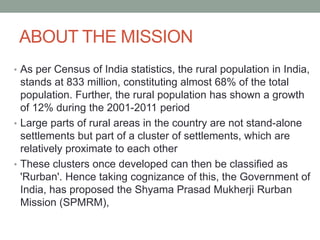
ABOUT THE MISSION
• As per Census of India statistics, the rural population in India,
stands at 833 million, constituting almost 68% of the total
population. Further, the rural population has shown a growth
of 12% during the 2001-2011 period
• Large parts of rural areas in the country are not stand-alone
settlements but part of a cluster of settlements, which are
relatively proximate to each other
• These clusters once developed can then be classified as
'Rurban'. Hence taking cognizance of this, the Government of
India, has proposed the Shyama Prasad Mukherji Rurban
Mission (SPMRM),
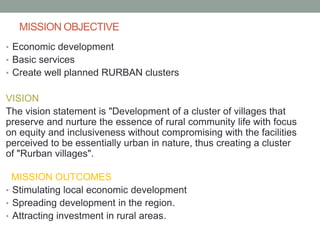
MISSION OBJECTIVE
• Economic development
• Basic services
• Create well planned RURBAN clusters
VISION
The vision statement is "Development of a cluster of villages that
preserve and nurture the essence of rural community life with focus
on equity and inclusiveness without compromising with the facilities
perceived to be essentially urban in nature, thus creating a cluster
of "Rurban villages".
MISSION OUTCOMES
• Stimulating local economic development
• Spreading development in the region.
• Attracting investment in rural areas.
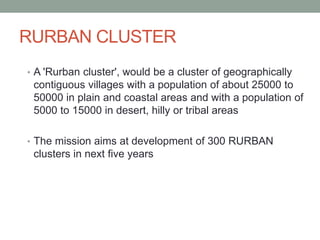
RURBAN CLUSTER
• A 'Rurban cluster', would be a cluster of geographically
contiguous villages with a population of about 25000 to
50000 in plain and coastal areas and with a population of
5000 to 15000 in desert, hilly or tribal areas
• The mission aims at development of 300 RURBAN
clusters in next five years
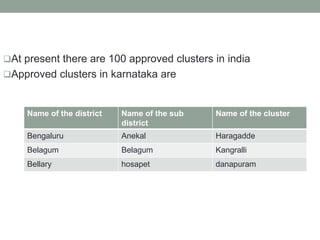
At present there are 100 approved clusters in india
Approved clusters in karnataka are
Name of the district Name of the sub
district
Name of the cluster
Bengaluru Anekal Haragadde
Belagum Belagum Kangralli
Bellary hosapet danapuram
SELECTION PROCEDURE
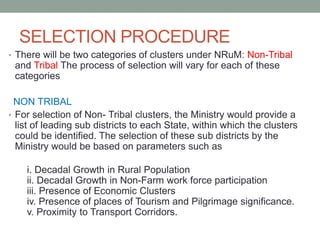
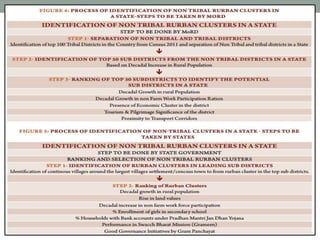
• There will be two categories of clusters under NRuM: Non-Tribal
and Tribal The process of selection will vary for each of these
categories
NON TRIBAL
• For selection of Non- Tribal clusters, the Ministry would provide a
list of leading sub districts to each State, within which the clusters
could be identified. The selection of these sub districts by the
Ministry would be based on parameters such as
i. Decadal Growth in Rural Population
ii. Decadal Growth in Non-Farm work force participation
iii. Presence of Economic Clusters
iv. Presence of places of Tourism and Pilgrimage significance.
v. Proximity to Transport Corridors.
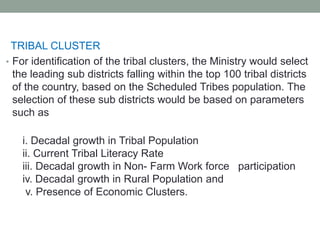
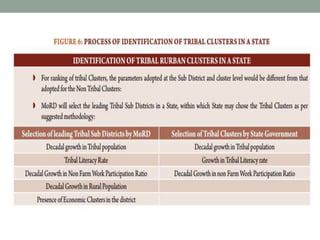
TRIBAL CLUSTER
• For identification of the tribal clusters, the Ministry would select
the leading sub districts falling within the top 100 tribal districts
of the country, based on the Scheduled Tribes population. The
selection of these sub districts would be based on parameters
such as
i. Decadal growth in Tribal Population
ii. Current Tribal Literacy Rate
iii. Decadal growth in Non- Farm Work force participation
iv. Decadal growth in Rural Population and
v. Presence of Economic Clusters.
How will the Rurban Clusters be
developed?
Rurban clusters would be developed by
provisioning of training linked to economic
activities, developing skills & local
entrepreneurship and by providing
necessary infrastructure amenities. The
Mission recommends fourteen desirable
components for an ideal Rurban cluster.
14 desirable components
recommended under the Mission
(i) Skill development training linked to economic activities
(ii) Agro Processing, Agri Services, Storage and Warehousing.
(iii) Fully equipped mobile health unit.
(iv) Upgrading school /higher education facilities.
(v) Sanitation
(vi) Provision of piped water supply.
(vii) Solid and liquid waste management.
(viii) Village streets and drains.
(ix) Street lights
(x) Inter-village road connectivity.
(xi) Public transport.
(xii) LPG gas connections
(xiii) Digital Literacy.
(xiv) Citizen Service Centres- for electronic delivery of citizen centric services/e-gram
connectivity
Resource mobilisation pattern for this
Mission
• In order to achieve the envisaged outcomes, under
NRuM, the State Government shall identify existing
Central Sector, Centrally Sponsored and State
Government Schemes relevant for the development of the
cluster and converge their implementation in an integrated
and time bound manner
• Under the NRuM framework, Government of India shall
provide Critical Gap Funding (CGF) to the clusters to
supplement the shortfall in funding available through
various Government schemes in achieving the outcomes
desired for the cluster
.
Critical Gap Funding
• In addition to the scheme funds, Critical Gap Funding
(CGF) is proposed to be provided through the Scheme
funds to the clusters to bridge the gap posed by
availability of scheme funds and fulfilling the development
aspirations of the 'Rurban Cluster'.
• The CGF would be capped at 30% of the capital cost or
Rs 30 crores whichever is lesser.
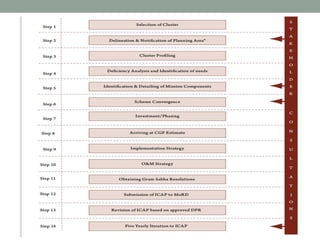
INTEGRATED CLUSTER ACTION PLAN
• What is an ICAP?
• Why is an ICAP needed?
• Who will prepare an ICAP?
• How will an ICAP be prepared?
Fund release pattern under this
Mission
• The Ministry shall release Rs. 35 lakhs (Rupees thirty five
lakhs only) per Rurban cluster approved in the State for
preparation of ICAPs. This will be adjusted against the 2%
administrative budget for each State. The funds would be
released in three instalments at appropriate stages of the
project cycle as illustrated below.
Total Mission budget
• The total funding requirement estimated for the scheme is
Rs.5142.08 crore from 2015-16 to 2019- 20.
THANK YOU

Rurban MISSION

  • 1.
  • 2.
    ABOUT THE MISSION •As per Census of India statistics, the rural population in India, stands at 833 million, constituting almost 68% of the total population. Further, the rural population has shown a growth of 12% during the 2001-2011 period • Large parts of rural areas in the country are not stand-alone settlements but part of a cluster of settlements, which are relatively proximate to each other • These clusters once developed can then be classified as 'Rurban'. Hence taking cognizance of this, the Government of India, has proposed the Shyama Prasad Mukherji Rurban Mission (SPMRM),
  • 3.
    MISSION OBJECTIVE • Economicdevelopment • Basic services • Create well planned RURBAN clusters VISION The vision statement is "Development of a cluster of villages that preserve and nurture the essence of rural community life with focus on equity and inclusiveness without compromising with the facilities perceived to be essentially urban in nature, thus creating a cluster of "Rurban villages". MISSION OUTCOMES • Stimulating local economic development • Spreading development in the region. • Attracting investment in rural areas.
  • 4.
    RURBAN CLUSTER • A'Rurban cluster', would be a cluster of geographically contiguous villages with a population of about 25000 to 50000 in plain and coastal areas and with a population of 5000 to 15000 in desert, hilly or tribal areas • The mission aims at development of 300 RURBAN clusters in next five years
  • 5.
    At present thereare 100 approved clusters in india Approved clusters in karnataka are Name of the district Name of the sub district Name of the cluster Bengaluru Anekal Haragadde Belagum Belagum Kangralli Bellary hosapet danapuram
  • 6.
    SELECTION PROCEDURE • Therewill be two categories of clusters under NRuM: Non-Tribal and Tribal The process of selection will vary for each of these categories NON TRIBAL • For selection of Non- Tribal clusters, the Ministry would provide a list of leading sub districts to each State, within which the clusters could be identified. The selection of these sub districts by the Ministry would be based on parameters such as i. Decadal Growth in Rural Population ii. Decadal Growth in Non-Farm work force participation iii. Presence of Economic Clusters iv. Presence of places of Tourism and Pilgrimage significance. v. Proximity to Transport Corridors.
  • 8.
    TRIBAL CLUSTER • Foridentification of the tribal clusters, the Ministry would select the leading sub districts falling within the top 100 tribal districts of the country, based on the Scheduled Tribes population. The selection of these sub districts would be based on parameters such as i. Decadal growth in Tribal Population ii. Current Tribal Literacy Rate iii. Decadal growth in Non- Farm Work force participation iv. Decadal growth in Rural Population and v. Presence of Economic Clusters.
  • 10.
    How will theRurban Clusters be developed? Rurban clusters would be developed by provisioning of training linked to economic activities, developing skills & local entrepreneurship and by providing necessary infrastructure amenities. The Mission recommends fourteen desirable components for an ideal Rurban cluster.
  • 11.
    14 desirable components recommendedunder the Mission (i) Skill development training linked to economic activities (ii) Agro Processing, Agri Services, Storage and Warehousing. (iii) Fully equipped mobile health unit. (iv) Upgrading school /higher education facilities. (v) Sanitation (vi) Provision of piped water supply. (vii) Solid and liquid waste management. (viii) Village streets and drains. (ix) Street lights (x) Inter-village road connectivity. (xi) Public transport. (xii) LPG gas connections (xiii) Digital Literacy. (xiv) Citizen Service Centres- for electronic delivery of citizen centric services/e-gram connectivity
  • 12.
    Resource mobilisation patternfor this Mission • In order to achieve the envisaged outcomes, under NRuM, the State Government shall identify existing Central Sector, Centrally Sponsored and State Government Schemes relevant for the development of the cluster and converge their implementation in an integrated and time bound manner • Under the NRuM framework, Government of India shall provide Critical Gap Funding (CGF) to the clusters to supplement the shortfall in funding available through various Government schemes in achieving the outcomes desired for the cluster .
  • 13.
    Critical Gap Funding •In addition to the scheme funds, Critical Gap Funding (CGF) is proposed to be provided through the Scheme funds to the clusters to bridge the gap posed by availability of scheme funds and fulfilling the development aspirations of the 'Rurban Cluster'. • The CGF would be capped at 30% of the capital cost or Rs 30 crores whichever is lesser.
  • 14.
    INTEGRATED CLUSTER ACTIONPLAN • What is an ICAP? • Why is an ICAP needed? • Who will prepare an ICAP? • How will an ICAP be prepared?
  • 16.
    Fund release patternunder this Mission • The Ministry shall release Rs. 35 lakhs (Rupees thirty five lakhs only) per Rurban cluster approved in the State for preparation of ICAPs. This will be adjusted against the 2% administrative budget for each State. The funds would be released in three instalments at appropriate stages of the project cycle as illustrated below. Total Mission budget • The total funding requirement estimated for the scheme is Rs.5142.08 crore from 2015-16 to 2019- 20.
  • 17.