Rural Retail Channel
Management
Retailing
• All the activities directly related to the sale of goods and services to
the ultimate consumer for personal, non-business use is called
retailing (Lamb, Hair, Sharma and McDaniel, 2012).
• A retail outlet can be defined as a constructed building from which
retailing is carried out and these are not premises from which mail-
order sales are being shipped, but an outlet which can be approached
by members of the public, without prior appointment and goods
stored for retail shall be sold to them (Guy, 1998).
Retailing
• Set of activities that markets products or services to final consumers
for their own personal or household use. It does this by organising
the availability of goods and then supplying them to consumers on
relatively small scale (Newman and Cullen, 2002).
• All the activities involved in selling goods or services directly to final
consumers for their personal non-business use (Kotler, 1998).
Retail Mix
• Price
• Location
• Communications
• Merchandise
• Physical attributes
• Services
• Personnel
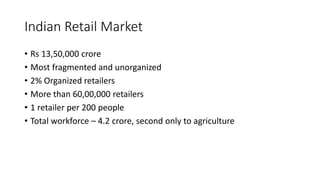
Indian Retail Market
• Rs 13,50,000 crore
• Most fragmented and unorganized
• 2% Organized retailers
• More than 60,00,000 retailers
• 1 retailer per 200 people
• Total workforce – 4.2 crore, second only to agriculture
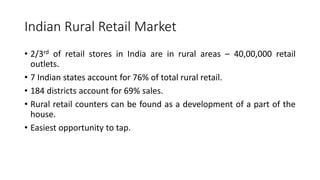
Indian Rural Retail Market
• 2/3rd of retail stores in India are in rural areas – 40,00,000 retail
outlets.
• 7 Indian states account for 76% of total rural retail.
• 184 districts account for 69% sales.
• Rural retail counters can be found as a development of a part of the
house.
• Easiest opportunity to tap.
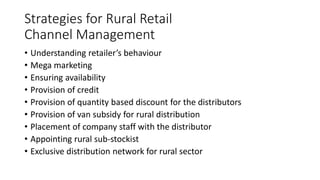
Strategies for Rural Retail
Channel Management
• Understanding retailer’s behaviour
• Mega marketing
• Ensuring availability
• Provision of credit
• Provision of quantity based discount for the distributors
• Provision of van subsidy for rural distribution
• Placement of company staff with the distributor
• Appointing rural sub-stockist
• Exclusive distribution network for rural sector
Thank You

Rural Retail Channel Management-2.pptx

  • 1.
  • 2.
    Retailing • All theactivities directly related to the sale of goods and services to the ultimate consumer for personal, non-business use is called retailing (Lamb, Hair, Sharma and McDaniel, 2012). • A retail outlet can be defined as a constructed building from which retailing is carried out and these are not premises from which mail- order sales are being shipped, but an outlet which can be approached by members of the public, without prior appointment and goods stored for retail shall be sold to them (Guy, 1998).
  • 3.
    Retailing • Set ofactivities that markets products or services to final consumers for their own personal or household use. It does this by organising the availability of goods and then supplying them to consumers on relatively small scale (Newman and Cullen, 2002). • All the activities involved in selling goods or services directly to final consumers for their personal non-business use (Kotler, 1998).
  • 4.
    Retail Mix • Price •Location • Communications • Merchandise • Physical attributes • Services • Personnel
  • 5.
    Indian Retail Market •Rs 13,50,000 crore • Most fragmented and unorganized • 2% Organized retailers • More than 60,00,000 retailers • 1 retailer per 200 people • Total workforce – 4.2 crore, second only to agriculture
  • 6.
    Indian Rural RetailMarket • 2/3rd of retail stores in India are in rural areas – 40,00,000 retail outlets. • 7 Indian states account for 76% of total rural retail. • 184 districts account for 69% sales. • Rural retail counters can be found as a development of a part of the house. • Easiest opportunity to tap.
  • 7.
    Strategies for RuralRetail Channel Management • Understanding retailer’s behaviour • Mega marketing • Ensuring availability • Provision of credit • Provision of quantity based discount for the distributors • Provision of van subsidy for rural distribution • Placement of company staff with the distributor • Appointing rural sub-stockist • Exclusive distribution network for rural sector
  • 8.