1
|
MTL: The Professional Development Programme
Running a Training Course
RUNNING A TRAINING
COURSE
Engaging minds and delivering results
MTL: The Professional Development Programme
2
|
MTL: The Professional Development Programme
Running a Training Course
Attribution: All images are from sources where a Creative Commons license exists for commercial use. All icons are on subscription
from thenounproject. All clipart is from free sources. The MTL Professional Development Programme is copyright of Manage Train
Learn.
Running a
Training
Course
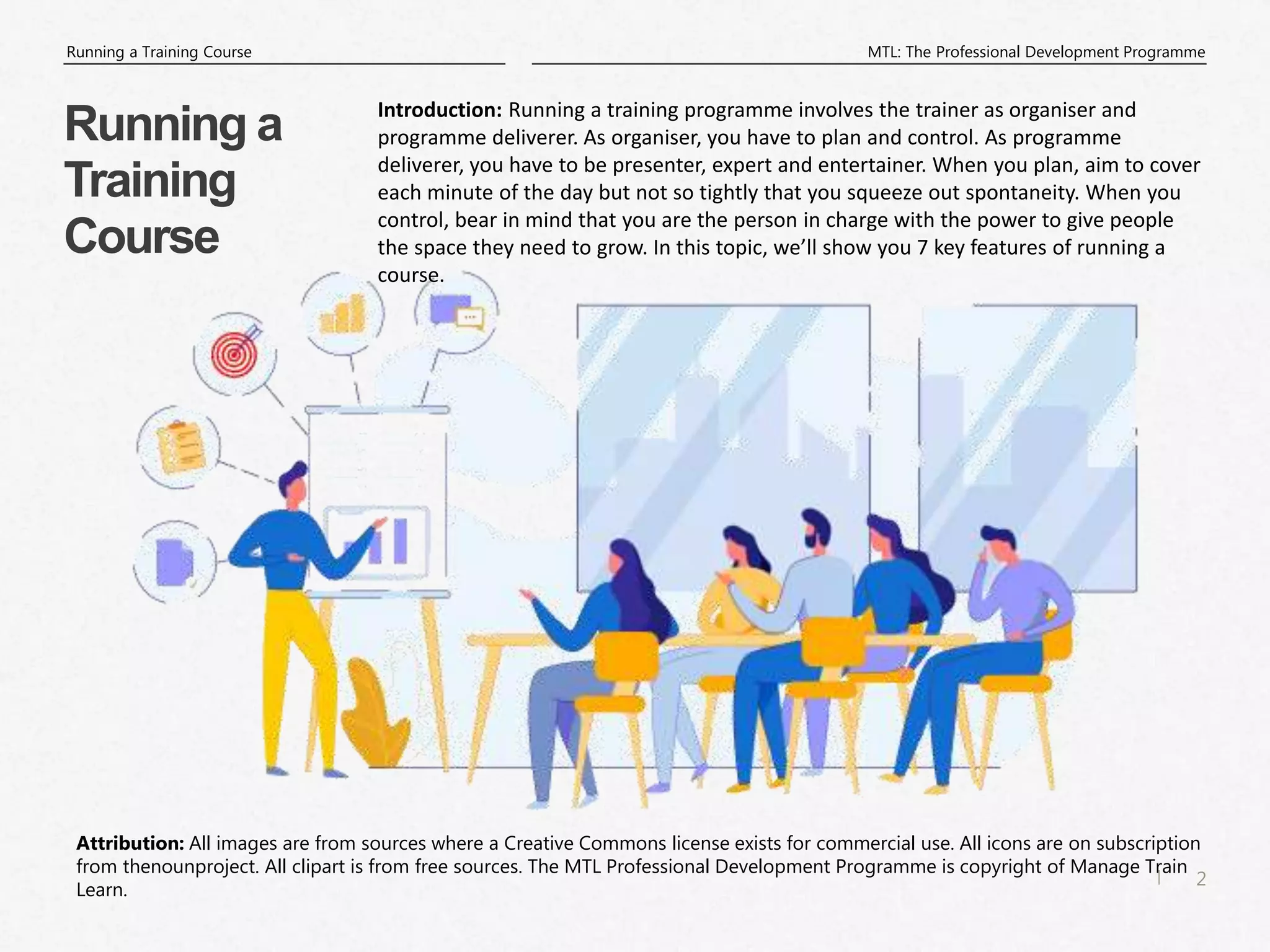
Introduction: Running a training programme involves the trainer as organiser and
programme deliverer. As organiser, you have to plan and control. As programme
deliverer, you have to be presenter, expert and entertainer. When you plan, aim to cover
each minute of the day but not so tightly that you squeeze out spontaneity. When you
control, bear in mind that you are the person in charge with the power to give people
the space they need to grow. In this topic, we’ll show you 7 key features of running a
course.
3
|
MTL: The Professional Development Programme
Running a Training Course
https://www.flickr.com/photos/poptech/4910884487/
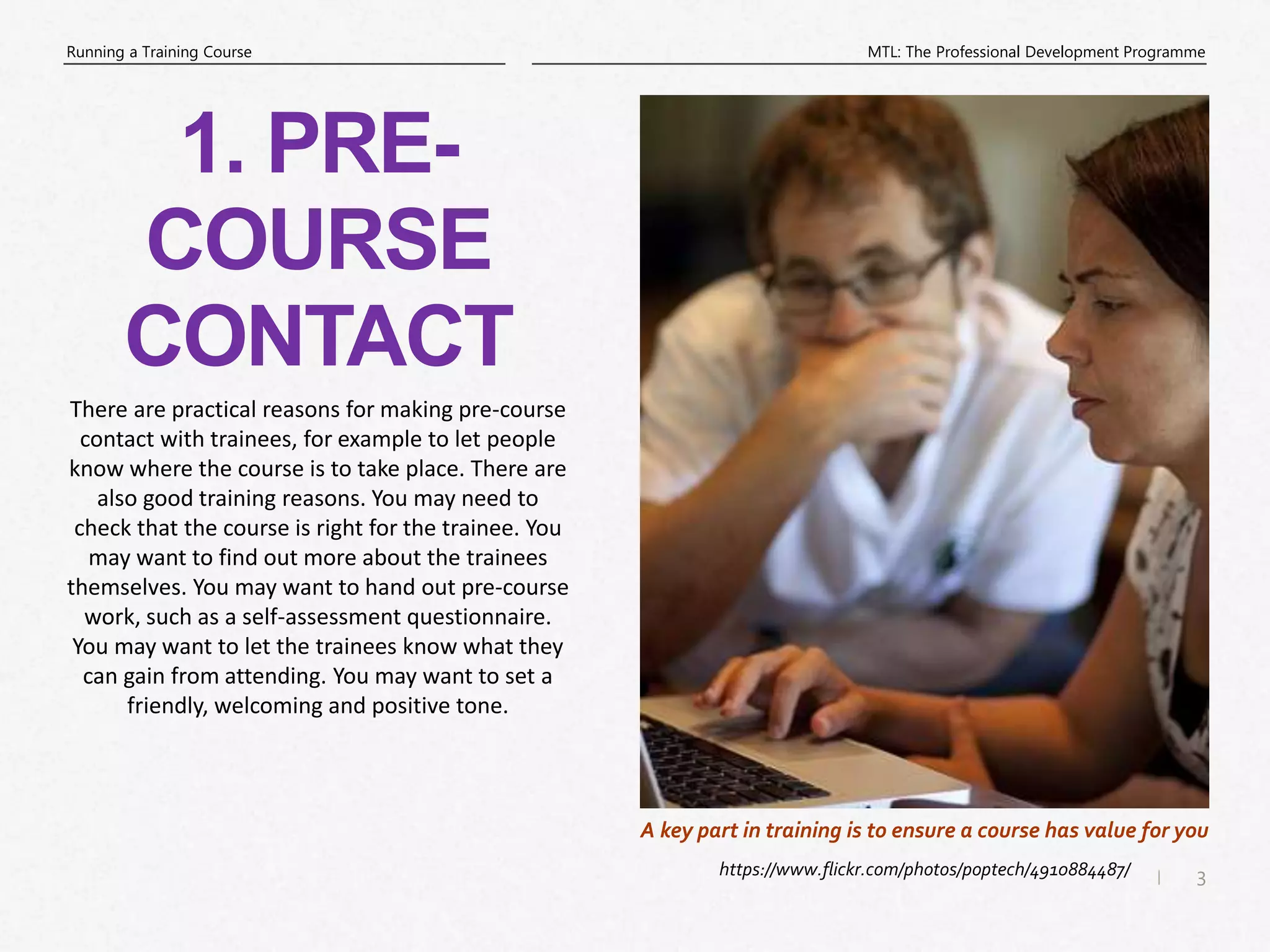
A key part in training is to ensure a course has value for you
1. PRE-
COURSE
CONTACT
There are practical reasons for making pre-course
contact with trainees, for example to let people
know where the course is to take place. There are
also good training reasons. You may need to
check that the course is right for the trainee. You
may want to find out more about the trainees
themselves. You may want to hand out pre-course
work, such as a self-assessment questionnaire.
You may want to let the trainees know what they
can gain from attending. You may want to set a
friendly, welcoming and positive tone.
4
|
MTL: The Professional Development Programme
Running a Training Course
2. INTROS
The course introduction has both surface and
sub-surface learning. On the surface, the
Introduction introduces people to each other,
breaks the ice, discusses expectations, outlines
rules and roles, gives the course aims, offers an
overview and deals with administrative matters.
Under the surface of the Introduction, trainees
should be learning that this is a safe environment
in which to be, that people will be valued for who
they are and that this is a course for the trainees
and not for the trainer.
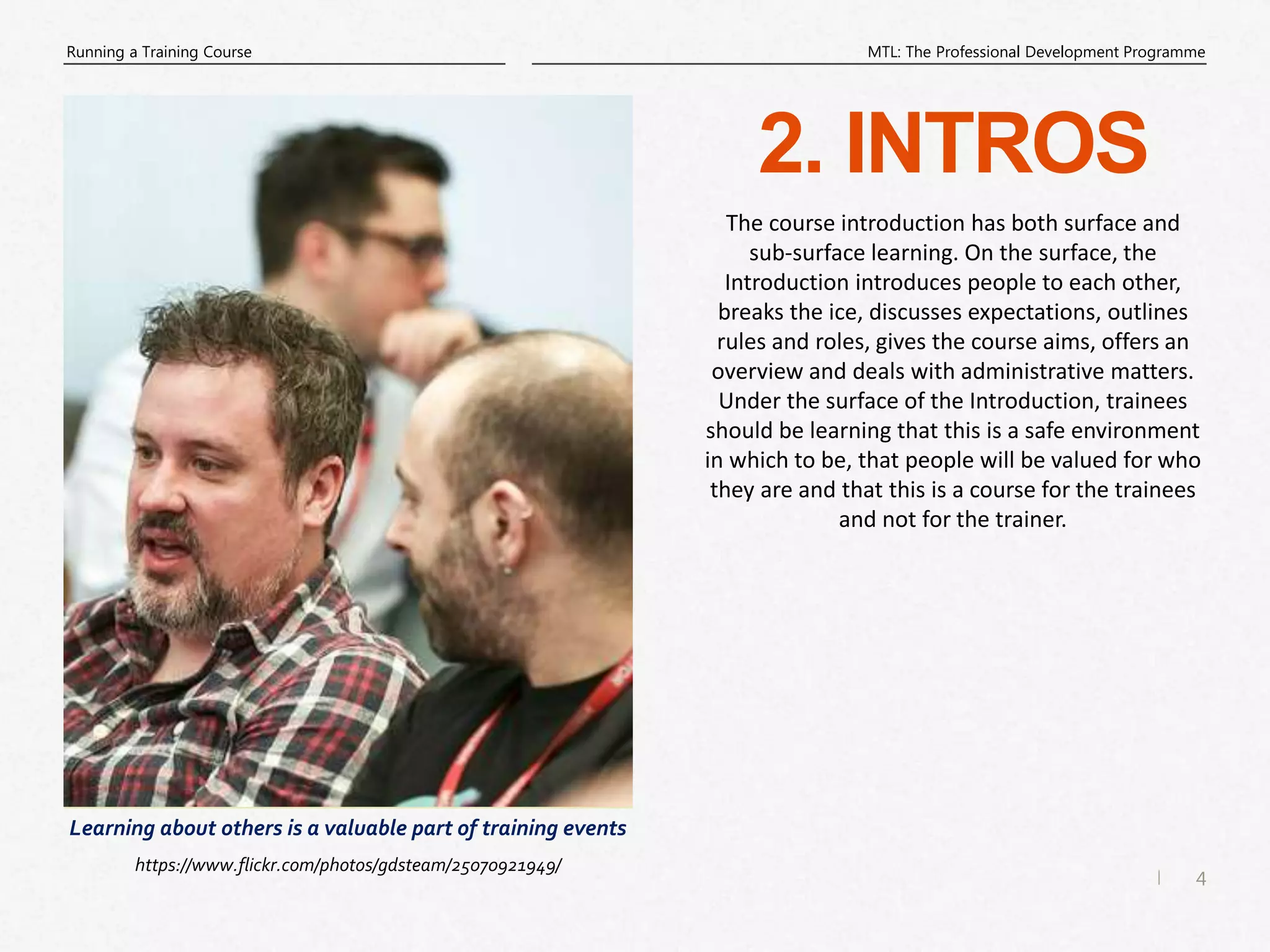
Learning about others is a valuable part of training events
https://www.flickr.com/photos/gdsteam/25070921949/
5
|
MTL: The Professional Development Programme
Running a Training Course
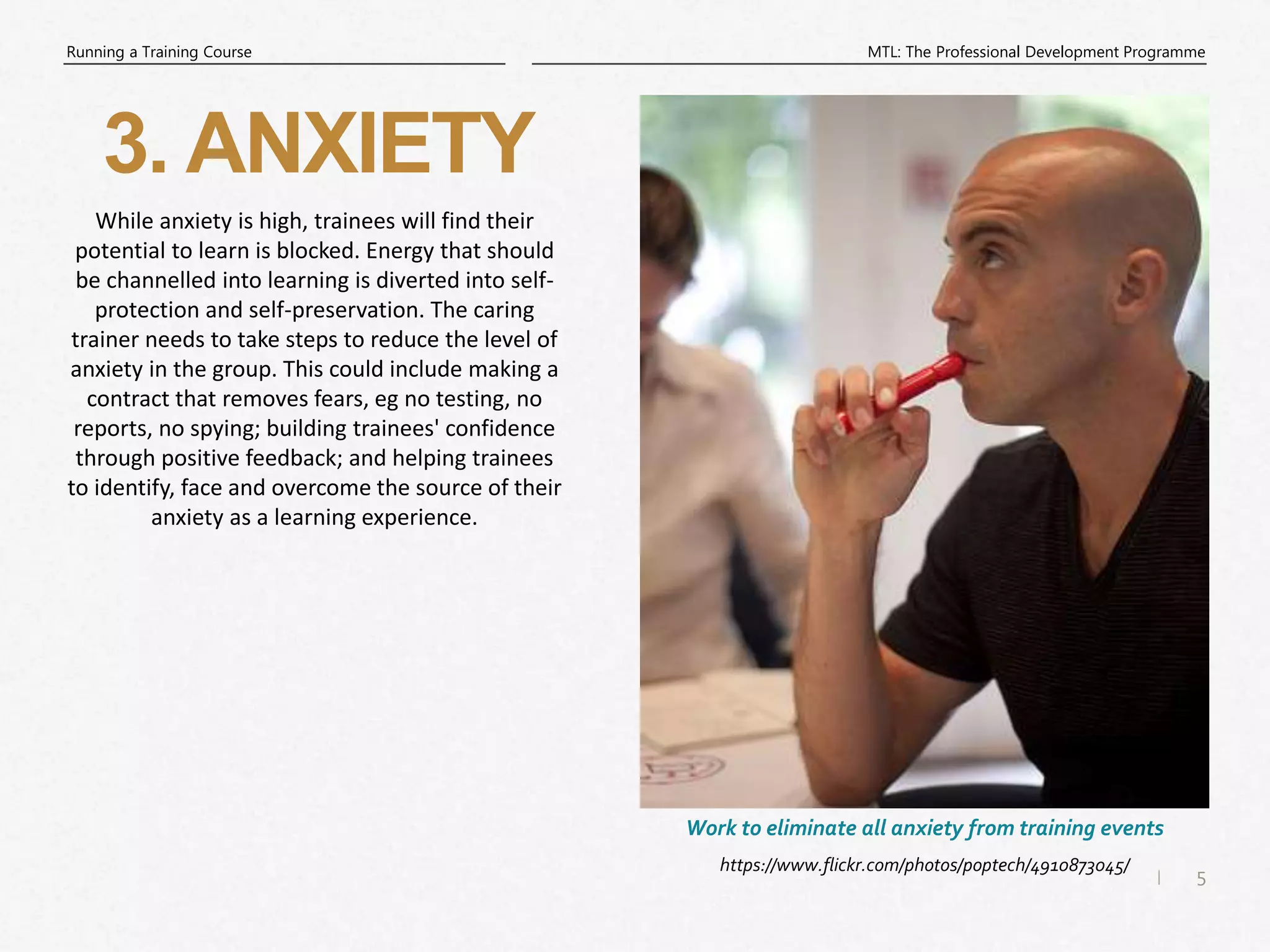
3. ANXIETY
https://www.flickr.com/photos/poptech/4910873045/
Work to eliminate all anxiety from training events
While anxiety is high, trainees will find their
potential to learn is blocked. Energy that should
be channelled into learning is diverted into self-
protection and self-preservation. The caring
trainer needs to take steps to reduce the level of
anxiety in the group. This could include making a
contract that removes fears, eg no testing, no
reports, no spying; building trainees' confidence
through positive feedback; and helping trainees
to identify, face and overcome the source of their
anxiety as a learning experience.
6
|
MTL: The Professional Development Programme
Running a Training Course
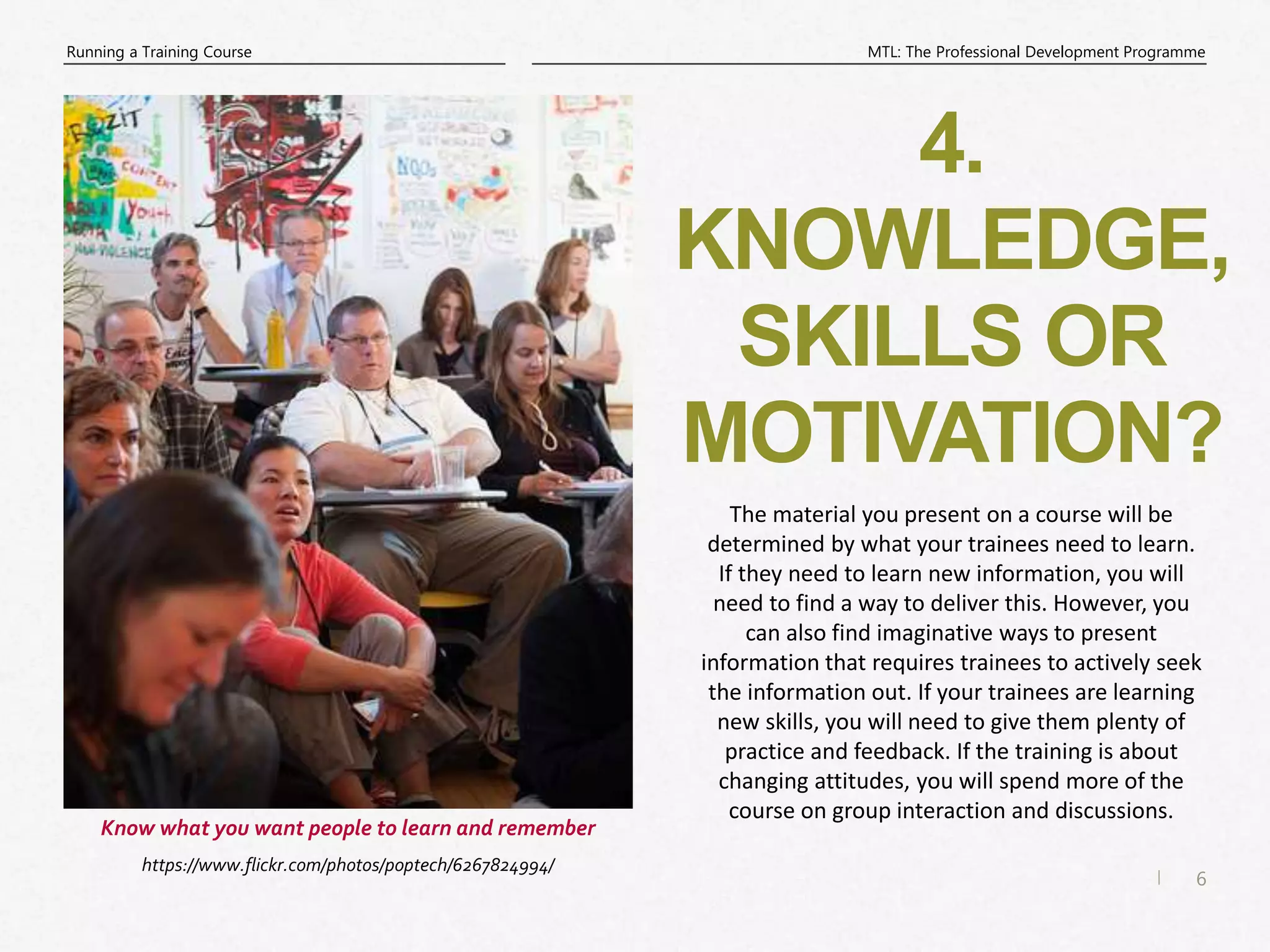
4.
KNOWLEDGE,
SKILLS OR
MOTIVATION?
https://www.flickr.com/photos/poptech/6267824994/
Know what you want people to learn and remember
The material you present on a course will be
determined by what your trainees need to learn.
If they need to learn new information, you will
need to find a way to deliver this. However, you
can also find imaginative ways to present
information that requires trainees to actively seek
the information out. If your trainees are learning
new skills, you will need to give them plenty of
practice and feedback. If the training is about
changing attitudes, you will spend more of the
course on group interaction and discussions.
7
|
MTL: The Professional Development Programme
Running a Training Course
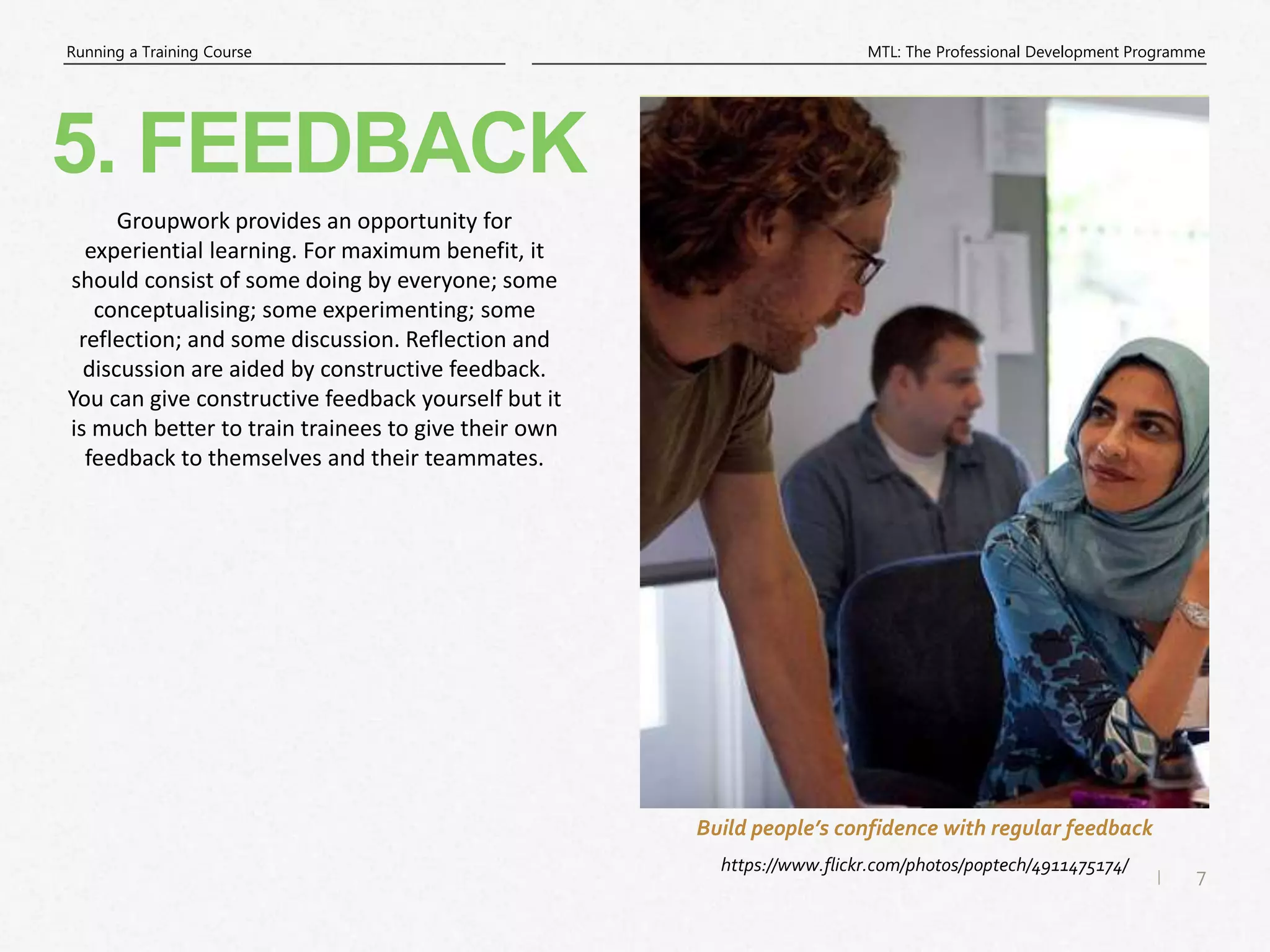
5. FEEDBACK
https://www.flickr.com/photos/poptech/4911475174/
Build people’s confidence with regular feedback
Groupwork provides an opportunity for
experiential learning. For maximum benefit, it
should consist of some doing by everyone; some
conceptualising; some experimenting; some
reflection; and some discussion. Reflection and
discussion are aided by constructive feedback.
You can give constructive feedback yourself but it
is much better to train trainees to give their own
feedback to themselves and their teammates.
8
|
MTL: The Professional Development Programme
Running a Training Course
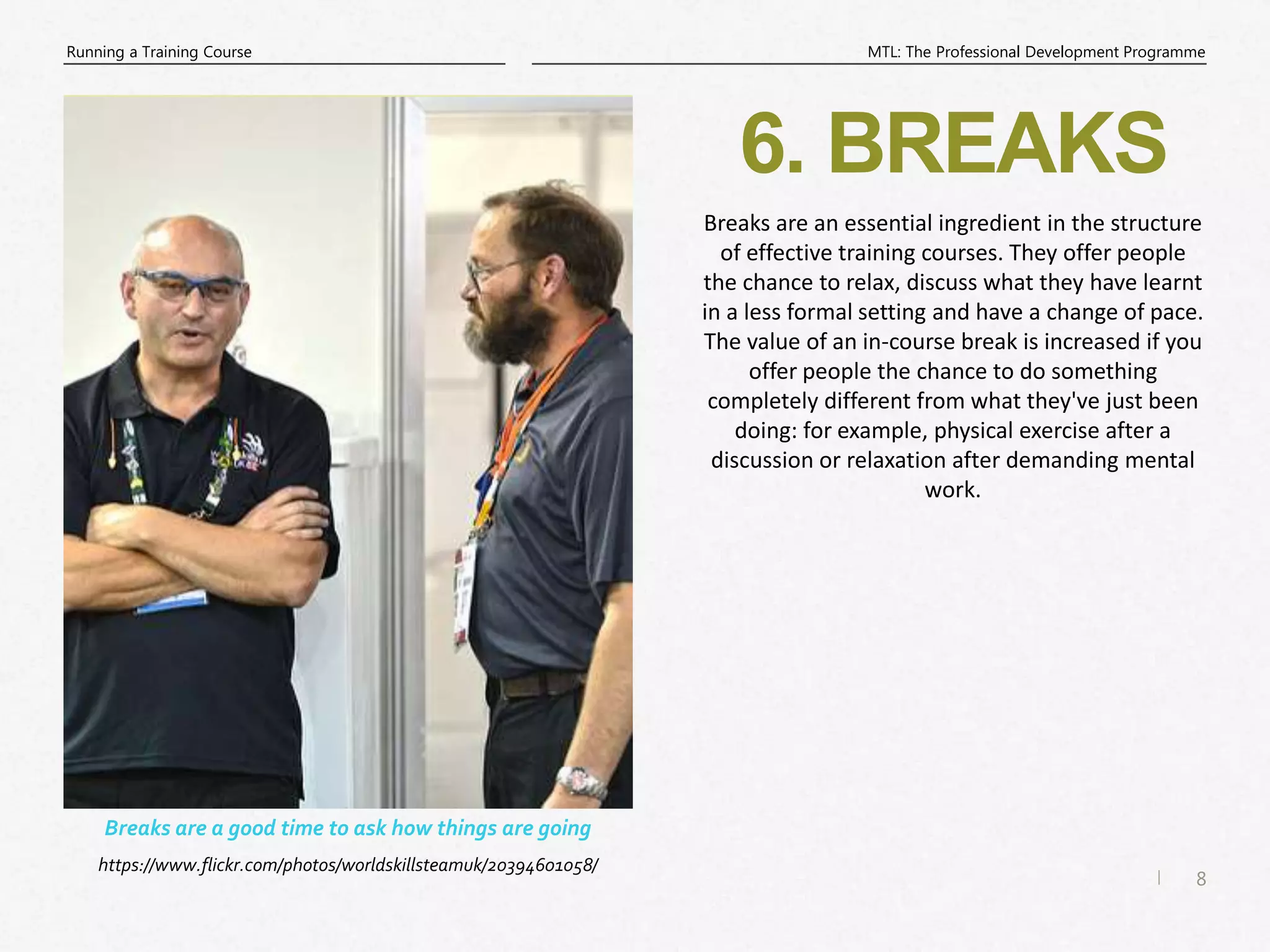
6. BREAKS
Breaks are an essential ingredient in the structure
of effective training courses. They offer people
the chance to relax, discuss what they have learnt
in a less formal setting and have a change of pace.
The value of an in-course break is increased if you
offer people the chance to do something
completely different from what they've just been
doing: for example, physical exercise after a
discussion or relaxation after demanding mental
work.
Breaks are a good time to ask how things are going
https://www.flickr.com/photos/worldskillsteamuk/20394601058/
9
|
MTL: The Professional Development Programme
Running a Training Course
7. ENDINGS
https://www.flickr.com/photos/gdsteam/12120116666/
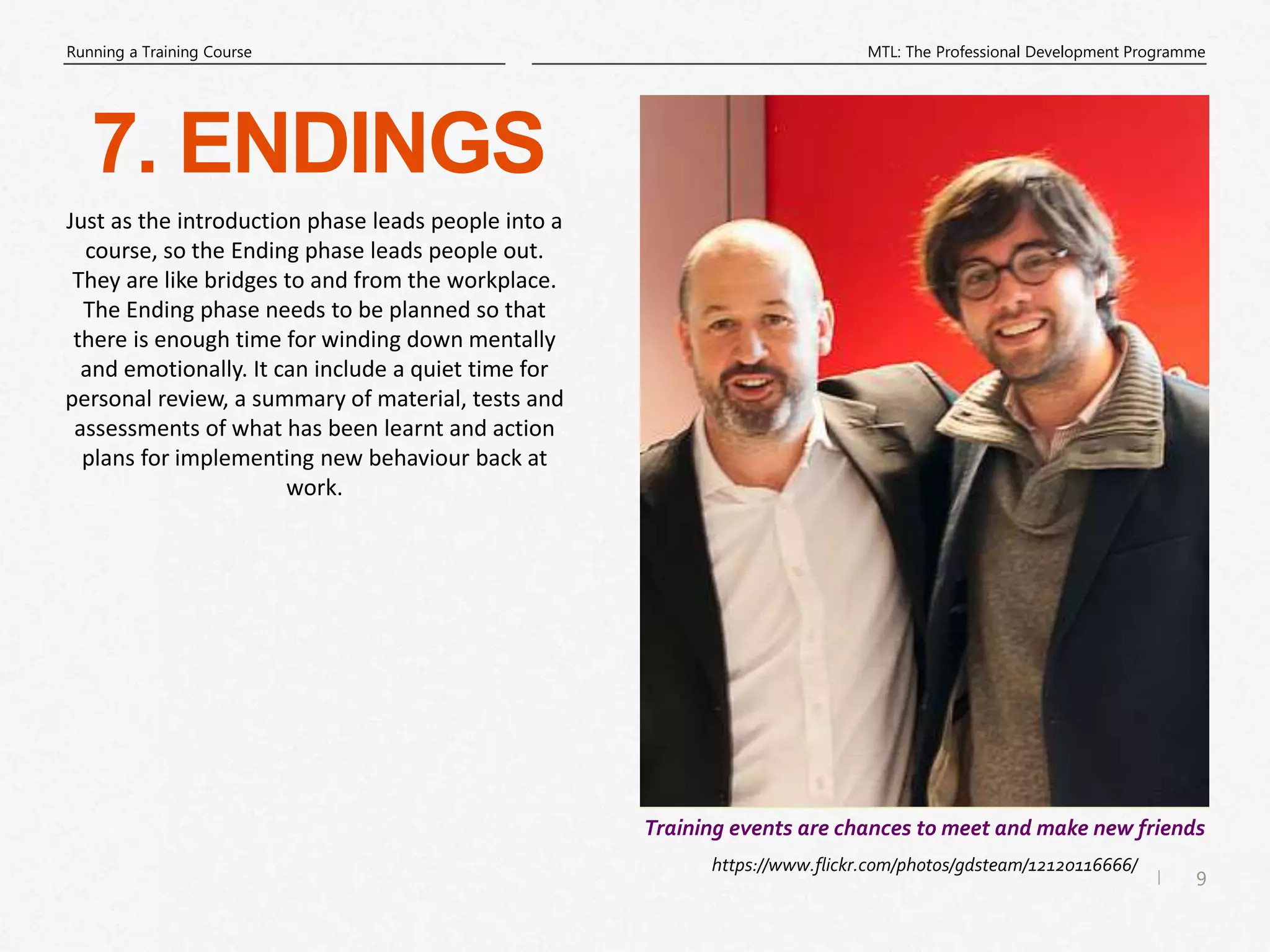
Training events are chances to meet and make new friends
Just as the introduction phase leads people into a
course, so the Ending phase leads people out.
They are like bridges to and from the workplace.
The Ending phase needs to be planned so that
there is enough time for winding down mentally
and emotionally. It can include a quiet time for
personal review, a summary of material, tests and
assessments of what has been learnt and action
plans for implementing new behaviour back at
work.
10
|
MTL: The Professional Development Programme
Running a Training Course
This has been a Slide Topic from Manage Train Learn
AFinal
Word
Running a training course requires the wearing of a number of hats. Before the course, you are a
promoter, consultant, and designer. During the course, you are presenter, coach, and facilitator.
And after the course, you are evaluator, assessor, and administrator.

Running a Training Course

  • 1.
    1 | MTL: The ProfessionalDevelopment Programme Running a Training Course RUNNING A TRAINING COURSE Engaging minds and delivering results MTL: The Professional Development Programme
  • 2.
    2 | MTL: The ProfessionalDevelopment Programme Running a Training Course Attribution: All images are from sources where a Creative Commons license exists for commercial use. All icons are on subscription from thenounproject. All clipart is from free sources. The MTL Professional Development Programme is copyright of Manage Train Learn. Running a Training Course Introduction: Running a training programme involves the trainer as organiser and programme deliverer. As organiser, you have to plan and control. As programme deliverer, you have to be presenter, expert and entertainer. When you plan, aim to cover each minute of the day but not so tightly that you squeeze out spontaneity. When you control, bear in mind that you are the person in charge with the power to give people the space they need to grow. In this topic, we’ll show you 7 key features of running a course.
  • 3.
    3 | MTL: The ProfessionalDevelopment Programme Running a Training Course https://www.flickr.com/photos/poptech/4910884487/ A key part in training is to ensure a course has value for you 1. PRE- COURSE CONTACT There are practical reasons for making pre-course contact with trainees, for example to let people know where the course is to take place. There are also good training reasons. You may need to check that the course is right for the trainee. You may want to find out more about the trainees themselves. You may want to hand out pre-course work, such as a self-assessment questionnaire. You may want to let the trainees know what they can gain from attending. You may want to set a friendly, welcoming and positive tone.
  • 4.
    4 | MTL: The ProfessionalDevelopment Programme Running a Training Course 2. INTROS The course introduction has both surface and sub-surface learning. On the surface, the Introduction introduces people to each other, breaks the ice, discusses expectations, outlines rules and roles, gives the course aims, offers an overview and deals with administrative matters. Under the surface of the Introduction, trainees should be learning that this is a safe environment in which to be, that people will be valued for who they are and that this is a course for the trainees and not for the trainer. Learning about others is a valuable part of training events https://www.flickr.com/photos/gdsteam/25070921949/
  • 5.
    5 | MTL: The ProfessionalDevelopment Programme Running a Training Course 3. ANXIETY https://www.flickr.com/photos/poptech/4910873045/ Work to eliminate all anxiety from training events While anxiety is high, trainees will find their potential to learn is blocked. Energy that should be channelled into learning is diverted into self- protection and self-preservation. The caring trainer needs to take steps to reduce the level of anxiety in the group. This could include making a contract that removes fears, eg no testing, no reports, no spying; building trainees' confidence through positive feedback; and helping trainees to identify, face and overcome the source of their anxiety as a learning experience.
  • 6.
    6 | MTL: The ProfessionalDevelopment Programme Running a Training Course 4. KNOWLEDGE, SKILLS OR MOTIVATION? https://www.flickr.com/photos/poptech/6267824994/ Know what you want people to learn and remember The material you present on a course will be determined by what your trainees need to learn. If they need to learn new information, you will need to find a way to deliver this. However, you can also find imaginative ways to present information that requires trainees to actively seek the information out. If your trainees are learning new skills, you will need to give them plenty of practice and feedback. If the training is about changing attitudes, you will spend more of the course on group interaction and discussions.
  • 7.
    7 | MTL: The ProfessionalDevelopment Programme Running a Training Course 5. FEEDBACK https://www.flickr.com/photos/poptech/4911475174/ Build people’s confidence with regular feedback Groupwork provides an opportunity for experiential learning. For maximum benefit, it should consist of some doing by everyone; some conceptualising; some experimenting; some reflection; and some discussion. Reflection and discussion are aided by constructive feedback. You can give constructive feedback yourself but it is much better to train trainees to give their own feedback to themselves and their teammates.
  • 8.
    8 | MTL: The ProfessionalDevelopment Programme Running a Training Course 6. BREAKS Breaks are an essential ingredient in the structure of effective training courses. They offer people the chance to relax, discuss what they have learnt in a less formal setting and have a change of pace. The value of an in-course break is increased if you offer people the chance to do something completely different from what they've just been doing: for example, physical exercise after a discussion or relaxation after demanding mental work. Breaks are a good time to ask how things are going https://www.flickr.com/photos/worldskillsteamuk/20394601058/
  • 9.
    9 | MTL: The ProfessionalDevelopment Programme Running a Training Course 7. ENDINGS https://www.flickr.com/photos/gdsteam/12120116666/ Training events are chances to meet and make new friends Just as the introduction phase leads people into a course, so the Ending phase leads people out. They are like bridges to and from the workplace. The Ending phase needs to be planned so that there is enough time for winding down mentally and emotionally. It can include a quiet time for personal review, a summary of material, tests and assessments of what has been learnt and action plans for implementing new behaviour back at work.
  • 10.
    10 | MTL: The ProfessionalDevelopment Programme Running a Training Course This has been a Slide Topic from Manage Train Learn AFinal Word Running a training course requires the wearing of a number of hats. Before the course, you are a promoter, consultant, and designer. During the course, you are presenter, coach, and facilitator. And after the course, you are evaluator, assessor, and administrator.