Political campaigns
What’s it all about?
What are elections for?
• To determine who will hold governmental
positions
– Not all positions
• To maintain public control over the
government
– Throw the rascals out
• To re-legitimize the system and the regime
– Government claim to consent of the governed
– Elections as rituals
What are campaigns for?
• To inform the public of what the government
has been doing and to critique the
performance of officials
• To stir up excitement for the system, and for
politics in general
• To inform officials of the preferences of the
electorate and to set priorities for action
– Agenda setting
Do elections do what they are
supposed to do?
• Many examples of politicians who have been
found guilty of crimes were returned to office.
• Candidates who are in other ways unfit are
returned to office
– Candidates who are at death’s door, etc.
Do elections do what they are
supposed to?
• Incumbency determines
– Since World War II, 92% of incumbents who ran
for reelection were successful. (Wikipedia)
• However, high-quality challengers are not always
available
• Incumbents with serious problems may not run again
Advantages incumbent
Congresspersons hold
• Experience – an incumbent by definition is experienced. He or
she has already won at least one election.
• Franking – congressional privilege that allows
congresspersons to send out mail to their constituents for
free. It’s in the Constitution.
• Free Media – local media like covering congressman.
Furthermore, they can go on national TV shows, they have an
office in Washington that can create media releases.
• Money – congressmen bring federal spending into their local
areas to benefit the district (which thus increases goodwill in
the district for them).
• Casework – when individual constituents have a problem and
call their congressman. It’s an easy, non-controversial way of
making voters happy. People helped (no matter what party)
will be more likely to vote for him and they will tell their
friends.
• Campaign finance – officeholders have a big advantage over
challengers because they are already in congress with a vote
over legislation and thus interest groups will attempt to
influence them (whatever their party).
– Wikipedia
Election outcomes
• There are at least some scholars that argue
that the outcome of elections does not seem
to reflect public opinion
– Candidates are elected that appear to oppose
majority opinion on a wide range of topics
– Decisions based on emotion and/or peripheral
issues rather than rational self-interest, which is
supposed to rule
Do campaigns do what they are
supposed to do?
• Voters rarely know very much about most of the
candidates on the ballot
– Name recognition may determine winners
• Even when they are acquainted with candidates
voters often do not know much about those
seeking office
– Few can actually identify candidate background, issue
positions, etc.
• False beliefs common
– Assume policy agreement where none exists
Information gain
• A great deal of research indicates that members
of the electorate gain only limited information
about candidates during the campaign
– (Leshner, Benoit and Hansen)
• Much of what the public learns is questionable,
inaccurate or biased
• Focus is often on peripheral cues rather than
issues
– Physical attractiveness, speaking tone, height
Information gain
• Biased reception
– The same information gained about a favored
candidate and a disfavored candidate would be
interpreted differently
Vote intention
• Traditionally, there has been little change in
vote intent during the campaign
– Most people’s votes can be predicted from
demographic information prior to the beginning of
the campaign
Content of campaign communications
• Distortion, untruth
• Images and symbolism
• Propaganda techniques
• Hoopla
• How could anyone make an intelligent
decision based on all this junk?
Politics as marketing
• The candidate is the ‘product’
– What are the ‘attributes’ of the candidate?
• A one-day ‘sale’
– Date is predetermined
• The monetary ‘price’ is zero
• Far more competitive/antagonistic environ
than most ‘products’
Marketing strategy and political
campaigns
• Goal is to win
• Use methods developed for marketing
branded products
• Historical transition from product orientation
to sales orientation to marketing orientation
Marketing strategy
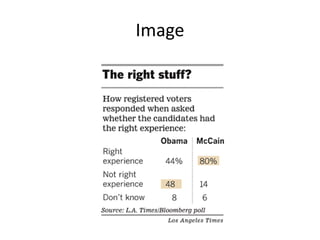
• Image/positioning
– Limited by prior performance of candidate
• Market research
– Polling
• Targeting
– “Two campaigns”
– Likely voters
– Persuadable groups
• Communication channels
– Interpersonal
– Mediated
– New media
• Message
– “Product attributes”
– Critique of opposition (far more prevalent in political
campaigns)
• Fundraising
• PR
– ‘Earned media’
– Press relations
• Development of organization
– Pre-existing organization in traditional marketing
campaigns
• GOTV
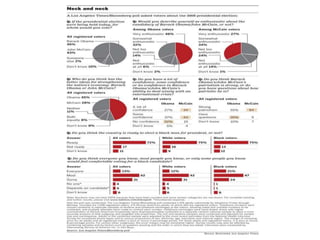
Image
Targeting
• Primaries v. general election
• Voters v. non-voters
– Talking to those who vote
– Convincing those who are supportive to go to the polls
• Demographics
• Persuasibility
• Accessibility
• Popular vote v. electoral college
– Gore won popular vote
– Plouffe analysis
Communication channels
• Interpersonal
– Face-to-face
• Too time-consuming for major elected office
• Still the main means for local
– Public meetings
– Speeches at gatherings
– Debates
• Media
– TV ads still most significant
• Lion’s share of campaign budgets in higher office
– Radio important for targeting
• Latino
– Newspapers mainly for elite
• New media
– Growing importance
– Innovative area
– Microtargeting
Message
• Issue
• “Character”
• Positive v. negative tone
• Issues of distortion, dishonesty
Fundraising
• Classic model
– PACs
– Large donors, dinners, etc.
– Large portion of candidate’s time personally soliciting donations
• Concern over undue influence
• New model
– Obama
• Vast numbers of small donors/Internet
• Public funding (McCain/Feingold)
– Limits on spending
• Other groups
– 527 groups
PR
• Media relations are tremendously important
– Spin
• Interaction with candidate
• Supporters providing press with background,
etc.
• On-air pundits
• Non-news media
Development of organization
• Obama v. Clinton
– Mass volunteer organizations
– Early preparation
– Online organizing
GOTV
• Phone reminders
• Transporting likely supporters to the polls
• Registering potential voters
• Tracking supporters

Political campaigns.ppt

  • 1.
  • 2.
    What are electionsfor? • To determine who will hold governmental positions – Not all positions • To maintain public control over the government – Throw the rascals out • To re-legitimize the system and the regime – Government claim to consent of the governed – Elections as rituals
  • 3.
    What are campaignsfor? • To inform the public of what the government has been doing and to critique the performance of officials • To stir up excitement for the system, and for politics in general • To inform officials of the preferences of the electorate and to set priorities for action – Agenda setting
  • 4.
    Do elections dowhat they are supposed to do? • Many examples of politicians who have been found guilty of crimes were returned to office. • Candidates who are in other ways unfit are returned to office – Candidates who are at death’s door, etc.
  • 5.
    Do elections dowhat they are supposed to? • Incumbency determines – Since World War II, 92% of incumbents who ran for reelection were successful. (Wikipedia) • However, high-quality challengers are not always available • Incumbents with serious problems may not run again
  • 6.
    Advantages incumbent Congresspersons hold •Experience – an incumbent by definition is experienced. He or she has already won at least one election. • Franking – congressional privilege that allows congresspersons to send out mail to their constituents for free. It’s in the Constitution. • Free Media – local media like covering congressman. Furthermore, they can go on national TV shows, they have an office in Washington that can create media releases.
  • 7.
    • Money –congressmen bring federal spending into their local areas to benefit the district (which thus increases goodwill in the district for them). • Casework – when individual constituents have a problem and call their congressman. It’s an easy, non-controversial way of making voters happy. People helped (no matter what party) will be more likely to vote for him and they will tell their friends. • Campaign finance – officeholders have a big advantage over challengers because they are already in congress with a vote over legislation and thus interest groups will attempt to influence them (whatever their party). – Wikipedia
  • 8.
    Election outcomes • Thereare at least some scholars that argue that the outcome of elections does not seem to reflect public opinion – Candidates are elected that appear to oppose majority opinion on a wide range of topics – Decisions based on emotion and/or peripheral issues rather than rational self-interest, which is supposed to rule
  • 9.
    Do campaigns dowhat they are supposed to do? • Voters rarely know very much about most of the candidates on the ballot – Name recognition may determine winners • Even when they are acquainted with candidates voters often do not know much about those seeking office – Few can actually identify candidate background, issue positions, etc. • False beliefs common – Assume policy agreement where none exists
  • 10.
    Information gain • Agreat deal of research indicates that members of the electorate gain only limited information about candidates during the campaign – (Leshner, Benoit and Hansen) • Much of what the public learns is questionable, inaccurate or biased • Focus is often on peripheral cues rather than issues – Physical attractiveness, speaking tone, height
  • 11.
    Information gain • Biasedreception – The same information gained about a favored candidate and a disfavored candidate would be interpreted differently
  • 12.
    Vote intention • Traditionally,there has been little change in vote intent during the campaign – Most people’s votes can be predicted from demographic information prior to the beginning of the campaign
  • 13.
    Content of campaigncommunications • Distortion, untruth • Images and symbolism • Propaganda techniques • Hoopla • How could anyone make an intelligent decision based on all this junk?
  • 14.
    Politics as marketing •The candidate is the ‘product’ – What are the ‘attributes’ of the candidate? • A one-day ‘sale’ – Date is predetermined • The monetary ‘price’ is zero • Far more competitive/antagonistic environ than most ‘products’
  • 15.
    Marketing strategy andpolitical campaigns • Goal is to win • Use methods developed for marketing branded products • Historical transition from product orientation to sales orientation to marketing orientation
  • 16.
    Marketing strategy • Image/positioning –Limited by prior performance of candidate • Market research – Polling • Targeting – “Two campaigns” – Likely voters – Persuadable groups • Communication channels – Interpersonal – Mediated – New media
  • 17.
    • Message – “Productattributes” – Critique of opposition (far more prevalent in political campaigns) • Fundraising • PR – ‘Earned media’ – Press relations • Development of organization – Pre-existing organization in traditional marketing campaigns • GOTV
  • 18.
  • 20.
    Targeting • Primaries v.general election • Voters v. non-voters – Talking to those who vote – Convincing those who are supportive to go to the polls • Demographics • Persuasibility • Accessibility • Popular vote v. electoral college – Gore won popular vote – Plouffe analysis
  • 21.
    Communication channels • Interpersonal –Face-to-face • Too time-consuming for major elected office • Still the main means for local – Public meetings – Speeches at gatherings – Debates
  • 22.
    • Media – TVads still most significant • Lion’s share of campaign budgets in higher office – Radio important for targeting • Latino – Newspapers mainly for elite
  • 23.
    • New media –Growing importance – Innovative area – Microtargeting
  • 24.
    Message • Issue • “Character” •Positive v. negative tone • Issues of distortion, dishonesty
  • 25.
    Fundraising • Classic model –PACs – Large donors, dinners, etc. – Large portion of candidate’s time personally soliciting donations • Concern over undue influence • New model – Obama • Vast numbers of small donors/Internet • Public funding (McCain/Feingold) – Limits on spending • Other groups – 527 groups
  • 27.
    PR • Media relationsare tremendously important – Spin • Interaction with candidate • Supporters providing press with background, etc. • On-air pundits • Non-news media
  • 28.
    Development of organization •Obama v. Clinton – Mass volunteer organizations – Early preparation – Online organizing
  • 29.
    GOTV • Phone reminders •Transporting likely supporters to the polls • Registering potential voters • Tracking supporters