Settlement Of Estate Of Deceased
Persons
Almujer U. Ammang
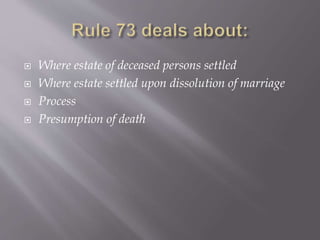
 Where estate of deceased persons settled
 Where estate settled upon dissolution of marriage
 Process
 Presumption of death
Where estate of deceased persons settled
Section 1
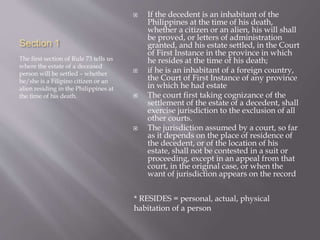
The first section of Rule 73 tells us
where the estate of a deceased
person will be settled – whether
he/she is a Filipino citizen or an
alien residing in the Philippines at
the time of his death.
 If the decedent is an inhabitant of the
Philippines at the time of his death,
whether a citizen or an alien, his will shall
be proved, or letters of administration
granted, and his estate settled, in the Court
of First Instance in the province in which
he resides at the time of his death;
 if he is an inhabitant of a foreign country,
the Court of First Instance of any province
in which he had estate
 The court first taking cognizance of the
settlement of the estate of a decedent, shall
exercise jurisdiction to the exclusion of all
other courts.
 The jurisdiction assumed by a court, so far
as it depends on the place of residence of
the decedent, or of the location of his
estate, shall not be contested in a suit or
proceeding, except in an appeal from that
court, in the original case, or when the
want of jurisdiction appears on the record
* RESIDES = personal, actual, physical
habitation of a person
Where estate settled upon dissolution of marriage
Section 2
When the marriage is dissolved by
the death of the husband or wife,
the community property shall be:
 inventoried,
 administered, and
 liquidated, and
 the debts thereof paid, in the
testate or intestate
proceedings of the deceased
spouse.
 If both spouses have died, the
conjugal partnership shall be
liquidated in the testate or
intestate proceedings of
either.
Process
Section 3
In the exercise of probate
jurisdiction, Courts of First Instance
may:
 issue warrants and process
necessary to compel the
attendance of witnesses or
 to carry into effect theirs orders
and judgments, and all other
powers granted them by law.
 If a person does not perform an
order or judgment rendered by
a court in the exercise of its
probate jurisdiction, it may
issue a warrant for the
apprehension and
imprisonment of such person
until he performs such order or
judgment, or is released.
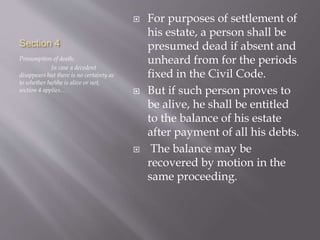
Presumption of death
Section 4
Presumption of death:
In case a decedent
disappears but there is no certainty as
to whether he/she is alive or not,
section 4 applies…
 For purposes of settlement of
his estate, a person shall be
presumed dead if absent and
unheard from for the periods
fixed in the Civil Code.
 But if such person proves to
be alive, he shall be entitled
to the balance of his estate
after payment of all his debts.
 The balance may be
recovered by motion in the
same proceeding.
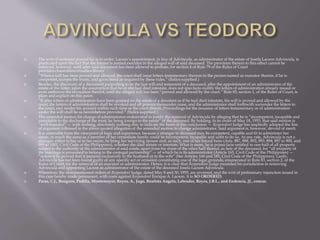
 EN BANC
 [G.R. No. L-9282. May 31, 1956.]
 EMILIO ADVINCULA, Petitioner, vs. HONORABLE JUDGE JOSE TEODORO, SR., Judge of the Court of First Instance of Negros Occidental,
and ENRIQUE A. LACSON, Respondents.

 D E C I S I O N
 CONCEPCION, J.:
 Petitioner Emilio Advincula seeks a writ of certiorari, to annul certain orders of the Court of First Instance of Negros Occidental.
 Said Petitioner was, on November 22, 1954, appointed, special administrator of the estate of his deceased wife, Josefa Lacson Advincula, in special
proceeding No. 3245 of said court. In due course, he was, on February 12, 1955, appointed regular administrator of said estate. After Advincula had
qualified as such, the brothers of the deceased, who left no issue, submitted to the court, for allowance, a document purporting to be her last will and
testament. Petitioneropposed the probate thereof upon the ground that it did not bear the signature of the deceased; chan roblesvirtualawlibrarythat
the signature thereon, if hers, was secured through fraud and duress; chan roblesvirtualawlibraryand that, the instrument had not been executed
with the requisite formalities. On May 4, 1955, Respondent Enrique Lacson, one of the brothers of the deceased, filed a motion praying that he be
appointed administrator of said estate, in lieu of Petitioner herein, for the reason that said Respondent is the executor named in the aforementioned
alleged will. On or about May 16, 1955, Attys. Jose Y. Torres and Antonio Lozada, as counsel for Advincula, filed an opposition to said motion.
When the latter was called for hearing on May 18, 1955, Atty. Lozada was served, in open court, copy of an amended motion, of Respondent Lacson,
for change of administrator, dated May 14, 1955. It was alleged therein, in addition to the ground set forth in the first
motion:chanroblesvirtuallawlibrary
 “5. That the present administrator is incompetent, incapable and unsuitable to the discharge of the trust, he being foreign to the estate, and without
changing or removing him as such would be disastrous to the estate and to the heirs named in the will of the decedent.”
 Atty. Lozada asked a postponement of the hearing upon the ground that Advincula’s main counsel, Atty. Torres, was in Manila, but his request was
denied. Then, after hearing the argument of opposing counsel, the court, presided over by Respondent, Honorable Jose Teodoro, Sr., Judge, issued, on
the same date (May 18, 1955), an order the pertinent parts of which read:chanroblesvirtuallawlibrary
 “The Court, after hearing the oral arguments of both parties, finds the motion for postponement not well-taken and hereby denies the same; chan
roblesvirtualawlibraryand finding the motion dated May 4, 1955 as amended by the amended motion dated May 14, 1955, well-founded and the
opposition thereto dated May 16, 1955 not well-founded, said motion is hereby granted.
 “WHEREFORE, in the interest of justice and for the preservation of the property for the heirs, the appointment of Emilio Advincula as administrator
is hereby revoked and in his stead, theOppositor, Enrique A. Lacson, is hereby appointed administrator of this intestate estate, and same may qualify
by filing a bond in the sum of P5,000 and taking and subscribing the corresponding oath of Office. Once said Enrique A. Lacson has qualified, let
letters of administration issue in his favor.
 “The former administrator, Emilio Advincula, is hereby ordered to submit within ten (10) days from receipt hereof, his final account covering the
entire period of his administration and should it appear that any deficiency has been incurred by him during his incumbency, his bond shall answer
for said deficiency.”
 Thereupon, Lacson gave the requisite bond, letters of administration was issued to him, and he tried to take possession of the estate of the deceased.
A reconsideration of said order of May 18, 1955, having been denied by another order, dated May 30, 1955, Petitioner instituted the present action for
certiorari, against Lacson and Judge Teodoro, to annul his aforesaid orders of May 18 and 30, 1955, upon the ground that the same were issued with
grave abuse of discretion. Upon the filing of a bond by Advincula, we issued, as prayed for in his petition, a writ of preliminary injunction
restraining Respondent Lacson and his agents from interfering, molesting and harassing the Petitioner in the administration of the estate of the
deceased, during the pendency of this case.
 The writ of certiorari prayed for is in order. Lacson’s appointment, in lieu of Advincula, as administrator of the estate of Josefa Lacson Advincula, is
predicated upon the fact that the former is named executor in the alleged will of said deceased. The provision therein to this effect cannot be
enforced, however, until after said document has been allowed to probate, for section 4 of Rule 79 of the Rules of Court
provides:chanroblesvirtuallawlibrary
 “When a will has been proved and allowed, the court shall issue letters testamentary thereon to the person named as executor therein, if he is
competent, accepts the trusts, and gives bond as required by these rules.” (Italics supplied.)
 Besides, the discovery of a document purporting to be the last will and testament of a deceased, after the appointment of an administrator of the
estate of the latter, upon the assumption that he or she had died intestate, does not ipso facto nullify the letters of administration already issued or
even authorize the revocation thereof, until the alleged will has been “proved and allowed by the court.” Rule 83, section 1, of the Rules of Court, is
plain and explicit on this point.
 “If after letters of administration have been granted on the estate of a decedent as if he had died intestate, his will is proved and allowed by the
court, the letters of administration shall be revoked and all powers thereunder cease, and the administrator shall forthwith surrender the letters to
the court, end render his account within such time as the court directs. Proceedings for the issuance of letters testamentary or of administration
under the will shall be as hereinbefore provided.” (Italics supplied.)
 The amended motion for change of administrator endeavored to justify the removal of Advincula by alleging that he is “incompetent, incapable and
unsuitable to the discharge of the trust, he being foreign to the estate” of the deceased. By holding, in its order of May 18, 1955, that said motion is
“well-founded” — with nothing, absolutely nothing else, to indicate the basis of this conclusion — Respondent Judge has impliedly adopted the line
of argument followed in the above quoted allegation of the amended motion to change administrator. Said argument is, however, devoid of merit.
 It is untenable from the viewpoint of logic and experience, because a stranger to deceased may be competent, capable and fit to administer her
estate, in much the same as a member of her immediate family could be incompetent, incapable and unfit to do so. At any rate, Advincula is not a
stranger, either to her or to her estate, he bring her surviving spouse and, as such, one of her forced heirs (Arts. 887, 888, 892, 893, 894, 897 to 900, and
995 to 1001, Civil Code of the Philippines), whether she died testate or intestate. What is more, he is prima facie entitled to one-half of all property
subject to the authority of the administrator of said estate, apart from his share of the other half thereof, as heir of the deceased, for “all property of
the marriage is presumed to belong to the conjugal partnership” — of which he is its administrator (Article 165, Civil Code of the Philippines) —
“unless it be proved that it pertains exclusively to the husband or to the wife” (See Articles 160 and 185, Civil Code of the Philippines). Lastly,
Advincula has not been found guilty of any specific act or omission constituting one of the legal grounds, enumerated in Rule 83, section 2, of the
Rules of Court, for the removal of an executor or administrator. Hence, it is clear that Respondent Judge exceeded his jurisdiction in removing
Advincula and appointing Lacson as administrator of the estate of the deceased Josefa Lacson Advincula.
 Wherefore, the aforementioned orders of Respondent Judge, dated May 8 and 30, 1955, are reversed, and the writ of preliminary injunction issued in
this case hereby made permanent, with costs against Respondent Enrique A. Lacson. It is SO ORDERED.
 Paras, C.J., Bengzon, Padilla, Montemayor, Reyes, A., Jugo, Bautista Angelo, Labrador, Reyes, J.B.L., and Endencia, JJ., concur.
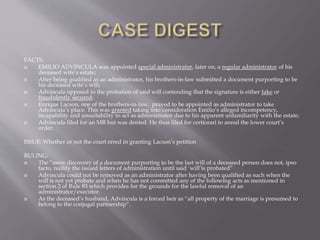
FACTS:
 EMILIO ADVINCULA was appointed special administrator, later on, a regular administrator of his
deceased wife’s estate;
 After being qualified as an administrator, his brothers-in-law submitted a document purporting to be
his deceased wife’s will;
 Advincula opposed to the probation of said will contending that the signature is either fake or
fraudulently secured;
 Enrique Lacson, one of the brothers-in-law, prayed to be appointed as administrator to take
Advincula’s place. This was granted taking into consideration Emilio’s alleged incompetency,
incapability and unsuitability to act as administrator due to his apparent unfamiliarity with the estate;
 Advincula filed for an MR but was denied. He thus filed for certiorari to annul the lower court’s
order.
ISSUE: Whether or not the court erred in granting Lacson’s petition
RULING:
 The “mere discovery of a document purporting to be the last will of a deceased person does not, ipso
facto, nullify the issued letters of administration until said ‘will’is probated”
 Advincula could not be removed as an administrator after having been qualified as such when the
will is not yet probate and when he has not committed any of the following acts as mentioned in
section 2 of Rule 83 which provides for the grounds for the lawful removal of an
administrator/executor.
 As the deceased’s husband, Advincula is a forced heir as “all property of the marriage is presumed to
belong to the conjugal partnership”.
Rule 73 - Settlement Of Estate Of Deceased Persons

Rule 73 - Settlement Of Estate Of Deceased Persons

  • 1.
    Settlement Of EstateOf Deceased Persons Almujer U. Ammang
  • 2.
     Where estateof deceased persons settled  Where estate settled upon dissolution of marriage  Process  Presumption of death
  • 3.
    Where estate ofdeceased persons settled
  • 4.
    Section 1 The firstsection of Rule 73 tells us where the estate of a deceased person will be settled – whether he/she is a Filipino citizen or an alien residing in the Philippines at the time of his death.  If the decedent is an inhabitant of the Philippines at the time of his death, whether a citizen or an alien, his will shall be proved, or letters of administration granted, and his estate settled, in the Court of First Instance in the province in which he resides at the time of his death;  if he is an inhabitant of a foreign country, the Court of First Instance of any province in which he had estate  The court first taking cognizance of the settlement of the estate of a decedent, shall exercise jurisdiction to the exclusion of all other courts.  The jurisdiction assumed by a court, so far as it depends on the place of residence of the decedent, or of the location of his estate, shall not be contested in a suit or proceeding, except in an appeal from that court, in the original case, or when the want of jurisdiction appears on the record * RESIDES = personal, actual, physical habitation of a person
  • 5.
    Where estate settledupon dissolution of marriage
  • 6.
    Section 2 When themarriage is dissolved by the death of the husband or wife, the community property shall be:  inventoried,  administered, and  liquidated, and  the debts thereof paid, in the testate or intestate proceedings of the deceased spouse.  If both spouses have died, the conjugal partnership shall be liquidated in the testate or intestate proceedings of either.
  • 7.
  • 8.
    Section 3 In theexercise of probate jurisdiction, Courts of First Instance may:  issue warrants and process necessary to compel the attendance of witnesses or  to carry into effect theirs orders and judgments, and all other powers granted them by law.  If a person does not perform an order or judgment rendered by a court in the exercise of its probate jurisdiction, it may issue a warrant for the apprehension and imprisonment of such person until he performs such order or judgment, or is released.
  • 9.
  • 10.
    Section 4 Presumption ofdeath: In case a decedent disappears but there is no certainty as to whether he/she is alive or not, section 4 applies…  For purposes of settlement of his estate, a person shall be presumed dead if absent and unheard from for the periods fixed in the Civil Code.  But if such person proves to be alive, he shall be entitled to the balance of his estate after payment of all his debts.  The balance may be recovered by motion in the same proceeding.
  • 11.
     EN BANC [G.R. No. L-9282. May 31, 1956.]  EMILIO ADVINCULA, Petitioner, vs. HONORABLE JUDGE JOSE TEODORO, SR., Judge of the Court of First Instance of Negros Occidental, and ENRIQUE A. LACSON, Respondents.   D E C I S I O N  CONCEPCION, J.:  Petitioner Emilio Advincula seeks a writ of certiorari, to annul certain orders of the Court of First Instance of Negros Occidental.  Said Petitioner was, on November 22, 1954, appointed, special administrator of the estate of his deceased wife, Josefa Lacson Advincula, in special proceeding No. 3245 of said court. In due course, he was, on February 12, 1955, appointed regular administrator of said estate. After Advincula had qualified as such, the brothers of the deceased, who left no issue, submitted to the court, for allowance, a document purporting to be her last will and testament. Petitioneropposed the probate thereof upon the ground that it did not bear the signature of the deceased; chan roblesvirtualawlibrarythat the signature thereon, if hers, was secured through fraud and duress; chan roblesvirtualawlibraryand that, the instrument had not been executed with the requisite formalities. On May 4, 1955, Respondent Enrique Lacson, one of the brothers of the deceased, filed a motion praying that he be appointed administrator of said estate, in lieu of Petitioner herein, for the reason that said Respondent is the executor named in the aforementioned alleged will. On or about May 16, 1955, Attys. Jose Y. Torres and Antonio Lozada, as counsel for Advincula, filed an opposition to said motion. When the latter was called for hearing on May 18, 1955, Atty. Lozada was served, in open court, copy of an amended motion, of Respondent Lacson, for change of administrator, dated May 14, 1955. It was alleged therein, in addition to the ground set forth in the first motion:chanroblesvirtuallawlibrary  “5. That the present administrator is incompetent, incapable and unsuitable to the discharge of the trust, he being foreign to the estate, and without changing or removing him as such would be disastrous to the estate and to the heirs named in the will of the decedent.”  Atty. Lozada asked a postponement of the hearing upon the ground that Advincula’s main counsel, Atty. Torres, was in Manila, but his request was denied. Then, after hearing the argument of opposing counsel, the court, presided over by Respondent, Honorable Jose Teodoro, Sr., Judge, issued, on the same date (May 18, 1955), an order the pertinent parts of which read:chanroblesvirtuallawlibrary  “The Court, after hearing the oral arguments of both parties, finds the motion for postponement not well-taken and hereby denies the same; chan roblesvirtualawlibraryand finding the motion dated May 4, 1955 as amended by the amended motion dated May 14, 1955, well-founded and the opposition thereto dated May 16, 1955 not well-founded, said motion is hereby granted.  “WHEREFORE, in the interest of justice and for the preservation of the property for the heirs, the appointment of Emilio Advincula as administrator is hereby revoked and in his stead, theOppositor, Enrique A. Lacson, is hereby appointed administrator of this intestate estate, and same may qualify by filing a bond in the sum of P5,000 and taking and subscribing the corresponding oath of Office. Once said Enrique A. Lacson has qualified, let letters of administration issue in his favor.  “The former administrator, Emilio Advincula, is hereby ordered to submit within ten (10) days from receipt hereof, his final account covering the entire period of his administration and should it appear that any deficiency has been incurred by him during his incumbency, his bond shall answer for said deficiency.”  Thereupon, Lacson gave the requisite bond, letters of administration was issued to him, and he tried to take possession of the estate of the deceased. A reconsideration of said order of May 18, 1955, having been denied by another order, dated May 30, 1955, Petitioner instituted the present action for certiorari, against Lacson and Judge Teodoro, to annul his aforesaid orders of May 18 and 30, 1955, upon the ground that the same were issued with grave abuse of discretion. Upon the filing of a bond by Advincula, we issued, as prayed for in his petition, a writ of preliminary injunction restraining Respondent Lacson and his agents from interfering, molesting and harassing the Petitioner in the administration of the estate of the deceased, during the pendency of this case.
  • 12.
     The writof certiorari prayed for is in order. Lacson’s appointment, in lieu of Advincula, as administrator of the estate of Josefa Lacson Advincula, is predicated upon the fact that the former is named executor in the alleged will of said deceased. The provision therein to this effect cannot be enforced, however, until after said document has been allowed to probate, for section 4 of Rule 79 of the Rules of Court provides:chanroblesvirtuallawlibrary  “When a will has been proved and allowed, the court shall issue letters testamentary thereon to the person named as executor therein, if he is competent, accepts the trusts, and gives bond as required by these rules.” (Italics supplied.)  Besides, the discovery of a document purporting to be the last will and testament of a deceased, after the appointment of an administrator of the estate of the latter, upon the assumption that he or she had died intestate, does not ipso facto nullify the letters of administration already issued or even authorize the revocation thereof, until the alleged will has been “proved and allowed by the court.” Rule 83, section 1, of the Rules of Court, is plain and explicit on this point.  “If after letters of administration have been granted on the estate of a decedent as if he had died intestate, his will is proved and allowed by the court, the letters of administration shall be revoked and all powers thereunder cease, and the administrator shall forthwith surrender the letters to the court, end render his account within such time as the court directs. Proceedings for the issuance of letters testamentary or of administration under the will shall be as hereinbefore provided.” (Italics supplied.)  The amended motion for change of administrator endeavored to justify the removal of Advincula by alleging that he is “incompetent, incapable and unsuitable to the discharge of the trust, he being foreign to the estate” of the deceased. By holding, in its order of May 18, 1955, that said motion is “well-founded” — with nothing, absolutely nothing else, to indicate the basis of this conclusion — Respondent Judge has impliedly adopted the line of argument followed in the above quoted allegation of the amended motion to change administrator. Said argument is, however, devoid of merit.  It is untenable from the viewpoint of logic and experience, because a stranger to deceased may be competent, capable and fit to administer her estate, in much the same as a member of her immediate family could be incompetent, incapable and unfit to do so. At any rate, Advincula is not a stranger, either to her or to her estate, he bring her surviving spouse and, as such, one of her forced heirs (Arts. 887, 888, 892, 893, 894, 897 to 900, and 995 to 1001, Civil Code of the Philippines), whether she died testate or intestate. What is more, he is prima facie entitled to one-half of all property subject to the authority of the administrator of said estate, apart from his share of the other half thereof, as heir of the deceased, for “all property of the marriage is presumed to belong to the conjugal partnership” — of which he is its administrator (Article 165, Civil Code of the Philippines) — “unless it be proved that it pertains exclusively to the husband or to the wife” (See Articles 160 and 185, Civil Code of the Philippines). Lastly, Advincula has not been found guilty of any specific act or omission constituting one of the legal grounds, enumerated in Rule 83, section 2, of the Rules of Court, for the removal of an executor or administrator. Hence, it is clear that Respondent Judge exceeded his jurisdiction in removing Advincula and appointing Lacson as administrator of the estate of the deceased Josefa Lacson Advincula.  Wherefore, the aforementioned orders of Respondent Judge, dated May 8 and 30, 1955, are reversed, and the writ of preliminary injunction issued in this case hereby made permanent, with costs against Respondent Enrique A. Lacson. It is SO ORDERED.  Paras, C.J., Bengzon, Padilla, Montemayor, Reyes, A., Jugo, Bautista Angelo, Labrador, Reyes, J.B.L., and Endencia, JJ., concur.
  • 13.
    FACTS:  EMILIO ADVINCULAwas appointed special administrator, later on, a regular administrator of his deceased wife’s estate;  After being qualified as an administrator, his brothers-in-law submitted a document purporting to be his deceased wife’s will;  Advincula opposed to the probation of said will contending that the signature is either fake or fraudulently secured;  Enrique Lacson, one of the brothers-in-law, prayed to be appointed as administrator to take Advincula’s place. This was granted taking into consideration Emilio’s alleged incompetency, incapability and unsuitability to act as administrator due to his apparent unfamiliarity with the estate;  Advincula filed for an MR but was denied. He thus filed for certiorari to annul the lower court’s order. ISSUE: Whether or not the court erred in granting Lacson’s petition RULING:  The “mere discovery of a document purporting to be the last will of a deceased person does not, ipso facto, nullify the issued letters of administration until said ‘will’is probated”  Advincula could not be removed as an administrator after having been qualified as such when the will is not yet probate and when he has not committed any of the following acts as mentioned in section 2 of Rule 83 which provides for the grounds for the lawful removal of an administrator/executor.  As the deceased’s husband, Advincula is a forced heir as “all property of the marriage is presumed to belong to the conjugal partnership”.