JUDICIAL APPROVAL OF VOLUNTARY
RECOGNITION OF MINOR NATURAL CHILDREN
Rule 105
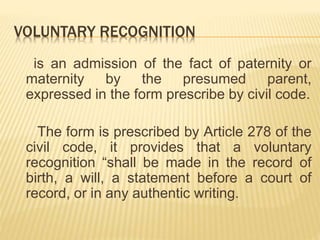
VOLUNTARY RECOGNITION
is an admission of the fact of paternity or
maternity by the presumed parent,
expressed in the form prescribe by civil code.
The form is prescribed by Article 278 of the
civil code, it provides that a voluntary
recognition “shall be made in the record of
birth, a will, a statement before a court of
record, or in any authentic writing.
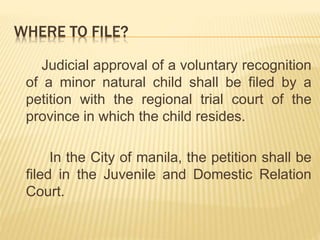
WHERE TO FILE?
Judicial approval of a voluntary recognition
of a minor natural child shall be filed by a
petition with the regional trial court of the
province in which the child resides.
In the City of manila, the petition shall be
filed in the Juvenile and Domestic Relation
Court.
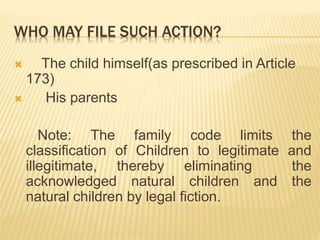
WHO MAY FILE SUCH ACTION?
 The child himself(as prescribed in Article
173)
 His parents
Note: The family code limits the
classification of Children to legitimate and
illegitimate, thereby eliminating the
acknowledged natural children and the
natural children by legal fiction.
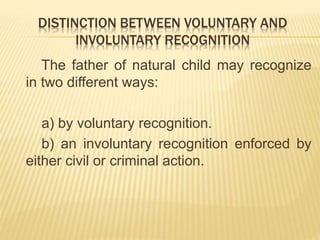
DISTINCTION BETWEEN VOLUNTARY AND
INVOLUNTARY RECOGNITION
The father of natural child may recognize
in two different ways:
a) by voluntary recognition.
b) an involuntary recognition enforced by
either civil or criminal action.
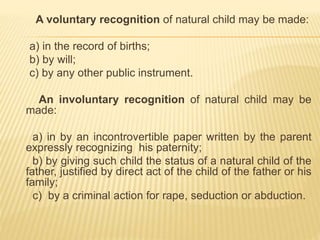
A voluntary recognition of natural child may be made:
a) in the record of births;
b) by will;
c) by any other public instrument.
An involuntary recognition of natural child may be
made:
a) in by an incontrovertible paper written by the parent
expressly recognizing his paternity;
b) by giving such child the status of a natural child of the
father, justified by direct act of the child of the father or his
family;
c) by a criminal action for rape, seduction or abduction.
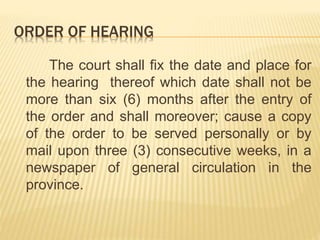
ORDER OF HEARING
The court shall fix the date and place for
the hearing thereof which date shall not be
more than six (6) months after the entry of
the order and shall moreover; cause a copy
of the order to be served personally or by
mail upon three (3) consecutive weeks, in a
newspaper of general circulation in the
province.
OPPOSITION
Any interested party must within fifteen
(150) days from service or from last date of
publication of the ordered referred file his
opposition to the petition, stating the grounds
or reasons therefor.
JUDGMENT
If the court is satisfied that the recognition
of the minor natural child was willingly and
voluntarily made by the parent or parents,
and that the recognition is for the best
interest of the child it shall render judgment
granting judicial approval of such recognition.
SERVICE OF JUDGMENT UPON CIVIL REGISTRAR
a copy of the judgment rendered shall be
served upon the civil registrar whose duty it
shall be to enter the same in the register.
SUPREME COURT
Manila
FIRST DIVISION
G.R. No. 76873 October 26, 1989
DOROTEA, VIRGILIO, APOLINARIO, JR.,
SULPICIO & DOMINADOR, all surnamed
UYGUANGCO, petitioners,
vs.
COURT OF APPEALS, Judge SENEN
PENARANDA and GRACIANO BACJAO
UYGUANGCO, respondents.
FACTS
Apolinario Uyguangco died intestate in 1975, leaving his wife,
Dorotea, four legitimate children (her co-petitioners herein), and
considerable properties which they divided among
themselves. Claiming to be an illegitimate son of the deceased
Apolinario, and having been left out in the extrajudicial settlement of his
estate, Graciano Bacjao Uyguangco filed a complaint for partition
against all the petitioners.
Graciano alleged that he was born in 1952 to Apolinario Uyguangco
and Anastacia Bacjao and that at the age of 15 he moved to his father's
hometown at Medina, Misamis Oriental, at the latter's urging and also of
Dorotea and his half-brothers. Here he received support from his father
while he was studying at the Medina High School, where he eventually
graduated. He was also assigned by his father, without objection from
the rest of the family, as storekeeper at the Uyguangco store in
Mananom from 1967 to 1973.
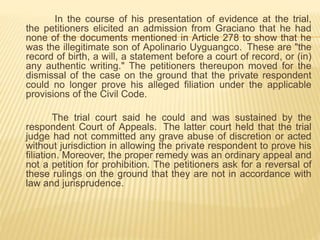
In the course of his presentation of evidence at the trial,
the petitioners elicited an admission from Graciano that he had
none of the documents mentioned in Article 278 to show that he
was the illegitimate son of Apolinario Uyguangco. These are "the
record of birth, a will, a statement before a court of record, or (in)
any authentic writing." The petitioners thereupon moved for the
dismissal of the case on the ground that the private respondent
could no longer prove his alleged filiation under the applicable
provisions of the Civil Code.
The trial court said he could and was sustained by the
respondent Court of Appeals. The latter court held that the trial
judge had not committed any grave abuse of discretion or acted
without jurisdiction in allowing the private respondent to prove his
filiation. Moreover, the proper remedy was an ordinary appeal and
not a petition for prohibition. The petitioners ask for a reversal of
these rulings on the ground that they are not in accordance with
law and jurisprudence.
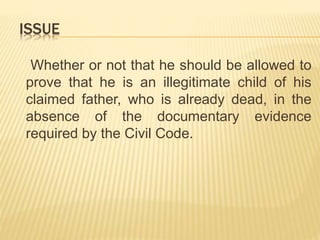
ISSUE
Whether or not that he should be allowed to
prove that he is an illegitimate child of his
claimed father, who is already dead, in the
absence of the documentary evidence
required by the Civil Code.
RULING OF THE SUPREME COURT
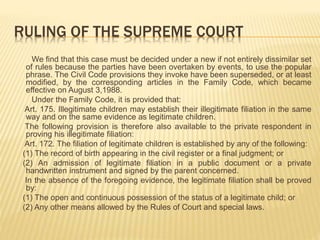
We find that this case must be decided under a new if not entirely dissimilar set
of rules because the parties have been overtaken by events, to use the popular
phrase. The Civil Code provisions they invoke have been superseded, or at least
modified, by the corresponding articles in the Family Code, which became
effective on August 3,1988.
Under the Family Code, it is provided that:
Art. 175. Illegitimate children may establish their illegitimate filiation in the same
way and on the same evidence as legitimate children.
The following provision is therefore also available to the private respondent in
proving his illegitimate filiation:
Art. 172. The filiation of legitimate children is established by any of the following:
(1) The record of birth appearing in the civil register or a final judgment; or
(2) An admission of legitimate filiation in a public document or a private
handwritten instrument and signed by the parent concerned.
In the absence of the foregoing evidence, the legitimate filiation shall be proved
by:
(1) The open and continuous possession of the status of a legitimate child; or
(2) Any other means allowed by the Rules of Court and special laws.
It is clear that the private respondent can no longer be allowed
at this time to introduce evidence of his open and continuous
possession of the status of an illegitimate child or prove his
alleged filiation through any of the means allowed by the Rules of
Court or special laws. The simple reason is that Apolinario
Uyguangco is already dead and can no longer be heard on the
claim of his alleged son's illegitimate filiation.
In her Handbook on the Family Code of the Philippines, Justice
Alicia Sempio-Diy explains the rationale of the rule, thus: "It is a
truism that unlike legitimate children who are publicly recognized,
illegitimate children are usually begotten and raised in secrecy
and without the legitimate family being aware of their existence.
Who then can be sure of their filiation but the parents
themselves? But suppose the child claiming to be the illegitimate
child of a certain person is not really the child of the latter? The
putative parent should thus be given the opportunity to affirm or
deny the child's filiation, and this, he or she cannot do if he or she
is already dead."
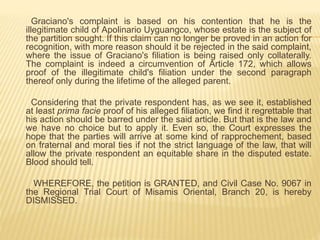
Graciano's complaint is based on his contention that he is the
illegitimate child of Apolinario Uyguangco, whose estate is the subject of
the partition sought. If this claim can no longer be proved in an action for
recognition, with more reason should it be rejected in the said complaint,
where the issue of Graciano's filiation is being raised only collaterally.
The complaint is indeed a circumvention of Article 172, which allows
proof of the illegitimate child's filiation under the second paragraph
thereof only during the lifetime of the alleged parent.
Considering that the private respondent has, as we see it, established
at least prima facie proof of his alleged filiation, we find it regrettable that
his action should be barred under the said article. But that is the law and
we have no choice but to apply it. Even so, the Court expresses the
hope that the parties will arrive at some kind of rapprochement, based
on fraternal and moral ties if not the strict language of the law, that will
allow the private respondent an equitable share in the disputed estate.
Blood should tell.
WHEREFORE, the petition is GRANTED, and Civil Case No. 9067 in
the Regional Trial Court of Misamis Oriental, Branch 20, is hereby
DISMISSED.

Rule 105

  • 1.
    JUDICIAL APPROVAL OFVOLUNTARY RECOGNITION OF MINOR NATURAL CHILDREN Rule 105
  • 2.
    VOLUNTARY RECOGNITION is anadmission of the fact of paternity or maternity by the presumed parent, expressed in the form prescribe by civil code. The form is prescribed by Article 278 of the civil code, it provides that a voluntary recognition “shall be made in the record of birth, a will, a statement before a court of record, or in any authentic writing.
  • 3.
    WHERE TO FILE? Judicialapproval of a voluntary recognition of a minor natural child shall be filed by a petition with the regional trial court of the province in which the child resides. In the City of manila, the petition shall be filed in the Juvenile and Domestic Relation Court.
  • 4.
    WHO MAY FILESUCH ACTION?  The child himself(as prescribed in Article 173)  His parents Note: The family code limits the classification of Children to legitimate and illegitimate, thereby eliminating the acknowledged natural children and the natural children by legal fiction.
  • 5.
    DISTINCTION BETWEEN VOLUNTARYAND INVOLUNTARY RECOGNITION The father of natural child may recognize in two different ways: a) by voluntary recognition. b) an involuntary recognition enforced by either civil or criminal action.
  • 6.
    A voluntary recognitionof natural child may be made: a) in the record of births; b) by will; c) by any other public instrument. An involuntary recognition of natural child may be made: a) in by an incontrovertible paper written by the parent expressly recognizing his paternity; b) by giving such child the status of a natural child of the father, justified by direct act of the child of the father or his family; c) by a criminal action for rape, seduction or abduction.
  • 7.
    ORDER OF HEARING Thecourt shall fix the date and place for the hearing thereof which date shall not be more than six (6) months after the entry of the order and shall moreover; cause a copy of the order to be served personally or by mail upon three (3) consecutive weeks, in a newspaper of general circulation in the province.
  • 8.
    OPPOSITION Any interested partymust within fifteen (150) days from service or from last date of publication of the ordered referred file his opposition to the petition, stating the grounds or reasons therefor.
  • 9.
    JUDGMENT If the courtis satisfied that the recognition of the minor natural child was willingly and voluntarily made by the parent or parents, and that the recognition is for the best interest of the child it shall render judgment granting judicial approval of such recognition.
  • 10.
    SERVICE OF JUDGMENTUPON CIVIL REGISTRAR a copy of the judgment rendered shall be served upon the civil registrar whose duty it shall be to enter the same in the register.
  • 11.
    SUPREME COURT Manila FIRST DIVISION G.R.No. 76873 October 26, 1989 DOROTEA, VIRGILIO, APOLINARIO, JR., SULPICIO & DOMINADOR, all surnamed UYGUANGCO, petitioners, vs. COURT OF APPEALS, Judge SENEN PENARANDA and GRACIANO BACJAO UYGUANGCO, respondents.
  • 12.
    FACTS Apolinario Uyguangco diedintestate in 1975, leaving his wife, Dorotea, four legitimate children (her co-petitioners herein), and considerable properties which they divided among themselves. Claiming to be an illegitimate son of the deceased Apolinario, and having been left out in the extrajudicial settlement of his estate, Graciano Bacjao Uyguangco filed a complaint for partition against all the petitioners. Graciano alleged that he was born in 1952 to Apolinario Uyguangco and Anastacia Bacjao and that at the age of 15 he moved to his father's hometown at Medina, Misamis Oriental, at the latter's urging and also of Dorotea and his half-brothers. Here he received support from his father while he was studying at the Medina High School, where he eventually graduated. He was also assigned by his father, without objection from the rest of the family, as storekeeper at the Uyguangco store in Mananom from 1967 to 1973.
  • 13.
    In the courseof his presentation of evidence at the trial, the petitioners elicited an admission from Graciano that he had none of the documents mentioned in Article 278 to show that he was the illegitimate son of Apolinario Uyguangco. These are "the record of birth, a will, a statement before a court of record, or (in) any authentic writing." The petitioners thereupon moved for the dismissal of the case on the ground that the private respondent could no longer prove his alleged filiation under the applicable provisions of the Civil Code. The trial court said he could and was sustained by the respondent Court of Appeals. The latter court held that the trial judge had not committed any grave abuse of discretion or acted without jurisdiction in allowing the private respondent to prove his filiation. Moreover, the proper remedy was an ordinary appeal and not a petition for prohibition. The petitioners ask for a reversal of these rulings on the ground that they are not in accordance with law and jurisprudence.
  • 14.
    ISSUE Whether or notthat he should be allowed to prove that he is an illegitimate child of his claimed father, who is already dead, in the absence of the documentary evidence required by the Civil Code.
  • 15.
    RULING OF THESUPREME COURT We find that this case must be decided under a new if not entirely dissimilar set of rules because the parties have been overtaken by events, to use the popular phrase. The Civil Code provisions they invoke have been superseded, or at least modified, by the corresponding articles in the Family Code, which became effective on August 3,1988. Under the Family Code, it is provided that: Art. 175. Illegitimate children may establish their illegitimate filiation in the same way and on the same evidence as legitimate children. The following provision is therefore also available to the private respondent in proving his illegitimate filiation: Art. 172. The filiation of legitimate children is established by any of the following: (1) The record of birth appearing in the civil register or a final judgment; or (2) An admission of legitimate filiation in a public document or a private handwritten instrument and signed by the parent concerned. In the absence of the foregoing evidence, the legitimate filiation shall be proved by: (1) The open and continuous possession of the status of a legitimate child; or (2) Any other means allowed by the Rules of Court and special laws.
  • 16.
    It is clearthat the private respondent can no longer be allowed at this time to introduce evidence of his open and continuous possession of the status of an illegitimate child or prove his alleged filiation through any of the means allowed by the Rules of Court or special laws. The simple reason is that Apolinario Uyguangco is already dead and can no longer be heard on the claim of his alleged son's illegitimate filiation. In her Handbook on the Family Code of the Philippines, Justice Alicia Sempio-Diy explains the rationale of the rule, thus: "It is a truism that unlike legitimate children who are publicly recognized, illegitimate children are usually begotten and raised in secrecy and without the legitimate family being aware of their existence. Who then can be sure of their filiation but the parents themselves? But suppose the child claiming to be the illegitimate child of a certain person is not really the child of the latter? The putative parent should thus be given the opportunity to affirm or deny the child's filiation, and this, he or she cannot do if he or she is already dead."
  • 17.
    Graciano's complaint isbased on his contention that he is the illegitimate child of Apolinario Uyguangco, whose estate is the subject of the partition sought. If this claim can no longer be proved in an action for recognition, with more reason should it be rejected in the said complaint, where the issue of Graciano's filiation is being raised only collaterally. The complaint is indeed a circumvention of Article 172, which allows proof of the illegitimate child's filiation under the second paragraph thereof only during the lifetime of the alleged parent. Considering that the private respondent has, as we see it, established at least prima facie proof of his alleged filiation, we find it regrettable that his action should be barred under the said article. But that is the law and we have no choice but to apply it. Even so, the Court expresses the hope that the parties will arrive at some kind of rapprochement, based on fraternal and moral ties if not the strict language of the law, that will allow the private respondent an equitable share in the disputed estate. Blood should tell. WHEREFORE, the petition is GRANTED, and Civil Case No. 9067 in the Regional Trial Court of Misamis Oriental, Branch 20, is hereby DISMISSED.