This document discusses criminal law and punishment in the Philippines. It covers several key points:
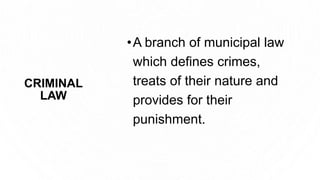
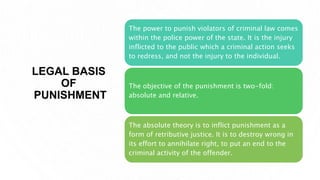
1) Criminal law defines crimes and provides for their punishment. Punishment comes from the state's police power and seeks to redress harm to the public, not just individuals.
2) Punishment has both absolute and relative theories - the absolute is retributive justice while the relative aims to prevent further crimes and reform the offender.
3) Only Congress can enact penal laws, which must be generally applicable and not ex post facto or bills of attainder. Penal laws apply to all crimes within Philippine territory.
4) A repeal of a penal law can be absolute if the crime is decriminalized