Just Cause is Not A Lost
Cause:
Summary Dismissal Since
McKinley
Ontario Bar Association
Current Issues in Employment Law
2016
Presented by Stuart E.
Rudner & Richa Sandill
1. Justifying the “Capital Punishment of
Employment Law”
2. Is a single instance of misconduct sufficient?
3. Building the Just Cause Wall Brick by Brick
4. Dealing with performance concerns and off-
duty conduct
5. Consequences of failed / false allegations of
cause: extraordinary damages
Overview
3
The Capital Punishment of
Employment Law
Just Cause: Is it a Lost Cause?
 No severance, no notice, reputational loss,
proof of misdeed leading to dismissal
 Courts reluctant to uphold arbitrary
summary dismissals
 Tong v. Home Depot of Canada: “capital
punishment” of employment law
HIGH THRESHOLD TO MEET
4
How Hard is it Exactly?
5
Racist slurs between co-
workers – serious, but
dismissal was “too harsh”
given social aspect of
relationship – Evraz North
America and USW, Local
6034 (2015)
Plaintiff with clean record
should not have been
dismissed for failing to
disclose incident w/ drunken
co-worker that got out of
hand - Christie v.
CitiFinancial Canada Inc.
(2015)
6
The McKinley Test
McKinley v. B.C. Tel., 2001, the Supreme Court of Canada:
More specifically, the test is whether the employee’s
dishonesty gave rise to a breakdown in the employment
relationship. This test can be expressed in different ways. One
could say, for example, that just cause for dismissal exists
where the dishonesty violates an essential condition of the
employment contract, breaches the faith inherent to the work
relationship, or is fundamentally or indirectly inconsistent with
the employee’s obligations to his or her employer. “In
accordance with this test, a trial judge must instruct the jury to
determine: (1) whether the evidence established the
employee’s deceitful conduct on a balance of
probabilities; and (2) if so, whether the nature and
degree of the dishonesty warranted dismissal.”
What Does the Employer Have
to Prove?
1. The alleged misconduct took place,
and
2. that the nature or degree of misconduct
warranted dismissal, bearing in mind all
relevant circumstances
Proportionality is guiding principle –
“punishment must fit the crime”*
7
The Contextual Approach is Key!
 Employer must consider all circumstances, not
just alleged misconduct
– Length of service
– Disciplinary history
– Nature of position
– Response to allegation
– Mitigating factors
 Same set of facts can yield different results
8
9
Is a Single Incident of
Misconduct Sufficient?
The McKinley Effect
 No “automatic” dismissals
 Courts take contextual approach
 Certain types of misconduct more likely to
attract cause dismissal:
– Dishonesty
– Workplace harassment/violence
– Insubordination/insolence
– Clear breach of policy/conflicts of interest
 Be careful about zero tolerance
10
DISHONESTY: Messier-Dowty Inc.
and IAMAW, Local 905
11
Facts: Grievor caught by surveillance
repeatedly stealing food from
cafeteria and automatically
dismissed in spite of clean
record
Just Cause? Yes
Reasoning: Seriousness is the greatest
factor in justifying dismissal,
and repeated acts calling
character into question justified
automatic dismissal
12
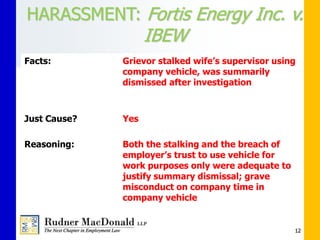
HARASSMENT: Fortis Energy Inc. v.
IBEW
Facts: Grievor stalked wife’s supervisor using
company vehicle, was summarily
dismissed after investigation
Just Cause? Yes
Reasoning: Both the stalking and the breach of
employer’s trust to use vehicle for
work purposes only were adequate to
justify summary dismissal; grave
misconduct on company time in
company vehicle
13
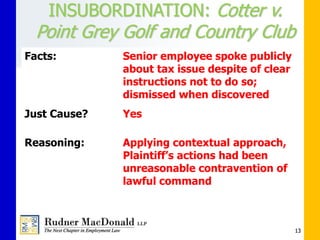
INSUBORDINATION: Cotter v.
Point Grey Golf and Country Club
Facts: Senior employee spoke publicly
about tax issue despite of clear
instructions not to do so;
dismissed when discovered
Just Cause? Yes
Reasoning: Applying contextual approach,
Plaintiff’s actions had been
unreasonable contravention of
lawful command
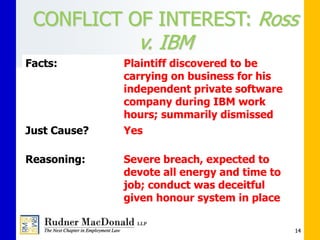
CONFLICT OF INTEREST: Ross
v. IBM
14
Facts: Plaintiff discovered to be
carrying on business for his
independent private software
company during IBM work
hours; summarily dismissed
Just Cause? Yes
Reasoning: Severe breach, expected to
devote all energy and time to
job; conduct was deceitful
given honour system in place
15
Building the Just Cause Wall
Progressive Discipline
 No hard and fast rules about what = just
cause
 Warnings of consequences
 Documentation of infractions
 Best practice: clear warnings, progressive
discipline, culminating incident
 Minor incident can be “culminating incident”
16
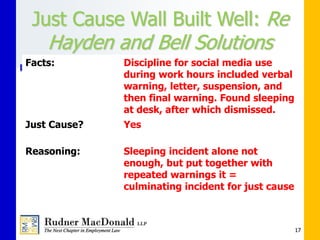
Just Cause Wall Built Well: Re
Hayden and Bell Solutions
 Hayden and Bell Te
17
Facts: Discipline for social media use
during work hours included verbal
warning, letter, suspension, and
then final warning. Found sleeping
at desk, after which dismissed.
Just Cause? Yes
Reasoning: Sleeping incident alone not
enough, but put together with
repeated warnings it =
culminating incident for just cause
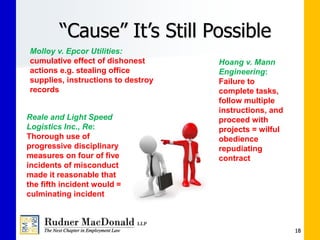
“Cause” It’s Still Possible
18
Molloy v. Epcor Utilities:
cumulative effect of dishonest
actions e.g. stealing office
supplies, instructions to destroy
records
Reale and Light Speed
Logistics Inc., Re:
Thorough use of
progressive disciplinary
measures on four of five
incidents of misconduct
made it reasonable that
the fifth incident would =
culminating incident
Hoang v. Mann
Engineering:
Failure to
complete tasks,
follow multiple
instructions, and
proceed with
projects = wilful
obedience
repudiating
contract
19
Performance and Off Duty
Conduct
20
Performance Issues
Employer must:
 Set a clear, reasonable standard
 Communicate expectations
 Measure the performance
 Give clear warning of consequences
 Take appropriate action
– Warnings (verbal and written) – document everything!
– Counseling
– Training
 Allow reasonable time for improvement
Can you Discipline for Off-Duty
Conduct?
 Generally, what employees do on their own time is
their business
 Unless
– The conduct renders the employee unable to perform his or
her duties satisfactorily.
– The conduct interferes with the efficient management of
the operation or workforce.
– The conduct leads to a refusal or reluctance of other
employees to work with him or her.
– The conduct harms the general reputation of the Employer,
its product or its employees.
Does it impact negatively employment relationship or
employer?
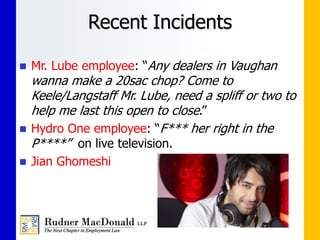
Recent Incidents
 Mr. Lube employee: “Any dealers in Vaughan
wanna make a 20sac chop? Come to
Keele/Langstaff Mr. Lube, need a spliff or two to
help me last this open to close.”
 Hydro One employee: “F*** her right in the
P****” on live television.
 Jian Ghomeshi
Case Law Examples
• PERFORMANCE ISSUES: Rogers Cable and Unifor (Hogan) (2015) –
dismissal for consistent poor performance reviews culminating in
driving under the influence UPHELD
• OFF DUTY CONDUCT:
• DISMISSAL UPHELD – Saaskatoon Co-Operative Association Ltd
and UFCW, Local 1400 (Allen)(2015) for setting off firecracker
near gas station where grievor worked, in addition to a
disciplinary record
• DISMISSAL REJECTED: Toronto (City) and CUPE (Katsuras)
(2015) – crashing municipal pool where grievor worked, while
lapse in judgment, did not warrant dismissal given remorse and
clean prior record
24
False / Failed Allegations 
Extraordinary Damages
Beware of the False Cause
 Courts awarding extraordinary damages
for false/egregious allegations
 Turner v. Newfoundland and Labrador
(Legal Aid Commission):
– Summary dismissal based on false
allegations of incompetence after 22 years
service
– $30,000 in moral / bad faith damages
25
26
The Importance of the
Investigation
 Investigate first
 Ensure fairness, objectivity, thoroughness
 Give opportunity to respond
 Often, employee response is critical factor
in determining appropriate discipline
 Failure to investigate can be HUGE factor
in awarding damages – Silvera v. Olympia
Jewellery
Vernon v. British Columbia
 30 year employee accused of bullying/harassment
 Investigators: Attacked accused and those who
supported her, misled decision-makers in report
 Result
– 18 months’ notice
– $35k in “The Damages Formerly Known as Wallace”
– $50k punitive damages
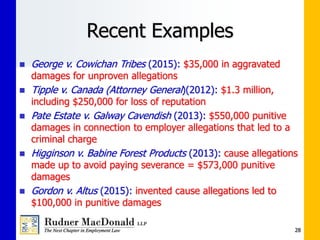
Recent Examples
 George v. Cowichan Tribes (2015): $35,000 in aggravated
damages for unproven allegations
 Tipple v. Canada (Attorney General)(2012): $1.3 million,
including $250,000 for loss of reputation
 Pate Estate v. Galway Cavendish (2013): $550,000 punitive
damages in connection to employer allegations that led to a
criminal charge
 Higginson v. Babine Forest Products (2013): cause allegations
made up to avoid paying severance = $573,000 punitive
damages
 Gordon v. Altus (2015): invented cause allegations led to
$100,000 in punitive damages
28
Bottom Line
29
Investigate all allegations –
false  punitive/aggravated
damages
Just cause: not impossible
but his threshold
Off-duty conduct: new facts
applied to old law
30
Stuart E. Rudner
srudner@rudnermacdonald.com
Toronto: 416-640-6402
York Region: 905-530-2484
www.rudnermacdonald.com
Twitter: @CanadianHRLaw
LinkedIn: Connect with me, join the
Canadian HR Law Group and visit the Rudner MacDonald Page
Blogs: www.rudnermacdonald.com/blog
www.hrreporter.com/blog/canadian-hr-law
FaceBook: Rudner MacDonald Page
Google+: Canadian HR Law, Rudner MacDonald Page
YouTube: Rudner MacDonald channel

Just Cause is Not a Lost Cause

  • 1.
    Just Cause isNot A Lost Cause: Summary Dismissal Since McKinley Ontario Bar Association Current Issues in Employment Law 2016 Presented by Stuart E. Rudner & Richa Sandill
  • 2.
    1. Justifying the“Capital Punishment of Employment Law” 2. Is a single instance of misconduct sufficient? 3. Building the Just Cause Wall Brick by Brick 4. Dealing with performance concerns and off- duty conduct 5. Consequences of failed / false allegations of cause: extraordinary damages Overview
  • 3.
    3 The Capital Punishmentof Employment Law
  • 4.
    Just Cause: Isit a Lost Cause?  No severance, no notice, reputational loss, proof of misdeed leading to dismissal  Courts reluctant to uphold arbitrary summary dismissals  Tong v. Home Depot of Canada: “capital punishment” of employment law HIGH THRESHOLD TO MEET 4
  • 5.
    How Hard isit Exactly? 5 Racist slurs between co- workers – serious, but dismissal was “too harsh” given social aspect of relationship – Evraz North America and USW, Local 6034 (2015) Plaintiff with clean record should not have been dismissed for failing to disclose incident w/ drunken co-worker that got out of hand - Christie v. CitiFinancial Canada Inc. (2015)
  • 6.
    6 The McKinley Test McKinleyv. B.C. Tel., 2001, the Supreme Court of Canada: More specifically, the test is whether the employee’s dishonesty gave rise to a breakdown in the employment relationship. This test can be expressed in different ways. One could say, for example, that just cause for dismissal exists where the dishonesty violates an essential condition of the employment contract, breaches the faith inherent to the work relationship, or is fundamentally or indirectly inconsistent with the employee’s obligations to his or her employer. “In accordance with this test, a trial judge must instruct the jury to determine: (1) whether the evidence established the employee’s deceitful conduct on a balance of probabilities; and (2) if so, whether the nature and degree of the dishonesty warranted dismissal.”
  • 7.
    What Does theEmployer Have to Prove? 1. The alleged misconduct took place, and 2. that the nature or degree of misconduct warranted dismissal, bearing in mind all relevant circumstances Proportionality is guiding principle – “punishment must fit the crime”* 7
  • 8.
    The Contextual Approachis Key!  Employer must consider all circumstances, not just alleged misconduct – Length of service – Disciplinary history – Nature of position – Response to allegation – Mitigating factors  Same set of facts can yield different results 8
  • 9.
    9 Is a SingleIncident of Misconduct Sufficient?
  • 10.
    The McKinley Effect No “automatic” dismissals  Courts take contextual approach  Certain types of misconduct more likely to attract cause dismissal: – Dishonesty – Workplace harassment/violence – Insubordination/insolence – Clear breach of policy/conflicts of interest  Be careful about zero tolerance 10
  • 11.
    DISHONESTY: Messier-Dowty Inc. andIAMAW, Local 905 11 Facts: Grievor caught by surveillance repeatedly stealing food from cafeteria and automatically dismissed in spite of clean record Just Cause? Yes Reasoning: Seriousness is the greatest factor in justifying dismissal, and repeated acts calling character into question justified automatic dismissal
  • 12.
    12 HARASSMENT: Fortis EnergyInc. v. IBEW Facts: Grievor stalked wife’s supervisor using company vehicle, was summarily dismissed after investigation Just Cause? Yes Reasoning: Both the stalking and the breach of employer’s trust to use vehicle for work purposes only were adequate to justify summary dismissal; grave misconduct on company time in company vehicle
  • 13.
    13 INSUBORDINATION: Cotter v. PointGrey Golf and Country Club Facts: Senior employee spoke publicly about tax issue despite of clear instructions not to do so; dismissed when discovered Just Cause? Yes Reasoning: Applying contextual approach, Plaintiff’s actions had been unreasonable contravention of lawful command
  • 14.
    CONFLICT OF INTEREST:Ross v. IBM 14 Facts: Plaintiff discovered to be carrying on business for his independent private software company during IBM work hours; summarily dismissed Just Cause? Yes Reasoning: Severe breach, expected to devote all energy and time to job; conduct was deceitful given honour system in place
  • 15.
  • 16.
    Progressive Discipline  Nohard and fast rules about what = just cause  Warnings of consequences  Documentation of infractions  Best practice: clear warnings, progressive discipline, culminating incident  Minor incident can be “culminating incident” 16
  • 17.
    Just Cause WallBuilt Well: Re Hayden and Bell Solutions  Hayden and Bell Te 17 Facts: Discipline for social media use during work hours included verbal warning, letter, suspension, and then final warning. Found sleeping at desk, after which dismissed. Just Cause? Yes Reasoning: Sleeping incident alone not enough, but put together with repeated warnings it = culminating incident for just cause
  • 18.
    “Cause” It’s StillPossible 18 Molloy v. Epcor Utilities: cumulative effect of dishonest actions e.g. stealing office supplies, instructions to destroy records Reale and Light Speed Logistics Inc., Re: Thorough use of progressive disciplinary measures on four of five incidents of misconduct made it reasonable that the fifth incident would = culminating incident Hoang v. Mann Engineering: Failure to complete tasks, follow multiple instructions, and proceed with projects = wilful obedience repudiating contract
  • 19.
  • 20.
    20 Performance Issues Employer must: Set a clear, reasonable standard  Communicate expectations  Measure the performance  Give clear warning of consequences  Take appropriate action – Warnings (verbal and written) – document everything! – Counseling – Training  Allow reasonable time for improvement
  • 21.
    Can you Disciplinefor Off-Duty Conduct?  Generally, what employees do on their own time is their business  Unless – The conduct renders the employee unable to perform his or her duties satisfactorily. – The conduct interferes with the efficient management of the operation or workforce. – The conduct leads to a refusal or reluctance of other employees to work with him or her. – The conduct harms the general reputation of the Employer, its product or its employees. Does it impact negatively employment relationship or employer?
  • 22.
    Recent Incidents  Mr.Lube employee: “Any dealers in Vaughan wanna make a 20sac chop? Come to Keele/Langstaff Mr. Lube, need a spliff or two to help me last this open to close.”  Hydro One employee: “F*** her right in the P****” on live television.  Jian Ghomeshi
  • 23.
    Case Law Examples •PERFORMANCE ISSUES: Rogers Cable and Unifor (Hogan) (2015) – dismissal for consistent poor performance reviews culminating in driving under the influence UPHELD • OFF DUTY CONDUCT: • DISMISSAL UPHELD – Saaskatoon Co-Operative Association Ltd and UFCW, Local 1400 (Allen)(2015) for setting off firecracker near gas station where grievor worked, in addition to a disciplinary record • DISMISSAL REJECTED: Toronto (City) and CUPE (Katsuras) (2015) – crashing municipal pool where grievor worked, while lapse in judgment, did not warrant dismissal given remorse and clean prior record
  • 24.
    24 False / FailedAllegations  Extraordinary Damages
  • 25.
    Beware of theFalse Cause  Courts awarding extraordinary damages for false/egregious allegations  Turner v. Newfoundland and Labrador (Legal Aid Commission): – Summary dismissal based on false allegations of incompetence after 22 years service – $30,000 in moral / bad faith damages 25
  • 26.
    26 The Importance ofthe Investigation  Investigate first  Ensure fairness, objectivity, thoroughness  Give opportunity to respond  Often, employee response is critical factor in determining appropriate discipline  Failure to investigate can be HUGE factor in awarding damages – Silvera v. Olympia Jewellery
  • 27.
    Vernon v. BritishColumbia  30 year employee accused of bullying/harassment  Investigators: Attacked accused and those who supported her, misled decision-makers in report  Result – 18 months’ notice – $35k in “The Damages Formerly Known as Wallace” – $50k punitive damages
  • 28.
    Recent Examples  Georgev. Cowichan Tribes (2015): $35,000 in aggravated damages for unproven allegations  Tipple v. Canada (Attorney General)(2012): $1.3 million, including $250,000 for loss of reputation  Pate Estate v. Galway Cavendish (2013): $550,000 punitive damages in connection to employer allegations that led to a criminal charge  Higginson v. Babine Forest Products (2013): cause allegations made up to avoid paying severance = $573,000 punitive damages  Gordon v. Altus (2015): invented cause allegations led to $100,000 in punitive damages 28
  • 29.
    Bottom Line 29 Investigate allallegations – false  punitive/aggravated damages Just cause: not impossible but his threshold Off-duty conduct: new facts applied to old law
  • 30.
    30 Stuart E. Rudner srudner@rudnermacdonald.com Toronto:416-640-6402 York Region: 905-530-2484 www.rudnermacdonald.com Twitter: @CanadianHRLaw LinkedIn: Connect with me, join the Canadian HR Law Group and visit the Rudner MacDonald Page Blogs: www.rudnermacdonald.com/blog www.hrreporter.com/blog/canadian-hr-law FaceBook: Rudner MacDonald Page Google+: Canadian HR Law, Rudner MacDonald Page YouTube: Rudner MacDonald channel